Posted tagged ‘Middle East’

IDF Rehearsing for Nightmare Scenario: 4,000 Killed in Days

June 7, 2015

IDF Rehearsing for Nightmare Scenario: 4,000 Killed in Days, Israel National News, Gil Ronen, June 7, 2015

Security forces are currently rehearsing and preparing for a scenario in which Israel’s enemies launch a “carpet” missile attack that Iron Dome will be unable to counter, due to the sheer number of missiles involved, Arutz Sheva has learned from knowledgeable sources that wish to remain anonymous.

In this scenario, up to 4,000 Israelis will be killed in the first days of the attack, which could happen as early as this summer.

“Iran is seeking to cover Israel with intense fire,” Prime Minister Binyamin Netanyahu warned in a special briefing for journalists at the week’s end.

“In Lebanon, the Iranians are inserting the most advanced weapons in the world, and strengthening Hezbollah, so that it can hit any spot in Israel,” Netanyahu was quoted as saying in the daily Makor Rishon. “They are trying to build a second front in the Golan, and of course, in Gaza.”

‘Earth-shaking shock’ 

Former prime minister and defense minister Ehud Barak also sounded dire warnings last week, regarding Hezbollah’s ability to deal a heavy blow to Israel, and Israel’s unpreparedness for this.

“Our rival is serious, and we have no room for smugness on any front,” he said. “We must not be smug and take our superiority as something that is self-evident and supposedly God-given. Superiority is the result of serious work. We have not really dealt with 100,000 rockets, and we have not started to deal with the matter of their accuracy. When the rockets are accurate, it is not more of the same thing. It is something completely different.”

“The country has no choice but to reach conclusions,” Barak warned. “One cannot deal with this challenge by deploying in all of the places, from which [anti-missile] missiles can be fired. These things are very expensive: Iron Dome and Magic Wand, Arrow and Super-Arrow are expensive projects.

“One cannot exaggerate the importance of safeguarding security,” he added, “and one cannot exaggerate the earth-shaking shock that can take place when it turns out that we did not prepare and we did not understand the urgency and practicality of challenges of this sort, and the need to translate clear thought to conclusions, and we will find ourselves [in a situation where] citizens suddenly discover that one cannot walk slowly and lackadaisically to the bomb shelters, knowing that nothing can happen, as we did in during Operation Protective Edge. These things must be done now, we must not wait.”

Israel’s Revenge Is That “We Are Still Here”

June 7, 2015

Israel’s Revenge Is That “We Are Still Here” The Legal Insurrection, June 7, 2015

My wife and I are back, after an intense two weeks in Israel.

From the Lebanese to Gaza borders, from the Mediterranean Sea to Judea and Samaria, from the cool evenings of Jerusalem to the heat of the Negev Desert, from an apartment in the Jewish Quarter of the Old City of Jerusalem to Bedouin villages in the north and south, from university campuses to military bases, from faculty to students, from Jews to Muslims … I can’t say we saw it all, but we saw a lot.

I’ve documented most of our big events in daily posts, with the exception of our emotional meetings with the families of Edward Joffe and Leon Kanner, students killed in the 1969 Supersol supermarket bombing by Rasmea Odeh; that post is coming, but I still have new photos, documents and information I have to work through.

Here are my 5 Big Takeaways from the trip:

1. Our Revenge Is That “We Are Still Here”

Near the start of our trip, we visited Moshav Avivim straddling the Lebanese border, where we met Shimon Biton, a survivor of the 1970 bazooka attack on a school bus by the Popular Front for the Liberation of Palestine.

Biton, who was six and one-half years old, lost his father in the attack, and himself was shot point blank range by the terrorists when they realized he survived the bazooka attack.  Ten days before we met Biton, he was reunited for the first time in 45 years with the nurse who helped save him.  (Featured Image)

When we asked whether he ever wanted revenge, Biton told us that the revenge was that “we are still here and building for another 70 families.”

Moshav-Aviviv-Shimon-Biton-e1432683043370[Shimon Biton, Moshav Avivim, Israel]

When we related that story to numerous people we met along the rest of the trip, heads vigorously shook up and down.  It struck a chord, since almost every Israeli has a relative or friend impacted by terror.

Despite several decades of terrorism, particularly intense during the Second Intifada, and a world campaign against it, the People of Israel are still there.

The will to resist is underestimated.  Israel has a longer-term view, and a history.  It will not give in to boycotts, or Obama, or outside pressure that puts its security at risk.

2. “I don’t like Bibi, BUT….”

For whatever the reason, most of the people with whom we interacted self-identified as center-left or left.

There was no shortage of criticism of Israeli Prime Minister Benjamin Netanyahu: He’s egotistical, he doesn’t keep his tough promises, he is only interested in his own political survival, he’s a liar, his pre-election comment about Arab voting was shameful, and so on.

Yet with only a couple of exceptions, the negative comments always were followed with a big BUT.

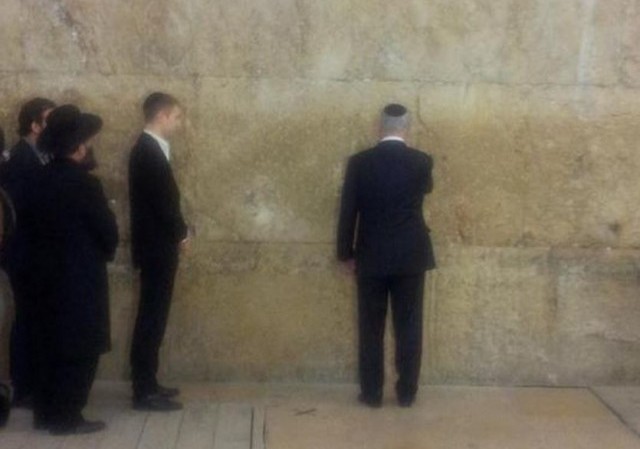
Benjamin-Netanyahu-at-Western-Wall-post-election-2015-e1426681806959[Israeli Prime Minister Benjamin Netanyahu at Western Wall after 2015 election victory.]

But he is the only Israeli politician who has the stature to handle the world pressure; but I don’t envy the position he is in with so many forces against us; but [opposition leader Yitzhak “Bougie” Herzog] Bougie is weak and no one will fear him; and so on.

These opinions pretty much were reflected in polling and the election results — Many people may not like Netanyahu, but he is the only Israeli politician capable of standing up for Israel in a hostile world.

3. I don’t like Obama, no BUTs about it

Polling in Israel shows Obama is hugely unpopular.  Our anecdotal interactions with Israelis confirmed that polling.

I  can’t recall anyone, from left to right, who had anything nice to say about Obama.  The most consistent theme was that Obama is naive and weak, and that naivitee and weakness had resulted in disaster in the Arab world as it encouraged the most aggressive Islamist elements.

They see Syria falling apart with al-Qaeda or ISIS groups likely to control large parts of the country; or if not, then Iran in control. There are no good outcomes for Israel’s Golan Heights border. Along the Lebanese border there is Hezbollah, and in Gaza Hamas and increasingly even more radical Salafist-ISIS groups.

Against this background of being surrounded by a sea of increasing threats resulting from Obama administration policy, not a single person thought the Iran nuclear deal made any sense, or trusted the Obama administration on it.

In other words, Israelis live in the real world, not the world of Obama’s delusional hope.  And they don’t appreciate Obama taking risks with their lives.

4. Are we really that popular in the United States?

The anti-Israel Boycott, Divestment and Sanctions movement was a frequent topic of conversation, almost always brought up by us as part of describing the type of coverage at Legal Insurrection.  This coincided with what I consider an irrational panic the past two weeks in the Israeli press and political discourse about BDS (more on that in a later post.)

I tried to explain that there is a complete disconnect between the BDS movement in the U.S. and the vast majority of Americans.  Gallup and Pew polling shows Israel at or near historical highs in terms of Israel’s favorability both abolutely and relative to favorability of Palestinians.  The gap between those who pick Israel over Palestinians when the question forces a choice, also is historically high.

Virtually every Israeli we met was shocked that Israel is actually so popular in the United States.  Even Israelis who have extensive American contacts and visit the U.S.

That’s not all so surprising.  Both the U.S. and Israeli media focus on the negative, though for different reasons.  The U.S. media long has had in implicit anti-Israel bias, compounded by the rise of left-leaning new media, while the Israeli media competes for readers with a “sky is falling” outlook.

(added) Israel’s enormous popularity among Americans is a strategic asset.  That strategic asset needs to be used more effectively to minimize the damage from the narrow but influential slices of the American population — radical faculty, some students, and mainstream journalists — who have explicit or implicit anti-Israel biases. The American people as a whole are the “Israeli Lobby.”

5. The Next War is Only a Matter of Time

While we were in Jerusalem, Israel underwent a national defense drill, including sirens warningof incoming rockets.

Our tour along the Gaza border, particularly near Sderot, also reflected preparation for the next round of rocket fire through reinforcing key civilian infrastructures, such as schools.

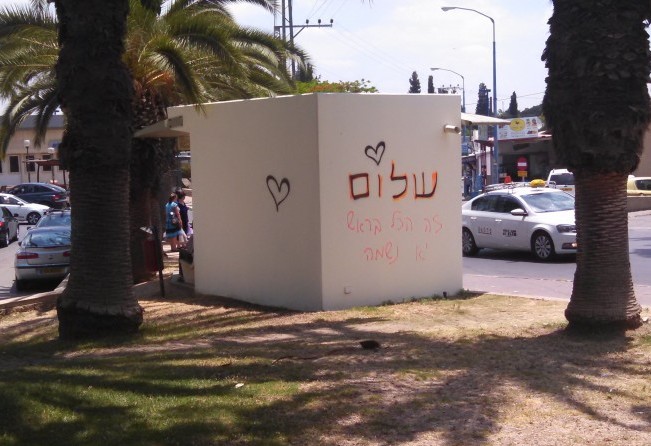
Sderot-Israel-bomb-shelter-street-e1433110130989[Sderot, Israel, street bomb shelter with “Shalom” grafitti]

There was a pervasive feeling that the calm cannot last.  And sure enough, while we were there and just after we left, rockets were fired from Gaza to Israel by Salafists suffering from a Hamas crackdown, and groups competing with Hamas for control.

That’s the logic of the region in which Israel lives: Radical groups retaliate against each other by firing rockets at … Israel.

The next war is coming.  Every Israeli knows it. It’s only a matter of time.

*  *  *  *  *

Those are my big takeaways.  I hope you enjoyed the coverage.

We will be back in Israel, hopefully next year.

Forfeiting America’s Military Leverage

June 6, 2015

Forfeiting America’s Military Leverage, American ThinkerAbraham Katsman, June 6, 2015

International diplomacy, it is said, is the art of letting the other party have your way.  While there are numerous diplomatic strategies to accomplish that, one of history’s more effective means of pursuing foreign policy goals was for a superior power to conspicuously display naval forces in the waters of the weaker power, posing a military threat until satisfactory terms with the weaker nation could be reached. Such “gunboat diplomacy” could be remarkably persuasive.

But if there is such a thing as the opposite of gunboat diplomacy, we are witnessing it in the nuclear negotiations with Iran.  There will be repercussions.

The United States and other leading nations taking part in the negotiations have military capabilities that dwarf those of Iran, at best a second-rate power. Yet, in spite of the huge military advantages — not to mention the moral gulf between the U.S and Iran, or the huge stakes of allowing Iran to go nuclear — negotiations have proceeded as if between equals.

U.S. military spending is greater than that of the next seven countries combined. Superpower America has a near-monopoly on those gunboats, as well as military aircraft and cruise missiles. But that power is only useful if there is a willingness to use it — or, more precisely, if America’s enemies believe that that there is such a willingness.

If there were ever thoughts that the U.S. under Obama would lay down the law with Iran and order, under overt military threat, the “voluntary” dismantling of the mullah’s nuclear program, they have passed quietly. Sure, President Obama occasionally makes some perfunctory mention that the military option is still on the table, but no one takes his half-hearted warning seriously, least of all the Iranians.

It doesn’t help matters when Obama says, as he did on Israeli TV this week, “A military solution will not fix [the Iranian nuclear problem]. Even if the United States participates, it would temporarily slow down an Iranian nuclear program but it will not eliminate it.”

Obama has effectively forfeited America’s military leverage. He has taken the position that the only alternative to his Iranian appeasement approach is war, and that war is not an outcome acceptable to him under any circumstances.

No Iranian misconduct disrupts Obama’s pacifism. Against American interests and those of America’s allies, Iran has expanded its reach into Syria, Lebanon, Iraq, and Yemen, ethnically cleansing Sunni communities in Iraq. It has seized a cargo ship under U.S. protection, and holds several Americans hostage (complete with an ongoing farcical “trial” against Washington Post reporter Jason Rezaian for espionage). It has increased its nuclear stockpile and violated its existing international agreements, including regarding type and number of centrifuges it may operate, and announced that it will build additional reactors with the help of China and Russia.

In fact, America’s gunboats notwithstanding, it is Iran that has been dictating the terms of a prospective agreement. Iran’s intransigence in the nuclear negotiations has been rewarded: the U.S. has already backed off demands regarding Iranian nuclear enrichment, centrifuges, missile technology, and duration of the prospective agreement — and gotten nothing in return.

Not only is the United States administration going along with all this, but it has released some $11 billion in cash assets to the Islamic Republic. On top of that, it is offering a “signing bonus” of tens of billions of additional dollars to Iran for coming to a nuclear agreement, irrespective of Iranian behavior, support for terror or holding Americans prisoners.

In this context, with no credible American military threat on the table, we should not be surprised that Iran is getting everything it wants from the negotiations at no cost and no risk. As a bonus, it gets to show the world how unserious its American arch-enemy has become.

For the last century, the United States has asserted a global foreign policy, the core of which is being ready, willing, and able to impose its military might to protect its vital interests. Is there a more compelling current American interest than to keep nuclear weapons out of the reach of a rabidly anti-American, anti-Semitic, destabilizing, theocratic, apocalyptic regime, which also threatens the world’s major oil suppliers and is the world’s greatest supporter of terror? If Obama cannot even consider the military protection of that interest, he has rendered American foreign policy impotent, and its military capabilities irrelevant.

That abandonment of longstanding American projection of military power to protect global interests does not go unnoticed, by either friend or foe. The American military’s deterrent effect has been eroded; its security umbrella to its allies looks a lot less secure. The effect on alliances both current and future is corrosive.

From Riyadh to Taipei to Jerusalem, from Moscow to Beijing to Pyongyang, the world is paying close attention. As much as these nuclear negotiations are about Iran, they are even more about America.


Two major Mid East escalations: Yemeni rebels fire Scuds at Saudi air base. ISIS warns Syrian rebels

June 6, 2015

Two major Mid East escalations: Yemeni rebels fire Scuds at Saudi air base. ISIS warns Syrian rebels, DEBKAfile, June 6, 2015

us_patriot_missiles_saudi_arabia_6.6.15US Patriots stationed in Saudi Arabia

Saudi military sources reported Saturday, June 6, that Patriot air defense batteries had intercepted Scud missiles fired by Yemen Houthi rebels against the kingdom’s largest air base at Khamis al-Mushait in the south west. It is from there that Saudi jets take off to strike the Yemeni rebels. DEBKAfile’s military sources report that the Patriot anti-missile systems, which were activated for the first time, were manned by American teams. This was the first direct US military intervention on the Saudi side of the Yemen conflict.

It was also the first time that Houthi rebels or their allies had fired Scud missile into the oil kingdom. Our sources add that the launch was supervised by Hizballah officers. They were transferred by Tehran to Yemen to ratchet up the conflict – although US, Saudi, Yemeni government and Houthi representatives meeting secretly in Muscat Friday agreed to attend a peace conference in Geneva this month.

Nonetheless, through Friday night and Saturday morning, Houthi forces and allied military units kept on battering at Saudi army and National Guard defense lines, in an effort to break through and seize territory in the kingdom’s southern provinces. The insurgents were evidently grabbing for strategic assets to strengthen their hand at the peace conference.

Iran’s supreme leader Ayatollah Ali Khamenei is also juggling his chips on the deteriorating Syrian warfront. In the coming hours, he is widely expected to announce the activation of the mutual defense pact signed between Iran and Syria in 2006, under which each signatory is committed to send military troops if necessary to defend its partner.

Thursday, June 4, Khamenei fired sharp verbal arrows at the Obama administration: “The United States tolerates extremist groups in Syria and Iraq and even helps them in secret,” he charged.

Our military sources add that although various Mid East publications, especially in Lebanon, are reporting that Iran has already sent units in numbers ranging from 7.000 to 15,000 troops to Syria, none have so far landed, except for the Shiite militias brought over at an earlier stage of the Syrian conflict. The expected Khamenei announcement may change this situation.

ISIS was not waiting. Saturday morning, the group issued a warning to the Syrian rebel forces fighting in the south – the Deraa sector of southern Syria near the meeting point of the Jordanian and Israeli borders and the Quneitra sector opposite the Israeli Golan. They were ordered to break off contact with the US Central Command Forward Jordan-CF-J which is located north of Amman, and the IDF operations command center in northern Israel. Any Syrian rebels remaining in contact with the two command centers would be treated as infidels and liable to the extreme penalty of beheading, the group warned.

The impression of ominous events brewing in the regime was rounded off Friday night by an unusual announcement by the Israeli army spokesman that Iron Dome anti-missile batteries had been deployed around towns and other locations in the south, although no reference was made to any fresh rocket attacks expected from the Gaza Strip. DEBKAfile adds: The first batteries were arrayed Thursday night, June 4, at vulnerable points in southern Israel – from the southernmost Port of Eilat on the Gulf of Aqaba to the western Port of Ashdod on the Mediterranean.

Iranian Soldiers Deployed to Protect Damascus

June 4, 2015

Iranian Soldiers Deployed to Protect Damascus as Rebels Advance

Iranian, Iraqi fighters sent to guard against rebel attack on Syrian capital, amid concerns Assad regime is failing.

By Arutz Sheva Staff

First Publish: 6/3/2015, 4:44 PM

via Iranian Soldiers Deployed to Protect Damascus – Middle East – News – Arutz Sheva.


Fighters from Al Qaeda’s Nusra Front in Idlib, Syria Reuters

Thousands of Iranian and Iraqi fighters have been deployed in Syria in past weeks to bolster the defenses of Damascus and its surroundings, a Syrian security source told AFP on Wednesday.

“Around 7,000 Iranian and Iraqi fighters have arrived in Syria over the past few weeks and their first priority is the defense of the capital. The larger contingent is Iraqi,” the source said on condition of anonymity.

“The goal is to reach 10,000 men to support the Syrian army and pro-government militias, firstly in Damascus, and then to retake Jisr al-Shughur because it is key to the Mediterranean coast and the Hama region” in central Syria, he added.

Syria’s government lost control of Jisr al-Shughur in northwestern Idlib province on April 25, as a coalition of opposition forces including Al-Qaeda affiliate Al-Nusra Front swept through the region.

Yesterday, Iran’s official news agency IRNA quoted elite Revolutionary Guards General Qassem Soleimani as saying “in the coming days the world will be surprised by what we are preparing, in cooperation with Syrian military leaders.”

The agency cautioned however that it “takes no responsibility for the information.”

Iran is a key ally of the Syrian government, and it has provided Damascus with financial and military support throughout the conflict that began in March 2011 with anti-regime protests.

That support has included raising a Syrian pro-government militia known as the National Defense Force (NDF) to supplement the badly-stretched regular Syrian army, as well as sending battalions of fighters from the Hezbollah terrorist group, Tehran’s most important and powerful proxies.

Iran had also coordinated the training, arming and mobilization of Iraqi Shia Islamist militias to fight alongside Syrian government forces as well – though since the Islamic State’s lightening offensive through Iraq last summer most have returned home from Syria to fight ISIS there.

Iran has also sent an unknown number of soldiers and commanders from its own elite Revolutionary Guard corps to battle Syrian rebels.

But despite all that aid, in recent months the Syrian government has lost territory in several parts of the country to both an alliance of largely Islamist groups including Al-Nusra, and to the Islamic State (ISIS) jihadist group. In the south of the country as well, a more moderate rebel alliance has been making steady gains.

The rapid succession of defeats have led many to speculate the Assad regime may be nearing its demise, although other analysts have warned it is far too early to write it off yet.

Faced with those setbacks, the government has appealed to Tehran and ally Russia to step up support, a Syrian political figure close to the regime told AFP.

A diplomatic source in Damascus said Iran had been critical of the regime’s failure to achieve the last major offensive operation it undertook – a February bid to cut rebel supply lines to the northern city of Aleppo.

Tehran had opposed the operation, citing lack of preparation, the source said, and subsequently insisted that Syria change its strategy to focus on holding less territory more securely.

Analysts and observers have said the Syrian government now appears ready to accept the de facto partition of the country, focusing on the defense of strategically important areas and leaving others to rebels or jihadists.

According to one source close to the regime, it considers the coast, the central cities of Hama and Homs, and the capital Damascus as vital.

It also regards the Damascus-Beirut and Damascus-Homs highways as “red lines”, the source said.

More than 220,000 people have been killed in Syria’s civil war.

AFP contributed to this report.

Turkey, Our Ally

June 4, 2015

Turkey, Our Ally

June 4, 2015 by Robert Ellis

via Turkey, Our Ally.


On his visit to Turkey in 2009, U.S. President Barack Obama proclaimed that Turkey and the U.S. can build “a model partnership” and in an interview with Time in January 2012, he spoke of “the bonds of trust” he had forged with certain leaders, including Turkey’s Recep Tayyip Erdogan.

Traditional Turkish foreign policy, based on Atatürk’s dictum “peace at home and peace abroad,” has been replaced by a delusion, created by former foreign and now prime minister, Ahmet Davutoglu, that Turkey can restore its former Ottoman magnificence. As Davutoglu proclaimed in Sarajevo in 2009, “Like in the 16th century, when the Ottoman Balkans were rising, we will once again make the Balkans, the Caucasus and the Middle East, together with Turkey, the center of world politics.”

The main thrust of this new policy has been to create a Muslim Brotherhood crescent running from Egypt through Turkey to Syria to rival Iran’s Shia crescent, but this policy has been a dismal failure. Turkish ambassadors have been withdrawn from Syria, Egypt, Israel, Libya and Yemen, and recently from Austria and the Vatican, after their acknowledgement of the Armenian genocide, resulting in what Ibrahim Kalin, Erdogan’s chief adviser, in a tweet two years ago, called “precious loneliness.”

It was the same Kalin who, in a keynote speech at the Istanbul Forum in 2012, rejected the European model of secular politics, democracy and pluralism in favor of what he termed a “value-based” (read: Islamist) foreign policy. However, the AKP government’s attempt to overthrow Syria’s Bashar al-Assad has seriously backfired, but they have still not given up trying to drag the U.S. into the quagmire. Turkey’s proposal for the creation of a safe zone and no-fly zone in Syria has been met with no response, and in return Turkey has denied its NATO ally the use of Incirlik airbase for sorties against Islamic State (ISIL).

Consequently, the Bipartisan Policy Center (BPC) in Washington has in its April report concluded that Turkey is an increasingly undependable ally, and that because of the fundamental strategic disparities between Ankara and Washington, the U.S. should look to other regional players, for example, the KRG (Kurdistan Regional Government), for support.

An overriding factor in the BPC’s conclusions has been the Turkish government’s ideologically driven backing for extremist Sunni groups in Syria, where it has acted as a highway for would-be jihadists, who have been given free rein to travel through, recruit from, equip, operate and recuperate in Turkey.

Furthermore, a report from the U.N.’s Analytical Support and Sanctions Monitoring Team concludes that Turkey has also provided the primary routes for arms smuggled to ISIL and the Al-Nusrah Front, an Al-Qaida affiliate.

In the run-up to the Turkish elections on Sunday, there is a furor about video footage published last Friday by secular daily Cumhuriyet, which shows a shipment of weapons and ammunition disguised as humanitarian aid for Syria on trucks belonging to MIT (Turkey’s National Intelligence Organization), Erdogan’s Praetorian Guard. Reuters has also confirmed how MIT helped deliver arms to parts of Syria under Islamist rebel control during late 2013 and early 2014.

Characteristically, the public prosecutors and gendarmerie officers involved in intercepting the arms shipment have been arrested and charged with attempting to overthrow the Turkish government. A gag order has been imposed on coverage of the scandal and President Erdogan has personally threatened Cumhuriyet’s editor-in-chief with retribution. He has now filed a criminal complaint against the newspaper and its editor, demanding a life sentence.

The Turkish military is also uneasy about the charges brought against the gendarmerie officers involved, as their actions fall under military jurisdiction.

However, there is no reason to believe President Erdogan will give way without a struggle. As the Bipartisan Policy Center notes, losing power would be tantamount to a prison sentence, at best, and is simply not an option.

Egypt Says NY Times Promoting Muslim Brotherhood Agitprop

June 3, 2015

Egypt Says NY Times Promoting Muslim Brotherhood Agitprop, The Clarion ProjectRyan Mauro, June 3, 2015

(Obama has spread and relied upon much the same meme as the NY Times and Washington Post. — DM)

New-York-Times-Building-IP_1The New York Times building in New York City

If the New York Times values objective reporting, then it must mention the Brotherhood’s calls to violence in its coverage as well as the many other instances of violence that the group has been involved in.

*********************

The Egyptian ambassador to the U.S. has written a public letter toThe New York Times protesting “its unquestioning adoption of Moslem Brotherhood’s propaganda” and false characterization of the Islamist group as non-violent.

Ambassador Mohamed Tawfik’s letter was written around the same time that the Egyptian embassy released three videos of calls to violence made on Muslim Brotherhood television networks based in Turkey.

The networks’ coverage promoted explicit calls for killing Egyptian police officers and attacking foreign companies and embassies. A threat was also made to carry out regional attacks against the interests of countries who support the Egyptian government.

Egypt is infuriated at the Times as well as the Washington Post for repeatedly asserting that the Brotherhood is non-violent. In response to the Times suggestion that the Egyptian government’s prosecution of the Brotherhood is pushing it towards terrorism, the Egyptian ambassador writes:

This statement demonstrates, at best, a complete misunderstanding of the roots of radicalism. At worst, it amounts to a justification for violent extremism. Today, terrorists in Egypt are part of a network of extremists who are bound by a singular distorted ideology, and by a shared goal of taking our region back hundreds of years. They are inspired by the radical teachings of the former Moslem Brotherhood leader Sayyid Kutb [Qutb]. Terrorists in Egypt share the same evil goals as terrorists in Iraq, Syria and Libya.

Indeed, Ambassador Tawfik is correct that the New York Times separates Islamists from terrorists and extremists. The Times editorial condemns “relentless and sweeping crackdown on Islamists, under the baseless contention that they are inherently dangerous.”

The New York Times described sentencing to death of former President Morsi and 100 other Brotherhood members as “deplorable.” It describes the Brotherhood as having renounced violence in the 1970s.

However, Morsi and the defendants were sentenced for his involvement in prison breaks in 2011 that freed 20,000 inmates, including Morsi himself. The Egyptian government says the attacks were well-orchestrated and involved participation by the Muslim Brotherhood, Hamas and Hezbollah.

Tawfik chastises the Times for failing to mention that the prison break was a violent operation that resulted in the deaths of prison guards and inmates and freed members of Hamas and Hezbollah.

The Egyptian ambassador also excoriated the Washington Post in February for “toeing the Muslim Brotherhood line” and advised it to be more balance in order to “save whatever is left of your credibility in the Arab world.”

Egyptian President El-Sisi came into power after the popularly-supported military intervention in July 2013 overthrew the Muslim Brotherhood government. The move had the support of a broad spectrum of Egyptian society with public endorsements from secular-democratic activists, the Grand Sheikh of Al-Azhar University and the leader of the Coptic Orthodox Church.

The overthrow came after Morsi (whose election itself was marred bycharges of voter fraud) seized far-sweeping powers for himself, essentially negating any semblance of a democratic government.

El-Sisi is often characterized as an anti-democratic strongman; a depiction that his government is now challenging.

He argues that these strongman tactics are necessary because a democratic transition cannot be completed without stability, economic development and a confrontation with Islamism (also known as Political Islam). He asks the West to understand that there is a “civilizational gap between us and you” and it will take time to modernize.

A study commissioned by the Egyptian government criticized its heavy-handedness but concluded that banning Islamist parties is required for the country’s stability and democratic development. It recommended a program to separate politics and religion.

The Egyptian government sees the Islamic State (ISIS) as a natural outgrowth of the Muslim Brotherhood. Its website warns that the Muslim Brotherhood has a network of fronts in America that are disguised as civil society organizations.

El-Sisi called for a reformation in Islamic interpretation in January 2014 and made a dramatic call on the Islamic religious establishment to address problematic teachings this January that received widespread media coverage. He has explicitly said that Egypt should be “a civil state, not an Islamic one” and defined the ideology of the enemy as Political Islam in an interview on FOX News Channel.

El-Sisi is also confronting Islamist terrorism internationally, in addition to its fight against Islamic State in the Sinai Peninsula. His government is an enemy of Hamas and is as minimally anti-Israel as can be expected of an Arab leader.

Egypt has conducted airstrikes on ISIS in Libya and is materially supporting the Libyan government in its civil war against Islamist forces. Egypt and Libya are complaining about a lack of American backing. A new Egyptian-backed offensive is said to be in the works.

El-Sisi is assembling an Arab rapid-reaction force of 40-50,000 troops that can quickly be deployed to fight Islamic State and other terrorists. Egypt is also taking part in the Arab military intervention against the Iranian-backed Houthi rebels in Yemen.

El-Sisi also made a historic visit to a Coptic Christian church during mass on Christmas Eve. He challenged the Egyptian honor culture when he apologized to a woman who was raped in Tahrir Square.

Major American media outlets have fallen for the falsehood that the Muslim Brotherhood is non-violent. It is true that the Egyptian government is often criticized for its human rights record, but coverage of those accusations should not automatically exempt the Brotherhood and other Islamists from blame.

If the New York Times values objective reporting, then it must mention the Brotherhood’s calls to violence in its coverage as well as the many other instances of violence that the group has been involved in.

Egyptian Muslim Brotherhood Videos Call for Violence

June 2, 2015

Egyptian Muslim Brotherhood Videos Call for Violence, The Clarion ProjectRyan Mauro, June 2, 2015

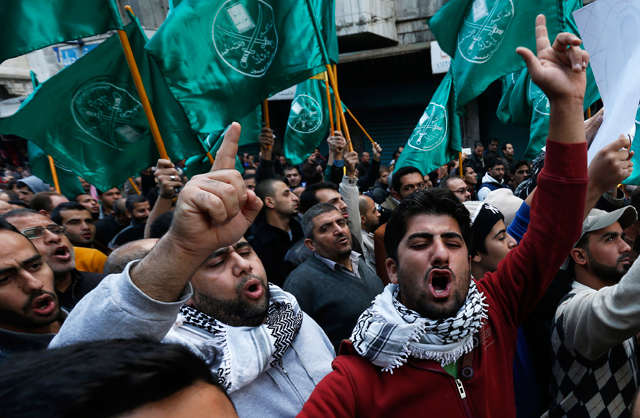
Egypt-Muslim-Brotherhood-Supporters-Flags-IPMuslim Brotherhood supporters in Egypt (Photo: © Reuters)

Egypt has released three videos of Muslim Brotherhood television networks in Turkey advocating violence against the Egyptian police, foreigners, embassies and interests in the region connected to countries that support President El-Sisi.

On Thursday, the Brotherhood’s English-language website announced a decision for revolution “with all its means and mechanisms” against the Egyptian government. The announcement references a declaration signed by 150 Islamic scholars that is less ambiguous in calling for jihad, also published in English.

The first video is from the Muslim Brotherhood’s Rabaa TV network launched in Turkey in 2013. The Egyptian government says the host in the video is a member of the Al-Gama’a Al-Islamiyya terrorist group.

The host is seen reading a statement from the “Revolutionary Youth Coalition;” a group that is almost certainly a Brotherhood front established to give itself plausible deniability while inciting and orchestrating terrorism. The vague terminology is an attempt to give its cause greater legitimacy by appearing more inclusive and broad-based.

The Brotherhood station reads the statement that demands the departure of all foreign Arabs, foreign Africans, embassy personnel, foreign companies and tourists by the end of (last) February. All governments must end their support for the Egyptian government “or else all of their interests in countries of the Middle East will be exposed to severe assaults or will be put in situations that nobody wants.”

The threat warns that henceforth there will be “no concessions or mercy.”

The second video is dated February 24 and is from a satellite network named Misr Alaan that the Egyptian government says was founded by the Brotherhood last year. The Arab press says it was launched from Turkey with Brotherhood sponsorship.  The network’s staff said its purpose is to reach a broader audience than the other Islamist channels in Turkey.

The video comes with an English translation that shows the host of a show explicitly urging the murder of Egyptian police and unspecified revolutionaries to rout the Egyptian soldiers who aid the police in the confrontation. His instructions are clear: “Kill them.”

“I say to the wives of all officers and the sons of all officers: Please be aware, your husbands will be dead. Your children will be orphans,” the host says while adding the sons of police officers may be kidnapped and claiming that the revolutionaries have the home addresses of the police.

The third video, also from Misr Alaan, shows a statement being read by a spokesman calling in from the “Revolutionary Punishment Movement,” continuing the pattern of using new, non-descriptive titles.

The speaker is asked about his group and he only says that it is a youth movement involved in the revolutions since the beginning, referring to the ousting of Egyptian President Mubarak. He condemns the arrests of female members of the group and declares there will be “reciprocal treatment.”

The speaker calls for the kidnapping and killing of Egyptian security personnel by the “lions” of this revolution. He then gives out the names of specific police officers to target without any interruption from the host.

On Thursday, May 28, the Brotherhood’s English-language website carried a statement by spokesperson Mohamed Montaser announcing “a final decision, after consulting its popular base, that the revolutionary option with all its means and mechanisms is its strategic choice from which there will be no retreat.”

The announcement appears to be a response to a reported rift within the Brotherhood between the older and more pragmatic leadership and the more militant youth advocating violence and disruption to society. It reiterates the legitimacy of the Brotherhood leadership and claims that it is inclusive of the youth.

The statement does not explicitly discuss the topic of violence but it certainly does not make the case for non-violence. It gives every reason for an Islamist to believe that violent jihad against the Egyptian government is now permissible.

The intention to inspire violence is detectable in how the Brotherhood references a declaration signed by 150 scholars that declares the Egyptian government to be an “enemy of Allah” waging “war against Islam.” The listed offenses qualify it as a target for violent jihad.

“It is an Islamic duty of the whole Muslim Ummah, rulers and peoples alike, to resist this regime and to seek to break it using all legitimate means in order to safeguard the fundamentals of the Ummah and to maintain the higher objectives of Islam,” it says.

The declaration most clearly instigates violence in points 4 and 6 regarding retribution for acts against the Brotherhood and for forcibly freeing prisoners:

“4. Rulers, judges, officers, soldiers, muftis, media persons, politicians and any other party proven beyond any doubt to be involved in the crimes of violating honor, bloodshed and illegal killing, even if through inciting such acts, are considered, from Islamic perspective, murderers to whom all rulings related to the crime of murder are applicable. They must receive qisas (retribution punishment) within the Islamic Law limits.”

“6. The nation must do its best to free any person, especially women, detained as a result of opposing the coup and demanding respect of the nation’s will and freedom. No effort should be spared to release them using the means approved by Islam.”

The Brotherhood is aware of what it’s calling for. If it didn’t want violent jihad, it would add a disclaimer about the declaration only authorizing non-violence. Instead, there’s only a mention of civil disobedience as a tactic without any kind of rejection of violence in point 13:

“13. We demand all forces opposing the coup and all free people, inside and outside Egypt, to combine efforts in resistance of this criminal regimes and to use all appropriate means such as civil disobedience and any other tool to purge the country of the coup’s tyranny and crimes and to stand up for the martyrs’ cause.”

The declaration is especially significant because brings the Brotherhood a step closer towards officially supporting violence in Egypt; a direction it’s been moving towards in its Arabic content.

In January, the Brotherhood announced a “new phase…where we recall the meanings of jihad and prepare ourselves, our wives, our sons, our daughters, and whoever marched on our path to a long, uncompromising jihad, and during this stage we ask for martyrdom.”

Any doubt as to whether the Brotherhood meant violence is put to rest by what follows:

Imam al-Banna [the founder of the Brotherhood] prepared the jihad brigades that he sent to Palestine to kill the Zionist usurpers and the second [Supreme] Guide Hassan al-Hudaybi reconstructed the ‘secret apparatus’ to bleed the British occupiers.”

The call to violence in Arabic was shortly followed by one in English titled, “Egypt Muslim Brotherhood Reiterates Commitment to Non-Violence.”  The contradiction is reflective of a long-standing patternwhere the Brotherhood speaks more diplomatically in English and more “jihadist” in Arabic. Contrary to assertions that the Brotherhood officially abandoned violence, the group has consistently endorsed and engaged in violent jihad since its supposed “moderation.”

The newly-released videos are just a sample of the proof that the Brotherhood’s “moderate” persona is a contrived mirage.

Obama Assures Iran It Has Nothing to Fear

June 2, 2015

Obama Assures Iran It Has Nothing to Fear, Commentary Magazine, June 1, 2015

(Obama seems to have been talking about Iranian efforts to militarize nukes, not peaceful uses such as medical or generation of electricity. If, as claimed, Iran has no intention of getting, keeping or using nukes why try to halt it? Why bother even to negotiate?– DM)

“A military solution will not fix it. Even if the United States participates, it would temporarily slow down an Iranian nuclear program but it will not eliminate it.”

****************

At this point, there is virtually no one in Israel or the United States who thinks it is remotely possible that the Obama administration would ever, under virtually any circumstances, use force against Iran. Though President Obama and his foreign policy team have always claimed that “all options,” including force, are always on the table in the event that Iran refuses to back down and seeks to produce a nuclear weapon, that is a threat that few took seriously. But President Obama has never been quite as explicit about this before as he was in an interview with Israel’s Channel 2 in which he reportedly said there is no military option to stop Iran. If Obama wanted to telegraph Iran that it could be as tough as it likes in the talks over the final text of the nuclear deal being negotiated this month this statement certainly did the job. Though they had little worry about Obama’s toughness or resolve, the ayatollahs will be pleased to note that the president no longer even bothers to pretend he is prepared to do whatever is necessary to stop Iran’s nuclear ambition.

According to the Times of Israel, Obama said:

“A military solution will not fix it. Even if the United States participates, it would temporarily slow down an Iranian nuclear program but it will not eliminate it.”

Though he continued to use rhetoric that left force as an option, the implicit threat of American action if a nuclear weapon were a possibility has lacked credibility since the president began his second term. Once he embarked upon secret back-channel talks in which, one by one, he abandoned his previous pledges about forcing Iran to shut down its program in concessions and virtually every other U.S. position on the issue, force was never a real possibility. The signing of a weak interim deal in November, 2013, and then the framework agreed upon this spring signaled the end of any idea that the U.S. was prepared to act. That is especially so because the current deal leaves Tehran in possession of its nuclear infrastructure and with no guarantees about inspections or the re-imposition of sanctions in the event the agreement collapsed. The current deal, even with so many crucial details left unspecified makes Iran a U.S. partner and, in effect, the centerpiece of a new U.S. Middle East policy that essentially sidelines traditional allies like Saudi Arabia and Israel that are directly threatened by Iran.

Moreover, it must be conceded that the use of force against Iran would be problematic even for the United States and its vast military resources. As for Israel, despite a lot of bold talk by some in the Jewish state, there has always been skepticism that its outstanding air force had the ability to sustain an air campaign for the length of time that would be required to make a difference. Nevertheless, the notion that force would not be effective in forestalling an Iranian bomb is mistaken. Serious damage could put off the threat for a long time and, if sanctions were kept in place or made stricter as they should have been to strengthen the West’s bargaining position, the possibility of an Iranian nuke could have been put off for the foreseeable future.

Yet, while talk about using force has been largely obsolete once the interim deal was signed in 2013, for the president to send such a clear signal that he will not under any circumstances walk away from the current talks, no matter what Iran does, is significant.

After all, some of the most important elements of the deal have yet to be nailed down. Iran’s Supreme Leader, Grand Ayatollah Ali Khamenei has publicly stated that he will never allow the sort of inspections that would make a deal verifiable. He has also demanded that sanctions be lifted permanently on the day the agreement is signed, and that there should be no provision for them to be snapped back. Nor are the Iranians conceding that their stockpile of nuclear fuel be taken out of their hands.

So if Obama is to get the “verifiable tough agreement” he told Channel 2 he seeks, the U.S. must somehow convince the Iranians to back down on all these points. That’s going to be difficult since the past two years of negotiations with Obama have taught them to wait for him to give up since he always does so sooner or later. The president’s statement makes it clear that, no matter how obdurate the Iranians remain, he will never walk away from the talks. And since this deal is the lynchpin of his foreign policy legacy, they know very well that all they have to do is to be patient.

Iran already knows that the deal in its current form allows them two clear paths to a bomb. One is by cheating on its easily evaded terms. The other is by waiting patiently for it to expire, the sunset provision being another astonishing concession by Obama.

If a tough deal were even a possibility, this would have been the moment for the president to sound tough. But throughout this process, the only toughness the president has shown has been toward Israel as he sought to disparage and dismiss its justifiable worries about his course of action. Merely saying now, as he does in the Channel 2 interview, that he understands Israel’s fears is mere lip service, especially since it comes along with a virtual guarantee to Iran that it needn’t worry about a U.S. strike under any circumstance.

With only weeks to go until the June 30 deadline for an Iran deal, there is no question that Obama’s statement makes an unsatisfactory final text even more certain than it was before. That’s good news for Tehran and very bad news for an Israeli people who have no reason to trust the president’s promises or believe in his good intentions.

ISIS arrives in Gaza: Supporters of the “Islamic State of Jerusalem” sighted on Israeli border

June 1, 2015

ISIS arrives in Gaza: Supporters of the “Islamic State of Jerusalem” sighted on Israeli border, DEBKAfile, June 1, 2015

ISIS-Gaza_5.15ISIS lands in Gaza

Followers of the Islamic State of Iraq and the Levant were spotted for the first time in the Gaza Strip this week, DEBKAfile’s military sources report. Their arrival on Israel’s border was confirmed as a division-strength IDF force launched its large-scale “Turning Point 2015” exercise for repelling Islamist cross-border incursions. The Islamist group which has established a substantial anti-Hamas presence in the Gaza Strip is Ansar al Dawa al-Islamia, renamed “Supporters of the Islamic State of Jerusalem.

Israeli, Egyptian and Hamas’ military sources are all concerned to make light of this development. When asked, they say that the group’s nature and scope have not yet been evaluated. Western and Middle East governments took the same tack two years ago, when ISIS first embarked on its calamitous course in Syria.

DEBKAfile’s military sources point to eight signs of the ISIS presence in the Gaza Strip:

1. In the last 48 hours, Hamas security authorities have suddenly set up scores of roadblocks across the Strip, including Gaza City.

2. They acted after senior Hamas security officer Sabah Siam was murdered Saturday, May 30, by a gang of five gunmen sporting ISIS insignia.

Hamas tried pretending that the officer died in a bomb planted in his vehicle by a local rival faction.  But the attack was too public to be concealed. The ISIS gunmen burst into a shop owned by the officer’s family in the center of Gaza City while he was visiting. They cut him down in front of his relatives and dozens of passersby, none of whom made any move to stop them as they made off in two vehicles.

The terrorists later issued a communiqué saying: “Sabah Siam was liquidated because he was a partner in a war declared against religion and against Muslims working for the heretical government in the Gaza Strip.”
In a declaration of war, ISIS warned the Palestinian Hamas to “end its war against religion in Gaza or face the consequences.”

3. Israeli and Egyptian security services, most likely in conjunction with Hamas, set up a tight ring of bodyguards to protect German Foreign Minister Frank-Walter Steinmeier against possible assassins when he visited Gaza Monday, June 1.  He insisted on going through with his visit in the face of the internecine Islamist fighting which had erupted in the Palestinian-ruled territory.

4.  On the day of the visit, Ansar al Dawa al-Islamia posted a social media notice calling on Gazans to discontinue their cooperation with the “heretical Hamas regime.”

5.  The same group also claimed responsibility for a string of bombings outside Hamas headquarters and offices in Gaza during the month of May.

6.  On May 8, the ISIS Sinai branch Ansar Bait Maqdis shelled the Hamas facility in Khan Younis, in southern Gaza.

7.   On May 28, ISIS-Sinai threatened to “target Eilat Port in the coming days,” as a joint project with the ISIS wing in the Gaza Strip, which would also attack Hamas’s military arm, Ezz e-din Al-Qassam, and take control of the Gaza Strip.

8.  DEBKAfile’s counter-terror sources report that Ansar al Dawa is preparing to declare the Gaza Strip a province of the Islamic State of Iraq and the Levant.