Posted tagged ‘Middle East’

Palestinians to Trump: moving embassy to Jerusalem equals declaration of war…

January 7, 2017

Palestinians to Trump: moving embassy to Jerusalem equals declaration of warA close aide to Palestinian Authority President Mahmoud Abbas calls Trump’s stated intention to move the US Embassy to the Israeli capital ‘a declaration of war on Muslims’, as another official threatens to call on Arab, Muslim countries to remove embassies from Washington.

Elior Levy|Published: 07.01.17 , 12:07

Source: Ynetnews News – Palestinians to Trump: moving embassy to Jerusalem equals declaration of war…

The Palestinian Authority has stepped up its combative rhetoric against US President-elect Donald Trump’s stated mission to transfer the US Embassy from Tel Aviv to Jerusalem, which was repeated by one of his top aides.

The sentiment was expressed by Palestinian Authority Mahmoud Abbas’s close advisor Mahmoud al-Habash, who on Friday called it “a declaration of war on Muslims.” The description was significant not only for its content, but also for the fact that it echoed a similar sentiment voiced by former Jerusalem Mufi Achrama Sabri, whose extreme views are normally not shared by the PA.


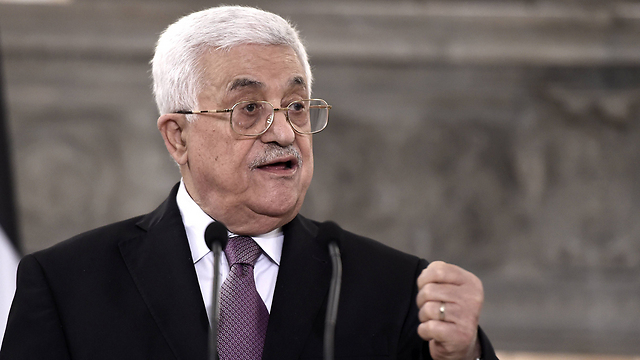
Palestinian Authority President Mahmoud Abbas (Photo: AFP)

Palestinian Authority President Mahmoud Abbas

“Everything can collapse if the embassy will be moved to Jerusalem,” said al-Habash. “It can open a wide door to possibilities that no one wants.” He added that they will not be able to sit idly by if such a move occurs.

US President-elect Donald Trump (Photo: AP)

US President-elect Donald Trump

Another official in the Palestinian Fatah party stated that if the embassy will be moved to Jerusalem, the PA will demand that that Arab and Muslim countries remove their embassies from Washington. The officials stressed that is not merely a Palestinian issue, but an Arab and Muslim one as well.

Abbas himself also commented on the possible scenario of the US Embassy moving to the Israeli capital. Abbas took a less militant tone, voicing his hope that Trump will not seek to implement his past statements, as it would cause irrevocable damage to the peace process.

“We heard a lot of statements relating to moving the US embassy, which we hope are not correct and will not be implemented, but if implemented then the peace process in the Middle East, and even peace in the world, will be in a crisis we will not be able to come out from,” stated Abbas.

The Palestinian campaign against transferring the US embassy to Jerusalem comes less than two weeks before Trump’s inauguration and days before the international peace conference that is set to be held next week in Paris. The conference will focus on trying to find a solution to the Israeli-Palestinian conflict.

Israel erased in UN schools

January 4, 2017

Israel erased in UN schools

UN-run schools in the West Bank and Gaza use textbooks which negate the existence of Israel; teach Western Wall, Cave of the Patriarchs are exclusively Muslim holy sites which the Jews strive to occupy; stamps from the British Mandate period are doctored to remove the Hebrew.

Elior Levy, Eitan Goldstein

Published: 03.01.17 , 19:03

Source: Ynetnews News – Israel erased in UN schools

An Israeli investigation into school books used by United Nations-run schools in the West Bank were found to consistently delegitimize and demonize the State of Israel.

These textbooks—written by the Palestinian Ministry of Education—are used in schools run by the United Nations Relief and Works Agency (UNRWA) in both Gaza and the West Bank.

However, the most shocking discovery is that the UN schools don’t teach Palestinian children to recognize Israel as a country—not within the 1947 borders, nor any borders at all.

Picture of the countries of the Middle East in one of the textbooks. "Palestine" is superimposed on the whole of Israel

Picture of the countries of the Middle East in one of the textbooks. “Palestine” is superimposed on the whole of Israel

The research was presented by Dr. Arnon Gross who translated the books, and Dr. Ronni Shaked from the Harry Truman Research Institute at the Hebrew University in Jerusalem.

In one of the history books, Zionism is defines as a colonialist movement that was founded by European Jews in order to gather Jews from all over the world and to put them in Palestine along with in other neighboring Arab countries. The textbooks argue that the Zionists do this via methods such as immigration and forcing the Arab population off their land.

No mention is made of the religious or historical connection of Jews to the Land of Israel or to Jerusalem in these textbooks used by UNRWA. The schools also make no mention of Jewish holy sites anywhere in their materials—no Western Wall, no Cave of the Patriarchs, and no Rachel’s Tomb.

Instead, the textbooks teach that these are all Muslim holy sites which the Jews are trying illegitimately to take control of.

Also, children at UNRWA schools are taught that the Arab massacres of Jews in 1929 (specifically in Safed, Hebron, and Jerusalem) was called the “al Buraq revolt,” and was carried out to keep the Jews from conquering and occupying these holy cities.

Over 130 Jews were murdered by their Arab neighbors during these massacres.

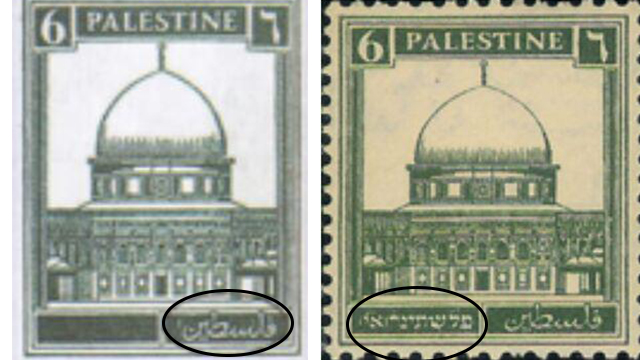
British stamp from the Mandate Era. On the right, all three languages included on the original stamp. On the left, the doctored stamp used in Palestinian textbooks, completely erasing the Hebrew

British stamp from the Mandate Era. On the right, all three languages included on the original stamp. On the left, the doctored stamp used in Palestinian textbooks, completely erasing the Hebrew

The textbooks used by the UN to teach Palestinian children even negate the existence of Hebrew. One of the books has a picture of a stamp used during the British Mandate Period upon which is written Hebrew, English, and Arabic. However, the textbooks written by the Palestinians erase the Hebrew, leaving only the English and the Arabic.

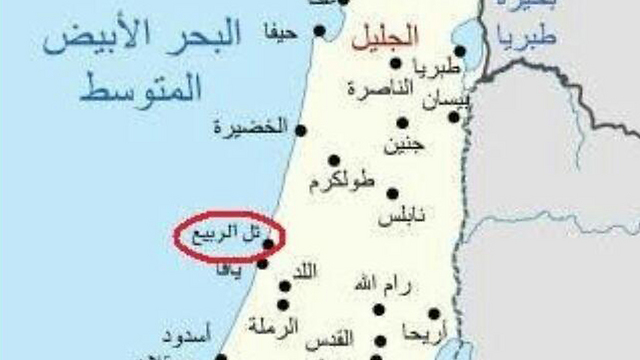
Additionally, there is no reference to the presence of Jews in Israel, with Jewish cities and towns established after 1948 erased from the maps given to Palestinian children. Tel Aviv, originally named after the Hebrew title of Theodor Herzl’s book Altneuland, is re-named “Tel al-Rabia.” The word al-rabia means the season of spring in Arabic.

Tel al-Rabia, circled, appears in place of Tel Aviv on a "Map of Palestine" used in UN schools. No Jewish towns built after 1948 are included

Tel al-Rabia, circled, appears in place of Tel Aviv on a “Map of Palestine” used in UN schools. No Jewish towns built after 1948 are included

Incitement in Palestinian textbooks is well known and documented. Palestinian President Mahmoud Abbas has spoken about the issue several times, and has agreed to be a part of a joint Israeli-US–Palestinian committee to design new textbooks. However, this committee has yet to meet.

The research was conducted by the Center for Near East Policy Research, and was published less than two weeks after the UN Security Council resolution declaring construction and settlements in the West Bank and eastern Jerusalem illegal.

UN schools were previously used as Hamas weapons storehouses during Operation Protective Edge.


The Significance, Ramifications, And Messages Of Hizbullah’s Show Of Military Force In Al-Qusayr, Syria

January 4, 2017

The Significance, Ramifications, And Messages Of Hizbullah’s Show Of Military Force In Al-Qusayr, Syria, MRMRI, Yael Yehoshua*, January 3, 2016

On November 13, 2016, Hizbullah marked its annual Martyr Day by holding its first military parade in a Syrian town, Al-Qusayr, which Hizbullah took over in 2013 following a long and bloody battle with rebel forces, and which has since become the main symbol of the organization’s involvement in the Syria war alongside the Assad regime. The parade featured hundreds of fighters in military uniforms, tanks, U.S.-made M113 armored personnel carriers, cannon, machine guns, and an armored regiment. Also marching was the Al-Radwan division, comprising some 10,000 fighters from Hizbullah’s “intervention forces” and “special forces” fighting in Syria, which constitute the spearhead of the organization in the country.[1]

By holding this parade at this time and at this location, Hizbullah was informing its rivals, locally and in the region – that is, political players in Lebanon, the Syrian rebels and their Arab supporters, and the West and Israel – that it is now a powerful cross-border military force that can control areas outside Lebanon’s borders. The parade did indeed cause a tremendous stir among Hizbullah supporters, as well as among the organization’s opponents.

This paper will review the significance and ramifications of the parade in Al-Qusayr and the messages that it sent.
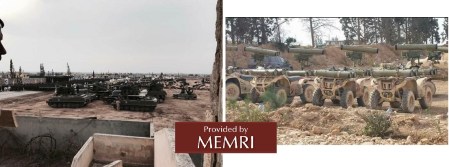
1295aPhotos from the parade. Arabipress.org, November 13, 2016; Addiyar.com, November 14, 2016
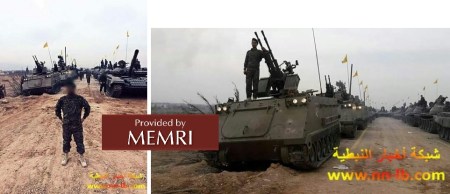
1295bPhotos from the parade. Nn-lb.com, November 13, 2016

Hizbullah Underlines Its Presence On Syrian Soil

Hizbullah’s holding the parade on Syrian soil, particularly in Al-Qusayr, is a symbolic yet highly significant act showing the organization’s control of part of Syrian territory. Al-Qusayr is the jewel in the crown of Hizbullah’s  military involvement in Syria and is seared into the memories of the Syrian rebels as an arena in which they were defeated by Hizbullah in 2013 after a bitter battle that lasted weeks and involved many losses on both sides. Moreover, Al-Qusayr is also Hizbullah’s gateway into Syria. After capturing it from the rebels, Hizbullah emptied it of its residents and turned it into a center for its headquarters and into a staging area for its fighters arriving from Lebanon, from which they leave for other battle fronts in Syria.

Also, holding the parade on Syrian soil as opposed to Lebanese soil is a blatant attempt by Hizbullah to highlight its presence in Syria and signal that this presence has become a known, established and certain fact. It may also reflect Hizbullah’s view of Al-Qusayr and its surroundings as its own military territory, and not as Syrian territory – with no consideration whatsoever for Syria’s sovereignty or for Lebanon’s position on this. [2] Hizbullah deputy secretary general Na’im Qassem hinted at this when he said, several days after the parade: “We are in Syria, and we do not need to give any explanation or justification for this. We stand alongside the Syrian army and the Syrian state.”[3]

Qassem’s statements were backed up by statements by Lebanese Army Gen. (ret.) Amin Hatit, who is close to Hizbullah: “Hizbullah’s presence in Syria is something basic… As far as we are concerned, there is no difference between Al-Qusayr and South [Lebanon].”[4]

By holding it on its Martyr Day, Hizbullah also intended the parade to convey a message to the Shi’ite public in Lebanon, which supports Hizbullah and is the source of its political power and its fighters, that despite its losses Hizbullah has remained strong. For Lebanese Shi’ites, many of whom have been killed and wounded in the past four years of Hizbullah’s fighting in Syria, and particularly in the ongoing battle for Aleppo, the parade was meant to boost morale and signal that the losses had not been in vain but had only further strengthened the organization and made it possible for it to become a regional power.

Hizbullah’s Transition From A Resistance Force To A Quasi-Regular Army

Hizbullah’s demonstration of its military strength by parading hundreds of its soldiers with tanks, cannon, machine guns, and so on also reflected its wish to send the message that it was now a well-trained and well-armed force, with new units, resembling an experienced regular army, and was no longer a resistance militia waging guerilla warfare against Israel.

This upgrade of its military and deterrence capabilities is the result of its military experience in Syria fighting the anti-regime rebels. In this context, Lebanese daily newspapers quoted Na’im Qassem making statements about Hizbullah’s military capability. The Lebanese Al-Mudun daily quoted Qassem as saying: “Hizbullah has added expertise, fighting capability, and military capabilities. This force is becoming more powerful and more developed, into something greater than resistance and less than a regular army.”[5] The Al-Safir daily quoted him as saying: “Now we have a trained army and the resistance is no longer based on methods of guerilla warfare. We are better armed and better trained, and we have advanced professional knowledge.”[6] It should be noted that an official Hizbullah communique denied that Qassem had called Hizbullah an army.[7]

It appears that Hizbullah’s show of strength at this time was because of achievements in the field by both it and its camp, the resistance axis. These achievements included the strengthening of Hizbullah, the Syrian army, and the militias that have been operating alongside the Syrian army since the beginning of Russia’s military involvement in Syria over a year ago along with the upsurge in the political status of Syrian President Bashar Al-Assad in the Arab world and in the West, and the bolstering of Iran’s regional and international status because of its increased military presence in Iraq and Syria and in the wake of the nuclear agreement and the election of the Hizbullah ally Michel Aoun to the Lebanese presidency.


Hizbullah As A Cross-Border Regional Force

Alongside the messages it sent locally, the parade was aimed at letting the region know that Hizbullah is a cross-border military force that is not bound by any particular territory and does not recognize the Syria-Lebanon border, or other borders between Middle East states, set by the Sykes-Picot agreement.

Hizbullah and its sponsor, Iran, which itself is striving to spread its Islamic Revolution and “Rule of the Jurisprudent” doctrine, do not consider geographic borders to be significant, and are deepening their penetration of many countries in the region. This approach is expressed by the military involvement of Iran and its agents in Syria, Iraq, and Yemen, and by Hizbullah’s complete military control of part of Syrian soil, including the Al-Qusayr region.

The military parade sent a message not only to the rebels in Syria, but also to their sponsors in the Arab and Muslim world – Saudi Arabia, Qatar, and Turkey – underlining that the resistance axis in Syria has the upper hand, and that Hizbullah will not hesitate to show its power anywhere it needs to in order to subjugate its opponents. On this matter, Lebanese Army Gen. (ret.) Amin Hatit said: “Had Hizbullah wanted to send a message to Lebanon, it would have held the demonstration there, not in Syria, and what it did in Al-Qusayr is a message to the region.”[8]

In an interview with the Iranian website Tasnim, which is close to Iran’s Islamic Revolutionary Guard Corps (IRGC), Qassem said: “If we want to look [at this] realistically, we see that Hizbullah has become a regional power. The way in which Hizbullah is confronting both the Zionist enemy and the takfiriyyoun [i.e. the Salafi-jihadi organizations]… shows that the organization is a regional power, and the changes in the region are proof of that.”[9]

Also, Nasser Qandil, editor of the pro-Syria Lebanese daily Al-Bina and an Assad associate, wrote in a November 16, 2016 article titled “Hizbullah – The New Middle East Army” that the organization is a cross-border force and that the borders between countries mean nothing to it. He stated that Hizbullah has become the “Middle East Army” because of its military capabilities and because it is a military force that crosses borders, and that it has achieved this by virtue of the popular organizations in the region that assist it, which comprise approximately a million fighters spread across the Middle East. These forces share its wars and its positions, and see Hizbullah secretary-general Hassan Nasrallah as a leader “with special status and as a source of authority for the wars in the Middle East.” He added that in actuality Hizbullah “has torn up Sykes-Picot” by transforming the areas of Syria that border Lebanon’s east and northeast into a “direct and vital continuation of the resistance.”

In this context, Qandil added that as Israel’s military strength and Saudi Arabia’s economic and political strength were waning, and as Al-Qaeda was failing, and as the U.S. was more preoccupied with domestic affairs and Russia was concerned about neutralizing other regional forces such as Turkey, “Hizbullah and the network of its allies is developing, becoming like a soft-[power] state that lives in the bosom of several countries. [Hizbullah] is not a rival [to the states on whose soil it exists], but complements them, living and developing at their consent as a deterrent force and as added strategic value. Thus, this force is becoming the most important fact emerging with the beginning of the 21st century… and no force in existence can threaten the growth of this new army of the Middle East that is deployed from Lebanon to Afghanistan, and from Aleppo to Bab Al-Mandeb.”[10]


Hizbullah As An Independent Force Operating Outside Lebanese Laws And Institutions

The Al-Qusayr military parade has great significance also vis-à-vis Lebanon. Hizbullah’s control in the Al-Qusayr region erases the Lebanon-Syria border and creates a single large, contiguous swath of territory from Syria to the northern Beqa’a, one of its strongholds in Lebanon, without the Lebanese government’s agreement and under harsh criticism from various political elements in that country.[11]

By holding the parade, Hizbullah has again proven, to Lebanon and to the entire world, that it is not subject to Lebanon’s laws and institutions, but that it operates according to its own interests and the interests of Iran and the resistance axis. As far as it is concerned, its presence in Syria depends solely on it, not on any decision by the Lebanese state. On this, Qassem said: “We stand alongside the Syrian army and the Syrian state, and without our intervention in Syria, the terrorists would enter every place in Lebanon. The issue of our involvement in Syria is no longer under discussion by Lebanese circles.”[12]

This message was discordant to Hizbullah’s opponents within Lebanon, who expressed harsh criticism of the Al-Qusayr parade. Ashraf Rifi, justice minister in Lebanon’s interim government, a bitter enemy of Hizbullah, said that this parade sends a message threatening Lebanon’s sovereignty. He tweeted: “Hizbullah has blatantly shown its military strength in occupied Syria… What will ‘the strong president’ [Michel Aoun] say about the armed militia that has become an army that is participating in the occupation of Syria, and dividing and killing its people?” He added that “Lebanon is in danger” and called on all the forces opposing the Iranian sponsorship of Lebanon to act together “to save Lebanon that Hizbullah has exploited with shari’a backing and has turned into a platform in service of Iran’s plans.”[13]

Other criticism came from Ali Al-Husseini, in his column in the Lebanese daily Al-Mustaqbal, associated with the March 14 Forces: “It is odd that this parade was held at the same time as preparations were being carried out by the Lebanese army for [Lebanon’s November 22] Independence Day… The message to Lebanon is that Hizbullah is an independent force that is not subjugate to the laws of the Lebanese state and does not want [Lebanon] to be independent… Hizbullah has established itself as an occupier and has declared Al-Qusayr and other regions [in Syria] to be under its control and its aegis from now on, and declared that negotiation on them in the future will be only with [Hizbullah] and according to its conditions.”[14]


Hizbullah As A Deterrent Force In Lebanon’s Internal Politics

Hizbullah’s parade, which also came several weeks after its ally Michel Aoun was elected Lebanon’s president,[15] and at the height of consultations for the establishment of a new government headed by Sa’ad Al-Hariri, head of the Al-Mustaqbal stream, was also a way of flexing its muscles at various forces in Lebanon’s political arena, particularly at President Aoun and his party which are still considered Hizbullah allies. This show of strength was aimed at reiterating that the organization had military power and that it would not agree to any changes to the political balance of power that were not in its favor, and would also not allow its weapons to be touched.

While Aoun’s election was considered a victory for Hizbullah and for the March 8 Forces that it heads, there is, according to reports in the Lebanese media, great apprehension in Hizbullah and in the March 8 Forces that Aoun will end his sweeping support for the resistance, and will moderate his stance, compromise, and lean more towards the center than he has in the past, and will show neutrality towards both the March 14 Forces and the March 8 Forces.

The cooperation between Aoun (who represents the majority of Christians in the country after forming an alliance with the Christian Lebanese Forces party led by Samir Geagea) and Al-Hariri (who represents the majority of Sunnis) – cooperation which led to Aoun’s election and to the appointment of Al-Hariri to establish the next government – is also of concern to the Shi’ite Hizbullah. Its main fear stems from the possibility of shifts in the political power balance in the country, because Aoun’s alliance with Hizbullah foe Geagea has created a powerful, cohesive Christian group that has shared out the government portfolios among its members, at the expense of the other Christian parties who belong to the March 8 Forces – and Aoun is likely to prioritize this powerful Christian group over his alliance with Hizbullah and his support for the resistance.

These apprehensions also increased following visits by Saudi and Qatari emissaries to Aoun, following which the latter promised that Saudi Arabia will be the first stop on his visits to Arab countries, and in light of his statement, as part of his wish to establish Lebanon as an independent actor, that Lebanon under his leadership would “adopt an independent policy and will not be subjugated to anyone.”[16]


Hizbullah As An Anti-Israel Deterrent Force From Both Lebanese And Syrian Territory

Hizbullah also used the parade to convey a message about its position on a war against Israel. In light of its military involvement in Syria fighting the rebels alongside the Assad regime, Hizbullah was accused by elements in and out of Lebanon of abandoning the path of resistance against Israel, and of having become an accessory to the Iranian plan to eliminate the Sunni presence in Syria. In response, with the parade, Hizbullah sought to clarify that establishing its might in Syria was part of the plan of the resistance that serves its war against Israel and intensifies its anti-Israel deterrence. On this topic, Na’im Qassem said that upgrading Hizbullah’s capabilities and transforming it into a real military force “is sufficient to deter the Israeli enemy.”[17]

That the parade was an attempt by Hizbullah to demonstrate its strength to Israel was also expressed by the fact that the main element marching in it was from the Al Radwan division, revealed here for the first time. According to a Lebanese source,[18] this division was thought up by the late Hizbullah chief of staff ‘Imad Mughniyeh, who was assassinated in 2008, and comprises some 10,000 fighters trained at Hizbullah bases specifically built for this purpose in Al-Qusayr. The division was initially established to invade Israel’s Galilee during the next conflict there, but is right now fighting the rebels in Syria and gaining combat experience, and Hizbullah considers it its spearhead in Syria. Having fighters from this division marching in the parade is a message to Israel that the Al-Radwan division, which it considers a deterring force against Israel, is complete and ready for action against it at a moment’s notice.

‘Abdallah Kamah wrote on the Lebanese website Alhadathnews.net: “At a time when the warriors of the Al-Radwan [division] are fighting and gaining combat experience in Syria, they see the Galilee as their strategic goal. In order to achieve this goal, we must prepare for a war [with Israel], which ‘Imad Mughniyeh had said ‘would be different from those that came before it.’ This difference opens the door to adopt new [combat] methods, because this campaign will not be the same as in the past, when it was conducted according to a scenario where the enemy invades and the resistance ambushes and charges, or fires rockets from groves and using mobile, manually-operated, ground-based launchers. Moreover, the next war, as Hizbullah showed yesterday, will be more offensive than defensive, and will include armored vehicles entering the occupied Upper Galilee.”[19] It should be mentioned in this context that in a February 2011 speech marking the third anniversary of Mughniyeh’s assassination, Hizbullah Secretary-General Hassan Nasrallah threatened Israel, and warned that in the next conflict he would order his men to take over the Galilee.[20]

Moreover, by holding the parade on Syrian soil, Hizbullah challenged Israel’s opposition to the establishment of Hizbullah forces in Syria, specifically in the Golan Heights. Increasing its presence in the Syrian Golan is part of the organization’s plan to expand the arena of conflict with Israel from southern Lebanon to the Golan Heights, and transform them into a single front that transcends political borders. Back in January 2016, Nasrallah stated that Hizbullah will no longer recognize either the rules of combat with Israel or the separation between the South Lebanon and Golan Heights fronts.[21] In May 2016, Ibrahim Al-Amin, head of the board of directors of the Lebanese daily Al-Akhbar, which is close to Hizbullah, stated that the organization had established a resistance infrastructure in the Syrian Golan Heights with the help of local residents.[22]

In an article published a few days after the parade, the political editor of the Lebanese daily Al-Safir implied that that one of the reasons Hizbullah is establishing itself in Syria is to open an additional front against Israel in the Golan Heights: “The weapons displayed by Hizbullah [at the parade] are weapons that [regular] armies have, and this is a clear message to Israel that the arena for every future campaign will absolutely not be limited to certain Lebanese borders and to a local population that either does or does not support [the resistance], but will rather be an arena that is more energetic, deeper, and broader – strategically, geographically, and militarily.”[23]

*Yael Yehoshua is Vice President for Research and Director of MEMRI Israel


[1] For more on the military parade, see MEMRI Special Dispatch No. 6677, Special Dispatch No. 6677, Hizbullah Military Parade In Syrian Town Of Al-Qusayr: Tanks, Cannon, And Machine Guns, November 14, 2016. It should be noted that the Lebanese army denied claims that the M113 APCs and other military equipment in the parade belonged to it. Al-Nahar (Lebanon), November 15, 2016.

[2] Al-Mudun (Lebanon), November 16, 2016.

[3] Al-Safir (Lebanon), November 16, 2016.

[4] Al-Nahar (Lebanon), November 14, 2016.

[5] Al-Mudun (Lebanon), November 16, 2016.

[6] Al-Safir (Lebanon), November 16, 2016.

[7] Alahednews.com, November 16, 2016.

[8] Al-Nahar (Lebanon), November 14, 2016.

[9] Tasnim (Iran), November 22, 2016.

[10] Al-Bina (Lebanon), November 16, 2016.

[11] For more on Lebanese criticism of Hizbullah’s involvement in the fighting in Syria, see MEMRI Inquiry & Analysis No. 980, Lebanon Openly Enters Fighting In Syria, June 13, 2013; Special Dispatch No. 6383, Lebanese Writer: Hizbullah Is No Longer A Resistance Organization, But An Occupier And Target For Resistance, April 12, 2016; Inquiry & Analysis No. 1147, Lebanese Elements Furious Over Hizbullah’s Activity In Golan, Shebaa Farms, Critical Of Nasrallah’s Statements About Uniting Lebanese, Syrian Resistance Fronts, March 11, 2016.

[12] Al-Safir (Lebanon), November 16, 2016.

[13] Twitter.com/Ashraf_Rifi, November 14, 2016.

[14] Al-Mustaqbal (Lebanon), November 15, 2016.

[15] See MEMRI Inquiry & Analysis No. 1276, Al-Hariri’s Choice Of Hizbullah Ally Aoun For Lebanese Presidency Is Another March 14 Forces Concession To Pro-Iran Axis, October 28, 2016.

[16] Al-Safir (Lebanon), November 12, 2016; Al-Akhbar (Lebanon), November 26, 2016.

[17] Al-Mudun (Lebanon), November 16, 2016.

[18] For example, Alhadathnews.net, November 15, 2016.

[19] Alhadathnews.net, November 15, 2016.

[20] Al-Akhbar (Lebanon), February 17, 2011. See MEMRI Special Dispatch No. 6051, The Emergence Of ‘Galilee Force’ – Palestinian Forces Fighting Alongside Syrian Regime, May 20, 2015.

[21] For Lebanese criticism of Nasrallah’s statement, see MEMRI Special Dispatch No. 5994, Lebanese Elements Furious Over Hizbullah’s Activity In Golan, Shebaa Farms; Slam Nasrallah’s Statements About Uniting Lebanese, Syrian Resistance Fronts, March 10, 2015; For more on Hizbullah and Iranian IRGC activity in the Syrian Golan on the Israeli border, see MEMRI Inquiry & Analysis No. 1138, Following Killing Of Hizbullah Operative Jihad Mughniyah, New Information Comes To Light Regarding Hizbullah, Iranian Activity In Syrian Golan On Israeli Border, January 28, 2015; MEMRI Daily Brief No. 1146, From The Mediterranean to the Golan, Iran Builds Active Front And Direct Military Presence On Israel’s Border To Deter Israel And Further Ideology Of Eliminating The Zionist Regime, February 16, 2015.

[22] For more on Hizbullah’s activity in the Golan, see MEMRI Special Dispatch No. 6039, Board Chairman Of Pro-Hizbullah Lebanese Daily: Hizbullah Has Established Resistance Infrastructure In Syrian Golan In Cooperation With Locals, April 30, 2015.

[23] Al-Safir (Lebanon), November 16, 2016.
Why Trump’s bid to amplify Muslim reformers will keep Americans safer

December 30, 2016

Why Trump’s bid to amplify Muslim reformers will keep Americans safer, The Hill, Cynthis Farahat, December 29, 2016

sisi_egypt_president_458617936© Getty Images

Sisi’s supporters say the Obama administration’s tolerance of Islamism and harsh criticism of Egypt’s counter-terrorism efforts have been an enormous obstacle. In contrast, Trump’s campaign expressed “strong support for Egypt’s war on terrorism” and pledged that “under a Trump Administration, the United States of America will be a loyal friend, not simply an ally, that Egypt can count on in the days and years ahead.”

**********************************

The recent terror attacks in Berlin and Zurich highlight once again the danger that radical Islamism poses to the West. While many are searching for ways to improve security and defeat the threat on the ground, few appear to appreciate that the decisive blow against Islamism can only be administered by leaders in the Middle East.

President-elect Donald Trump pledged during his last major foreign policy speech before the election to “be a friend to all moderate Muslim reformers in the Middle East” “amplify their voices.”

President Abdel Fattah el-Sisi and most of the political and media establishment in Egypt warmly embraced this policy. After meeting with the Republican nominee on the sidelines of the UN General Assembly in September, Sisi told CNN he had “no doubt” Trump would make a strong leader. Sisi was also the first Arab leader to telephone Trump after his election win.

Egyptian affections for Trump are partly fueled by distaste for former Secretary of State Hillary Clinton, who many Egyptians believe conspired with the Muslim Brotherhood to help elect Islamist Muhammad Morsi as president in 2012 (after which she was greeted in Egypt with protestors hurling tomatoes).

However, the main attraction of Trump in the eyes of many Egyptians is his staunch anti-Islamism.

Since coming to power in 2013, Sisi has spoken passionately about the need for an Islamic reformation. For Sisi, Islamism isn’t merely a ruinously bad blueprint for modern governance and a chronic source of security threats, it is also a wedge fueling outside hostility to Muslims, both Islamists and non-Islamists alike. In a 2015 New Year’s Day speech at al-Azhar University, the world’s most prestigious seat of Sunni Islamic learning, Sisi warned that the “corpus of [Islamic] texts and ideas that we have sacralized over the years” are “antagonizing the entire world” and “caus[ing] the entire umma [Muslim world] to be a source of anxiety, danger, killing and destruction.”

Not surprisingly, Sisi has faced opposition in the region, especially from Turkey, Qatar, and powerful figures in the Saudi royal family, who have opened their media to Brotherhood operatives to attack Sisi and even call for his assassination. One of the only Arab governments openly backing Sisi’s uncompromising stance on Islamists is the United Arab Emirates (UAE), which in 2014 designated the Muslim Brotherhood as a terrorist organization (along with two of its U.S.-based affiliates, the Council on American-Islamic Relations and the Muslim American Society).

Within Egypt, Sisi’s calls for a religious revolution have made him extremely popular, but he has faced fierce resistance from Islamists, who still dominate many sectors of Egyptian civil society and exert influence in government, particularly the judiciary.

Sisi’s supporters say the Obama administration’s tolerance of Islamism and harsh criticism of Egypt’s counter-terrorism efforts have been an enormous obstacle. In contrast, Trump’s campaign expressed “strong support for Egypt’s war on terrorism” and pledged that “under a Trump Administration, the United States of America will be a loyal friend, not simply an ally, that Egypt can count on in the days and years ahead.” Walid Phares, a foreign policy advisor for the president-elect, stated in an interview that Trump will work to pass legislation designating the Muslim Brotherhood as a terrorist organization.

Trump’s election appears to have emboldened Sisi to step up his Islamic reformation campaign. Just days later, Sisi pardoned 82 prisoners, among them Islam Behery, a former TV host and prominent leader of a growing neo-Mu’tazilah-style movement that claims Islamic scriptures are man-made and should not overrule reason and critical thinking.

Behery’s movement has gained sweeping popularity as horrors committed by Al-Qaeda, Islamic State, and other Sunni jihadist groups have mounted in recent years.

Many across the Arab world, and Egyptians in particular, are hopeful that the election of Donald Trump will open a new page of cooperation between the United States and those who are seeking to challenge Islamic extremism in the war of ideas. Only together can we defeat the Islamists wreaking carnage on the streets in the West.

Cynthia Farahat is a fellow at the Middle East Forum and a columnist for the Egyptian daily Al-Maqal.

The views expressed by authors are their own and not the views of The Hill.;

Zionist Response to Obama: Jerusalem to Approve 5,600 Homes Across ‘Greenline’

December 25, 2016

By: David Israel Published:

December 25th, 2016

Source: Zionist Response to Obama: Jerusalem to Approve 5,600 Homes Across ‘Greenline’ | David Israel | Sunday, December 25, 2016 | JewishPress.com

New construction in Gilo, eastern Jerusalem
Photo Credit: Yonatan Sindel/Flash90

The UN Security Council resolution will not slow down construction in the 1967 liberated parts of Jerusalem, according to the municipality’s Local Planning and Construction committee. In fact, on Wednesday, the committee plans to vote to approve thousands of new housing units in Jewish and mixed neighborhoods across the 1949 armistice line, a.k.a. the “greenline.”

The planning committee will approve 2,600 new housing units in the neighborhood of Gilo, another 2,600 units in Givat Hamatos, and 400 units in Ramat Shlomo – altogether 5,600 units in eastern Jerusalem.

Acting and Deputy Mayor of Jerusalem and Chairman of the Local Planning and Building committee Meir Turgeman, told the press he is “not intimidated by the UN or by any other entity trying to dictate to us what to do in Jerusalem. I hope the new US Administration will give us a push to continue replenishing the housing stock which was reduced during the eight years of the Obama Administration.”

FROM THE RIVER TO THE SEA – A CALL FOR GENOCIDE

December 24, 2016
Published on Oct 15, 2015

By Pierre Rehov. www.middleeaststudio.com

According to most Palestinians, “Israeli Occupation” means Tel Aviv, Ber Sheva and Haifa, and for their leaders, Palestine should be built “From the River to the Sea”. Meaning, should replace Israel, from the Jordan River to the Mediterranean Sea.

In this disturbing film, “From the River to the Sea”, a revised version of “Hostages of Hatred” acclaimed director Pierre Rehov sets out to tell us the real story of those men, women and children, who have been shamefully used as mere pawns for over 50 years, by Arab leaders at first, by Palestinian leaders later on and until this very day but also by the United Nations’ body that was specially created to supposedly take care of them: the United Nations Relief and Works Agency, UNWRA.

Trump and Sisi discuss Middle East peace

December 23, 2016

Trump and Sisi discuss Middle East peace, Israel National News, Elad Benari, December 23, 2016

trumpandsisiTrump and Sisi meet in New YorkReuters

“The presidents agreed on the importance of affording the new U.S. administration the full chance to deal with all dimensions of the Palestinian case with a view of achieving a full and final settlement,” he added.

Sisi recently praised Trump and said he expected greater engagement in the Middle East from his administration.

******************************

Egyptian President Abdel Fattah al-Sisi on Thursday night spoke with U.S. President-Elect Donald Trump, Sisi’s office said, according to Reuters.

The call came hours after the UN Security Council postponed indefinitely a vote on Egypt’s draft resolution denouncing Israeli “settlements”.

“During the call they discussed regional affairs and developments in the Middle East and in that context the draft resolution in front of the Security Council on Israeli settlement,” said Sisi’s spokesman, Alaa Yousef.

“The presidents agreed on the importance of affording the new U.S. administration the full chance to deal with all dimensions of the Palestinian case with a view of achieving a full and final settlement,” he added.

Thursday’s vote on the UN Security Council resolution was reportedly postponed after Sisi instructed his nation’s delegation to push for a delay in the vote.

Trump had earlier called for the United States to veto the resolution, as it has traditionally done with similar proposals. American officials indicated that the Obama administration was planning to abstain from voting or even to vote yes.

Sisi recently praised Trump and said he expected greater engagement in the Middle East from his administration.

The Egyptian President has also been at the forefront of the effort to resume talks between Israel and the Palestinian Authority, having several months ago urged Israelis and Palestinian Arabs to seize what he said was a “real opportunity” for peace and hailed his own country’s peace deal with Israel.

The comments were welcomed by Prime Minister Binyamin Netanyahu, who stressed that “Israel is ready to participate with Egypt and other Arab states in advancing both the diplomatic process and stability in the region.”

Palestinian Authority (PA) chairman welcomed Sisi’s call as well, saying he welcomed the Egyptian president’s efforts to achieve peace and establish a Palestinian state.

Hezbollah using US weaponry in Syria: senior Israeli military officer

December 22, 2016

Hezbollah is using US weaponry in Syria, according to a senior Israeli military officer

Reuters

(By Ori Lewis; editing by Jeffrey Heller)

Source: Hezbollah using US weaponry in Syria: senior Israeli military officer – Business Insider

TEL AVIV (Reuters) – Israel has informed the United States that Lebanese Hezbollah fighters in Syria are using U.S. armored personnel carriers originally supplied to the Lebanese Army, a senior Israeli military officer said on Wednesday.

The U.S. State Department said last month that the American embassy in Beirut was working to investigate images on social media purporting to show Hezbollah, which supports President Bashar al-Assad, displaying U.S. military equipment in Syria.

Those images were widely reported to have been of U.S.-made M113 armored personnel carriers, which the State Department said were extremely common in the region.

In an intelligence briefing to foreign reporters in Tel Aviv, the senior officer showed a photograph of military vehicles, which he said included U.S.-made armored personnel carriers (APCs), along a road.

“These APCs are of the Hezbollah, while fighting in Syria, that they took from the Lebanese armed forces,” he said in English, describing the guerrilla group as dominant in Lebanon.

shia militia M113 APC

An M113 armored personnel carrier in the possession of Iraqi Shia militias.

“We shared this information with other countries, including the U.S. of course, and I can even say that we recognized these specific APCs with some specific parameters that we know … these were given to the Lebanese armed forces. It’s not an assumption,” said the officer, who under the rules of the briefing could not be identified by name, rank or position.

Western diplomatic sources have said the APCs were delivered to the Lebanese Army by the United States as part of a program to equip that force.

The officer made no comment about when the APCs would have been supplied to the Lebanese Army.

The officer said Hezbollah has 8,000 fighters in Syria where more than 1,700 of the group’s combatants have been killed since 2011.

Israel and Hezbollah, which the officer said has 30,000 members, half of them combatants, last fought a war in 2006.


Declaration Of War? Erdogan Says Turkish Forces Are In Syria To End Assad’s Rule

November 30, 2016

Declaration Of War? Erdogan Says Turkish Forces Are In Syria To End Assad’s Rule

Source: Declaration Of War? Erdogan Says Turkish Forces Are In Syria To End Assad’s Rule | Zero Hedge

Having stated in the past that the only reason Turkish forces are on Syrian soil is to combat Islamic State terrorists, today Turkish president Recep Tayyip Erdogan made a dramatic diplomatic reversal and said that the Turkish Army has entered Syria to end the rule of President Bashar Assad, whom he accused of terrorism and causing the deaths of thousands.

“We entered [Syria] to end the rule of the tyrant al-Assad who terrorizes with state terror. [We didn’t enter] for any other reason,” the Turkish president was quoted by Huyrriyet as saying at the first Inter-Parliamentary Jerusalem Platform Symposium in Istanbul. Erdogan said that Turkey has no territorial claims in Syria, but instead wants to hand over power to the Syrian population, adding that Ankara is seeking to restore “justice.”

“Why did we enter? We do not have an eye on Syrian soil. The issue is to provide lands to their real owners. That is to say we are there for the establishment of justice,” he said, taking a page out of the US playbook, which however in recent weeks has been muted following substantial advances by Syrian and Russian forces which as reported last night, have made material gains in the fight against Syrian rebels in east Aleppo.


Turkish Army tanks driving to the Syrian Turkish border town of Jarabulus

Erdogan went on to say that “in his estimation” almost 1 million people have died in the conflict in Syria, although no monitoring group has provided any similar figures according to RT.

The Turkish moral arbiter of all that is right also said that Turkey could not “endure” the unending killing of civilians and “had to enter Syria together with the Free Syrian Army.

The Turkish leader also accused the UN of inability to influence the situation in Syria and said that the organization is ineffective in its current state. “The world is bigger than five,” he said, referring to the number of permanent members on the UN Security Council, as reported by Hurriyet.

As readers will recall, Turkish troops entered Syria on August 24, launching operation Euphrates Shield. Turkey deployed ground troops and air power to northern parts of its neighboring country, with what then was a stated goal of retaking areas held by Islamic State. However, many observers have said that Ankara aims to suppress Kurdish forces in Syria and prevent them from connecting three de facto autonomous Kurdish areas into one enclave south of the Turkish border.

In October, Turkey’s air forces killed between 160 and 200 fighters of the Kurdish YPG militia group in 26 airstrikes conducted in just one night. The Turkish military campaign in Syria has also led to increasingly strained relations with Assad’s government.

Ankara was forced to halt air support for its ground incursion into Syria on October 22, after Damascus vowed to shoot down Turkish Air Force planes in Syrian skies, accusing Turkey of violating its national sovereignty. Turkey in turn accused the Syrian Army of attacking FSA fighters in the northern Aleppo province.

The announcement is hardly a surprise, coming just one day after what we reported, is set to be Assad’s biggest victory since the start of the Syrian war with the imminent capture of rebel-stronghold Aleppo, and whose eastern part had been some 40% “freed” from militants by Syrian government forces, according to the Russian Defence Ministry.

In light of today’s latest statement, which according to some is tantamount to a declaration of war by Turkey against a sovereign state, it is unclear what the Syrian response will be to the NATO member. It is also unclear how Russia – which is alligned with the Assad regime – will respond in light of recent overtures by both Erdogan and Putin to bring relations between the two nations closer.

The False Premise of Palestine and Peace

November 22, 2016

The False Premise of Palestine and Peace

by Barry Shaw

November 22, 2016 at 5:00 am

Source: The False Premise of Palestine and Peace

  • If the international community wants to see Israel make dangerous concessions, then they, and they alone, must ensure that Israel has a united and pragmatic peace partner.
  • This should be Israel’s basic demand: that a united Palestinian political leadership will recognize the right of all the citizens of the Jewish State of Israel to live in peace and security, alongside the State of Palestine.
  • It is that simple. That is all it takes.

The notion that the creation of a state of Palestine will herald everlasting peace is naïve in the extreme.

After 50 years of a two-state failure, the French and other diplomats, in their duplicitously-named “peace initiative,” have no other idea for how to settle the Palestinian problem, except to behave like parched men trudging across a burning desert toward a distant mirage that they think is an oasis paradise. It is not, and the same diplomats will take no responsibility for cleaning up the dangerous outcome of such a disaster.

The international community is pressuring Israel to make wholesale concessions in territory and security, risking social and political upheaval, to grant the so-called Palestinians a state of their own.

The sole criterion for making this happen is for the international community to accept the Palestinian precondition of forcing Israel withdraw to pre-1967 lines, which are the 1949 armistice lines and not a defined border.

Whenever I approach a European diplomat with the following questions, none of them can give me an answer:

1) What happens when a new emboldened Palestinian government continues calls for the liberation of the “rest of Palestine”?

They call Haifa, Acre, Jaffa and the Galilee — in fact, all of Israel — “occupied Palestinian land”. Just look at any Palestinian map: it is identical to Israel.

It is little known that members of the Palestinian Authority call Israeli Arabs “Palestinians of the Interior.”

They also call Israeli Arabs the “Palestinians of ’48.” They have been joined in this by Arab Knesset Members, who also would not object to the eventual displacement of Jews by Arabs in Israel.

According to their ambition, these Israeli Arabs will be “liberated” by a new Palestine.

2) What will happen when inevitably — by the ballot or by the bullet — this Palestine is taken over by Hamas, designated an Islamic terror organization by the U.S. Department of State?

If you think this question is far-fetched, think again. The students of Bir Zeit University voted overwhelming to elect Hamas representatives to head their student body. Bir Zeit is not in the Gaza Strip. It is less than ten kilometers north of Ramallah, literally a stone’s throw from the offices of the Palestinian Authority in the West Bank.

These Hamas-supporting students will be the Palestinians’ future opinion-makers after graduation.

And let us not forget how in the Gaza Strip, in June 2007, Hamas seized power in a bloody coup that left more than a hundred dead and more than five hundred wounded.

Hamas will continue its incendiary calls to destroy the Jewish state and to slaughter Jews.

3) Do you really think that we Israelis will call upon our government to make territorial concessions that will bring these terrorists closer to our families and homes?

So, what is the answer I get from the diplomats based in Israel to these genuine concerns? Well, nothing really. Just a throwaway line about it being up to the parties to solve their ongoing difficulties.

If the international community wants to see Israel make dangerous concessions, then they, and they alone, must ensure that Israel has a united and pragmatic peace partner, not a weak, aging, corrupt, rejectionist and undemocratic leader to our east, who constantly says he will never recognize Israel as the Jewish State, and to our south, in Gaza, a rabid Islamic terror regime bent on our destruction.

This should be Israel’s basic demand: that a united Palestinian political leadership will recognize the right of all the citizens of the Jewish State of Israel to live in peace and security, alongside the State of Palestine.

It is that simple. That is all it takes.

Let the diplomatic world spend the next 50 years educating and training the divided Palestinian political leadership to come together as a force for peace.

Then Israel will be happy to consider making concessions that might well be life-threatening, as it has done before.

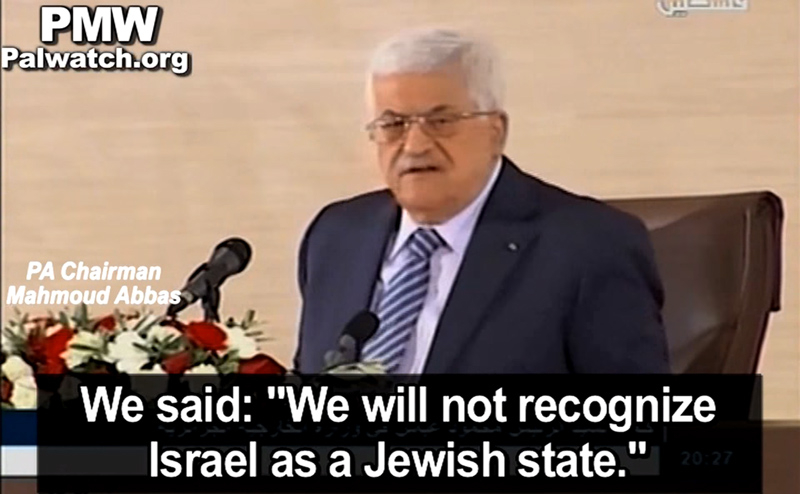
If the international community wants to see Israel make dangerous concessions, then they, and they alone, must ensure that Israel has a united and pragmatic peace partner, not a weak, aging, corrupt, rejectionist and undemocratic leader to our east, who constantly says he will never recognize Israel as the Jewish State, and to our south, in Gaza, a rabid Islamic terror regime bent on our destruction. (Image source: Palestinian Media Watch)

Barry Shaw is a Senior Associate at the Israel Institute for Strategic Studies.