Posted tagged ‘Middle East’

Dear Fellow Americans: Do You Have Any Idea What’s Being Done In Your Name In Syria?

November 6, 2015

Dear Fellow Americans: Do You Have Any Idea What’s Being Done In Your Name In Syria?

Posted on November 5, 2015

by WashingtonsBlog

Source: Dear Fellow Americans: Do You Have Any Idea What’s Being Done In Your Name In Syria? Washington’s Blog

Americans have some vague understanding that the U.S. wants Syria’s Assad to go, while Russia wants him to stay.

And Americans know that the U.S. “war against ISIS” hasn’t done much, while the Russians have been pounding Syrian targets with jets.

But Americans have no idea that the U.S. is deploying fighter jets designed solely to engage in plane-to-plane dogfighting … in order to counter the Russians.

And we don’t understand that the U.S. is arming the Syrian “rebels” with should-fired anti-aircraft weapons. As the Wall Street Journal  reports:

The U.S. and its regional allies agreed to increase shipments of weapons and other supplies to help moderate Syrian rebels hold their ground and challenge the intervention of Russia and Iran on behalf of Syrian President Bashar al-Assad, U.S. officials and their counterparts in the region said.

The deliveries from the Central Intelligence Agency, Saudi Arabia and other allied spy services deepen the fight between the forces battling in Syria, despite President Barack Obama’s public pledge to not let the conflict become a U.S.-Russia proxy war.

Saudi officials not only pushed for the White House to keep the arms pipeline open, but also warned the administration against backing away from a longstanding demand that Mr. Assad must leave office.

In the past month of intensifying Russian airstrikes, the CIA and its partners have increased the flow of military supplies to rebels in northern Syria, including of U.S.-made TOW antitank missiles, these officials said. Those supplies will continue to increase in coming weeks, replenishing stocks depleted by the regime’s expanded military offensive.

An Obama administration official said the military pressure is needed to push Mr. Assad from power. 

“Assad is not going to feel any pressure to make concessions if there is no viable opposition that has the capacity, through the support of its partners, to put pressure on his regime,” the official said.

In addition to the arms the U.S. has agreed to provide, Saudi and Turkish officials have renewed talks with their American counterparts about allowing limited supplies of shoulder-fire man-portable air-defense systems, or Manpads, to select rebels. Those weapons could help target regime aircraft, in particular those responsible for dropping barrel bombs, and could also help keep Russian air power at bay, the officials said.

Mr. Obama has long rebuffed such proposals, citing the risk to civilian aircraft and fears they could end up in the hands of terrorists. To reduce those dangers, U.S. allies have proposed retrofitting the equipment to add so-called kill switches and specialized software that would prevent the operator from using the weapon outside a designated area, said officials in the region briefed on the option.

U.S. intelligence agencies are concerned that a few older Manpads may already have been smuggled into Syria through supply channels the CIA doesn’t control.

(This comes a week after ISIS may have used a Manpad to shoot down a Russian civilian airliner.)

Americans don’t know that sending Manpads into Syria and trying to establish a no-fly zone is what Al Qaeda leaders have been hoping for, and that ISIS and Al Qaeda will end up with all of the weapons which the U.S. sends to Syria.

Americans don’t know the history of American regime change in Syria:

Americans don’t know that it was the “rebels” – not the Syrian government – who carried out the chemical weapons massacre in Syria.

Americans don’t know that U.S. backed rebels told Christians, “Either you convert to Islam or you will be beheaded.”   Syrian rebels slit the throat of a Christian man who refused to convert to Islam, taunting his fiance by yelling: “Jesus didn’t come to save him!”  A former Syrian Jihadi says the rebels have a “9/11 ideology”.  Indeed, they’re literally singing Bin Laden’s praises and celebrating the 9/11 attack.

Americans don’t know that the U.S. and its allies are largely responsible for creating ISIS, that U.S., Turkey and Israel have all been acting as ISIS’ air force, and that influential American figures are calling for openly arming Al Qaeda … and perhaps even ISIS.

Americans don’t know that Russia and China are catching up to the U.S. military, and that this isn’t a mere proxy war … but is “one step closer” to all out war between the U.S. and Russia.

And Americans don’t know that  history shows that empires collapse when they overextend themselves militarily … and fight one too many wars.

Postscript.  Americans also don’t know how close we’ve come to the worst-case scenario:

  • We came very close to nuclear war with Russia numerous times in the past … and only the courage of a handful of men to disobey the commands of their superiors saved the world
  • In 1962, the head of the U.S. Air Force – General Curtis LeMay – pushed president Kennedy to use the “opportunity” to launch a nuclear war against Russia, and was bitterly disappointed that Kennedy instead opted for peace.  As highly-regarded reporter David Talbot said recently:

The military in this country and the CIA thought that we could take, you know, Castro out. During the Cuban missile crisis, they were prepared to go to a nuclear war to do that. President Kennedy thought people like Curtis LeMay, who was head of the Air Force, General Curtis LeMay, was half-mad. He said, “I don’t even see this man in my—you know, in my sight,” because he was pushing for a nuclear confrontation with the Soviet Union. And even years later, Curtis LeMay, after years after Kennedy is dead, in an interview that I quote from in the book, bitterly complains that Kennedy didn’t take this opportunity to go nuclear over Cuba. So, President Kennedy basically, I think, saved my life—I was 12 years old at the time—saved a lot of our lives, because he did stand his ground. He took a hard line against the national security people and said, “No, we’re going to peacefully resolve the Cuban missile crisis.”

  • One of the world’s leading physicists (Michio Kaku) revealed declassified plans for the U.S. to launch a first-strike nuclear war against Russia in the 1987 book To Win a Nuclear War: The Pentagon’s Secret War Plans.  The forward was written by the former Attorney General of the United States, Ramsey Clarke
  • American, Russian and other experts warn that U.S. and Russian conflicts elsewhere could lead to nuclear war

CIA, Saudis To Give “Select” Syrian Militants Weapons Capable Of Downing Commercial Airliners

November 6, 2015

CIA, Saudis To Give “Select” Syrian Militants Weapons Capable Of Downing Commercial Airliners

by Tyler Durden on 11/05/2015 19:49 -0500

Source: CIA, Saudis To Give “Select” Syrian Militants Weapons Capable Of Downing Commercial Airliners | Zero Hedge

Here we go again , are you getting  a déjà vu now ?

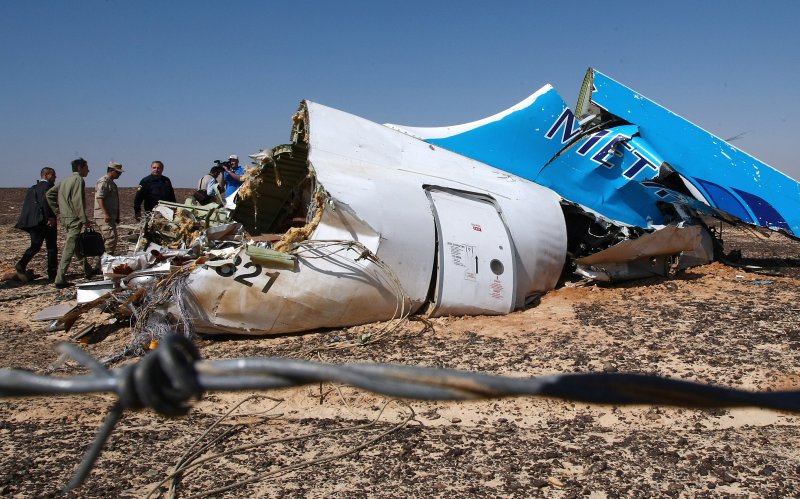
Wednesday brought a veritable smorgasbord of “new” information about the Russian passenger jet which fell out of the sky above the Sinai Peninsula last weekend.

First there was an audio recording from ISIS’ Egyptian affiliate reiterating that they did indeed “down” the plane. Next, the ISIS home office in Raqqa (or Langley or Hollywood) released a video of five guys sitting in the front yard congratulating their Egyptian “brothers” on the accomplishment.

Then the UK grounded air traffic from Sharm el-Sheikh noting that the plane “may well” have had an “explosive device” on board.

Finally, US media lit up with reports that according to American “intelligence” sources, ISIS was probably responsible for the crash.

Over the course of the investigation, one question that’s continually come up is whether militants could have shot the plane down. Generally speaking, the contention that ISIS (or at least IS Sinai) has the technology and/or the expertise to shoot down a passenger jet flying at 31,000 feet has been discredited by “experts” and infrared satellite imagery.

But that’s nothing the CIA can’t fix.

With the Pentagon now set to deploy US ground troops to Syria (and indeed they may already be there, operating near Latakia no less), Washington is reportedly bolstering the supply lines to “moderate” anti-regime forces at the urging of (guess who) the Saudis and Erdogan.

Incredibly, some of the weapons being passed out may be shoulder-fire man-portable air-defense systems, or Manpads, capable of hitting civilian aircraft. 

But don’t worry, those will only be given to “select rebels.” Here’s more from WSJ:

 The U.S. and its regional allies agreed to increase shipments of weapons and other supplies to help moderate Syrian rebels hold their ground and challenge the intervention of Russia and Iran on behalf of Syrian President Bashar al-Assad, U.S. officials and their counterparts in the region said.

The deliveries from the Central Intelligence Agency, Saudi Arabia and other allied spy services deepen the fight between the forces battling in Syria, despite President Barack Obama’s public pledge to not let the conflict become a U.S.-Russia proxy war.

Saudi officials not only pushed for the White House to keep the arms pipeline open, but also warned the administration against backing away from a longstanding demand that Mr. Assad must leave office.

In the past month of intensifying Russian airstrikes, the CIA and its partners have increased the flow of military supplies to rebels in northern Syria, including of U.S.-made TOW antitank missiles, these officials said. Those supplies will continue to increase in coming weeks, replenishing stocks depleted by the regime’s expanded military offensive.

An Obama administration official said the military pressure is needed to push Mr. Assad from power. 

“Assad is not going to feel any pressure to make concessions if there is no viable opposition that has the capacity, through the support of its partners, to put pressure on his regime,” the official said.

In addition to the arms the U.S. has agreed to provide, Saudi and Turkish officials have renewed talks with their American counterparts about allowing limited supplies of shoulder-fire man-portable air-defense systems, or Manpads, to select rebels. Those weapons could help target regime aircraft, in particular those responsible for dropping barrel bombs, and could also help keep Russian air power at bay, the officials said.

Mr. Obama has long rebuffed such proposals, citing the risk to civilian aircraft and fears they could end up in the hands of terrorists. To reduce those dangers, U.S. allies have proposed retrofitting the equipment to add so-called kill switches and specialized software that would prevent the operator from using the weapon outside a designated area, said officials in the region briefed on the option.

U.S. intelligence agencies are concerned that a few older Manpads may already have been smuggled into Syria through supply channels the CIA doesn’t control.

If that sounds insane to you, that’s because it is. Even as US intelligence (which we can only assume emanates from the CIA) indicates that IS Sinai likely brought down a Russian passenger jet with 224 people on board, the same CIA is working with the Saudis to supply “select rebels” with weapons capable of shooting down commercial airliners.

In order to make sure no one ends up blowing a 747 out of the sky, Washington will “retrofit” the weapons with “special” software that makes sure they can only be used in certain areas.

Make no mistake, this has gone beyond absurd and is now bordering on the bizarre. It’s apparently not enough that the US is supplying anti-tank missiles to rebels shooting at the very same Iran-backed militias that the US implicitly supports across the border in Iraq so now, the CIA and Saudi Arabia will give these rebels the firepower to shoot down planes, meaning that in the “best” case scenario they’ll be firing at Russian fighter jets, and in the worst case scenario these weapons will end up in the “wrong” hands and be used to down commercial flights. 

It’s difficult to see how John Kerry can attend “peace” talks in Vienna and keep a straight face while chatting with Sergei Lavrov. That’s not to say that Russia bears no responsibility for its role in the conflict (sure, Moscow is supporting a “legitimate” government in Syria but they’re still dropping bombs on populated areas), but the US and the Saudis are arming Sunni extremist groups and encouraging them to shoot at Russian and Iranian forces. For Obama to suggest this isn’t a proxy war is absurd.

Putting this all together, it now appears possible that the US is, i) sending anti-tank weapons to rebels who are shooting at Iranian soldiers, ii) embedding ground troops near Latakia which means they’ll almost certainly be engaging Hezbollah directly, and iii) passing weapons capable of downing a commercial airliner to “select” militants days after a Russian passenger jet exploded in the skies above the Sinai Peninsula.

This is all in conjunction with the Saudis and Erodgan, who just rigged an election in Turkey on the way to rewriting his country’s constitution.

And the Western media reports this with a straight face as though it all makes some measure of sense…

Israeli wounded with mysterious bottle

November 6, 2015

Chemical warfare? Israeli wounded with mysterious bottle Escalation of the terror wave: motorist lightly wounded, suffering burning eyes after bottle of unknown liquid hurled at car outside J’lem.

By Ari Yashar

First Publish: 11/6/2015, 12:04 PM

Source: Israeli wounded with mysterious bottle – Defense/Security – News – Arutz Sheva

Arab rioter throws bottle (illustration)

Arab rioter throws bottle (illustration)
Ahmad Gharabli/Flash 90

The current wave of Arab terror attacks sweeping Israel has included numerous lethal forms, from stabbing to shooting, rock throwing to car attacks – but a chilling incident on Friday indicates a potential escalation in the terror towards the direction of chemical warfare.

The attack took place late Friday morning near the Hizme Checkpoint, located not far from the Jerusalem neighborhood of Pisgat Ze’ev to the northeast of the capital.

In the incident, Arab rioters hurled rocks and a bottle with an unidentified substance inside it at an Israeli car, not far from the checkpoint.

The Israeli motorist drove to the checkpoint where he complained of suffering from a burning feeling in his eyes, indicating the contents of the bottle were some chemical substance, possibly a type of acid.

He was classified as lightly wounded and received medical treatment at the site.

The attack would seem to indicate a potential increase in the severity of means used by Arab rioters who hurl rocks at Israeli cars on a daily basis.

It follows calls by a veteran terrorist who last month urged the younger generation of terrorists to poison their knives before stabbing Jews, in a call for chemical warfare.

Such weapons have been a chilling, if infrequent element in the arsenal of Palestinian Arab terrorists. Back in 2001 Hamas claimed detonating poisoned bombs in attacks against Israeli civilians.

At the time the Israeli Health Ministry revealed that a bomb detonated in an attack in Jerusalem on December 1, 2001 was filled with nails dipped in rat poison. A police spokesperson was quoted by Associated Press at the time saying that since 1995, traces of chemicals had been found at the site of at least five bombing attacks.

UK Resumes Flights From Sharm el-Sheikh But Adds Security at Airport

November 6, 2015

Britain agrees to resume flights from Sharm el-Sheikh, with new security measures and additional staff at the airport.

By: Hana Levi Julian

Published: November 6th, 2015

Source: The Jewish Press » » UK Resumes Flights From Sharm el-Sheikh But Adds Security at Airport

An airplane over Eilat near the southern Israeli border, close to Jordan and Egypt's Sinai Peninsula.

An airplane over Eilat near the southern Israeli border, close to Jordan and Egypt’s Sinai Peninsula.
Photo Credit: Moshe Shai / Flash 90

Britain has decided to allow flights to resume from the Egyptian resort of Sharm el-Sheikh as the probe into Saturday’s crash of a Russian MetroJet continues.

At present there are 20,000 UK citizens stranded in the area, most of them tourists.

The UK prime minister’s office had suspended flights after the Russian airliner apparently exploded above the Sinai Peninsula while en route to St. Petersburg from Sharm el-Sheikh.

According to the latest intelligence, Da’esh (ISIS) may indeed have succeeded in planting a barometric pressure bomb aboard the aircraft prior to its departure from the airport.

“Following further discussions with the airlines and the Egyptians, we have agreed on a package of additional security measures that is being put in place rapidly,” Prime Minister David Cameron’s office said in a statement. “Consequently the government has decided, in consultation with the airlines that flights from Sharm to the UK will resume tomorrow.”

Egyptian President Abdel Fattah el-Sisi met with Cameron at his office in London on Thursday.

Cameron told journalists that “more likely than not” it was a terrorist bomb that brought down the aircraft – a view shared by UK and U.S. intelligence personnel, as well as other intelligence operatives in the Middle East.

“I think there is a possibility that there was a bomb on board,” agreed President Barack Obama in a radio interview late Thursday, “and we’re taking that very seriously.”

The UK has sent extra security personnel to the airport in Sharm el-Sheikh to carry out special measures.

Checked bags are being sent back to the UK separately, passengers are being body-searched and carry-on luggage only is being allowed on all return flights. Investigators are checking for explosive residue, as are the bodies of the victims of the doomed flight.

Obama rules out Israeli-Palestinian peace deal before leaving office

November 6, 2015

Obama rules out Israeli-Palestinian peace deal before leaving office US officials say president has made ‘realistic assessment’; will discuss steps to prevent further violence with Netanyahu on Monday

By AP, Times of Israel staff and AFP

November 6, 2015, 2:17 am

Source: Obama rules out Israeli-Palestinian peace deal before leaving office | The Times of Israel


From left: Prime Minister Benjamin Netanyahu, US President Barack Obama and PA President Mahmoud Abbas during a trilateral meeting in New York, Sept. 22, 2009 (photo credit: Avi Ohayon/GPO/Flash90)

From left: Prime Minister Benjamin Netanyahu, US President Barack Obama and PA President Mahmoud Abbas during a trilateral meeting in New York, Sept. 22, 2009 (photo credit: Avi Ohayon/GPO/Flash90)

US officials said Thursday that President Barack Obama has made a “realistic assessment” that a peace deal between Israelis and Palestinians is not possible during his final months in office.

The stark assessment comes ahead of Israeli Prime Minister Benjamin Netanyahu’s visit to the White House on Monday — the first meeting between the two leaders in more than a year. Preparation for that meeting has been overshadowed by Netanyahu’s appointment of a new media chief, Ran Baratz, who has previously branded Obama an anti-Semite and mocked Secretary of State John Kerry. Netanyahu was Thursday night said to have told Kerry that he was reviewing the appointment.

Officials said the two leaders will discuss steps to prevent a confrontation between the parties in the absence of a two-state solution. They said that while Obama remains committed to a two-state solution between Israelis and Palestinians, he does not believe it’s possible before he leaves office in January 2017, barring a major shift.

White House deputy national security adviser Ben Rhodes told Israeli reporters that the president would want to hear from Netanyahu on Monday ways in which the prime minister will seek to keep a two-state solution viable even in the absence of direct negotiations. Rhodes said Obama regards a two-state solution as urgent, and reiterated the US stance that settlement building undermines faith in the diplomatic process and delays such a solution.

“The main thing the president would want to hear from Netanyahu is that, without peace talks, how does he want to move forward to prevent a one-state solution, stabilize the situation on the ground and to signal he is committed to the two-state solution,” said Rob Malley, the president’s senior adviser on the Middle East, according to Haaretz.

The president expects that Netanyahu will take trust-building steps that “leave the door open for a two-state solution,” Malley said, without elaborating. “We said for some time that we expect from both parties to show that they are committed to a two-state solution. We would expect they take steps that are consistent with that,” Malley said.

A wave of Israeli-Palestinian violence, marked by dozens of Palestinian stabbing attacks on Israelis, broke out two months ago; clashes at Jerusalem’s contested Temple Mount have been followed by Palestinian terror attacks across Israel and into the West Bank, and Palestinian-Israeli clashes in the West Bank and at the border with the Gaza Strip.

At a press conference last month, Obama reiterated his long-held conviction that the only way Israel would be secure, and the Palestinians would meet their aspirations, was via a two-state solution. He indicated then, but did not spell out, that the US was not about to start a new peace effort, saying “it’s going to be up to the parties” to do that, “and we stand ready to assist.”

Kerry sought to be broker an accord in 2013-2014, but the effort collapsed amid a stream of bitter accusations and recriminations between the sides.

With no realistic prospect of substantial negotiated progress, the Obama administration is said to remain determined to keep the idea of a two-state solution viable, and it is understood the president and the prime minister will discuss possible steps in that direction.

The two leaders will likely discuss means to prevent a further deterioration on the ground, including how to thwart further terrorism; tackle incitement more effectively; deal with the strained Palestinian Authority; and safeguard Israeli-Jordanian relations.

No meeting is known to be scheduled for the near future between Obama and PA President Mahmoud Abbas.

The two leaders are also expected to announce that their allied countries are at work on a new long-term agreement for US defense assistance to Israel. The current 10-year framework, which provided for over $30 billion in US military aid, expires in 2018, and there has been talk of a new 10-year framework valued at $40-50 billion in total.

Obama and Netanyahu are expected to discuss commitments that could see Israel get more than the 33 hi-tech F-35 jets already ordered, precision munitions and a chance to buy V-22 Ospreys and other weapons systems designed to ensure Israel’s military edge over its neighbors.

The weapons said to be under discussion reflect the prominence of Iran in US and Israeli military thinking.

The F-35 is the only aircraft able to counter the S-300 surface-to-air missile system that Russia has suggested it may sell to Tehran.

Officials said Israel may also seek to ensure that other US allies in the region do not get the F-35.

The White House has so far rebuffed Arab Gulf states’ requests to buy the planes.

But while Israel has been offered some bunker-busting bombs, divisions over how to handle Tehran may put the sale of 30,000 pound “Massive Ordnance Penetrators” that could be used to target Iranian nuclear sites off the table.

“This is not something that has been raised in the context of the MoU discussions,” said senior Obama national security aide Ben Rhodes referring to the deal, known formally as a memorandum of understanding.

Military experts say Israel’s lack of bunker busting capability has limited Netanyahu’s ability to launch a unilateral strike against Iran, effectively giving Washington a veto over military action.

The visit, Rhodes said, “would be an opportunity to discuss and hear from Israel its assessment of its security challenges and the related security needs it has… whether it is something like the F-35 or a variety of others.”

Obama and Netanyahu will be meeting face-to-face for the first time since the US and its partners reached a nuclear accord with Iran. Netanyahu has been a chief critic of the deal.

On that vexed issue, the meeting could mark the day when Netanyahu finally engages with the administration on the practical implications of the deal, enabling the two sides to get down to work coordinating their positions on countering the threats posed by an emboldened and soon-to-be wealthier Iran, and on the appropriate responses to possible Iranian violations of the deal.

Cartoon added by JK

Two-Office Solution

Photo Credit: Asher Schwartz

‘Islamophobia’ in America vs. murderous Christophobia in the Islamic world

November 5, 2015

‘Islamophobia’ in America vs. murderous Christophobia in the Islamic world, Front Page MagazineJack Kerwick, November 5, 2015

(‘Jewophobia’ appears to be at least as prevalent. — DM)

Cross

As organizations like CAIR and their allies wax indignant over “Islamophobia” in America, Muslims around the globe are visiting the worst sort of cruelty upon the Christian minorities in their midst.

For instance, over a span of four days, from October 19-23, the Indonesian government succumbed to the demand of Islamic “extremists” and demolished nine churches.  Six days earlier, on October 13, Muslims unleashed a torrent of violence that left a church burned to the ground and a person dead.

And in the course of this single day, 8,000 Christians found themselves displaced from their homes.

The government has deported them.

According to a local church activist, someone who self-identified only as “Rudy,” Islamic militants issued an ultimatum to the Indonesian government: Either raze these Christian churches to the ground or “the radicals will deploy around 7,000 people” to besiege this Christian community.

The organization Open Doors, a group dedicated to “serving persecuted Christians worldwide,” reports: “Church members wept as they watched in despair [as] civil police officers [began] hammering down their worship houses.” As of this juncture, over 1,000 “churchless believers are prohibited from raising temporary tents to hold Sunday worship services.”

The predominantly Islamic country of Bangladesh is a place where Christian women are regularly subjected to unspeakable violence.  Open Doors states that “two out of every three women in Bangladesh will experience gender-based violence in their lifetimes.” Furthermore, the United Nations’ “Special Rapporteur on Violence Against Women” has found that “girls are regularly harassed and abused on their way to and from school,” a phenomenon that is the function of the fact that “sexual harassment is often seen as ‘part of the culture.’”

One young woman who has fallen victim to this culture is Susmita Chambugonj.  Back in May, the 20-year-old was assailed by five “youths” who dragged her into a microbus.  While inside, Susmita was raped by two of her abductors.

The current “refugee crisis” has hit Syrian and Iraqi Christians particularly hard. Open Doors informs us that Christians in these countries “have had their homes marked by ISIS,” and “some come from historically Christian towns that were obliterated.” Moreover, some Christians are discovering “that they are being discriminated against when it comes to receiving aid.”

In Africa, stories of Islamic-on-Christian oppression are even more grisly.  At the same time, these same stories supply us with proverbial textbook exhibitions of Christian heroism.

Earlier in the year Boko Haram paid Habila Adamu a visit at his home.  When the militants informed Habila that they were “looking for him” in order to end his life, he replied that he had been looking for them as well—but in order to share with them the Gospel of Christ.

The predators weren’t impressed.  When Habila refused to recant his faith, his persecutors shot him in the face and left him for dead.

Thankfully, Habila survived.

Joshua, however, did not.  Joshua was 18 years old.  A member of a family of farmers, he worked in a factory during the dry season.  One day, Islamic militants showed up at his place of employment and proceeded to separate those employees who were Muslims from those that were Christians.  Then, they wasted no time in murdering the Christians one by one.

Initially, Joshua was in another room with some other employees. They watched through a window as the mass murder unfolded.  When an Islamic woman and fellow employee of Joshua begged the latter to deny his Christianity, he refused. Joshua was blunt: “No,” he told her, for “I am a Christian and they are killing my brothers.”

Joshua continued: “I am also going out there. I am not going to stay here and pretend that I am a Muslim.”

Joshua was martyred along with nine young men.

Even as I write this, the Christian community in Turkey has become the object of a systematic, relentless campaign of death threats.  According to Open Doors, the targeted are being blasted for being “heretics” who have “chosen the path that denies Allah[.]”

In Pakistan this past July, Saddique Azam, a veteran school teacher, was promoted to the position of “headmaster” at an elementary school.  Azam is a Christian.  For months, he was repeatedly threatened by Muslims who believed that the office of headmaster should be held by a Muslim.  Azam refused to resign.

Then, on October 6, three of his Islamic colleagues who worked under him physically attacked Azam.

Azam recounted his experience: “Three Muslim teachers entered the school, went into my office and waited for me there.  When I entered the office, I was alarmed to see them.  I asked them the reason for the visit and they launched a tirade of warnings against me to withdraw and resign from teacher headship.”

From the beating, Azam sustained a severe injury to his left eye.  Things could’ve been worst had it not been for other staff that stopped the assault.

But witnesses reported that while they pummeled Azam, his Islamic assailants mocked him by referring to him as “choora,” an anti-Christian epithet used by Pakistani Muslims. “Choora” connotes the “sweeper” or “untouchable” caste.  “You are a ‘Christian Choora,’” his victimizers shouted. How, then, “can you be a headmaster and be given seniority over us?”

The next time that we hear about the “Islamophobia” that Muslims in America allegedly face, let’s recall the face of real religious persecution: the persecution that truly defenseless Christians suffer at the hands of Muslim aggressors throughout the Islamic world.

Anti-air missiles in ISIS hands also imperil Saudi, Jordanian and Israeli skies

November 5, 2015

Anti-air missiles in ISIS hands also imperil Saudi, Jordanian and Israeli skies, DEBKAfile, November 5, 2015

Shut_up

The Ansar al Sharia terrorist organization in Libya, which attacked the US consulate in Benghazi and murdered the American ambassador in 2012, has the very missiles capable of shooting down large airliners flying at high altitudes: Russian-made ground-to-air Buk missiles, which have a range of between three and 42 kilometers. This ultra-violent Islamist terror group has very close operational ties with ISIS-Sinai, and very possibly smuggled the missile system into Sinai from Libya.

****************************

The British Cobra (emergency cabinet) decision of Wednesday, Nov. 4, not to send airliners to or from Sharm El-Sheikh, where 20,000 British tourists are stranded, further strengthens the assumption that the Russian Metrojet Flight 9268 was downed over Sinai Saturday by a terrorist missile. It confirms that air traffic over Sinai and landings at Sharm are under threat from the ground – else why leave a large group of Britons under virtual siege in the Egyptian Red Sea resort? London said that the suspension of flights to Sharm was “indefinite.”

Moscow early Thursday accused London of being moved to this action out of hostility to Russia rather than security concerns.

Downing Street released a statement Wednesday saying: “As more information has come to light, we have become concerned that the plane may well have been brought down by an explosive device.” This statement was criticized by Egypt as “premature” – not a good omen for the conversation Prime Minister David Cameron is due to hold with his visitor, Egyptian president Abdel-Fatteh El-Sisi, later Thursday.

The British government has therefore stubbed toes in Moscow and Cairo without coming up with an emergency plan for evacuating its citizens from Egypt, whether overland to Cairo by bus or by sea aboard ships picking them up at the Red Sea resort and sailing through the Suez Canal.

This lack of initiative is a sign of confusion and uncertainty.

So far, the drawn-out deliberations and prevarications by officials in several countries regarding the crash of the Russian plane are meant for one purpose: to gain time for doing nothing about ISIS in Sinai. Neither the US, Russia or Britain is ready to send forces to the peninsula to confront the terrorists head-on.

The Ansar al Sharia terrorist organization in Libya, which attacked the US consulate in Benghazi and murdered the American ambassador in 2012, has the very missiles capable of shooting down large airliners flying at high altitudes: Russian-made ground-to-air Buk missiles, which have a range of between three and 42 kilometers. This ultra-violent Islamist terror group has very close operational ties with ISIS-Sinai, and very possibly smuggled the missile system into Sinai from Libya.

A number of intelligence agencies are aware of this and so a flock of leading European and Persian Gulf airlines lost no time in rerouting their flights to avoid Sinai straight after the Russian air disaster.

By causing this disaster, the Islamist terrorists coolly aimed for four goals:

1.  Retaliation for Russian intervention in Syria

2.  An attempt to destabilize the regime of Egyptian President Fattah Al-Sisi

3.  To show up the inadequacies of the 63-member coalition that the US formed in its effort to fight ISIS

4. To parade before the world the Islamic State’s operational prowess, its ability to shoot down the large passenger planes of the world’s biggest powers.

For five days, intelligence and flight safety experts dismissed the claim of responsibility that ISIS issued on the evening of October 31, maintaining that it was not to be taken seriously because no proof had been provided to support the claim – as if the charred fragments of the plane spread across tens of kilometers of desert were deniable.

In the second of its three messages, ISIS repeated its claim Wednesday, Nov. 4, promising details of how it downed the plane at a later date.

While more and more Western governments are coming around to accepting that the Russian airliner’s crash was caused by an explosive device, DEBKAfile’s counterterrorism sources repeat that they cannot rule out the possibility of a missile. The argument made on Wednesday in Washington and London that terrorist organizations do not have missiles capable of downing such planes is are simply incorrect.

ISIS-Sinai’s possession of an advanced ground-air missile system does not only endanger planes in the peninsula’s airspace, but also those aircraft flying over the Suez Canal as well as parts of Saudi Arabia, Jordan and Israel. One of the Egyptian president’s main purposes in his London visit was to try and persuade Prime Minister Cameron to join an Egyptian military operation against Ansar al Sharia in Libya and so eliminate a major prop and arms supplier for ISIS-Sinai. He does not hold out much hope of success.

Ya’alon Warns Israel’s Enemies Divided on Ideology But United in Hatred

November 3, 2015

Defense Minister Moshe Ya’alon warns that Israel’s enemies are divided in ideology but united in their hatred of the Jewish State. By: Hana Levi Julian Published: November 3rd, 2015

Source: The Jewish Press » » Ya’alon Warns Israel’s Enemies Divided on Ideology But United in Hatred

An F-16 fighter jet takes off from Ramat David air force base.
Photo Credit: Ofer Zidon / Flash 90

Israel’s Defense Minister Moshe Ya’alon warned Tuesday that Israel’s enemies are split along ideological lines, but united in their hatred of the Jewish State.

The defense minister noted there appear are several axes among those aligned against Israel: on one side are forces united with the Muslim Brotherhood, which include Turkey and Qatar. On another, there are those united with the Global Jihad movement, which include Salafi Islamists such as Al Qaeda-linked groups such as the Army of Islam, and Da’esh (ISIS).

Both are united in their hatred of Jews and Israel, and the “unwillingness… to recognize our right to exist as the nation state of the Jewish people,” Ya’alon said – as is the Palestinian Authority.

[PLO Chairman Yasser] “Arafat and [Palestinian Authority leader Mahmoud] Abbas also did not want to end the conflict on the 1967 borders,” he said.

In remarks broadcast last week on official Palestinian Authority television, Abbas said in Arabic to the United Nations Human Rights Commission in Geneva: “Mr. President, ladies and gentlemen, haven’t you wondered: For how long will this protracted Israeli occupation of our land last? After 67 years (i.e., the re-creation of the State of Israel), how long? Do you think it can last, and that it benefits the Palestinian people?”

The remarks were translated and reported by the media watchdog organization Palestinian Media Watch (PMW). Www.palwatch.org

Israel has “zero tolerance” for arms sales to terrorists, the defense minister said in remarks following alleged Israeli air strikes against Hezbollah near the Syrian-Lebanese border.

Speaking at a Kibbutz Leadership conference in Judea-based Kibbutz Ma’ale Hamisha, near Jerusalem, Ya’alon warned in a cryptic remark, “Those who cross red lines will be hit.” It is believed that Ya’alon was referring not only to standard ordnance but also to the transfer of chemical weapons by Syria to the Hezbollah terrorists who have fought to defend President Bashar al-Asssad.

Ya’alon commented that the Hamas terror organization has only withheld hostilities out of dire necessity: “not because they have turned Zionist, but due to the price they paid [last year] in Operation Protective Edge.”

Analysis: Why Palestinians do not want cameras on the Temple Mount

November 3, 2015

Analysis: Why Palestinians do not want cameras on the Temple Mount

Source: Analysis: Why Palestinians do not want cameras on the Temple Mount – Arab-Israeli Conflict – Jerusalem Post

Why is the Palestinian Authority (PA) opposed to Jordan’s proposal to install surveillance cameras at Jerusalem’s Haram al-Sharif (Temple Mount), sacred to Christians, Muslims and Jews?

This is the question that many in Jordan have been asking in light of the recent agreement between Israel and Jordan that was reached under the auspices of US Secretary of State John Kerry. The idea was first raised by Jordan’s King Abdullah in a bid to ease tensions at the holy site in the Old City of Jerusalem.

Shortly after Israel accepted the idea, the Palestinian Authority rushed to denounce it as a “new trap.” PA Foreign Minister Riad al-Malki and other officials in Ramallah expressed concern that Israel would use the cameras to “arrest Palestinians under the pretext of incitement.”

During the past two years, the Palestinian Authority and other parties, including Hamas and the Islamic Movement (Northern Branch) in Israel, have been waging a campaign of incitement against Jewish visits to the Haram al-Sharif. The campaign claimed that Jews were planning to destroy al-Aksa Mosque.

In an attempt to prevent Jews from entering the approximately 37-acre (150,000 m2) site, the Palestinian Authority and the Islamic Movement in Israel hired scores of Muslim men and women to harass the Jewish visitors and the police officers escorting them. The men are referred to as Murabitoun, while the women are called Murabitat (defenders or guardians of the faith).

These men and women have since been filmed shouting and trying to assault Jews and policemen at the Haram al-Sharif. This type of video evidence is something that the Palestinian Authority is trying to avoid. The PA, together with the Islamic Movement, wants the men and women to continue harassing the Jews under the pretext of “defending” the al-Aksa Mosque from “destruction” and “contamination.”

The installation of surveillance cameras at the site will expose the aggressive behavior of the Murabitoun and Murabitat, and show the world who is really “desecrating” the Islamic holy sites and turning them into a base for assaulting and abusing Jewish visitors and policemen.

The cameras are also likely to refute the claim that Jews are “violently invading” al-Aksa Mosque and holding prayers at the Temple Mount. The Palestinian Authority, Hamas and the Islamic Movement have long been describing the Jewish visits as a “provocative and violent incursion” into al-Aksa Mosque. But now the cameras will show that Jews do not enter al-Aksa Mosque, as the Palestinians have been claiming.

Another reason the Palestinians are opposed to King Abdullah’s idea is their fear that the cameras would expose that Palestinians have been smuggling stones, firebombs and pipe bombs into al-Aksa Mosque for the past two years. These are scenes at the PA, Hamas and the Islamic Movement do not want the world to see: they show who is really “contaminating” the Haram al-Sharif. Needless to say, no Jewish visitors have thus far been caught trying to smuggle such weapons into the holy site.

By rejecting the idea of setting up 24-hour surveillance cameras at the Haram al-Sharif, the Palestinian Authority has found itself on a course of collision with Jordan. Jordanian politicians and columnists have voiced outrage over the stance of the PA, and have dubbed it harmful to Palestinian and Islamic interests.

The Jordanian newspaper Al-Ghad, which is close to the government, quoted Jordanian politicians as denouncing the opposition of the Palestinian Authority to the cameras as “inappropriate, clumsy, tasteless and unfair.”

Sources in Ramallah explained this week that the PA’s opposition to cameras should also be seen in the context of the power struggle between the Palestinians and Jordan over control of the Islamic holy sites in Jerusalem. The Jordanians have long been seeking to preserve their status as “custodians” of al-Aksa Mosque and other Islamic holy sites in Jerusalem. This is a status that some Palestinians and the Islamic Movement in Israel have been trying to change during the past two decades, especially after the signing of the Oslo Accords between the PLO and Israel in 1993.

The Palestinian Authority’s opposition to the installation of cameras is seen as an attempt to undermine Jordan’s status at the Islamic holy sites. Many Palestinians argue that they, and not the Jordanians, should be in charge of the Haram al-Sharif. Members of the PA are opposed to the cameras because it is a Jordanian proposal and reinforces Jordan’s role at the holy site.

As such, the Palestinian Authority’s position could be seen as an attempt to change the status quo at the holy site by driving the Jordanians out of the area. King Abdullah is obviously aware of the Palestinian attempt to prevent him from playing any role at the holy site; that is why he was quick to reach a deal with Israel about the installation of cameras. The PA, meanwhile, will continue to work against having cameras in the hope of preventing the world from seeing what is really happening at the site and undermining Jordan’s “custodianship” over Islamic holy sites in Jerusalem.

It now remains to be seen how Secretary Kerry, who brokered the camera deal between Israel and Jordan, will react, if at all, to the latest Palestinian Authority attempt to continue escalating tensions at the holy site. If Kerry fails to pressure the PA to stop its incitement and repeated attempts to exclude the Jordanians from playing any positive role at the Haram al-Sharif, the current wave of knife attacks against Jews will continue.

Russia warns that Syria war could become a ‘proxy war’

November 1, 2015

Russia warns that Syria war could become a ‘proxy war’ BreitbartJohn J. Xenakis, November 1, 2015

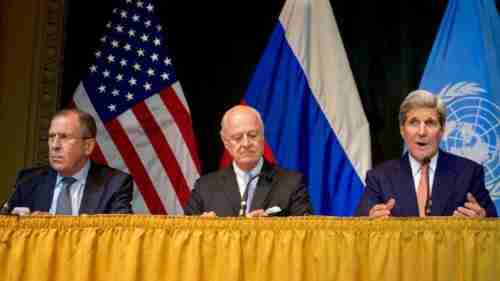
g151031bL-R: Sergei Lavrov, United Nations Special Envoy for Syria Staffan de Mistura, and John Kerry in Vienna on Friday (state.gov)

Russia has poured millions of dollars of heavy weapons into Syria, and is now sending in Russian troops to establish bases there. Recently, Russia launched 27 cruise missiles from the Caspian Sea to targets in Syria. Iran is pouring new troops into Syria. Iran has also given Lebanon’s Hezbollah terrorist group a great deal of money, and Hezbollah has sent thousands of troops into Syria to support Syria’s president Bashar al-Assad.

Al-Assad’s genocidal attacks on innocent Syrian Sunnis, killing hundreds of thousands and forcing millions from their homes, has caused Sunni jihadists from all of the world to fight against al-Assad, Russia, Hezbollah, and Iran in Syria. Along the way, these jihadists formed the so-called Islamic State (IS or ISIS or ISIL or Daesh).

And now, on Friday, Russia’s Foreign Minister Sergei Lavrov made a pronouncement that Barack Obama was going to trigger a “proxy war” in Syria by sending in 50 special operations forces, as we reported yesterday.

You can’t make this stuff up.

Thanks to Iran, Russia, al-Assad and Hezbollah, there are now tens of thousands of foreign troops fighting each other in Syria, with al-Assad in particular supported by massive amounts of foreign weapons.

But somehow, those tens of thousands of foreign fighters don’t make it a “proxy war,” but America’s 50 special forces troops do.

You can’t trust any garbage that comes out of Lavrov’s mouth, or out of al-Assad’s mouth, or out of Vladimir Putin’s mouth, but I listen to BBC, al-Jazeera, FOX, CNN, and other media sources all the time, and I see these news anchors report this crap with a straight face all the time. I don’t know whether it is more sickening to watch those fatuous news anchors, or to watch the fawning Secretary of State John Kerry suck up to Lavrov and Putin, which has happened in issues involving Ukraine, Iran’s nuclear development, and Syria.

All this verbiage is coming out of a meeting in Vienna whose purpose is to find a “political solution” to the Syria problem. With hundreds of thousands of Syrian migrants pouring into Europe, and with hundreds of ISIS militants returning to Russia to fight Putin, there is a lot of pressure to find a “political solution.” But this week’s announcement that Iran will fully enter the war in Syria on the side of the Syrian regime makes any “political solution” farther away than ever. On the contrary, Saudi Arabia and other Gulf countries will never agree to anything like the emerging situation. Actions by Russia and Iran, intervening militarily in Syria, is an emerging disaster, likely triggering a sectarian Sunni versus Shia war throughout the region. BBC and International Business Times and Reuters

Syria’s civil war and Generational Dynamics

In the 12 years that I’ve been doing this, I’ve posted about 4,000 articles with hundreds of Generational Dynamics predictions.

In 2011, when the Syrian civil war began, I said that the war should fizzle within a year or two. Of all the hundreds of Generational Dynamics predictions, this is the one where I’ve clearly been (depending on how you look at it) either wrong or poorly described.

Syria’s last generational crisis war was civil war that climaxed in 1982 with the massacre at Hama. There was a massive uprising of the 400,000 mostly Sunni citizens of Hama against Syria’s president Hafez Assad, the current president’s father. In February, 1982, Assad turned the town to rubble, 40,000 deaths and 100,000 expelled. Hama stands as a defining moment in the Middle East. It is regarded as perhaps the single deadliest act by any Arab government against its own people in the modern Middle East, a shadow that haunts the Assad regime to this day.

(As a related matter, the civil war in Lebanon also climaxed that year, with the bloody massacre at Sabra and Shatila occurring in September 1982. And it occurred as the Iran/Iraq war was ongoing, three years after Iran’s bloody Great Islamic Revolution in 1979. At that time, much of the Mideast was re-fighting World War I and the collapse of the Ottoman Empire, 60 years earlier.)

So, in 2011, I said that the civil war in Syria would fizzle, and could not turn into a crisis civil war. And that’s both wrong and true. There are too many survivors who remember the 1982 slaughter, and do not want to see it repeated. And so there’s been no massive anti-government uprising, as there was in 1982, and Bashar al-Assad’s Shia/Alawite troops have been fighting half-heartedly, with many soldiers defecting or deserting.

But the war did not fizzle.

It should have fizzled in 2011 or 2012, but Hezbollah and Iran starting pouring troops in to support al-Assad. And foreign fighters from around the world arrived to fight al-Assad and to form ISIS. That’s not something that Generational Dynamics could have predicted.

Earlier this year, it looked like al-Assad’s army was near collapse. In July, a desperate al-Assad gave a national speech in which he admitted he was losing. The war should have fizzled this year. But now, Russia and Iran are pouring tens of thousands more troops into Iran to bolster al-Assad. And that also is not something that Generational Dynamics could have predicted.

So the problem for me is: How should I have characterized the situation in 2011? The prediction that it wouldn’t turn into a crisis civil war was correct, but the war did not fizzle, because it turned into a proxy war.

Well, I don’t think there’ll be a next time, but if there is, I’ll try to characterize the situation differently, without simply using the word “fizzle.” NPR (1-Feb-2012)

Generational Dynamics and crisis civil wars

I write about a number of civil wars going on in the world today, so this is a good time to discuss civil wars from the point of view of Generational Dynamics.

Among generational crisis wars, an external war is fundamentally different than a civil war between two ethnic groups. If two ethnic groups have lived together in peace for decades, have intermarried and worked together, and then there is a civil war where one of these ethnic groups tortures, massacres and slaughters their next-door neighbors in the other ethnic group, then the outcome will be fundamentally different than if the same torture and slaughter is rendered by an external group. In either case, the country will spend the Recovery Era setting up rules and institutions designed to prevent any such war from occurring again. But in one case, the country will enter the Awakening era unified, except for generational political differences, and in the other case, the country will be increasingly torn along the same ethnic fault line.

The period following the climax of a crisis war is called the “Recovery Era.” One path that the Recovery Era can take is that the leader of one ethnic group decides that the only way to prevent a new civil war is for him to stay in power, and to respond to peaceful anti-government demonstrations by conducting massive bloody genocide, torture and slaughter of the other ethnic group, in order to maintain the peace. (Dear Reader, I assume you’ve grasped the irony of the last sentence.)

For example, in a July article about Burundi, I described how Burundi’s Hutu president Pierre Nkurunziza was using such violence to quell Tutsi protests, supposedly to avoid a repeat of the 1994 Rwandi-Burundi genocidal war between Hutus and Tutsis.

As another example, in a June article about Zimbabwe, I described how Zimbabwe’s president Robert Mugabe was even worse. His 1984 pacification campaign was known as “Operation Gukurahundi” (The rain that washes away the chaff before the spring rain). During that campaign, accomplished with the help of Mugabe’s 5th Brigade, trained by North Korea, tens of thousands of people, mostly from the Ndebele tribe, were tortured and slaughtered. Later, Mugabe single-handedly destroyed the country’s economy by driving all the white farmers off the farms, resulting in one of the biggest hyperinflation episodes in world history.

That is what Bashar al-Assad is doing in Syria. Fearing a Sunni uprising, like the one in 1982, al-Assad is conducting a massive “peace campaign” by slaughtering and displacing millions of innocent Sunnis. As I wrote above, this should have fizzled in 2011 or 2012, but it’s turned into a proxy war, and it’s a disaster for the Mideast and the world.

But none of the above three examples is a crisis civil war. A crisis war has to come from the people, not from the politicians. So, for example, there’s a massive crisis civil war going on today in Central African Republic (CAR), between the Muslim ex-Seleka militias fighting Christian anti-Balaka militias.

Unlike the previous examples, CAR is in a generational Crisis era. CAR’s last generational crisis war was the 1928-1931 Kongo-Wara Rebellion (“War of the Hoe Handle”), which was a very long time ago, putting CAR today deep into a generational Crisis era, where a new crisis war is increasingly likely. That’s why the CAR is a genuine crisis civil war, and won’t fizzle out. In fact, it won’t end until it has reached some kind of explosive conclusion — of the kind we described in Hama or Sabra and Shatila. ( “2-Oct-15 World View — Violence resurges in Central African Republic crisis war”)

Generational Dynamics and war between Palestinians and Israelis

I’ll discuss one more example — not a civil war, but very similar to a civil war, with the same kinds of issues.

In the last few years, there have been three non-crisis wars between Israelis and Palestinians in Gaza. In each case, the Israelis destroyed Hamas’s infrastructure, ending the war. The war began again each time when Hamas’s infrastructure was rebuilt.

But the point I want to make is that these three non-crisis wars were all directed by politicians. Palestinians attacked when the leadership told them to, and stopped attacking when the leadership told them to stop.

What I have been describing in numerous articles recently is that there is emerging a major, fundamental, historic change.

In the emerging situation, young people today are no longer willing to listen to these leaders. According to the CIA World Fact Book, 20% of Gaza’s population are in the 15-24 age range, and so are 21% of the West Bank — about 200,000 males in each territory, or 400,000 young males total.

On the Israeli side, there are over 600,000 young males in the same age range. There have been unconfirmed reports of young Israelis also disgusted with the leadership. It is possible that, like the young Palestinians, they are willing to take matters into their own hands.

So in this environment, what could happen next? The last three Gaza wars were non-crisis wars, but the next one could be a crisis war between Israelis and Palestinians.

How can a crisis war begin? How about if those 200,000 young male Gazans blow holes in the walls, pour across into Israel and start killing Israeli citizens en masse in their homes and villages? And how about if they are joined by those 200,000 young male Palestinians on the West Bank, who start with the Jewish settlers and continue with the Jews in Jerusalem. And how about if the young Israeli males strike back and start killing Palestinians in their homes and villages?

Israel’s tanks and bombers would not be of much use. You can’t bomb Jerusalem, and you can’t bomb Israeli villages and settlements to kill Palestinians.

That is the difference. That is what a generational crisis war is like. It is not two tanks shooting at each other. It is hand to hand combat in homes, neighborhoods and streets by people armed with sticks and knives. It is what happened in Central African Republic last year, it is what happened in Rwanda in 1994, in Bosnia in 1994, and in Palestine in 1947.

And by the way, that assumes that the bloody mess stays confined to Israel and the Palestinian territories. The Palestinians are likely to be joined by tens or hundreds of thousands from Jordan, Lebanon and Egypt.

The recent widely reported changes in the attitudes and behaviors of young Palestinians is a sign that this kind generational crisis war is coming.