Posted tagged ‘Middle East’

The IDF’s Misplaced Trust in the Palestinian Authority

February 3, 2016

The IDF’s Misplaced Trust in the Palestinian Authority The new major threat inside Israeli communities enters a new phase.

February 3, 2016 Caroline Glick

Source: The IDF’s Misplaced Trust in the Palestinian Authority | Frontpage Mag

Amjad Sakari made no effort to hide his feelings and intentions towards Israel. The soldier in the Palestinian security forces filled his Facebook page with paeans to Saddam Hussein. Last weekend he published two posts indicating his imminent plan to carry out a terrorist attack.

In other words, if the PA forces he served had been serious about preventing their members from carrying out terrorist attacks, they could have easily prevented Sakari from driving to an IDF checkpoint between Ramallah and Beit El Sunday morning, opening fire and wounding three soldiers – one critically. Sakari, who was killed in the course of his attack, was the third member of the US-backed PA security forces who engaged in terrorism in the past two months.

On December 3, Mazen Ariba, an officer in the PA’s US-sponsored Preventive Security Forces opened fire on Israelis at the Hizma checkpoint north of Jerusalem. Ariba wounded two Israelis – one critically – before he was shot and killed.

Ariba, was PLO Secretary General Saeb Erekat’s nephew. Erekat made a very public condolence call to Ariba’s home. Ariba was posthumously hailed as a hero.

Two weeks ago, the Shin Bet arrested Ala’a Barkawi, an officer in the PA’s US-supported intelligence services. Barkawi was a member of a three-man terror cell that carried out a shooting attack against IDF forces operating in Tulkarm earlier last month.

Sunday night Prime Minister Binyamin Netanyahu demanded that PA President Mahmoud Abbas condemn the terrorism carried out by forces operating under his command. Abbas rejected Netanyahu’s demand and instead doubled down in supporting terrorism.

According to Channel 2, in US-mediated discussions between the two leaders, Abbas demanded that Israeli hand over Sakari’s body.

The IDF’s relationship with the Palestinian security forces is becoming a source of concern. The now five month old Palestinian terror campaign is entering a new phase, with direct attacks inside Israeli communities becoming a new major threat.

While many commanders on the ground in Judea and Samaria hold few illusions about the long-term viability of their cooperation with their US-trained Palestinian counterparts, senior IDF commanders serve as their greatest advocates and apologists. Following the murders of Dafna Meir and Shlomit Krigman late last week, the IDF’s senior commanders insisted yet again that Israel must do nothing to harm the PA security forces.

Sakari’s attack didn’t dampen their enthusiasm.

In a radio interview Monday morning, Defense Minister Moshe Yaalon reported that Palestinian forces foil about twenty percent of the terror plots. In so proclaiming the day after a Palestinian security officer gunned down three IDF troops, Yaalon made clear that the IDF will change nothing in its cooperative position towards them.

For their part, almost immediately after word got out that Sakari served in the PA forces, senior IDF commanders set out to control the damage. Sakari, they told reporters, was but a marginal figure in an unimpressive unit. He did not serve in any of the seven battalions deployed to the Palestinian population centers that were trained by the US military in Jordan. His actions, they insisted, were not indicative of a wider phenomenon within the PA security forces.

Both Yaalon and his senior commanders were doubtlessly telling the truth. But that doesn’t mean that all is well with the PA security forces.

Sakari served as a driver for the PA’s General Prosecutor Ahmed Hanoun. As such, he may have been a member of an unimportant unit, although certainly he had access to some of the most senior members of the PA. But as intelligence officers, Ariba and Barkawi were members of the core of the forces.

But in the final analysis, whether or not Ariba, Barkawi and Sakari were important operatives is beside the point. The main problem with the Palestinian security forces is that by their very nature, they are inherently hostile to Israel and supportive of terrorism.

PA forces are commanded by terrorists from Fatah and other affiliated PLO terror groups. The tens of thousands of men under arms in these forces are recruited from these terrorist groups.

The Palestinian Authority which they serve itself supports terrorism. On a practical level, as Deputy Foreign Minister Tzipi Hotovely relayed in a Wall Street Journal op-ed last week, the PA spends 16 percent of its donor financed annual budget paying salaries to terrorists jailed in Israeli prisons and stipends to their families. Moreover, the PA’s heroes are all terrorists. Its media and school system daily incite Palestinians to take up arms against Israelis and murder them. Murad Adais, who murdered Dafna Meir in her home in Otniel two weeks ago told investigators that he decided to murder Jews after watching incendiary PA media broadcasts.

In trusting the security cooperation they receive from the PA, our military leaders are mistaking inputs for outputs. That is, they assume that because they receive cooperation from these forces, these forces are inherently friendly. But again, the opposite is the case.

The PA is cooperating with the IDF today for two reasons. First, at present, Abbas believes that he has more to gain from cooperating with Israel than he does from Hamas. Second, at present, Abbas controls the bulk of his forces.

Both of these variables are likely to change, and Israel can do nothing to keep them constant.

In the past, both Abbas and his predecessor Yassir Arafat assessed at various points that they were better off cooperating with Hamas against Israel than with Israel against Hamas. Their decisions in 1996, from 2000 to 2007, and intermittently ever since, have had little to do with Israel’s positions. Indeed, their shifts from Israel to Hamas have often occurred at times when Israel did the most to support them.

As for Abbas’s control over his forces, this too can change on a dime. For years, Palestinian sources have insisted that these forces feel no intrinsic loyalty to Abbas. They stay with Abbas because he pays them.

Ideologically, these men under arms are free floaters. Nothing they believe is a bar for shifting their loyalties to Hamas. More to the point, all the US financial transfers to the PA security forces won’t stop any of the US-trained Palestinian forces from moonlighting as Hamas, Fatah or Hezbollah terrorists. They’ve done it in the past and they will do it again.

The instrumental, and necessarily temporary nature of Palestinian security cooperation with the IDF tells us three things.

First, the IDF needs to ditch its current counterterror strategy which is based on the wrongheaded assumption that we can rely on the PA security forces. Central Command needs to develop contingency plans for neutralizing these forces. These contingency plans don’t need to be made public. But to the extent that aspects of the plans can be quietly implemented, they should be implemented as quickly as possible.

Second, IDF commanders need to stop praising these hostile forces. At some point in the not so distant future the IDF will be required to fight these forces. When that day comes, the IDF’s enthusiastic tributes to their great cooperation with these terror-supporting forces will come back to haunt us. How will we be able to explain why our actions are necessary to allies to whom we have praised these hostile forces? This brings us to the final thing we need to recognize about these Palestinian forces. It was a major strategic blinder for Israel to support the US’s decision to train them. By supporting the US training program, Israel has given the US an incentive to deny the hostile nature of these forces.

Even worse than guaranteeing that the US will be unwilling to accept that in training these forces its military built a terror army, is that threat these forces pose. Today seven US-trained Palestinian combat battalions are deployed close to Israel’s major urban centers. Their fighting skills far surpass anything Israel has had to deal with in campaigns to date against Palestinian terror onslaughts.

As IDF commanders have warned over the years, due to the American training these terror-supporting anti-Israel forces have received, they can overrun small Israeli communities. They can carry out mass terror onslaughts in larger ones, on both sides of the armistice lines.

Following Sakari’s attack, Monday morning the IDF encircled Ramallah, barring non-residents from entering the city. The move was first announced by Palestinian security forces. So clearly the IDF coordinated the move with them before implementing it.

It is all well and good that the Palestinians continue to cooperate with the IDF, to the extent that the do. But Sakari’s attack must serve as a wake-up call. The defense establishment needs to quit relying on and praising this cooperation.

Because it will end. And if we are not prepared, the end will be very bad for Israel, and for the IDF.

 Critical Injuries in Jerusalem Attack, 3 Terrorists Dead [video]

February 3, 2016

By: David Israel Published: February 3rd, 2016

Source: The Jewish Press » » Critical Injuries in Jerusalem Attack, 3 Terrorists Dead

ID cards of the three terrorists who carried out attack at Jerusalem's Damascus Gate.

ID cards of the three terrorists who carried out attack at Jerusalem’s Damascus Gate.
Photo Credit: social media

A young female Border Guard officer was critically injured Wednesday afternoon in a combined stabbing and shooting attack by three terrorists at the Shechem (Damascus) Gate of the Old City of Jerusalem. Another female Border Guard police officer was seriously wounded and a third person was less severely injured. Numerous others were badly traumatized from the scene.

Aftermath of attack at Damascus gate entrance to Old City of Jerusalem.

Security forces initially prevented the Magen David Adom paramedics from going near the attackers for fear of a pipe bomb the terrorists were carrying.

According to Jerusalem police, three terrorists armed with Carl Gustav M/45 sub-machine guns, knives and explosives arrived at the Damascus Gate and were immediately identified by Border Guard officers at the site. They stopped them for questioning; one terrorist handed his ID card, the other pulled out his gun and started shooting. Two female Border Guards were injured and all three of the terrorists were neutralized.

The critically injured female officer, 20, was rushed to the Trauma Center at Hadassah Mount Scopus Medical Center, as was the second female officer, 19, who was stabbed in the neck. A man, 21, was injured lightly; he was treated at the scene and then evacuated to the hospital as well.

Two pipe bombs were successfully dismantled by sappers from the security force, according to Israel Police spokesperson Micky Rosenfeld.

The three terrorists were residents of Qabatiya, in the Jenin area of Samaria, with no prior history of security offenses, according to Israeli security sources.

All three of the attackers — Ahmed Rajeh Zakarneh, Mohamed Ahmed Kmail and Ahmed Najeh Abu Al-Rub – were killed.

The Really Insane Thing About Ban Ki-Moon’s Speech

January 28, 2016

The Really Insane Thing About Ban Ki-Moon’s Speech, AlgemeinerElder of Ziyon, January 27, 2016

(H/t The Jewish Press

Ban-Ki-Moon-two-state-solution

— DM)

Ban-Ki-Moon-270x300United Nations Secretary-General Ban Ki-moon, pictured, this week addressed the Security Council “on the situation in the Middle East.” Photo: World Economic Forum.

Yes, it is outrageous that Ban Ki Moon essentially called terror attacks a natural result of “occupation,” and Netanyahu was right in slamming him for it.

But that wasn’t the strangest part of the speech.

The title of Ban Ki-Moon’s talk was “Secretary-General’s remarks to the Security Council on the Situation in the Middle East.”

There were 52 paragraphs in the speech according to the official UN record.

Of those 52, three were about Lebanon. Two referred to Syria – one about refugees and one about the Golan.

The entire rest of the speech was about Israel and the Palestinians.

The Secretary General of the UN gives an overview of the Middle East without mentioning Syrian atrocities, without mentioning Iraqi instability, without even mentioning ISIS.

Nothing about Iran. Nothing about Saudi Arabia, which is killing more civilians in Yemen than Israel did in Gaza. Nothing about Egypt or Libya. Not a word about Kurds.

On the contrary – Ban Ki Moon implied that if only Israel would just give some more concessions, then the rest of the region would be inspired to make peace. “As the wider Middle East continues to be gripped by a relentless wave of extremist terror, Israelis and Palestinians have an opportunity to restore hope to a region torn apart by intolerance and cruelty.”

The word “obsession” hardly does justice to the single-minded Israel fetish at the UN.

But, yes, we must also be angry at the Secretary General’s justification for terror.

Report: Turkey suspects Russia building air base near border with Syria

January 22, 2016

Report: Turkey suspects Russia building air base near border with Syria

January 22, 2016, Friday/ 14:41:44/ TODAY’S ZAMAN

Source: Report: Turkey suspects Russia building air base near border with Syria

 Report: Turkey suspects Russia building air base near border with Syria

Turkish troops and military vehicles are seen on the Turkish-Syrian border near the Syrian town of Qamishli in this May 2015 file photo. (Photo: DHA)

Turkish authorities reportedly have intelligence suggesting that Russia might be preparing to establish an air base close to Turkey’s border with Syria, a step likely to deepen tensions that flared between the two countries after Turkish warplanes downed a Russian fighter jet in November last year, according to a report.

A Russian delegation led by a lieutenant general flew to the northern Syrian town of Qamishli, right across the border from Nusaybin in southeastern Turkey, on Jan. 16, a news report published in the Hürriyet daily said, quoting unnamed security sources.

Qamishli is being controlled by the Democratic Union Party (PYD), a Syrian Kurdish group that is linked to the Kurdistan Workers’ Party (PKK) terrorist group. Ankara opposes PYD efforts to expand its influence in northern Syria, saying it is a terrorist organization that is no different from the Islamic State in Iraq and the Levant (ISIL).

The Russian delegation conducted extensive inspections in and around the airport in Qamishli, according to the sources. The delegation, which included officials from Russian military intelligence, was accompanied by representatives from the PYD.

Turkish sources suspect that the delegation’s visit is a part of Russian plans to renovate the airport in the town so that it can be turned into a base for warplanes and military cargo planes. This would also entail the installation of radars that would be able to closely monitor Turkish military activities in the area.

After reports that Russia deployed troops to YPG-controlled Qamishli, the Turkish military reinforced the Syrian border with additional tanks and armored vehicles and has started to dig trenches on the border as a security measure.

The Turkish armed forces are now digging trenches on the Turkish side of the border opposite an airport in Qamishli. A large minefield lies between Nusaybin, a Turkish border town in the southeastern province of Mardin, and Qamishli in Syria.

The deployment of Russian troops and military experts to conduct examinations in Kurdish-controlled Qamishli has brought tension between the two countries to a dangerous new level, increasing the prospect of an inadvertent encounter in the area.

These events come after media reports yesterday of an agreement between the US and the YPG for the US to use an airfield in the YPG-controlled part of Hasakah province in northeastern Syria. US military experts are now working to expand the airfield so as to deploy American aerial vehicles, including UAVS, for strikes against ISIL.

The recent developments reveal the complicated nature of geopolitics and the rapidly shifting alignments in Syria’s combustible battlefield, with countless numbers of actors seeking to carve out zones of influence for themselves. Syrian Kurds, who have adopted a non-aligned stance in the Syrian civil war, have cultivated close ties with both the US and Russia to further their own interests, which involve establishing a separate political zone for the Kurdish people.

Speaking in a parliamentary session on Thursday, Deputy Prime Minister Tuğrul Türkeş confirmed Russia’s deployment of a small contingent force in Qamishli. But he played down the nature of the development, saying that a small-scale Russian military presence near the Turkish border is not a significant threat to NATO-member Turkey.

Russia’s foray into Syria’s prolonged war created a new conundrum both for Turkey and the US-led international coalition against the Islamic State in Iraq and the Levant (ISIL).

When a Russian bomber jet violated Turkish airspace after two previous incursions, it prompted Turkish air forces to shoot it down. Subsequently a major dispute broke out between the two nations, triggering a series of sanctions imposed by Moscow on Turkish trade goods.

Following the jet crisis Russia deployed cutting-edge S-400 air defense systems to Syria. This was a move meant to keep Turkish air forces out of Syrian airspace, and one which practically ruled out any Turkish contribution to Western coalition air strikes against ISIL targets in Syria. To avoid another incident, the US urged Turkey to suspend all its flights over Syria.

On Thursday, the US-led coalition carried out new air strikes against ISIL targets in Syria. On the same day, according to Turkish military sources, Russian jets pounded Turkmen positions in western Syria and rural Aleppo, in an intensifying campaign to uproot Western-backed moderate Syrian rebel groups, including Turkmen forces, to the dismay and fury of Turkey and the West.

Russia’s selective targeting of moderate groups has complicated the fight against ISIL, leading to renewed accusations from the West and Turkey, who say Moscow intends to destroy non-ISIL opposition groups rather than fighting the extremist ISIL militants.

Moscow denies charges of watering down its fight against ISIL.

Russian Foreign Ministry Spokesperson Maria Zakharova accused Turkey of sending militants to Syria to join terrorist groups such as the “al-Nusra Front.” She went on to claim that the recent Turkish efforts to build a wall are not intended to boost border security, but rather serve as shelter for terrorists and position from which terrorists can cross the border.

Turkey and Russia frequently engage in tit-for-tat accusations and recriminations over each other’s stance in the Syrian conflict, exacerbating the state of discord among them.


Palestinians: Western Media’s Ignorance and Bias

January 21, 2016

Palestinians: Western Media’s Ignorance and Bias by Khaled Abu Toameh January 21, 2016 at 5:00 am

Source: Palestinians: Western Media’s Ignorance and Bias


  • Foreign journalists based in Jerusalem and Tel Aviv have for years refused to report on the financial corruption and human rights violations that are rife under the Palestinian Authority (PA) and Hamas regimes. Palestinian “suffering” and the “evil” of the Israeli “occupation” are the only admissible topics.
  • Another Ramallah-based colleague shared that a few years ago he received a request from a cub correspondent to help arrange an interview with Yasser Arafat. Except at that point, Arafat had been dead for several years. Fresh out of journalism school and unknowledgeable about the Middle East, the journalist was apparently considered by his editors a fine candidate for covering the Israeli-Palestinian conflict.
  • Western reporters would do well to remember that journalism in this region is not about being pro-Israel or pro-Palestinian. Rather, it is about being “pro” the truth, even when the truth runs straight up against what they would prefer to believe.

Two Western journalists recently asked to be accompanied to the Gaza Strip to interview Jewish settlers living there.

No, this is not the opening line of a joke. These journalists were in Israel at the end of 2015, and they were deadly serious.

Imagine their embarrassment when it was pointed out to them that Israel had completely pulled out of the Gaza Strip ten years ago.

You have to have some pity for them. These foreign colleagues were rookies who aimed to make an impression by traveling to a “dangerous” place such as the Gaza Strip to report on the “settlers” living there. Their request, however, did not take anyone, even my local colleagues, by surprise.

These “parachute journalists,” as they are occasionally called, are catapulted into the region without being briefed on the basic facts of the Israeli-Palestinian conflict. Sadly, correspondents such as these are more the rule than the exception. A particular clueless British reporter springs to mind:

When Israel assassinated Hamas’s founder and spiritual leader, Ahmed Yasmin, in 2004, a British newspaper dispatched its crime reporter to Jerusalem to cover the event. To this reporter, the region, as well as Hamas, were virgin territory. His editors had sent him to the Middle East, he said, because no one else was willing to go.

Well, our hero reported on the assassination of Ahmed Yassin from the bar of the American Colony Hotel. His byline claimed that he was in the Gaza Strip and had interviewed relatives of the slain leader of Hamas.

Sometimes one feels as if one is some sort of a lightning rod for these tales. Another Ramallah-based colleague shared that a few years ago he received a request from a cub correspondent to help arrange an interview with Yasser Arafat. Except at that point, Arafat had been dead for several years. Fresh out of journalism school and unknowledgeable about the Middle East, the journalist was apparently considered by his editors a fine candidate for covering the Israeli-Palestinian conflict.

In the three decades of covering this beat, journalists of this type have become quite familiar to me. They board a plane, read an article or two in the Times and feel ready to be experts on the Israeli-Palestinian conflict.

Some of them have even assured me that before 1948 there was a Palestinian state here with East Jerusalem as its capital. Like the ill-informed young colleagues who wished to interview the nonexistent Jewish settlers in the Gaza Strip of 2015, they were somewhat taken aback to learn that prior to 1967, the West Bank had been under the control of Jordan, while the Gaza Strip had been ruled by Egypt.

Is there some difference between an Arab citizen of Israel and a Palestinian from the West Bank or Gaza Strip? My foreign colleagues may well not be able to say. Does the Hamas charter really state that the Islamist movement seeks to replace Israel with an Islamic empire? If so, my international co-workers may not be able to tell you.

One memorable journalist, several years ago, asked to visit the “destroyed” city of Jenin, where “thousands of Palestinians had been massacred by Israel in 2002.” She was referring to the IDF operation in the Jenin refugee camp where nearly 60 Palestinians, many of them gunmen, and 23 IDF soldiers were killed in a battle.

Pity aside, this degree of incomprehension — and professional laziness — is difficult to imagine in the Internet age.

But when it comes to covering the Israeli-Palestinian conflict, ignorance apparently is bliss. Misconceptions about what goes on here plague the international media. The binary good guy/bad guy designation tops the list. Someone has to be the good guy (the Palestinians are assigned that job) and someone has to be the bad guy (the Israelis get that one). And everything gets refracted through that prism.

Yet the problem is deeper still. Many Western journalists covering the Middle East do not feel the need to conceal their hatred for Israel and for Jews. But when it comes to the Palestinians, these journalists see no evil. Foreign journalists based in Jerusalem and Tel Aviv have for years refused to report on the financial corruption and human rights violations that are rife under the Palestinian Authority (PA) and Hamas regimes. They possibly fear being considered “Zionist agents” or “propagandists” for Israel.

Finally, there are the local journalists hired by Western reporters and media outlets to help the cover the conflict. These journalists may refuse to cooperate on any story that is deemed “anti-Palestinian.” Palestinian “suffering” and the “evil” of the Israeli “occupation” are the only admissible topics. Western journalists, for their part, are keen not to anger their Palestinian colleagues: they do not wish to be denied access to Palestinian sources.

Thus, the international media’s indifference in the face of the current wave of stabbings and car-rammings against Israelis should come as no surprise. One would be hard-pressed to find a Western journalist or a media organization referring to Palestinian assailants as “terrorists.” In fact, international headlines often show more sympathy toward Palestinian attackers who are killed in the line of aggression than toward the Israelis who were attacked in the first place.

Of course, the above tales hardly apply to all foreign journalists. Some correspondents from the US, Canada, Australia and Europe are both very knowledgeable and very fair. Unfortunately, however, these represent but a small group among mainstream media in the West.

Western reporters, especially those who are “parachuted” into the Middle East, would do well to remember that journalism in this region is not about being pro-Israel or pro-Palestinian. Rather, it is about being “pro” the truth, even when the truth runs straight up against what they would prefer to believe.

Khaled Abu Toameh is an award-winning journalist based in Jerusalem.

  • Follow Khaled Abu Toameh on Twitter


Islamist militants in Aleppo, Syria, got reinforcements from Turkey

January 21, 2016

Islamist militants in Aleppo, Syria, got reinforcements from Turkey – Russian Foreign Ministry

Published time: 21 Jan, 2016 12:25 Edited time: 21 Jan, 2016 13:14

Source: Islamist militants in Aleppo, Syria, got reinforcements from Turkey – Russian Foreign Ministry — RT News

© Hosam Katan


Terrorists have increased their activities ahead of the next week’s inter-Syrian talks, with insurgents in the Syrian province of Aleppo receiving reinforcements from Turkey, Russia’s Foreign Ministry said.

The much-anticipated talks between the Syrian government and different opposition groups are scheduled to take place in the Swiss city of Geneva on January 25.

“Unfortunately, in recent days, it’s especially noticeable that ahead of the planned start of the inter-Syrian negotiations in Geneva the activities of terrorist groups have intensified. Obviously, they’re trying to turn the tide in their favor on the battlefield,” Foreign Ministry spokeswoman Maria Zakharova said during a briefing in Moscow.

Read more

Al-Qadam district south of Damascus © RT Arabic

According to Zakharova, Attempts to launch counter-attacks against the government forces were performed by Al-Nusra Front and Ahrar ash-Sham groups, which “got serious reinforcements from Turkey.”

The increased activity of the terrorists was witnessed in several suburbs of Damascus, Homs and Idlib provinces of Syria, she added.

Russia will continue providing humanitarian assistance to the civilian population in Syria, Zakharova stressed.

She reiterated that Russia’s Emergencies Ministry has performed 30 flights “not only to Syria, but also to Lebanon and Jordan” in January, delivering 600 tons of food and essentials for those affected by the conflict.

Besides humanitarian assistance, “Russia has also been involved in evacuation of citizens who want to leave dangerous areas,” she added.

Zakharova said that Moscow was “surprised” by recent comments from Washington, in which “representatives of the US State Department said that they don’t see Russia’s efforts in regard to providing humanitarian aid to Syria.”

“This is very strange, especially since the State Department allegedly sees everything, including Russian tanks that are being flown in or crawling into the territory of other states, but there’s no humanitarian aid in sight,” she said.

Read more

U.S. Secretary of State John Kerry shakes hands with Russian Foreign Minister Sergey Lavrov before their meeting on Syria, in Zurich, Switzerland, January 20, 2016. © Jacquelyn Martin

Zakharova said that Russia is concerned over Ankara’s increased military incursions into Syria, adding that “it cannot be ruled out that… fortifications [built by Turkey] along the Syrian-Turkish border may be used by militant groups as strongholds.

“While all parties involved pin their hopes on the start of a meaningful and… inclusive dialogue between the Syrian government and the opposition, external forces continue to help militants in Syria, including terrorist groups, providing them with arms and ammunition,” she stressed.

According to the spokeswoman, the Syrian government has sent an official appeal to UN secretary-general and chairman of the UN Security Council over “repeated incursions of Turkish troops into Syrian border areas.”

Since March 2011, Syria has been engulfed in a bloody civil war, in which over 250,000 lives were lost, according to UN estimates.

During those years, the Syrian government of President Bashar Assad battled various opposition and terror groups, including Islamic State (IS, formerly ISIS) and Al-Nusra Front.

ISIS Followers Plan to Take over Gaza Strip

January 13, 2016

ISIS Followers Plan to Take over Gaza Strip

by Khaled Abu Toameh

January 12, 2016 at 5:00 am

Source: ISIS Followers Plan to Take over Gaza Strip

  • In the video produced by the pro-ISIS Palestinian Islamic Army (PIA), Hamas leaders are denounced for aligning themselves with moderate Arab leaders in the Gulf, who are described as “criminals and enemies of Islam.”
  • Apparently, Hamas has been too kind to Christians living in the Gaza Strip. The narrator blasts Hamas leaders for offering greetings to Christians on their holidays.
  • It seems that there may be valid reasons for Egypt’s reluctance to reopen the Rafah border crossing with Gaza, as well as to Israel’s opposition to lifting the naval blockade on Gaza — initiated to prevent weapons from being imported to Hamas and other extremists in Gaza. The PIA video provides proof that the Gaza Strip has become a hub for jihadi groups posing a murderous threat not only to Israel and “the West,” but also to Muslims who are deemed by the terrorists as lacking in religious standards.

A new group calling itself the Palestinian Islamic Army (PIA) has popped up in the Gaza Strip, signaling incontrovertibly the growing influence of the Islamic State (ISIS) among Palestinians.

A thirty-minute video put out by the PIA shows its followers pledging allegiance to ISIS “Caliph” Abu Bakr Al-Baghdadi, and paints Hamas leaders as “apostates” and “infidels” for failing to implement Islamic sharia law in the Gaza Strip. The video constitutes proof positive that the ISIS ideology has infiltrated Gaza — a truth that Hamas has unsuccessfully been trying to conceal for the past year.

A frame from the recent video produced in Gaza by the Palestinian Islamic Army (PIA), in which the PIA followers pledge allegiance to ISIS “Caliph” Abu Bakr Al-Baghdadi.

In the video, Hamas leaders Ismail Haniyeh and Khaled Mashaal are denounced for aligning themselves with moderate Arab leaders in the Gulf, who are described as “criminals and enemies of Islam.” Apparently, Hamas has been too kind to Christians living in the Gaza Strip. The narrator blasts Hamas leaders for offering greetings to Christians on their holidays and condolences on the death of some of the community’s members. Hamas leaders are featured making visits to Christian “polytheists” in the Strip.

Yet Christians are not the only bedfellows prohibited to Hamas by the PIA. The video also damns Hamas leaders for their alliance with the Shiite Muslims of Iran and Lebanese Hezbollah. For the PIA, Hezbollah leader Hassan Nasrallah is a “Satan” waging war on Sunni Muslims. And this “Satan” is in good company: “The Hamas government in the Gaza Strip is a sect of apostasy and blasphemy,” the PIA video declares. Muslims are urged vigorously to distance themselves from the heretical Hamas.

The PIA holds Hamas responsible for the deaths of 11 of its members in the Gaza Strip. “The Hamas members executed them in front of their mothers, and left the wounded to die after preventing ambulances from reaching them,” the video charges. “One of those killed in this massacre was brother Saeb Abu Obaida, who was executed by Hamas in cold blood.” According to the video, Abu Obaida was the “emir” of the PIA in the Gaza Strip.

One of the leaders and founders of the ISIS-affiliated PIA, Mu’taz Daghmash (known by his nickname Abu Al-Majd), was killed in an Israeli airstrike two years ago — much to the satisfaction of Hamas. The video reveals that arch-terrorist Daghmash was involved in the 2006 abduction of Israeli soldier Gilad Shalit and the assassination of two Palestinian security commanders in the Gaza Strip — Musa Arafat and Jad Tayeh.

A second jihadi mentioned in the video, Sultan Al-Harbi, is described as a senior member of ISIS who received military training in Yemen, Sudan and Libya before returning to the Gaza Strip. He too was killed last year in an Israeli airstrike.

Nidal Al-Ashi (aka Abu Huraira) was another PIA member in good standing, before becoming the first Palestinian to be killed in Syria while fighting for ISIS. Al-Ashi participated in multiple rocket attacks on “the enemies of Allah, the Jews,” and attacks on churches and other Christian targets in Gaza, as well attacks as on Western journalists and diplomats.

Egyptian security officials have attested repeatedly that the Gaza Strip has become a major exporter of jihadis to Sinai. Events have proven those officials correct. It seems that there may be valid reasons for Egypt’s reluctance to reopen the Rafah border crossing with Gaza, as well as to Israel’s opposition to lifting the naval blockade on Gaza — initiated to prevent weapons from being imported to Hamas and other extremists in the Gaza Strip. The PIA video provides definitive proof that the Gaza Strip has become a hub for jihadi groups posing a murderous threat not only to Israel and “the West,” but also to Muslims who are deemed by the terrorists as lacking in religious standards.

Hamas has brought nothing but havoc to its people in the Gaza Strip. As for the Palestinian Authority and its leader, Mahmoud Abbas, all that is left for them is to be grateful for the presence of Israel in the West Bank. Without the Israeli military, Hamas and ISIS would eat Abbas and his Palestinian Authority for breakfast. One wonders: Is this the sort of state that Palestinians are seeking to establish?

Khaled Abu Toameh is an award-winning journalist based in Jerusalem.

Our World: In Pakistan, they trust

January 12, 2016

Our World: In Pakistan, they trust, Jerusalem Post, Caroline Glick, January 11, 2016

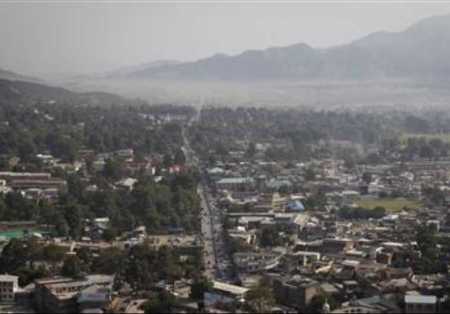
Pakistan viewA general view of houses from a hilltop in Abbottabad, Pakistan. (photo credit:REUTERS)

It is a testament to the precarious state of the world today that in a week that saw North Korea carry out a possible test of a hydrogen bomb, the most frightening statement uttered did not come from Pyongyang.

It came from Pakistan.

Speaking in the military garrison town of Rawalpindi, Pakistani Army chief Gen. Raheel Sharif said that any Iranian threat to Saudi Arabia’s territorial integrity will “wipe Iran off the map.”

Sharif made the statement following his meeting with Saudi Arabia’s defense minister and Deputy Crown Prince Mohammed bin Salman. According to media reports, Salman was the second senior Saudi official to visit Pakistan in the past week amid growing tensions between Iran and the kingdom.

Salman’s trip and Sharif’s nuclear threat make clear that following the US’s all-but-official abandonment of its role as protector of the world’s largest oil producer, the Saudis have cast their lots with nuclear-armed Pakistan.

When last October, the USS Harry Truman exited the Persian Gulf, the move marked the first time since 2007 that the US lacked an aircraft carrier in the region. Nine years ago, the US naval move was not viewed as a major statement of strategic withdrawal, given that back then the US had some one hundred thousand troops in Iraq.

While the USS Truman returned to the Gulf late last month, its return gave little solace to America’s frightened and spurned Arab allies. The Obama administration’s weak-kneed response to Iran’s live-fire exercises on December 26, during which an Iranian Revolutionary Guards vessel fired rockets a mere 1,370 meters from the aircraft carrier as it transited the Straits of Hormuz, signaled that the US is not even willing to make a show of force to deter Iranian aggression.

And so the Saudis have turned to Pakistan.

It would be foolish to view Sharif’s nuclear threat as mere bluster.

By every meaningful measure, Pakistan is little more than a failed state with nuclear weapons. Pakistan appears in every global index of failed or failing states.

To take just a few leading indicators, as spelled out by Basit Mahmood in a report last summer for The Political Domain, barely 1% of Pakistanis pay taxes of any kind. More than half the population lives in abject poverty. The government has no control over most Pakistani territory.

Between 2003 and 2015, more than 58,000 people were killed by terrorism countrywide.

Public health is a disaster. Polio, eradicated throughout much of the world, is now galloping through the country.

Last summer more than 1,300 people died in a heat wave in the supposedly advanced city of Karachi.

These data do not take into account the wholesale slaughter and persecution of minority groups – first and foremost Christians – and the systematic denial of basic human rights and widespread, violent persecution of women and girls.

As for its nuclear arsenal, a 2010 report by the Bulletin of Atomic Scientists estimated that Pakistan possesses between 70 and 90 nuclear warheads. Other credible reports estimate the size of the arsenal at 120.

Pakistan refuses to adopt a no-firststrike policy. In the US and worldwide, it is considered to be the greatest threat to global nuclear security.

Following a Pakistani jihadist assault on the Indian parliament in late 2001, India and Pakistan both deployed forces along their contested border. In the months that followed, due to Pakistani nuclear threats, the prospect of nuclear war was higher than it had ever been.

Cold War nuclear brinksmanship – which reached its high point during the 1962 Cuban missile crisis – paled in comparison.

In 2008, following the Pakistani jihadist assault on Mumbai, India threatened to retaliate against Pakistan.

India’s threats rose as evidence mounted that, as was the case in 2001, the jihadists were tied to Pakistan’s ISI spy service. Once again, rather than clean its own house, Pakistan responded by threatening to launch a nuclear attack against India.

And now, following the unraveling of US-strategic credibility, Pakistan’s aggressive nuclear umbrella is officially coming to the Persian Gulf.

Saudi Arabia’s decision to turn to Pakistan for protection indicates that the second wave of the destruction of the Arab state model is upon us. The notion of Arab states was invented nearly 100 years ago by the British and French at the tail end of World War I. The Sykes-Picot agreement, which partitioned the Arab world into states, rewarded national dominion to the most powerful tribal actors in the various land masses that became the states of the Arab world.

With the possible exception of Egypt, which predated Sykes-Picot, the Arab states formed at the end of World War I were not nation states. Their populations didn’t view themselves as distinct nations. Rather the populations of the Arab states were little more than a hodgepodge of tribes, clans and sectarian and ethnic groupings. In each case, the British and French made their determinations of leadership based on the relative power of the various groups. Those chosen to control these new states were viewed either as the strongest factions within the new borders or as the most loyal allies to the European powers.

The first wave of Arab state collapse began six years ago. It submerged the non-royal regimes, which fell one after the other, like houses of cards.

Syria, Libya, Iraq and Yemen ceased to exist.

Egypt, which in the space of two years experienced both an Islamist revolution and a military counter-revolution, still teeters on the brink of collapse.

Lebanon will likely break apart at the slightest provocation.

Today we are seeing the opening stages of the collapse of the Arab monarchies, and most importantly, of Saudi Arabia.

Most of the international attention to Saudi Arabia’s current threat environment has focused on Iran. The Iranian threat to the Saudis has grown in direct proportion to the Obama administration’s determination to realign the US away from its traditional Sunni allies and towards Iran. The conclusion of the US-led nuclear pact with Tehran has exacerbated Iran’s regional aggression as it no longer fears US retaliation for its threats to the Sunni monarchies.

But Iran is just the most visible of three existential threats now besetting the House of Saud.

The most profound threat to the world’s largest oil power is economic.

The drop in world oil prices has endangered the kingdom.

As David Goldman reported last week in the Asia Times, according to an International Monetary Fund analysis, the collapse in Saudi oil revenues “threatens to exhaust the kingdom’s $700 billion in financial reserves within five years.”

The house of Saud’s hold on power owes to its oil-subsidized economy. As Goldman noted, last month dwindling revenues forced the Saudis to cut subsidies for water, electricity and gasoline.

According to Goldman, Riyadh’s mass execution of 43 long-jailed prisoners at the start of the month was an attempt by the aging royal house to demonstrate its firm control of events. But the very fact the Saudi regime believed it was necessary to stage such a demonstration shows that it is in distress.

The third existential threat the regime now faces is Islamic State. Since 1979, the Saudis have sought to deflect domestic opposition by promoting Wahabist Islam at home and Wahabist jihad beyond its borders.

Now, with Islamic State in control over large swathes of neighboring Iraq, as well as Syria and Libya and threatening the Saudi-supported Sisi regime in Egypt, the Saudi royal family faces the rising threat of blowback. Some analysts argue that given the popular support for jihad in Saudi Arabia, were Islamic State to cross the Saudi border, its forces would be greeted with flowers, not bullets.

If the House of Saud falls, then the Gulf emirates will also be imperiled.

The Egyptian regime, which is bankrolled by the Saudis and its Gulf allies will also be endangered. The Hashemite monarchy in Jordan, which is protected by the US and by Israel, will face unprecedented threats.

The implications of expanding chaos – or worse – in Arabia are not limited to the Middle East. The global economy as well as the security of Europe and the US will be imperiled.

Obviously, the order of the day is for the US security guarantee to Saudi Arabia to be reinforced, mainly through straightforward US action against Iranian naval aggression and ballistic missile development.

Unfortunately, the Obama administration can be depended on to take just the opposite approach. And as a consequence, at least for the next year, the main thing propping up the Gulf monarchies, and with them, the global economy and what passes for global security, is a failed state with an itchy finger on the nuclear trigger.

Iran: U.S. Lifting Sanctions in a ‘Few Days’

January 12, 2016

Iran: U.S. to Lift Sanctions in a ‘Few Days’ Republicans pushing last-minute effort to block release of billions Share Tweet Email Hassan Rouhani Hassan Rouhani /

AP BY: Adam Kredo Follow @Kredo0 January 12, 2016 5:00 am

Source: Iran: U.S. Lifting Sanctions in a ‘Few Days’


As Republican lawmakers on Capitol Hill focus on a last-ditch effort to prevent the Obama administration from awarding Iran $100 billion, the Islamic Republic’s leaders have stated that economic sanctions on the country will be fully lifted in the coming days.

President Hassan Rouhani, in a recent address, promised “good news” in the next few days, hinting that the Obama administration will make good on its promise to fully lift economic sanctions and provide Iran with up to $100 billion in unfrozen cash assets as part of the nuclear deal finalized last year.

Rouhani’s comments comport with recent remarks by Secretary of State John Kerry, who claimed last week that Iran is just “days away” from upholding its own end of the deal, which required it to ship certain nuclear materials to Russia.

As Iran prepares to receive the cash influx, which experts say will revive the country’s long-stalled economy, Republican lawmakers in Congress are focusing on last-minute efforts to block the Obama administration from releasing these cash assets and unraveling sanctions on individuals who have aided Tehran’s nuclear weapons program.

Sen. Kelly Ayotte (R., N.H.) along with a growing coalition of colleagues in both the House and Senate, has put forward legislation that would stop sanctions relief until the Obama administration can officially verify that Iran has ceased all work on a nuclear weapon.

The bill would require the director of national intelligence to launch an investigation into this activity and submit a report to Congress. All sanctions relief agreed to by the Obama administration would be blocked until this report is complete, according to the bill.

The lawmakers maintain that an ongoing United Nations investigation into this activity remains incomplete due to stalling efforts by Iranian hardliners who seek to keep the country’s military work a secret.

“Given the glaring deficiencies of the International Atomic Energy Agency’s (IAEA) PMD report and Iran’s continued brazen missile tests and rocket launches, Congress must take serious action to protect the American people,” Rep. Mike Pompeo (R., Kansas), a key sponsor of the House version of the bill and member of the House Permanent Select Committee on Intelligence, said in a statement.

“With the impending implementation of the president’s dangerous nuclear agreement with Iran, the world’s largest state sponsor of terror, it is absolutely unacceptable that we still do not have a thorough understanding of this regime’s past weaponization efforts,” he said. “This information is critical to our ability to detect and thwart future efforts by Iran to restart its nuclear program.”

Congressional critics of the nuclear deal have repeatedly warned that Iran—designated by the United States as one of the world’s leading sponsors of terrorism—will use the newly unfrozen cash assets to fund its military operations and pursuit of ballistic missiles.

The White House still has not disclosed why it abandoned recent efforts to impose new sanctions on Iran as a result of its multiple ballistic missile tests, which violate U.N. Security Council resolutions.

Some in Congress have speculated that the administration was forced to abandon the new sanctions after Iran threatened to walk away from the deal.

Experts predict that much of the sanctions relief will help fund Iran’s military campaigns in Syria, Yemen, Iraq, and elsewhere.

“The lion’s share of the inflow of capital and technology in Iran in the post-implementation day era will go to the” Iranian Revolutionary Guard Corps, Iran’s leading military organization, according to Saeed Ghasseminejad, an expert at the Foundation for Defense of Democracies.

That money, Ghasseminejad said, “will be used to oppose the U.S. in the Middle East and around the world.” Implementation of the deal will enrich the Revolutionary Guard Corps and give it the tools necessary to push Iran’s extremist ideology across the region, he said.

“The administration should stop acting as Rouhani’s campaign manager and instead has to focus on fighting back against the IRGC’s growing influence in the region by punishing the IRGC for its bad behavior,” Ghasseminejad said.

The State Department maintains that it is prepared to uphold up its end of the deal and lift U.S. sanctions on the day the deal is implemented.

“‎None of the sanctions specified in the [nuclear deal] will be lifted prior to Implementation Day, which will occur when the [International Atomic Energy Agency] verifies that Iran has completed its relevant nuclear steps,” said a State Department official who was not authorized to speak on record.

“All of the details of the specific actions to be taken by the U.S. and the [European Union] as it relates to the lifting of sanctions under the Joint Comprehensive Plan of Action (JCPOA), as well as the timing of those actions, are spelled out in the text of the deal,” the official said.

Mark Dubowitz, Foundation for Defense of Democracies executive director and a leading expert on the deal, told the Free Beacon that “Implementation Day is no cause for celebration.”

Iran, he said, “get a patient pathway to a nuclear weapon, intercontinental ballistic missiles and an economy increasingly fortified against future sanctions pressure.”

The United States, on the other hand, gets “a brief pause in their nuclear expansion” due to the shipment on some enriched material to Russia. However, Iran “can easily regenerate” this material and expand it by turning on advanced centrifuges, which more quickly enrich nuclear materials.

“Unless a new president digs us out from under this flawed agreement, the Obama Iran deal will severely erode American deterrence and greatly expand Iranian regime power,” Dubowitz said.

Under the parameters of the deal, the United States is set to suspend most of the sanctions enacted by Congress over the past several years.

This includes the suspension of nearly all sanctions related to Iran’s banking system, its insurance industry, energy and petrochemical sectors, shipping industry, gold trade, and automotive sector, according to the deal.

The major Iranian banks and companies included in the list have long been believed to be supporting the country’s nuclear program and military.

“Other nuclear proliferation-related sanctions will also be lifted,” according to information in Annex II of the nuclear agreement.

Sanctions pertaining to Iran’s commercial airline industry also will be suspended, paving the way for U.S.-owned entities to resume legal trade with Tehran.

Sanctions on those accused of aiding Iran’s nuclear efforts also will be removed from U.S. government lists. This includes certain individuals and companies on the specially designated persons list as well as its list of foreign sanctions evaders .

Additionally, the United States has agreed to eventually remove sanctions on two individuals, Fereidoun Abbasi-Davani and Mohsen Fakhrizadeh, both accused of providing critical support to Iran’s weaponization and nuclear activities.

Experts tracking the deal estimate that after eight years only 25 percent of nearly 650 entities designated by Treasury over the past decade for their role in Iran’s nuclear and ballistic missile program will remain sanctioned.

Israel and the Four Powers

January 9, 2016

Israel and the Four Powers, Algemeiner, Ben Cohen via JNS Org., January 8, 2016

download-4

JNS.org The rulers of the Arab Gulf states are, it seems, increasingly attentive to what Israel has to say about the balance of power in the region. As a rising Shi’a Iran faces off against a Sunni coalition led by Saudi Arabia, the core shared interest between Israel’s democracy and these conservative theocracies — countering Iran’s bid to become the dominant power and influence in the Islamic world — has rarely been as apparent.

Hence the interview given by a senior IDF officer to a Saudi weekly, Elaph, which laid out how Israel analyzes the present wretched state of the Middle East. In the Israeli view, there are, the officer said, four powers that have coalesced in the region. The first power centers on Iran and its allies and proxies, such as the Bashar al-Assad dictatorship in Syria, Shi’a rebels in Yemen and Iraq, and most pertinently for Israel, Hezbollah in Lebanon. The second power contains what the officer called “moderate” states with whom Israel has “a common language” — Egypt, Jordan and the Gulf countries. The third power, one that is obviously waning, is represented in the form of the Muslim Brotherhood, now vanquished in its Egyptian heartland but still reigning in Hamas-controlled Gaza. Finally, the fourth power is another non-state actor, the combined forces of jihadi barbarism like Al-Qaeda and Islamic State.

Israel’s goal in this situation is a modest one. As the IDF officer put it, “There is a danger that the strife will reach us as well if the instability in the region continues for a long time. Therefore, we need to take advantage of the opportunity and work together with the moderate states to renew quiet in the region.”

The key phrase here, it seems to me, is “renew quiet.” Foremost for the Israelis, that means counteracting Iran and especially its Lebanese proxy Hezbollah, and then minimizing the potential for jihadi terrorists to operate on or near Israeli-controlled territory. A broader strategic vision can also be detected here: Ultimately, both Israel and the conservative Arab states share the common interests of neutralizing Iran and eliminating the jihadi groups.

The partnership between Israel and these states is already in operation, at the levels of intelligence sharing and — not for the first time — cautious exploration of trade relations. That there is a strong military dimension as well to all this is entirely conceivable. And for the time being, it seems that neither side wants to expand or contract on their public ties with each other; Israel has long had embassies in Cairo and Amman, but that doesn’t mean there’ll be an Israeli ambassador in Riyadh anytime soon, much less a film festival or trade expo.

There’s another factor that has accelerated the formation of this undeclared, look-the-other-way alliance: the shift in American Middle East policy under President Barack Obama. Some readers will remember that back in 1991, the first Bush administration pointedly left Israel out of the coalition to expel Saddam Hussein from Kuwait, so as not to antagonize the Gulf states. Now, frustration with Obama has compelled these very same states to recognize that they have an existential interest in cooperating with Israel.

You might say that the president deserves credit for bringing about a situation, in the wake of the nuclear deal with Iran, which has compelled the Gulf states to grasp the reality and permanence of Israel as never before. Still, the visions and prophecies of a Middle Eastern equivalent of the European Union, much indulged during the Oslo Accords years in the late 1990s, are not now in evidence, and that’s welcome. For their own reasons, neither Israel nor the Arab states feel obliged to articulate a sense of what their region should look like in the event that the Iranian threat is overcome.

Indeed, there’s a case that doing so would be counterproductive — it would impose political pressures upon a discreet yet strategically vital relationship that above all requires, in the parlance of the IDF officer, the “moderate” states to remain as moderate states. With the reorientation of American policy towards a rapprochement with Tehran, along with Russia’s active involvement in the Tehran-Damascus axis, Israel is the nearest reliable, not to say formidable, power that these countries can turn to.

In the present Middle Eastern context, then, the realism and discretion which has always underwritten Israeli foreign policy continues to prevail. That realism presumably extends to recognizing that regimes like Saudi Arabia and Bahrain might eventually succumb to their internal instabilities, already exacerbated by the further collapse of the price of oil.

When you consider the alternatives, the region’s architecture could be much worse for Israel than it is currently. Long an anomaly as the only open society in the region, the target of Arab military and economic warfare throughout the latter half of the last century, Israel in this century is now a partner in a regional bloc. To be sure, this is a bloc based upon interests, not common values, and is therefore necessarily limited in scope. But in the present storm, and amidst the appalling human suffering generated by the clash of these rival interests in Syria, it’s the closest thing we have to progress.

