Posted tagged ‘Middle East War’

Russia Targeting US-Backed Syrians to Challenge Obama

October 6, 2015

Russia Intentionally Targeting US-Backed Syrian Rebels to Challenge Obama Policy

BY:
October 6, 2015 10:05 am

Source: Russia Targeting US-Backed Syrians to Challenge Obama

U.S. officials on the ground in Syria said they believe Russia is deliberately targeting CIA-backed Syrian rebels with its airstrikes in the region as a direct challenge to President Obama’s policy in Syria.

The Wall Street Journal reported that the conclusion led the Obama administration to consider how the U.S. can increase help to Syrian rebel groups fighting the Bashar al-Assad regime without getting further involved in the civil war there.

Obama has said that the does not want the U.S. to become more embroiled in the conflict.

According to officials, the Department of Defense has refused to share information with Moscow regarding the position of U.S.-backed rebels. The Pentagon fears Russia, a strong ally of the Assad regime, could use the intelligence to more accurately target the rebels or relay it to Assad.

Russia launched its first airstrikes in Syria last Wednesday near the city of Homs, an area that is not controlled by the Islamic State (IS, also known as ISIL or ISIS), despite Moscow’s assurances it has bolstered military involvement in Syria in order to combat IS and other terrorist groups. Most of the subsequent airstrikes have appeared to target rebel groups fighting Assad that have been armed and trained by the CIA.

“On day one, you can say it was a one-time mistake,” a senior U.S. official explained. “But on day three and day four, there’s no question it’s intentional. They know what they’re hitting.”

Officials suspect Russia is attacking U.S.-backed Syrian rebel groups presenting the greatest immediate threat to the Assad regime.

Though Russian President Vladimir Putin and his officials have insisted that the country’s military activity in Syria will only involve airstrikes, Moscow said Monday that its “volunteer” forces will soon begin fighting on the ground in Syria. Similar Russian forces fought on the ground in Ukraine as Putin intervened there.

The White House has yet to offer aid to the Syrian rebels being targeted by Russia.

Iran troops to join Syria war, Russia bombs group trained by CIA

October 6, 2015

Iran troops to join Syria war, Russia bombs group trained by CIA

BEIRUT/MOSCOW |

By Laila Bassam and Andrew Osborn

Source: Iran troops to join Syria war, Russia bombs group trained by CIA | Reuters

Hundreds of Iranian troops have arrived in Syria to join a major ground offensive in support of President Bashar al-Assad’s government, Lebanese sources said on Thursday, a sign the civil war is turning still more regional and global in scope.

Russian warplanes, in a second day of strikes, bombed a camp run by rebels trained by the U.S. Central Intelligence Agency, the group’s commander said, putting Moscow and Washington on opposing sides in a Middle East conflict for the first time since the Cold War.

Senior U.S. and Russian officials spoke for just over an hour by secure video conference on Thursday, focussing on ways to keep air crews safe, the Pentagon said, as the two militaries carry out parallel campaigns with competing objectives.

“We made crystal clear that, at a minimum, the priority here should be the safe operation of the air crews over Syria,” Pentagon spokesman Peter Cook said.

Two Lebanese sources told Reuters hundreds of Iranian troops had reached Syria in the past 10 days with weapons to mount a major ground offensive. They would also be backed by Assad’s Lebanese Hezbollah allies and by Shi’ite militia fighters from Iraq, while Russia would provide air support.

“The vanguard of Iranian ground forces began arriving in Syria -soldiers and officers specifically to participate in this battle. They are not advisers … we mean hundreds with equipment and weapons. They will be followed by more,” one of the sources said.

So far, direct Iranian military support for Assad has come mostly in the form of military advisers. Iran has also mobilised Shi’ite militia fighters, including Iraqis and some Afghans, to fight alongside Syrian government forces.

Moscow said it had hit Islamic State positions, but the areas it struck near the cities of Hama and Homs are mostly held by a rival insurgent alliance, which unlike Islamic State is supported by U.S. allies including Arab states and Turkey.

Hassan Haj Ali, head of the Liwa Suqour al-Jabal rebel group that is part of the Free Syrian Army, told Reuters one of the targets was his group’s base in Idlib province, struck by about 20 missiles in two separate raids. His fighters had been trained by the CIA in Qatar and Saudi Arabia, part of a programme Washington says is aimed at supporting groups that oppose both Islamic State and Assad.

“Russia is challenging everyone and saying there is no alternative to Bashar,” Haj Ali said. He said the Russian jets had been identified by members of his group who once served as Syrian air force pilots.

The group is one of at least three foreign-backed FSA rebel factions to say they had been hit by the Russians in the last two days.

At the United Nations, Russian Foreign Minister Sergei Lavrov told a news conference Moscow was targeting Islamic State. He did not specifically deny that Russian planes had attacked Free Syrian Army facilities but said Russia did not view it as a terrorist group and viewed it as part of a political solution in Syria


NATO Warns Russia to Stay Out of Turkish Air Space

October 6, 2015

NATO has warned Russia to keep its aircraft, currently in Syria, out of Turkey’s air space.

By: Hana Levi Julian

Published: October 6th, 2015

Source: The Jewish Press » » NATO Warns Russia to Stay Out of Turkish Air Space

American F-16 fighter jets

F-16 fighter jets in flight. (Illustration photo)
Photo Credit: US Government

Russia was warned Tuesday to keep out of Turkish air space by the North Atlantic Treaty Organization (NATO) over its violations of Turkish Air Space.

“Russian combat aircraft have violated Turkish airspace,” NATO secretary-general Jens Stoltenberg said in a statement on the NATO website following the organization’s meeting Monday (Oct 5). “This is unacceptable.”

In a follow-up news conference, Stoltenberg went on to say, “It doesn’t look like an accident (as Moscow had claimed earlier), and we also have seen two of them, two violations of Turkish airspace. Intelligence that we have received provides me with reason to say it doesn’t look like an accident.”

The first incursion was reported on Saturday, and the second allegedly occurred on Sunday, officials said.

“I’m also concerned that Russia is not targeting ISIL (the group’s acronym for ISIS, or Da’esh), but instead attacking the Syrian opposition and civilians,” Stoltenberg continued.

“I discussed the situation in Syria with [Russia’s] Foreign Minister [Sergei] Lavrov in New York last week. I urge Russia to play a constructive and cooperative role in the fight against ISIL, and to strive for a negotiated political solution to the conflict in Syria.”

Turkey has been an active member of NATO since 1952.

Israeli Minister Yuval Steinitz told Galei Tzahal Radio last week that Israel does not want to see Russian troops on the Golan Heights and is concerned about the positioning of Iranian ground troops in the neighboring country, and the opening of a direct ground front with Iran.

Steinitz added, the world powers must “ensure the Iranian army stays in Iran. We should not see Iranian army divisions in Syria.”

Steinitz said Israel has no official position on the fate of Assad as it’s an internal Arab civil war, but added that “the war against Sunni terror [ISIS] can’t come together with support for Iranian Shiite terror.”

“Allies expressed their deep concern with regard to the Russian military build-up in Syria,” NATO said in its statement, “and especially the attacks by the Russian Air Force on Hama, Homs, and Idlib which led to civilian casualties and did not target Da’esh.

“Russian military actions have reached a more dangerous level with the recent violations of Turkish airspace on 3 October and 4 October by Russian Air Force SU-30 and SU-24 aircraft in the Hatay region. The aircraft in question entered Turkish airspace despite Turkish authorities’ clear, timely and repeated warnings,” the statement went on.

“Allies strongly protest these violations of Turkish sovereign airspace, and condemn these incursions into and violations of NATO airspace. Allies also note the extreme danger of such irresponsible behaviour. They call on the Russian Federation to cease and desist, and immediately explain these violations.”

Russia is also moving in equipment in preparation for a rather more extended role in the region than its originally-stated claim, according to eyewitness reports in Syria.

Recently Moscow moved electronic jamming equipment into the country, including a truck-mounted system and a number of aircraft-mountable pods, according to local sources.

Several pieces of artillery were also moved into the country at Latakia port, including four highly accurate BM-30 multiple-launch rapid-fire rocket systems.

Instead of remaining at the port, however, the weapons were moved and currently are reported to be in position west of Idlib, towards Homs.

According to the report, the U.S. believes Russia is “stepping up its ground activity” to attack Syrian opposition forces rather than ISIS.

Officials are reportedly questioning whether Russian forces are planning to jam the electronics of coalition aircraft as they fly over Syria.

Russia, meanwhile, contends it is indeed targeting ISIS. But it is clear that its forces are also clearly bolstering the flagging defenses of Syrian President Bashar al-Assad.

U.S. President Barack Obama meanwhile authorized additional supplies on Monday for the Kurdish and other Muslim opposition forces in Syria, according to CNN.

“President Obama was clear that we intend to continue our efforts to degrade and ultimately destroy ISIL in Syria and to keep supporting the moderate Syrian opposition,” said a senior administration official who spoke with CNN.

Although both the Russians and the Americans claim to be targeting Da’esh forces, neither deny they are also supporting Syrian fighters – with Russia backing the government and the U.S. backing “moderate” Muslim opposition fighters.

There are problems on both sides.

The government forces have tortured and murdered hundreds of thousands of their own citizens, and used chemical weapons against their own people as well.

The “moderate” rebel forces, meanwhile, have also been caught selling their American-made weapons to radical Islamist forces – including the Al Qaeda-linked Jabhat al-Nusra group – in order to secure safe passage and in some cases, simply in order to remain alive. There is simply no way to know into whose hands those American weapons will fall next.

What is very likely, however, is that whichever “moderate” forces exist in Syria will not be in control of the country when the war ends. Up to half of the country’s total population have fled Syria to other lands simply to survive

Marco Rubio Wants US to Risk War with Russia Over Syria

October 6, 2015

Marco Rubio Wants US to Risk War with Russia Over Syria

Kristinn Taylor

Oct 5th, 2015 6:55 pm

Source: Marco Rubio Wants US to Risk War with Russia Over Syria – The Gateway Pundit


Republican presidential candidate Sen. Marco Rubio of Florida gave an interview with CNBC’s John Harwood on Monday in which Rubio called for the United States to risk war with Russia to enforce a proposed no-fly zone over Syria.

Rubio said going to war with Russia would be better than the current state of affairs in Syria, citing the migration crisis, the growth of terrorist groups including ISIS and ‘Jabhat al Nusra’ and having Russian President Vladimir Putin as the “most influential geopolitical broker in the region.”

Transcript via CNBC:


HARWOOD: ONE FOREIGN POLICY QUESTION. AND I’M GOING TO TOSS IT BACK TO SCOTT WHO HAS A QUESTION FOR YOU AS WELL. YOU SUPPORT A NO-FLY ZONE IN SYRIA.

RUBIO: I SUPPORT A SAFE ZONE IN SYRIA THAT INCLUDES A NO-FLY ZONE, CORRECT.

HARWOOD: WOULD YOU BE WILLING TO ENGAGE IN MILITARY CONFLICT WITH THE RUSSIANS WHO ARE NOW FLYING BOMBING MISSIONS OVER SYRIA TO ENFORCE THAT ZONE? WOULD YOU BE WILLING TO HAVE WAR WITH RUSSIA OVER THAT?

RUBIO: NO. THE ANSWER TO YOUR QUESTION IS THE FOLLOWING. NUMBER ONE, IF YOU ARE GOING TO HAVE A NO-FLY ZONE, IT HAS TO BE AGAINST ANYONE WHO WOULD DARE INTRUDE ON IT. AND I AM CONFIDENT THAT THE UNITED STATES AIR FORCE CAN ENFORCE THAT, INCLUDING AGAINST THE RUSSIANS. THAT I BELIEVE THE RUSSIANS WOULD NOT TEST THAT. I DON’T THINK IT’S IN THE RUSSIANS INTEREST TO ENGAGE IN AN ARMED CONFLICT OF THE UNITED STATES.

HARWOOD: YOU THINK PUTIN WOULD BACK OFF IF WE HAD A NO-FLY ZONE?

RUBIO: I DON’T THINK HE’S GOING TO GO INTO A SAFE ZONE, ABSOLUTELY. I DON’T BELIEVE HE WILL LOOK FOR A DIRECT MILITARY CONFLICT AGAINST THE UNITED STATES IN ORDER TO GO INTO A SAFE ZONE.

HARWOOD: WHAT IF HE WAS?

RUBIO: WELL, THEN YOU’RE GOING TO HAVE A PROBLEM. BUT THAT WOULD BE NO DIFFERENT THAN ANY OTHER ADVERSARY.

HARWOOD: YOU’D BE WILLING TO ACCEPT THAT CONSEQUENCE?

RUBIO: BECAUSE THE ALTERNATIVE IS THIS MASSIVE MIGRATION CRISIS THAT WE’RE NOW FACING. THE ALTERNATIVE IS THAT ASSAD WILL REMAIN IN POWER, BUT NEVER CONTROL THE WHOLE WHOLE OF SYRIA AGAIN. THE ALTERNATIVE IS THE CONTINUED GROWTH OF NON-ISIS TERRORIST GROUPS IN ADDITION TO ISIS ITSELF. SO I THINK THE ALTERNATIVE IS WORSE.

HARWOOD: DON’T YOU THINK THE PROSPECT OF POTENTIAL MILITARY – HOT MILITARY CONFLICT WITH RUSSIA WOULD SCARE THE AMERICAN PEOPLE?

RUBIO: SURE. BUT THE CONSEQUENCES OF NOT DOING ANYTHING WOULD SCARE THEM EVEN MORE AND THAT INCLUDES ITS ONGOING CRISIS OF THE MIGRATORY CRISIS THAT WE’RE NOW FACING. THE CONTINUED GROWTH, NOT JUST OF ISIS, BUT A JABHAT A- NUSRA AND OTHER GROUPS IN THE REGION AS WELL. AT THE END OF THE DAY, THIS IS NOT AN EASY SITUATION AND WE WISH WE DIDN’T FIND OURSELVES HERE. AND IN MANY REASONS WE ARE IN THIS POSITION, BECAUSE WHAT THE OBAMA ADMINISTRATION DIDN’T DO TWO AND A HALF YEARS AGO WHEN I WAS ADVOCATING FOR THEM TO DO THIS TWO AND A HALF YEARS AGO OR A YEAR AND A HALF AGO. NOT NOW THAT BEING SAID, WE CANNOT SAY, WELL, IF PUTIN IS GOING TO TEST US, THEN WE CAN’T DO ANYTHING. YOU’VE BASICALLY AT THAT POINT CEDED TO HIM AS BECOMING THE MOST INFLUENTIAL GEOPOLITICAL BROKER IN THE REGION.

Russian Air Force destroys 20 ISIS tanks near Palmyra

October 6, 2015

Russian Air Force destroys 20 ISIS tanks near Palmyra – Defense Ministry (VIDEOS)

Published time: 5 Oct, 2015 21:23

Edited time: 6 Oct, 2015 11:51

Source: Russian Air Force destroys 20 ISIS tanks near Palmyra – Defense Ministry (VIDEOS) — RT News

Russian pilots prepared to board the SU-30 attack plane to take off from the Hmeimim aerodrome in Syria. © Dmitriy Vinogradov
Russia’s Sukhoi jets flew 15 sorties over Syria on Monday striking 10 Islamic State targets in various regions, according to Russia’s Defense Ministry. 20 tanks and 3 rocket launchers in Homs province near embattled Palmyra were destroyed,

“During the day, Sukhoi-34, Sukhoi-24M and Sukhoi-25 warplanes flew a total of 15 sorties from the Khmeimim airbase. Air strikes were delivered at ten targets of the Islamic State [IS, formerly ISIS/ISIL] group in Syria,” Igor Konashenkov, Russia’s Defense Ministry spokesman said in a statement on Monday.

A pair of Su-25Ms (NATO reporting name: Frogfoot) together with an Su-24 (NATO reporting name: Fencer) carried out strikes on two IS targets in the eastern part of Homs province near the city of Tadmur, he said.

“About 20 units of medium T-55 tanks, which were earlier seized by the militants from the Syrian army, have been destroyed [in the strikes],” as well as three multiple rocket launchers, he noted.

A video released by the ministry also showed a strike against an IS ammunition depot in Homs. The ministry explained: “Bright flashes confirm detonation of munitions caused by direct hits of air bombs. Thick smoke provides evidence of fire in the depot.”

The city Tadmur is located in an oasis in the middle of the Syrian Desert and stands about half a kilometer northeast of the ruins of the ancient city of Palmyra. The UNESCO protected cultural site was captured by IS in May. They have been gradually destroying archeological artifacts and structures since seizing the ancient city. On Sunday they blew up the Arch of Triumph, a centerpiece of the ancient ruins.

READ MORE: ISIS terrorists blow up iconic 2,000yo Arch of Triumph in Palmyra  

US Central Command reported on Monday that the US-led coalition had conducted airstrikes near Palmyra with “inconclusive results.

Russian Su-34 bombers destroyed IS headquarters and a command post in the Aleppo province, Konashenkov said on Monday, adding that there had been “direct hits” on structures housing field commanders in Dayr Hafir and al-Bab.

Some 30 IS military vehicles including tanks were destroyed in the forested area near the city of Idlib in northwest Syria, according to the ministry.

We have irrefutable intelligence, including [intercepted] communications between the militants in the area, [proving] the destruction and damage of the terrorists’ armored vehicles,” Konashenkov said.

Russia launched its anti-IS operation in Syria on September 30 after a request from President Bashar Assad. Russian President Vladimir Putin has also expressed concern about the number of Russian extremists in the country.

On Saturday, three days into the operation, Russia’s Defense Ministry said that, based on Russian intelligence, the militants were fleeing the area which had been under their control. It also stated that the strikes have significantly reduced the terrorists’ combat capabilities.

With Russia’s Dep. Army Chief due in Israel, Moscow posts 64 S-300 ship-to-air missiles off Syria, N. Israel

October 5, 2015

With Russia’s Dep. Army Chief due in Israel, Moscow posts 64 S-300 ship-to-air missiles off Syria, N. Israel

DEBKAfile Exclusive Report October 5, 2015, 2:18 PM (IDT)

Source: With Russia’s Dep. Army Chief due in Israel, Moscow posts 64 S-300 ship-to-air missiles off Syria, N. Israel

The Russian missile cruiser Moskva in action. In addition to 64 S-300 anti-aircraft missiles, the warship has 16 SS-N-12 missiles aboard specially designed to destroy US aircraft carriers.


Russia’s deputy chief of staff, Gen. Nikolay Bogdanovsky, accompanied by a large military delegation, arrives in Israel for a two-day visit on Tuesday, Oct. 6, to discuss increased coordination between the two militaries. However, Moscow seems to be sending Jerusalem an altogether different message: Friday, Oct. 2, the Russian Defense Ministry announced the surprise deployment of Navy cruiser, the Moskva, armed with 64 advanced anti-aircraft missiles S-300 ship-to-air missiles opposite the Syrian coastal town of Latakia.
debkafile’s military sources point out that Russia, without saying so publicly, has thus created an effective no-fly zone over most of Syria, most of northern Israel, including the Golan, as well as southern Turkey, for US aircraft based there for air strikes in Syria; Cyprus, the site of British air force bases; and Jordan.

Since 2012, The Obama administration has been discussing the possibility of establishing no-fly zones in northern and southern Syria on a number of occasions, but has shelved the plan whenever a decision was imminent. Now, with one move, Moscow has imposed a no-fly zone over Syria.

The presence of the wide-ranging S-300s means that the Turkish, British, Israeli and Jordanian air forces will need to coordinate their aerial operations in Syrian or Lebanese airspace with Russia, or face the risk of their planes being shot down.

In the view of debkafile’s military sources, the only aircraft capable of evading those advanced missiles are stealth planes. Neither the Israeli, British, Jordanian or Turkish air forces, nor the US squadron in Turkey consisting of F-16 fighters, have such aircraft at their disposal.

The S-300 has a range of 150 kilometers and can shoot down any type of missile, including cruise missiles, as well as planes.

If US President Obama truly wanted to deal effectively with Moscow’s military moves in Syria, besides saying that Russia is bound to fail, he would have ordered the deployment of US stealth fighters to Turkey and Israel. However,may have been held back from this step by fear of antagonizing Iran, which has so far delayed sealing the nuclear agreement with the world powers by putting it to vote in parliament.

The presence of Moskva off the shores of Syria and close to northern Israel creates a new situation that will very likely be discussed in the talks that start Tuesday in Tel Aviv between Russia’s deputy chief of staff and his Israeli counterpart, IDF Gen. Yair Golan.

Although Russian President Vladimir Putin promised Israeli Prime Minister Binyamin Netanyahu during their summit in Moscow on September 21 not to allow S-300 missiles reach the hands of the Syrian military, he made no promises about positioning them on a Russian warship in the Mediterranean facing Syria and northern Israel.          .

Our military sources point out that Russian air strikes have not been confined to any single area so far, but the injection of S-300s into the war arena widens the Russian air force’s options.

In an interview with CNN on October 4, Prime Minister Netanyahu described how the Russian operation in Syria had affected relations with Moscow. “We don’t want to go back to the days when, you know, Russia and Israel were in an adversarial position,” he said. “I think we’ve changed the relationship. And it’s, on the whole, good.” He added that Israel’s close relations with the US were in a completely different and special category.

When asked whether he thought Russia’s intervention would cause instability in the region, he seemed to avoid giving a detailed response, only saying, “I don’t know. I think time will tell”.

However, on the topic of the transfer of advanced weaponry to Hizballah, the prime minister was very clear. ”If anybody wants to use Syrian territory to transfer nuclear weapons to Hezbollah, we’ll take action,” he said.

It marked the first time for an Israeli prime minister to speak publicly on the possibility that the terrorist organization could acquire atomic weapons.

Gaza Rocket Hits Eshkol Region

October 5, 2015

Gaza Rocket Hits Eshkol Region Terrorists from Gaza fire two rockets at southern Israel, of which one lands on Gazan side. No injuries reported.

By Elad Benari, Canada

First Publish: 10/4/2015, 11:17 PM / Last Update: 10/4/2015, 11:26 PM

Source: Gaza Rocket Hits Eshkol Region – Defense/Security – News – Arutz Sheva

Rocket fire from Gaza

Rocket fire from Gaza
Flash 90

The calm of the holiday was disturbed in the Gaza Belt on Sunday evening when, shortly after 11:00 p.m., the “Red Alert” incoming rocket siren was heard in Nahal Oz, Alumim and the area.

Two rockets were fired from Gaza towards Israel, but the first one missed the target and exploded on the Gazan side of the border.

A second rocket exploded in an open area of the Eshkol Regional Council. There were no physical injuries or damages.

Rocket attacks on the south have been intermittent over the past few weeks. Last week, a rocket was intercepted by the Iron Dome anti-missile system as it was headed towards the city of Ashdod.

On September 21, a rocket that was fired from Gaza exploded in the Hof Ashkelon region of southern Israel.

The rocket exploded in an open region, causing no physical injuries or damages.

Turkey says Russia has escalated Syrian conflict with violation of its airspace

October 5, 2015

Turkey says Russia has escalated Syrian conflict with violation of its airspace

Source: Turkey says Russia has escalated Syrian conflict with violation of its airspace – Middle East – Jerusalem Post

Turkey said on Monday it had summoned Russia’s ambassador to protest the violation of its airspace by one of its warplanes and was told it was a “mistake” that would not happen again.

Turkey, which has the second-largest army in NATO, scrambled two F-16 jets on Saturday after a Russian warplane crossed into its airspace near the province of Hatay, which borders Syria, the foreign ministry said.

In a second incident, the Turkish military said a MiG-29 fighter jet — an aircraft used by both Russia and Syria — had harassed two of its F-16s by locking its radar on to them on Sunday as they patrolled the border.

Speaking in a live interview on HaberTurk TV, Prime Minister Ahmet Davutoglu accused Moscow of escalating the Syrian crisis by entering the conflict.

Russian air strikes in Syria, launched last week, have wrong-footed both the United States and its allies including Turkey, which says lasting peace can only be achieved with President Bashar al-Assad’s removal. Moscow says its intervention aims to weaken Islamic State militants, but Ankara and Western powers see it as support for Assad.

“What we have received from Russia this morning is that this was a mistake and that they respect Turkey’s borders and this will not happen again,” Davutoglu said of Saturday’s airspace violation, making clear Turkey would respond if provoked.

“Turkey’s rules of engagement apply to all planes, be they Syrian, Russian or from elsewhere. Turkey’s armed forces are very clearly instructed. Necessary steps would be taken against whoever violates Turkey’s borders, even if it’s a bird,” he said in the interview.

“For Russia, which long opposed foreign intervention in Syria and blocked UN Security Council resolutions, to be actively involved in Syria is both a contradiction and a move that has escalated the crisis.”

U.S. Defense Secretary Ash Carter said Washington was conferring with Turkey about the incursion. Speaking during a trip to Spain, he also compared Moscow’s effort to bolster Assad to tethering itself to a sinking ship.

“By taking military action in Syria against moderate groups targets, Russia has escalated the civil war,” Carter said in a speech in Madrid.

Turkish President Tayyip Erdogan has criticised Russia’s actions as a “grave mistake”.

“Assad has committed state terrorism, and unfortunately you find Russia and Iran defending (him),” Erdogan was quoted by the Hurriyet newspaper as telling a crowd of supporters in Strasbourg, France, late on Sunday.

“Those countries that collaborate with the regime will account for it in history,” he said.

The Turkish foreign ministry said it had summoned Moscow’s ambassador to protest the violation and urged Russia against any repeat, warning that it would be held “responsible for any undesired incident that may occur.”

Foreign Minister Feridun Sinirlioglu spoke with his Russian counterpart Sergei Lavrov, as well as key NATO partners, the statement said.

Kremlin spokesman Dmitry Peskov confirmed that the Russian ambassador had been summoned, telling reporters that “some facts were mentioned there which are to be checked”. There was no emergency meeting planned between Erdogan and his Russian counterpart Vladimir Putin, Peskov said.

“(The) Russian incursion into Turkish airspace raises stakes in what is already a high risk situation,” British Foreign Secretary Philip Hammond said on Twitter, calling on Moscow to desist.


U.S. Military Trained Top ISIS Commander

September 22, 2015

U.S. Military Trained Top ISIS Commander Written

by Alex Newman

Thursday, 17 September 2015

Source: U.S. Military Trained Top ISIS Commander

U.S. Military Trained Top ISIS Commander


One of the Islamic State’s top military commanders was actually trained by U.S. Special Forces in the nation of Georgia before taking up arms for ISIS in Syria, according to a variety of sources quoted in an explosive new report by the McClatchy news agency. Another member of the Obama administration’s supposed “anti-ISIS” coalition, the Wahhabi-Islamic dictatorship in Saudi Arabia, played a key role radicalizing the jihadist leader through a hard-core Islamist mosque it funded near his village. In other words, without the direct assistance of key “anti-ISIS” governments — including Washington, D.C. — the man said to be ISIS’ most fearsome and skilled military leader would almost certainly never have arrived in Syria to wage ruthless war on infidels in the first place. But ISIS commander Tarkhan Batirashvili (shown), who now calls himself Abu Omar al Shishani, is hardly the only one.

As explosive evidence and news reports continue to emerge highlighting the trend, it is becoming increasingly difficult to tell where ISIS begins and the globalist establishment ends. Among other revelations, Vice President Joe Biden, speaking at Harvard, admitted that Obama’s “anti-ISIS” coalition had funded and armed various terrorist groups in Syria that went on to become ISIS. Later, U.S. Joint Chiefs of Staff Chairman Martin Dempsey revealed in Senate testimony that Sunni Arab dictators in Obama’s “anti-ISIS” coalition were not just supporting ISIS — they were funding it. Next, a 2012 U.S. Defense Intelligence Agency report released under the Freedom of Information Act exposed the fact that Western powers and their Islamic dictator allies were supporting Islamic terrorists and wanted to see a fundamentalist Islamic State created in Eastern Syria. And finally, the former chief of DIA went on TV and spilled the beans on Obama’s “willful” support to Islamic terrorists while distancing himself from the deadly policies.

The McClatchy report, then, is only the latest shoe to drop in a long train of revelations directly linking the U.S. government and its allies to ISIS and jihad more broadly. Headlined “U.S. training helped mold top Islamic State military commander,” the September 15 article by special correspondent Mitchell Prothero contains a treasure trove of information about the U.S.-trained terrorist gathered from interviews with a wide range of sources, including many close to the ongoing Syrian war. In essence, the report paints a troubling picture of Batirashvili’s background, and offers much insight into how he became a leading ISIS commander responsible for a number of critical victories secured by the terrorist group. From his U.S. military training in Georgia to his radicalization in a Saudi-funded mosque, the piece provides still more evidence about the utter failure — or outright insanity, perhaps even criminality — surrounding what Washington, D.C., likes to characterize as “foreign policy.”

According to the McClatchy report, the 30-year-old Batirashvili (a.k.a. Abu Omar) is a “key figure” in ISIS, reportedly serving on the ISIS “governing council” in addition to being the terror group’s “supreme military leader in northern Syria and Aleppo.” The report, citing his military prowess obtained from U.S. training and a number of critical military victories he led over Syrian dictator Bashar al-Assad’s forces, also refers to him as “perhaps the group’s most fearsome ground commander.” And there is a good reason for that: your tax dollars. “We trained him well, and we had lots of help from America,” an unidentified former Georgian defense official told the news agency, asking not to be named because of the sensitivity of the terrorist’s role in ISIS. “In fact, the only reason he didn’t go to Iraq to fight alongside America was that we needed his skills here in Georgia.”

Batirashvili’s former comrades in the Georgian military echoed the praise for the terrorist’s military abilities and told McClatchy that he was “immediately” recruited into Georgia’s U.S.-trained special forces upon enlistment. Again, your tax dollars — and your sons serving in the U.S. military — played a crucial role in transforming Batirashvili from an impoverished Muslim Chechen villager into a brutal and well-trained commander whose forces are now busily decapitating Christians and selling children into sex slavery to fund jihad. “He was a perfect soldier from his first days, and everyone knew he was a star,” explained a former military comrade of Batirashvili, who also requested anonymity because he was violating orders by speaking to the press about the issue. “We were well trained by American special forces units, and he was the star pupil.”

Of course, the U.S. government training for Batirashvili and other soldiers in Georgia did not take place with the explicit goal of producing future military leaders for a group of savages styling themselves the Islamic State. Instead, similar in many ways to what happened with Osama bin Laden and al-Qaeda in Afghanistan, the U.S. government plan, supposedly at least, was to help the government of Georgia defend itself against potential aggression from the Kremlin. And indeed, according to sources interviewed for the McClatchy report, Batirashvili fought well against Russian strongman Vladimir Putin’s forces, first as a Chechen rebel, and later as a U.S.-trained Georgian Special Forces officer.

While Batirashvili came from an isolated Islamic enclave in the largely Christian nation, Batirashvili and others from his region had traditionally followed a moderate strain of Islam, so-called Sufi Islam. But Sufi Muslims are often considered heretics by their more radical coreligionists in places such as Saudi Arabia and Afghanistan. Eventually, thanks to generous funding from the U.S.-allied Saudi dictatorship, hardcore Wahhabi Islam would soon make its mark on the Chechen enclave in Georgia — and on Batirashvili in particular. The same phenomenon has happened around the world.

According to McClatchy, the moderate version of Islam followed by locals from Batirashvili’s region came under pressure in the year 2000, when the Saudi regime financed the construction of a new mosque for the handful of ethnic Chechen villages in the Georgian valley. A local community leader quoted in the article explained that this new mosque “preached a kind of alien Wahhabi-style Islam” — the same radical Islam that the Saudi monarchy, a key member of Obama’s “anti-ISIS” coalition, has for generations been trying to propagate around the world with lavish funding from its oil revenues. “It told our people that it was wrong to pray at graves of saints and ancestors, as our people have done for hundreds of years, and even to share our religious rites with our Christian brothers,” the community leader said. Other residents told the news agency that by the mid-2000s, the new Saudi-backed mosque had split the local Muslim community in two, with older Muslims sticking to their traditional faith while younger villagers became radicalized in the new mosque.

Then, the globalist-engineered civil war broke out in Syria after years of U.S. taxpayer funding for Syrian opposition groups exposed in official U.S. diplomatic cables. At that point, the radicalized young Muslim villagers in Georgia affiliated with the Saudi mosque — prepared for violent jihad through years of Saudi-funded radical teachings — began an exodus to go wage holy war in Syria. “They all started leaving for Syria,” the community elder told McClatchy. “Things are safer here now because all the radicals — our children — have gone to Syria.” The report also notes that the radicalized Batirashvili served as an excellent recruiting tool for ISIS, attracting jihadists from across central Asia to join the jihad on the “apostate” dictator of Syria.

It is impossible to know how many other ISIS fighters from around the world were also radicalized in mosques funded by members of the “anti-ISIS” coalition, or how many of those fighters received training from the U.S. military under various guises. But without a doubt, there are many. In fact, Obama’s alleged plan to fight ISIS — training and equipping so-called moderate jihadists to fight more radical jihadists — was exposed as a monumental failure this week. Testifying before the U.S. Senate Armed Services Committee on September 16, General Lloyd Austin, the top U.S. military commander for the Middle East, admitted that just “four or five” of Obama’s U.S.-trained jihadists were actually fighting against ISIS in Syria. On the other hand, as The New American and others have documented extensively, far more than that are currently fighting with ISIS, al-Qaeda, and other terrorist groups across Syria — often with heavy U.S. weapons. Indeed, entire brigades of U.S.-trained rebels have joined terror groups or signed agreements with them to fight Assad.

As a direct consequence of the Obama administration’s lawless so-called “foreign policy” machinations, hundreds of thousands are dying, millions are fleeing their homes, refugees are swamping Europe, Middle Eastern Christians are facing genocide, and the national security threat to the United States is growing stronger by the day. Now, all those crises are being exploited by the same globalists who created them to push more of the same insanity.

It is time for Congress to shut down this farce and hold everyone responsible for it accountable.

Photo of  Abu Omar al Shishani, taken from a video: AP Images

Alex Newman, a foreign correspondent for The New American, is normally based in Europe. Follow him on Twitter @ALEXNEWMAN_JOU. He can be reached at anewman@thenewamerican.com.

Related articles:

U.S. Intel: Obama Coalition Supported Islamic State in Syria

ISIS: The Best Terror Threat U.S. Tax Money Can Buy

U.S. Defense Intel Chief: Obama Gave “Willful” Aid to Al-Qaeda

Globalists Who Created Refugee Crisis Now Exploiting It

Globalists Using Muslim Terrorists as Pawns  

Globalists Exploit ISIS Threat to Empower UN

Obama and Co. Middle East Policies Aiding Genocide of Christians

Anti-ISIS Coalition Built ISIS (Video) 

Christian Massacres: A Result of U.S. Foreign Policy

ISIS Origins Traced to U.S. Prison in Iraq

U.S.-backed Syrian Opposition Linked to Bilderberg, CFR, Goldman Sachs & George Soros

Bin Laden & Al-Qaeda: U.S. Govt. Creations

In Moscow, presence of IDF generals sends a message of military urgency

September 21, 2015

In Moscow, presence of IDF generals sends a message of military urgency In rare move, Netanyahu brings both IDF chief and intelligence head to Russia to drive home concerns on Hezbollah, Syria By Judah Ari Gross September 21, 2015, 11:54 am

Source: In Moscow, presence of IDF generals sends a message of military urgency | The Times of Israel

Prime Minister Benjamin Netanyahu sits with IDF Chief of Staff Gadi Eisenkot during a visit to the northern border of Israel on August 18, 2015. (Amos Ben Gershom/GPO)

Prime Minister Benjamin Netanyahu sits with IDF Chief of Staff Gadi Eisenkot during a visit to the northern border of Israel on August 18, 2015. (Amos Ben Gershom/GPO)

n a sign that it has not taken last week’s movement of the Russian military into Syria lightly, Israel sent not one but two members of the IDF General Staff with Prime Minister Benjamin Netanyahu to Moscow Monday, in an effort to hash out the precarious relationships between Israel, Russia, Syria and Hezbollah.

Both IDF Chief of Staff Lt. Gen. Gadi Eisenkot and Military Intelligence Head Maj. Gen. Herzl “Hertzi” Halevi are accompanying Prime Minister Benjamin Netanyahu to discuss the movement of Russian troops into Syria with Russian President Vladimir Putin and his advisers.

The presence of either one of these generals on this trip would be notable in itself. That both are traveling with Netanyahu is meant to demonstrate to both the people of Israel and the government of Russia the gravity of the situation on Israel’s northern border and the IDF’s intention to keep up airstrikes on high-priority Hezbollah targets in Syria.

Israel has admitted to targeting several Hezbollah and Syrian weapons facilities and convoys in the past several years, and it has been assumed that the Israel Air Force has carried out many more, despite officials’ refusal to claim responsibility.

Prime Minister Benjamin Netanyahu and Russian President Vladimir Putin at Netanyahu's residence in Jerusalem on June 25, 2012 (Marc Israel Sellem/POOL/Flash90)

Most such attacks have been against so-called advanced weapons systems — missiles and artillery guns, rather than rifles and grenades.

Putin, however, complicated Israel’s strategies vis-a-vis Hezbollah and Syria when he announced that the Russian military would be moving into the war-torn country, setting up in the port city of Latakia.

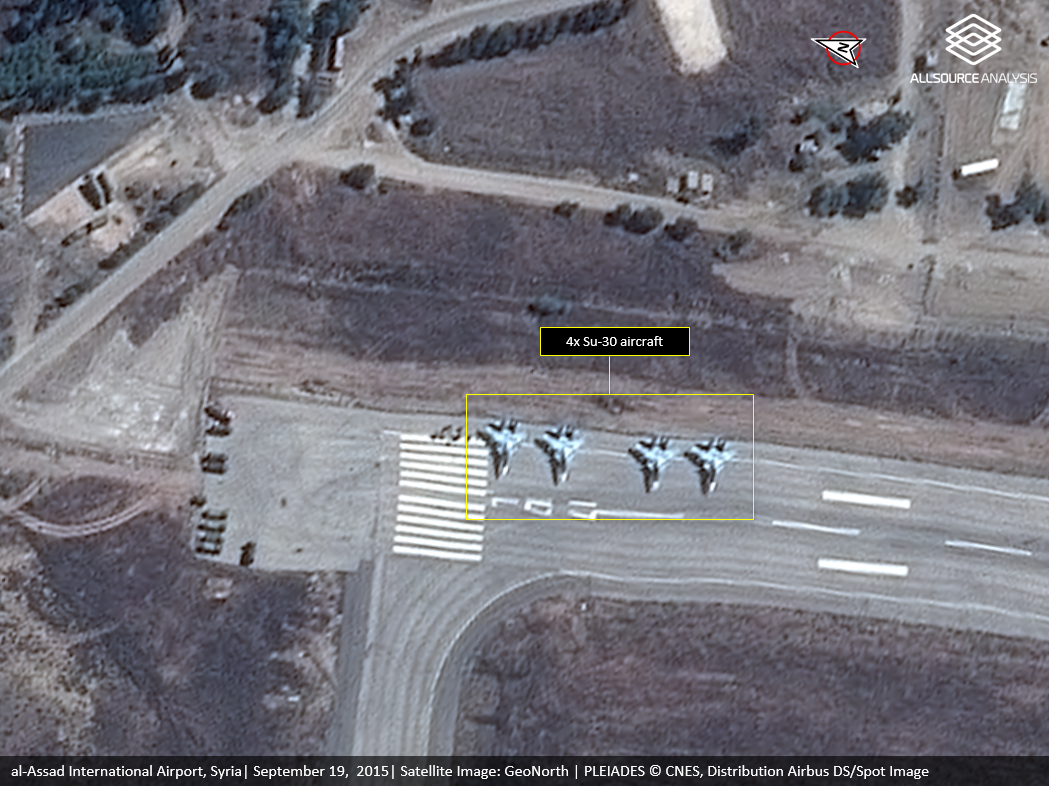
Satellite images already show Russian-made artillery guns and SU-30 combat planes in the northwestern Syrian city.

The presence of Russian soldiers in the country is an added obstacle for the IDF, which must now continue to prevent Israel’s enemies from obtaining dangerous weapons, without causing an international incident by killing an ally’s soldiers.

In 2013 and 2014, Israel was suspected of having carried out airstrikes on weapons sites in Latakia. With Russian military now present in the city, similar attacks may be more difficult to carry out.

An armored personnel carrier, likely a Russian made BTR-82A, firing large-caliber bullets during a battle in Latakia, Syria, is seen in a video posted online on August 23, 2015. (Screen capture YouTube)

Though the Israeli government has not released an itinerary for Monday’s trip, Eisenkot and Halevi will likely meet with their Russian army counterparts to address two related issues: preventing Hezbollah from obtaining Russian-made weaponry and Israel Air Force strikes against the advanced weapons systems already in the possession of the Iran-aligned militia.

Though some of Hezbollah’s arsenal comes from Iran, several of its deadliest weapons — the Kornet anti-tank missile, which has been deadly in combat against Israeli Merkava tanks, and the Katyusha rocket, which rained down on Israel’s northern cities during the Second Lebanon War in 2006 — come from Russia.

Though many of these weapons systems were intended for Syria, some have nevertheless ended up in the hands of Hezbollah, according to Nadav Pollak, a senior fellow at the Washington Institute for Near East Policy.

Some of the systems sold by Russia include anti-aircraft guns and surface-to-air missiles, which could be devastating to Israel’s air superiority in a future conflict with Hezbollah, Pollak said.

As head of intelligence, Halevi will likely present information to the Russian military, showing how these Russian-made weapons end up in the hands of Hezbollah, Pollak explained.

Brig. Gen. Herzi Halevi speaking Thursday. (photo credit: Mitch Ginsburg/Times of Israel)

In addition to attempting to prevent further such transfers, Netanyahu, Eisenkot and Halevi will also discuss Israel’s plans to destroy those advanced systems the terrorist organization has already acquired.

As Hezbollah has been closely aligned with Russia’s ally Assad, this may be a sticking point with Putin, though it is not one Israel is prepared to give up on, Yossi Cohen, national security adviser to the prime minister, told the Israel Hayom newspaper Monday.

Netanyahu will tell Putin that Israel won’t accept restrictions on its response capabilities in Syria, Cohen said.

As Israel’s strikes against Hezbollah have taken place on Syrian territory, which violates its sovereignty, Pollak explained, “there is a chance that Russia will express its objection to this policy.”

The United States has also voiced concerns over Putin’s role in the Syrian civil war.

“Continued military support for the regime by Russia or any other country risks the possibility of attracting more extremists and entrenching Assad, and hinders the way for resolution,” US Secretary of State John Kerry told reporters in Germany on Sunday.

Kerry has proposed military-to military talks with Russia to prevent any clashes between US and Russian forces in the region, to ensure that “there’s no potential of a mistake or of an accident of some kind that produces a greater potential of conflict.”