Posted tagged ‘Middle East War’

Stability in Syria under Assad ‘a dream’: Turkish FM

October 16, 2015

Stability in Syria under Assad ‘a dream’: Turkish FM

Russia, Israel, Hamas & ISIL: Putting Together the Pieces of the Puzzle

October 15, 2015

Russia, Israel, Hamas & ISIL: Putting Together the Pieces of the Puzzle

21:40 15.10.2015(updated 21:47 15.10.2015)

Source: Russia, Israel, Hamas & ISIL: Putting Together the Pieces of the Puzzle

Speaking to Radio Sputnik on Thursday, Israeli political analyst Avigdor Eskin attempted to explain Israel’s motivations in the war against ISIL.

Commenting on Hamas’s role in the war, Eskin recalled that Hamas is an offshoot of the Muslim Brotherhood, adding that “the Muslim Brotherhood is, in a sense, partially ISIS,” with some of their members “turning to ISIS: It happened in Iraq, it happened in Syria, when certain significant numbers of their people decided to become more radical.”

In the case of Hamas, as you know, this organization was aided largely by Syria and Iran up until a couple of years ago, and their military headquarters were sustained in Damascus…And what they did when the civil war started was to turn their weapons against the government of Syria. Therefore the government of Syria –Assad and Iran today are very unhappy with Hamas –they fight Hamas. And Hamas people in Syria joined ISIS. Therefore, today we cannot separate Hamas from ISIS.”

As far as Israel’s position toward ISIL is concerned, Eskin noted that “Israel is definitely threatened by ISIS, and has helped Yazidis and the Kurds in Iraq since the beginning of the fighting there. Israel was the first to assist them in their fight against ISIS. Thus, Israel has been fighting ISIS in indirect ways since shortly after ISIS came into existence.”

Citing the recent arrests of ISIL-affiliated would-be terrorists in Moscow, Eskin emphasized that today, “everybody is threatened by ISIS. As far as Israel is concerned, the one thing I can say is that the country is trying not to interfere in Syrian affairs, since there are still anti-Israeli sentiments in the Arab world…the involvement of Israel could undermine Russian efforts, so Israel just needs to keep quiet about the situation in Syria. Let Russia and President Assad do the job. But on the other hand, Israel is assisting indirectly by helping the Yazidis and the Kurds to destroy ISIS in Iraq.”

The analyst noted that “one thing is clear: terrorism is terrorism. And it’s important that the West will help Russia, President Assad and Israel instead of criticizing, instead of undermining their efforts and spreading information which is not correct.”

Commenting on the assessment that Israel may actually benefit from the existence of ISIL, Eskin suggested that this was a “disturbed way of thinking,” adding that “ISIS is a group which wants to destroy Israel, and acts against Israel, and from the very beginning supports the idea that Israel should not exist in the Middle East, so how can anyone be benefiting?”

US defense chief: we will deter Russia’s ‘malign and destabilizing influence’

October 15, 2015

US defense chief: we will deter Russia’s ‘malign and destabilizing influence’ Ash Carter says US will not cooperate as long as Russia pursues a ‘misguided strategy’ in Syria but Moscow says it has been rebuffed in calls for consultation

Source: US defense chief: we will deter Russia’s ‘malign and destabilizing influence’ | World news | The Guardian

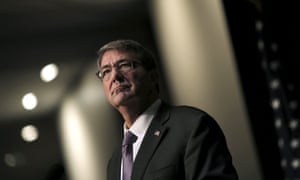
Ash Carter
Carter said the US ‘will take all necessary steps’ to counter Russian ‘influence, coercion and aggression’. Photograph: Carlos Barria/Reuters

The US defense chief has vowed to take “all necessary steps” against a resurgent Russia which is challenging a frustrated Washington in eastern Europe and the Middle East.

Ash Carter, the US defense secretary, said the Russian president, Vladimir Putin, had wrapped his country in a “shroud of isolation” which only a drastic change in policy could reverse.

“We will take all necessary steps to deter Russia’s malign and destabilising influence, coercion and aggression,” Carter said, attacking Russian military intervention in Ukraine and Syria.

The speech at a US army convention on Wednesday included some of the strongest language yet by the Obama administration, which came into office determined to “reset” relations with Russia and move them in a more cooperative direction.

Carter said that as long as Russia pursued a “misguided strategy” in Syria to bolster its client Bashar al-Assad, “we have not, and will not, agree to cooperate with Russia”.

Meanwhile, Russia claimed that the United States snubbed its overtures for high-level consultations on Syria, refusing to send a delegation to Moscow or receive a high-ranking Russian delegation.

On Tuesday, Putin said he wanted to send a delegation led by the Russian prime minister, Dmitry Medvedev, to the US. Moscow said the suggestion was first raised during a meeting between Putin and Barack Obama on the sidelines of the UN general assembly last month.

“Literally today, we got an official reply,” the foreign minister, Sergei Lavrov, said on Wednesday. “We have been told that they can’t send a delegation to Moscow and they can’t host a delegation in Washington either.”

Putin’s spokesman, Dmitry Peskov, said on Wednesday evening: “Given the current situation in Syria, refusing dialogue does not help to save the country and region from the Islamic State.”

There was no immediate response to the claim from US officials, though the accusation stands in contrast to two weeks of unresolved requests from the Pentagon to the Russian defence ministry for a clear procedure to avoid midair conflict.

While the US Defense Department last week held out hope for “deconfliction”, three rounds of talks have yet to result in clear rules for US and Russian pilots and their commanders, despite a series of undisclosed proposals and counterproposals. A third video conference made “progress” on Wednesday, and was described as “focused narrowly on the implementation of specific safety procedures” by a Pentagon spokesman, Captain Jeff Davis.

Lavrov said on Wednesday that agreement was close and procedures “should become operational any day now”.

The diplomatic disagreement over the international community’s response to the Syrian war reflects the positions of two distinct coalitions with divergent goals. Russia, Iran and the Syrian regime of the dictator Assad have accelerated a military offensive against Assad’s Syrian enemies.

The pro-Assad coalition is reportedly aiming to retake Aleppo in the coming days, with Russian warplanes supporting Iranian ground forces.

The US and much of the west are focused instead on a relatively slower campaign against the Islamic State, which formally opposes Assad but has turned its attention to consolidating its hold on eastern Syria and north-western Iraq.

On the one hand, Russia has been using its entrance into the Syria theatre to regain diplomatic clout after isolation following its actions in Ukraine, with Putin meeting with Obama in New York on the sidelines of the UN general assembly meeting, and the latest attempt to send a negotiating group to Washington.

On the other hand, when the strategy has failed, Putin has not shied from going it alone, launching the air campaign in Syria just two days after his speech at the UN calling for a coalition, and giving the US just an hour’s notice, via diplomats in Baghdad.

“I believe some of our partners simply have mush for brains,” Putin said, complaining that the US did not appear to have a firm set of goals in Syria.

In the balance for the US is the Iraqi government, which pivots between US and Iranian sponsorship. The Iraqi government of Haider Abadi, installed with the aid of the US last year, has begun flirting with the Russian-Iranian-Assad coalition in frustration with what it considers insufficient US support against Isis.

Iraq now hosts an intelligence fusion centre with Russian, Syrian and Iranian liaisons and reportedly has begun using situational awareness generated from the centre to bomb Isis positions.

Russia has said it would be willing to consider expanding its airstrikes to Iraq but only if it was asked to do so by Iraqi authorities.

The US has made clear it will not participate in the intelligence centre, out of concern that its Russian and Iranian adversaries would gain access to US information; the US maintains its own independent intelligence cell with the Iraqis. The Iraqi defence ministry has provided “assurances that our information will be appropriately protected”, Warren said on 1 October.

Meanwhile Carter said that he did not know if Putin would take “the opportunity to change course”.

“From the Kamchatka peninsula through south Asia, into the Caucasus and around to the Baltics, Russia has continued to wrap itself in a shroud of isolation. And only the Kremlin can decide to change that.”

Russia and US Close to Agreement on Flights Over Syria

October 15, 2015

Russia and US Close to Agreement on Flights Over Syria

14:27 15.10.2015(updated 18:36

Source: Russia and US Close to Agreement on Flights Over Syria

Over the past 24 hours, Russian warplanes completed 33 sorties in Syria, striking ISIL facilities in the provinces of Idlib, Hama, Damascus, Aleppo, and Deir az-Zor, the Russian Defense Ministry said Thursday.

 Russia and the United States are moving closer to a possible agreement to provide for the safety of their aircraft over Syria, the Russian Defense Ministry said Thursday.

“Yesterday, another round of negotiations was held on a possible agreement on ensuring the safety of Russian and US-led coalition flights over Syria. We note that our positions are moving closer on key provisions of the future document,” ministry spokesman Maj. Gen. Igor Konashenkov told reporters.

In addition, Russian and Israeli aircraft have begun training on safe flights in Syrian airspace.“Yesterday, the first stage of exercises on preventing dangerous incidents in the sky above the Syrian Arab Republic began between Russia’s Aerospace Forces and the Israeli Air Force,” Konashenkov said, adding that the second phase of joint exercises will take place later on Thursday.

The spokesman noted that a mutual information mechanism on flights over Syria has been organized between the Russian control center at Syria’s Hmaimim airbase and the Israeli Air Force’s command post.

Over the past 24 hours, Russian aviation completed 33 sorties in Syria, striking ISIL facilities in the provinces of Idlib, Hama, Damascus, Aleppo, and Deir az-Zor, he added.

“Near the region of East Ghouta in the Damascus Province, an Su-34 destroyed a camouflaged firing position with an Osa missile complex that was earlier captured by militants from the Syrian Armed Forces,” Konashenkov said.

He said a KAB-500 bomb destroyed the complex that was under a concrete enclosure.

In addition, Su-24M bombers smashed an ISIL command post in Qusair al-Ward in the Aleppo province. The facility was destroyed by a direct hit, he said.

In the province of Hama Russian warplanes destroyed a professionally camouflaged artillery battery, the Defense Ministry spokesman went on to say. According to him, it was detected by Russian military drones.

The methods the enemy used to deploy its artillery shows that Islamic State has professionals with good military training in its ranks,” Konashenkov said.

According to him, after additional reconnaissance and target localization Su-34 bombers and Su-25 attack aircraft carried out a massive airstrike.

The precision airstrikes took out six pieces of artillery, armament, and four high terrain vehicles equipped with mortars, he added.

According to Konashenkov, Islamic State militants have begun to retreat in Syria, as Russian aviation increases reconnaissance to pinpoint new positions.

“The militants are retreating, trying to establish new positions, and changing underway the course of their existing logistics system for the supply of ammunition, weaponry and equipment,” ministry spokesman Maj. Gen Igor Konashenkov told reporters.

Of course, in order to verify and confirm this information we have increased the intensity of reconnaissance flights by the air force and by unmanned aerial vehicles,” he said.

At the same time, Russian forces have eased the intensity of sorties in Syria over the last day, the spokesman stated. “This is due to the fact that the Syrian army’s offensive is transforming the contact line with Islamic State terrorist formations.”

Al- Fateh Army announces the start of “the battle of liberating Hama”

October 15, 2015

Al- Fateh Army announces the start of “the battle of liberating Hama” after 2 days of announcing “the clarion call” launched by the head of “Do’at al- Jihad Center” Abdullah al- Muhaysini

October 13, 2015

Source: Al- Fateh Army announces the start of “the battle of liberating Hama” after 2 days of announcing “the clarion call” launched by the head of “Do’at al- Jihad Center” Abdullah al- Muhaysini | Syrian Observatory For Human Rights

SOHR received a copy of a statement issued by al- Fateh Army factions about the beginning of what they name it “the battle of liberating Hama.” The statement declared, “Under the guile led by the axis of evil Russia, backed by Syrian and Iranian militias, al- Fateh Army bring the good news for the people of al-Sham that is the beginning of the second phase of liberating Bilad al- Sham (Syria) by announcing the start of the battle of liberating Hama the dignity and the heroism, we say to our people in al- Sham they seek to frighten you with those besides Allah, but remember “ is not Allah sufficient for his servant, and that the power is wholly Allah’s.”


The statement added, “your brothers the mujahedeen are your shields and fortress, so they are no going to reach you, your life and the life of your brothers are the same.”


Al- Fateh Army said, “we call all the mujahedeen in Hama to inflame the fronts within their areas in order to make the Muslims legions meet in Hama liberating it InshaAllah, and that al- Fateh Army declares the charter of this blessed battle as follows:


“Any fighting group, whether it is of Nusayri (Alawites) or Rafedah (Shiites) or Daesh (Islamic State) encounters al- Fateh Army is going to be fought until we liberate the whole land of al- Sham God willing, we ask out Ummah to help us by your faithful prayers that Allay grants us a clear victory and that Allah assists us with his own soldiers.”


It is noted that SOHR received an audio record 2 days ago for the head of “Do’at al- Jihad Center” and the leading figure in Jabhat al- Nusra Front (al- Qaeda in Levant) The doctor Abdullah al- Muhaysini, where he call the fighters of rebel and Islamist factions for the clarion call, and that no one stays in his positions unless he was preparing for a significant actions, where they have to overturn the equation and keep the initiative that the “Kuffar (the unbelievers)” have tried to kidnap it from the rebels. Al- Muhaysini said that if the initiative kidnapped the battle is going to turn into consecutive collapses, so the mujahedeen must move towards Atshan, the coastal areas and Sahl al- Ghab, and that al- Fateh Army and the other factions in the north, al- Ghouta and Daraa have to carry out a counter account against the regime forces in order to penetrate the first defense lines of the regime because if that is not done then, the future is going to be horrible. The vigor and morale of fighters are very high and they are waiting for the commanders’ orders. We will see when the Russians and Muslims confront how the epic is going to be. He also call the leaders of factions to hit the regime forces from the heart, cut off their supply lines and cut Khanser roads by launching an attack on several areas, and that the factions must mobilize their military capabilities , where the Kuffar are not going to reach but on the bodies of rebels. Al- Muhaysini assures the leaders that the counter attack must start as soon as possible and that the rebels have to prepare for violent clashes with the regime and Russian forces.

PLO issues revised English version of Abbas’ ‘execution’ speech

October 15, 2015

PLO issues revised English version of Abbas’ ‘execution’ speech

Source: PLO issues revised English version of Abbas’ ‘execution’ speech – Arab-Israeli Conflict – Jerusalem Post

http://bcove.me/xwxqsq0w

http://MyPlayer.swf

The Palestine Liberation Organization on Thursday released a different version of Palestinian Authority President Mahmoud Abbas’ speech, which was broadcast on Palestine TV on Wednesday night.

The new English version quotes Abbas as talking about the “shooting of our children in cold blood as they did with the child Ahmed Manasrah and other children from Jerusalem.”

The modified English version was released by the PLO’s Negotiations Affairs Department, which said this was a “full translation” of Abbas’s speech.

http://bcove.me/jymcr02u

However, the Arabic version of Abbas’s speech does not talk about “shooting.” Instead, Abbas is quoted as talking about the “execution of our children in cold blood, as they did with the boy Ahmed Manasrah and other children in Jerusalem and other places.”

PLO officials did not offer any explanation as to why they chose to change Abbas’s statement about Manasrah.

The English “translation” was published in response to accusations made by Israel against Abbas following his speech.

Israel accused Abbas of lying and incitement, especially with regards to his claim that Manasra, who took part in the stabbing attack at Pisgat Ze’ev in Jerusalem last Monday, had been “executed.”

A senior PA official in Ramallah accused the Israeli government of incitement against Abbas.

A statement released by Abbas’s office did not refer to the case of Manasrah. However, the statement called for an “end to Israeli incitement” – a reference to Justice Minister Ayelet Shaked’s call for closing Palestine TV.

“We call on the Israeli government to work towards ending all what aggravates violence and incitement,” the statement said.

Mahmoud Khalifa, PA Deputy Minister of Information, accused the Israeli media of serving as a mouthpiece for the Israeli government’s propaganda machine. He claimed that Israeli journalists were “reserve soldiers” in the IDF who were promoting their government’s version regarding “field executions” of Palestinians.


Islam Plans to Destroy Israel by 2022

October 15, 2015

Op-Ed: Islam Plans to Destroy Israel by 2022 They have it all worked out.

Published: Thursday, October 15, 2015 9:45 AM

Source: Islam Plans to Destroy Israel by 2022 – Op-Eds – Arutz Sheva

In front of the United Nations General Assembly, Israeli Prime Minister Benjamin Netanyahu did not only stare for forty seconds into the eyes of the world’s representatives, charging them of having kept silent in the face of Iran’s promise to destroy Israel. Netanyahu also pulled out a book in Farsi. The author is the Supreme Leader Ali Khamenei and he writes that “within 25 years there will be no more Israel”.

There is a date recurring obsessively in the proclamations of the leaders of the Arab-Islamic world: 2022. It is the year that they have reserved for  the end of Israel. “By 2022, possibly earlier, Israel will be destroyed” has just said Hassan Rahimpour Azghadi of Iran’s Supreme Council for the Revolution, the right arm of Khamenei.

A year ago, Hamas Interior Minister Fathi Hamad said that the Palestinian Arabs will liberate all of Palestine “within eight years”. So – in 2022. Last May, in an interview on Lebanese channel Nbn TV, the imam of the mosque of Al Quds in Sidon, Maher Hamoud, said that “according to calculations based on the Koran the end of Israel will be in 2022”. Sheikh Ahmed Yassin, the founder of Hamas, shared the same vision.

Another Iranian book, published earlier this year and based on the occult sciences, interpretation of the Koran and mathematical calculations, says  Israel will be destroyed in 2022.

Recently, the Islamic State published a book stating that “the beginning of the end of Israel will be in 2022”, two years after the fall of Rome, the symbol of Christianity. “In 2022 the fourty years of peace and security of Israel will be over”. The key text of this Islamic hallucination is entitled “The collapse of the Israeli empire in 2022” and is written by a Palestinian Arab scholar, Bassam Nihad Jarrar. The book, published in Arabic in 1990, was translated into English and widely distributed in Malaysia. Since then, it is a bestseller in the Arab-Islamic world.

A date, that of 2022, which has almost become a legend. A Syrian journalist interviewed by the television of the Palestinian Authority said he was aware of a report that the CIA had informed then US president Bill Clinton that Israel would not exist after 2022.

The problem is that the Arab-Islamic world, from the Iranian nuclear weapons threat to the Palestinian Arabs’ stabbings and stonings, is working hard to make these fantasies true.

If you approach Israel as a sea shell, you hear the sound of loneliness. The Jewish State’s survival Seems precarious. But everything points to the contrary. Israel’s population today is nine times higher than that of 1948, the year of the creation of the state and the war for independence. Israeli Jews love life and hate death more than any other population in the world.

For 2022, the Islamic world is plotting to turn Israel into a nation of empty houses. But, for now, the houses of Israel are full of joy and children. As they should be.

Iran’s Soleimani visits Syrian Golan as Tehran bolsters war effort

October 15, 2015

Iran’s Soleimani visits Syrian Golan as Tehran bolsters war effort Powerful head of Tehran’s Quds Force in Syria to oversee new push against anti-Assad rebels, visits near border to boost morale of troops after setbacks

By Avi Issacharoff, Times of Israel staff and AP

October 15, 2015, 8:57 am

Source: Iran’s Soleimani visits Syrian Golan as Tehran bolsters war effort | The Times of Israel

Iranian Revolutionary Guards al-Quds Force commander Maj. Gen. Qassem Soleimani. (YouTube/BBC Newsnight)

Iranian Revolutionary Guards al-Quds Force commander Maj. Gen. Qassem Soleimani. (YouTube/BBC Newsnight)

ranian general Qassem Soleimani, the commander of the country’s expeditionary al-Quds Force, visited the Syrian side of the Golan in recent days, The Times of Israel has learned.

Soleimani, a powerful figure thought to be at the forefront of Iranian fighting abroad, is in Syria to oversee a new offensive by Iranian and Assad regime troops meant to help the government retake large swaths of the country’s north.

His visit to the Golan, near the border with Israel, was apparently intended to boost morale of Syrian and Hezbollah forces – the latter loyal to Iran’s regime — after a series of setbacks against the “southern front” of rebel groups in the area.

By Wednesday, Soleimani was in the Latakia province, on the Mediterranean coast north of Lebanon, from which the northern operation is expected to launch, backed by the recent influx of Russian air power.

A regional official and Syrian activists said Wedneday that hundreds of Iranian troops were being deployed in northern and central Syria, dramatically escalating Tehran’s involvement in the civil war as they join allied Hezbollah fighters in an ambitious offensive to wrest key areas from rebels amid Russian airstrikes.

The official, who has deep knowledge of operational details in Syria, said the Iranian Revolutionary Guards — currently numbering around 1,500 — began arriving about two weeks ago, after the Russian airstrikes began, and have accelerated recently. The Iranian-backed group Hezbollah has also sent a fresh wave of fighters to Syria, he told The Associated Press.

Iranian and Syrian officials have long acknowledged Iran has advisers and military experts in Syria, but denied there were any ground troops. Wednesday’s statements were the first confirmation of Iranian fighters taking part in combat operations in Syria.

The main goal is to secure the strategic Hama-Aleppo highway and seize the key rebel-held town of Jisr al-Shughour in Idlib province, which Assad’s forces lost in April to insurgents that included al-Qaida’s Nusra Front.

The loss of Jisr al-Shughour, followed by the fall of the entire province, was a resounding defeat for Assad, opening the way for rebels to threaten his Alawite heartland in the coastal province of Latakia. The official suggested the Syrian army’s alarmingly tenacious position around that time is what persuaded the Russians to join the fray and begin airstrikes two weeks ago.

The Syrian government and Iran had been asking Russia to intervene for a year, the official said, speaking on condition of anonymity because he was not authorized to discuss military affairs. He said the Russian “tsunami wave” has given allies such as Iran the cover to operate more freely in Syria.

His account of Iranian troops arriving ties in with reports from Syrian opposition activists, who reported a troop buildup in the northern provinces of Idlib and Aleppo. The Syrian Observatory for Human Rights also reported Wednesday that Iranian troops were arriving and being transported to a military base in the coastal town of Latakia, in the town of Jableh outside the provincial capital.

At least two senior Iranian commanders were killed in Syria in recent days, including Gen. Hossein Hamedani, a senior Revolutionary Guard commander, who died Oct. 8 near Aleppo.

“Syria will witness big victories in coming days,” said Gen. Mohammad Ali Jafari, chief of Iran’s Revolutionary Guard, speaking Monday at Hamedani’s funeral.

The Quds Force is the de facto overseas operational arm of the of the Iranian Revolutionary Guards Corps, which is loyal to Iranian Supreme Leader Ayatollah Ali Khamenei and is separate from Iran’s national military force.

Israeli officials have accused the IRGC of trying to build an anti-Israel front on the Syrian Golan, alongside Hezbollah forces and local Druze opposed to Israel.

On January 18, a reported Israeli air strike on the Syrian Golan targeting a Hezbollah cell there killed six Hezbollah fighters and an IRGC brigadier general, Mohammed Ali Allahdadi. Allahdadi was said to be involved in helping to build up the operational capabilities of Hezbollah’s burgeoning Golan presence.

Soleimani himself traveled to Lebanon the following day to meeting with Hezbollah chief Hassan Nasrallah and visit the graves of the Hezbollah fighters killed in the strike.

Reports from late January claimed that a cross-border Hezbollah reprisal attack the following week, in which two IDF soldiers were killed and seven injured, was planned by two Quds Force officers appointed by Soleimani.

Terror, Shmerror, State Dept Only Cares About Two State Holy Grail

October 15, 2015

The U.S. State Dept. is equally unhappy with Israelis and Palestinian Arabs for the increase in violence – it interferes with the path to the beloved Two State Holy Grail.

By: Lori Lowenthal Marcus

Published: October 15th, 2015

Source: The Jewish Press » » Terror, Shmerror, State Dept Only Cares About Two State Holy Grail

U.S. State Dept. Spokesperson John Kirby at Daily Press Briefing, Oct. 15, 2015.

U.S. State Dept. Spokesperson John Kirby at Daily Press Briefing, Oct. 15, 2015.
Photo Credit: screen capture State.gov

Several things became clear during Wednesday’s U.S. State Dept. press briefing, the first half of which focused exclusively on the wave of terrorism in Israel.

First, the overriding goal for the United States of America is the creation of a Two State Solution and anything that gets in the way of that is a problem. The Two State Solution is the Holy Grail (as it were) regardless of whether that fixed goal will dramatically increase violence and further destabilize the region or not.

Second, the U.S. State Department despises the fact that increasing numbers of Jews are living beyond the “Green Line,” in Judea and Samaria. The U.S. hates this so much that official policy is to condemn Jews living and breathing in that area at least as much, if not more, than brutal murders of innocent Jewish civilians by Arab terrorists.

Third, the U.S. has so embraced the idea that the Temple Mount “belongs” to the Palestinian Arabs that it casts unarmed, non-hostile Jewish tourists or Israelis who peacefully ascend the Mount as the legitimate cause of savage murders of any Jews, anywhere. The U.S. has jettisoned the fact that Israel re-acquired control of the Temple Mount in a defensive war and simply handed over control of that area to the Arabs, in the hope and belief that members of all religions would have equal access to that site.

Throughout the first half of the Oct. 15 State Dept. press briefing, reporters sought to pin down State Department Spokesperson John Kirby on who and what the U.S. believes is responsible for the recent tsunami of terror in which Jews were shot, stabbed with kitchen knives, hunting knives, butcher knives and rammed with cars by Arab Palestinians.

The violence is condemned by the U.S., although this government refuses to assign primary blame to either party. Young Arab men and women are brutally stabbing Israeli Jews standing at bus stops, boarding buses, walking on Israeli streets? That’s bad, but, as Kirby quoted Secretary of State John Kerry, “there’s disenfranchisement, there’s disgruntlement, there is – there’s frustration on both sides that have led to this [increase in violence].”

Why this reluctance to assign blame? It is because, apparently, anything that diplomats aching for a Two State Solution see as an impediment to their goal is equally bad. This becomes apparent from watching and reading the transcripts of the endless State Dept. briefings in which the issue of terrorism or violence in Israel is raised.

More than a dozen Israeli Jews going about their lives in Israel were stabbed, shot or run over by Arab terrorists in the past few weeks alone. One 17-year old Israeli Jew stabbed four Beduoins in Dimona, Israel. That act was condemned across the spectrum in the Israeli government, including by Prime Minister Benjamin Netanyahu.

“Israel is a country of law and order. Those who use violence and break the law – from whatever side – will be dealt with to the fullest extent of the law,” said Netanyahu. He added that he “strongly condemns the attack against innocent Arabs.”

When Matt Lee of the Associated Press asked Kirby why it was so important that Secretary Kerry refused to assign blame, the response was:

I think he’s been very clear that he wants both sides to take affirmative actions, both in rhetoric and in action, to de-escalate the tension, to restore calm, and to try to move forward towards a two-state solution. He also recognizes, as a public servant with a long career associated with foreign affairs and the diplomatic relations of this country, that many of these issues are ages old. And when there’s a specific attack such as we’ve seen, we are not shy about calling it out. And as I said last week on – if we believe it’s terrorism, to say it’s terrorism. We’re not shy about that in terms of affixing responsibility for it. But in terms of the general scope of the violence that we’re seeing and the unrest, he’s been very clear that rather than to affix blame specifically on all of that, to try to focus on moving forward and restoring calm.

In other words, specific acts don’t matter, the only thing that matters is the Holy Grail in the distance and the desire to continue moving towards it.

This position was reinforced when Kirby was asked to comment about whether there has been a change in Israeli policy on the Temple Mount. Arab leadership, religious and political, have spread rumors of efforts by Israeli to change the policy on the Temple Mount in order to inspire religious terrorist responses.

The AP’s Lee asked whether it was the Administration’s position that the status quo at the Temple Mount has been broken.

Kirby responded: “Well certainly, the status quo has not been observed, which has led to a lot of the violence.”

In fact, there has not been a change in policy regarding the Temple Mount, other than a recent prohibition directed at members of knesset from visiting the site. In other words, Israel preemptively sought to remove any potentially incendiary actions, or ones that could be interpreted that way.

Several hours after the briefing, Kirby sent out a tweet in which he sought to claim that he “did not intend to suggest that status quo at Temple Mount/Al Sharif was broken.” Well, that is what he said, hard to understand what else he could have intended by it.

What the State Department Spokesperson’s tweet should have said is that he was wrong to suggest the status quo was broken, and therefore, Israel was not responsible for any violent acts purporting to avenge dishonor to the Temple Mount.

One reporter pressed Kirby on  Secretary Kerry’s upcoming visit to the region. The bottom line answer, of course, is to try and shove the parties along the path to the Two State Holy Grail.

MR KIRBY: The Secretary’s made clear his concerns over what’s going on there and his desire to travel to the region to engage and to discuss and to try to find ways to reduce the tensions, restore the calm, and then start to work collaboratively, hopefully, towards a two-state solution. SAID ARIKAT, al Quds: John? MR KIRBY: Yeah. ARIKAT: What would be the practical steps that both sides can take immediately to defuse the situation? What would be, like, practical suggestions to both sides that they must do now? MR KIRBY: Well, again, I wouldn’t get too specific here. I think the Secretary spoke about this yesterday very clearly that the violence needs to stop. So to the degree leaders on either side can help lead to that outcome, that would be useful. The incitement needs to stop. ARIKAT: Right. MR KIRBY: So to the degree to which leaders – whether they’re responsible for it or not, to the degree that they can contribute to an atmosphere which isn’t encouraging more violence, more killing, that would be useful. And then, again, to sort of put in place and then keep in place, maintain a sense of calm. All that would useful right now, and I think that’s really again where the Secretary’s head was yesterday. It’s where it is today, and it’s why he’s interested in pursuing travel there soon. ARIKAT: For instance, the Israelis put a great many checkpoints in the last, let’s say, 24 hours in and around Arab neighborhoods, Palestinian neighborhoods in Jerusalem and the surrounding areas, and so on. Would that be something that the Secretary or you would call on the Israelis to undo, so to speak, to sort of – to alleviate some of the frustration or the feeling of being cooped in and so on by these young men and women? MR KIRBY: Well, I don’t think it’s going to be useful for me to stake out a position on each and every decision that the Israeli security forces are making. They certainly have an obligation towards their citizens and we understand that. Again, what the Secretary wants to see is the violence cease. ARIKAT: Mahmoud Abbas just made a speech, a short speech, a little while ago. I wonder if you’ve had the chance to see it. MR KIRBY: I have not. ARIKAT: But he’s – he’s basically accusing Israel of conducting summary executions, and so on. He’s threatening to take it to the international court – the International Criminal Court. He’s saying that we will not be held hostage to agreements that Israel is not adhering to, and so on. Apparently he’s talking about Oslo. He’s saying that the Palestinians must have a recourse to resist an occupation. Do you agree that the Palestinians must have some sort of a method or recourse, and so on, by which they oppose this occupation that has gone on for so long? MR KIRBY: Well, again, without getting into specific terminology here, Said, what we would like to see is progress made on both sides in both rhetoric and in action towards a meaningful two-state solution. That is very difficult to get to, to even get to the process of pursuing that when there’s so much violence going on, which isn’t doing anything but spiraling the tension upward rather than downward. And so again, what we want to see is both sides take the actions to calm things down so that we can have meaningful discussions and progress towards a two-state solution. No one even bothered to point out that Abbas’s “short speech” is an effort to rouse anger and incite violence directed at Israelis.

You can’t really blame Arikat for trying to corner Kirby into labeling Israel’s new security measures as forms of incitement. Arikat has successfully manipulated State Dept. spokespeople into making similar statements before.

Michael Wilner of the Jerusalem Post also tried to pin down Kirby as to what constitutes incitement and who is responsible for the increase in violence, to no avail.

Wilner pointed out that Ambassador Saperstein had just spoken at the State Department and “said to hold Israel to different standards than other – any other country isn’t just inappropriate; it’s anti-Semitism. What would you have – in terms of these checkpoints, what would you have Israel do?”

Kirby evaded the anti-Semitism point – which was a good one – and said the State Dept. is not going to dictate immediate security requirements onto Israel, which has the right and obligation to protect its citizens. He did, however, say that the U.S. is concerned by some reports of “what many would consider the excessive use of force.”

And then Kirby masterfully steered back on course, saying that what the State Dept. wants so see is “for both sides to take – to take the leadership responsibilities of calling for calm, maintaining that calm, and being able to restore a sense of normalcy so that people can get on with their lives safely and not have to worry, but also so that we can really begin to have again a meaningful discussion towards a two-state solution – which we continue to believe is the outcome that is – that’s best for the people there in the region.”

Terror, shmerror. The U.S. only cares about the Two State Holy Grail.

Erdogan Pushing Kurds and Russians Into Each Other’s Arms

October 14, 2015

Erdogan Pushing Kurds and Russians Into Each Other’s Arms Attacking both the Kurds and Assad turns out not to be a successful policy for Turkey

Source: Erdogan Pushing Kurds and Russians Into Each Other’s Arms

This article originally appeared in German Economic News. Translated from the German by Paul Dunne

The Kurds in Syria have indicated that they are willing to co-operate with Russia.  This would be a setback for Turkish President Erdogan, who wants to defeat the PKK.  However, in the USA support is growing for working together with Russia, because the US fight against IS is turning out to be harder than thought.

At present the Syrian army still controls a third of Aleppo.  The city is linked to the rest of the areas controlled by the government by a narrow road.  This route is under danger of being cut by Al-Qaida or IS.  The Assad regime has therefore been forced to co-operate with Kurdish fighters of the YPG, the Syrian wing of the PKK.  The Kurds on the other hand want to build a corridor between the cantons Afrin and Kobane and the Kurdish quarter of Aleppo, according to a report from the Washington Institute for Near East Policy think tank.  The author of the report, Fabrice Balanche of Lyon University, recommends therefore that the US government should co-operate with the Russians, in order not to lose the YPG as an ally.
The Syrian Kurd leader Salih Muslim said on 1st October in an interview with “al-Monitor” that the Syrian Kurds are interested in an alliance with Russia and Syria.  Muslim also said that he himself was ready to fight not just for the Kurds, but with anyone willing to fight against IS.  On the other hand, Turkey fears that a new Kurdish region will emerge along its southern border, which could lead to destabilisation within Turkey.  Indeed, the Syrian Kurdish leader fears that Turkey may intervene.  Russia has promised the Damascus government to oppose any Turkish intervention in Syria.  At the end of the day, the Kurdish regions of Syria remain part of Syria.
The battle for Aleppo seems to be harder for the Russians than they thought.  The FT cites Syrian groups and anonymous militants as claiming that the IS overran the northern part of Aleppo on Thursday and gained significant ground.  This has not been confirmed.  Nevertheless the fact that the official Russian media have been silent about this up until now, indicates that the operations in Syria are not going so smoothly as planned.
Fabrice Balanche advised the US government not to hope that Syria will become a new Afghanistan for Putin.  The Americans ought rather to adjust to the new situation and make sure that they have a say in the new order in the Middle Eat.  This strategy is also supported by major players in the US government.