Posted tagged ‘Middle East War’

The Funeral of the Oslo Accords

October 26, 2016

The Funeral of the Oslo Accords

by Guy Millière

October 25, 2016 at 4:30 am

Source: The Funeral of the Oslo Accords

  • Despite the unceasing waves of murdering innocent Israeli civilians, Western politicians speak as if Israel were not under attack. The politicians are not interested in hearing what Palestinian leaders say when they call for the ethnic cleansing of Jews.
  • These Western leaders can well imagine what those consequences would be if the Arabs had their way: genocide. One can only assume they are pleased with that.
  • In private, some people say that the burial of Shimon Peres was also the burial of the Oslo Accords and of a never-ending “peace process” that brought only war.
  • Understanding that the economic relations between Israel and Europe could deteriorate, Netanyahu set about negotiating free trade agreements with China, India, South Korea and Japan, and he signed economic and military cooperation agreements with seven African countries also threatened by Islamic terrorism.
  • Against all odds, Israel is now in a much stronger position than it was even a few years ago.

The death of former Israeli President Shimon Peres led to a wave of almost unanimous tributes. Representatives from 75 countries came to Jerusalem to attend the funeral. Palestinian Authority (PA) President Mahmoud Abbas even left Ramallah for a few hours to show up.

Such a consensus could seem to be a sign of support for Israel, but it was something else entirely.

Those who honored the memory of Shimon Peres put aside the years he dedicated to creating Israel’s defense industry and to negotiating key arms deals with France, Germany and the United States. Those who honored the memory of Peres spoke only of the man who signed the Oslo Accords and who embodied the “peace process.” They then used the occasion to accuse Israel.

Barack Obama delivered a speech that could have resembled a mark of heartwarming friendship, until he evoked the “the unfinished business of peace talks.” A harsh and negative sentence followed, saying that “the Jewish people weren’t born to rule another people.” The next sentence implied that Israel is behaving like a slave-owner: “From the very first day we are against slaves and masters;” but it is clear to anyone in Israel that there is no such relationship even resembling that. His conclusion followed: “The Zionist idea will be best protected when Palestinians will have a state of their own.”

British Prime Minister Theresa May and French President François Hollande issued press releases in the same direction.
At the funeral of Shimon Peres in Jerusalem, standing before representatives from 75 countries, Barack Obama delivered a speech that could have resembled a mark of heartwarming friendship, until he evoked the “the unfinished business of peace talks,” followed by a harsh and negative portrayal of Israel.

Despite the unceasing waves of murdering innocent Israeli civilians, Western politicians speak as if Israel were not under attack. They are not interested in seeing the spilled blood, the threats, the hatred constantly spread by Palestinian newspapers, and the incessant and ugly consequences of that hatred. European and American politicians are not interested in hearing what Palestinian leaders say when they call for the ethnic cleansing of Jews. These leaders seem happy to forget the chaos in the Middle East, the ruthless global violence of Islamic extremists, and the outspoken, genocidal intentions of the rulers of Iran. Instead, they speak abstractly of “peace” as if it is something that can be dropped down from sky on people who every day are threatening to kill the Jews.

These politicians practice willful blindness and seem obsessed by a desire illegally to impose the creation of a Palestinian state — whatever the consequences for Israel. These Western leaders can well imagine what those consequences would be if the Arabs had their way: genocide. One can only assume they are pleased with that.

Israelis, however — Muslims, Christians and Jews — cannot practice willful blindness. The spilled blood is not an abstract headline; it is their red blood. The threats, the hatred and the consequences of that hatred are real. Israelis hear clearly what the Palestinian leaders say. They cannot forget what is happening in the Middle East: Jerusalem is 150 miles from Damascus and 1000 miles from Tehran; Hezbollah has more 120,000 missiles aimed at Israel from Lebanon.

Hamas, a designated terrorist group openly dedicated to destroying Israel, rules Gaza just a few miles away. Israelis note the genocidal threats from Iran: Iran can obtain nuclear weapons at any time, along with long-range missiles to deliver them.

Even though many Israeli citizens were proud to see that so many Western leaders came to honor Shimon Peres, they were not fooled. A recent survey showed that only 28% of the Israeli population believe that a peace agreement is even conceivable; 64% think no agreement will ever be signed. Another survey from July 2016 showed that a clear majority of Israelis are opposed to any withdrawal from Judea and Samaria, and resolutely hostile to any foreign interference in Israeli affairs.

Israeli Prime Minister Benjamin Netanyahu politely received Western leaders when they came to Jerusalem. He paid tribute to Shimon Peres — without omitting the first decades of Peres’ life. He also answered those who speak of “peace” as if no other factors mattered, and firmly stated his position: security comes first; there is no way that peace can exist without security.

Netanyahu listened to Obama’s speech. He doubtless read the press releases of Theresa May and François Hollande. He could easily decipher the innuendos in those speeches and press releases: the same innuendos have been used by Western politicians for a quarter of a century.

Netanyahu has acted to make Israel immune to attacks and Western pressure. Despite tensions and disagreements with the Obama administration, he managed to maintain robust ties of friendship between Israel and the United States, and negotiated a US military-aid agreement of $38 billion over ten years.

Seeing that Russian President Vladimir Putin has come to occupy one of the places in the Middle East left invitingly vacant by the Obama administration, Netanyahu established working relations with Putin and used the relationship to contain Syria’s chaos and ensure that it would not overflow into Israel. Netanyahu also used those relations to curb Hezbollah’s and Iran’s activities on the Golan Heights and in South Lebanon, and to try to reconcile with Turkey.

Understanding that economic relations between Israel and Europe could deteriorate, he set about negotiating free trade agreements with China, India, South Korea and Japan, and he signed economic and military cooperation agreements with seven African countries also threatened by Islamic terrorism (Uganda, Ethiopia, Kenya, Rwanda, South Sudan, Tanzania and Zambia).

Realizing that Sunni Arab countries were concerned about the rising regional power of Iran, he strengthened strategic ties with Jordan and Egypt. Egyptian Foreign Minister Sameh Shoukry visited Israel in July, and a few weeks ago, the deputy chief of staff of the Israel Defense Forces (IDF), Yair Golan, said that military cooperation between Israel, Egypt and Jordan had never been closer.

Netanyahu began a rapprochement between Israel and Saudi Arabia; in April 2016, Saudi prince Al-Waleed bin Talal of Saudi Arabia became the first honorary ambassador to Israel. A few months earlier, the opening of an Israeli diplomatic office in the United Arab Emirates, in Abu Dhabi, was announced.

Against all odds, Israel is now in a much stronger position than it was even a few years ago.

Netanyahu also probably realized that even if Western politicians want to impose the creation of a Palestinian state, Sunni Arab leaders, Russia, and even Iran, despite the inflammatory mullahs, consider that the issue can presently be placed on the back burner until the multiple fires that plague the region calm down; it seems evident they will not calm down any time soon.

Netanyahu also doubtless sees that Abbas came to Jerusalem because Western leaders are now his main protectors, and that Abbas’s usual accusatory speech before the UN General Assembly in New York this year was received by the press and diplomats as a side show.

Netanyahu assuredly also sees that Sunni Arab leaders have had enough of Abbas; that they want normalization between the Arab world and Israel, and that they have a plan that basically envisions relieving Abbas of his position.

Netanyahu also cannot help seeing that France and other Western powers are preparing anti-Israeli maneuvers and are ready to support questionable resolutions at the UN. A recent article in the Weekly Standard said that the Obama administration is “manufacturing a crisis with Israel in anticipation of a post-election diplomatic push targeting the Jewish state.”

Netanyahu emphasized, when it was his turn to speak before the United Nations, a few hours after Mahmoud Abbas, that Israel is not isolated, and that it will not accept having unacceptable conditions dictated to it.

Both Netanyahu and the Israeli government apparently consider that a page of history has been turned, and that the centrality of the Israeli-Palestinian conflict in Middle East peace essentially belongs to the past.

In private, some people say that the burial of Shimon Peres was also the burial of the Oslo Accords and of a never-ending “peace process” that brought only war.

In 2009, Daniel Pipes wrote that “Israelis eventually must return to their pre-1993 policy of establishing that Israel is strong, tough, and permanent.” Israel is going in this direction.

Another eminent scholar, Walter Russell Mead, noted recently that Netanyahu’s successes “will not and cannot make Israel’s problems and challenges go away,” but that they put Israel in a much “stronger global position.” Mead added that if and when American liberals understand the causes of Netanyahu’s successes, “a new and smarter era of foreign policy debate” might begin.

Western politicians would do well to listen.

Ash Carter: Raqqa Invasion Will Begin Before Mosul Campaign Ends

October 26, 2016

Ash Carter: Raqqa Invasion Will Begin Before Mosul Campaign Ends

BY:

October 25, 2016 6:00 pm

Source: Ash Carter: Raqqa Invasion Will Begin Before Mosul Campaign Ends


Secretary of Defense Ash Carter revealed Tuesday that Western allies fighting the Islamic State have already begun preparing to invade the terrorist group’s de facto capital of Raqqa in Syria before the ongoing military campaign to recapture the ISIS-controlled Iraqi city of Mosul is complete.

In anticipation of potential security threats and repercussions from the Islamic State’s expulsion from Mosul, Carter was hosted by his French counterpart, Jean-Yves Le Drian, in Paris and met with defense ministers from 12 other nations to discuss plans for Raqqa, the Wall Street Journal reported

“We’ve already begun laying the groundwork with our partners to commence the isolation of Raqqa,” Mr. Carter said. “As we meet here, we’re helping to generate the local forces that will do so.”

The question of what ground forces will lead the invasion of Raqqa is proving to be a thorny problem for the U.S. and its allies. Turkey, a key member of the anti-Islamic State coalition, has objected to Kurdish fighters, longtime foes of Ankara, being involved in the operation.

Mr. Carter on Tuesday described the soldiers that he hopes will take Raqqa as “capable and motivated local forces that we identify and then enable. The lasting defeat of ISIL can’t be achieved by outsiders; it can only be achieved by Syrians enabled by us.” ISIL is one acronym for Islamic State.


Carter and other senior officials believe that ISIS militants may begin retreating from Raqqa to plan other terrorist attacks in the region or Europe, raising the urgency to take Raqqa to prevent further attacks. French President François Hollande said Tuesday at the start of the meeting that the U.S.-led coalition would need to focus on picking out ISIS fighters from civilian masses expected to flee when combat reaches Mosul itself, Iraq’s second largest city.

“We must clearly identify them, and we must be extremely vigilant about the return of foreign fighters,” Hollande said.

Iraqi and Kurdish forces, with American advisers, began their operation to reclaim Mosul last week and have been largely successful, getting closer to the outskirts of the city of 1.2 million people. Iraqi security forces anticipate more resistance as they get closer to the central part of the city.

ISIS jihadists are expected to flee from Iraq and Syria as they lose territory, which concerns American advisers due to their likely tactic of reverting back to bombing civilian targets  or using guerrilla tactics, the Journal noted.

“Those who are hatching those plots, we’re killing the leadership of ISIL,” Mr. Carter said in Erbil on Sunday. “We’re getting more and more effective at doing that.”

Defense officials hoped the meeting Tuesday would get the coalition to focus on what happens after Islamic State loses its main territories and becomes more of a traditional terrorist threat.

“This meeting will follow up those themes, and start to push the conversation in a more focused way beyond Mosul and Raqqa,” a senior defense official said.

Hours prior to the Paris meeting, NATO Secretary-General Jens Stoltenberg warned in Brussels that Russian naval ships headed towards the Mediterranean could strike targets and civilians in eastern Aleppo in Syria.

“The battle group may be used to increase Russia’s ability to take part in combat operations over Syria and to conduct even more airstrikes against Aleppo,” Stoltenberg said. “The concern is that the carrier group can be used as a platform for increased airstrikes against civilians in Aleppo.”

Germany: World must take action in order to end Syrian crisis

October 21, 2016

European leaders condemn Russia for involvement in Syrian civil war The German Chancellor announced that the EU will take action in order to put an end to the deteriorating situation in Syria.

Oct 21, 2016, 4:00PM

Source: Germany: World must take action in order to end Syrian crisis – World News | JerusalemOnline

Merkel and Putin Photo Credit: Reuters/Channel 2 News

While the Russian and Syrian airstrikes on Aleppo continue, German Chancellor Angela Merkel said today (Friday) that the entire world needs to take action in order to end the “barbaric” situation in the city. Merkel added that if the attacks do not end, the EU will take measures against Russia and the Syrian government. Additional European leaders also condemned Russia for the continuous attacks on the city.

“We demand an end to the attacks,” said Merkel. “We have not only said that we could not only impose sanctions against Syria but also sanctions against all who are allied with Syria. This applies to Russia.” The EU leaders indented to impose new sanctions on Moscow but Italy has been opposing this course of action.

British Prime Minister Theresa May said that she would support sending a strict message to Russia and Syria in order to cause them to cease the attacks. UN High Commissioner for Human Rights Zeid Ra’ad Al Hussein called the attacks on Aleppo “crimes of historic proportions.”

Moscow summons Belgian ambassador, presents data on F-16s bombing of Syrian civilians

October 21, 2016

Moscow summons Belgian ambassador, presents data on F-16s bombing of Syrian civilians

Published time: 21 Oct, 2016 12:34 Edited time: 21 Oct, 2016 13:29

Source: Moscow summons Belgian ambassador, presents data on F-16s bombing of Syrian civilians — RT News

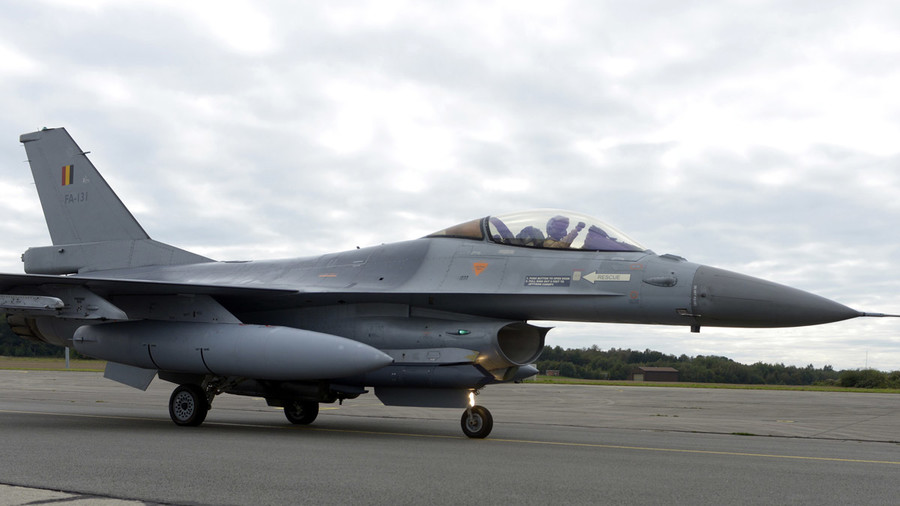
A Belgian F-16 fighter jet © Eric Vidal / Reuters

Russia’s Foreign Ministry said in a statement that it has presented Alex Van Meeuwen, Belgium’s ambassador in Moscow, with evidence proving the involvement of Belgian Air Force jets in a recent airstrike on a Syrian village that killed four civilians.

The Russian Foreign Ministry summoned Van Meeuwen on Friday.

“During the conversation with Van Meeuwen, First Deputy Foreign Minister Vladimir Titov said that Moscow was puzzled by Belgium’s ongoing denial of the fact that the Belgian Air Force carried out an airstrike that killed civilians on the outskirts of Aleppo on October 18 of this year,” the Russian Foreign Ministry said in a statement.

“The Belgian diplomat [Van Meeuwen] was presented with evidence showing involvement of the Belgian Air Force in the airstrike on the village of Hassadjek. It was also mentioned that detailed info on the technical aspects of the flight of the two F-16 jets had been given to Belgium’s military attaché in Moscow by the Russian Ministry of Defense.”

Read more

An F-16 fighter jet from the Belgian Air Force  © Jon Nazca

Brussels is using “worthless excuses” in an attempt to divert public attention from the airstrike on the Syrian village, Russian Defense Ministry spokesman Major-General Igor Konashenkov said on Friday.

“Attempts by the Belgian Defense Minister [Steven Vandeput] to divert public attention from the tragedy, using obviously worthless excuses, causes profound confusion. It speaks of either Mr Vandeput’s misunderstanding of the document provided by Russia, or the desire of the US Armed Forces Central Command, responsible for providing targeting data to aircraft of the international coalition in Syria, to evade responsibility for the death of six Syrian civilians, killed in the airstrike,” Konashenkov told journalists.

Belgian Foreign Ministry spokesperson Didier Vanderhasselt told Interfax on Friday the ministry is not yet aware of the content of its ambassador’s conversation with Russia’s deputy foreign minister, and is waiting for the results of the meeting. “We maintain dialogue with the Russian side, we need to know exactly what was said at this meeting,” he added.

“We are also surprised by the fact that we have not been provided with the data before,” Vanderhasselt is cited as saying by Interfax. “Our military gave all the explanations to the military attaché of the Russian Embassy in Belgium yesterday [Thursday] morning,” he added.

Russian Defense Ministry spokesman General Igor Konashenkov said on Thursday that Brussels’ obstinate denial of involvement shows that Belgian Defense Minister Steven Vandeput is either “deliberately deceiving people in Belgium and around the world, or his subordinates and the Americans are lying to the leadership of Belgium.”

The airstrike on the village of Hassadjek in Syria’s Aleppo province reportedly killed six civilians on Tuesday.

According to Konashenkov, the two Belgian F-16s were immediately identified by Russian and Syrian air defense radar and all of their movements were tracked.

“Every aircraft type has a unique identifiable signature,” he noted.

The warplanes, which had flown in from the Muwaffaq Salti Airbase in Jordan, delivered their night strike on the village at 00:35 GMT, about two hours after takeoff, leaving six civilians dead and four injured, the general said. Russia tracked the flight of the two planes from Jordan to Iraq and Syria, as well as their meeting with a US KC-135 tanker, which refueled them over the Deir ez-Zor area, Konashenkov said, adding that the US-led coalition hadn’t informed Russia about the Belgian flights.

WATCH MORE:

Has World War 3 Already Started?

October 20, 2016

Has World War 3 Already Started?

by Nick Giambruno, Senior Editor

Source: Has World War 3 Already Started? | International Man

It took 3 million soldiers, 3,000 tanks, 7,000 artillery pieces, and 2,500 aircraft…

“Operation Barbarossa” was the code name for Nazi Germany’s invasion of the Soviet Union in 1941.

It was the largest military operation in human history.

The Nazis had already conquered most of Europe. Hitler had grown overconfident from his recent military victories. Now he was hunting for big game… Stalin’s USSR.

Throughout history, many European invaders, including Napoleon, suffered monumental defeats when they took on Russia. Despite this, Hitler thought he could succeed where they had failed.

The idea was to inflict a total defeat on the Soviets in a matter of months, before the notoriously brutal Russian winter began.

At first, it looked like the Germans might succeed. The Soviets were taken by surprise and were disorganized.

But those initial victories wouldn’t be enough. Thanks to stubborn resistance and a seemingly inexhaustible supply of Soviet troops, Operation Barbarossa stalled.

The Germans didn’t make it to Moscow before winter. The ruthless cold weather would prove to be a far more effective weapon than anything in the Soviet arsenal. Hitler’s hopes of quickly taking out the USSR perished in the brutal cold. It ultimately turned the tide of the war against Germany.

But the Soviet victory cost millions of lives. By the end of the war, the Soviets had lost over 20 million people. Some estimate they lost many millions more. By comparison, the U.S. lost around 400,000 people.

So, it shouldn’t be surprising that the Russians get a little prickly when a foreign military starts marching toward their borders.

And recently… for the first time since Operation Barbarossa, German tanks are once again advancing on Russia’s border.

You probably haven’t heard this extraordinary piece of news. That’s because the mass media has basically ignored and obscured it. They’ve been busy covering far more important things… like transgender issues and Kim Kardashian’s latest stunt.

That’s why I want to tell you about Operation Anaconda 2016.

It’s the largest war game in Eastern Europe since the end of the Cold War. It’s essentially a rehearsal to secure a quick NATO victory in the event of war with Russia.

It was launched from Warsaw, Poland, recently and involves 31,000 NATO troops.

Operation Anaconda 2016 is one of the most important stories you’re not hearing about. It shows how perilously close the world is to another global war.

I found out about Operation Anaconda 2016 while in Warsaw with Doug Casey earlier this year.

(Incidentally, Poland is one of the cheapest, enjoyable countries I’ve ever been to. A 30-minute taxi ride from the middle of Warsaw to the airport is only $5. You’ll be hard-pressed to find an entrée in one of the nicest restaurants for over $15.

Poland does not use the European currency, the euro. It has its own currency, the zloty. And the zloty’s weakness is a big reason Poland is so inexpensive today. By the way, “zloty” means “gold” in Polish. But the currency has no tie to gold. It’s just a paper currency, like the dollar and euro are.)

Operation Anaconda 2016 is controversial even within NATO. German Foreign Minister Frank-Walter Steinmeier recently said:

Whoever believes that a symbolic tank parade on the alliance’s eastern border will bring security is mistaken. We are well advised to not create pretexts to renew an old confrontation.

Although Steinmeier said Operation Anaconda 2016 is symbolic, he failed to mention exactly what it symbolizes.

First, an anaconda is a giant snake. It kills its prey by squeezing it. From the Russian perspective, they’re the ones who feel squeezed. This is precisely what the U.S. has been doing by fomenting so-called colored revolutions in Ukraine and Georgia (both on Russia’s periphery) and trying to absorb them into NATO.

Second, this unprecedented “tank parade” on Russia’s borders symbolizes nothing less than World War 3.

(Doug Casey: It’s provocative, and actually quite insane. The Western media paints the Russians as the aggressors, which—let me shock you by saying this—is the opposite of the truth. Russia is an economic minnow, producing nothing but oil and gas, and mostly unprofitably, at current prices. Its population is in permanent decline, and it’s actually a disintegrating empire with a dozen secession movements. Its only serious industrial sector is manufacturing weapons, but even the most advanced Sukhois and MiGs (like the F-22 and F-35) are artifacts of a bygone era. The Russians aren’t in a position to threaten anyone—entirely apart from the fact that conquering neighboring countries no longer makes sense. In today’s world, you’re no longer acquiring an asset to be looted, but taking on a liability.

As for NATO, it’s outlived its usefulness by over 25 years. The huge military bureaucracy is just a hammer in search of a nail. It should be abolished before it gets everyone in a lot of trouble.)

Russian President Vladimir Putin has reacted to Operation Anaconda 2016 with alarm. At a recent press conference, he warned Western mainstream media journalists that the world is sleepwalking into World War 3, saying:

We know year by year what’s going to happen, and they know that we know. It’s only you that they tell tall tales to, and you buy it, and spread it to the citizens of your countries. Your people in turn do not feel a sense of the impending danger—this is what worries me.

How do you not understand that the world is being pulled in an irreversible direction? While they pretend that nothing is going on. I don’t know how to get through to you anymore.

U.S. politicians like to use Putin as a piñata to show how tough they are. Hillary Clinton has declared Putin to be the new Hitler. This is the kind of thinking that fueled Operation Anaconda 2016.

Now, we’re not referees charged with deciding which political players are good guys and which are bad guys.

However, the portrait of Putin as a Hitler or a crazy man leading his country toward disaster—the picture you get from the mainstream media and from many politicians—is suitable only for propaganda posters.

I don’t give two you-know-whats about what happens in Eastern Europe, except to the extent it might spark World War 3 and cause us to get vaporized in a nuclear exchange.

Albert Einstein once said, “I know not with what weapons World War 3 will be fought, but World War 4 will be fought with sticks and stones.”

Editor’s Note: It’s always been true, as Bourne said, that “war is the health of the State.” But it’s especially true when economic times get tough. That’s because governments like to blame their problems on outsiders; even an imagined foreign threat tends to unify opinions around those of the leaders.

Since economies around the world are all weakening, and political leaders are all similar in essential mindset, there’s good reason to believe the trend toward World War 3 is accelerating.

Unfortunately, there’s little any individual can do to practically change the trajectory of this trend in motion. The best you can and should do is to stay informed so that you can protect yourself in the best way possible and even profit from the situation.

That’s exactly why New York Times best-selling author Doug Casey and his team just released an urgent video. Click here to watch it now.

Norway Surveillance Photos Show Russian Aircraft Carrier Flotilla On Route To Syria

October 20, 2016

Norway Surveillance Photos Show Russian Aircraft Carrier Flotilla On Route To Syria

Source: Norway Surveillance Photos Show Russian Aircraft Carrier Flotilla On Route To Syria | Zero Hedge

One month ago we reported that in the latest naval escalation involving the US and Russia, one which would make the eastern Mediterranean a carbon copy of what it looked like three years ago during the peak of 2013 Syrian conflict which almost ended in war between Russia and the US, Russia announced it would deploy its only aircraft carrier, the Admiral Kuznetsov to the coast of Syria.

Russia’s defence minister said Wednesday that Moscow was dispatching its flagship aircraft carrier to bolster its forces in the eastern Mediterranean off Syria. The Admiral Kuznetsov aircraft carrier would be sent to join Russia’s current naval deployment there, minister Sergei Shoigu said during a televised meeting.


“At the moment the Russian task force in the Eastern Mediterranean consists of no fewer than six combat ships and three or four logistic ships from all fleets” the minister said adding that “to build up the group’s combat capabilities we plan to reinforce it with an Admiral Kuznetsov-led group,” Shoigu told a meeting of the Defense Ministry’s board. He added that the Russian Navy has been permanently present in the Eastern Mediterranean since 2013.

Now, according to a report by the Norwegian military which released pictures taken by surveillance aircraft, we know that the Kuznetsov accompanied by a fleet of Russian warships, is currently on its way to Syria and is sailing in international waters off the coast of Norway near Trondheim. Photos of the vessels, which include the aircraft carrier Admiral Kuznetsov and the Pyotr Velikiy battle cruiser, were taken near Andoya island, in northern Norway on Monday.

As reported by Reuters , a spokesman for the Norwegian military intelligence service said the country’s armed forces frequently releases such footage, while newspaper VG quoted General Morten Haga Lunde, head of the service, as saying the eight ships involved “will probably play a role in the deciding battle for Aleppo”. According to Russia’s TASS state news agency, the aircraft carrier would carry 15 Su-33 and MIG-29K jet fighters and over 10 Ka-52K, Ka-27 and ??-31 helicopters.

The naval group which includes the carrier and its escort of seven other Russian ships, is the most powerful Russian naval task force to sail in northern Europe since 2014, Russia’s Nezavisimaya Gazeta daily reports. The carrier can carry more than 50 aircraft and its weapons systems include Granit anti-ship cruise missiles.

Next in the flotilla, in terms of firepower, is the Russian nuclear-powered battle cruiser Peter the Great.

The Kirov-class cruiser Peter the Great escorts the carrier

As BBC adds, a Norwegian Lockheed P-3 Orion reconnaissance plane, monitoring the force, photographed the ships. MiG-29 Fulcrum jets and combat helicopters were visible on the carrier’s deck.

The other Russian surface ships in the group are: two large anti-submarine warships – the Severomorsk and Vice-Admiral Kulakov – and four support vessels.

Several of the task force ships are shown in this Norwegian photo

Norway did not appear to be fazed by the passage of the Russian flotilla in international waters: “The Kuznetsov Task Group situation is normal routine for the Norwegian military,” said Norwegian military spokesperson Maj Elisabeth Eikeland. “The only unusual thing is the amount of ships,” she told the BBC.

The group will beef up the Russian naval presence off the Syrian coast – Russia already has about 10 ships there. During its bombardment of anti-government rebels in Syria that force has fired cruise missiles.

In an article headed “Moscow’s Maritime Fist” the Russian armed forces channel TV Zvezda said several submarines would probably move from the Atlantic to escort the flotilla.

Meanwhile, commenting on the Russian flotilla, a Royal Navy spokesperson said: “UK and Nato assets routinely monitor warships from other nations when they enter our area of interest and this will be no different.”

More importantly, when the group reaches Syria the Russian navy will rival the firepower of the US Sixth Fleet in the region, Russian media report. As such, the possibility of a provocation on either side rises substantially. This is particularly notable in light of the recent report that having launched a military assault on Yemen due to alleged attacks by Houthi rebels on a US warship traveling in the Red Sea, subsequently the Pentagon admitted it was no longer confident the attack had originated from Yemen, suggesting the failed missile attack may have been in fact a false flag, potentially originating out of Saudi Arabia.

Iranian ships in Gulf of Aden: How far might Yemen escalation go? Op-Edge

October 16, 2016

Iranian ships in Gulf of Aden: How far might Yemen escalation go?

Source: Iranian ships in Gulf of Aden: How far might Yemen escalation go? — RT Op-Edge

The U.S. Navy guided-missile destroyer USS Mason © Blake Midnight / Reuters

With Iranian warships in the Gulf of Aden, political analyst and expert on American studies, Sayed Mohammad Marandi says the Iranians feel their presence is to facilitate trade and shipping while the American presence serves to create further chaos.

Iran has established a military presence off the coast of Yemen hours after Washington carried out its first direct strikes against Houthi forces. Two Iranian warships were sent to the Gulf of Aden reportedly to protect trade vessels from piracy.

The White House insists its strike was a defensive measure against a reported attempt by the Houthis to target a US navy vessel in the Red Sea.

Read more

FILE PHOTO Iranian navy warship © Stringer

RT: Now there are Iranian warships in the Gulf of Aden. How far might this escalation over Yemen go?

Sayed Mohammad Marandi: I don’t think this is all that important. The Iranians have a permanent presence in that part of the world because of the problems with shipping thanks to the American policies over the past few decades. There is a lot of instability in the Red Sea. And the Iranian ships are there basically to prevent pirates from boarding Iranian ships. They’ve been doing this for a number of years now. The Iranians have also protected the ships of other countries as well. The problem really is the US presence. Iranians are confident the Americans are lying about missile attacks on American vessels. They say this is a fabricated story that the US could enter the fray on behalf of Saudi Arabia to boost Saudi morale.

Because after all the Saudis after bombing weddings, funerals, schools and hospitals despite the fact that the Western media is completely silent about it and Western leaders like Boris Johnson don’t seem to care about the Yemenis who are being massacred in the country. But despite all that the Saudis are losing the war. They have lost the war. And the Yemeni resistance, the Houthis and Ansar Allah and the Yemeni army they have succeeded in defeating Saudi-backed forces and Saudi forces on the border between Yemen and Saudi Arabia. The Iranians feel that their presence is one to help facilitate trade and shipping while the American presence as in the past few decades is only serving to create further chaos.

Middle East affairs commentator Ali Rizk says the Americans and Saudis are guilty of double standards: “Some US figures who favor intervention are now saying: “Look, the Houthis are attacking the US navy vessels therefore we have to get more deeply involved. That is in a very contrast to Syria. I think it shows the clear double standards and that shows also very clearly that the US and Saudi Arabia in particular have no interest in democracy or anything else. What is going on is part of the geopolitical game.”

RT: Isn’t it a danger here that now both sides will see each other as a threat?I

MM: The Iranians believe that the Americans have already lost the war in Yemen. Their support for Saudi Arabia has failed. And the Americans are just as responsible for the atrocities in Yemen as is the Saudi regime. The American president has blood on his hands just like the Saudi King, Crown Prince and the Deputy Crown Prince. The Iranians feel the Americans are not really in a position to escalate further. What they want to do is put pressure on Ansar Allah so that the Saudis could negotiate from a stronger position. And also I think in order to increase pressure on the US after the Saudi regime deliberately targeted the funeral killing 150 people and injuring hundreds more. A lot of people in the West have been increasingly protesting in the media and otherwise against America’s support for the Wahhabi regime.

Read more

A still image from video released October 13, 2016 shows U.S. military launching cruise missile strikes from U.S. Navy destroyer USS Nitze to knock out three coastal radar sites in areas of Yemen controlled by Houthi forces. ©

This latest fabricated accusation by the US that Ansar Allah fired missiles despite the denials by Ansar Allah and the Yemeni army. This was basically to draw attention away from the killings in the funeral to ease pressure so that the US could continue supporting the Wahhabi regime in Saudi Arabia.

RT: Do you expect Washington to in any way review its co-operation with Saudi Arabia which it suggested it might do after Saturday’s carnage at the funeral in Sana’a?

MM: No, they are being completely dishonest. The Americans from the very beginning when the Saudis were using cluster bombs, they continued to give them weapons, when they bombed hospitals, they continued to support them, when they bombed weddings…The Americans have no problem with what the Saudis are doing on Yemen. It is uncomfortable so they every now and then, they complain about it…

The statements, views and opinions expressed in this column are solely those of the author and do not necessarily represent those of RT.

Iranian warships deployed off Yemen coast after US bombs Houthi targets

October 13, 2016

Iranian warships deployed off Yemen coast after US bombs Houthi targets

report Published time: 13 Oct, 2016 13:32

Source: Iranian warships deployed off Yemen coast after US bombs Houthi targets – report — RT News

FILE PHOTO Iranian navy warship © Stringer / Reuters

Iran has deployed a fleet of warships to the Gulf of Aden, according to the Tasnim news agency. The deployment follows US cruise missile strikes on Yemeni positions thought to be under Houthi rebel control.

The Iranian Navy has sent the warships to international waters for a mission that includes entering the area off the southern coast of Yemen, Tasnim reported on Thursday. The area is among the world’s busiest maritime trade routes.

“Iran’s Alvand and Bushehr warships have been dispatched to the Gulf of Aden to protect trade vessels from piracy,” Tasnim reported earlier, as quoted by Reuters.

Read more

FILE PHOTO © Eric Garst

Saudi Arabia, which has fought a long war with Yemen’s Houthi rebels, accuses Iran of supporting the group – a charge denied by Tehran.

The US military carried out “limited self-defense strikes” in Yemen on Thursday, in retaliation for recent attacks on an American naval destroyer, USS Mason, which has been operating north of the Bab Al-Mandab Strait.

According to the Pentagon’s initial assessments, three “radar sites” in the Houthi rebel-controlled area of Yemen were destroyed in the attack.

The attack on coastal targets was carried out by Tomahawk cruise missiles launched from the destroyer USS Nitze, NPR reported.

The Houthis have denied carrying out the attack, however. A military source reportedly told Saba news agency – a media outlet run by the group – that the assault did not come from areas under its control.

More from RT.com

Peters: ‘Obama Doesn’t Have Guts’ for Confrontation With Russia

October 12, 2016

Peters: ‘Obama Doesn’t Have the Guts’ for Confrontation With Russia

BY:
October 11, 2016 3:58 pm

Source: Peters: ‘Obama Doesn’t Have Guts’ for Confrontation With Russia

Retired Lt. Col. Ralph Peters told Fox Business Network’s Trish Regan on Tuesday that President Obama “doesn’t have the guts” to enter into a military confrontation with Russia.

While describing the flaws in both of the presidential candidate’s proposed Syria policies, Peters slammed Obama for his inaction in the Syrian civil war during his presidency.

“President Obama has let this go on so long. He’s been so apathetic, so lethargic that it’s gotten to the point where Russia dominates the skies, and [Vladimir] Putin has warned us explicitly that any attempt on our part to ground, to militarily ground Syria’s air force will lead to a military confrontation with Russia,” he said. “And you know President Obama doesn’t have the guts for that.”

This did not stop Peters from laying into Donald Trump as well.

“Mr. Trump is utterly wrong that [Bashar al] Assad and ISIS and–rather, that Assad and Putin are fighting ISIS,” he said. “They’re fighting the moderate rebels that we equipped and letting us pay the bill to fight ISIS.”

Peters said that Clinton’s no-fly zone proposal could have been effective years ago.

While elaborating on Clinton’s policy proposal, Peters ripped into Obama again.

“Now, Hillary Clinton talks about a no-fly zone, and it’d be great if we could do it at no cost, but are we really going to confront Russia militarily in the skies?” Peters asked. “Are our aircraft going to be dogfighting Russia? I’m not saying we shouldn’t or we should, I’m trying to lay out the problems here because Obama has let it go on so very, very wrong.”

He took a final hit at Trump and Clinton after laying into Obama.

“So, Trump is wrong utterly about the situation,” he concluded. “I think Hillary Clinton is four years too late in the solution.”

‘S-300, S-400 air defenses in place’: Russian MoD warns US-led coalition not to strike Syrian army

October 6, 2016

‘S-300, S-400 air defenses in place’: Russian MoD warns US-led coalition not to strike Syrian army

Published time: 6 Oct, 2016 13:22 Edited time: 6 Oct, 2016 14:07

Source: ‘S-300, S-400 air defenses in place’: Russian MoD warns US-led coalition not to strike Syrian army — RT News

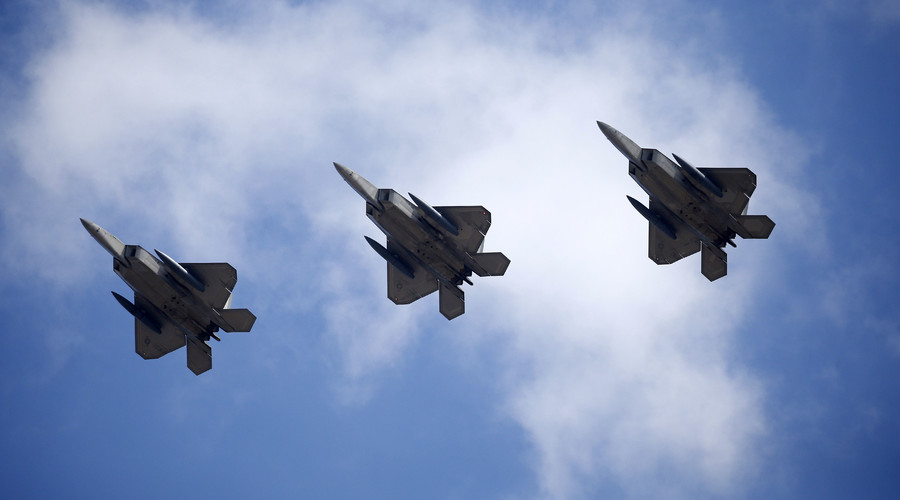
U.S. F-22 stealth fighter jets © Kim Hong-Ji / Reuters

Russia’s Defense Ministry has cautioned the US-led coalition of carrying out airstrikes on Syrian army positions, adding in Syria there are numerous S-300 and S-400 air defense systems up and running.

Russia currently has S-400 and S-300 air-defense systems deployed to protect its troops stationed at the Tartus naval supply base and the Khmeimim airbase. The radius of the weapons reach may be “a surprise” to all unidentified flying objects, Russian Defense Ministry spokesperson General Igor Konashenkov said.

Read more

© Kirill Kallinikov

According to the Russian Defense Ministry, any airstrike or missile hitting targets in territory controlled by the Syrian government would put Russian personnel in danger.

The defense official said that members of the Russian Reconciliation Center in Syria are working “on the ground” delivering aid and communicating with a large number of communities in Syria.

“Therefore, any missile or air strikes on the territory controlled by the Syrian government will create a clear threat to Russian servicemen.”

Russian air defense system crews are unlikely to have time to determine in a ‘straight line’ the exact flight paths of missiles and then who the warheads belong to. And all the illusions of amateurs about the existence of ‘invisible’ jets will face a disappointing reality,”  Konashenkov added.

Read more

© Abdalrhman Ismail

He also noted that Syria itself has S-200 as well as BUK systems, and their technical capabilities have been updated over the past year.

The Russian Defense Ministry’s statement came in response to what it called “leaks” in the Western media alleging that Washington is considering launching airstrikes against Syrian government forces.

“Of particular concern is information that the initiators of such provocations are representatives of the CIA and the Pentagon, who in September reported to the [US] President on the alleged controllability of ‘opposition’ fighters, but today are lobbying for ‘kinetic’ scenarios in Syria,” he said.

He cautioned Washington to conduct a “thorough calculation of the possible consequences of such plans.”

US-led coalition jets bombed positions of the Syrian government forces on September 17, resulting in the deaths of 83 servicemen. Washington said the airstrike was a mistake, however Damascus claimed the incident was a “blatant aggression.”

The relocation of the S-300 system in order to protect Russian ships and the naval base in Syria was confirmed by Russian defense officials on October 4. Konashenkov assured that the S-300 is a “purely defensive system and poses no threat.” Russia also has S-400 missile defense systems at Khmeimim base that were placed there after Turkey downed a Russian SU-24 jet in November of 2015.