Posted tagged ‘Mad Mullahs’

Losin’ in Lausanne (8) [Updated]

April 3, 2015

Losin’ in Lausanne (8) [Updated], Power LineScott Johnson, April 2, 2015

The last time Zarif accused the Obama administration of lying on a factsheet was after the JPOA was announced, in the context of granting a “right to enrich.” He was 100% right and the Americans were 100% wrong.

***************

Omri Ceren writes from Lausanne to put today’s announcement of a “framework” for an agreement in perspective:

Zarif just finished his speech, and there’s a break while the President speaks back in DC. But some of what Zarif revealed has already generated controversy. There was a lot of braggadocio in the speech: no closing of facilities, R&D will continue on Iran’s scientific schedule, enrichment will continue, the heavy water at Arak will be modernized, etc.

Perhaps most relevant to people who have been following the day-to-day in Lausanne, is that Zarif confirmed the U.S. has completely caved on the Fordow concession that the AP blew open on Thursday. Recall that Fordow is the underground bunker, built into the side of a mountain, which the Iranians emptied and made into an illicit enrichment facility. The assumption had always been that the Iranians would have to close it under any reasonable deal.

President Obama was saying as late as 2012: “We know they don’t need to have an underground, fortified facility like Fordo in order to have a peaceful program” [1].

The Iranians simply said no [2]. So the Americans caved and said that they could keep it open as a research facility, but they had to remove all the centrifuges for storage [3]. The compromise was the brainchild of Robert Einhorn from Brookings – a top State nonproliferation official stretching back to the Clinton era – and there was a lot of talk of Iranian flexibility when they accepted it [4]. Then this week, it emerged that in fact the Iranians would be allowed to keep centrifuges spinning inside the mountain.

But instead of spinning uranium, the centrifuges would be spinning germanium or similar non-nuclear elements. That’s the administration’s talking point: that there will not be any “enrichment” going on at Fordow. The claim is – bluntly – false. Centrifuges spin isotopes into lighter and heavier elements, thereby “enriching” the material. That’s what they do. In fact that’s all they do. The administration has gone all-in on a talking point can be defeated by a Google search for “centrifuges enrich germanium” (if you’re fastidious you can set the Google search to before the AP scoop, to make sure you’re not getting Fordow-specific articles).

This isn’t a minor point. The concession has the potential to gut the whole deal:

(1) Allows N-generation centrifuge R&D beyond the reach of the West – since the process is the exact same process, Iran will have a hardened facility where it will be able to research and develop N-generation centrifuges. Zarif bragged from the stage in Lausanne that Iranian R&D on centrifuges will continue on IR-4s, IR-5s, IR-6s, and IR-8s, and that the pace of research will be tied to Iranian scientific progress. The development of advanced centrifuges would give the Iranians a leg up if they decide to break out, and will put them instantly within a screw’s turn of a nuke when the deal expires.

(2) Leaves Iranian nuclear infrastructure running beyond the reach of the West – if the Iranians kick out inspectors and dare the world to respond, the West will have zero way to intervene. The Iranians will have a head start on enrichment, and a place to do it beyond the reach of Western weapons. The administration’s early pushback has been that the breakout time will still be a year, so they could in theory reimpose sanctions, but it takes more than a year for sanctions to take an economic toll. So: zero options to stop a breakout.

[1] http://www.wsj.com/articles/bret-stephens-the-capitulationist-1427758881
[2] http://www.jpost.com/Middle-East/Rejecting-US-comments-on-its-nuclear-program-Iran-FM-says-Fordo-Arak-are-non-negotiable-340458
[3] http://articles.chicagotribune.com/2014-07-09/news/sns-rt-us-iran-nuclear-fordow-20140709_1_fordow-enriched-uranium-interim-nuclear-deal
[4] http://www.brookings.edu/research/papers/2014/03/31-nuclear-armed-iran-einhorn

Omni follows up with this:

The issue of sequencing sanctions relief – how, when, and to what extent sanctions will be lifted in exchange for Iranian compliance – was one of the key sticking points over the last week. At some points journalists were describing it as a near-obsession of the Iranians, the suspicion being that they had received some very specific instructions from the Supreme Leader (or had made some very ambitious representations to him).

Achieving an understanding on sanctions would bhave to be counted as a major achievement, and it’s already being claimed as such. But there’s something wrong here. I haven’t figured out what it is yet, but I’m pretty sure I don’t like it.

– The EU/Iran joint statement says sanctions will be terminated “simultaneously” with Iran implementing its obligations (http://www.eeas.europa.eu/statements-eeas/2015/150402_03_en.htm): The EU will terminate the implementation of all nuclear-related economic and financial sanctions and the US will cease the application of all nuclear-related secondary economic and financial sanctions, simultaneously with the IAEA-verified implementation by Iran of its key nuclear commitments.

– The White House factsheet says sanctions will be suspended “after” Iran has taken “all” of its nuclear-related steps (https://www.scribd.com/doc/260719595/Parameters-for-a-Joint-Comprehensive-Plan-of-Action-regarding-the-Islamic-Republic-of-Iran-s-Nuclear-Program): U.S. and E.U. nuclear-related sanctions will be suspended after the IAEA has verified that Iran has taken all of its key nuclear-related steps. If at any time Iran fails to fulfill its commitments, these sanctions will snap back into place.

Zarif is already saying the White House is lying about how sanctions will be lifted:

The solutions are good for all, as they stand. There is no need to spin using “fact sheets” so early on.

Iran/5+1 Statement: “US will cease the application of ALL nuclear-related secondary economic and financial sanctions.” Is this gradual?

Iran/P5+1 Statement: “The EU will TERMINATE the implementation of ALL nuclear-related economic and financial sanctions”. How about this?

The last time Zarif accused the Obama administration of lying on a factsheet was after the JPOA was announced, in the context of granting a “right to enrich.” He was 100% right and the Americans were 100% wrong.

It’s not clear what the actual sanctions deal is, but it’s worrying that there are already differences. If the Americans are right, then the Iranians are setting up unrealistic expectations for their people and making a deal untenable. If the Iranians are right, then the White House is again misleading journalists and lawmakers about the actual scope of their concessions.
Iran Accuses U.S. of Lying About New Nuke Agreement

April 3, 2015

Iran Accuses U.S. of Lying About New Nuke Agreement, Washington Free Beacon, April 2, 2015

(Breaking news: Obama lied! That’s shocking. Who would’a thunk? — DM)

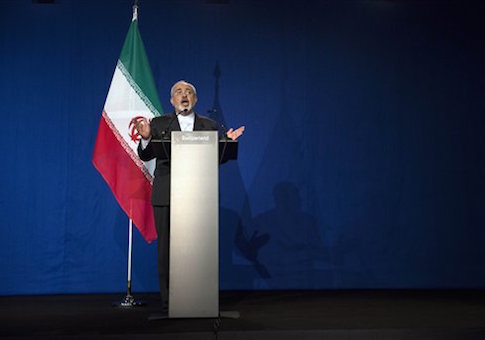
Switzerland Iran Nuclear TalksJavad Zarif / AP

LAUSANNE, Switzerland — Just hours after the announcement of what the United States characterized as a historic agreement with Iran over its nuclear program, the country’s leading negotiator lashed out at the Obama administration for lying about the details of a tentative framework.

Iranian Foreign Minister Javad Zarif accused the Obama administration of misleading the American people and Congress in a fact sheet it released following the culmination of negotiations with the Islamic Republic.

Zarif bragged in an earlier press conference with reporters that the United States had tentatively agreed to let it continue the enrichment of uranium, the key component in a nuclear bomb, as well as key nuclear research.

Zarif additionally said Iran would have all sanctions lifted once a final deal is signed and that the country would not be forced to shut down any of its currently operating nuclear installations.

Following a subsequent press conference by Secretary of State John Kerry—and release of a administration fact sheet on Iranian concessions—Zarif lashed out on Twitter over what he dubbed lies.

“The solutions are good for all, as they stand,” he tweeted. “There is no need to spin using ‘fact sheets’ so early on.”

Zarif went on to push back against claims by Kerry that the sanctions relief would be implemented in a phased fashion—and only after Iran verifies that it is not conducting any work on the nuclear weapons front.

Zarif, echoing previous comments, said the United States has promised an immediate termination of sanctions.

“Iran/5+1 Statement: ‘US will cease the application of ALL nuclear-related secondary economic and financial sanctions.’ Is this gradual?” he wrote on Twitter.

He then suggested a correction: “Iran/P5+1 Statement: ‘The EU will TERMINATE the implementation of ALL nuclear-related economic and financial sanctions’. How about this?”

The pushback from Iran’s chief diplomat follows a pattern of similar accusations by senior Iranian political figures after the announcement of previous agreements.

Following the signing of an interim agreement with Iran aimed at scaling back its nuclear work, Iran accused the United States of lyingabout details of the agreement.

On Thursday evening, Zarif told reporters the latest agreement allows Iran to keep operating its nuclear program.

“None of those measures” that will move to scale back Iran’s program “include closing any of our facilities,” Zarif said. “We will continue enriching; we will continue research and development.”

“Our heavy water reactor will be modernized and we will continue the Fordow facility,” Zarif said. “We will have centrifuges installed in Fordow, but not enriching.”

The move to allow Iran to keep centrifuges at Fordow, a controversial onetime military site, has elicited concern that Tehran could ramp up its nuclear work with ease.

Zarif said that once a final agreement is made, “all U.S. nuclear related secondary sanctions will be terminated,” he said. “This, I think, would be a major step forward.”

Zarif also revealed that Iran will be allowed to sell “enriched uranium” in the international market place and will be “hopefully making some money” from it.

The Tricks Obama Is Trying to Play with the Iran Announcement

April 2, 2015

The Tricks Obama Is Trying to Play with the Iran Announcement, Commentary Magazine, April 2, 2015

(When will Iran say what and to whom about Obama’s new “framework?” Will Iran cloud the results of the negotiations as cleverly as did Obama? — DM)

If you look at what happened today between the U.S. and Iran through the lens of domestic American politics, Barack Obama has made a very clever play here—because what might be called “the agreement of the framework of the possibility of a potential deal” gives him new leverage in his ongoing battle with the Senate to limit its ability to play a role in the most critical foreign-policy matter of the decade.

The “framework” codifies the Obama administration’s cave-ins but casts them as thrilling reductions in Iran’s capacities rather than what they are—a pie-in-the-sky effort to use inspections as the means by which the West can “manage” the speed with which Iran becomes a nuclear power.

Obama’s tone of triumph this afternoon was mixed with sharp reminders that the deal is actually not yet done—and that is entirely the point of this exercise from a domestic standpoint. the triumph signals his troops and apologists that the time has come for them to stand with him, praise the deal sheet and pretend it’s a deal, declare it historic, and generally act as though the world has been delivered from a dreadful confrontation by Obama and Kerry.

But since the deal is not yet done, it could still be derailed. And that is where Obama’s truly Machiavellian play here comes in: He may have found a way to put the Senate in a box and keep Democrats from melting away from him on Iran and voting not only for legislation he doesn’t want but also to override the veto he has promised.

The Senate has two provisions at the ready with which it could go ahead any time. One, called Kirk-Menendez, imposes new sanctions on Iran. Obama promised a veto of this bill should it pass, and after today, one ought to presume that it’s dead.

The other, Corker-Menendez, requires the administration to submit any deal to the Senate within 60 days of its signing. This is a key provision because, of course, what the Iranians want—and what they said today they got—was the lifting of all sanctions. The president, in his statement, vowed to lift the “nuclear” sanctions (there are others involving human rights) if the Iranians comply by the terms of the deal.

Existing sanctions legislation features waivers the president can arguably use to do that. But those sanctions were put into place specifically to make it incredibly painful for Iran to retain any nuclear-weapons capability—not as a means of acceding to Iran’s retention of a nuclear capability.

For this reason, and for the reason that the president is essentially negotiating an arms-control treaty with Iran, the Senate should approve any final deal. Obama disagrees and claims this is merely a nuclear-agreement, not a treaty, and therefore Congress has no role.

That’s a very nervy argument. It is not only disrespectful of the Senate but it misrepresents the nature of what’s being negotiated. And that’s why it’s an argument it appeared the president would lose—that senators would not only vote for Corker-Menendez but would override his veto of it.

Which is why the deal-that’s-not-yet-a-deal works in his favor. Talks are now to continue until the end of June. Obama can and will argue to Democrats that they owe it to him, to their base, and to their governing ideology to give him all the room he needs to get to June 30.

Of course, if the legislation does not pass by June 30 and Obama signs a final deal, the game is up; the Senate can’t retroactively insist in July he bring it to them for a vote.

Will there be a deal by June 30? Maybe, maybe not; maybe they’ll finish, maybe they won’t; maybe the Iranians will say they didn’t agree to this or that and blow up the whole thing; who knows. Probably the total collapse, after all this, would bring the Kirk-Menendez sanctions back to life. Which is why there will never be a total collapse—because these talks can simply go on….

Khameni to Zarif: Don’t sign! Obama to Kerry: Make them sign! Gridlock

April 2, 2015

Khameni to Zarif: Don’t sign! Obama to Kerry: Make them sign! Gridlock, DEBKAfile, April 2, 2015

Kerry_hotel_nuclear_talks_C_1.4.15John Kerry takes a break from the Lausanne talks

Tehran is not averse to negotiating ad infinitum – so long as the talks go their way. 

So the real gridlock centered on finding a procedure that fitted the US delegation’s instructions to get some sort of a deal signed, and the Iranian group’s directive to sign nothing that could be seen as an accord. So who will give ground first?

***************

It is hard to make out exactly what the seven exhausted foreign ministers of the world powers and Iran were actually talking about in Lausanne this week – especially in the last two days, when the negotiations overran their March 31 deadline for a framework nuclear accord.

The highly-colored reports from the Swiss hotel up until Thursday, April 2, bespoke a mighty battle between the American negotiators led by Secretary of State John Kerry and Energy Secretary Ernest Moniz, and the Iranian group, headed by Foreign Minister Mohammed Javad Zarif, over four key points still at issue between them: the pace of sanctions relief, research and development projects, international inspections – including snap visits to any nuclear facilities they demanded, and, finally, the quantity of low-enriched uranium Iran may retain after the bulk of its stockpile is shipped overseas.

The drama was heightened by the sight of the American delegation marching into a tent set up in the hotel yard “to defeat eavesdropping” for a video conference with President Barack Obama in the White House. Kerry wanted to know whether to carry on the never-ending negotiations, which were looking more and more farcical as the hours ticked by without closure, or quit. This would be tantamount to the failure of the entire structure of nuclear diplomacy.

Obama directed the delegation to carry on talking with the Iranians and disregard the missed deadline as though nothing had changed.

The Secretary of State earlier appeared in an upper hotel window gazing out in the distance. Was he seeing a solution of the impasse visible to no one else?

The French Foreign Minister, Lauren Fabius, fed up with the game playing out between the Americans and the Iranians, left more than once for home. He returned Thursday saying: “We are a few meters from the finishing line, but it’s always the last meters that are the most difficult. We will try and cross them. It’s not done yet.”

Zarif told reporters: “Our friends need to decide whether they want to be with Iran based on respect or whether they want to continue based on pressure. They have tested the other one; it is high time to test this one.”

Those words carried two messages: One that the Iranians were serious when they reiterated in the past weeks that a framework accord for ending the current phase of negotiations was unacceptable, and insisted on the talks carrying straight through to a comprehensive deal by June 30.

The Iranian foreign minister’s second message was a negation of “pressure” – i.e., sanctions, in obedience to supreme leader Ayatollah Ali Khamenei’s directive to the delegation to reject the incremental easing of international sanctions and press Tehran’s demand for immediate relief.

That directive was laid down by the ayatollah on February 18, when he determined that “an agreement would be arrived at not in two stages but in one stage to be completed by the end of June 2015 and the agreement would include the removal of all sanctions on Iran.”

The writing was on the wall for all the parties to see. The current deadline crisis could have been avoided by understanding that there was no way the Iranian delegation would ever disobey the supreme leader’s dictates.

Tehran is not averse to negotiating ad infinitum – so long as the talks go their way.

So the real gridlock centered on finding a procedure that fitted the US delegation’s instructions to get some sort of a deal signed, and the Iranian group’s directive to sign nothing that could be seen as an accord. So who will give ground first?

Experts: Iran Housing Nuke Materials in North Korea, Syria

March 31, 2015

Experts: Iran Housing Nuke Materials in North Korea, Syria
BY: Adam Kredo March 31, 2015 11:10 am Via The Washington Free Beacon


(Sneaky little devils, those Mullahs. – LS)

LAUSANNE, Switzerland — A top State Department official on Monday dismissed reports that Iran may be hiding key nuclear-related assets in North Korea and implied that she was unaware of the possibility, despite the publication this weekend of several articles by top analysts expressing alarm at the extent of nuclear cooperation between Tehran and Pyongyang.

Marie Harf, a spokeswoman for the State Department, dismissed as “bizarre” the reports, which described the transfer of enriched uranium and ballistic missile technology back and forth between the two rogue regimes.

The existence of an illicit Iranian nuclear infrastructure outside of the Islamic Republic’s borders would gut a nuclear deal that the administration has vowed to advance by Tuesday, according to these experts and others.

If Iran is not forced to disclose the full extent and nature of its outside nuclear work to the United States, there is virtually no avenue to guarantee that it is living up to its promises made in the negotiating room, according to multiple experts and sources in Europe apprised of the ongoing talks.

Gordon Chang, a North Korea expert who has written in recent days about Iran’s possible “secret program” there, described the State Department’s dismissal of these reports as naïve.

“Let me see if I get this straight: The country with the world’s most highly developed technical intelligence capabilities does not know what has been in open sources for years?” Chang said. “No wonder North Korea transfers nuclear weapons technology to Iran and others with impunity.”

“The North Koreans could go on CNN and say, ‘Hey, Secretary Kerry, we’re selling the bomb to Iran,’ and the State Department would still say they know nothing about it,” Chang said. “No wonder we’re in such trouble.”

Other Iranian experts specializing in the country’s military workings also have raised recent questions about Tehran’s collaboration with North Korea.

Ali Alfoneh and Reuel Marc Gerecht, both senior fellows at the Foundation for Defense of Democracies (FDD), have revealed that a nuclear reactor destroyed in Syria in 2007 by Israel was likely a North Korean-backed Iranian project.

Gerecht told the Free Beacon in a follow-up interview that key issues regarding Iran’s past military work and outside collaboration are being ignored in the negotiating room as diplomats rush to secure a tentative deal by Tuesday night.

“It certainly appears that the administration has backed away from [previous military dimensions] questions,” Gerecht said. “The plan appears to be to let the [International Atomic Energy Agency] continue its so far fruitless effort to gain access to sensitive sites, personnel, and paperwork, but to keep these questions out of the talks.”

“The administration is doing this because it fears the Iranians would walk out,” he added. “Any military work revealed by the Iranians would prove the Supreme Leader and [President] Rouhani liars.

Despite concerns from countries such a France over the issue, the United States has attempted to accommodate Iran, Gerecht said.

“The White House wants to believe that monitoring of known sites will be sufficient. It’s a bit mystifying given the Iranian track record and the CIA’s longstanding inability to penetrate the nuclear-weapons program (it’s just too hard of a target to do this reliably),” he explained. “But since they fear a breakdown, they bend their credulity in Iran’s favor. This has been the story of the negotiations from the beginning.”

Alfoneh also told the Free Beacon that Iran should be pressed by the United States to disclose the full extent of its nuclear relationship with North Korea.

“I certainly think the Islamic Republic should come clean concerning its past record of nuclear activities: Did the Islamic Republic ever try to build a nuclear weapon? If not, how are we to understand the opaque references to Tehran-Pyongyang nuclear cooperation in the 1990s?” Alfoneh said.

“As long as the Islamic Republic does not provide a clear record of its nuclear activities in the 1980s and 1990s, and as long as we do not know the full scope of Tehran-Pyongyang nuclear cooperation, there is always the risk of the two states renewing that cooperation, which in turn would jeopardize any agreement the Islamic Republic and the P5+1 Group may reach,” he said.

Another potential complication includes the ability of international inspectors to discern the extent of Iran’s nuclear work in Syria.

“Syria’s current chaos makes it virtually impossible for inspectors to do their job even if the Syrians were compliant,” according to Emanuele Ottolenghi, a onetime advisor to foreign ministries in Europe.

There is no way to determine whether Syria is housing any other nuclear sites on behalf of the Iranian, according to Ottolenghi, another senior fellow at FDD.

“Syria has covered up its nuclear activities after the 2007 [Israeli Air Force] raid on Deir al-Azour,” he said. “After four years of inconclusive efforts, the [International Atomic Energy Agency] ended up deferring the issue to the [United Nations Security Council] after declaring Syria in non-compliance.”

Iran, North Korea, nukes and Obama

March 30, 2015

Iran, North Korea, nukes and Obama, Dan Miller’s Blog, March 30, 2015

(The views expressed in this article are mine and do not necessarily reflect those of Warsclerotic or its other editors. — DM)

North Korea has ample nukes and wants money. Iran wants (and may already have) nukes, has money and will have more as sanctions are ended. The two rogue nations have long had a symbiotic relationship and it has not diminished. Yet “our” P5+1 negotiators, under the leadership of Obama’s minions, ignore that inconvenient problem as well as Iran’s missile development, “possible” nuclear weaponization and increasing regional hegemony.

I wrote about the Iran – North Korea connection back in 2013 in articles titled China, Iran and North Korea — a radioactive stew,  Iran, North Korea and Nuke Negotiations and elsewhere. As I noted in the radioactive stew article,

The main thing that puzzles me is why we continue to focus on Iran’s uranium enrichment. Is Iran (again) playing us for suckers? North Korea is fully capable of enriching uranium for Iran (or for anyone else) and would doubtless be happy to enrich as much as may be desired in exchange for the hard currency freely available to Iran if it were only to cease its own enrichment. North Korea needs the money and is not likely very particular about its sources. Just as our sanctions have not impacted Iran’s enrichment capabilities significantly, neither have they impacted those of North Korea. Perhaps we may awaken before it’s too late and notice Iran playing its Korean hole card in our high-stakes poker game.

We have not awakened and the problem has worsened since 2013.

Soure: American in North Korea

Soure: American in North Korea

In 2014, I summarized several earlier articles in one titled The Iran scam continues. There, I pointed out that the English language version of the interim P5+1 deal and the White House summary generally ignore “undisclosed” — but known — Iranian sites for missile and warhead development and the work done there– despite warnings from the International Atomic Energy Agency. I also noted the Iran – North Korea nexus. Again, the situation has become worse since then. As the magic date of March  31, 2015 arrives, Iran is still demanding – and likely will get — more and more concessions.

“The Iranians are again outplaying the Americans,” said one source in Europe familiar with the negotiations. “They know they’ll have to give up certain things eventually. So they’re digging in their heels on issues that mean everything and preparing to give ground on relatively minor issues—but not yet, and not until they see how much more the Americans are willing to give.” [Emphasis added.]

. . . .

“Iran has successfully dragged the administration toward their positions to attain massive concessions, and, sensing that kind of weakness, they are seeking to press their advantage to gain further ground on critical points,” according to the source, who added that on the sanctions relief front, Iran is seeking a rollback “without dismantling anything.” [Emphasis added.]

a1  Obama and Kahameni -building a toaster

What might Iran be willing to give up in order to get additional important concessions? How about stuff that North Korea will be pleased to do in exchange for a share of the extra funds Iran will have as sanctions are eliminated?

Occasionally but not often, news media raise the Iran – North Korea connection. For example, a March 29th article at the Washington Post by Ali Alfoneh and Reuel Marc Gerecht is titled What else is Iran hiding? Another article at the Daily Beast by Gordon G. Chang is titled Does Iran Have Secret Nukes in North Korea?

As noted in the Washington Post article,

The unfinished North Korean-designed reactor that was destroyed by Israeli planes on Sept. 6, 2007, at Deir al-Zour in Syria was in all likelihood an Iranian project, perhaps one meant to serve as a backup site for Iran’s own nuclear plants. We draw this conclusion because of the timing and the close connection between the two regimes: Deir al-Zour was started around the time Iran’s nuclear facilities were disclosed by an Iranian opposition group in 2002, and the relationship between Shiite-ruled Syria and Shiite Iran has been exceptionally tight since Bashar al-Assad came to power in 2000. We also know — because Ali Akbar Hashemi Rafsanjani, the former Iranian president and majordomo of the political clergy, proudly tells us in his multivolume autobiography — that sensitive Iranian-North Korean military cooperation began in 1989. Rafsanjani’s commentary leaves little doubt that the Iranian-North Korean nexus revolved around two items: ballistic missiles and nuclear-weapons technology. [Emphasis added.]

. . . .

The Iranian-North Korean contacts intensify in 1992, the year that Rafsanjani, with Rouhani at his side, launches a policy of commercial engagement with the Europeans. On Jan. 30, Rafsanjani receives intelligence minister Ali Fallahian and Mostafa Pourmohammadi, the ministry’s director of foreign espionage, to discuss “procurement channels for sensitive commodities.” On Feb. 8, Rafsanjani writes, “The North Koreans want oil, but have nothing to give in return but the special commodity. We, too, are inclined to solve their problem.” Rafsanjani orders defense minister Akbar Torkan to organize a task force to analyze the risks and benefits of receiving the “special commodity.” This task force recommends that the president accept the “risk of procuring the commodities in question.” Rafsanjani adds that “I discussed [this] with the Leader [Ayatollah Ali Khamenei] in more general terms and it was decided to take action based on the [task force’s] review.” [Emphasis added.]

It’s most unlikely that the “special commodity” and the technical know-how surrounding it have anything to do with ballistic missiles; Rafsanjani expresses anxiety that the “special commodity” could be intercepted by the United States, but doesn’t share this worry about missile procurement. In a March 9, 1992, journal entry, the cleric gloats about the U.S. Navy having tracked a North Korean ship bound for Syria but not two ships destined for Iran. Two days later, when the “special commodity” is unloaded, he writes: “The Americans were really embarrassed.” [Emphasis added.]

. . . .

Odds are good that North Korea helped to jump-start Iran’s nuclear-weapons program. If so, how long did this nefarious partnership continue?

Rouhani was Rafsanjani’s alter ego. He’s undoubtedly the right man to answer all of the PMD questions that the IAEA keeps asking and the Obama administration keeps avoiding. [Emphasis added.]

As noted at the Daily Beast article,

In October 2012, Iran began stationing personnel at a military base in North Korea, in a mountainous area close to the Chinese border. The Iranians, from the Ministry of Defense and associated firms, reportedly are working on both missiles and nuclear weapons. Ahmed Vahidi, Tehran’s minister of defense at the time, denied sending people to the North, but the unconfirmed dispatches make sense in light of the two states announcing a technical cooperation pact the preceding month.

. . . .

[N]o inspections of Iranian sites will solve a fundamental issue: As can be seen from the North Korean base housing Tehran’s weapons specialists, Iran is only one part of a nuclear weapons effort spanning the Asian continent. North Korea, now the world’s proliferation superstar, is a participant. China, once the mastermind, may still be a co-conspirator. Inspections inside the borders of Iran, therefore, will not give the international community the assurance it needs.

The cross-border nuclear trade is substantial enough to be called a “program.” Larry Niksch of the Center for Strategic and International Studies in Washington, D.C., estimates that the North’s proceeds from this trade with Iran are “between $1.5 billion and $2.0 billion annually.” A portion of this amount is related to missiles and miscellaneous items, the rest derived from building Tehran’s nuclear capabilities. [Emphasis added.]

Iran has bought a lot with its money. Mohsen Fakhrizadeh, thought to be Tehran’s chief nuclear scientist, was almost certainly in North Korea at Punggye-ri in February 2013 to witness Pyongyang’s third atomic test. Reports put Iranian technicians on hand at the site for the first two detonations as well.

The North Koreans have also sold Iran material for bomb cores, perhaps even weapons-grade uranium. The Telegraph reported that in 2002 a barrel of North Korean uranium cracked open and contaminated the tarmac of the new Tehran airport.

. . . .

Even if Iran today were to agree to adhere to the Additional Protocol, it could still continue developing its bomb in North Korea, conducting research there or buying North Korean technology and plans. And as North Korean centrifuges spin in both known and hidden locations, the Kim regime will have a bigger stock of uranium to sell to the Iranians for their warheads. With the removal of sanctions, as the P5+1 is contemplating, Iran will have the cash to accelerate the building of its nuclear arsenal.

So while the international community inspects Iranian facilities pursuant to a framework deal, the Iranians could be busy assembling the components for a bomb elsewhere. In other words, they will be one day away from a bomb—the flight time from Pyongyang to Tehran—not one year as American and other policymakers hope. [Emphasis added.]

Why does the Obama administration persistently avoid raising the Iran – North Korea nexus? Perhaps doing so would scuttle the “negotiations” and thereby Obama’s dreams about His legacy. Perhaps Obama is keen for Iran to have, and be in a position to use, nukes to enhance its hegemony over the Middle East and to displace Israel as well as regional Arab allies in the Gulf states. Since Israel is unwilling to commit suicide in present circumstances by agreeing to a two state solution with Palestinians — intent upon and capable of causing her destruction — that may well be His only way to bring to fruition His desire for Middle east “peace” through submission and “social justice.”

to follow the Constitution.  It's to old and too slow.

to transform the Middle East with social justice

Conclusions

The Iran – North Korea nexus, regardless of its importance, was not considered (or was considered but deemed too intractable to approach) when the framework for the P5+1 negotiations was decided and it will not be considered now. That’s bad and dangerous. If a deal with Iran evolves from the current mess, Obama will gloat about His legacy and the Mad Mullahs will gloat about having put one over on the weak and declining free world. That’s frustrating but otherwise of little consequence.

Because of the Iran – North Korea nexus, Iran would need little time to repair any damage Israel and/or her Arab allies might do to Iran’s existing or future nuclear infrastructure. What can and should be done? I wish I knew. Perhaps Iran’s borders could be sealed adequately to keep North Korean stuff out, but that would require an expensive long term commitment. Perhaps others will think of something better. I hope so.

Ben Shapiro: Obama’s Faith in Iran

March 26, 2015

Ben Shapiro: Obama’s Faith in Iran, Truth Revolt via Front Page Magazine, March 26, 2015


TRANSCRIPT:

President Obama has made it one of his chief missions to reach out to the Islamic Republic of Iran. His attempt to cut a nuclear deal with Iran – a deal that would leave Iran with a huge number of centrifuges intact and a crippling sanctions regime against it largely removed – is merely the latest signal that the President has faith that the Iranian dictatorship can be an ally to the United States. In 2009, Obama said this:

My administration is now committed to diplomacy that addresses the full range of issues before us, and to pursuing constructive ties among the United States, Iran and the international community.  This process will not be advanced by threats.  We seek instead engagement that is honest and grounded in mutual respect. You, too, have a choice.  The United States wants the Islamic Republic of Iran to take its rightful place in the community of nations.

In 2009, Iran began shooting dissenters in the streets.

Obama said this particular shooting was “heartbreaking” and blathered about the arc of the moral universe bending toward justice. Then he went back to catering to the mullahs.

In 2011, Obama did virtually nothing when Iran began filling the vacuum left by the United States in Iraq. This week, Obama signaled that he was ready to cut a deal with Iranian-backed Syrian dictator Bashar Assad – a man he said “had to go” after Assad used weapons of mass destruction on his own people in 2011. Earlier this year, the Obama State Department labeled the radical Iranian-backed Houthis in Yemen – a group that burns American flags and screams “Death to the Jews” – a “legitimate political constituency.” This week, Obama celebrated the Iranian holiday of Nowruz at the White House, with Michelle Obama gushing, “I think it’s so fitting we’re holding this celebration here today.”

How wrong is Obama about Iran?

Let’s look back at history. In 1979, after Jimmy Carter let the Shah of Iran fall, the Ayatollah Khomeini took over. The new regime promptly popularized the slogan “Death to America,” and took Americans at the embassy hostage. Every Friday for the last 37 years, massive prayer sessions led by the mullahs chant that slogan. Here’s one from last year, as our friends at MEMRI reveal:


Murals like this one are not uncommon across Tehran.

It’s not just sloganeering. The bombing of the US Embassy in Beirut in 1983 was carried about by Hezbollah, a Shiite Iranian proxy group. The United States believes that Hezbollah was behind the bombing of US Marine barracks in Beirut that same year as well, and Reagan reportedly thought about bombing Iranian Revolutionary Guard stations in retaliation. The continuous kidnapping of Americans ended up leading to the Iran-Contra scandal when the Reagan administration began smuggling weapons to the Iranians in an attempt to free American hostages. During this period, the Iranian regime used child soldiers; the president encouraged those above the age of 12 to volunteer. A reported 95,000 children under the age of 18 were wounded or killed in the war.

Iran provided significant material support for the 9/11 hijackers. According to the 9/11 Commission Report:

Senior managers in al Qaeda maintained contacts with Iran and the Iranian-supported worldwide terrorist organization Hezbollah, which is based mainly in southern Lebanon and Beirut. Al Qaeda members received advice and training from Hezbollah. Intelligence indicates the persistence of contacts between Iranian security officials and senior al Qaeda figures after Bin Ladin’s return to Afghanistan…we now have evidence suggesting that 8 to 10 of the 14 Saudi “muscle” operatives traveled into or out of Iran between October 2000 and February 2001….In sum, there is strong evidence that Iran facilitated the transit of al Qaeda members into and out of Afghanistan before 9/11, and that some of these were future 9/11 hijackers.

The Commission concluded, “We believe this topic requires further investigation by the U.S. government.” No further investigation ever took place.

During the Iraq War, the Iranian government heavily facilitated the rise of Shiite militias dedicated to the murder of American troops. In Afghanistan, they provided material support to the Taliban to assist in the murder of American troops. All of this continued during the Obama administration. Obama’s own Chairman of the Joint Chiefs of Staff, Admiral Mike Mullen, said in 2011 that Iranian-backed militas were “killing our troops” in Iraq. He said that Iranian officials “know about it.” “Iran is playing an outsized role,” Mullen said. “That has to be dealt with. It’s killing our people.”

Obama’s solution: pull out of Iraq and hand the country over to Iran, which had already helped turn the country into shambles with its allied leader, Nouri Al-Maliki, cleaning security forces of Sunnis. His replacement is an even more pro-Iranian leader, Haider al-Abadi.

Even as the Iranian economy suffers from global sanctions and Saudi attempts to undercut Iranian oil prices, Iran’s expansionism grows. Iraq. Syria. Lebanon. Yemen. The Saudis live in fear. So do the Jordanians and the Egyptians.

Iranian power over the past three decades has meant thousands of dead Americans. But Obama keeps pushing for Iranian power nonetheless. Which means thousands more dead Americans in our future.

For Obama, Bibi’s words matter while Iran’s don’t

March 22, 2015

For Obama, Bibi’s words matter while Iran’s don’t, Times of IsraelShmuley Boteach, March 22, 2015

(Please see also, Iranians Chant “Death to America” While Negotiations Continue. — DM)

President Obama says that Bibi’s words matter when it comes to a Palestinian state. “We take him at his word when he said that it wouldn’t happen during his prime ministership,” he told The Huffington Post. The President used Netanyahu’s statement as cause for a “reassessment” of American ties with Israel.

White House spokesman Josh Earnest echoed the sentiment in last Thursday’s White House briefing that the Prime Minister’s words could bring punishment. “Words matter,” he said. There could be “consequences” for Netanyahu’s statements. “Everybody who’s in a position to speak on behalf of their government understands that that’s the case, and particularly when we’re talking about a matter as serious as this one.”

So let’s get this straight. When foreign leaders speak, it matters. What they say is consequential. Bibi’s going to have to pay for his remarks.

But I have one question. Why doesn’t any of this apply to Iran? Why, on Saturday Ayatollah Ali Khameini uttered the words “Death to America” even as John Kerry was expressing optimism the very same day that the United States would come to a nuclear accord with Iran!

Suddenly, Iran’s words don’t matter?

Taking this further, the most hair-raising aspect about the growing American rapprochement with Iran is that it has all happened while Iran has continued to repeatedly threaten the annihilation of the Jewish people. Ayatollah Khameini has called Jews dogs and tweeted as recently as this past November that “there is no cure for Israel other than annihilation.”

Now, if words matter, how can the United States continue to speak to his government while they are openly threatening a second holocaust? Why did President Obama and John Kerry not establish a repudiation of these genocidal words and threats as a precondition for any talks?

The hypocrisy is startling. And it leads to a more important point.

By now it’s clear to all that President Obama positively loathes Prime Minister Netanyahu more any other world leader. His hostility to the Prime Minister has become so pronounced that the President can no longer disguise or control it.

Am I the only one that finds it just a touch unseemly for the leader of the free world to hate the leader of the only free country in the Middle East?

The President has a good relationship with Erdogan, the tyrant of Turkey, who has destroyed his nation’s democracy and allows fighters to pass through his nation to join ISIS. President Obama traveled to Saudi Arabia to pay his personal condolences upon the passing of arch-misogynist King Abdullah of Saudi Arabia, a man who wouldn’t even allow women to drive a car. And he utters not an unkind word about Ayatollah Khameini, the world’s foremost terrorist.

But he hates Netanyahu. Go figure.

For years we Americans have heard that our President is cerebral and unflappable. That he famously remains cool under the most challenging circumstances. It turns out that this is true for every world leader except one, Benjamin Netanyahu, who makes the President’s blood boil.

Don’t we deserve to know why?

If the two leaders merely had bad personal chemistry, I could understand. They’re not the best of friends. Fine. But for Obama the hatred of Netanyahu has become positively visceral, personal, and irrepressible.

My own belief is this. President Obama is desperate for some foreign policy victories. There’s a year-and-a-half left to his Presidency and the world is on fire. From Iran to Boko Haram to ISIS to Putin to Hezbollah to Al Qaida and Hamas, bad guys are running amok under this president. American Foreign policy is a shambles.

The only ally President Obama can truly expert pressure on for a deal that would give him the lasting foreign policy legacy he needs and craves is Israel. And in the past Israeli Prime Ministers have proven so utterly malleable. American Presidents have squeezed them like lemons.

But Bibi refuses to be squeezed. He won’t play ball. He won’t withdraw from Judea and Samaria and allow “Hamastan” on his eastern border the way it is in Gaza. He won’t shut up about America’s capitulation to the Iranian mullahs that would leave them with a military-grade nuclear program. He won’t go quietly into the nuclear night while America appeases one of the most violent and vile regimes on earth.

This darned Bibi guy just won’t bend.

And our President finds the intransigence so utterly frustrating.

He prayed and hoped that someone else might win the Israeli election. And some of the President’s top political operatives went and worked for Herzog. But, huff and puff as he might, the President could not blow Bibi’s house down.

So now he’s stuck with him. A stick-necked Prime Minister, getting in the way of the President’s peace deals with Iran and the Palestinians.

And with no way of getting rid of the Israeli nuisance, all the President can do is continue to give interviews that express his dislike and frustration, not realizing that we’re reaching a point where the President is beginning to look positively un-Presidential and where is enmity is becoming unbecoming.

It’s called democracy, Mr. President. Bibi won. And it’s time for the world’s foremost democracy, the United States of America, to live with it and work with the man who has the mandate of the Israeli people, just as you have the mandate of the American people.


Obama’s Surrender to Iran

March 12, 2015

Obama’s Surrender to Iran, Front Page Magazine, March 12, 2015

obama-iran

Iran, therefore, needs nuclear weapons to protect itself should it fail to derail Obama’s ambitious plans. Should the Pan Arabic (Sunni) Islamic Union become a reality, the Iranian rulers believe that having the capability of ushering in Armageddon will keep the Sunni’s at bay.

At the very least, the Mullahs in Iran rest better knowing, should they fall, that they can take everyone else down with them. Think “mutually-assured destruction.” A sort of “MAD” amongst madmen.

***************************

It is becoming increasingly clear that Obama’s agenda in the Middle East is to help the Islamists regain the land they once controlled but lost in 1924 with the fall of the Ottoman Empire.

The Arab Spring was not a movement to replace ruthless dictators with democratic governments. It was an Islamic movement to replace secular governments with Islamic ones.

Step by step, this administration is helping to establish the Islamists’ dream of a revived caliphate, or “Pan Arabic Islamic Union” as it has been called by Islamist leaders recently.

There is a mistaken school of thought that believes such an Islamic Union would function like an Arabic European Union, growing their economies and enabling them to take their place among the other nations of the world as equals.

This school neglects to answer the most salient question: How do you contain a movement that recognizes no borders but its own and is compelled by dint of faith to dominate the rest of the world or die in the effort?

Unfortunately, the primary opposition to this plan isn’t coming from the American people. Sadly, much of America is suffering from confusion, ignorance, self-loathing and a dedication to bending over backwards in an attempt to avoid the confrontation that looms ahead.

Rather than marshaling a strong core of support for the hard choices that must be made, our administration is creating a huge chasm between citizens over trivialities and over-amplified slights. We are far weaker for it.

One might ask then, who is opposing the mighty President of the United States? Who dares stand in the way of the Nobel Peace prize winner “Barack Obama?”

The answer will be something of a shock to many.

In no particular order, listed below are those who are arrayed against the designs of our “Dear Leader.”

Putin

Standing most prominently, is Vladimir Putin, the Russian bear. Putin has designs on the former Soviet satellite nations and he needs a strong economy and the leverage that an oil monopoly over the European market provides to fuel his aspirations.

His Ukraine adventure is proving more troublesome than originally thought, and Obama’s push to topple Assad in Syria threatens Putin’s access to a warm water port for Russia’s oil exports to Europe.

The Russian oligarchs are growing restive under the thumb of Putin, seeing his dreams of Sovietus revivivus as bad for business and potentially catastrophic. Putin’s leash is shortening, and his tenure is by no means a sure thing.

While Putin remains in power, he will oppose Obama’s Ottoman revival. He has no choice.

Old Guard and Monarchies of the Middle East

Next are the old guard and monarchies of the Middle East. We like to call them “dictators” even though in reality, while they are all Sunni Muslims, they are more concerned with maintaining their own wealth and power than in recreating an Islamic caliphate.

Among these were Gaddafi, Mubarak and the others deposed in the Arab Spring, but also numbered in this groups is the Hashemite kingdom of Jordan and both Saudi Arabia and the Emirates.

All are in danger of being ejected from this game. But just like Putin, they will not go bloodlessly.

Islamic Republic

The final player is also the strongest: Iran.

Iran, a Shiite nation, is a natural enemy to any Sunni Islamic caliphate system. The Iranian rulers know from Islamic history (the same history we completely ignore here in the West) that any Sunni caliphate will soon swallow and erase the Shi’a, destroying all opponents to their well-established ideals of Islamic religious and political structure.

Iran, therefore, needs nuclear weapons to protect itself should it fail to derail Obama’s ambitious plans. Should the Pan Arabic (Sunni) Islamic Union become a reality, the Iranian rulers believe that having the capability of ushering in Armageddon will keep the Sunni’s at bay.

At the very least, the Mullahs in Iran rest better knowing, should they fall, that they can take everyone else down with them. Think “mutually-assured destruction.” A sort of “MAD” amongst madmen.

Don’t let this apocalyptic scenario, however, lead you to think that Iran is going quietly into oblivion. On the contrary, it has tirelessly worked to thwart Obama’s plans.

Iran’s use of terror and terror proxies is on the upswing. It will distract and misdirect, strike and cajole, but it will not permit a Sunni caliphate to appear on its border without a nuclear capability of its own to deter Sunni adventurism.

Obama’s setbacks in Syria and Benghazi have forced him to negotiate with the Iranians. He wants to assure them that they have nothing to fear from a caliphate, while simultaneously keeping the American people from recognizing the monumentally stupid policy objective he is pursuing.

To this end, he tells us he has gotten Iran to agree to postpone its nuclear work for ten years, under the ridiculously naive idea that the dynamics of the Middle East will have changed. Many believe Obama is in fact a Muslim. In reality, that really doesn’t matter.

His administration believes that all conflict can be framed in Marxist terms. Empower those who have little and they will join the community with smiles and slaps on the back. The administration fundamentally misunderstands the problem and is applying a solution akin to gasoline on a grease fire.

Economics are unimportant to the Islamists. Power is their currency and they spend all they have to purchase the world for Allah. The establishment of an Islamic caliphate will not calm the Arab street, it will invigorate it to greater conquests, as Islam demands.

Of course, in the eyes of the neo-progressives in the White House, to speak truthfully about this “Islamophobia.”

To Obama, a nuclear Iran is an acceptable trade-off for a revived caliphate, To Israel, however, both Iran and a caliphate are threats to their very existence.

Iran with a nuclear weapon has no reason not to make good on its long-standing promise to “wipe Israel from the face of the earth.” A reconstituted caliphate modeled after the former Ottoman Empire has no room for Israel, indeed, on Iran’s maps, Israel doesn’t exist at all.

America is negotiating nuclear policy with a terrorist state, and geopolitical hegemony with an ideology/religion that knows no borders but its own.

In 2013, President Obama told us we can all take a deep breath, he was able to wring an invaluable concession out of the Iranians. He breathlessly announced that Iran had issued a fatwa against nuclear weapons.

It appeared that we had been brought back from the brink by the president’s keen ability to negotiate.   Notwithstanding the obvious (and wholly inappropriate) grandstanding by the POTUS, there are a few other issues that need to be addressed in relation to this irrelevant fatwa.

Most Americans aren’t aware that the foundation of Iran’s nuclear program was laid on March 5th, 1957 by the United States, under an Eisenhower program called “Atoms for Peace.”  Iran established the Tehran Nuclear Research Center (TNRC) in 1967, which was a 5 megawatt nuclear research reactor, fueled by enriched uranium.

In 1968, Iran signed the Nuclear Non-Proliferation Treaty (NPT) ratifying it in 1970, making Iran’s nuclear program subject to International Atomic Energy Agency (IAEA) verification and accountability.

Following the 1979 Revolution, nearly all international nuclear cooperation with Iran was cut off.  With little hope of regaining international cooperation, Iran elected to continue the program on their own, although they thought it best to save face and attempt to “shame” America (and by extension its advanced nuclear technology) by condemning all things nuclear.

It was for this reason and this reason alone, that the fatwa was issued. It had nothing to do with any humanitarian interests held deeply in the hearts of Iranian leaders; they are certainly more than amenable to any method that allows them to more efficiently eliminate their enemies, most especially Israel.

The anti-nuclear fatwa, is fully revealed to be a sham five years later, when we see the destruction of a reputedly “non-existent” Iranian nuclear program by Iraqi forces.

All of this is still occurring under the reign of the same Ayatollah that issued the nuclear fatwa a brief five years previous. Clearly, the Iranians had continued their nuclear program, despite the fatwa.

The next time we saw any reference to the 1979 “nuclear fatwa” was in 2003.  The IAEA issued a report, condemning the Iranian nuclear program, accusing it of once again, trying to weaponize the technology.

Still, Iran didn’t budge.  It wasn’t until the U.S. threatened to get involved militarily (the full might and power of the U.S. military was on display right next door in Iraq under the leadership of President Bush) that the Iranians finally caved.

What did this concession look like?  Well, as you might have guessed, Iran simply reaffirmed the old stand-by fatwa from 1979, condemning nuclear weapons and promising to play nice.

So, for the record, we have clear evidence that the Iranians consider their anti-nuclear fatwa to be toilet paper, so Obama’s “concession” is more enabling than disarming. Iran had cast the ‘79 fatwa out again in 2013, hoping we’ll bite on it one more time. Obama readily obliged.

President Obama appears willing to do whatever it takes to build his legacy on reestablishing the Islamic state after an 80 year absence. He also appears willing to endanger both the United States and Israel to get it done.

European colonization didn’t create terrorists; Islam and Mohammed birthed terrorism in order to spread a brutal and unforgiving ideology.

Absent European intervention, Muslims might yet be centuries further behind than they already are. Islam is a crippling force. Science has never been particularly important to the Islamists.

European contact brought Muslim countries out of the Stone Age; the same stone age to which the Islamic jihad intends to return us all.


