Posted tagged ‘Kurds’

The battles in N. Syria will determine the fate of the peace process

December 21, 2015

The battles in N. Syria will determine the fate of the peace process, DEBKAfile, December 21, 2015
Syria_Iraq_Kurdsweekly

The US-Russian plan, approved by the UN Security Council as the lever for activating a political process towards ending the five-year Syrian war, can only go so far towards its objectives. The process is not capable of halting the fighting or removing Bashar Assad from power; just the reverse: progress in the talks is heavily dependent on the state of play on the battlefields of the north while the Syrian dictator’s ouster is a fading issue.

The limitations and obstacles facing the UN-endorsed US-Russian plan are summed up here by DEBKAfile’s analysts:

1. The understanding reached by the Obama administration and the Kremlin in the past month was first conceived as a stopgap measure. It was never intended to bring the calamitous Syrian war to an end or remove Assad, but rather to provide a pretext to account for the expansion of Russia’s ground operation and gloss over America’s military deficiencies in the Syrian conflict. Taking it as carte blanche from Washington, President Vladimir Putin felt able to announce Saturday, Dec. 19, that “the Russian armed forces have not employed all of their capability in Syria and may use more military means there if necessary.”

2. President Barack Obama has stopped calling for Assad’s removal as the condition for ending the war and is silent on the expanding Russian military intervention. Obama and Putin have in fact developed a working arrangement whereby Putin goes ahead with military operations and Obama backs him up..

3. Almost unnoticed, on Dec. 17, the day before the Security Council passed its resolution for Syria, all the 12 US warplanes that were deployed a month earlier at the Turkish air base of Incirlik for air strikes in Syria were evacuated. This happened at around the same time as Russia deployed to Syria its Buk-M2-SA-17 Grizzly antiaircraft missile systems. The presence of this system would have endangered American pilots had US air strikes over Syria not been halted. The upshot of the two evidently coordinated moves was the US withdrawal of most of its military resources for striking the Islamic State forces in Syria and the handover of the arena to the Russian army and air force.

4. In another related development, Friday, Dec. 18 the German intelligence service, BDN, leaked news that it had renewed its contacts with the Assad regime’s intelligence services and German agents were now visiting Damascus regularly. The import of this change is that Berlin no longer relies on US intelligence briefings from Syria and, rather than turn to Moscow, it prefers to tap its own sources in the Syrian capital.

5. Washington and Moscow are still far apart on the shape of the transitional government mandated by the Security Council resolution

The Obama administration wants Assad to hand presidential powers over the military and of all security-related and intelligence bodies to the transitional government, which is to be charged with calling general and presidential elections from which Assad will be barred.

Putin won’t hear of this process. He insists on a transitional government being put in place and proving it can function before embarking on any discussion of its powers and areas of authority.

The two presidents agree that the transition will need at least two years, overlapping the Obama presidency by about a year and dropping the issue in the lap of his successor in the White House.

6. The US and Russia don’t see to eye to eye either on which Syrian opposition organizations should be represented in the transitional government and which portfolios to assign them. On this question, both Washington and Moscow are at odds with the Persian Gulf states, Saudi Arabia, Qatar and the UAE, which back some of the organizations labeled as terrorist by Moscow.

7. But it is abundantly clear that the Obama administration is ready to wash its hands of the Syrian rebel movement and most of all, abandon Turkish President Tayyip Erdogan to give the Russians an open remit.

On Saturday, Dec. 19, Putin turned the screw again on Erdogan when he said he had no problem with the Turkish people, adding, “As for the current Turkish leadership, nothing is eternal.”

In support of Moscow, Obama meanwhile leaned hard on the Turkish president in a telephone conversation, to remove Turkish forces from northern Iraq. Ankara responded that Putin’s comment was not worth a response and denied hearing of any such US request.

Ankara may be feigning ignorance but it must realize by now that Moscow and Washington have joined forces to pus the Turkish military out of any involvement in northern Syria and Iraq.

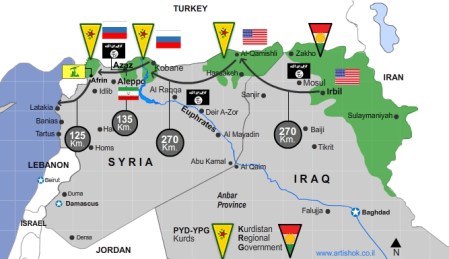
8. This US-Russia collaboration against Turkey is having a dramatic effect on the war in northern Syria along the Turkish border. DEBKAfile’s military and intelligence sources report it opened the door to the secret deal between Washington and Moscow to divide the areas of influence in northern Syria between them – essentially assigning the Kurdish enclaves north of the Euphrates river and bordering on Iraq to American influence (see map), and the areas west of the Euphrates up to the Mediterranean to Russian control. This deal (first revealed by DEBKA Weekly 688 on Dec. 4) effectively squeezes Turkey out of any role in the Syrian conflict.

9. The ongoing battles in northern Syria near the Turkish border will have a greater impact in shaping the future of Syria and its unending conflict than any UN resolution. Participating in the fighting at present is a very big mixed cast: Russia, the Kurdish YPG militia, most of the important rebel groups, including radical Sunni organizations tied to Al Qaeda, such as the Nusra Front and Ahram al-Sham, Iran and Shiite Hizballah, and the Islamic State.

It is only when one of these forces gains the upper hand in this free-for-all, that there will be progress toward a political solution on ending the war.

ISIS Selling Yazidi Women and Children in Turkey

December 20, 2015

ISIS Selling Yazidi Women and Children in Turkey, Gatestone InstituteUzay Bulut, December 20, 2015

♦ “Some of those women and girls have had to watch 7-, 8-, and 9-year-old children bleed to death before their eyes, after being raped by ISIS militia multiple times a day.” — Mirza Ismail, chairman of the Yazidi Human Rights Organization-International.

♦ “An office has been established by ISIS members in Antep [Turkey]; and at that office, women and children kidnapped by ISIS are sold for high amounts of money. Where are the ministers and law enforcement officers of this county who are talking about stability?” — Reyhan Yalcindag, prominent Kurdish human rights lawyer.

♦ “Five thousand people have been taken as captives. Women and children are raped, and then sold. These must be considered crimes.” — Leyla Ferman, Co-President of the Yazidi Federation of Europe.

♦ “Turkey has signed several international treaties, but it is the number one country when it comes to professional non-compliance with human rights treaties.” — Reyhan Yalcindag.

This month, the German television station, ARD (Consortium of Public Broadcasters in Germany), produced footage documenting the slave trade being conducted by the Islamic State (ISIS) through a liaison office in the province of Gaziantep (also known as Antep) in Turkey, near the border with Syria.

In August 2014, Islamic State jihadists attacked Sinjar, home to over 400,000 Yazidis. The United Nations confirmed that 5,000 men were executed, and as many as 7,000 women and girls made sex slaves.

While some have escaped or been ransomed back, thousands of Yazidis remain missing.

1392A news report from German broadcaster ARD shows photos of Yazidi slaves distributed by ISIS (left), as well as undercover footage of ISIS operatives in Turkey taking payment for buying the slaves (right).

Last month, after Kurdish forces recaptured the area from ISIS jihadists, mass graves, believed to contain the remains of Yazidi women, were discovered east of Sinjar.

The German TV channels NDR and SWR declared on their website:

“IS [Islamic State] offers women and underage children in a kind of virtual slave market with for-sale photos. … The transfer of money, as the reporter discovered, takes place through a liaison office in Turkey. …

“For weeks, NDR and SWR accompanied a Yazidi negotiator, who, on behalf of the families, negotiates with the IS for the release of the slaves and their children. … the women are sold in a digital slave market to the highest bidder. 15,000 to 20,000 US dollars are a typical price. Similar sums for ransom are also required to free Yazidis. The money is then transferred via IS-liaison offices and middlemen to the terrorist group.

“NDR and SWR were present at the liberation of a woman and her three small children, aged between two and four years old, and followed the negotiations. How many Yazidi slaves are still ‘owned’ by IS is unclear. Experts estimate that there still could be hundreds.”

The negotiator told NDR and SWR that in the course of a year, he transferred more than USD $2.5 million to ISIS from the families of 250 Yazidi women and children, in order to free them.

He also said that to advertise the slaves, ISIS assigns numbers to the female and child slaves, and posts their photographs on the WhatsApp Messenger smartphone app.[1]

In response to these reports, the Gaziantep Bar Association filed a criminal complaint against “Turkey’s National Intelligence Organization (MIT) and law-enforcement officers that have committed neglect of duty and misconduct by not taking required measures, and not carrying out preventive and required intelligence activities before the media covered the said incidents.”

The bar association also demanded that the prosecutors start prosecuting and punishing perpetrators engaged in crimes of “human trafficking, prostitution, genocide, deprivation of liberty, crimes against humanity, and migrant smuggling,” according to the Turkish penal code.

“The tragic reality,” said lawyer Bektas Sarkli, the head of Gaziantep Bar Association, “is that Gaziantep is a crowded city; the suicide bombers easily cross [to Syria and Iraq]. Unfortunately, Gaziantep exports terrorism.”

Sarkli added: “When you see the ammunition captured and especially take into account the money transferred here [it is clear that] ISIS easily shelters in this city. Gaziantep is the logistic site of ISIS.”

Mahmut Togrul, an MP of the pro-Kurdish Peoples’ Democratic Party (HDP), in a motion to Efkan Ala, Turkey’s Interior Minister, asked about the alleged office where ISIS members engage in slavery and the sex trade. His questions included: “How many liaison offices affiliated with ISIS terror organization are there in Gaziantep? If there are, do those liaison offices have any legal basis? Under what names do these offices operate? Are those offices affiliated with any institution?”

Interior Minister Ala has not yet provided any answers.

“According to the local press of Gaziantep, as well as the national press,” Togrul said, “Gaziantep has been turned into a city with sleeper cell houses for the ISIS terror group; ISIS members abound and travel freely.” [2]

The “Struggle Platform for Women Forcefully Seized,” the Democratic Society Congress (DTK) and the Kurdish Congress of Free Women (KJA) in Diyarbakir also filed a criminal complaint, calling for the prosecutors to investigate allegations and bring the perpetrators to account.

Reyhan Yalcindag, a prominent Kurdish human rights lawyer, said, “An office has been established by ISIS members in Antep; and at that office, women and children kidnapped by ISIS are sold for high amounts of money. Where are the ministers and law enforcement officers of this county who are talking about stability?”

“Turkey,” she said, “has signed several international treaties, but it is the number one country when it comes to professional non-compliance with human rights treaties.”

The Co-President of the Yazidi Federation of Europe, Leyla Ferman, referred to the number of the genocides to which the Yazidis say they have been exposed throughout history. “The Yazidis have been given 73 death warrants,” she said, “The people are massacred under the Islamic State. Thousands of Yazidi women are missing. Five thousand people have been taken as captives. Women and children are raped, and then sold. Today, due to the war, women have been scattered all around. These must be considered crimes.”

This is not the first time the presence of ISIS in Antep appeared in the news.

In November 2015, after the terrorist attacks in Paris, a group waving black ISIS flags appeared, honking the horns of their cars and celebrating in the streets of Antep. The footage was shared widely on social media. One user wrote, “This is Turkey supposedly struggling against ISIS. This is the ISIS convoy in Antep celebrating the Paris massacre.”

The Yazidis, a historically persecuted community, are ethnically Kurdish, but not Muslim; their native religion of Yazidism is linked to ancient Mesopotamian religions. The Yazidis are indigenous to northern Mesopotamia and Anatolia; part of the Yazidi homeland is located in what is modern Turkey; other parts are in Syria and Iraq.

Yazidis have been exposed to campaigns of forced Islamization and assimilation, according to the Turkish sociologist Ismail Besikci, a prominent expert on Kurdistan:

“During the 1912-13 Pontic Greek deportations and the 1915 Armenian genocide, Yazidis were also driven out from their lands. Throughout the history of republican Turkey, all methods have been tried to Islamize the Yazidis. Before 1915, for instance, Suruc was an entirely Yazidi town. So was the town of Viransehir. Today, there is not a single Yazidi left in Suruc. Furthermore, the Islamized Yazidis can be seen exhibit insulting behavior towards those who remain Yazidis.”

Because they are Kurds, the state has not recognized their Kurdishness; and because they are Yazidis, the state has not recognized their religion. The section of ‘religion’ in Yazidis’ identity cards has been left empty; or the religion of some has been registered as ‘x’ or ‘-‘ .

“Research states that in 2007, there were only 377 Yazidis left in Turkey,” an Assyrian MP of the Peoples’ Democratic Party (HDP), Erol Dora, said.

“Yazidis, just like other minorities in Turkey, have also been exposed to discrimination and hate speech; that is why they have had to leave their lands. … Their villages and lands have been seized; their agricultural areas have been appropriated, their holy sites have been attacked. All these racist attitudes continue today; the language, religion and culture of Yazidis face extinction.”

Yazidis say they have been subjected to 72 attempts at extermination, or attempted genocide. Today, they are the victims of yet another attempted genocide in Iraq — at the hands of ISIS jihadists.

“According to many escaped women and girls to whom I spoke in Northern Iraq, the abducted Yazidis, mostly women and children, number over 7,000,” said Mirza Ismail, founder and chairman of the Yezidi Human Rights Organization-International, in his speech at the U.S. Congress.

“Some of those women and girls have had to watch 7-, 8-, and 9-year-old children bleed to death before their eyes, after being raped by ISIS militia multiple times a day.

“I met mothers, whose children were torn from them by ISIS. These same mothers came to plead for the return of their children, only to be informed, that they, the mothers, had been fed the flesh of their own children by ISIS. Children murdered, then fed to their own mothers.

“ISIS militias have burned many Yezidi girls alive for refusing to convert and marry ISIS men. Young Yezidi boys are being trained to be jihadists and suicide bombers. All of our temples in the ISIS controlled area are exploded and destroyed. Why? Because we are not Muslims, and because our path is the path of peace. For this, we are being burned alive: for living as men and women of peace.”

The Yazidis, one of the most peaceful people on earth, are struggling to survive yet another Muslim genocide, before the eyes of the entire world.

While much of the world has been silent, a NATO member, Turkey has been openly complicit — the enabler of jihadist terrorism. Reports and eyewitnesses testify that Turkey has contributed to the rise of the Islamic State by letting fighters and arms over the border. Some of the fighters go on to join the jihadist terrorist group.

The latest reports reveal that in Turkey, a country that fancies itself as a candidate for EU membership, Yazidi women and children are enslaved and forced into sexual slavery. Meanwhile, the Turkish government has not even bothered to make a single statement about these reports.

That is what happens when a regime is never held responsible.

No, the Islamic State Will Not Be Defeated — and if It Is, We Still Lose

November 25, 2015

No, the Islamic State Will Not Be Defeated — and if It Is, We Still Lose, BreitbartBen Shapiro, November 24, 2015

GettyImages-497044984-640x480

Barack Obama has now created an unwinnable war.

While all of the 2016 candidates declare their strategies for victory against ISIS, President Obama’s leading from behind has now entered the Middle East and the West into a free-for-all that cannot end any way but poorly.

The best way to understand the situation in Syria is to look at the situation and motivation of the various players. All of them have varying agendas; all of them have different preferred outcomes. Few of them are on anything approaching the same page. And Barack Obama’s failure of leadership means that there is no global power around which to center.

ISIS. ISIS has gained tremendous strength since Barack Obama’s entry to power and pullout from Iraq. They currently control northern Syria, bordering Turkey, as well as large portions of northern Iraq. Their goal: to consolidate their territorial stranglehold, and to demonstrate to their followers that they, and not other competing terrorist groups like Al Qaeda, represent the new Islamic wave. They have little interest in toppling Syrian dictator Bashar Assad for the moment. They do serve as a regional counterweight to the increasingly powerful Iranians – increasingly powerful because of President Obama’s big nuclear deal, as well as his complete abdication of responsibility in Iraq.

Iran. Iran wants to maximize its regional power. The rise of ISIS has allowed it to masquerade as a benevolent force in Iraq and Syria, even as it supports Assad’s now-routine use of chemical weapons against his adversaries, including the remnants of the Free Syrian Army (FSA). Iran has already expanded its horizons beyond Iraq and Syria and Lebanon; now it wants to make moves into heretofore non-friendly regions like Afghanistan. Their goal in Syria: keep Bashar Assad in power. Their goal in Iraq: pushing ISIS out of any resource-rich territories, but not finishing ISIS off, because that would then get rid of the global villain against which they fight.

Assad. The growth of ISIS has allowed Assad to play the wronged victim. While the FSA could provide a possible replacement for him, ISIS can’t credibly do so on the international stage. Assad knows that, and thus has little interest in completely ousting them. His main interest is in continuing to devastate the remaining FSA while pretending to fight ISIS.

Egypt/Saudi Arabia/Jordan. As you can see, ISIS, Iran, and Assad all have one shared interest: the continued existence of ISIS. The same is not true with regard to Egypt, Saudi Arabia, and Jordan, all of whom fear the rise of radical Sunni terrorist groups in their home countries. They are stuck between a rock and a hard place, however, because openly destroying ISIS on behalf of Alaouite Assad, they embolden the Shia, their enemies. Egypt, Saudi Arabia, and Jordan would all join an anti-ISIS coalition in the same way they did against Saddam Hussein in 1991, but just like Hussein in 1991, they won’t do it if there are no Sunni alternatives available. Tunisia, Saudi Arabia, and Jordan are the top three sources of foreign fighters for ISIS.

Turkey. The Turks have several goals: to stop the Syrian exodus across their borders, to prevent the rise of the Iranians, and to stop the rise of the Kurds. None of these goals involves the destruction of ISIS. Turkey is Sunni; so is ISIS. ISIS provides a regional counterweight against Iran, so long as it remains viable. It also keeps the Kurds occupied in northern Iraq, preventing any threat of Kurdish consolidation across the Iraq-Turkey border. They will accept Syrian refugees so long as those other two goals remain primary – and they’ll certainly do it if they can ship a hefty portion of those refugees into Europe and off their hands.

Russia. Russia wants to consolidate its power in the Middle East. It has done so by wooing all the players to fight against one another. Russia’s involvement in the Middle East now looks a good deal like American involvement circa the Iran-Iraq War: they’re playing both sides. Russia is building nuclear reactors in Egypt, Jordan, Turkey and Iran. They’re Bashar Assad’s air force against both the FSA and ISIS. Russia’s Vladimir Putin doesn’t have a problem with destroying ISIS so long as doing so achieves his other goal: putting everyone else in his debt. He has a secondary goal he thought he could chiefly pursue in Eastern Europe, and attempted with Ukraine: he wants to split apart the North Atlantic Treaty Organization, which he rightly sees as a counterbalance to check Russian aggression. Thanks to today’s Turkish attack on a Russian plane, and thanks to the West’s hands-off policy with regard to the conflict, Putin could theoretically use his war against ISIS as cover to bombard Turkish military targets, daring the West to get involved against him. Were he to do so, he’d set the precedent that NATO is no longer functional. Two birds, one war.

Israel. Israel’s position is the same it has always been: Israel is surrounded by radical Islamic enemies on every side. Whether Iranian-backed Hezbollah or Sunni Hamas and ISIS, Israel is the focus of hate for all of these groups. Ironically, the rise of Iran has unified Israel with its neighbors in Jordan, Egypt, and Saudi Arabia. All three of those countries, however, can’t stand firmly against ISIS.

All of which means that the only country capable of filling the vacuum would be the United States. Just as in 1991, a major Sunni power is on the move against American interests – but unlike in 1991, no viable option existed for leaving the current regime in power. And the US’ insistence upon the help of ground allies is far too vague. Who should those allies be, occupying ISIS-free ISISland?

The Kurds have no interest in a Syrian incursion. Turkish troops movements into ISIS-land will prompt Iranian intervention. Iranian intervention into ISIS-land would prompt higher levels of support for Sunni resistance. ISIS-land without ISIS is like Iraq without Saddam Hussein: in the absence of solidifying force, chaos breaks out. From that chaos, the most organized force takes power. Russia hopes that should it destroy ISIS, Assad will simply retain power; that may be the simplest solution, although it certainly will not end the war within the country. There are no good answers.

Barack Obama’s dithering for years led to this. Had he lent his support in any strong way to one side, a solution might be possible. Now, it’s not.

ISIS Threatens Obama With ‘New Lesson’ in Beheading Video

October 31, 2015

ISIS Threatens Obama With ‘New Lesson’ in Beheading Video, Newsmax, Sandy Fitzgerald, October 31, 2015

(Video at the link. Has Obama recently decided that the Islamic State is a greater threat than climate change?– DM)

A horrifying new 15-minute video appears to show Islamic State (ISIS) terrorists beheading four captured Kurdish Peshmerga fighters — and delivering a bold warning to President Barack Obama.

The video claims to be the ISIS response to a Delta Force-Kurdish raid in northern Iraq last week that cost American Master Sgt. Joshua Wheeler his life.

“Obama, you have learned a new lesson,” a masked terrorist warns Obama in what sounds like an American accent. “Six of the soldiers of the caliphate faced 400 of your children; they killed and injured them by Allah’s grace.”

The warning was delivered before the man executes one of the prisoners, reports CNN, and the other three prisoners are also beheaded by the video’s end. Arabic text also appears onscreen, translating as “Peshmerga soldiers that Americans came to rescue.”

The video was released online Friday, and earlier in the clip, ISIS claims to show the aftermath of the raid, in which Kurdish, U.S., and Iraqi forces rescue 70 hostages from an ISIS prison in Hawija, located in Kirkuk, a province located in northern Iraq.

CNN reports that those who were set free included 20 of the Iraqi Security Forces, local residents and several ISIS fighters accused of spying. None of the hostages were Kurds.

As of Saturday morning, there had not been an official response issued from the White House on the video or the threat. But in Kurdistan, regional government spokesman Dindar Zebari told CNN that “ISIS respects no form of human rights. Our message to them is that we will finish them.”

But Kurdistan will not kill ISIS prisoners in response, Zebari said.

“We hold 215 ISIS prisoners and we treat them according to international human rights laws,” he said. “We have also freed 85 prisoners who had been suspected of association with ISIS. We do not kill our prisoners.”

The Kurdistan regional government said that more than 20 ISIS fighters were killed in last week’s raid, and six more were captured.

The Kurdish Peshmerga, which protects an autonomous region in northern Iraq, has been fighting against ISIS and its push to take Iraq and Syria and create a caliphate.

ISIS earlier this week said the Delta Force-Kurdish raid, called for by the Kurds to rescue Peshmerga fighters, was a failure.

The man who issued the threat does not appear to be the infamous “Jihadi John,” the English-speaking jihadist who has appeared in several other ISIS beheading videos.

The terrorist, whose real name is believed to be Mohammed Emwazi, is considered to be a priority target after killing American, Western, and Japanese hostages.

Meanwhile, two Syrian activists have also been killed in recent days in the Turkish town of Urfa, and their deaths are being blamed on ISIS.

According to the groups Raqqa is Being Slaughtered Silently and Eye on Homeland, activists Ibrahim Abdul Qadir and Faris Humadi the men who were shot and beheaded. ISIS has not yet claimed responsibility for their deaths.

Qadir and Humadi worked for Eye on Homeland, a Syrian media group that reports on the civil war, and Qadar also was a founding member of the Raqqa group, which posts photos, video, and other information online from the Raqqa province in Syria.

Kurds Ask for Peace, Turkey Attacks

October 18, 2015

Kurds Ask for Peace, Turkey Attacks, Gatestone InstituteUzay Bulut, October 18, 2015

  • Just after the bombing attack in Ankara, Turkish authorities said that the Islamic State (ISIS) was responsible. But in response, Turkish jets did not bomb ISIS; they bombed the Kurdish PKK, who are fighting ISIS.
  • Where were the special forces and the police, so quick to shoot Kurds but not protect them? The police delayed medical help, and instead attacked with tear gas the people that were helping the wounded, in an effort to disperse them.
  • “The PKK ceasefire means nothing for us. The operations will continue without a break.” — Senior Turkish security official.
  • “Ankara is the capital of Turkey. If a bird flies here, the state knows about it. … There was a rally of 100,000 people but no security precautions were taken. Look at their own rallies: the security precautions start 10 streets away.” — Selahattin Demirtas, co-chairman of the Kurdish HDP Party.
  • Many massacres have been carried out against the Kurds. None of the perpetrators has ever been punished — in those massacres, the planners were the state authorities themselves.

On October 10, the Kurds in Turkey were exposed to yet another massacre – this time a double suicide bombing in Ankara, the capital of Turkey, in the center of town.

This time, two explosions ripped through a peaceful crowd that had gathered outside the entrance to Ankara’s central railway station to proclaim an end to violence in a “Labor, Peace and Democracy” rally.

Together with the Kurds were officials from the pro-Kurdish Peoples’ Democratic Party (HDP); supporters of left-wing parties, and members of trade unions in Turkey — all calling for peace and democracy.[1]

At least 105 people were killed, according to the Turkish Medical Association, and more than 400 injured.[2]

One victim, Meryem Bulut, was a 70-year-old member of the “Saturday Mothers” group, who have protested about their missing sons and daughters since the 1990s. Her grandchild died last year fighting against ISIS in the Yazidi town of Sinjar, Iraq.

Nine-year old Veysel Atilgan participated in the rally with his father, Ibrahim Atilgan; both were killed in the blasts.

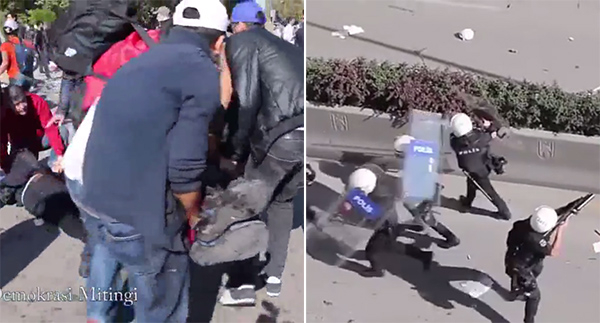
The aftermath of the explosion was almost as horrific. The police delayed medical help, and instead attacked with tear gas and pepper spray the people that were helping the wounded, in an effort to disperse them. The government, after attacking even the wounded, unleashed the military and police apparatus against Kurds who came to mourn their dead.

Orhan Antepli, the legal secretary of the Bursa branch of the Trade Union of Public Employees in Health and Social Services (SES), witnessed the explosion. The police used tear gas against the wounded, he said, and did not allow ambulances to enter the area:

“On the road, for two kilometers, we did not see a single police officer. I was facing where the second explosion took place. After it, there were about 100 pieces of flesh of 1cm each on the coat of the person beside me.”

Antepli said that he ran to help the wounded, but the police did not allow ambulances to enter the area: “While I was treating a wounded man, the police started using tear gas. They blocked the road. Two or three gas bombs were thrown at the people.”

1308At least 105 people were killed and more than 400 wounded in the Oct. 10 Ankara suicide bombings. For a long time after the explosions, neither police nor ambulances came to the scene — victims were left to fend for themselves. When police arrived, they fired tear gas at the wounded and those helping them.

In the meantime, Turkish Prime Minister Ahmet Davutoglu said, incredibly,

“An utterly successful operation against terror was carried out. Similarly, due to our vigorous efforts since 23 July, the most important cadres of ISIS have been arrested or their contacts have been broken. … But when you step out of routine, this has a limit in a democratic state of law. You cannot arrest someone without a reason. There is even a list of people who might engage in suicide bombing in Turkey. You follow them, but when you do something before they carry out that act, you are exposed to another protest.”

So, Turkey keeps a list of potential suicide bombers, while Davutoglu is saying with a straight face that the government — which has attacked and even arrested many journalists simply for doing their job, and even high-school students for tweets critical of the government — should not arrest a potential suicide bomber “without a reason.” The AKP is the last government that should be talking about a “democratic state of law.”

Just after the blasts, some Turkish authorities said that the Islamic State (ISIS) had caused them. Yet in response, Turkish jets did not bomb ISIS; they bombed the Kurdish PKK, who are fighting ISIS. After the government rejected a new ceasefire announced by the PKK on Saturday, the Turkish air force attacked.

The PKK had declared in a written statement that “they reached the decision to stop military action against Turkish state forces as long as there were no attacks.”

The Turkish government, however, seems determined to continue killing Kurds no matter what. “The PKK ceasefire means nothing for us,” one senior Turkish security official told Reuters. “The operations will continue without a break.”

While the Turkish army is bombing the PKK headquarters (again), the Ankara Chief Public Prosecutor’s Office has issued a gag order on the Ankara massacre investigation.

In addition, the state media watchdog, the Turkish Radio and Television Supreme Council (RTUK), imposed a ban on broadcasting images of the bombings. After the temporary ban, Twitter, Facebook, and several other social media sites were also inaccessible throughout Turkey. That is what a repressive state does to keep facts from coming out.

Later, when many people in Ankara, including Kurdish MPs and mayors, took to the streets to protest the massacre, police used water cannons and tear gas against them. Some protesters were wounded and taken to hospital; four were arrested.

Across Turkish Kurdistan, countless protesters were also exposed to police violence. The police in Diyarbakir used real bullets with the tear gas. An ambulance was reportedly prevented from entering the area where Ahmet Taruk, 63, was overcome by the tear gas; he lost his life on the way to the hospital. During a police crackdown in Izmir, 66 people were arrested.

Eventually, the Turkish media reported that both perpetrators of the Ankara suicide bombing attack had indeed been identified as members of ISIS. One of them, Omer Deniz Dundar, had gone to Syria in 2013 and came back to Turkey in 2014. Eight months later, he went back to Syria again. His father said in an interview that he had sought the help of the police many times to bring his son back home, but could do nothing.

The other suspect, Yunus Emre Alagoz, in his latest telephone conversation in May 2015, said, “This is the last time we are speaking.” The call was recorded by the police. They interrogated Alagoz as a “suspect” but then released him.

His brother, Yusuf Alagoz, said that Yunus Emre Alagoz had attended school in Afghanistan in 2009, followed by a religious education at a madrassah [Muslim theological school] in Iran.

Still another brother, Seyh Abdurrahman Alagoz, had carried out the deadly suicide bomb attack in Suruc on July 20, in which 33 people were killed.

But just imagine for a moment that it really was two terrorists who committed the massacre, without the knowledge of the Turkish government, and that the state institutions were completely innocent. Where, then, were the security forces to help people after the blast? Where were the medics to help with the wounded? Where were the ambulances? Where were the special forces and the police, so quick to shoot Kurds but not protect them?

The pro-government media in Turkey has been claiming that the PKK was the perpetrator and that the HDP party should be held responsible. They only criticize the public’s response to the attacks; never the attacks themselves.

In Turkey, at other gatherings, not even a mosquito can fly without the Turkish police interrupting it. Yet for this demonstration, there was no security; no medical personnel, no protection for the demonstrators. After the blasts, people were covering the dead with the banners they brought to the rally. People were trying to resuscitate the wounded and making splints for their broken bones by themselves.

Who knows how many people would have survived had it not been for the tear gas that prevented them from breathing? So severe were the wounds that people could not even leave the area; and police were firing tear gas.

After the massacre, Selahattin Demirtas, the co-chairman of the HDP party, said:

“They are trying to convey the message that ‘we can come and rip you to pieces in the middle of Ankara’. They are on the brink of saying ‘the HDP blew up its own rally.’ The prime minister spoke for half an hour; he spent 20 minutes insulting and threatening us. Did you hear him make a single statement condemning ISIS? No. He is still threatening us. Ankara is the capital of Turkey. If a bird flies here, the state knows about it. This is the city where the intelligence unit is the strongest. There was a rally of 100,000 people but no security precautions were taken. Look at their own rallies: the security precautions start 10 streets away. There were 100 corpses; 500 wounded. But they had also had to deal with the water cannons fired by police. Is that what your justice is?”

During the rule of the AKP government, similar massacres against Kurds in Roboski, Diyarbakir and Suruc have also taken place. Before that, since 1920s, there were many massacres against Kurds. None of the perpetrators has ever been punished: in those massacres, the planners and organizers were state authorities themselves.

On October 10, the Kurds and their friends tried to call for an end to war. The Kurds proclaimed peace and brotherhood — Turkey as usual, responded with murder.

____________________________________

[1] The rally was organized by the Confederation of Progressive Trade Unions of Turkey (DISK), the Union of Chambers of Turkish Engineers and Architects (TMMOB), the Turkish Medical Association (TTB) and the Confederation of Public Workers’ Unions (KESK). The Peoples’ Democratic Party (HDP) was one of the major participants.

[2] The Peoples’ Democratic Party (HDP) said in a written statement that the Ministry of Health does not share the data at hand about the dead and wounded and the chief physicians of hospitals have been given certain instructions not to share the data with the public.

Warning PYD, Ankara says any violation against Turkey will be reciprocated

October 15, 2015

Warning PYD, Ankara says any violation against Turkey will be reciprocated

Emine Kart – ANKARA

Thursday,October 15 2015, Your time is 13:07:07

Source: Warning PYD, Ankara says any violation against Turkey will be reciprocated – DIPLOMACY

AA Photo

AA Photo

In strongly-worded remarks, Turkey’s Foreign Minister Feridun Sinirlioğlu has recommended Syria’s Democratic Union Party (PYD) watch their step, making clear that any move aimed at Turkey would not remain unreciprocated.

“I call on [PYD leader] Salih Muslim to [use] good sense and to pull himself together. It would not be good for him if he doubts Turkey’s will and determination. Turkey has been fighting against terror and nobody should attempt to test its determination in this fight against terror,” Sinirlioğlu said on Oct. 15 in response to reported remarks by Muslim.

Earlier this week, Prime Minister Ahmet Davutoğlu lashed out at both the United States and Russia for supplying weapons and support to the People’s Protection Units (YPG), the military wing of PYD, in its bid to fight extremist jihadists, raising concerns that the arms could be used against Turkey by the outlawed Kurdistan Workers’ Party (PKK), an affiliate of the PYD.

“At the moment, nobody can assure us that these weapons delivered to the PYD will not go to the PKK. If we find out that these weapons are taken into northern Iraq and used there, we will destroy them wherever they are,” Davutoğlu said on Oct. 12.

In remarks reported by Arbil-based BasNews agency on Oct. 14, Muslim said that Syrian Kurds won’t attack Turkey but they will strongly meet any Turkish assaults.

“The message that we have given to the PYD is clear. If they resort to any move directed at Turkey, the required penalty will be given without hesitation,” Sinirlioğlu said a joint press conference with Saudi Arabia’s Al-Jubeir following their meeting.

In Washington, following Davutoğlu’s warning, U.S. State Department Spokesperson John Kirby said the United States will continue its support for groups that are “proving effective against ISIL [the Islamic State of Iraq and the Levant] in Syria.” His remarks on Oct. 14 were delivered in response to a question regarding U.S. aid to the PYD, which underlined a contradiction between statements by State Department Deputy Spokesperson Mark Toner and Muslim on recipients of U.S. ammunition airdrops.

While Toner argued that the ammunition was provided to Syrian Arabs, Muslim told the Turkish press that the PYD and its allies have been receiving U.S. airdrops.

Sinirlioğlu, meanwhile, didn’t touch upon any statements from Washington.

October/15/2015

Turkey warns US, Russia over arms supply to Syrian Kurds

October 14, 2015

Turkey warns US, Russia over arms supply to Syrian Kurds

Serkan Demirtaş – ANKARA

PM Davutoğlu is left apoplectic after the US gives weapons to the Kurdish PYD, an enemy of Ankara, amid additional ire for Moscow

Source: Turkey warns US, Russia over arms supply to Syrian Kurds – DIPLOMACY

In this Tuesday, Oct. 6, 2015, military reinforcements for Iraqi anti-terrorism forces arrive at the Ramadi Stadium after regaining control of the complex and the neighboring al-Bugleeb area. AP Photo

In this Tuesday, Oct. 6, 2015, military reinforcements for Iraqi anti-terrorism forces arrive at the Ramadi Stadium after regaining control of the complex and the neighboring al-Bugleeb area. AP Photo

Turkey’s prime minister has lashed out at both the United States and Russia for supplying weapons and support to the Democratic Union Party (PYD) of Syria in its bid to fight extremist jihadists, raising concerns that the arms could be used against Turkey by the outlawed Kurdistan Workers’ Party (PKK), an affiliate of the PYD.

Turkey summoned the United States’ ambassador to Turkey, John Bass, on Oct. 13 to the Foreign Ministry to convey Ankara’s strong reaction over the airdropping of ammunition to the PYD late Oct. 11. A similar message was scheduled to be conveyed to Russia later on Oct. 13.

“We have expressed this to the U.S. and Russia in the clearest way. This is an issue of national security for us. Everybody perfectly knows how we take action when it’s about our national security, just like we did on the night of July 23, when we attacked the PKK and Daesh,” Prime Minister Ahmet Davutoğlu told Ankara bureau chiefs of newspapers on Oct. 12. Davutoğlu used the Arabic acronym for the Islamic State of Iraq and the Levant (ISIL) as he recalled Turkey’s launch of a comprehensive military operation against ISIL and the PKK.

Davutoğlu’s reaction came as the U.S. Department of Defense confirmed that a U.S. cargo plane airdropped some logistical material to the PYD late Oct. 11 in line with Washington’s plans to reinforce the Syrian Kurds in their fight against ISIL in Syria.

“The aircraft delivery includes small arms ammunition to resupply the local forces” to enable them to continue operations against ISIL, Pentagon spokeswoman Elissa Smith told Anadolu Agency on Oct. 13. Smith said the “successful” airdrop was conducted by a “U.S. Air Force C-17 cargo aircraft flying from the U.S. Central Command area of responsibility” and added that all aircraft exited the drop area safely. Like the U.S., Russia is also in close contact with the PYD, but there are no confirmed reports about arms supplies from Moscow.

“I have instructed the foreign minister on this. Necessary diplomatic initiatives are being taken and our message is that ‘We don’t and never will approve of such a thing,’” he said.

‘These weapons will be destroyed’

Recalling that ISIL was now using the sophisticated weapons Washington had supplied to the Iraqi army a year ago, Davutoğlu indirectly addressed the U.S., saying: “When you provide weapons to a group, you should also be able to foresee whose hands these weapons could go to later. At the moment, nobody can assure us that these weapons delivered to the PYD will not go to the PKK. If we find out that these weapons are taken into the northern Iraq and used there, we will destroy them wherever they are. Nobody should expect understanding on this issue. These weapons will harm our soldiers, police and civilian citizens,” Davutoğlu said.

Turkish prime minister underlined that Turkey will take all necessary measures in the event of any infiltration from Syria into Turkey or the transportation of any ammunition “just like the Turkish army is doing in northern Iraq.” “I want to announce this with clarity.”

PKK, PYD indistinguishable from each other

Recalling that the situation in the region and in Turkey had changed as the PKK resumed its violent acts against the Turkish army, Davutoğlu said: “Five or six months ago when there were no PKK attacks against Turkey, allied countries’ intention to arm the PYD could be seen in a certain frame. It was not right but had a sort of a meaning. The crisis in Syria is a Syrian crisis until an attack targets Turkey. [If] the PYD or the al-Assad regime were to commit an act against Turkey, necessary actions would be taken. We have made clear that we will have no tolerance.”

October/14/2015

New Rebel Coalition Forms In Syria; Insurgents Lost Ground Over Weekend

October 13, 2015

New Rebel Coalition Forms In Syria; Insurgents Lost Ground Over Weekend

October 12, 2015 9:07 AM ET

Bill Chappell

Source: New Rebel Coalition Forms In Syria; Insurgents Lost Ground Over Weekend : The Two-Way : NPR

A photo from Sunday shows Syrian soldiers in Achan, Hama province. Bolstered by Russian jet strikes, Syria's army and its allies have reportedly pushed out insurgents in some parts of the central province.

A photo from Sunday shows Syrian soldiers in Achan, Hama province. Bolstered by Russian jet strikes, Syria’s army and its allies have reportedly pushed out insurgents in some parts of the central province.

Alexander Kots/AP

Rebel groups that oppose both Syrian President Bashar al-Assad and terrorist group ISIS have formed a new coalition, called the Syrian Democratic Forces. Led by Kurds, the coalition could receive U.S. air support in Syria.

From Beirut, NPR’s Alison Meuse reports for our Newscast unit:

“The Syrian Democratic Forces calls itself a unified national military, aimed at establishing a new democratic Syria. Members include Kurds, Arabs and Assyrian Christians. But those familiar with the group say it’s led by the Kurdish YPG, the only partner the U.S. trusts.

“Washington last week announced the overhaul of a rebel training program, which was halted after trainees handed equipment over to al-Qaida. The new Syrian Democratic Forces will absorb some of those trainees. One of them, reached by NPR, says he’s been tasked with calling in airstrikes against ISIS and recruiting moderate rebels.”

News of the coalition’s formation comes after Russia’s military began carrying out airstrikes in Syria at the end of September, targeting both ISIS and the rebel groups that had received U.S. support and training.

On the strength of those airstrikes, Syria’s army launched a new ground offensive that made advances over the weekend. Russia says that in the past 24 hours, its fighters and other aircraft have ” flown 55 sorties to hit 53 targets,” reports state-owned news agency Tass.

According to Reuters:

“The Syrian Observatory for Human Rights, a group that monitors the 4-year-old conflict, said the Syrian military and its Lebanese Hezbollah militia allies had taken control of Tal Skik, a highland area in Idlib province, after fierce Russian bombing.

“That brings Syrian government forces closer to insurgent-held positions along the main highway that links Syria’s principal cities. The area is held by a rebel alliance that excludes Islamic State fighters.”

Turkey warns US, Russia against backing Kurdish militia in Syria: Officials

October 13, 2015

Turkey warns US, Russia against backing Kurdish militia in Syria: Officials

ANKARA – Reuters

Source: Turkey warns US, Russia against backing Kurdish militia in Syria: Officials – DIPLOMACY

In this Nov. 19, 2014, file photo, fighters from Kurdish popular defense units YPJ (women) and YPG (men) gather during a short break before heading out to fight for new positions in Kobani, Syria. AP Photo

 In this Nov. 19, 2014, file photo, fighters from Kurdish popular defense units YPJ (women) and YPG (men) gather during a short break before heading out to fight for new positions in Kobani, Syria. AP Photo

Turkey has warned the United States and Russia it will not tolerate Kurdish territorial gains by Kurdish militia close to its frontiers in north-western Syria, two senior officials said.

“This is clear cut for us and there is no joking about it,” one official said of the possibility of Syrian Kurdish militia crossing the Euphrates to extend control along Turkish borders  from Iraq’s Kurdistan region toward the Mediterranean coast.

Turkey fears advances by Kurdish People’s Protection Units (YPG) militia, backed by its Democratic Union Party (PYD) political wing, on the Syrian side of its 900-kilometer border will fuel separatist ambitions among Kurds in its own southeastern territories. But Washington has supported YPG fighters as an effective force in combating Islamic State of Iraq and the Levant (ISIL).

“The PYD has been getting closer with both the United States and Russia of late. We view the PYD as a terrorist group and we want all countries to consider the consequences of their cooperation,” one of the Turkish officials said, referring to the PYD, which Turkey links to the outlawed Kurdistan Workers’ Party (PKK).

Turkey suspects Russia, which launched air strikes in Syria two weeks ago, has also been lending support to the PYD and YPG, its armed wing.

“With support from Russia, the PYD is trying to capture land between Jarablus and Azaz, going west of the Euphrates. We will never accept this,” the official said.

Obama arms Islamic terrorists who called for “slaughtering Americans like cattle”

October 12, 2015

Obama arms Islamic terrorists who called for “slaughtering Americans like cattle,” Front Page Magazine, Daniel Greenfield, October 12, 2015

(Surely Obama, with access to top military and intelligence officials, knows precisely what he’s doing. Not only that, it couldn’t be his mess. Somebody else has to be blamed. Right? — DM)

logo_of_ghuraba_al-sham_front

The Syrian Civil War is a mess. Whether or not that disclaimer appears at the top of every article and post, you should assume that it does. There are factions and splinter groups that are constantly merging and reforming.

Which is why backing anyone in the war is hazardous. But here’s the latest phase of Obama’s “I don’t know what the hell I’m doing in Syria” strategy.

The U.S. military airdropped 50 tons of small arms ammo and grenades in northern Syria on Sunday, a senior defense official told Fox News, representing the Pentagon’s shift from training rebel fighters to equipping them.

Coming just two days after the Defense Department announced it was effectively ending its current training program, the airdrop delivery was made Sunday by four C-17 transport aircraft. The 112 pallets contained ammunition for M-16s and AK-47s.

This time, the official said Syrian Kurds were not recipients of the U.S. airdrop — only Syrian Arabs fighting ISIS. There is sensitivity in Washington over arming Syrian Kurds, whom Turkey sees as an enemy but the U.S. counts as a NATO ally.

Who is actually getting the weapons? Here’s whom the weapons are meant to be going to…

The alliance calling itself the Democratic Forces of Syria includes the Kurdish YPG militia and Syrian Arab groups, some of which fought alongside it in a campaign that drove Islamic State from wide areas of northern Syria earlier this year.

The Arab groups in the new alliance are operating under the name “The Syrian Arab Coalition” – a grouping which U.S. officials have said would receive support under a new U.S. strategy aimed at fighting Islamic State in Syria.

So Turkey has forced the US to deny weapons to the Kurdish part of the alliance. The Syriac Military Council is in the alliance too, but it’s unclear if they’re getting resupplied.

So that just leaves the Syrian Arab Coalition. And who is in the Syrian Arab Coalition?

“We met the Americans and this has been approved and we have been told these new arms … are on their way,” said Abu Muazz, a spokesman for the Raqqa Revolutionaries Front, a grouping of mainly Arab tribal insurgents who are mostly drawn from the Raqqa area.

Tribal insurgents. Sounds okay, right? Except that name doesn’t appear to be in use. This may be the Raqqa Revolutionaries’ Brigade whose Arabic name is Liwa Thuwwar al-Raqqa which was formerly allied with the Al Nusra Front… which is Al Qaeda. Since then Liwa claims to have split from Nusra and is fighting ISIS. But Nusra is also fighting ISIS.

Aymenn Jawad Al-Tamimi has a summary of the relationship that runs several paragraphs. (The Syrian Civil War is a mess. See above.)

The new alliance includes the YPG, various Arab groups including Jaysh al-Thuwwar (Army of Rebels) and the Arab tribal Jaysh al-Sanadeed, and an Assyrian Christian group, according to a statement announcing its establishment.

Except we’re apparently not arming the YPG. It’s unclear if we’re arming the Assyrians. But we are arming Jaysh al-Thuwwar, which is a coalition of a bunch of other groups formerly part of the FSA. The Sanadeed appear to actually be closely linked to the YPG.

But it gets messier from here.

Another faction in the new coalition, Jaysh al-Qasas, worked with IS in 2014. FSA commanders say its leader spends most of his time in Turkey and his fighters are most interested in looting.

Of course the FSA, which used to be US backed, has every reason to trash talk the current aid recipients.

“They are fighters who have moved from one militia to another,” says Abdul Rahman, a commander with the Army of Mujahideen , which is aligned with Jaish al Fata, or the Army of Conquest, the Islamist rebel alliance.“Most of them are rejects. They are not reliable — we don’t trust them,” he told VOA.

“I generally agree with the testimony of those rebels you have spoken to,” says Aymenn Jawad al-Tamimi, a fellow at U.S.-based think tank the Middle East Forum. He says that armed groups in one of the largest of the factions, the Dawn of Freedom, have “reputations for corruption.”

“The main groups of the coalition are splinters from larger rebel militias and in the case of Dawn of Freedom it is essentially a regrouping of militias that had reputations for criminality in North Aleppo, such as Ghuraba al-Sham,” he told VOA. Some of the factions were thrown out of an Islamist rebel alliance.

Al-Tamimi added: “The other components of the rebel allies with the YPG are small groups of locals who fled their homes in Deir ez-Zor and Jarabulus” after the Islamic State overran the towns. Some are members of the Shammar tribe in eastern Syria, which has suffered repeated IS reprisals and massacres.

Opportunists is about the nicest thing we could say about them. But it also means they’re likely to resell weapons or engage in fake battles. And when a lot of fighters move from one militia to another, we could very well end up directly arming ISIS or Al Qaeda groups.

But don’t worry, when this falls apart, Obama will blame Hillary Clinton or McCain and claim that he never wanted to do it in the first place. Because Obama never takes responsibility.

Oh by the way, here’s something on Ghuraba al-Sham.

Ghuraba al-Sham comprising mainly Turks and fighters from former Soviet bloc countries…

As Syrian preacher Dr. Mahmud al-Aghasi, known as Abu al-Qaqa, left an Aleppo mosque after Friday prayers on September 28, an assassin stepped out of a car and opened fire with an automatic weapon. The controversial preacher received mortal wounds to the head and body, while three others were wounded. Little information on the case has emerged from the normally secretive and tightly controlled Syrian state. Most of what is known comes from al-Qaqa’s own followers in Ghuraba al-Sham (Strangers of Greater Syria), some of whom chased the killer for two to three kilometers before apprehending him.

It gets worse. Much, much worse.

On the CDs, Abu al-Qaqa is shown speaking to worshipers under the banner of a then-unknown group, Guraba al-Sham (Strangers of Greater Syria). This became the umbrella under which he operated, and whose name was imprinted on all of his CDs. On camera, he tells his followers, who are assembled before him at a mosque: “We will teach our enemies a lesson they will never forget.” He then asks: “Are you ready?” Thundering chants respond affirmatively from his audience, who get worked up into tears as they listen, and he carries on: “Speak louder so [US President George W Bush] can hear you!” Their tears make him weep as well, as he gets impassioned with anti-Americanism and adds: “Guests have come to our land … slaughter them like cattle. Burn them! Yes, they are the Americans!”

So that’s who we’re arming. The pet militia of a guy who played a key role in funneling terrorists to kill Americans in Iraq.

Today the Iraqi government aired the confession of Mohammed Hassan al Shemari, a Saudi al Qaeda member who claims to be the leader of the terror group’s forces in Diyala province. Sherari said Syrian intelligence, or the Mukhabarat, actively supports al Qaeda in Iraq. From Reuters:

Shemari said when he arrived in Syria from Saudi Arabia, he was met by a militant who took him to an al Qaeda training camp in Syria. The head of the camp was a Syrian intelligence agent called Abu al-Qaqaa, he said. “They taught us lessons in Islamic law and trained us to fight. The camp was well known to Syrian intelligence,” he said.

Once inside Iraq he undertook more training in its vast desert province of Anbar, bordering Syria, alongside 30 other foreign fighters. He then met a purported al Qaeda in Iraq leader, Omar al-Baghdadi, who he said appointed him head of al Qaeda in the violent Diyala province.

He launched gun attacks on police checkpoints in Diyala, kidnapping Iraqi officers and extorting money for their release or killed them with knives and set up suicide bombings, he said.

Assad at the time was collaborating with Al Qaeda in conducting attacks on Americans. Which is why all the Russian propaganda claiming that the US created ISIS and that Assad is the only bulwark against them is laughable. Assad was their former pal. Guraba al-Sham is a group of former Jihadists backed by Assad to kill Americans that turned against Assad.

And their dead leader really hated America.

“Our hearts are filled with joy when we hear about any resistance operations in Iraq against the American invaders. We ask people to keep praying to Allah to help achieve victory for Iraq against the US,” Sheikh Qaqa says.

Qaqa’s Islamic values go far beyond vocal – and popular – hostility toward US Mideast policy. For example, he openly calls for an Islamic state based on sharia law in Syria…

“Yes, I would like to see an Islamic state in Syria and that’s what we are working for,” Qaqa says. There are even indications that Qaqa’s support base is becoming organized. His followers hold meetings in a building that serves as an office and library. Several of his followers wear camouflage military trousers.

So we’re arming the Islamic State to fight the Islamic State. It’s a plan that can’t fail.

Sheikh Qaqa was also known as the godfather of Fatah al-Islam. Fatah al-Islam was officially classified as a terror group under Bush, but not under Obama. It was inspired by Al Qaeda and worked with Zarqawi, the leader of what would become ISIS.

It attempted to carry out terrorist attacks in Europe and it’s currently allied with ISIS.

Heck of a job, John Kerry. Heck of a job.