Posted tagged ‘Kurdish fighters’

Mosul assault – a military Tower of Babel

October 17, 2016

Mosul assault – a military Tower of Babel, DEBKAfile, October 17, 2016

mosul_offensive_declaration_16-10-16

The underlying US rationale for embarking on this high-wire operation is President Barack Obama’s aspiration to achieve Mosul’s liberation before his departure from the White House in January, in the hope that this landmark success will provide a major distraction from his administration’s failed policies in Syria.

****************************

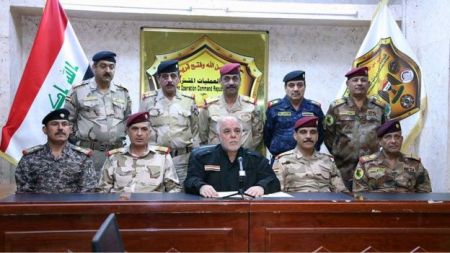
Sunday night, Oct. 16, Iraqi Prime Minister Haidar al-Abadi, supported by a bevy of generals, announced that the military operation to recapture Mosul from its two-year occupation by the Islamic State had begun.

Three formally approved participants are taking part in the operation, DEBKAfile’s military sources report:

1. American special operations, artillery and engineering units – equipped with floating bridges for crossing the Tigris River – plus the US air force for massive bombardment to crush enemy resistance.

2. Iraqi army armored divisions, special ops forces, regular troops and anti-terror police units.

3. The Iraqi Kurds’ Peshmerga.

The Iraqi prime minister pledged formally that only Iraqi fighters would enter Mosul, i.e. no Americans, Kurds or other non-Iraqi forces.

It was a pledge that neither the Iraqi Sunni and Shiite combatants nor the Kurdish and Turkmen fighters trusted him to uphold, after similar promises went by the wayside in the US-led coalition battles fought in the past two years to retake the Iraqi towns of Ramadi, Tikirit, Baiji and Fallujah from ISIS.

The first forces to enter those cities were by and large pro-Iranian Iraqi Shiite militias, especially the Bader Brigades and the Popular Mobilization Units, under Iran’s supreme Middle East commander Gen. Qassem Soleimani. Nonetheless, despite the ravages they wrought in those Sunni cities, US air support was forthcoming for their advance, while in Washington US officials pretended they were helping Iraqi government army units.

With regard to the Mosul campaign, Obama administration officials and military officers, like the Iraqi prime minister, insist there will be no repetition of the Iranian-backed Shiite invasion and conquest of yet another Sunni city, where a million inhabitants still remain.

mosul_offensive_17-10-16

They don’t explain how this will be prevented when those same pro-Iranian Iraqi Shiite forces are already massing northeast of Mosul, near the Iraqi-Syria border, and standing by for the order to advance into the city.

Tehran quite obviously has no intention of being left out of the epic capture of Mosul.

Neither is another uninvited party, Turkish President Tayyip Erdogan. He too has positioned a Turkish military concentration in Iraq, in defiance of strong objections from Washington and Baghdad. Turkish troops stand ready to move forward to do Erdogan’s will and achieve three strategic goals:

a) To actively frustrate Kurdish Peshmerga entry to Mosul, although its 15,000 fighters out of the 25,000 invasion force are a vital element of the spearhead thrust into the city. Ankara has warned that if Kurds set foot in Mosul, Turkish troops will follow.

b)  To block the path of Syrian Kurdish YPG militiamen from entering Iraq and linking up with their Iraqi brothers-in-arms.

c) To provide backing, including Turkish air support, for the Iraqi Turkmen militias still present in the Turkmen quarter of Mosul.

DEBKAfile’s military sources count six assorted military groupings taking part in the liberation of Mosul. They have nothing in common aside from their determination to drive the Islamic State out.

They are utterly divided on the two main aspects of the offensive: How to achieve their common goal and what happens to Mosul after the Islamist invaders are gone.

The underlying US rationale for embarking on this high-wire operation is President Barack Obama’s aspiration to achieve Mosul’s liberation before his departure from the White House in January, in the hope that this landmark success will provide a major distraction from his administration’s failed policies in Syria.

The Islamic State might have been expected to take advantage of the prior warning of the offensive for a stand in defense of the Iraqi capital of Abu Bakr Al-Baghdadi’s caliphate and so exploit the conflicting interests of the invading force.

But ISIS leaders decided against waiting for the combined offensive. Indeed, according to DEBKAfile’s sources, thousands of jihadis made tracks out of the city two or three months ago, relocating the bulk of their combat strength and institutions in two new locations: in the western Iraqi desert province of Anbar at a site between the Jordanian and Saudi borders and eastern Syria. Several hundred fighters were left behind in Mosul to harass the US-Iraq-Kurdish armies as they advance into the city and exploit the invaders’ discord to retain a foothold in Mosul.

Obama hands Syria over to Putin

September 10, 2016

Obama hands Syria over to Putin, DEBKAfile, September 10, 2016

putin_obama_g-20_china-1

The Syrian cease-fire agreement that US Secretary of State John Kerry and Russian Foreign Minister Sergey Lavrov announced Friday night, September 9, in Geneva hands Syrian affairs over to Russia’s President Vladimir Putin and the country’s military.

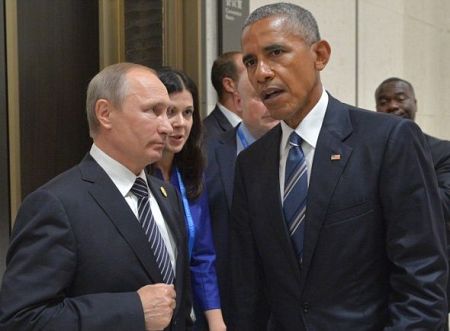
The accord marked a sharp reversal for Washington. In his meeting with Putin in China last week, US President Barack Obama did not agree to those steps for the simple reason that such an agreement would be in line with the policy and stance of Republican presidential nominee Donald Trump, not those of the Democratic nominee Hillary Clinton.

Trump suggested several months ago that the US should let Putin finish the war in Syria, asserting that the Russian leader would be able to do it better.

Under the current situation it is no wonder that Kerry and Lavrov agreed not to release the details of the agreement.

Publication of the details would reveal that the rebels in the Aleppo area, and perhaps in all of Syria, have been abandoned.

The Syrian rebels now find themselves trapped by both the Russian-Turkish agreement and the Russian-US agreement, with a noose seemingly closing around them.

Meanwhile, on Friday, DEBKAfile released the following report:

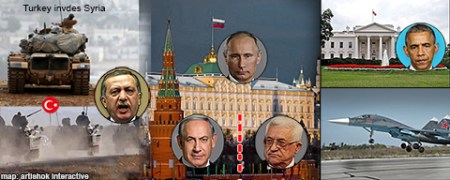
The fledgling “initiatives” reverberating this week in Washington, Moscow, Ankara, Jerusalem and the G20 summit were nothing but distractions from the quiet deals struck by two lead players, Russia and Turkey to seize control of the region’s affairs. Recep Tayyip Erdogan knew nothing would come of his offer on the G20 sidelines to US President Barack Obama to team up for a joint operation to evict ISIS from Raqqa. And, although Moscow was keen on hosting the first handshake in almost a decade between Israeli Prime Minister Binyamin Netanyahu and the Palestinian leader Mahmoud Abbas (Abu Mazen), neither were known to be ready for the last step toward a meeting.

But the game-changing events to watch out for took place in Hangzhou without fanfare – namely, the Obama-Putin talks and the far more fruitful encounter between Putin and Erdogan.

According to DEBKAfile’s intelligence and Mid East sources, Putin virtually shut the door on further cooperation with the United States in Syria. He highhandedly informed Obama that he now holds all the high cards for controlling the Syrian conflict, whereas Washington was just about out of the game.

Putin picked up the last cards, our sources disclose, in a secret deal with Erdogan for Russian-Turkish collaboration in charting the next steps in the Middle East.

The G20 therefore, instead of promoting new US-Russian understanding, gave the impetus to a new Russian-Turkish partnership.

Erdogan raked in instant winnings: Before he left China, he had pocketed Putin’s nod to grab a nice, 4,000-sq.km slice of northern Syria, as a “security zone” under the control of the Turkish army and air force, with Russian non-interference guaranteed.

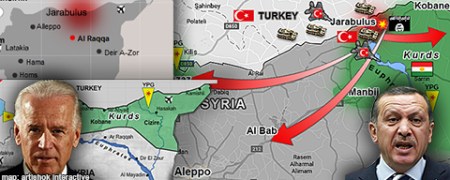
This Turkish zone would include the Syrian towns of Jarablus, Manjib, Azaz and Al-Bab.

Ankara would reciprocate by withdrawing its support from the pro-US and pro-Saudi rebel groups fighting the Assad army and its allies in the area north of Aleppo.

Turkey’s concession gave Putin a selling-point to buy the Syrian ruler assent to Erdogan’s project. Ankara’s selling-point to the West was that the planned security zone would provide a safe haven for Syrian refugees and draw off some of the outflow perturbing Europe.

kremlinwhitehouse480-1

It now turns out that, just as the Americans sold the Syrian Kurds down the river to Turkey (when Vice President Joe Biden last month ordered them to withdraw from their lands to the eastern bank of the Euphrates River or lose US support), so too are the Turks now dropping the Syrian rebels they supported in the mud by re-branding them as “terrorists.”

The head of this NATO nation has moreover gone behind America’s back for a deal with the Russian ruler on how to proceed with the next steps of the Syrian conflict.

Therefore, when US Secretary of State John Kerry met Russian Foreign Minister Sergei Lavrov in Geneva Thursday and Friday, Sept. 8-9, for their sixth and seventh abortive sit-downs on the Syrian issue, there was not much left for them to discuss, aside from continuing to coordinate their air traffic over Syria and the eastern Mediterranean.

Washington and Moscow are alike fearful of an accidental collision in the sky in the current inflammable state of relations between the two powers.

As a gesture of warning, a Russian SU-25 fighter jet Tuesday, Sept 6, intercepted a US Navy P8 plane flying on an international route over the Black Sea. When the Russian jet came as close as 12 feet, the US pilots sent out emergency signals – in vain, because the Russian plane’s transponder was switched off. The American plane ended up changing course.

Amid these anomalies, Moscow pressed ahead with preparations to set up a meeting between the Israeli and Palestinian leaders, as the Russian Foreign Ministry announced Thursday.

Putin is keen to succeed where the Obama administration failed. John Kerry abandoned his last effort at peacemaking as a flop two years ago.  But it is hard to see Netanyahu or Abu Mazen rushing to play along with the Russian leader’s plan to demean the US president in the last months of his tenure – especially when no one can tell who will win the November 8 presidential election – Hillary Clinton or Donald Trump – or what policies either will pursue.

All the region’s actors will no doubt be watching closely to see how Turkey’s “Russian track” plays out and how long the inveterate opportunists can hang together.

Erdogan tells US: Stop backing the Kurds

August 30, 2016

Erdogan tells US: Stop backing the Kurds, DEBKAfile, August 30, 2016

5 (1)

US-Turkish discord over the Turkish army’s onslaught on the Kurds of northern Syria reached a new low Wednesday, Aug. 30, when the presidential palace spokesman Ibrahim Kalin said in Ankara: “The US must revise its policy of supporting Kurdish forces.”

The demand came after a senior US official called on “all the armed actors in the fight against the Islamic State in northern Syria to stand down,” in an effort to contain the new conflict dragging northern Syria into further chaos.

The call was addressed equally to Ankara to freeze its military operations in Syria and to the Kurdish PYD-YPG militia to halt the flow of fraternal reinforcements for defending Mabij, the Syrian town the militia wrested from ISIS earlier this month with US assistance.

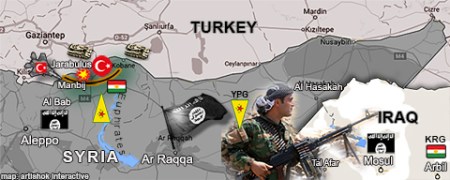
DEBKAfile’s military sources report that the Turkish army and Kurdish forces are already tensely aligned for a decisive battle over Manbij that will determine the outcome of the Turkish invasion of Aug. 24. President Tayyip Erdogan calculates that a Turkish victory will force the Kurds to retreat to the eastern bank of the Euphrates and away from the Turkish border, while Kurdish leaders are determined to halt the Turkish army at the gates of the town, and so brand the invasion a fiasco and carry off an epic victory.

The Obama administration is making a huge effort to avert this confrontation. In the hope of reining in the Turks, Vice President Joe Biden arrived in Ankara on the day their army crossed the Syrian border and met them halfway by issuing an ultimatum to the Kurds to withdraw to east of the Euphrates or else lose US support.

Unheeding of the US warning, the Kurds went forward to build up their fighting strength and engage the Turkish army.

Ankara suspects that the Americans are continuing notwithstanding to give the Kurds weapons and assistance on the quiet.

Washington fears that a Turkish-Kurdish showdown in Manbij will further destabilize the military situation such as it is in northern Syria and northern Iraq, and all their efforts to persuade the Kurds to lead the ground forces of the coalition offensives against ISIS will go for nothing.

In an earlier report on Monday, DEBKAfile covered the conflict between Turkey and the Kurds as it unfolded after the Turkish invasion.

An all-out Turkish-Kurdish war has boiled over in northern Syria since the Turkish army crossed the border last Wednesday, Aug. 24 for the avowed aim of fighting the Islamic State and pushing the Syrian Kurdish YPG militia back. Instead of falling back, the Kurds went on the offensive and are taking a hammering. This raging confrontation has stalled the US-led coalition offensive against ISIS and put on indefinite hold any US plans for campaigns to drive the jihadists out of their Syrian and Iraqi capitals of Raqqa and Mosul.

The Kurdish militia ground troops, who were backed by the US and assigned the star role in these campaigns, are now fully engaged in fighting Turkey. And, in another radical turnaround, Iraqi Kurdish leaders (of the Kurdish Regional Republic) have responded by welcoming Iran to their capital, in retaliation for the US decision to join forces with Turkey at the expense of Kurdish aspirations.

The KRG’s Peshmerga are moreover pitching in to fight with their Syrian brothers. Together, they plan to expel American presence and influence from both northern Syria and northern Iraq in response to what they perceive as a US sellout of the Kurds.

DEBKAfile’s military analysts trace the evolving steps of this escalating complication of the Syrian war and its wider impact:

  • Since cleansing Jarablus of ISIS, Turkey has thrown large, additional armored and air force into the battle against the 35.000-strong YPG Kurdish fighters. This is no longer just a sizeable military raid, as Ankara has claimed, but a full-fledged war operation. Turkish forces are continuing to advancing in three directions and by Sunday, Aug. 28 had struck 15-17km deep inside northern Syria across a 100km wide strip.
    Their targets are clearly defined: the Kurdish enclave of Afrin in northwest Syria and the Kurdish enclave of Qamishli and Hassaka in the east, in order to block the merger of Kurdish enclaves into a contiguous Syrian Kurdish state.
    Another goal was Al-Bab north of and within range of Aleppo for a role in a major theater of the Syrian conflict. To reach Al-Bab, the Turkish force would have to fight its way through Kurdish-controlled territory.
  • The Turks are also using a proxy to fight the Syrian Kurds. Thousands of Syrian Democratic Army (SDF) rebels, whom they trained and supplied to fight Syria’s Bashar Assad army and the Islamic State, have been diverted to targeting the Kurds under the command of Turkish officers, to which Turkish elite forces are attached.
  • A Turkish Engineering Corps combat unit is equipped for crossing the Euphrates River and heading east to push the Kurds further back. Contrary to reports, the Turkish have not yet crossed the river itself or pushed the Kurds back – only forded a small stream just east of Jarablus. The main Kurdish force is deployed to the south not the east of the former ISIS stronghold.
KurdishWar480
  • Neither have Turkish-backed Syrian forces captured Manbij, the town 35km south of Jarablus which the Kurds with US support captured from ISIS earlier this month. Contrary to claims by Ankara’s spokesmen, those forces are still only 10-15km on the road to Mabij.
  • Sunday, heavy fighting raged around a cluster of Kurdish villages, Beir Khoussa and Amarneh, where the Turks were forced repeatedly to retreat under Kurdish counter attacks. Some of the villages were razed to the ground by the Turkish air force and tanks. At least 35 villagers were reported killed.
  • In four days of fierce battles, the Kurds suffered 150 dead and the Turkish side, 60.
  • DEBKAfile military sources also report preparations Sunday to evacuate US Special Operations Forces and helicopter units from the Rmeilan air base near the Syrian-Kurdish town of Hassaka. If the fighting around the base intensifies, they will be relocated in northern Iraq.
  • Fighters of the Iraqi-Kurdish Peshmerga were seen removing their uniforms and donning Syrian YPG gear before crossing the border Sunday and heading west to join their Syrian brothers in the battle against Turkey.
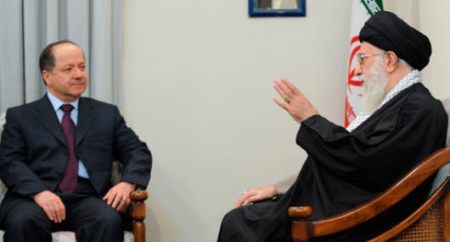
  • The KRG President Masoud Barazani expects to travel to Tehran in the next few days with an SOS for Iranian help against the US and the Turks. On the table for a deal is permission from Irbil for the Iranian Revolutionary Guards to win their first military bases in the Iraqi Kurdish republic, as well as transit for Iranian military forces to reach Syria through Kurdish territory..

Syrian Kurds clash with Turkish forces

August 26, 2016

Syrian Kurds clash with Turkish forces, DEBKAfile, August 26, 2016

(Please see also, Biden Gushes to Erdoğan That American People ‘Stand in Awe’ of Turkish ‘Courage’ — DM)

Tanks_invading_Syria_B_24.8.16

Just a few days ago, the Americans were speaking highly of Kurds as the sharpest sword in the coalition’s arsenal for vanquishing the jihadists. Since Biden’s deal with Erdogan on Wednesday, Washington can forget about the Syrian Kurdish PYG or the Iraqi Kurdish Pershmerga as spearheads of the campaigns to liberate Raqqa in Syria and Mosul in Iraq for ISIS.

*****************************

Syrian Kurdish militia commanders are flouting the ultimatum US Vice President Joe Biden handed them Wednesday, Aug. 24 to retreat to east of the Euphrates or else forfeit US support.  Instead, DEBKAfile’s military sources report, they decided to stand their ground and fight it out with the Turkish army.

The first clash occurred Thursday overnight, when Kurdish forces from Manbij attacked the positions taken by Turkish tanks in Jarablus, hours after Islamic State forces were put to flight from this border town.

The battles continued into Friday morning, Aug. 26.

The US ultimatum to the Kurds was the outcome of understandings US Vice President Joe Biden reached with Turkey’s President Tayyip Erdogan in Ankara on Wednesday, hours after the Turkish army crossed into northern Syria.

“Syrian Kurdish forces will lose US support if they don’t retreat to east bank of Euphrates,” the US vice president stated at a news conference.

Yet Thursday night, Turkish officials made an effort to counteract the impression that their military intervention in Syria was coordinated with the United States. They announce that Russian chief of staff Gen. Valery Gerasimov would be arriving in Ankara Friday for talks with his Turkish counterpart, Gen. Hulusi Akar.

The US commander of American troops in Iraq and Syria, Lt. Gen. Stephen Townsend, had meanwhile instructed all US Special Operations personnel to withdraw from Syrian-Kurdish YPG militia units, and return to the N. Syrian Rmeilan airfield near Hassaka. This is reported from DEBKAfile military and intelligence sources.

The US general also stopped artillery ammo supplies to the Kurdish militia and the transfer of field intelligence from the fighting in areas newly occupied by the Turkish army.

These measures were temporary, the US officers informed Salih Muslim, Syrian Kurdish Democratic Union Party (PYD) leader, and would be lifted after his YPG militia was instructed to pull back from northern Syria and head east of the Euphrates.

Only last week, the Syrian Kurdish militia was riding high, covered in praise for its feat in capturing Manbij with the assistance of US Special Forces.

Their comedown after the US decided to jump aboard the Turkish invasion would be complete, if they complied with the Biden ultimatum. They would forfeit all their hard-won gains from years of combat against the Islamic State, and have to forget their dream of a Kurdish state linking their enclaves along the 900km Syrian-Turkish border.

A stream of information and misinformation is meanwhile muddying the waters as the Kurds in Syria and Iraq absorb the shock of the American turn against them.

The Ministry of Foreign Affairs in Ankara said Thursday that US Secretary of State John Kerry had informed the Turkish Foreign Minister Mevlut Cavusoglu that the US-backed Syrian Kurdish militias had begun their retreat to the eastern bank of the Euphrates River.


ManbijKoteret480

US sources qualified this claim, confirming only that a ‘main element’ of the Kurds has retreated, but not the entire force. The Kurds were evidently in no hurry to take any marching orders either from Turkey or the United States.

A short Kurdish statement claimed that their forces had indeed withdrawn to the eastern bank of the Euphrates River, but DEBKAfile’s military sources military sources say that a large body of Kurdish fighters is still in place west of the river. Indeed our sources found Kurdish PYG officers adamant in their determination to stay put and take on the Turkish army.

After the Turkish invasion Wednesday, Kurdish leader Salih Muslim declared, “Turkey will be defeated in Syria along with the Islamic State.”

Kurdish units also took up positions on the roads leading to the US base at Rmeilan, ready enforce a blockade. A Kurdish food convoy due at the base Thursday did not arrive.

In Iraq, there is word of a Kurdish Peshmerga mutiny against US instructors at the bases where they are training for the offensive to recapture Mosul from the ISIS.

However, the events of this week around northern Syria have dealt a major setback to the US-led war on ISIS.

Just a few days ago, the Americans were speaking highly of Kurds as the sharpest sword in the coalition’s arsenal for vanquishing the jihadists. Since Biden’s deal with Erdogan on Wednesday, Washington can forget about the Syrian Kurdish PYG or the Iraqi Kurdish Pershmerga as spearheads of the campaigns to liberate Raqqa in Syria and Mosul in Iraq for ISIS.

The Case for Kurdish Statehood

July 11, 2016

The Case for Kurdish Statehood, Investigative Project on Terrorism, Noah Beck, July 11, 2016

1691

Why has the West been so supportive of Palestinian nationalism, yet so reluctant to support the Kurds, the largest nation in the world without a state?

The Kurds have been instrumental in fighting the Islamic State (ISIS); have generously accepted millions of refugees fleeing ISIS to the Kurdistan Regional Government (KRG); and embrace Western values such as gender equality, religious freedom, and human rights. They are also an ancient people with an ethnic and linguistic identity stretching back millennia and have faced decades of brutal oppression as a minority. Yet they cannot seem to get sufficient support from the West for their political aspirations.

The Palestinians, by contrast, claimed a distinct national identity relatively recently, are less than one-third fewer in number (in 2013, the global Palestinian population was estimated by the Palestinian Authority to reach 11.6 million), control land that is less than 1/15th the size of the KRG territory, and have not developed their civil society or economy with nearly as much success as the Kurds. Yet the United Nations, the European Union, the Arab League, and other international bodies have all but ignored Kurdish statehood dreams while regularly prioritizing Palestinian ambitions over countless other global crises.

Indeed, in 2014 the UK and Sweden joined much of the rest of the world in recognizing a Palestinian state. There has been no similar global support for a Kurdish homeland. Moreover, Kurdish statehood has been hobbled by U.S. reluctance to see the Iraqi state dismantled and by regional powers like Turkey, which worries that a Kurdish state will stir up separatist feelings among Turkish Kurds.

With an estimated worldwide population of about 35 million (including about 28 million in the KRG or adjacent areas), the Kurds are the fourth-largest ethnic group in the Middle East (after the Arabs, Persians, and Turks), and have faced decades of persecution as a minority in Turkey, Iran, and Iraq.

The 1988 “Anfal” attacks, which included the use of chemical weapons, destroyed about 2,000 villages and killed at least 50,000 Kurds, according to human rights groups (Kurds put the number at nearly 200,000). Several international bodies have recognized those atrocities as a genocide.

The Kurds in Turkey have also suffered oppression dating back to Ottoman times, when the Turkish army killed tens of thousands of Kurds in the Dersim and Zilan massacres. By the mid-1990s, more than 3,000 villages had been destroyed and 378,335 Kurdish villagers had been displaced and left homeless, according to Human Rights Watch.

The drive for Kurdish rights and separatism in Iran extends back to 1918, and – during its most violent chapter – cost the lives of over 30,000 Kurds, starting with the 1979 rebellion and the consequent KDPI insurgency.

A 2007 study notes that 300,000 Kurdish lives were lost just in the 1980s and 1990s. The same study states that 51,000 Jews and Arabs were killed in the Arab-Israeli conflict from 1950 until 2007 (and, because that total includes wars with Israel’s Arab neighbors, Palestinians are a small fraction of the Arab death toll).

Perhaps because of the Kurds’ own painful history, the KRG is exceptionally tolerant towards religious minorities and refugees. The KRG has embraced its tiny community of Jews, and in 2014, the Kurds rescued about 5,000 Yazidis trapped on Mount Sinjar after fleeing attempted genocide by ISIS. Last November, the Kurds recaptured the Sinjar area from ISIS, liberating hundreds more Yazidis from vicious oppression.

The KRG absorbed 1.8 million refugees as of December, representing a population increase of about 30 percent. The KRG reportedly needs $1.4 to 2.4 billion to stabilize the internally displaced people in its territory.

“Most of the refugees [in the KRG] are Arab Sunnis and Shia, Iranians, Christians, and others,” Nahro Zagros, Soran University vice president and adviser to the KRG’s Ministry of Higher Education, told the  IPT. “Yet there is no public backlash from the Kurds. And of course, we have been helping the Yazidi, who are fellow Kurds.”

The Kurdish commitment to gender equality is yet another reason that Kurdish statehood merits Western support. There is no gender discrimination in the Kurdish army: their women fight (and get beheaded) alongside the men. Last December, Kurdistan hosted the International Conference on Women and Human Rights.

The Kurds are also the only credible ground force fighting ISIS, as has been clear since the ISIS threat first emerged in 2014. ISIS “would have totally controlled the Baji oil field and all of Kirkuk had the [Kurdish] Peshmerga not defended it,” said Jay Garner, a retired Army three-star general and former Army assistant vice chief of staff who served during “Operation Provide Comfort” in northern Iraq. “Losing Kirkuk would have changed the entire war [against ISIS], because there are billions of dollars [per] week in oil flowing through there. The Iraqi army abandoned their equipment [while the Kurds defended Kirkuk, which has historically been theirs].”

Masrour Barzani, who heads the KRG’s intelligence services, says that Kurdish independence would empower the Kurds to purchase the type of weapons they need without the delays that currently hobble their military effort against ISIS. Under the present arrangement, Kurdish weapons procurement must go through Iraq’s Shia-led central government, which is also under heavy Iranian influence.

Besides bolstering the fight against ISIS, there are other geopolitical reasons for the West to support Kurdish statehood: promoting a stable partition of Syria, containing Iran, balancing extremist forces in the Middle East, and giving the West another reliable ally in a volatile region.

Now that Syria is no longer a viable state, it could partition into more sustainable governing blocs along traditional ethnic/sectarian lines with Sunni Arabs in the heartland, Alawites in the northwest, Druze in the south, and Kurds in the northeast. KRG leader Masrour Barzani recently argued that political divisions within Iraq have become so deep that the country must transform into “either confederation or full separation.”

Southeast Turkey and northwest Iran also have sizeable Kurdish areas that are contiguous with the KRG, but those states are far from disintegrating, and would aggressively resist any attempts to connect their Kurdish areas to the future Kurdish state. However, the Kurdish areas of former Syria should be joined to Iraqi Kurdistan as a way to strengthen the fledgling Kurdish state and thereby weaken ISIS.

In a recent article, Ernie Audino, the only U.S. Army general to have previously served a year as a combat adviser embedded inside a Kurdish Peshmerga brigade in Iraq, notes that Iran currently controls the Iraqi government and Iran-backed fighters will eventually try to control Kurdistan. He also makes the point that Western support for the Kurdish opposition groups active in Iran would force the Iranian regime to concentrate more on domestic concerns, effectively weakening Iran’s ability to pursue terrorism, expansionism, and other destabilizing activities abroad.

Because the Kurds are religiously diverse moderates who prioritize their ethno-linguistic identity over religion, a Kurdish state would help to balance out the radical Mideast forces in both the Shiite and Sunni camps. The Kurds are already very pro-American, thanks to their Western-leaning values, the U.S.-backed-no-fly zone, and the 2003 toppling of Saddam Husssein that made the KRG possible.

A Kurdish state would also have excellent relations with Israel, another moderate, non-Arab, pro-Western democracy in the region. Israeli Prime Minister Benjamin Netanyahu endorsed Kurdish independence in 2014, and Syrian Kurds – after recently declaring their autonomy – expressed an interest in developing relations with Israel.

By contrast, the Palestinian Authority slanders Israel at every opportunity: Abbas recently claimed in front of the EU parliament that Israel’s rabbis are trying to poison Palestinian drinking water. The Authority raises Palestinian children to hate and kill Jews with endless anti-Israel incitement coming from schools, media, and mosques. Palestinians have also shown little economic progress in the territories that they do control, particularly in Gaza, where Palestinians destroyed the greenhouses that donors bought for them in 2006 and instead, have focused their resources on attacking Israel with tunnels and rockets.

By almost any measure, a Kurdish state deserves far more support from the West. After absorbing millions of Syrian refugees while fighting ISIS on shrinking oil revenue, the KRG is battling a deepening financial crisis. Aggravating the situation, Iraq’s central government has refused – since April 2015 – to send the KRG its share of Iraqi oil revenue. The economic crisis has cost the KRG an estimated $10 billion since 2014.

U.S. Rep. Ed Royce, R-Calif., chairman of the House Foreign Affairs Committee, introduced House Resolution 1654 “to authorize the direct provision of defense articles, defense services, and related training to” the KRG. Fifteen months later, the bill is still stuck in Congress.

Helping the Kurds should be an even bigger priority for the European Union, which absorbs countless new refugees every day that ISIS is not defeated. If the EU were to fund the KRG’s refugee relief efforts and support their military operations against ISIS, far fewer refugees would end up on their shores.


Can US, Turkey keep up appearances in Syria?

May 30, 2016

Can US, Turkey keep up appearances in Syria? Al-Monitor, May 29, 2016

A terrorist group linked to the Islamic State (IS) claimed responsibility for suicide bombings in Tartus and Jableh in Syria on May 23 that killed more than 150 civilians and wounded more than 200 others. Maxim Suchkov points out that the attack in Tartus occurred deep inside government-controlled territory. Russia maintains a naval base in Tartus and an air base and reconnaissance center in Khmeimim in the Latakia region. The suicide attacks, Suchkov suggests, could be a catalyst for a Russian “first strike” strategy against terrorist and aligned Salafi groups.

Moscow had already signaled the prospect of escalation against Jabhat al-Nusra and allied groups prior to the May 23 attacks. The Russian Ministry of Defense has announced a pause in its air campaign to allow armed groups allied with Jabhat-al Nusra to distance themselves from the al-Qaeda affiliate. On May 26, Jabhat al-Nusra, Ahrar al-Sham and allied groups seized the town of Dirkhabiyah near Damascus. Ahrar al-Sham has coordinated more closely with Jabhat al-Nusra in response to increased US and Russian targeting of the al-Qaeda affiliate over the past few months.

This column last week suggested that the United States take up a Russian offer to coordinate attacks on Jabhat al-Nusra, which is not a party to the cessation of hostilities. For the record, we have no tolerance or empathy for groups or individuals who stand with al-Qaeda. We hope that this is at least part of the message the United States is conveying to its regional partners who have backed these groups.

With the Geneva talks suspended for several weeks, the prospect of a Russian campaign to deliver heavy and potentially fatal blows to Jabhat al-Nusra and its allies, especially in and around Aleppo and Idlib, could signal yet another turning point in the Syria conflict.

Turkey’s failed proxy war

The United States and Turkey are struggling to keep up appearances in Syria, despite even further signs of division and discord.

Gen. Joseph Votel, US CENTCOM commander, met last week with Syrian Kurdish forces during a “secret” visit to northern Syria as part of a regional diplomatic tour that also included a stop in Ankara. Votel told Washington Post columnist David Ignatius that he is seeking to “balance” Turkey’s role as a “fabulous” partner in the battle against IS with that of the People’s Protection Units (YPG), the backbone of the Syrian Defense Forces (SDF), which is a “very good partner on the ground.”

In contrast to the YPG, Turkey’s proxy forces, including a worrying mix of Salafists who are willing to run operations with Jabhat al-Nusra, have been a flop. Last week, IS seized at least seven villages in the northern Aleppo region.

Fehim Tastekin reports that SDF-led military operations to liberate Jarablus, which is an essential gateway along with al-Rai to the outside world via Turkey, were postponed “because of Turkey’s red line against the Kurds.” The offensive against Raqqa has also been slowed, writes Tastekin, because “the SDF’s operational capacity still leaves much to be desired. It is not an option for the Kurdish YPG-YPJ to control Raqqa, because they will encounter local resistance. They also worry that scattering their forces in Arab regions could weaken the defensive lines of Rojava (Syrian Kurdistan). Therefore, Arab forces would have to get in shape to control the situation in the post-IS period.” Laura Rozen reports from Washington that the United States is seeking to boost the numbers of Arab Sunni forces among the SDF in anticipation of an advance on Raqqa.

Meanwhile, the Pentagon found itself in a public relations fiasco after Turkey complained that US special forces in Syria were wearing badges with the logo of the YPG, which Turkey considers the Syrian partner of the Kurdistan Workers Party (PKK) and therefore also a terrorist organization. This might be compared with what in the sports world is known as an unforced error, and made Votel’s already daunting diplomacy that much more complicated.

Air Force Col. Sean McCarthy also told Ignatius that US air operations against IS out of Incirlik Air Base were mostly “autonomous” of Turkish missions, saying that “we don’t discuss with them where we’re going.”

Adding it all up, the US-Turkish “partnership” against IS may be more fable than fabulous. The open secret is that Turkey is preoccupied first with thwarting advances by Syria’s Kurds, and second with shutting down the remaining lifelines for IS in northern Syria. These priorities are of a piece. No doubt Turkey is taking up the fight against IS, but first things first. Tastekin, who previously broke the back story on Turkey’s disastrous proxy efforts to retake al-Rai from IS in April, now concludes that “there is no room for optimism that Ankara will erase its red lines vis-a-vis the Kurds. Instead, Turkey is now trying to put together an even more formidable force with Jabhat al-Nusra, which it is trying to steer away from al-Qaeda.”

The catch might just be that many of the Syrian armed groups backed by Washington’s regional partners are proxies for a sectarian agenda that is mostly about toppling Syrian President Bashar al-Assad, however unlikely that now appears, and, by extension, keeping the heat on Iran. The when and where of taking the fight to IS or Jabhat al-Nusra is more or less negotiable, depending on trade-offs and pressure. We do not feel we are out on a limb in suggesting that efforts by Ankara or others to wean Jabhat al-Nusra from al-Qaeda will come to no good. This column has repeatedly documented the fluidity of foreign-backed Salafi groups such as Ahrar al-Sham and Jaish al-Islam shifting in and out of tactical alliances with Jabhat al-Nusra, all the while preaching an ideology almost indistinguishable from al-Qaeda and IS.

The losers, of course, are the people of Syria, including those who suffer under IS’ tyranny that much longer because of Turkey’s concerns about the Kurds, and as Washington’s policymakers and pundits begin another maddening deep dive into how to rejigger ethnic and sectarian fault lines. Syrians fleeing IS terror in Aleppo, meanwhile, told Mohammed al-Khatieb that living under IS is “like hell … unbearable.” While we acknowledge the complexities and challenges of the raw ethnic and sectarian politics of Syria, as well as the potential for vendettas and mass killings, there is, in our score, an urgency and priority to focus on the destruction of IS and al-Qaeda above all else.

Sur’s aftermath

Diyarbakir’s historic district of Sur has witnessed some of the most brutal fighting between Turkish military and PKK forces over the past year. Mahmut Bozarslan reports from Diyarbakir that “historical landmarks in Sur, which was last year added to UNESCO’s World Heritage List, also suffered their share of destruction. The walls of the Armenian Catholic church are partially destroyed, while the nearby Haci Hamit Mosque is missing its minaret, with a dome riddled with bullets. Another Armenian church, Surp Giragos, had its windows shattered and interior damaged.”

“Still, those ancient monuments were lucky compared with more ordinary structures in the area,” writes Bozarslan. “A building with an intact door was almost impossible to find. The warring parties had used some buildings as fighting bases, others as places to rest. Stairways were littered with empty tins; one was also stained with blood. At the bloodied spot, a piece of paper reading “body #1” was left behind, suggesting that the security forces had been there for a crime scene report. A couple seemed relieved that they had escaped with relatively little damage, but grumbled that their apartment had been broken into, with the bedroom and closets rummaged. They claimed it was the security forces who had entered, while their neighbor showed Al-Monitor binoculars that had been left behind.”

Pentagon Denies Troop Presence on Syria Front Lines Despite Photographs

May 28, 2016

Pentagon Denies Troop Presence on Syria Front Lines Despite Photographs, Washington Free Beacon, May 27, 2016

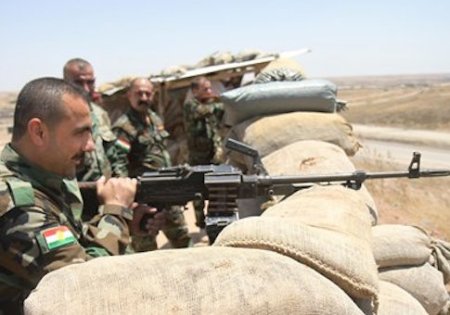
Kurdish Peshmerga soldiers guard against Islamic State militants at a frontline base near Mosul, northern Iraq, on June 6, 2015, four days before the first anniversary of the second-largest Iraqi city's fall to the extremists. (Kyodo) ==Kyodo

Kurdish Peshmerga soldiers guard against Islamic State militants at a frontline base near Mosul, northern Iraq, on June 6, 2015, four days before the first anniversary of the second-largest Iraqi city’s fall to the extremists. (Kyodo)

The Pentagon Thursday denied the presence of U.S. troops on the front lines in Syria despite photographic evidence showing special operations troops fighting alongside Kurdish forces in an offensive to retake Raqqa from the Islamic State.

Peter Cook, the Pentagon press secretary, maintained the Obama’s administration’s claim that ground troops in Syria are solely serving in advisory and assistance roles in the war-torn region.

“They are not on the forward line. They are providing advice and assistance,” Cook said during a testy exchange with reporters. “That mission has not changed, their role has not changed. They are not leading this fight. They are supporting those forces that are at the leading edge of this fight, and they are doing it in a very effective fashion.”

Near frontline north of the Islamic State bastion of Raqa city, in Syria an AFP photographer saw armed US soldiers http://u.afp.com/ZEZo 

proxy (1)
Fatisah (Syria) (AFP) – US forces on the ground in northern Syria are helping a major offensive against the Islamic State group in its stronghold of Raqa 

Cook refused to comment specifically on the photos.

“What I will say is that special operations forces when they operate in certain areas do what they can to, if you will, blend in with the community to enhance their own protection, their own security… And they might be, again, for visual purposes, might be blending in with the local community,” he said.

The AFP reported that U.S. commandos were seen climbing onto a rooftop “carrying U.S.-made anti-tank missiles.” A fighter with the Syrian Democratic forces told the outlet that U.S. troops are taking part in the group’s operation against ISIS.

The revelations contradict the Obama administration’s insistence that ground troops are in Syria solely to advise and assist local forces.

Ahead of the president’s announcement last month that he would deploy an additional 250 special operations forces to Syria, Deputy National Security Adviser Ben Rhodes reiterated that U.S. troops would not be acting in a combat role

“Obviously, any special forces troops that we deploy into Iraq or Syria are going to be combat-equipped troops,” Rhodes said. “They’re not being sent there on a combat mission. They’re being sent there on a mission to be advising and assisting and supporting the forces that are fighting against ISIL on the ground.”

One reporter pressed Cook to clarify the difference between a “forward line” and a “front line.” He replied vaguely that he didn’t “have a yardstick measurement” and that the front lines of war are always “fluid.”

Turkey’s Islamic Supremacist Foreign Policy

April 29, 2016

Turkey’s Islamic Supremacist Foreign Policy, Gatestone InstituteUzay Bulut, April 29, 2016

♦ “We have never been involved in an attack against Turkey … we were never involved in such an action… Davutoglu wants to pave the way for an offensive on Syria and Rojava and cover up Turkey’s relations with the ISIS which is known to the whole world by now.” — YPG (Kurdish) General Command.

♦ “Thousands of settlers from Anatolia were shipped in by the Turkish government to occupy former Greek villages and to change Cypriot demography — in the same manner the occupying Ottoman Empire once did in the 16th century.” — Victor Davis Hanson, historian.

♦ Turkey, for more than 40 years, has been illegally occupying the northern part of the Republic of Cyprus, historically a Greek and Christian nation, which it invaded with a bloody military campaign in 1974.

♦ What Turkey would call a crime if committed by a non-Turkish or a non-Sunni state, Turkey sees as legitimate if Turkey itself commits it.

Between March 29 and April 2, 2016, Turkey’s president, Recep Tayyip Erdogan, paid a visit to Washington D.C. to participate in the 4th Nuclear Security Summit hosted by U.S. President Barack Obama.

In an interview with CNN broadcast March 31, Erdogan said, “We will not allow an act such as giving northern Syria to a terrorist organization… We will never forgive such a wrong. We are determined about that.”

Asked which terror organization he was referring to, Erdogan said: “The YPG [Kurdish People’s Protection Units], the PYD [Democratic Union Party] … and if Daesh [ISIS] has an intention of that sort then it would also never be allowed.”

Erdogan was thereby once again attempting to equate Islamic State (ISIS), which has tortured, raped, sold or slaughtered so many innocent people in Syria and Iraq, with the Kurdish PYD, and its YPG militia, whose members have been fighting with their lives to defeat genocidal jihadist groups such as al-Nusra and ISIS.

The question is not why Erdogan or his government have such an intense hatred for Kurds. Turkey’s genocidal policies against the Kurds are not a secret. Turkey’s most recent deadly attacks are ongoing in Kurdish districts even now. The more important question is why Erdogan thinks that Turkey is the one to decide to whom the predominantly Kurdish north of Syria will belong — or who will not rule that part of Syria.

On February 17, Turkey’s capital, Ankara, was shaken by a car bomb that killed 28 people and wounded 61 others.

Turkey’s Prime Minister, Ahmet Davutoglu, immediately announced that the perpetrator was a Syrian national with links to the Syrian Kurdish People’s Protection Units (YPG).

“A direct link between the attack and the YPG has been established,” Davutoglu said. “The YPG attack was carried out with logistical support from the Kurdistan Workers’ Party (PKK) inside Turkey. Just as al-Qaeda or Daesh do not have seats at the table, the YPG, which is a terrorist organization, cannot have one.” He then once again refused to permit Kurdish YPG participation in U.N.-brokered Syria peace talks in Geneva.

Saleh Muslim, the head of Syria’s Kurdish Democratic Union Party (PYD), replied via Agence France-Presse: “We deny any involvement in this attack. These accusations are clearly related to Turkish attempts to intervene in Syria.”

The General Command of the YPG also denied any involvement in the attack:

“Under challenging conditions, we are protecting our people from barbaric gangs such as ISIS and Al-Nusra. Countless states and media outlets have repeatedly reported about the support Turkey has been providing to these terrorist groups. Apart from the terrorist groups attacking us, we as YPG have engaged in no military activity against the neighboring states or other forces.

“We would like to repeat our message to the people of Turkey and the world: We have no links to this incident… We have never been involved in an attack against Turkey. The Turkish state cannot possibly prove our engagement in any kind of attack on their side because we were never involved in such an action. Turkish Prime Minister Davutoglu’s remarks ‘Ankara attack was conducted by YPG’ is a lie and far away from the truth. With this statement, Davutoglu wants to pave the way for an offensive on Syria and Rojava and cover up Turkey’s relations with the ISIS which is known to the whole world by now.”

The Middle East is going through mass murders, kidnappings, rapes, the sexual slavery of women and other crimes. And Turkey’s aggressive and supremacist foreign policy, which does not respect the sovereignty of its neighbors, has played a large role in this situation.

Syria and Iraq, Turkey’s southern neighbors, are now the breeding ground of genocidal jihadist groups, foremost the Islamic State (ISIS). Many reporters, experts and eyewitnesses have revealed that Turkey has contributed to the rise of jihadist terrorists in the region — by letting ISIS members get in and out of Turkey and even by providing funds, logistics, and arms for ISIS.

Inside its own boundaries, Turkey has been engaged in an all-out war against its own Kurdish citizens since last August. Turkey has been murdering them indiscriminately and destroying their homes and neighborhoods.

Turkey’s hatred of Kurds is so intense that it also targets Kurdish defense forces in Syria.

On February 13, Davutoglu confirmed shelling the Kurdish YPG group in Syria, after the YPG advanced on the rebel-held town of Azaz in Syria. “We will retaliate against every step [by the YPG],” Davutoglu said. “The YPG will immediately withdraw from Azaz and the surrounding area and will not go close to it again.”

The rebels in Azaz and elsewhere in Syria are mostly Islamist jihadists. According to the scholar Aymenn Jawad Al-Tamimi, Azaz was mostly controlled in early 2015 by the group Liwa Asifat al-Shamal (“Northern Storm Brigade”), affiliated with the Islamic Front. Syria’s al-Qaeda affiliate Jabhat al-Nusra (“Al-Nusra Front”) also had a presence there.

“Azaz is a symbol for Turkey,” said Fabrice Balanche of the Washington Institute For Near East Policy. “Prime Minister Davutoglu fears that if the Kurds capture Azaz, they could start a big offensive from Kobane to the west and from Afrin to the east,” he told BBC.

As widely reported, the crisis in the region reached a peak when a Turkish Air Force F-16 fighter jet shot down a Russian Air Force Su-24 bomber along the Turkey-Syria border on November 24, killing the pilot, Lieutenant-Colonel Oleg Peshkov. The Turkish government tried to excuse the attack by claiming that the jet was downed after it had violated Turkish airspace for 17 seconds.

The Russia Defense Ministry, however, denied the aircraft ever left Syrian airspace, and released a video they claimed shows that the Su-24 was not in Turkish airspace when it was shot down.

Meanwhile, Turkey’s neighbor to its West, Greece, has long been a victim of Turkey’s violations of its sovereign airspace. According to data recorded by the Greek military, in 2014 alone, Turkish aircraft violated Greek airspace 2,244 times. On just one day, February 15, Turkish warplanes violated Greek airspace 22 times, according to Athens News Agency.

After Syria, Greece and Russia, Turkey’s next target was its other southern neighbor, Iraq. In December, Iraq’s President, Fuad Masum, said, “The presence of the Turkish Army Forces in Mosul Province without our permission violates international rules. I want Turkish officials to get its force out of Iraq’s territory immediately.”

Iraq’s Prime Minister Haider al-Abadi also condemned Turkey’s action: “We have not asked Turkey for any force and no one had informed us about the arrival of the force.”

Two neighbors of Turkey, Cyprus and Armenia, have also been victims of Turkish aggression — for an even longer time.

Turkey, for more than 40 years, has been illegally occupying the northern part of the Republic of Cyprus, which it invaded with a bloody military campaign in 1974. According to historian Victor Davis Hanson:

“Thousands of settlers from Anatolia were shipped in by the Turkish government to occupy former Greek villages and to change Cypriot demography — in the same manner the occupying Ottoman Empire once did in the 16th century. … The island remains conquered not because the Greeks have given up, but because their resistance is futile against a NATO power of some 70 million people. Greeks know that Turkey worries little about what world thinks of its occupation.”

Turkey has also been blockading yet another neighbor since 1993: “Turkey and Azerbaijan have effectively been exercising an illegal unilateral economic blockade against Armenia, which has hurt the latter economically,” wrote Armen V. Sahakyan, the executive director of the Eurasian Research and Analysis Institute. “Turkey and Azerbaijan are in clear violation of the Principle of Good Neighborliness, as well as all of the General Assembly resolutions condemning unilateral coercive measures.”

Turkey has been assaulting its neighbors in what appears as outbursts of Turkish Islamic supremacy. What Turkey would call a crime if committed by a non-Turkish or a non-Sunni state, Turkey sees as legitimate if Turkey itself commits it.

When Turkey invaded Cyprus, historically a Greek and Christian nation, it is not called an invasion. Turkey still refers to the 1974 military campaign as a “peace operation.” Senior politicians and military officials from Turkey also participate in the official ceremonies called “the Peace and Freedom Festival,” organized in occupied northern Cyprus on July 20 every year, to celebrate what they “achieved” more than 40 years ago — namely, an ethnic cleansing and colonization campaign that they conducted through many crimes, including mass murders, wholesale and repeated rapes, torture and inhuman treatment, plundering Cypriot cultural heritage and destroying churches, among others.
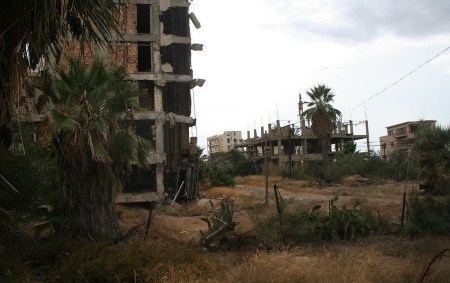
1569The crumbling buildings of the Varosha district of Famagusta, Cyprus, photographed in 2009. The area lies within Turkish-controlled northern Cyprus. The inhabitants fled during the 1974 Turkish invasion and the district has been abandoned since then. (Source: Wikimedia Commons)

If anyone blockaded another state, especially a Sunni state, Turkey would most certainly condemn it. But when Turkey itself blockades a Christian nation, it is always “justified” — most often as a response to some “unacceptable wrongdoing” by the other side.

If a non-Turkish, or non-Sunni state, treated a Turkish or Sunni minority brutally, Turkey would passionately condemn it. But Turkey sees no harm in slaughtering its own Kurdish citizens, and devastating their towns. Turkey claims this is a just way of “fighting against terrorism.”

Turkey can shoot down a Russian plane in the blink of an eye, because supposedly no one can violate Turkish airspace even for a few seconds — or even if no such violation takes place. But Turkey can violate the Greek sovereign airspace countless times as a national sport or hobby whenever it feels like it?

If Western authorities criticize Turkey for its policies, Turkey accuses them of “intervening in Turkey’s internal affairs.”

For instance, when a group of journalists close to the movement of the Islamic cleric Fethullah Gulen were detained in a mass arrest operation on December 14, 2014 in Turkey, the European Commission, in a joint statement, criticized the police raids and arrests of the media representatives.

EU foreign affairs chief Federica Mogherini and the commissioner heading EU enlargement talks also said the arrests went “against European values.”

Turkish President Recep Tayyip Erdogan responded in a public speech:

“When we take a step, someone in the European Union immediately comes up and makes a statement. According to what do you make this statement? What do you know?

“Those who have made this country wait at the gate of the European Union for 50 years, do you ever know what this [our] step is? The elements that threaten our national security — be they members of the press, or this or that — will get the required response. It is impossible for us to make them sovereign in this country.

“And when we take such a step, we do not think about ‘what will the European Union say?’ or ‘will the EU accept us [as a member]?’ We do not have such concerns. We will pull ourselves up by our own bootstraps. Please keep your intellect to yourselves.”

Erdogan also said that the detentions were not an “issue” of press freedom and claimed that the Fethullah Gulen movement was backed by Israel, which Erdogan referred to as “the country in the south that he [Gulen] loves.”

So, the European Union, of which Turkey is allegedly “striving” to be a member, cannot even issue a critical statement concerning Turkey’s policies because that would “intervene in Turkish steps for national security,” but Turkey can send jihadist fighters, arms or funds into Syria or Iraq and destroy lives and civilizations there?

Turkey seems to believe it always has to be strong and a leading force in the region. But if Kurds — an indigenous, stateless and persecuted people — are to gain a single right anywhere in the world, does Turkey find that unacceptable?

The entire history of Turkey as well as its current policies demonstrate that Turkey believes Kurds are inferior to Turks. Turkey does not even recognize the Kurds’ right to be educated in Kurdish, evidently in an attempt to separate them from their identity.

“The policy of Republican Turkey since its establishment in 1923,” wrote the author Amir Hassanpour, “is a typical case of what has been called ‘linguicide’ or ‘linguistic genocide.’ Forcing the Kurds to abandon their language and become native speakers of Turkish is the primary goal of the language policy.”

Freedom and sovereignty are for Turks only. Kurds are just to be murdered or to be Turkey’s servants. This has been the state policy of Turkey ever since it was founded in 1923.

“The master in this country is the Turk,” said Mahmut Esat Bozkurt, Turkey’s first Minister of Justice, in 1930. “Those who are not genuine Turks can have only one right in the Turkish fatherland, and that is to be a servant, to be a slave. We are in the most free country of the world. They call this Turkey.”
 

Kurds raise an army to defend new federal region

April 21, 2016

Kurds raise an army to defend new federal region, Israel National News, Staff, April 21, 2016

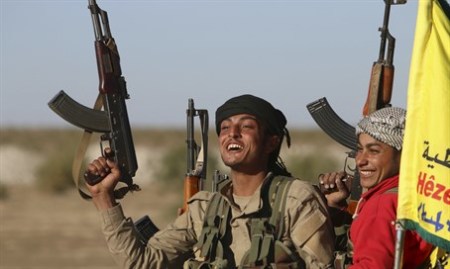
Kurds in SyriaKurdish fighters in Syria Reuters

In a leafy field in Syria, fighters in beige fatigues negotiate an obstacle course as they are trained to defend a Kurdish federal region across the country’s north.

Clutching rifles under a bright spring sun, the men are among thousands undergoing obligatory nine-month training to join the Autonomous Protection Forces.

The APF, its commander-in-chief Renas Roza says, will be responsible for defending the federal region declared last month at a Kurdish-led conference.

“This is the nucleus of a new army that will take up the defense of the federal region in northern Syria,” Roza tells AFP in his headquarters at Amuda near the border with Turkey.

The clean-shaven commander sits under a large poster bearing the APF logo – a long, curved sword crossed over a rifle below a red five-point star.

Roza says thousands of Kurdish, Arab and Syriac Christian men between the ages of 18 and 30 have completed the compulsory training.

For the first two months, conscripts are taught military structure and tactics, and then have lessons on human rights and interaction with civilians.

Three stages of training are led by the powerful People’s Protection Units (YPG), the military arm of the leading Kurdish Democratic Union Party (PYD).

Fadi Abdo Lahdo, a Syriac fighter training in the Bawr camp near Rmeilan, says his trainers are from the YPG’s commando force.

Dealing with civilians

“We’re learning how to cross over both cement barriers and natural barriers,” says the fair-haired fighter, squinting in the sunlight.

Other training sessions are administered by civic institutions.

“I served five months and I still have four months before I finish my service,” says Rinas Ahmad, an 18-year-old conscript with gelled hair.

“We were trained on military life and on how to deal with civilians so we don’t become like the Syrian (government) army,” Ahmad says.

Syria’s Kurds have both exploited and benefited from the chaos of the five-year-war to expand their control across northern parts of thecountry.

When the regime’s armed forces withdrew from Kurdish-majority areas in 2012, Kurds filled the void with a system of three “autonomous administrations.”

The three cantons, known from west to east as Afrin, Kobane and Jazire, already feature their own independent police forces, driving licenses and schools.

In March, a Kurdish-led summit in Rmeilan announced that it would establish a “federal region” uniting the cantons.

It elected a 31-member assembly tasked with laying the groundwork for the federal region by September.

The announcement was swiftly shot down by both the mainstream opposition and the regime, which categorically reject a federal system for Syria.

Rounding up recruits

In anti-government demonstrations across the country, some protesters burned the Kurdish flag to show their opposition to federalism.

Syria’s Kurds have continued their preparations nevertheless.

Training camps currently operate in the Afrin and Jazire cantons and will open soon in Kobane, Roza says.

The APF is also rounding up anyone who has yet to complete his nine-month service.

“We check people’s papers as they pass through checkpoints. If they have not done the training, we take them there,” an APF spokesman says.

An Arab APF trainee, who spoke on condition of anonymity, says he was detained at a Kurdish-run checkpoint as he drove to work.

Non-Kurdish residents living under the PYD-run cantons were already complaining about a six-month period of compulsory military service run by the YPG, but the new training period is three months longer.

As the federal region’s future army, APF units have begun deploying to areas recently captured from the Islamic State (ISIS) jihadist group.

Although they are not yet involved in front-line fighting, they are increasingly cooperating with the YPG and the Kurdish-Arab Syrian Democratic Forces.

The APF moves in to secure towns that the YPG or the SDF have seized from ISIS – such as Shadadi in Hasakeh province, which the SDF captured in February.

Kurdish forces have led the fight against ISIS since the jihadist group emerged in Syria in 2013, scoring several major victories in the recapture of key border towns, like Kobane, last year.

Russian-Turkish clash building up over Syria

February 14, 2016

Russian-Turkish clash building up over Syria, DEBKAfile, February 14, 2016

Turkish-self-propelled_howitzers_13.2.16

Turkish President Tayyip Erdogan clearly took a calculated risk when he ordered a two-our cross-border artillery bombardment Saturday, Feb. 13 of Syrian army forces positioned around the northern Syrian town of Azaz and the Kurdish YPG militia units which two days earlier took control of the former Syrian military air base of Minagh some six kilometers from the Turkish border.

Kurdish troops backed by the Russian air force seized that base last week from rebel militias as part of the operation for cutting the rebel groups under siege in Aleppo from their supply routes. The Turkish bombardment was therefore an indirect attack on the Russian forces backing pro-Assad forces against the rebels in the Syria war.

Erdogan knows that Moscow hasn’t finished settling accounts with Turkey for the shooting down of a Russian Su-24 on Nov. 24 and is spoiling for more punishment. After that incident, the Russians deployed top-of-line S-400 ground-to-air missile batteries and advanced Sukhoi Su-35 warplanes to their base in Latakia near the Turkish border. Ankara therefore limited its strike to a two-hour artillery bombardment from Turkish soil, reasoning that a Turkish warplane anywhere near the Syrian border would be shot down instantly.

Emboldened by the delay in the Russian response, the Turks took another step: Prime Minister Ahmet Davutoglu threatened the Kurdish YPG militia with more attacks if they failed to withdraw from the Menagh air base.

Although the Turkish prime minister had called on “allies and supporters” to back the operation against the Russian-backed  Syrian Kurds, Washington took the opposite line by urging Turkey, a fellow member of NATO, to desist from any further attacks.

Washington’s concern is obvious. An outright clash between Turkey and Russia would entitle Ankara to invoke the NATO charter and demand allied protection for a member state under attack.

The Obama administration would have had to spurn this appeal for three reasons:

1. To avoid getting mixed up in a military clash between two countries, just as the US kept its powder dry in the Russian-Ukraine confrontation after Moscow’s annexation of the Crimean Peninsula in February 2014.

2. To avoid upsetting the secret Obama-Putin deal on the allocation of spheres of influence in Syria: the Americans have taken the regions east of the Euphrates River, and the Russians, the west.

The Kurdish YPG militia forces near Aleppo and the city itself come under the Russian area of influence.

3. Regional tensions were tightened another notch Saturday by Russian comments: Russian Prime Minister Dmitry Medvedev said that his country and the West have “slid into a new Cold War period,” and Foreign Minister Sergei Lavrov said a third World War is actually underway -“I call this struggle a third World War by other means.,” he said.

Washington will avoid any action that risks further stoking this high state of international tension, but will act instead to de-escalate the cross-border Turkish-Russian confrontation over Syria.

All eyes are now on Moscow, Much depends on Russia’s response to the artillery bombardment of its Syrian and Kurdish allies. It is up to Putin to decide when and how to strike back – if at all.