Posted tagged ‘Kerry’

White House Pro-Iran ‘Propaganda Operation’ May Violate Law

May 17, 2016

White House’s Pro-Iran ‘Propaganda Operation’ May Violate U.S. Law Obama admin lambasted during investigation into Iran deal deception

BY:
May 17, 2016 2:15 pm

Source: White House Pro-Iran ‘Propaganda Operation’ May Violate Law

The Obama administration’s efforts to create a so-called “echo chamber” meant to mislead reporters and lawmakers about the substance of last summer’s comprehensive nuclear deal with Iran may have violated U.S. laws against the establishment of domestic propaganda outfits, according to testimony to Congress by a former Pentagon adviser.

Top U.S. officials, including Secretary of State John Kerry, may have fallen victim to a massive spin operation helmed by White House national security adviser Ben Rhodes, who has come under intense scrutiny following a magazine profile detailing his efforts to mislead the American public and prominent D.C. insiders about the Iran deal, according to testimony offered Tuesday before the House Oversight Committee.

The administration late Monday declined to make Rhodes available to testify to Congress about his press operation, which was run out of the White House by Rhodes and other top members of the National Security Council.

In lieu of Rhodes, the Oversight Committee invited three former U.S. officials to discuss the ways in which the pro-Iran effort intentionally misinformed Congress and negatively impacted American national security.

Michael Rubin, a former Pentagon adviser who testified, told the Washington Free Beacon following the hearing that Congress has grounds to launch an investigation into whether these efforts may have violated U.S. laws against the establishment of domestic propaganda campaigns targeting Americans.

“Rhodes essentially bragged about creating a propaganda operation,” Rubin told the Free Beacon. “It wasn’t simply about spin, rather, it was about denying facts he knew to be true, feeding outright lies into the mainstream press through sympathetic enablers and supposed independent experts on the Ploughshares trough whom he knew were anything but independent.”

“In effect,” Rubin explained, “he was running a propaganda operation against the American public and other officials. There are laws against that. Unfortunately, it seems that Kerry himself—a person whom even staffers have described as too credulous—got caught in that web.”

Questions remain about whether Kerry ever received impartial information from experts functioning outside of Rhodes’ so-called echo-chamber, Rubin said.

“In essence, did Rhodes—working from the National Security Council, a body that was always supposed to coordinate policy across agencies and not run a spin war room—craft propaganda that was fed to State Department leaders through unofficial channels by a network of experts who had financial incentive to amplify what he said?” Rubin asked.

Rubin further explained during his testimony how Rhodes may have deceived Kerry as part of the operation, a situation that raises questions about whether the secretary of state was negotiating with Iran from a sound position.

“Rhodes has placed the security of the U.S. and its allies at risk,” Rubin testified. “Certainly any dissemination of falsehoods to Congress and the American people warrants a broader investigation. National security and Congress’ credibility are at risk.”

Rubin expressed concern that “by creating an echo chamber and only talking to people in it, in effect, what Rhodes did was create a propaganda operation in which he entrapped none other than Secretary of State John Kerry. Did Secretary of State Kerry talk to people outside the echo chamber? If not, then he’s a victim of Ben Rhodes as well.”

Rep. Jason Chaffetz (R., Utah), the committee’s chairman, expressed frustration at the White House’s decision to bar Rhodes from testifying. Chaffetz has suggested that Rhodes could be subpoenaed to testify in the future.

“The White House on Thursday claimed that this wasn’t about exec privilege, then, less than 24 hours, before this hearing they reversed course,” Chaffetz said. “Now who’s being inconsistent?”

“You had plenty of times, Mr. Rhodes, to go out and talk to your media friend in the echo chamber” before showing up to testify, he said.

Michael Doran, a former senior director of the White House National Security Council under George W. Bush, said that the White House still has not publicly revealed the complete contents of the nuclear deal.

“In my view, the creation of the echo chamber and war room [by Rhodes] constitutes a deception of the American people,” Doran said at the hearing. “We do not actually know what is in the Iran deal. We still to this day do not know.”

The White House’s spin operation effectively created a false narrative about Iranian moderates rising to power in the Islamic Republic, according to Doran, who explained that this false narrative set the stage for negotiations to take place.

The deepening scandal surrounding the White House campaign prompted a call from leading senators on Monday for President Barack Obama to fire Rhodes, according to a letter sent to the White House and first reported by the Free Beacon.

The Glazov Gang-Michael Cutler Moment: Obama’s Pathway to the “Borderless World”

May 17, 2016

The Glazov Gang-Michael Cutler Moment: Obama’s Pathway to the “Borderless World” via YouTube, May 16, 2016

Iran’s Soft War Against America

May 17, 2016

Iran’s Soft War Against America, Gatestone InstituteLawrence A. Franklin, May 17, 2016

♦ Iran’s sophisticated employment of asymmetrical tactics such as “soft war” — which relies on the other side’s wishes, conscious or not, to be taken in — is apparently part of Tehran’s strategy to level the playing field against the U.S., despite America’s overwhelming military superiority.

♦ Iran is now being treated by most of the world as a normal nation-state rather than the revolutionary, terror-supporting, totalitarian regime that in reality it is.

Iran is waging a “soft war” offensive — media, social media, charm — against the United States. Tehran believes it is scoring significant victories in this war, and it clearly has, as can be seen by the so-called “Iran deal” — technically no “deal” at all: one side, Iran, got everything.

Iran’s sophisticated employment of asymmetrical tactics, such as “soft war” — which relies on the other side’s wishes, conscious or not, to be taken in — is apparently part of Tehran’s strategy to level the playing field against the U.S., despite America’s overwhelming military superiority.

Tehran seems to think, with justification, that it has successfully exploited the Obama administration’s uncorseted desire for better bilateral relations into granting Iran concessions that are not part of the original Joint Comprehensive Program of Action (JCPOA).

One of these concessions is granting Iran access to the U.S financial system; U.S. Secretary of State John Kerry spent last week trawling through Europe, imploring bankers to do business with Iran, despite that minor detail that America will not.

Another concession is the U.S. offer to buy Iran’s heavy water, a product of its planned plutonium bomb-making reactor in Arak.

Still another concession is the U.S. administration’s failure to increase sanctions on Iran for repeatedly launching potentially nuclear-capable ballistic missiles — in violation of UN Security Council Resolution 2231.

The Iranian regime may well attribute these American concessions to its employment of the “jang-e-narm” (soft war) tactic of “smile diplomacy”: the media-friendly demeanor of President Hassan Rouhani and Foreign Minister Mohammad Javad Zarif.

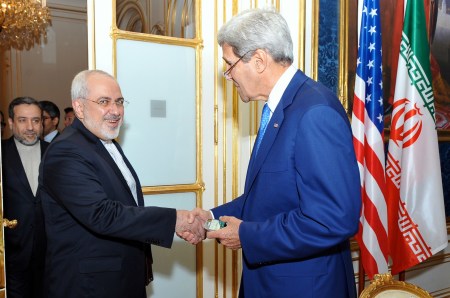
767 (1)The Iranian regime may well attribute recent American concessions to its employment of the soft war tactic of “smile diplomacy”: the media-friendly demeanor of President Hassan Rouhani and Foreign Minister Mohammad Javad Zarif. Pictured: U.S. Secretary of State John Kerry shakes hands with Iranian Foreign Minister Mohammad Javad Zarif during talks in Vienna, Austria, July 14, 2014. (Image source: U.S. State Department)

Not surprisingly, those are the same tactics that Iran is accusing Washington of using against Iran. Iran has been alleging that the U.S. has been waging soft war attacks against it, via Facebook, YouTube, and Twitter, supposedly — according to Iran — to develop sympathies within Iran’s elites for Western culture, policies, and ideals. Presumably the next concession is that the U.S. be quiet and let Iran keep expanding as far as it likes. The other day, Iran threatened to block the transport of oil by closing the Strait of Hormuz at the mouth of the Persian Gulf.

This is the problem: Iran is now being treated by most of the world as a normal nation-state rather than the revolutionary, terror-supporting, totalitarian regime that in reality it is.

Iran also is using this narrative of an American-led soft war against Iran to institute tighter controls on Iranian citizens. Iran recently dispatched Basij paramilitary teams to elementary schools to instill revolutionary Islamic values in the students. Iran has also established “Atlas,” a new, government-controlled press agency modeled upon Qatar’s Al-Jazeera network. Iranian authorities most likely hope that this news service will counteract any untoward thoughts of liberalization that the “Arab Spring” might have conjured up to question the regime’s “stability.”[1]Iran has also stepped up internet censorship as well as efforts by the government’s plainclothes police to sever contacts between Western NGO personnel and Iran’s civil society activists.

Evidence of how seriously Iran views the potential of America’s supposed soft war tactics was its establishing a National Data Center to filter messages coming into Iran from Western media, in addition to Tehran’s sponsorship of its first National Forum on Soft War, in the autumn of 2015.

Meanwhile, pursuing both its hard war and soft war offensives, Iran continues to trumpet its ability to produce new weapons systems, including novel and illegal ballistic missiles.

The regime also boasts about its acquisition of weapons from outside the country, such as Russia’s S-300 air defense system.

Not surprisingly, this soft war saber-rattling by Shi’ite Iran has been increasing the security concerns of its neighboring Sunni Arab States. These concerns, in turn, cause the Gulf countries and others to demand that their American ally demonstrate that it is serious about halting Iranian expansion in the region. Recent visits to the Sunni states by high-level American political leaders (President Obama), ranking diplomats (Secretary of State John Kerry), and senior military figures (Secretary of Defense Ashton Carter and Chairman of the Joint Chiefs of Staff General Dunford) have sought to allay these fears; it is still not clear with what.

Meanwhile, Iran’s aggressive involvement in Syria, Yemen, and Iraq is clearly creating the impression among Gulf states and others that regional leadership is passing from Sunni Saudi Arabia onto a toxic Shi’ite Iran.

US State Dept ‘Concerned’ Iran Contest is ‘Platform for Holocaust Denial, Anti-Semitic Speech’

May 15, 2016

Secy of State John Kerry apparently responded to PM Netanyahu’s call to denounce Iran’s Holocaust cartoon contest.

By: Hana Levi Julian

Published: May 15th, 2016

Source: The Jewish Press » » US State Dept ‘Concerned’ Iran Contest is ‘Platform for Holocaust Denial, Anti-Semitic Speech’

Iranian Holocaust cartoon contest in Tehran.
Photo Credit: courtesy Israel Prime Minister’s Office

U.S. Secretary of State John Kerry used his finest diplospeak Sunday to strongly urge Iran to cancel its Holocaust cartoon contest, even though it was highly unlikely Iran would cooperate.

The “suggestion” came in what appeared to be a prompt response to a personal request from Israel’s Prime Minister Benjamin Netanyahu, who called on U.S. Secretary of State John Kerry over the weekend to demand Iran cancel the Holocaust cartoon contest.

Netanyahu told reporters he had personally asked Kerry in a phone conversation Saturday night to condemn the Holocaust cartoon contest held over the weekend in Iran, the prime minister said Sunday.

“I think that every country in the world must stand up and fully condemn this,” Netanyahu said. “This is what I told US Secretary of State John Kerry last night in my conversation with him.”

Netanyahu posted photos of the contest registration being held in Tehran on Twitter with the tweet: Iran hosts Holocaust-denial cartoon contest while preparing another Holocaust. Shameful. Don’t stay quiet about it.”

Kerry was in Saudi Arabia on Sunday meeting with King Salman in talks on the conflicts in Syria, Libya and Yemen. He also met with the Saudi crown prince, deputy crown prince and foreign minister.

But Kerry was apparently also listening closely to the Israeli government’s outrage over Iran’s anti-Semitic Holocaust cartoon contest. He was also likely to have been considering the effect Iran’s actions – and America’s response – might have on the U.S. presidential election campaign, and/or the effect it could have on Israel’s increasingly close ties with Russia’s President Vladimir Putin.

Netanyahu is slated to fly to Moscow next month on an official state visit to mark the 25th anniversary of the restoration of diplomatic ties with Russia.

Shortly after Netanyahu called on Kerry to denounce Iran’s actions, the State Department released a statement expressing “concern” over the effect the contest might have, and denouncing Holocaust denial in general.

“We are concerned that this contest in Iran could be used as a platform for Holocaust denial and revisionism and egregiously anti-Semitic speech, as it has in the past,” said the statement, tweeted by AP journalist Matt Lee.

“Such offensive speech should be condemned by the authorities and civil society leaders rather than encouraged. We denounce any Holocaust denial and trivialization as inflammatory and abhorrent. It is insulting to the memory of the millions of people who died in the Holocaust,” the statement said.

Obama, the Iran Scam, Ben Rhodes and Public Credulity

May 8, 2016

(The views expressed in this article are mine and do not necessarily reflect those of Warsclerotic or any of its other editors. — DM)

A recent article by David Samuels at the New York Times Magazine, based on an interview with Obama’s foreign policy guru Ben Rhodes, purported to explain how, and about what, the Obama administration lied to get public support for the Iran Scam. According to the article, the principal Obama lie involved who was the Iranian president when the negotiations with Iran began. It’s much deeper and worse than that. As Paul Harvey would say, “Here’s “the rest of the story.” 

Iranian President Rouhani was elected on June 15, 2013 and assumed office on August 3d. According to Rhodes,

negotiations started when the ostensibly moderate Hassan Rouhani was elected president, providing an opening for the administration to reach out in friendship. In reality, as Samuels gets administration officials to admit, negotiations began when “hardliner” Mahmoud Ahmadinejad was still president. [Emphasis added.]

There is no necessary inconsistency — about a month and a half elapsed between Rouhani’s election and becoming the Iranian president. However, that is of little if any consequences.

Mr. Rosen, interviewed in the above video, touches, very briefly, on other problems with the Iran scam. Back in the world of reality, “we” had been negotiating with Iran during Ahmadinejad’s presidency for a couple of years, during which “we” gave Iran everything it requested. This article is intended to provide substantially more information and analysis of what happened and why during “our” secret bilateral negotiations with Iran.

The Negotiations

According to interviews with Iranian vice president and Atomic Energy Organization head Ali Akbar Salehi, translated and published by the Middle East Media Research Institute (MEMRI) on August 17, 2015, secret bilateral negotiations between the Obama and Iranian regimes had begun much earlier and included Obama’s Assistant Secretary of State, William Burns. During those negotiations, the U.S. conceded that Iran’s right to Uranium enrichment would be respected, that Iran’s missile programs would be left out of any deal and that its efforts to develop nuclear warheads and other devices would be ignored. Obama had essentially caved in to Iran’s demands even before the existence of negotiations was acknowledged.

In an interview published in the daily Iran on August 4, 2015 under the title “The Black Box of the Secret Negotiations between Iran and America,” Iranian vice president and Atomic Energy Organization head Ali Akbar Salehi, who is a senior member of Iran’s negotiation team and was foreign minister under president Ahmadinejad, revealed new details on the secret bilateral talks between Iran and the U.S. that started during Ahmadinejad’s second presidential term. According to Salehi, U.S. Secretary of Energy Dr. Ernest Moniz, whom Salehi knew from his period as a doctoral student at MIT, was appointed to the American negotiation team at Salehi’s request, a request which the Americans met within hours. [Emphasis added.]

Salehi added that Khamenei agreed to open a direct channel of negotiations between Iran and the U.S. on the condition that the talks would yield results from the start and would not deal with any other issue, especially not with U.S.-Iran relations. Following this, Salehi demanded, via the Omani mediator Sultan Qaboos, that the U.S. recognize Iran’s right to enrich uranium, and received a letter from Qaboos expressing such American recognition, which he relayed to Ahmadinejad.  [Emphasis added.]

The secret bilateral Iran-US negotiations had begun with a letter for Iran delivered to an Omani official. Salehi told an Omani intermediary.

‘I am not sure how serious the Americans are, but I will give you a note. Tell them that these are our demands. Deliver it on your next visit to Oman.’ I wrote down four clear issues, one of which was official recognition of rights to [uranium] enrichment. I figured that if the Americans were sincere in their offer, then they must agree to these four demands. Mr. Suri gave this short letter to the mediator, and stressed that these were Iran’s demands. [He added that]if the Americans wished to solve this issue, they were welcome to, otherwise dealing with White House proposals would be useless and unwarranted…

“All the demands in the letter were related to the nuclear challenge. These were issues we have always come against, such as closing the nuclear dossier [in the Security Council], official recognition of [Iran’s] right to enrich [uranium], and resolving the issue of Iran’s actions under the PMD [Possible Military Dimensions]. After receiving the letter, the Americans said: ‘We are certainly willing and able to easily solve the issues Iran has brought up.’ [Emphasis added.]

The first meeting between the Iranian and American negotiating teams began following eight months of coordination. Iran

sent a team to Oman that included the deputy foreign minister for European and American affairs, Mr. [Ali Asghar] Khaji, as well as several CEOs. The Americans were surprised in the first meeting and said, ‘We cannot believe this is happening. We thought Oman was joking. We aren’t even prepared for these talks with you.’

Q: What was the level of the team that the Americans dispatched?

A: It included Assistant Secretary of State William Burns. They said: ‘We only came to see if Iran was truly willing to negotiate.’ Our representative gave them the required response and eventually there were talks on this issue. The initial result was achieved and the ground was prepared for further coordination. [Emphasis added.]

Q: How were the Americans convinced that the Iranian diplomats who were dispatched had the necessary authority?

A: [Until] that phase, Iran and America had not been allowed to sit opposite each other at the negotiating table. The fact that Iran had sent a deputy foreign minister to the talks indicated its seriousness. The Americans also noticed how seriously [Iran was taking] the issue. At that meeting, Khaji pressed the Americans to set up a roadmap for the negotiations, and eventually the talks of a roadmap were postponed to the second meeting. At the second meeting, Khaji warned the Americans: ‘We did not come here for lengthy negotiations. If you are serious, you must officially recognize enrichment, otherwise we cannot enter into bilateral talks. But if you officially recognize enrichment, then we too are serious and willing to meet your concerns on the nuclear matter as part of international regulations.

International regulations were later agreed upon by the P5+1 negotiators, in the form of the Iran – IAEA secret deals concerning nuke inspections and a UN resolution dealing with Iranian missiles. Neither was included in the Joint Cooperative Plan of Action.

“Of course, at that time we were [still] exchanging various information with the Americans via the [Omani] mediation, and this is documented at the Foreign Ministry. We did not do it in the form of official letters, but rather unofficially and not on paper. The Omani mediator later came to Iran, held talks with us, and then later spoke to the Americans and told them our positions, so that the ties were not severed. But there was no possibility for direct talks.

Thus, a real opportunity was squandered because, at the time, the Americans were genuinely prepared to make real concessions to Iran. Perhaps it was God’s will that the process progressed like that and the results were [eventually] in our favor. In any case, several months passed and Obama was reelected in America [in November 2012]. I thought that, unlike the first time, we must not waste time in coordinating [within regime bodies], so with the leader’s backing and according to my personal decision, I dispatched our representatives to negotiate with the Americans in Oman. [Emphasis added.]

Q: Didn’t you have another meeting with the leader about the process and content of the talks?

A: No. Obviously during the process I wrote a letter to the leader detailing the problems. He said ‘try to solve them.’ He was always supportive but told me to ‘act in a manner that includes necessary coordination [within the regime]. In this situation, I dispatched Khaji to the second meeting in Oman (around March 2013) and it was a positive meeting. Both sides stayed in Oman for two or three days and the result was that the Omani ruler sent a letter to Ahmadinejad saying that the American representative had announced official recognition of Iran’s enrichment rights. Sultan Qaboos sent the same letter to the American president. When Ahmadinejad received the letter, several friends said that this move would be fruitless and that the Americans do not keep [their]  commitments. [But] we had advanced to this stage. [Emphasis added.]

. . . . We [then ] prepared ourselves for the third meeting with the Americans in order to set up the roadmap and detail the mutual commitments. All this happened while Iran was nearing the presidential elections [in June 2013]. At that time, the leader’s office told me that I had to cease negotiations and let the next government handle the talks after the results of the elections were known.

. . . .

Q: What was the Americans’ position in the first meetings between Iran and the P5+1 held during the Rohani government [era]?

A:After the Rohani government began to operate – along with the second term of President Obama – the new negotiations between Iran and the P5+1 were started. By then, Kerry was no longer an American senator but had been appointed secretary of state. As a senator, Kerry had been appointed by Obama to be in charge of handling the nuclear dossier, and then [in December 2012] he was appointed secretary of state. [Emphasis added.]

“Before that, the Omani mediator, who had close relations with Kerry, told us that Kerry would soon be appointed [U.S.] secretary of state. During the period when the secret negotiations with the Americans were underway in Oman, there was a situation in which it was easier to obtain concessions from the Americans. After the Rohani government and the American administration [of Obama’s second term] took power, and Kerry become secretary of state, the Americans spoke from a more assertive position. They no longer showed the same degree of eagerness to advance the negotiations. Their position became harder, and the threshold of their demands rose. At the same time, on the Iranian side, the situation [also] changed, and a most professional negotiating team took responsibility for negotiating with the P5+1. [Emphasis added.]

As to the reluctance of the American side to make concessions after Kerry had replaced Clinton as the Secretary of State, it must be remembered that “we” had already made all or most of the concessions Iran sought.

Another positive point was that [President] Rohani oversaw the dossier, knew its limits, and as a result succeeded in producing a good strategy to advance the nuclear dossier. At the same time, Rohani took responsibility for everything. Many may have reservations and ask why we were putting ourselves in danger, but Rohani’s willingness to take responsibility was very high. There are those who say, from a political standpoint, that he was willing to take a very great risk, because, had the negotiations not achieved certain results, and had the best results not been achieved, he would have faced waves of criticism. But he took upon himself the risk of [such] criticism. In any event, he agreed to take this responsibility, and, God be praised, even God helped him, and he emerged [from the negotiations] with his head held high.” [Emphasis added.]

At some point, the negotiations broke down over “technical issues.” Salehi, a technical expert as well as a diplomat, found a way to resolve those issues.

A . . .  condition was that American experts would come to Iran and talk to me. I said that as vice president I would not enter into a discussion with their experts, because as far as the protocol was concerned, this would create a bad situation and they would say that Iran would capitulate in any situation. This was not good for Iran, but I was willing to quit and to come to the talks not as vice president but as the foreign minister’s scientific advisor. Larijani said ‘he’s right.’ The next day, Fereydoun asked me to come to his office and asked me who my [American] counterpart was. I said, the [U.S.] Department of Energy. Fereydoun called Araghchi and said, ‘Tell [U.S. Under Secretary of State for Political Affairs] Ms. [Wendy] Sherman that Salehi is joining the negotiations provided that the American secretary of energy also joins the negotiators.‘ Araghchi and Sherman were the liaison between Iran and America. Araghchi said in this conversation with Fereydoun that on such short notice it was unlikely that they [i.e. the Americans] would send their secretary of energy. I heard [Fereydoun’s conversation with Araghchi]. In short, Fereydoun asked and Araghchi contacted Sherman and a few hours later a report that they welcomed Iran’s proposal arrived. [Emphasis added.]

Q: How many hours did it take before they [the Americans] said yes?

A: It didn’t take long. I went to see Fereydoun in the evening and the next day they responded. This was because of the time difference [between Tehran and Washington].

Q: The general perception was that because Moniz was brought into the negotiating team, you were brought into the Iranian team?

A: [On the contrary,] Moniz came because of me. In any case, in February [2015] I joined [the negotiations], and praise God, matters moved forward with Moniz.

Q: Did you and Moniz study together?

A: Moniz knew me more than I knew him. I saw him at the annual IAEA meeting. When I was a doctoral student at MIT, he had just been accepted as a staff member. He is five years older than me.

Q: Did you take one of his classes?

A: No. He knew me because my doctoral studies advisor was his close friend and right hand man in scientific fields. Even now he is an advisor on many of Moniz’s scientific programs. Many of my fellow students are now experts for Moniz. One of them was Mujid Kazimi, who is of Palestinian origin. He recently died. He was two years older than me but we were friends in college. After graduating, he became the head of the MIT Department of Nuclear Science and was a prominent figure who carried out many programs with Moniz.

Q: How did Moniz treat you initially?

A: In light of our prior acquaintance, he was excited. We’ve known each other for years and he treated [me] very well. Our first meeting was in public.

Q: How did you feel when you heard Moniz was coming [to the talks]?

A: I was very happy. I was assured. I said that the prestige of the Islamic Republic remained intact [because] an Iranian official would not speak to an American expert but rather would negotiate with a high-ranking American official. This was very important. Second, as I said before, he could make a decision [while] an expert could not. We had a very interesting group meeting. The American experts were same ones who had dealt with disarmament vis-à-vis the Soviet Union.

“I said [to Moniz]: ‘I cannot accept your offer for various reasons.’ One American expert said, ‘We do not accept the basic assumption of your calculations.’ I said, ‘Tell us what is the basic assumption of [your] calculations so we can work from there.’ He said ‘we can’t do that.’ I said to them, ‘If you don’t accept our estimation, then tell us [yours]. You say that you cannot because this [exposes] your process. If we show [our] calculation, you will know our working secrets.’ So then I said ‘ok, what do we do now?’ The meeting stagnated.

“Later I thought about it… and said ‘Mr. Moniz, I am here with full authority from my country. Anything I sign will be acceptable to my country. Do you have full authority as well, or does any result achieved here need to be asked and clarified with officials from other countries?’ He said ‘no, I have full authority.’

Q: Did you have full authority?

A: Yes. In the scientific discussions, I knew the level of [Iran’s] demands. I said, ‘Mr. Moniz, you made an offer to Iran, and Iran rejects it. I want to ask you a question. If you can answer it [then] I will have no problem with your offer.’ I continued and said: ‘Show me one place on earth where enrichment is taking place using the method you are demanding of us. If you can give me even a single example then I will sign on the spot and we will become the second country to enrich in this method.’ He looked [at me] and then announced that the meeting was over, and we spoke. We had the first private meeting that lasted two or three hours. He said: ‘Mr. Salehi, when I was called [out of the negotiating room, it was because] Obama wanted to speak to me. Now I am free [to continue]. What you said is acceptable [but] there are practical problems with your offer.’ I said, ‘Do you agree? Then I relinquish that proposal.’ Eventually. we reached mutual understandings on this issue. I said ‘let’s start from the top.’ This diplomatic challenge should be published in a memoir so that everyone can understand how we reached 6,000 centrifuges. It is a very nice story… [Emphasis added.]

The Aftermath

Ultimately, Iran’s right to enrich Uranium was fully recognized in the Joint Plan of Action (JPOA) and in the subsequent Joint Cooperative Plan of Action (JCPOA). As to the missile aspects of the  “possible military dimensions” of Iran’s nuclear program, neither document dealt with Iranian missiles. That was left up to the United Nations Security Council to deal with in its resolution approving the nuke “deal.” In light of Russia’s warm relations with Iran, Russia would most likely veto any proposed Security Council resolution finding Iran in violation of its missile provisions.

The “verification” mechanism was included only in separate and secret “side deal(s)” solely between Iran and the IAEA which members of the U.S. Congress were not permitted to see during the pseudo-approval process. According to Kerry, he was not permitted to see them either, but the details were “fully explained” to him.

Here’s a video of Secretary Kerry under questioning about the side deals:

Questions might have been better directed to this Kerry clone; more candid answers might have been provided.

As I wrote earlier, the Iranian nuke inspections are a sick joke.

Any pretense that the IAEA will have “any time, anywhere” access to Iran’s military sites was mere rhetoric, as acknowledged by US Under Secretary of State Wendy Sherman on July 16th

“I think this is one of those circumstances where we have all been rhetorical from time to time,” Sherman said in a conference call with Israeli diplomatic reporters. “That phrase, anytime, anywhere, is something that became popular rhetoric, but I think people understood that if the IAEA felt it had to have access, and had a justification for that access, that it would be guaranteed, and that is what happened.” [Emphasis added.]

Ms. Sherman was right about the rhetorical nature of administration assertions, but wrong about IAEA access, of which there will apparently be little or none pursuant to the secret deals between Iran and the IAEA.

As I observed on August 4, 2015,

In an interview on Al Jazeera TV last week Ali Akbar Velayati, Security Adviser to Iran’s Supreme Leader, stated that

United Nations nuclear inspectors from the International Atomic Energy Agency would not be given access to Tehran’s sensitive military nuclear sites.

. . . .

“First, allow me to emphasize that the issue of the missiles and of Iran’s defensive capabilities were not part of the negotiations to begin with,” Velayati said. [Emphasis added.]

“No matter what pressure is exerted, Iran never has negotiated and never will negotiate with others – America, Europe, or any other country – about the nature and quality of missiles it should manufacture or possess, or about the defensive military equipment that it needs. This is out of the question.” [Emphasis added.]

. . . .

Reza Najafi, Iran’s ambassador and permanent envoy to the IAEA, stated over the weekend that “no country is permitted to know the details of future inspections conducted by the IAEA.” [Emphasis added.]

Najafi’s statement could mean (a) that no details about inspection methodology will be disclosed, (b) that no details about inspection results will be disclosed or (c) both. If inspection methodologies — who did the inspections as well as when, where and how, are not disclosed, what useful purpose will they serve, other than for Iran? If details of the results of inspections are not disclosed, that will also be the case. How, in either or both cases, will the members of the P5+1 negotiating teams have sufficient information to decide whether to “snap back” sanctions — if doing so is now even possible — or anything else? [Emphasis added.]

Conclusions

One can only hope that our next president will dispose of the Iranian “deal” as a treaty which Obama refused to submit to the Congress as the Constitution requires or at least ostentatiously ignore it and grant no more concessions.

Otherwise, be not afraid; Obama the Great One — the smartest person in any room and the best President ever — has made us safe. How can one possibly be safer alive than dead?

Washington Says Not Opposed to Foreign Banks’ Trade with Tehran

April 23, 2016

Washington Says Not Opposed to Foreign Banks’ Trade with Tehran, Tasnim News Agency, April 23, 2016

Iran and banks

On Thursday, US State Department Spokesman John Kirby said Washington had scrambled expert teams, “akin to a roadshow,” to assure world bankers that they can do trade with Iran.

“We certainly are not trying to become an obstacle in any way of foreign banks and institutions working with Iran through the sanctions relief process,” Kirby said.

************************

US Secretary of State John Kerry said Washington is not against foreign banks’ investment and presence in Iran following the removal of anti-Tehran sanctions, stressing that the banks are free to do business with the Islamic Republic.

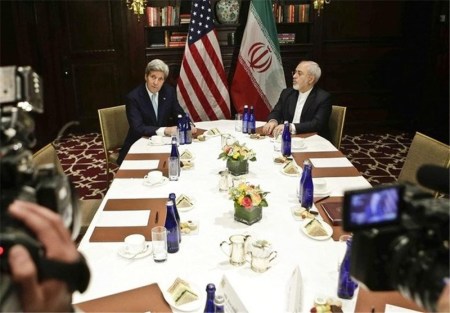
“The United States is not standing in the way and will not stand in the way of business that is permitted with Iran since the (nuclear deal) took effect,” Kerry told reporters on Friday, sitting alongside Iranian Foreign Minister Mohammad Javad Zarif in a New York hotel, AFP reported.

“I want to emphasize we’ve lifted our nuclear-related sanctions as we committed to do. And there are now opportunities for foreign banks to do business with Iran,” he further said.

The Iranian foreign minister, for his part, said Iran “has implemented its part of the bargain.”

“We hope that the statement made today by Secretary Kerry will begin to open the difficult path that had been closed because of concerns that banks had about the US approach toward implementation of the commitments under the JCPOA (Joint Comprehensive Plan of Action, the nuclear agreement). We see serious implementation of all the JCPOA benefits that Iran should derive from this agreement,” he added.

Zarif also emphasized that serious differences still remain between Tehran and Washington.

On Thursday, US State Department Spokesman John Kirby said Washington had scrambled expert teams, “akin to a roadshow,” to assure world bankers that they can do trade with Iran.

“We certainly are not trying to become an obstacle in any way of foreign banks and institutions working with Iran through the sanctions relief process,” Kirby said.

While the JCPOA, the 159-page nuclear agreement between Iran and the Group 5+1 (Russia, China, the US, Britain, France and Germany) came into force in January, some Iranian officials have complained about the US failure to fully implement the accord.

Last month, Leader of the Islamic Revolution Ayatollah Seyed Ali Khamenei said Americans have yet to fulfill what they were supposed to do as per the nuclear deal.

Iran still has problems in its banking transactions or in restoring its frozen assets, because Western countries and those involved in such processes are afraid of Americans, Imam Khamenei said, criticizing the US for its moves to prevent Iran from taking advantage of the sanctions removal.

Arab Press Reports On U.S.-Russia Understandings Allowing Assad To Remain In Power In Syria During Transitional Phase

April 22, 2016

Arab Press Reports On U.S.-Russia Understandings Allowing Assad To Remain In Power In Syria During Transitional Phase, MEMRI, N. Mozes*, April 22, 2016

(The analysis does not mention the Arab press’ reaction to the Putin – Obama agreement to turn Golan over to Syria. — DM)

According to many reports in the Arab press in recent days, alongside the indirect talks in Geneva between the Syrian regime and opposition that are being mediated by UN Special Envoy Staffan de Mistura, the U.S. and Russia have been conducting separate secret talks to draw up understandings on resolving the crisis. The reports state that the U.S. is inclined to accept the position of the Syrian regime and its Russian ally, namely, that the idea of a transitional governing body should be abandoned in favor of a joint regime-opposition body, and that the Syrian regime should remain in the hands of President Bashar Al-Assad, at least in the transitional phase.

Concurrently, during his talks with the regime and opposition delegations, de Mistura presented an idea that he claims he did not initiate, which involves Assad remaining as a figurehead president and appointing deputies to whom he would delegate his political and military authority. It is hard to imagine that the U.S. and Russia were unaware of this proposal, which is in line with what has been reported on their own understandings regarding Assad’s remaining president during the transitional period. These reports, if true, show that the U.S. has backed down even further from its position vis-à-vis Assad and the Syrian opposition, and that it is disregarding the clause in the 2012 Geneva I communique calling for the establishment of a transitional body with full authority.

Arab press reports on these U.S.-Russia efforts increased greatly after Secretary of State John Kerry’s March 24, 2016 meetings with Russian Foreign Minister Sergey Lavrov and President Vladimir Putin. Following the meetings, Kerry said that both sides had agreed to step up their efforts to achieve a political transition in Syria and had agreed on a timetable and that a draft constitution would be submitted in August 2016.[1] On April 8, Kerry confirmed reports that the U.S. was further backing down from its previous position when he told the Saudi Al-Arabiya TV channel that while Assad can no longer lead his country in light of the many crimes he had committed, he would still be present at the start of the transitional phase. He added that if Assad would facilitate this phase, then a safe exit for him could be discussed.[2]

According to the Arab reports, the U.S.-Russia understandings would be imposed on the parties involved, as with the February 12, 2016 agreement on cessation of hostilities. In another similarity to that agreement, the Assad regime will be the main one to benefit.

This paper will review the reports on U.S.-Russia understandings on the Syrian crisis:

27751U.S. Secretary of State John Kerry and Russian Foreign Minister Lavrov (image: Orient-news.net, April 17, 2016)

Anti-Assad Media: American-Russian Deal Includes Assad Remaining In Power

On April 16, 2016, three days after the start of the third round of indirect talks in Geneva between the Syrian regime and opposition under the mediation of UN Special Envoy Staffan de Mistura, the London-based Saudi daily Al-Sharq Al-Awsat reported that Western diplomats “are warning that there will be a U.S.-Russia deal on Syria before the summer.” According to the report, it is the Americans who are pressuring the Russians to arrive at understandings that are to be “very close to the Russia proposal regarding the nature of the transitional phase, the regime, the constitution, and the elections.” The diplomats cited in the report said that the U.S. is trusting Moscow to find a solution for the Syrian crisis while ignoring Western and regional elements.[3]

The following day, the newspaper reported that the U.S. and Russia were discussing not only “regime leader Bashar Al-Assad’s remaining in power during the transitional phase, but also the central role he would play in it, including in drafting a constitution and in the elections set for 18 months after the start of negotiations between the sides.”[4] In a later report, the paper cited Western sources who warned against recycling “the Yemen model” under which Yemen president ‘Ali ‘Abdallah Saleh had officially been removed but had in effect remained in control of the armed forces and in possession of many political cards.[5]

On April 17, the London-based Saudi daily Al-Hayat also reported on the U.S.-Russia talks. According to the daily, Robert Malley, the White House Coordinator for the Middle East and chief advisor to President Obama on Syria, and Putin’s Syria envoy Alexander Lavrentiev were holding intensive talks behind the scenes with the aim of drawing up “constitutional and political principles” based on a “political partnership” between the regime and the opposition, “in accordance with an improved Lebanese model.”[6] Under this proposal, the regime and opposition would share executive, military, security, legal, and constitutional authority. The newspaper also stated that Obama would present these understandings during his visit to the Gulf states on April 21, and that the Russians would present them to Qassem Soleimani, commander of the Qods Force of Iran’s Islamic Revolutionary Guard Corps (IRGC), who recently visited Moscow. The understandings would then be brought before Syrian regime representatives, and a “select list” of oppositionists who agree to a political solution.[7]

On April 18, 2016, the London-based daily Al-Arabi Al-Jadid reported that in light of the Geneva talks’ failure so far to bring the sides closer together, representatives of presidents Obama and Putin are working in Geneva to formulate an alternative plan in the event that the negotiations fail; this plan would be imposed on the sides via a UN Security Council resolution, under Chapter VII of the United Nations Charter. Two main proposals to resolve the crisis were presented at these U.S.-Russia Talks: The first is based on the principle of a “political partnership” among all elements of Syrian society, which would be more comprehensive than the 1989 Taif Agreement and would include leaving Assad in power, because he controls the main power base in Syria. The second proposal includes the establishment of a transitional council comprising eight technocrats; this council would lead the transitional phase.[8]

Russian Foreign Minister Lavrov denied the reports about secret U.S.-Russia talks, stressing that they were “routine consultations.”[9] However, during the regime-opposition Geneva talks, de Mistura brought the delegations a proposal “from an expert” that also involved Assad’s remaining in power, at least temporarily. Under this proposal, he would continue to serve as president and would appoint three deputies to whom he would delegate his political and military authority and who would manage the country during the transitional phase.[10] It is hard to imagine that the U.S. and Russia, who sponsor the Geneva talks, were unaware of this proposal, which is in line with what has been reported on their own understandings regarding Assad’s remaining president during the transitional period.

As noted, these reports come in addition to similar reports in the Arab press following Kerry’s March 24 visit to Moscow that focused on a U.S.-Russia convergence on the issue of the Syrian crisis. Thus, the London-based Qatari daily Al-Quds Al-Arabi reported on March 29, 2016 that the U.S. and Russia had drawn up the general details of a three-point plan that includes general parliamentary elections under UN auspices, a new constitution, and creation of a presidential election mechanism allowing Assad to run “even though the U.S. would prefer that Russia persuade him not to do so.” The report also added that the president’s authority would be downgraded.[11]  Al-Hayat reported on March 31 that Kerry had informed Arab countries that the U.S. and Russia had arrived at understandings that included Assad’s exit to another country, but not a timetable for it.[12]

On April 11, 2016, a Syrian oppositionist website reported that Russia had prepared an alternative plan in case the Geneva talks failed; it dictated the establishment of a military council comprising both regime and opposition elements; this council would rule the country and prepare for parliamentary and presidential elections. Under this plan, there would be no transitional phase and no interim ruling body, as neither are compatible with the current Syrian constitution. Russia reportedly presented this plan to Kerry during the latter’s Moscow visit, and Kerry assured his hosts that the U.S. would not oppose it but that Russia would have to persuade the opposition to accept it.[13]

Kerry: Assad Should Remain For Start Of Transitional Phase

The American administration’s statements on resolving the Syrian crisis are rife with internal contradictions. For example, officials repeatedly state that Assad is illegitimate because of his crimes against his people, and that he cannot unite Syria, but at the same time Kerry said that Russia and the U.S. have agreed that he should remain for the start of the transitional phase. This effectively confirms reports that the American position is moving closer to the Russian one, and that the former no longer objects to Assad’s remaining in power during the transitional phase.

In an April 8, 2016 interview, Kerry told the Saudi Al-Arabiya TV: “During the transitional phase, Assad will remain in power in accordance with the Geneva [I] communique, since this communique required joint [regime and opposition] consensus regarding the phase. This means that both Assad and the opposition must join this consensus… The U.S. and Russia have reached an agreement that was reached also with many other countries, that is, there is no escaping a transitional phase followed by a united, secular, and non-sectarian Syria… Likewise, we agreed that Assad should be present at the start of the transitional phase…

“The Russians have made it clear that Assad has assured them that he will participate in the transitional phase and support the drafting of a new constitution and the holding of presidential elections. If he does not meet his commitments, I do not believe the Russians will continue to support him.”

In response to the question of whether Assad would be allowed safe passage out of Syria if he agreed to step down, Kerry responded: “… If Assad is willing to be a constructive factor in the efforts to make peace in Syria, this safe passage would receive significant attention, and the sides should seriously consider this effort and enable Assad to live safely, which is what I wish for him…”[14]

On April 16, a Syrian opposition website also reported that the U.S. had agreed to postpone the debate on Assad’s fate, and stated that Kerry, on his April 7 visit to Bahrain, had told the Gulf Cooperation Council foreign ministers that Assad’s withdrawal from power should not be discussed at this time.[15]

U.S.-Russia Military Coordination

Although U.S. administration officials reject the prospect of military coordination with Russia and the Syrian regime against the Islamic State (ISIS), there are indications of U.S.-Russia coordination regarding military activity in Syrian territory. Thus, the Syrian Democratic Forces – an umbrella organization of Kurdish and Sunni Arab forces fighting ISIS, Jabhat Al-Nusra, and Islamist opposition factions – received aerial support from both the U.S.-led international coalition and the Russian air force during its takeover of the city of Al-Shaddadi in southern Al-Hasakah in northwest Syria.[16] On March 24, the Pentagon reported that international coalition jets had bombed an ISIS post near Tadmur.[17]  A Syrian oppositionist website reported that this attack was carried out as regime forces, backed by the Russian air force, reached the outskirts of the city.[18]

The Syrian Opposition Fears That The U.S. Will Back Down Still More From Its Original Position

The Syrian opposition, represented by the High Negotiations Committee (HNC) that was established in Riyadh, expressed grave concern at the reports of an imminent U.S.-Russia deal enabling Assad to remain in power, and displeasure at the U.S. for not updating it on the details of such a deal. [19] On April 2, 2016, HNC general coordinator Riyad Hijab said: “It is clear that the U.S. has agreed with Russia on vague matters of whose nature we are not being informed… We do not fear rapprochement between the U.S and Russia, but rather the vagueness and opaqueness of these relations.”[20] Basma Qadmani, a member of the HNC delegation to the Geneva talks, stressed: “The American ambiguousness is disturbing to the Syrian opposition… We do not know what the U.S. discussed with Moscow. There are all sorts of rumors, and we are waiting for the U.S. to confirm that it still opposes leaving Assad in power.”[21]

In light of this ambiguity, HNC officials stressed that the purpose of the current Geneva talks was to establish a transitional governing body with full authority in accordance with the Geneva I communique, which they interpret as including Assad’s departure and a replacement of the existing regime.

* N. Mozes is a research fellow at MEMRI.

Endnotes:

[1] Nytimes.com, March 24, 2016.

[2] Alarabiya.net, April 8, 2016.

[3] Al-Sharq Al-Awsat (London), April 16, 2016.

[4] Al-Sharq Al-Awsat (London), April 17, 2016.

[5] Al-Sharq Al-Awsat (London), April 18, 2016.

[6] A reference to the 1989 Taif Agreement that ended the Lebanese civil war and distributed political, civil, and military authority in the country along sectarian lines. Past reports indicated an intention to implement the Lebanese model in Syria as well.

[7] Al-Hayat (London), April 17, 2016.

[8] Al-Arabi Al-Jadid (London), April 18, 2016.

[9] Sputniknews.com, April 18, 2016.

[10] Webtv.un.org, April 18, 2016.

[11] Al-Quds Al-Arabi (London), March 29, 2016.

[12] Al-Hayat (London), March 31, 2016.

[13] Orient-news.net, April 11, 2016.

[14] Alarabiya.net, April 8, 2016.

[15] Alsouria.net, April 16, 2016.

[16] Orient-news.net, February 19, February 20, 2016.

[17] Defense.gov, March 24, 2016.

[18] Zamanalwsl.net, March 24, 2016.

[19] See MEMRI Special Dispatch No. 6280, Syrian Opposition On Eve Of Geneva Talks: U.S. Made ‘A Scary Retreat’ From Its Former Position, January 27, 2016.

[20] Etilaf.org, April 2, 2016.

[21] Orient-news.net, April 3, 2016.
Palestinians: When in Doubt, Try Intimidation

April 22, 2016

Palestinians: When in Doubt, Try Intimidation, Gatestone InstituteKhaled Abu Toameh, April 22, 2016

♦ The Palestinians argue that security cameras on the Temple Mount would be used by Israel to identify and arrest Muslim worshippers who protest against visits by Jews. What they seem to have forgotten is that these “protesters” regularly harass Jewish groups and individuals touring the Temple Mount.

♦ While Mahmoud Abbas claimed he was in favor of the plan to install the security cameras, his Islamic clerics and Palestinian Authority (PA) officials continued to incite against the plan

♦ The straw that broke the Jordanian back was a leaflet that was distributed at the Temple Mount during Friday prayers two weeks ago. The leaflet urged Muslims to smash any cameras installed at the holy site

♦ In one blow, Palestinians have managed to undermine Jordan’s historic role as “custodian” of the holy sites in Jerusalem and humiliate King Abdullah, who was the mastermind of the camera plan.

Succumbing to Palestinian intimidation, Jordan has dropped its plan to install surveillance cameras at the Haram Al-Sharif (Noble Sanctuary), or Temple Mount.

The cancellation of the plan is seen as a severe blow not only to Jordan, but also to U.S. Secretary of State John Kerry, who, in October 2015, brokered the agreement to install the cameras at the site.

Kerry announced then that Jordan and Israel had agreed to round-the-clock video surveillance, with the goal of reducing tensions at the Temple Mount.

Since then, however, the Palestinians, who have unleashed a wave of violent attacks on Israel in a purported response to Israeli “provocations” at the Temple Mount, have been campaigning against the plan to install the security cameras there. This week, it turned out that this campaign of intimidation was not in vain.

The Palestinians argue that the cameras would be used by Israel to identify and arrest Muslim worshippers who protest against visits by Jews to the Temple Mount. What they seem to have forgotten is that these “protesters” regularly harass Jewish groups and individuals touring the Temple Mount. The “protesters” are known as murabitoun (the Steadfast) and their main mission is to stop Jews from touring the Temple Mount. Some are affiliated with the Palestinian Authority (PA), while others are on the payroll of the Islamic Movement in Israel.

How Kerry will respond to this spit in the face remains to be seen. Not a sound was heard from him throughout the months of the Palestinian campaign to scuttle the plan.

With the U.S. deafeningly quiet on the subject, the Jordanians were left alone to deal with the Palestinian intimidation.

As the Palestinian threats intensified, Jordan’s King Abdullah dispatched his foreign minister, Nasser Judeh, to an urgent meeting with Palestinian Authority President Mahmoud Abbas in Ramallah.

At the meeting, Abbas did his old bait-and-switch trick. Claiming that he was in favor of the plan to install the security cameras at the Temple Mount, his Islamic clerics and Palestinian Authority officials continued to incite against the plan.

Abbas’s foreign minister, Riad Malki, denounced the plan as a “new trap.” He warned that Israel would use the cameras to arrest Palestinians under the pretext of “incitement.”

Malki is here referring to the male and female Muslim worshippers whose mission is to harass and intimidate Jewish visitors to the Temple Mount. Thus, the PA foreign minister wishes to maintain the right to threaten Jews at the Temple Mont without being documented or caught on camera.

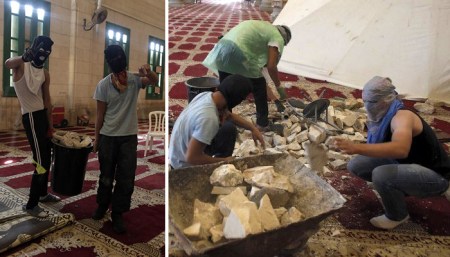
1277 (2)Palestinian Arab young men with masks, inside Al-Aqsa Mosque (some wearing shoes), stockpile rocks to use for throwing at Jews who visit the Temple Mount, September 27, 2015.

The Islamic Movement in Israel, headed by Sheikh Raed Salah, joined the chorus of critics by issuing its own threats to thwart the camera plan.

The straw that broke the Jordanian back was a leaflet that was distributed at the Temple Mount during Friday prayers two weeks ago. The leaflet urged Muslims to smash any cameras installed at the holy site. Who was behind the leaflet remains unclear, but sources in East Jerusalem blamed Palestinian activists and members of the Islamic Movement in Israel. The latest threat came as Jordan announced that the cameras would be installed at the site in the coming days.

Jordanian Prime Minister Abdullah Ensour made no bones about the decision to drop the plan: it was, he stated, a direct response to Palestinian “opposition” and “reservations.” He also noted that Israel had agreed to the installation of the cameras.

“At the beginning, Israel tried to hinder the project through various means,” Ensour said. “But we were able to overcome that.” He said that Jordan was nevertheless “surprised” by the reaction of the Palestinians to the cameras initiative.

Jordan has made clear that it was the Palestinians, and not Israel, who foiled the installation of more than 50 surveillance cameras at the Temple Mount as a stop towards easing tensions there.

Yet, no reaction from Kerry.

In one blow, Palestinians have managed to undermine Jordan’s historic role as “custodian” of the holy sites in Jerusalem and humiliate King Abdullah, who was the mastermind of the camera plan. They managed to do so largely thanks to the failure of the U.S. Administration to follow up on the implementation of the Kerry-brokered agreement.

We are seeing an old movie. Once again, the Palestinians have strong-armed their way to disaster. Their incessant intimidation fails to achieve a truly worthy goal: a better life under a non-dictatorial regime.

Once again, the Palestinians have prevailed — and in their win, they lose yet again.

OMRI CEREN: Dollarizing Iran (2)

April 21, 2016

OMRI CEREN: Dollarizing Iran (2), Power LineScott Johnson, April 21, 2016

(Please see also, U.S., Iran Are Negotiating An Obama-Rohani Meeting. Here’s a key point from the article:

Following Khamenei’s recent harsh attacks on what he termed the U.S. administration’s misconduct and its failure to implement the economic and banking aspects of the JCPOA,[4] Khamenei’s representatives from Iran’s pragmatic camp have been openly talking with U.S. officials in order to extract from the U.S. more concessions that are not part of the JCPOA.

— DM)

On Tuesday Eli Lake reported on the State Department’s letter to the governors of all 50 states as well as some local officials asking them to reconsider any laws on the books that called for divesting state funds from businesses interacting with Iran’s economy, or laws that would deny contracts to companies that do business with Iran. Following up on Lake’s report, Seth Lipsky noted that the “delicate wording — the wheedling tone — of the administration letter suggests that Secretary of State Kerry knows he has no authority to demand that states retreat from their laws against the Iranian regime.” It is imperative in the view of the Obama administration that we fund and otherwise facilitate Iran’s ventures. Now Omri Ceren writes from the Israel Project to update readers on developments in our unfolding partnership with the Islamic Republic of Iran:

On Monday Secretary Kerry met with Iranian FM Zarif in New York. His comments after the meeting suggest that he and Zarif are preparing this Friday to announce new American concessions facilitating Iranian access to the U.S. dollar [a]:

QUESTION: Mr. Secretary, did you reach any agreement (inaudible) with the dollar issue and the (inaudible) sanctions issue?

SECRETARY KERRY: We agreed to – we’re both working at making sure that the JCPOA, the Iran agreement – nuclear agreement – is implemented in exactly the way that it was meant to be and that all the parties to that agreement get the benefits that they are supposed to get out of the agreement. So we worked on a number of key things today, achieved progress on it, and we agreed to meet on Friday. After the signing of the climate change agreement, we will meet again to sort of solidify what we talked about today.

Note specifically Kerry’s claim that the Iranians are entitled to the concession under the terms of the deal: “the benefits that they are supposed to get out of the agreement.” He made the same claim two weeks ago, in comments that were promptly picked up by Iranian state media [b]. That’s not how the deal was sold last summer. Back then top Treasury officials explicitly and repeatedly declared that prohibitions on Iranian dollar access would remain in place to maintain U.S. leverage on Iranian terrorism, human rights violations, ballistic missile development, etc. [c].

But then a month ago the Iranians started declaring that they weren’t getting the relief they’re entitled to because of banking sanctions, and they demanded dollar access lest they walk away from the deal [d][e][f][g]. Within weeks of the new Iranian demands the AP and WSJ confirmed that the administration was planning to offer dollar-related concessions, which the AP noted “would reverse a ban that… the administration had vowed to maintain” [h][i][j]. That triggered a Congressional backlash, forcing the administration to publicly declare that no new concessions were planned [k].

Now it looks like concessions are back on the agenda, and so are Secretary Kerry’s claims that the Iranians are entitled to them. On Monday evening – few hours after his meeting with Zarif – Kerry again suggested that the Iranians aren’t getting all the relief they’re due, saying they’ve only gotten $3 billion of $55 billion in escrowed oil funds [m]:

Do you remember the debate over how much money Iran was going to get?… We calculated it to be about $55 billion when you really take a hard look at the economy and what is happening. Guess what, folks; you know how much they have received to date as I stand here tonight? About $3 billion.

That’s a strange claim to make. 1st, there’s no reason it would be true: during the 17 month JPOA negotiation period the Iranians repatriated $700 million of escrowed oil funds per month, or $11.9 billion total. So a mechanism exists for getting Iran those funds. 2nd, statements from Iran suggest it’s false: the Iranians declared in February that they had been given full access to $100 billion in escrowed reserves [l]. The State Department’s Marie Harf responded by blaming Treasury for underestimating the windfall at $50 billion – an estimate that Kerry repeated – but she didn’t suggest that the Iranians were wrong about having been given access to their escrowed funds [n].

Journalists spent Tuesday trying to figure out what Kerry could have been suggesting, and if he was intentionally echoing the Iranian position. The debate spilled into the State Department press briefing [o]. The AP’s Matt Lee: “he’s making the Iranians’ argument here, right?… saying that the Iranians are correct when they complain… that the Iranians have a point here.” CNN’s Elise Labott: “he’s trying to tell the Iranians they’re going to get their money?” Reuters’s Lesley Wroughton: “Is it because of the financial restrictions that the Iranians are arguing about?”

State Department spokesman Kirby repeatedly denied that Kerry had intended to echo Iranian talking points.

[a] http://www.state.gov/secretary/remarks/2016/04/255977.htm
[b] http://www.presstv.ir/Detail/2016/04/06/459389/Kerry-Iran-US-dollar/
[c] http://www.foreign.senate.gov/imo/media/doc/07-23-15%20Lew%20Testimony.pdf%5D%5Bhttp://www.washingtoninstitute.org/uploads/Documents/other/SzubinTranscript20150916-v2.pdf
[d] https://twitter.com/khamenei_ir/status/707981817434009600
[e]http://www.al-monitor.com/pulse/originals/2016/03/iran-sanctions-jcpoa-banking-khamenei-nowruz-speech.html
[f]http://www.reuters.com/article/us-iran-trade-finance-idUSKCN0WO1Y3
[g] http://thediplomat.com/2016/03/the-real-threat-to-the-iran-deal-tehrans-banking-system/%5D
[h] http://bigstory.ap.org/article/b2c1eb1820154a518deb12b85882536e/gop-worries-obama-leaving-door-open-new-iran-relief
[i]http://hosted.ap.org/dynamic/stories/U/US_UNITED_STATES_IRAN?SITE=AP&SECTION=HOME&TEMPLATE=DEFAULT
[j] http://www.wsj.com/articles/u-s-moves-to-give-iran-limited-access-to-dollars-1459468597%5D
[k] http://www.jta.org/2016/04/13/news-opinion/politics/amid-rumors-white-house-rules-out-giving-iran-access-to-us-dollar
[l] https://www.washingtonpost.com/world/iran-claims-100-billion-now-freed-in-major-step-as-sanctions-roll-back/2016/02/01/edfc23ca-c8e5-11e5-a7b2-5a2f824b02c9_story.html
[m] http://www.state.gov/secretary/remarks/2016/04/255951.htm
[n] https://twitter.com/marieharf/status/694371008459988992
[o] http://www.state.gov/r/pa/prs/dpb/2016/04/255961.htm#IR

U.S., Iran Are Negotiating An Obama-Rohani Meeting

April 21, 2016

U.S., Iran Are Negotiating An Obama-Rohani Meeting, MEMRI, April 20, 2016

Following Khamenei’s recent harsh attacks on what he termed the U.S. administration’s misconduct and its failure to implement the economic and banking aspects of the JCPOA,[4] Khamenei’s representatives from Iran’s pragmatic camp have been openly talking with U.S. officials in order to extract from the U.S. more concessions that are not part of the JCPOA.

***************************

Intense U.S.-Iran negotiations appear to be underway at this time, on various levels. They have included meetings this week in New York between Iranian Foreign Minister Zarif and U.S. Secretary of State Kerry, and an April 14 Washington meeting between Central Bank of Iran governor Valiollah Seif and U.S. Secretary of the Treasury Jack Lew.[1]

According to an April 19 report on the Iranian website Sahamnews.org, which is affiliated with Iran’s Green Movement, President Obama asked to meet with Iranian President Hassan Rohani in two secret letters sent in late March to both Iranian Supreme Leader Ali Khamenei and President Rohani.

According to the report, Obama wrote in the letters that Iran has a limited-time opportunity to cooperate with the U.S. in order to resolve the problems in Syria, Iraq, and Yemen, and promised that if Iran agreed to a meeting between him and Rohani, he would be willing to participate in any conference to this end.

The Sahamnews report further stressed that Supreme Leader Khamenei discussed the request with President Rohani, that Rohani said that Iran should accept the request and meet with Obama, and that such a meeting could lead to an end to the crises in the region while increasing Iran’s influence in their resolution. Rohani promised Khamenei that any move would be coordinated with him and reported to him. According to the report, Khamenei agreed with Rohani.

The Sahamnews report also emphasized that Khamenei’s recent aggressively anti-U.S. speeches were aimed at maintaining an anti-U.S. atmosphere among the Iranian public, whereas in private meetings he expresses a different position.

Further hints regarding Obama’s wish to meet with Iranian officials could be found in both American[2] and Iranian[3] media.

Following Khamenei’s recent harsh attacks on what he termed the U.S. administration’s misconduct and its failure to implement the economic and banking aspects of the JCPOA,[4] Khamenei’s representatives from Iran’s pragmatic camp have been openly talking with U.S. officials in order to extract from the U.S. more concessions that are not part of the JCPOA.

After Secretary of State Kerry’s April 19 New York meeting with Foreign Minister Zarif, the two announced that their discussions would continue on April 22. Zarif said that the meeting had been aimed “to ensure that Iran obtains the interests that it anticipates [receiving] from the JCPOA… The main focus of the talks concerned the correct implementation of the JCPOA so that the sides, especially the Iranian people, will receive what is coming to them under this agreement.”[5]

Secretary of State Kerry said that progress had been made in several issues, and that the two would meet again on April 22: “We agreed to – we’re both working at making sure that the JCPOA, the Iran agreement – nuclear agreement – is implemented in exactly the way that it was meant to be and that all the parties to that agreement get the benefits that they are supposed to get out of the agreement. So we worked on a number of key things today, achieved progress on it, and we agreed to meet on Friday. After the signing of the climate change agreement, we will meet again to sort of solidify what we talked about today.”[6]


Endnotes:

[1] Wall Street Journal, April 15, 2016.

[2] See, for instance, an article in Foreign Affairs, March 7, 2016, by a representative of the National Iranian American Council.

[3] Kayhan (Iran), April 3, 2016. See also MEMRI Special Dispatch No. 6373, Power Struggle Between Iranian Supreme Leader Khamenei’s Ideological Camp And Rafsanjani’s Pragmatic Camp Intensifies – Part III: Iranian Supreme Leader Ali Khamenei Speaks Out Against Pragmatic Camp Leaders Rafsanjani, Rohani, April 5, 2016.

[4] See MEMRI Special Dispatch No. 6373, Power Struggle Between Iranian Supreme Leader Khamenei’s Ideological Camp And Rafsanjani’s Pragmatic Camp Intensifies – Part III: Iranian Supreme Leader Ali Khamenei Speaks Out Against Pragmatic Camp Leaders Rafsanjani, Rohani, April 5, 2016.

[5] ISNA (Iran), April 20, 2016.

[6] State.gov, April 19, 2016.