Posted tagged ‘Israeli security’

Funding Terrorism to Fight Terrorism

July 18, 2017

Funding Terrorism to Fight Terrorism, Front Page Magazine, Daniel Greenfield, July 18, 2017
AIPAC hasn’t gotten behind the Taylor Force Act. Instead it’s holding out for some “revised” version that would make it meaningless while attracting bipartisan support. Meaningless pro-Israel measures that pass with huge majorities are AIPAC’s bread and butter. They’re its political Potemkin villages.

The ideal Taylor Force Act, according to AIPAC, most Democrats and some Republicans, would condemn terrorism without cutting a cent in foreign aid to the Palestinian Authority. It would contain a national security waiver and plenty of gimmicks that would actually increase funding for terror.

************************************

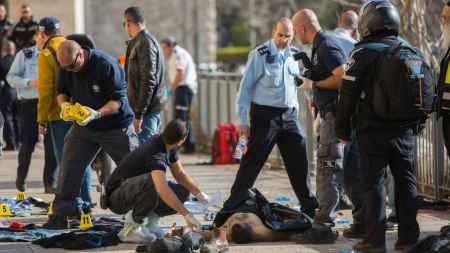
Master Sgt. Haiel Sitawe, the father of a newborn baby, and Kamil Shnaan, who was newly engaged, were murdered in an Islamic terrorist attack in Jerusalem. The two Israeli police officers were members of the Druze community in Israel. The terrorists who shot them were killed by other police officers.

While Israel will compensate the families of the dead police officers, the Palestinian Authority will compensate the families of the terrorists. And American taxpayers will compensate both.

This is typical of a foreign policy in which we fund both the terrorists and the terrorized.

Sooner or later, we are going to have to choose a side.

This mad policy is facing its biggest threat with the Taylor Force Act. The bill, named after a murdered Afghanistan and Iraq War veteran stabbed to death in Tel Aviv, would strip funding from the Palestinian Authority unless the terror state stops giving money to terrorists and their families for their crimes.

The Taylor Force Act has plenty of support in Congress. But the Palestinian Authority has made it abundantly clear that it will not stop paying terrorists to kill Israelis. PA terror boss Abbas is gambling that our politicians will blink first rather than stop sending him hundreds of millions of dollars.

And the tragedy of it is that he appears to be right.

Everyone condemns the Palestinian Authority’s policy of funding terrorists. Typical adjectives include “abhorrent” and “abominable”. But don’t expect them to actually cut off the cash.

Senators are scurrying to neuter the Taylor Force Act. There are dire warnings that if we stop funding the biggest Islamic terrorist group in Israel, it will collapse and make way for more terrorism.

If we don’t stop giving Islamic terrorists money to commit terrorism… the terrorists will win.

This sums up the insanity of our foreign policy in which we fund terrorism to fight terrorism, and in which the “moderate” Islamic terrorists of the Palestinian Authority and the Muslim Brotherhood are our best hope for restraining the really scary “extremist” Islamic terrorists of ISIS and Al Qaeda.

Senators have been complaining about the act’s “All or nothing” approach. All or nothing means that the Palestinian Authority would have to stop funding terror or lose funding. And since the Palestinian Authority won’t stop funding terror and they don’t want to cut its funding, they hate all or nothing.

AIPAC hasn’t gotten behind the Taylor Force Act. Instead it’s holding out for some “revised” version that would make it meaningless while attracting bipartisan support. Meaningless pro-Israel measures that pass with huge majorities are AIPAC’s bread and butter. They’re its political Potemkin villages.

The ideal Taylor Force Act, according to AIPAC, most Democrats and some Republicans, would condemn terrorism without cutting a cent in foreign aid to the Palestinian Authority. It would contain a national security waiver and plenty of gimmicks that would actually increase funding for terror.

Instead of the Taylor Force Act, the call is on for a “Taylor Force like” bill that would be like it the way that a $25 Rolex being peddled from a wheelbarrow outside Central Park is like a real Rolex.

There are calls for a more “targeted” bill that would go after some, but not all of the PA’s funding.

But what would a targeted bill actually target? There are calls to exempt humanitarian aid. Never mind that much of the humanitarian aid really finds its way into the pockets of PA and Hamas leaders. Then there is the “security assistance” that enables the terrorists to pretend to fight terrorism.

And then there’s all the institutional support to maintain the corrupt authoritarian institutions of the PA while still providing all of the social services that the PA is supposed to provide, but doesn’t. We have to build roads and schools, and provide electricity and fund hospitals for our worst enemies.

If we can’t cut social services to the biggest terrorist welfare state in the world or security assistance to its terrorist armies, what can we cut?

You guessed it. Nothing.

Cut social services and we’ll just “radicalize” and “embitter” them further. Cut security assistance and they’ll have no choice but to resort to more terrorism. What can we do except give them more money?

A Taylor Force like bill will just move money around. And nothing will change. Senators will pat themselves on the back. And the State Department will see to it that the terror funding continues.

Just to make a madly irrational policy even more absurdly insane, critics of the Taylor Force Act claim that ending funding for terror will undermine Israeli security. The basis for this claim comes from what is usually described in umpteen news stories as a coalition of retired Israeli military officers.

But Caroline Glick has already exposed Commanders for Israel’s Security as a left-wing group with links to Obama and Soros. CIS holds positions that undermine Israeli security. And it’s part of a pattern of recruiting retired Israeli security personnel and military people as fronts for anti-Israel agendas.

Prime Minister Netanyahu supports the Taylor Force Act. As do top former military officials. The first name on the list belonged to former Defense Minister Ya’alon; no friend of Netanyahu. The letter concludes by noting that, “The Knesset is considering passage of a law calling for deducting the amount the PA pays terrorists from the money Israel transfers to the PA. It is legislation sponsored by members of all parties, except the far-left Meretz and the Joint Arab List.”

And yet we have politicians and pundits who insist that “we should listen to the Israelis” and keep on funding the PLO. The “Israelis” they want us to listen to are not the country’s elected government and its voters, but a fake organization with an agenda and links to Israel’s opponents.

And so here we are funding terrorism to fight terrorism and listening to Israelis by ignoring them.

Sarah Yerkes of the Brookings Institution and the Carnegie Endowment for International Peace argues that threatening to defund the PA unless it stops funding terrorism could lead to it refusing to change its policy of funding terrorism. If the PA doesn’t stop financing terror out of the goodness of its heart, we’re utterly helpless to do anything except keep shoving more money into its dirty and bloody hands.

The consequences of not funding terrorism are too terrifying to contemplate. What else can we possibly do except nothing?

Cutting off money to the terrorists would just lead to more terrorism. That’s the sum of all the arguments. And there’s a word for it. Blackmail.

We can’t figure out how to stop paying blackmail money to Islamic terrorists. The most powerful nation on earth can’t stop writing big checks to one of the oldest active Islamic terror groups on the planet.

But it’s easy. You just stop sending the checks.

You stop worrying about stability, further radicalization and an imaginary peace process. You can’t buy stability by paying the biggest terrorist group to keep the smaller ones down. If you’re going to do that, you might as well start subsidizing the mafia to keep other criminals in line.

The PA, Fatah and the PLO constantly promote and celebrate Islamic terrorism. They’re not as bad as ISIS, but does that mean we should be funding every Islamic terrorist group less terrible than ISIS?

Finally, if the PA won’t stop funding Islamic terrorists who kill Israelis decades after signing what was supposed to be a peace accord with Israel, talk of a peace process is hollow nonsense.

The United States shouldn’t need a special bill to defund an Islamic terrorist group that has murdered many Americans over the years. We can’t end terrorism tomorrow. But we can at least stop funding it.

If only we can figure out how to stop writing the checks.
Temple Mt. opens in stages amid terror probe

July 15, 2017

Temple Mt. opens in stages amid terror probe, DEBKAfile, July 15, 2017

Pressure on Israel from the Arab world to reopen Temple Mount and its mosques for Muslim prayer without delay has been strongly countered by the Israeli police and security authorities. They need more time to complete their investigation of the scene of the terror attack, Friday, July 14, in which two Israeli officers on guard were shot dead and a third injured. The three Israeli Arabs who committed the murders were shot dead in the subsequent firefight outside the Dome of the Rock.

The Israeli government also decided that the shrine, which is sacred to three monotheistic faiths, needs better security installed before it is judged safe for worship and visits.

On Saturday, Washington came to the aid of the investigation. Strongly condemning the “heartbreaking act of terror on Temple Mount,” the White House press secretary added: “The attack forced the government of Israel to temporarily close the Temple Mount/Haram al Sharif to conduct its investigation,” said the statement. “Israel has assured the world that it has no intention to alter the status of this holy site, a decision which the United States applauds and welcomes.”

Saturday night, the Netanyahu government Saturday nevertheless ordered Temple Mount opened Sunday “in stages” –  which gives the police and security authorities a little breathing space.

The police have been combing through the “scene of terror,” to reconstruct the crime and discover the secret arms caches hidden there. This undertaking is vast, complex and exceptionally sensitive.

The Temple Mount surface platform is 150,000 sq. meters in area with nine ancient open gates. It stands atop 13 historic periods of construction and destruction, each of which has left layer upon layer of mostly unexplored tunnels, pipes, caves, pits, shafts and debris. Even archeologists working there for decades and the clerical staff of the Waqf authority in charge of Muslim rites there can’t claim to have explored all the warrens hidden under the paved surface.

It is also suspected that there may be secret underground channels running under the Temple Mount wall and leading outside the compound.

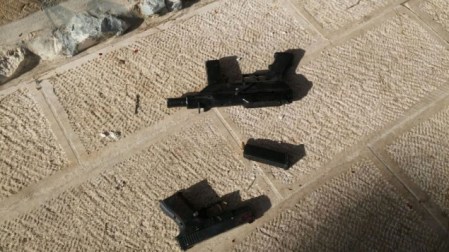
The police are meanwhile keeping their cards very close to their vests. They have detained some Waqf officials on suspicion of a connection with the terrorists, without releasing figures, and discovered a quantity of firearms. But the cops, unfamiliar with this unique ancient site, don’t know what they will find. They are after information about the identities of the party which instructed them to hide the two rifles and pistols used by the terrorists and said when they should be handed over. In short, whether a terrorist network exists on Temple Mount.

Relatives of the three terrorists, who belonged to the same clan in the Israeli Arab town of Umm al-Fahm, have been detained in search of information about how they came to perform the first act of terror by Moslems on Temple Mount. Most of the town and other parts of the Arab population are hostile to the investigation.

Israeli Arab community leaders, including their 13 parliamentarians, have refused to condemn the attack, willing only to voice regret for all the deaths inflicted Friday, including the three assailants.

This was resented not only by Israelis at large, but most bitterly by the Druze community, which buried two of its sons, Hail Stawi, 30, from Maghar and Kamil Shanan, 22, from Hurfeish both in northern Israel. They were shot to death while guarding the holy site.

The Temple terror investigation has exposed troubling animosities in Israeli Arab society.

Peace is light-years away

July 14, 2017

Peace is light-years away, Israel Hayom, Ruthie Blum, July 14, 2017

(Israel: give, give, give. Palestinians: take, take, take. But no peace. — DM)

So far, however, all Abbas has done is call the shots on the venue of a meeting ‎between his honchos and Trump’s team, agree to water and electricity deals that ‎benefit the PA and give the White House cause for false optimism. Undoubtedly, ‎he has already figured out how to get around the Taylor Force Act, if and when it ‎passes. A revised, bipartisan version of the bill, in particular — geared toward ‎guaranteeing that ordinary Palestinians are not robbed of humanitarian services ‎as a result of their leaders’ violations — will provide him with sufficient loopholes ‎to keep his “martyrs” in clover.‎

****************************

If the leaders of the Palestinian Authority had invested as much time, energy and ‎other people’s money in building a flourishing society as they do in the pursuit of ‎death and destruction, there would be no need for outside efforts to broker ‎peace between them and their Israeli counterparts. It takes only about 30 minutes ‎to drive from the Muqataa compound in Ramallah to the Prime Minister’s Office in ‎Jerusalem. Yet it is still easier for dignitaries from the United States and Europe to ‎spend hours on flights to Tel Aviv for the purpose of talking about a two-state ‎solution than it is for PA President Mahmoud Abbas to budge in any direction ‎other than backwards. ‎

Take this week, for instance, which began with the Palestinians’ refusal to host ‎U.S. Ambassador to Israel David Friedman — whom U.S. President Donald Trump ‎has included in his Mideast peacemaking team, along with advisers Jason ‎Greenblatt and Jared Kushner — in Ramallah. Friedman is too pro-Israel, as far as ‎Abbas is concerned. As a result, the meeting between American and Palestinian ‎officials on Tuesday took place at the King David Hotel in west Jerusalem. ‎

On Thursday, Greenblatt joined fellow envoys of the Middle East Quartet — the ‎U.S. (which he represents), the European Union, the United Nations and Russia — ‎in Jerusalem “to discuss current efforts to advance Middle East peace, as well as ‎the deteriorating situation in Gaza.”‎

Also on Thursday, Greenblatt announced that Israel had agreed to sell the PA 1.2 ‎billion cubic feet of water. This, he said, in addition to an electricity deal reached ‎between Israel and the PA on Monday, will improve the Palestinians’ standard of ‎living.‎

Meanwhile, in Washington, D.C. on Wednesday, the Senate Foreign Relations ‎Committee conducted a hearing on the proposed Taylor Force Act, named after ‎the former U.S. Army officer who — while on a trip to Israel in March 2016 — was ‎stabbed to death by a knife-wielding Palestinian on a rampage in Tel Aviv. The bill, ‎co-sponsored by Senators Lindsey Graham (R-S.C.), Dan Coats (R-‎Ind.) and Roy Blunt (R-Miss.), aims to halt American aid to the PA until it ‎stops paying salaries and stipends to imprisoned terrorists and the families of ‎those “martyred” while murdering Israelis. ‎

Testifying before the committee on behalf of the bill, Senior Fellow for Middle ‎Eastern Studies at the Council on Foreign Relations Elliott Abrams — who served as ‎deputy assistant to the president and deputy national security adviser in the ‎George W. Bush administration — railed against the “Palestinian practice of ‎making payments to individuals convicted of acts of terror, and their families or ‎survivors, in accordance with the severity of their acts and the length of their ‎sentences.” The “predictable effect of this practice,” he said, “is to reward and ‎incentivize acts of terror.”‎

Pointing to the billions of dollars that the U.S. has poured into the PA since its ‎establishment in the 1990s, Abrams said, “As long as the Palestinian government ‎is in effect rewarding terror, we need to be sure we make our objections — our ‎condemnation — known, and that cannot be merely in words. Our assistance ‎program must reflect our feeling of repugnance.” He then proposed a revision to ‎the bill that would enable the U.S. to continue funding hospitals and other ‎projects that benefit the Palestinian people, while preventing the money from ‎lining the pockets of corrupt bureaucrats.‎

Whether this carrot-and-stick approach to the PA was purposeful or inadvertent ‎is unclear. What is certain, however, is that the PA president is not turning over a ‎new leaf. Earlier this month, as Palestinian Media Watch reported, Abbas ‎was quoted on Fatah’s official Facebook page as proclaiming: “Even if I have to ‎leave my position, I will not compromise on the salary of a martyr or a prisoner, ‎as I am the president of the entire Palestinian people, including the prisoners, the ‎martyrs, the injured, the expelled and the uprooted.”‎

This sentiment was echoed recently by PA Prime Minister Rami Hamdallah. ‎Hamdallah — who launched the first-ever Palestinian-owned power substation in ‎Jenin with Israeli National Infrastructure, Energy and Water Resources Minister ‎Yuval Steinitz on Monday, and signed the electricity deal touted by Greenblatt — ‎vowed last month to continue rewarding terrorists.‎

On June 16, according to PMW, the official PA newspaper quoted Hamdallah ‎announcing: “On behalf of … Abbas and our Palestinian people, I salute all of the ‎martyrs’ families … [and] emphasize to them that their rights are protected. … We ‎remember the sacrifices and struggle of the pure martyrs, guardians of the land ‎and identity, who have turned our people’s cause into a historical epic of struggle ‎and resolve.”‎

Hamdallah’s reassurance came on the heels of U.S. Secretary of State Rex ‎Tillerson’s claim that the PA’s “intent is to cease the payments to the families of ‎those who have committed murder or violence against others.” Ironically, both ‎Israeli and Palestinian officials were incensed by the statement, and Tillerson was ‎forced to modify it. Washington and Ramallah — he said the following day — are ‎engaged in an “active discussion” on the matter.‎

So far, however, all Abbas has done is call the shots on the venue of a meeting ‎between his honchos and Trump’s team, agree to water and electricity deals that ‎benefit the PA and give the White House cause for false optimism. Undoubtedly, ‎he has already figured out how to get around the Taylor Force Act, if and when it ‎passes. A revised, bipartisan version of the bill, in particular — geared toward ‎guaranteeing that ordinary Palestinians are not robbed of humanitarian services ‎as a result of their leaders’ violations — will provide him with sufficient loopholes ‎to keep his “martyrs” in clover.‎

Ramallah may be a mere 10 miles from Jerusalem, but it — ‎like peace — is light-years away.‎

Russians enter Daraa, Syrians/Hizballah move out

July 12, 2017

Russians enter Daraa, Syrians/Hizballah move out, DEBKAfile, July 12, 2017

Israel has so far objected to any Russian military presence along its borders with Syria, even in the capacity of ceasefire monitors, preferring Americans to police the truce in the Qunetra region. If that proved unfeasible, then Israel would leave the Syrian rebels controlling this area in place.

**********************************

Russian troops stepped into southern Syria for the first time Wednesday, July 13, when they entered the embattled town of Daraa to start enforcing the partial ceasefire agreed by Presidents Donald Trump and Vladimir Putin in Hamburg on July 7.  DEBKAfile’s military sources report this exclusively.

The Russians, including military police and Chechen paratroopers, were sighted getting out of the vehicles of their convoy and taking up positions in the center of Daraa. As they moved into the town, our sources report that tank units of the pro-regime Syrian army’s 5th Armored Division were seen driving out, along with Hizballah.

Their withdrawal cut short the Syrian military’s Operation Big Dawn against the Syrian rebels in Daraa, which breached the ceasefire Monday, July 11 – less then 24 hours after it went into force.

The Russian deployment in a southern Syrian border town Wednesday was the first step in their posting along Syria’s Israeli and Jordanian borders, as agreed between Washington and Moscow. President Trump had assented to this arrangement to bolster the first stage of the Syrian ceasefire going into effect in the de-confliction zone of the southwest.

Jordan also assented, in the interests of de-escalating tensions on its border with Syria.

The Russian troops and Chechens in Russian military police uniforms were armed only with light weapons. On July 5, Putin’s special envoy for Syrian affairs, Alexander Levrentiev, said that the Russian troops deployed in Syrian ceasefire zones would be lightly armed for self-defense. Most would consist of Russian military police. This description was intended to cover the presence of Chechen paratroops, who were seconded to the Russian police force for this mission.

Israel has so far objected to any Russian military presence along its borders with Syria, even in the capacity of ceasefire monitors, preferring Americans to police the truce in the Qunetra region. If that proved unfeasible, then Israel would leave the Syrian rebels controlling this area in place.

But our sources predict that, after the arrival of Russian troops in Daraa to preserve the ceasefire, both Washington and Moscow will lean hard on Jerusalem to accept Russian troops at Quneitra too, that is, opposite the Golan.

What Hamas Wants

July 3, 2017

What Hamas Wants, Front Page MagazineHerbert London, July 3, 2017

As is evident, there cannot be a negotiated settlement in the Middle East unless you are considering an Israel engaged in preemptive surrender. In the mind of Hamas, a peace treaty similar to the one negotiated between Israel and Egypt would be a form of high treason. Hamas regards itself as the spearhead in the struggle against world Zionism and will not concede an inch of this designation.

***********************************

Illusions in the Middle East die hard. However, with the publication of Hamas’ new political document, there shouldn’t be any doubt about the motives of this Muslim Brotherhood organization. The western press continues to assert that Hamas is “moderating” its views, but the document itself offers a different picture.

The main points of the new political document are:

  1. Reliance on Islam as the sole source of authority;
  2. Denial of the Jewish right to self-determination in the Land of Israel;
  3. Conferral of a sacred Islamic character on all of Palestine;
  4. An armed struggle to liberate Palestine is legitimate and must continue.

In the last year, Hamas has altered the wording in many of its public statements to seem accommodating. Presumably naiveté in the West has given it leverage at the U.N. and as a legitimate political actor on the world stage. In fact, the modification in language is an exercise in “taqiyyah” (deception in the cause of Allah). Impression, not substance, is what counts for Hamas officials.

The real goal is to gain control of the PLO, thereby securing legitimate rule over all the Palestinian territories and using that influence on international bodies. To subvert Israel’s power, Hamas deploys diplomatic and propaganda techniques. Hence it is often difficult to distinguish between lies, fabrications and exaggerated claims coming from the leadership.

With the publication of the new political document, Hamas is hoist by its own petard. There is no question it will not recognize the Jewish state. Moreover, any claim about Israel that relies on historical antecedents is deemed inaccurate. For Hamas, Israel is an historic blindspot. Fortunately, there are those in the Trump White House who understand the futility of the Hamas stance.

Should one engage in a serious investigation of Hamas, it will become obvious that the goals have remained unaltered, the purpose of the organization intact and tactics unchanged. There is a good reason to suspect that will be the case decades ahead, for if Hamas had modified its position it could not attract volunteers to its cause.

Netanyahu slammed Hamas as the metamorphosis of an ideology that emerged in 1928. He claims that it does little more than proselytize for radical ideas. Whether Netanyahu is right, is less relevant than how Hamas describes itself. Here the Netanyahu claims and the Hamas document converge. If the land of Palestine is consecrated for future Moslem generations until Judgment Day, every individual sharing the faith has an obligation – as part of his religious duty – to fight for this territory free of Jews. A good Muslim is he who loudly proclaims, “Hail to Jihad!” and struggles continuously for the achievement of liberation.

As is evident, there cannot be a negotiated settlement in the Middle East unless you are considering an Israel engaged in preemptive surrender. In the mind of Hamas, a peace treaty similar to the one negotiated between Israel and Egypt would be a form of high treason. Hamas regards itself as the spearhead in the struggle against world Zionism and will not concede an inch of this designation.

So let’s get over the pollyannish view peace can be negotiated. It will not be negotiated as long as one side at the negotiating table wants to kill those across from them. That is the reality, however difficult it is to accept.

Herbert London in President of the London Center for Policy Research.

Obama’s Anti-Israel Diplomats Want to Gut Taylor Force Act

July 2, 2017

Obama’s Anti-Israel Diplomats Want to Gut Taylor Force Act, The Point (Front Page Magazine), Daniel Greenfield, July 2, 2017

It was only a matter of time.

The Taylor Force Act, which demands that the PLO stop funding terror or lose US taxpayer cash, is picking up steam. So the usual anti-Israel crowd is crawling into action.

Obama’s errand boy to Israel, Dan Shapiro and Ilan Goldenberg, who describes himself as a “former deep stater” on his Twitter profile, have a call to neuter it in Foreign Policy. The game plan is everything you would expect.

Warn about “instability” if the terrorists don’t get their cash. Cite Israeli lefties who warn against it. And then suggest a “national security waiver”. That waiver is why the embassy still isn’t in Jerusalem.

Also there are warnings that the US wouldn’t be able to provide “humanitarian aid” to Gaza the next time Hamas gets bombed. And, worst of all, the terrorists might stop accepting our money to train their terrorists.

This is an actual argument that Shapiro and Goldenberg make.

“But if security assistance is the only U.S. support that remains, and no other economic benefits for the Palestinians materialize, then it becomes politically much more difficult for the Palestinian leadership to accept these funds and continue the program.”

If we don’t give the terrorists more money to shove into their Swiss bank accounts under the guise of “improving life for Palestinians”, they won’t take our money to train their terrorists.

This isn’t an argument. This is a Monty Python skit. But what else would one expect from the author of “Why Israel’s Settlement Construction Must Be Stopped” and “How Israel Brought U.N. Resolution on Itself With Irrational Settlement Push”

Trump’s productive Middle East failure

June 30, 2017

Trump’s productive Middle East failure, Israel Hayom, Jonathan S. Tobin, June 30, 2017

What the Palestinians fail to understand is that ending PA support for terror is itself a core ‎issue that must be addressed now, and it is not a distraction from the real diplomatic ‎agenda.‎

It’s hardly surprising that the Palestinians are having trouble adjusting to the ‎administration’s mindset. Since neither the Americans nor the Europeans have ‎been much interested in the Palestinians’ terror payments and incitement, they seem to view ‎Trump’s focus on those issues as an indication that he is in Israel’s pocket. Former President Barack Obama was obsessed with the idea that pressure on Israel was ‎the key to peace and was willing to give the Palestinians a pass on anything they ‎did. But Trump rightly understands that as long as the Palestinians are funding ‎terror — and doing so with money given them by the West — they can’t be ‎considered serious about peace.‎

***************************

It didn’t take long for the bubble to burst. The chance of U.S. President Donald Trump achieving a breakthrough in Middle East peace that had eluded all his ‎predecessors was always slim. But reports about Palestinian Authority President ‎Mahmoud Abbas yelling at presidential adviser and son-in-law Jared Kushner during ‎their meeting last week may signal that the Trump initiative is over even ‎before it begins.‎

The president’s critics should acknowledge that even if the effort was ‎bound to end in failure, it nevertheless points toward the only way peace can be ‎achieved. By focusing on the Palestinians’ willingness to foment and subsidize ‎terror, the U.S. has exposed a key problem that the Obama administration ignored. ‎Rather than this obstructing peace, it is an important step without ‎which genuine progress toward ending the conflict will be impossible.‎

The meeting between Kushner and Abbas went badly. The Palestinians were ‎shocked that Kushner followed up on the key sticking point that had arisen ‎between Trump and the Palestinian leader during their two meetings in May. ‎Abbas claimed during their first encounter in the White House that the PA was not ‎engaging in incitement to hatred against Israelis and that it did not pay salaries or ‎pensions to terrorists and their families. By the time they met again, Trump had ‎learned that Abbas had lied to him about both issues and reportedly pounded the ‎table as he demanded that the Palestinian leader end these practices.‎

But when Kushner and chief U.S. peace negotiator Jason Greenblatt raised the issue ‎again with Abbas, the Palestinians were angry. As far as Abbas ‎was concerned, the Americans were merely relaying a list of demands from Israeli ‎Prime Minister Netanyahu, when Abbas had been expecting to hear about American ‎positions on “core issues of the conflict,” by which he meant strategies to stop ‎Israel from building in the West Bank and push it back to the 1967 ‎borders.‎

What the Palestinians fail to understand is that ending PA support for terror is itself a core ‎issue that must be addressed now, and it is not a distraction from the real diplomatic ‎agenda.‎

It’s hardly surprising that the Palestinians are having trouble adjusting to the ‎administration’s mindset. Since neither the Americans nor the Europeans have ‎been much interested in the Palestinians’ terror payments and incitement, they seem to view ‎Trump’s focus on those issues as an indication that he is in Israel’s pocket. Former President Barack Obama was obsessed with the idea that pressure on Israel was ‎the key to peace and was willing to give the Palestinians a pass on anything they ‎did. But Trump rightly understands that as long as the Palestinians are funding ‎terror — and doing so with money given them by the West — they can’t be ‎considered serious about peace.‎

The administration denies reports that it is considering backing away from the ‎push for negotiations. But the president may realize that his statement after his ‎first meeting with Abbas, in which he claimed that Middle East peace “is not as ‎difficult as most people thought,” was more than premature. ‎

While few thought his willingness to prioritize the peace process was likely to be ‎rewarded with success, his thinking that the time is ripe for a breakthrough was rational. With Sunni Arab states now looking at Israel as an ally against the ‎threat from Iran, it was reasonable to suppose that this confluence of ‎interests might result in an effort to pressure the Palestinians to settle their dispute ‎with Israel.

However, the theory that the Palestinians can be either pushed or ‎bribed by the Saudis into making peace is now being called into doubt.‎

As long as the Palestinians cling to the idea that their national identity is inextricably tied up with the ‎century-long war on Zionism, peace will remain a pipe dream. Neither Trump’s threats ‎nor the efforts of the Saudis are likely to persuade them to abandon a political ‎culture in which incitement and pensions for terrorists — on which they have ‎lavished more than $1.1 billion in just the last four years — are seen as laudable. ‎Trump is asking Abbas for something he cannot do and still ‎survive in power.‎

But with Congress looking to tie his hands by considering legislation that would ‎end U.S. aid unless the Palestinians stop the terror payments, Trump may not be ‎willing to let this issue drop. If so, his efforts won’t lead to the “ultimate deal” he ‎longs to broker, but it will lay the foundation for more realism about the peace ‎process. It will also put the Palestinians on ‎notice about what they must do if they genuinely want a two-state solution.‎

Jonathan S. Tobin is the opinion editor of JNS.org and a contributing writer for ‎National Review. 

Northern border heating up

June 27, 2017

Northern border heating up, Israel Hayom, Ofek Ish Maas, June 27, 2017

(Please see also, After IDF retaliates for spillover, Syrian army warns Israel.– DM)

In the past few days, the Syrian civil war has been knocking on Israel’s door. On Saturday, 10 errant mortars and tank shells landed in the northern Golan Heights, and at the beginning of the week the IDF Spokesperson’s Unit reported a few more ordnance hits in open areas.

In accordance with policy, the IDF responded by firing at Syrian army targets. But although tenuous quiet has been restored, we cannot discount the possibility that errant fire from Syria will continue and increase.

The army of Syrian President Bashar Assad, which was responsible for the errant fire, is trying to block an attack by rebels, who want to break through and reach the highway that leads from Damascus to the southwestern city of Daraa, which has been the site of heavy fighting for control of southern Syria over the past month.

Since the beginning of June, Daraaa has been subjected to massive bombing by the Syrian regime and its allies. Hundreds of barrel bombs and rockets and dozens of bombs from Syrian and Russian planes have rained down on the city. According to rebel reports, some of the bombs even included phosphorus. Among other things, in an attempt to deter the rebels, the regime intentionally attacked a school in a nearby village, killing more than 20 women and children who had sought shelter there. The worsening situation led the local government to declare Daraa and its surroundings a disaster area.

Daraa, which lies about 30 kilometers (18.5 miles) east of Israel and 13 kilometers (8 miles) north of Syria’s border with Jordan, is a strategic target for the Syrian regime. First, control over border crossings in a symbol of sovereignty and the implementation of Assad’s desire to once again control all of Syria. Second, the regime and its Shiite allies want to reduce the chance of a sustainable security buffer zone under Western, Jordanian, and Israeli influence being established in southern Syria. Assad’s forces reaching the Jordanian border would stop the supply of logistic, military, and humanitarian aid Western and Persian Gulf nations are sending the rebels and would create a divide between the two rebel-controlled areas in southern Syria.

With a goal so important to the regime, and with the increasingly serious stand-off between the U.S., Russia, and Iran in eastern Syria threatening any chances of a peace deal in the south, it appears that nothing is stopping Assad from proceeding full force.

The ramifications for Israel’s security could be heavy. In the short term, if we see a repeat of the images out of Aleppo at the end of 2016 — women and children slaughtered, buildings collapsing with people inside, the use of unconventional weapons against civilians — there will be waves of displaced persons, some of whom might seek shelter along the border, in Israel’s shadow, and even ask for asylum. In the long term, Israel’s northeastern front could become a stronghold of Iran, Hezbollah, and other Shiite militias that would comprise a threat to security and safety in northern Israel.

Israel must decide how it will prepare to prevent these dangerous scenarios. It must choose between increasing support for the Sunni rebels as a buffer against Iran and its satellites, or assenting through silence to Assad returning to power. If Israel wants to stick to the idea of a buffer zone, it will have to increase support for the rebels and provide them with defense coverage, both diplomatic, against Russia, and military, in hope that the U.S. will agree. But diverting American attention to southwestern Syria will hamper its efforts to defeat the Islamic State in the east and prevent Iran from filling the ensuing vacuum. Israel, therefore, would have to roll up its sleeves and plunge its hands into the Syrian mess. On the other hand, if Israel is unwilling to do so, it will have to set clear rules of engagement for the Assad regime, which is regaining ground, by demanding that Iranian satellites not gain a foothold in the region and backing that demand up with military action.

In any case, neither option is certain and each has its risks. But the reality in Syria, especially in the south of the country, is changing fast, and the comparative security that Israel has been enjoying is in danger and requires immediate planning and responses.

Ofek Ish Maas (Riemer) is a research assistant at the Institute for National Security Studies.

Golan battles bring Hizballah near Israeli border

June 25, 2017

Golan battles bring Hizballah near Israeli border, DEBKAfile, June 25, 2017

But for now,  both these warfronts hang in the balance and are undecided. Also undecided on how and when to react are Israel and Jordan. Hizballah is already 3km from the Golan border, although Israel’s government and military leaders have pledged repeatedly that they would be allowed to come in so close.

**************************

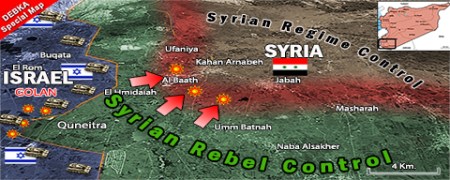
In the last 48 hours, Israel has conducted air strikes on and aimed tank fire at Syrian army positions near Quneitra’s northern suburb of Baath city, 3km from IDF Golan border defenses. (See map). Those positions were the source of the mortar shells that exploded on the Israeli Golan – 10 on Saturday, June 24 and three the next day. They came from a battle in which Syrian and Hizballah units were fighting off a Syrian rebel offensive around Quneitra.

The rebel militias set up a coalition to coordinate their offensive. It is dominated by the Hay’at Tahrir Al-Sham (HTS), which Damascus claims is an arm of Al Qaeda-Syria. In fact, it is an alignment of dozens of Islamist groups, some of which belonged and still do to Jabhat Fateh al-Sham – the former Nusra Front.

Fighting on the side of the Assad regime are the remnants of the Syrian army’s 90thBrigade, the Iranian Revolutionary Guards South Syrian command center, and the pro-Iranian Afghan Shiite militia.

They are joined by members of Hizballah’s Southern Shield Brigade.

This brigade is made up of Palestinians, Druzes, Circassians and local Syrians, whom Hizballah recruited and has posted in Hermon villages ready to launch terrorist attacks inside Israel.

The battle around Quneitra was preceded on June 17 by the assassination of Majd a-Din Khalik Khaymoud, commander of the Southern Shield Brigade and his two lieutenants, who were caught in an ambush near the village of Khan Arnabah. No party took responsibility for this attack.

Then, on Saturday, June 24, the rebel coalition launched its offensive on the Syrian-Hizballah units at Al-Baath, boasting that they would not stop until they reached Damascus. Although they caught the enemy by surprise, they were unable to follow up with a rapid advance, because they were pushed back by superior fire power. Since the Syrian mortars were aiming their fire at the rebel units concentrated around Quneitra, i.e., from east to west, some of the shells spilled over the border into the Golan.

When the rebels saw they were falling short of their objective, they drummed up a more modest goal: It was to open a second front in order to lighten the pressure on a separate rebel organization which for nearly three weeks has been fighting off fierce assaults on their positions in the southern Syrian town of Daraa, close to the Jordanian border.

Assad’s army, combined with large-scale Hizballah units and pro-Iranian forces, are therefore in full flight to seize control of Syria’s borders with Jordan and Israel. Amman and Jerusalem therefore face a twin peril on the Daraa and Al-Baath fronts.   Both are anxious to keep Hizballah as far as possible from their territory.

But for now,  both these warfronts hang in the balance and are undecided. Also undecided on how and when to react are Israel and Jordan. Hizballah is already 3km from the Golan border, although Israel’s government and military leaders have pledged repeatedly that they would be allowed to come in so close.

Report: Trump May Exit Peace Talks After ‘Tense’ Kushner/Abbas Meeting

June 24, 2017

Report: Trump May Exit Peace Talks After ‘Tense’ Kushner/Abbas Meeting, Jerusalem Post, Asser Okbi/ Maariv Haskavua, Jpost.Com Staff, June 24, 2017

(“Abbas angrily accused Kushner and Trump’s lead international negotiator, Jason Greenblatt, of taking Israel’s side. . . ” After the Obama administration, he must be shocked. — DM)

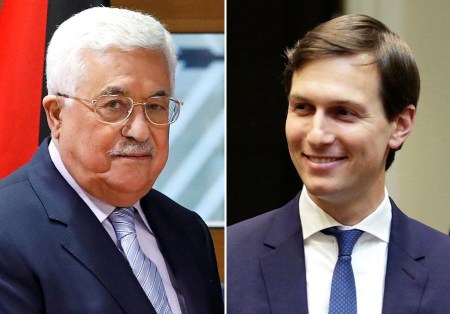
Abbas and Kushner. (photo credit:REUTERS)

US President Donald Trump is reportedly weighing whether to pull out of Israeli-Palestinian peace negotiations following a “tense” meeting with White House senior staff and officials in Ramallah, according to London-based Arabic daily al-Hayat on Saturday.

The report claimed that Trump is to determine the future of reigniting Mideast peace talks in the near future, including  the possibility of withdrawing completely from the process.

The al-Hayat report came just days after a meeting between the administration’s senior adviser Jared Kushner and Palestinian Authority President Mahmoud Abbas, which was described as “tense” by an Abbas advisor present at the talks.

Abbas was supposedly furious with the president’s son-in-law after Kushner relayed Israeli demands to the 81-year-old Palestinian leader which included the immediate halt of payments to terrorists and their families.

Abbas angrily accused Kushner and Trump’s lead international negotiator, Jason Greenblatt, of taking Israel’s side and refused to commit to the request.

The report claims that the Trump administration was equally upset with Abbas after he failed to denounce the latest stabbing attack in Jerusalem, leaving 23-year-old St.-Sgt. Maj. Hadas Malka brutally stabbed to death in a terror attack last week. Ties were further strained after Abbas reportedly refused to meet  American ambassador to Israel David Friedman.

The Palestinian official also told the paper that the Americans demanded Palestinian officials curb inflammatory statements regarding Israel.

“(Kushner) will submit his report to the president and, after it is submitted, Trump will decide if there’s a chance for negotiations or it might be preferable to pull out peace talks,” the official said.

Abbas claimed that Israel is using the issue of payments to terrorists and their families as a pretext to avoid entering peace-talks, saying that the payments are a part of the Palestinian government’s “social responsibility.”