Posted tagged ‘Israeli security’

Palestinian unity deal signed – but partial

October 12, 2017

Palestinian unity deal signed – but partial, DEBKAfile, October 12, 2017

Hamas, which calls for Israel’s destruction, has fought three wars with the Jewish state and its armed wing is designated a terrorist group by Israel, the US, the European Union and other powers.

Israel has said it will not deal with a Palestinian government that contains Hamas ministers.

*********************************

Gaza’s Rafah crossing passes from Hamas to the Palestinian Authority on Nov. 1;  the enclave’s central administration – on Dec. 1

The Egyptian-brokered deal hailed by Palestinian leader Mahmoud Abbas as “the end of the rift,” is cautiously seen in Cairo as a partial resolution of the dispute between the Fatah and Hamas rival factions.

The reconciliation accord was announced at dawn Thursday, Oct 10, by Hamas leader Ismail Haniyeh after night-long negotiations at the Egyptian intelligence ministry in Cairo. The promised news conference at which details of the agreement were to be revealed by Egyptian mediators and Palestinian officials did not take place.

Egyptian sources reveal that seven points of agreement were hammered out:

  1. The two Palestinian parties will meet in one month to set out the date and modalities for elections to the presidency and parliament.
  2. Before then, Palestinian Authority Chairman Mahmoud Abbas will spend a few days in the Gaza Strip, his first visit there in a decade since Hamas ousted his Fatah party in a military coup..
  3. A joint Palestinian Authority-Hamas commission will determine procedures for the merger of the PA and Gaza governing administrations. The future of the 60,000 people employed by the Gaza administration must also be decided.
  4. In the next two weeks, Hamas will transfer into Egyptian hands control of the Rafah border crossing from the Gaza Strip to Egyptian Sinai.
  5. The Palestinian Authority will take charge of the Rafah crossing from Egyptian officials – not directly from Hamas.
  6. Up until the parties come to terms on Gaza Strip’s electricity bill – which the Palestinian Authority has refused to cover for months – Egypt and Israel will provide the enclave with fuel for running the grid.
  7. The main sticking point in the reconciliation process – control of Hamas’ armed wing and arsenal – appears to have been left out of the deal signed Thursday. Hamas has consistently objected to foregoing or sharing control of its militia. Non-Egyptian sources report that the Palestinian Authority is to deploy 30,000 members of its security battalions to the Gaza Strip, but make no mention of coordination between the two forces. Cairo does not refer to this question.

Hamas, which calls for Israel’s destruction, has fought three wars with the Jewish state and its armed wing is designated a terrorist group by Israel, the US, the European Union and other powers.

Israel has said it will not deal with a Palestinian government that contains Hamas ministers.

The coming Israel-Iran confrontation

October 12, 2017

The coming Israel-Iran confrontation, Israel Hayom, Elliott Abrams, October 12, 2017

As one Israeli military commentator recently wrote, “If the Israeli diplomatic move fails to bear fruit, we [Israel] are headed toward a conflict with the Iranians.” That conclusion, and the Iranian moves that make it a growing possibility should be on the minds of Trump administration officials as they contemplate a new policy toward Iran’s ceaseless drive for power in the Middle East.

********************************

In the United States, discussions of Iran have for the last few years been mostly about the Joint Comprehensive Plan of Action – the nuclear deal negotiated by former President Barack Obama. In the Middle East, things are different.

This is because while we have been debating, Iran has been acting. And Israel has been reacting. Israel has struck weapon convoys in Syria a hundred times in the last five years, bombing when it saw an Iranian effort to move advanced weapons to Hezbollah in Lebanon. Last month Israel bombed the so-called Scientific Studies and Researchers Center in Masyaf, a city in central Syria, a military site where chemical weapons and precision bombs were said to be produced.

Now, there are reports that Iran is planning to build a military airfield near Damascus, where the Revolutionary Guards could build up their presence and operate; that Iran and President Bashar Assad’s regime are negotiating giving Iran its own naval pier in the port of Tartus; and that Iran may actually deploy a division of soldiers in Syria.

Such developments would be unacceptable to Israel, and it will convey this message to Russia and to the United States. Russian Defense Minister Sergei Shoigu is scheduled to visit Israel soon, after which Israeli Defense Minister Avigdor Lieberman will visit Washington. Previous Israeli efforts (during Netanyahu’s four visits to Moscow in the last year) to get Russian President Vladimir Putin to stop Iran have failed, which suggests that Israel will need to do so itself, alone – unless the new Iran policy being debated by the Trump administration leads the United States to seek ways to stop the steady expansion of Iran’s military presence and influence in the Middle East.

That remains to be seen. Rumors suggest that the Trump administration may label the IRGC a terrorist group, which could open the door to using counterterrorism authorities to stop its expansion. Whatever the debate over the JCPOA, there may well be a broader consensus in the administration that Iran’s growing military role in Iraq, Syria, Lebanon and elsewhere in the region must be countered.

Whatever the American conclusion, if Iran does indeed plan to establish a large and permanent military footprint in Syria – complete with permanent naval and air bases and a major ground force – Israel will have fateful decisions to make. Such an Iranian presence in the Mediterranean and on Israel’s border would change the military balance in the region and fundamentally change Israel’s security situation. And under the JCPOA as agreed by Obama, remember, limits on Iran’s nuclear program begin to end in only eight years, Iran may now perfect its intercontinental ballistic missile program, and there are no inspections of military sites where further nuclear weapons research may be underway.

As Senator Tom Cotton said recently, “If Iran doesn’t have a covert nuclear program today, it would be the first time in a generation.” Israel could be a decade away from a situation where Iran has nuclear weapons and has bases in Syria – and could logically therefore even place nuclear weapons in Syria, just miles from Israel’s border.

As one Israeli military commentator recently wrote, “If the Israeli diplomatic move fails to bear fruit, we [Israel] are headed toward a conflict with the Iranians.” That conclusion, and the Iranian moves that make it a growing possibility should be on the minds of Trump administration officials as they contemplate a new policy toward Iran’s ceaseless drive for power in the Middle East.

Elliott Abrams is a senior fellow for Middle East Studies at the Council on Foreign Relations. This piece is reprinted with permission and can be found on Abrams’ blog “Pressure Points.”


Israel asks US to plumb real motive behind Sisi-sponsored Palestinian talks

October 9, 2017

Israel asks US to plumb real motive behind Sisi-sponsored Palestinian talks, DEBKAfile, October 9, 2017

Jason Greenblatt, the president’s special envoy for the Israeli-Palestinian peace process, is due to arrive in Cairo Monday, Oct. 9, to ask the Egyptians what they are up to.

****************************************

Israel was startled by the Egyptian president’s comment that the Palestinian reconciliation process he is brokering would lead to peace with Israel.

Abdel Fatteh El-Sisi put it this way in an interview on Sunday, Oct. 8: “The Egyptian moves aimed at helping the Palestinian brothers to start a new stage of unity of the Palestinian ranks would pave the way for a just peace between Palestine and Israel.” He defined his goal as being: “The establishment of an independent Palestinian state to meet the legitimate aspirations of the Palestinian people for a secure, stable and prosperous life.”

El-Sisi added no further details, but he said enough to finally rattle the Netanyahu government. The Palestinian reconciliation process was clearly intruding on terrain that properly belonged to negotiations with Israel. Jerusalem’s policy of standing aside from Cairo’s efforts to broker the internal Palestinian rift between |Hamas and Fatah had left Israel without a say in the process as it advanced. It was becoming clear that Cairo was no longer briefing Israel, despite its promises to do so, on the directions to which Egyptian intelligence officials were leading the Palestinian negotiations for burying the hatchet. (On Oct. 3, DEBKAfile warned that Israel would pay a price for standing aloof from the process.)

The Netanyahu government had finally begun appreciating that trusting the Egyptians with closed eyes might lead to untoward circumstances and loss of control. The Trump administration was therefore asked to find out what was going on. As a result Jason Greenblatt, the president’s special envoy for the Israeli-Palestinian peace process, is due to arrive in Cairo Monday, Oct. 9, to ask the Egyptians what they are up to.

That is why the round of Cairo talks between the Palestinian Authority and Hamas was put back – albeit by just one day – from Monday to Tuesday.

The Trump administration was also taken by surprise by the direction indicated in the Sisi interview. His mediation effort was perceived in Washington as designed to remove the meddling hands of Iran, Turkey and Qatar from the Gaza Strip. The Egyptian effort was now revealing a quite different motivation.

Hamas negotiators, too,  are preparing to land a couple of surprises on the next round of talks in Cairo. DEBKAfile has received exclusive information on this nature of those surprises. They are clearly ploys to “pave the way for a just peace between Palestine and Israel,” in keeping with the Egyptian president’s words Sunday, while at the same time not giving an inch on their interests.

  1. Hamas will give Palestinian Authority Chairman Mahmoud Abbas and the Egyptian mediators a pledge to rescind its claim to representation in the future Palestinian unity government. In the absence of Hamas ministers, Israel will have no grounds for refusing to deal with a Palestinian administration which has no terrorist component.
  2. Hamas will also promise not to run as a movement against Abbas’ Fatah party in future elections to the presidency and parliament when it is called by the Palestinian Authority. Hamas is offering to establish a new party under a new name – such as the “Palestinian Justice Front” – for its adherents to elect, and assure Abbas and his party of victory in a general election.

By these stratagems, the extremist Hamas movement places itself on the road to achieving its two main objectives: One is to hand over full budgetary responsibility for administrating the Gaza Strip to the Palestinian Authority and Abbas; and other is to preserve the operational autonomy of its armed wing and arsenal.

In This Round of Reconciliation Talks, Hamas is the Great Victor

October 5, 2017

In This Round of Reconciliation Talks, Hamas is the Great Victor, FrontPage MagazineCaroline Glick, October 5, 2017

Tuesday’s surrender ceremonies tell us two things.

First, the notion that Fatah is even remotely interested in defeating Hamas is complete nonsense. For 10 years since its forces were humiliated and routed in Gaza, Fatah has faithfully funded and defended Hamas. Abbas’s only concern is staying in charge of his Israeli-protected fiefdom in Ramallah. To this end, he will finance – with US and EU taxpayer monies – and defend another 10 Hamas wars with Israel.

The second lesson we learn from Hamas’s victory is that we need to curb our enthusiasm for Sisi and his regime in Egypt, and for his backers in the UAE. Sisi’s decision to facilitate and mediate Hamas’s newest victory over Fatah shows that his alliance with Israel is tactical and limited in scope. His decision to side with Israel against Hamas during Operation Protective Edge three years ago may not repeat itself in the next war.
*****************************************

Originally published by the Jerusalem Post

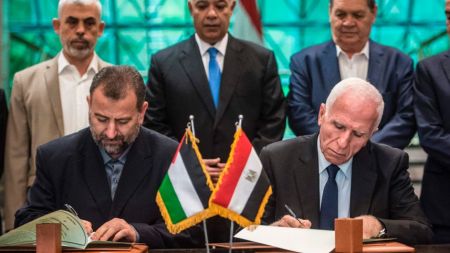
On Tuesday, a delegation of 400 Fatah officials from Ramallah, led by Palestinian Authority Prime Minister Rami Hamdallah, arrived in Gaza to officially surrender to Hamas.

No, the ceremony isn’t being portrayed as a Fatah surrender to Hamas. But it is. It’s also an Egyptian surrender to Hamas.

How is this the case? Ten years ago this past June, after a very brief and deadly assault by Hamas terrorists against US-trained Fatah forces in Gaza, the Fatah forces cut and ran to Israel for protection. Fatah politicians also headed for the border and then scurried into Fatah-controlled (and Israeli protected) Ramallah. Ever since, Hamas has served as the official authority on the ground in Gaza. Its personnel have been responsible for internal security and for Gaza’s borders with Egypt and Israel.

Despite their humiliating defeat and removal from Gaza, Fatah and its PA government in Ramallah continued to fund Hamas-controlled Gaza. They paid Gaza’s bills, including the salaries of all the PA security forces that were either no longer working or working double shifts as stay at home Fatah gunmen and up and coming Hamas terrorist forces.

The PA paid Hamas’s electricity bills to Israel and it paid Israeli hospitals which continued to serve Gaza.

Internationally, the PA defended Hamas and its constant wars against Israel. The PA and Fatah, led by President-for-life Mahmoud Abbas, continued to use Israel’s defensive operations against Hamas as a means to ratchet up their political war against Israel. The latest victory in that war came last week with Interpol’s decision to permit the PA to join the organization despite its open support for and finance of terrorism.

For most of the past decade, the PA-Fatah has allocated more than half of its EU- and US-underwritten budget to Hamas-controlled Gaza. It has defended its actions to successive delegations of US lawmakers and three US administrations. It has defended its actions to EU watchdog groups. No amount of congressional pressure or statements from presidential envoys ever made a dent on Abbas’s strident devotion to paying the salaries of Hamas terrorists and functionaries.

But then, in April, Abbas cut them off.

Ostensibly he cut them off because he was under pressure from the US Congress, which is now in the end stages of passing the Taylor Force Act. Once passed, the law will make it a bit more difficult for the State Department to continue funding the terror- financing PA.

While the Taylor Force Act is the ostensible reason for Abbas’s move, Palestinian sources openly acknowledge that congressional pressure had nothing to do with his decision.

Abbas abruptly ended PA financing of Hamas in retaliation for Hamas’s decision to open relations with Abbas’s archrival in Fatah, Muhammad Dahlan.

From 1994, when the PA was established, until 2007, when Hamas ousted his US-trained forces from Gaza, Dahlan was the Gaza strongman.

Once one of Abbas’s closest cronies, since 2011 Dahlan has been his archenemy. Abbas, now in the twelfth year of his four-year term in office, views Dahlan as the primary threat to his continued reign.

As a consequence, he ousted Dahlan from Fatah and forced him to decamp with his sizable retinue to the UAE. There Dahlan enjoys exceedingly close ties with the Nahyan regime.

The UAE is allied with Egyptian President Abdel Fattah Sisi. Both view Hamas’s mother organization the Muslim Brotherhood as their mortal foe. As a result, Sisi and the UAE as well as Saudi Arabia sided with Israel in its 2014 war with Hamas.

Since May, the UAE, Saudi Arabia and Egypt have been in open conflict with Qatar. Qatar, which sponsors the Muslim Brotherhood, has long sponsored Hamas as well.

Since the start of the year, the UAE has been interested in prying Hamas away from Qatar. And so with the blessing of his UAE hosts, Dahlan began building ties with Hamas.

Recognizing Dahlan’s close ties to the UAE and through it, with Sisi, Hamas, which has been stricken by Sisi’s war against it, and particularly Sisi’s enforcement of the closure of Gaza’s border with Egypt’s Sinai, was quick to seize on Dahlan’s initiative.

The talks between Dahlan and Sisi on the one hand and Hamas on the other were ratcheted up in April after Abbas cut his funding to Gaza.

In May, Hamas formally cut its ties with the Muslim Brotherhood.

In exchange, Sisi permitted the Rafah border crossing with Gaza to open for longer hours and permitted Gazans to transit Egypt en route to their religious pilgrimage to Saudi Arabia, among other things.

To build its leverage against Abbas, beginning in the spring, Hamas began describing Dahlan as a viable alternative to Abbas. The UAE agreed to begin financing Hamas’s budget and to help pay for electricity.

Against this backdrop, it is self-evident that Abbas didn’t send his own representatives to Cairo to negotiate a surrender deal with Hamas because his aid cut-off brought Hamas to its knees. Abbas sent his people to Cairo because Hamas’s double dealing with Dahlan brought Abbas to his knees.

As for Sisi, Hamas has also played him – and the UAE.

Over the past few months, Hamas has been rebuilding its client relationship with Iran. A senior Hamas delegation visited Tehran last month for Iranian President Hassan Rouhani’s swearing-in ceremony.

They met there with Iranian Foreign Minister Javad Zarif and with senior Revolutionary Guards commanders.

A month earlier, senior Hamas terrorist Salah Arouri, who lives under Hezbollah protection in Beirut, paved the way for the reconciliation in a meeting under Hezbollah sponsorship with senior Revolutionary Guards commander Amir Abdollahian.

Following the meeting in Tehran, Hamas leader in Gaza Yahya Sinwar extolled Hamas’s relations with Iran as “fantastic.” Sinwar also said that Iran is “the largest backer financially and militarily” of Hamas’s terrorism apparatus.

Concerned about Tehran’s growing influence in Gaza, and through it, the Sinai, where Sisi continues to fight against an Islamic State-backed insurgency, Sisi has an interest in tempering Hamas’s client-ties to Tehran.

So just as Abbas has decided to restore financing to Hamas to keep Dahlan at bay, so Sisi has decided to embrace Hamas to keep Iran at bay.

In all cases, of course, Hamas wins.

The fact that Hamas has just won is obvious when we consider the unity deal it just concluded with Fatah.

Hamas made one concession. It agreed to break up its civil governing authority – a body it formed in response to Abbas’s decision to cut off funding in April. In exchange for agreeing to disband a body it only formed because Abbas cut off its funding, Hamas receives a full restoration of PA funding. The PA will fund all civil service operations in Gaza. It will pay the salaries of all civil servants and security personnel in Gaza. It will pay salaries to all Hamas terrorists Israel freed from its jails.

In other words, the PA will now be responsible for keeping the lights on and picking up the garbage.

And Hamas will be free to concentrate on preparing for and initiating its next terror war against Israel. It can dig tunnels. It can build missiles. It can expand its operational ties with Hezbollah, Islamic State, Iran’s Revolutionary Guard Corps and Fatah.

In the wake of Hamas’s leadership’s meetings in Tehran, Sinwar told reporters that Hamas is now moving full speed ahead toward doing all of these things. Sinwar said that Hamas is “developing our military strength in order to liberate Palestine.” He added, “Every day we build missiles and continue military training.”

Thousands of people, he said, are working “day and night” to prepare Hamas’s next terror war against Israel. And indeed, two weeks ago, two Hamas terrorists were killed when the tunnels they were digging collapsed on them.

Tuesday’s surrender ceremonies tell us two things.

First, the notion that Fatah is even remotely interested in defeating Hamas is complete nonsense. For 10 years since its forces were humiliated and routed in Gaza, Fatah has faithfully funded and defended Hamas. Abbas’s only concern is staying in charge of his Israeli-protected fiefdom in Ramallah. To this end, he will finance – with US and EU taxpayer monies – and defend another 10 Hamas wars with Israel.

The second lesson we learn from Hamas’s victory is that we need to curb our enthusiasm for Sisi and his regime in Egypt, and for his backers in the UAE. Sisi’s decision to facilitate and mediate Hamas’s newest victory over Fatah shows that his alliance with Israel is tactical and limited in scope. His decision to side with Israel against Hamas during Operation Protective Edge three years ago may not repeat itself in the next war.
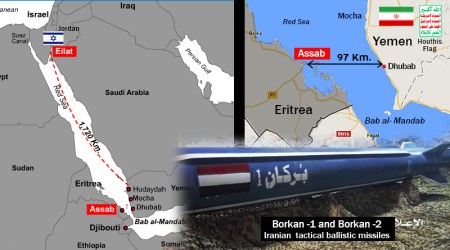
Yemen’s Houthi rebels threaten to attack Israel with missiles

October 1, 2017

Yemen’s Houthi rebels threaten to attack Israel with missiles, DEBKAfile, October 1, 2017

While Israel has no reason to fear an Iranian missile attack on its soil by Yemeni insurgents as yet,  its Red Sea shipping is definitely vulnerable to the P-20 (Chinese Silkworm) shore-to-ship weapon, a kind of cruise missile, which the Houthis have available for shooting at the Israeli war fleet and merchant vessels sailing in the Red Sea to and from the Gulf of Aqaba.

***********************

Israel heard a new threat this week from an entirely new quarter, Yemen’s rebel Houthis. Their military spokesman, Col, Aziz Rashid, said Sunday, Oct. 1, in reference to Israeli bases in Eritrea: “Israel’s military bases in Africa are within range of Houthi missiles,” adding, if necessary, “Our forces would soon have missiles capable of reaching Israel itself.”

He did not need to spell out where those missiles come from. It is no secret that the Houthis are amply armed and supplied with intermediate range ballistic missiles from a single source, their sponsor, Iran.

Interestingly, the spokesman mentioned missiles able to cover the 1,720km distance between northern Yemen and the Israeli port of Eilat. However, according to DEBKAfile’s military sources, the Yemeni insurgents don’t have missiles with that sort of range. Tehran has given them Borkan-1 and Borkan-2 tactical ballistic missiles, whose ranges are respectively 800km and 1,400km. Both are short of the distance to Israel.

In the past year, the Houthis fired a number of missiles into neighboring Saudi Arabia, leader of the coalition fighting their insurgency. Some were aimed at the capital Riyadh. Two fell short near the Yemeni border and one hit a military target outside the Saudi capital. But most of the others were either intercepted by Saudi anti-missile defenses or exploded on open ground far wide of target.

While Israel has no reason to fear an Iranian missile attack on its soil by Yemeni insurgents as yet,  its Red Sea shipping is definitely vulnerable to the P-20 (Chinese Silkworm) shore-to-ship weapon, a kind of cruise missile, which the Houthis have available for shooting at the Israeli war fleet and merchant vessels sailing in the Red Sea to and from the Gulf of Aqaba.

Exactly a year ago, a Houthi missile struck a United Arab Emirate warship and set it on fire. Ten days later, on Oct. 10, they launched missiles against the USS Mason destroyer and drew an American retaliatory blow to their missile batteries.

More recently, on September 14, the Houthi leader, Abdulmalek Badruddin Al-Houthi, declared that the UAE is within his forces’ missile range. He noted that he spoke from experience after a successful test launch at the oil emirates, which is 1,500km away. He did not say when the test took place or which missiles were fired. But he went on to boast that his army possessed drones capable of cruising through Saudi air space.

The Houthi spokesman’s threat Sunday of a missile attack on Israel was the second time in a month that the Yemeni insurgents had referred to new Iranian long-range missiles for attacking a nation accused of siding with Saudi Arabia.

They claim Israel has become involved in the Yemen war by providing the Saudis with intelligence from its reconnaissance fleet which is based at the Eritrean port of Assab just 97km across the sea from the Yemeni coast.

Israel has never acknowledged those bases, but foreign sources began reporting in 2012 the discovery of Israeli war ships and submarines in permanent berths at Assab port, as well as an early warning station built there.

Palestinian ‘Reconciliation’: Jihad is Calling!

September 25, 2017

Palestinian ‘Reconciliation’: Jihad is Calling! Gatestone InstituteBassam Tawil, September 25, 2017

(To what extent does the “international community” agree with Hamas and the Palestinian Authority that Israel must be destroyed? — DM)

Hamas insists on maintaining its terror and military capabilities in preparation for war against Israel.

At the risk of overwhelming the international community with troubling facts, here is a final one: Hamas aims to use the agreement with the Palestinian Authority as a smokescreen for concealing its true goal: the destruction of Israel.

Here is how it works: Hamas is telling Abbas, “You continue to pretend as if you want to talk peace with the Jews, while we prepare for war.”

*************************************

Leaders of Hamas maintain that under no circumstances will they agree to lay down their weapons. Hamas is, in fact, continuing full-speed-ahead digging tunnels under the border between the Gaza Strip and Israel. Hamas is planning to use the tunnels to smuggle armed terrorists into Israel.

The accord with Hamas requires Mahmoud Abbas to lift the sanctions he recently imposed on the Gaza Strip, such as refusing to pay Israel for the electricity it supplies to Gaza. It also requires Abbas to resume payment of salaries to thousands of Palestinians who served time in Israeli prison for terror-related offenses.

Above all, Hamas wants to use the agreement to be removed from the U.S. State Department List of Foreign Terror Organizations.

The Russians are closing their ears to what Hamas itself declares day after day: that its true goal is to eliminate Israel and that it has no intention of abandoning its murderous, genocidal agenda.

The Palestinian terror group Hamas has once again made clear that its true intention is to pursue the fight against Israel until the “liberation of Palestine, from the (Jordan) river to the (Mediterranean) sea.” Hamas, which controls the Gaza Strip, says that despite the latest “reconciliation” agreement reached with the Palestinian Authority (PA) under the auspices of the Egyptian government, it will continue to prepare for war with Israel.

While some Western analysts have misinterpreted the agreement as a sign that Hamas is moving towards moderation and pragmatism, leaders of the Islamist movement maintain that under no circumstances will they agree to lay down their weapons. Hamas is, in fact, continuing full-speed-ahead digging tunnels under the border between the Gaza Strip and Israel. Hamas is planning to use the tunnels to smuggle armed terrorists into Israel.

Just last week, two Hamas terrorists were killed when the tunnels in which they were working collapsed, in separate incidents in the Gaza Strip. The terrorists were identified as Khalil Al-Dumyati and Yusef Abu Abed.

The news about the collapse of the tunnels coincided with the reports of the new “reconciliation” agreement reached in Cairo between Hamas and the Palestinian Authority (PA). This means that while the Egyptians and Abbas’s representatives were discussing with Hamas leaders ways of ending their 10-year-long dispute and achieving “national unity,” Hamas terrorists were busy tunneling under the Gaza Strip to prepare for attacks on Israel.

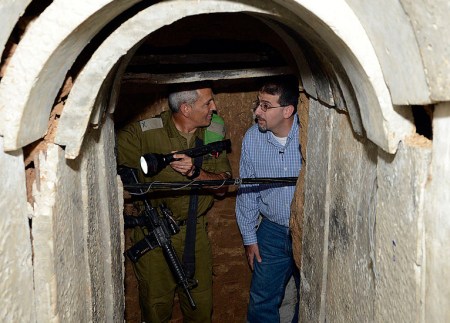
Pictured: On October 17, 2013, then U.S. Ambassador to Israel Dan Shapiro visited a tunnel penetrating Israel from Gaza, which had been discovered by the Israeli army. Shapiro said: “I was shocked from what I saw in the tunnel. It is clear that this tunnel has only one purpose: to carry out terrorist attacks against Israeli civilians and IDF soldiers.” (Image source: Matty Stern/U.S. Embassy Tel Aviv)

The “reconciliation” accord does not require Hamas to stop terror attacks on Israel. Nor does it require Hamas to abandon its charter, which explicitly calls for the elimination of Israel. Instead, the agreement, which has yet to be implemented, requires Abbas’s PA government to resume funding for various government institutions and civil servants in the Gaza Strip.

In other words, this agreement benefits Hamas by absolving it of its responsibilities toward the two million Palestinians living under its control in the Gaza Strip. Moreover, the agreement emboldens Hamas by allowing it to redirect its resources and energies towards amassing weapons and digging tunnels to be used for launching terror attacks against Israel. The accord requires Abbas to lift the sanctions he recently imposed on the Gaza Strip, such as refusing to pay Israel for the electricity it supplies to Gaza, reducing medical supplies and forcing thousands of civil servants in the Gaza Strip into early retirement. It also requires Abbas to resume payment of salaries to thousands of Palestinians who served time in Israeli prison for terror-related offenses. All this in return for one “concession” on the part of Hamas: dismantling the shadow government it established in the Gaza Strip a few months ago — something to which Hamas happily agreed in return for Abbas lifting the sanctions.

Make no mistake: Hamas has no intention of relinquishing security control over the Gaza Strip. Thousands of Hamas “security officers” and members of its military wing, Ezaddin Al-Kassam, will remain the law-enforcement force in the Gaza Strip. This means that even if Abbas’s government will be allowed to operate in the Gaza Strip, it would have limited civilian powers only, such as paying salaries and funding various projects.

One week after the Cairo “reconciliation” agreement, Hamas is still urging Abbas to lift the sanctions he imposed on the Gaza Strip. Why the rush? Jihad against Israel is calling. Hamas’s message to Abbas: Hurry up and give us the funds because we need to invest our energies and money in building more tunnels and smuggling weapons (through Egypt) into the Gaza Strip.

Hamas has been seeking international recognition and legitimacy and is hoping that the agreement with Abbas’s Palestinian Authority will facilitate this mission. Above all, Hamas wants to use the agreement to be removed from the U.S. State Department List of Foreign Terror Organizations.

This position was relayed last week to the Russian government by a senior Hamas delegation that visited Moscow. Hamas is hoping that in wake of the Egyptian-sponsored agreement with the PA, the Russians will exert pressure on the U.S. to remove Hamas from the terror list.

Musa Abu Marzouk, a senior Hamas official who participated in the Moscow discussions, confirmed that he and his friends had asked the Russians for their help. “We asked the Russians to help stop the US from keeping Hamas on the (terror) list,” Abu Marzouk said. “We also asked that the Russians help remove the (Israeli and Egyptian) blockade on the Gaza Strip.” Abu Marzouk and the Hamas delegation appear to have found a sympathetic ear in Moscow. They now claim that the Russians told them that Moscow does not consider Hamas a terror organization “because Hamas won a free and fair (parliamentary) election in 2006.”

If true, the Russians seem to have bought the lie that Hamas is headed towards moderation and pragmatism, supposedly thanks to the latest “reconciliation” agreement. More disturbing still, concerning the reported Russian position, is that Moscow, it seems, does not view Hamas as a terror group; the reason for this omission is apparently that Hamas “won” an election. The Russians are ignoring the fact that since Hamas won in 2006, the terror movement has launched thousands of rocket and other terror attacks against Israel. The Russians are also ignoring Hamas’s continued buildup and preparation for war by digging tunnels and amassing weapons in the Gaza Strip. More significantly, the Russians are closing their ears to what Hamas itself declares day after day: that its true goal is to eliminate Israel and that it has no intention of abandoning its murderous, genocidal agenda.

How do the Russians and the rest of the world define “non-negotiable”? The same way as Abu Marzouk after the Moscow visit, with regards to the Hamas weapons: “The weapons of the resistance belong to all the Palestinians and are non-negotiable,” Abu Marzouk emphasized. “No one can tamper with this issue.”

The statement means that Hamas insists on maintaining its terror and military capabilities in preparation for war against Israel.

At the risk of overwhelming the international community with troubling facts, here is a final one: Hamas aims to use the agreement with the Palestinian Authority as a smokescreen for concealing its true goal: the destruction of Israel.

Here is how it works: Hamas is telling Abbas, “You continue to pretend as if you want to talk peace with the Jews, while we prepare for war.”

In the eyes of Hamas, the “reconciliation” agreement should serve as functional sharing between the PA and Hamas, with each side playing the role it wants. Abbas will go on pretending he wants peace, while Hamas builds more tunnels and acquires additional weapons. That is their real agenda: Hamas wants to collaborate with Abbas in fooling the world. Abbas’s job will be to “pursue peace” and rake in the money, while Hamas plans for the next round of terrorism against the Jews.

It remains to be seen whether the Western-funded Palestinian Authority will be complicit in this scheme to scam the world. Also interesting should be seeing whether the international community will once again fall into the web of lies woven by the master manipulators, Abbas and Hamas.

Bassam Tawil is a Muslim based in the Middle East.

Moscow: US-backed SDF faces “destruction.” Pro-Iranian Iraqi force crosses into Syria

September 21, 2017

Moscow: US-backed SDF faces “destruction.” Pro-Iranian Iraqi force crosses into Syria, DEBKAfile, September 21, 2017

Israel’s strategic situation took several steps back in the first week of the New Year, chiefly: The US pulled back from E. Syria under Russian threat, allowing Iran to move in.

In just one week, the dire perils, which many military and political experts warned against for years, are suddenly looming on Israel’s northern border.

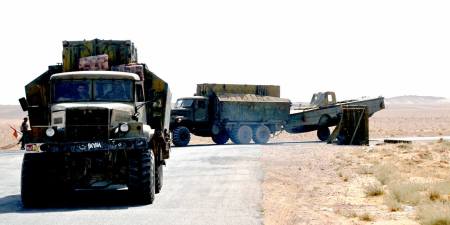
        1. From Sept.15-17, Syrian and Hizballah forces crossed the Euphrates to the eastern bank on pontoon bridges provided by Russia.
        2. Last Saturday, Sept. 16, Russian jets bombed the US-backed Syrian Defense Forces (SDF) in the Deir ez-Zour region, as a warning against their obstructing the eastward impetus of those Syrian and Hizballah units.
        3. On Monday, Sept. 18, US Marines began blowing up buildings at the Zaqaf military base in eastern Syria and then retreating to the Jordanian border. The US set up Zaqaf early this year in the Syrian Desert as a barrier against this very Syrian/Hizballah crossing to impede their advance to the Syrian-Iraqi border.
        4. The following day, on the heels of the US withdrawal, Hizballah troops took charge of the Zaqaf base.
        5. On Wednesday, Sept. 19, the Iraqi Hashd Al-Sha’abi (Popular Mobilization Units – PMU) crossed into Syria and linked up with the Syrian-Hizballah force. The PMU is under the direct command of Gen. Qassam Soleimani, head of Iranian military operations in Syria and Iraq.
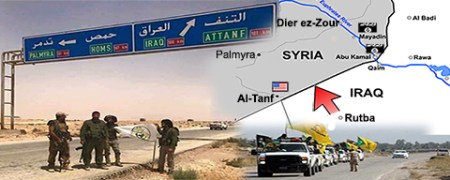
        6. Iran, through its Iraqi, Lebanese and other foreign Shiite pawns, is now in control of 230km of the Syrian border, from Abu Kamal (still held by ISIS) in the north, to Al Tanf in the Syrian-Iraqi-Jordanian border triangle in the south – where, too, US and coalition special forces have begun packing up ready to exit.
          Iran in recent years imported some 20,000 Afghan and Pakistani Shiite fighters to reinforce the Syrian army and Hizballah in their battles for Bashar Assad. The new Iraq arrivals boost that figure by tens of thousands and more are coming in all the time.
        7. On Thursday, Sept. 21, the growing disconnect between Moscow and Washington over Syria suddenly erupted into an open breach with a crude threat from the Kremlin: “Russia has officially informed the United States via a special communications channel that Russian forces will strike immediately US-backed forces if they attack or shell Syrian or Russian task forces operating near the Deir Ez-Zour city. Any attempts at shelling from the areas where the militants of the Syrian Democratic Forces are based will be immediately curbed. Russian forces will suppress firing points in these areas using all means of destruction.”

      A threat of this degree of ruthlessness has not been encountered in the Middle East for decades, it may recall Moscow’s threat to Israel in 1956 to end its invasion of the Sinai without delay or else…

      Where do these menacing steps leave Israel?

        • The US has washed its hands of central and southeastern Syria.
        • Russia is wholly, unreservedly and openly in lockstep with the Syrian army, Iran and Hizballah in all their objectives in the war-torn country, and moreover, willing to threaten any pro-American entity with total military punishment. Is this an indirect message to Israel too?
          Iraqi Shiite forces are surging into Syria; they have given Tehran the gift of control of a 230km segment of the border.

      And what does the IDF chief of staff, Lt. Gen. Gady Eisenkott have to say about all this?  In an interview to Israeli media as recently as Wednesday, Sept. 19, when it was all happening, he said: “If Iran  does entrench itself in Syria, that will be bad news for the entire region, including the moderate Sunni camp, and even more for the countries of Europe.”

He went on to explain: “That is why we have given the Iranian threat and halting its expanding influence very high priority as an issue to be dealt with.”

Gen. Eisenkott underlined the IDF’s focus as being to prevent [Israel’s foes] from obtaining weaponry, i.e. missiles – of high targeting precision.

The trouble is that, while the IDF focuses on this objective, commendable in itself, Russia and Iran are focusing and in full flight on a far wider-ranging goal, the precise and systematic deepening of Iran’s military presence in Syria. Iran and Hizballah have already established military commands at Arnaba just 6 km from Israel’s Golan border.

Yet the IDF chief is still talking about this as an untoward event that may – or may not – come some time in the future.

Syrian/Hizballah troops cross Euphrates to east

September 16, 2017

Syrian/Hizballah troops cross Euphrates to east, DEBKAfile, September 16, 2017

It is worth noting in this regard that, in recent weeks, Israel’s generals and colonels have suddenly dropped references in their discourse to Iran and Hizballah as existential threats.

This may be the time to remind them of an unfortunate precedent. In the months leading up to the Yom Kippur War of 1973, Israel’s leaders brushed aside the Egyptian and Syrian armies as threats to the state’s survival –  only to find defeat at their hands staring the IDF in the face in the early days of that war.

No less dangerous would be a war fought by the Syrian army, Hizballah and Iran, with powerful Russian military support. By establishing a foothold on both banks of the Euphrates River and both sides of the Syrian-Iraqi border, Iran has taken a step towards pursuing its avowed goal of Israel’s destruction.

***********************************

Shortly after the US-led coalition threatened to strike any Syrian Arab Army units if they crossed the Euphrates River, Syrian and Hizballah troops were marching across imported Russian pontoon bridges to reach the river’s eastern bank. By Friday, Sept. 15 they were able to establish a bridgehead there.

The attached photo shows the pontoons being lifted and set in place in a manner which recalls the method by which the IDF  was able to cross the Suez Canal for a landing in Egypt towards the end of the 1973 war.

Throughout the three-day operation, the Syrians and Hizballah worked under the cover of more newly-arrived Russian armaments, the MiG-29SMT (Nato-codenamed “Fulcrum),  whose landing in Syria was announced on Wednesday. This twin-engine jet fighter aircraft is a match for the F-18 in service with the US Air Force as well as the Israeli Air force’s F-15, F-16 and F-16 fighters.

The day the MiG-29s arrived in Syria, British Maj. Gen. Rupert Jones, Deputy Commander in Chief of the US-led Coalition in Syria, threatened to strike any units of the SAA if they crossed the Euphrates River.

The crossing operation, as well as deepening Russia’s military involvement in Syrian and Hizballah offensives, is a major boost for Iran’s objectives, with grave strategic implications for the US and Israel.

1. For the Trump administration, it trampled the principle Presidents Barack Obama and Vladimir Putin established exactly two years ago, i.e., for eastern Syrian across the Euphrates to be assigned to American military control and the west to the Russians.

2.  US satellites and reconnaissance planes watched the Russian army trucking the pontoons east and saw them being thrown over the river for the crossing. Nonetheless, no orders came from the White House or the Pentagon to make good on the coalition’s threat of a strike and to interfere.

3. Established on the east bank of the Euphrates, Syrian and Hizballah troops are in position to go forward for the operation to capture the Syrian-Iraqi border town of Abu Kamal from ISIS. They have moreover opened the way to link up with the Iraqi Population Mobilization Units (PMU), a surrogate of Iran’s Revolutionary Guards.

4. DEBKAfile’s military sources report that PMU units are already heading for this rendezvous on the Iraqi-Syrian border. This step is tantamount to opening up an Iranian-controlled military corridor between Iraq and Syria by cutting deep into the US-ruled region of eastern Syria.

5.  As recently as Thursday night, Sept. 14, President Donald Trump declared: “We are not going to stand for what they [Iran] are doing “

6.  The US president was not alone in refraining from lifting a finger to stop “what they are doing.” Prime Minister Binyamin Netanyahu likewise chose words over deeds. “Israel would not tolerate an Iranian presence on its northern border with Syria,” he reiterated Friday, Sept. 14, on his arrival in New York to address the UN General Assembly and meet Donald Trump.

But already Iran and its pawns were creating an accomplished fact, with massive logistical and military assistance from the Russian army.

It is worth noting in this regard that, in recent weeks, Israel’s generals and colonels have suddenly dropped references in their discourse to Iran and Hizballah as existential threats.

This may be the time to remind them of an unfortunate precedent. In the months leading up to the Yom Kippur War of 1973, Israel’s leaders brushed aside the Egyptian and Syrian armies as threats to the state’s survival –  only to find defeat at their hands staring the IDF in the face in the early days of that war.
No less dangerous would be a war fought by the Syrian army, Hizballah and Iran, with powerful Russian military support. By establishing a foothold on both banks of the Euphrates River and both sides of the Syrian-Iraqi border, Iran has taken a step towards pursuing its avowed goal of Israel’s destruction.

IDF’s Gaza Wall May Change Hamas Terror Strategies

September 15, 2017

IDF’s Gaza Wall May Change Hamas Terror Strategies, Investigative Project on Terrorism, Yaakov Lappin, September 15, 2017

The big question now is whether Hamas will sit back and watch Israel take away its offensive tunnel option, or whether it will feel cornered and strike out, risking a new conflict.

Hamas is most likely to respond to Israel’s improved position against the tunnels in Gaza by upping attempts to generate terrorism from the West Bank.

Hamas, together with Iran, could try to smuggle rockets into the West Bank, Karmon said, citing a directive by Iran’s Supreme Leader Ayatollah Khamenei to assist West Bank terrorist cells.

******************************

Time may be running out for one of Hamas’s main weapons against Israel: Its cross-border terror tunnels.

By 2019, according to Israel Defense Forces (IDF) assessments, Israel will complete an underground wall that stretches along the 60-kilometer (37 mile) border with Gaza. The wall is the product of several years of research and development, and is designed to eliminate the tunnel threat to Israeli communities located near Gaza.

During the past three years, since the end of its last conflict with Israel, Hamas has invested big resources into its tunnel maze. One of its top goals is to rehabilitate an ability to inject murder squads into Israeli territory through the tunnels.

Once inside Israel, they could target IDF soldiers and Israeli civilians for murder or kidnapping, whenever the next conflict breaks out.

But Israel has invested far more than Hamas to try stopping that threat. It is paying 150 million shekels ($42.5 million) for each kilometer of the new wall.

Work began on the subterranean project in areas where Israeli communities were very close to the border. Then, gradually, other areas began receiving protection.

During a conference call held with reporters in August, the commander of the IDF’s Southern Command, Maj.-Gen. Eyal Zamir, said the wall will prevent “the digging of tunnels into our territory,” adding that work is “advancing according to plan. In the coming months, this project is going to significantly accelerate. We will see an expansion in the scope of the works. Within two years, we will be able to complete work.”

Many details about the wall remain classified. But IDF sources have previously indicated that the wall will come with electronic sensors. The sensors will issue alerts to military control centers, sounding the alarm about suspicious tunnel digging activity.

The control rooms, would, in turn, be able to order action if necessary.

Similar military control rooms are popping up along the Gaza border to handle intelligence coming in from Israel’s above-ground border fence. Sensors installed on the barrier, together with units from the IDF’s Combat Intelligence Collection Corps, are joined by drones, spy balloons, and radars, all feed the control centers with a flow of data, and alert them to suspicious activity.

The big question now is whether Hamas will sit back and watch Israel take away its offensive tunnel option, or whether it will feel cornered and strike out, risking a new conflict.

“We very much hope we will not be challenged as this [work] continues,” said Zamir. “We hope that this quiet will continue, but continue to prepare. We are on high alert.”

Hamas’s military wing, the Izzadin Al-Qassam Brigades, issued a statement earlier this month saying that the underground wall “will not limit the ability of the resistance,” and vowing to “find the solutions needed to overcome it.”

But Hamas is unlikely to launch attacks in response to Israel’s wall, Ely Karmon, a senior research scholar at the International Institute for Counter-Terrorism in Herzliya, Israel, told the Investigative Project on Terrorism.

“They cannot initiate a military maneuver now. The timing is bad for them,” he said, citing Hamas’s financial woes, made worse by the fact that Qatar, under U.S. pressure, is cutting off the cash flow to the Gaza Strip.

Hamas wants to engage Egypt to improve its isolation and find a way out of its financial crisis. It just opened an office in Cairo. It cannot depend on friends like Turkey, which has a limited ability to provide assistance, Karmon said. “Beyond that, Hamas is under pressure from the Palestinian Authority. A new military clash with Israel will harm them,” he said.

During his remarks, Zamir said that the “Gaza arena is stable,” adding, “We have identified that Hamas remains deterred, and that it is restraining many attacks [by smaller Palestinian armed factions].”

At the same time, he said, Hamas is encouraging the flames of terrorism to spread in the West Bank, and is orchestrating terror cells remotely, as it prepares itself for future war in Gaza.

That’s an assessment that was echoed by Karmon, who said Hamas is most likely to respond to Israel’s improved position against the tunnels in Gaza by upping attempts to generate terrorism from the West Bank.

Hamas, together with Iran, could try to smuggle rockets into the West Bank, Karmon said, citing a directive by Iran’s Supreme Leader Ayatollah Khamenei to assist West Bank terrorist cells.

“The Iranians understood that Hamas is deterred in Gaza, and limited in what it can do,” Karmon said.

As a result, Hamas likely will remain focused on igniting the West Bank, and using it as a launchpad for terrorist attacks on Israel, he said.

Karmon cited information unveiled by the chief of Israel’s domestic intelligence agency, the Shin Bet, in recent days, which told the government that about 200 terror attacks had been thwarted in 2017.

“Most of the big attacks [that were stopped by the Shin Bet] were organized by Hamas, not Fatah,” Karmon said. “Hamas’s whole campaign is focused on the West Bank, and includes using clans that support Hamas, and distributing propaganda for violent incitement. They are neutralized in Gaza, and are trying to heat up the West Bank.”

Meanwhile, back in Gaza, Hamas continues neglecting the basic needs of the 2 million Palestinians it rules over, as it remains focused on its quiet military build-up, according to the chief of the IDF’s Southern Command.

“Many resources in Gaza are going to the Hamas military wing. They could be used instead to improve the humanitarian situation,” Zamir said. “We continue to prepare. Reality is explosive. It could deteriorate into a conflict at any time.”

In addition to offensive tunnels, Hamas has built a maze of tunnels that crisscross Gaza City. Zamir described them as “an underground metro network,” designed to move Hamas armed members, weapons, and logistics out of Israel’s sight.

Yet Israel’s Southern Command is watching these activities closely, and preparing a range of solutions designed to enable Israel to turn Hamas’s underground city into a large death trap if a new conflict begins.

The IDF’s Southern Command recently sent out images of civilian facilities in Gaza that Hamas uses as a cover for its military-terrorist activities.

One image is of a six-story residential building, which Hamas used to build an underground facility nearby, according to the military. The second photo is a of a home containing a family with five children, which is linked to a tunnel that leads to a mosque, enabling Hamas terrorists to move underground and use human shields as they do.

This type of activity “endangers the civilians of Gaza,” Zamir cautioned. “We hope that this quiet will continue, but we are continuing to prepare, and are on high alert.”

Yaakov Lappin is a military and strategic affairs correspondent. He also conducts research and analysis for defense think tanks, and is the Israel correspondent for IHS Jane’s Defense Weekly. His book, The Virtual Caliphate, explores the online jihadist presence.

US set to quit Al Tanf. Pro-Iranian force moves in

September 8, 2017

US set to quit Al Tanf. Pro-Iranian force moves in, DEBKAfile, September 8, 2017

While Israeli jets were bombing the Syrian CERS chemical facility at Masyaf, 38km west of the central Syrian town of Hama, early Thursday, Sept 7,  control of the Syrian-Iraqi border to the east was quietly changing hands.

DEBKAfile tracks the ongoing process:

  • Washington was winding up discussions with Moscow on terms for US special forces to evacuate the Al Tanf post they were holding in the Syrian-Iraqi-Jordanian triangle and hand it over to the Syrian army.Quitting Al Tanf is tantamount to the US withdrawal from southeastern Syria and its handover to Syria and its allies, including Hizballah.
  • US-backed Syrian rebel units are also about to leave their posts in the southern town of Daraa, having completed negotiations for a deal with the Russian officers manning this de-escalation zone and Hizballah officers. They have agreed to hand in their weapons and either join up with Syrian government units or disperse.. For the first time in the Syrian civil war, Hizballah announced an important development in the name of Russia.
  • Units of Tehran’s Iraqi surrogate, the Popular Mobilization Units (PMU), Thursday night began crossing the border and taking up positions in southeastern Syria. The PMU, although formally integrated in the Iraqi national army, takes its orders from Iran’s supreme Middle East commander, the Al Qods chief Gen. Qassem Soleimani.
  • Early Friday, Sept. 8, Damascus issued a warning to the US and Kurdish forces fighting to liberate Raqqa from the Islamic State, not to continue southeast towards the ISIS stronghold at Abu Kamal. This was the announcement: “The Syrian Army High Command views the liberation of the Deir Ez-Zour border city of Abu Kamal as an imperative military endeavor that cannot be dictated by the US Coalition and their allies.”
  • The connotation of this Syrian announcement is obvious: With the way clear for Syrian and Hizballah troops to move into the al-Tanf post, only Abu Kamal remains to be captured for them to achieve full command of all 600km of the Syrian-Iraqi border. Tehran’s key strategic objective of an open land corridor through Iraq to Syria and the Mediterranean will then be in the bag.

Thursday night, Israel’s Defense Minister Avigdor Lieberman, while ducking confirmation of the Israeli air strike in Masyaf, affirmed instead: “We shall not allow the formation of a Shiite corridor from Iran to Lebanon.”

He was followed by Israeli Military Intelligence (AMAN) commander Maj. Gen. Hertzi Levy, who said “We are dealing resolutely with the threats against us.”

Unfortunately, neither of these declarations appears to correlate with the real events unfolding nearby in southeastern Syria. Predominantly hostile powers are carving out new, strategic facts in that region, which pose great harm to Israel’s national security.