Posted tagged ‘Israeli security’

Hamas Wants Quiet As It Prepares For Next Assault on Israel

April 27, 2017

Hamas Wants Quiet As It Prepares For Next Assault on Israel, Investigative Project on Terrorism, Yaakov Lappin, April 27, 2017
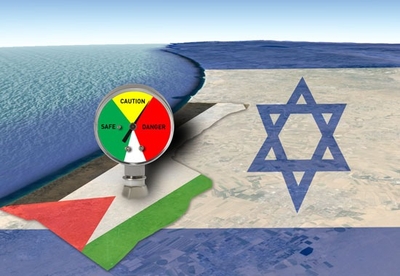
In the long run, Sinwar and his regime plan to continue to prepare for the ‘grand’ destiny they have chosen for Gaza. So long as Hamas rules Gaza, it will be the base of unending jihad against Israel, buffered by tactical ceasefires, until conditions are ripe for a new assault.

**************************

Strategically, Hamas remains as committed as ever to its objective of destroying Israel and toppling the Fatah-run Palestinian Authority in the process. Tactically, however, Hamas exhibits pragmatism and won’t rush into wars with Israel when conditions are ill suited.

Hamas looks at the long run, and remains convinced that it can eradicate Israel, even if it takes decades or centuries. Yet it would prefer to bide its time, and build up its force until the next clash while working to decrease its acute regional isolation. For this to happen, Hamas needs to avoid plunging Gaza into a new war any time soon. Yet it remains far from clear that it will be able to do this.

Should a war erupt in the near future, it likely will be triggered by unplanned dynamics of escalation.

Gaza’s woeful living standards and infrastructure are among those factors. Crises such as the ongoing electricity supply problem plaguing the Strip could facilitate an early conflict, as Hamas may try to distract the population’s frustrations from its failings, and divert them to Israel.

The Palestinian Authority (PA) is threatening to make matters worse by cutting off cash for Gaza’s power plant. It’s part of the ongoing feud between the Fatah-run PA in Ramallah and Hamas in Gaza. Gazans now receive electricity only four to six hours a day due to this feud. In January, Gazans took the unprecedented step of protesting power cuts, making Hamas extremely nervous.

In addition to tensions over the electricity crisis, a Hamas-run terror cell could spark conflict if it carries out a mass casualty attack that spawns Israeli retaliation.

The sheer scope of such plots that Israel thwarts every year is enormous.

Last year, 184 shooting attacks, 16 suicide bombings, and 16 kidnapping plots were foiled, Shin Bet chief Nadav Argaman testified last month before the Knesset’s Foreign Affairs and Defense Committee. Hamas had “significantly increased” efforts to pull off attacks in the West Bank and in Israel, he said, adding that Israeli security forces arrested more than 1,000 Hamas members in the West Bank last year and broke up 114 cells.

These are risks Hamas is prepared to take, since the day that it ceases all attempts to carry out jihadist terrorism against Israel is the day that it stops being Hamas.

Yet Hamas is also a government now, and it must consider the Gazans it rules. Hamas is keenly aware of Palestinian sentiment. Its leaders grew up in Gaza’s refugee camps and always have their finger on the pulse of Gazan society.

Hamas leaders seem to understand that the public opposes a new damaging war with Israel. They recognize that the Palestinian public cannot stomach a war with Israel every two years. The reconstruction program in Gaza following the 2014 conflict is far from complete. There are still Gazans whose homes haven’t been repaired from the damage inflicted in 2014.

The general population, despite being exposed to Hamas’s daily propaganda diet of jihadist rhetoric, would likely be reluctant to be again be used as human shields by the military wing, barely three years since the end of the last clash.

The price of Hamas’s policy of embedding its rocket launchers and fighters in Gaza’s civilian areas also is not alluring to many Gazans.

On the flip side, one of Hamas’s worst fears is of being perceived as weak. After one of its senior operatives was mysteriously killed recently, it executed three people it accused of collaborating with Israel.

Hamas also responded to Mazen Fuqaha’s murder by sending threatening messages to Israel promising vengeance. Hamas videos suggest it will target senior Israeli security officials for assassination.

Fuqaha was a key figure in the Izzadin Al-Qassam Brigades, and reportedly in charge of setting up multiple terrorist cells in the West Bank. His bullet-ridden body was found last month outside of his Gazan apartment building.

The Israeli defense establishment takes these Hamas threats seriously. Despite the noise, however, Hamas has not rushed to respond just yet – underlining the fact that Hamas is aware of the restraints factors that it is under.

Since the end of the 2014 war with Israel, the Islamist regime has shied away from escalating the security situation with Israel.

Hamas’s leadership sees unfavorable regional conditions. They lack any powerful regional backer following the 2013 downfall of Muhammad Morsi, the Muslim Brotherhood president in neighboring Egypt, in whom Hamas staked so many of its hopes.

In the past, Hamas enjoyed many partnerships, enjoying arms support and funding from the Shi’ite axis (Iran and Hizballah) – and forming relationships with Sunni powers.

But the Middle Eastern regional upheaval, which pits Sunnis against Shiites, and Islamists against non-Islamists, forced Hamas to make choices. It could no longer be on the same side of both Shi’ite Iran and Sunni Saudi Arabia, who are locked in a transnational proxy war. In the same vein, Hamas cannot be on the same side as both the Assad regime and the Sunni rebels fighting to remove him.

Worst of all from Hamas’s perspective, Morsi’s departure means it cannot rely on its primordial impulse to attach itself to a Sunni Muslim Brotherhood-led backer.

Five years ago, there were initial signs of a regional wave of Muslim Brotherhood successes. The Brothers rose to power in Egypt, Turkey, Tunisia, and had Qatari backing. Morsi’s 2013 fall changed Hamas’s fortunes for the worse. The rise of Egyptian President Abdel Fattah El-Sisi, a leader who identifies Hamas as a Gazan branch of his domestic arch-enemy, the Egyptian Muslim Brotherhood, guaranteed Hamas’s isolation.

Relations with Cairo remain rocky despite recent Hamas attempts to improve ties. Egypt may open its Rafah border crossing a few days a week, but this does not change its core view of Hamas as a true enemy, to be held at bay, weakened, and deterred.

Hamas has also fallen out with Saudi Arabia. And Hamas and Iran do not get along very well either, despite Iran continuing to be the chief sponsor of the military wing, paying it $50-$60 million a year, according to various estimates.

This leaves Hamas with just two stalwart friends: Qatar and Turkey, neither of which can back them substantially. Turkey is not an Arab state, meaning that its role in the Arab world is limited, and its desire to lead the Arab world will always be met with suspicion. A failure by Turkey to infiltrate the region means that it can only do so much to assist Gaza. Qatar, though wealthy, is politically weak, and geographically distant.

New Hamas leader Yihyeh Sinwar, despite his fundamentalist inclinations, must consider these constraints and see that his Islamist-run enclave has little real backing.

To compound its problems, Hamas also has serious financial issues. It has three main sources of income: Donations from states, donations from private individuals, and Hamas’s network of investments.

Hamas gets far less money than it used to from its donors, according to Israeli assessments. Only Qatar and Turkey donate on a regular basis, while Iran continues to finance the military wing, but not the entire movement.

Hamas is a large organization, with operations in the West Bank, Qatar, and Turkey in addition to Gaza. In the Strip, it needs to pay salaries, and prepare for its next clash with Israel. Hamas also seeks to export terrorism to the West Bank and build up political support among West Bank Palestinians. All of this costs money. It is has offices and headquarters in multiple states overseas that require annual budgets.

Private Gulf State donors are drying up. Wealthy Saudis are more interested in supporting Syrian rebels. Hamas’s cause has moved to the back of the line.

Its investments, meant to be saved for a rainy day, now must be tapped.

So what can Hamas do? First and foremost, it continues its domestic military build-up, mass producing rockets, mortar shells, variants of shoulder-fired missiles, drones, and digging tunnels – all at the expense of the welfare of the 2 million Palestinians it rules.

That’s because Hamas drew many operational lessons from its last conflict with Israel, and is keen on rebuilding its terrorist-guerrilla army without interruptions.

One lesson was to focus on a perceived Israeli vulnerability through short-range strikes. To that end, it is building new rockets that carry 200 kilogram warheads – significantly larger than past rockets made in Gaza.

These projectiles are not accurate, but would cause enormous damage if they slammed into a southern Israeli town or village.

Hamas weapons factories produce simple RPGs as well.

Second, Hamas is trying to becoming more ‘acceptable’ to the region and to the world. It is about to unveil a new charter which will be an attempt to obfuscate its jihadist ideological leanings and ties with the Muslim Brotherhood, and present itself as being merely a national “resistance” organization.

In the long run, Sinwar and his regime plan to continue to prepare for the ‘grand’ destiny they have chosen for Gaza. So long as Hamas rules Gaza, it will be the base of unending jihad against Israel, buffered by tactical ceasefires, until conditions are ripe for a new assault.

Yaakov Lappin is a military and strategic affairs correspondent. He also conducts research and analysis for defense think tanks, and is the Israel correspondent for IHS Jane’s Defense Weekly. His book, The Virtual Caliphate, explores the online jihadist presence.

Golan tension: Pro-Iran troops move on Quneitra

April 27, 2017

Golan tension: Pro-Iran troops move on Quneitra, DEBKAfile, April 27, 2017

(Please see also, Massive Explosion Reported Near Damascus International Airport Following Israeli Airstrikes. — DM)

There is no word yet on whether the warning issued by the defense minister from Moscow has produced a direct Israeli response to the provocation. Very possibly the five explosions and ball of fire they set off at Damascus international airport Thursday morning may prove to be connected to that response.

***************************

Early Thursday, April 26, a mixed Syrian-Iranian-Hizballah force embarked on a general offensive in southern Syria ready for a leap on Israel’s Golan border. They moved forward in the face of Israeli warnings that were relayed from Moscow to Tehran and Hizballah.

This latest warning was issued by Defense Minister Avigdor Lieberman, who is visiting the Russian capital this week to attend an international security conference. After meeting Russian Foreign Minister Sergey Lavrov and Defense Minister Gen. Sergey Shogun, the Israeli minister stated clearly on Wednesday: “Israel will not allow the concentration of Iranian and Hizballah forces on its Golan border.”

By Thursday morning, it was evident that a decision had been taken in Moscow, Tehran, Damascus and Beirut to ignore Lieberman’s warning.

DEBKAfile’s military sources report that early Thursday, Shiite militias under the command of Iranian Revolutionary Guards officers, alongside Hizballah troops, organized as the Southern Shield Brigade, launched their offensive at Mt. Hermon southwest of Damascus, on their way to the Syrian-Israeli Golan border in the region of Quneitra. The Syrian contingents taking part in this push are the Syrian army’s elite 42nd Brigade and elements of the 4th Mechanized Division.

Their first objective is to capture a string of villages held by Syrian rebel groups in the region of Hadar on the Hermon slopes. They are advancing towards the Golan along the Beit Jinn route.

There is no word yet on whether the warning issued by the defense minister from Moscow has produced a direct Israeli response to the provocation. Very possibly the five explosions and ball of fire they set off at Damascus international airport Thursday morning may prove to be connected to that response.

The UNRWA book battle

April 20, 2017

The UNRWA book battle, Israel Hayom, Jonathan S. Tobin, April 20, 2017

(More on the UN Rocket Warehousing Agency and the Palestinian authority. Please see also, UNRWA Won’t Be Changing School Textbooks and Curriculum. — DM)

It is an article of faith for the international community and the Jewish Left that the ‎Palestinian Authority is a moderate force that wants to make peace with Israel. ‎That belief has been undermined by many of the PA’s actions and statements since ‎its creation after the signing of the Oslo Accords in 1993, yet somehow it survives and forms the basis for many of the assumptions critics make ‎about Israel’s government.

The latest proof that the PA is a principle obstacle to ‎peace rather than its best hope has not received any attention in the Western press. ‎But a discussion of the conflict that has arisen between it and the United Nations ‎Relief and Works Agency speaks volumes about everything that is wrong ‎with the PA.‎

UNRWA is the world body that is devoted solely to aiding Palestinian refugees. ‎Unlike the United Nations High Commissioner for Refugees, which is tasked with helping all other refugees around the world, UNRWA doesn’t try ‎to resettle refugees or resolve their problems. On the contrary, since its creation ‎after the Arab failure to destroy Israel in its War of Independence, UNRWA has ‎helped to perpetuate the clash between Israel and the Muslim and Arab worlds and ‎championed the “right of return” that would spell Israel’s end. Its schools and aid ‎projects have been hotbeds of radicalism aimed at erasing the existence of the ‎Jewish state and have even been used by Hamas. In particular, critics have noted ‎the way UNRWA schools in the West Bank and Gaza have curricula and textbooks ‎that teach up to 600,000 Palestinian youngsters to reject Israel’s legitimacy and ‎glorify the struggle to destroy it. ‎

But, like the rest of the U.N., UNRWA has been feeling some pressure to ‎reform. The Trump administration has shown a willingness to throw its weight ‎around that directly contrasts with former President Barack Obama’s support for the U.N. Under ‎new Secretary General Antonio Guterres, who previously headed the U.N.’s other ‎refugee agency, efforts to promote the libel that Israel is an apartheid state were ‎rejected. So when the Arab press reported leaks about a shift in UNRWA’s ‎education policy, this seemed to indicate that even that agency was feeling some ‎pressure to change its ways.‎

According to those reports, UNRWA was planning to alter the textbooks it uses ‎in its schools. Among the planned changes, cities inside Israel would stop being labeled as Palestinian, a practice that instills a sense in readers that the Jewish state is ‎merely a colonialist intrusion built entirely on “stolen” Arab land. Other changes ‎included an effort to tone down praise of Palestinians who commit terrorism ‎against Jews and Israelis. Its teaching about Jerusalem would treat it as a city that ‎is as holy to all three monotheistic religions, rather than just Islam. That’s significant because Palestinian efforts to claim that shrines such ‎as the Temple Mount and even the Western Wall are ‎exclusively Muslim were part of a campaign of incitement that led to the recent ‎‎”stabbing intifada.” Perhaps just as significant is that the new texts would also seek ‎to correct gender bias that was part of the old books.‎

But rather than welcome reform, the Palestinian Authority has reacted with fury. ‎Last week, the PA announced that it was suspending ties with UNRWA over the ‎proposed changes, which have yet to be formally announced. It said the revisions ‎to the curriculum were an “affront to the Palestinian people, its history and ‎struggles” and that the suspension would continue until the agency’s “positions are ‎corrected.”‎

The PA Education Ministry issued the following statement:‎ “Any distortion of the Palestinian curriculum is a flagrant violation of the laws of the ‎host country, and any change to any letter to appease any party is a betrayal of the ‎Palestinian narrative and the right of the Palestinian people under occupation to ‎preserve its identity and struggle.‎”

The implications of the PA position for the prospects for peace in this or future ‎generations cannot be overestimated.‎

For more than a century, Palestinian national identity has been inextricably tied to the war on Zionism. Throughout two decades of failed peace negotiations, the ‎supposedly moderate Palestinian Authority has consistently rejected Israeli offers ‎of independence that would obligate it to recognize the legitimacy of the Jewish ‎state within any borders. Any chance that this will change rests not so much on ‎more Israeli concessions but on a sea change in Palestinian political culture. ‎Leaving aside the role of Hamas, unless the PA’s future leaders are able to embrace ‎peace without fear that doing so will be seen as a betrayal, the failure of more talks ‎is foreordained. UNRWA’s proposed changes are a step in the right direction. The ‎PA’s opposition is more proof that it is an obstacle to any hope for a better life for ‎both Israeli and Palestinian children.‎

KLEIN – Iran Is the Wild Card Following U.S. Air Strikes In Syria

April 7, 2017

KLEIN – Iran Is the Wild Card Following U.S. Air Strikes In Syria, BreitbartAaron Klein, April 7, 2017

U.S. Navy/via AP

President Vladimir Putin cannot risk a military confrontation with Trump and Russia is already signaling willingness to abandon Assad to come to a larger regional accommodation.

Still, there is the possibility that Russia may quietly support action by others, especially agents of a very nervous Iranian regime that has been preparing proxies for years who can heat up Israel’s northern border and beyond.  Both Moscow and Tehran have reason for wanting Trump to pay a price for acting in their Syrian playground.  The question is whether they will dare to respond, even tacitly.

The next few days and weeks will be critical in determining Iran and Russia’s resolve in the face of an awakened America that has returned from its eight-year slumber.

******************************

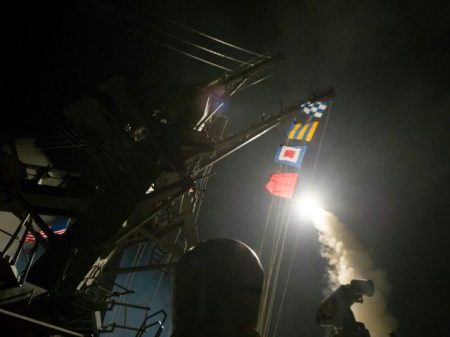
TEL AVIV – Following the U.S. launch of Tomahawk missiles targeting a strategic Syrian airfield on Thursday night, Iran must be monitored carefully for the possibility that it may use its proxies for retaliation, especially against Israel’s northern border.

Following eight years of inaction on Syria under the Obama administration, President Donald Trump demonstrated last night that he is willing to hold Syrian President Bashar al-Assad to account, this time by striking the Shayrat Airfield near the Syrian city of Homs that was believed to have been utilized to carry out a chemical weapons attack that killed scores of civilians.

The U.S. airstrikes signaled to Assad and his Russian and Iranian backers that Trump will act in Syria and the administration strongly supports the removal of the Syrian president – an important strategic ally of Moscow and Tehran. The U.S. military move demonstrates to Israel and the Sunni Arab bloc cast aside by Obama’s nuclear deal with the mullahs that American leadership has officially returned to the region.

Assad himself is unlikely to retaliate since the last thing he wants amidst a years-long insurgency attempting to topple his regime is to go to war with Trump or expand the battlefield to U.S. ally Israel.

Trump’s bold authority in Syria directly threatens Russian interests since it was Moscow that largely filled the security vacuum in that country when Obama repeatedly failed to take any meaningful action against Assad. However, Russia’s direct response will most likely be confined to vocal protestation, such as Kremlin spokesman Dmitry Peskov calling the U.S. strikes “aggression against a sovereign nation” carried out on a “made-up pretext.”

President Vladimir Putin cannot risk a military confrontation with Trump and Russia is already signaling willingness to abandon Assad to come to a larger regional accommodation.

Still, there is the possibility that Russia may quietly support action by others, especially agents of a very nervous Iranian regime that has been preparing proxies for years who can heat up Israel’s northern border and beyond.  Both Moscow and Tehran have reason for wanting Trump to pay a price for acting in their Syrian playground.  The question is whether they will dare to respond, even tacitly.

And that brings us to Iran.  Trump’s embrace of America’s traditional Sunni Arab partners at the expense of Tehran and his strong positions against the disastrous international nuclear agreement have been deeply concerning to the expansionist, terrorist-supporting Twelvers in Tehran.  And while the removal of Assad from power would be a blow to Russia, depending on the ultimate outcome such a move could be disastrous for Iran’s position in Syria.  Iranian Revolutionary Guard units have been fighting the anti-Assad insurgents alongside the Syrian military and the Iran-backed Hezbollah militia.  Syria represents a key pawn in Iran’s geopolitical chessboard that stretches across the vital region.

In recent weeks, there have been strong indications that Iran has been seeking to arm its Hezbollah proxy with even more advanced weapons that can target the Jewish state. Last month, Israel took the unusual step of striking a Hezbollah weapons convoy near the city of Palmyra that Prime Minister Benjamin Netanyahu said was transporting advanced weapons to the Iran-backed militia.

Israeli leaders and Hezbollah terrorists have in recent weeks ratcheted up war rhetoric, with Israeli officials warning that Hezbollah, which can only act at the direction of Iran, has been preparing for conflict.

Last Sunday, IDF Chief of Staff Lt. Gen. Gadi Eisenkot warned the IDF would not hold back from striking Lebanese state institutions in a future conflict with Hezbollah. “The recent declarations from Beirut make it clear that in a future war, the targets will be clear: Lebanon and the organizations operating under its authority and its approval,” Eisenkot stated.

Hezbollah is not Iran’s only option. Breitbart Jerusalem has been reporting on the formation of a “Golan Liberation Brigade,” which was announced last month by the secretary-general of the Iraqi Harakat al Nujaba Shiite militia and is reportedly being trained by the Iranian Revolutionary Guard Corps.  The so-called militia is another Iranian front that could be used to target Israel’s Golan Heights at the behest of Tehran.

The next few days and weeks will be critical in determining Iran and Russia’s resolve in the face of an awakened America that has returned from its eight-year slumber.

Trump strikes Assad and sends the world a message

April 7, 2017

Trump strikes Assad and sends the world a message, Israel National News, Jack Engelhard, April 7, 2017

(Chinese President Xi Jinping was honored with a huge fireworks display, setting the tone for his discussions with President Trump about such stuff as North Korea and the disputed islands in the South China Sea. Comrade Xi probably could not see it in far-away Syria, but if he didn’t get the message perhaps another fireworks display can be arranged in his honor just to the south of China’s border with North Korea. — DM)

Everything changed last night and the world will never be the same after President Donald Trump ordered the military to take action against Syrian dictator Bashar al-Assad. Two Navy warships fired 50 Tomahawk missiles upon a Syrian airfield from which chemical weapons were dropped on civilians, killing some 80, including children.

It was the slaughter of children that provoked Trump and led him to change his mind about interfering with force in the throes of Syria’s civil war – though he was critical of Obama for declaring a red line during a previous chemical assault but that saw no action from Obama.

Trump sent a message to Assad that indeed there’s a new sheriff in town. At the same time, Trump alerted the nations that this President means business and that the days of taking the United States for granted are over. His UN envoy Nikki Haley has been his voice of change at the UN – warning the nations that the United States has had its fill of Israel bashing while ignoring war crimes throughout the rest of the world.

In his message last night, Trump vowed to stop Assad and asked the civilized world to join him in eradicating terrorism everywhere.

He did not mention North Korean dictator Kim Jong-un. But that is one Supreme Leader that got a wake-up call, as did every other tyrant.

World leaders everywhere will now have to think twice before going ahead rashly. This includes Putin.

Americans got the news at around 8 pm last night. Full coverage was immediate throughout the cable networks.

CNN bested Fox news with sharper and more immediate facts and analysis. Anderson Cooper was factual and let the experts speak.

Fox News’ Shepard Smith was unable to mask his disdain for the President and kept interrupting his analysts with critical and inappropriate asides.

This was no time for backstabbing, but there was more of it on MSNBC.

A time like this, our military in action, is no time for bickering. The news media, so hostile to Trump from day one, will have to find a new voice in which to speak to America, whether Trump speaks their political language or not. Americans won’t tolerate divisiveness while our servicemen are in hostile waters – and certainly not when the job is about putting a stop to the random killing of infants.

For Israel there is a dark undercurrent to Trump’s response. The Palestinian Arabs who’ve been waging terrorism against Israel throughout the years, namely the PA and Hamas, have surely taken note at Trump’s heightened sensibilities toward children – they watch and they learn.

They learn that harming infants is one way to get at Trump, and so Israel must be prepared for a Gaza war aimed not to defeat Israel by arms, but through bombing Israeli towns and villages, and creating terror on the streets, drawing the IDF into a conflict that leaves Israel no choice but to move in at all costs. Otherwise the risk to the Jewish State would be unbearable.

Hamas has perfected the use of human shields to wage warfare through soliciting sympathy…with the PA’s Mahmoud Abbas cheering on.

They did it three times previously – 2008, 2012, 2014.

Hamas and the PA care nothing for the number of children that get killed, Jewish children and even their own children – if it makes a point.

So that’s Israel’s challenge against this epidemic of terrorism that has spread throughout the world.

Trump’s world is a new world and we all better start getting used to it, for the best we trust, and so far, so good.

Palestinians: The Diploma for Terror

April 3, 2017

Palestinians: The Diploma for Terror, Gatestone InstituteBassam Tawil, April 3, 2017

The unashamed glorification of murderers; terrorists paraded as role models and paragons of virtue to yet another generation of Palestinians. Under these conditions of unremitting incitement, no Palestinian can talk about peace with Israel.

When President Abbas visits the White House, it will be interesting to see if his “peace” stance includes a discussion of the Diploma for Terror.

*********************************

A glance at their leaders and senior officials tells them that Palestinian Authority jobs go to “graduates” of Israeli prisons.

Besides sending a message to Palestinians about who is valued in Palestinian society, the Fatah leader is also making it clear that the path to leadership and employment passes through Israeli prisons. Abbas’s senior representative is telling Palestinians that there is no need for them to pursue actual education: Israeli prisons are the best “universities.”

The longer the time spent in prison, the higher the military rank. Ten years will earn them the rank of Colonel. More than that will earn them General. The path to winning a job with a PA ministry also passes through Israeli prisons. These are the leaders touted as role models to young Palestinians.

Palestinians who are being held in Israeli prisons are “a model for sensibility and national culture and constitute a pillar for the establishment of a Palestinian state.” This glorification of Palestinian prisoners, many of whom are behind bars for murdering Jews, was issued last week by Fayez Abu Aitah, a senior representative of President Mahmoud Abbas’s ruling Fatah faction.

Abu Aitah’s words of appreciation for murderers of Jews came during a visit he paid to Hatem al-Maghari, a Palestinian Authority (PA) policeman who was released last week after serving 17 years in prison for his role in the lynching of two Israeli reserve soldiers who mistakenly entered Ramallah. Upon his arrival at his home in the town of Rafah in the southern Gaza Strip, Al-Maghari received a hero’s welcome. Hundreds of Palestinians have since converged on his home to congratulate him on his release from prison and heap praise him on for his “contribution” to the Palestinian cause.

Abbas’s Fatah was quick to embrace al-Maghari as “one of our sons” in order to send a message to Palestinians that the Fatah faction is also involved in terror attacks against Israel. For years, Fatah’s opponents have been accusing it of abandoning the “armed struggle” in favor of a peace process with Israel. Groups such as Hamas, Popular Front for the Liberation of Palestine (PFLP) and Palestinian Islamic Jihad continue to criticize Fatah for not being sufficiently active in the terror campaign against Israel.

The release of al-Maghari provided an opportunity for Fatah to remind its Palestinian enemies of its “contribution” to the war against Israel. The lynching of the two soldiers inside a Palestinian Authority police station in Ramallah was one of the most brutal crimes perpetrated by Palestinians. The PA leadership has never accepted responsibility for the lynching of the two soldiers, who were being held by PA policemen inside the station after taking a wrong turn into the city as they were on their way to their base.

The hero’s welcome that al-Maghari received and the words of praise from Fatah leaders serve as a reminder of how murderers of Jews continue to be hailed as role models for Palestinians. President Abbas and his PA and Fatah representatives have long lauded Palestinian prisoners held by Israel as “heroes” and future leaders of a Palestinian state.

As Abu Aitah explained during his well-wishing visit to the released terrorist:

“The prisoners are the pillar of our national movement. They have sacrificed the best of our committed and responsible national cadres that are leading the struggle of our people. Our prisoners have turned (Israeli) prisons into universities from where the future leaders graduate.”

Besides sending a message to Palestinians about who is valued in Palestinian society, the Fatah leader is also making it clear that the path to leadership and employment passes through Israeli prisons. In no uncertain terms, he is saying to young Palestinians: “If you want to become a leader, you need to prove your qualifications by following the example of those Palestinians who carried out terror attacks against Israel and spent time in Israeli prison.” Again: Abbas’s senior representative is telling Palestinians that there is no need for them to pursue actual education: Israeli prisons are the best “universities.”

Palestinians have every reason to believe Abu Aitah; he is the top Fatah official. Just a glance at their leaders and senior officials tells them that Palestinian Authority jobs go to “graduates” of Israeli prisons. There is no shortage of such leaders who rose to power thanks to their involvement in terror attacks against Israel.

In the world of the Palestinians, terror is indeed the diploma of currency. Serving time in Israeli prison can even earn one a military rank without having to go to any military or security academy.

The PA, according to Palestinian sources, has one of the largest numbers of Generals and Colonels in the Arab world. Most of these high-ranking officers earned their titles thanks to the time they served in Israeli prison, not because they studied at any military academy.

Take, for example, Jibril Rajoub, the former commander of the Palestinian Authority’s notorious Preventive Security Force, who holds the rank of Major-General. Rajoub’s rank is largely the result of the 17 years he spent in Israeli prison for his role in terrorism. Rajoub is only one of dozens, if not hundreds, of former prisoners who hold such high-ranking titles but do not have any real military background.

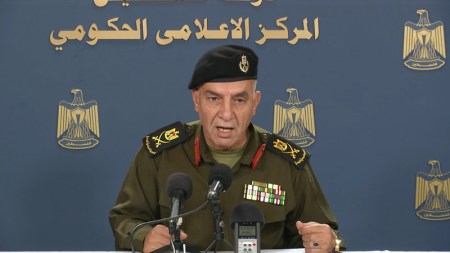
Many high-ranking PA security officials, such as Major-General Adnan Damiri, spokesman for the PA security forces, wear medals and decorations on their military uniforms even though they have not participated in any war. Damiri spent 10 years in Israeli prison for security-related offenses.

Many high-ranking Palestinian Authority (PA) security officials, such as Major-General Adnan Damiri, spokesman for the PA security forces, wear medals and decorations on their military uniforms even though they have not participated in any war. (Image source: PA video screenshot)

These are the leaders touted as role models to young Palestinians. No small number of Palestinian senior “officers” failed even to complete their high school education. But that should not bother any Palestinian who is dreaming of assuming a senior job in a Palestinian state.

On April 17, the Palestinians will again mark “Palestinian Prisoners’ Day” by holding as series of rallies in solidarity with prisoners who carried out terror attacks against Israel. This event is marked every year by Palestinians to honor the “heroes” who made “huge sacrifices” on behalf of the Palestinians.

These “sacrifices” include the maiming and murder of Jews. The annual event in the West Bank is sponsored and funded by Abbas’s Fatah, in turn funded by Europe and the West, in the context of glorifying terrorists and encouraging Palestinian youths to follow their presumably heroic example.

A Palestinian teenager who wishes to become a “general” under Abbas need not apply to any sort of academy. The shortest route to achieve rank is by carrying out a terror attack against Israel and doing time in Israeli prison. The longer the time spent in prison, the higher the military rank. Ten years will earn them the rank of Colonel. More than that will earn them General. The path to winning a job with a Palestinian Authority ministry also passes through Israeli prisons. Former prisoners are treated as the “good boys of the revolution” and granted the plum jobs. Meanwhile, those Palestinians who actually choose to become educated once again lose out.

It would be no surprise, then, if al-Maghari finds himself awarded the rank of General in Abbas’s Fatah-controlled security forces.

And so it continues: the unashamed glorification of murderers; terrorists paraded as role models and paragons of virtue to yet another generation of Palestinians. Under these conditions of unremitting incitement, no Palestinian can talk about peace with Israel.

When President Abbas visits the White House, it will be interesting to see if his “peace” stance includes a discussion of the Diploma for Terror.

London terror – a lesson from Israel

March 23, 2017

London terror – a lesson from Israel, Israel National News, Jack Engelhard, March 23, 2017

So yesterday violent Islam won again, this time in London, from where the UK’s foreign secretary, Boris Johnson, only a few weeks ago, warned Israel that it must absolutely abide by a two-state solution – must split itself in half to make happy Hamas, Abbas, the PA, the PLO and the rest of them that seek Israel’s destruction – along with the rest of Western civilization.

Does nothing get learned?

***********************

A terrorist rams his car into a crowd. Then he steps out and starts knifing civilians.

That was Wednesday in London, but in Israel it can be any day of the week.

So the terrorist attack at Westminster outside Parliament, which killed four, would surprise no Israeli, particularly as to this pattern of terrorism. In Israel it’s been going on for years…deadly car rammings and indiscriminate knifings as a method to strike fear into the heart of an entire population.

Now the entire world knows how it feels, but it all begins in Israel, where Islamic terrorists try out new tactics to see how the rest of the world will respond. I call it spring training for Radical Islam. If the response is full support for Israel, we win, they lose.

But if the world says the terrorists had an excuse…if the world says Israel must give up more land to pacify Muslim extremists…we lose, they win.

So yesterday violent Islam won again, this time in London, from where the UK’s foreign secretary, Boris Johnson, only a few weeks ago, warned Israel that it must absolutely abide by a two-state solution – must split itself in half to make happy Hamas, Abbas, the PA, the PLO and the rest of them that seek Israel’s destruction – along with the rest of Western civilization.

Does nothing get learned?

The brave talk fools nobody, not the Islamic hot heads first of all. “We remain defiant,” said one Member of Parliament over at the BBC.

Defiant, how? You keep bringing more of them in.

Basic math says the more terrorists you bring in, the more you are bound to suffer the consequences.

Granted, they are not all terrorists, but so inclined from specific countries. Our President, Donald Trump, keeps trying to keep them out.

So far he has not been entirely successful because of certain judges who tolerate anything, including rape, in the name of Tolerance.

In the name of Inclusiveness they give in to terror, and so, an hour after the attack, another Member of Parliament told the BBC:

“We will never give in to terror.”

Have you tried getting on a plane lately – without being near strip-searched? Every big city has quadrupled its police force and its intelligence gathering operations. Walls have gone up all over Europe – and we are building a wall. Check points everywhere. Constant alerts – if you see something, say something.

What is that? That is giving in to terror, and it’s happening all over, and electing a Muslim as London’s mayor stopped nothing.

Over the months, Mayor Sadiq Khan has called Trump’s proposed travel pause offensive and “ridiculous.”

Now what’s he say?

Kahn also said that every big city around the world ought to be ready and to expect terror attacks.

No, Sir, we never expected any such business until we shut our eyes and flung our doors and borders wide open.

Fatah Official: We Should Launch Popular Resistance Against Israel Because What Unites Us Is The Struggle Against It, Not Dialogue With It

March 22, 2017

Fatah Official: We Should Launch Popular Resistance Against Israel Because What Unites Us Is The Struggle Against It, Not Dialogue With It, MEMRI, March 22, 2017

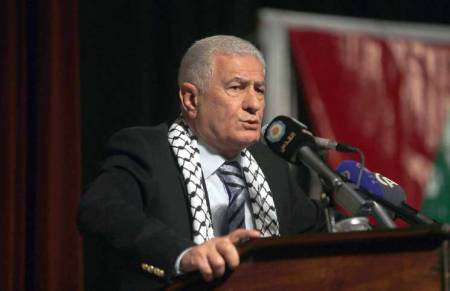
In a March 21, 2017 article in the Palestinian daily Al-Quds, Fatah Central Committee member ‘Abbas Zaki wrote that nothing has changed since the 1967 defeat. Therefore, he said, Fatah must mobilize its tens of thousands of members and launch a popular resistance campaign against Israel, which all the other Palestinian factions will then join. He claimed that Fatah already did this in the past, after 1967, when its resistance operations “restored the Arab nation’s hope and realized the Palestinian legitimacy,” because “the sword is ever aimed [at the enemy] and the rifle comes before the olive branch.” He called on the Palestinian officials to continue pursuing Israel in international courts and to put the good of the homeland before their personal interests, as the “generation of pioneers” did.

The following are excerpts from his article:[1]

‘Abbas Zaki (image: Al-Quds, Jerusalem)

“How similar our current time is to yesteryear. In the June 1967 [war] we suffered defeat, and the [West] Bank, Sinai, and the Golan fell into Israeli hands. The leader of the [Arab] ummah, [Gamal] ‘Abd Al-Nasser, [felt] compelled to resign from his position and become a private citizen, [but] the public came out and stopped him from doing this. He had a high measure of national honor and people like him do not accept defeat, in accordance with his eternal slogan: What was taken by force cannot be restored by anything other than force, and therefore he decided on a war of attrition [against Israel].

“At the time, a message was sent to Fatah in Damascus that read: Oh, boys of Fatah, mobilize and fight, even by starting fires. If you don’t do this, Arab banners will never be raised [in these lands]. The leader of our path and the commander of our revolution, Yasser Arafat, took the hint and left for the occupied lands immediately – crossing the Syria-Jordan border and reaching the [Jordan] valley. The [deputy] commander of [Fatah’s] Al-‘Asifa unit, Abu Sabri Saidam, also followed suit. From there they crossed the Jordan River to the place their hearts yearned for – to Palestine, which is suffering the wound of the occupation and the disappointments of defeat…

“Fatah restored the nation’s hope and realized the Palestinian legitimacy by [creating] the PLO framework and with other achievements that cannot be downplayed. Despite the ups and downs, the sword remains aimed [at the enemy] and the rifle comes before the olive branch, while [Fatah] is showing the entire world that the Palestinian people are heroes who will never surrender or bend; that the smallest geographic region [can] occupy the world’s decision-makers; and that the Palestinian issue is the strongest card in the equation of Middle East conflicts…

“[We] require the awakening and practical action of tens of thousands of Fatah activists, [who must] join the civil popular resistance against the settlers and occupation forces, and their number will double once they are joined by national and Islamic parties and organizations, and by the entire public of our mighty people. For what unites the Palestinians is the struggle rather than the dialogue [with Israel], [a dialogue] which has already lost its effectiveness on all tracks. If the sweeping [masses] block the bypass roads [leading to the Israeli settlements in the West bank], Israel and the settlers will not remain [in the West Bank] because their presence there is motivated by their freedom [of movement] and an absence of resistance to their presence there as imperialists who occupy our Palestinian land.

“The government and the [PLO] Executive Committee need to pursue Israel in international courts for its ongoing crimes, presenting everything related to these issues: the settlements; the prisoners; the destruction of the foundations of Palestinian life; the crimes of arson, murder and demolition of homes, and the denial of our people’s freedom. [All this in order] to place Israel on the list [of countries that practice] apartheid, as the report of the [UN’s] Economic and Social Commission for Western Asia [ESCWA] stated – and we cherish the role played by [the commission’s former head,] Rima Khalaf, in this – and in order to place Jerusalem… at the top of the priority list of Palestinian missions on the economic level, and support the steadfast position and all needs of life in a manner befitting [Jerusalem’s] status as the eternal capital of Palestine and its spiritual status in the world.

“In order to belong to the generation of pioneers at this difficult phase, we must be loyal to the oath of devoting our time, money, and spirit to the homeland… and make sure that those who are concerned with the Palestinian cause will win out over those who seek privileges at the expense of the homeland… [All this] in order to fulfill our national dream of return and the establishment of an independent state with Jerusalem as its capital and our people’s right to self-determination. Each of us should ask himself what proof he can give that we are following in the footsteps of the great ones in order to rally our public – which is water and life, and the recipient of future rights. Long live the memory, the glory of the martyrs, and the freedom for prisoners.”

_________________________________

[1] Al-Quds (Jerusalem), March 21, 2017.

World Shrugs as Hizballah Prepares Massive Civilian Deaths

March 21, 2017

World Shrugs as Hizballah Prepares Massive Civilian Deaths, Investigative Project on Terrorism, Noah Beck, March 21, 2017

Like the terror group Hamas, Hizballah knows that civilian deaths at the hands of Israel are a strategic asset, because they produce diplomatic pressure to limit Israel’s military response. Hizballah reportedly went so far as offering reduced-price housing to Shiite families who allowed the terrorist group to store rocket launchers in their homes.

********************************

Hizballah leader Hassan Nasrallah recently warned Israel that his Iran-backed terror group could attack targets producing mass Israeli casualties, including a huge ammonia storage tank in Haifa, and a nuclear reactor in Dimona.

Also last month, Tower Magazine reported that, since the beginning of the Syrian civil war, Iran provided Hizballah with a vast supply of “game-changing,” state-of-the art weapons, despite Israel’s occasional airstrikes against weapons convoys.

In a future conflict, Hizballah has the capacity to fire 1,500 rockets into Israel each day, overwhelming Israel’s missile defense systems. Should such a scenario materialize, Israel will be forced to respond with unprecedented firepower to defend its own civilians.

Hizballah’s advanced weapons and the systems needed to launch them reportedly are embedded across a staggering 10,000 locations in the heart of more than 200 civilian towns and villages. The Israeli military has openly warned about this Hizballah war crime and the grave threats it poses to both sides, but that alarm generated almost no attention from the global media, the United Nations, or other international institutions.

Like the terror group Hamas, Hizballah knows that civilian deaths at the hands of Israel are a strategic asset, because they produce diplomatic pressure to limit Israel’s military response. Hizballah reportedly went so far as offering reduced-price housing to Shiite families who allowed the terrorist group to store rocket launchers in their homes.

But if the global media, the UN, human rights organizations, and other international institutions predictably pounce on Israel after it causes civilian casualties, why are they doing nothing to prevent them? Hizballah’s very presence in southern Lebanon is a flagrant violation of United Nations Security Council resolution 1701, which called for the area to be a zone “free of any armed personnel, assets and weapons” other than the Lebanese military and the U.N. Interim Forces in Lebanon (UNIFIL).

The resolution also required Hizballah to be disarmed, but the terror group today has an arsenal that rivals that of most armies. Hizballah possesses an estimated 140,000 missiles and rockets, and reportedly now can manufacture advanced weapons in underground factories that are impervious to aerial attack.

“Israel must stress again and again, before it happens, that these villages [storing Hizballah weapons] have become military posts, and are therefore legitimate targets,” said Yoram Schweitzer, senior research fellow at Israel’s Institute for National Security Studies (INSS).

Meir Litvak, director of Tel Aviv University’s Alliance Center for Iranian Studies, agrees, adding that global attention would “expose Hizballah’s hypocrisy in its cynical use of civilians as… human shields.”

Even a concerted campaign to showcase Hizballah’s war preparation is unlikely to change things, said Eyal Zisser, a senior research fellow at the Moshe Dayan Center for Middle Eastern and African Studies. Hizballah exploits the fact that “the international community is too busy and…weak to do something about it,” Zisser said. All of “these talks and reports have no meaning. See what is happening in Syria.”

Israel has targeted Hizballah-bound weapons caches in Syria twice during the past week. Syria responded last Friday by firing a missile carrying 200 kilograms of explosives, which Israel successfully intercepted.

If Hizballah provokes a war, Israel can legitimately attack civilian areas storing Hizballah arms if the Israel Defense Forces (IDF) first attempts to warn the targeted civilians to leave those areas, Litvak said. But “it will certainly be very difficult and will look bad on TV.”

While Sunni Arab states are generally united against the Shiite Iranian-Hizballah axis, Litvak, Zisser, and Schweitzer all agreed that Israel could hope for no more than silent support from them when the missiles fly.

Indeed, the “Sunni Arab street” is likely to be inflamed by the images of civilian death and destruction caused by Israel that international media will inevitably broadcast, further limiting support for Israel from Iran’s Sunni state foes.

Rather perversely, the Lebanese government has embraced the very terrorist organization that could cause hundreds of thousands of Lebanese civilian deaths by converting residential areas into war zones. “As long as Israel occupies land and covets the natural resources of Lebanon, and as long as the Lebanese military lacks the power to stand up to Israel, [Hizballah’s] arms are essential, in that they complement the actions of the army and do not contradict them,” President Michel Aoun told Egyptian television last month. Hizballah, he said, “has a complementary role to the Lebanese army.”

Aoun’s declaration means that Lebanon “takes full responsibility for all of Hizballah’s actions, including against Israel, and for their consequences to Lebanon and its entire population, even though the Lebanese government has little ability to actually control the organization’s decisions or policy,” said INSS Senior Research Fellow Assaf Orion.

MK Naftali Bennett, a veteran of Israel’s 2006 war with Hizballah, believes that Lebanon’s official acceptance of Hizballah and its policy of embedding military assets inside residential areas removes any constraints on Israeli targeting of civilian areas. “The Lebanese institutions, its infrastructure, airport, power stations, traffic junctions, Lebanese Army bases – they should all be legitimate targets if a war breaks out,” he said. “That’s what we should already be saying to them and the world now.”

In a future war, Hizballah is certain to try bombarding Israeli civilian communities with missile barrages. Israel, in response, will have to target missile launchers and weapons caches surrounded by Lebanese civilians.

But it need not be so. Global attention on Hizballah’s abuses by journalists and diplomats could lead to international pressure that ultimately reduces or even prevents civilian deaths.

Those truly concerned about civilians do not have a difficult case to make. Hizballah has shown a callous disregard for innocent life in Syria.

It helped the Syrian regime violently suppress largely peaceful protests that preceded the Syrian civil war in 2011. Last April, Hizballah and Syrian army troops reportedly killed civilians attempting to flee the Sunni-populated town of Madaya, near the Lebanese border. In 2008, its fighters seized control of several West Beirut neighborhoods and killed innocent civilians after the Lebanese government moved to shut down Hizballah’s telecommunication network.

Hizballah terrorism has claimed civilian lives for decades, including a 1994 suicide bombing at Argentina’s main Jewish center that killed 85 people . As the IDF notes, “Since 1982, hundreds of innocent civilians have lost their lives and thousands more have been injured thanks to Hizballah.”

If world powers and the international media genuinely care about avoiding civilian casualties, they should be loudly condemning Hizballah’s ongoing efforts – in flagrant violation of a UN resolution – to cause massive civilian death and destruction in Lebanon’s next war with Israel.

In-House Hizballah Missile Factories Could Add to Massive Arms Buildup

March 17, 2017

In-House Hizballah Missile Factories Could Add to Massive Arms Buildup, Investigative Project on Terrorism, Yaakov Lappin, March 17, 2017

This does not mean Hizballah is seeking a conflict with Israel now, but it does mean that should a new war erupt in the future, Israel’s civilian population will face unprecedented threats.

Israel’s defense establishment is making its own preparations accordingly, based on the understanding that this Iranian agent has developed into a full-fledged terrorist army.

*********************************

A recent report saying that Iran constructed underground missile factories in Lebanon for Hizballah would, if accurate, indicate a disturbing boost in the Shi’ite terror organization’s ability to self-produce weapons.

Already, the Israeli defense establishment sees Hizballah as a powerful and radical army rather than a ‘mere’ terror organization due to its deep and sophisticated weaponry (which surpasses that of most states), and its hierarchical command structure.

An ability to manufacture destructive rockets and missiles would mean that the militant Islamist Lebanese-Shi’ite organization is no longer entirely reliant on arms trafficking from its patron Iran and ally, the Assad regime in Syria.

The report, made available by the Middle East Media Research Institute (MEMRI), was published in the Kuwaiti daily Al-Jarida. It cites an aide to the commander of Iran’s Islamic Revolutionary Guards Corps (IRGC) as its source. The IRGC’s Quds Force is an elite unit that runs Iran’s extensive overseas operations to arm, finance, and strengthen Iran’s regional proxies.

According to the Kuwaiti report, the IRGC built the arms-making facilities more than 50 meters underground and fortified them against air strikes before handing control of them over to Hizballah three months ago.

The report is well within the realm of the possible, Ely Karmon, a Hizballah expert and a senior research scholar at the International Institute for Counter-Terrorism in Herzliya told the Investigative Project on Terrorism. He pointed to a 2015 statement made by the IRGC’s Aerospace Force commander, Brigadier General Amir Ali Hajizadeh, boasting that Tehran has provided “Syria, Iraq, Palestine and the Lebanese Hizballah resistance group with the needed know-how to produce missiles.”

“The IRGC’s Aerospace Force has developed to a stage in the field of missile industries that it can mass-produce different types of short- and mid-range missiles,” Hajizadeh said.

Assessing the latest Kuwaiti report, Karmon said that it is “possible that these Hizballah military factories are in the Quseyr area in Syria, and not in Lebanon.” Quseyr is an area of western Syria near Lebanon which has come under Hizballah control in recent years after being seized from Sunni rebel organizations.

Israel bombed targets in the area in the past, Karmon noted, likely as part of Israel’s covert program to selectively disrupt of Hizballah’s force build-up.

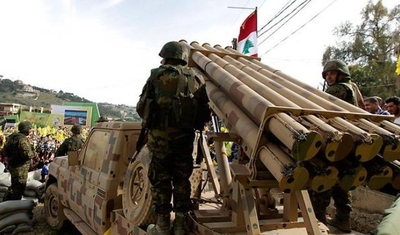
In November, Hizballah paraded its heavy weaponry in Quseyr – including tanks, armored personnel carriers, artillery guns, and missile launchers.

The Kuwaiti report also claimed that “a special department has been established at the IRGC’s Imam Hossein University [in Tehran] to train Lebanese and other experts, and hundreds of experts have already been trained… The manufacture of the missiles does not take place in one factory; different parts are built in different factories and then assembled together.”

The missile factories reportedly can produce surface-to-surface missiles with a range of over 500 kilometers – in other words, capable of hitting anywhere in Israel – surface-to-sea missiles, perhaps intended to hit Israeli ships and Israel’s offshore gas rigs in the Mediterranean Sea, armed drones, anti-tank missiles, and other weapons. The production sites can also be used to make machine guns, mortars, and anti-aircraft guns.

Since the end of the 2006 war with Israel, Hizballah stockpiled an arsenal totaling 120,000 missiles – one of the largest of its kind in the world. The vast majority of these arms were manufactured in Iran and Syria and smuggled into Lebanon. A growing number are guided rockets and missiles, which Hizballah could use to try to use to overcome Israeli air defenses and target sensitive targets.

Iranian weapons transfers continue regardless of whether Hizballah has access to its own missile factories. Israeli Prime Minister Benjamin Netanyahu provided details on “the ongoing Iranian attempt to transfer weapons, advanced weapons, to Hizballah, via Syria,” when he visited Russian President Vladimir Putin in Moscow earlier this month.

Reports say that Israel targeted such weapons again overnight, triggering Syrian surface-to-air missile fire at Israeli jets. At least one of those missiles reportedly was intercepted by Israel’s Arrow defense system.

Hizballah also is training elite terror cells to infiltrate Israel during the next war, and to temporarily ‘conquer’ northern Israeli communities in a bid to demoralize Israelis.

These preparations, it is safe to assume, are being closely monitored by Israel.

Hizballah’s deep involvement fighting for the Assad regime in Syria for four years also has boosted its power. The best form of training is combat itself, and its operatives have been exposed to Iranian commanders and technology on the battlefields of Syria.

Meanwhile, back in Lebanon, Hizballah has embedded the vast majority of its bases, rocket launchers, and command posts in civilian regions, including a massive maze of underground tunnels and subterranean compounds.

Yet all is not well in Hizballah’s camp despite its clear and growing power. Hizballah is facing a dramatic economic crisis due to a shortage of cash flow from Iran, which itself has not yet received all of the funds it was expecting to get after signing the nuclear deal.

Hizballah’s expenses are not only military and terrorist. They include many civilian and political activities in Lebanon, for which it is now struggling to pay. Additionally, the fact that it has sustained more than 1,500 casualties in Syria has demoralized sections of the traditional Lebanese Shi’ite support base.

Nevertheless, Hizballah is pushing to build up its massive offensive capabilities against Israel.

It seeks more accurate rockets and missiles, while its leader Hassan Nasrallah has repeatedly threatened to strike Israeli strategic targets such as ships carrying industrial ammonia to the Israeli city of Haifa, and Israel’s nuclear reactor in Dimona.

This does not mean Hizballah is seeking a conflict with Israel now, but it does mean that should a new war erupt in the future, Israel’s civilian population will face unprecedented threats.

Israel’s defense establishment is making its own preparations accordingly, based on the understanding that this Iranian agent has developed into a full-fledged terrorist army.