Posted tagged ‘Israel’

Does the PA have a strategy?‎

October 11, 2015

Does the PA have a strategy?‎ Israel Hayom, Richard Baehr, October 11, 2015

Abbas may sense that a reconciliation between Israel and the ‎Obama administration is not at hand this time around. The obvious and petty ‎boycott of Netanyahu’s speech at the U.N. certainly supports that thesis. This president ‎carries grudges. In Israel’s case, he seems to have come into office carrying one. ‎With the president in full-time legacy-building mode in his last 16 months in office ‎‎(the climate treaty and executive action on gun control are next up), it is hard to ‎believe that he will simply accept defeat and an inability to influence the Israeli-‎Palestinian conflict in the time he has left. ‎

************************

A third intifada has not yet been officially designated by Haaretz or The New York ‎Times or National Public Radio, though it may feel as if one is underway, when ‎over 60% of Israelis in the latest public opinion survey say they now fear for their ‎personal safety. So too, there is no evidence yet that the wave of Palestinian ‎attacks or — new to this current campaign — the attempted mass crossings from Gaza, ‎have peaked. ‎

Certainly, the reporting on the current events in Israel reflects old habits about ‎how most journalists cover stories of Palestinian violence and Israeli responses. ‎Two standbys always work. One if that there is “a cycle of violence” ( a pox on both ‎your houses), always leaving unclear who the original perpetrators were in an ‎individual attack or group of attacks. A second is to keep a daily scorecard of the ‎comparative body counts, especially when there are more Palestinian casualties ‎and fatalities than Israeli, courtesy of Israeli police or soldiers responding to ‎stabbing attacks, not all of which prove lethal before the attacker is neutralized. ‎This narrative leads to the inevitable charge of disproportionality, one that has ‎become the principal media assault on Israeli responses to terror emanating from ‎Gaza in recent years. As in every other instance in recent years, Haaretz is playing ‎its appointed role of feeding the many international journalists in the country with ‎the “truth in English” as it sees it, and as the international media want to receive ‎and see it, confirming all their established biases about Israel behavior.

For Israeli ‎responses to the current violence to be “fair” and proportional, the comparative ‎Jewish and Arab body counts would need to be more in balance than in prior ‎years. When the current campaign of attacks on Israelis began, The New York Times ‎relegated the story to it its interior pages. Once a few Palestinians were killed by ‎Israeli police, the story became front page news.‎

Any attack on Arabs by an Israeli is always highlighted since it removes any ‎attempt by Israel to argue it is the victim of attacks. It also buttresses the PA’s ‎charges that Israelis, whether in security roles or settlers, are willing executioners, ‎committing crimes against Palestinians. Regardless of how infrequent these individual attacks by Israelis ‎are, they serve to solidify the cycle of violence theme. The Israeli government can ‎condemn these attacks and capture the perpetrators, but it makes no difference. ‎The PA, meanwhile, will applaud the heroism of their new martyrs protecting the ‎holy places on the Temple Mount from an invasion of stinking Jewish filth.‎

The current wave of Arab attacks followed a Palestinian Authority incitement ‎campaign with language such as that above, in which President Mahmoud Abbas, ‎seemingly the president for life, though only elected to a four year term, ‎condemned Israel’s campaign to change the status of the Temple Mount, for which ‎there is no evidence whatsoever. U.S. Secretary of State John Kerry, probably in ‎seclusion and being treated with antidepressants since being denied the Nobel ‎Peace Prize for his abject surrender to the Iranians in Geneva, has acknowledged ‎to Israeli Prime Minister Benjamin Netanyahu that the Americans understand there is no ‎Israeli effort underway to reshape any policy regarding behavior on the Temple ‎Mount. Kerry can probably blame Yasser Arafat’s Nobel Peace Prize for the peace ‎prize medal he did not receive (and likely would not have tossed away). The ‎selection committee was probably not anxious to have the Iranians make them look ‎like fools in years to come once they violated the nuclear deal as Arafat tossed Oslo ‎aside when it was inconvenient. ‎

The naked demagoguery of Abbas’ continually repeated lies about Israeli plans for ‎the Temple Mount will always have the desired affect on the many young men on ‎whom the PA can depend to take to the streets and do their part to protect the ‎‎”holy places” for a fee. While there is no consensus on the degree of PA control ‎over the attacks, the Palestinians certainly know where their rhetoric leads.‎

The question, though, is why the Palestinians have chosen this point in time to ‎overheat the situation, resulting in the loss of both Israeli and Palestinian lives.‎

The answer offered by most analysts so far is that the PA wanted to draw ‎international attention back to its grievances with Israel, which most basically ‎begins with the continued existence of the State of Israel. For many months, ‎relations between Israel and the United States, never very good at any time during ‎the Obama years, have become much more fractious as a result of the ‎disagreement between the two countries over the wisdom of America’s ‎spearheading the effort to make all the concessions required as achieve the ‎nuclear deal with Iran by the ‎P5+1 group of nations. ‎

In prior administrations, when relations between the two countries hit a rough ‎patch over some policy disagreement, typically there was an effort made by both ‎parties to try to restore the historic relationship. In the Obama years, the White ‎House has had problems with Israel on pretty much everything — whether to ‎impose new sanctions on Iran, inhibiting Israeli steps targeting Iran’s nuclear ‎program, the nuclear deal itself, and of course the peace process with the ‎Palestinians, the breakdown of which was blamed on Israel by the administration. ‎In no prior administration has the public rhetoric and off-the-record commentary ‎about Israel and its elected leader been so consistently hostile. A boycott of Netanyahu’s speech to a joint meeting of Congress was supported by the ‎administration, which pulled Vice President Joe Biden from attendance. Near a quarter ‎of all Democrats in Congress chose to observe the boycott. The administration ‎doubled down on its boycott campaign when Kerry and ‎Ambassador Samantha Power were instructed not to attend ‎Netanyahu’s recent speech to the U.N. General Assembly. It makes sense that the president has never condemned the Boycott, Divestment and Sanctions campaigns targeting Israel on American ‎college campuses. He would probably be leading them if he were now a student. ‎

In any case, Abbas may sense that a reconciliation between Israel and the ‎Obama administration is not at hand this time around. The obvious and petty ‎boycott of Netanyahu’s speech at the U.N. certainly supports that thesis. This president ‎carries grudges. In Israel’s case, he seems to have come into office carrying one. ‎With the president in full-time legacy-building mode in his last 16 months in office ‎‎(the climate treaty and executive action on gun control are next up), it is hard to ‎believe that he will simply accept defeat and an inability to influence the Israeli-‎Palestinian conflict in the time he has left. ‎

Abbas has resorted to the strategy that always works to get his cause back in the ‎news — get some of his people killed by Israel, and blame it on Israeli over-reaction ‎and trigger-happy behavior. Maybe Obama will then show his disgust with Israel ‎and commit to not vetoing new measures targeting Israel at the U.N. Security ‎Council, including establishing a plan for Israeli withdrawal from the West Bank ‎and Jerusalem. ‎

It is also possible that Obama planned to lower the temperature of the American-‎Israeli relationship now that the Iran deal had not been blocked by Congress. The prime minister had been invited to the White House next month, and reportedly ‎the president planned to show up. If Abbas thought this was the new glide path, ‎then throwing a monkey wrench into the mix with new violence would certainly ‎complicate things. Obama’s press secretary, Josh Earnest, gave a particularly awful ‎response when questioned about the new wave of Palestinian violence this week, ‎suggesting he had not been advised to turn any page:‎

“The United States condemns in the strongest possible terms ‎violence against Israeli and Palestinian civilians. We call upon ‎all parties to take affirmative steps to restore calm and refrain ‎from actions and rhetoric that would further enflame tensions ‎in that region of the world. We continue to urge all sides to find ‎a way back to the full restoration of the status quo at the ‎Temple Mount in Haram al-Sharif, the location that has ‎precipitated so much of the violence that we’ve seen there.”

In other words, both sides are guilty for attacking the other’s ‎civilians, and somehow a change in the status of the Temple ‎Mount (Israel’s doing) was the root cause of the new problems. ‎

When the administration’s top spokesperson makes this kind ‎of comment, do you think Abbas will decide to ease ‎up on the violence accelerator?

Op-Ed: Chaos and 2nd Cold War, Part II: Israel’s Nuclear Strategy

October 11, 2015

Op-Ed: Chaos and 2nd Cold War, Part II: Israel’s Nuclear Strategy, Israel National News, Prof. Louis René Beres, October 11, 2015

(Part I is available here. — DM)

Israel should now be calculating the exact extent or subtlety with which it should consider communicating key portions of its nuclear posture and positions. Naturally, Israel should never reveal any too-specific information about its nuclear strategy, its nuclear hardening, or even its nuclear yield-related capabilities. Still, sometimes, the duty of finely-honed intelligence services should not be to maximize strategic secrecy, but rather, to carefully “share” certain bits of pertinent information.

**********************************

How will Russia respond to any ramped up American uses of force in the Middle East, and, more plausibly, vice-versa?  One must assume that Jerusalem is already asking these key questions, and even wondering whether, in part, greater mutualities of interest could sometime exist with Moscow than with Washington.

To wit, Prime Minister Benjamin Netanyahu met with Russia’s President Vladimir Putin in September 2015. Among other things, the Israeli leader must  be calculating: 1)Will the Obama Administration’s incoherent retreat from most of the Middle East point toward a more permanent United States detachment from the region; and 2) If it does, what other major powers are apt to fill the resultant vacuum? Just as importantly, and as an obvious corollary to (2), above, the prime minister should be inquiring: “How will the still-emerging Cold War II axis of conflict impact America’s pertinent foreign policy decisions?”

There are some additional ironies yet to be noted. Almost certainly, ISIS, unless it is first crushed by U.S. and/or Russian-assisted counter-measures, will plan to march westward across Jordan, ultimately winding up at the borders of West Bank (Judea/Samaria). There, ISIS Jihadists could likely make fast work of any still-posted Hamas and Fatah forces, in effect, taking over what might once have become “Palestine.” In this now fully imaginable scenario, the most serious impediment to Palestinian statehood is not Israel, but rather a murderous band of Sunni Arab terrorists.[16]

What about the larger picture of “Cold War II?” Israeli defense planners will need to factor into their suitably nuanced calculations the dramatically changing relationship between Washington and Moscow. During “Cold War I,” much of America’s support for the Jewish State had its most fundamental origins in a perceived need to compete successfully in the Middle East with the then Soviet Union. In the progressive development of “Cold War II,” Jerusalem will need to carefully re-calculate whether a similar “bipolar” dynamic is once again underway, and whether the Russian Federation might, this time around, identify certain strategic benefits to favoring Israel in regional geo-politics.

In all such strategic matters, once Israel had systematically sorted through the probable impact of emerging “superpower” involvements in the Middle East, Jerusalem would need to reassess its historic “bomb in the basement.” Conventional wisdom, of course, has routinely pointed in a fundamentally different policy direction. Still, this “wisdom” assumes that credible nuclear deterrence is simply an automatic result of  physically holding nuclear weapons. By the logic of this too-simplistic argument, removing Israel’s nuclear bomb from the “basement” would only elicit new waves of global condemnation, and would likely do so without returning any commensurate security benefits to Jerusalem.

Scholars know, for good reason, that the conventional wisdom is often unwise. Looking ahead, the strategic issues facing Israel are not at all uncomplicated or straightforward.  Moreover, in the immutably arcane world of Israeli nuclear deterrence, it can never really be adequate that enemy states merely acknowledge the Jewish State’s nuclear status. Rather, it is also important that these states should be able to believe that Israel holds usable nuclear weapons, and that Jerusalem/Tel-Aviv would be willing to employ these usable weapons in certain clear, and situationally recognizable, circumstances.

Current instabilities in the Middle East will underscore several good reasons to doubt that Israel could ever benefit from any stubborn continuance of deliberate nuclear ambiguity. It would seem, too, from certain apparent developments already taking place within Mr. Netanyahu’s “inner cabinet,” that portions of Israel’s delegated leadership must now more fully understand the bases of any such informed skepticism.

In essence, Israel is imperiled by compounding and inter-related existential threats that justify its fundamental nuclear posture, and that require a correspondingly purposeful strategic doctrine. This basic need exists well beyond any reasonable doubt. Without such weapons and doctrine, Israel could not expectedly survive over time, especially if certain neighboring regimes, amid expanding chaos,  should soon become more adversarial, more Jihadist, and/or less risk-averse.

Incontestably, a purposeful nuclear doctrine could prove increasingly vital to coping with various more-or-less predictable strategic scenarios for Israel, that is, those believable narratives requiring preemptive action, and/or an appropriate retaliation.

Typically, military doctrine carefully describes how national forces should fight in various combat operations. The literal definition of “doctrine” derives from Middle English, from the Latin doctrina, meaning teaching, learning, andinstruction. Though generally unrecognized, the full importance of doctrine lies not only in the several ways that it can animate and unify military forces, but also in the uniquely particular fashion that it can transmit certain desired “messages.”

In other words, doctrine can serve an increasingly imperiled  state as a critical form of communication, one directed to its friends, and also to its foes.

Israel can benefit from just such broadened understandings of doctrine. The principal security risks now facing Israel are really more specific than general or generic. This is because Israel’s extant adversaries in the region will likely be joined, at some point, by: (1) a new Arab state of “Palestine;” and/or by (2) a newly-nuclear Iran. It is also because of the evidently rekindled global spark of “bipolar” or “superpower” adversity, and the somewhat corollary insertion of additional American military forces to combat certain new configurations of Jihadi terror.

For Israel, merely having nuclear weapons, even when fully recognized in broad outline by enemy states, can never automatically ensure successful deterrence. In this connection, although starkly counter-intuitive, an appropriately selective and thoughtful end to deliberate ambiguity could improve the overall credibility of Israel’s nuclear deterrent.  With this point in mind, the potential of assorted enemy attack prospects in the future could be reduced by making available certain selected information concerning the safety of  Israel’s nuclear weapon response capabilities.

This crucial information, carefully limited, yet more helpfully explicit, would center on the distinctly major and inter-penetrating issues of Israeli nuclear capability and decisional willingness.

Skeptics, no doubt, will disagree. It is, after all, seemingly sensible to assert that nuclear ambiguity has “worked” thus farWhile Israel’s current nuclear policy has done little to deter multiple conventional terrorist attacks, it has succeeded in keeping the country’s enemies, singly or in collaboration, from mounting any authentically existential aggressions. This conclusion is not readily subject to any reasonable disagreement.

But, as the nineteenth-century Prussian strategic theorist, Karl von Clausewitz, observed, in his classic essay, On War, there may come a military tipping point when “mass counts.” Israel is already coming very close to this foreseeable point of no return. Israel is very small.  Its enemies have always had an  undeniable advantage in “mass.”

More than any other imperiled state on earth, Israel needs to steer clear of such a tipping point.

This, too, is not subject to any reasonable disagreement.

Excluding non-Arab Pakistan, which is itself increasingly coup-vulnerable, none of Israel’s extant Jihadi foes has “The Bomb.”  However, acting together, and in a determined collaboration, they could still carry out potentially lethal assaults upon the Jewish State. Until now, this capability had not been possible, largely because of insistent and  persistently overriding fragmentations within the Islamic world. Looking ahead, however, these same fragmentations could sometime become a source of special danger to Israel, rather than remain a continuing source of  national safety and reassurance.

An integral part of Israel’s multi-layered security system lies in the country’s ballistic missile defenses, primarily, the Arrow or “Hetz.” Yet, even the well-regarded and successfully-tested Arrow, now augmented by the newer and shorter-range iterations of “Iron Dome,” could never achieve a sufficiently high probability of intercept to meaningfully protect Israeli civilians.[17] No system of missile defense can ever be “leak proof,” and even a single incoming nuclear missile that somehow managed to penetrate Arrow or corollary defenses could conceivably kill tens or perhaps hundreds of thousands of Israelis.[18]

In principle, at least, this fearsome reality could be rendered less prospectively catastrophic if Israel’s traditional reliance on deliberate ambiguity were suitably altered.

Why alter? The current Israeli policy of an undeclared nuclear capacity is unlikely to work indefinitely. Leaving aside a Jihadi takeover of already-nuclear Pakistan, the most obviously unacceptable “leakage” threat would come from a nuclear Iran. To be effectively deterred, a newly-nuclear Iran would require convincing assurance that Israel’s atomic weapons were both (1) invulnerable, and (2) penetration-capable.

Any Iranian judgments about Israel’s capability and willingness to retaliate with nuclear weapons would then depend largely upon some prior Iranian knowledge of these weapons, including their expected degree of protection from surprise attack, as well as Israel’s expected capacity to “punch-through” all pertinent Iranian active and passive defenses.

Jurisprudentially, at least, following JCPOA in Vienna, a  nuclear weapons-capable Iran is a fait accompli. For whatever reasons, neither the “international community” in general, nor Israel in particular, had ever managed to create sufficient credibility concerning a once-timely preemptive action. Such a critical defensive action would have required very complex operational capabilities, and could have generated Iranian/Hezbollah counter actions that might have a  very significant impact on the entire Middle East. Nevertheless, from a purely legal standpoint, such preemptive postures could still have been justified, under the authoritative criteria of anticipatory self-defense, as permitted under customary international law.

It is likely that Israel has undertaken some very impressive and original steps in cyber-defense and cyber-war, but even the most remarkable efforts in this direction will not be enough to stop Iran altogether. Earlier, the “sanctions” sequentially leveled at Tehran – although certainly better than nothing – could have had no tangible impact on effectively halting Iranian nuclearization.

Strategic assessments can sometimes borrow from a Buddhist mantra. What is, is. Ultimately, a nuclear Iran could decide to share some of its nuclear components and materials with Hezbollah, or with another kindred terrorist group. Ultimately, amid growing regional chaos, such injurious assets could find their way to such specifically U.S- targeted groups as ISIS.

Where relevant, Israeli nuclear ambiguity could be loosened by releasing certain very general information regarding the availability and survivability of appropriately destructive  nuclear weapons.

Israel should now be calculating the exact extent or subtlety with which it should consider communicating key portions of its nuclear posture and positions. Naturally, Israel should never reveal any too-specific information about its nuclear strategy, its nuclear hardening, or even its nuclear yield-related capabilities. Still, sometimes, the duty of finely-honed intelligence services should not be to maximize strategic secrecy, but rather, to carefully “share” certain bits of pertinent information.

What about irrational enemies? An Israeli move from ambiguity to disclosure would not likely help in the case of an irrational nuclear enemy. It is even possible, in this regard, that particular elements of Iranian leadership might meaningfully subscribe to certain end-times visions of a Shiite apocalypse. By definition, any such enemy would not necessarily value its own continued national survival more highly than any other national preference, or combination of preferences. By definition, any such enemy would present a genuinely unprecedented strategic challenge.

Were its leaders to become authentically irrational, or to turn in expressly non-rational directions, Iran could then effectively become a nuclear suicide-bomber in macrocosm.  Such a profoundly destabilizing strategic prospect is improbable, but it is also not inconceivable. A similarly serious prospect exists in already-nuclear Pakistan.

To protect itself against military strikes from irrational enemies, especially those attacks that could carry existential costs, Israel will need to reconsider virtually every aspect and function of its nuclear arsenal and doctrine. This is a strategic reconsideration that must be based upon a number of bewilderingly complex intellectual calculations, and not merely on ad hoc, and more-or-less presumptively expedient political judgments.

Removing the bomb from Israel’s basement could enhance Israel’s strategic deterrence to the extent that it would heighten enemy perceptions of the severe and likely risks involved. This would also bring to mind the so-called Samson Option, which, if suitably acknowledged, could allow various enemy decision-makers to note and underscore a core assumption. This is that Israel is prepared to do whatever is needed to survive. Interestingly, such preparation could be entirely permissible under governing international law, including the 1996 Advisory Opinion of the International Court of Justice.[19]

Irrespective of  its preferred level of ambiguity, Israel’s nuclear strategy must always remain oriented toward deterrence, not to actual war-fighting.[20] The Samson Option refers to a policy that would be based in part upon a more-or-less implicit threat of massive nuclear retaliation for certain anticipated enemy aggressions.  Israel’s small size means, inter alia, that any nuclear attack would threaten Israel’s very existence, and could not be tolerated. Israel’s small size also suggests a compelling need for sea-basing (submarines) at least a recognizably critical portion of its core nuclear assets,

From a credibility standpoint, a Samson Option could make sense only in “last-resort,” or “near last-resort,” circumstances. If the Samson Option is to be part of a convincing deterrent, as it should, an incremental end to Israel’s deliberate ambiguity is essential. The really tough part of this transformational process will lie in determining the proper timing for such action vis-a-vis Israel’s security requirements, and in calculating authoritative expectations (reasonable or unreasonable) of the “international community.”

The Samson Option should never be confused with Israel’s overriding security objective: To seek stable deterrence at the lowest possible levels of military conflict. As a last resort, it basically states the following warning to all potential nuclear attackers:  “We (Israel) may have to `die,` but (this time) we won’t die alone.”

There is a related observation. In our often counter-intuitive strategic world, it can sometimes be rational to pretend irrationality. The nuclear deterrence benefits of any such pretended irrationality would depend, at least in part, upon an enemy state’s awareness of Israel’s intention to apply counter-value targeting when responding to a nuclear attack. But, once again, Israeli decision-makers would need to be aptly wary of ever releasing too-great a level of specific operational information.

In the end, there are specific and valuable critical security benefits that would likely accrue to Israel as the result of a purposefully selective and incremental end to its historic policy of deliberate nuclear ambiguity.   The right time to begin such an “end”  has not yet arrived. But, at the precise moment that Iran verifiably crosses the nuclear threshold, or arguably just before this portentous moment, Israel should  promptly remove The Bomb from its “basement.”

When this critical moment arrives, Israel should already have configured (1) its presumptively optimal allocation of nuclear assets; and (2) the extent to which this preferred configuration should now be disclosed. Such strategic preparation could then enhance the credibility of Israel’s indispensable nuclear deterrence posture.

When it is time for Israel to selectively ease its nuclear ambiguity, a second-strike nuclear force should be revealed in broad outline. This robust strategic force – hardened, multiplied, and dispersed – would need to be fashioned so as to recognizably inflict a decisive retaliatory blow against major enemy cities. Iran, it follows, so long as it is led by rational decision-makers, should be made to understand that the actual costs of  any planned aggressions against Israel would always exceed any expected gains.

In the final analysis, whether or not a shift from deliberate ambiguity to some selected level of nuclear disclosure would actually succeed in enhancing Israeli nuclear deterrence would depend upon several complex and intersecting factors. These include, inter alia, the specific types of nuclear weapons involved; reciprocal assessments and calculations of pertinent enemy leaders; effects on rational decision-making processes by these enemy leaders; and effects on both Israeli and adversarial command/control/communications operations. If  bringing Israel’s bomb out of the “basement” were to result in certain new enemy pre-delegations of nuclear launch authority, and/or in new and simultaneously less stable launch-on-warning procedures, the likelihood of unauthorized and/or accidental nuclear war could then be substantially increased.

Not all adversaries may be entirely rational. To comprehensively protect itself against potentially irrational nuclear adversaries, Israel has no logical alternative to developing an always problematic conventional preemption option, and to fashion this together with a suitable plan for subsequent “escalation dominance.” Operationally, especially at this very late date, there could be no reasonable assurances of success against many multiple hardened and dispersed targets. Regarding deterrence, however, it is noteworthy that “irrational” is not the same as “crazy,” or “mad,” and that even an expectedly irrational Iranian leadership could still maintain susceptible preference orderings that are both consistent and transitive.

Even an irrational Iranian leadership could be subject to threats of deterrence that credibly threaten certain deeply held religious as well as civic values. The relevant difficulty here for Israel is to ascertain the precise nature of these core enemy values. Should it be determined that an Iranian leadership were genuinely “crazy” or “mad,” that is, without any decipherable or predictable ordering of preferences, all deterrence bets could then have to give way to preemption, and possibly even to certain plainly unwanted forms of war fighting.

Such determinations, of course, are broadly strategic, not narrowly jurisprudential. From the discrete standpoint of international law, especially in view of Iran’s expressly genocidal threats against Israel, a preemption option could still represent a permissible expression of anticipatory self-defense. Again, however, this purely legal judgment would be entirely separate from any parallel or coincident assessments of operational success. There would be no point for Israel to champion any strategy of preemption on solely legal grounds if that same strategy were not also expected to succeed in specifically military terms.

Growing chaotic instability in the Middle East plainly heightens the potential for expansive and unpredictable conflicts.[21] While lacking any obviously direct connection to Middle East chaos, Israel’s nuclear strategy must now be purposefully adapted to this perilous potential. Moreover, in making this adaptation, Jerusalem could also have to pay special attention not only to the aforementioned revival of  major “bipolar” animosities, but also, more specifically and particularly, to Russia’s own now-expanding nuclear forces.

This cautionary warning arises not because augmented and modernized Russian nuclear forces would necessarily pose any enlarged military threat to Israel directly, but rather because these strategic forces could determine much of the way in which “Cold-War II” actually evolves and takes shape. Vladimir Putin has already warned Washington of assorted “nuclear countermeasures,” and recently test launched an intercontinental nuclear missile.[22] One such exercise involved a new submarine-launched Bulava missile, a weapon that could deliver a nuclear strike with up to 100 times the force of the 1945 Hiroshima blast.

Current adversarial Russian nuclear posturing vis-à-vis the United States remains oriented toward the Ukraine, not the Middle East.[23] Nevertheless, whatever happens to U.S.-Russian relations in any one part of the world could carry over to certain other parts, either incrementally, or as distinctly sudden interventions or escalations. For Jerusalem, this means, among other things, an unceasing obligation to fashion its own developing nuclear strategy and posture with an informed view to fully worldwide power problems and configurations.

Whether looking toward Gaza, West Bank (Judea/Samaria), Iran, Lebanon, Iraq, Jordan, Egypt, or Syria, Israel will need to systematically prioritize existential threats, and, thereafter, stay carefully focused on critically intersecting and overriding factors of global and regional security. In all such meticulously careful considerations, both chaos and Cold War II should be entitled to occupy a conspicuous pride of place.

Sources:

[16] A further irony here concerns Palestinian “demilitarization,” a pre-independence condition of statehood called for by Israeli Prime Minister Benjamin Netanyahu. Should Palestinian forces (PA plus Hamas) ever actually choose to abide by any such formal legal expectation, it could makes these forces less capable of withstanding any foreseeable ISIS attacks. Realistically, however, any such antecedent compliance would be highly improbable. See, for earlier legal assessments of Palestinian demilitarization, Louis René Beres and (Ambassador) Zalman Shoval, “Why a Demilitarized Palestinian State Would Not Remain Demilitarized: A View Under International Law,” Temple International and Comparative Law Journal, Winter 1998, pp. 347-363; and Louis René Beres and Zalman Shoval, “On Demilitarizing a Palestinian `Entity’ and the Golan Heights: An International Law Perspective,” Vanderbilt Journal of Transnational Law, Vol. 28, No. 5, November 1995, pp. 959-972.

[17] There is another notable and more generic (pre-nuclear age) risk of placing too-great a reliance on defense. This is the risk that a corollary of any such reliance will be a prospectively lethal tendency to avoid taking otherwise advantageous offensive actions. Recall, in this connection, Carol von Clausewitz On War:  “Defensive warfare…does not consist of waiting idly for things to happen. We must wait only if it brings us visible and decisive advantages. That calm before the storm, when the aggressor is gathering new forces for a great blow, is most dangerous for the defender.” See: Carl von Clausewitz, Principles of War, Hans W. Gatzke, tr., New York: Dover Publications, 2003, p. 54.

[18] For early authoritative accounts, by the author, of expected consequences of a nuclear attack, see: Louis René Beres, Apocalypse: Nuclear Catastrophe in World Politics (Chicago: University of Chicago Press, 1980); Louis René Beres, Mimicking Sisyphus: America’s Countervailing Nuclear Strategy (Lexington, Mass., Lexington Books, 1983); Louis René Beres, Reason and Realpolitik: U.S. Foreign Policy and World Order (Lexington, Mass., Lexington Books, 1984); and Louis René Beres, Security or Armageddon: Israel’s Nuclear Strategy (Lexington, Mass., Lexington Books, 1986).

[19] See: “Summary of the Legality of the Threat or Use of Nuclear Weapons,” Advisory Opinion, 1996, I.C.J., 226 (Opinion of 8 July 1996). The key conclusion of this Opinion is as follows: “…in view of the current state of international law, and of the elements of fact at its disposal, the Court cannot conclude definitively whether the threat or use of nuclear weapons would be lawful or unlawful in an extreme circumstance of self-defense, in which the very survival of a State would be at stake.”

[20] This advice was a central recommendation of the Project Daniel Group’s final report,  Israel’s Strategic Future (ACPR, Israel, May 2004: “The overriding priority of Israel’s nuclear deterrent force must always be that it preserves the country’s security without ever having to be fired against any target. The primary point of Israel’s nuclear forces must always be deterrence ex ante, not revenge ex post.” (p. 11). Conceptually, the core argument of optimizing military force by not resorting to any actual use pre-dates the nuclear age. To wit, Sun-Tzu, in his ancient classic, The Art of War, counseled: “Supreme excellence consists of breaking the enemy’s resistance without fighting.”

[21] Once again, Prussian military thinker, Carl von Clausewitz, had already highlighted the generic (pre-nuclear age) dangers of unpredictability, summarizing these core hazards as matters of “friction.”

[22] ICBM test launches are legal and permissible under the terms of New START, It does appear, however,  that Russia has already developed and tested a nuclear-capable cruise missile with a range of 500-5500 KM, which would be in express violation of the Intermediate Nuclear Forces Treaty (INF). At the same time, current research into the U.S. Conventional Prompt Global Strike Program seeks to circle around INF Treaty limitations, by employing a delivery vehicle trajectory that is technically neither ballistic nor cruise.

[23] Russia, of course, is operating much more openly and substantially in Syria, but here, in the Middle East theatre, at least, Moscow’s public tone toward Washington is somewhat less confrontational or adversarial.
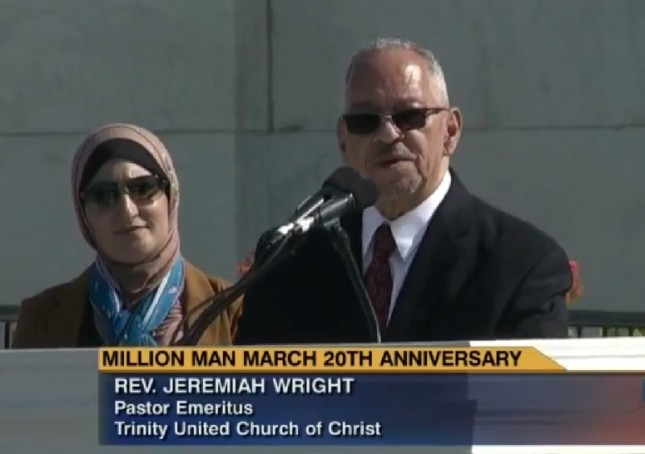
 

Check Out What Obama’s Former Pastor Says About Jesus During Million Man March Speech

October 11, 2015

Check Out What Obama’s Former Pastor Says About Jesus During Million Man March Speech, The Blaze, October 10, 2015

(Obama was a member of the Reverend Mr. Wright’s church for some twenty years. However, he never heard a single word that he said.

Please see also, Jeremiah Wright: Jesus was a Palestinian! at Power Line and Jeremiah Wright claims ‘Jesus was a Palestinian’ at American Thinker. The latter begins,

The man who married Barack and Michelle Obama, baptized their daughters, gave him the title of one of his books, and was the only beneficiary of his charity dollars before Obama’s presidential run, has made a remarkably ignorant antisemitic claim.

— DM)

The Rev. Jeremiah Wright, former pastor of President Barack Obama, offered the traditional Muslim greeting — “salaam alaikum” — at the beginning of his speech at the 20th anniversary of the Million Man March in Washington on Saturday.

Then the pastor emeritus of Chicago’s Trinity United Church of Christ launched into an appeal for “Palestinian justice” and for blacks to stand with them.

rev-jeremiah-wright-e1444529619382Image source: C-SPAN

Not mentioning Israelis, he called Palestinians the “original people” — and then offered the crowd a reminder.

“Please remember, Jesus was a Palestinian,” Wright said.

He added that Palestinians are fighting against those who say “their god told them they could have somebody else’s country,” calling it “one of the most egregious injustices in the 20th and 21st centuries.”

Wright also said that youths in Ferguson, Missouri, and youths “in Palestine” have “united” and that blacks should join them.

Wright made headlines in 2008 after his sermons were examined and Barack Obama — then campaigning for the presidency — was forced to renounce his former pastor‘s controversial statements (e.g., “No, no, no, not God bless America! God damn America — that’s in the Bible — for killing innocent people.”)

After Obama’s election, Wright commented in 2009 that “them Jews” were keeping him from the new president. ”Them Jews ain’t going to let him talk to me,” Wright told the Daily Press of Newport News, Virginia. “I told my baby daughter that he’ll talk to me in five years when he’s a lame duck, or in eight years when he’s out of office.”

Here’s the clip from Wright’s Saturday speech:


Op-Ed: Chaos and 2nd Cold War, Part I: Israel’s Nuclear Strategy

October 11, 2015

Op-Ed: Chaos and 2nd Cold War, Part I: Israel’s Nuclear Strategy, Israel National News,Prof. Louis René Beres, October 9, 2015

To fashion a functional nuclear strategy would be difficult for any state in world politics, but it could be especially challenging for one that keeps its bomb more-or-less securely “in the basement.” Now, as the Middle East descends into an ever more palpable chaos,[1] Israel will have to make certain far-reaching decisions on this very complex task.

Among other nuanced and widely intersecting concerns, Jerusalem’s decisions will need to account for a steadily hardening polarity between Russia and the United States.

Here, almost by definition, there will be no readily available guidebook to help lead the way. For the most part, Israel will need to be directed by an unprecedented fusion of historical and intellectual considerations. In the end, any resultant nuclear strategy will have to represent the prospective triumph of mind over mind, not merely of mind over matter.[2]

Conceivably, at least for the Jewish State that is smaller than America’s Lake Michigan, an emergent “Cold War II” could prove to be as determinative in shaping its national nuclear posture as coinciding regional disintegration. Still, a new Cold War need not necessarily prove disastrous or disadvantageous for Israel. It is also possible, perhaps even plausible, that Jerusalem could sometime discern an even greater commonality of strategic interest with Moscow, than with Washington.

To be sure, any such stark shift of allegiance in Israeli geo-political loyalties ought not to be intentionally sought, or in any way cultivated for its own sake. Moreover, on its face, it would currently be hard to imagine in Jerusalem that a superpower mentor of both Syria and Iran could somehow also find strategic common ground with Israel. Yet, in these relentlessly tumultuous times, any normally counter-intuitive judgments could, at least on rare occasions, prove surprisingly correct.

Credo quia absurdum. “I believe because it is absurd.” In these tumultuous times, certain once preposterous counter-intuitive judgments should no longer be dismissed out of hand. Moreover, in seeking to best understand the Israel-relevant dynamics of any renewed Washington-Moscow bipolar axis of conflict, Jerusalem will need to consider the prospects for a conceivably “looser” form of enmity.

In other words, looking ahead, it would seem realistic that a now “restored” superpower axis might nonetheless reveal greater opportunities for cooperation between the dominant “players.” Understood in the traditional language of international relations theory, this points toward a relationship that could become substantially less “zero-sum.”[3]

By definition, regarding zero-sum relationships in world politics, any one state’s gain is necessarily another state’s loss. But in Cold War II, it is reasonable to expect that the still-emerging axis of conflict will be “softer.” Here, for both major players, choosing a cooperative strategy could sometimes turn out to be judged optimal.[4]

Recognizing this core difference in superpower incentives from the original Cold War, and to accomplish such recognition in a timely fashion,  could prove vitally important for Israel. In essence, it could become a key factor in figuring out what should or should not be done by Jerusalem about any expected further increments of regional nuclear proliferation, and about Iran.

Iranian nuclearization remains the single most potentially daunting peril for Jerusalem. In this regard, virtually nothing has changed because of the recent Iran Nuclear Agreement (Joint Comprehensive Plan of Action, Vienna, 14 July, 2015).[5] To the contrary, in a situation fraught with considerable irony, Iran’s overall strategic latitude will actually have been expanded and improved by the terms of this concessionary pact.[6] Most plainly, these Iranian enhancements are the permissible result of a now no-holds-barred opportunity for transfer of multiple high-technology weapons systems, from Moscow to Tehran.

For the foreseeable future, the nuclear threat from Iran will continue to dwarf all other recognizable security threats.[7] At the same time, this enlarging peril could be impacted by certain multi-sided and hard to measure developments on the terrorism front.  In more precisely military terminology, these intersecting terror threats could function “synergistically,” or as so-called “force multipliers.”

The “whole” of the strategic danger now facing Israel is substantially greater than the simple arithmetic sum of its parts.[8] This true combination could include a persistently shifting regional “correlation of forces,”[9] one that would continue to oscillate menacingly, and also to the  observable benefit of Israel’s mortal enemies, both state and sub-state.

In Jerusalem and Tel-Aviv, serious derivative questions should now be addressed. What does this changing set of adversarial developments mean for Israel in very specifically operational and policy terms? Above all, this configuration of enmity should warn that a steady refinement and improvement of Israel’s nuclear strategy must be brought front and center. For Israel, there can be no other reasonable conclusion, not only because of ominous developments in Iran, but also because of the growing prospect of additional nuclear weapon states in the region, including perhaps Egypt, and/or Saudi Arabia.

Despite U.S. President Barack Obama’s continuing support for a “world free of nuclear weapons,” all of the world’s existing nuclear weapon states are already expanding and modernizing their nuclear arsenals. As of the end of September 2015, the world’s total inventory of nuclear warheads was reliably estimated as 17,000.[10] What Israel must also bear in mind is that this American president’s notion that nuclear weapons are intrinsically destabilizing, or even evil, makes no defensible intellectual sense.

It is plausible, rather, that only the perceived presence of nuclear weapons in the arsenals of both original superpowers prevented World War III. Equally convincing, Israel, without its atomic arsenal – whether ambiguous, or declared – could never survive, especially in a region that may soon combine further nuclear spread with steadily undiminished chaos.

Israel will have to decide, in prompt and sometimes inter-related increments, upon the precise extent to which the nation needs to optimize its composite national security policies on preemption, targeting, deterrence, war fighting, and active defense. A corollary imperative here must be to deal more purposefully with the complicated and politically stubborn issues of “deliberate ambiguity.” Going forward, it will not serve Israel’s best interests to remain ambiguous about ambiguity.

To date, at least, it seems that this longstanding policy of “opacity” (as it is also sometimes called) has made perfectly good sense. After all, one can clearly assume that both friends and enemies of Israel already acknowledge that the Jewish State holds persuasive military nuclear capabilities that are (1) survivable; and (2) capable of penetrating any determined enemy’s active defenses. Concerning projections of nuclear weapon survivability, Israel has made plain, too, its steady and possibly expanding deployment of advanced sea-basing (submarines).

Thus far, “radio silence” on this particular “triad” component has likely not been injurious to Israel. This could change, however, and rather quickly. Here, again, there is no room for error. Already, in delivering his famousFuneral Speech, with its conspicuously high praise of Athenian military power, Pericles had warned: “What I fear more than the strategies of our enemies, is our own mistakes.”[11]

Thus far, there have been no expressed indications that Israel’s slowly growing force of Dolphin-class diesel submarines has anything at all to do with reducing the vulnerability of its second-strike nuclear forces, but any such policy extrapolations about Israeli nuclear retaliatory forces would also be problematic to dismiss.[12]

Also significant for Israel’s overall security considerations is the refractory issue  of “Palestine.” A Palestinian state, any Palestinian state, could pose a serious survival threat to Israel, in part, as a major base of operations for launching increasingly lethal terrorist attacks against Israeli citizens. A possibly more important “Palestine” security issue for Israel lies in an even larger generalized potential for creating a steadily deteriorating correlation of regional forces. More specifically, any such deterioration could include various destabilizing “synergies,” that is, tangible interactive effects resulting from instabilities already evident  in Iraq and Syria, and from a manifestly concomitant Iranian nuclearization.

Leaving aside the various possibilities of any direct nuclear transfer to terrorists, a Palestinian state would  itself remain  non-nuclear. But, when viewed together with Israel’s other regional foes, this new and 23rd Arab state could still have the stunningly consequential effect of becoming a “force multiplier,” thereby impairing Israel’s already-minimal strategic depth, and  further rendering the Jewish State vulnerable to a thoroughly diverse panoply of both conventional and unconventional attacks. Here, for a variety of easily determinable reasons, a “merely” non-nuclear adversary could still heighten the chances of involving Israel in assorted nuclear weapons engagements,[13] including, in the future, a genuine nuclear war.[14]

What, then, should Israel do next about its core nuclear posture, and about its associated “order of  battle?”  How, exactly, should its traditionally ambiguous nuclear stance be adapted to the increasingly convergent and inter-penetrating threats of Middle Eastern chaos, Iranian nuclearization, and “Palestine?” In answering these difficult questions, Jerusalem will have to probe very carefully into the alleged American commitment to “degrade” and “destroy” ISIS(IS).  However well-intentioned, this pledge, especially if actually carried out effectively, could simultaneously aid both Syria’s President Assad, and the surrogate Shiite militia, Hezbollah.[15]

___________________________

[1] Although composed in the seventeenth century, Thomas Hobbes’Leviathan still offers an illuminating and enduring vision of chaos in world politics. Says the English philosopher in Chapter XIII, “Of the Naturall Condition of Mankind, as concerning their Felicity, and Misery:”  during chaos, a condition which Hobbes identifies as a “time of Warre,”  it is a time “…where every man is Enemy to every man… and where the life of man is solitary, poore, nasty, brutish, and short.” At the time of writing, Hobbes believed that the condition of “nature” in world politics was less chaotic than that same condition existing among individual human beings -because of what he called the “dreadful equality” of individual men in nature being able to kill others – but this once-relevant differentiation has effectively disappeared with the global spread of nuclear weapons.

[2] The core importance of literally thoughtful military doctrine – of attention to the complex intellectual antecedents of any actual battle – had already been recognized by early Greek and Macedonian armies. See, on this still-vital recognition, F.E. Adcock, The Greek and Macedonian Art of War (Berkeley, CA: University of California Press, 1962), especially Chapter IV.

[3] For much earlier, but still useful, scholarly assessments of polarity in world politics, by this author, See: Louis René Beres, “Bipolarity, Multipolarity, and the Reliability of Alliance Commitments,” Western Political Quarterly, Vol. 25, No. 4, December 1972, pp. 702-710; Louis René Beres, “Bipolarity, Multipolarity, and the Tragedy of the Commons,” Western Political Quarterly, Vol. 26, No. 4, December 1973, pp. 649-658; and Louis René Beres, “Guerillas, Terrorists, and Polarity: New Structural Models of World Politics,”Western Political Quarterly, Vol. 27, No.4., December 1974, pp. 624-636.

[4] Of course, in the context of any non-zero-sum game, ensuring enforceable agreements between the players (here, the United States and Russia) could still prove more-or-less decisively problematic.

[5]  See Louis René Beres, “After the Vienna Agreement: Could Israel and a Nuclear Iran Coexist?”  IPS Publications, IDC Herzliya, Institute for Policy and Strategy, Israel, September 2015.

[6] Significantly, this agreement also violates two major treaties, the 1968Non-Proliferation Treaty (NPT), and the 1948 Genocide Convention. The first violation has to do with subverting the NPT expectation that all non-nuclear state signatories must remain non-nuclear for a period of “indefinite duration.” The second violation centers on codified U.S. indifference to Genocide Convention obligations concerning responsibility to enforce the prohibition against “incitement to genocide.” In both cases, moreover, per article 6 of theU.S. Constitution – the “Supremacy Clause” – these violations are ipso factoalso violations of U.S. domestic law.

[7] See Louis René Beres, “Like Two Scorpions in a Bottle: Could Israel and a Nuclear Iran Coexist in the Middle East?” The Israel Journal of Foreign Affairs, Vol. 8., No. 1., 2014, pp. 23-32. See, also: Louis René Beres and (General/USAF/ret.) John T. Chain, “Living With Iran: Israel’s Strategic Imperative,” BESA Perspectives Paper No. 249, May 28, 2014, BESA Center for Strategic Studies, Israel. General Chain was Commander-in-Chief, U.S. Strategic Air Command.

[8] See Louis René Beres, “Core Synergies in Israel’s Strategic Planning: When the Adversarial Whole is Greater than the Sum of its Parts,” Harvard National Security Journal, Harvard Law School, June 2, 2015.

[9] See Louis René Beres, “Understanding the Correlation of Forces in the Middle East: Israel’s Urgent Strategic Imperative,” The Israel Journal of Foreign Affairs, Vol. IV, No. 1 (2010). Russia’s Putin, of course, is accustomed to thinking in such strategic terms; in the Soviet days, “correlation of forces” was already a tested yardstick for measuring Moscow’s presumptive military obligations.

[10] Se: Hans M. Kristensen, “Nuclear Weapons Modernization: A Threat to the NPT?”  Arms Control Today, Arms Control Association, September 2015, 11 pp.

[11] From the Funeral Speech of 431 BCE, near the outbreak of the Peloponnesian War, when Sparta first invaded Attica. For greater detail, see:Thucydides, The Speeches of Pericles, H.G. Edinger, tr., New York: Frederick Ungar Publishing Co., 1979), 68 pp.

[12] On nuclear sea-basing by Israel (submarines) see: Louis René Beres and (Admiral/USN/ret.) Leon “Bud” Edney, “Israel’s Nuclear Strategy: A Larger Role for Submarine Basing,” The Jerusalem Post, August 17, 2014; and Professor Beres and Admiral Edney, “A Sea-Based Nuclear Deterrent for Israel,” Washington Times, September 5, 2014. Admiral Edney was NATO Supreme Allied Commander, Atlantic.

[13] Such engagements could include assorted enemy attacks on Israel’sDimona nuclear reactor. Already, in both 1991 and 2014, this small reactor came under combined missile and rocket attack from Iraq and Hamas aggressions, respectively. For fully authoritative assessments of these attacks, and related risks, see: Bennett Ramberg, “Should Israel Close Dimona? The Radiological Consequences of a Military Strike on Israel’s Plutonium-Production Reactor,” Arms Control Today, Arms Control Association, May 2008, pp. 6-13.

[14] Naturally, the risks of a nuclear war would be expected to increase together with any further regional spread of nuclear weapons. In this connection, returning to the prophetic insights of Thomas Hobbes, back in the seventeenth century (see Note #1, above), Leviathan makes clear that the chaotic condition of nature is substantially worse among individual human beings, than among states. This is because, opines Hobbes, also in Chapter XIII, within this particular variant of chaos, “…the weakest has strength enough to kill the strongest….” Now, however, with the spread of nuclear weapons, the “dreadful equality” of Hobbesian man could be replicated, more or less, in the much larger and more consequential arena of world politics.

[15] “Everything is very simple in war,” advises Clausewitz, “but the simplest thing is also very difficult.” See: Carl von Clausewitz, On War.

The cipher in the White House

October 11, 2015

The cipher in the White House, Washington TimesWesley Pruden, October 8, 2015

3f7c81114649b52c830f6a706700a75e_c0-0-4712-2746_s561x327

Mr. Obama, humiliated by Vladimir Putin’s seizure of the initiative in the Middle East, seems not to understand what has happened to him. No one fears him or respects him. He has become a harmless cipher in an empty suit in the affairs of serious men. The nation pays the price.

************************

ANALYSIS/OPINION:

Perhaps it’s not fair to blame Barack Obama for the mess he’s making. The Middle East is where chaos was invented, after all, and perhaps not even the collection of incompetents and boobs the president has installed in the White House could make things this bad. Maybe it’s someone else’s fault. He blames the Jews.

When Mr. Obama promised the United Nations General Assembly earlier this month “a different type of leadership,” he prescribed “a leadership strong enough to recognize that nations share common interests and people share a common humanity.” That’s all very nice, and Mr. Obama should buy the world a Coke (or at least a Perrier in a glass bottle). He may have a profitable post-White House career waiting for him writing treacle for greeting cards.

Well-meaning he may be (or not), but he doesn’t have a clue about how such leadership would deal with people who do not share the common humanity. Some people have no humanity, but are the bastard progeny of an alien species of an evil planet in a cosmos, far, far away from our own.

Israel, which has seen pain and death in every guise, was stunned this week by a round of stabbings and shootings, including the murder of an American and his Israeli wife, seated in their car on the road near Nablus, by Palestinian gunmen who required their four children — aged 9, 7, 4 and 4 months — watch while their mother and father bled out their lives. The brutes fled, leaving the terrified children to deal with the terror and the gruesome aftermath of unspeakable cruelty.

The Palestinians celebrated the slaying with what Palestinian newspapers described as “joy” over the “heroics” of the gunmen. They put up photographs of their grim work on Twitter and Facebook. In Washington, the government of the “leader from behind” said it was “monitoring” the violence with a “growing sense of alarm.” The leader from behind hoped the perpetrators would be “swiftly brought to justice.”

Senior officials at the White House viewed with alarm, and pointed with pride at the moral equivalence served at the State Department. “We are deeply concerned about recent violence and escalating tensions in the West Bank and Jerusalem, and we condemn in the strongest terms violence against Israeli and Palestinian civilians.”

And then, with its reserves of decency spent, comes the “but” that everyone knew was on the way. “We call upon all parties to take affirmative steps to restore calm, and refrain from actions and rhetoric that would further escalate tensions.” Memo to Israel: “This means you.” Those parents with their four children should have known their presence on the road was a provocation. Why else assess the not-so-subtle blame for both killer and prey? The super-sleuths in Foggy Bottom are still trying to figure out whether the slaying of the couple on the road, with their four children watching, was an “act of terror.” Why not ask the 9-year-old?

President Obama and his friends dismiss as canard the logical conclusion of a reasonable man that this president just doesn’t like Jews very much, and scorns Israelis in particular.

Israeli President Benjamin Netanyahu demonstrated with devastating effect his dilemma in getting a fair hearing for Israel at the U.N. When he observed that only 70 years after the Holocaust, Iran, guaranteed by Mr. Obama’s deal to get a nuclear bomb, threatens anew to annihilate the Jewish state. There was no response from the General Assembly audience — not a cheer, not even a rumble of applause, nothing but the silence of frightened churls. Mr. Netanyahu did not disturb the silence while 44 seconds ticked off the clock. The only movement in the hall was the squirming in the ranks of the West by the occasional delegate with still a remnant of shame.

The same audience had wildly cheered President Obama the day before as he took a victory lap for his deal with the mullahs, and for making sure a docile Congress took nothing away. The delegates now sat again in stony silence when Mr. Netanyahu observed that Iran continues to spread fear and terror, opposing every interest of America and the democracies, and works without rest toward establishing dominion over the region. Worst of all, there was no silence more profound and more frightening than in the ranks of the American delegates.

Mr. Obama, humiliated by Vladimir Putin’s seizure of the initiative in the Middle East, seems not to understand what has happened to him. No one fears him or respects him. He has become a harmless cipher in an empty suit in the affairs of serious men. The nation pays the price.

Concerning Israel, Don’t Trust Proportional Journalism

October 11, 2015

Concerning Israel, Don’t Trust Proportional Journalism, Israel Today, Tsvi Sadan, October 11, 2015

The foreign media dealing with Israel has transformed from news reporting to malice.

Known for his crisp Facebook posts, Israeli Lev Solodkin is wondering how British people would have reacted if during WWII, newspapers had reported that “a 21-year-old German peace-loving pilot was killed by British security forces over British skies”?

This, however, is exactly the type of reports about Israel emerging from many respected media outlets.

UK newspaper The Independent is involved in such distorted journalism when it portrays the present stoning and knifing of Jews as legitimate “riots” and “clashes” carried out by peace-loving Palestinians. A Saturday issue of this newspaper reported that five Palestinians were killed and five Jews were stabbed. The headline and content of the report was every bit like that of an innocent Luftwaffe pilot flying aimlessly over Britain.

Though disguised as news, the Independent piece is a political manifest carefully crafted to create the impression of defenseless Palestinians killed during legitimate “protests” against murderous Israel. The paper’s reporter spared no effort to make sure this point was not missed. The fact that armies around the world recruit 18-year-old men for active military service doesn’t matter much to theIndependent, which described the Palestinians involved as “boys.”

“A 19-year-old Palestinian boy stabbed three police officers” creates the desired impression of criminal Israel killing defenseless, under-aged youths. In the same manner, to legitimatize the Palestinian violence allegedly sparked by the Jewish presence on the Temple Mount, the Independent chose to replace the Jewish Temple Mount with the Muslim “Noble Sanctuary” (Haram al-Sharif) to create the desired impression of who the real perpetrator is.

RT America (Russian Television) has done much the same in the way it chose to report on the “day of rage” that took place last Wednesday in New York City. The anchor gave American Palestinian activist Lamis Deek an undisturbed time to spew her venom. Deek did a fine job lying through her teeth about the reasons leading to the present Palestinian stabbing frenzy. Among her lies was blaming the Israeli government for allowing para-military settlers to rain terror on innocent Palestinians. Deek’s rant went unchallenged.

The New York Times didn’t fare much better. A headline from Tuesday inserts doubts about news coming from Israeli officials, thus conditioning readers to trust reports coming from the NYT’s “proportional journalism.”

For example, a headline concerning the killing of Eitam and Naama Henkin announces that “Israel says 5 from Hamas confess in Israeli couple’s killing.” What “Israel says” is contrasted with what the NYT says, which is, “Israeli forces fatally shooting two Palestinian teenagers — one 13” who was “innocent and was shot in cold blood.” The report goes on to give the names of innocent dead Palestinian “kids,” while omitting names of Israelis killed by such innocent “kids.”

The “peace-loving German pilot” type of journalism, euphemized as “proportional,” has become so prevalent that it is no longer possible to escape, let alone justify it. Considering the means of news proliferation 70 years ago, Germans could barely hide behind the excuse of “I didn’t know.” Today, however, none but a villain could say the aforementioned reports are even worth the ink used for their printing.

Moscow:UK Should Explain Report of Permission to Hit Russian Jets Over Iraq

October 11, 2015

Moscow:UK Should Explain Report of Permission to Hit Russian Jets Over Iraq

14:50 11.10.2015

(updated 16:07 11.10.2015)

Source: Moscow:UK Should Explain Report of Permission to Hit Russian Jets Over Iraq

The Russian Embassy in London has requested the UK Foreign Office’s clarifications on media reports of the alleged British leadership’s decision to enable UK pilots participating in anti-ISIL coalition’s airstrikes to shoot down Russian planes over Iraq.

Earlier, a UK defense source told the Daily Star Sunday tabloid that British and NATO pilots reportedly had been given a clearance to shoot down Russian jets over Iraq.UK defense sources stressed that RAF pilots have been told to avoid contact with Russian jets “at all costs,” but warned the pilots must be prepared to attack Russian jets “if their lives depend on it.”

“We are concerned by media reports as far as they refer to senior members of the Cabinet. We urgently requested UK Foreign Office’s clarifications. At the same time, the hypothesis itself of a potential conflict between British and Russian aircraft in the skies over Iraq is incomprehensible. As it is known, the Russian jets are not involved in attacks on ISIL targets on its [Iraqi] territory”, Russian Ambassador in the UK Alexander Yakovenko told RIA Novosti.

Russia launched precision airstrikes against Islamic State targets in Syria last week at the request of Syrian President Bashar Assad. Kremlin spokesman Dmitry Peskov said Moscow had not received any requests from Baghdad to carry out airstrikes against ISIL targets in Iraq.The Royal Air Force’s (RAF) Tornado combat aircraft are said to be equipped with up to four Advanced Short Range Air-to-Air Missiles (ASRAAM) to shoot down a Russian jet they encounter. The 2,300-miles-per-hour missiles with warheads filled with 22 pounds of high explosive lock onto targets using an infrared heat-seeker.

British Defense Secretary Michael Fallon said earlier he was seeking to extend RAF’s anti-ISIL efforts in Iraq to Syria.A US-led coalition of 60 nations has been conducting anti-ISIL airstrikes in Iraq and Syria for over a year, bypassing the UN Security Council’s and Assad’s approval.

Yakovenko also said that British aircraft were not involved in the coalition strikes against ISIL in Syria.

“As for the joint struggle against the Islamic State, we have not received an official response to our request concerning information the British side has on ISIL’s infrastructure targets, which could be used by the Russian Air Force,” the ambassador added.

Iraqi air force: We hit convoy of ISIS leader Baghdadi

October 11, 2015

Iraqi air force: We hit convoy of ISIS leader Baghdadi

Source: Iraqi air force: We hit convoy of ISIS leader Baghdadi – Middle East – Jerusalem Post


ISIL, led by Baghdadi, last year proclaimed a caliphate straddling Iraqi and Syria [AP]

BAGHDAD  – The Iraqi air force struck a convoy of Islamic State leader Abu Bakr al-Baghdadi in western Anbar province close to the Syrian border on Sunday, a military statement said.

The fate of the terrorist leader, who has declared himself the leader of a caliphate in areas Islamic State controls in Iraq and Syria, is still unknown, the statement said.

“Iraqi air forces have bombed the convoy of the terrorist Abu Bakr al-Baghdadi while he was heading to Karabla to attend a meeting with Daesh commanders”, the statement read, using the Arabic acronym for Islamic State.

Sunday’s report is not the first time Baghdadi is said to have been wounded by his enemies. The Islamic State leader was reportedly wounded in a March attack launched by the US-led coalition in the al-Baaja district of Nineveh, close to the Syrian border.

In November, Iraqi Defense Minister Khaled al-Abadi claimed that Baghdadi was wounded by a US air strike near Mosul. According to the post, Baghdadi’s deputy was killed in the attack.

Last week, a recording of al-Qaida leader Ayman Zawihri documenting his disapproval of Baghdadi was released.

“You spill blood and attack the Muslim people in order to rule,” Zawihri said. “Baghdadi’s caliphate is a caliphate of explosions, damage and destruction.”

Yasser Okbi and JPost.com staff contributed to this report.

Officials: CIA-backed Syrian rebels under Russian blitz

October 11, 2015

Officials: CIA-backed Syrian rebels under Russian blitz

By KEN DILANIAN Oct. 10, 2015 11:13 AM EDT

Source: Officials: CIA-backed Syrian rebels under Russian blitz


WASHINGTON (AP) — CIA-backed rebels in Syria, who had begun to put serious pressure on President Bashar Assad’s forces, are now under Russian bombardment with little prospect of rescue by their American patrons, U.S. officials say.

Over the past week, Russia has directed parts of its air campaign against U.S.-funded groups and other moderate opposition in a concerted effort to weaken them, the officials say. The Obama administration has few options to defend those it had secretly armed and trained.

The Russians “know their targets, and they have a sophisticated capacity to understand the battlefield situation,” said Rep. Mike Pompeo, R-Kan., who serves on the House Intelligence Committee and was careful not to confirm a classified program. “They are bombing in locations that are not connected to the Islamic State” group.

Other U.S. officials interviewed spoke on condition of anonymity because they were not authorized to discuss the matter publicly.

The CIA began a covert operation in 2013 to arm, fund and train a moderate opposition to Assad. Over that time, the CIA has trained an estimated 10,000 fighters, although the number still fighting with so-called moderate forces is unclear.

The effort was separate from the one run by the military, which trained militants willing to promise to take on IS exclusively. That program was widely considered a failure, and on Friday, the Defense Department announced it was abandoning the goal of a U.S.-trained Syrian force, instead opting to equip established groups to fight IS.

For years, the CIA effort had foundered — so much so that over the summer, some in Congress proposed cutting its budget. Some CIA-supported rebels had been captured; others had defected to extremist groups. The secret CIA program is the only way the U.S. is taking on Assad militarily. In public, the United States has focused its efforts on fighting IS and urging Assad to leave office voluntarily.

“Probably 60 to 80 percent of the arms that America shoveled in have gone to al-Qaida and its affiliates,” said Joshua Landis, a Syria expert at the University of Oklahoma.

But in recent months, CIA-backed groups, fighting alongside more extremist factions, began to make progress in Syria’s south and northwest, American officials say. In July and August, U.S.-supported rebels seized territory on the al-Ghab plain, in northwest Syria’s Idlib and Hama governorates. The plain is a natural barrier between areas controlled by Sunni Muslims and the Alawite sect to which Assad and his loyalists belong. The capture of the al-Ghab plain was seen as a breakthrough toward weakening the Alawites.

Those and other gains put Damascus, the capital, at risk, officials say.

But in recent days, Russian airstrikes have hit groups in the area, according to the Institute for the Study of War, a Washington think tank that closely tracks the situation. Russian bombs and missiles have hit specific buildings associated with the moderate Syrian opposition, according to a U.S. official briefed on the intelligence.

Russian officials have insisted they are bombing Islamic State militants and other terrorists.

U.S. intelligence officials see many factors motivating Russia’s intervention: Moscow’s reasserting its primacy as a great power, propping up Assad and wanting to deal a blow to the United States, which has insisted that Assad must go to end Syria’s civil war.

Russia is also interested in containing IS, an organization that includes thousands of Chechen fighters who may pose a threat to Russia, officials say.

But in the short term, “my conclusion is that the timing of their intervention was driven by Assad really going critical,” said Rep. Jim Himes, D-Conn., also a House Intelligence Committee member.

The administration is scrambling to come up with a response to Russia’s moves, but few believe the U.S. can protect its secret rebel allies. The administration has all but ruled out providing CIA-backed groups with surface-to-air missiles that can down aircraft, fearing such weapons would end up in the wrong hands, officials say.

Rep. Adam Schiff, the top Democrat on the committee, says the U.S. should consider establishing a no-fly zone that allows rebels a safe place from which to operate, and shooting down Syrian helicopters that are bombing civilians. He said the U.S. also should provide arms to the Ukrainian government fighting Russian-backed separatists.

A no-fly zone would require the U.S. military to be ready to engage in air battles with the Syrian government, something it is not prepared to do.

The administration “is debating the merits of taking further action or whether they are better off letting Putin hang himself,” he said, referring to Russian President Vladimir Putin.

“Our options are much narrower than they were two weeks ago,” said Sen. Angus King, I-Maine, who serves on the Intelligence and Armed Services committees. “I don’t think there is any simple answer. … Further air involvement has become very problematic because of the Russian engagement.”

63 ISIS targets hit in 64 Russian sorties over Syria – combat report

October 11, 2015

63 ISIS targets hit in 64 Russian sorties over Syria – combat report

Published time: 11 Oct, 2015 10:12

Edited time: 11 Oct, 2015 11:25

Source: 63 ISIS targets hit in 64 Russian sorties over Syria – combat report — RT News

© Russian Defence Ministry
Russian Aerospace Forces have extended the range of their airstrikes on Islamic State positions in Syria to four provinces, focusing primarily on demolishing fortified installations and eliminating supply bases and the terrorists’ infrastructure.

Over the last 24 hours Russian aircraft have attacked terrorist positions in the Hama, Idlib, Latakia and Raqqa provinces of Syria. In total, 64 sorties targeted 63 Islamic State installations, among them 53 fortified zones, 7 arms depots, 4 training camps and a command post.

The airstrikes were carried out by Sukhoi Su24M and Su-34 bombers and Su-25SM assault aircraft, with Sukhoi Su-30 fighter jets ensuring air escort for the assault groups.

“Having accomplished combat assignments, all aircraft of the task force operating in Syria successfully returned to the Khmeimim airbase,” said the spokesperson for the Russian Defense Ministry, Igor Konashenkov.

In the vicinity of the city of Saraqib in northwest Syria, an artillery position known for inflicting strikes on the nearby residential areas has been exposed and eliminated.

A group of Sukhoi Su-24M bombers attacked a terrorist field headquarters near the village of Salma in northwest Syria. This command post has been coordinating operations of the militants in whole of the Latakia province.

“A direct hit of a guided KAB-500 air bomb completely destroyed a building with militant commanders inside,” the Defense Ministry’s spokesperson reported. “The airstrike also eliminated five SUVs with ZU-23 double-barreled 23mm anti-aircraft guns mounted on them that were parked nearby.”

A Sukhoi Su-24M bomber attacked a thoroughly concealed position of SUVs with mortar launchers mounted on them near the village of Kafer-Delba. As a result of the attack, a mobile sub-artillery battery consisting of four vehicles was eliminated.

Aerial reconnaissance discovered a stronghold of terrorists near the village of Achan. A pinpoint airstrike carried out by Su-24M aircraft eliminated the installation, along with an ammunition and logistics depot.

The Russian Defense Ministry’s spokesman, Igor Konashenkov, also said that the Russian and American armed forces have held a second video conference regarding the operation in Syria. The two sides discussed in detail proposals voiced at the first such event and focused on issues of air security to be ensured by both sides, since both US and Russian aircraft are currently operating in Syria’s airspace.

The date for the next consultation is to be arranged later.


