Posted tagged ‘Israel’

Analysis: Why Palestinians do not want cameras on the Temple Mount

November 3, 2015

Analysis: Why Palestinians do not want cameras on the Temple Mount

Source: Analysis: Why Palestinians do not want cameras on the Temple Mount – Arab-Israeli Conflict – Jerusalem Post

Why is the Palestinian Authority (PA) opposed to Jordan’s proposal to install surveillance cameras at Jerusalem’s Haram al-Sharif (Temple Mount), sacred to Christians, Muslims and Jews?

This is the question that many in Jordan have been asking in light of the recent agreement between Israel and Jordan that was reached under the auspices of US Secretary of State John Kerry. The idea was first raised by Jordan’s King Abdullah in a bid to ease tensions at the holy site in the Old City of Jerusalem.

Shortly after Israel accepted the idea, the Palestinian Authority rushed to denounce it as a “new trap.” PA Foreign Minister Riad al-Malki and other officials in Ramallah expressed concern that Israel would use the cameras to “arrest Palestinians under the pretext of incitement.”

During the past two years, the Palestinian Authority and other parties, including Hamas and the Islamic Movement (Northern Branch) in Israel, have been waging a campaign of incitement against Jewish visits to the Haram al-Sharif. The campaign claimed that Jews were planning to destroy al-Aksa Mosque.

In an attempt to prevent Jews from entering the approximately 37-acre (150,000 m2) site, the Palestinian Authority and the Islamic Movement in Israel hired scores of Muslim men and women to harass the Jewish visitors and the police officers escorting them. The men are referred to as Murabitoun, while the women are called Murabitat (defenders or guardians of the faith).

These men and women have since been filmed shouting and trying to assault Jews and policemen at the Haram al-Sharif. This type of video evidence is something that the Palestinian Authority is trying to avoid. The PA, together with the Islamic Movement, wants the men and women to continue harassing the Jews under the pretext of “defending” the al-Aksa Mosque from “destruction” and “contamination.”

The installation of surveillance cameras at the site will expose the aggressive behavior of the Murabitoun and Murabitat, and show the world who is really “desecrating” the Islamic holy sites and turning them into a base for assaulting and abusing Jewish visitors and policemen.

The cameras are also likely to refute the claim that Jews are “violently invading” al-Aksa Mosque and holding prayers at the Temple Mount. The Palestinian Authority, Hamas and the Islamic Movement have long been describing the Jewish visits as a “provocative and violent incursion” into al-Aksa Mosque. But now the cameras will show that Jews do not enter al-Aksa Mosque, as the Palestinians have been claiming.

Another reason the Palestinians are opposed to King Abdullah’s idea is their fear that the cameras would expose that Palestinians have been smuggling stones, firebombs and pipe bombs into al-Aksa Mosque for the past two years. These are scenes at the PA, Hamas and the Islamic Movement do not want the world to see: they show who is really “contaminating” the Haram al-Sharif. Needless to say, no Jewish visitors have thus far been caught trying to smuggle such weapons into the holy site.

By rejecting the idea of setting up 24-hour surveillance cameras at the Haram al-Sharif, the Palestinian Authority has found itself on a course of collision with Jordan. Jordanian politicians and columnists have voiced outrage over the stance of the PA, and have dubbed it harmful to Palestinian and Islamic interests.

The Jordanian newspaper Al-Ghad, which is close to the government, quoted Jordanian politicians as denouncing the opposition of the Palestinian Authority to the cameras as “inappropriate, clumsy, tasteless and unfair.”

Sources in Ramallah explained this week that the PA’s opposition to cameras should also be seen in the context of the power struggle between the Palestinians and Jordan over control of the Islamic holy sites in Jerusalem. The Jordanians have long been seeking to preserve their status as “custodians” of al-Aksa Mosque and other Islamic holy sites in Jerusalem. This is a status that some Palestinians and the Islamic Movement in Israel have been trying to change during the past two decades, especially after the signing of the Oslo Accords between the PLO and Israel in 1993.

The Palestinian Authority’s opposition to the installation of cameras is seen as an attempt to undermine Jordan’s status at the Islamic holy sites. Many Palestinians argue that they, and not the Jordanians, should be in charge of the Haram al-Sharif. Members of the PA are opposed to the cameras because it is a Jordanian proposal and reinforces Jordan’s role at the holy site.

As such, the Palestinian Authority’s position could be seen as an attempt to change the status quo at the holy site by driving the Jordanians out of the area. King Abdullah is obviously aware of the Palestinian attempt to prevent him from playing any role at the holy site; that is why he was quick to reach a deal with Israel about the installation of cameras. The PA, meanwhile, will continue to work against having cameras in the hope of preventing the world from seeing what is really happening at the site and undermining Jordan’s “custodianship” over Islamic holy sites in Jerusalem.

It now remains to be seen how Secretary Kerry, who brokered the camera deal between Israel and Jordan, will react, if at all, to the latest Palestinian Authority attempt to continue escalating tensions at the holy site. If Kerry fails to pressure the PA to stop its incitement and repeated attempts to exclude the Jordanians from playing any positive role at the Haram al-Sharif, the current wave of knife attacks against Jews will continue.

New Rules of Engagement Result in Safer Security Forces, High Arab Casualties

November 2, 2015

IDF soldiers are finally allowed to defend themselves and fight the terrorists…

By: JNi.Media

Published: November 2nd, 2015

Source: The Jewish Press » » New Rules of Engagement Result in Safer Security Forces, High Arab Casualties

Palestinian Arabs clash in riots with IDF troops in Bethlehem. (Oct. 2015)

Palestinian Arabs clash in riots with IDF troops in Bethlehem. (Oct. 2015)
Photo Credit: Flash 90


(JNi.media) In late September, 2015, following a critical increase in Arab terrorism, Israel changed the rules of engagement for its security forces. The perceived result has been a decline in injuries and casualties among Israeli police and the military– in part, due to the use of preemptive measures, and a sharp rise in injuries and casualties among Arab rioters and terrorists.

A Red Crescent report published this week suggests as many as 2,617 Arabs were shot with live and rubber-coated steel bullets in the recent clashes. A Crescent spokesperson told Ma’an that when considering Arab rioters who were repelled with tear gas, the total figure for October comes to 8,262.

The report claims 26 Arabs were shot dead during clashes, and another 40 were shot dead after carrying out (attempted or successful) stabbing or shooting attacks against Israeli civilians or security forces. Ten Israelis were killed during the same period, every one of them from an attack by Arab terrorists.

On September 24, the Israeli government opened a new chapter in its relationship with security forces in the field. The rules of engagement for Israeli police and border guards were changed. It was a process, it involved a steady rise in Arab stone throwing and stabbing attempts, as well as sporadic shots at Israeli drivers passing through Judea and Samaria, but after a little less than a month, the rules of engagement were finally changed.

On a Thursday night, the Netanyahu Security Cabinet approved unanimously a series of decisions to assist in the fight against stone, Molotov cocktail and fireworks throwers in eastern Jerusalem and elsewhere. The Cabinet decided, among other things, that police officers would be “allowed to open fire when faced with a threat to the life of any individual.” In addition, Public Security Minister Gilad Erdan accepted the police argument that it is impossible to tell if the stone throwers are minors or adults, and insisted on removing the clause stating that the rules of engagement apply only to adults. It meant that police were given a green light to shoot minors who throw stones or Molotov cocktails.

The change was major not only because of the obvious understanding the cabinet was showing, of the difficulties being faced by its security men and women on the ground. It also, shortly thereafter, delivered the message to the same officer on the ground that the Netanyahu government is finally ready to protect them against the Attorney General apparatus which in the past was inclined to limit their range of responses when carrying out their assignments against violent Arab mobs.

The AG put up a fierce fight against both ideas: that police be allowed to shoot at rioters even if they don’t pose a direct threat to the policeman but are endangering the lives of others; and the allowance for cops to shoot at anyone posing such a threat, without having to verify his or her age. There were intense debates between the AG staff and police over these new rules, and, eventually, Netanyahu came down on the side of police and, with that, changed everything. His decision also carried a message to the AG and his office, that while they are appointed civil servants, and must support him, the elected executive who ultimately makes those decisions.

The new atmosphere that followed matched the changes in the IDF command’s approach to its own set of rules of engagement. Back in mid-August, OC Central Command Chief Col. Roni Numa revised the rules of engagement in Judea and Samaria during riots and terrorist attacks, to require that if the attacking terrorist does not endanger the security forces, and, having carried out his attack is now running away from them, firing should be in the air and not at the terrorist’s body. The purpose of the change was to “avoid escalating the tense situation in Judea and Samaria and to avoid raising the number of Palestinians being killed.”

The revision came in response to criticism of the IDF and security forces for indiscriminate shooting of innocent people, or unarmed terrorists, heard time and again from the Palestinians and from human rights groups. A report released by the Breaking the Silence NGO, allegedly based on soldiers’ testimonies from Operation Protective Edge, argued, for example, that there were “indiscriminate firing policies, and an extensive moral lapse in the IDF operation policy, reaching from the top command down.”

The IDF’s approach to the rules of engagement was also changed shortly thereafter, when it was discovered that the softer methods did nothing to quell Arab violence, quite the opposite, it encouraged a steep rise in Arab acts of terrorism.

This new Israeli approach to protecting the lives of the security forces has not gone without outside condemnation. The UN High Commissioner for Human Rights, Zeid Raad al-Hussein, said: “The high number of casualties, in particular those resulting from the use of live ammunition by Israeli security forces, raise concerns of excessive use of force, and violations of the right to life and security of the person.”

Amnesty International said only last week that Israeli forces “ripped up the rulebook and resorted to extreme and unlawful measures.”

Palestinian, Israeli and international rights groups have been claiming that in the majority of cases, Israeli forces needlessly killed their attackers, who posed no imminent threat. Israeli NGO B’Tselem called it “extrajudicial executions.”

As was the case during the 2014 Gaza war, the extreme left is angriest when Israel turns its disproportionate might against its enemies. It should be noted that even if human rights advocates were correct, and every single Arab who rushed an Israeli policeman or soldier with a knife didn’t pose a real threat (which is debatable) — in most Western democracies such an attack would result in the killing of the perpetrator. Likewise with a civilian who would light up a Molotov cocktail and throw it at a patrol car —that individual would likely be signing his or her death warrant, regardless of whether or not the firebomb managed to blow up its target.

The wave of terror continues as November rolls in, with fresh riots leaving more Arab youths injured this past Sunday. Interestingly, a report by the Gaza Health Ministry of a shooting of two Arabs by Israeli forces in the central Gaza Strip acknowledges that both Palestinians were hit in their lower extremities, following which they were taken in moderate condition to Shuhada al-Aqsa Hospital. A simple analysis of the news report belies the extreme left’s claims of “extrajudicial executions.” If an enemy soldier wants to execute you, he probably won’t aim at your legs.

Russia warns that Syria war could become a ‘proxy war’

November 1, 2015

Russia warns that Syria war could become a ‘proxy war’ BreitbartJohn J. Xenakis, November 1, 2015

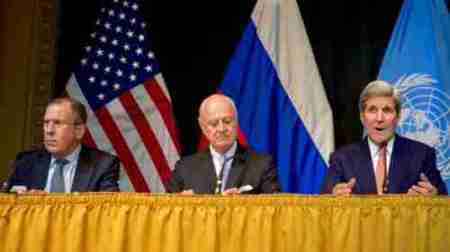
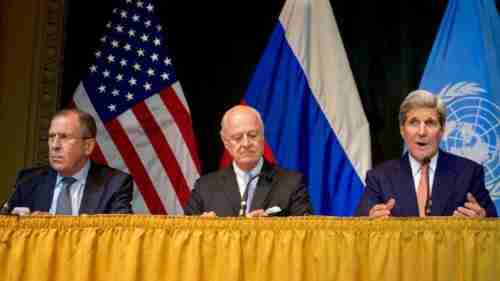
g151031bL-R: Sergei Lavrov, United Nations Special Envoy for Syria Staffan de Mistura, and John Kerry in Vienna on Friday (state.gov)

Russia has poured millions of dollars of heavy weapons into Syria, and is now sending in Russian troops to establish bases there. Recently, Russia launched 27 cruise missiles from the Caspian Sea to targets in Syria. Iran is pouring new troops into Syria. Iran has also given Lebanon’s Hezbollah terrorist group a great deal of money, and Hezbollah has sent thousands of troops into Syria to support Syria’s president Bashar al-Assad.

Al-Assad’s genocidal attacks on innocent Syrian Sunnis, killing hundreds of thousands and forcing millions from their homes, has caused Sunni jihadists from all of the world to fight against al-Assad, Russia, Hezbollah, and Iran in Syria. Along the way, these jihadists formed the so-called Islamic State (IS or ISIS or ISIL or Daesh).

And now, on Friday, Russia’s Foreign Minister Sergei Lavrov made a pronouncement that Barack Obama was going to trigger a “proxy war” in Syria by sending in 50 special operations forces, as we reported yesterday.

You can’t make this stuff up.

Thanks to Iran, Russia, al-Assad and Hezbollah, there are now tens of thousands of foreign troops fighting each other in Syria, with al-Assad in particular supported by massive amounts of foreign weapons.

But somehow, those tens of thousands of foreign fighters don’t make it a “proxy war,” but America’s 50 special forces troops do.

You can’t trust any garbage that comes out of Lavrov’s mouth, or out of al-Assad’s mouth, or out of Vladimir Putin’s mouth, but I listen to BBC, al-Jazeera, FOX, CNN, and other media sources all the time, and I see these news anchors report this crap with a straight face all the time. I don’t know whether it is more sickening to watch those fatuous news anchors, or to watch the fawning Secretary of State John Kerry suck up to Lavrov and Putin, which has happened in issues involving Ukraine, Iran’s nuclear development, and Syria.

All this verbiage is coming out of a meeting in Vienna whose purpose is to find a “political solution” to the Syria problem. With hundreds of thousands of Syrian migrants pouring into Europe, and with hundreds of ISIS militants returning to Russia to fight Putin, there is a lot of pressure to find a “political solution.” But this week’s announcement that Iran will fully enter the war in Syria on the side of the Syrian regime makes any “political solution” farther away than ever. On the contrary, Saudi Arabia and other Gulf countries will never agree to anything like the emerging situation. Actions by Russia and Iran, intervening militarily in Syria, is an emerging disaster, likely triggering a sectarian Sunni versus Shia war throughout the region. BBC and International Business Times and Reuters

Syria’s civil war and Generational Dynamics

In the 12 years that I’ve been doing this, I’ve posted about 4,000 articles with hundreds of Generational Dynamics predictions.

In 2011, when the Syrian civil war began, I said that the war should fizzle within a year or two. Of all the hundreds of Generational Dynamics predictions, this is the one where I’ve clearly been (depending on how you look at it) either wrong or poorly described.

Syria’s last generational crisis war was civil war that climaxed in 1982 with the massacre at Hama. There was a massive uprising of the 400,000 mostly Sunni citizens of Hama against Syria’s president Hafez Assad, the current president’s father. In February, 1982, Assad turned the town to rubble, 40,000 deaths and 100,000 expelled. Hama stands as a defining moment in the Middle East. It is regarded as perhaps the single deadliest act by any Arab government against its own people in the modern Middle East, a shadow that haunts the Assad regime to this day.

(As a related matter, the civil war in Lebanon also climaxed that year, with the bloody massacre at Sabra and Shatila occurring in September 1982. And it occurred as the Iran/Iraq war was ongoing, three years after Iran’s bloody Great Islamic Revolution in 1979. At that time, much of the Mideast was re-fighting World War I and the collapse of the Ottoman Empire, 60 years earlier.)

So, in 2011, I said that the civil war in Syria would fizzle, and could not turn into a crisis civil war. And that’s both wrong and true. There are too many survivors who remember the 1982 slaughter, and do not want to see it repeated. And so there’s been no massive anti-government uprising, as there was in 1982, and Bashar al-Assad’s Shia/Alawite troops have been fighting half-heartedly, with many soldiers defecting or deserting.

But the war did not fizzle.

It should have fizzled in 2011 or 2012, but Hezbollah and Iran starting pouring troops in to support al-Assad. And foreign fighters from around the world arrived to fight al-Assad and to form ISIS. That’s not something that Generational Dynamics could have predicted.

Earlier this year, it looked like al-Assad’s army was near collapse. In July, a desperate al-Assad gave a national speech in which he admitted he was losing. The war should have fizzled this year. But now, Russia and Iran are pouring tens of thousands more troops into Iran to bolster al-Assad. And that also is not something that Generational Dynamics could have predicted.

So the problem for me is: How should I have characterized the situation in 2011? The prediction that it wouldn’t turn into a crisis civil war was correct, but the war did not fizzle, because it turned into a proxy war.

Well, I don’t think there’ll be a next time, but if there is, I’ll try to characterize the situation differently, without simply using the word “fizzle.” NPR (1-Feb-2012)

Generational Dynamics and crisis civil wars

I write about a number of civil wars going on in the world today, so this is a good time to discuss civil wars from the point of view of Generational Dynamics.

Among generational crisis wars, an external war is fundamentally different than a civil war between two ethnic groups. If two ethnic groups have lived together in peace for decades, have intermarried and worked together, and then there is a civil war where one of these ethnic groups tortures, massacres and slaughters their next-door neighbors in the other ethnic group, then the outcome will be fundamentally different than if the same torture and slaughter is rendered by an external group. In either case, the country will spend the Recovery Era setting up rules and institutions designed to prevent any such war from occurring again. But in one case, the country will enter the Awakening era unified, except for generational political differences, and in the other case, the country will be increasingly torn along the same ethnic fault line.

The period following the climax of a crisis war is called the “Recovery Era.” One path that the Recovery Era can take is that the leader of one ethnic group decides that the only way to prevent a new civil war is for him to stay in power, and to respond to peaceful anti-government demonstrations by conducting massive bloody genocide, torture and slaughter of the other ethnic group, in order to maintain the peace. (Dear Reader, I assume you’ve grasped the irony of the last sentence.)

For example, in a July article about Burundi, I described how Burundi’s Hutu president Pierre Nkurunziza was using such violence to quell Tutsi protests, supposedly to avoid a repeat of the 1994 Rwandi-Burundi genocidal war between Hutus and Tutsis.

As another example, in a June article about Zimbabwe, I described how Zimbabwe’s president Robert Mugabe was even worse. His 1984 pacification campaign was known as “Operation Gukurahundi” (The rain that washes away the chaff before the spring rain). During that campaign, accomplished with the help of Mugabe’s 5th Brigade, trained by North Korea, tens of thousands of people, mostly from the Ndebele tribe, were tortured and slaughtered. Later, Mugabe single-handedly destroyed the country’s economy by driving all the white farmers off the farms, resulting in one of the biggest hyperinflation episodes in world history.

That is what Bashar al-Assad is doing in Syria. Fearing a Sunni uprising, like the one in 1982, al-Assad is conducting a massive “peace campaign” by slaughtering and displacing millions of innocent Sunnis. As I wrote above, this should have fizzled in 2011 or 2012, but it’s turned into a proxy war, and it’s a disaster for the Mideast and the world.

But none of the above three examples is a crisis civil war. A crisis war has to come from the people, not from the politicians. So, for example, there’s a massive crisis civil war going on today in Central African Republic (CAR), between the Muslim ex-Seleka militias fighting Christian anti-Balaka militias.

Unlike the previous examples, CAR is in a generational Crisis era. CAR’s last generational crisis war was the 1928-1931 Kongo-Wara Rebellion (“War of the Hoe Handle”), which was a very long time ago, putting CAR today deep into a generational Crisis era, where a new crisis war is increasingly likely. That’s why the CAR is a genuine crisis civil war, and won’t fizzle out. In fact, it won’t end until it has reached some kind of explosive conclusion — of the kind we described in Hama or Sabra and Shatila. ( “2-Oct-15 World View — Violence resurges in Central African Republic crisis war”)

Generational Dynamics and war between Palestinians and Israelis

I’ll discuss one more example — not a civil war, but very similar to a civil war, with the same kinds of issues.

In the last few years, there have been three non-crisis wars between Israelis and Palestinians in Gaza. In each case, the Israelis destroyed Hamas’s infrastructure, ending the war. The war began again each time when Hamas’s infrastructure was rebuilt.

But the point I want to make is that these three non-crisis wars were all directed by politicians. Palestinians attacked when the leadership told them to, and stopped attacking when the leadership told them to stop.

What I have been describing in numerous articles recently is that there is emerging a major, fundamental, historic change.

In the emerging situation, young people today are no longer willing to listen to these leaders. According to the CIA World Fact Book, 20% of Gaza’s population are in the 15-24 age range, and so are 21% of the West Bank — about 200,000 males in each territory, or 400,000 young males total.

On the Israeli side, there are over 600,000 young males in the same age range. There have been unconfirmed reports of young Israelis also disgusted with the leadership. It is possible that, like the young Palestinians, they are willing to take matters into their own hands.

So in this environment, what could happen next? The last three Gaza wars were non-crisis wars, but the next one could be a crisis war between Israelis and Palestinians.

How can a crisis war begin? How about if those 200,000 young male Gazans blow holes in the walls, pour across into Israel and start killing Israeli citizens en masse in their homes and villages? And how about if they are joined by those 200,000 young male Palestinians on the West Bank, who start with the Jewish settlers and continue with the Jews in Jerusalem. And how about if the young Israeli males strike back and start killing Palestinians in their homes and villages?

Israel’s tanks and bombers would not be of much use. You can’t bomb Jerusalem, and you can’t bomb Israeli villages and settlements to kill Palestinians.

That is the difference. That is what a generational crisis war is like. It is not two tanks shooting at each other. It is hand to hand combat in homes, neighborhoods and streets by people armed with sticks and knives. It is what happened in Central African Republic last year, it is what happened in Rwanda in 1994, in Bosnia in 1994, and in Palestine in 1947.

And by the way, that assumes that the bloody mess stays confined to Israel and the Palestinian territories. The Palestinians are likely to be joined by tens or hundreds of thousands from Jordan, Lebanon and Egypt.

The recent widely reported changes in the attitudes and behaviors of young Palestinians is a sign that this kind generational crisis war is coming.

Leader: Negotiation with US on Regional Issues Meaningless

November 1, 2015

Leader: Negotiation with US on Regional Issues Meaningless, Tasnim News Agency (Iranian), November 1, 2015

139408101241559676429254


While many consider the Joint Comprehensive Plan of Action (JCPOA) a major breakthrough in the improvement of ties between Iran and the West, the Leader has already made it clear that Tehran’s policy toward the US will remain unchanged regardless of the ultimate fate of the JCPOA.

***********************

TEHRAN (Tasnim) – Supreme Leader of the Islamic Revolution Ayatollah Seyed Ali Khamenei dismissed the idea of Iran-US negotiation on regional issues, saying the totally contrasting policies of the two countries and Washington’s attempts to impose its demands make such talks pointless.

In a meeting with the Foreign Ministry staffers in Tehran on Sunday, Ayatollah Khamenei underlined that Iran’s foreign policy is founded upon the Constitution, the long-term interests of the country and the Islamic Republic’s values, and that, consequently, they do not change in different administrations.

Different administrations would affect only the “tactics and executive initiatives” in carrying out the country’s foreign policy strategies, the Leader stressed.

The Supreme Leader then dismissed as a Western illusion the notion that Iran’s foreign policy has undergone a forcible change.

Imam Khamenei further referred to the US policies in West Asia as the root cause of the tense situation across the region, adding, “Unlike the view of certain individuals, the US is the main plank of the region’s problems, not part of a solution to the problems.”

The Leader then called on the Iranian foreign ministry officials, ambassadors and diplomats to stick to the tenets of the Islamic Republic’s foreign policy “firmly, mightily and gloriously”, so that foreigners and their followers inside the country would not pin hopes on a shift in Iran’s foreign policy.

Ayatollah Khamenei referred to Iran’s policies on Palestine, Syria, Iraq, Yemen and Bahrain, saying they differ from those of the US by “180 degrees”.

The root cause of insecurity in the region is Washington’s support for the Zionist regime of Israel and the terrorist groups, the Leader underscored.

Imam Khamenei then categorically dismissed the idea of negotiations with the US on regional issues.

“The Americans seek to impose their interests, not to settle problems. They want to impose 60, 70 percent of their demands via negotiations, and practically implement and impose the rest of their objectives illegally. Then what would negotiations mean?”

Elsewhere, Ayatollah Khamenei lauded Foreign Minister Mohammad Javad Zarif and other diplomats for handling nuclear talks with six world powers well, saying they could very well safeguard the country’s goals in the talks.

Iran and the Group 5+1 (Russia, China, the US, Britain, France and Germany) on July 14 reached a conclusion on a lasting nuclear agreement that would terminate all sanctions imposed on Tehran over its nuclear energy program after coming into force.

While many consider the Joint Comprehensive Plan of Action (JCPOA) a major breakthrough in the improvement of ties between Iran and the West, the Leader has already made it clear that Tehran’s policy toward the US will remain unchanged regardless of the ultimate fate of the JCPOA.

Doomed Russian jet did not issue a distress call: report

November 1, 2015

Doomed Russian jet did not issue a distress call: report, DEBKAfile, November 1, 2015

The Russian passenger plane that crashed in the Sinai Peninsula on Saturday did not send out any distress call, reports said Sunday, meaning that the plane suddenly blew up. A number of Israeli commentators continue to claim, like Egypt, that the pilots reported a technical problem to the Egyptian control tower, and that the plane broke in half during the flight. However, there is no basis to those reports.

Reports: IAF targets Hezbollah assets in Syria

October 31, 2015

Reports: IAF targets Hezbollah assets in Syria, Times of Israel, October 31, 2015

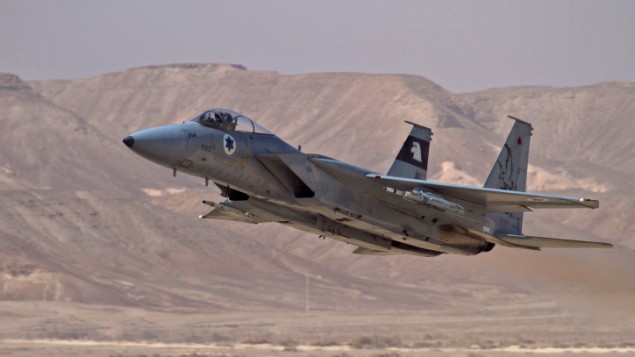
Israeli jet fighterAn Israeli fighter jet takes off during a training sortie in February 2010. (photo credit: Ofer Zidon/Flash90)

The Lebanese and Syrian media said Saturday that Israel Air Force warplanes have attacked targets in Syria linked to the Lebanon-based militant group Hezbollah. Reports varied, however, on the exact targets and location of the strikes.

According to a report on the Lebanese Debate website, six IAF jets carried out the strike over the Qalamoun Mountains region of western Syria, and targeted weapons that were headed for Hezbollah, Channel 10 said.

Syrian opposition groups, for their part, claimed Israeli planes had attacked targets in the Damascus area, in two strikes in areas where Hezbollah and pro-Assad forces were centered.

Syrian media, however, said that Israeli warplanes hit several Hezbollah targets in southern Syria.

Israel’s defense establishment declined to comment on the reports of the strikes, which would be the first since Russia boosted its involvement in the Syrian civil war.

Syrian and Iranian media reported Friday that Russia was carrying out air strikes against anti-Assad rebel forces on the Syrian side of the Golan Heights border with Israel.

The Jewish state has reportedly carried out several strikes on Syrian arms convoys destined for Hezbollah, although it routinely refuses to confirm such operations. It has, however, warned that it will not permit the Lebanon-based group to obtain what it calls “game-changing” advanced weaponry.

Prime Minister Benjamin Netanyahu said last month after meeting with Russian President Vladimir Putin in Moscow that Israel and Russia have agreed on a mechanism to avoid military confrontations between the two countries in Syria.

Russia, a key ally of Syrian President Bashar Assad, is in the midst of a military operation in the war-torn country, ostensibly to fight Islamic State militants who have seized huge swathes of territory. Critics however, claim that Russian airstrikes are targeting not only the fundamentalist group, but also Western-backed opposition groups who are seeking Assad’s ouster.

“My goal was to prevent misunderstandings between IDF forces and Russian forces. We have established a mechanism to prevent such misunderstandings. This is very important for Israel’s security,” Netanyahu told Israeli reporters during a telephone briefing from the Russian capital.

“Our conversation was dedicated to the complex security situation on the northern border,” the prime minister said. “I explained our policies in different ways to try to thwart the deadly weapons transfers from the Syrian army to Hezbollah — action actually undertaken under the supervision of Iran.”

Netanyahu said that he told Putin in “no uncertain terms” that Israel will not tolerate Tehran’s efforts to arm Israel’s enemies in the region, and that Jerusalem has taken and will continue to take action against any such attempts. “This is our right and also our duty. There were no objections to our rights and to what I said. On the contrary: there was readiness to make sure that whatever Russia’s intentions for Syria, Russia will not be a partner in extreme actions by Iran against us.”

Ahead of their meeting, as they made statements to the press, Netanyahu told Putin that Iran and Syria have been arming Hezbollah with advanced weapons, thousands of which are directed at Israeli cities. He also told his Russian host that Israel’s policy is to prevent these weapons transfers “and to prevent the creation of a terrorist front and attacks on us from the Golan Heights.”

In April, Defense Minister Moshe Ya’alon also warned that Israel would not let Iran equip Hezbollah with advanced weapons — a day after an alleged Israeli airstrike hit weapons depots in Syria.

Although Ya’alon did not discuss the airstrike that reportedly hit surface-to-surface missile depots, he declared that Israel would not allow Iran to supply arms to the terror group, which has a strong military presence in Lebanon as well as in Syria, the two countries lying on Israel’s northern borders.

Palestinian Attacks Continue Amid Report Abbas Ordered Shift to West Bank

October 31, 2015

Palestinian Attacks Continue Amid Report Abbas Ordered Shift to West Bank, Investigative Project on Terrorism, October 30, 2015

Palestinian Authority President Mahmoud Abbas issued a directive 11 days ago to cease attacks in Jerusalem in order to increase attacks in the West Bank, emphasizing the areas of Gush Etzion and Hebron, the Jerusalem Post reported.

*****************************

Palestinian violence against Jews continues, as a terrorist stabbed and injured an Israeli man in Jerusalem on Friday, reports the Times of Israel.

Israeli police shot and critically wounded the terrorist; however a second Israeli man was accidentally injured by police gunfire.

The stabbing was the first in Jerusalem since Oct. 17, and comes amid analyses that the Palestinian violence has shifted primarily from the Israeli capital to the West Bank.

Palestinian Authority President Mahmoud Abbas issued a directive 11 days ago to cease attacks in Jerusalem in order to increase attacks in the West Bank, emphasizing the areas of Gush Etzion and Hebron, the Jerusalem Post reported.

The clear difference in Israeli authorities’ ability to prevent attacks in eastern Jerusalem versus the West Bank shows the extent of the PA’s influence over the Palestinians in the capital. However, today’s events show that not all Jerusalem Arabs are heeding to Abbas’ call to divert attacks, suggesting that broader societal Palestinian incitement continues to play a major role in driving violence against Jews.

Meanwhile, two Palestinian attackers attempted to stab Border Police officers at the Tapuah Junction in the West Bank and were subsequently shot by Israeli authorities – one terrorist died as a result.

Palestinians rioted in the West Bank city of Ramallah, leading Israeli police to shoot an assailant who was ready to throw a Molotov cocktail. As Israeli first responders administered first aid to the wounded Palestinian, another Palestinian terrorist approached the medical officers wielding a sharp object. Seeking to prevent another terrorist attack, an Israeli commander in a jeep ordered his driver to approach the terrorist. The driver hit the second Palestinian and moderately wounded him.

These incidents mark more than 60 separate terrorist attacks against Israeli civilians and security personnel in the last month, killing 10 Israelis and injuring dozens more

Hizbullah Sec.-Gen. Nasrallah: The U.S. Supports ISIS, Runs the Entire War in Our Region

October 30, 2015

Hizbullah Sec.-Gen. Nasrallah: The U.S. Supports ISIS, Runs the Entire War in Our Region,Middle East Media Research Institute TV via You Tube, October 29, 2015

(Oh well. — DM)


According to the blurb following the video,

In an October 23 speech at a ceremony marking the ‘Ashura holiday in Beirut, Hizbullah Secretary-General Hassan Nasrallah said that the U.S. “provided ISIS with money, weapons, and aid,” and that “the war raging in our region is actually being led by the US.” The speech aired on the Iranian Al-Alam TV channel.

US, Russia edge close to military collaboration in Syria and Iraq

October 27, 2015

US, Russia edge close to military collaboration in Syria and Iraq, DEBKAfile, October 27, 2015

ForcesIaqSyria480

Washington and Moscow appear close to agreeing to their armed forces teaming up for war operations in Syria and Iraq. Nothing definite has so far emerged about this potential collaboration, or even if it is to be conducted covertly and experimentally ad hoc or seriously and out in the open.

A comment suggesting that the Obama administration was ready for a new direction on Syria came from US Defense Secretary Ashton Carter Tuesday, Oct. 27. In testimony before the Senate Armed Services Committee, he said, “we won’t hold back from supporting capable partners in opportunistic attacks against ISIL…or conducting such mission directly, whether by strikes from the air or direct action on the ground.”

According to Pentagon sources, the US intends to deploy small units of Special Operations forces in Syria and “special advisers” in Iraq, which too are believed to be special operations units under another name.

However, DEBKAfile’s military sources point out that small-scale military ventures in open-ended war situations tend to extend beyond the scale originally intended. Therefore, it is more than likely that both the US and Russia will find themselves committing increasing numbers of air and ground troops if the conflicts in the two countries continue.

The way matters are going now, the plan for Iraq is for US forces to join Iraqi and Iranian units in launching an offensive to recover Ramadi, capital of the Western province of Anbar, 110 km West of Baghdad, which ISIS captured in May.

In Syria, American troops plan to work with the northeastern Kurdish PYD-YPG militia for marching on Raqqa, the Islamic State’s headquarters in that country.

At the Senate hearing, Carter pointed to last week’s rescue operation in northern Syria. US Delta commandos and Syrian Kurdish special forces stormed a prison held by the Islamic State and freed dozens of Kurdish prisoners.

This operation was outside the bounds of normal US involvement in the Syrian conflict. After it was over, the US Defense Secretary said the military expects “more raids of this kind.”

This joint US-Kurdish raid brought forth a furious response from Turkey.The Turkish military twice directed machine gun fire at the Syrian Kurdish PYD force in the Syrian town of Tal Abyad Sunday, Oct. 25.

DEBKAfile’s military sources note that Tel Abyad is the closest point to Raqqa to have been reached by America’s Kurdish allies.

Ankara is vehemently opposed to the US partnership with the Kurds of Syria and Iraq, and puts its campaign against their separatist trends ahead of its commitment to the anti-ISIS coalition.

However, the Obama administration appears to have finally come down in favor of a combined operation with the Kurdish forces, even at the expense of its ties with Ankara, another pointer to the up-and-coming US ground operations in Syria.

Neither Washington nor Moscow has commented on their possible military cooperation for the fight to vanquish ISIS. But straws in the wind point in that direction.

Russian President Vladimir Putin has repeated: “I have no plans to put ground troops in Syria,” indicating that Moscow would confine itself to air strikes.

The US Defense Minister Tuesday explicitly mentioned “…direct action on the ground” as well as, ”supporting capable partners in opportunistic attacks against ISIL.”

DEBKAfile’s military sources find common elements in the American and Russian modes of action. Whereas the Americans plan to deploy ground troops for fighting with Kurdish forces, the Russians will stick to aerial attacks in conjunction with certain Syrian rebel groups.

Moscow’s plan unfolded on Monday, Oct. 26, when a delegation of the Free Syrian Army, which is backed by the US, Israel and Saudi Arabia, turned up in Moscow seeking to coordinate its military operations with the Russians.

It is hard to tell if US-Russian military cooperation in the Syrian and Iraqi wars actually ripens into a productive effort or proves ephemeral. Israel’s concerns and its responses to the fast-moving, explosive situation on its northern borders are scheduled to be thrashed out in the talks Defense Minister Moshe Ya’alon is holding this week in Washington with Defense Secretary Carter.

Israel’s delightful partners for peace

October 27, 2015

Israel’s delightful partners for peace, Dan Miller’s Blog, October 26, 2015

(The views expressed in this article are mine, and do not necessarily reflect those of Warsclerotic or its other editors. — DM)


Mahmoud Abbas is the longest serving President of “Palestine,” having been elected to a four year term in 2005. Due to “internal Palestinian conflict,” there have been no elections since then. Abbas has been praised by Pope Francis and Imam Obama as a true partner for peace between Israelis and Palestinians.

Lone-Wolf-Attack

According to The Catholic Herald, Pope Francis did not refer to Abbas as an “angel of peace” in May of this year; He merely said that he could be one.

[A]ccording to La Stampa, after giving Abbas a medallion with the figure of the angel of peace, the Pope told him: “The angel of peace destroys the evil spirit of war. I thought about you: may you be an angel of peace.” Other reports quoted the Pope as saying: “Ho pensato a lei: che lei possa essere un angelo della pace” — “I have thought of you: that you could be an angel of peace.”

In March of 2013, Imam Obama said:

Of course, Israel cannot be expected to negotiate with anyone who is dedicated to its destruction. But while I know you have had differences with the Palestinian Authority, I believe that you do have a true partner in President Abbas and Prime Minister Fayyad. Over the last few years, they have built institutions and maintained security on the West Bank in ways that few would have imagined a decade ago. So many Palestinians – including young people – have rejected violence as a means of achieving their aspirations. [Emphasis added.]

Here are a few videos showing Abbas, his colleagues, friends and followers demanding (Islamic) peace and love everlasting. Their hopes for change they can believe in should be easy to accomplish. Israeli Prime Minister Netanyahu need only listen to reason and stop inciting Jews to violence against innocent Palestinians. Oh. One insignificant detail: destroy Israel and kill the Jews.

In a September 16 address, Palestinian President Mahmoud Abbas declared: “The Al-Aqsa Mosque and the Church of the Holy Sepulcher are ours. They are all ours, and they have no right to defile them with their filthy feet.” Abbas further said: “We salute every drop of blood spilled for the sake of Jerusalem.” The address was aired on the official TV channel of the Palestinian Authority.

Of course, it’s not just Abbas, may his holy name be praised. Here is a video of remarks by a member of the Fatah Central Committee. Fatah is an organ of Abbas’ Palestinian Authority.The fine gentleman in the video acknowledges that Israel has to be eliminated, but says that must be kept secret for a little while longer.

Fatah Central Committee Member, Abbas Zaki, Calls Netanyahu and Obama “Scumbags” and Says: “The Greater Goal Cannot Be Accomplished In One Go”, Al-Jazeera TV (Qatar) …

Here are videos of peaceful Palestinians promoting peace with Israel:


Israeli Prime Minister is an insecure and nasty little racist. He obviously doesn’t want peace because he refuses to give the Pope’s and Imam Obama’s friend, President Abbas, his colleagues and followers, what little they demand, merely the destruction of Israel. To Move On is a small price to pay for (Islamic) peace and understanding. Perhaps Imam Obama and Stenographer Kerry will persuade him to negotiate, seriously, for a two state solution.

On the other hand, this might be a better idea even though it wouldn’t work either: