Posted tagged ‘Israel’

IDF Racing to Restructure Itself for New Middle East Warfare

February 24, 2016

IDF Racing to Restructure Itself for New Middle East Warfare, Investigative Project on Terrorism, Yaakov Lappin, February 23, 2016
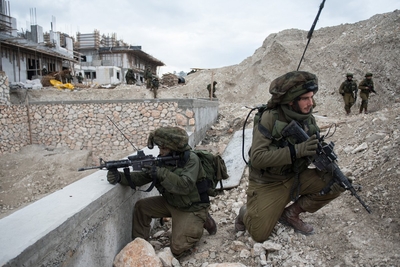
1362Photo Credit: IDF Spokesperson

The Israel Defense Forces (IDF) is in a race against time, and it is a race that is relevant to how other Western powers will also deal with the rise of radical, armed, Islamic groups proliferating across the Middle East.

As the IDF’s commanders look around the region, they see heavily armed, hybrid, Islamic sub-state foes that are replacing states. The traditional threat of hierarchical armies is fading quickly away, into obscurity.

The Sunni and Shi’ite jihadist entities on Israel’s borders – Hamas, Hizballah, ISIS-affiliated groups in Syria, Jabhat Al-Nusra, as well as elements of Iran’s IRGC forces – are all building their power and preparing for a future unknown point in time when they will clash with Israel.

The IDF is preparing, too, but it is not only counting how many soldiers, tanks, fighter planes, and artillery cannons it can call up in the next round. The IDF is in a race to adapt to 21st century Middle Eastern warfare, which bears no resemblance to how wars were fought in the 20th century.

In this new type of conflict, enemies appear and vanish quickly, use their own civilians as cover, bombard Israeli cities with projectiles, seek out the weakest link in Israel’s chain, and send killing squads through tunnels to attack Israeli border villages.

In this type of clash, the enemy looks for a ‘winning picture’ at the start of any escalation. This means landing a surprise blow that will knock Israeli society off balance, at least for a short while.

To be clear, all of the hostile sub-state actors currently are deterred by Israel’s considerable firepower and are unlikely to initiate a direct, all-out attack right now.

The price they would pay for such action is deemed too high, for now.

Yet, opportunities and circumstances can suddenly arise that would alter these calculations, and put these terrorist organizations on a direct collision course with the IDF.

Israel has fought four conflicts against Hamas and Hizballah in the past 10 years, and emerged with the conclusion that the era of state military versus state military warfare is over.

Acknowledging this development is one thing; the organizational transformation that must follow is quite another. Israel did not want to enter any of the past four conflicts that were forced upon it, but since they occurred, they have aided in the IDF’s adaptation process, which has been as complex as it has been painful, and is far from over.

“What you have to do against an enemy like this, and it is a great difficulty for militaries, including the IDF, is to operate in a combined, cross-branch [air force, ground forces, navy] manner, and to keep it [operations] focused. Focus the ground maneuver and firepower, on the basis of the intelligence you get,” a senior IDF source said earlier this month in Tel Aviv, while addressing the challenges of adaptation.

Taking southern Lebanon, the home base of Hizballah, as an example, the area has well over 100 Shi’ite villages that have been converted into mass rocket launching zones.

With one out of every 10 Lebanese homes doubling up as a Hizballah rocket launching site (complete with roofs that open and close to allow the rocket to launch), Hizballah has amassed over 120,000 projectiles – some of them GPS guided – with Iran’s help. This arsenal, pointed at Israel, forms one of the largest surface to surface rocket arsenals on Earth.

Would sending several military divisions into such an area be sufficient for Israel in stopping the rocket attacks? Without focused intelligence, the military source argued, the answer is a resounding no. Israel’s reliance on intelligence has never been more paramount in the age of sub-state, radical enemies.

“The urban areas swallow up our forces. If we can’t focus the maneuver, no amount of forces will be sufficient in dealing with this issue. It must be focused, and the information that must direct this focus is real-time intelligence,” the source said.

The IDF’s Military Intelligence Directorate has the mammoth task of building up a battle picture and a database of targets ahead of any conflict. After a conflict erupts, it must start the process all over again within a few days, when the entire map of threats changes in the modern dynamic battlefield.

This is a far cry from the old intelligence work that looked at enemy tank divisions and infantry formation.

IDF planners believe that any future conflict with a hybrid, terror-guerrilla military force will consist of five stages. An “opening picture” – that surprise blow intended to shock Israelis – will mark the start of hostilities, in which Israel must deny the adversary its “winning picture.” This will be followed by an exchange of firepower. After a few days, Israel would need to call up reserves, and then launch a ground offensive. Throughout this period, the Israeli home front would absorb heavy rocket fire, while the Israel Air Force would pound enemy targets. The IAF could fire thousands of precision-guided munitions every 24 hours, if it deploys its firepower to the maximum, as it would in an all-out clash with Hizballah.

Israeli air defense systems like Iron Dome could soften the blow to the home front significantly, but this is truer with respect to Gazan rockets than against the downpour of Hizballah rockets and missiles, which would overwhelm air defenses.

The ground offensive must destroy “70 to 75 percent of [enemy] capabilities,” the source said. “If there are 100 missiles and two operatives on the other side, and you kill the operatives, than the missiles become irrelevant.”

The last phase is the end stage, and it is unlikely that an entity like Hamas or Hizballah would wave a white flag when hostilities conclude, even if most of their capabilities have been destroyed.

The era of clear-cut military victories, like Israel experienced in the 1967 Six Day War, is gone, the source said.

With this reality in view, the IDF’s steps to adapt itself to modern threats include the ability to gather huge quantities of intelligence and deliver them, in real-time, to the forces that need them most in the battlefield, right down to the level of a battalion commander.

This requirement includes establishing an “operational Internet,” an internal IDF network that allows battalion commanders to access Military Intelligence target data in their area, and direct their units accordingly.

It would also allow field commanders to communicate directly with a fighter jet pilot or drone operator, or even a missile ship commander, for the type of cross-forces cooperation the IDF thinks will be most effective in shutting down threats.

As a result, the IDF’s C4i Branch has spent recent years overcoming many hurdles and objections and integrating the command and control networks of the air force, navy, and ground forces. It then directly linked them up to Military Intelligence.

By the end of this year, the first IDF division will have a “military Internet” network, complete with applications and browsers, up and running.

“I don’t want a squad commander walking around with a screen in his hand. He has to be aware of his soldiers. [But] the battalion commander should certainly have this,” the source said.

In 2014, the IDF did not do a good enough job in detecting, in real-time, the location of Hamas rocket launches in Gaza. It got away with this failure because of the effectiveness of the Iron Dome anti-rocket batteries. But against Hizballah’s much larger arsenal, no amount of air defenses will be sufficient, and the IDF therefore is working on improving its rocket detection and accurate return fire abilities.

“In the next stage [of our development], if you detect the rocket launch areas and the centers of activity of the enemy, and transmit them [to your own forces], you can learn the enemy’s patterns better,” the officer said.

Knowing the enemy has never been more important for Israel’s ability to defend itself against the jihadist entities that are replacing states in the Middle East. As these radical Islamist organizations prepare for the day of battle, Israel does the same, through updating its old 20th century battle doctrines and bringing them up to speed with its rapidly changing and chaotic environment.

Netanyahu phones Putin for clarifications on the South Syrian ceasefire

February 24, 2016

Netanyahu phones Putin for clarifications on the South Syrian ceasefire, DEBKAfile, February 24, 2016

PutinBibi2-480

Prime Minister Binyamin Netanyahu phoned President Vladimir Putin Wednesday Feb. 24, to find out how the partial Syrian ceasefire due to go into effect Saturday Feb. 27 will affect Israel’s northern border security. According to the Kremlin statement, “The two leaders discussed the Middle East and reached agreement to hold a number of high-level contact meetings.”

Agreement was also reached on “a range of contact [meetings] on the high and highest level, taking into consideration the 25tyh anniversary of the establishment of diplomatic relations between the two countries,” the communiqué went on to say.

The language and content of this communiqué struck DEBKAfile’s diplomatic sources as oddly off the point compared with statements that came after past conversations.

It is hard to believe that the Russian President, while deeply immersed in tense exchanges with President Barack Obama and Iran’s Hassan Rouhani for tying up the ends of the approaching Syrian ceasefire, would give his attention to the celebration of a historic event.

The words did however convey the impression that the Russian leader was making an effort to calm Israel’s apprehensions about the coming stage of the Syrian crisis.

According to our sources, Netanyahu put in the call to Putin when he learned that the Russian and American presidents had agreed to get the partial ceasefire started in southern Syria, namely on the front closest to the borders of Israel and Jordan.

Israeli and Jordanian military officials have been trying to get a picture of how these arrangements would work and affect their national security, but Washington and Moscow are similarly tightlipped on information. This is also the reaction the Israeli Foreign Ministry’s Director General Dore Gold found when he called on Russian Foreign Minister Sergei Lavrov in Moscow on Feb. 18. The minister was polite but avoided direct answers to questions.

Israel is most deeply troubled by the possibility that Syrian army, Iranian and Hizballah forces currently in offensive momentum in South Syria will exploit the cessation of hostilities to advance towards its Golan border with hostile intent.

With only three days to go before the truce goes into effect, Israel has still not received any clear answers about whether the Russian air force will continue to strike Syrian rebel elements deemed “terrorists” unabated in close proximity to its northern borders.

US officials have tried in the last 24 hours to assuage Israel’s concerns, but they are no more forthcoming with clear information than the Russians.

Netanyahu therefore picked up the phone to the Russian president, with whom he maintains a friendly dialogue, to find out what was ahead in the wake of the truce and to ask for guarantees that Syrian, Iranian and Hizballah forces would not permitted to take advantage of the lull to gain ground.

The prime minister also asked Putin about the huge $14bn arms deal in negotiation with Tehran.

He is most unlikely to have been appeased by the bone the Russian president threw him about a joint celebration of an anniversary. The record is not assuring. In early January, Putin promised Netanyahu that he would make sure that Hizballah forces would not be part of the Russian-backed Syrian army offensive in the South. But then, on Jan. 27, a large Hizballah force entered the southern town of Daraa and Russian air strikes drew ever closer to the Israeli border, until explosions could be heard in Israel from a distance of no more than a few hundred meters.

Canadian FM outdoes himself

February 23, 2016

Canadian FM outdoes himself, Israel Hayom, Ruthie Blum, February 23, 2016

(Please see also, Abu Mazen rebuffs Kerry’s appeal to cool Palestinian terror against Israelis. – DM)

Canadian Foreign Affairs Minister Stephane Dion exhibited a real knack for the twofer on Friday, by going after both his political opposition and the Israeli government in one disingenuous swoop.

In perfect doublespeak, Dion managed to announce his (Liberal) party’s support for a Conservative motion condemning the boycott, divestment and sanctions movement against Israel, while attacking it as an attempt to foment discord in parliament.

The motion to “condemn any and all attempts by Canadian organizations, groups or individuals” to engage in BDS — “the demonization and delegitimization” of Israel — was tabled by Tory MP Tony Clement.

“This is not a partisan issue,” he asserted, urging Liberals to “side with us on this motion. Send a strong message to our fellow Canadians and to freedom-lovers around the world.”

Tory MP David Sweet went even further, calling BDS “anti-Semitic.” Sweet also got up and commended the Liberals for joining in a bipartisan effort to combat it. But this was too much for Dion, who made sure to say that though the Liberals would support the motion, they had “reservations” about it, among them the impure and divisive motives of the Tories in pushing the bill forward.

“To me, this is further proof that the Conservatives have not learned from their mistakes and are still trying to divide Canadians on issues that should unite them,” he said.

Huh?

And then he proceeded to defend not only “freedom of expression,” but BDS as well — at least its supporters whose motives (unlike those of the Tories) are pure.

“Some supporters of the boycott have bad intentions, do not want peace and are working against Israel,” he said. “However, it cannot be denied that many of the boycott supporters are mistaken in good faith. Many organizations and individuals in Canada and abroad support the BDS movement out of the belief that it will somehow accelerate the peace process and be a nonviolent initiative that leads to a lasting resolution of the Israeli-Palestinian conflict. Their goal ultimately is the same as ours: a two-state solution with a secure, stable and democratic Israel, living side-by-side with a secure, stable and democratic Palestinian state. However, they are mistaken in the way this goal may be achieved.”

This is quintessential Dion drivel in its finest. Since the November election of Prime Minister Justin Trudeau, which marked the end of Stephen Harper’s conservative government, Dion has been making it clear in his convoluted way that Israel shares, if not bears, responsibility for the ills befalling it.

The wave of Palestinian terrorism against the Jewish state that surged shortly before Trudeau took office provided Canada’s recently instated top diplomat with the perfect opportunity to show the international community that he — the new peace sheriff in town – grasped this tenet. To illustrate he meant business, Dion promptly took a sharp turn away from his predecessor’s public display of support for Israel as a staunch Western ally, under the same kind of attack at the hands of radical Islamists as the rest of the Christian, Jewish and Muslim world.

The way he did this was to issue a public statement equating Palestinian and Israeli “violence and incitement,” and calling on “both sides” to return to the negotiating table. His timing was impeccable, as an additional heads up about a more harshly worded reprimand to Israel came on the heels of two particularly horrifying stabbing attacks by Palestinian terrorists against two Israeli women — one slashed to death in front of her traumatized teenage daughter, the other wounded while pregnant.

Imagine how painful it must be for him, then, to have to join forces with his enemies at home in countering Israel’s enemies abroad. No need to worry, however. We have not heard the last of Dion, whose ability to distort reality to suit his fantasy may yet surpass that of his counterpart, U.S. Secretary of State John Kerry.

Fortunately for Israel, Canada has no real power; it has simply become yet another former ally professing to have its best interests at heart.

World Council of Churches Demonizes Israel – Again

February 23, 2016

World Council of Churches Demonizes Israel – Again Does the German Protestant Church Know What It Is Doing?

by Thomas Smith February 23, 2016 at 5:00 am

Source: World Council of Churches Demonizes Israel – Again

  • Usually, in regular Lenten services, solemn memories of divine mercy on the sinners of the world take center stage for Christians. But not in this liturgy. Center stage was instead given to committing a sin of evil speech: launching a lie about an Israeli-made water shortage suffered by Palestinians. The lie is a sin in which all the member churches of the WCC are invited to participate.
  • Those leaders of Protestant churches, turned into political propagandists, used the pulpit of Jerusalem unjustly to call upon the Protestant faithful worldwide to listen to Palestinian water libels against the State of Israel.
  • This liturgy abused the biblical readings as a means of invigorating the equally false Kairos Palestine message, that Israel takes the Land of Palestine and has no right to be where it is.
  • A close look shows no scientific analysis, neither of water distribution nor of water politics for the territories of Israel and the Palestinian Authority (PA).
  • The Palestinians certainly are experiencing a water crisis; the question is to what extent are they themselves are responsible for it, and to what extent are their own leaders responsible for keeping them as victims for effective international “marketing.”

On February 10 (Ash Wednesday in the Western Christian calendar), the Palestinian Lutheran Bishop, Munib Younan, on behalf of the World Council of Churches (WCC), launched the Lenten Campaign of the Ecumenical Water Network. Entitled “Seven Weeks for Water,” it was presented at the (German) Lutheran Church of the Redeemer in the Old City of Jerusalem.

Younan — a “yes-signatory/no-signatory” of the infamous document published by Kairos Palestine in 2009 — was flanked by other well-known supporters of Palestinian agitation against Israel:

  • Dr. Antje Jackelen, the Archbishop of Sweden, (another “yes-advocate/no-advocate” of the document)
  • Rev. Dr. Olaf Fykse Tveit, the General Secretary of the WCC (he heads the body that generated Kairos Palestine and continues to be its main sponsor)
  • Mrs. Hind Khoury, the current Secretary General of Kairos Palestine; also a Palestinian economist from Bethlehem and PLO delegate general to France 2006-10)
  • Mr. Dinesh Suna, the Coordinator of the Ecumenical Water Network
The Lutheran Church of the Redeemer in Jerusalem, Israel. (Image source: Wikimedia Commons)
It was an impressive group of seasoned activists for Palestine who gathered for a ten-page prefabricated liturgy during an hour-long church service. The few people in the pews were to be sensitized about an alleged injustice to the Palestinian people: the supposed deprivation of rightful quantities of water by supposedly evil Israelis. In order to bring some action into this otherwise flow of distorted information, each participant got a cross of ash on his forehead — possibly one of the few remnants of the Christian custom of Lent.

In regular Lenten services, for seven weeks until Easter, solemn memories of divine mercy on the sinners of the world take center stage for Christians. But not in this liturgy. Center stage was instead given solemnly to committing a sin of evil speech: launching a lie about an Israeli-made water shortage suffered by Palestinians, a sin that all present were invited to commit daily for the next seven weeks; a sin in which all the member churches of the WCC are invited to participate.

Those leaders of the Protestant churches, turned into political propagandists without even any hindrance, used the pulpit of Jerusalem unjustly to call upon the Protestant faithful worldwide to listen to Palestinian water libels against the State of Israel. This liturgy abused the biblical readings as a means of invigorating the equally false Kairos Palestine message, that Israel takes the Land of Palestine and has no right to be where it is.

The WCC acolytes who gathered at the Redeemer Church are now set up to spread this propaganda through a confusing network of seemingly distinct organizations, all of which turn out — on closer inspection — to be WCC subsidiaries.

Two organizations were highlighted: first, the Pilgrimage of Justice and Peace (PJP), launched in 2013 at the 10th WCC Assembly in South Korea. The PJP in Jerusalem was accompanied by three strategic support groups: the “Theological Study Group,” the “Reference Group,” and the “International Research Group.” Second, the Ecumenical Water Network (EWN), launched in 2008 as a network of churches and Christian organizations, to keep watch on water access. Although PJP and EWN seem to be two different entities, the WCC’s press center advertised its Seven Weeks for Water campaign as a

“pilgrimage of water justice in the Middle East, with specific reference to Palestine. The Biblico-theological reflections and resources for the seven weeks will be based on the water crisis in Middle East region and take into consideration issues of justice and peace.”

That is, the work of PJP and EWN is closely interlinked. Both groups, in fact, are committed to the Palestinian cause and can be best understood as parts of the WCC-sponsored network that implements the Kairos Palestine agenda.

A close look at the EWN website shows no scientific analysis, neither of water distribution nor of water politics for the territories of Israel and the Palestinian Authority (PA). The EWN material also shows no reference to any of the existing water distribution analyses in Israel (e.g.: here and here). Neither is the well-documented mismanagement of water by the Palestinian Authority mentioned, nor is Israel’s just and generous over-the-quota water support for the PA areas.

The aim of the water campaign clearly appears to spring from an unjust and unsubstantiated discrimination against the State of Israel, as propagated in the Kairos Palestine statement. The intent of launching the Seven Weeks for Water campaign was unashamedly addressed by Tveit in his sermon,

“As the WCC’s Pilgrimage of Justice and Peace is focused on issues of the Middle East, particularly in this year, we hope your stories and struggle for justice and peace will become the stories and struggle for the churches around the world. May this Lenten season help us to reflect on these issues more deeply. May the Seven Weeks for Water during this Lent help us to highlight the water crisis in Palestine and other places in the world in desperate need for more clean water.”

Such Palestinian narratives had been collected, a short time before the services at the Redeemer Church, under the watchful eyes of Bishop Younan, when the “International Research Group” met in Bethlehem. Dinesh Suna wrote on his Facebook page:

“The IRG meeting of the WCC’s Pilgrimage of justice and Peace started today at Bethlehem. To set the tone of the discussion we went to listen to stories of struggle to end occupation of Palestine by Israel. It was quite a touching moment for us to hear these stories…”

Did these people ever meet with Israelis, as well? Did the “International Research Group” ever research the countless academic water analyses, which are freely available on-line? There is no reference that either activity ever took place.

Instead, we are informed, the WCC’s PJP is organizing “two strategically important groups” in “the Holy Land” between February 9-17. One is PJP’s “Theological Study Group” at the Roman Catholic St. Anne’s Church in Jerusalem on February 9-11, “in order to deepen the theology for accompanying PJP.”

The other is PJP’s “Reference Group” in Bethlehem, February 12-17, presumably for parading more “eyewitnesses of the water crisis.” The Palestinians certainly are experiencing a water crisis; the question is, or should be, for their sake, to what extent are they themselves are responsible for it, and to what extent are their own leaders responsible for keeping them as victims to have them appear more wretched for effective international “marketing.”

Tveit and his WCC staff accompany both groups. The point of this money-intensive travel of those well-salaried clergy-cum-politicians is not to solve any misery. Rather, it is, as Tveit sermonized: “we hope your stories and struggle for justice and peace will become the stories and struggle for the churches around the world.”

In short, the WCC invites the Christian world to join in an assault upon the State of Israel. This is the actual underlying message of Kairos Palestine and PJP’s Seven Weeks for Water campaign.

Predictably, WCC’s PJP projects will find any number of young, enthusiastic, uninformed and naive Christian followers to deceive. And the Lutheran Church of the Redeemer in Jerusalem is just a perfect location for launching more and more of such initiatives. How curious.

Also curious is that the German Protestant Church, owner of the Lutheran Church of the Redeemer in Jerusalem, and committed to reconciliation with Israel, seems to tolerate WCC approaches against Israel, under the local auspices of the Palestinian Bishop. Is Bishop Younan just a willing fig leaf for German Protestant Church agitation against Israel? Or does the German Protestant Church not know what is going on in its own church in Jerusalem?

Thomas Smith is a scholar based in the Middle East.

Erdan: IDF plan for peace talks is ‘infuriating’

February 23, 2016

Erdan: IDF plan to beat terror with peace talks is ‘infuriating’ Internal Security Minister discusses IDF Intelligence head’s call for ‘diplomatic process,’ noting periods of peace talks more lethal.

By Ido Ben-Porat

First Publish: 2/23/2016, 3:28 PM

Source: Erdan: IDF plan for peace talks is ‘infuriating’ – Defense/Security – News – Arutz Sheva

Minister Gilad Erdan
Flash 90

Internal Security Minister Gilad Erdan (Likud) on Tuesday denied that IDF Intelligence Corps head Maj. Gen. Herzl (Herzi) Halevi told the Security Cabinet the Arab terror wave will expand if peace talks aren’t launched with the Palestinian Authority (PA).

Halevi appeared at the Security Cabinet on January 24 together with other senior Intelligence Corps officials to deliver the annual intelligence appraisal for 2016, before delivering it again Tuesday to the Knesset’s Foreign Affairs and Defense Committee, according to Channel 10 reports on Monday night.

The report alleged that Halevi told the Cabinet a “diplomatic process” with the PA is the only way to stop the terror wave, as he claims the military has largely done all it can. If peace talks are not advanced, he stated additional forces will join the terror wave, including the Tanzim terror group, which is the “armed wing” of PA Chairman Mahmoud Abbas’s Fatah faction.

“I sat in many meetings that he (Halevi) took part in. I never heard him say something like that,” Erdan told Army Radio on Tuesday, denying the reports.

“If something like that was said in a briefing for military correspondents, I think that’s an infuriating statement because we remember the days of a diplomatic process, in which the attacks and the terror were much stronger.”

Erdan’s statement would appear to be a reference to the 1994 Oslo Accords, in which Israel supplied the newly created PA and its Security Forces with weapons. The Accords led to the 2000 Second Intifada or Oslo War, in which over 1,000 Israelis were murdered; PA officials later bragged that 70% of the attacks were conducted by PA Security Force members.

In the current wave as well a number of the terrorist attackers have been identified as PA policemen.

Erdan also spoke about returning the bodies of terrorists, a move he has generally opposed as a deterrence factor so as to avoid massive funerals encouraging more attacks.

“Since our last talk I think one or two bodies were returned. The reason no one heard about it is because the families agreed to cooperate with the police and hold a respectable funeral…not one with incitement or support for the act of terror that the terrorist conducted,” he said.

“We have no interest in holding these bodies, rather (we do it) simply because we are in a wave of terror in which the glorification of the ‘martyr’ and the imitation by his friends is an integral part. We are not prepared for things like this to happen in funerals and possibly even bring about additional attacks.”

Abu Mazen rebuffs Kerry’s appeal to cool Palestinian terror against Israelis

February 23, 2016

Abu Mazen rebuffs Kerry’s appeal to cool Palestinian terror against Israelis, DEBKAfile, February 23, 2016

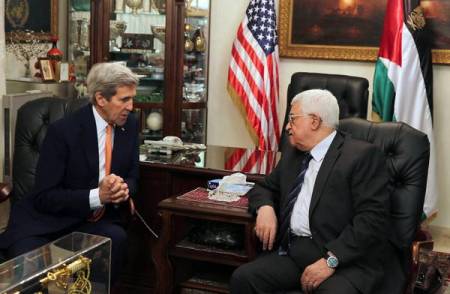
epa05173718 Visiting US Secretary of State John Kerry (L) and Palestinian President Mahmoud Abbas (R) speak to each other during their meeting in Amman, Jordan, 21 February 2016. Kerry arrived in Amman on 20 February for an official visit during which he also will meet Jordan's King Abdullah II to discuss the latest developments in the Middle East. EPA/JAMAL NASRALLAH / POOL

epa05173718 Visiting US Secretary of State John Kerry (L) and Palestinian President Mahmoud Abbas (R) speak to each other during their meeting in Amman, Jordan, 21 February 2016. Kerry arrived in Amman on 20 February for an official visit during which he also will meet Jordan’s King Abdullah II to discuss the latest developments in the Middle East. EPA/JAMAL NASRALLAH / POOL

US Secretary of State John Kerry came away empty-handed from his latest meeting with Palestinian Authority Chairman Mahmud Abbas (Abu Mazen) in Amman on Sunday, February 21,- which shouldn’t have surprised him as it was par for the course.  DEBKAfile’s Middle Eastern sources report that Kerry was finally persuaded that Abbas would not give Israel an inch on any political or security-related matters. The Palestinian leader has never swerved from his conviction that it was the duty of the international community to force Israel to present the Palestinians with a state of their own – without direct negotiations. 

To this end, Kerry found Abu Mazen clinging to the initiative put forward by French President Francois Hollande, for an international conference that will establish a Palestinian state, while letting the Palestinians off the hook of talks with Israel.

France in fact warned Israel that without progress towards a two-state solution of the conflict, Paris would go ahead and recognize a Palestinian state on its own.

The Palestinian leader is determined to campaign on behalf of the French initiative in the coming month, undeterred by the US Secretary’s repeated warning that Washington will not go along with it, even if France puts it before the UN Security Council.

But Kerry was most of all taken aback to find himself rebuffed by Abu Mazen when he asked him to make a speech or issue some statement calling on the Palestinians to halt their terrorist attacks against Israel now entering their fifth consecutive month. Al his efforts to persuade the Palestinian leader to tamp down the violence were in vain.

A senior member of Kerry’s entourage told DEBKAfile’s sources: “Abbas obviously thinks that terrorism in its present form serves his policy, although he won’t admit as much in public.” The source described the US Secretary’s mood after this encounter as “disappointed and shocked.”

DEBKAfile’s military sources note that Abbas is treading a very fine line. While he finds a measure of violence useful for letting the Palestinians vent their resentments, he nonetheless instructs his security services to partially cooperate with Israel so that Palestinian violence does not get out of hand and make him their next target.

And before him is the constant sight of the consequences of Israel’s withdrawal from the Gaza Strip, the rise of Hamas rule. This must be prevented from happening on the West Bank avoided at all costs.

Notwithstanding this reality, the age-old controversy dogging Israeli politics erupted again this week, when the IDF military intelligence chief, Maj. Gen. Herzl Halevi, was quoted (or misquoted) as commenting some weeks ago at a security cabinet session that diplomatic traction between Israel and the Palestinians might cool the current wave of terror,

This theory, disproved each time a new round of peace talks sparked a fresh outbreak of Palestinian terror in the last three decades, was strikingly refuted once again in the Kerry-Abbas meeting in Amman.

Recent leaks from Israel’s security cabinet, although often taken out of context, show that intelligence evaluations are too often wide of the mark – both on the Palestinian issue and the prospects of the Syrian conflict.

This may have something to do with Prime Minister Benyamin Netanyahus delay in appointing a new National Security Council Director to take over from Yossi Cohen who has been appointed Mossad Director.
Netanyahu, it appears, is not happy with the intelligence evaluations put on his table and may decide to dispense with yet another evaluator.

Netanyahu, it appears, is not happy with the intelligence evaluations put on his table and may decide to dispense with yet another evaluator.

Also short on substance were the remarks made by Defense Minister Moshe Ya’alon on Feb. 22 from the deck of the American destroyer, the USS Carney, which is anchored at the port of Haifa in the framework of the joint US-Israeli Juniper Cobra 2016 missile defense.

Yaalon said, “The United States and Russia, both of which are currently active in the Syrian civil war, recognize Israel’s freedom to act in defense of its interests.”

While the two powers may indeed recognize this freedom in principle, Israel will be certain to avoid any action that makes it liable to being accused of damaging the chances of a ceasefire going into effect in Syria on Feb. 27. Both the US and Russia will also make sure that no outside power, whether Turkey, Saudi Arabia or Israel, intervenes militarily in the Syrian conflict whatever their security interests may be.

Trump: Israel Is Victim In Conflict With Palestine, If Attacked ‘100% I’d Come to Their Defense’

February 23, 2016

Trump: Israel Is Victim In Conflict With Palestine, If Attacked ‘100% I’d Come to Their Defense’

by Ian Hanchett

23 Feb 2016

Source: Trump: Israel Is Victim In Conflict With Palestine, If Attacked ‘100% I’d Come to Their Defense’ – Breitbart


Republican presidential candidate Donald Trump stated that he sees Israel as the victim in the Israeli-Palestinian conflict and he would “100%” come to its defense if it was attacked in an interview broadcast on Monday’s “Hannity” on the Fox News Channel.

Trump was asked about his comments that he would be “neutral” in the conflict between Israel and Palestine, and whether he sees “that Israel is the victim in this?” Trump said that he does and that he’s “a great friend of Israel.”

He added that making a deal between Israel and Palestine would be “the ultimate deal” if it was possible, and “I have been told by people, very high level people, it’s impossible, because the hatred, especially on the one side, I won’t even say which side –”

After host Sean Hannity cut in with, “On the Palestinian side.” Trump continued, “is so intense. It’s so incredible, and from the time they’re 2 years old they’re told to hate, to hate, to hate. It’s got to be taken away.”

Trump concluded that if Israel was attacked, “100% I’d come to their defense. 100%. Now, you know that under the Iran deal… but under the Iran deal, if Israel ends up attacks Iran because they’re — they see they’re doing the nuclear, or if it’s the other way around, we have to fight with Iran. By the way, that’s not happening, folks. I don’t care. Deals are meant to be broken in some cases, all right?”

IAI awarded two mega contracts

February 23, 2016

IAI becoming industry leader; awarded two mega contracts IAI awarded multimillion dollar contracts from Boeing and Lockheed Martin to build parts for Boeing 777x and Lockheed Martin F-35s.

By Arutz Sheva Staff

First Publish: 2/23/2016, 1:49 PM

Source: IAI awarded two mega contracts – Defense/Security – News – Arutz Sheva

F-35 in flight
Lockheed Martin

Israel Aerospace Industries (IAI) has been awarded two new and lucrative contracts, one by Boeing to build the empennage leading edges for the 777X, and one by Lockheed Martin to produce 800 wing sets for the F-35 project.

The Boeing project will see IAI help construct the newest passenger aircraft, the Boeing 777x, which is expected to enter into service in the year 2020. IAI was also awarded an extension of its existing contract for the 777 empennage leading edges which will continue for the duration of the life of the program. These two Boeing contract awards follow hard on the heels of a strategic agreement which was signed by the two companies and will see the pair explore opportunities for additional future contracts that could be worth upwards of several hundred million dollars.

The Lockheed Martin contract to produce more than 800 pairs of F-35 wings for the multinational cooperative F-35 project, is worth a potential value of $2.5 billion that will be spread across the next 10-15 years.

According to two reports by the IsraelDefense website, both Boeing and Lockheed Martin have recognized the value of working with the IAI and developing new systems and technologies in Israel.

“Boeing’s renewed vote of confidence in IAI is an act that cannot be overestimated. Working with the world’s leading aviation giant serves as a stamp of quality for IAI’s technological and aviation capabilities”, said an IAI spokesperson in an interview with IsraelDefense.

With regard to the second contract, “Lockheed Martin recognizes IAI’s commitment to the F-35 program and understands the importance of the quality delivered by the IAI team,” said Jeff Babione, Lockheed Martin F-35 program manager.

Joseph (Yossi) Weiss, president and CEO of IAI said in reference to the Lockheed Martin contract that  “the award reflects a strong vote of confidence in IAI’s abilities and commitment to this partnership, part of the development of the most advanced fighter aircraft ever produced. We are extremely proud of this cooperation and believe it will continue to be strengthened in the future.”

IsraelDefense reports that “the IAI currently supplies Boeing with the empennage leading edge for the 777 as well as the pivot bulkhead, passenger floor beams and door surround details for the 787 Dreamliner.”

With regards to the F-35 Wings package, the IAI will be significantly stepping up production to meet the quota following the creation of an automated F-35 wing production line. The automated production line is, according to reports, extremely accurate and ensures protection of the environment during all stages of the production process.

IAI will build the 777X empennage leading edges at its Lod, Israel, manufacturing facility, with the first delivery planned for the second half of 2017. Construction of the 800 F-35 wing sets will span the next 15 years. The wing production center at IAI’s ‘Lahav’ Division also produces wings for the F-16 and T-38 aircraft, as well other aerostructures for other aircraft and customers.

Terrorist stabber at large – due to IDF rules? –

February 22, 2016

Terrorist stabber at large – due to open fire rules? Armed and dangerous terrorist flees after soldiers follow protocols – did Eizenkot’s orders prevent an elimination of the danger?

By Uzi Baruch

First Publish: 2/22/2016, 3:36 PM

Source: Terrorist stabber at large – due to IDF rules? – Defense/Security – News – Arutz Sheva

Arab terrorist armed with a knife (illustration)
Flash 90

An Arab terrorist was thwarted in an attempted stabbing attack on Monday afternoon, but since fleeing the scene remains at large, raising questions about the IDF opening fire protocols.

The attack attempt took place at Habitot Junction located in Samaria, near the Arab town of Huwara to the south of Shechem (Nablus).

The terrorist ran at an IDF force at the junction, which is near Kfar Tapuach, and in response the soldiers conducted the standard procedures, which include shouting out in Arabic for him to stop and then firing in the air before firing at the lower body.

Apparently at the stage of firing in the air the terrorist turned and fled, and the soldiers did not shoot him as he no longer presented an immediate threat to their lives.

IDF forces are currently scouring the area for the armed and dangerous terrorist, who was left alive despite his attempt to attack with a lethal weapon due to the opening fire protocols.

The incident comes as the topic of open-fire procedures are being closely examined, after IDF Chief of Staff Gadi Eizenkot last Wednesday defended the strict protocols saying soldiers must not “empty magazines” into a 13-year-old female terrorist wielding scissors. He also disparaged a famous Talmudic maxim on self-defense, saying “the IDF cannot speak in slogans like ‘when someone comes to kill you – kill him first.'”

Eizenkot’s statements stirred an outcry, although Prime Minister Binyamin Netanyahu and Jewish Home chairperson Naftali Bennett came to his defense. A poll Sunday found the majority of Israeli Jews oppose Eizenkot’s words.

Regarding the open-fire orders, last August the protocols were made even tighter, mandating soldiers in Judea and Samaria to only fire in the air, and not even shoot the lower extremities of an attacker other than in extreme cases of imminent life-threatening danger. In May, it was reported that IDF soldiers were told to avoid killing terrorists, even if they spot them as they are about to throw a potentially lethal firebomb or rock at a car.

Habitot Junction has become something of a hot spot for attacks, as just a day earlier on Sunday another Arab terrorist arrived at the junction and tried to stab soldiers. In that incident, the terrorist was shot and eliminated before being able to cause injuries.

That stabbing attempt was one of three attempts Sunday; a 14-year-old Arab terrorist tried to conduct a stabbing at Sde Kalev near Hevron in Judea, but was shot by security forces and arrested.

Earlier a 17-year-old from Kusra in Samaria was arrested at Tapuach Junction after raising the suspicions of Border Police officers. He approached the security forces and refused calls to stop, before eventually raising his hands – the alert officers noticed that as he did so he threw aside a knife. The terrorist admitted he planned to conduct an attack after watching inciting videos on social media.

Palestinians: Kerry and the Game of Obfuscation

February 22, 2016

Palestinians: Kerry and the Game of Obfuscation, Gatestone InstituteKhaled Abu Toameh, February 22, 2016

♦ “intifada” is simply a further phase in a larger plan to destroy Israel. When the plan began officially, with the establishment of the PLO in 1964, there were no “settlements” — not until after the June 1967 War — so what exactly were the Palestinians planning to “liberate”?

♦ The current conflict is not about “defending” any mosque from being contaminated by the “filthy feet” of Jews: it is about seeing Israel forced to its knees. Abbas and others seek to reap delicious political fruits from this “intifada.”

♦ Here is a novel idea: Kerry could put pressure on the Palestinian and Jordanian leadership to cease anti-Israeli incitement and indoctrination. Now that would be pressure well applied.

♦ Abbas is expected to become a partner in the fight against ISIS and radical Islamist groups. All well and good. Why then is he not expected to stop cheering on and glorifying young Palestinians who attack Jewish Israelis?

U.S. Secretary of State John Kerry is back in town. This time he is meeting with Jordanian and Palestinian leaders about “ongoing security issues in the region and continued tensions between Israel and the Palestinians.”

For those not involved in political newspeak, here is a translation:

“Ongoing security issues” = the Islamic State terror group (ISIS).

“Tensions between Israel and the Palestinians” = the ongoing wave of Palestinian stabbing, car-ramming and shooting attacks that began in October 2015.

Jordan and the Palestinian Authority (PA) fighting ISIS? Now that’s an idea! Jordanian King Abdullah and PA President Mahmoud Abbas ending “tensions” between Israel and the Palestinians? Let’s think about that.

Kerry comes back, but never calls a spade a spade. The “tensions” to which he deceptively alludes are knifings and car-rammings. And what is the biggest spade that Kerry avoids calling by its name? The new generation of Palestinians brainwashed to believe that Israel can be defeated with knives and car-attacks.

This “intifada” is simply a further phase in a larger plan to humiliate and destroy Israel. This plan began officially, with the establishment of the Palestine Liberation Organization (PLO), in May 1964. At that time there were no “settlements” — not until after the June 1967 War — so what exactly were the Palestinians planning to “liberate”?

The plan continued in 1974, at the twelfth session of the Palestinian National Council in Cairo, with the 10-point “Phased Plan” (see Appendix below for full text of the Phased Plan). Article 2 called for “armed struggle” (terrorism) to establish “an independent combatant national authority” that is “liberated” from Israeli rule.

Contrary to Palestinian leaders’ pap, the current conflict is not about “defending” any mosque from being contaminated by the “filthy feet” of Jews: it is about seeing Israel forced to its knees. Abbas and others seek to reap delicious political fruits from this “intifada.”

That is why, in his meeting with Kerry, Abbas made it clear that he intends to pursue unilateral moves to impose a solution on Israel, with the help of the international community.

Abbas also told Kerry that he intends to continue with his efforts to seek a UN Security Council resolution condemning Israel over “settlement construction.”

Never mind that on Palestinian maps, all of Israel is regarded as one big “settlement.”

1271Palestinian Authority leaders, official television, schools and media outlets often display maps showing Palestine stretching from the River Jordan to the Mediterranean Sea. The maps do not show the existence of Israel.

But back to Kerry. His “tensions” imply two sides engaged in some kind of a dispute that has aggravated a situation and strained relations between them, instead of what it really is: Palestinians openly trying to supplant Israelis — the entire state.

So the game of obfuscation continues. No doubt, we will witness more pressure on Israel to make concessions that will supposedly ease the “tensions.”

Kerry and his friends either do not “get it” or do not want to “get it.” Palestinians are waging an out-and-out war against Israel with the goal of making Israelis suffer to a point at which they will beg their leaders to capitulate. In the Palestinian view, such behavior pays off royally.

It is a Palestinian commonplace that the two previous uprisings — in 1987 and 2000 — brought major achievements to the Palestinians.

The first “intifada” led to Israel’s recognition of the PLO as the “sole legitimate representative of the Palestinians” — a move that was followed by the signing of the Oslo Accords and the creation of the Palestinian Authority.

The second “intifada,” the Palestinians argue, led to Israel’s full withdrawal from the Gaza Strip in the summer of 2005.

And so we arrive at the newest wave of attacks. As the saying goes: Step-by-step.

Kerry would like to see an end to the Palestinian attacks on Israeli Jews. The only problem is that his vacuous rhetoric prevents him from having a snowball’s chance in a Middle Eastern summer from attaining that goal.

Let us also not underestimate Palestinian Authority rejectionism. On the eve of the Kerry-Abbas meeting, Palestinian Authority officials were quoted as saying that they did not expect anything positive to come out of the talks “because the U.S. remains biased in favor of Israel.”

As always, the Palestinian stance is, “My way or the highway.”

Moreover, Kerry is dreaming if he thinks that President Mahmoud Abbas or King Abdullah are able to stop the attacks on Israelis. Neither has the mandate or the credibility to do so. In any case, they and their media outlets are too busy with their anti-Israeli ranting to do much on that score.

Thus far, not a word has been uttered by either of the two Arab leaders that could be even vaguely interpreted by their people as “stop killing Israelis.” In the Palestinian Looking Glass, it is Israel that is responsible for the deadly attacks. After all, claims that are untrue about Israelis “storming and desecrating the Al-Aqsa Mosque and other Islamic holy sites” are provocative, to say the least.

Here is a novel idea: Kerry could put pressure on the Palestinian and Jordanian leadership to cease anti-Israeli incitement and indoctrination. Now that would be pressure well applied. And it does not even require funding.

President Abbas is expected to become a partner in the fight against ISIS and radical Islamist groups. All well and good. Why then is he not expected to stop cheering on and glorifying young Palestinians who attack Jewish Israelis?

When Kerry and his crew finally wake up to the fact that it is precisely this incitement that is driving Palestinians into the open arms of ISIS, Hamas and other terror groups, perhaps, finally, we will be able to hope for “easing tensions in the region.”

Meanwhile, Kerry is back blathering about peace in the Middle East. Unfortunately, he seems incapable of calling a spade a spade — especially when that spade’s name is Palestinian prevarication.


