Posted tagged ‘Israel’

 2 IDF Soldiers Wounded, 5 Bombs Still ‘Hot’ in Attack at Hizme Checkpoint

May 11, 2016

Five more bombs were found after a quadruple bombing that left an IDF officer with head and facial wounds at Hizme checkpoint.
By: Hana Levi Julian

Published: May 10th, 2016 Latest update: May 11th, 2016

Source: The Jewish Press » » 2 IDF Soldiers Wounded, 5 Bombs Still ‘Hot’ in Attack at Hizme Checkpoint

Scene of bombing attack at Hizme checkpoint
Photo Credit: Zoro / Rotter.net

An IDF officer and a second soldier were wounded Tuesday night in a quadruple bomb attack at the Hizme checkpoint, while an hour later five more bombs were defused by IDF sappers.

The IED (improvised explosive device) were detonated by terrorists as the officer was searching a suspicious package planted on the road at the entrance to the checkpoint.

Two pipe bombs were discovered attached to a gas canister shortly after that initial bombing attack, according to local sources. The Adam junction was evacuated for the safety of everyone in the area.

Sappers then discovered five more additional bombs as well, including that which was tied up with the gas canister. The bomb squad carefully worked on dismantling all five bombs at the site.

The IDF officer, meanwhile, was evacuated to Hadassah Ein Kerem Medical Center with serious face and upper body wounds, according to Magen David Adom medics on the scene. The victim sustained head and facial wounds but was fully conscious.

A second soldier was in stable condition after sustaining shrapnel wounds in the leg. He too was treated at the scene before he was evacuated for further treatment.

The Hizme checkpoint is located near the northern Jerusalem neighborhood of Pisgat Ze’ev, not far from the Jewish community of Adam.

Video added by JK


Hezbollah convoy hit in possible Israeli airstrike

May 10, 2016

Lebanon: Hezbollah convoy hit in apparent Israeli airstrike Unconfirmed reports say Israeli jets hit a convoy belonging to Shia terrorist group in along the Syrian-Lebanese border.

By Ari Soffer First Publish: 5/10/2016, 9:04 PM / Last Update: 5/10/2016, 9:11 PM

Source: Hezbollah convoy hit in possible Israeli airstrike – Defense/Security – News – Arutz Sheva

IAF F-16  Flash 90

A convoy of Hezbollah terrorists and weapons was hit in an apparent Israeli airstrike in Lebanon, according to Channel 2 reports.

The convoy was reportedly traveling through the village of Anjar, close to Lebanon’s border with Syria, when it was hit.

Anjar is located in the Bekaa Valley region, a Hezbollah stronghold in Lebanon.

Israeli airstrikes have targeted Hezbollah positions in Syria over the past several years, as part of efforts to avoid the Shia terrorist group obtaining advanced weaponry from Iran in exchange for its support of the Assad regime.

However Israeli strikes in Lebanon – Hezbollah’s heartland – have been far rarer over the past several years, and only in direct response to attacks by Hezbollah and other terrorist groups.

Updates to follow.

Israel remembers its fallen soldiers, victims of terror

May 10, 2016

Israel remembers its fallen soldiers, victims of terror, DEBKAfile, May 10, 2016

Israeli soldies gather on the Mount of Olives cemetery of fallen Israeli soldiers to place flags on the graves during a ceremony held at the Mount of Olives in preparation for Memorial Day, beginning tonight. Memorial Day commemorates the death of Israeli soldiers killed in wars since 1860. May 10, 2016. Photo by Nati Shohat/Flash90 *** Local Caption *** ?????? ?? ?????? ??? ????? ????? ??? ???????

Israeli soldies gather on the Mount of Olives cemetery of fallen Israeli soldiers to place flags on the graves during a ceremony held at the Mount of Olives in preparation for Memorial Day, beginning tonight.

At 7:30 p.m., there will be a candle-lighting ceremony at the Western Wall attended by President Reuven Rivlin, the IDF chief of staff, Lieut. Gen. Gady Eisenkot, the chief rabbi of the Western Wall, Shmuel Rabinovitz, and representatives of bereaved families. At the start of the official ceremony, the national flag will be lowered to half staff, and at 20:00 sirens will go off for one minute around the country.

At 9:15 p.m. there will be a ceremony titled “poems in their memory” at the Knesset that will be attended by hundreds of bereaved family members. Poems will be read by Knesset Speaker Yuli Edelstein, Defense Minister Moshe Ya’alon, the IDF deputy chief of staff, Maj. Gen. Yair Golan, and Police Commissioner Roni Alsheikh. Singers Shiri Maimon, Ninet Tayeb, Harel Skaat, Eidan Habib, Uzia Tzadok and military bands will also perform.

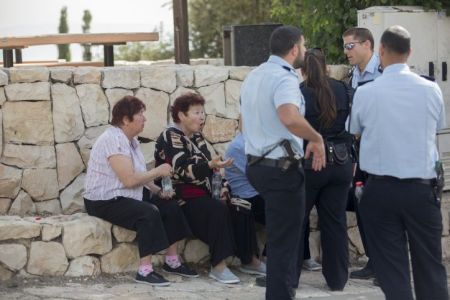
Israeli security forces at the scene of a stabbing attack in Armon Hanatziv neighborhood in Jerusalem on May 10, 2016. Photo by Yonatan Sindel/Flash90 *** Local Caption *** ???? ????? ?????? ????? ????? ?????

Israeli security forces at the scene of a stabbing attack in Armon Hanatziv neighborhood in Jerusalem on May 10, 2016. Photo by Yonatan Sindel/Flash90.

 Paletinian terrorists stabbed their two friends, aged 86 and 82, in Jeruslaem.

On Wednesday, the events will start at 11:00 a.m. with sirens going off around the country for two minutes, followed by the official ceremony on Mt. Herzl to honor the fallen from Israel’s wars, which will be attended by the president, the prime minister, the chief of staff, the chief judge of the supreme court and representatives of bereaved families.

Official memorial ceremonies are to be held at cemeteries around the country. The ceremony at Kiryat Shaul cemetery in Tel Aviv will be attended by Defense Minister Yaalon. The official ceremony to honor those who died in terrorist attacks is to take place at 1;00 p.m. at Mt.. Herzl.

Obama Admin Under Pressure for Lax Approach to Terror Financers

May 10, 2016

Obama Admin Under Pressure for Lax Approach to Terror Financers Treasury Dept. pressed to cut off foreign funders of terror

BY:
May 10, 2016 5:00 am

Source: Obama Admin Under Pressure for Lax Approach to Terror Financers

The Obama administration is facing criticism over what some lawmakers say is an overly permissive attitude toward terrorism financing by foreign nations, according to new congressional communication obtained by the Washington Free Beacon that presses U.S. officials to hold these nations accountable for enabling terror.

Congressional sources and experts accused the administration of going soft on Middle Eastern allies such as Qatar that are known to be chief financiers of global terrorism movements like al Qaeda and Hamas, according to conversations with sources.

The permissive environment has allowed these countries to continue receiving vast amounts of U.S. taxpayer aid while facilitating the transfer of money to rogue terror entities, some of which are currently designated by the United States as global terrorists, according to these sources.

Some Obama administration officials welcome Qatar’s role as an emissary to these terrorist groups, according to conversations described by sources to the Free Beacon.

In the latest bid to force the administration to crack down on this behavior, Sen. Mark Kirk (R., Ill.) petitioned the Treasury Department on Tuesday to adopt a more aggressive stance against Qatar’s terror financing, according to a letter sent to the administration and obtained by the Free Beacon.

Qatar, which is home to a major U.S. military base, has benefited from billions of dollars in arms deals with America. Yet it also enjoys close relations with Hamas, which has received billions of dollars in support from Qatar.

Kirk is pressing the administration to use its leverage to force Qatar to break ties with its global terror allies. The senator also is requesting that the administration outline the steps it has taken to stop this behavior.

“For over a decade, the Qatari government has displayed leniency and negligence toward individuals who support and finance ISIS, its predecessor Al-Qaeda in Iraq (AQI), and other terrorist groups,” Kirk wrote in a letter to Treasury Secretary Jack Lew. “If Qatar’s permissiveness continues, it will further fuel terrorism both regionally and worldwide.”

“I therefore urge the Administration to press the Qatari government to stop the operations of terrorism supporters and financiers within its territory, and to comply fully with” international agreements mandating that Qatar cut all ties with terror financiers, Kirk wrote.

“To this day, terrorist financiers—including those designated by the United States and the United Nations—continue to enjoy such impunity in Qatar,” Kirk notes in the letter.

While the Obama administration has admitted Qatar continues to fund terrorism, critics such as Kirk maintain that officials have done little to rectify the situation.

David Cohen, former treasury undersecretary for terrorism and financial intelligence, acknowledged in a 2014 speech that at least two Qatari terror funders have yet to be prosecuted by the government.

Several other supporters of al Qaeda also have been designated as terrorists by the United States but appear to still be operating with immunity in Qatar, according to information disclosed by Kirk.

At least one of the individuals, Khalifa Muhammad Turki al-Subaiy, was caught raising money online as recently as April of this year.

“I am disturbed to see the Qatari Government has apparently taken no significant action against” these funders, Kirk wrote. “Indeed, both terrorist financiers reportedly remain at large.”

“Unless the United States convinces all of our coalition partners, including Qatar, to do all they can to eliminate sources of terrorist financing, our collective efforts will continue to address the symptoms of international terrorism without effectively dealing with one of its root causes,” Kirk wrote.

Jonathan Schanzer, a former terrorism finance analyst at the Treasury Department, told the Free Beacon that there are some U.S. officials who approve of Qatar’s actions.

“Remarkably, some officials have told me that they like having Qatar serve as an intermediary between the U.S. and jihadi groups,” Schanzer said.

“Qatar has long used its hosting of crucial U.S. military facilities as a means to offset the fact that it is also host to terrorist figures from Hamas, the Taliban, and a range of jihadist groups in Syria,” Schanzer explained. “Successive administrations have accepted this situation and refuse to demand that Doha change its policies. Similarly, successive administrations have refused to demand that Qatar bring known financiers to justice who have found shelter on Qatari soi

Why Middle Eastern Leaders Are Talking to Putin, Not Obama

May 9, 2016

Why Middle Eastern Leaders Are Talking to Putin, Not Obama, Politico, Dennis Ross, May 8, 2016

John Hinderaker at Power Line writes,

Dennis Ross is a respected, if thoroughly conventional, expert on the Middle East. A Democrat, he has served in both Republican and Democratic administrations as an adviser and envoy. Ross served in the State Department as Hillary Clinton’s Special Advisor for the Persian Gulf and Southwest Asia. Subsequently, he joined President Obama’s National Security Council staff as a Special Assistant to the President and Senior Director for the Central Region, which includes the Middle East, the Persian Gulf, Afghanistan, Pakistan and South Asia. So when Ross writes, in Politico, that Obama’s foreign policy weakness is hurting American interests, we should take notice.

— DM)

Putin and Middle Eastern leaders understand the logic of coercion. It is time for us to reapply it.

*****************************

The United States has significantly more military capability in the Middle East today than Russia—America has 35,000 troops and hundreds of aircraft; the Russians roughly 2,000 troops and, perhaps, 50 aircraft—and yet Middle Eastern leaders are making pilgrimages to Moscow to see Vladimir Putin these days, not rushing to Washington. Two weeks ago, Israeli Prime Minister Benjamin Netanyahu traveled to see the Russian president, his second trip to Russia since last fall, and King Salman of Saudi Arabia is planning a trip soon. Egypt’s president and other Middle Eastern leaders have also made the trek to see Putin.

Why is this happening, and why on my trips to the region am I hearing that Arabs and Israelis have pretty much given up on President Barack Obama? Because perceptions matter more than mere power: The Russians are seen as willing to use power to affect the balance of power in the region, and we are not.

Putin’s decision to intervene militarily in Syria has secured President Bashar Assad’s position and dramatically reduced the isolation imposed on Russia after the seizure of Crimea and its continuing manipulation of the fighting in Ukraine. And Putin’s worldview is completely at odds with Obama’s. Obama believes in the use of force only in circumstances where our security and homeland might be directly threatened. His mindset justifies pre-emptive action against terrorists and doing more to fight the Islamic State. But it frames U.S. interests and the use of force to support them in very narrow terms. It reflects the president’s reading of the lessons of Iraq and Afghanistan, and helps to explain why he has been so reluctant to do more in Syria at a time when the war has produced a humanitarian catastrophe, a refugee crisis that threatens the underpinnings of the European Union, and helped to give rise to Islamic State. And, it also explains why he thinks that Putin cannot gain—and is losing—as a result of his military intervention in Syria.

But in the Middle East it is Putin’s views on the uses of coercion, including force to achieve political objectives, that appears to be the norm, not the exception—and that is true for our friends as well as adversaries. The Saudis acted in Yemen in no small part because they feared the United States would impose no limits on Iranian expansion in the area, and they felt the need to draw their own lines. In the aftermath of the nuclear deal, Iran’s behavior in the region has been more aggressive, not less so, with regular Iranian forces joining the Revolutionary Guard now deployed to Syria, wider use of Shiite militias, arms smuggling into Bahrain and the eastern province of Saudi Arabia, and ballistic missile tests.

Russia’s presence has not helped. The Russian military intervention turned the tide in Syria and, contrary to Obama’s view, has put the Russians in a stronger position without imposing any meaningful costs on them. Not only are they not being penalized for their Syrian intervention, but the president himself is now calling Vladimir Putin and seeking his help to pressure Assad—effectively recognizing who has leverage. Middle Eastern leaders recognize it as well and realize they need to be talking to the Russians if they are to safeguard their interests. No doubt, it would be better if the rest of the world defined the nature of power the way Obama does. It would be better if, internationally, Putin were seen to be losing. But he is not.

This does not mean that we are weak and Russia is strong. Objectively, Russia is declining economically and low oil prices spell increasing financial troubles—a fact that may explain, at least in part, Putin’s desire to play up Russia’s role on the world stage and his exercise of power in the Middle East. But Obama’s recent trip to Saudi Arabia did not alter the perception of American weakness and our reluctance to affect the balance of power in the region. The Arab Gulf states fear growing Iranian strength more than they fear the Islamic State—and they are convinced that the administration is ready to acquiesce in Iran’s pursuit of regional hegemony. Immediately after the president’s meeting at the Gulf Cooperation Council summit, Abdulrahman al-Rashed, a journalist very well connected to Saudi leaders, wrote: “Washington cannot open up doors to Iran allowing it to threaten regional countries … while asking the afflicted countries to settle silently.”

As I hear on my visits to the region, Arabs and Israelis alike are looking to the next administration. They know the Russians are not a force for stability; they count on the United States to play that role. Ironically, because Obama has conveyed a reluctance to exercise American power in the region, many of our traditional partners in the area realize they may have to do more themselves. That’s not necessarily a bad thing unless it drives them to act in ways that might be counterproductive. For example, had the Saudis been more confident about our readiness to counter the Iranian-backed threats in the region, would they have chosen to go to war in Yemen—a costly war that not surprisingly is very difficult to win and that has imposed a terrible price? Obama has been right to believe that the regional parties must play a larger role in fighting the Islamic State. He has, unfortunately, been wrong to believe they would do so if they thought we failed to see the bigger threat they saw and they doubted our credibility.

Indeed, so long as they question American reliability, there will be limits to how much they will expose themselves—whether in fighting the Islamic State, not responding to Russian entreaties, or even thinking about assuming a role of greater responsibility for Palestinian compromises on making peace with Israel. To take advantage of their recognition that they may need to run more risks and assume more responsibility in the region, they will want to know that America’s word is good and there will be no more “red lines” declared but unfulfilled; that we see the same threats they do; and that U.S. leaders understand that power affects the landscape in the region and will not hesitate to reassert it.

Several steps would help convey such an impression:

⧫ Toughen our declaratory policy toward Iran about the consequences of cheating on the Joint Comprehensive Plan of Action to include blunt, explicit language on employing force, not sanctions, should the Iranians violate their commitment not to pursue or acquire a nuclear weapon;

⧫ Launch contingency planning with GCC states and Israel—who themselves are now talking—to generate specific options for countering Iran’s growing use of Shiite militias to undermine regimes in the region. (A readiness to host quiet three-way discussions with Arab and Israeli military planners would signal we recognize the shared threat perceptions, the new strategic realities, and the potentially new means to counter both radical Shiite and Sunni threats.)

⧫ Be prepared to arm the Sunni tribes in Iraq if Prime Minister Haider al-Abadi continues to be blocked from doing so by the Iranians and the leading militias;

⧫ In Syria, make clear that if the Russians continue to back Assad and do not force him to accept the Vienna principles (a cease-fire, opening humanitarian corridors, negotiations and a political transition), they will leave us no choice but to work with our partners to develop safe havens with no-fly zones.

Putin and Middle Eastern leaders understand the logic of coercion. It is time for us to reapply it.


New UK campaign – it’s ‘payback time’ for the EU

May 9, 2016

New UK campaign – it’s ‘payback time’ for the EU, Israel National News, Ari Yashar, May 9, 2016

As the UK is poised ahead of a fateful vote on whether or not to remain in the EU, a group of concerned British ex-pats and Israelis have launched a new “Support Israel-Leave Europe” campaign to get Britain out of the EU and stop helping its efforts against the Jewish state.

The campaign, which is funded by Jewish land rights watchdog Regavim and whose website can be viewed here, has launched a humorous video of Hamas terrorists calling on the UK to stay in the EU to continue helping fund the terrorists in their fight against Israel.

Regavim’s work on the project comes amid their legal battle against the EU over its funding of illegal Arab settlements in Area C, the region in Judea and Samaria designated as being under full Israeli control by the 1994 Oslo Accords and which contains all the Jewish residents.  Area A is under complete Arab control and only security in Area B is controlled by Israel.

The new “Support Israel-Leave Europe” campaign presents several major reasons why those who support the Jewish state should want to see Britain leave and consequently weaken the EU.

Firstly, the EU has paid millions in aid money to the Palestinians, a large portion of which is going directly to pay the salaries of terrorist murderers.

Another strike against the EU is its funding of illegal Arab buildings in Area C, as it has built over 1,000 structures in the region to create a de-facto state of “Palestine” there.

The campaign also argues the EU’s recent campaign to label all Jewish products made in Judea, Samaria, eastern Jerusalem and the Golan Heights is a form of state-sponsored anti-Semitism, and finally it notes that the EU provides huge budgets for hundreds of virulently anti-Israeli NGOs to support their work delegitimizing Israel and conducting lawfare against it.

“For decades the European Union has meddled in Israeli affairs to the detriment of the Jewish State, for thousands of Israel supporters in the United Kingdom and ex-pats around the globe, it’s pay back time,” said Ari Briggs, Regavim’s international director.

“We call on everyone who supports Israel to ‘vote leave’ and deal a major blow to this mammoth bureaucracy that has an unhealthy obsession with Israel.”

Briggs warned that “the double standard in which the EU holds Israel, is nothing short of state-sponsored anti-Semitism. We encourage all eligible ex-pats in Israel and elsewhere to make sure they are on the electoral registry before the June 7th deadline to ensure they can vote, all the information needed is provided on our website.”

Iran’s Plans to Control a Palestinian State

May 9, 2016

Iran’s Plans to Control a Palestinian State, Gatestone Institute, Khaled Abu Toameh, May 9, 2016

(Please see also, Op-Ed: Trump’s “peace through strength”  for  USA also applies to Israel. — DM)

♦ The Iran nuclear deal, marking its first anniversary, does not appear to have had a calming effect on the Middle East.

♦ Iran funnels money to Hamas and Islamic Jihad because they share its desire to eliminate Israel and replace it with an Islamic empire. The Iranian leaders want to see Hamas killing Jews every day, with no break. Ironically, Hamas has become too “moderate” for the Iranian leadership because it is not doing enough to drive Jews out of the region.

♦ More Palestinian terror group leaders may soon perform the “pilgrimage” to their masters in Tehran. If this keeps up, the Iranians themselves will puppeteer any Palestinian state that is created in the region.

The Iran nuclear deal, marking its first anniversary, does not appear to have had a calming effect on the Middle East. The Iranians seem to be deepening their intervention in the Israeli-Palestinian conflict in general and in internal Palestinian affairs in particular.

This intervention is an extension of Iran’s ongoing efforts to expand its influence in Arab and Islamic countries, including Iraq, Yemen, Syria and Lebanon and some Gulf states. The nuclear deal between Tehran and the world powers has not stopped the Iranians from proceeding with their global plan to export their “Islamic Revolution.” On the contrary, the general sense among Arabs and Muslims is that in the wake of the nuclear deal, Iran has accelerated its efforts to spread its influence.

Iran’s direct and indirect presence in Iraq, Syria, Yemen and Lebanon has garnered some international attention, yet its actions in the Palestinian arena are still ignored by the world.

That Iran provides financial and military aid to Palestinian groups such as Hamas and Islamic Jihad has never been a secret. In fact, both the Iranians and the Palestinian radical groups have been boasting about their relations.

Iran funnels money to these groups because they share its desire to eliminate Israel and replace it with an Islamic empire. Like Hezbollah in Lebanon and the Houthis in Yemen, Hamas and Islamic Jihad agreed to play the role of Tehran’s proxies and enablers in the Israeli-Palestinian conflict.

1162 (1)Iran used to funnel money to Hamas and Islamic Jihad because they share its desire to eliminate Israel and replace it with an Islamic empire. Relations between Iran and Hamas foundered a few years back, when Hamas leaders refused to support the Iranian-backed Syrian dictator, Bashar Assad. Pictured above: Hamas leader Khaled Mashaal (left) confers with Iranian “Supreme Leader” Ali Khamenei, in 2010. (Image source: Office of the Supreme Leader)

But puppets must remain puppets. Iran gets nasty when its dummies do not play according to its rules. This is precisely what happened with Hamas and Islamic Jihad.

Relations between Iran and Hamas foundered a few years back over the crisis in Syria. Defying their masters in Tehran, Hamas leaders refused to declare support for the Iranian-backed Syrian dictator, Bashar Assad. Things between Iran and Hamas have been pretty bad ever since.

First, the Assad government closed down Hamas offices in Damascus. Second, Assad expelled the Hamas leadership from Syria. Third, Iran suspended financial and military aid to Hamas, further aggravating the financial crisis that the Gaza-based Islamist movement had already been facing.

Islamic Jihad got it next. Iranian mullahs woke up one morning to realize that Islamic Jihad leaders have been a bit unfaithful. Some of the Islamic Jihad leaders were caught flirting with Iran’s Sunni rivals in Saudi Arabia and other Gulf countries. Even worse, the Iranians discovered that Islamic Jihad was still working closely with their erstwhile allies in the Gaza Strip, Hamas.

Iran had had high hopes for Islamic Jihad replacing Hamas as Tehran’s darling, and major proxy in the Palestinian arena. But here were Islamic Jihad leaders and activists working with their cohorts in Hamas, in apparent disregard of Papa Iran.

The mullahs did not lose much time. Outraged by Islamic Jihad’s apparent disloyalty, Iran launched its own terror group inside the Gaza Strip: Al-Sabireen (The Patient Ones). This group, which currently consists of several hundred disgruntled ex-Hamas and ex-Islamic Jihad members, was meant to replace Islamic Jihad the same way Islamic Jihad was supposed to replace Hamas in the Gaza Strip — in accordance with Iran’s scheme.

Lo and behold: it is hard to get things right with Iran. Al-Sabireen has also failed to please its masters in Tehran and is not “delivering.” Palestinian sources in the Gaza Strip say that Iran has realized that the investment in Al-Sabireen has not been worthwhile because the group has not been able to do anything “dramatic” in the past two years. By “dramatic,” the sources mean that Al-Sabireen has neither emerged as a serious challenger to Islamic Jihad or Hamas, and has not succeeded in killing enough Israelis.

So Iran has gone running back to its former bedfellow, Islamic Jihad.

For now, Iran is not prepared fully to bring Hamas back under its wings. Hamas, for the Iranians, is a “treacherous” movement, thanks to its periodic temporary ceasefires with Israel. The Iranian leaders want to see Hamas killing Jews every day, with no break. Ironically, Hamas has become too “moderate” for the Iranian leadership because it is not doing enough to drive Jews out of the region.

That leaves Iran with the Islamic Jihad.

In a surprise move, the Iranians this week hosted Islamic Jihad leader Ramadan Shalah and senior officials from his organization, in a renewed bid to revive Islamic Jihad’s role as the major puppet of Tehran in the Gaza Strip. Islamic Jihad officials said that the visit has resulted in the resumption of Iranian financial aid to their cash-strapped organization. As a result of the rift between Islamic Jihad and Iran, the Iranians are said to have cut off nearly 90% of their financial aid to the Palestinian terror organization.

Some Palestinians, such as political analyst Hamadeh Fara’neh, see the rapprochement between Iran and Islamic Jihad as a response to the warming of relations between Hamas and Turkey. The Iranians, he argues, are unhappy with recent reports that suggested that Turkey was acting as a mediator between Hamas and Israel.

Other Palestinians believe that Iran’s real goal is to unite Islamic Jihad and Al-Sabireen so that they would become a real and realistic alternative to Hamas in the Gaza Strip.

Whatever Iran’s intentions may be, one thing is clear: The Iranians are taking advantage of the nuclear deal to move forward with their efforts to increase their influence over some Arab and Islamic countries. Iran is also showing that it remains very keen on playing a role in the Israeli-Palestinian conflict — one that emboldens radical groups that are bent on the destruction of Israel and that share the same values as the Islamic State terror group.

Iran’s latest courtship of Islamic Jihad is yet another attempt by the mullahs to deepen their infiltration of the Palestinian arena by supporting and arming any terror group that strives to smash Israel. For now, it seems that Hamas’s scheme is working, largely thanks to the apathy of the international community, where many believe that Iran has been declawed by the nuclear deal.

But more Palestinian terror group leaders may soon perform the “pilgrimage” to their masters in Tehran. If this keeps up, the Iranians themselves will puppeteer any Palestinian state that is created in the region. Their ultimate task, after all, is to use this state as a launching pad to destroy Israel. And the Iranians are prepared to fund and arm any Palestinian group that is willing to help achieve this goal.

Iran claims to successfully test missile that can reach Israel

May 9, 2016

Iran claims to successfully test missile that can reach Israel Senior general says highly accurate projectile has a range of 2,000 kilometers, was launched two weeks ago

By Tamar Pileggi

May 9, 2016, 12:00 pm

Source: Iran claims to successfully test missile that can reach Israel | The Times of Israel

Screen capture of an Iranian missile launch, October 10, 2015 (YouTube: PressTV News Videos)

senior Iranian general on Monday announced that the country’s armed forces successfully tested a precision-guided, medium-range ballistic missile two weeks ago, the state-run Tasnim agency reported.

“We test-fired a missile with a range of 2,000 kilometers and a margin of error of eight meters,” Brigadier General Ali Abdollahi was quoted as saying at a Tehran science conference.

The eight-meter margin means the “missile enjoys zero error,” he told conference participants.

The general went on to say that 10 percent of Iran’s defense budget has been allocated to “research projects aimed at strengthening defense power,” the report said.

Under a nuclear deal signed last year between world powers and Iran, ballistic missile tests are not forbidden outright, but are “not consistent” with a United Nations Security Council resolution from July 2015, US officials say.

According to the UN decision, “Iran is called upon not to undertake any activity related to ballistic missiles designed to be capable of delivering nuclear weapons, including launches using such ballistic missile technology,” until October 2023.

That has not stopped Iran from carrying out a number of tests of ballistic missile technology since the nuclear deal was adopted on October 18, 2015.

In November, Iran launched a missile with a range of 1,930 kilometers (1,200 miles) from a site near the Gulf of Oman, US officials said at the time.

In March, Iran test-fired two more ballistic missiles, which an Iranian news agency said had the phrase “Israel must be wiped out” written on them in Hebrew. An Iranian commander said the test was designed to demonstrate to Israel that it is within Iranian missile range.

That launch sparked international fury as it appeared to flout the agreements made in the Iranian nuclear deal.

The US, France, Britain and Germany decried the launch as “destabilizing and provocative” and called for United Nations action. A UN committee later determined Iran’s ballistic tests were in violation of a Security Council resolution prohibiting Tehran from launching ballistic missiles capable of delivering nuclear weapons.

Last month, American and Russian officials said Iran test-fired an advanced rocket system in the Dasht-e Kavir desert, in what some considered a cover for intercontinental ballistic missile research.

Israel has pointed to ballistic missile tests as proof Tehran plans to continue pursuing an atomic weapon, despite the landmark agreement aimed at curbing its nuclear program.

In response to the missile tests, Washington imposed fresh sanctions over Iran’s missile program in January, almost immediately after lifting separate sanctions related to Iran’s nuclear program under the nuclear deal.

Iran maintains that because it cannot develop nuclear weapons under the deal, none of its missiles is capable of carrying a nuclear weapon.

Israeli Police Issue New Guideline: ‘Beware of Attacks with Poisoned Syringes’

May 9, 2016

’ By: JNi.Media Published: May 9th, 2016

Source: The Jewish Press » » Israeli Police Issue New Guideline: ‘Beware of Attacks with Poisoned Syringes’

The Judea and Samaria Police District is concerned about a new kind of Arab terrorism, using poison-filled syringes against Israeli security personnel, Walla reported Monday. Police base their concern on an attempted attack a week and a half ago, in which an Arab female, 15, tried to stab soldiers with a syringe that was filled with detergents.

A police intelligence report disseminated last Thursday notes that two syringes had been discovered in the possession of two 15-year-old Arab females, one of whom was wielding hers when they arrived at the check post near Beit Horon, on route 443 (an alternative to Highway 1, connecting Tel Aviv and Jerusalem). In view of the new development, the police called on every last officer to remain alert to the possibility of the use of syringes in attacks and conduct body searches with that possibility in mind.

The female who had wielded the syringe was shot and wounded, and her friend was arrested without injury to Israeli security forces. Both females, residents of Ramallah, also had in their possession knives and a letter with citations from the Koran. In their interrogation, both confessed to a desire to kill Jews. Police believe the substance in their syringes was a combination of bathroom cleaner and dish liquid.

The Judea and Samaria Police District report mentions a 2015 Facebook post by the Commission on Information and ideological Mobilization – Fatah calling on Arab terrorists to use syringes full of poison instead of knives, because “it’s a more efficient and deadly method than using a knife.”

The Fatah-affiliated group’s post recommends that, “in light of the installation of metal detectors at the entrances to Jerusalem to prevent the use of knives, there is a new and simple method — using syringes with firewater, such as benzene or any other poisonous substance.”

However, until the publication of the story in Walla Monday morning, there has been only that one reported instance of an attempted attack with a poisoned syringe.

Stay tuned.

Politics: On Trump’s side

May 7, 2016

Politics: On Trump’s side, Jerusalem Post, Gil Hoffman, May 7, 2016
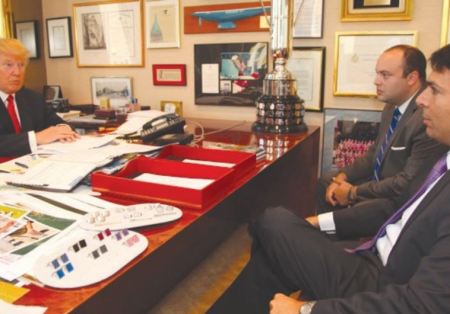
Trump and Israeli ambassadorREPUBLICAN PRESIDENTIAL candidate Donald Trump talks in his office to Ambassador to the UN Danny Danon (right) and Johnny Daniels. (photo credit:Courtesy)

A week before the January 2013 Israeli election, Prime Minister Benjamin Netanyahu received a surprising endorsement from American real estate mogul Donald Trump.

Trump released a video in which he called himself “a big fan of Israel” and Netanyahu “a great prime minister,” a “terrific guy,” and “a winner.”

“I think he would have been a great president of the United States,” Trump said in a telephone interview with The Jerusalem Post at the time. “I have great respect for Netanyahu. He has a tremendous understanding of Israel and where it’s going. His voice is respected. I don’t think he has a bad relationship with Democrats, and he has the respect of the president.”

Netanyahu has been careful not to speak about the current American election campaign, so he will not return the favor with a video endorsing Trump to succeed President Barack Obama.

The man who organized the video endorsement and the interview was 30-year-old British-born public relations phenom Jonny Daniels, who runs the Holocaust commemoration organization From The Depths and is arguably the Israeli closest to Trump.

Trump became the presumptive Republican nominee for president this week, following the departures of rival candidates Ted Cruz and John Kasich.

He made many Israelis feel uneasy when he called himself neutral on the Israeli- Palestinian conflict, but in an interview on Wednesday Daniels said people who care about the Jewish state should not fear a Trump presidency.

“It is very good news for Israel that he will be the Republican candidate for president, because we really do have a good friend in Donald Trump,” Daniels said. “I’m not sure people realize who he is beyond his media persona. He is a politician playing politics, and there are certain things you do and say for votes, and if it’s inflammatory so be it. Netanyahu and Obama have also reached out to their voter base, and that’s what Trump has been doing.”

Daniels got to know Trump through friends who worked for him. He has met him numerous times in different capacities at his Trump Tower office and on golf courses. Daniels is close to Trump’s staff, with whom he is meeting in New York this weekend.

“The Donald Trump I know is thoughtful, strong-willed and an incredibly smart person,” Daniels said. “He reads people and situations and, most importantly, doesn’t give up. He will fight for Israel and – just as important for Israel – fight for the USA. A strong America is a strong Israel. Over the past eight years, there has been a massive decrease in American strength, and as the US’s great ally that has been a significant problem for us.”

When Trump and Daniels have met, the former has asked the latter questions about how Israelis feel, as well as deep queries about Iran and other key issues on the public agenda. Daniels tried to organize the first-ever visit by Trump to Israel, but scheduling did not work out.

“In my conversations one-on-one with Mr. Trump, he gets it,” Daniels said. “You can base it on the questions he asks.

They are in-depth questions. This is a guy who truly understands our side of the conflict. He asked deep questions about Iran, because we are friends, and I am sure he talks to security experts as well.”

When Daniels did not have the answers, he connected Trump to those who did and arranged for him to meet four years ago with then-Likud MK and current ambassador to the United Nations Danny Danon.

“He didn’t base his foreign policy on what I told him,” Daniels said. “He talks to people smarter than me. But it’s good that he talks to a father of two girls who lives in Israel and deals with the issues day to day.”

Daniels dismisses Trump’s “neutral” statement as him just “trying to be careful.”

He said Trump has been wise to speak about Israel in formal settings with teleprompters in order to avoid making mistakes.

“He is smart enough to understand that a peace deal wouldn’t be brokered over night,” Daniels said. “When we look at his true understanding of the concerns facing Israel, we have to see it promisingly. He was vehemently against the Iran deal before he thought he would be running for president.

He knows Israel is a complicated issue, and the fact that he knows you can’t shoot from the hip on it is something you should look at it in a positive light.”

Criticizing Trump’s competition in the race, Daniels said “anyone who doesn’t think Hillary Clinton will be a continuation of Obama is living on a different planet.”

Daniels said Israelis can be reassured that Trump surrounds himself with “strong, tough people, and it just so happens that a lot of them happen to be Jewish.” He singled out attorney Michael Cohen, who sits in the office next to Trump. Cohen’s parents were survivors of Auschwitz, and Daniels said he has an incredible affinity for Israel.

The campaign video for Netanyahu was Daniels’s idea when he was in touch with the prime minister’s campaign team in 2013.

“I came to them with the idea of having US celebrities endorse Netanyahu,” he recalled. “When I asked him [Trump], he was incredibly happy. I didn’t tell him what to say. He knew exactly what to say. At the time, he wasn’t running for anything. Had he been a candidate for president, I wouldn’t have asked for the endorsement. Israel does not get involved in internal US politics, and I don’t know who Bibi backs now.”

Daniels said Trump’s image as a racist and a hater of women is “utter nonsense and political spin.”

“Israelis across the political spectrum in Israel should not be worried about a Trump presidency for Israel,” he said.

“He is the furthest thing from a racist that I know. There are plenty of Republicans who would worry me a lot more, because they see things as biblical prophesies.”

Another factor Daniels believes Israelis should keep in mind is Trump’s connection to Judaism through his daughter Ivanka, who went through an Orthodox conversion, and his son-in-law, businessman Jared Kushner. Daniels attended a Shabbat meal hosted by the couple in New York two years ago and heard from them about their father’s ties to their faith.

“He is someone who understands our traditions,” Daniels said. “Just like Obama grew up in traditional Muslim settings, Trump has gained an appreciation of traditional Judaism.”

Daniels said Trump attends Shabbat dinner with the Kushners monthly, sitting silently as his grandchildren sing “Shalom Aleichem” and – as is customary – not uttering a word between hand-washing and the “Hamotzi” blessing over bread. He also pointed out the plaques on Trump’s office wall thanking him for his support of yeshivot and his serving as grand marshal of the Israel Day Parade after September 11, 2001.

Because of his ties with Trump, Daniels has been approached by Israeli television channels and people with political and real estate ideas, such as opening a Trump resort in Beersheba.

“That’s not the relationship I have with him,” he said. “Trump is not my best friend. He is someone I look up to.”

But Daniels said he does not intend to join the Trump campaign and would not move to Washington, even if offered a role in a Trump administration.

“I’m very happy in the work that I do in keeping the memory of the Holocaust alive,” he said. “There are many people who can work in a campaign or in an administration. I have two beautiful daughters who I want to be with. Dude, I love Israel. I’m not going anywhere.”