Posted tagged ‘Israel’

Poll: Hamas Would Rule Judea and Samaria in New Elections

September 2, 2014

Hamas won the war in political terms, but that won’t stop Kerry.

By: Tzvi Ben-GedalyahuPublished: September 2nd, 2014

via The Jewish Press » » Poll: Hamas Would Rule Judea and Samaria in New Elections.


Hamas’ Ismail Haniyeh would replace Abbas chairman of the Palestinian Authority if elections were held today.
Photo Credit: Abed Rahim Khatib / Flash 90


Hamas would win election in Judea and Samaria and well as Gaza and Ismail Haniyeh would defeat Mahmoud Abbas if elections were held today, according to a new poll conducted by the Palestinian Center for Policy and Survey Research.

Before the war in Gaza, Abbas had a 12 point margin over Haniyeh, 53 percent against 41 percent.

The new survey was carried out on the last day of the war and during the first four days of last week’s cease-fire. If elections were held today, Haniyeh would trounce Abbas by a 2-1 margin, with 61 percent support of the voters as opposed to only 32 percent for Abbas.

The pollster, Khalil Shikaki, said that Abbas probably will recoup some of his losses because Hamas’ popularity previously fell after battles after mini-wars with Israel, but a 2-1 gap will be hard to overcome.

More worrisome, the poll revealed that 86 percent of the respondents think that Hamas should resume rocket attacks on Israel if the partial blockade is not completely lifted, and only 15 percent think that Hamas should be dis-armed after all sanctions are lifted.

In addition, 72 percent of Arabs in Judea, Gaza and Samaria support the Hamas strategy of using arms to attack Israelis in Judea and Samaria.

An overwhelming majority of 79 percent believe that Hamas won the war.

Hamas has not enjoyed such high support in Judea and Samaria since 2006, shortly after it ousted Abbas’ Fatah faction from Gaza in a bloody terrorist militia war.


To a certain extent, Abbas’ propaganda machine is directly responsible for Hamas’ overwhelming support. Years of demonizing Israel and Jews in the school system and in Palestinian Authority media has produced the desired effect of widespread hate and distrust of Israel and Jews.

False, malicious and twisted reporting have convinced Arabs in Judea and Samaria that the “occupation” is the cause of all or their problems, and a recent on-the-street survey by a Canadian living in Israel discovered that most Arabs that Israel carried out a “holocaust” in Gaza. Most of those interviewed also are ignorant of the Holocaust or think that the numbers of those butchered by the Nazi was grossly exaggerated, as seen in the video below.

Last month, the Israel Security Agency (Shin Bet) announced that a Hamas network, directed from Turkey, was planning a coup to overthrow Abbas. Haaretz reported Tuesday that a partial transcript of the investigation revealed that the plan actually was to wait for the Palestinian Authority to collapse and then take over power.

However, Hamas propaganda has consistently tried to undermine the Abbas regime, and every terrorist attack in Judea and Samaria weakens Abbas’ image that he is able to provide security.

Abbas has made a Frankenstein out of the “Peace Process,” demanding everything and accepting no compromise. The longer he cannot come up with the goods, the more his popularity falls. His only hope to force Israel to agree to impossible demands, such as allowing mass immigration of millions of so-called “refugees” and giving up land to connect Gaza with Judea and Samaria, is to go to the United Nations and the International Court. That process, which would provide doubtful result but in any case could take years, and the Arab street has lost its patience.

If U.S. Secretary of State John Kerry still thinks he can fall out of the clouds with his precious peace process, which has proved to be a war process, he will have a hard time pretending that Hamas is not in the picture.

PA plan seeks Palestinian state, IDF pullout within 3 years

September 2, 2014

PA plan seeks Palestinian state, IDF pullout within 3 years

Present a map of future Palestine or face international condemnation and an end to West Bank security cooperation, Abbas to tell Israel

By Times of Israel staff and Avi Issacharoff

September 2, 2014, 3:12 pm

via PA plan seeks Palestinian state, IDF pullout within 3 years | The Times of Israel.


Palestinian Authority President Mahmoud Abbas (photo credit: Issam Rimawi/Flash90)


alestinian Authority President Mahmoud Abbas plans to present a framework for renewed peace talks with Israel, according to a Palestinian ex-minister close to Abbas.

In an effort to jumpstart stalled peace talks and expedite the establishment of a Palestinian state, Abbas is preparing to present Israel with a specific timetable for talks and a detailed set of demands.

According to former PA minister of religious affairs Mahmoud al-Habash, the plan calls for new talks over a maximum of nine months, which would secure an Israeli withdrawal from the agreed-upon territory slated for the future Palestinian state in no more than three years.

Abbas is reportedly demanding that the chief issue of contention between the sides, the location of the borders between the two states, be determined at the start of talks. The first three months would be devoted to establishing the borders, and the following six months for the remaining issues, including refugees, Jerusalem, settlements, security arrangements and water, Habash said, according to the Ynet news site.

During the talks, Abbas will demand the freezing of settlement construction and the implementation of the fourth phase of the prisoner release that was called off as the previous talks broke down earlier this year.

Abbas is slated to present his plan to the upcoming gathering of Arab League foreign ministers in Cairo on September 7. PA chief negotiator Saeb Erekat and intelligence chief Majed Faraj have met with European leaders and are slated to travel to Washington to present the plan to senior American officials.

As The Times of Israel reported Monday, Abbas envisions filing a request with the Americans to pressure Israel to present a map of a future Palestinian state as the basis for substantive negotiations. After Israel presents the map, Abbas’s plan calls for the Israeli withdrawal according to the three-year timetable, and the establishment of a Palestinian state with Jerusalem as its capital.

If Israel rejects or delays resuming talks under Abbas’s proposed framework, the PLO, headed by Abbas, would turn to unilateral moves, including appeals to the International Criminal Court against Israeli policies and officials.

In such a scenario, Abbas intends to apply all the diplomatic means at his disposal to pressure Israel, including, within three months, to seek a UN Security Council resolution that recognizes the establishment of a Palestinian state on the 1967 lines.

Since the Palestinians expect the US to veto any Security Council resolution, they intend to then approach the General Assembly with the same request. After that, the PLO will seek to join international bodies and organizations, and then to campaign to have Palestine recognized as a nation under occupation according to the Geneva Conventions.

If none of those moves achieves Abbas’s goal of the declaration of a Palestinian state, he threatens to halt joint security operations with Israel, so central to the recent relative calm in the West Bank, and hand over all responsibility for rule in Palestinian cities to the IDF.

Were that to happen, the PA would effectively, if not formally, cease to function.

Ending joint security operations is still a long way off and, at this stage, there could yet be changes, developments, and restructuring of the Abbas plan. But, for Abbas and his close confidants, matters are clear: Israel has until the end of the calendar year to decide whether or not it intends to present a map of the future Palestine. If the answer is negative, a diplomatic confrontation between the PA and Israel will be unavoidable, and will also lead to the cessation of the joint security apparatus.

Israel and the U.S.-Qatari Axis

September 1, 2014

Israel and the U.S.-Qatari Axis, Front Page Magazine, September 1, 2014

US-Turkey

When considering the geo-political map of the current Middle East, not everything is negative or alarming, at least from an Israeli point of view. Although the Middle East is more splintered today than ever before, Israel’s political and diplomatic isolation in the region has faded. The Middle East is now composed of three main blocs and Israel is a partner with one major bloc, which also happens to be its immediate neighbors, or the inner circle of moderate-Sunni and hitherto pro-American Arab states: Egypt, Jordan, Saudi Arabia, and the Emirates.  However, what is counter-intuitive is the Obama administration’s choice of partners in the region. It is not the moderate Sunni-Muslim states and Israel that Washington sought out as mediators for a Hamas-Israel cease-fire, but the Muslim Brotherhood bloc of Turkey and Qatar.

David Ben Gurion, Israel’s first Prime Minister and one of the founding fathers of the Jewish State recognized early on that the State of Israel had no chance to develop friendly relations with its neighboring Arab states. Pan-Arab leaders such as Egypt’s president Gamal Abdul Nasser fanned the flames of hatred and revenge against the Jewish state, as did fellow Arab dictators in Syria and elsewhere. As a result, Israel’s leadership sought to develop friendly relations with its outer-circle non-Arab states such as Iran, Ethiopia, and Turkey.

The rise of the Islamic Republic in Iran under Khomeini following the Iranian revolution in 1979, and the departure of the Israel-friendly Shah of Iran ended Israeli-Iranian relations. Iran became the arms supplier of Israel’s Palestinian enemies and Hezbollah in Lebanon, and with its nuclear ambition, it constitutes an existential threat to the Jewish State.

Turkey was the only Muslim state to have a steady and rather friendly relationship with the Jewish state. Until the electoral triumph of the AK Party (Justice and Development Party) in 2002, Israel’s trade and military cooperation with Turkey was significant to both countries. The AK Prime Minister Recep Tayyip Erdogan changed all of that. His hostility to Israel intensified with each successive electoral victory. Following his second parliamentary victory in 2007, he began tangling with Israel. In late May 2010, Erdogan gave the green light to a Gaza flotilla headed by the Mavi Marmara. It was a deliberate provocation by Erdogan to break through the Israeli blocade. The subsequent AK victory in the 2011 parliamentary elections increased Erdogan’s arrogance and simultaneously his anti-Israel and anti-Semitic outbursts. His latest 2014 presidential victory and his unmitigated support for Hamas and the Muslim Brotherhood severed the special relations Israel has had with Turkey.

Turkey is, in fact, part of the radical Sunni, pro-Muslim Brotherhood bloc, that includes Qatar and Hamas.

The radical Shia bloc led by Iran, which includes Shiite Iraq, the Assad regime in Syria, and the Hezbollah in Lebanon, comprise the third bloc.

The puzzling question is why Washington chose to align itself with the Sunni radical Muslim Brotherhood bloc (Qatar and Turkey), and not with the more moderate bloc led by Egypt and Saudi Arabia? Both the Egyptian regime under President Abdel Abdel Fattah el-Sisi and the Saudi royals are upset with the Obama administration. Cairo resents Washington’s support for the deposed Muslim Brotherhood President Mohammad Morsi. Washington withheld arms delivery to Egypt because it considered Morsi’s removal illegitimate, albeit, over 30 million Egyptians demanded Morsi’s removal because of his gross mismanagement of the economy, his authoritarian style, his promotion of sectorial Brotherhood ideals and the erosion of civil liberties.

The Saudis resent the Obama administration rapprochement with Iran, and its November 24, 2013 nuclear agreement with Iran signed in Geneva.  Israelis are also uncomfortable with the Geneva Agreement, albeit they are more skeptical than resentful. The U.S. “Red Line” against the Assad regimes use of chemical weapons that was never put into force has added to the Saudis sense of betrayal.  Riyadh blames the U.S. for turning Iraq into an

Iranian Shiite satellite, and abandoning the Sunnis. The Saudis are also upset with Obama’s treatment of el-Sisi’s Egypt, whom they support.

The U.S. administration’s reasoning is hard to understand but for the fact that in 2003 Combat Air Operations Center for the Middle East moved from Prince Sultan Airbase in Saudi Arabia to Qatar’s Al Udeid airbase near its capital of Doha. Qatar currently serves as the host to major U.S. military facilities. The Al Udeid base and other facilities in Qatar serve as the logistics, command and control, and hub for the U.S. Central Command (CENTCOM) area of operations. Al Jazeera (the Qatari regime mouthpiece) reported on July 15, 2014 that “The United States has signed an agreement with Qatar to sell Apache attack helicopters and Patriot and Javelin air-defense systems valued at $11bn.” Qatar also has the third largest proven natural gas reserves in the world, and is the largest exporter of liquefied natural gas, benefitting mainly the Europeans.

America stands for more than multi-billion-dollar defense contracts. Its core values include human rights, religious freedom and democracy for all. The 2012 U.S. State Department Country Report on Human Rights in Qatar has concluded that “Inability of citizens to change their government peacefully, restrictions on fundamental civil liberties, and pervasive denial of expatriate workers rights” are just some of the human rights abuses by the Qatari regime. Political parties are not allowed to exist and forced labor is pervasive in Qatar, particularly in the construction and domestic labor sectors. Qatar serves as host to Sheikh Yusuf al-Qaradawi, the radical Muslim Brotherhood ideologue that the Anti-Defamation League has called “theologian of terror,” and has provided a home base to Khaled Mashal, the Hamas political chief.

Particularly worrisome are the Qatari elites, including the ruling family, who support Al Qaeda and other extremist and violent Islamist groups. Additionally, Qatar’s embrace of Iran as well as Hamas and Hezbollah, deemed by Saudi Arabia and the other Gulf states as terrorist organizations, requires a great deal of scrutiny by the U.S.  Reuters reported (March 9, 2014) that “Iraqi Prime Minister Nouri al-Maliki has accused Saudi Arabia and Qatar of openly funding the Sunni Muslim insurgents (ISIS) his troops are battling in western Anbar province.” Lebanon’s Daily Star (August 14, 2014) quoted Hezbollah’s Chief Sayyed Hassan Nasrallah as saying “Turkey and Qatar are supporting ISIS (also known as Islamic State in Iraq and the Levant and most recently as the Islamic State.), and I am convinced that Saudi Arabia fears it.”

Qatar, the hub of CENTCOM, and the recipient of top-notch U.S. weaponry, is the same state that enables Hamas’ terror against Israel by providing it with donations to buy its arms from Iran. Therefore, it was a surprise for the Israelis that Secretary of State John Kerry chose to adopt the pro-Hamas track offered by the foreign ministers of Turkey and Qatar. He ignored both the interests of Israel and Egypt who border the Hamas-ruled Gaza Strip.

Al-Monitor (July 29, 2014) summed up the divergence of interests between Israel, the U.S’s only democratic and most reliable ally in the region and the U.S.–Qatar axis. “The Israeli leadership estimates that the cease-fire initiative (regarding the Hamas-Israeli war in Gaza-JP) of U.S. Secretary of State John Kerry responds well to the interests of Qatar, Turkey, Hamas, and its own interests with Qatar – but hardly addresses Israel’s security needs.”

Sderot and Afterwards

August 31, 2014

Sderot and Afterwards

What goes for Israel goes for the U.S

by David Solway

via PJ Media » Sderot and Afterwards.


I recall in July 2008 watching candidate Obama’s sympathetic address to the rocket-battered residents of the town of Sderot in southern Israel, in which he declared “an unshakeable commitment to Israel’s security” — and being appalled by his performance. Judging from his body language, something furtive in his gestures, and the smarmy, brackish diction and rhetoric that have since made it impossible for me to listen to an Obama speech without grinding my teeth, it seemed clear that Obama was lying with every ostensibly heartfelt word. My “reading” of Obama’s disingenuousness, however, was plainly not shared by the troupe of Israeli officials earnestly bustling about and an audience filled with respect and enthusiasm for their artfully sincere guest.

How things have changed. The presidential aspirant who swore in Sderot that he would not let his daughters be terrorized by incoming missiles — “If somebody was sending rockets into my house where my two daughters sleep at night, I’m going to do everything in my power to stop that. And I would expect Israelis to do the same thing” — is now “outraged” by Israeli defensive actions jeopardizing Gaza civilians in the current Hamas-initiated conflict, regardless of preliminary warnings of impending strikes to eliminate or reduce civilian casualties. Obama appears oblivious to the terrorists’ recruiting their own citizens as human shields, conducting rocket and mortar launches from residential areas, occupying  hospitals as command centers, and using UNRWA schools as missile-storage facilities.

He now allows the FAA to suspend flights to Ben Gurion Airport in Tel Aviv, resulting in the crippling of the Israeli economy; places a limit on arms shipments to the IDF; and instructs his secretary of state, the lamentable John Kerry, to confer with jihadist-loving, anti-Israel regimes like Turkey and Qatar to broker a ceasefire on terms favorable to Hamas.

Obama’s 2008 histrionics were bad enough, but the jubilant acclaim with which his speech was greeted by Israelis, Zionists, American Jews, and liberal voters was no less distressing. I said to a Jewish friend, an academic with strong left-wing proclivities, who was swooning with delight at Obama’s suave assurances, “Don’t trust this man for a second,” and was duly accused of cynicism and conservative bile.

I think now of Alan Dershowitz, who looked into the president’s eyes, as Bush looked into Putin’s, and saw a trustworthy soul gazing back at him. “I am confident,” Dershowitz wrote, “that President Obama will keep his promise ‘always [to] have Israel’s back’ in the face of the continuing threats posed by Israel’s enemies.”  It is mind-boggling how people, even intelligent people, appear so desperate to believe in fictions and illusions that valorize their cherished sense of social generosity, aquiline political insight, groundless hope and natal compassion that they cannot distinguish an indefeasible truth from a glaring lie, or tell the difference between a messiah and a confidence man.  As for my pro-Obama academic friend, he has been monumentally silent of late (though Dershowitz, in the fullness of his naivete, is still intent on pursuing hallucinations, regarding himself as “a supporter of Obama” despite his expediently revised assessment of the president’s policy toward Israel).

The Sderot episode seems a kind of epiphany of the president’s future actions vis-à-vis Israel, and indeed of his fecklessness and treacherous behavior toward America’s allies and fervent embrace of its avowed enemies, not to mention his fundamental disreputableness as a national leader.

Anyone who has monitored Obama’s conduct from the early stages of his career; wondered about the mysteriously sealed records; followed without preconceptions the ongoing controversy over the validity of his credentials; mused about his preference for golf and fund-raising over statecraft; contemplated his tendency to govern by executive decree or remarked on his serial breaking of laws (the arbitrary amending of “Obamacare,” itself a perversion of the body social and possibly illegal in toto, the Bergdahl/Taliban swap which the General Accounting Office has cited for two violations of legality, etc.); pondered his reluctance to secure the southern border, across which criminals, diseased refugees, and Islamic terrorists are free to enter the country; and compared his words to his actions, noting a discrepancy so vast one could fit the entire nation into the chasm — anyone who has done all this should by this time be aware that the man who sits in the Oval Office is a president in name only and a blight upon the nation.

Yet even now when the presumably soaring cadences seem flat as gravy on a plate, and the lies are demonstrably tripping over themselves with reckless abandon, Obama still retains, according to the polls, a 40% approval rating. Many commentators have pointed out that such numbers are alarmingly low, and signify his declining impact and prestige. Perhaps it is time to think again. What this figure shows is that, after six years of racial divisiveness, political incompetence, massive foreign policy blunders, endemic deception, unabashed cronyism, a veritable plague of scandals, systemic unemployment and astronomical debt, four out of ten Americans continue to support or give the benefit of the doubt to a man who is arguably the greatest nemesis that America faces today, a man who will “transform” their country into a socialist dystopia and an international laughing stock if he is not checked.

That the Harry Reids and Nancy Pelosis, the “progressivist” institutions, and the radical wing of the Democratic Party remain among his staunchest advocates is no surprise — he is, of course, the embodiment of their ideological fantasies as well as their meal-ticket. That entitlement recipients are enamored of their president is also understandable — he is their meal-ticket too, even if it doesn’t include fine-dining and cabaret perks. Nevertheless, in any sane and responsible society, Obama’s approval rating should now be in single digits, and sinking fast. Forty percent is indeed an alarming figure — far too high.

The great majority of Israelis and the more prudent diaspora Jews, who once fell for Obama’s Sderot burlesque — the dramaturgy was admittedly slick and convincing to those who so passionately wanted to believe — have awakened to this virulent travesty of a president. But there really is no excuse any longer for that 40% of American citizens who have all the evidence before them of a president who rarely, if ever, tells the truth and who represents only himself, his personal interests and doctrinaire convictions, his partisans, and, yes, what is all too often the case, America’s enemies.

The cozy relations with Turkey and Qatar, the funding of Hamas, the empowering of the Muslim Brotherhood, not only in Egypt but in the sensitive echelons of his own administration, the failed “reset” with a resurgent Russia that is expanding its malign influence in the Caucasus and the Middle East, together with the legion of broken promises that has become Obama’s trademark, should be more than enough to persuade any American whose brains, to quote David Horowitz, are not “stuffed with ideological fairy dust” that Israel is not some faraway country with no bearing on the security or prospects of the U.S.

It has rightly been said that Israel is on the front lines of the war against Islamic terror and Muslim supremacism, serving as America’s advance guard. But the front lines are migrating homeward. In effect, America is Israel writ large, hated and reviled by multitudes, the economic and geopolitical target of hostile nations, and riddled with Islamic sleeper cells and lone jihadists waiting for the opportunity to create havoc. And Sderot, in one way or another, despite the svelte and consoling pronouncements of a rogue president, is the plausible future of many American cities.

David Solway is a Canadian poet and essayist. He is the author of The Big Lie: On Terror, Antisemitism, and Identity, and is currently working on a sequel, Living in the Valley of Shmoon. His new book on Jewish and Israeli themes, Hear, O Israel!, was released by Mantua Books. His latest book is The Boxthorn Tree, published in December 2012. Visit his Website at www.davidsolway.com.

US missiles to be released ‘soon’ — whatever the Hellfire that means

August 29, 2014

US missiles to be released ‘soon’ — whatever the Hellfire that means

Delay in arms shipment to Israel may –- or may not –- end in coming days, but Obama administration will continue increased scrutiny

By Rebecca Shimoni Stoil August 29, 2014, 1:44 pm

via US missiles to be released ‘soon’ — whatever the Hellfire that means | The Times of Israel.


Illustrative photo of Hellfire missiles (photo credit: CC BY-Wikipedia)


WASHINGTON — Exactly how bad are Israel-US relations today? Who the Hellfire knows.

What is clear is that two weeks after the revelation that the US had added an additional level of scrutiny to resupplying the IDF with weapons, business was anything but usual regarding the military-to-military relationship upon which Israel relies.

The administration in Washington is hunkered down tight on the transfer of Hellfire missiles to the IDF — a transfer that would most likely have been routine until the additional level of scrutiny was applied. And, despite optimism that the transfer would soon go ahead as planned, no such action has been confirmed by Washington.

Details on the timeline for the release of the Hellfires have proven elusive. Even on Capitol Hill, the sense is that the missiles will be released “soon” — a word repeated in numerous off-the-record conversations on the subject — but neither the timeline, nor the mechanism for their release, is clear.

Washington has, in fact, been extremely closed-lipped about the Hellfires.

It has been two weeks since The Wall Street Journal first reported that the White House had been caught off-guard by transfers of military equipment from the Pentagon to the IDF in the course of Operation Protective Edge.

According to that report, the administration responded to the surprise by tying up further arms transfers in an additional multi-agency review process. Some transfers requested by the IDF have since been released, but a request for additional Hellfire missiles remains unfulfilled.

Asked about the Hellfires almost two weeks ago, State Department Deputy Spokesperson Marie Harf said that “we generally don’t talk about specific deliveries after they’re requested and before they’re delivered, but I will say that things are being — things that have been requested from Israel are — we’re taking a little bit of additional care now given the situation, and if there were requests for such missiles, that would fall under that.”

Harf downplayed the significance of the “additional care”, arguing that “when there’s an ongoing crisis that senior people are involved with, whether it’s Secretary Kerry trying to get a ceasefire, whether it’s other folks on the ground, obviously we believe there’s an inter-agency process that needs to be at play here, and there always is for these.”

But, along with the State Department, neither the Pentagon nor the National Security Council would clarify any details about the process itself, including the timeline, the considerations involved, or the mechanism for the missiles’ release.

The report of the “additional care” emerged after a much-reported dust-up between Washington and Jerusalem over Secretary of State John Kerry’s attempts to broker an Israel-Hamas ceasefire, in consultation with Qatar and Turkey. The timing reinforced perceptions that political — and even personal — considerations may be involved in the decision to freeze the transfer.

Harf responded to that charge too, saying that she “strongly disagreed with the notion” that “the additional care is being taken because of some sort of diplomatic or political wrangling.”

Instead, in repeated statements, the State Department emphasized that the additional scrutiny was tied to the ongoing military in Gaza.

With a ceasefire in its third day on Friday, however, there was still no word from the administration regarding a timeline for the missiles’ delivery.

In fact, on Wednesday, State Department spokeswoman Jen Psaki said that the ceasefire had not impacted the additional level of scrutiny that the transfer of weapons to Israel has faced in recent weeks.

The relative quiet on the issue in Washington has been compounded by a number of factors.

It is late August, a period in which Washington goes on vacation. Issues get put on hold, unless they are really pressing, e.g., a Russian invasion of Ukraine, or a terror group decapitating American journalists.

Congress, which has traditionally taken a very vocal front seat on issues related to Israel’s defense, is on its summer recess and will only return for a whirlwind two-week session before departing Washington for another week.

In addition, mid-term elections are around the corner, a fact that generally redirects the focus to domestic topics.

Although there was some anticipation that Congress might address the missile transfer, should the munitions remain undelivered when Congress returns to work next week, the silence thus far has been dominant — if not entirely deafening.

Last week, Sen. Ted Cruz (R-TX) offered a solitary tweet on the topic, asking why arms sales to Turkey were underway while the transfer to Israel had been stalled. But many Congressional Republicans and Democrats alike have indicated that they were told that the Hellfires would be released “soon” — and that there was no reason to worry or to act to speed them up at this juncture.

On Tuesday, Israeli media also reported that the delay was ending and the weapons would be transferred “soon” — but once again, no specific timeline was given by an unnamed military official quoted in a Haaretz article.

Such delays are not unprecedented. Previous administrations — and this administration — have put a temporary kibosh on weapons transfers to Israel in the past when relationships between Washington and Jerusalem have soured.

In late 2006, following the Second Lebanon War, the Bush administration delayed transferring weapons requested by Israel to replenish stockpiles, including the Joint Direct Attack Munition. In that period as well, State Department officials emphasized that Israeli requests for munitions were not rejected, just merely under examination.

There are different claims as to why that defense slowdown occurred, but it likely reached an even broader scale than the current “additional scrutiny.” The US went so far as to block military contractor Northrop Grummond from revealing details on US-made missile defense technology that Israel hoped to purchase, effectively suspending the deal altogether. An Israeli military delegation to the US was canceled as the media reported that relations had hit an all-time low for the Bush administration.

Even before that, in the early days of the Second Intifada, the US also threatened to stop the supply of spare parts for the Apache helicopters in protest at Israel’s use of targeted assassination — a threat that receded in the months following the September 11 terror attacks. At that time, Hellfires were also at the center of the controversy — the Apaches were the launching platform for Hellfire missiles used in the strikes, such as the November 2000 killing of Tanzim official Hussein Mohammed Abayat.

In the case of the Apaches, however, there was a clear ultimatum delivered: Stop targeted killings, or else. In this case — at least publicly — there has been little explanation as to why the precision missiles have been singled out for extra, protracted scrutiny.

It is, ultimately, a scrutiny that, according to all sources, will be over “soon.” But how long “soon” means, and what steps Israel is meant to take in the meantime, are anything but clear.

Iran Begins Arming Palestinian Terrorists

August 29, 2014

Iran Begins Arming Palestinian Terrorists

Promises ‘the annihilation of the Zionist regime’

BY:
August 28, 2014 6:20 pm

via Iran Begins Arming Palestinian Terrorists | Washington Free Beacon.


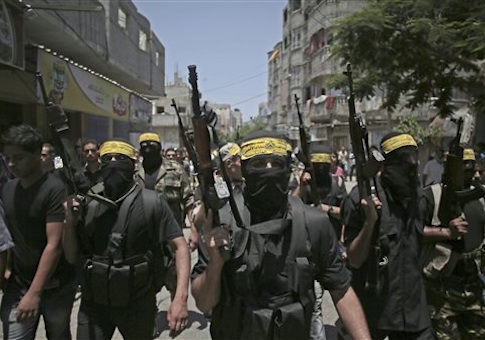
Masked Palestinian militants march with guns / AP

 Iranian military leaders say that they have begun weapons deliveries to Palestinian terrorists in the West Bank and elsewhere in the region after months of promising increased military support for Israel’s enemies, according to regional reports.

A top Iranian military commander confirmed that weapon shipments to the West Bank have already begun and that more will be sent to other “Palestinian resistance groups.”

“Arming the West Bank has started and weapons will be supplied to the people of this region,” Brigadier General Mohammad Reza Naqdi, the commander of Iran’s volunteer Basij force told the state-run Fars News Agency on Wednesday.

The announcement was made after weeks of inflammatory statements from Iranian leaders threatening war on Israel and promising to rearm Palestinian militants such as Hamas so that they can continue their war on the Jewish state.

The military leader also confirmed what has long been suspected by Israeli intelligence agencies: That Iran is responsible for training and arming Hamas with highly advanced rockets that were used to penetrate deep into Israeli territory during the most recent conflict.

Much of the arms Hamas deployed “were the products of the Islamic Republic of Iran,” Fars reported Naqdi as saying.

Iran is arming terrorists in the more moderate West Bank of Israel—as opposed to the Hamas-run Gaza Strip—because attacks on Israel from this area will ensure “the annihilation of the Zionist regime.”

“The Zionists should know that the next war won’t be confined to the present borders and the Mujahedeen will push them back,” Naqdi said.

An Iranian General this week vowed to launch a surprise attack on Israel in retaliation for an Israeli drone that was reportedly shot down near an Iranian nuclear site.

Anger at the incident has also prompted Tehran to step up its military support for Palestinian terrorists.

“We will accelerate arming the West Bank and we think that we are entitled to give any response (to the recent aggression) which we deem appropriate,” Brigadier General Amir Ali Hajizadeh, commander of Iran’s Revolutionary Guards Corps’ (IRGC) Aerospace Force, was quoted as saying on Monday.

Iran also is considering military force, according to Hajizadeh.

The IRGC claims to have shot down the Israeli drone with a surface to air missile. It lashed out at Israel in vitriolic terms in a statement issued earlier in the week.

“This mischievous attempt once again made the adventurous nature of the Zionist regime more evident and added another black page to the dark record of this fake and warmongering regime, which is full of crimes and wickedness,” the IRGC said in its statement.

Iran has been promising to arm Palestinian terrorist for weeks as the most recent conflict between Israel and Hamas escalated.

“The West Bank must be armed like Gaza,” Iranian Supreme Leader Ayatollah Ali Khamenei said in late July. He echoed these comments on Twitter.

Iran also has boasted of its past arming of Hamas terrorists.

“Today, the fighters in Gaza have good capabilities and can meet their own needs for weapons,” an Iranian lawmaker reportedly stated on television in July. “But once upon a time, they needed the arms manufacture know-how and we gave it to them.”

Talking Turkey with an Islamist academician

August 29, 2014

Talking Turkey with an Islamist academician, The Washington Times, Daniel Pipes, August 27, 2014

As Turkey’s 26th prime minister, Mr. Davutoglu faces a bubble economy perilously near collapse, a breakdown in the rule of law, a country inflamed by Mr. Erdogan’s divisive rule, a hostile Gulen movement, and a divided AKP, all converging within an increasingly Islamist (and therefore uncivil) country. Moreover, the foreign-policy problems that Mr. Davutoglu himself created still continue, especially the Islamic State hostage emergency in Mosul.

The unfortunate Mr. Davutoglu brings to mind a cleanup crew arriving at the party at 4 a.m., facing a mess created by now-departed revelers. Happily, the contentious and autocratic Mr. Erdogan no longer holds Turkey’s key governmental position, but his placing the country in the unsteady hands of a loyalist of proven incompetence brings many new concerns for the Turks, their neighbors and all who wish the country well.

**********

As Recep Tayyip Erdogan ascends Thursday to the presidency of Turkey, his hand-picked successor, Ahmet Davutoglu, simultaneously assumes Mr. Erdogan’s old job of prime minister. What do these changes portend for Turkey and its foreign policy? In two words: nothing good.

In June 2005, when Mr. Davutoglu served as chief foreign policy adviser to Mr. Erdogan, I spoke with him for an hour in Ankara. Two topics from that conversation remain vivid.

He asked me about the neoconservative movement in the United States, then at the height of its fame and supposed influence. I began by expressing doubts that I was a member of this elite group, as Mr. Davutoglu assumed, and went on to note that none of the key decision-makers in the George W. Bush administration (the president, vice president, secretaries of state and defense, or the national security adviser) was a neoconservative, a fact that made me skeptical of its vaunted power. Mr. Davutoglu responded with a subtle form of anti-Semitism, insisting that neoconservatives were far more powerful than I acknowledged because they worked together in a secret network based on religious ties. (He had the good grace not to mention which religion that might be.)

In turn, I asked him about the goals of Turkish foreign policy in the Middle East in the era of the Justice and Development Party (AKP) that had begun in 2002, noting Ankara’s new ambitions in a region it had long disdained. He conceded this change, then took me on a quick tour d’horizon from Afghanistan to Morocco, noting Turkey’s special ties with many countries. These included the presence of Turkic-speakers (e.g., in Iraq), the legacy of Ottoman rule (Lebanon), economic symbiosis (Syria), Islamic ties (Saudi Arabia), and diplomatic mediation (Iran).

What struck me most was the boastful optimism and complete self-assurance of Mr. Davutoglu, former professor of international relations and an Islamist ideologue. He not only implied that Turkey had waited breathlessly for him and his grand vision, but he also displayed an unconcealed delight at finding himself in a position to apply his academic theories to the great canvas of international politics. (This privilege occurs surprisingly rarely.) In sum, that conversation inspired neither my confidence nor my admiration.

While Mr. Davutoglu has done remarkably well for himself in the intervening years, he did so exclusively as consigliere to his sole patron, Mr. Erdogan. His record, by contrast, has been one of inconsistent policy and consistent failure, a failure so abject it borders on fiasco. Under Mr. Davutoglu’s stewardship, Ankara’s relations with Western countries have almost universally soured, while those with Iran, Iraq, Syria, Israel, Egypt and Libya, among other Middle Eastern states, have plummeted.

Symbolically, Turkey is slipping away from the NATO alliance of democracies and toward the shoddy Sino-Russian grouplet known as the Shanghai Cooperation Organization. As Kemal Kilicdaroglu, leader of the opposition, sadly notes, “Turkey has grown lonely in the world.”

Having failed as foreign minister, Mr. Davutoglu now — in an application of the Dilbert Principle — ascends to a heady but subservient leadership of both the AKP and the government. He faces two major challenges:

As AKP leader, he is tasked with producing a great victory in the June 2015 parliamentary elections to modify the constitution and turn the semi-ceremonial position of president into the elected sultanate Mr. Erdogan lusts for. Can Mr. Davutoglu deliver the votes? Color me skeptical. I expect that Mr. Erdogan will rue the day he relinquished his prime ministry to become president, as he finds himself ignored and bored living in the sprawling presidential “campus.”

As Turkey’s 26th prime minister, Mr. Davutoglu faces a bubble economy perilously near collapse, a breakdown in the rule of law, a country inflamed by Mr. Erdogan’s divisive rule, a hostile Gulen movement, and a divided AKP, all converging within an increasingly Islamist (and therefore uncivil) country. Moreover, the foreign-policy problems that Mr. Davutoglu himself created still continue, especially the Islamic State hostage emergency in Mosul.

The unfortunate Mr. Davutoglu brings to mind a cleanup crew arriving at the party at 4 a.m., facing a mess created by now-departed revelers. Happily, the contentious and autocratic Mr. Erdogan no longer holds Turkey’s key governmental position, but his placing the country in the unsteady hands of a loyalist of proven incompetence brings many new concerns for the Turks, their neighbors and all who wish the country well.

Mashaal Vows Cease-Fire a Step to New ‘Resistance’ War against Israel

August 29, 2014

By: Tzvi Ben-Gedalyahu

Published: August 28th, 2014

via The Jewish Press » » Mashaal Vows Cease-Fire a Step to New ‘Resistance’ War against Israel.


Hamas chief Khalid Mashaal rallies supporters in Gaza (archive).
Photo Credit: Screenshot

Hamas’ supreme leader Khaled Mashaal dashed any hopes of long-term peace with Israel in a speech in Qatar on Thursday in which he shot from the hip at Israel and also at his terrorist organization’s new partner, the rival Fatah movement headed by Palestinian Authority chairman Mahmoud Abbas.

His lengthy speech in Qatar, which has financed Hamas terror and which fought Egyptian cease-fire proposals, followed by one day a “victory” speech by Ismail Haniyeh, the senior Hamas political leader in Gaza. Mashaal’s silence while Haniyeh accepted the cease-fire is a clear sign of a fierce power struggle between Hamas in Gaza and between Mashaal and Qatar, which holds the purse strings.

Mashaal also claimed victory, with lies that Hamas missiles hit the Ben Gurion Airport, which is not true, and that more than 5 million Israelis hid in bomb shelters, a gross exaggeration. However, there is no doubt that Hamas succeeded in scaring the daylight out of millions of Israelis, interrupting a few flights and generally turning half of Israel into sitting ducks.

And this won’t be the last time, regardless of a cease-fire, he warned.

“Whatever happened [in Gaza] is not the end to this story, and this is not the last operation to free Palestine. It was an important stop on the way to victory,” Mashaal declared.

His speech threw every obstacle possible on the road to negotiations with Israel. The talks are supposed to begin in a month, leaving open the possibility, or probability, that Prime Minister Binyamin Netanyahu is carrying on secret negotiations that will be formalized in 30 days.

The Prime Minister suffered another blow to any trust that Israelis may have for him with a report on Thursday that he met secretly with Jordanian King Abdullah, and perhaps Abbas, prior to the cease-fire, circumstantial evidence that Israel negotiated under fire, contrary to Netanyahu’s promise.

If Mashaal gets his way, there won’t be any talks because one of the new powers in Gaza is slated to be Abbas, whose security forces would patrol Gaza borders, according to the Egyptian proposal. That would provide Cairo with another tactic to get rid of Hamas.

Mashaal nailed Abbas to the wall in his speech, accusing him of throwing cold water on the resumption of the intifada during the war by allowing his security forces to limit protests.

“The next operation needs to use all of the Palestinian capabilities, not just part of them,” Mashaal said. “The resistance is holy and weapons are holy. There is no such thing as a country without weapons.”

A country or not, Gaza still has at least 2,000 rockets as well as anti-tank rockets and presumably anti-aircraft missiles. It still has rocket factories, one of which was filmed in production by Hamas during one of the failed cease-fires during the war.

Netanyahu had demanded that any halt in violence would be accompanied by disarming Hamas, but this week’s cease-fire only left the issue to be put on the negotiating table, along with Hamas’s demands for a deep-sea port and an airport.

Mashaal’s speech was full of hate and crude accusations that Israel inflicted a “Holocaust” on Gaza by “destroying schools and hospitals,” which all but the most extreme anti-Israel media now know were used by Hamas as rocket launching and terrorist command centers.

“We are against what Hitler did to the Jews, and Israel committed a second Holocaust in Gaza. Israel is an embarrassment to Jews and to the entire world,” according to Mashaal.

His rhetoric was aimed at Abbas as well as Israel. If and when negotiations begin, Egypt and the United States will be on the side of Abbas, who despite his unity government with Hamas has proved politically smart by a patient and single-minded tactic of using international support to slowly but surely win concession after concession from Israel until there is nothing left to negotiate.

Including Gaza as part of the Palestinian Authority works to Abbas’ benefit because it will solidify position that a Palestinian Authority state needs to on contiguous territory, meaning that Sderot residents can start packing up and leaving their homes as well as their bomb shelters, which would save Hamas lots of time and money when digging terror tunnels from the Western Negev to Ashdod.

Mashaal’s aim is the same as Mashaal, but his strategy is different When Mashaal says that there will be another war to “free Palestine,” he is referring to all of Israel, from Kiryat Shmona in the north to Eilat in the south, and from the Dead Sea in the east to the Mediterranean Sea on the west.

Abbas talks about a “two-state solution,” the magic phrase that sends U.S. Secretary of State John Kerry into hallucinations and hypnotizes the foreign media into pretending that the Palestinian Authority’s maps of “Palestine” don’t include the existence of Israel.

But Mashaal reminded everyone in his speech that he has people on his side.

He thanked his sponsors for terror, namely Qatar, Turkey, Yemen and Algeria, and he thanked South Africa and Latin American countries for boycotting Israel.

Israeli forces caught up in Al Qaeda’s complex toils in both Golan and Gaza

August 28, 2014

Israeli forces caught up in Al Qaeda’s complex toils in both Golan and Gaza. DEBKAfile, August 28, 2014

GolanSyrianAir

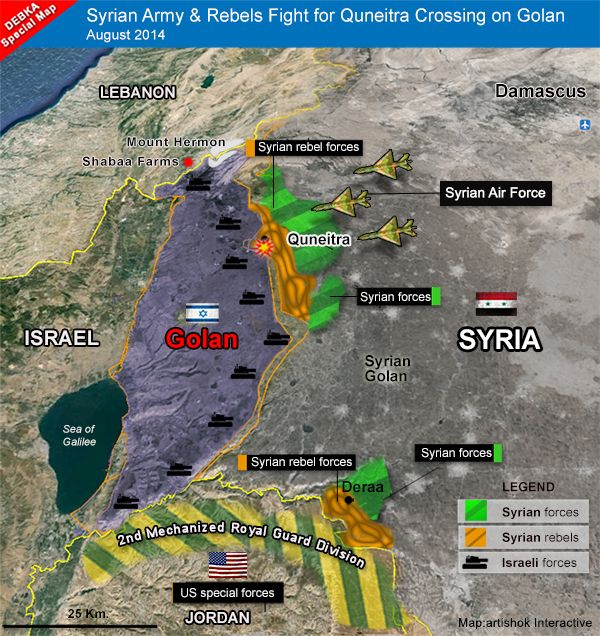
The cross-border incident on the Golan Wednesday, Aug. 27, in which an Israeli officer was injured by stray fire from the fighting between Syrian army and rebel forces near Quneitra, put this battle zone on the front pages. However,DEBKAfile’s military sources report that this incident, fought by only 300 combatants on each side backed by 10 tanks, had no real military importance for the Syrian conflict at large. The Syrian army, helped by Iran and Hizballah, is winning and the rebel side is crumbling.

The battle for Qoneitra, fought 200 meters from the Israeli border, is much more important as a touchstone in quite a different setting, that concerns not only Israel but the complicated US posture against the many-headed Al Qaeda peril in the Middle East.

The US, Jordan and Israel are quietly backing the mixed bag of some 30 Syrian rebel factions which Tuesday, Aug. 26, seized control of the Syrian side of the Quneitra crossing, the only transit point between Israeli and Syrian Golan. However – here comes the rub – Al Qaeda elements have permeated all those factions.

The crossing is formally under the control of UNDOF, an international peacekeeping force, which too is falling apart as contingents are recalled by their governments.

Damascus hit back at the rebels Thursday, Aug. 28, by sending the Syrian air force to destroy the new rebel positions. This was a flagrant contravention of Israel-Syrian armistice agreements. The Israeli air force might have been justified in scrambling to combat the Syrian air incursion, but was not ordered to do so.

This appeared to contradict a fact which Israel has kept very dark: The 30 or so Syrian rebel offensive to wrest Quneitra would have stood no chance without Israel’s aid – not just in medical care for their injured, but also in limited supplies of arms, intelligence and food. Israel acted as a member, along with the US and Jordan, of a support system for rebel groups fighting in southern Syria. Their efforts are coordinated through a war-room which the Pentagon established last year near Amman. The US, Jordanian and Israeli officers manning the facility determine in consultation which rebel factions are provided with reinforcements from the special training camps run for Syrian rebels in Jordan, and which will receive arms.

All three governments understand perfectly that, notwithstanding all their precautions, some of their military assistance is bound to percolate to Al Qaeda’s Syrian arm, Jabhat Al-Nusra, which is fighting in rebel ranks. Neither Washington or Jerusalem or Amman would be comfortable in admitting they are arming Al Qaeda’s Nusra Front in southern Syria.

And not only Nusra: It turned out in this week’s incident that some of the rebel fighters come from the terrorist group Ansar Beit al-Maqdis, a coalition of Al Qaeda contingents based in the Egyptian Sinai Peninsula and Gaza Strip. Another piece of this dissonant jigsaw is Al Maqdis’ close alignment for its violent operations with the Palestinian Hamas ruling Gaza, with which Israel has just been locked in a deadly 50-day war.

Wednesday night, at his news conference to sum up that war, Prime Minister Binyamin Netanyahu included in his list of Israel’s diplomatic successes, the winning over of world opinion to the perception that Hamas and Al Qaeda belong to the same family of terrorists and share the same fundamentalist ideology, which must be fought.

As he spoke, Al Qaeda fighters, intermingled with Syrian rebel factions, fetched up just yards from Israel’s northern border fence.

DEBKAfile’s military sources say that Washington, Amman and Jerusalem can expect to keep the embarrassing fact fairly quiet only until the first black Al Qaeda flag is raised over a rebel position at the Quneitra crossing or a captured Syrian post opposite the line of Israeli positions on the Golan. Israel will then face a new dilemma on this sensitive front, which will take some explaining.

Report: Qatar Plans to Fund a New Gaza Flotilla

August 28, 2014

Report: Qatar Plans to Fund a New Gaza Flotilla

Aug. 27, 2014 2:04 pm

Sharona Schwartz

via Report: Qatar Plans to Fund a New Gaza Flotilla | TheBlaze.com.

Qatar, a dedicated supporter of the Muslim Brotherhood and Hamas, will fund a flotilla to Gaza spearheaded by a Turkish group with reported terrorist ties, according to an Israeli media report.

A report by the Israeli news site NRG quoted in the Algemeiner stated that Qatar and IHH, the Turkish group that bills itself as humanitarian, signed a cooperation agreement on Monday.

The Jerusalem Post also reported on the cooperation agreement but did not state that a new flotilla was part of the agreement.


Turkish Gaza flotilla ship, the Mavi Marmara, is seen in Istanbul, Turkey, Monday, May 30, 2011. (AP)
 

IHH was the key group behind the 2010 Gaza flotilla, which tried to break Israel’s sea blockade of Gaza instituted to stop the flow of weapons to Hamas.

Instead, the Israel Defense Forces boarded one of the vessels, the Mavi Marmara, before it reached Gaza. Upon boarding, the soldiers were attacked by Islamist IHH activists wielding knives and metal bars, the IDF ultimately killing nine activists in response.

“The organization will send another flotilla after they receive permission from the government in Ankara that Turkish naval forces will defend the flotilla and its participants,” IHH leader Bulent Yildirim said, according to the Algemeiner.

Turkey had initially expressed support for a new flotilla but reversed course.

Yildirim is under investigation for financial ties to Al-Qaeda, Turkish media have reported, the Algemeiner noted.

Israeli government officials, including Prime Minister Benjamin Netanyahu, in recent weeks have lambasted the Qatari government for its support of Hamas. Al Jazeera is owned and funded by Qatar, leading to criticism in Israel of its coverage of the 50 days of violence between Hamas and Israel.

On Tuesday, a cease-fire was announced, putting an end at least for now to the 4,450 rockets that were fired into Israeli communities since July by Hamas and other terrorist groups and the IDF’s response to the launchings.

In May, the father of one of those killed on the Mavi Marmara was invited to accompany the Turkish prime minister on his visit to Washington, D.C.

The father of Furkan Dogan, a 19-year-old with both Turkish and U.S. citizenship who had expressed his desire for “martyrdom,” had a breakfast meeting with Secretary of State John Kerry during the same trip, an event touted by the Turkish foreign minister on Twitter.
Other Must-Read Stories