Posted tagged ‘Israel’

Iranian leader: US should focus on terror, not nukes

September 25, 2014

Iranian leader: US should focus on terror, not nukesAhead of UN address, Rouhani says Tehran and Washington can work together to curb Islamic extremismBy George Jahn September 25, 2014, 12:23 pm

via Iranian leader: US should focus on terror, not nukes | The Times of Israel.


Iranian President Hassan Rouhani speaks during his keynote address at New America,
a public policy institute and think tank,
on Wednesday, Sept. 24, 2014 in New York (Photo credit: Bebeto Matthews/AP)


NEW YORK (AP) — Iranian President Hasan Rouhani urged the United States on Wednesday to move beyond “insignificant” fears that his country seeks nuclear arms and challenged it to join his country in battling what he described as the global threat of Islamic extremism.

During a speech and question-and-answer session hosted by the New America think tank, Rouhani urged the US government to “let go of pressure politics toward Iran” — a reference to Iranian complaints that Washington’s demands at the nuclear talks are unrealistic. Repeating that Iran is not interested in nuclear arms, he urged the US to “leave behind (this) insignificant issue.”

Instead, he said, the two countries must focus on the fight against the Islamic State group and other extremist groups, the “real and serious common challenges which … threaten the entirety of the world.”

At the same time, he was critical of the US bombing campaign of Islamic State strongholds in Iraq and Syria and the growing coalition of countries seeking to stop the terrorists by military means. “Bombing and airstrikes are not the appropriate way,” he said, warning that “extraterritorial interference…in fact only feeds and strengthens terrorism.”

Blaming “the misunderstandings of the realities of the region by…outsiders,” Rouhani said wrong US policies, including the invasions of Afghanistan in 2001 and Iraq in 2003, likely led to the birth of the Islamic State group by creating power vacuums exploited by extremists.

Rouhani also suggested it was in the West’s interest to reach a nuclear agreement with Iran, freeing Tehran to play a more active role in creating and maintaining stability in the Islamic world.

The nuclear talks appear stuck two months before their extended November 24 deadline. While the US is formally joined by five other powers at the negotiating table with Iran, it is clear that the Americans are the lead negotiators, and Rouhani directed most of his comments at Washington.

Even if a nuclear deal is sealed, it could face harsh opposition by Iranian hardliners and US congressional critics united in one fear — that their side has given away too much. But Rouhani shrugged off opposition from inside his country and said it was up to US President Barack Obama to deal with Congress.

Iran-US tensions have eased since the election last year of the moderate Rouhani. A year ago, he and Obama spoke by telephone for 15 minutes, the first time the presidents of the United States and Iran had talked directly since the 1979 Iranian revolution and siege of the American embassy. The conversation was hailed as an historic breakthrough.

Tensions have risen recently, with American officials furious over the arrest of Jason Rezarian, an American-Iranian journalist for the Washington Post detained on unspecified charges in Iran.

But Rouhani made clear he was not prepared to interfere in the case of Rezarian, whose wife was also arrested.

Iranian officials have not specifically said why the couple is being held, and Rouhani has dodged questions about their fate. Asked Wednesday about Rezarian, he said he would be freed if he is innocent of any crime.

“We must not prematurely express opinions about a case that hasn’t reached the court yet,” he said.

Fatah’s Gaza Branch Making Rockets to Use before Next Cease-Fire [video]

September 25, 2014

Hamas is making new rockets while Israel demands disarmament

By: Palestinian Media Watch

Published: September 24th, 2014

via The Jewish Press » » Fatah’s Gaza Branch Making Rockets to Use before Next Cease-Fire .

Fatah Al Aqsa terrorists shows off “cease-fire” rocket production.


Gaza’s branch of Fatah, Hamas’ rival terrorist party headed by Palestinian Authority chairman Mahmoud Abbas, showed off its continuing rocket-manufacturing capabilities for visiting Russian journalists, Palestinian Media Watch (PMW) reported.

Fatah invited Russian TV (RT) last week to a rocket production facility to witness and film the actual production of new rockets. Fatah’s military wing, the Al-Aqsa Martyrs’ Brigades, depleted its reserves while taking an active part in the Gaza war alongside Hamas, firing rockets at Israeli towns and cities:

“The moment the war ended, the Palestinian military wings renewed military production in order to replenish the stock, which was emptied during the war,”  according to an Arab journalist for RT, quoted by Fatah on its Facebook page.

A Fatah video, as seen below, shows Fatah members at work producing new rockets, and a masked Fatah terrorist explained, “We are preparing and developing rockets in the productions’ division of the Al-Aqsa Martyrs’ Brigades – Al-Asifa Army following the ceasefire agreement in preparation for the coming battles.”

The Palestinian Authority does not want another cease-fire unless it has plenty of rockets on hand to make sure that the truce is temporary. Terrorists in Gaza, like those in the Judea and Samaria who received thousands of rifles from Israel in the 1990s to keep the peace as part of the Oslo Accords, never store their weapons for a long period of time. Their idea of “defense” is to use them to attack Israel, whose existence is considered an offensive act.

The journalist added that Fatah is making rockets because the partial blockade imposed by Israel and Egypt interferes with efforts to smuggle weapons into Gaza.

Of course, Israel could put an end to all smuggling simply by removing the maritime blockade. Then, Fatah, Islamic Jihad, Hamas and all of the other terrorist groups simply could bring in weapons at will in response to the “humanitarian gesture” by Israel.

Fatah’s activity in the war, in which it lost 17 times more members than those identifying with Hamas, is a sign that Fatah and Hamas have achieved unity in the area of terror, if not on the diplomatic front.

A Sept. 10 Fatah post, translated and published by PMW, quoted the RT reporter as stating. “We are visiting the Al-Aqsa Brigades – Al-Asifa Army (i.e., Fatah’s military wing)… where fuel for rockets and mortar shells is being produced.”

An Al-Aqsa Martyrs’ Brigades fighter added, “We are preparing and developing rockets in the productions’ division of the Al-Aqsa Martyrs’ Brigades – Al-Asifa Army following the ceasefire agreement in preparation for the coming battles. During the last war, we fired rockets at the Zionist enemy. We have notified the enemy that we have many more [rockets]. We have also successfully developed the K-132 rocket, which is here beside me.”


Obama Defends Islam, Smacks Israel, American Racism at UN

September 24, 2014

Obama Defends Islam, Smacks Israel, American Racism at UN

via Obama Defends Islam, Smacks Israel, American Racism at UN.

24 Sep 2014, 8:26 AM PDT


On Wednesday, on the first anniversary of President Barack Obama’s speech to the United Nations in which he called for ouster of Syrian dictator Bashar Assad, Obama attempted to rally support for his airstrikes against Assad’s terrorist opposition. Taking on issues ranging from Iran to Russia, from Ukraine to Syria, from global warming to Ebola, Obama pledged to utilize American might in service to the United Nations, speaking grandly of the beauty and power of the world’s least effective and most morally bankrupt international institution.

Obama opened with a Dickensian world of Manichean opposites:

Mr. President, Mr. Secretary General, fellow delegates, ladies and gentlemen: we come together at a crossroads between war and peace; between disorder and integration; between fear and hope.

He then offered delegates a choice between paper and plastic.

Actually, he stated that the world has never been better off, praising the increase of member states at the UN and the decrease in poverty (neglecting, of course, that that decrease in poverty is a direct result of the rise of global capitalism), as well as the iPhone. “I often tell young people in the United States that this is the best time in human history to be born, for you are more likely than ever before to be literate, to be healthy, and to be free to pursue your dreams,” Obama said, apparently forgetting the last two decades of human history.

But, said Obama, there are a few problems with which we have to contend: Ebola, Russian aggression, “brutality of terrorists” in Syria and Iraq. And those problems, Obama continued, are “symptoms of a broader problem – the failure of our international system to keep pace with an interconnected world.” Incredibly enough, the rise of disease, Obama believes, is because we haven’t invested enough in the United Nations, not because incompetent regimes upheld by the UN have failed their people. In amazingly hypocritical fashion, Obama – a man elected on the basis of his undercutting of George W. Bush’s Iraq war, a war based almost entirely on enforcement of UN resolutions — said that terrorism has flourished because “we have failed to enforce international norms when it’s inconvenient to do so.”

Obama said America chooses “hope over fear.”

According to Obama, that choice entails standing up to Russia – presumably, by doing nothing. Obama stated that Russia’s worldview was that “might makes right,” that their vision was of a “world in which one nation’s borders can be redrawn by another, and civilized people are not allowed to recover the remains of their loved ones because of the truth that might be revealed.” Obama then contrasted that vision with America’s:

America stands for something different. We believe that right makes might – that bigger nations should not be able to bully smaller ones; that people should be able to choose their own future.

Right, of course, does not make might. To believe in that vision is idiotic. Right must build might in order to enforce right. But Obama’s unceasing belief in the power of his own verbiage means that he thinks he can simply talk Russia into backing off:

We call upon others to join us on the right side of history – for while small gains can be won at the barrel of a gun, they will ultimately be turned back if enough voices support the freedom of nations and peoples to make their own decisions.

Obama went on to suggest that Russia should use “the path of diplomacy and peace,” citing our signing of the Nuclear Non-Proliferation Treaty, which Russia has been routinely cheating. “That’s the kind of cooperation we are prepared to pursue again,” Obama said.

To which Vladimir Putin has formally responded: “ROFLMAO.”

Obama then turned to Ebola, stating that we’re sending troops to West Africa; he turned to Iran, where he said that “we can reach a solution that meets your energy needs while assuring the world that your program is peaceful.”

To which the mullahs have formally responded: “LOLWUT.”

Obama next addressed China’s aggression in the South China Sea, suggesting that America will insist “that all nations abide by the rules of the road, and resolve their territorial disputes peacefully, consistent with international law.”

To which China has formally responded: “SMDH.”

Then Obama went on his world-beating rant: he said that America would help “eradicate extreme poverty by 2030.” Not through capitalism, mind you: through foreign aid. He said that America would cut our own carbon emissions. He spouted trite slogans: “On issue after issue, we cannot rely on a rule-book written for a different century. If we lift our eyes beyond our borders – if we think globally and act cooperatively – we can shape the course of this century as our predecessors shaped the post-World War II age.”

Finally, he turned to the actual pressing issue of the day, Islamic terrorism. And he proceeded to explain that Islam is a religion of peace, no different from any other, and defend his reactive foreign policy as somehow proactive.

I have made it clear that America will not base our entire foreign policy on reacting to terrorism. Rather, we have waged a focused campaign against al Qaeda and its associated forces – taking out their leaders, and denying them the safe-havens they rely upon. At the same time, we have reaffirmed that the United States is not and never will be at war with Islam. Islam teaches peace. Muslims the world over aspire to live with dignity and a sense of justice. And when it comes to America and Islam, there is no us and them – there is only us, because millions of Muslim Americans are part of the fabric of our country.

He stated that America rejected “any suggestion of a clash of civilization.” Our opponents have not done the same, of course. But Obama stated that we could fight those “religiously motivated fanatics” – fanatics who have nothing to do with Islam, of course, even if they are universally Muslim – by providing food and water and jobs. Obama’s Marxist foreign policy has never wavered: he believes that inequality, not religious conflict, lies at the root of Islamist enmity for the West.

Obama laid out a four-pronged plan for fighting terrorism.

First, he said that ISIL had to be “degraded, and ultimately destroyed.” And once again, he emphasized that ISIL was not Islamic, and once again, he ruled out utilizing American troops.

Second, Obama said that Muslim communities had to “explicitly, forcefully, and consistently reject the ideology of al Qaeda and ISIL.” In the process, he praised Islam as part of a family of religions that “accommodate devout faith with a modern, multicultural world,” and added that “All religions have been attacked by extremists from within at some point, and all people of faith have a responsibility to lift up the value at the heart of all religion: do unto thy neighbor as you would have done unto you.”

His solution: talking about how ISIL and al Qaeda and Boko Haram are bad. Obama’s faith in words is absolutely unshakeable, as he made clear: “The ideology of ISIL or al Qaeda or Boko Haram will wilt and die if it is consistently exposed, confronted, and refuted in the light of day.” Hilariously, Obama explained that the UN Security Council would pass a resolution about combating “violent extremism,” but refused to explain what steps would actually be taken to do so, instead putting that discussion off for “next year.”

Third, Obama stated, sectarian conflict must end. How? Obama didn’t say. But he did pooh-pooh Muslim sectarian conflict as the religious norm:

There is nothing new about wars within religions. Christianity endured centuries of vicious sectarian conflict. Today, it is violence within Muslim communities that has become the source of so much human misery. It is time to acknowledge the destruction wrought by proxy wars and terror campaigns between Sunni and Shia across the Middle East. And it is time that political, civic and religious leaders reject sectarian strife. Let’s be clear: this is a fight that no one is winning.

Flipping through his trusty rhetorical playbook, Obama neglected any realistic solution to these sectarian conflicts, but did come up with this hackneyed chestnut:

Cynics may argue that such an outcome can never come to pass. But there is no other way for this madness to end – whether one year from now or ten. Indeed, it’s time for a broader negotiation in which major powers address their differences directly, honestly, and peacefully across the table from one another, rather than through gun-wielding proxies. I can promise you America will remain engaged in the region, and we are prepared to engage in that effort.

Fourth, Obama proposed, Arab and Muslim countries had to focus on “the extraordinary potential of their people – especially the youth.” He said that young Muslims “come from a great tradition that stands for education, not ignorance; innovation, not destruction; the dignity of life, not murder. Those who call you away from this path are betraying this tradition, not defending it.” That is the same message Obama and his minions have been braying for years at this point. No one, apparently, is listening.

And then Obama dropped the other shoe. After spending fifteen minutes blabbering about the glories and wonders of Islam, even as he decried extremism and sectarianism, Obama proceeded to blame Israel for conflict in the Middle East:

Leadership will also be necessary to address the conflict between Palestinians and Israelis. As bleak as the landscape appears, America will never give up the pursuit of peace. The situation in Iraq, Syria and Libya should cure anyone of the illusion that this conflict is the main source of problems in the region; for far too long, it has been used in part as a way to distract people from problems at home. And the violence engulfing the region today has made too many Israelis ready to abandon the hard work of peace. But let’s be clear: the status quo in the West Bank and Gaza is not sustainable. We cannot afford to turn away from this effort – not when rockets are fired at innocent Israelis, or the lives of so many Palestinian children are taken from us in Gaza. So long as I am President, we will stand up for the principle that Israelis, Palestinians, the region, and the world will be more just with two states living side by side, in peace and security.

The Israelis may not be the “main source of problems in the region,” but by pressuring Israel before the entire world just weeks after Hamas continuously fired rockets into Israel and shielded its own rockets with children, Obama demonstrates his distaste for the Jewish State, and his desire to cast them as a bleeding abscess leading to more violence. The moral equivalence here was stunning, unjustifiable, and purely disgusting.

As Obama moved toward his conclusion, he finally turned inward, apologizing for America yet again:

I realize that America’s critics will be quick to point out that at times we too have failed to live up to our ideals; that America has plenty of problems within our own borders. This is true. In a summer marked by instability in the Middle East and Eastern Europe, I know the world also took notice of the small American city of Ferguson, Missouri – where a young man was killed, and a community was divided. So yes, we have our own racial and ethnic tensions. And like every country, we continually wrestle with how to reconcile the vast changes wrought by globalization and greater diversity with the traditions that we hold dear.

Ferguson? Really? This is just the latest incident in which President Obama has condemned a private citizen before the world. In 2012, it was a filmmaker who guilty of provoking Islamic rage; today, it’s Officer Darren Wilson in Ferguson, Missouri, who has provoked America’s racial conflict. The United Nations has become a wonderful place for President Obama to convict American citizens.

Obama concluded with his campaign stump speech:

After nearly six years as President, I believe that this promise can help light the world. Because I’ve seen a longing for positive change – for peace and freedom and opportunity – in the eyes of young people I’ve met around the globe. They remind me that no matter who you are, or where you come from, or what you look like, or what God you pray to, or who you love, there is something fundamental that we all share.

America shares virtually nothing with the other member states at the UN. But President Obama shares a lot with them: a desire for America to take a secondary role in the world affairs, a desire for Israel to surrender in the face of its enemies, a desire for talk rather than action, a desire to demean the United States on the global stage.

Blog: David Rubin, The Israeli Response to Mahmoud Abbas’ Political ‘Bomb’

September 24, 2014

The Israeli Response to Mahmoud Abbas’ Political ‘Bomb’

By David Rubin9/24/2014, 7:09 AM

via Blog: David Rubin, The Israeli Response to Mahmoud Abbas’ Political ‘Bomb’ – Arutz Sheva.


t has now been confirmed that Palestinian Authority (PA) President Mahmoud Abbas is planning to ask the UN to set a timetable for the end of the Israeli “occupation” and the establishment of a Palestinian state along the pre-1967 borders, with its capital in eastern Jerusalem.

Interviewed in the Palestinian media, top PA official Jibril Rajoub has reported that Abbas will “drop a bomb” on Israel at the UN, presenting his aggressive proposal as part of a “day after” plan following the end of the current war in the Gaza Strip.

According to the Qatari News Agency, an agreement to that effect was reached in Abbas’ meeting with Qatari Emir Tamim bin Hamad al-Thani and Hamas’ political chief Khaled Meshal, in Doha last week.

Despite the fact that such a move by the Hamas-Fatah unity government at the UN is a clear violation of the Oslo Accords, which was the legal basis for the establishment of the Palestinian Authority, Israel’s political leadership is eerily silent. One might have thought that after past Israeli warnings to Abbas not to form a unity government with Hamas and not to ignore the Oslo Accords by taking hostile political steps at the UN, we would see Israeli firm action in response to this latest “timetable threat”.

The deafening silence from Israeli leaders, who still refer to Mahmoud Abbas affectionately as “Abu Mazen” (Mazen’s father), thereby putting a gentle, human face on a deceitful enemy who has continued the PA tradition of directly rewarding terrorists and their families after each terrorist attack, is very disturbing.  Despite the blatantly hostile moves taken by Abbas, there have been only weak, temporary responses, and so far, there has been no response to this latest threat, which this time he seems intent on carrying out in honor of Rosh Hashanah, the Jewish New Year. Somehow, the flaccid responses or non-responses from Jerusalem haven’t proven to be a convincing deterrent to Abbas’ political aggression.

The Israeli response doesn’t have to be complicated, but it should be very clearly stated as follows, as a direct response to hostile actions:

1. Once Abbas issues his “timetable” demand at the UN this week, make it clear to him and do so publically, that the Israeli time clock has started ticking, leading to the dissolution of his Palestinian Authority.

2. The PA was established as a result of an agreement with Israel. Once the PA unilaterally throws the responsibility for making peace over to the UN, that agreement is null and void.

3. The Levy Report, which in 2012 reaffirmed Israel’s national rights over Judea and Samaria (the so-called West Bank), should be immediately adopted, thereby replacing the Oslo Accords as the legal basis for government policy in these areas, in which the PA currently has seven autonomous cities and many defacto autonomous towns.

4. The PA should thus be declared “a hostile entity on Israeli soil”, with the ramifications of that statement for follow-up Israeli actions to be debated in the Cabinet.

While much was written during Operation Protective Edge about the need to restore Israel’s military deterrence, the real problem all along has been our lack of a political deterrence, which causes the world not to take seriously our occasional threats to respond to political aggression.

“You make of us an object of strife unto our neighbors, and our enemies laugh amongst themselves.” (Psalms 80:7)

Until we start responding with more than empty words to Abbas’ long list of hostile actions, Israel’s political deterrence will continue to be the laughing stock of the Middle East.

Israel must prepare for third Lebanon war

September 17, 2014

Israel must prepare for third Lebanon war, Al MonitorBen Caspit, September 16, 2014

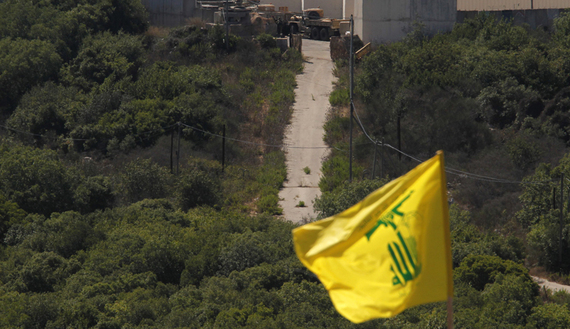
Israeli soldiers and trucks are seen from the southern Lebanese village Marwaheen, as a Hezbollah flag flutters during a protest in solidarity with Palestinian people in Gaza near the Lebanese-Israeli borderIsraeli soldiers and trucks are seen from the southern Lebanese village Marwaheen, as a Hezbollah flag flutters near the Lebanese-Israeli border, July 25, 2014. (photo by REUTERS/Ali Hashisho)

Israel must prepare for an eventual third Lebanon war, where it will be confronted with much stronger and more organized forces, perhaps equivalent in equipment to other Arab armies, capable of penetrating Israeli territory.

*****************

Not since the War of Independence, which broke out one day after Israel’s establishment was proclaimed in October 1947, has the sovereignty of the Jewish state been in such real peril. During that war, communities and territories frequently exchanged hands. Once the campaign stabilized and the picture became clearer, the Green Line was born. To date, this remains the only recognized international border between Israel and its Arab surroundings.

Since 1948 until today — over 66 years — none of Israel’s enemies posed a real threat to its territorial integrity. No Israeli community has ever been conquered nor have military raids into the country been carried out. The only exception occurred during the 1973 Yom Kippur War, when the Egyptian and Syrian armies mounted a surprise invasion. However, the areas they seized had been conquered by Israel during the 1967 Six-Day War and were beyond the Green Line.

Israel’s defense doctrine is predicated on one patently clear and solid principle: Warfare should be shifted into the enemy’s territory as quickly as possible. This principle stems from reality’s constraints: Israel is a tiny state, whose width in some areas does not exceed 10 miles. As a result, it doesn’t have the luxury of conducting campaigns in its own territory. This principle has been upheld throughout the state’s existence. Israel’s wars have always been conducted in the enemy’s territory.

When a senior officer from the Northern Command of the Israel Defense Forces (IDF) briefed reporters on Sept. 14, he dropped a journalistic bombshell. During the next round of hostilities between Israel and Hezbollah, the officer said, it is possible that Hezbollah will take over an Israeli community or carry out a land grab for a certain period of time. Intimations to this effect had been previously heard here and there (including in my article for Al-Monitor from August 2013). Yet, when this topic starts dominating the headlines in Israel, it constitutes a watershed. The IDF is well aware of the fact that Hezbollah may have changed its warfare doctrine and that it has accumulated more self-confidence, knowledge and fighting experience. The organization is now able to carry out an armed and violent raid into Israel, relying on a force consisting of a “few dozen to several hundred combatants,” as the officer put it.

A serious coalition crisis is currently raging in Israel between Prime Minister Benjamin Netanyahu and Finance Minister Yair Lapid. The linchpin of the dispute is the 2015 state budget, and more specifically, the defense budget. The events of Operation Protective Edge have shaken Israel’s self-confidence. For the first time, Israel encountered an aggressive and proactive Hamas, which repeatedly incurred into its communities in a bid to “shift the war into its territory.”

There’s no way the IDF can deploy all along the country’s borders, from the north (Hezbollah) to the Golan Heights (the al-Qaeda-affiliated Jabhat al-Nusra) to the Egyptian border (Ansar Bayt al-Maqdis) and Gaza (Hamas and Islamic Jihad).

A foreign military force that wants to raid an enemy territory along a vast and winding border will always manage to find the most vulnerable point where the defense contingency is small.

This is Israel’s greatest concern ahead of a “third Lebanon war.” Nobody knows when it will break out, yet everyone is sure it eventually will. To date, Hezbollah has adopted a fairly simple warfare doctrine. Based on massive rocket fire at the Israeli home front that aims to disrupt life, deal a blow to the economy and inflict casualties, it is combined with guerrilla warfare against the IDF in mountainous terrain — either forested or built up — using its weapons of choice: antitank fire, powerful improvised explosive devices and ambushes. That’s the name of the game when guerilla forces are pitted against a regular army.

From now on, however, it’s a whole different ball game. Israeli military officials emphasize that while Hezbollah is indeed preoccupied in Syria and northern Lebanon and is deployed along a vast sector and is bleeding profusely, it is nevertheless well organized and trained. It is also being run prudently and sensibly, gathering military experience and self-confidence. According to Israeli sources, Hezbollah is training its commando forces to make a surprise incursion into Israel, take over a community (such as a kibbutz or a moshav — a cooperative community — or even a small town like Shlomi). It will try to inflict as much damage as possible and hold out for as long as possible, taking hostages that will allow its troops to pull back safely home into Lebanon.

The current Israeli assessment is that Hezbollah’s Secretary-General Hassan Nasrallah has no reason for the moment to be caught up in another confrontation with Israel. On the other hand, he continues his organization’s long-term massive buildup, while improving its capabilities and training, and stockpiling means that will allow him, in the next round, to stage a different kind of warfare, the likes of which we have yet to see. According to a senior Israeli source, Hezbollah is already as strong as any other regular Arab army. Its ORBAT (Order of Battle), according to one of the intelligence officials I spoke with, is bigger than Jordan’s, even at the time when it was considered Israel’s bitter rival. For all intents and purposes, Hezbollah operates like a regular army. It is building intelligence capabilities. Equipped with unmanned airborne vehicles, it also has surveillance stations and manages a modern communications network.

Next time, to have its victory photo and an unprecedented psychological achievement, it will try, as noted, to seize an Israeli community. If that were the case, it would be a first since 1948. This could seriously compromise the sense of security among Israelis, crushing the Jewish-Israeli population in the northern Galilee and causing much greater damage to Israelis living there than what Hamas’ incursion attempts during Operation Protective Edge did to the residents of the Gaza periphery.

The IDF is bracing for such an eventuality. The battle over the defense budget illustrates the degree of seriousness that Netanyahu attaches to the “growing security challenges around us,” as he put it on Sept. 15. My sources indicate that there is already talk in security circles about significantly expanding elite units such as YAMAM (a highly trained counterterrorism police unit) and deploying them in war-prone areas by way of “first responders.”

When it comes to events such as those described above, whereby an organization such as Hezbollah or Hamas is trying to infiltrate Israel, intelligence and time are of the enormous essence. During Operation Protective Edge, all of the IDF’s top-notch infantry units were dispatched to the communities in the Gaza periphery. They deployed across the border fence, charging every territorial compartment with regard to which there was a warning about a possible ”tunnel assault.” Back then, it worked. Hamas terrorists scored no significant success in their operations against Israeli communities. However, they did inflict significant losses to the IDF during its engagements with Israeli troops. When it comes to a much longer and far more complicated front, will the IDF also succeed against a semi-military organization such as Hezbollah that’s much more powerful than Hamas?

Meanwhile, on Sept. 14, the Counterterrorism Bureau issued a travel advisory ahead of the upcoming Jewish holiday season. In addition to all the usual warnings, the travel advisory to Western Europe came as a surprise. There’s a threat — the statement read — that Islamic State (IS) terrorists will carry out attacks against Jewish or Israeli objectives in the countries from which they originally set out to join IS ranks. We’re talking about countries such as Belgium, France, Sweden, Great Britain and others.

This travel advisory took flak from different directions. Terrorist threats exist also in Israel and the United States. In fact, they exist almost anywhere around the globe, a well-versed Israeli source told me. We, of all people, who get upset whenever the Europeans or Americans issue a travel advisory about Israel, need to be more sensitive and realize that not everything merits an official travel advisory.

Either way, the number of Israeli tourists visiting their favorite European capitals during the Jewish holidays of Rosh Hashanah, Yom Kippur and Sukkoth is not expected to plummet. Even Beyonce’s two evenings of concerts in Paris saw thousands of Israeli spectators. Israeli tourists read those travel advisories, file them away in their mind and take off. From their standpoint, danger is an inherent part of their normal existence.

This is What Happens When You Attack Israel

September 17, 2014

For too long the media and international community have been preaching that “Palestinians” bear no responsibility for the consequences of their decisions and they are passive victims of the conflict.

By: Shalom Bear
Published: September 17th, 2014

via The Jewish Press » » This is What Happens When You Attack Israel.


A Gaza building, reportedly used by Hamas, destroyed by the IDF on August 26, 2014.
Photo Credit: Emad Nassar/Flash90
 

Leftwing websites love to play up the photos of destruction of Gaza. The poor, suffering, innocent “Palestinians”, victims of Israeli aggression and collective punishment, are their front page stories.

Their bottom line is always the same, the Gazans (or the “Palestinians”) are not responsible for their actions and decisions; they’re passive victims of the conflict.

But it’s not true.

Even before their violent takeover of Gaza, Hamas received the largest block of votes in Gaza, giving them the majority, in fact Hamas secured 76 out of 132 seats – that’s 58% – in the Palestinian Authority’s parliament.

The people of Gaza, knowing full well the genocidal charter of Hamas, voted Hamas in. There’s no getting around that.

It’s both immoral and patronizing to say Gaza’s residents (or the Arabs in Judea and Samaria) voted Hamas in because Hamas’s social programs are more important to them than Hamas’s plans for genocide.

It is now well documented that the destruction in Gaza by the IDF was limited to areas that Hamas was using to attack Israel, whether it be for their command centers, missile silos, terror tunnels, or terrorist positions. For the most part, areas that were not involved in the fighting emerged from the war mostly unscathed.

Even within terror-infested neighborhoods, there are buildings that were hit, and buildings that weren’t.

Owners of many of the hit buildings were profiting from Hamas, charging them rent and receiving payment for letting Hamas store their weapons there, build terror tunnels entrances underneath their homes, or to set up rocket launchers in their orchards and backyards.

Unfortunately, there were also other civilian locations which Hamas illegally decided to use during the war, to attack Israel from.

The problem is that the international community refuses to report on the Arab civilian’s complicity and collusion with the terrorists, preferring to always portray them as the innocent victims, stuck in a situation out of their control.

Last week a Hamas official accidentally let it slip that Gazans are not letting Hamas back into their homes.

So much for the myth of the innocent and oppressed Gazans who can’t stand up to Hamas.

What was missing until now was any incentive for the Gazans to stand up to Hamas.

After all, the media and the UN teach them that there are absolutely no consequences to their actions – so why not let part of your house be converted into a missile silo to wipe out the Jews.

But now, the Gazans have learned an important life lesson. If you participate in any way in the genocidal attempt to destroy Israel, there are significant consequences to your actions.

The media should keep showing these photos of the destruction in Gaza.

Some day, the Gazans and the Arabs in Judea and Samaria will demand the right to vote from their leaders in the Palestinian Authority and Hamas.

They will once again need to decide whether they want the corrupt terrorists to take over, or if they want the ruthless terrorists to take over.

Unfortunately, a poll right after the war showed that Hamas was more popular than ever.

But perhaps, just perhaps, with a little retrospection, they’ll look at these pictures from Gaza and say, “We want a third option.”

Mortar shell fired from Gaza at Israel

September 16, 2014

Mortar shell fired from Gaza at Israel, Times of IsraelStuart Winer, September 16, 2014

(Whoops? — DM)

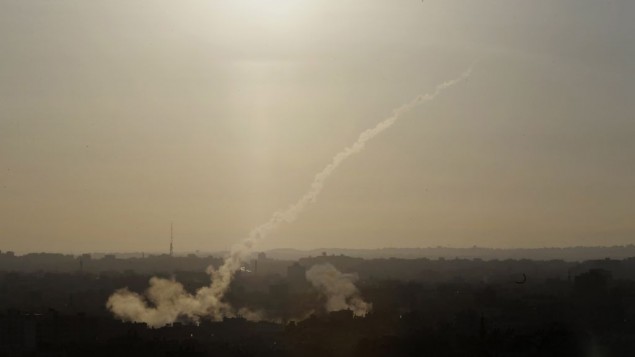
Mideast-Israel-Palest_Horo-59-635x357A rocket is fired from Gaza City towards Israel, Saturday, August 9, 2014. (illustrative photo credit: AP/Dusan Vranic)

Hamas denies it launched projectile; IDF searching for impact site in the Eshkol Region.

A mortar shell was fired from the Gaza Strip towards Israel on Tuesday evening, the Israel Defense Forces confirmed, the first since a ceasefire agreement between Israel and Hamas on August 26.

The Red Alert rocket warning system did not sound and the IDF said it was searching for the impact point that was believed to be somewhere near the border fence in the Eshkol Regional Council.

Army Radio reported that Eshkol residents heard an explosion nearby. However, Ynet reported that the rocket may have landed near the fence inside the Gaza Strip.

No injuries or damage were reported.

Hamas denied that it was responsible for the launch.

The fire came hours after Defense Minister Moshe Ya’alon said he did not think Hamas would resume rocket fire on Israel.

Eshkol Regional Council head Haim Yallin said that it was still unclear whether the launch was part of a Hamas training session gone wrong, or whether it was directed at Israel, Ynet reported.

“We will not accept sporadic fire at our communities,” he added. “Israel’s leadership will evaluate how it chooses to protect its residents. We expect the government to act to bring quiet to the region.”

On Monday, the Code Red siren sounded near the Gaza Strip in what the IDF said was a false alarm.

Gaza border towns came under daily rocket fire over the course of a seven-week conflict between Israel and Hamas that ended when the two sides agreed to an Egyptian-brokered ceasefire. Some 4,600 rockets and projectiles were fired at Israel during the 50-day conflict.

The deal called for an immediate end to hostilities and easing of restrictions on movement of personnel and goods through the crossings into Gaza that Israel controls.

(UPDATE: According to Israel National News, the IDF has confirmed

that a mortar shell fired from Gaza and landed on the Israeli side of the security fence, in the first such attack by Gaza terrorists since the ceasefire went into effect on August 26.

There have been mixed reports on the precise nature of the projectile fired, with Channel 10 saying the attack was a mortar shell as opposed to a rocket; likewise, IDF spokesperson Lt. Col. Peter Lerner labeled it a mortar shell on the IDF’s official Twitter feed. However, nearly all other major Israeli media sources have identified it as a rocket attack.

No “color red” warning siren was sounded prior to the rocket which was fired around 6:30 p.m., and which caused no damage or injuries.

— DM)

Syrian rebels said to control most of the border with Israel

September 13, 2014

Syrian rebels said to control most of the border with Israel, Times of Israel, September 13, 2014

(How many and what types of weapons will “vetted, moderate” Syrian rebels on Israel’s border receive in support of Obama’s “war” against the Islamic State? — DM)

UN evacuates equipment from main HQ into Israel as insurgents capture two more towns; Qatar reportedly paid high ransom for release of Fijian troops

Mideast-Israel-Al-Qai_Horo2-e1409938780328-635x357Smoke rises following an explosion in Syria’s Quneitra province as Syrian rebels clash with President Bashar Assad’s forces, seen from the Israeli-controlled Golan Heights, on August 28, 2014. (photo credit: AP/Ariel Schalit, File)

Syrian rebels are in control of almost the entire Syrian border with Israel, a monitoring group and the Al-Arabiya news network reported Saturday.

According to the report quoted by Israel’s Channel 10, rebel forces on Friday gained control of two additional villages near Quneitra, the war-torn nation’s solitary border crossing with Israel, leaving only one village in the Syrian army’s hands.

The report added that the towns of Rawadi and Hamidiyah were taken after heavy fighting between the rebels and the army, loyal to President Bashar Assad.

“The regime is on the retreat before the advancing rebels,” Syrian Observatory for Human Rights director Rami Abdel Rahman told AFP. “The regime has now lost control of about 80 percent of towns and villages in Quneitra province.”

On Friday night a mortar shell exploded on the Israeli side of the Golan Heights, in what authorities believe was a stray from fighting across the border. There were no reports of injuries or damage.

Meanwhile Israel Radio reported that UN peacekeepers were evacuating the equipment from Camp Faouar, their main headquarters in Syria, to Israel. UN troops were bringing their gear over the border via special gates opened for them by the IDF, according to the report, and not through Quneitra which is now under rebel control. Only a small Fijian force is expected to remain at the base in a few days.

A-Sharq al-Awsat, quoting Syrian opposition sources, reported Saturday that the Qatari government paid a heavy ransom to rebels for the release of 45 captive UN peacekeepers freed Thursday.

According to the report Doha paid somewhere between $20-$45 million to the al-Qaeda-linked Nusra Front which had held the troops since August 28. Qatar took credit for negotiating the release on Friday, though it made no mention of a ransom.

Fighters from the Nusra Front group captured the Fijian troops late last month in the Golan Heights, where a 1,200-strong UN force monitors the buffer zone between Syria and Israel.

In exchange for the Fijians’ release, Nusra Front had demanded removal of the group from the UN terrorist list, the delivery of humanitarian aid to parts of the Syrian capital of Damascus, and compensation for three of its fighters who, it claims, were killed in a shootout with UN officers.

The capture of the 45 came during heavy fighting between rebels groups and Syrian army soldiers around the Quneitra crossing. Dozens of other peacekeepers from the Philippines managed to escape the group during a firefight.

The Nusra Front has accused the UN of doing nothing to help the Syrian people since the uprising against Assad began in March 2011. It said the Fijians were seized in retaliation for the UN’s ignoring “the daily shedding of the Muslims’ blood in Syria” and even colluding with Assad’s army “to facilitate its movement to strike the vulnerable Muslims” through a buffer zone in the Golan Heights.

Last week, several mortar shells exploded in an open area in the Golan Heights, apparently the result of inadvertent spillover from fighting in Syria, according to the IDF. Israel responded by firing a Tamuz missile at the origin of the attack. An IDF spokesperson said the strike was successful.

Artillery from Syria has landed frequently on the Israeli side of the Golan Heights for the past few weeks as regime and rebel forces fight over the Quneitra crossing.

Israel pulls back from anti-Assad policy, as IDF redeploys against Islamist seizure of Golan

September 9, 2014

Israel pulls back from anti-Assad policy, as IDF redeploys against Islamist seizure of Golan, DEBKAfile, September 9, 2014

Nusra_front_near_Israeli_Golan_4.9.14Islamist Nusra Front fighters near Israeli Golan

The Israeli government has radically changed tack on Syria, reversing a policy and military strategy that were longed geared to opposing Syrian President Bashar Assad, DEBKAfile’s exclusive military and intelligence sources report. This reversal has come about in the light of the growing preponderance of radical Islamists in the Syrian rebel force fighting Assad’s army in the Quneitra area since June.

Al Qaeda’s Syrian Nusra front, which calls itself the Front for the Defense of the Levant, is estimated to account by now for 40-50 percent – or roughly, 4,000-5,000 Islamists – of the rebel force deployed just across Israel’s Golan border. No more than around 2,500-3,000 belong to the moderate Syrian militias, who were trained by American and Jordanian instructors in the Hashemite Kingdom and sent back to fight in Syria.

This shift in the ratio of jihadists-to-moderates has evolved in four months. In early June, the pro-Western Syrian Revolutionary Front-SRF, mostly deployed in the southern Syrian town of Deraa on the Jordanian border, was the dominant rebel force and Nusra Front the minority.

The balance shifted due to a number of factors:

1. Nusra Front jihadis fighting alongside insurgents on the various Syrian battlefronts made a practice of surreptitiously infiltrating their non-Islamist brothers-at-arms, a process which the latter’s foreign allies, the US, Israel, Saudi Arabia, Qatar and Jordan, either ignored or were unaware of.

2.  These tactics began to pay off in the past month, when large numbers of moderate rebels suddenly knocked on the Nusra Front’s door and asked to join.

One reason for this was these militias’ defeat and heavy losses of men and ground under the onslaught of the combined forces of Syria, Hizballah and Iran. Nusra Front was less affected. It was also the moderate rebels’ preferred home, rather than the Islamic State in Iraq and Levant, whose atrocities, especially the beheadings of hostages and prisoners, they find repellent.

3.  Nusra deployment on the Syrian Golan further swelled of late as its fighters were pushed out of eastern Syria by IS in its rapid swing through the Syrian towns of Deir a-Zor and Abu Kemal (see attached map) to reach its ultimate goal – one which has so far not rated a mention in Western and Israeli media.

The Islamist extremists are on the way to conquering the Euphrates basin in Syria and Iraq before advancing on the place where the two great rivers of Mesopotamia, the Euphrates and Tigris, are in closest proximity – Mahmoudiya, south of Baghdad.

Nusra fighters moved out of the way of the IS push through eastern Syria and made tracks for Quneitra to join the fight to seize this strategic Golan town and crossing into Israel from Assad’s forces.

The pro-Islamist cast of the Syrian rebel force on Israel’s Golan border is reflected in the turnaround in Israel’s military position and attitude toward the insurgents on the other side of the Golan border fence. The IDF will henceforth be less supportive of the rebel struggle and more inclined to help Syrian troops in fending off rebel attacks.

This calls for a delicate balancing act in Jerusalem.  While definitely not seeking an Assad victory in the long Syrian war, Israel has no desire to see Al Qaeda’s Syrian branch, Al Nusra, seizing control of the Syrian sector of the Golan, including Quneitra.

Israel therefore finds itself in a quandary much like that of US President Barack Obama, who has promised to unveil his strategy for fighting the Islamic State of Iraq and Syria Wednesday, Sept. 10.  He too is strongly reluctant to throw US support behind Bashar Assad, but he may find he has no other option.

Why Europe Must Not Be Trusted to Monitor Hamas

September 2, 2014

Why Europe Must Not Be Trusted to Monitor Hamas, The Gatestone InstituteSoeren Kern, September 2, 2014

Hamas would likely resort to violence to thwart any attempts to disarm the group. It is therefore highly unlikely the Europeans would confront Hamas in any meaningful way.

Spanish intelligence agents met secretly with Hezbollah operatives, who agreed to provide “escorts” to protect Spanish UNIFIL patrols. The quid pro quo was that Spanish troops would look the other way while Hezbollah was allowed to rearm for its next war with Israel. Hezbollah’s message to Spain was: mind your own business.

If the European experience with Hezbollah in Lebanon is any indication, not only will Hamas not be disarmed, it will be rearmed as European monitors look on and do nothing.

What is clear is that European leaders have never been committed to honoring either the letter or the spirit of UN Resolutions 1559, 1680 and 1701, all of which were aimed at preventing Hezbollah from rearming.

European leaders are calling for a greater European role in enforcing the cease-fire in the Gaza Strip. They say their focus should be not only on rebuilding Gaza, but also on monitoring the demilitarization of Hamas and helping to secure the border crossings between the Gaza and Egypt to ensure that Hamas cannot be rearmed.

But if the European experience with Hezbollah in Lebanon is any indication, not only will Hamas not be disarmed, it will be rearmed as European monitors look on and do nothing.

French President François Holland, in a major foreign policy speech in Paris on August 28, said Europe should play a greater role in Gaza. “Since 2002, Europe has done a lot to rebuild and develop Palestine […] but it cannot simply be a cashier used to heal the wounds after a recurring conflict,” he said.

Referring to a nascent proposal for creating a Gaza observer mission under the auspices of the European Union, Hollande added: “Gaza can no longer be an army base for Hamas, or an open-air prison for its inhabitants. We have to go towards a progressive lifting of the blockade and the demilitarization of the territory.”

The EU observer mission—which is being promoted by Britain, France and Germany and would be established by a United Nations Security Council resolution—would be based at the Rafah border crossing, the main crossing between the Gaza Strip and Egypt. The mission would be charged with preventing the smuggling of weapons into Gaza and ensuring that building supplies such as cement and metal products are used for civilian reconstruction projects and not for building tunnels and rockets.

According to German media reports, the mission would be “more political than military,” which implies it would not be tasked with disarming Hamas.

The Israeli government has insisted that the reconstruction of Gaza must be linked to its demilitarization. “The process of preventing the arming of terror organizations must be part of any solution, and the international community must demand this aggressively,” Israeli Prime Minister Benyamin Netanyahu said on July 28.

This demand has been repeated by Israeli Foreign Minister Avigdor Lieberman. In an article entitled, “Take Away Their Guns—Then We’ll Talk,” published by Foreign Policy magazine on August 27, Lieberman wrote: “It should thus be entirely obvious that unless Hamas is disarmed and its only tools of control removed, there can be no peace and security.” He continued:

Any discussion on opening up entry points into Gaza, increasing access to the sea for Gazans, or any steps necessary for the revitalization of the Strip and its inhabitants cannot take place while it is occupied and terrorized by Hamas.

Israel fully supports a broad international effort to provide all the necessary means to rebuild the civilian infrastructure and economy in Gaza, provided there is a concerted parallel effort to prevent Hamas from rearming itself with weapons systems and rebuilding its terrorist infrastructure. Hamas cannot be allowed to rebuild its military force and prevent the essential international aid being directed to the Palestinian residents.

Lieberman also pointed out that the disarmament of Hamas and other Palestinian terrorist groups has been an essential element of a long list of agreements and understandings between Israel and the Palestinians. These include the Oslo II Accord signed in 1995, the Wye River Memorandum negotiated in 1998, and the so-called Road Map accepted by the Palestinian Authority in 2003.

But the exiled leader of Hamas, Khaled Meshaal, has vowed that the group will never disarm. “The weapons of the resistance are sacred and we will not accept that they be on the agenda” of future negotiations with Israel, he said on August 29. “The issue is not up for negotiations. No one can disarm Hamas and its resistance.”

Meshaal also said the conflict between Israel and Hamas is not over. “This is not the end. This is just a milestone to reaching our objective [of destroying Israel], we know that Israel is strong and is aided by the international community,” he said. “We will not restrict our dreams or make compromises to our demands.”

Hamas—an Islamist group whose raison d’être is the destruction of Israel—would probably resort to violence to thwart any attempts to disarm the group. It is therefore highly unlikely the Europeans would confront Hamas in any meaningful way.

The reluctance to disarm Hamas has much in common with the failure to disarm Hezbollah.

In September 2004, the UN Security Council passed Resolution 1559, which, among other demands, called for the disarmament and disbanding of Lebanese and non-Lebanese militias.

Hezbollah Secretary-General Hassan Nasrallah has flatly rejected Resolution 1559; he says he considers his organization to be a “resistance movement.” Nasrallah has said:

We do not consider ourselves a militia. The Lebanese government does not consider us a militia, the parliament does not consider us a militia, and most of the Lebanese people do not consider us a militia. Therefore the resolution does not apply to us.

In May 2006, the Security Council adopted Resolution 1680, which reiterated the “call for the full implementation of all requirements of Resolution 1559 […] and called for further efforts to disband and disarm all Lebanese and non-Lebanese militias and to restore fully the Lebanese Government’s control over all Lebanese territory.”

In August 2006, the UN Security Council passed Resolution 1701, which ended the 34-day war that began when Hezbollah captured two Israeli soldiers in a cross-border raid into Israel. During the war, Hezbollah fired more than 4,000 rockets and missiles against Israel, killing 44 civilians. The resolution called for the disarmament of all armed groups in Lebanon, including Hezbollah. It also called for the:

full implementation of the relevant provisions of the Taif Accords, and of resolutions 1559 (2004) and 1680 (2006), that require the disarmament of all armed groups in Lebanon, so that, pursuant to the Lebanese cabinet decision of July 27, 2006, there will be no weapons or authority in Lebanon other than that of the Lebanese state.

Then—as now—world leaders seemed more concerned about preventing Israel from defending itself, than about disarming the Islamic terrorist groups that initiated the fighting in the first place by attacking Israel.

While visiting Haifa in July 2006, then French Foreign Minister Philippe Douste-Blazy had to take cover from Hezbollah-launched Katyusha rockets. At the time, Douste-Blazy said: “The first condition for a cease-fire is of course the disarming of Hezbollah.”

Then French President Jacques Chirac also warned against a continued Hezbollah armed presence in southern Lebanon. “It is absolutely normal to have a current which expresses politically what the Hezbollah part of Lebanese public opinion thinks,” Chirac said in a radio interview in Paris. “What is unacceptable is to express it by the use of force, with armed militias. No country accepts that part of its territory be controlled by armed militias.”

Chirac’s defense minister, Michèle Alliot-Marie, promised that French peacekeepers would be operating with “strong rules of engagement” so that the United Nations Interim Force in Lebanon [UNIFIL] could act “with rigor and strongly if it is necessary.” She said: “These are the conditions necessary for the Force to be credible and dissuasive.”

But as soon as France assumed command of an “enhanced” UNIFIL, one that included a new contingent of 7,000 European troops, the disarmament of Hezbollah was no longer on the agenda. Apparently, French officials became afraid that Nasrallah might activate Hezbollah sleeper cells in the cities of France.

“The disarmament of Hezbollah is not the business of UNIFIL,” the French commander of UNIFIL, Major General Alain Pelligrini, said in September 2006. “This is a strictly Lebanese affair, which should be resolved at a national level.”

Several days later, France became Hezbollah’s chief protector, as French Air Force jets were reportedly patrolling the skies over Beirut during Hassan Nasrallah’s victory speech. The French were apparently seeking to protect Nasrallah from Israeli assassins.

In late September, four UNIFIL tanks manned by French soldiers shielded Hezbollah terrorists by blocking Israeli tanks trying to stop the firing of mortar shells into Israel. A few weeks later, commanders of the French contingent in UNIFIL warned that they would open fire on Israeli warplanes if they continued their reconnaissance flights over Lebanon to search for clandestine shipments of arms to Hezbollah.

Meanwhile, the UN Secretary General at the time, Kofi Annan, also disclaimed responsibility for disarming Hezbollah. “UNIFIL troops are not going in there to disarm, let’s be clear,” he said. “The understanding was that it would be the Lebanese who would disarm Hezbollah,” he said, knowing full well that the Lebanese government—outmanned and outgunned by Hezbollah—lacked the power to do so on its own.

UNIFIL not only did nothing to disarm Hezbollah. UNIFIL also did nothing to prevent the group from rearming, even after Hezbollah’s representative in Iran, Muhammad Abdullah Sif al-Din, bragged that Nasrallah had a new strategic plan to rearm ahead of the “next round against Israel.”
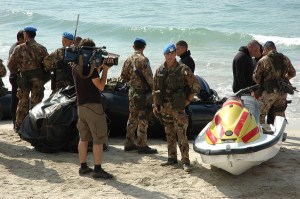
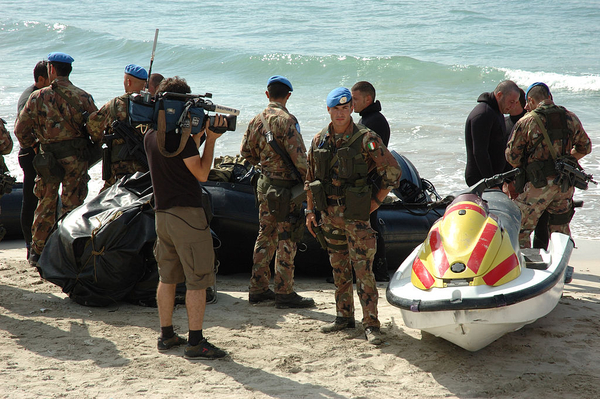
667Italian UNIFIL soldiers on the beach in Lebanon, September 2006. (Image source: Julien Harneis/Wikimedia Commons)

As early as October 2006, Terje Roed-Larsen, the special UN envoy for Lebanon, reported that “there have been arms coming across the border into Lebanon.” In April 2007, Walid Jumblatt, a senior Lebanese politician, told Al-Jazeera television that Lebanese security agents were helping Hezbollah guerrillas smuggle weapons across the porous border with Syria. In June of that year, Roed-Larsen warned the Security Council of an “alarming and deeply disturbing picture” of “a steady flow of weapons and armed elements across the border from Syria.”

At the same time, Hezbollah began to push back hard against UNIFIL. In June 2007, for example, six Spanish troops were killed by a car bomb, just days after Spanish peacekeepers discovered a secret Hezbollah weapons depot in southern Lebanon. Hezbollah’s message to Spain was: mind your own business.

Less than a month after those killings, it emerged that Spanish intelligence agents had met secretly with Hezbollah operatives, who agreed to provide “escorts” to protect Spanish UNIFIL patrols. The quid pro quo was that Spanish troops would look the other way while Hezbollah was allowed to rearm for its next war against Israel.

In November 2009, Israel’s Navy intercepted a ship carrying 500 tons of Iranian weapons, rockets and missiles intended for Hezbollah. In April 2010, former US Secretary of Defense Robert Gates said that Hezbollah “has more missiles than most governments in the world.” In March 2011, an IDF intelligence report revealed that Hezbollah had built close to 1,000 military facilities throughout Southern Lebanon. The installations included more than 550 weapons bunkers and 300 underground facilities.

Meanwhile, Hezbollah stepped up its attacks against European peacekeepers in southern Lebanon. In May 2011, six Italian peacekeepers were wounded by a roadside bomb in the southern city of Sidon. In July, five French troops were wounded by a bomb in the same area. In December, five French peacekeepers werewounded by a roadside bomb in the southern coastal city of Tyre.

Rather than confront Hezbollah over the attacks, however, the governments of France, Italy and Spain cowered and announced the withdrawal of significant numbers of their troops from Lebanon.

In January 2012, UN Secretary General Ban Ki-Moon demanded that Hezbollah be disarmed. “I am deeply concerned about the military capacity of Hezbollah and the lack of progress in disarmament,” he said. “All these arms outside of the authorized state authority, it’s not acceptable,” he declared.

Nasrallah responded with mockery and contempt: “Your concern, secretary-general, reassures us and pleases us. What matters to us is that you are worried, and that America and Israel are worried with you,” he said.

In July 2013, the European Union announced that it would place part of Hezbollah on its terrorism blacklist, ostensibly to cut off the Shiite militant group’s sources of funding inside Europe. But in a classic European fudge, EU governments agreed only to blacklist the “military” wing of Hezbollah, thus maintaining the politically expedient fiction that a clear distinction can be drawn between Hezbollah terrorists and those members of the group’s “political” wing.

Following the EU’s decision, the editor of the pro-Hezbollah newspaper Al-Akhbar, Ibrahim al-Amin, issued thinly-veiled threats of “military” consequences for UNIFIL’s European members, whom Amin said were now “operating behind enemy lines.”

All the while, Hezbollah has continued to build an arsenal of ever-more powerful weapons that can reach deeper into Israel than ever before. According to the Israel Defense Force (IDF), Hezbollah has obtained sophisticated long-range surface-to-air missiles from Syria. The group has also acquired advanced guided-missile systems in preparation for its next conflict with Israel.

According to Brigadier General Itay Baron, director of military intelligence research for the IDF, Hezbollah now has around 65,000 rockets and missiles, many times the number it had on the eve of the 2006 war. Nasrallah hinted at this rearmament when he proclaimed that a future Hezbollah assault on Israel would “turn the lives of thousands of Zionists into a living hell.”

During the past eight years of European leadership of UNIFIL, Hezbollah has more than fully rearmed itself while European soldiers have stood by and done nothing. What is clear is that European leaders have never been committed to honoring either the letter or the spirit of UN Resolutions 1559, 1680 and 1701, which were all aimed at preventing Hezbollah from rearming. So why would anyone now trust the Europeans to ensure that Hamas is disarmed or not rearmed?