Posted tagged ‘Israel’

The Lethality of De-Judaizing Jerusalem

December 2, 2014

The Lethality of De-Judaizing Jerusalem, Front Page Magazine, December 2, 2014
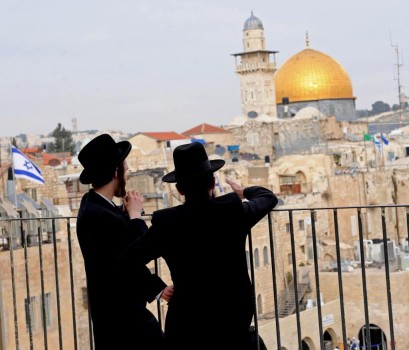
jr-409x350

Only in an alternate, Orwellian universe could only one group of people on earth—Jews—be enjoined from praying on the single site most holy to their faith, and, moreover, be told that their presence there is not only provocative but is repugnant and befouls the very ground on which those of another faith—Muslims—have staked a triumphalist religious claim and now wish gather and pray.

***************

As an example of what the insightful commentator Melanie Phillips referred to as a “dialogue of the demented” in her book The World Turned Upside Down, Palestinian President Mahmoud Abbas is continuing a long tradition of attempting to de-Judaize Jerusalem by expressing his mendacious notion that, as he put it, “Jerusalem has a special flavor and taste not only in our hearts, but also in the hearts of all Arabs and Muslims and Christians,” and “Jerusalem is the eternal capital of the Palestinian state and without it there will be no state.” The same scholar of history who wrote a doctoral dissertation that questioned the extent and truthfulness of the Holocaust was now making his own historical claim that there had never been a Jewish presence and history in the world’s holiest city.

In recent weeks, Abbas has been at it again, adding new layers of rhetoric to his tactical campaign to de-Judaize Jerusalem, in general, and to the Temple Mount, specifically. In an October PA TV broadcast, Abbas made the breathtakingly absurd claim that Jews not only had no historic claim to the Temple Mount, but they also should never even be allowed to have their presence known at that location. “The settlers have arrived . . . ,” he said. “This is our Sanctuary, our Al-Aqsa and our Church [of the Holy Sepulchre]. They have no right to enter it . . . [or] right to defile it. We must prevent them . . . .”

Only in an alternate, Orwellian universe could only one group of people on earth—Jews—be enjoined from praying on the single site most holy to their faith, and, moreover, be told that their presence there is not only provocative but is repugnant and befouls the very ground on which those of another faith—Muslims—have staked a triumphalist religious claim and now wish gather and pray.

This attempt to airbrush out a Jewish presence from Jerusalem—in fact, all of historic Palestine—is not a new message for Abbas, of course. In 2000 he expressed similar contempt for the idea that a Jewish temple had ever existed on the Temple Mount and that, even if it had existed, the offenses committed by Israel against the Palestinians negated any claim Jews might have enjoyed, absent their perfidy. “Anyone who wants to forget the past [i.e., the Israelis] cannot come and claim that the [Jewish] temple is situated beneath the Haram,” Abbas absurdly asserted in an article in Kul Al-Arab, an Israeli Arabic-language weekly newspaper. “ . . . But even if it is so, we do not accept it, because it is not logical for someone who wants a practical peace.”

Judging by the October 30th statement by U.S. State Department spokesperson Jen Psaki, forgetting the past is something in which the John Kerry’s office is also complicit. “We’re extremely concerned by escalating tensions across Jerusalem and particularly surrounding the Haram al-Sharif, Temple Mount,” Psaki said, pointedly, and dangerously, referring to the Temple Mount by its Arab name first and thereby fortifying, and seeming to lend equal weight to, the Palestinian’s spurious claim to spiritual and territorial rights to the site, and to the wider area described now as East Jerusalem.

“It is actually critical that all sides exercise restraint, refrain from provocative actions and rhetoric and preserve the status quo,” she added, suggesting that Jews not be allowed to pray on the Mount and that the status quo prohibiting Jews from praying on the site be ordered to continue so as to not incite Muslim sensibilities.

But in characterizing East Jerusalem —or any part of Jerusalem, for that matter —as territory that Israel “occupies” but over which it enjoys no sovereignty, Abbas (and U.S. State Department, too) is misreading, once again, the content and purpose of 1967′s U.N. Security Council Resolution 242 that suggested an Israeli withdrawal “from territories [not all territories]” it acquired in the Six-Day War. Critics of Israeli policy who either willfully misread or deliberately obscure the resolution’s purpose say that the Jewish State is in violation of 242 by continuing to occupy the West Bank and Jerusalem, including what is spuriously now referred to as “Arab” East Jerusalem.  But the drafters of Resolution 242 were very precise in creating the statute’s language, and they never considered Jerusalem to have been occupied by Israel after the Six-Day War.  Former U.S. ambassador to the U.N., Arthur Goldberg, one of the resolution’s authors, made this very clear when he wrote some years later that “Resolution 242 in no way refers to Jerusalem, and this omission was deliberate[.] . . . At no time in [my] many speeches [before the U.N.] did I refer to East Jerusalem as occupied territory.”

But the true danger of the Palestinian thinking about Jerusalem—and, indeed, about all of the Palestine that they covet, including Israel itself—was revealed in Yasser Arafat’s own view that he expressed in a July 2000 edition of al-Hayat al-Jadida when he threatened that “They can occupy us by force, because we are weaker now, but in two years, ten years, or one hundred years, there will be someone who will liberate Jerusalem [from them].”

“Liberating” Jerusalem, of course, does not mean transforming it into a pluralistic, open city where members of three major faiths can live freely and practice their religions openly. Liberating Jerusalem for the Palestinians would be more in keeping with the type of liberation that Transjordan’s Arab League effected when they burned and looted the Jewish Quarter in Jerusalem in 1948; expelled and killed its hapless Jewish population; destroyed some 58 synagogues, many hundreds of years old; unearthed gravestones from the history-laden Jewish cemetery on the Mount of Olives and used them for latrine pavers; and barred any Jew from praying at the Western Wall or entering the Temple Mount.

But false irredentist claims, Islamic supremacism which compels Jews and Christians to live in dhimmitude under Muslim control, and an evident cultural and theological disregard for other faiths— while troubling in the battle over sovereignty in Jerusalem—are not, according to Dore Gold, Israel’s former ambassador to the United Nations, the most dangerous aspects of a diplomatic capitulation which would allow the Palestinians to claim a shared Jerusalem. In his engaging book, The Fight for Jerusalem: Radical Islam, the West, and the Future of the Holy City, Gold pointed to a far more troubling aspect: in their desire to accede to Arab requests for a presence and religious sovereignty in Jerusalem, the State Department, EU, UN member states, and Islamic apologists in the Middle East and worldwide may actually ignite jihadist impulses they seek to dampen with their well-intentioned, but defective, diplomacy.

Why? Because, as Gold explained, “In the world of apocalyptic speculation, Jerusalem has many other associations—it is the place where the messianic Mahdi [the redeemer of Islam] is to establish his capital. For that reason, some argue that it also should become the seat of the new caliphate that most Islamic groups—from the Muslim Brotherhood to al-Qaeda—seek to establish.”

When Yasser Arafat in July 2000 gave expression to the eventual “liberation” of Jerusalem as a sacred and unending ambition for the Palestinian cause, he defined it as a recapture of what had been, and should be, in his view, Muslim land, just as the eventual extirpation of Israel and the reclamation of all of historic Palestine would accomplish. The establishment of the Palestinian capital in East Jerusalem is the first important step in the long-term strategy to rid the Levant of Jews and reestablish the House of Islam in Palestine. “Jerusalem’s recapture is seen by some as one of the signs that ‘the Hour’ and the end of times are about to occur,” Gold suggested. “And most importantly, because of these associations, it is the launching pad for a new global jihad powered by the conviction that this time the war will unfold according to a pre-planned religious script, and hence must succeed.”

So far from creating a political situation in which both parties—Israelis and the Palestinians—feel they have sought and received equal benefits, such negotiations and final agreements would have precisely the opposite effect: destabilizing the region and creating, not the oft-hoped for Israel and Palestine “living side by side in peace,” but an incendiary cauldron about to explode into an annihilatory, jihadist rage. Those in the West who are urging Israel “to redivide Jerusalem by relinquishing its holy sites,” Dore cautioned, “may well believe that they are lowering the flames of radical Islamic rage, but in fact they will only be turning up those flames to heights that have not been seen before.” If the State Department and other Western diplomats are intent on mollifying the Arab street by pressuring Israel to divide Jerusalem as a peace offering to the Palestinians, it may well be setting into motion the exact opposite result—a jihadist, apocalyptic movement invigorated by the misguided diplomacy of the West that, once more, asks Israel to sacrifice its security and nationhood so that Islamists can realize their own imperial and theological ambitions at the Jewish state’s expense.

US-led warplanes cut through to ISIS targets in Syria & Iraq over Israel

December 2, 2014

US-led warplanes cut through to ISIS targets in Syria & Iraq over Israel, DEBKAfile, December 2, 2014

Flights over Israel

All US and European coalition strike and surveillance flights against ISIS forces in Syria and Iraq under Operation Inherent Resolve have been reaching their targets through the skies of Israel and Jordan, US, European and civilian monitors of global air force movements report. The bodies engaged in minute-by-minute observations of the movements of military strike and refueling craft across the world have released detailed images mapping those routes. They reveal that US and European warplanes are refueling at two points over the Mediterranean Sea before entering Israeli airspace.

They are using two corridors (see attached map) which run over central and northern Israel.

In the first, US planes reach high altitudes over an area just north of Tel Aviv and head east to pass over Jordan to reach Iraq. They are focusing of late on striking ISIS-Al Qaeda-occupied sites in the Anbar Province of western Iraq and the Euphrates basin.

The Islamists have taken to hiding newly established bases in the dense river bank vegetation, from where they are almost impossible to detect by military and spy satellites.

The second US air corridor runs over Haifa Bay, then east over the Jezreel Valley and thence to Hama at the southern tip of the Golan, where the Israeli, Jordanian and Syrian borders converge. The next lap takes the assault fleet into eastern Syria to strike ISIS forces at Abu Kemal and Deir A-Zor and other locations on Syria’s eastern border with Iraq.

The US air force turned to the Israeli route to Syria after Jordan’s King Abdullah declined to provide access over his realm to coalition warplanes bent on striking jihadist targets in Syria. He only permitted them to fly over his kingdom to Iraq, with permission from Baghdad.

Neither Washington, Jerusalem nor Amman are willing to confirm or deny that these trajectories are being used for reaching ISIS targets in Syria and Iraq – although several military websites have made such data public with detailed maps.

The US and Israel have opted for reticence out of three considerations:

1. Reluctance to reveal that Israel and Jordan are partners in Operation Inherent Resolve;

2. Equally embarrassing would be the disclosure that the use of their air space was subject to the permission of the Israeli and Jordanian governments;

3. The scale of the operation also needs to be kept under wraps: US air strikes are managed from three commands: US Central Command in Tampa, Florida; its forward command at the US Al Udeid Air Base in Qatar; and NATO Headquarters in Brussels, which coordinates US and European air operations with the Middle East air forces taking part in the mission against ISIS.

DEBKAfile’s military sources note that, notwithstanding the broad scale of the coalition air offensive against ISIS, to which 20 countries are contributing more than 200 aircraft, its achievements are unimpressive to say the least.

Although official communiqués refer to scores of air strikes (55 at the end of last week), less than 10 strikes per day are actually taking place. This is far below the intensity required for re-tilting the military balance against the Islamists.

The only noteworthy gain to come out of this grand offensive is the decision taken by ISIS leader Abu Bakr Al-Baghdad to draw a line against expanding his territorial conquests in Syria and Iraq in order to save his organization from further losses from US and allied air strikes. He has determined to focus now on stabilizing and shoring up his gains. ISIS has thus shifted from a strategy of expansion to one of defense.

Obama Admin Wants Hamas Ally Qatar to Remain Chief Broker in Peace Process

December 2, 2014

Obama Admin Wants Hamas Ally Qatar to Remain Chief Broker in Peace Process, Washington Free Beacon, December 1, 2014

(Please see also Hamas Declares Palestinian Unity Government Dead. According to the article republished below, “The State Department maintains that Qatar shares President Obama’s views about the Middle East peace process.” Their views have long been anti-Israel, pro-Islam. But what difference does it make nowThe “peace process” is already moribund and Qatar will administer the last rites.  — DM)

Khaled MashaalHamas chief Khaled Mashaal and Hamas Prime Minister Ismail Haniyeh / AP

Qatar promised the State Department it would not give more money to Hamas.

The State Department maintains that Qatar shares President Obama’s views about the Middle East peace process.

***********

The Obama administration is pressing for the Qatari government to remain a chief broker in the Israeli-Palestinian peace process despite the country’s longstanding financial support for the terror group Hamas, according to recent correspondence from the State Department to lawmakers on Capitol Hill.

Qatar—which has come under harsh criticism by lawmakers in recent months due to its longtime financial support for Hamas—has promised the Obama administration that it will not allow the terror group to benefit from a new $150 million cash infusion that is meant to go toward reconstruction efforts in the Gaza Strip, according to the letter.

The Obama administration will maintain its close ties with Qatar and push for it to have a key role in the tenuous peace process, despite protestations from lawmakers on Capitol Hill who say that the country cannot be trusted due to its close ties to Hamas, according to the letter sent by State Department officials late last month to Rep. Peter Roskam (R., Ill.).

Although Qatar has pledged in past years to give Hamas at least $400 million in aid, it has assured the United States that the next $150 million sent to the Palestinians will not make its way to the terror group.

“Qatar has pledged financial support that would be directed to the Palestinian people in Gaza,” Julia Frifield, an assistant secretary for legislative affairs at the State Department, informed Roskam in a Nov. 21 letter. “Qatar assured us that its assistance would not go to Hamas. We continue to interact closely with the government of Qatar and will reinforce that such assistance should not go to Hamas.”

The Obama administration in turn will continue to rely on Qatar to serve a role in the peace process and to engage with Hamas, according to the letter.

“Qatar has said it wants to help bring about a cease fire to the ongoing hostilities in Israel and Gaza,” the letter states. “The Qatari government has engaged with Hamas to this end.”

While the United States still regards Hamas as a terrorist organization, “We need countries that have leverage over the leaders of Hamas to help put a ceasefire in place,” Frifield wrote. “Qatar may be able to play that role as it has done in the past.”

Lawmakers and experts remain dubious that Qatar can be taken at its word given its robust support for Hamas in the past.

“It’s an indisputable fact that Qatar has become the chief sponsor of Hamas—an internationally recognized terrorist organization committed to the destruction of Israel,” Roskam said earlier this year after he petitioned the administration to reassess its close ties to Qatar.

“With Qatar’s financial backing, Hamas continues to indiscriminately launch thousands of rockets at our ally Israel,” Roskam said. “The Obama administration must explain its working partnership with a country that so brazenly funds terrorism right before our eyes, even going so far as turning to Qatar to help broker a ceasefire between Hamas and Israel.”

The administration cannot blindly trust Qatar to cut its close ties with Hamas, said one senior congressional aide who works on the issue.

“It appears the administration is willing to take Qatar for its word on funding some of the world’s most dangerous terrorist organizations, and the notion that Qatar can simultaneously fund Hamas and help broker and Israeli-Palestinian peace treaty is laughable,” the source said. “Congress is intent on holding the Qataris responsible for their illegal behavior and send a message that under no circumstances should the United States tolerate such brazen support for terrorism.”

The State Department maintains that Qatar shares President Obama’s views about the Middle East peace process.

“Qatar has welcomed President Obama’s commitment to a solution to the Israeli-Palestinian conflict and shares the view that such a solution would advance security, prosperity, and stability in the Middle East,” the letter states.

In addition to its role in the peace process, the administration believes that Qatar can help in the international fight against terrorism and groups such as the Islamic State (IS).

“We remain strongly committed to working with Qatar to confront ongoing terrorist financing and advance our shared regional goals,” the State Department told Roskam, noting that more than 8,500 U.S. troops are housed at the country’s Al Udeid Air Base.

“We also have a productive relationship with Qatar on key regional issues ranging from Syria to Iran,” the State Department wrote.

Hamas Declares Palestinian Unity Government Dead

December 1, 2014

Hamas Declares Palestinian Unity Government Dead, Washington Free Beacon, December 1, 2014

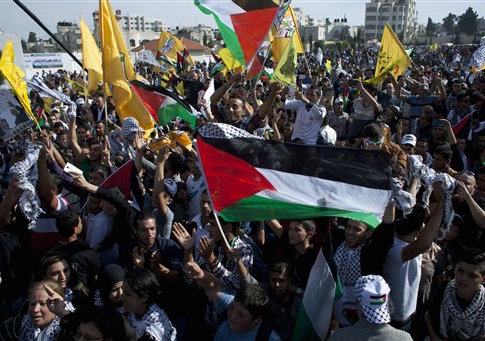
Mideast Israel PalestiniansPalestinian supporters fly Palestinian and Fatah party flags, chant slogans and dance during a ceremony marking the 10th anniversary of the late Palestinian leader Yasser Arafat’s death, at the Palestinian Authority headquarters, in the West Bank city of Ramallah / AP

Fatah claims otherwise.

***************

Leaders of the Palestinian terror group Hamas announced on Sunday that a national unity government formed earlier this year with the Fatah party had officially expired, leaving the status of the fragile political framework up in the air, according to regional reports.

The end of a tenuous six-month unity deal reached between Hamas and Fatah means that leaders from both Palestinian factions will have to meet in the coming weeks to decide whether or not to renew the governing coalition, which had united the ruling parties in the Gaza Strip and West Bank.

The expiration of the deal was announced on Sunday by Hamas Spokesman Sami Abu Zuhri during a news conference in Gaza, according to the Palestinian Ma’an News Agency. Conflicting reports about the status of the unity government emerged just hours later when a Fatah official claimed that an expiration date had never been set on the deal.

The uncertainty surrounding the unity government comes as tension in Jerusalem remains high amid a spate of violent protests by the Palestinians that have been endorsed by Fatah leaders in several cases.

Hamas Spokesman Zuhri said that the group “isn’t interested in incitement, but rather seeks to maintain national unity,” according to Ma’an.

Hamas “does not control the Gaza Strip at all,” according to Zuhri, who added, “If the national consensus government doesn’t want to take responsibility for Gaza, this doesn’t mean the government is exempted from this responsibility.”

Hamas also expressed anger at a recent crackdown on its supporters undertaken by Palestinian Authority security forces.

At least 80 Hamas-backers have been arrested in the West Bank, according to Ma’an.

“Hamas denounces the escalating violations and criminal acts by the PA security services against supporters of Hamas and the Palestinian resistance,” Zuhri was quoted as saying.

Meanwhile, Fatah leaders are claiming that the unity government was not supposed to expire.

The unity government was tasked with holding elections within a six-month time frame, but was not supposed to be dissolved if this was not completed.

“If the Hamas movement has retracted the reconciliation agreement and the termination of rivalry, that is a different case,” Fatah official Faisal Abu Shahla was quoted as telling Ma’an after Hamas’s announcement.

Shahla further stated that “reconciliation discussions were pending a response from Hamas regarding the attacks with explosives against Fatah leaders’ property in Gaza and the cancellation of a ceremony commemorating the late Palestinian leader Yasser Arafat in Gaza City in early November,” according to Ma’an.

Erdogan slams US on Syria again, days after Biden visit

December 1, 2014

Erdogan slams US on Syria again, days after Biden visit, Al-Monitor, Week in Review, November 30, 2014

U.S. VP Biden meets with Turkey's President Erdogan in IstanbulUS Vice President Joe Biden (L) meets with Turkey’s President Recep Tayyip Erdogan at Beylerbeyi Palace in Istanbul, Nov. 22, 2014. (photo by REUTERS/Murad Sezer)

Turkish President Recep Tayyip Erdogan calls US “impertinent” on Syria, says West likes seeing Muslim children die; Israel considers extension of Iran nuclear talks as better than a bad deal.

*********************

Turkish President Recep Tayyip Erdogan said on Nov. 26 that he is “against impertinence, recklessness and endless demands” coming from “12,000 kilometers away” (7,456 miles), his latest not-so-veiled rebuke of US policy toward Syria.

Erdogan’s outburst came four days after US Vice President Joe Biden departed Turkey. Biden, the latest in a seemingly endless stream of senior US official visitors to Ankara, spoke of the “depth” of the US-Turkish relationship and how the United States “needs” Turkey. The US vice president praised Turkey’s turnaround, for now, in its ties with Iraq, as reported this week by Semih Idiz, and Turkey’s handling of close to 1.6 million Syrian refugees (the UN High Commissioner for Refugees puts the number at approximately 1.1 million).

Despite the predictable deadening public platitudes, Biden’s visit, like those of other senior US officials, was a flop for the anti-Islamic State (IS) coalition. Erdogan prefers to hold his support against IS as ransom for a US-backed buffer or no-fly zone inside Syria. Not that the Turkish president, or others hawking such a plan, present any “day after” strategies for Syria; explain how a buffer zone or “doubling down” on the Syrian opposition would do anything more than prolong the war and wreck what remains of the Syrian state; lay out how the United States can avoid another Libya or another Iraq (that is, a failed state or a prolonged occupation) if it pursues regime change in Syria; identify where a post-transition stabilization force may come from given the limitations of Syrian rebel forces; or explain why the jihadists would not gain the upper hand in a divided post-Assad Syria with such a weak and fragmented opposition.

Turkey’s unwillingness to combat IS and other terrorist groups stands in contrast with US allies Saudi Arabia, United Arab Emirates, Jordan and Bahrain, as well as Iran, all of whom have concerns about US policy but are nonetheless engaged in combat operations against terrorists in Syria and Iraq.

Bruce Riedel explains how Saudi Arabia, which uncovered an IS-linked cell operating in the kingdom this week, is struggling with managing the threat from IS and its regional rivalry with Iran, but is nonetheless playing a leading role in the anti-IS coalition. Hossein Mousavian points out that among the “ground forces” combating IS, besides US-supported Syrian rebel forces, are the Iraqi and Syrian armies and Hezbollah, which are all backed by Iran. According to Mousavian, Tehran could be ready to do more if a nuclear deal is reached. Ali Hashem reports this week on Hezbollah’s role in Iraq, and Ali Mamouri chronicles the higher profile role that Iran Quds Force leader Qasem Soleimani is playing with Iraqi forces battling IS. Iraqi Kurdistan Region President Massoud Barzani, whose forces are also on the frontlines of the battle against IS, praised Iran’s role, saying in August that “Iran was the first country to provide us with weapons and ammunition” to confront the IS advance toward Erbil. Syrian government warplanes bombed Raqqa, an IS stronghold, on Nov. 25, although the United States accused Syria of killing many civilians in the process. US-led coalition forces also conducted airstrikes against IS forces in Raqqa this week.

Erdogan appears to be the odd man out in the coalition, compared with the actions of the other regional powers, and his policies and statements should raise broader questions about the direction of Turkish foreign policy, including what it means for Turkey’s membership bid in the EU and its role in NATO. Idiz writes that Erdogan appears to be turning his back on Turkey’s EU membership bid. On Nov. 28, the eve of Pope Francis’ visit to Turkey, Erdogan offered the following about Western countries: “Believe me, they don’t like us,” AFP reported him as saying. “They look like friends, but they want us dead — they like seeing our children die. How long will we stand that fact?”

The United States might soon tire of the all-pain, no-gain appeals to Turkey and simply ask Erdogan to pick a side in the US war against terrorists, making clear, as US President Barack Obama recently said, that the United States is not planning to remove Syrian President Bashar al-Assad at this time. Turkey is a critical US ally that must play a constructive role in Syria and the region, but the trends are becoming alarming. The United States, for its part, does not “need” Turkish bases to train anti-IS or anti-Assad rebels, does not “need” Turkish troops in Syria, and certainly does not “need” a buffer or no-fly zone, unless Washington is longing for a quagmire. What the coalition “needs” is for Turkey to crack down, hard, on the terrorist transit, trade and financial networks operating through Turkey into Syria, which have contributed to the rise of these groups over the past three years. Turkey’s intensified efforts at border security and counterterrorism cooperation would be a major contribution to the coalition. It does not seem to be an unreasonable ask, even if Ankara disagrees with the US approach to Assad.

As this column wrote on Nov. 16, it is the prospect of a nuclear deal with Iran, and the potential for regional cooperation with Iran, that is the key to a settlement of many of the region’s problems, including a political settlement in Syria and whether Assad stays or goes: “US interests in both defeating IS and securing a political settlement to end the Syria war depend on Iran’s good offices in Damascus. The United States cannot deal with Assad, but Iran can. Iran, like Washington’s regional allies, has a high tolerance for the spilling of Syrian blood. If the United States wants to deal Iran out in Syria, especially in the context of a bid to oust Assad, then Iran’s card will be to make the awful situation in Syria go from bad to worse. Iran is not necessarily immovable on Assad’s survival. Iran’s four-point plan for Syria includes a decentralization of power away from the Syrian presidency. Iranian officials privately signal that Assad may not be untouchable, under the right conditions, but such conversations — if they are to bear fruit — can only occur with Iran in a spirit of collaboration, not confrontation. Otherwise, Iran will simply hunker down, and the war will go on.”

Israel OK with extension of Iran nuclear talks

The seven-month extension of the P5+1 nuclear talks with Iran has sparked reactions across the region. Laura Rozen reports from Vienna that progress was made as the Nov. 24 deadline approached but observers are still divided on whether this can be turned into a finished deal in the upcoming months.

Ben Caspit writes of the furious diplomatic effort by Israel to fend off what it would consider a bad deal: “Israel has invested enormous amounts of energy in this. Over the past few months, and especially in the last few weeks, Minister of Intelligence Yuval Steinitz, who has coordinated these efforts, has become a ‘frequent flyer,’ plowing through the relevant capitals right and left. And Steinitz wasn’t alone in this. Senior Israeli intelligence officials also made frequent trips abroad to present their colleagues in different relevant capitals with intelligence documents, intelligence per se, and plenty of new information obtained by the Mossad and other Israeli intelligence agencies about the dangers inherent in that ‘bad agreement.’

“As the deadline approached this week, Steinitz intensified his activities, making two more quick visits, to London and to Paris, and meeting with German Foreign Minister Frank-Walter Steinmeier. Steinitz’s message, backed as always with intelligence reports, expert assessments and various analyses: ‘The agreement under discussion is a terrible agreement. It leaves room for huge potential breaches, which means that it is propped up on weak foundations. If those gaps are not sealed, it would be preferable to avoid reaching any agreement whatsoever than to sign the current one.’”

Retired Israel Defense Forces Gen. Michael Herzog writes that Israel views the extension of the talks as the least of all possible evils, “The truth is that Israel’s ability to influence the relationship between Iran and the West has reduced considerably. The credibility of its military option (which still exists) has decreased in the eyes of the United States and Iran, and its tense relationship with US President Barack Obama’s administration makes it difficult to engage in open dialogue between the two country’s top leaders. At this stage, as long as Iran is not hurtling toward the critical nuclear threshold, all that is left for Israel to do is to maintain the hope that Iran will continue to be intransigent, and that the US Congress will continue to play tough.”


Distorted perceptions of Ferguson, Israel and Islam have similar roots

November 30, 2014

Distorted perceptions of Ferguson, Israel and Islam have similar roots, Dan Miller’s Blog, November 29, 2014

Those who find “racist” repression of Blacks in Ferguson, “racist” repression of Arabs in Israel and “racist” repression of Muslims by non-Muslims everywhere have much in common. 

Leftist and mainstream media perceptions of “repression” by Ferguson’s White minority of its Black majority, of Israeli “war crimes” against her minority Muslim residents and of the “peaceful” nature of Islam hinge on increasingly common notions: fairness requires inconvenient facts to be altered if possible to suit an ideology while others, inconsistent with the altered facts, must be ignored. We must speak and act with compassion toward and empathy with the oppressed. Only in this way, it is believed, can true fairness and empathetic compassion be achieved. Then, and only then, will we have true justice.

David Solway, in an excellent PJ Media article titled ‘Politricks’ and the English Language, summed it up:

[T]he Big Lie has been installed among us as the primary form of political and cultural address along the entire gamut of disinformation, from outright interment of fact and customizing of inconvenient truths to unmitigated calumny and virulent libel. The Western media and the “progressivist” left-liberal political class have, over the years, incrementally adopted the discursive techniques of totalitarian states and theocratic dispensations. [Emphasis added.]

Please read the whole article.

Perceptions of Ferguson, Missouri

No justice no peace

Michael Brown, a Black “gentle giant,” was shot and killed by a “racist” White police officer, Darren Wilson, on August 9th. There were eyewitnesses and many others who claimed to be eyewitnesses but were not. The latter based their accounts on what others had told them and on what they believed might have happened. Rather than select a new grand jury, an existing grand jury was kept in session, apparently to avoid claims that the members of a new jury had been chosen to exonerate Officer Wilson. On November 23rd, the grand jury determined that Officer Wilson would not be charged with a criminal offense under Missouri law. Here’s what happened next. Although the facts presented to the grand jury have been released, the facts matter but little:

The riots went forward as planned; the media steadfastly distributed its prewritten narrative of evil racist white cop murdering innocent young black man. [Emphasis added.]


Some Blacks defended White-owned businesses. That’s good. Others looted and burned Black as well as White-owned businesses.

Please see also this article by Rich Lowry at Politico. His analysis points to this:

This is a terrible tragedy. It isn’t a metaphor for police brutality or race repression or anything else, and never was. Aided and abetted by a compliant national media, the Ferguson protestors spun a dishonest or misinformed version of what happened—Michael Brown murdered in cold blood while trying to give up—into a chant (“hands up, don’t shoot”) and then a mini-movement. [Emphasis added.]

When the facts didn’t back their narrative, they dismissed the facts and retreated into paranoid suspicion of the legal system. [Emphasis added.]

Beyond that, I don’t consider it necessary to dwell on what happened in Ferguson last August and what happened thereafter, before and after the grand jury declined to indict Officer Wilson for the “murder” of “gentle giant” Michael Brown. Most who will read this article are already familiar with what happened; perceptions and their bases are my focus here.

Reports of “racism” and associated violence help to sell print and broadcast advertising, particularly if the reports can be made consistent with the perceptions of audiences: White people are racist and oppress Black people. Hence, most in the mass media rely, consciously or unconsciously, on confirmation bias,

a tendency for people to favor information that confirms their preconceptions or hypotheses regardless of whether the information is true.[Note 1][1] As a result, people gather evidence and recall information from memory selectively, and interpret it in a biased way. The biases appear in particular for emotionally significant issues and for established beliefs.

The “legitimate” media proceeded in similar fashion when George Zimmerman, a “racist” “White Hispanic,” shot and killed a “defenseless” Black “child” in April of 2012. The “legitimate” media changed or ignored facts in their quests to declare Zimmerman guilty, to encourage rioting and to vindicate their own perceptions that Blacks are “different” and that their actions need to be dealt with more leniently than those of others. Please see also this article about a well to do White kid who said that he deserved to be mugged because of his White privilege. Many in the mass media appear to share his perceptions, at least with respect to the mugging of others.

After digesting the factual evidence the Zimmerman trial jury disagreed with the mass media and the assorted race baiters upon whom the mass media feasted and found him not guilty. After digesting the factual evidence, the grand jury — which had three Black members — disagreed about Officer Wilson and declined to indict him.

It has been reported that, following the grand jury’s refusal to indict Officer Wilson, the Obama administration promoted indoctrination of students on the basis that Brown was “a victim of police violence.” Part of the “White House Initiative on Educational Excellence for African Americans,” the indoctrination apparently is to include this:

“During the first few weeks of classes, students can create a memorial to Michael Brown on a classroom bulletin board. This activity involves having students use whatever they feel skilled in to create something that would honor Michael Brown and other people who have been victims of police and other violence. Students may choose to draw, write poetry, design art pieces, paint, or collect news clippings. Students can use this opportunity to create a counter-narrative to negative stories and images about Ferguson and Michael Brown, or even to document stories and images they have seen in the media about the case. Engaging in this type of activity allows teachers to understand youth strengths and form classroom solidarity.” [Emphasis added.]

It is important for young people to learn how to make connections between the Michael Brown shooting and similar cases that have emerged in recent history. While a discussion of the Michael Brown shooting and the current events in Ferguson are powerful, conversations about Michael Brown with a consideration of Trayvon Martin, Eric Garner, Renisha Mcbride and other cases that involve similar scenarios place the events in Ferguson in proper context… [Emphasis added.]

Assuming that the report is accurate, is the Obama administration trying to heal racial divides, or to exacerbate them as it has often done?

David Goldman, in an article at PJ Media titled How Far Down Do You Define Deviancy in Ferguson? summed up the positions of the current “civil rights” movement and the consequences were they to be adopted:

Young black men are disproportionately imprisoned. One in three black men have gone to prison at some time in their life. According to the ACLU, one in fifteen black men are incarcerated, vs. one in 106 white men. That by itself is proof of racism; the fact that these individuals were individually prosecuted for individual crimes has no bearing on the matter. All that matters is the outcome. Because the behavior of young black men is not likely to change, what must change is the way that society recognizes crime itself. [Emphasis added.]

. . . .

[T]he solution is to decriminalize behavior that all civilized countries have suppressed and punished since the dawn of history.  Because felonious behavior is so widespread and the causes of it so intractable, the criminals’ rights movement insists, society “cannot afford to recognize” criminal behavior below a certain threshold. [Emphasis added.]

If America were to accept this logic, civil society would come to an end. The state would abandon its monopoly of violence to street rule. Large parts of America would come to resemble the gang-ruled, lawless streets of Central America, where violent pathology has overwhelmed the state’s capacity to control it, creating in turn a nightmare for America’s enforcement of its own immigration law. [Emphasis added.]

The Ferguson episode was not a civil rights movement in any traditional or otherwise legitimate sense.

The response of the African-American “civil rights” establishment and the American Left to the verdict in Ferguson came quickly and predictably.  Al Sharpton and other racial demagogues urged their followers to take to the streets if anything but a first degree murder indictment was handed down for Officer Darren Wilson. The protestors and rioters were prepared, but Missouri’s governor wasn’t. He failed to call out the National Guard on the day the verdict was released.

What is particularly galling is the argument that the events in Ferguson, and the no bill for Wilson, are a throwback to the segregationist era of the 1950s and 1960s, when the modern civil rights movement engaged in non-violent civil disobedience.  “The Movement,” as they called it then, showed the nation and the world the immoral actions of police chief Bull Connor of Birmingham, Alabama, and others of similar ilk, thereby exposing the injustice of the system of segregation — a system based on power and violence, preventing black Americans from enjoying the rights and liberties guaranteed to them by the U.S. Constitution. [Emphasis added.]

Civil rights movement

Israel

Just as confirmation bias caused many in Missouri — and also in distant places — to condemn a “racist” White police officer and to preach about the benign nature of his Black “victim,” so many throughout the world blame Israel for everything bad that people do.

Blame Israel1

I recently wrote an article titled Hamas, Abbas, Obama and Islamic Savagery. It includes this photo of Palestinians celebrating their brethren’s murders of Jews praying in a Jerusalem synagogue:

celebratingmurder_20141118_105338

Recently, there have been many more attacks on Jews in Israel.

Academia, where leftism now prevails, has done much to slander Israel as a wicked apartheid state, more barbaric than Nazi Germany.

This summer’s Israeli incursion, Operation Protective Edge, provided anti-Semites and loathers of the Jewish state with resurgent justifications for assigning the epithet of Nazi on the Jews yet another time, together with oft-heard accusations of “crimes against humanity, “massacres,” genocide,” and, according to recent comments by Turkey’s prime minister Tayyip Erdoğan, in their treatment of the Palestinians, Israel has demonstrated that “. . . their barbarism has surpassed even Hitler’s.”[Emphasis added.]

The Nazification of Israelis—and by extension Jews—is both breathtaking in its moral inversion and cruel in the way it makes the actual victims of the Third Reich’s horrors a modern-day reincarnation of that same barbarity. It is, in the words of Boston University’s Richard Landes, “moral sadism,” a salient example of Holocaust inversion that is at once ahistorical, disingenuous, and grotesque in its moral and factual inaccuracy. [Emphasis added.]

. . . .

[They did so] by redefining Israel as the most glaring example of those human predations, what he called “the embodiment of all evil” of the Twentieth Century: apartheid and Nazism. He defined the process of grafting this opprobrium on Israel as “ideological anti-Semitism,” one which “involves the characterization of Israel not only as an apartheid state—and one that must be dismantled as part of the struggle against racism—but as a Nazi one.” [Emphasis added.]

. . . . [O]nce Israel had been tarred with the libels of racism and Nazism, the Jewish state had been made an international outlaw, a pariah, losing its moral right to even exist—exactly, of course, what its foes have consistently sought. “These very labels of Zionism and Israel as ‘racist, apartheid and Nazi’ supply the criminal indictment,” said Cotler. “No further debate is required. The conviction that this triple racism warrants the dismantling of Israel as a moral obligation has been secured. For who would deny that a ‘racist, apartheid, Nazi’ state should not have any right to exist today?” [Emphasis added.]

Such academic perceptions have spread worldwide. European nations are now rushing to recognize a Palestinian nation, without regard to reality.

Does anyone really think that granting, or recognizing, Palestinian statehood will make them more peaceful? On the contrary. From past experience, any time the Palestinians achieve a political goal without effort, they take that as a reward for their violent behaviour and only increase their terrorist activities.

In that context, the Israeli Ambassador to the U.N. General Assembly recently chastised much of the world, particularly Europe, for accepting such perceptions regardless of reality.

He did not likely make many friends; calling to people’s attention that they are sadly misguided rarely does.

Why are Islamic nations, where apartheid and violence against non-Muslims prevail, subjected to little anger and disdain while Israel, the only free and democratic nation in the entire region, gets nearly all of the anger and disdain? Might this double standard be useful because it caters to the notion that Israel’s freedom and democracy for all of her citizens, including Arabs — particularly along with her technological and financial successes — set her apart? Make her “the Other?” Might it be that Islamic nations, hugely represented at the U.N. and sadly deficient in freedom, democracy and technological prowess, reject Israeli freedom and democracy while envious of Israel’s technological success? They have substantial wealth, but it is largely based on oil and the technology of others. Little of the resulting wealth is shared with their masses.

Islam

That brings us to Islam, the “religion of peace.” According to Obama and other luminaries, the Islamic State is not Islamic. According to Obama no religion — least of all Islam — countenances the violence in which the Islamic State and other comparable Islamic terrorist groups engage. Remember His Eid-al-Fitr message?

While Eid marks the completion of Ramadan, it also celebrates the common values that unite us in our humanity and reinforces the obligations that people of all faiths have to each other, especially those impacted by poverty, conflict, and disease. [Emphasis added.]

In the United States, Eid also reminds us of the many achievements and contributions of Muslim Americans to building the very fabric of our nation and strengthening the core of our democracy.  That is why we stand with people of all faiths, here at home and around the world, to protect and advance their rights to prosper, and we welcome their commitment to giving back to their communities. [Emphasis added.]

Interfaith tolerance and respect? The “very fabric of our nation?” “Strengthening the core of our democracy?”

Let's have an honest discussion about Islam

Let’s have an honest discussion about Islam

In Islam, peace can come only after all other religions have been destroyed or subjugated. That Islamic belief now plagues Israel and will continue to do so for the foreseeable future. Islamic Palestinians who murder Jews are seen as heroes and more are encouraged to do more of the same.

Many Muslims adhere also to the view that the Peace of Islam can come only after other Muslims who profess variant religious doctrines — Sunni vs. Shia for example — have been destroyed or subjugated and become “true” Muslims. Sect vs. sect violence was common throughout the centuries and now seems to be worse and increasing.

That is to be expected, but why do many nations which do not yet have Muslim majorities tend to ignore these Islamic actions and view Islamic slaughter as not characteristics of Islam? Are they merely ignorant about Islam? Have they been fatally infected with multiculturalism and political correctness? Might they even view adherents to Islam as subhumans, whose violence and other depredations are best ignored or tolerated?


Conclusions

It seems reasonable to conclude that the world is spiraling ever deeper into insanity. Until leaders of “the international community,” academia and the mass media revise their views and act on the basis of facts instead of fictions, and on logic rather than on raw emotion coupled with pandering to those blinded by confirmation bias against “the Others,” sanity will continue to be increasingly rare. Insanity will continue to be manifested through violence as it persists and worsens because perceptions drive actions.

These are not optimistic conclusions, because it seems unlikely that “the international community,” academia or the mass media — which tend to proceed in tandem — will reform anytime soon.

ADDENDUM

Is Christianity dead in the Middle East? It probably is in most of the region, but not in Israel.

Is it the end of Christianity in the Middle East?  Could be, he says, at least so far as Iraq is involved:

What is a Christian life there now? The Bishop of Mosul said recently that for the first time in 2,000 years there was no church in Nineveh [an ancient city that is now part of Mosul]. That’s the reality.

It is indeed the reality, and not just in Iraq.  And “the West” is silent, as it has been so often when it faces evil far from its own boundaries.  Meanwhile, [Anglican Canon Andrew White] has moved on, to the one country in the Middle East that provides its citizens with religious freedom and the security to practice their faith.  He’s in Jerusalem, trying to achieve reconciliation between Muslim and Jewish religious leaders.  It’s not an altogether new venture for him;  in his last days in Baghdad, he was the “rabbi” for the city’s remaining six Iraqi Jews.  And back at that conference in Copenhagen, the guest of honor at the closing banquet was the former chief rabbi of Denmark. [Emphasis added.]

Guess what?  During the week, all the Iraqi religious leaders arranged for private meetings with said rabbi.  Why?  They’d looked at the map, and they knew that if things were going to be ok for them, they’d need help from the Jews in Israel.  Andrew knew it too.  He still knows it.  That’s no doubt why he’s working in Jerusalem. [Emphasis added.]

The UN’s theater of the absurd

November 30, 2014

The UN’s theater of the absurd, Israel Hayom, Ron Prosor, November 30, 2014

(Please see also Ambassador Proser’s recent address to the U.N. General assembly. — DM)

In 1975, after repeated attempts to kick Israel out of the U.N., the General Assembly succumbed to the pressure exerted by the Arab countries and determined that Zionism is racism. The decision was the cornerstone of the institutionalized factory of discrimination against Israel at the United Nations. The U.N. waited 16 long years before retracting its “Zionism is racism” decision. The protocols have been updated, but even with no official reminder, the stain remains on the walls of the general assembly hall and the stench is still in the U.N.’s corridors today.

Of the 193 states that belong to the U.N., only 87 are democracies — less than half. The countries that are taking advantage of the democratic process at the United Nations are the same ones that suppress any spark of democracy within their borders. Although the U.N. uses a parliamentary mechanism, many of the hands raised to vote are the hands of brutal dictators.

*****************

On Nov. 29, 1947, a Saturday night, the entire Yishuv (the Jewish community of pre-state Israel) held its breath. The tiny voice of Brazilian U.N. General Assembly President Osvaldo Aranha blared from the radios in every home. The agenda for the day: Resolution 181 on the end of the British Mandate and the partition plan of Palestine. Holocaust survivors, Jews who were kicked out of Arab lands, the many waves of immigrants to Israel, the pioneers and those who immigrated illegally all cast their lot with the promising institution that would be a magnificent monument to the triumph of good over evil in World War II.

Sixty-seven years after that historical vote — the U.N.’s shattered dream lies before us. Over the years, it has gone from a monument of victory to a memorial, a remnant of the hope that has vanished. Although it was designed to prevent the reoccurrence of Nazi crimes, the U.N. has become an international arena for Arab criminal bullying. The Arab world attacked the Yishuv only hours after rejecting the outcome of the vote, and it did not stop even after the thunder of the Napoleon cannons subsided at the end of the War of Independence. The unification of Arab and Muslim countries at the U.N. has created the foundation for a 120-state-strong anti-Israel diplomatic cartel.

In 1975, after repeated attempts to kick Israel out of the U.N., the General Assembly succumbed to the pressure exerted by the Arab countries and determined that Zionism is racism. The decision was the cornerstone of the institutionalized factory of discrimination against Israel at the United Nations. The U.N. waited 16 long years before retracting its “Zionism is racism” decision. The protocols have been updated, but even with no official reminder, the stain remains on the walls of the general assembly hall and the stench is still in the U.N.’s corridors today.

Of the 193 states that belong to the U.N., only 87 are democracies — less than half. The countries that are taking advantage of the democratic process at the United Nations are the same ones that suppress any spark of democracy within their borders. Although the U.N. uses a parliamentary mechanism, many of the hands raised to vote are the hands of brutal dictators.

The U.N. has gone from being a stage for courageous statecraft to a theater of the absurd: The General Assembly allows wild Palestinian incitement, the Security Council has Venezuela and Malaysia managing peacekeeping forces, and then there is the Human Rights Council, in which the guardians of humanity are regimes without a shred of humanity, regimes that invent blood libels against Israel while in Syria, a tyrant slaughters hundreds of thousands of his own people.

Franklin Roosevelt and Winston Churchill had a vision of cross-border cooperation. It’s doubtful that this is the United Nations they envisioned: Nations united by their hatred of Israel. Right now, the U.N. is being asked to decide on its place in the annals of history, will it be remembered as an obstacle to the free world or as a magnet to the nations that aspire to join it?

“Our future does not depend on what the Gentiles will say, but on what the Jews will do,” David Ben-Gurion once said. Israel is not waiting for the U.N. to reform itself — our response to its injustices is in our actions. Our response to the demonization of Israel in the Human Rights Council is the uncompromising defense of the rights of all sectors of society, including women, members of the proud community and the disabled. Our response to delegitimization in the Security Council is the contribution of knowledge and professional experience to the U.N. peacekeeping forces. Our response to incitement in the General Assembly is a series of initiatives that aspire to create a better world, including agricultural technology in the Third World, entrepreneurship in developing countries and taking steps toward religious tolerance, like making Yom Kippur the first Jewish holiday officially recognized by the United Nations.

On the fifth day of the Hebrew month of Iyyar in 1948, the Declaration of Independence was signed. Its text mentions the United Nations no less than seven times. The founders of the state committed with their signatures to stay true to the principles of its charter. Even though the U.N. has lost its way, Israel is keeping its promise. Israeli eye doctors are spreading light in East Africa, Israeli officers offer help during every disaster, and the sharing of blue-and-white knowledge and resources brings water and solar energy to areas in need — we will continue to light the way for the international community until we will again gather in our homes in Israel, looking toward the United Nations filled with hope, not disappointment, appreciation and not contempt.

Ron Prosor is the Israeli ambassador to the United Nations.

Clearing my spindle, Iran edition

November 30, 2014

Clearing my spindle, Iran edition, Power LineScott Johnson, November 29, 2014

(A very good summary of the Iranian mullahs vs. those who don’t want them to have nukes. — DM)

I take it that the mullahs who run the show in Iran have been pursuing nuclear warheads to hitch to ballistic missiles for about as long as the regime as been in business. They have sacrificed much in pursuit of their goals and they are within shouting distance of success, mostly minus whatever sacrifice imposed by the sanctions crafted by Congress against the will of the Obama administration.

Watching the absurd negotiations taking place with the Iranian regime in Vienna, with the United States and the rest of the crew steadily bidding against themselves, I wonder what is to be done by the likes of us. We understand what is happening, but are powerless to do a blessed thing about it.

As the negotiations drag on past their appointed hour, I want to round up some of the recent news and commentary that sheds some light on where we are and whither we are tending. Beyond the links I have little in the way of commentary other than to say that they provide an aid to understanding the consequential events taking place behind closed doors.

Rebecca Shimoni Stoil, Times of Israel, “Former envoy: Iran showed no flexibility in nuke talks.” What do you make of that? Probably more than the Obama administration does.

Bret Stephens, Wall Street Journal, “Iran cheats, Obama whitewashes” (subscribers only, accessible via Google here). Stephens makes a powerful case that the Obama administration has gone into public relations on behalf of the Islamic Republic of Iran:

Why the spin and dishonesty? Partly it’s the old Platonic conceit of the Noble Lie—public bamboozlement in the service of the greater good—that propels so much contemporary liberal policy-making (cf. Gruber, Jonathan: transparency, lack of). So long as the higher goal is a health-care bill, or arms control with Russia, or a nuclear deal with Iran, why should the low truth of facts and figures interfere with the high truth of hopes and ideals?

But this lets the administration off too easily. The real problem is cowardice. As a matter of politics it cannot acknowledge what, privately, it believes: that a nuclear Iran is undesirable but probably inevitable and hardly catastrophic. As a matter of strategy, it refuses to commit to the only realistic course of action that could accomplish the goal it professes to seek: The elimination of Iran’s nuclear capabilities by a combination of genuinely crippling sanctions and targeted military strikes.

And so—because the administration lacks the political courage of its real convictions or the martial courage of its fake ones—we are wedded to this sham process of negotiation. “They pretend to pay us; we pretend to work,” went the old joke about labor in the Soviet Union. Just so with these talks. Iranians pretend not to cheat; we pretend not to notice. All that’s left to do is stand back and wait for something to happen.

Caroline Glick, Jerusalem Post, “Iran’s no China.” Glick draws the inevitable contrast, not to our benefit:

Not only will Obama’s Iran opening not redound to the US’s benefit in the short term. Its inevitable result will be a decade or more of major and minor regional wars and chronic instability, with the nuclear-armed Iran threatening the survival of all of America’s regional allies. It will also lead to shocks in the global economy and massively expand Iran’s direct coercive power over the world as a whole.

Not only is Obama no Nixon, compared to him, Neville Chamberlain looks like a minor, almost insignificant failure.

Ron Ben-Yishai, YnetNews, “Despite nuclear talks’ extension, Iran still on the verge of a bomb.” Not sure about “despite,” but you get the idea.

Michael Herzog, Al Monitor, “Israel views extension of Iran talks as lesser of two evils.” Keep hope alive!

Andrew McCarthy, PJ Media, “Iran celebrates victory over Great Satan because American have clearly surrendered.” As I have observed previously, the public pronouncements of the powers-that-be in Iran have proved far better guides to the course of events than have those of their opposite numbers in the P5+1. Why would that be?

Amos Yadlin, INSS, “Kicking the can down the road.” Keep hope alive!

Aaron David Miller & Jason Brodsky, Wilson Center, “4 big reasons the Iran nuclear deal didn’t happen.” Miller and Brodsky usefully summarize the conventional wisdom while overlooking the glaringly obvious. By contrast, Michael Ledeen extracts the 1 big reason in“The fantasy of the deal.”

Eds., New York Daily News, “Obama bombs in Iran again.” The editors of the Daily News pay attention to what the mullahs have to say:

The supreme religious leader of Iran has confirmed what many Americans already knew: The seven-month extension of talks on Iran’s nuclear program is a victory for the fanatics in Tehran and a serious setback for the world.

Ayatollah Ali Khamenei crowed that, in blowing through the deadline set for Iran to agree to curbs on its uranium enrichment, the West had failed to cow a resurgent Islamic Republic.

“In the nuclear issue,” he told fellow mullahs, “America and colonial European countries got together and did their best to bring the Islamic Republic to its knees — but they could not do so — and they will not be able to do so.”

As I say, the public pronouncements of the mullahs on this matter of the utmost seriousness have a higher truth quotient than those of the Obama administration. The least we can do is attend to them.

Reuel Marc Gerecht, Weekly Standard, “Extending extensions.” In the department of what is to be done?, Gerecht offers this: “Increase the pressure. Don’t be scared of Ali Khamenei. We still hold the high ground. Use it—or lose it. Iranian research and development continue to advance.”

George Will, Washington Post, “Better a contained Iran than an all out war.” Will seems to me the lamest commenter on this subject. He holds to the views expressed in this December 2013 column, but he has yet to explain what he means by “containment.”

Will assumes that the same theory of deterrence applies to Iran’s ongoing war against the United States as applied to the Soviet Union’s against what we used to call the free world. For these purposes Will does not differentiate between a theologically driven regime such as Iran’s and a militantly atheist regime such as the Soviet Union’s. Will has thus opted for discretion as the better part of valor in ignoring the case made by Norman Podhoretz in the Wall Street Journal column “Strike Iran now to avert disaster later” (accessible via Google here).

Abbas: PA to halt security coordination with Israel if peace talks aren’t revived

November 29, 2014

Abbas: PA to halt security coordination with Israel if peace talks aren’t revived

via Abbas: PA to halt security coordination with Israel if peace talks aren’t revived.


Talestinian Authority President Mahmoud Abbas ( abu mazen ).. (photo credit:REUTERS) o

Palestinian Authority President Mahmoud Abbas on Saturday threatened to halt security coordination with Israel unless the peace talks are revived.

“We are no longer able to live with the status quo,” Abbas said in a speech before an emergency meeting of Arab foreign ministers in Cairo.

He also reiterated the Palestinians’ refusal to recognize Israel as a Jewish state.

“We recognize the State of Israel, but we won’t recognize a Jewish state at all,” Abbas stressed.

The meeting was held to discuss the latest developments surrounding the Palestinian issue in light of Abbas’s plan to seek a UN Security Council resolution that sets a timeline for Israel’s withdrawal to the pre-1967 lines.

Abbas is hoping to win the Arab ministers’ support for his plan in wake of US pressure to refrain from presenting it to the Security Council.

Abbas has said in the past that he intends to present the plan to the Security Council by the end of this month.

“The situation in the West Bank is dangerous and can’t continue as it is,” Abbas said in his speech. “The most dangerous thing facing the Palestinian cause at this time is the continuation of the status quo.”

He said that Israel knows very well that there would be no Palestinian state without the Gaza Strip. Israel, he charged, is continuing with its policy of creating facts on the ground by building settlements on Palestinian territories.

“Israel does not know where its borders are and is refusing to define them,” Abbas said. “We will present an Arab plan to the Security Council calling for the establishment of a Palestinian state. All indications are that US mediation efforts to revive the peace talks have failed.”

He said that the PA had asked US Secretary of State John Kerry to work together to draft the resolution that would be presented to the Security Council. The PA also asked Kerry to put pressure on Israel to stop settlement construction, Abbas added.

Lapid: US veto at Security Council no longer assured | The Times of Israel

November 29, 2014

Lapid: US veto at Security Council no longer assured

Finance minister says Israel-US ties at ‘unprecedented low’ ahead of expected Palestinian UN resolution demanding Israeli pullout to ’67 lines

By Times of Israel staff November 29, 2014, 1:58 pm

via Lapid: US veto at Security Council no longer assured | The Times of Israel.


Finance Minister Yair Lapid on September 7, 2014. (photo credit: Yonatan Sindel/Flash90)


inance Minister Yair Lapid said Saturday that ties between Israel and the US have reached such a nadir that the US’s assistance at the UN Security Council — including using its right to veto anti-Israel resolutions — was no longer assured.

“We are at an unprecedented low point in our ties with the US. No one knows what they will do when Abu Mazen [Palestinian Authority President Mahmoud Abbas] goes to the Security Council. Their veto is not assured like before,” Lapid, head of the Yesh Atid party, said at a gathering in Tel Aviv.

The Palestinians have yet to formally submit to the UN Security Council a UN draft resolution calling for an Israeli withdrawal to the pre-1967 lines by 2016, but are expected to do so in the coming weeks.

Despite Palestinian statements that the text would come up for a vote in November, Palestinian representative Riyad Mansour told AFP this week that no date had been set for the draft to be discussed at the 15-member council.

(The Times of Israel reported earlier this month that many in Jerusalem fear the US can no longer be relied upon to use its veto in the Security Council. In a second article, ToI’s Raphael Ahren wrote that in the Security Council’s present constellation, it will be difficult — though certainly not impossible — for Abbas to get the nine yes votes required to pass a resolution or force the US to veto it. “However, if Abbas decided to hold off until next year, when five of the non-permanent Security Council members will be replaced, the chances of the Palestinian demarche will increase significantly,” he noted.)

On Monday, UN chief Ban Ki-moon urged Israel and the Palestinians to “step back from the brink” and return to peace talks amid European moves toward recognizing Palestine.

His comments reflected international alarm over the spate of terrorist attacks in Israel by Palestinians and East Jerusalem residents, the tensions over the Temple Mount, and the deadlock over peace talks which ended in late April.

With no political solution in sight, governments and parliaments in Europe are moving toward Palestinian recognition, with France’s National Assembly set to vote on a non-binding resolution on December 2 after debating the issue on Friday.

That follows Sweden’s announcement that it will recognize Palestine, and non-binding votes in the British and Spanish parliament in favor of Palestinian recognition.

The Netanyahu-led Israeli government and the Obama administration have often gone head to head, sometimes publicly, over a variety of issues, including disagreements over the ongoing talks with Iran on its nuclear program, continued Israeli settlement activity and perceived Israeli intransigence on peace talks.

Some of the differences have deteriorated into exchanges of name-calling between officials, reports of snubbing and other uncommon behavior between allies.

This includes Israeli government accusations over the summer that US Secretary of State John Kerry was engaging in a ”terrorist” attack on Israel by backing a cease-fire agreement with Hamas that had been shaped by its Qatari backers; Defense Minister Moshe Ya’alon calling Kerry “obsessive” and “messianic” on the peace process; and an anonymous Obama administration official telling US journalist Jeffrey Goldberg that Netanyahu’s behavior on the peace process and on Iran was “chickenshit.”

Kerry later called Netanyahu to apologize on behalf of the US government for the remark.