Posted tagged ‘Israel’

Preacher at Al-Aqsa Mosque to the Jews: “We Shall Slaughter You Without Mercy”

December 9, 2014

Preacher at Al-Aqsa Mosque to the Jews: “We Shall Slaughter You Without Mercy,” You Tube, December 7, 2014

(His views must, if we are to credit Obama and many others, not be Islamic. Nor, of course, could they represent the views of Hamas or the “moderate” Palestinian Authority, as to which Israel is told to show restraint. — DM)

What Israeli Elections Mean for Obama

December 8, 2014

What Israeli Elections Mean for Obama, Front Page Magazine, Daniel Greenfield, December 8, 2014

Israel's Prime Minister Netanyahu waves to supporters at the Likud party headquarters in Tel Aviv

For Obama and European leaders, Israel is reducible to the peace process. And the Israeli left depends on the support of foreign governments for its network of foreign funded non-profit organizations. The Israeli left can’t let go of its exploding version of ObamaCare [the Palestinian Authority] because the left is becoming a foreign organization with limited domestic support. Its electorate isn’t in Israel; it’s in Brussels.

The Israeli left is short on ideas, both foreign and domestic, and its last remaining card is Obama.

Israel is meant to be a scapegoat in foreign affairs and a safe fundraising line for Democratic politicians. It’s supposed to take the blame for Obama’s foreign policies while posing for photos with him for Jewish audiences.

Obama’s ideal Israeli government would allow itself to be berated and blamed for everything without ever speaking up in its own defense. It would be pathetically grateful for any attention from Obama. That’s all the Israeli left can offer him and it can’t even deliver that because it can’t win.

In trying to weaken Netanyahu, Obama only made him stronger.

*********************

While in most countries immigration moves the electorate to the left, in Israel immigration moved the country to the right. In the United States the left is counting on demographics to make it easier for them to win elections, but in Israel demographic shifts have made it easier for the right to win.

But the biggest problem for the Israeli left is that it’s tethered to its own version of ObamaCare in the form of the Palestinian Authority which won’t make peace, won’t stop funding terrorism and won’t stop playing the victim. As with ObamaCare, the Israeli left teeters between running on the disastrous peace process that everyone hates and pivoting away from it toward economic bread and butter issues.

For Obama and European leaders, Israel is reducible to the peace process. And the Israeli left depends on the support of foreign governments for its network of foreign funded non-profit organizations. The Israeli left can’t let go of its exploding version of ObamaCare because the left is becoming a foreign organization with limited domestic support. Its electorate isn’t in Israel; it’s in Brussels.

The Israeli left is short on ideas, both foreign and domestic, and its last remaining card is Obama.

Escalating a crisis in relations has been the traditional way for US administrations to force Israeli governments out of office. Bill Clinton did it to Netanyahu and as Israeli elections appear on the horizon Obama would love to do it all over again.

There’s only one problem.

The United States is popular in Israel, but Obama isn’t. Obama’s spats with Netanyahu ended up making the Israeli leader more popular. The plan was for Obama to gaslight Israelis by maintaining a positive image in Israel while lashing out at the Jewish State so that the blame would fall on Netanyahu.

That was what Obama’s trip to Israel had been about. While his approval ratings in Israel briefly picked up, they clattered down again over his attitude during the recent Hamas war. Polls show that the majority of Israelis don’t trust him to have their back on Islamic terrorism or Iran. And that’s bad news for him and for an Israeli left that needs to sell the image of a good Obama and a bad Netanyahu.

The foreign policy crowd is divided on whether Obama should intervene in Israel’s elections and how much. Trial balloons being floated show that Obama Inc. is at the very least willing to play coy about suggestions of sanctioning Israel. The sanctions are unlikely to ever get past Congress, but they never have to exist. Obama’s people are letting the Israeli left and their media outlet Haaretz do the heavy lifting by drawing up political doomsday scenarios and then issuing non-denial denials.

The idea is to undermine Netanyahu without getting Obama’s hands dirty. Anonymous leaks provide plausible deniability without anything that can officially be traced back to Obama. While Obama, Biden and Hillary spin the attacks as “normal disagreements between friends” for the consumption of Americans, Jewish and non-Jewish, the Israeli left warns that the relationship between America and Israel has been completely wrecked.

While Jewish Democrats have remained oblivious, as intended, these tactics have only hurt Obama’s image among the Israeli target audience. And that has strengthened Netanyahu’s image as a strong leader willing to stand up for his country’s interests.

In trying to weaken Netanyahu, Obama only made him stronger.

The Israeli left however isn’t done yet. Unpopular with the public, its members still control the police, the judiciary, the media, academia and the entertainment industry. They form the Israeli “Deep State” made up of everyone from top security officials to the media who are constantly warning about the threats to democracy from democracy, the dangers of right-wing extremism and the need to crack down on “incitement” which usually means any view that diverges from that of the left.

When it comes to elections, the left compensates for its unpopularity with fake third parties that claim to be centrist or reformist. Yesh Atid, the current incarnation of the fake third party built around an anchorman who went from high school dropout to the Minister of Finance, is sinking, but it had already fulfilled its purpose. The next incarnation of the fake third party will be headed by Moshe Kahlon.

Moshe Kahlon is a familiar figure, a defector from the conservative Likud party, a fake moderate who claims that the “extreme right” has taken over his old party. Swap out Reagan for Begin and it’s the exact same rhetoric you can hear from a Charlie Crist or a Larry Pressler.

The left may not be able to win a popularity contest, let alone a contest of ideas, but it has been agile at manipulating Israel’s multi-party system to its advantage. It doesn’t need to beat the right. It just needs to build a coalition out of fake third parties fueled by public frustration with the existing dominant parties while finding ways to splinter the right. And that’s where Obama can do the most harm.

Obama has failed at winning over Israelis, but he doesn’t need to if he can force Netanyahu to make enough concessions to destroy his image. And then the right begins to eat itself. It’s the same tactic that Obama used against Congressional Republicans. Uniting the left and dividing the right had worked well in America. Netanyahu’s willingness to compromise has lost the right without winning over anyone else.

Netanyahu may not be beatable this time around, but if his coalition can be watered down with enough leftists then it compromises his ability to get anything done while creating a ticking time bomb. New elections are the result of the ticking time bomb finally going off. The “inclusive” coalition favored by this administration last time around effectively undermined the Netanyahu government.

If a more solid conservative coalition emerges from the election then Obama will have lost. But the overall relationship would remain unchanged even if the left won.

No Israeli government can deliver the things that Obama wants because they are physically impossible. The PLO does not want peace. It will not agree to any final deal that ends all future demands on Israel and all justifications for violence against the Jewish State. And even if such a deal were reached, it would have no impact on Hamas which controls Gaza and will control the West Bank. Nor would it make the regional Muslim violence that the conflict is frequently blamed for vanish into thin air.

Even a government of the left would still be berated because there are Jews living in Jerusalem and across Israel in places that Obama disapproves of. No Israeli government could ethnically cleanse a quarter of a million Jews. And even if it did, new demands and claims of occupied territory would follow.

A government of the left can however give Obama political cover. It would avoid making statements about Iran and freely put Israeli lives at risk to meet administration demands. Its members would help Obama maintain the illusion of a friendly relationship no matter how ugly things become behind the scenes. There would be no more public tension and nothing to raise questions for American Jews.

And that’s what Obama really wants. Israel is meant to be a scapegoat in foreign affairs and a safe fundraising line for Democratic politicians. It’s supposed to take the blame for Obama’s foreign policies while posing for photos with him for Jewish audiences.

That’s where Netanyahu rocked the boat by speaking out. That’s what infuriates Obama.

Obama’s ideal Israeli government would allow itself to be berated and blamed for everything without ever speaking up in its own defense. It would be pathetically grateful for any attention from Obama. That’s all the Israeli left can offer him and it can’t even deliver that because it can’t win.

No obstacles, just challenges .

December 7, 2014

No words needed. just a lesson to learn.


Abbas Shuts the Door to Negotiations with Israel

December 7, 2014

Abbas Shuts the Door to Negotiations with Israel

Lt. Col. (ret.) Jonathan D. Halevi,

December 4, 2014

via Abbas Shuts the Door to Negotiations with Israel.


Institute for Contemporary Affairs
Founded jointly with the Wechsler Family Foundation

Vol. 14, No. 39       December 4, 2014

  • On Nov. 29, the Arab League approved a political action plan by PA President Mahmoud Abbas aimed at imposing the establishment of a Palestinian state without any political compromise on the Palestinians’ part. Jordan, currently the only Arab member of the UN Security Council, will submit a resolution to the Council along the lines of Abbas’ plan in the coming days.
  • The plan involves internationalizing the Israeli-Palestinian conflict by having the Security Council fix a date for the establishment of a Palestinian state based on the 1967 lines with east Jerusalem as its capital.
  • Abbas, who claimed there was no longer an Israeli partner for a political settlement, said his plan includes having the “state of Palestine” join international conventions and organizations, particularly the International Criminal Court in The Hague, and requesting the UN to provide protection to the Palestinian people.
  • Abbas’ political plan shuts the door to any possibility of reaching a political settlement through negotiations with Israel. The conditions he has presented for resuming negotiations impose terms on Israel with no reciprocity from the Palestinians in the context of a political compromise.
  • Abbas is trying to exert pressure on the U.S., the international community, and Israel simultaneously. Abbas hopes to goad the international community into forcing Israel to recognize a sovereign Palestinian state based on the 1967 lines without a peace agreement being signed.
  • The Palestinian Authority is determined, even at the price of a run-in with the U.S. and Israel, to advance a unilateral political process that is aimed against Israel. The rioting and terror in Jerusalem and the West Bank, which are being encouraged by the Palestinian Authority, serve as a form of pressure on Israel and are also aimed at spurring the international community’s intervention.

PA President Mahmoud Abbas  -  The Palestinian Authority Presses Its Unilateral Process against Israel

On November 29, 2014, the Arab Peace Initiative Committee of the Arab League Council approved a political-action plan submitted by Mahmoud Abbas (Abu Mazen), “president of the state of Palestine,” which aims to “bring an end to the Israeli occupation of lands of the state of Palestine.”1 An announcement published at the end of the meeting held in Cairo said the issue had been transferred to the Arab League Council appropriate action.2  A diplomatic official told the Al Arabiya network that Jordan, currently the only Arab member of the UN Security Council, will submit in the coming days a proposal for a resolution along the lines of Abbas’ plan.3

The political plan Abbas presented was detailed in a speech he gave to the Arab League Council.4 The plan involves internationalizing the Israeli-Palestinian conflict by submitting a proposal for a resolution to the Security Council, whereby the Security Council would fix a date for the establishment of a Palestinian state based on the 1967 lines with east Jerusalem as its capital.

In his speech Abbas, who claimed there was no longer an Israeli partner for a political settlement, set forth the other components of his plan. They include: the “state of Palestine” joining international conventions and organizations, particularly the International Criminal Court in The Hague and a conference of states parties to the Geneva conventions, where one of the resolutions would be to declare the conventions applicable to the state of Palestine;” requesting the United Nations to provide protection to the Palestinian people; and a diplomatic effort to convince additional states to recognize the “state of Palestine.”

Abbas’ political plan shuts the door to any possibility of reaching a political settlement through negotiations with Israel. Whereas Abbas conveys to the world at large that he remains committed to the path of negotiations, the conditions he has presented for resuming them entail imposing terms on Israel with no reciprocity from the Palestinians in the context of a political compromise.

Abbas says Palestinian conditions for renewing the talks include: ending construction in the settlements, freeing the fourth group of Palestinian prisoners (terrorists who are Israeli citizens and are serving prison sentences), withdrawing IDF forces from parts of Area A in the West Bank that are supposed to be under the Palestinian Authority’s full security control, and Israeli agreement to negotiate with the Palestinians on making the 1967 lines the border between the state of Israel and the state of Palestine.

Abbas’ Pressure Tactics Include Violence

Abbas is trying to exert pressure on the United States, the international community, and Israel simultaneously. He told the Arab League Council that he sees no need to wait for the results of U.S. Secretary of State John Kerry’s attempt to bridge the Israeli and Palestinian positions, and that, if the United States vetoes the resolution in the Security Council, he would then reassess relations with Israel, end security cooperation with it (which is aimed at preventing terror), and transfer control of the “state of Palestine” to Israel, which he called “the occupying state.” By means of that scenario – which could foster political and security chaos leading to an Israeli-Palestinian confrontation (a third intifada) that would have a regional and international impact – Abbas hopes to goad the international community into forcing Israel to fulfill the Palestinian condition of recognizing a sovereign Palestinian state based on the 1967 lines, without a peace agreement being signed.

Thus the Palestinian Authority is determined, even at the price of a run-in with the United States and Israel, to advance a unilateral political process that is aimed against Israel and has the full support of the Arab League. The rioting and terror in Jerusalem and the West Bank, which are being encouraged by the Palestinian Authority, serve this political process as a form of pressure on Israel and also are aimed at spurring the international community’s intervention. Abbas not only has not condemned the wave of Palestinian anti-Israeli terror but, in traditional fashion, his speeches have reiterated the formula of “praise to the pure martyrs, freedom to the heroic prisoners, and rapid recovery to the heroic wounded.” What this adds up to is backing for every Palestinian who takes part in the struggle against Israel, including terrorist murderers.

The unilateral Palestinian political process marks the launching of an all-out political campaign against Israel accompanied by terror that could develop into an armed intifada. In relation to the international community Abbas has a supreme interest in maintaining the tenuous unity agreement with Hamas, since it indicates that the Palestinian Authority exercises rule (actually only apparent) over Gaza as well. Hamas, the real and unquestioned ruler of Gaza, is extending a rope to Abbas because it sees him as a means, in the international sphere, of attaining the “liberation” of the West Bank, which Hamas wants to take over in a similar way that it drove Fatah from Gaza in the summer of 2007. Hence, for the time being, Hamas is not likely to initiate hostilities with Israel from Gaza, and most of the terror effort will be directed at the West Bank and, from it, at Israel, while continuing to rehabilitate and build up terror infrastructures and military capabilities in Gaza.

Netanyahu’s epic understandings with Egyptian, Saudi and UAE rulers – a potential campaign weapon

December 6, 2014

Netanyahu’s epic understandings with Egyptian, Saudi and UAE rulers – a potential campaign weapon, DEBKAfile, December 6, 2014

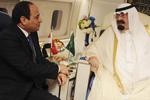
Abdullah-al_sisiEgyptian and Saudi rulers take charge of Arab affairs

Netanyahu may or may not opt to brandish Israel’s diplomatic breakthrough to the Arab world as campaign fodder to boost his run for re-election.  Whatever he decides, the rulers of Saudi Arabia, the Arab emirates and Egypt are turning out to have acquired an interest in maintaining him in office as head of the Israeli government, in direct opposition to President Obama’s ambition to unseat him.

******************

The six Gulf Cooperation Council (GCC) rulers meet in the Qatari capital of Doha next week amid high suspense across the Arab world. Its agenda is topped by moves to finally unravel the 2010 Arab Spring policy championed by US President Barack Obama, moves that also bear the imprint of extensive cooperation maintained on the quiet between Israel and key Arab rulers.

DEBKAfile reports that the Doha parley is designed to restore Egypt under the rule of President Abdel Fatteh El-Sisi to the lead role it occupied before the decline of Hosni Mubarak. Another is to root out the Muslim Brotherhood by inducing their champion, the young Qatari ruler, Emir Tamim bin Hamad Al Thani, to drop his government’s support.

At talks taking place in Riyadh ahead of the summit, Qatari officials appeared ready to discontinue the flow of weapons, funds and intelligence maintained since 2011 to the Brothers and their affiliates across the Arab world (Libya, Egypt, Syria, Jordan and Hamas-ruled Gaza), as well shutting down the El Jazeera TV network – or at least stopping the channel’s use as the Brotherhood’s main propaganda platform.

The Doha summit is designed to crown a historic effort led by Saudi King Abdullah, UAE ruler Sheikh Mohammed bin Zayed and President El-Sisi to undo the effects of the Obama administration’s support for elements dedicated to the removal of conservative Arab rulers, such as the Brotherhood.

They have found a key ally in this drive in Israel’s Prime Minister Binyamin Netanyahu, who took advantage of the chance of an epic breakthrough in relations with the leading bloc of Arab nations, with immediate and far-reaching effect on Israeli security and its standing in the region.

Yet at the same time, Netanyahu has kept this feat under his hat – even while smarting under a vicious assault by his detractors – ex-finance minister Yair Lapid and opposition leader Yakov Herzog of Labor – on his personal authority and leadership credibility (“everything is stuck,” “he’s out of touch.”) and obliged to cut short the life of his government for a general election on March 17.

He faces the voter with the secret still in his pocket of having achieved close coordination with the most important Arab leaders – not just on the Iranian nuclear issue and the Syrian conflict, but also the Palestinian question, which has throughout Israel’s history bedeviled its ties with the Arab world.

When Yair Lapid, whom Netanyahu sacked this week, boasted, “I am talking to the Americans” while accusing the prime minister of messing up ties with Washington, he meant he was talking to the Americans close to Barack Obama, whom Egypt, Saudi Arabia and Abu Dhabi, hand in hand with Netanyahu, have judged adverse to their regimes.

This Arab-Israeli collaboration encompasses too many areas to keep completely hidden. Its fruits have begun breaking surface in a string of events.

This week, Israel apparently out of the blue, quietly agreed to Egypt deploying 13 army battalions in Sinai (demilitarized under their 1979 peace treaty), including tanks, and flying fighter jets over terrorist targets.

A joint Saudi-Israeli diplomatic operation was instrumental in obstructing a US-Iran deal on Tehran’s nuclear program.

Another key arena of cooperation is Jerusalem.

Friday, Dec. 5, Jordan announced the appointment of 75 new guards for the Al Aqsa Mosque compound on Temple Mount. The director of the mosque, Sheikh Omar al-Kiswani, said they will begin work in the coming days.

This was the outcome of Jordanian King Abdullah’s talks with the Egyptian president in Cairo Sunday, Nov. 30, in which they agreed that the Muslim Waqf Authority on Temple Mount must change its mode of conduct and replace with new staff the violent elements from Hamas, the Al Tahrir movement and Israeli Arab Islamists, which had taken charge of “security.”.

The Moslem attacks from the Mount on Jewish worshippers praying at the Western Wall below and Israeli police have accordingly ceased in the two weeks since Israel lifted its age restrictions on Muslim worshippers attending Friday prayers at Al Aqsa. Israel groups advocating the right to Jewish prayer on Temple Mount were discreetly advised to cool their public campaign.

The Palestinian riots plaguing Jerusalem for months have died down, except for isolated instances, since, as DEBKAfile revealed, Saudi and Gulf funds were funneled to pacify the city’s restive Palestinian neighborhoods.

Cairo and the Gulf emirates have used their influence with Palestinian Authority Chairman Mahmoud Abbas to get him to moderate his invective against Israel and its prime minister, and slow his applications for Palestinian membership of international bodies as platforms for campaigning against the Jewish state.

Concerned by the way the mainstream Arab world was marginalizing the Palestinian question, Hamas leader Khaled Meshaal chose his moment Friday – ahead of the White House meeting between the Jordanian monarch and President Obama – to try and re-ignite the flames of violence in Jerusalem. He went unheeded.

Netanyahu may or may not opt to brandish Israel’s diplomatic breakthrough to the Arab world as campaign fodder to boost his run for re-election.  Whatever he decides, the rulers of Saudi Arabia, the Arab emirates and Egypt are turning out to have acquired an interest in maintaining him in office as head of the Israeli government, in direct opposition to President Obama’s ambition to unseat him.

Can President Obama Pass Disraeli’s Test?

December 5, 2014

Can President Obama Pass Disraeli’s Test? American ThinkerKen Blackwell and Bob Morrison, December 5, 2014

(Please see also Reports: Obama Mulling Sanctions on Israel. — DM)

Applying the Disraeli Test to this administration, President Obama’s policies fail on every count. No wonder our present foreign policy seems to stray so far from true American principles and interests.

***************

British Prime Minister Benjamin Disraeli famously said: “The Lord deals with the nations as the nations deal with the Jews.” Winston Churchill was an avid student of Disraeli’s “Tory Democracy” and passed Disraeli’s test easily, as Steven Hayward wrote recently in the Weekly Standard.

This raises a most interesting question: How would President Obama fare on a Disraeli test? His policy toward the Jewish State of Israel leads us to question whether this outstanding student, this graduate of Columbia University and Harvard Law School, could pass a simple, three-question test suggested by one of the Nineteenth Century’s leading statesmen.

President Obama made it a point to skirt around Israel during the entire four years of his first term, while making it his point to go to Turkey, Egypt, and Saudi Arabia in those years.

First, what about Turkey? In 2009, President Obama congratulated that secular republic on its commitment to democratic rule. Turkey is the only member of NATO with a Muslim majority. As such, Turkey’s 50-year alliance with the U.S. and its longtime support for Israel — the only Muslim land in the Near East to give such support — were certainly an important factor worthy of consideration in U.S. foreign policy. But under President Recep Tayyip Erdogan, Turkey has moved farther and farther away from the United States and closer to Russia.

As to Israel, Turkey has become a leading sympathizer of the Hamas terrorist-led regime in Gaza, attempting to run the Israeli blockade of Gaza and charging Israel with violating the human rights of the Arabs of Palestine. Interestingly, while Israel formally supports the idea of statehood for Palestinian Arabs, Turkey denies statehood for its hugeKurdish minority of 20 million. In fact, the Kurds are by far the largest ethnic group in the Mideast denied a state.

Does President Obama hold the Turks to the same standard that he applies to the Israelis? Not at all. He has not begun to press the Turks on Kurdish rights. Until 2000, it was illegal for a person holding Turkish citizenship to identify himself as a Kurd. Contrast this with Israel, where Arabs not only can so identify, they actually sit in the Israeli parliament, the Knesset, as Arabs and form legal Arab political parties.

Now, what of this administration’s view of Egypt? President Obama speedily recognized the Muslim Brotherhood-dominated government in Egypt headed by Mohamed Morsi. Morsi — educated in the U.S. but strongly rejecting American principles of religious liberty and constitutional government — quickly brought Egypt to the brink of chaos. Morsi planned a visit to the U.S. — one eagerly anticipated by the Obama administration — even though Morsi announced he would press the White House to pardon a terrorist.

Morsi wanted Obama to release Sheikh Omar Abdul Rahman, in prison for his part in the first terrorist attack on the World Trade Center. That attack killed seven Americans in 1993.

National Review’s Andrew C. McCarthy provided this stunning profile of Mr. Obama’s obeisance to the Muslim Brotherhood in Egypt.

Reports that the State Department was discussing a transfer of the Blind Sheikh back to Egypt surfaced months ago, in the context of a potential swap for democracy activists the Supreme Council of the Armed Forces was then detaining. The administration then issued a visa to Hani Nour Eldin, a member of the Islamic Group — the Blind Sheikh’s terrorist organization, to which it is a felony to provide material assistance. The purpose was to invite Eldin to, yes, the White House, for consultations with top American national-security officials on prospective relations between the United States and the new, Islamist Egypt. As the administration had to know he would do, he pressed his top agenda item: The United States must return the Blind Sheikh as a “gift to the revolution.”

Fully willing to give hundreds of millions in U.S. aid to Morsi, Mr. Obama promptly yanked that aid when Egypt’s military finally pulled the plug on the Muslim Brotherhood’s misrule in Egypt.

That leaves Saudi Arabia as the final question in Mr. Obama’s “Disraeli Test.” It is illegal for a Jew to live in Saudi Arabia. Any Saudi national who converts to Judaism is beheaded for apostasy. In February, 1945, President Roosevelt appealed to Saudi Arabia’s founding monarch, Abdulazziz, for the Jewish survivors of the Holocaust. Even then, the Saudis were unyielding. FDR, hoping to touch the desert despot’s heart, told him that three million Jews had been murdered in Poland. It was one of the first confirmations by a world statesman of the plight of European Jewry. Abdulazziz’s reaction to this horrific news? There was obviously no need for a Jewish state in the Mideast since there would now be plenty of room for Europe’s surviving Jews — in Poland!

Despite this history of no peace with Israel, no recognition of Israel, no compromise with Israel, President Obama shamefully bowed to the King of Saudi Arabia. No American president had ever bowed to anyone before.

Applying the Disraeli Test to this administration, President Obama’s policies fail on every count. No wonder our present foreign policy seems to stray so far from true American principles and interests.


ISIS in Gaza

December 5, 2014

ISIS in Gaza, Gatestone InstituteKhaled Abu Toameh, December 5, 2014

When One Radical Group Believes Another Is Not Radical Enough

Now almost everyone is talking about the Islamic State threats in Gaza against poets, writers and women. The leaflets mention the poets and writers by name — a move that has created panic. The leaflets also include an ultimatum to Palestinian women to abide by Islamic attire or face the Islamic State style of punishment — presumably being stoned to death.

Of course, all this is taking place while Hamas continues to insist that that the Islamic State is not operating in Gaza. Those who are taking the threats seriously are the writers and women whose names appeared in the leaflets.

Islamic State flags can already be seen at football stadiums, on windshields of vehicles, mosques, educational centers and wedding invitations.

It is also clear that if and when the Hamas regime collapses, the Gaza Strip will not fall into the lands of the less-radical Palestinians.

It is important to keep in mind that the counties in Europe now voting for a Palestinian state may effectively be paving the way for a takeover by Islamic State.

It is always dreamlike to see one Islamist terror group accuse the other of being too “lenient” when it comes to enforcing sharia laws. But it is not dreamlike when a terrorist group starts threatening writers and women.

That is what is happening these days in the Gaza Strip, where supporters of the Islamic State are accusing Hamas of failing to impose strict Islamic laws on the Palestinian population — as if Hamas has thus far endorsed a liberal and open-minded approach toward those who violate sharia laws.

825Members of Islamic State, in Gaza. (Image source: Islamic State YouTube video)

Until this week, the only topic Palestinians in the Gaza Strip were talking about was how to rebuild homes and buildings that were destroyed during the last war between Hamas and Israel.

Now, however, almost everyone is talking about the Islamic State threats against poets, writers and women.

It is no secret that the Islamic State has a presence in the Gaza Strip. According to sources there, many disgruntled members of Hamas and other radical salafi-jihadi groups have already joined the Islamic State, with some fighting together with ISIS groups in Syria and Iraq.

Earlier this year, it was revealed here that Islamic State has already begun operating inside the Gaza Strip — much to the dismay of Hamas.

Hamas, nevertheless, continues to deny any presence of Islamic State inside the Gaza Strip. “There are no members of Islamic State in the Gaza Strip,” said Eyad al-Bazam, spokesman for the Hamas-run Interior Ministry.

Many Palestinians, however, do not seem to take Hamas’s denials seriously, and remain unconvinced.

Over the past few days, two separate leaflets signed by Islamic State threatened to target Palestinian poets and writers for their “wantonness” and “atheism.” The leaflets mention the poets and writers by name — a move that created panic among many Palestinians in the Gaza Strip.

The leaflets also included an ultimatum to Palestinian women to abide by Islamic attire or face the Islamic State style of punishment — presumably being stoned to death. The threat leaves one with the false impression that, under Hamas, women can wear swimming suits at the beach and walk around the streets of Gaza City in mini-skirts.

But this is what happens when one fundamentalist group believes that the other is not radical enough.

“We warn the writers and poets of their wanton sayings and atheist deeds,” one of the leafletsread. “We give the apostates three days to retract their apostasy and wantonness and enter the religion of Islam anew.”

The threats issued by Islamic State have drawn strong condemnations from many Palestinians. This is the first time that such threats have been made against poets and writers or women.

Although Hamas has denied any connection to the threats, Fatah officials in the West Bank were quick to accuse the Islamist movement — which has been in control of the Gaza Strip since 2007 — of being behind the leaflets.

Palestinian political analyst Naji Sharab explained that any attempt to deny the presence of Islamic State terrorists in the Gaza Strip was “unrealistic.”

“There’s no denying that Islamic State exists [in the Gaza Strip] as a small group or as individuals,” he said. “The leaflets that were distributed this week could not have come from any Palestinian organization.”

Palestinians point out that the two leaflets were not the only sign of the presence of Islamic State inside the Gaza Strip. They say that Islamic State flags can be seen in many parts of the Gaza Strip, especially at football stadiums and public buildings. In addition, Islamic State stickers can be seen on the windshields of many vehicles.

More recently, Palestinians say, families have begun attaching the Islamic State emblem to wedding invitations sent out to friends and relatives. Photos of Palestinians who were killed while fighting with Islamic State in Iraq and Syria appear in many places, especially mosques and educational centers.

Of course, all of this is taking place while Hamas continues to insist that the Islamic State is not operating in Gaza.

Those who are taking the threats seriously are the women and writers whose names appeared in the leaflets.

Amal Hamad, a member of the Palestinian Women’s Union, expressed deep concern about the threats made by Islamic State. “We are headed toward the worst in the Gaza Strip,” she complained. “We hold the Hamas security forces responsible for the leaflets of intimidation and terror.” She and a large group of women in the Gaza Strip held an emergency meeting to discuss the repercussions of the threats.

Judging from reactions, it is clear that many Palestinians — including Hamas — are extremely worried about Islamic State’s presence in the Gaza Strip. Even if the terror group still does not have many fighters in the Gaza Strip, it already has countless followers and admirers.

It is also clear that if and when the Hamas regime collapses, the Gaza Strip will not fall into the hands of less-radical Palestinians.

The Gaza Strip has already been turned into an “Islamist Emirate” that is run by Hamas and other radical groups such as Islamic Jihad.

While Islamic State may have succeeded in infiltrating the Gaza Strip, its chances of entering the West Bank are zero. This is thanks to the presence of the Israel Defense Forces [IDF] in the West Bank. The Palestinian Authority and its President Mahmoud Abbas are well aware that without the Israeli security presence in the West Bank, the area would easily fall into the hands of Hamas or Islamic State.

It is important to keep in mind that the countries in Europe now voting for a Palestinian state may effectively be paving the way for a takeover by Islamic State

Obama set on obstructing Netanyahu’s re-election

December 4, 2014

Obama set on obstructing Netanyahu’s re-election, DEBKAfile, December 4, 2014

Obama Netanyahu 2013

The White House is still working on a detailed plan of action, but has lost no time in setting up appointments for the president to receive heads of the parties sworn to overthrow Netanyahu – among others, ex-minister Lapid, opposition leader Yitzhak Herzog of Labor and Tzipi Livni (The Movement), who was fired this week as Justice Minister along with Lapid.

******************

President Barack Obama and his White House National Security team headed by Susan Rice have decided to seize on the political crisis besetting the Israeli government and the upcoming general election on March 17 for action to bar Binyamin Netanyahu’s reelection to a fourth term as prime minister.

This decision reverberated through Future party leader Yair Lapid’s assertion Wednesday night, Dec. 3, after he was sacked as finance minister, that Binyamin Netanyahu would not be next prime minister. He laid claim to the premiership himself.

The Obama administration has maintained close ties with Lapid during the foreshortened 22 month-life of the departing Israeli government.

The White House is still working on a detailed plan of action, but has lost no time in setting up appointments for the president to receive heads of the parties sworn to overthrow Netanyahu – among others, ex-minister Lapid, opposition leader Yitzhak Herzog of Labor and Tzipi Livni (The Movement), who was fired this week as Justice Minister along with Lapid.

They will be accorded attractive photo-ops with Obama and joint communiqués designed to signify to the Israeli voter that the US president would favor their election to the future government and the country as a whole would gain tangibly from a different government to the incumbent one.

This White House campaign would be accompanied by leaks from Washington for putting Netanyahu and his policies in a derogatory light. Messages to this effect were transmitted to a number of serving political figures as an incentive to jump the Likud-led ship to opposition ranks. The US administration has begun hinting that it may emulate the Europeans by turning the screws on Israel as punishment for the prime minister’s signature policy of developing West Bank and Jerusalem development construction.

Accounts reaching DEBKAfile speak of an outburst of joy in the White House over news of the Netanyahu government’s breakup. It was seen as an opportunity to finally get rid of Binyamin Netanyahu and a golden opportunity to bring Israel back to negotiations with the Palestinians with the Obama administration finally chalking up a success.

At the same time, some senior sources in the US capital confided to DEBKAfile that administration joy over political developments in Israel could quickly prove premature – either in view of another round of violence overtaking the Middle East, or by once again misreading Israel’s political map before stepping in and so failing in its object. But for now the circles around the US president are “highly optimistic” about their chances of forcing Netanyahu’s exit, comparing them to the former success of the first President George Bush in forcing the ouster of the late Yitzhak Shamir as Israeli prime minister in the 90s.

Meanwhile, on Wednesday night, Dec. 3, US Congress passed the US.-Israel Strategic Partnership Act that raises by $200 million the value of emergency US weapons stocked in Israel to a total of $1.8 billion, and guarantees Israel’s qualitative military edge over its neighbors and foes. The motion, passed by a voice vote in the House after clearing the Senate unanimously last September, also promotes closer links in energy, water, homeland security, alternative fuel technology and cyber-security. The bill now goes to President Obama for his signature.

Op-Ed: Obama Empowers Enemies and Imperils Friends

December 4, 2014

Op-Ed: Obama Empowers Enemies and Imperils Friends, Israel National News, Matthew M. Hausman, December 2, 2014

The panel concluded that the United States and Israel have similar security concerns and identical interests in preserving cultural and political values common to both their societies.  Accordingly, they find the administration’s policies in the region counterproductive and dangerous.

Clearly, Israel cannot place her trust in the Obama administration, but she can still draw strength and inspiration from Yehoshua, whose words have resonated for thousands of years and will continue to do so long after this president leaves office.
*********************

Even after the recent war in Gaza – and in spite of the dangers posed by ISIS and other Islamist forces – many American Jews still do not fully comprehend the risk to Israel and the West of a rejectionist ideology that promotes jihad and genocide.  But the threat is real and arises from a doctrine that demands total submission from the vanquished.  In failing to recognize the scope of the threat, western progressives – Jews and Gentiles alike – view the world as they believe it should be, not the way it actually is.  The reality, however, is that liberal ideals are irrelevant in regions where politics have no existence independent of religion and religion is unforgivingly totalitarian.

This failure is as much political as intellectual.  Moreover, it engenders complacency with the foreign policy of an administration that has not only failed to respond adequately to the Islamist threat, but whose actions have bolstered fundamentalism across the Mideast and undercut the interests of Israel – America’s only stable and dependable ally in the region.

These points were articulated at a security panel conference entitled, “Israel and the US: The Fight to Save Western Civilization from Global Jihad,” which took place in Massachusetts recently.  The program featured retired Generals Jerry Boykin and Tom McInerney, former CIA Station Chief Gary Berntsen, and retired Lt. Colonel (and former congressman) Allen West.  The program focused on the need to recognize the threat of jihadist extremism, as well as the myriad foreign policy failures that have helped destabilize the Mideast.

Secular progressives have become unwitting foils for Islamist radicalism by their failure to acknowledge its supremacist aspirations and their perception of Muslims as a vulnerable minority despite a global population of approximately 1.6 billion.  This view is a little ironic considering the progressive tendency to disparage Jewish national claims and values and to condemn any perceived Christian intrusion into American politics, but nevertheless to discourage speech that criticizes Islam or mentions any Muslim involvement in terrorism.

Secular progressives often support anti-blasphemy laws and are quick to label as racists those who criticize Muslims on political grounds, although Islam is a religion and is not defined by race or ethnicity.  Moreover, while they often rationalize Islamist extremism as an indigenous voice of protest against western chauvinism, its ubiquity is the result of conquest,colonialism, and the subjugation of “infidel” minorities.  It is the height of cognitive dissonance when feminists, gay rights activists and other social progressives express support for religious extremists who persecute and kill based on gender, sexuality, and dissenting religious belief or political opinion, but condemn Israel – the only country in the Mideast where minorities have equal rights and protections under the law.

Over the last six years, the administration has sought rapprochement with the Islamic world through a series of questionable policies.  Domestically, it has discouraged official use of terms such as “Islamic terrorism,” instead referring to terror incidents involving Muslims as criminal acts, workplace violence or violent extremism.  On the foreign stage, it enabled the rise of the Muslim Brotherhood in Egypt, provided funding in areas governed by Hamas despite that organization’s stated goals of jihad and genocide, and failed to honor strategic commitments to Israel during the Gaza war.

Perhaps most troubling, the administration has used the pretense of negotiations to allow Iran to continue its quest for nuclear weapons – to the consternation not only of Israel, but of Saudi Arabia and all Sunni states in the region.  Though it rationalizes that Iran should be permitted to develop nuclear energy for peaceful purposes, critics point out that 55 percent of Iran’s domestic energy comes from natural gas, 42 percent from oil and two percent from hydroelectricity, such that it has no apparent consumer need for nuclear power. Its true intentions are reflected in the statements of its leaders, including Ayatollah Ali Khamenei, who recently tweeted that Israel “… has no cure but to be annihilated.”

Whether promoting Islamists, enabling Iran’s nuclear ambitions, or chastising the way Israel defended herself in Gaza, the administration has pursued policies that have empowered America’s enemies and imperiled its allies.  Furthermore, by drawing meaningless redlines that it refuses to enforce and unilaterally disarming in Europe, it has signaled to the world that it is no longer willing to defend its own interests or those of its allies, but instead will stand aside while Russia, China and other geopolitical rivals assert themselves within traditional U.S. spheres of influence.

Speaking to a packed house at Ahavath Torah Congregation in Stoughton, Massachusetts, Generals Boykin and McInerney, Colonel West, and Agent Berntsen discussed the weakening of American strength and prestige under the current administration, and how this has enhanced Islamist resolve, endangered the safety of Israel, and compromised American interests around the globe.

They spoke with inside knowledge of the U.S. military and intelligence establishments and with a deep and abiding respect for Israel.  General Boykin, a 36-year veteran and the first commander of Delta Force, related how he was in Jerusalem last summer when Hamas kidnapped and murdered three yeshiva boys, and how the outrage it spawned illustrated the inevitability of a military response.  According to Boykin, who has spent considerable time in Israel and lived with the Golani Brigade, the kidnapping was the tipping point in a string of events, including rocket attacks against Israeli civilians and the construction of terror tunnels, which necessitated decisive counteraction.

In the panel’s view, Operation Protective Edge was essential, not only to stop rocket attacks and destroy terror tunnels, but because of the existential implications of radical Islam.  These implications are reinforced by various charters calling for the destruction of Israel and Hamas’s explicit goal of exterminating the Jews, by ISIS’s goal of establishing a caliphate throughout the Mideast, and by Iran’s repeated pledges to blow Israel off the map. Despite political differences between the Muslim Brotherhood, Hamas, ISIS, Hezbollah, al-Qaeda and Boko Haram, and doctrinal differences between Sunni and Shiite terror states, they all represent the same threat to Israel and the West.

Boykin sees a clear thread connecting past actions against the United States, such as the bombing of the marine barracks in Beirut in 1983 and the first World Trade Center attack in 1993, with the kidnappings and beheadings of westerners today.  Unfortunately, Americans often have a limited frame of reference, particularly in a political climate that shuts down any critical discussion of these issues as “Islamophobic.”  The problem is exacerbated by an administration that appeases enemies and alienates allies and by political elements in the military that lack the resolve to implement appropriate corrective strategies.  In Boykin’s view, the latter problem is related to the exodus of young officers from all service branches in response to cuts in military spending and concomitant reductions in personnel.

The military is being cut back at a time when Islamist extremism is ascending, as demonstrated by the gruesome success of ISIS.  Political and military leaders willfully ignore the ramifications of jihadi radicalism and the need to confront it from a position of strength.  Despite recent acts of terror committed on North American soil, including beheadings and murders by lone-wolf perpetrators and the attack on Canada’s Parliament, the administration refuses to concede any terrorist links.  Indeed, while Canadian Prime Minister Harper proclaimed that the Parliament attack was an act of terror, President Obama would not draw the same conclusion.

In contrast, Israel knows how high the stakes are because they challenge her very existence.  “Israel has nowhere to go,” Boykin said, and thus cannot afford to be ignorant about the nature of an existential threat grounded in ideology, not geography.

General McInerney, a former U.S. Air Force Vice Chief of Staff and Vice Commander in Chief of U.S. Forces in Europe, agrees that the battle against Islamists is ideological.  “We have to understand the threat we face [and that] Radical Islam is as dangerous an ideology as Nazism and Communism.”  According to McInerney, Islamism is not a response to western provocations, but derives from Muslim scriptural sources.  Likewise, the jihadist impulse does not arise from economic privation, class struggle or geographic dispossession as western progressives often preach.  Rather, it comes from deeply held religious convictions that must be understood if they are to be confronted effectively.

In order for this to happen, though, control of the dialogue has to be taken back from those who censor the use of language deemed offensive to extremists and who employ moral equivalency to justify radicalism.  In addition, the dialogue should be purged of intentionally misleading buzzwords that have become commonplace, including such terms as: “occupation,” which refers to the entire State of Israel; “historical Palestine,” which legitimizes a country that never existed; and “proportionality,” which is used to criticize defensive actions taken by Israel, but not the acts of those who attack her citizens and use civilians as shields.

Accusations that Israel’s military responses are disproportionate are particularly galling, especially considering how she routinely sacrifices her strategic advantage by warning civilians of impending strikes ahead of time and by providing aid to those caught in the crossfire.  The unprecedented humanity displayed by Israel during wartime should debunk the ongoing critique of the proportionality of her response in Gaza and her supposed failure to protect civilians.  Such statements bespeak ignorance, bad faith or complicity in advancing anti-Israel propaganda.

According to General McInerney, the term “proportionality” is simply a euphemism for “not enough Israelis killed” and should be given no credence. Nevertheless, White House and State Department voices seem more vested in chiding Israel for civilian casualties than in blaming Hamas for starting the conflict and using noncombatants as human shields.  The treatment of Hamas as a legitimate political entity defies history, logic and common sense.

The Obama administration’s apparent affinity for Islamists has not garnered it support from the Islamic world, and military reductions on its watch have fostered an image of international weakness.  By unilaterally disarming in Europe, where the U.S. currently maintains almost no tanks or mechanized divisions, General McInerney believes the administration has eroded the deterrent effect of American military strength.

And by treating Iran, perhaps the largest state sponsor of global terrorism, as a rational partner for constructive engagement, the administration increases the risk of a regional arms race as the Sunni states may be forced to seek parity.  The threat of a nuclear Iran cannot be minimized, the panel said, noting that it would take only a few nuclear weapons to destroy Israel.  To claim that a nuclear Iran could ever be trusted is to ignore the radical ideology that has driven its quest for nuclear weapons since the Islamic revolution in 1979 and its dogmatic fixation on destroying Israel.  It also ignores an Iranian worldview in which the United States remains the “Great Satan.”

The panel’s perspective on the spread of Islamism is buttressed by the long view of many in the intelligence community, but the administration seems to ignore any observations and analyses that do not jibe with the partisan and politicized assumptions underlying its foreign policy.  This is all the more disturbing in light of reports during the ISIS fiasco claiming that President Obama does not read all intelligence memos that cross his desk.

The intelligence angle was addressed by Gary Berntsen, a career CIA officer, former station chief and former counter-terrorism director.  A fluent Farsi speaker, Berntsen directed counterterrorism deployments in response to the bombings of the U.S. Embassy in East Africa and the attacks on 9/11, and is familiar with the evolution of both Hezbollah and ISIS.  Whereas Mr. Obama claimed to have been surprised by the rise of ISIS, Berntsen said that U.S. intelligence has been tracking the faction from which it grew for years; and that despite the president’s attempt to blame the intelligence community for failing to identify the threat, the administration has been fully briefed about the capabilities and resources of ISIS on an ongoing basis.

Moreover, in evaluating the evolution of ISIS, the intelligence community had a model for comparison in Hezbollah.  According to Berntsen, there were parallels to the growth of Hezbollah, which together with Islamic Jihad serves as the operational wing of the Iranian Revolutionary Guard. Hezbollah maintains a standing army, finances its operations through unsavory enterprises and billions in funding from Iran, and serves as a conduit for Iranian-exported terrorism, Berntsen noted.  Moreover, it has insinuated itself in Lebanon, where it persecutes non-Muslims and threatens Israel.

ISIS followed a similar trajectory on its way to amassing a fighting force of some 30,000 men and a large arsenal of sophisticated weaponry.  Initially supported by a number of Sunni states, ISIS has become self-sustaining by reaping profits from banks and oil production facilities it has seized and by stockpiling weapons and hardware taken from routed opponents across Syria and Iraq.

Though ISIS is certainly a menace that must not be ignored, the United States cannot afford to lose sight of Iran’s influence throughout the region.  Without minimizing the ISIS threat, Berntsen believes that “Iran is the major confrontation state” and that American interests are ill-served by the obsession with concluding a nuclear deal.  The administration appears to believe it can encourage a shift in Iranian loyalty and seems prepared to sacrifice its relationships with Sunni allies, such as Saudi Arabia, in order to do so.  Given that Iran’s official views regarding the United States have not changed, and that it continues to call for the annihilation of Israel, the initiative to flip its allegiance seems grounded in fantasy.

The panel concluded that the United States and Israel have similar security concerns and identical interests in preserving cultural and political values common to both their societies.  Accordingly, they find the administration’s policies in the region counterproductive and dangerous.

These observations are especially poignant in light of recent events, including continuing criticisms of Israel by the administration and State Department over the Gaza war.  Official malice against Israel seemed incontrovertible after General Martin Dempsey, Chairman of the Joint Chiefs of Staff, recently lauded Israel for taking unprecedented steps to minimize civilian casualties in Gaza and stated that the U.S. military would adopt similar strategies for fighting in civilian areas.  The State Department responded by distancing itself from Dempsey’s remarks and denying that they reflected the government’s position.

Then there were the recent comments from an unnamed White House source who used expletives to describe Benyamin Netanyahu and called him cowardly for failing to strike Iran’s nuclear facilities, although the Obama administration discouraged the strike and reportedly leaked sensitive information (regarding strikes on similar sites in Syria) to prevent Israel from acting.  When these comments are juxtaposed against the administration’s failure to contain ISIS and the domestic loss of confidence in Mr. Obama’s ability to protect and defend, the foreign policy landscape looks very bleak indeed.

The American Jewish community needs to wake up and acknowledge the administration’s abandonment of Israel.  Though some Jewish Democrats still contend that Obama “has Israel’s back,” his order blocking shipments of Hellfire missiles and other military equipment to Israel during the Gaza war shows the fallacy of such claims.   Furthermore, his preoccupation with reaching a nuclear deal with Iran – a rogue regime that has repeatedly vowed to obliterate the Jewish State – should give pause to all who profess support for his administration’s intentions regarding Israel.

The message delivered by the esteemed panel in Massachusetts was that American and Israeli interests are identical when it comes to dealing with global jihad, and that the failure to support Israel will only embolden those who seek to take the fight directly to the United States.  The proof on the ground becomes more apparent with each foreign policy gaffe, and seems to be denied only by those who choose to ignore it or who continue to promote the administration’s regional agenda out of blind partisan allegiance.

The opening remarks of Colonel West, who moderated the panel discussion with wit and insight, actually set the tone for its conclusion.  “America is at a critical crossroads in our global standing,” he said.  “And this is clearly apparent in the Mideast [where] we’re facing a vile existential threat in ISIS.”  The increase in Hamas’s destructive power, the evolution of ISIS in Syria and Iraq, and the empowerment of extremists across North Africa have coincided with the administration’s conduct in pivoting U.S. policy away from its traditional interests in the Mideast and undercutting the American-Israeli relationship.

Nevertheless, Colonel West believes the American people’s bond with Israel cannot be broken by the policies of a hostile administration.  Regarding Israel’s future, he referred to the Book of Yehoshua, which says:  “Be strong and courageous; be not afraid, nor be dismayed; for the Lord your G-d is with you wherever you go.” (Joshua, 1:9.).

Clearly, Israel cannot place her trust in the Obama administration, but she can still draw strength and inspiration from Yehoshua, whose words have resonated for thousands of years and will continue to do so long after this president leaves office.
Sisi is not Mubarak

December 4, 2014

Sisi is not Mubarak, Canada Free Press, Caroline Glick, December 4, 2014

Sisi1

Due to the events that propelled him to power, Sisi has adopted a strategic posture far different from Mubarak’s. As Sisi sees things, Sunni jihadist forces and their Iranian-led Shi’ite allies are existential threats to the Egyptian state even when their primary target is Israel. Sisi accepts that Israel’s fight against them directly impacts Egypt.

He recognized that when Israel is successful in defeating them, Egypt is more secure. When Israel is weak, the threat to Egypt rises.

The government must take every possible action, in economic and military spheres, to ensure that Sisi benefits from his actions. 

******************

The Egyptian court’s decision last Saturday to acquit former president Hosni Mubarak, his sons and associates of all remaining charges against them caused most commentators to proclaim that current Egyptian President Abdel Fattah Sisi has turned back the clock. Under his leadership, they say, Egypt has restored Mubarak’s authoritarian regime under a new dictator.

While this may be how things appear on the surface, the fact of the matter is that at least as far as Israel is concerned, nothing could be further from the truth.

During his 30-year rule, Mubarak always assessed that threats against Israel were unrelated to threats against Egypt. Due to this view, despite continuous complaints from Jerusalem, Mubarak enabled jihadists to take root in Sinai. He allowed Egypt to be used as the major path for terrorist personnel and armaments to enter Gaza. He took only minor, sporadic action against the smuggling tunnels connecting Gaza to Sinai.

By 2005, it became apparent that forces from Hamas, Hezbollah, Iran and al-Qaida were operating in the Sinai and cooperating with one another.

Despite warnings from Israel, Mubarak took no effective action to break up the emerging alliance and convergence of forces.

It was due to Mubarak’s refusal to act that the Palestinians in Gaza were able to begin and massively expand their projectile war of mortars, rockets and missiles against Israel. From the first such attacks, carried out 14 years ago, the Palestinian projectile campaigns could never have happened without Egypt’s effective collaboration.

On countless occasions, Palestinian terrorist commanders were able to escape to Sinai and avoid arrest by Israeli forces, only to return to Gaza from Sinai and continue their operations.

Mubarak believed that Israel was his safety valve.

Mubarak: Facilitating jihadist operations against Israel from Egyptian territory

By facilitating jihadist operations against Israel from Egyptian territory, he assumed that he was securing Egypt from them. As he saw things, the Muslim Brotherhood, Hamas, Hezbollah and Iran would be so satisfied with his cooperation in their jihad against the Jews that they would leave him alone.

It was only in 2009, when Egypt announced the unraveling of a terrorist ring in Sinai comprised of Iranian Revolutionary Guards, Hamas and Hezbollah operatives planning attacks against Israel and Egypt, and seeking the overthrow of the regime, that Mubarak began signaling he may have misjudged the situation. But even then, his actions against those forces were sporadic and half-hearted.

Hamas’s continued assaults against Israel in the years that followed, and the build-up of Muslim Brotherhood and al-Qaida forces in Sinai, were a clear sign that Mubarak was unwilling to contend with the unpleasant reality that the very forces attacking Israel were also seeking to overthrow his regime and destroy the Egyptian state.

In stark contrast, Sisi rose to power as those selfsame forces were poised to destroy the Egyptian state. The Muslim Brotherhood’s rise to power owed in part to the support it received from Hamas.

Sisi and his generals overthrew the Muslim Brotherhood with Saudi and UAE support in order to prevent Egypt from dissolving into a Sunni jihadist axis i

During the January 2011 rebellions against Mubarak, Hamas operatives played a key role in storming Egyptian prisons in Sinai and freeing Muslim Brotherhood leaders – including Muslim Brotherhood president Mohammed Morsi – from prison. In 2012 and 2013, Hamas forces reportedly served as shock troops to quell protests against the Muslim Brotherhood regime. Those protests arose in opposition to Morsi’s moves to seize dictatorial powers Mubarak never dreamed of exercising, and his constitutional machinations aimed at transforming Egypt into an Islamic state and hub of a future global caliphate.

Sisi and his generals overthrew the Muslim Brotherhood with Saudi and UAE support in order to prevent Egypt from dissolving into a Sunni jihadist axis in which Hamas, al-Qaida and other jihadist movements were key players, and Iran and Hezbollah were allied forces.

Due to the events that propelled him to power, Sisi has adopted a strategic posture far different from Mubarak’s. As Sisi sees things, Sunni jihadist forces and their Iranian-led Shi’ite allies are existential threats to the Egyptian state even when their primary target is Israel. Sisi accepts that Israel’s fight against them directly impacts Egypt.

He recognized that when Israel is successful in defeating them, Egypt is more secure. When Israel is weak, the threat to Egypt rises.

Like Israel, Sisi acknowledges that the ideology of the Muslim Brotherhood, which is shared by Hamas, al-Qaida and all other significant Sunni jihadist groups renders all of these groups threats to Egypt. And because of this acknowledgment, Sisi has abandoned Mubarak’s policy of enabling their war against Israel.

Not only has he abandoned Mubarak’s policy of enabling them, Sisi has acted in alliance with Israel in combating them. This is nowhere more evident than in his actions against Hamas in Gaza.

After seizing power in July 2013, Sisi immediately ordered the Egyptian military to take action to secure the border between Gaza and Sinai. To this end, for the first time, Egypt took effective, continuous steps to block the smuggling of arms and people between the two areas. These steps had a profound impact on Hamas’s regime. Hamas went to war against Israel this past summer in a bid to force Egypt and Israel to open their borders with Gaza in support of the Hamas regime and its jihadist allies.

Hamas was certain that footage of suffering in Gaza would force Egypt to oppose Israel, and so open its border with Gaza. It would also lead to US-led pressure on Israel that would make Israel succumb to Hamas’s demands.

Against all expectations, and previous precedents of Egyptian behavior under both Mubarak and Morsi, Sisi supported Israel against Hamas. Moreover, he brought both Saudi Arabia and the UAE into the unofficial alliance with Israel. The bloc he formed was powerful enough to surmount US pressure to end the war by bowing to Hamas’s demands and opening Gaza’s borders with Egypt and Israel.

Since the cease-fire came into force three months ago, Sisi has continued to seal the border. As a consequence, he has denied Hamas the ability to rebuild Gaza’s terror infrastructure. In its reduced state, Hamas is less able to facilitate the operations of its jihadist brethren in Sinai that are primarily involved in waging an insurgency against the Egyptian state.

To be sure, the most significant strategic development in recent years is the US’s strategic realignment under President Barack Obama. Under Obama the US has switched sides, supporting Iran and its allies, satellites and assets, including the Muslim Brotherhood and Hamas, against America’s Sunni allies and Israel.

But the alliance that emerged this summer between Israel and Egypt, with the participation of Saudi Arabia and the UAE , is also a highly significant strategic development. For the first time, a major regional power is basing its strategic posture on its understanding that the threats against itself and against Israel stem from the same sources and as a consequence, that the war against Israel is a war against it.

Israelis have argued this case for years to their Arab neighbors as well as to the Americans and other Western states. But for multiple reasons, no one has ever been willing to accept this basic, obvious reality.

As a consequence, everyone from the Americans to the Europeans to the Saudis long supported policies that empower jihadist forces against Israel.

Sisi became the first major leader to break with this consensus, as a result of actions Hamas took before and since his rise to power. He has brought Saudi Arabia and the UAE along on his intellectual journey.

And this reassessment has had a profound impact on regional realities generally and on Israel’s strategic posture specifically.

From Israel’s perspective, this is a watershed event.

The government must take every possible action, in economic and military spheres, to ensure that Sisi benefits from his actions.