Posted tagged ‘Israel’

Obama turns a smiling face to Israel. Biden: Iran has enough material for 8 nuclear bombs

May 3, 2015

Obama turns a smiling face to Israel. Biden: Iran has enough material for 8 nuclear bombs, DEBKAfile, May 2, 2015

(Obama and Biden speak with forked tongues. Please see also, PM Netanyahu’s Remarks to the Washington Institute for Near East Policy.– DM)

Biden-netanyahu_30.4.15We drive each other nuts…

President Barack Obama and Vice President Joe Biden have gone out of their way in the last fortnight to shower friendly gestures on Israel, Prime Minister Binyamin Netanyahu and even Ambassador to Washington, Ron Dermer. Refuting the dire predictions by Netanyahu’s critics of a disastrous breach, Obama and Biden, by word and gesture, are putting behind them the rancor long marring relations between Washington in Jerusalem.

The White House launched its new charm campaign for Israel on April 13 by meetings with three groups of American Jewish leaders. Obama addressed the first with an emotional affirmation of his support for Israel and its security. Vice President Biden, National Security adviser Susan Rice and Biden’s national security adviser Colin Kahl then talked to another group of Jewish leaders, while Obama spoke to Jewish “community leaders”, a group of individuals who though unaffiliated are influential and generous donors to the Democratic Party.

Ten days later, on April 23, Biden was the keynote speaker at the Israeli embassy’s Independence Day reception. He stood alongside the former object of administration ire – Ambassador Dermer – and declared: “We have Israel’s back, you can count on that.” He announced that Israel would be the first country in the world to receive the new US F-35 stealth aircraft already next year.

Thursday, the Vice President delivered a lecture at the Washington Institute for Near East Policy, the key DC research think tank on the subject of US-Israel relations.

In this important lecture, Biden defended in great detail US strategy and objectives in the negotiations for a nuclear accord with Iran, as they enter their final lap.

All in all, the US president and vice president are devoting more time to gestures for repairing relations with Israel than on the burning crises afflicting the world in Yemen, Iraq, Syria and Ukraine.

DEBKAfile found four reasons for this striking White House pivot:

1. After the fireworks sparked by Netanyahu’s March 3 speech to the US Congress against the nuclear accord, which placed him at the forefront of the international front opposing the deal, the White House decided that instead of sparring with him, it would be more productive to convert the Israeli prime minister into a supporter by meeting him halfway on certain points.

2. The rift with Israel proved disadvantageous to the Obama administration, while boosting Netanyahu and his Likud in Israel’s recent general election. The US president has paid a high political and personal price for colliding with Congress on the Iranian nuclear issue. His strategic advisers have recommended a bid to convince Netanyahu that Israel’s most pressing concerns about the nuclear deal are being addressed in the final stage of the talks. Assuming that the prime minister too is not looking for a major rift with Washington, he may be amenable to partly changing course and withdrawing some of his objections to the deal. Congress might then respond more positively to the administration’s nuclear policy.

3. As American gears up for its 2016 elections, the Democratic Party needs to woo the Jewish vote and most importantly its financial support for campaigners.

The Biden lecture to the Washington Institute is therefore worthy of close scrutiny. This masterly and eloquent work is an attempt to lay the political and security groundwork for Prime Minister Netanyahu’s consent to a change of heart from opposition to the nuclear deal to its support.

DEBKAfile has therefore singled out is 17 high points:

  • Israel is absolutely right to be worried about the world’s most dangerous weapons falling in the hands of a nation, whose leaders dream openly of a world without Israel.
  • So the criticism that Israel is too concerned I find preposterous.  They have reason to be concerned. (DF. Netanyahu’s concerns about Iran are fully justified.)
  • …that’s why the President, President Obama, decided for the first time — people forget this — to make it an explicit, declared policy of the United States of America – no such policy existed before President Obama uttered it — that all instruments of American power to prevent — not contain, not contain -— to prevent a nuclear-armed Iran would be used to prevent that from happening.
  • …our military had the capacity and the capability to execute the mission, if it was required. (DF. This was an explicit US presidential pledge to use military force to prevent a nuclear-armed Iran.)

Vice President Biden then laid down 12 conditions as the sine qua non for a deal. “If what’s on the table doesn’t meet the President’s requirements, there will be no deal,” he said.

  • A final deal must effectively cut off Iran’s uranium, plutonium and covert pathways to the bomb.
  • The final deal must ensure a breakout timeline of at least one year for at least a decade or more.
  • A final deal must include phased sanction relief, calibrated against Iran taking meaningful steps to constrain their program. (DF. Iran insists on immediate sanctions relief.)
  • A final deal must provide verifiable assurances to ensure Iran’s program is exclusively peaceful.
  • If they did try to cheat… they would be far more likely to be caught because… we’ll also put in place the toughest transparency and verification requirements.
  • Iran will be required to implement the Additional Protocols, allowing IAEA inspectors to visit not only declared nuclear facilities, but undeclared sites where suspicious, clandestine work is suspected and address IAEA concerns about the military dimensions of past nuclear research.
    Not only would Iran be required to allow 24/7 eyes on the nuclear sites you’ve heard of — Fordow and Natantz and Arak — and the ability to challenge suspect locations, every link in their nuclear supply chain will be under surveillance.
  • And if Iran resumes its pursuit of nuclear weapons, no option available today will be off the table. In fact, the options will be greatly increased because we will know so much more.

Biden went on to warn: “Let’s not kid each other. They already have paved a path to a bomb’s worth of material. Iran could get there now if they walked away in two to three months without a deal.” He went on to say:  “Without this deal, they already have enough material if further enriched for as many as eight nuclear bombs. Already, right now, as I speak to you.

  • Under the proposed final deal, the Arak reactor will be redesigned to produce zero weapons-grade plutonium. The spent fuel will be required to be shipped out of Iran for the life of the reactor. And Iran will be barred from building the reprocessing plant for extracting bomb-grade material from plutonium.

“Finally there is the myth that a nuclear deal between the United States and Iran enables Iran to gain dominance inside the Middle East.” The US vice president protested: “But it is a nuclear bargain between Britain, France, Russia, China, Germany, the EU, America and Iran – one that reduces the risk of nuclear war and makes the region and the world a safer place,” he stressed.

“We are working continually to develop the means and capacity to counter Iran’s destabilizing activities…“ he said citing the Strait of Hormuz. We are prepared to use (inaudible) the force.”

Biden wound up his peroration by directing these words to Israel. “It’s true we disagree sometimes. But as I said last week at Israel’s Independence Day celebration, we’re family. I think it was Ambassador Dermer who essentially said the same thing. We drive each other nuts. But we love each other. And most of all we protect each other.”

DEBKAfile’s Washington sources note: The Obama administration appears willing to keep on smiling towards Israel. US Secretary of State John Kerry will soon schedule a visit to Israel, after staying away for a long time, The visit will be billed as promoting Israeli-Palestinian peace talks, but his real errand will be to test the ground with Prime Minister Netanyahu and assess how successful the White House’s gestures of affection have been in toning down his opposition to the nuclear deal.

For now, the host of critics who accused Netanyahu of causing an irreparable breach with Washington over the nuclear issue have retired to a corner.

PM Netanyahu’s Remarks to the Washington Institute for Near East Policy

May 3, 2015

PM Netanyahu’s Remarks to the Washington Institute for Near East Policy, via You Tube, May 2, 2015

A powerful totalitarian theocracy can bring peace. Of sorts.

May 2, 2015

A powerful totalitarian theocracy can bring peace. Of sorts. Dan Miller’s Blog, May 2, 2015

(The views expressed in this article are mine, and do not necessarily reflect those of Warsclerotic or its other editors. — DM)

a1  Obama and Kahameni -building a toaster

Iran, an already powerful theocratic totalitarian state with extensive hegemonic ambitions, is about to become (if it is not already) a nuclear power. So equipped, it can extend its rule over the Middle East and beyond, bringing the “peace” of submission to Islam. Obama may favor this outcome and in any event appears to be at best indifferent.

Iran is ruled by Ayatollah Khamenei, its supreme political and religious power. He has the ultimate authority to approve or reject any P5+1 agreement, should there be one — which seems increasingly likely due to Obama’s ludicrous efforts to concede every possible matter of substance. Obama wants a foreign policy legacy and needs a “deal;” Iran does not need a “deal.” It has already benefited greatly from sanctions relief. Other nations have also benefited economically to the point that even were the U.S. to try to reimpose sanction such trade would continue and expand. Moreover, it is highly likely that Iran has done all of the necessary technical research on nukes and on delivery devices to the extent that, regardless of whether there is a “deal,” Iran can have deliverable nukes within a few months if not sooner. As I pointed out here, the insanity of the 2013 framework, adhered to except when arguably in America’s favor, led inexorably to this result.

The North Korea – Iran linkage makes the problem worse. Chinese nuclear experts recently revised their estimation of North Korea’s current possession of nukes:.

China’s top nuclear experts have increased their estimates of North Korea’s nuclear weapons production well beyond most previous U.S. figures, suggesting Pyongyang can make enough warheads to threaten regional security for the U.S. and its allies.

The latest Chinese estimates, relayed in a closed-door meeting with U.S. nuclear specialists, showed that North Korea may already have 20 warheads, as well as the capability of producing enough weapons-grade uranium to double its arsenal by next year, according to people briefed on the matter. [Emphasis added.]

Iran and North Korea have a long history of nuclear cooperation. Delivering North Korean technology, materials and nukes to Iran would not be very difficult. I addressed the problem here, herehere and elsewhere.

Consequences of a nuclear Iranian theocracy

The Iranian Shiite theocracy is totalitarian in every sense of the word; it has not moderated under “moderate” President Rouhani. To the contrary, it seems to have worsened. To the extent that credible figures are available, sexually transmitted disease has risen and the birth rate in Iran has fallen, considerably in recent years. Despite sanctions relief, poverty has increased. Where has the money gone? Iran pursues its hegemonic ambitions, most recently to help the Houthi in Yemen, while continuing to provide economic, logistical and weapons support to its other proxy terrorist organizations such as Hamas, Hezbollah, the Muslim Brotherhood and others. Iran is very likely motivated by its own desire eventually to control the Middle East and beyond.

The recent Iranian hijacking of a cargo ship under “U.S. protection” may well have been an Iranian warning to Saudi Arabia, an American ally and leading opponent of the Iranian proxy war by Houthi in Yemen, that it can and might close the Strait of Hormuz to Saudi oil exports.

Strait-of-Hormuz

Although obligated under treaty to come to the defense of the Marshall Islands-registered cargo ship, the Obama Nation did not. Instead, it simply watched as the Iranian Navy fired shots across her bow and took her to an Iranian port to the North at Bandar Abbas. The ship and her crew remain there. Caroline Glick, in an article titled The Marshall Islands’ cautionary tale pointed out that

The Maersk Tigris is flagged to the Marshall Islands. The South Pacific archipelago gained its independence from the US in 1986 after signing a treaty conceding its right to self-defense in exchange for US protection. According to the treaty, the US has “full authority and responsibility for security and defense of the Marshall Islands.” [Emphasis added.]

Given the US’s formal, binding obligation to the Marshall Islands, the Iranian seizure of the ship was in effect an act of war against America.

. . . .

If the US allows Iran to get away with unlawfully seizing a Marshall Islands flagged ship it is treaty bound to protect, it will reinforce the growing assessment of its Middle Eastern allies that its security guarantees are worthless.

As the Israel Project’s Omri Ceren put it in an email briefing to journalists, “the US would be using security assurances not to shield allies from Iran but to shield Iran from allies.” [Emphasis added.]

What can other nations, with which America has treaties calling upon us to come to their defense, expect from the Obama administration if attacked by Iran? Precious little.

Under credible threat from nuclear attack by Iran and lacking actual (as distinguished from verbal) support from the Obama administration, Middle East Arab nations cannot be expected to resist very effectively, even as they seek to obtain their own nuclear arsenals.

Israel, the “Little Satan?” She would fight fiercely to the end, but might be overcome. Perhaps she will take the initiative and destroy Iran’s nuclear facilities before they become too extensive and better protected, perhaps by missiles provided by Russia. I suggested here that she can and should do so. Here is a link to a far more detailed analyses of what she can and should do, soon.

America, the “Great Satan,” is not immune to an Iranian nuclear attack. As I suggested here, a nuclear armed Iran could launch an EMP attack to drive the U.S. back to the stone age. Such an attack would increase Iran’s hegemonic potentials, and hence ambitions, by foreclosing the possibility of American help to nations with which we have protection treaties. However, even without an EMP attack, Obama would not provide much help. Therefore, I wonder whether — despite all of the continuing Iranian “death to America” bluster — Iran would be foolish enough to do it before Obama leaves office. He does His best to help Iran get nukes and pursue its hegemonic ambitions. Why try to kill a staunch friend like Obama’s America?

The Obama administration — and many voters — view global warming, climate change, climate disruption and whatever new phrases as may be developed as the most severe threat to humanity. An interesting article titled Progressives at the Poker Table compares “Progressive” attitudes toward “the threat of climate warming and that of a nuclear-armed Iran.” Predictably, the Obama Administration and most of the “legitimate news media” are far more concerned about the former than the latter, even though there is little if anything that we can do, even at great expense, about climate change (mostly natural in origin). If so disposed, there is quite a lot that we could do about the far greater, and in any event more immediate, threat from a nuclear Iran. Perhaps it’s simply easier to stage pious shows about costly but ineffective ways to “save the Earth” than to make useful efforts to save humanity from Islamic ravages.

Church of climatology

Conclusions

Andrew Klavan ridicules Obama’s P5+1 “deal” here:

The Congress probably won’t do anything to stop it, so Iran will very likely have nukes and the missiles with which to deliver them soon — if it does not already have them.

Hitler made a “deal” with Prime Minister Chamberlain years ago and returned from Munich to display a piece of paper signed by Hitler. Crowds cheered. Hitler laughed and continued his hegemonic pursuits throughout Europe. Hitler could have been stopped with relative ease long before World War II erupted but wasn’t. The “Peace in our time” meme was too powerful. Then we fought WWII.

Is that how the current mess with Iran will turn out?

code pink on Iran

Israel’s economy defies common sense

May 2, 2015

Israel’s economy defies common sense

By Yoram Ettinger — Bio and Archives  May 2, 2015

via Israel’s economy defies common sense.

The long-term viability of Israel and its economy is also reflected by its economic indicators, which refute conventional “wisdom.”

Irrespective of a cynical and gullible “elite” media, independent of diplomatic pressure, political correctness and conventional wisdom, in defiance of the global economic slowdown, in the face of war and terrorism, and despite ill-advised threats of boycott, divestment and sanctions—but, due to principle-driven tenacity, inherent optimism, human capital/brain power, creativity, cutting edge ingenuity and breakthrough, game-changing innovations—Israel’s economy is expanding beyond expectations, reacting constructively to pressures/challenges, and developing unique commercial and security niches in response to local and global needs.

For example, the April 10 issue of Financial Times reported that “Israel’s cyber security technologies claim 10% of the world’s investments, and Israel’s exports exceed $3bn…. Buy Swiss watches from Switzerland and information security from Israel….

Israel built its cyber-related offensive, defensive and snooping functions as a byproduct of its regional conflicts, ‘turning lemons into lemonade’ (Udi Mokady, CEO of CyberArk)….”Leveraging Israel’s cyber knowhow, Lockheed Martin —which joined EMC in fathering Israel’s CyberSPark Industry Initiative – collaborates with Israel’s National Cyber Bureau, Israel’s Technology and Information Administration and the University of Maryland, training Israeli students, reflecting its growing involvement in Israel’s cyber research and development (R & D). PayPal acquired Israel’s anti-virus cyber company, CyActive, for $60mn, its second R & D center in Israel. In 2008, PayPal acquired FraudScience for $169mn.

BottomLine acquired the Israeli cyber company, Intellinx, for $67mn.According to the April 20, 2015 issue of the London Economist Intelligence Unit: “Israel’s high tech sector is in the midst of a boom stronger than anything seen since the late 1990s. [300] Startups raised a record $3.4bn in 2014…. Israel has gained a global reputation as a technology innovation leader in several areas, with several hundred new technology firms emerging annually…. Some 82 Israeli startups were sold last year [for $7bn], mostly to foreign multinationals, while another 17 conducted initial public offerings (IPO)…. Foreign multinationals operate more than 200 R & D centers in Israel…. It is also significant in boosting Israel’s relations with emerging economic powers hungry for innovation, such as India and China….”

Contrary to the misperception of Israel’s supposed isolationContrary to the misperception of Israel’s supposed isolation, Renren (“China’s Facebook”) and Tencent invested $100mn in an Israeli venture capital fund. China’s Internet giant, Alibaba, known for the highest-ever IPO ($25bn in 2014), invested about $50mn in Israel’s JVP, which is currently focusing on cyber technology.

Chinese contractors are increasingly involved in major Israeli infrastructure projects, winning bids for the Mt. Carmel Tunnel, the Acre-Carmiel railroad, the port of Ashdod, the new deep water Port of Haifa, the supply of electric locomotives, etc. PingAn, YongJin and ZTE, Chinese giants in the areas of insurance, financial management and cellular, respectively, invested $25mn in Israel’s Rainbow, which invests in medical equipment.Bloomberg reported on March 30, 2015 that India’s mega-billionaire, Mukesh Ambani “is scouting for startups in Israel and the Silicon Valley….

Morgan Stanley predicts e-commerce sales will surge, in India, tenfold to $100bn by 2020.” India’s information technology giant, InfoSys, acquired Israel’s Panaya for $230mn.Israel’s defense giant, Elbit, represents the rapidly expanding ties between Israel and the emerging markets of India,China and Latin America. According to an April 12, 2015 Bloomberg report: “While US defense spending is in a long term downward trend…demand from those regions helped push up Elibt’s backlog orders to $6.3bn, an 8% jump from 2013…. While the US accounted for 28% of total sales in 2014 ($3bn)—the biggest slice… Elbit’s combined sales in Asia and Latin America in 2014 (35%) surpassed those in the US for the first time.” Israel Aerospace Industries (IAI) has teamed up with Brazil’s IACIT, establishing a radar maintenance center in Brazil, whose air force is using IAI-made airborne radars.

Israel’s Gilat Satellites won a $285mn bid to establish a regional telecommunications infrastructure in Peru.Long-term confidence in Israel’s economy was demonstrated by Microsoft, which inaugurated its second R & D center in Israel, which is the site of Microsoft’s first R & D center outside the USA.According to Bank of Israel, $1.6bn were invested, by foreign investors, in Israel’s high-tech, traditional industries and real estate during January-February, 2015; $8.3bn were invested during 2014 and $30bn in 2012-2014. Industrial exports (without diamonds) catapulted from $5mn in 1948 to $47bn in 2014.

How attractive are Israel’s high tech companies? During January-March, 2015, eleven Israeli companies raised $1.5bn on Wall Street. Recently, Nielsen Global acquired Israel’s eXelate (digital marketing) for $200mn, in addition to its Nielsen Innovative incubator with nine Israeli startups. Canada’s NorthLeaf Capital acquired 40% of Israeli Ormat’s US subsidiary for $175mn. Blackberry is buying Israel’s WatchDog for $100mn. Avid Technology acquired Israel’s OrAd for $70mn. Apple operates, in Israel, its largest R & D center (700 employees) outside the USA, consisting of three companies: LinX that was just bought for $20mn, Anobit Technologies and PrimeSense. TeraData acquired Israel’s Appoxee for $20mn, and DocuSign purchased Israel’s ARX for $30mn.The long-term viability of Israel and its economy is also reflected by its economic indicators, which refute conventional “wisdom.” For instance, Israel’s growth rate (3%) is similar to the USA and above the OECD average, Canada, Britain and Germany, and Israel’s unemployment is below the OECD average. Israel’s declining debt-to-GDP ratio (67%) is lower than the USA, the Euro Bloc, Japan, France, Canada, Britain and Germany.Judging by Israel’s stellar economic performance, one would hardly guess that Israel experienced a six week war, against Hamas terrorists, in July-August, 2014.Wishing you Shabbat Shalom and a rewarding weekend

Column One: The Marshall Islands’ cautionary tale

May 1, 2015

Column One: The Marshall Islands’ cautionary tale, Jerusalem Post, Caroline Glick, April 30, 2015

Iranian navy shipIranian navy ship.. (photo credit:REUTERS)

There is a thread that runs between Obama’s policy toward Iran and his policy toward Israel.

On Tuesday, the Iranian Revolutionary Guard Corps forcibly commandeered the Maersk Tigris as navigated its way through the Straits of Hormuz. Iran controls the strategic waterway through which 40 percent of seaborne oil and a quarter of seaborne gas transits to global markets.

The Maersk Tigris is flagged to the Marshall Islands. The South Pacific archipelago gained its independence from the US in 1986 after signing a treaty conceding its right to self-defense in exchange for US protection. According to the treaty, the US has “full authority and responsibility for security and defense of the Marshall Islands.”

Given the US’s formal, binding obligation to the Marshall Islands, the Iranian seizure of the ship was in effect an act of war against America.

In comments to Bloomberg hours after the ship was seized, Junior Aini, chargé d’affairs at the Marshall Islands Embassy in Washington, indicated that his government’s only recourse is to rely on the US to free its ship.

Immediately after the incident began, the US Navy deployed a destroyer to the area. But that didn’t seem to make much of an impression on the Iranians. More significant than the naval movement was the fact that the Obama administration failed to condemn their unlawful action.

If the administration continues to stand by in the face of Iran’s aggression, the strategic implications will radiate far beyond the US’s bilateral ties with the Marshall Islands. If the US allows Iran to get away with unlawfully seizing a Marshall Islands flagged ship it is treaty bound to protect, it will reinforce the growing assessment of its Middle Eastern allies that its security guarantees are worthless.

As the Israel Project’s Omri Ceren put it in an email briefing to journalists, “the US would be using security assurances not to shield allies from Iran but to shield Iran from allies.”

But President Barack Obama apparently won’t allow a bit of Iranian naval piracy to rain on his parade. This week Obama indicated that he feels very good about where his policy on Iran now stands. And he has every reason to be satisfied.

With each day that passes, the chance diminishes that his nuclear deal with the mullahs will be scuppered.

On the one hand, the Iranians are signaling that they are willing to sign a deal with the Great Satan. And this makes sense. For them the deal has no downside.

First there’s the money. Last week the State Department indicated that it won’t rule out paying Iran a $50 billion “signing bonus.”

The $50b. would be an advance on Iranian funds that have been frozen in Western banks under the terms of the sanctions regime that would be lifted in the event a deal is concluded.

Iran can do a lot with $50b.

Iran is spending $3b. a month to finance its war in Syria. With $50b. in their pockets the ayatollahs can fight for another year and a half without selling a barrel of oil.

According to a report earlier this week on Channel 10, during Syrian Defense Minister General Fahd al-Freij’s visit to Tehran this week, he was instructed to enable Hezbollah to open a front against Israel on the Golan Heights. Iran’s “signing bonus” would pay for Iran’s new war against Israel.

As for their nuclear weapons program, even Obama admitted that when his deal expires in 10 years, Iran will have the capacity to build nuclear weapons at will.

Iran can get around the ideological issue of signing with its theological foe by focusing its hatred on the US Congress, something Foreign Minister Mohammad Javad Zarif did effortlessly at a press conference in New York on Wednesday.

At home as well, Obama no longer faces serious opposition to his Iran policy. The Iranian Nuclear Agreement Review Act, the bill now being debated on the Senate floor, ensures that Congress will have no ability to stand in the way of the deal. In contrast to the provisions of the US Constitution that require a two-third Senate majority to approve an international treaty, the Senate bill requires a two-third majority of senators to block the implementation of Obama’s nuclear deal with the greatest state sponsor of terrorism.

Obama has successfully bullied centrist Democrat senators into abandoning their concern for US national security and supporting his deal.

They in turn have convinced centrist Republicans – and AIPAC – to push forward the legislation and so turn Congress into partner in Obama’s nuclear gambit.

Attempts by Republican senators, including presidential candidate Sen. Ted Cruz, to attach amendments to the bill that would require Congress to either treat the deal as an international treaty, or at the very least require a simple majority to reject it, have been strenuously opposed not only by the Democrats, but by the Republican leadership as well.

Obama’s confidence that his deal will go through has freed him up to mark the next target of his foreign policy in what he recently referred to as the “fourth quarter” of his presidency: Israel.

According to a report in Foreign Policy, the administration is now seeking to delay anti-Israel resolutions at the UN Security Council – including a French draft resolution that would require Israel to surrender all of Judea and Samaria and northern, southern and eastern Jerusalem to the Palestinians – until after the deal with Iran is concluded at the end of June. According to the report, the administration doesn’t want to upset pro-Israel Democrats while it still needs them to approve the deal with Iran.

But Obama has no problem with marking the target.

And so, on Monday, Undersecretary of State for Political Affairs Wendy Sherman did just that.

In an address before Reform Jews, Sherman issued a direct threat against Israel.

In her words, “If the new Israeli government is seen to be stepping back from its commitment to a two-state solution, that will make our job in the international arena much tougher… it will be harder for us to prevent internationalizing the conflict.”

In an apparent attempt to soften the harsh impression Sherman’s statement made on the Israeli public, on Wednesday US Ambassador Dan Shapiro gave an interview to Army Radio.

Although his American-accented Hebrew is always a crowd pleaser, Shapiro’s statements were simply a more diplomatic restatement of Sherman’s threat.

As he put it, “We are entering a period without negotiations [between Israel and the Palestinians] and this leads us to two important challenges.

One – how do we make progress toward the two-states for two-peoples solution, and two – negotiations have always been critical to preventing the delegitimization of Israel.”

In other words, Shapiro signaled that the Obama administration expects Israel to make significant concessions to the Palestinians in return of nothing, in the absence of negotiations.

And if we fail to make such unreciprocated concessions, we will have no legitimacy and the US will have no choice but to act against Israel at the UN.

That is, by Shapiro’s and Sherman’s telling, Israel’s unwillingness to bow to Palestinian and US demands for concessions to the Palestinians is what has caused and what feeds the international campaign to delegitimize its right to exist.

For anyone who entertains the thought that Shapiro and Sherman are correct to blame Israel for the movement to delegitimize it, this week we received new proof of its falsity.

This week, the leaders of the Boycott, Divestment and Sanctions movement condemned Israel not for failing to make concessions to the Palestinians. This week they condemned the Jewish state for helping Nepal earthquake victims.

Ever since the Israeli humanitarian aid mission set off for Nepal earlier this week, leading figures in the BDS movement have been working overtime to attribute ill and even demonic intentions to their mission.

Kenneth Roth, the executive director of Human Rights Watch, tweeted on his Twitter account, “Easier to address a far-away humanitarian disaster than the nearby one of Israel’s making in Gaza. End the blockade!” Max Blumenthal, a Jewish anti-Semite who has risen to prominence in the BDS campaign, tweeted, “For a country responsible for so many man-made catastrophes, natural disasters can’t come often enough.”

Ali Abumiah, the editor of Electronic Intifada, intoned that Israel was racist to evacuate newborn infants born to surrogate mothers in Nepal and leave the surrogates behind. He also tweeted, “Propaganda operation goes into high gear to exploit Nepal earthquake to improve Israel’s blood-soaked image.”

These assaults, which attribute malign, exploitative designs to Israel’s humanitarian relief efforts, make clear that there is no connection between Israel’s actions and hostility toward Israel.

The purpose of the BDS movement is not to pressure Israel to make concessions to the Palestinians.

Its purpose is to delegitimize Israel’s right to exist and delegitimize support for Israel’s right to exist.

If Israel is evil for sending hundreds of soldiers and relief workers to Nepal to rescue earthquake victims, clearly Israel will be attacked as evil for making concessions to the Palestinians that the Palestinians and the Obama administration will insist are insufficient.

Shapiro’s claim that negotiations between Israel and the PLO, or Israeli unilateral concessions to the Palestinians, protect Israel from its Western detractors is totally unfounded.

There is a thread that runs between Obama’s policy toward Iran and his policy toward Israel.

That common threat is mendacity. Obama’s actual goals in both have little to do with his stated ones.

Obama claims that he wishes to prevent Iran from acquiring nuclear weapons. But as we see from his willingness to allow Iran to become a nuclear threshold state while running wild in the Straits of Hormuz, committing mass slaughter in Syria, building an empire that includes Iraq, Syria, Lebanon and Yemen, and threatening its Arab neighbors and Israel, the purpose of the administration’s negotiations with Iran is not to prevent Iran from becoming a nuclear power.

The purpose of the negotiations is to build an American-Iranian alliance on Iran’s terms.

So, too, Obama says his goal is to advance the cause of peace between Israel and the Palestinians.

But his pressure and hostility toward Israel does nothing to achieve this goal. The goal of a policy of acting with hostility toward Israel is not to promote peace. It is to distance the US from Israel and align America’s Israel policy with Europe’s preternaturally hostile treatment of the Jewish state.

Three days after a ship sailing under their flag was seized by Iran’s Revolutionary Guards, citizens of the Marshall Islands discovered that their decision to place their security in America’s hands is no longer the safe bet they thought it was 29 years ago.

Anyone who entertains the belief that Israel will gain diplomatic acceptance or even a respite from American pressure if it makes concessions to the Palestinians is similarly making a high risk gamble.

Iran swings behind escalated Syrian-Hizballah anti-Israel terror offensive on the Golan

May 1, 2015

Iran swings behind escalated Syrian-Hizballah anti-Israel terror offensive on the Golan, DEBKAfile, May 1, 2015

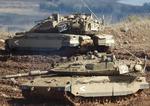
israeli_tanks_golanIsraeli tanks on the Golan

The Syrian and Hizballah military delegations visiting Tehran this week achieved their purpose: DEBKAfile’s intelligence and military sources report that in three days of talks up until Friday April 30, Syrian Defense Minister Gen. Fahad Jassim al-Freij procured from his Iranian counterpart Hussein Dehghan, approval for a stepped up terror campaign against Israeli forces and civilians on the Golan, to be executed by terrorist surrogates. Iran pledged its support for this campaign and promised to make the Revolutionary Guards and Afghani Shiite forces present in Syria available, in the event of an Israeli counter-attack.

A stamping ground, designated “the open area,” was to be provided for all terrorist militias willing to attack Israel. It would stretch from Damascus to the Golan – a distance of 60 km by road – and take in the Syrian Hermon and Lebanese Chebaa Farms. Syrian and Hizballah military intelligence services will take responsibility for coordinating their operations and providing them with arms and intelligence.

According to the plan approved in Tehran, Syria and Hizballah will establish new militias for their campaign as well as deploying existing terrorist groups.

One such framework, made up of Syrian Druzes, was set up in recent weeks. Its first attack last Sunday April 26 – an attempt to plant a bomb near an Israeli Golan border position – was a flop. All four bombers were killed in an Israeli air strike and the device did not detonate.

The commander of the new Druze militia is Samir Kuntar, a name familiar to Israelis as the murderer of the Haran family of Nahariya and two police officers, who got out of prison in 2008 after serving 36 years of a life sentence. Kuntar is a rare Lebanese Druze who joined Hizballah in his youth.

Our sources note that President Bashar Assad many times suggested setting up a special Syrian-Palestinian “resistance movement” for taking back the Golan, which Israel captured during Syria’s 1967 invasion and later annexed.

However, the terrorist attacks on Israel were left until now mostly to Palestinian squads created ad hoc for single operations. They were often drawn from Ahmed Jibril’s PFLP-General Command group or recruited in the Yarmuk refugee camp in Damascus.

But now, Assad and his Hizballah ally are set on a serious escalation by different tactics, DEBKAfile’s sources report. For a major terror offensive, they are building new frameworks with local recruits mustered in South Lebanon and the Syrian Golan. Some of those militiamen have been seen moving about in the Druze villages scattered over Jabal Druze and the Hermon up to the Chebaa farms.

How Iran Saved Obama’s “Blame America” Foreign Policy

April 29, 2015

How Iran Saved Obama’s “Blame America” Foreign Policy, Front Page Magazine, April 28, 2015

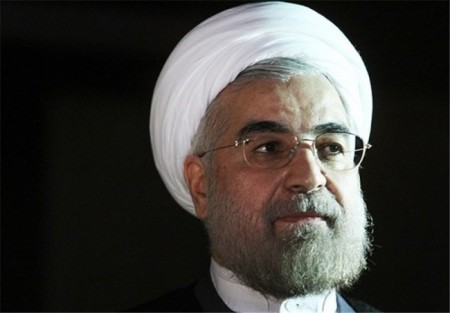
rouh-450x313

Obama’s public rejection of every ally, from Israel to Egypt to Saudi Arabia, has finally created the Post-American Middle East that his “Blame America” doctrine sought. The Post-American Middle East is a hive of terrorist groups and a region of nuclear arms races where murderous despots with vast armies dream of resurrecting the Ottoman Empire, the Persian Empire and the Abbasid Caliphate.

*********************

Obama’s Middle East policy was doomed to fail because it was based on the myth that everything wrong with the region was America’s fault.

Senator Obama had argued that Iraq would fix itself once we pulled out. Without America, the Iraqis would create a “political solution”. Instead the Shiites used the withdrawal to take over the government and Al Qaeda rebounded to dominate the Sunnis. After years of denying what was going on, he was forced back into Iraq after genocide and beheadings filled every television screen.

From the White House, he deployed the “Iraq Solution” across the Middle East by withdrawing support from American allies and backing terrorist groups like the Muslim Brotherhood. The chaos tore apart the region and turned over entire cities and countries to terrorists.

Egypt went through multiple coups. Street violence in Tunisia wrecked the country and supplied thousands of fighters to ISIS. His regime change war in Libya led to terrorist takeovers of its capital. Al Qaeda nearly took over Mali. Houthi Jihadists backed by Iran took over Yemen’s capital. The Saudis are bombing Yemen. The Egyptians are bombing Libya. The French are still fighting in Mali.

Iran and Al Qaeda have divided up Iraq, Syria and Yemen between themselves.

Withdrawing American power and influence didn’t work because we were never the problem. American soldiers weren’t causing the Sunnis and Shiites to fight each other. They were the only thing preventing it. American power and influence across the Middle East wasn’t holding back freedom and human rights, it was the only thing keeping a modicum of freedom alive in places like Egypt and Tunisia that quickly fell to Islamist rule in the Arab Spring, resulting in street violence, torture, terrorism and military coups.

The left had been fundamentally wrong about the cause of the problems in the Middle East. Obama trashed the region by following its wrongheaded doctrines.

Once the “Blame America” foreign policy has been implemented and the region went to hell, he had no idea what to do next. Intervening in Libya made sense according to the “Blame America” doctrine because Gaddafi had recently cut a deal with the United States and was obstructing the Jihadists who were implementing the local version of the Arab Spring in coordination with the Muslim Brotherhood.

But intervening in Syria didn’t. Assad wasn’t an American ally. Therefore the “Blame America” doctrine said that he should be left alone. But he was obstructing the Arab Spring. Overthrowing him would let the Muslim Brotherhood claim another country, but would alienate Iran and spoil any reconciliation.

Unable to make a final decision, Obama veered back and forth between Iran and the Muslim Brotherhood. Some days he seemed on the verge of bombing Syria and other days he was against even providing the promised weapons to the Sunni rebels. Even his supporters accused him of having no plan.

Syria’s real red line was the one that it had drawn through his foreign policy. Instead of making the Middle East better, his withdrawals had made it worse. And the beneficiaries of his foreign policy, especially the Muslim Brotherhood, were clamoring for more American military intervention.

Even Iraq’s Shiite government, backed by Iran, wanted American intervention.

Obama’s foreign policy had created a new set of untrustworthy client states which had to be kept alive by American intervention. The great joke of his foreign policy was that his new terrorist states acted just like the old dictators they were supposed to replace. They wanted American weapons and soldiers. Their own people hated them and hated America by extension. The climax of the Arab Spring came with crowds in Tahrir Square denouncing Obama and the Muslim Brotherhood for acting as his client state.

The “Blame America” foreign policy had led to even more blame of America. The new “democratic” Islamist governments that he helped bring to power to appease the Arab Street and atone for the sins of supporting the old secular-ish dictators backfired by making the Arab Street hate us more than ever.

Iran saved Obama’s foreign policy. Just as he was stumbling around Syria and weeping at being stuck back in Iraq, the agents of the Iran Lobby suggested that the whole mess could be put back together again. Iran and the US would fight on the same side against ISIS in Syria and Iraq. And this cooperation could be used to hammer out a nuclear accord that would retroactively justify Obama’s Nobel Prize.

The only problem was that everyone else in the region was completely against the idea.

The Iran Lobby threw Obama’s failed foreign policy a lifeline and he grabbed it. The bombing of Syria was off. Assad turned over some WMDs, but went on using others. The US began acting as the air force for Iran’s Shiite militias in Iraq while the Kurds and the Sunni Sheikhs of the Awakening were shut out.

When the Houthis took over Yemen, Obama shrugged. When the Saudis began bombing Yemen, they didn’t tell him because they were afraid the news would leak to Iran. And the administration covertly began pressuring them to stop, confirming that it now took its marching orders from Tehran, not Riyadh.

Obama ignored the vocal opposition, particularly from Israel’s Netanyahu, because the Iran deal was the only thing holding his foreign policy together. It made it seem as if he knew what he was doing. Take away the Iran deal and there was no longer a strategy, just a series of incoherent panicked responses.

That is why he continues to cling to the Iran deal. Without it, the Emperor’s foreign policy is naked.

The Iran deal salvaged the “Blame America” foreign policy by reorienting it away from the Muslim Brotherhood to deal with our great enemy in the region. By acceding to Iran’s nuclear program, Obama could finally fix everything by atoning for America’s biggest foreign policy sin in the region.

Despite his Muslim family background, Obama never understood the Middle East. Instead he looked at the region through a left-wing lens and saw only America’s crimes.

The Sunnis and Shiites, the Arabs, Kurds, Persians and Turkmen, weren’t fighting because of America. They were fighting over differences in religion, ethnicity and clan. The left has always thought that the way to fix the Middle East was to withdraw American influence. Instead doing that destabilized the region and created a power vacuum that Russia and Iran have been more than happy to fill.

Obama’s final foreign policy act was to fall directly into Iran and Al Qaeda’s trap.

Iran and the various Al Qaeda groups had effectively split parts of the region among themselves. By embracing Iran, Obama alienated the Sunni Middle East and shoved entire populations into Al Qaeda’s waiting embrace. He completed the polarizing process that he began with the Arab Spring by selling out the moderates to the extremists and waiting for everyone in the region to love America again.

But the Muslim Brotherhood lost out to its edgier Al Qaeda children. Egypt and the Saudis are scrambling to hold together some sort of Sunni center without the United States and against its wishes. Obama’s alignment with Iran, his rejection of Egypt’s new government and his failure to back the Saudis in Yemen has sent the message that the only legitimate alternative to Al Qaeda is Iran.

That’s not an alternative that most Sunnis can accept. Many would rather stand with Al Qaeda than Iran.

Obama’s public rejection of every ally, from Israel to Egypt to Saudi Arabia, has finally created the Post-American Middle East that his “Blame America” doctrine sought. The Post-American Middle East is a hive of terrorist groups and a region of nuclear arms races where murderous despots with vast armies dream of resurrecting the Ottoman Empire, the Persian Empire and the Abbasid Caliphate.

While genocide goes on, sex slaves are raped under the rule of a Caliph and black flags are unfurled and nuclear weapons are developed to fulfill apocalyptic Islamic prophecies, Obama smiles for the camera and waits for his second Nobel Prize.

It had been America’s fault all along. Now that Iran and Al Qaeda are in charge, everything will be okay.

Report: Kerry Told Iran He Wishes ‘U.S. Had a Leader like Iran’s Supreme Leader’

April 29, 2015

Report: Kerry Told Iran He Wishes ‘U.S. Had a Leader like Iran’s Supreme Leader’ Washington Free Beacon, April 29, 2015

(Who is fibbing?– DM)

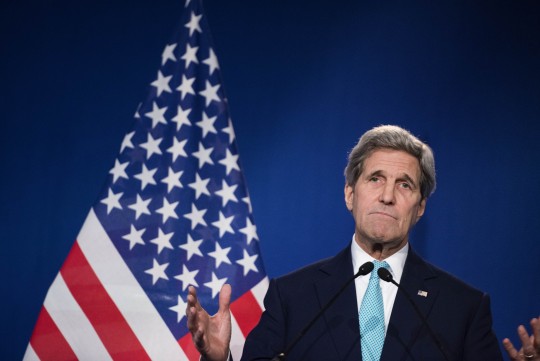
Kerry againAP

Secretary of State John Kerry told his Iranian counterpart that he wished the United States had a leader more like Supreme Leader Ayatollah Khamenei, according to comments made by a senior Iranian cleric and repeated in the country’s state-run media.

Ayatollah Alam al-Hoda claimed during Friday prayer services in Iran that in negotiations over Tehran’s contested nuclear program, Kerry told the country’s foreign minister that he “wished the U.S. had a leader like Iran’s supreme leader,” according to a Persian-language report on the remarkspublished by the Asriran news site.

“In the negotiations Kerry told [Iranian Foreign Minister Javad] Zarif that he [Kerry] wished U.S. had a leader like Iran’s supreme leader,” according to Alam al-Hoda, who is a senior member of the Iran’s powerful Assembly of Experts.

A senior administration official told the Washington Free Beacon that such a contention is patently absurd.

The remarks are the latest in a string of comments made by Iranian leaders purporting to reveal private details of the talks.

Iranian newspapers have carried multiple reports in recent months suggesting that Iranian Foreign Minister and chief negotiator Javad Zarif was ordered to stop screaming at Kerry behind closed doors.

In his Friday remarks, al-Hoda went on to say that Obama is set on striking a deal with Iran by June.

“Both Republicans and Democrats want these negotiations with Iran, but they fight each other for partisan interests,” he was quoted as saying. “Obama wants the negotiation to succeed so his party can win the next election and Republicans want to stop him.”

Alam al-Hoda also celebrated Iran’s expansion in the region and controversial activities in war-torn countries such as Syria and Yemen.

“Today, the resistance crescent has gone beyond Syria and Lebanon and reached to Yemen,” he said. “Today the resistance front is in control of Strait of Hormuz and Bab-el-Mandeb.”

The “U.S. and Israel have not been so weak anytime before,” he continues. “All these events are being managed by the hidden Imam,” a revered religious figure in Shia Islam.

Saeed Ghasseminejad, an Iranian dissident and fellow at the Foundation for Defense of Democracies (FDD), said U.S. overtures to Iran at the negotiating table have failed to win it any respect from the Islamic Republic’s leaders.

“President Obama thinks that by making more concessions he can gain the trust and respect of Iranian leaders,” Ghasseminejad said. “However, Iranian leaders neither trust him nor respect him.

“Seeing unprecedented weakness in the U.S. president, Iranian leaders do not fear the United States anymore. Partnership, trust, and alliance between the radical Islamist regime of Tehran and United States cannot and should not exist.”

Meanwhile, Zarif said over the weekend that fighting between the Obama administration and Congress over a potential final deal could not stop America from implementing any agreement the White House signs.

“As we have stated since the beginning, we consider the U.S. administration responsible for implementing the agreement and internal problems and conflicts in the U.S. are not related to us and to the implementation of the agreement, and based on the international laws, the countries’ internal problems don’t exempt them from implementing their undertakings and this is the main framework that we attach importance to,” Zarif said, according to the Fars News Agency.

On Monday, Zarif urged the United States to woo Iran.

“Maintaining an uncertain and unstable situation is not acceptable to Iran and the Americans should take practical and confidence-building measures to reach a comprehensive nuclear agreement,” Zarif was quoted as telling reporters.

Raid on Iran

April 28, 2015

Raid on Iran, Jerusalem PostHarry Moskoff, April 28, 2015

The only question now is:  when could an attack on Iran be carried out? At this point, Israel can’t afford NOT to make a strike, as the policy of the current nuclear negotiations with Iran has changed from prevention, to containment.  Indeed, all have come to agree that if the military option isn’t utilized by either the US or Israel, a nuclear Iran is simply a fait accompli.

If a preventative strike on Iran’s nuclear facilities is going to happen, it must be both before the P5+1 negotiating deadline of June 30th, and before the Russian S-300 anti-aircraft missiles are delivered and setup on Iranian soil. Indeed, if and when that eventuality comes into play, Israel may be forced to destroy that weapons convoy on route to Iran. I’m pretty sure this threat has already been issued.

**********************

As a rule, I don’t usually get involved in war scenarios, but after seeing the Israeli Air Force (IAF) jets put on their brilliant display this week for Israel Independence Day, I was inspired.  I was thinking: what if they just continued flying southwest? There’s an important point that I want to make here.

Sooner rather than later, Israel will be forced to make that raid. You know the one. It’s the BIG one. It will make the 1981 precision strike on Iraqi’s Osirak reactor, otherwise known as Operation Raid on the Sun, look like a walk in the park. Back then (just like now), when some argued that the attack would alienate both the United States and Europe, Ariel Sharon allegedly quipped “If I have a choice of being popular and dead or unpopular and alive, I choose being alive and unpopular.” Prime Minister Begin ultimately agreed and the rest of the cabinet fell in behind him. The only question now is:  when could an attack on Iran be carried out? At this point, Israel can’t afford NOT to make a strike, as the policy of the current nuclear negotiations with Iran has changed from prevention, to containment.  Indeed, all have come to agree that if the military option isn’t utilized by either the US or Israel, a nuclear Iran is simply a fait accompli.

If a preventative strike on Iran’s nuclear facilities is going to happen, it must be both before the P5+1 negotiating deadline of June 30th, and before the Russian S-300 anti-aircraft missiles are delivered and setup on Iranian soil. Indeed, if and when that eventuality comes into play, Israel may be forced to destroy that weapons convoy on route to Iran. I’m pretty sure this threat has already been issued. Effectively, we’re looking at a window of opportunity of a little over 2 months to initiate an attack that could take many hours, if not days to carry out, with hundreds or even thousands of missile strikes per day.  Simply put, if there is no attack now, Israel must prepare for the day after – a new, grim reality in the Middle East.

However, here’s an interesting point. If the arms shipment isn’t destroyed, there may be another answer to the S-300. Israel’s Defense Ministry sent a Letter of Request to Congress in 2003 asking for authorization to purchase “up to” 75 brand new, top of the line jet fighters that have significant new counter-missile capabilities. In 2010, it signed a deal with the US-based Lockheed-Martin aeronautical company for 19 F-35As, with the first few aircraft set to arrive in late 2016. The total cost of that deal was $2.75 billion, a spokesman for Lockheed-Martin said, out of which $475 million was for non-recurrent costs for the incorporation of upgraded Israeli technology. It’s interesting to note that the approximate cost of the aircrafts was (a staggering) $120 million. Each! These are stealth fighters with highly advanced radar, which will see its targets before it is seen.  Armed with the intelligence of where the surface to air missile systems are located, the IAF will then take the necessary measures to first avoid the S-300 systems, then destroy them.  What other choice is there – finding the Ark of the Covenant and using that, as in biblical times? True, the planes are insanely expensive, but obviously quite necessary!

On April 15 at Yad Vashem, and echoing his recent, now-famous address to Congress, PM Netanyahu said: “Even if we are forced to stand alone against Iran, we will not fear…”  Well folks, I dare say that we have reached that point.  Everyone knows by now that where the negotiations are concerned, the US no longer considers use of force in the cards, and quite the contrary, President Obama has indicated that even sanctions have become negotiable. People here in Israel feel that the State Dept. may even act AGAINST Israel if it unilaterally attempts a pre-emptive attack.  Besides the obvious existential threat to Israel, one of the other problems is that Iran seeks to “dominate the region” (Netanyahu’s words), and impose a Khomeini-style revolution in the Middle East.  We now see clearly that they are doing just that in places like Yemen, Syria, Lebanon, and even here in Gaza. Whether Israel sees a right-wing government emerge in the coming weeks, or even a broad-based coalition with the Left, all agree at the end of the day that it’s just a matter of time before Iran breaches their side of an already bad deal, and action will need to be taken, whether backed by the US or not.

What most Israeli’s don’t realize is that once a breach in the agreement is discovered (publicly), there is simply no way the US will neutralize Iranian capabilities with a military strike.  Obama won’t do it, and the reason why he won’t do it is because he is not prepared to cast and label Iran as an Enemy of the State. To him, those days are over and it doesn’t lie in synch with his doctrine. In fact, the US President apparently vetoed a potential Israeli attack on Iran’s nuclear facilities back in 2012. Is it so hard to see why? Back door negotiations were going on even then between the US and Iran, as Hillary Clinton recently admitted herself.  It is crystal clear that the White House CAN forcibly bring the Iranian nuclear program to a halt, it simply chooses not to do so. Will this change after, let’s say – an Iranian nuclear test?  Perhaps, but unlikely.

As such, practically speaking, can Israel attack Iran with any real success? Is it worth it? The following are some salient points to consider.

We know that Saudi Arabia has already given tacit permission for Israel to use its airspace to reach the Iranian military targets because as a Sunni Muslim state, they are considered as ‘infidels’ to Iran, who are Shiite Muslims. In fact, they have more to worry about than Israel does, and as a result of the framework agreement that was signed in Vienna, they are demanding the same rights to nuclear capabilities that Iran is apparently going to get. Credible sources state that Pakistan is now prepared to ship a nuclear package to the Saudis. As for Iran, it already has the ballistic missile capability that could hit Saudi Arabia with a warhead at the push of a button. And they know it. So does Jordan.

The truth is that Israel has sufficient nuclear and conventional power to destroy the Islamic Republic in one day in the event of any war. In this case though, we’re talking about a surprise attack (more or less). As mentioned above, Israel is believed to have a fully prepared plan to launch a strike, which by necessity, would likely involve some 80 planes, and perhaps up to several hundred aircraft according to some military experts. In reality, this has been in the planning for over 10 years. Israel possesses the advanced midair refueling capabilities required for carrying out sorties over multiple Iranian targets situated between 1,500 and 2,000 km away from home. Possible targets could include uranium-enrichment sites at Natanz and Qom, the uranium-conversion plant at Isfahan, and a heavy water reactor in Arak suspected of being used to pursue a plutonium-based nuclear arms program, as well as additional facilities. The mission would require the use of powerful, penetrating warheads, otherwise known as bunker-buster bombs, as well as possible repeated strikes to ensure success. According to a Newsweek article from September of last year, the US Congress signed and transferred 55 such bombs to Israel. Further, the attack would likely be coordinated with the assistance of Israeli intelligence satellites that could provide real time detailed images from the battle arena, as well as Airborne Warning and Control (AWAC) aircraft. It could also involve the use of a fleet of giant Heron 2 drones, which are the size of 737 commercial airliners. The UAVs form the first line of defense against an expected Iranian counterstrike, involving the launch of long-range Shihab 3 missiles, or worse.   These drones can reportedly reach Iran and hover over missile launch sites. Israel’s Arrow missile defense shield would undoubtedly also come into play to intercept missiles heading into Israeli airspace.

In terms of other forms of weaponeering capabilities, Israel maintains (at least) two elite special forces units dedicated to assisting with air strikes, one dedicated to laser target designation (Sayeret Shaldag/Unit 5101) and one to real time bomb damage assessment (Unit 5707).  These units are extremely well-trained and could potentially be infiltrated to the target zone prior to attack.  While it would be both difficult and risky to deploy these units inside Iran, they would be very useful in aiding the strike package, particularly in bad weather.

Obviously, such a strike would touch off conflict with Iran’s proxy in southern Lebanon, Hezbollah, which is armed with thousands of rockets, as well as Hamas in Gaza, and possibly with Syria. The resulting chain of events could easily lead to a major regional war and long-term instability, so much so that some senior Israeli defense figures have reportedly been rejecting the idea of attacking Iran for years.  Assuming that a military strike is issued in the near future, Israel cannot hope to destroy Iran’s entire nuclear infrastructure, as facilities are distributed across the country and there are simply too many sites to plan to attack them all.  To have a reasonable chance of success, both in the mission and in the ultimate goal of rendering Iran’s nuclear program impotent, the target set must be narrowed to concentrate on the critical nodes in Iran’s nuclear infrastructure, which seems to be growing by the day!

The main focus of an imminent strike must be to target the Natanz facility first.  Natanz is by far both the most difficult and most important target to destroy.  The main enrichment facility apparently has two large (25,000-32,000 m2) halls located 8 to 23m underground and protected by multiple layers of concrete.  The combination of large size and target hardening mean that only a very robust strike could hope to destroy or at least render unusable the centrifuges within.  In order to ensure penetration of a target with these high levels of hardening, one technique is to use the bunker busters targeted on the same aimpoint but separated slightly in release time to ‘burrow’ into the target. What happens essentially, is that one bomb hits the crater made by the previous weapon, a technique contemplated by the U.S. Air Force in the first Gulf War.  This takes advantage of the extremely high accuracy of bombs in combination with a penetrating warhead.  The IAF appears to have purchased these with this technique in mind. In fact, Gen. Eitan Ben-Eliyahu, former commander of the IAF (and a participant in the Osirak strike), commented on this method of attacking hardened facilities in Jane’s Defense Weekly: “Even if one bomb would not suffice to penetrate, we could guide other bombs directly to the hole created by the previous ones and eventually destroy any target.”

Has the point been made yet? This is just the tip of the proverbial iceberg on Israel’s military capability, and there is no doubt that the IAF can pull off an attack and get the job done. And let’s not forget about our Dolphins (nuclear subs) in the Gulf.  The factor that complicates matters so much is that, unlike in 1981 where the mission was so secret that the pilots themselves only learned of their target the day before, the US government must be notified before an attack of this magnitude.

On that note, the Obama administration has been exerting great pressure in the back halls for some time now in order to convince (even by means of veiled threats to withhold their veto power in the UN), their Israeli counterparts to refrain from issuing an attack order on Iran.  The only problem is that if Israel chooses again to wait it out and not attack, the world is bound to lie in dread of a new, powerful Iranian nuclear regime – to shake under their threat, similar to the way the world was just 70 years ago regarding the appeasement of Germany. Saudi Arabia will then look to the US for advice, and to provide an umbrella defense mechanism. Needless to say, a third world war might just emerge (heaven forbid).  This scenario is actually already depicted in the Zohar, the Midrash and other traditional Jewish texts in reference to the future world war of ‘Gog and Magog.’  Let’s pray it doesn’t come to that! In our lifetimes, or our offspring.

What bothers me the most right now though, is that even as the West is negotiating with a fanatical, expansionist Islamic regime in those posh Viennese boardrooms, the people on Tehran’s streets are chanting: “Death to the US; death to Israel” (in that order). The recent military parade echoed the same rhetoric.  HELLO…… isn’t someone paying attention over there? This is the reason why Israel shouldn’t just flex its military muscles for display to the Mullahs. It must attack. And it must attack now. This is precisely what the IDF was created for! Ben Gurion knew it. Menachem Begin knew it, and now Netanyahu knows it too. At this juncture in time, Iran cannot be trusted, and we know this to be an undeniable and unfortunately, well proven fact. Especially since, as of last week, the world discovered that Iran’s intent to destroy Israel is “non-negotiable.”  I believe that the citizens living in Israel (like myself) should, and will, accept the inevitable consequences that come with protecting our beautiful country.

A raid on Iran? My point here is:  The best defense is a good offense.

Lebanon: IDF in pre-emptive action at Shebaa Farms

April 27, 2015

Lebanon: IDF in pre-emptive action at Shebaa Farms, DEBKAfile, April 27, 2015

Israeli air and ground forces are reported by Lebanese sources Monday to be conducting preventive counter-terror action around the disputed Shabaa Farms area north of the Golan. Large IDF ground forces are scouring the area, with air force jets, drones and helicopters cruising overhead. Machine gun fire is heard occasionally. Other Lebanese sources report low-flying Israeli jets over South Lebanon.