Posted tagged ‘Islamic supremacy’

Iran’s terror general plotted Russian strikes in Syria

October 8, 2015

Iran’s terror general plotted Russian strikes in Syria, Front Page Magazine, Daniel Greenfield, October 8, 2015

(Please see also, Obama Admin’s Iran Point Man Promotes Anti-Israel Conspiracy Theories as it relates to Soleimani. — DM)

Russian propaganda claims that Putin wants to protect Christians. If he really wanted to protect Christians, he would tell his Iranian pals to stop persecuting Christians.

*********************

First, a little background on Qassem Soleimani.

“He’s got American blood on his hands,” Senator John Cornyn said of Soleimani. “I’m not sympathetic to lifting sanctions on him, that’s for sure.”

“Soleimani is the guy that sent the copper-tipped IEDs into Iraq,” said Senate Armed Services Committee Chairman John McCain, referring to powerful improvised explosive devices, which Marine Corps Commandant General Joseph Dunford testified last week were responsible for the deaths of 500 soldiers and Marines. “That is really unbelievable,” McCain said when asked about Soleimani’s name showing up in the bowels of the Iran nuclear deal.

In practice, Soleimani’s IRGC is a terrorist group despite protests from Obama and other Democrats. It’s also the key lever Iran is using to transform the region.

At a meeting in Moscow in July, a top Iranian general unfurled a map of Syria to explain to his Russian hosts how a series of defeats for President Bashar al-Assad could be turned into victory – with Russia’s help.

Major General Qassem Soleimani’s visit to Moscow was the first step in planning for a Russian military intervention that has reshaped the Syrian war and forged a new Iranian-Russian alliance in support of Assad.

As Russian warplanes bomb rebels from above, the arrival of Iranian special forces for ground operations underscores several months of planning between Assad’s two most important allies, driven by panic at rapid insurgent gains.

Soleimani is the commander of the Quds Force, the elite extra-territorial special forces arm of Iran’s Revolutionary Guards, and reports directly to Iran’s Supreme Leader, Ayatollah Ali Khamenei.

Perversely, Soleimani already enjoys US air support from Obama for his Shiite terror militias in Iraq. Now he’s got Russian air power backing his Shiite terror militias in Syria.

One of the world’s top terrorists has two air forces to play with.

Russian propaganda claims that Putin wants to protect Christians. If he really wanted to protect Christians, he would tell his Iranian pals to stop persecuting Christians.

A leaked German document confirms what we already know about Turkish support to Syrian rebels

October 8, 2015

A leaked German document confirms what we already know about Turkish support to Syrian rebels

Published October 6th, 2015 – 09:44 GMT

via SyndiGate.info

Source: A leaked German document confirms what we already know about Turkish support to Syrian rebels | Al Bawaba

Ahrar al-Sham is an ally of al-Nusra Front, Syria's al-Qaeda affiliate. (AFP/File)

Ahrar al-Sham is an ally of al-Nusra Front, Syria’s al-Qaeda affiliate. (AFP/File)

It’s a report we’ve all heard before — that Turkey, along with Saudi Arabia, is supporting Syrian rebels to help take President Bashar al-Assad down.

According to the document leaked from the German Intelligence Services, Turkey is providing Ahrar al-Sham and the Islamic Front with weapons. Turkey denied the claim again in May, but it still doesn’t come as much of a surprise.

The document shows German parliamentarian Katrin Kunert’s written request from the German government on May 18.

Here’s a translation:

… Question 25 asked which Syrian parties are receiving which type of weapons from the Turkish government (if possible please list border cities where deliveries take place).

Answer: Since mid-November of 2014, information from Federal German Intelligence Service indicate that Ankara delivers weapons to armed Syrian rebel groups. Recipients are said to be the groups Ahrar al-Sham and Islamic Front. 

German paper Die Welt (“The World”), which published a photo of the document, seemed to confirm the document’s legitimacy when it reported Germany’s attempts to find the person who leaked it to PKK-owned media.

“The German Parliament is filing charges,” said Martin Steltner, a speaker of the prosecution, according to Die Welt. “We are investigating and the investigations will continue.”

So what’s the problem with Turkey supporting these rebels? Both Salafist groups, Ahrar al-Sham and the Islamic Front are known to have more extreme goals in the Syrian conflict. Ahrar al-Sham has partnerships with al-Nusra Front, which is affiliated with al-Qaeda and sometimes considered more dangerous than Daesh (ISIS) itself.

By Hayat Norimine


turkey-syria-border


The so-called “buffer zone” — allegedly established to protect refugees and stage military operations aimed at ISIS — is a de facto no-fly zone used to protect jihadist fighters entering the country from Turkey.

More Evidence of Turkish Collusion with ISIS

Earlier this week a leaked German intelligence document confirmed reports that Turkey is directly assisting Harakat Ahrar ash-Sham al-Islamiyya, a coalition of Islamist and Salafist units that have vowed to establish a Sunni Wahhabist state under Sharia law in Syria.

Ahrar ash-Sham is aligned with al-Nusra which has pledged allegiance to the Islamic State.

The Russians understand that Ahrar ash-Sham — currently the most powerful and effective jihadist group fighting in Syria — must be targeted if it hopes to turn back the effort to unseat Bashar al-Assad.

If NATO follows through on its promise to “defend all allies” by inserting troops in Turkey’s illegal “safe zone,” it will be effectively aiding and abetting the Islamic State.

In May declassified US Defense Intelligence Agency documents from 2012 revealed the United States and its partners in the Gulf states and Turkey supported the Islamic State and plan to establish a Salafist principality in Syria.

Saudi Sheikh Yahya Al-Jana’ Waxes Lyrical about the Virgins of Paradise

October 8, 2015

Saudi Sheikh Yahya Al-Jana’ Waxes Lyrical about the Virgins of Paradise, Middle East Media Research Institute, October 7, 2015

(This must be either a warning about raping immodest women or a put-down of Viagra. — DM)

According to the blurb following the video,

In a lesson posted on the Internet on September 1, 2015, Saudi Sheik Yahya Al-Jana’ talks about the joys of Paradise, saying that men will have the strength of a hundred men in Paradise and will be busy “tearing hymens,” while the virgins of Paradise, whose breasts are “like pomegranates,” become virgins every time again.

The Conventional Wisdom on Putin is Dangerously Wrong

October 8, 2015

The Conventional Wisdom on Putin is Dangerously Wrong It’s not about ‘order’—it’s about empire

BY: Aaron MacLean October 8, 2015 5:00 am

Source: The Conventional Wisdom on Putin is Dangerously Wrong – Washington Free Beacon

 The official Washington line on Vladimir Putin’s military action is as follows: It is a mistake,

The official Washington line on Vladimir Putin’s military action is as follows: It is a mistake, demonstrating Russian weakness, sure to get the Russian military stuck in a “quagmire,” according to President Obama. Josh Earnest, the president’s press secretary, took that observation one further, comparing Putin’s policies to those of the Bush administration (the sickest of White House burns) by arguing the Russians “will not succeed in imposing a military solution” just as the U.S. did not succeed in imposing one in Iraq. Adopting the characteristic snark of his boss, at a later press conference Earnest assessed Putin not to be “playing chess—he’s playing checkers.” Ash Carter, the secretary of defense, weighed in by noting that the Russian strategy was “a backward approach that’s sure to backfire.”

If the Syria deployment is such an obvious mistake, why is Putin doing it? The conventional wisdom has concluded that his actions are driven by fear. The Assad regime, long friendly to Moscow, was about to fall, and Putin takes a dim view of the collapse of sovereign states as a consequence of popular uprisings or foreign interventions. Steven Lee Myers, long time Moscow correspondent for the New York Times, is out with a perfectly timed book assessing Putin’s life and ideology. Applying his broader argument to the case of Syria in the Times, Myers says:

Many have variously interpreted Mr. Putin’s intervention in Syria as a response to domestic pressures caused by an economy faltering with the drop in oil prices and sanctions imposed after Crimea; a desire to change the subject from Ukraine; or a reassertion of Russia’s position in the Middle East.

All are perhaps factors, but at the heart of the airstrikes is Mr. Putin’s defense of the principle that the state is all powerful and should be defended against the hordes, especially those encouraged from abroad. It is a warning about Russia, as much as Syria.

Myers’ argument fits well with the White House’s assessment, and has been echoed in publications friendly to the administration’s policies. You know who else agrees? Vladimir Putin—without the emphasis on fear and the expectation of failure, of course. But in his address last week to the United Nations, Putin made an argument that journalists like Myers have largely taken at face value:

It seems, however, that instead of learning from other people’s mistakes, some prefer to repeat them and continue to export revolutions, only now these are “democratic” revolutions. Just look at the situation in the Middle East and Northern Africa already mentioned by the previous speaker. Of course, political and social problems have been piling up for a long time in this region, and people there wanted change. But what was the actual outcome? Instead of bringing about reforms, aggressive intervention rashly destroyed government institutions and the local way of life. Instead of democracy and progress, there is now violence, poverty, social disasters and total disregard for human rights, including even the right to life.

I’m urged to ask those who created this situation: do you at least realize now what you’ve done?

It is no small irony that the same American politicos and journalists who are quick to accuse their domestic political opponents of acting in bad faith now go to impressive lengths to take the Russian president at his word, and to see him as a man whose actions are, if foolish, at least driven by an understandable sense of self-preservation and a realist’s principled opposition to disorder. Indeed, when there are no cameras around, those friendly to the administration will tell you that Putin’s intervention is actually a great boon to American policy, and that our opposition to Assad has been misguided from the start. This wing of American politics, the members of which seem to believe that they are “realists,” believes that the American presence in the Middle East is at the root of the instability there.

Putin understands this all too well, and much of his UN speech was pitched directly at the consciences of these men and women. It was impossible not to chuckle at the strongman’s chutzpah when, nearing his conclusion, Putin explained his hope to partner with other nations on an “issue that shall affect the future of the entire humankind”—climate change. In his recent 60 Minutes interview with Charlie Rose, Putin parried a question about the rule of law in Russia by invoking American race relations—a tried and true rhetorical gambit of the Soviet era:

How long did it take the democratic process to develop in the United States? Do you believe that everything is perfect now from the point of view of democracy in the United States? If everything was perfect there wouldn’t be the problem of Ferguson. There would be no abuse by the police. But our task is to see all these problems and to respond properly.

Putin understands American liberals better than most of them understand themselves, and lightyears better than they understand him. This is among the reasons their assessment of his motivations is so misleading and incomplete. By presenting his actions as essentially reasonable and defensive in nature, by continuing, humiliation after humiliation, to hope that Putin will one day be their partner, they fail to focus their analysis on the dark core of his beliefs, which are ironically the very traits they believe compromise American conservatism: toxic nationalism and neo-imperialism.

He’s not trying that hard to hide it. Consider the terrifying implications of this remark, also from the Charlie Rose interview:

I indeed said that I believe that the collapse of the USSR was a huge tragedy of the 20th century. You know why? … Because, first of all, in an instant 25 million Russian people found themselves beyond the borders of the Russian state, although they were living within the borders of the Soviet Union. Then, all of a sudden, the USSR collapsed—just overnight, in fact. And it’s turned out that in the former Soviet Republics—25 million Russian people were living. They were living in a single country. And all of a sudden, they turned out to be outside the borders of the country. You see this is a huge problem. First of all, there were everyday problems, the separation of families, social problems, economic problems. You can’t list them all. Do you think it’s normal that 25 million Russian people were abroad all of a sudden? Russia was the biggest divided nation in the world. It’s not a problem? Well, maybe not for you. But it’s a problem for me.

This is not an offhand aside. This is a casus belli, and racialist rhetoric one tends to identify with fascism. It is coming from a man who has invaded two nations in the last decade, has his sights set on NATO, and has just made a big play for dominance in the Middle East, to which Obama is all but certainly going to acquiesce completely. It is true that Putin fears phenomena like the Color Revolutions and the Arab Spring, but it is dangerously wrong to reason further that the man who seized Crimea in a surprise attack has some sort of principled preference for order over chaos. It isn’t order he wants. It’s the return of the Russian Empire.

ISIS training militants from Russia in Afghanistan, ‘US and UK citizens among instructors’

October 8, 2015

ISIS training militants from Russia in Afghanistan, ‘US and UK citizens among instructors’

Published time: 8 Oct, 2015 10:27

Edited time: 8 Oct, 2015 12:48

Source: ISIS training militants from Russia in Afghanistan, ‘US and UK citizens among instructors’ — RT News

Islamic State is training militants from Russia in Afghanistan as part of its efforts to expand into Central Asia, a senior Russian diplomat told a security conference in Moscow. He added that US and UK passport holders are among the instructors.

“There are several camps operated by [Islamic State, previously ISIS/ISIL, in Afghanistan] that train people from Central Asia and some regions of Russia. They speak Russian there,” said Zamir Kabulov, President Putin’s special representative for Afghanistan.

He added that there is a wide national variety of instructors in those camps. There are Arabs, Pakistanis and even people with US and British citizenship, he said.

Russian intelligence estimates the number of militants in Afghanistan who have pledged allegiance to the Syria- and Iraq-based Islamic State, at 3,500, Kabulov said, and the number is rising.

“The rise of [Islamic State] in Afghanistan is a high-priority threat. Just think about it: [ISIS] showed up in Afghanistan for real just a year ago, and now it has 3,500 fighters plus supporters who may be recruited into the ranks of the militants,” he said.

Overall, there are some 50,000 fighters belonging to more than 4,000 militant groups in Afghanistan, said Army General Valery Gerasimov, who heads the Russian General Staff. He was addressing the same conference in Moscow, which is discussing the security situation in Afghanistan. The Afghan Taliban is by far the strongest militant movement in the country, with some 40,000 fighters in their ranks.

But their dominant position is being challenged by Islamic State, which sees Afghanistan as a recruiting ground, a source of income and a foothold for further expansion over Central Asia, reported Colonel General Igor Sergun, the head of the Main Intelligence Directorate, Russia’s military intelligence agency.

“ISIL [a former name for Islamic State, along with ISIS] uses the worsening of the situation in Afghanistan to strengthen its position,” he said, adding that such development poses a real threat to Russia’s security.

“We estimate that ISIL gets new troops by bribing field commanders of Taliban, the Islamic movement of Uzbekistan and other radical religious organizations operating on Afghan territory,” Sergun said.

Russia believes that if Islamic State is allowed to grow in Afghanistan unchecked, the group could spread its influence north toward Russia and east to China’s Xinjiang Uyghur Autonomous Region, the general said. There the jihadists would be recruiting people from national minorities and local terrorist organizations.

The Afghan government in Kabul is unable to turn the tables on the militants, despite having superior weapons and numbers, Sergun said. He blamed poor planning skills of Afghan commanders and bad training of their troops for it.

On the other hand, Afghan tribal society resists ISIS’s ideology, which makes the terrorist group’s effort to gain support somewhat more difficult, the general said.

“The will to fight for ISIL in most cases comes from financial interest. But at the same time, the ISIL message is spreading quickly among the educated youth who have access to the internet and other media that is spreading the radical version of Islam,” Sergun warned.

slamic State is targeting radical fighters in Afghanistan who are falling for ISIS propaganda, accusing Taliban leaders of abandoning the fight against the United States and the government in Kabul, Sergun reported. This year alone clashes between the Taliban and ISIS have claimed an estimated total of 900 lives on both sides, he added.

Russian officials accused Washington of orchestrating the deterioration of security in Afghanistan and the expansion of Islamic State there.

“It seems like someone’s hand is pushing freshly trained ISIL fighters to mass along Afghanistan’s northern border. They don’t fight foreign or Afghan government troops,” Kabulov said.

He added that on several occasions Taliban groups that refused to join Islamic State were “set up” to be targeted by airstrikes.

“The Afghan Army practically has no aircraft. Only the Americans do. These details bring some very bad thoughts and concerns. We have to take them into account and draw conclusions accordingly,” he said.

Sergun said the US has a long-term goal of preventing stabilization in Central Asian countries and surrounding Russia and China with a network of regimes loyal to America and hotspots of tension.

Iranian Terrorist Attack Against U.S. Revealed

October 8, 2015

Iranian Terrorist Attack Against U.S. Revealed

By Arnold Ahlert — Bio and Archives

October 8, 2015

Source: Iranian Terrorist Attack Against U.S. Revealed

A bombshell report by the Washington Times reveals that fecklessness in the face of terror isn’t a condition exclusive to the Obama administration. “Bill Clinton’s administration gathered enough evidence to send a top-secret communique accusing Iran of facilitating the deadly 1996 Khobar Towers terrorist bombing,” the Times states, “but suppressed that information from the American public and some elements of U.S. intelligence for fear it would lead to an outcry for reprisal, according to documents and interviews.”

Nineteen American servicemen were killed in that attack and another 372 people were wounded when a tanker laden with plastic explosives was driven into the parking lot and detonated next to the eight-story dormitory used for U.S. Air Force personnel assigned to the Gulf. A U.S. indictment was issued in 2001 charging 13 Saudis and a Lebanese man with the crime for which then-Attorney General John Ashcroft blamed Iran, stating they “inspired, supported and supervised members of Saudi Hezbollah.” Yet no Iranian officials were named or charged, nor was the Iranian government accused of any legal responsibility for the atrocity.

According to memos obtain by the Times, the intelligence demonstrating Iranian involvement in the attack was characterized as extensive and credible. It included interviews by the FBI of a half-dozen Saudi co-conspirators who told the agency their passports were provided by the Iranian embassy in Damascus. They further revealed they reported to a top Iranian general, and received training from Iran’s Revolutionary Guard (IRGC), according to FBI officials.

The Times further notes the revelation about what former President Clinton knew has taken on “new significance” due to the August announcement that Ahmed al-Mughassil, described by the FBI in 2001 as both head of the military wing of Saudi Hezbollah and the alleged leader of the attack, had been captured. According to the Saudi newspaper Asharq Al-Awsat, al-Mughassil was arrested in Beirut and transferred to Riyadh. U.S. officials contend his capture has revealed new evidence of Iran’s and Hezbollah’s complicity in the attack—as well as Clinton administration efforts to shield both from responsibility.

Former FBI Director Louis Freeh minced no words describing what occurred. “The bottom line was they weren’t interested,” he stated during an interview. “They were not at all responsive to it. They were looking to change the relationships with the regime there, which is foreign policy. And the FBI has nothing to do with that. They didn’t like that. But I did what I thought was proper.”

Freeh insists that when he initially sought help from the Clinton White House to gain access to the Saudi suspects, he was repeatedly turned down. When he went around the Clinton and succeeded in bringing the evidence to light, it was dismissed as “hearsay,” and a request was made not to disseminate it to others because the administration was endeavoring to improve relations with the world’s foremost state sponsor of terror. Freeh was also dismissed as a partisan when he revealed the same allegations in a book he wrote a decade ago about his time with the bureau. The same Clinton defenders further insisted the evidence obtained by Freeh was inconclusive.

“But since that time, substantial new information has emerged in declassified memos, oral history interviews with retired government officials and other venues that corroborate Mr. Freeh’s account, including that the White House tried to cut off the flow of evidence about Iran’s involvement to certain elements of the intelligence community,” the Times reports.

Damning memo sent in 1999 by Clinton to newly-elected Iranian President Mohammad Khatami.

The chief piece of evidence cited by the paper is a damning memo sent in 1999 by Clinton to newly-elected Iranian President Mohammad Khatami. Clinton stated the American government “has received credible evidence that members of the Iranian Revolutionary Guard Corps (IRGC), along with members of Lebanese and Saudi Hizballah were directly involved in the planning and execution” of the bombing. Clinton insisted the United States viewed the evidence “in the gravest terms,” and though the atrocity had occurred before Khatami’s election those responsible “have yet to face justice for this crime.” Clinton further stated “the IRGC may be involved in planning for further terrorist attacks against American citizens,” and that such a possibility remains a “cause of deep concern to us.”

The 2001 indictment was issued after Clinton left office, and whatever doubt remained about Iranian involvement in the crime was shattered in 2006, when U.S. District Judge Royce C. Lamberth ruled that Iran was responsible for the bombing, and ordered the Iranian government to pay $254 million to the families of 17 Americans who died. “The totality of the evidence at trial . . . firmly establishes that the Khobar Towers bombing was planned, funded, and sponsored by senior leadership in the government of the Islamic Republic of Iran,” Lamberth wrote.

Following the linkage of Iran to the attack, Clinton had initially ordered the military to come up with plan for a retaliatory strike, and gave the CIA the green light to pursue “Operation Sapphire” aimed at disrupting Iranian intel operations in several nations. Yet just like our current president, Clinton believed the election of the ostensibly more moderate Khatami would produce a thaw in the U.S./Iranian relationship leading to Iran aiding the investigation, and renouncing terror.

Iran pushed back with a vehement denial—and a threat to publish Clinton’s cable to Khatami. Clinton officials were scared such a revelation would force the president’s hand. “If the Iranians make good on their threats to release the text of our letter, we are going to face intense pressure to take action,” wrote top Clinton aide Kenneth Pollack in a Sept. 15, 1999 memo.

As the evidence linking Iran to the crime piled up, the administration was backing down, speculating that Saudi Arabia was fanning a Shia-Sunni confrontation and that it would be better to work with the new Iranian regime rather than dealing with the possibility of engendering a wider war against terror, according to former aides. Thus, despite the State Department and FBI getting increased cooperation from the Saudis with regard to Iranian involvement, the flow of information suddenly stopped. “We were seeing a line of traffic that led us toward Iranian involvement, and suddenly that traffic was cut off,” said career intelligence officer Wayne White, who served as deputy director of the State Department’s Bureau of Intelligence and Research’s Office of Analysis for the Near East and South Asia.

When White tried to get the intel flowing again, he discovered “the stream had been cut off by Sandy Berger, and the original agency producing the intelligence was struggling to work around the roadblock,” he said. Berger was Clinton’s top security aide—and the man who was fined $50,000 following his 2008 conviction for illegally removing highly classified documents from the National Archives, some of which he intentionally destroyed.

White’s account was confirmed to the Times by several U.S. officials “with direct knowledge of the matter” including Freeh, who also revealed he tried to get around Berger by contacting former President George H.W. Bush, who had a good relationship with the Saudis. “I explained to him what my dilemma was and asked if he would contact the Saudis. And he did,” Freeh revealed. White noted that intel analysts didn’t want Iran involved in the attack because of the serious long-term ramifications it would engender for America. But when the evidence became irrefutable, he was disgusted with the administration’s politically-motivated reaction. “You cannot provide your intelligence community selective intelligence without corrupting the process, and that was an outrage,” he declared.

It is an outrage allegedly reprised by the Obama administration, which has been accused by 50 intelligence analysts working out of the U.S. military’s Central Command of doctoring their reports in an effort to downplay the danger ISIS and the Syrian branch of al Qaeda presented. The same Obama administration got equally traitorous Democrats to sustain a filibuster against the Iran deal in Congress. The GOP abetted the outrage, allowing a vote to proceed despite the law requiring all parts of that agreement, including Iran’s “side deals” with the International Atomic Energy Agency (IAEA) to be part of the process. Their cowardice was exemplified by Senate Majority leader Mitch McConnell, who refused to invoke the nuclear option and force a vote on what is arguably the most important national security issue of our time.

Exactly like Bill Clinton, who also promised us the Agreed Framework of 1994 would prevent a nuclear North Korea, Obama is embracing appeasement with Iranian Islamo-fascists responsible for far more American deaths than the Khobar Towers attack. Beginning with the 1979 hostage crisis, during which Americans were beaten and placed in solitary confinement, Iran has precipitated numerous instances of aggression, including kidnapping and murder, against America. The terror timeline is highlighted by 1983 U.S. Embassy bombing in Beirut, killing 17 Americans and the Beirut barracks bombing that killed 241 U.S. Marines. Moreover their involvement in both Afghanistan and Iraq cost at least 500 American soldiers their lives, according to Congressional testimony presented last July by current Joint Chiefs of Staff Chairman Marine Corps Gen. Joseph Dunford. And one is left to wonder if Iran’s propensity for killing Americans was part of the equation to which our contemptible Secretary of State John Kerry referred, when he admitted the part of the Iranian deal that frees up billions of dollars for their use will be devoted to “nefarious activities.”

Like the Clinton administration before them, the Obama administration is indulging the fantasy they can improve relations with terrorist thugs whose contempt for America hasn’t diminished an iota in 37 years. And as these revelations from the Washington Times indicate, Bill Clinton and his apparatchiks were every bit as dishonest as Barack Obama and his equally duplicitous underlings when it came to pursuing an agenda utterly inimical to American interests and security. Make no mistake: both men have demonstrated a willingness to countenance the murder of their fellow countrymen in pursuit of appeasement. Times have changed. The unconscionable nature of the Democratic/progressive mindset with regard to America’s enemies remains a constant.

Robert Spencer: The speech the U.S. Catholic Bishops don’t want you to see

October 7, 2015

Robert Spencer: The speech the U.S. Catholic Bishops don’t want you to see, Jihad Watch via You Tube, October 5, 2015

(An excellent explication of differences between Islam and Christianity and the theological bases for the animosity of religious Muslims toward religious Christians. Please see also, Evangelicals Embrace Islamists at Maryland Interfaith Event. — DM)


According to the blurb beneath the video,

Jihad Watch director Robert Spencer was the keynote speaker at the annual convocation of the North American Lutheran Church, Dallas, Texas, August 13, 2015. He spoke about Muslim persecution of Christians.

The U.S. Conference of Catholic Bishops pulled their representative from the North American Lutheran Church convocation when they found out Spencer was the keynote speaker. Watch this speech and see what the Catholic Bishops of the United States don’t want you to know.

Russia’s endgame in Syria: Follow the Money

October 7, 2015

Russia’s endgame in Syria: Follow the Money, Center for Security Policy, John Cordero, October 6, 2015

(Is Putin engaging in a holy war against the Islamic State, an oily war or both? — DM)

3300795117

The one strategic motivation for Russia that has been widely ignored is the economic one.  Qatar, the richest country in the world per capita and also owner of the world’s largest natural gas field, proposed in 2009 to jointly construct a gas pipeline running through Saudi Arabia, Jordan, Syria, Turkey, and into Europe.  Assad, not wanting to provoke Moscow, refused to sign on.  Instead, he floated an alternative: an Iran-Iraq-Syria and possibly Lebanon pipeline, to then follow under the Mediterranean to Europe. The Qatar-Turkey pipeline would run through majority Sunni countries with the exception of Syria’s Alawite regime. Assad’s counter proposal follows the Shia crescent.

Russia, not wanting to lose its primary market in Europe, is adamantly opposed to a prospective Qatari project.  A military presence in Syria will guarantee that even if Assad is removed from power, the pipeline will not be built.  It will look on favorably to the Iranian proposal, provided Gazprom and other state-owned companies get their share of the pie.

****************************

As Vladimir Putin orders airstrikes against rebels of all stripes fighting Bashar al-Assad’s regime, there are important strategic economic goals behind Russia’s actions in Syria.  The short term goal is easy to discern: prevent Assad’s collapse as no alternative suitable to Russian interests exists, preserve Russia’s only naval base in the Middle East at Tartus, and promote Russia both at home and abroad as a world power that counterbalances American hegemony.

Much of the media has focused on Putin as a personal driver of Russian behavior.  While forays into Georgia and Ukraine have accomplished the tactical goals of preventing increased European Union presence in Russia’s sphere of influence, these have come at a high cost both politically and economically in the form of isolation and sanctions. Putin seems to have concluded that intervening in Syria in the name of fighting terrorism can only help repair Russia’s battered image.

It is important to at least try to understand Putin’s motivation without delving too much into psychoanalysis.  He is on record as lamenting the collapse of the Soviet Union as “the greatest geopolitical catastrophe of the 20th century.”  In power since 2000, the former KGB officer is an ardent Russian nationalist, a promoter of a personality cult concerned with his country’s standing and perception in the world.  With his career spent in the service of the state, he is not one to take a background role in world affairs. Putin has effectively used Russia’s alliance with Iran as an effective tool to undermine the US, both regionally in the Gulf and globally with the nuclear deal.

The current buildup at Tartus and Latakia is nothing new: since Hafez al-Assad’s rise to power in 1970, the Former Soviet Union and then Russia was and is a stalwart ally, long attempting to position Syria as a counterbalance to American and Israeli military superiority in the Middle East.

Russia’s actions are also a message to the world: unlike the US, which abandoned long-time ally Hosni Mubarak during his time of need in Egypt, Russia is prepared to intervene, militarily if necessary, to preserve a friendly regime in danger.  Therefore, it pays for autocrats to court Moscow, especially if they possess valuable resources or are in prime strategic locations.

While Vladimir Putin ostensibly espouses the acceptable goal of a global alliance against IS, the strategic context is that he has entered into a sectarian alliance with Shia Iran, Iraq, Syria, and the proxy army Hezbollah (The P4+1) against the American-backed Sunni alliance of Turkey, Saudi Arabia, Qatar, Jordan, and the UAE, all of whom insist that Assad has no future in Syria.

Through its airstrikes, Russia continues to advance the prior Syrian strategy of focusing efforts against pro-Western rebels, with the recognition that, while dangerous, the Islamic State is the one party in the conflict the West will never support.

The Islamic State will take advantage of both the respite, and the propaganda value of being the recognized number one enemy of the infidel coalition, which it uses to rally supporters simply by pointing out that its enemies are gathering to destroy the renewed Caliphate.

The one strategic motivation for Russia that has been widely ignored is the economic one.  Qatar, the richest country in the world per capita and also owner of the world’s largest natural gas field, proposed in 2009 to jointly construct a gas pipeline running through Saudi Arabia, Jordan, Syria, Turkey, and into Europe.  Assad, not wanting to provoke Moscow, refused to sign on.  Instead, he floated an alternative: an Iran-Iraq-Syria and possibly Lebanon pipeline, to then follow under the Mediterranean to Europe. The Qatar-Turkey pipeline would run through majority Sunni countries with the exception of Syria’s Alawite regime. Assad’s counter proposal follows the Shia crescent.

Russia, not wanting to lose its primary market in Europe, is adamantly opposed to a prospective Qatari project.  A military presence in Syria will guarantee that even if Assad is removed from power, the pipeline will not be built.  It will look on favorably to the Iranian proposal, provided Gazprom and other state-owned companies get their share of the pie.

Pipeline politics in the region have a long and varied history of Russian involvement.  The Baku-Tbilisi-Ceyhan oil pipeline was built only after Moscow’s demand for an alternative pipeline for Azeri oil to Russia was met.  During the 2008 Russia-Georgia war, US intelligence officials determined that an explosion on the pipeline near the Turkish-Georgian border was carried out via Russian government cyber warfare.  Days after the explosion, Russian fighter jets bombed positions in Georgia close to the pipeline. Although the BTC pipeline was built precisely to avoid Russian interference, the Kremlin has never let that stop them.

Turkey and Azerbaijan have also begun construction on a joint natural gas pipeline, theTANAP. This project’s stated goal is to reduce the EU’s dependence on Russian natural gas, a prospect that cannot please Moscow.   Both the BTC and TANAP bypass Armenia, a Russian ally and wary of its neighbors in the Caucasus.

As the endpoint for the Qatari project, Turkey is adamant in calling for Assad to step down or be removed, which dovetails with the proposed Sunni pipeline.  By clearing the way through Syria, Qatar and Saudi Arabia can receive a handsome return on their investment in backing jihadis fighting Assad.  On the other hand, Iran will not sit idly by and leave potential billions of dollars in the hands of its ideological and regional enemies.

Russian intervention in Syria is just beginning. There is every possibility that it will expand as more targets are found, perhaps those that are in the way of the proposed Iranian pipeline, directly threatening Damascus and by extension, the Russian monopoly of gas exports to Europe.  For the time being, Putin has the world’s attention.

Egypt’s secular culture minister ruffles Salafi feathers

October 7, 2015

Egypt’s secular culture minister ruffles Salafi feathers, Al-MonitorRami Galal, October 6, 2015

(Building a secular Muslim state in a region dominated by Islamists is difficult and takes time, as Egypt and Al-Sisi are learning. — DM)
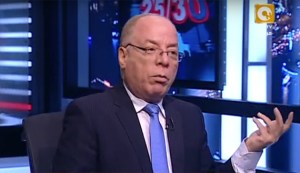
helmiEgypt’s newly appointed Culture Minister Hilmi al-Namnam appears on the Egyptian talk show 25/30, Nov. 11, 2014. (photo by youtube.com/ONtv)

CAIRO — On Sept. 19, a new Egyptian Cabinet, headed by Prime Minister Sherif Ismail, was sworn in before President Abdel Fattah al-Sisi. Among the new ministers is the journalist Hilmi al-Namnam, who holds the culture portfolio. The appointment of Namnam, a secularist, has sparked controversy among Egyptian Salafis and aroused opposition in Saudi Arabia. Such Saudi writers and intellectuals as Jamal Khashoggi, editor-in-chief of Al-Arab News Channel, object to Namnam’s appointment because he opposes Wahhabi Salafism, the religiopoliticial movement that originated in the Nejd region of the Saudi kingdom.

Muhammad ibn Abd al-Wahhab founded what became the Wahhabi movement in the 18th century. In 1744, Wahhab allied with Muhammad ibn Saud, emir of the Nejd and founder of the first Saudi state, to increase followers of the Quran, Sunnism and the words and actions of the Salaf, the first three generations of Muslims. In doing so, they sought to purify Islam of misguided practices negatively affecting the Islamic essence of unity and various forms of heresy.

Immediately after Namnam assumed the culture portfolio, a video of him from July 2013 went viral. In it, Namnam stated, “The political Islam current must leave the political game completely, especially the Salafist Nour Party, which is more dangerous than the Muslim Brotherhood.” He compared the Nour Party to a “whore who extorts her husband if he doesn’t fulfill her demands by escorting someone else.” Namnam also said, “We lie when we say Egypt is a naturally religious country. It is high time we said Egypt is a naturally secular state.”

The Nour Party came in second in the 2012 parliamentary elections. Among its positions at the time were prohibitions on electing women and Copts, saluting the flag and singing the national anthem. The party altered these platforms, however, after lending its stamp of approval in 2013 to the June 30 revolution, although most of its leading figures waivered over what course to take.

On Sept. 19, Shaaban Abdel Aleem, a member of the Nour Party’s board, requested information on the selection criteria used for appointing the new ministers. On the same day, Khashoggi, who is close to Saudi decision-makers, commented on Namnam’s appointment via Twitter. “For whoever is planning mutual cultural exchanges with our brothers in Egypt, the following piece of information could be useful: Namnam is not only a critic of Wahhabism, but abhors it and blames it for all his country’s catastrophes,” Khashoggi tweeted. In a separate tweet, he wrote, “Honestly, for the sake of relations between Saudi Arabia and Egypt, and due to the nature of the regime there, Egypt should not appoint a minister like Namnam, who has taken it too far in offending the kingdom.”

Namnam responded that evening in a phone call to “Al-Ashera Masaa,” a show on Dream TV, saying, “I did not say Wahhabism was the mother of vices. These are not my words, but I am against terrorist groups in general.” He added that he had criticized “attempts to export Wahhabism to Egypt,” but that he “respects the kingdom’s choices, just as the kingdom’s writers should respect Egypt and Egyptians’ choices.”

Khashoggi immediately replied, again on Twitter, writing, “Egypt’s minister of culture claims he respects Wahhabism, but admits that he is against exporting it to Egypt. I would like to tell him that Wahhabism cannot be exported. It is a pillar of the Egyptian revolution and is represented by emblematic figures like the followers of Sheikh Muhammad Abduh.” The Islamic jurist Abduh, an Egyptian, is a founder of Islamic modernism. He spearheaded the movement at the end of the 19th century, beginning of the 20th century to counter intellectual and cultural stagnation and revive the Islamic nation in line with the times.

Khashoggi argued, “Salafism preceded the Muslim Brotherhood in Egypt, as there was the Ansar al-Sunna al-Muhammadiyah group, which remains the oldest reformist Islamic organization in Egypt and the world.” Ansar al-Sunna al-Muhammadiyah seeks absolute unity and the rejection of superstitions and cults. It began in Cairo’s Hadara Mosque in 1926. Many Al-Azhar scholars and Salafist preachers were welcoming of it.

On Oct. 2, tensions escalated when Namnam said during an interview on the Sada al-Balad channel that he was ready to be “martyred to spare Egypt from turning into a caliphate state.” He added that secularism is not the adversary of Islam, as some claim. “Every moderate Muslim is necessarily secular. But, not every secularist is a Muslim,” he said.

The following day, Yasser Borhami, deputy leader of the Salafist Call, implored Sisi to intervene and forbid Namnam from making such statements, which he said contradict the constitution given that Sharia is the primary source of legislation.

Nour Party leader Younes Makhyoun entered the fray Oct. 3, asserting that Namnam should remain impartial or be dismissed. “The person [Sisi] who appointed this minister must oblige him to respect the constitution,” he stated.

Sayyed Mustafa, deputy chair of the Nour Party, told Al-Monitor, “The party did not look into Namnam’s old opinions, because they stem from personal freedom. Each person has the right to believe whatever they wish. But he must realize that he is the minister of culture for 90 million Egyptians. The Ministry of Culture should represent all currents, not just one, be it secular or nonsecular.” He added, “As a minister handling a political portfolio, Namnam must take into consideration Egypt’s foreign relations in general and brotherly relations in particular, like those it shares with Saudi Arabia.”

Zubeida Atta, former dean of Helwan University’s faculty of arts and a member of the Supreme Council of Culture, has a different perspective on the issue. “The concept of secularism that Namnam called for is not a heretical one. It relies on the use of education and its application in countries to improve them and ensure their civil aspects, instead of mixing religion with political life. The latter [mixing of the two] would send Egypt down a sectarian abyss that would threaten its existence,” she told Al-Monitor. “The Nour Party demanded clarifying the selection criteria of ministers. I demand clarifying the criteria that allow such a religious party to participate in political life and in parliamentary elections.”

As for the rumblings from the Gulf, Atta asserted, “Egypt does not dare suggest a Saudi Arabian minister for a certain ministry in the kingdom or criticize a current minister in the Saudi Arabian regime, because this is an internal Saudi Arabian matter. Why is Khashoggi, among others, allowing himself to interfere in the appointment of a minister in the Egyptian Cabinet?”


Disgusting video encourages Arabs to murder Jews

October 7, 2015

Disgusting video encourages Arabs to murder Jews, elderofziyon2 via You Tube, October 6, 2015


This video was released apparently from Gaza telling Arabs to attack Jews.

Not Israelis – Jews.