Posted tagged ‘Islamic State’

How Iran continues to deceive the West

January 27, 2015

How Iran continues to deceive the West

By Missing Peace

via How Iran continues to deceive the West | Missing Peace | missingpeace.eu | EN.


Last week’s IAF strike on a Hezbollah convoy near Kuneitra on the Israel-Syria border in which six members of the Iranian Revolutionary Guard Corps (IRGC) were killed has led to increased Iranian threats to annihilate the Jewish State.

Iranian top officials vowed to hit Israel with ‘devastating thunderbolts’ that would cause “the collapse of the Zionist regime”. The IAF strike killed Brig. Gen. Mohammad Ali Allahdadi who oversaw Iranian military actions in Syria on behalf of Syrian president, al-Assad.

The presence of the IRGC members on the Golan Heights in Syria has led to speculation that Iran and Hezbollah were on the verge of executing a military operation against Israel.

Eyal Ben Reuven, a retired Israeli major general and former deputy head of the Northern Command of the Israeli Defense Forces (IDF) last week said that if the “highest level of Hezbollah and IRGC commanders were in the Golan Heights it means that what they’re planning could be an operation on a high level”.

Other reports claimed that Hezbollah planned to bring rocket launchers to the Kuneitra area in order to open a new front against Israel from the Golan Heights.

This seems to be pure speculation. The fact of the matter is that IRGC members were on a reconnaissance mission on the Golan Heights.

What does that mean? It is new evidence of Iran’s success in advancing its strategy for Syria and other parts of the Middle East (Iraq,Yemen,Gaza,Bahrain)

The aim of this strategy is to widen Iran’s influence in the Middle East and beyond. It is for this reason too that Iran develops nuclear weapons and long-range ballistic missiles and it is one of the reasons it aims to destroy Israel, the sole regional superpower. It is therefore more reasonable to assume that Israel delivered a strong signal to Iran to not upset the delicate status quo on the Golan Heights and that it will put limits on Iran’s activities adjacent to Israeli borders.

Iran’s involvement in Syria

Israel apparently realizes that Iran has taken over control of (what remains of) Syria from President al-Assad.

Here is how that happened.

In late 2012 Assad was on the ropes in his battle with opposition groups such as al-Nusra in the north of Syria and the area around Damascus. He had to make tough choices and decided to shift his forces from the Qusayr area to the area of Damascus and to eastern Ghouta and Daraya.

At that point Hezbollah and IRGC stepped in to defend Qusayr to make sure that Homs would not be cut off from Damascus and to secure access from the Beqaa Valley in Lebanon to Damascus and Homs.

However as has become clear from a recent Der Spiegel report there was another reason for the Iranians to step in at Qusayr.  The German Magazine reported on January 9th that it had obtained secret information that made clear that the world had again been misled about Syria’s nuclear ambitions. A new nuclear facility had been built after Israel destroyed Syria’s nuclear reactor in Deir al-Zur in 2007.

This new nuclear facility is located west of Qusayr, two kilometers from the border with Lebanon.  The area saw heavy fighting between al-Nusra and elite Hezbollah units in the spring of 2013. Hezbollah suffered heavy losses but succeeded in holding the area.

Intercepted radio traffic between a high-ranking Hezbollah operative and Ibrahim Othman, the head of the Syrian Atomic Energy Commission delivered the clearest proof that an underground nuclear facility has been built in Qusayr.  The Hezbollah man referred to the site as the “atomic factory”.  During the intercepted conversations he also mentioned that members of the IRGC were working at the facility.

According to Der Spiegel it is almost certain that Chou Ji Bu, the  engineer who built the nuclear reactor in Yongbyon in North Korea is also involved in the new nuclear project at Qusayr.

Der Spiegel labeled the secret facility at Qusayr “a new Syrian push for nuclear weapons”. However the area has been controlled by Hezbollah and the Iranian Revolutionary Guard since mid-2013. The commander of the Iranian paramilitary al-Quds Force, Qassem Soleimani was the one who fully orchestrated the Hezbollah take-over of Qusayr.

Though it is true that al-Assad originally directed the work in Qusayr that began in 2009, today it is clear that Hezbollah and the IRGC are the ones controlling the facility.

Members of the Free Syrian Army in the area of Qusayr reported on January 12th that Iranian officers were supervising the secret facility and that the Syrian regime is only a cover-up for this.

Another indication that Iran has de facto taken over Syria came from IRGC commander Haji Zadeh. He said that Iran is now manufacturing Iranian missiles on Syrian soil. He also said that Iranian missiles were made to hit Israel in the first place.

From Zadeh’s statement it becomes clear that Iran uses the territory of Syria to advance its quest for regional domination and to advance its plans for the destruction of Israel.

Qusayr and JPOA

It is no coincidence either that Iran now controls a nuclear facility outside its own territory. Although Syria is a signatory to the Treaty on the Non-Proliferation of Nuclear Weapons inspections by the IAEA are not possible because of the turmoil in the country. This is an ideal situation for Iran that is currently negotiating with the P5+1 countries about a deal designed to curb its nuclear program.

Under the Joint Plan of Action (JPOA) that was part of the interim deal between Iran and the six UNSC countries from November 2013, Iran should halt activities at its plutonium plant in Arak. The White House fact sheet stated: “Iran has committed to no further advances of its activities at Arak and to halt progress on its plutonium track.”

Observers were quick to notice that the text contained a loophole. The reference to activities at Arak seemed to allow unlimited research and work on locations away from the site as long as they did not physically happen at Arak.

Later it became clear that Iran had noticed the loophole too. Foreign Minister Zarif announced that Iran would continue construction at the facility. State Department spokeswoman Jen Psaki did not see any problem when reporters pressed her on the issue. “What’s the big deal about a road here or a building there”, she said.

Foreign Policy last month reported that the United States has privately accused Iran of an international shopping spree to acquire components for a heavy water reactor such as in Arak. The magazine wrote that a U.S. delegation informed a UNSC panel of experts that Iranian procurement agents have been increasing their efforts to illicitly obtain equipment for the reactor at the Arak nuclear complex.

It is not clear yet what type of nuclear facility has been built at Qusayr. Weapons expert Jennifer Dyer says it is certainly not a centrifuge facility like the complexes in Natanz and Fordo in Iran. It could be a plant where yellowcake is converted to UF4 and is metalized into fuel rods for a reactor. But it also could be a plutonium facility.

The reactor in Deir al-Zur was assessed to be a gas-graphite reactor like the one in Yongbyon, North Korea. That reactor could produce enough plutonium for one or two plutonium bombs per year, Dyer wrote.

Whatever the type of nuclear facility in Qusayr, the fact is that Iran has decided to use Syrian territory to advance its nuclear program.  The US State Department however, insists that the facility in Qusayr has nothing to do with the Iranian nuclear program and that the issue will not be discussed in the ongoing negotiations with Iran.

Israeli TV shows Iranian IBM

Other evidence of Iran’s aggressive ambitions was published by Israeli TV Channel Two last week.

The Channel showed a satellite image taken by the Israeli EROS B satellite of a twenty seven meter long Iranian Intercontinental Ballistic Missile (IBM) on a launch pad close to Teheran. This type of missile is generally used to carry a nuclear warhead and can reach the United States.

The existence of such a missile was known to Israeli intelligence. But Channel Two now reported that although images of the missile were never shown in the US and Europe, the existence of the IBM has been known to the West for at least two years. So both EU and US knew about the existence of the missile before they signed the interim agreement with Iran.

Iran is obligated by United Nations Security Council resolutions to suspend work on ballistic missiles. The images published by Channel Two clearly show that Iran has violated these UNSC resolutions.

More astonishing however, is the fact that the JPOA that was part of the interim agreement between Iran and the 5+1 countries did not impose any restrictions on ballistic missile development. Originally an US National Security Council official said that an Iranian ballistic-missile test would” be in violation of the agreement” and cause the deal to “cease to exist”.         Obama officials however, clarified their stance. Instead of imposing absolute restrictions on such tests, the JPOA apparently imposed no restrictions on ballistic missile tests. As a result Iran now possesses a missile that can carry a nuclear warhead to the United States.

Twelve fruitless years of negotiations

These recent developments involving Iran show clearly that the regime in Teheran has not changed its ways and is still advancing its agenda of exporting the Islamic revolution by destabilizing the region.

It is also very clear that Iran keeps making progress on its nuclear program and is only conducting talks with the P5+1 -countries to buy time.

How do we know this? In fact it is a simple story. The West has been negotiating with Iran for twelve years now. Iran’s position has remained unchanged since 2003 when the EU3 countries started to engage Iran regarding its nuclear program, through 2008 when U.S. Under Secretary of State William Burns joined the negotiations, until today when the Obama administration is trying to obtain a deal.

The regime in Teheran insists on its right to enrich uranium and to build new nuclear facilities. Iran continues to work on the development of ballistic missiles which are used to carry nuclear warheads. The Iranians also breached the JPOA by feeding gas into IR-5 centrifuges and by testing advanced IR-8 centrifuges.  They illicitly acquired parts for their heavy-water reactor and busted through energy caps every single month of the deal. Iran is also heavily involved in a new nuclear facility in Syria that could be a plutonium plant.

Last week IAEA director Yukiya Amono  said that Iran still refuses to give the Atomic Agency all the information it needs to determine if all of the Iranian nuclear activities are for peaceful purposes.

Here is what Amono said during a speech at the University of Indonesia last Friday: “As far as Iran is concerned, the Agency is able to verify the non-diversion of nuclear material declared to us by Iran under its Safeguards Agreement. But we are not in a position to provide credible assurance about the absence of undeclared nuclear material and activities in Iran, and therefore to conclude that all nuclear material in Iran is in peaceful activities.”

When the moment of truth came in the current negotiations in July and November last year the Iranians refused once again to accept the proposals to limit their nuclear program.

At the same time the positions of the West have totally collapsed. Gone is the demand that Iran dismantles its centrifuges and ship its uranium stock to a third country. Also gone is the demand that Iran ceases all uranium enrichment as well as the demand to downgrade its plutonium reactor. And finally the original demand to halt all proliferation-sensitive missile activity has gone too.

The original Western threat that “all options (including the military) are on the table” to stop Iran from becoming a nuclear threshold power has become a joke. Now the U.S. administration even opposes a Congressional bill to impose deadline-triggered sanctions against Iran if no reasonable deal is reached by July of this year.

During a closed-door meeting of Senate Democrats in Baltimore last week Obama charged that the Congressmen who favor the bill were doing so only to please “donors”. Everybody in the room understood that he meant Jewish and pro-Israel donors. Senator Robert Menendez who initiated the bill took this as a personal affront but Obama didn’t back away from his statement.

In CBS’ ‘Face of the Nation’ Senator John McCain this weekend said that the president has lost touch with reality. He said that Iran is on the march everywhere and there is no strategy to defeat them. McCain stated that there is a need for congressional ratification of any agreement that is made and that it is important that Israeli PM Netanyahu speaks to the American people about the dangers of a nuclear Iran.
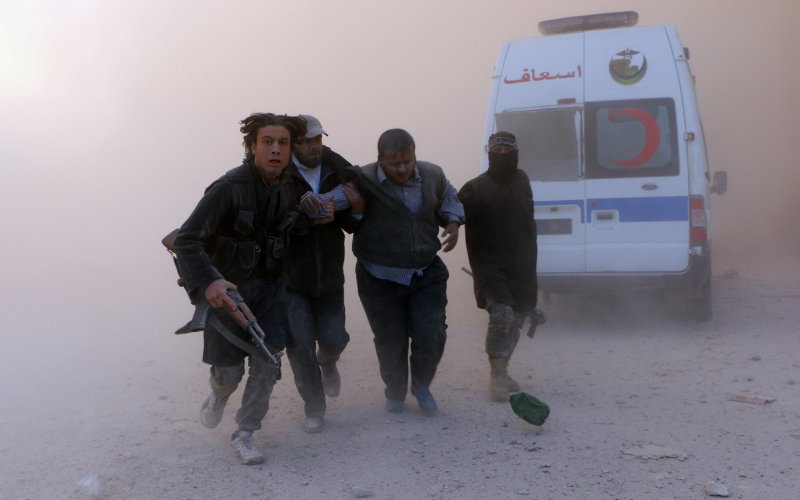
Exclusive: Obama Cuts Funds for the Syrian Rebels He Claims to Support

January 27, 2015

Exclusive: Obama Cuts Funds for the Syrian Rebels He Claims to Support, Daily Beast, January 27, 2015

1422366030311.cachedFadi al-Halabi/AFP/Getty

LOST CAUSE?

Even the favored secular militias groomed to fight ISIS have seen their funding cut in half.

GAZIANTEP, Turkey — In the past several months many of the Syrian rebel groups previously favored by the CIA have had their money and supplies cut off or substantially reduced, even as President Obama touted the strategic importance of American support for the rebels in his State of the Union address.

The once-favored fighters are operating under a pall of confusion. In some cases, they were not even informed that money would stop flowing. In others, aid was reduced due to poor battlefield performance, compounding already miserable morale on the ground.

From afar, the U.S.-approved and partially American-armed Syrian “opposition” seems to be a single large, if rather amorphous, organization. But in fact it’s a collection of “brigades” of varying sizes and potentially shifting loyalties which have grown up around local leaders, or, if you will, local warlords. And while Washington talks about the Syrian “opposition” in general terms, the critical question for the fighters in the field and those supporting them is, “opposition to whom?” To Syrian President Assad? To the so-called Islamic State, widely known as ISIS or ISIL? To the al Qaeda affiliate, Jabhat al Nusra?

That lack of clarity is crippling the whole effort, not least because of profound suspicions among rebel groups that Washington is ready to cut some sort of deal with Assad in the short or medium term if, indeed, it has not done so already. For Washington, the concern is that the forces it supports are ineffectual, or corrupt, or will defect to ISIS or Nusra—or all of the above.

Republican lawmakers in D.C. are at their boiling point over the Obama administration’s anti-ISIS strategy, whether it is a failure to establish a no-fly zone in Syria, or unreliability with the issue of aid, or the Pentagon’s promised train and equip plan for the Syrian rebels.

“This strategy makes Pickett’s Charge appear well thought out,” said Sen. Lindsey Graham of South Carolina, referring to the poorly-planned and futile Confederate assault at Gettysburg. “We’re about to train people for certain death.”

In late October, al Qaeda’s Jabhat al Nusra routed American-backed militias in the northwest Syrian province of Idlib.

As a direct result, four of the 16 U.S.-approved brigades operating in the northern part of the country had their funding cut off and have been dropped from the list of “ratified” militias, say a State Department official and opposition sources. Since December, the remaining 12 brigades in the region have seen shortfalls or cuts in promised American assistance.

Syrian rebel sources who spoke on condition of anonymity say the 7thDivision, which is affiliated with the Syria Revolutionaries Front and aligned to the Free Syrian Army, has not received salaries from the CIA in months, although the State Department has maintained food shipments to the unit.

The secular Harakat al-Hazm, the most favored of the U.S.-backed brigades and one of the very few to be supplied with TOW anti-tank missiles, has seen a severe cutback in the monthly subsidy for its nearly 4,000 fighters. It is now receiving roughly 50 percent of the salaries it was receiving before. Weapon shipments arrived recently but commanders are nervous about whether future ones will come through. And the Farouq Brigade, a militia formed originally by moderate Islamist fighters based in the city of Homs, is getting no money for salaries at the moment.

CIA officials tell rebel commanders that unspecified “other funders” have ordered the cuts, or that Langley just doesn’t have the resources any longer. “What are the fighters meant to do?” complains one rebel commander. “They have families to feed.” Another says, “The idea that they don’t have the money is insulting. I don’t believe this—it is a political decision.”

Syrian rebel groups and their Washington, D.C. allies argue that CIA funding cuts —explained and unexplained—create relative advantages for extremist groups like al Nusra and ISIS, even as the president heralds the rebels as America’s on-the-ground-partners in the campaign to defeat the self-proclaimed Islamic State.

“It’s not just that the administration is failing to deliver on committed resources, it’s that they aren’t even communicating with formerly affiliated battalions regarding the cutoff,” says Evan Barrett, a political advisor to the Coalition for a Democratic Syria, a Syrian-American opposition umbrella group. “This puts our former allies in an incredibly vulnerable position, and ensures that groups like al Nusra will be able to take advantage of their sudden vulnerability in the field.”

The Obama administration says publicly that its support of moderate rebel brigades is not waning: the State Department continues to dispense non-lethal aid, the Pentagon supplies weapons, and the CIA pays salaries to brigades affiliated with the umbrella organization known as the Free Syrian Army. A CIA spokesman declined to comment for this story.

Privately, U.S. officials concede there have been funding changes. But American intelligence sources insist this is not a reflection of any shift in CIA strategy. They talk about “individual case-by-case shut offs” that are the consequences of brigades collapsing or failing to perform. And these sources dispute suggestions there’s an overall decrease in CIA subsidies, saying they are not giving up on the Syrian rebels—even though the Syrian rebels in the north of the country in the vicinity of the Turkish border increasingly believe this to be true. (Those in the south, near the Jordanian border and Damascus, may fare better.)

A State Department official told The Daily Beast that “the CIA has more money now than before and the State Department pie has not shrunk,” but confirms there has been some cutting off and cutting down. The official cited the “poor performance” of rebel brigades in Idlib last October as a primary reason.

When they were up against al Nusra, this official said, “they didn’t fight hard enough.” Several moderate brigades failed to come to the assistance of the Syria Revolutionaries Front, in particular, because they disapproved of its leader, who has been widely accused of corruption. The ease with which al Nusra was able to pull off its offensive angered U.S. officials—as did American-supplied equipment falling into jihadist hands.

That anger was compounded when the members of some U.S.-backed rebel groups actually defected to al Nusra during the offensive. One senior U.S. official admitted that some brigades have been “getting too close for our liking to al Nusra or other extremists.”

On Christmas Day armed groups formed an alliance for the defense of besieged rebel-held areas in Aleppo, where Assad had launched a major offensive to encircle them. Al-Jabha al-Shamiyya (Shamiyya Front), as the operational alliance is called, includes not only hardline Salafist factions from the groups known as the Islamic Front but more moderate brigades like the Muslim-Brotherhood-linked Mujahideen Army and Harakat Nour al-Din al-Zenki, which also has received TOW anti-tank missiles from Washington in the past.

Although al Nusra was not invited to join formally, it coordinates with the Shamiyya Front via the so-called Aleppo Operations Room, a joint headquarters for armed factions. It’s an arrangement that Washington does not like at all.

Aleppo-based rebels say they have no choice but to work with al Nusra and the Islamic-Front-aligned factions that are among the strongest armed groups in the war-torn city. Without them Assad’s forces would overwhelm the rebels.

“What do the Americans expect us to do?” asks a commander in the operations room. “Al Nusra is popular here. It is a perilous time for us—Assad is pushing hard.”

Syrian rebel sources who spoke on condition of anonymity say the 7th Division, which is affiliated with the Syria Revolutionaries Front and aligned to the Free Syrian Army, has not received salaries from the CIA in months, although the State Department has maintained food shipments to the unit.

The secular Harakat al-Hazm, the most favored of the U.S.-backed brigades and one of the very few to be supplied with TOW anti-tank missiles, has seen a severe cutback in the monthly subsidy for its nearly 4,000 fighters. It is now receiving roughly 50 percent of the salaries it was receiving before. Weapon shipments arrived recently but commanders are nervous about whether future ones will come through. And the Farouq Brigade, a militia formed originally by moderate Islamist fighters based in the city of Homs, is getting no money for salaries at the moment.

CIA officials tell rebel commanders that unspecified “other funders” have ordered the cuts, or that Langley just doesn’t have the resources any longer. “What are the fighters meant to do?” complains one rebel commander. “They have families to feed.” Another says, “The idea that they don’t have the money is insulting. I don’t believe this—it is a political decision.

For the Syrian rebels, uncertainties over funding changes by the CIA add doubt to already high skepticism over American policy toward the war in Syria. That skyrocketed when the Obama administration failed to enforce in 2013 its “red line” against Assad’s alleged use of chemical weapons, and the skepticism has merely grown since.

On the ground, the combatants say they suffer from the Obama administration’s inconsistency and argue that all too often they are being left out to dry, like some Syrian version of the Bay of Pigs, but much, much bloodier.

In the coffee shops of the Turkish border town Gaziantep last week, Syrians gathered on the safer side of the frontier listened incredulously as State Department spokesperson Jen Psaki insisted, “We maintain our belief that al Assad has lost all legitimacy and must go.” It was the first such inflexible anti-Assad statement for weeks from a senior U.S. official.

But that wasn’t what they’d heard from President Obama in his State of the Union address a few days before. Gone was the rhetoric of 2013 when he said he had “no doubt that the Assad regime will soon discover that the forces of change cannot be reversed, and that human dignity cannot be denied.” Instead, last Tuesday Obama spoke about the administration’s so-called train-and-equip plan to build a force that will target ISIS, and he made vague noises about helping Syria’s moderate opposition.

Those moderates are precisely the men and women on the ground who feel that bit by bit they are being abandoned.

Already, nearly four months after Secretary of State John Kerry announced the plan to train and equip Free Syrian Army units, Kurdish Peshmerga, and Iraqi Shia militiamen as anti-ISIS forces, the project appears to be facing major hurdles.

U.S. Senators emerged grim-faced last week from a classified briefing on the train-and-equip mission, with some of them predicting disaster from a Pentagon program that will train too few fighters and too slowly to make a difference.

At its best, Republican senators argue, it’s not going to work. At its worst, it will lead to the mass slaughter of the trained rebels.

“This strategy makes Pickett’s Charge appear well thought out,” said Sen. Lindsey Graham of South Carolina, referring to the brave but futile Confederate assault at Gettysburg. “We’re about to train people for certain death.”

The number of recruits required for a “strategic change in momentum is years away,” said Graham. “The concept of training an army that will be subject to slaughter by two enemies, not one, is militarily unsound,” and “if the first recruits you train get wiped out, it’s going to make it hard to recruit.”

Sen. Jeanne Shaheen, a Democrat who emerged from the same classified briefing, was tight-lipped: “I think we have a lot to do, and a lot of questions to answer.”

In Syria, few rebel fighters want to join a force focused only on ISIS. They argue that Assad is responsible for considerably more deaths among them and their extended families than ISIS, which is able to draw defectors from their ranks because it pays much higher salaries to its fighters and because it is able to exploit distrust of American intentions towards the Syrian revolution.

U.S. officials now acknowledge difficulties recruiting from insurgent ranks, conceding it is a serious challenge finding enough recruits willing to put off fighting the Assad regime.

So American officials recruiting for the train and equip mission are now hoping to fish in the pool of rebel fighters from eastern Syria who disbanded, quit the war and fled to Turkey when ISIS established control of the cities of Raqqa and Deir ez-Zor. The U.S. officials say the anti-ISIS force in Syria will have to be smaller than envisaged initially, but they are hoping early victories on the ground will convince more people to enlist.

Two rockets fired from Syria at Israel, IDF returns fire

January 27, 2015

Army fires 20 artillery shells at Syrian positions from which rockets launched at northern Golan originated; no injuries or damages reported on Israeli side.

Ynet reporters

Latest Update: 01.27.15, 14:36 / Israel News

via Two rockets fired from Syria at Israel, IDF returns fire – Israel News, Ynetnews.


At least two rockets from Syria hit the northern Golan Heights on Tuesday and IDF returned fire, nine days after an Israeli air strike in Syria killed an Iranian general and several Lebanese Hezbollah fighters.

The IDF said it fired 20 artillery shells at Syrian positions from which the rockets originated. The rockets hit open areas and no injuries or damages were reported.

Residents in Druze villages near the border reported to hearing several explosions, shortly after a Code Red rocket alert siren was sounded near the border.

IDF soldiers evacuating visitors from Hermon ski site.

The IDF has instructed the evacuation of some 1,000 visitors from the Hermon Mountain ski site, and the resort has been closed until further notice.

Officials at the Hermon ski site said the rockets fell in several places in the Golan Heights. “Following this, the IDF instructed to evacuate the visitors from the Hermon site … the IDF is also at the scene,” they said.


the Hermon ski site (Photo courtesy of Hermon ski site
Visitors being evacuated from the Hermon ski site (Photo courtesy of Hermon ski site)

Residents in the Maron Golan area were asked to remain close to safe rooms and shelters and farmers in the area were instructed to evacuate. Israel Police briefly blocked all roads leading to the Golan Heights, and has since re-opened all but the ones leading to the Hermon.

Fighting in neighboring Syria’s civil war has spilled over to Israel in the past. Mortar shells have exploded sporadically inside Israeli territory since the conflict began, sometimes causing minor damage. Israel believes most fire is errant shots but has at times accused Syria of aiming at Israeli targets. Israeli troops have returned fire on several occasions.

This time, however, “it does not seem that it was errant fire,” Lieutenant-Colonel Peter Lerner, an IDF spokesman, told Reuters.

Hezbollah’s Al-Manar TV network reported that Israel Air Force planes were circling over the Israel-Syria border at Quneitra on the Israeli side.

The IDF raised its alert level on the northern front last Monday in positions along the border with Syrian and Lebanon and deployed an Iron Dome rocket interceptor battery near the northern border, after a strike attributed to Israel killed senior Hezbollah officers and an Iranian general nine days ago. Both Hezbollah, which is backed by Iran and fought a 34-day war with Israel in 2006, and the Revolutionary Guards vowed to avenge the deaths.

On Sunday, a number of roads were closed amid a possible security incident along Israel’s northern border. Shortly afterwards the roads were reopened, indicating that if there was an event it had come to an end.

Senior security sources in Lebanon who are affiliated with Hezbollah recently said that the attack, in which Iranian general Mohammad Ali Allahdadi and the son of master terrorist Imad Mughniyah were killed, “shows that Israel has crossed the red line in the security war with Hezbollah, which means the rules have changed.”

This is an ongoing event, updates are forthcoming.

Yoav Zitun, Ahiya Raved, Michal Margalit, Reuters, AP contributed to this report.

Obama and cognitive dissonance

January 26, 2015

Obama and cognitive dissonance, Dan Miller’s Blog, January 26, 2015

(The views expressed in this article are mine and do not necessarily reflect those of Warsclerotic or its other editors. — DM)

It has been argued that Obama’s cognitive dissonance is demonstrated by His dealings with Iran and His other disruptive efforts in the Middle East.  Perhaps the contrary is more accurate.

Basis of His foreign policies?

Basis of His foreign policies?

An article at Front Page Magazine by Bruce Thorton is titled The Dangers of Obama’s cognitive dissonance (also at Warsclerotic). It argues that Obama mistakenly believes that Iran and “we” want many of the same things and that He acts on that belief.

The heart of this mistake is the belief that whatever their professed beliefs, all peoples everywhere are just like us and want the same things we want. Since our highest goods are peace and prosperity, we think other nations’ privilege the same things. If peoples behave differently, it’s because they are warped by poverty or bad governments or religious superstitions, and just need to be shown that they can achieve those boons in rational, peaceful ways, especially by adopting liberal democracy and free-market economies. Once they achieve freedom and start to enjoy the higher living standards economic development brings, they will see the error of their traditional ways and abandon aggression and violence, and resolve conflicts with the diplomacy and negotiation we prefer. [Emphasis added.]

The Islamic Republic of Iran most likely does want peace and prosperity, but on its own terms.

Iran hangings by crane

Iran wants Islamic “peace” — the peace of universal submission to (a Shiite?) Allah — and at least sufficient prosperity to force its will on others who do not want “peace” of that sort. If Iran gets (or gets to keep) nuclear weapons, along with increasingly longer range missiles, it will be in an increasingly improved position to do that.

Obama may well have very similar goals for Iran. His demands that the P5+1 process continue despite Iran’s persistent refusals to make significant concessions, even as it continues to enhance its nuclear war machine, and His disposition to give Iran whatever concessions it wants, suggest that His and Iran’s objectives are similar. There is support for an alternative, that Obama is simply delusional. However, unless His closest, most trusted and therefore most important advisors are at least equally delusional, that alternative makes little sense. Although she appears to be a despicable person, Valerie Jarrett seems quite competent at what she does on His behalf. Others fall on their swords, fall into line and salute or leave.

Obama’s “extraordinary disconnect” in foreign policy was recently highlighted on CBS’ Face the Nation.

John Bolton said much the same.

Is it more likely that Obama merely fails to understand what’s happening, or that He understands and likes it? His State of Union address was full of foreign policy nonsense, much of it about Iran. However, it seems to have worked quite well with the large segment of the American public which neither understands nor cares about foreign affairs (except amusing affairs of a salacious nature) and believes that He strives mightily to give them the “free stiff” they believe they want, without understanding the economic hardships it has brought and will bring to them. If members of the public who already worship Him (and that includes most of the “legitimate news” media) continue to do so, it may well make little if any difference to Him or to His closest advisors whether those who disagree with Him still like, or continue to like, Him.

Leftist beliefs

After all, as we learned at the Democrat National Convention that nominated Obama for a second term, “we all belong to the Government,” it’s “one big happy family” and Obama is the head of “our family.”

In the final analysis, it may make little difference whether Obama is incompetent and delusional or is competent, understands His plans for Iran and the rest of the world far better than the rest of us and has perverse conceptions of evil and good.

Both theories are worth considering because both can help us to understand what He does, why He does it and what He intends to accomplish. However, delusional actions and intentions are difficult for those who are not delusional to understand and therefore to challenge. Actions and intentions that are, instead, based on a rational thought process — but one that views evil as good and good as evil — are easier to understand and therefore to challenge.

As I have watched Obama and His accomplishments over the years, I have come to lean toward the notion that He is competent, evil, understands what He is trying to achieve and likes it.

The Dangers of Obama’s Cognitive Dissonance

January 26, 2015

The Dangers of Obama’s Cognitive Dissonance, Front Page Magazine, January 26, 2015

ol-450x253

The worst crisis we face is the relentless progress Iran is making toward creating nuclear weapons, a development that would set off an arms race in the Middle East and destabilize an already chaotic region. The Islamic Republic has already extended its malign influence into Syria, Lebanon, and Yemen, creating a Shi’a crescent that threatens our allies in the region, especially Israel, Jordon, Egypt, and Saudi Arabia. If a failed gangster-state like North Korea can demand so much international attention just because it possesses nuclear weapons, think what Iran––with 3 times the population and the world’s 3rd largest oil reserves––could do. Oil won’t stay cheap forever.

Obama, in short, can say that “all options are on the table” all he wants, but the mullahs know he will not take military action against them, nor help Israel to. They know that Obama has withdrawn from the region, and at best will make only token gestures of engagement, like the current bombing campaign against ISIL. They know his ultimatums and “red line” threats are empty. They know he wants a deal more than they do, so he can burnish his legacy. Thus the Iranians are spinning out the negotiations, cadging extensions, pocketing concessions without reciprocating, and giving Obama just enough hope to think he can achieve what he thinks will be a Nixon-goes-to-China foreign policy coup, but will in fact will go down in history as a humiliating and dangerous blunder like Chamberlain’s Munich debacle.

*********************

There are many moments from the past 6 years that demonstrate the criminal incompetence of this president and his administration. But for me, Obama’s interview with GloZell––whose claim to YouTube fame comes from eating Cheerios in a bathtub filled with milk––represents best the essential emptiness, triviality, and sheer dumbness of this president. Imagine Franklin D. Roosevelt in 1938 being interviewed by a carnival geek, and you can gauge just how low the most consequential political office in the world has sunk.

This interview, remember, took place the same time as problems requiring urgent presidential attention were escalating. Libya imploding, Iran inching toward a nuclear bomb, ISIS expanding in Syria and holding ground in northern Iraq, Iranian military assets active in Iraq, Yemen falling to an Iranian proxy terrorist group, another Iranian client, Bashar al Assad, strengthening his hold over Syria––and that’s just the Middle East. And don’t forget, the GloZell farce followed hard on Obama’s State of the Union address, a congeries of wishful thinking, narcissistic braggadocio, and outright-lies, a preposterous catalogue in which generous sprinklings of first-person-pronoun fairy dust transmuted every failure into an achievement.

It is the contradiction between fact and fiction, evident in every line of the president’s speech, that typifies progressives in general. This cognitive dissonance may simply be nothing more than the grubby machinations of those who will say and do anything for political power and the wealth and influence it brings. In other words, they know they are hypocrites. But it also could be something more dangerous than a venal character and moral corruption. One gets the feeling that many progressives actually believe what they say, that they are reciting the mantras of their ideological cult, no matter how contrary to reality or their own actions. What’s more important is that whatever the source, this failure to acknowledge reality, to think critically, and to respect intellectual coherence is dangerous to all of us, especially in the many foreign policy crises that have mushroomed on Obama’s watch.

And the worst crisis we face is the relentless progress Iran is making toward creating nuclear weapons, a development that would set off an arms race in the Middle East and destabilize an already chaotic region. The Islamic Republic has already extended its malign influence into Syria, Lebanon, and Yemen, creating a Shi’a crescent that threatens our allies in the region, especially Israel, Jordon, Egypt, and Saudi Arabia. If a failed gangster-state like North Korea can demand so much international attention just because it possesses nuclear weapons, think what Iran––with 3 times the population and the world’s 3rd largest oil reserves––could do. Oil won’t stay cheap forever.

But in the face of this threat, Obama has appeased the mullahs under the guise of diplomatic “engagement” and negotiations, the time-proven way to avoid action while pretending to do something. Indeed, so besotted is he by his faith in diplomacy that he has threatened to veto a Congressional bill that would strengthen his negotiating position by toughening economic sanctions, the best non-lethal shot we have for changing the Iranians’ behavior, given the current decline in their oil revenues. But what we see here is a problem that transcends any one president or Secretary of State, for it reflects the intellectual error and failure of imagination peculiar to modernity.

The heart of this mistake is the belief that whatever their professed beliefs, all peoples everywhere are just like us and want the same things we want. Since our highest goods are peace and prosperity, we think other nations’ privilege the same things. If peoples behave differently, it’s because they are warped by poverty or bad governments or religious superstitions, and just need to be shown that they can achieve those boons in rational, peaceful ways, especially by adopting liberal democracy and free-market economies. Once they achieve freedom and start to enjoy the higher living standards economic development brings, they will see the error of their traditional ways and abandon aggression and violence, and resolve conflicts with the diplomacy and negotiation we prefer.

The problem with this scenario is not that other peoples don’t want freedom and prosperity, or are incapable of achieving them. Rather, it is that they often have other goals more important than the ones we prize. Like religion, for example, or national honor, or revenge. We may think such motives are irrational avatars from an uncivilized past, but they are still drivers of action in individuals and nations alike. They may be, to quote Orwell on the Nazis, “ghosts” out of the premodern world, but they’re still “ghosts which need a strong magic to lay them.”

Of course, if weaker than an enemy or rival, such a people may conceal these motives, and pretend to play by the rules of the more powerful, until they are strong enough to use force to achieve their aims. In such situations, diplomatic engagement becomes a tactic for achieving through words what cannot be gained through deeds. As Robert Conquest said of our Cold War negotiations with the Soviets, “The Soviets did what their interests required when the alternative seemed less acceptable, and negotiation was merely a technical adjunct.”

History shows the truth of this insight, from the Munich Conference in 1938, to the many arms reduction treaties with the Soviet Union, which we know the Soviets and now the Russians have serially violated. More pertinent for Iran is the sorry history of the diplomatic attempts to prevent North Korea from developing nuclear weapons. For decades we indulged in cycles of concessions, agreements, conferences, and violations that all ended up with the North announcing it had gone nuclear. The failure to learn from that recent history is evident in Obama’s current reprise of that sordid dance in his engagement with Iran.

This is not to say that diplomacy can’t ever work. But to be effective, negotiation has to start with a clear understanding of the other side’s motives. One must avoid the “trap,” as Conquest called it, “of thinking that others think, within reason, like ourselves. But this trap is precisely the error that must be avoided in foreign affairs.” The rulers of Iran may lust after wealth and secular power, the default materialist motives recognized by the West. But that greed can coexist with their messianic, apocalyptic strain of Shi’a Islam, and the acceptability of violence in service to their faith that characterizes traditional Islam.

Thus when Muslim warriors tell us, as they have for 14 centuries, that they love death as we love life; when they proclaim, as Mohammed, Iran’s Ayatollah Khomeini, Osama bin Laden, and the Fort Hood jihadist did, “I was instructed to fight all men until they say there is no god but Allah,” we’d better listen and take them seriously, rather than brush aside such profound religious beliefs as mere camouflage for materialist motives. Yet so blind is Obama to this truth, that he and his officials stubbornly refuse even to utter a phrase like “Islamic extremist,” since he has decided that all the Muslim violence roiling the world every day has “nothing to do with Islam.”

Second, diplomacy can work only when backed by a credible threat of force. The other side must believe that mind-concentrating violence will punish them for negotiating in bad faith and violating agreements. In the case of Iran, the mullahs must believe that we will put to the test their love of death and longing for paradise. But our long history with the Islamic Republic has proved the opposite. Iran has never been punished for taking our embassy staff hostage in 1979, for instigating the murder of 241 of our soldiers in Beirut in 1983, or for training and funding the terrorists who have killed our troops in Iraq and Afghanistan, or for being the world’s leading promoter of terrorist violence.

Obama, in short, can say that “all options are on the table” all he wants, but the mullahs know he will not take military action against them, nor help Israel to. They know that Obama has withdrawn from the region, and at best will make only token gestures of engagement, like the current bombing campaign against ISIL. They know his ultimatums and “red line” threats are empty. They know he wants a deal more than they do, so he can burnish his legacy. Thus the Iranians are spinning out the negotiations, cadging extensions, pocketing concessions without reciprocating, and giving Obama just enough hope to think he can achieve what he thinks will be a Nixon-goes-to-China foreign policy coup, but will in fact will go down in history as a humiliating and dangerous blunder like Chamberlain’s Munich debacle.

So much is obvious. Yet in his State of the Union speech Obama astonished even his loyal media retainers when he asserted that his negotiations have “halted the progress of its [Iran’s] nuclear program and reduced its stockpile of nuclear material.” In reality, Iran continues to enrich uranium and is building new nuclear reactors, not to mention constructing missile sites and nuclear facilities in Syria. International inspectors are still barred from numerous sites in Iran, and so the West has no real idea of how many facilities exist there. This means that even if an agreement is signed, it will be worthless if it leaves Iran with the knowledge and technology needed to make nuclear bombs at a time of its choosing. And it means that someday we all will pay the price for our president’s cognitive dissonance.

Israel News – Hamas test-fired 10 rockets from Gaza into the sea

January 26, 2015

Hamas test-fired 10 rockets from Gaza into the sea

Hamas fired 10 rockets into the Mediterranean Sea today, testing its rocket range limit.

Jan 26, 2015, 01:30PM | Yael Klein

via Israel News – Hamas test-fired 10 rockets from Gaza into the sea – JerusalemOnline.


Archive photo

Archive photo Photo Credit: Reuters/Channel 2 News

Today (Sun), the Palestinians completed a series of rocket testing. They fired 10 rockets toward the Mediterranean Sea.

Hamas has been conducting many tests over the past several months.  However, a barrage of 10 rockets is considered rare. 70 rockets have been fired by Hamas in tests conducted since Operation Protective Edge. The Palestinians are attempting to improve the rockets’ range limit. However, they are facing difficulties in doing so due to the lack of supplies delivered to them from outside the Gaza Strip. Therefore, they manufacture the explosives themselves, which is another reason for conducting the many tests.

One month ago, a siren alarm went off in a number of communities in the Eshkol Regional Council, after a rocket fired from Gaza exploded in Southern Israel, without causing injuries or damage.

Eshkol Mayor Haim Yalin stated following the incident: “The state had an extraordinary opportunity to agree upon a long-term arrangement with the Palestinians. Instead, we find ourselves with a ticking clock in hour hands, counting down to the next war.”

Saudi Arabia Unveils Badass Anti-ISIS Wall That Makes U.S. Border Look Like Swiss Cheese

January 26, 2015

Saudi Arabia Unveils Badass Anti-ISIS Wall That Makes U.S. Border Look Like Swiss Cheese

By Jennifer Van Laar (1 week ago) | Military, Nation

via Saudi Arabia Unveils Badass Anti-ISIS Wall That Makes U.S. Border Look Like Swiss Cheese.


Getty – YASSER AL-ZAYYA
The oldest way to defend land is through a physical barrier, such as a wall. Yet some Americans dispute the efficacy of a wall when defending our southern border against infiltration from either illegal immigrants or terrorists.

One country is not buying into that notion: Saudi Arabia.

Last week, a Saudi general was killed in a skirmish with ISIS at the border with Iraq, along which Saudi Arabia is constructing a 600-mile-long wall:

Image Credit: Telegraph

Image Credit: UPI

The prospect of this wall separating Iraq from Saudi Arabia is not a welcome one for ISIS, whose goals include capturing Saudi Arabia – home to the Holy Mosques of Mecca and Medina.

Saudi Arabia’s oil fields are another key strategic goal for the terror group intent on creating a Sharia-run caliphate.

Construction began on the wall last September and, according to Jane’s,

“…consists of 78 monitoring towers, eight command centers, 10 mobile surveillance vehicles, 32 rapid-response centers, and three rapid intervention squads, all linked by a fiber-optic communications network.”

The Kingdom is also creating a 1,000 mile wall along its border with Yemen to the south.

If the Saudis are putting this much stock in a wall, why do some in the United States claim that tactic won’t work here?

For one thing, the Mexican-U.S. border wall being constructed is more of a fence and not a fully integrated security solution.

Also, the Saudi’s wall is solely constructed in a desert, while the United States boundary includes a river. Wildlife concerns make it difficult to place a fortified border wall next to a body of water.

But, with the economic and public health threat posed by illegal border crossings and potential terrorism concerns, some feel that Congress might do well to take a cue from the Saudi solution–especially with the reported weaknesses with our own border security.

Unfortunately, within the fortress they are building, Saudi Arabia is still denying its citizens the most basic human rights. According to Yahoo News, the kingdom has ‘sparked an international outcry’ for sentencing a blogger to 1,000 lashings for insulting Islam.

CBS Panel Blasts Obama’s ‘Extraordinary Disconnect,’ ‘Question if WH Knows What’s Going On’

January 25, 2015

CBS Panel Blasts Obama’s ‘Extraordinary Disconnect,’ ‘Question if WH Knows What’s Going On’, You Tube, January 25, 2015

(Other questions might be: Does he care? About what? and Why? — DM)

President Obama’s ‘successful’ counterterrorism strategy in Yemen in limbo

January 25, 2015

President Obama’s ‘successful’ counterterrorism strategy in Yemen in limbo, Long War Journal, Thomas Joscelyn & Bill Roggio, January 24, 2015

If this is what a successful counterterrorism strategy looks like, we’d hate to see failure.

**********************

When announcing the US strategy to “degrade and ultimately destroy” the Islamic State in both Iraq and Syria, President Barack Obama said he would model it after America’s counterterrorism strategy in Somalia and Yemen, “one that we have successfully pursued…for years.”

Immediately after Obama’s speech, we at The Long War Journal questioned the wisdom of describing Somalia and Yemen as “successfully pursued” counterterrorism operations. Al Qaeda’s official branches, Shabaab in Somalia and al Qaeda in the Arabian Peninsula (AQAP) in Yemen, remain entrenched in their respective countries, despite some setbacks here and there. AQAP’s core leadership cadre is intact. And both al Qaeda branches continue to control territory while working to conduct attacks outside of their countries. [For details, see LWJ report, US strategy against Islamic State to mirror counterterrorism efforts in Yemen, Somalia.]

In the four plus months since Obama described Yemen as a successful engagement, things have gone from bad to worse. The Iranian-backed Shiite Houthis have broken out from the northern provinces and overran the capital. Just this week, President Hadi, who was perhaps America’s greatest ally on the Arabian Peninsula as he actively endorsed and facilitated US counterterrorism operations, including controversial drone strikes against AQAP, was forced to step down. The prime minister has also resigned and the government has dissolved.

During this timeframe, the US drone program against AQAP has stalled. The last US drone strike in Yemen that has been confirmed by The Long War Journal took place on Nov. 12, 2014. This is especially remarkable given that AQAP has claimed credit for the assault on Charlie Hebdo’s offices in Paris, and the terrorists themselves said that AQAP sent them.

Unsurprisingly, US officials are now telling Reuters that counterterrorism operations in Yemen are “paralyzed” with the collapse of the Hadi government (the long gap in strikes in the face of the Charlie Hebdo attack is a clear indication that US CT operations are in limbo). Yemen’s military is also said to be in disarray.

If US officials expect the Houthis to be willing participants against AQAP, they are mistaken. The Houthis, while enemies of AQAP, are no friends of the US. While their movement was not created by Iran, they have adopted the Iranians’ motto: “Death to America.” Additionally, any action against AQAP only serves to strengthen the Houthis, and by extension, Iran.

Meanwhile, without a central government and effective military, Sunnis may be tempted to back AQAP against the Shiite Houthis, thereby increasing AQAP’s recruiting pool. There is already evidence that this is happening.

If this is what a successful counterterrorism strategy looks like, we’d hate to see failure.


John Bolton on WMAL 1-22-15

January 23, 2015

John Bolton on WMAL 1-22-15, via You Tube, January 22, 2015

(Audio only. Amb. Bolton speaks of PM Netanyahu’s address to Congress, no-go zones and Obama’s fantasies about Islamic terrorism, the Islamic State and Iran. — DM)