Posted tagged ‘Islamic State’

Warning PYD, Ankara says any violation against Turkey will be reciprocated

October 15, 2015

Warning PYD, Ankara says any violation against Turkey will be reciprocated

Emine Kart – ANKARA

Thursday,October 15 2015, Your time is 13:07:07

Source: Warning PYD, Ankara says any violation against Turkey will be reciprocated – DIPLOMACY

AA Photo

AA Photo

In strongly-worded remarks, Turkey’s Foreign Minister Feridun Sinirlioğlu has recommended Syria’s Democratic Union Party (PYD) watch their step, making clear that any move aimed at Turkey would not remain unreciprocated.

“I call on [PYD leader] Salih Muslim to [use] good sense and to pull himself together. It would not be good for him if he doubts Turkey’s will and determination. Turkey has been fighting against terror and nobody should attempt to test its determination in this fight against terror,” Sinirlioğlu said on Oct. 15 in response to reported remarks by Muslim.

Earlier this week, Prime Minister Ahmet Davutoğlu lashed out at both the United States and Russia for supplying weapons and support to the People’s Protection Units (YPG), the military wing of PYD, in its bid to fight extremist jihadists, raising concerns that the arms could be used against Turkey by the outlawed Kurdistan Workers’ Party (PKK), an affiliate of the PYD.

“At the moment, nobody can assure us that these weapons delivered to the PYD will not go to the PKK. If we find out that these weapons are taken into northern Iraq and used there, we will destroy them wherever they are,” Davutoğlu said on Oct. 12.

In remarks reported by Arbil-based BasNews agency on Oct. 14, Muslim said that Syrian Kurds won’t attack Turkey but they will strongly meet any Turkish assaults.

“The message that we have given to the PYD is clear. If they resort to any move directed at Turkey, the required penalty will be given without hesitation,” Sinirlioğlu said a joint press conference with Saudi Arabia’s Al-Jubeir following their meeting.

In Washington, following Davutoğlu’s warning, U.S. State Department Spokesperson John Kirby said the United States will continue its support for groups that are “proving effective against ISIL [the Islamic State of Iraq and the Levant] in Syria.” His remarks on Oct. 14 were delivered in response to a question regarding U.S. aid to the PYD, which underlined a contradiction between statements by State Department Deputy Spokesperson Mark Toner and Muslim on recipients of U.S. ammunition airdrops.

While Toner argued that the ammunition was provided to Syrian Arabs, Muslim told the Turkish press that the PYD and its allies have been receiving U.S. airdrops.

Sinirlioğlu, meanwhile, didn’t touch upon any statements from Washington.

October/15/2015

US defense chief: we will deter Russia’s ‘malign and destabilizing influence’

October 15, 2015

US defense chief: we will deter Russia’s ‘malign and destabilizing influence’ Ash Carter says US will not cooperate as long as Russia pursues a ‘misguided strategy’ in Syria but Moscow says it has been rebuffed in calls for consultation

Source: US defense chief: we will deter Russia’s ‘malign and destabilizing influence’ | World news | The Guardian

Ash Carter
Carter said the US ‘will take all necessary steps’ to counter Russian ‘influence, coercion and aggression’. Photograph: Carlos Barria/Reuters

The US defense chief has vowed to take “all necessary steps” against a resurgent Russia which is challenging a frustrated Washington in eastern Europe and the Middle East.

Ash Carter, the US defense secretary, said the Russian president, Vladimir Putin, had wrapped his country in a “shroud of isolation” which only a drastic change in policy could reverse.

“We will take all necessary steps to deter Russia’s malign and destabilising influence, coercion and aggression,” Carter said, attacking Russian military intervention in Ukraine and Syria.

The speech at a US army convention on Wednesday included some of the strongest language yet by the Obama administration, which came into office determined to “reset” relations with Russia and move them in a more cooperative direction.

Carter said that as long as Russia pursued a “misguided strategy” in Syria to bolster its client Bashar al-Assad, “we have not, and will not, agree to cooperate with Russia”.

Meanwhile, Russia claimed that the United States snubbed its overtures for high-level consultations on Syria, refusing to send a delegation to Moscow or receive a high-ranking Russian delegation.

On Tuesday, Putin said he wanted to send a delegation led by the Russian prime minister, Dmitry Medvedev, to the US. Moscow said the suggestion was first raised during a meeting between Putin and Barack Obama on the sidelines of the UN general assembly last month.

“Literally today, we got an official reply,” the foreign minister, Sergei Lavrov, said on Wednesday. “We have been told that they can’t send a delegation to Moscow and they can’t host a delegation in Washington either.”

Putin’s spokesman, Dmitry Peskov, said on Wednesday evening: “Given the current situation in Syria, refusing dialogue does not help to save the country and region from the Islamic State.”

There was no immediate response to the claim from US officials, though the accusation stands in contrast to two weeks of unresolved requests from the Pentagon to the Russian defence ministry for a clear procedure to avoid midair conflict.

While the US Defense Department last week held out hope for “deconfliction”, three rounds of talks have yet to result in clear rules for US and Russian pilots and their commanders, despite a series of undisclosed proposals and counterproposals. A third video conference made “progress” on Wednesday, and was described as “focused narrowly on the implementation of specific safety procedures” by a Pentagon spokesman, Captain Jeff Davis.

Lavrov said on Wednesday that agreement was close and procedures “should become operational any day now”.

The diplomatic disagreement over the international community’s response to the Syrian war reflects the positions of two distinct coalitions with divergent goals. Russia, Iran and the Syrian regime of the dictator Assad have accelerated a military offensive against Assad’s Syrian enemies.

The pro-Assad coalition is reportedly aiming to retake Aleppo in the coming days, with Russian warplanes supporting Iranian ground forces.

The US and much of the west are focused instead on a relatively slower campaign against the Islamic State, which formally opposes Assad but has turned its attention to consolidating its hold on eastern Syria and north-western Iraq.

On the one hand, Russia has been using its entrance into the Syria theatre to regain diplomatic clout after isolation following its actions in Ukraine, with Putin meeting with Obama in New York on the sidelines of the UN general assembly meeting, and the latest attempt to send a negotiating group to Washington.

On the other hand, when the strategy has failed, Putin has not shied from going it alone, launching the air campaign in Syria just two days after his speech at the UN calling for a coalition, and giving the US just an hour’s notice, via diplomats in Baghdad.

“I believe some of our partners simply have mush for brains,” Putin said, complaining that the US did not appear to have a firm set of goals in Syria.

In the balance for the US is the Iraqi government, which pivots between US and Iranian sponsorship. The Iraqi government of Haider Abadi, installed with the aid of the US last year, has begun flirting with the Russian-Iranian-Assad coalition in frustration with what it considers insufficient US support against Isis.

Iraq now hosts an intelligence fusion centre with Russian, Syrian and Iranian liaisons and reportedly has begun using situational awareness generated from the centre to bomb Isis positions.

Russia has said it would be willing to consider expanding its airstrikes to Iraq but only if it was asked to do so by Iraqi authorities.

The US has made clear it will not participate in the intelligence centre, out of concern that its Russian and Iranian adversaries would gain access to US information; the US maintains its own independent intelligence cell with the Iraqis. The Iraqi defence ministry has provided “assurances that our information will be appropriately protected”, Warren said on 1 October.

Meanwhile Carter said that he did not know if Putin would take “the opportunity to change course”.

“From the Kamchatka peninsula through south Asia, into the Caucasus and around to the Baltics, Russia has continued to wrap itself in a shroud of isolation. And only the Kremlin can decide to change that.”

Russia and US Close to Agreement on Flights Over Syria

October 15, 2015

Russia and US Close to Agreement on Flights Over Syria

14:27 15.10.2015(updated 18:36

Source: Russia and US Close to Agreement on Flights Over Syria

Over the past 24 hours, Russian warplanes completed 33 sorties in Syria, striking ISIL facilities in the provinces of Idlib, Hama, Damascus, Aleppo, and Deir az-Zor, the Russian Defense Ministry said Thursday.

 Russia and the United States are moving closer to a possible agreement to provide for the safety of their aircraft over Syria, the Russian Defense Ministry said Thursday.

“Yesterday, another round of negotiations was held on a possible agreement on ensuring the safety of Russian and US-led coalition flights over Syria. We note that our positions are moving closer on key provisions of the future document,” ministry spokesman Maj. Gen. Igor Konashenkov told reporters.

In addition, Russian and Israeli aircraft have begun training on safe flights in Syrian airspace.“Yesterday, the first stage of exercises on preventing dangerous incidents in the sky above the Syrian Arab Republic began between Russia’s Aerospace Forces and the Israeli Air Force,” Konashenkov said, adding that the second phase of joint exercises will take place later on Thursday.

The spokesman noted that a mutual information mechanism on flights over Syria has been organized between the Russian control center at Syria’s Hmaimim airbase and the Israeli Air Force’s command post.

Over the past 24 hours, Russian aviation completed 33 sorties in Syria, striking ISIL facilities in the provinces of Idlib, Hama, Damascus, Aleppo, and Deir az-Zor, he added.

“Near the region of East Ghouta in the Damascus Province, an Su-34 destroyed a camouflaged firing position with an Osa missile complex that was earlier captured by militants from the Syrian Armed Forces,” Konashenkov said.

He said a KAB-500 bomb destroyed the complex that was under a concrete enclosure.

In addition, Su-24M bombers smashed an ISIL command post in Qusair al-Ward in the Aleppo province. The facility was destroyed by a direct hit, he said.

In the province of Hama Russian warplanes destroyed a professionally camouflaged artillery battery, the Defense Ministry spokesman went on to say. According to him, it was detected by Russian military drones.

The methods the enemy used to deploy its artillery shows that Islamic State has professionals with good military training in its ranks,” Konashenkov said.

According to him, after additional reconnaissance and target localization Su-34 bombers and Su-25 attack aircraft carried out a massive airstrike.

The precision airstrikes took out six pieces of artillery, armament, and four high terrain vehicles equipped with mortars, he added.

According to Konashenkov, Islamic State militants have begun to retreat in Syria, as Russian aviation increases reconnaissance to pinpoint new positions.

“The militants are retreating, trying to establish new positions, and changing underway the course of their existing logistics system for the supply of ammunition, weaponry and equipment,” ministry spokesman Maj. Gen Igor Konashenkov told reporters.

Of course, in order to verify and confirm this information we have increased the intensity of reconnaissance flights by the air force and by unmanned aerial vehicles,” he said.

At the same time, Russian forces have eased the intensity of sorties in Syria over the last day, the spokesman stated. “This is due to the fact that the Syrian army’s offensive is transforming the contact line with Islamic State terrorist formations.”

Al- Fateh Army announces the start of “the battle of liberating Hama”

October 15, 2015

Al- Fateh Army announces the start of “the battle of liberating Hama” after 2 days of announcing “the clarion call” launched by the head of “Do’at al- Jihad Center” Abdullah al- Muhaysini

October 13, 2015

Source: Al- Fateh Army announces the start of “the battle of liberating Hama” after 2 days of announcing “the clarion call” launched by the head of “Do’at al- Jihad Center” Abdullah al- Muhaysini | Syrian Observatory For Human Rights

SOHR received a copy of a statement issued by al- Fateh Army factions about the beginning of what they name it “the battle of liberating Hama.” The statement declared, “Under the guile led by the axis of evil Russia, backed by Syrian and Iranian militias, al- Fateh Army bring the good news for the people of al-Sham that is the beginning of the second phase of liberating Bilad al- Sham (Syria) by announcing the start of the battle of liberating Hama the dignity and the heroism, we say to our people in al- Sham they seek to frighten you with those besides Allah, but remember “ is not Allah sufficient for his servant, and that the power is wholly Allah’s.”


The statement added, “your brothers the mujahedeen are your shields and fortress, so they are no going to reach you, your life and the life of your brothers are the same.”


Al- Fateh Army said, “we call all the mujahedeen in Hama to inflame the fronts within their areas in order to make the Muslims legions meet in Hama liberating it InshaAllah, and that al- Fateh Army declares the charter of this blessed battle as follows:


“Any fighting group, whether it is of Nusayri (Alawites) or Rafedah (Shiites) or Daesh (Islamic State) encounters al- Fateh Army is going to be fought until we liberate the whole land of al- Sham God willing, we ask out Ummah to help us by your faithful prayers that Allay grants us a clear victory and that Allah assists us with his own soldiers.”


It is noted that SOHR received an audio record 2 days ago for the head of “Do’at al- Jihad Center” and the leading figure in Jabhat al- Nusra Front (al- Qaeda in Levant) The doctor Abdullah al- Muhaysini, where he call the fighters of rebel and Islamist factions for the clarion call, and that no one stays in his positions unless he was preparing for a significant actions, where they have to overturn the equation and keep the initiative that the “Kuffar (the unbelievers)” have tried to kidnap it from the rebels. Al- Muhaysini said that if the initiative kidnapped the battle is going to turn into consecutive collapses, so the mujahedeen must move towards Atshan, the coastal areas and Sahl al- Ghab, and that al- Fateh Army and the other factions in the north, al- Ghouta and Daraa have to carry out a counter account against the regime forces in order to penetrate the first defense lines of the regime because if that is not done then, the future is going to be horrible. The vigor and morale of fighters are very high and they are waiting for the commanders’ orders. We will see when the Russians and Muslims confront how the epic is going to be. He also call the leaders of factions to hit the regime forces from the heart, cut off their supply lines and cut Khanser roads by launching an attack on several areas, and that the factions must mobilize their military capabilities , where the Kuffar are not going to reach but on the bodies of rebels. Al- Muhaysini assures the leaders that the counter attack must start as soon as possible and that the rebels have to prepare for violent clashes with the regime and Russian forces.

“Russia” calling “another US’ bad bluff”!

October 15, 2015

“Russia” calling “another US’ bad bluff”! Zero Point via You Tube, October 14, 2015


According to the blurb below the video,

The US has now thrown in the towel on the ill-fated strategy of training Syrian fighters and sending them into battle only to be captured and killed by other Syrian fighters who the US also trained..

The Pentagon’s effort to recruit 5,400 properly “vetted” anti-ISIS rebels by the end of the year ended in tears when the entire world laughed until it cried after word got out that only “four or five” of these fighters were actually still around. The rest are apparently either captured, killed, lost in the desert, or fighting for someone else..

This has cost the US taxpayer somewhere in the neighborhood of $40 million over the last six months..
Because this latest program was such a public embarrassment, the Pentagon had to come up with a new idea to assist Syria’s “freedom fighters” now that they are fleeing under bombardment by the Russian air force only to be cut down by Hezbollah..

The newest plan: helicopter ammo. No, really. The US has now resorted to dropping “tons” of ammo into the middle of nowhere and hoping the “right” people find it..

Here’s CNN:

U.S. military cargo planes “gave” 50 tons of ammunition to rebel groups overnight in northern Syria, using an air drop of 112 pallets as the first step in the Obama Administration’s urgent effort to find new ways to support those groups..

Details of the air mission over Syria were confirmed by a U.S. official not authorized to speak publicly because the details have not yet been formally announced..

C-17s, accompanied by fighter escort aircraft, dropped small arms ammunition and other items like hand grenades in Hasakah province in northern Syria to a coalition of rebels groups vetted by the US, known as the Syrian Arab Coalition..

And here’s a bit more color from GOP mouthpiece Fox News:

The ammunition originally was intended for the U.S. military’s “train and equip” mission, the official said. But that program was canceled last week..

“So now we are more focused on the ‘E’ [equip] part of the T&E [train & equip],” said the official, who described equipping Syrian Arabs as the focus of the new strategy against ISIS..

The Defense Department announced Friday that it was overhauling the mission to aid Syrian rebel fighters. After the program fell far short of its goals for recruiting and training Syrian fighters, the DOD said it would focus instead on providing “equipment packages and weapons to a select group of vetted leaders and their units so that over time they can make a concerted push into territory still controlled by ISIL”..

The shift also comes as Russia continues to launch airstrikes in Syria, causing tension with the U.S. amid suspicions Moscow is only trying to prop up Bashar Assad..

Col. Steve Warren, spokesman for the U.S.-led anti-ISIS coalition, confirmed that coalition forces conducted the airdrop..

“The aircraft delivery includes small arms ammunition to resupply counter-ISIL ground forces so that they can continue operations against ISIL. All aircraft exited the drop area safely,” he said in a statement. All pallets successfully were recovered by friendly forces, a U.S. official said..

The US just paradropped 50 tons of ammo on pallets into the most dangerous place on the face of the planet with no way of ensuring that it falls into the “right” hands (it goes without saying that the term “right” is meaningless there). Meanwhile, the Russians are dropping bombs on the same extremists who are set to receive the guns the US is dropping..

Of course if it does somehow fall into the “wrong” hands, it wouldn’t be the first time (see Mosul and recall the $500 billion worth of weapons Washington “misplaced” in Yemen) and as we said a few days ago, this is at least great news for the military-industrial complex. It means more “terrorist attacks” on U.S. “friends and allies”, and perhaps even on U.S. soil – all courtesy of the US government supplying the weapons – are imminent…

Russia and Iran Moving to Corner the Mideast Oil Supply

October 15, 2015

Russia and Iran Moving to Corner the Mideast Oil Supply, American ThinkerSteve Chambers, October 15, 2015

It looks like Vladimir Putin and the ayatollahs are preparing to corner the world’s oil supply – literally.

Last May I wrote on this site that Iran was in the process of surrounding the Saudi/Wahhabi oil reserves, along with those of the other Sunni Gulf petro-states.  I added that, “Iran’s strategy to strangle Saudi/Wahhabi oil production also dovetails with Putin’s interests.  As the ruler of the second largest exporter of oil, he would be delighted to see the Kingdom’s production eliminated or severely curtailed and global prices soar to unseen levels.  No wonder he is so overtly supporting Iran.”

We’ve now seen Putin take a major, menacing step in support of the Iranians by introducing combat forces into Syria.  Many analysts argue that he’s doing this both to protect his own naval base at Tartus and as some sort of favor to the Iranians.  Are those really sufficient inducement for him to spend scarce resources and risk Russian lives, or does he have bigger ambitions in mind?  Given the parlous state of Russia’s economy, thanks in very large part to the recent halving of oil prices, he must relish the opportunity now presented to him, in an axis with Iran, to drive those prices back to prior levels.

The Iranians, for their part, must welcome this opportunity as well, for two huge reasons: first, when sanctions are finally lifted, thanks to their friend in the White House, Iran’s oil production will only aggravate the current global excess oil supply, reducing their cash flow (although they will still repatriate the $150 billion released by the nuclear deal).  They and the Russians must both be desperate to find a way to prevent further oil price declines.  And second, Iran’s mortal sectarian enemies and rivals for leadership of all of Islam are the Saudi/Wahhabi clan, so the prospect of simultaneously hurting them while strengthening themselves must seem tremendously tantalizing.

To achieve this, the Russian-Iranian axis can pursue the encirclement strategy of the Arabian Peninsula that Iran has already been overtly conducting, as I described in May, and is evident by referring to the map below.

195414_5_

Iran and its allies already control the border across the Saudi/Wahhabi Kingdom’s northern frontier, although the Iranian grip on the Syrian portion is tenuous – hence the Russian intervention.  Now Iran is also fighting a bitter proxy war with the Kingdom in Yemen, where Iran is backing coreligionist Shi’ites.  From Yemen, Iran can also threaten the Bab-al-Mandeb that provides access to the Red Sea, multiplying the pressure it already exerts on the Kingdom by threatening the Strait of Hormuz at the entrance to the Persian Gulf from its own territory.

Moreover, Iran is widely believed to be supporting the Shi’a who live on top of the Saudi/Wahhabi oil reserves in the Eastern Province.  The natural affinity between the Shi’a of Arabia and Iran has long worried the royal family and led them to discriminate against their Shi’ite subjects, fostering resentment among them.  Attacks on the Shi’a community early this year have increased tensions.  On top of all that, Iran is reportedly behind the recent Shi’a unrest in Bahrain, which Iran considers it lost “14th province” – much as Saddam viewed Kuwait in the late 1980s.

With this being the current state of the Mideast chessboard, consider how the game can unfold.  With Russian assistance, Iran can save its Syrian puppet and reinforce its defensive enclave in the Allawite homeland in the northwest of its putative boundaries.  Then the combined forces of the axis can turn on ISIS, all the while boasting of doing the world a favor, and reduce its territorial control if not extirpate it entirely.  Of course, the Saudi/Wahhabis will probably do whatever they can to assist their vicious ideological offspring, but it would be hard to bet against the axis.

As the axis pacifies Syria, it can then begin pressure the Saudi/Wahhabis and other Sunni petro-states to curtail their oil production enough both to accommodate the increased Iranian flow and to lift prices back to acceptable levels.  $100 a barrel must sound like a nice target.

The axis’s initial pressure will probably be diplomatic, applied by both principal powers.  However, with Iran’s foothold-by-proxy in Yemen and their influence in the Eastern Province and Bahrain, it could easily foment more general violence against the Saudi/Wahhabis, even within the Kingdom itself.  Iran could likewise twist Bahrain’s arm and thereby rattle the cages of the lesser Sunni petro-states.  Then, by trading a reduction in oil for a reduction in violence, the axis could achieve its objective.

If not, the Iranians could escalate the violence further.  Perhaps ideally from the Iranian perspective, the Saudi/Wahhabis would overreact and provide Iran with an excuse to strike directly at the geographically highly concentrated Arabian oil fields and support facilities.  Iran might not be willing to risk royal retaliation by attacking on its own, but it could be emboldened with Russian backing by air and sea, and perhaps even a nuclear umbrella.  In that scenario, the proud Arabs would be forced to bow to the will of their ancient Persian foes – particularly since it is obvious that the US under its current president could not be relied upon for support.

An attack on the Kingdom’s fields would cause a severe and lengthy disruption of Mideast oil supply, which would dreadful for the rest of the world – but certainly not the worst-case scenario.  Such a disruption would precipitate another nasty global recession and could severely weaken the US, Europe, and China, all of whose economies are fragile and probably brittle.  Thus the damage inflicted could far outlast the disruption itself.  This could be yet another highly attractive incentive for Putin and his ayatollah allies.

So, Putin and the ayatollahs have powerful motives to corner the world’s oil market and therefore the US and the rest of the world are facing an enormous risk.  The horrible pity of this is that the US could easily demonstrate the futility of the Russian-Iranian axis trying to take the world hostage with Mideast oil, simply by opening up our surface deposits of oil shales in the Rockies.  As I showed in this analysis last March, these resources could make Mideast oil irrelevant.

The US’ surface oil shales are completely different from the deep shales that are accessed through directional drilling and fracking and that grab all the headlines; the deep shales are a mere side show in terms of reserves.  The surface shales hold up to 3 trillion barrels of oil versus about 50 billion barrels of tight oil accessed by fracking.  The total global proven reserves of oil are 1.6 trillion barrels, and the Canadian tar sands have 1.6 to 2.5 trillion barrels (although they’re officially listed at 175 billion barrels, which are incorporated in the global total).  So, the US and Canada together essentially can triple the global supply of oil, and at prices in the $60-75/barrel range.  Meanwhile, Mideast reserves are about 800 billion barrels – half of Canada’s oil sands, perhaps less than a third of the US surface shales.  The world no longer needs the Muslim oil.

Unfortunately, the vast majority of the Rockies surface shales sit on Federal land, and while George W. Bush opened up those lands for development, Obama rescinded that policy.  These reserves now sit almost entirely idle.

As with any petroleum deposit, these surface shale reserves can’t be turned on with the wave of a wand.  But they can be opened for development with just a pen, and not even a phone.  For the protection of this country, and the good of the world, our current president should immediately open these reserves for development, with great fanfare.  If he will not use our military to protect our interests, he should at least use our economic weapons.

There is no time to lose.  Russia is on the march, in unison with the emboldened and enriched Iranians, thanks again to our president.  Putin and the ayatollahs know they will enjoy only another 464 days with this president and that none of his likely replacements will be so complacent and flexible, to use his own term.  We should therefore expect that they will want to make as much hay as they can while the sun reflects off of Obama’s insouciant grin.


Islam Plans to Destroy Israel by 2022

October 15, 2015

Op-Ed: Islam Plans to Destroy Israel by 2022 They have it all worked out.

Published: Thursday, October 15, 2015 9:45 AM

Source: Islam Plans to Destroy Israel by 2022 – Op-Eds – Arutz Sheva

In front of the United Nations General Assembly, Israeli Prime Minister Benjamin Netanyahu did not only stare for forty seconds into the eyes of the world’s representatives, charging them of having kept silent in the face of Iran’s promise to destroy Israel. Netanyahu also pulled out a book in Farsi. The author is the Supreme Leader Ali Khamenei and he writes that “within 25 years there will be no more Israel”.

There is a date recurring obsessively in the proclamations of the leaders of the Arab-Islamic world: 2022. It is the year that they have reserved for  the end of Israel. “By 2022, possibly earlier, Israel will be destroyed” has just said Hassan Rahimpour Azghadi of Iran’s Supreme Council for the Revolution, the right arm of Khamenei.

A year ago, Hamas Interior Minister Fathi Hamad said that the Palestinian Arabs will liberate all of Palestine “within eight years”. So – in 2022. Last May, in an interview on Lebanese channel Nbn TV, the imam of the mosque of Al Quds in Sidon, Maher Hamoud, said that “according to calculations based on the Koran the end of Israel will be in 2022”. Sheikh Ahmed Yassin, the founder of Hamas, shared the same vision.

Another Iranian book, published earlier this year and based on the occult sciences, interpretation of the Koran and mathematical calculations, says  Israel will be destroyed in 2022.

Recently, the Islamic State published a book stating that “the beginning of the end of Israel will be in 2022”, two years after the fall of Rome, the symbol of Christianity. “In 2022 the fourty years of peace and security of Israel will be over”. The key text of this Islamic hallucination is entitled “The collapse of the Israeli empire in 2022” and is written by a Palestinian Arab scholar, Bassam Nihad Jarrar. The book, published in Arabic in 1990, was translated into English and widely distributed in Malaysia. Since then, it is a bestseller in the Arab-Islamic world.

A date, that of 2022, which has almost become a legend. A Syrian journalist interviewed by the television of the Palestinian Authority said he was aware of a report that the CIA had informed then US president Bill Clinton that Israel would not exist after 2022.

The problem is that the Arab-Islamic world, from the Iranian nuclear weapons threat to the Palestinian Arabs’ stabbings and stonings, is working hard to make these fantasies true.

If you approach Israel as a sea shell, you hear the sound of loneliness. The Jewish State’s survival Seems precarious. But everything points to the contrary. Israel’s population today is nine times higher than that of 1948, the year of the creation of the state and the war for independence. Israeli Jews love life and hate death more than any other population in the world.

For 2022, the Islamic world is plotting to turn Israel into a nation of empty houses. But, for now, the houses of Israel are full of joy and children. As they should be.

The real Islam .

October 15, 2015

Assyrian Christians living in Sweden have been targeted with a string of threatening messages linked to the Islamic State, including demands that they “convert or die.


A LOT more here .

http://www.barenakedislam.com/2015/10/15/convert-or-die-the-caliphate-is-here-warns-islamic-state-isis-jihadists-who-are-threatening-assyrian-christians-living-in-swedenyes-sweden/


And you may pay for it.


Erdogan Pushing Kurds and Russians Into Each Other’s Arms

October 14, 2015

Erdogan Pushing Kurds and Russians Into Each Other’s Arms Attacking both the Kurds and Assad turns out not to be a successful policy for Turkey

Source: Erdogan Pushing Kurds and Russians Into Each Other’s Arms

This article originally appeared in German Economic News. Translated from the German by Paul Dunne

The Kurds in Syria have indicated that they are willing to co-operate with Russia.  This would be a setback for Turkish President Erdogan, who wants to defeat the PKK.  However, in the USA support is growing for working together with Russia, because the US fight against IS is turning out to be harder than thought.

At present the Syrian army still controls a third of Aleppo.  The city is linked to the rest of the areas controlled by the government by a narrow road.  This route is under danger of being cut by Al-Qaida or IS.  The Assad regime has therefore been forced to co-operate with Kurdish fighters of the YPG, the Syrian wing of the PKK.  The Kurds on the other hand want to build a corridor between the cantons Afrin and Kobane and the Kurdish quarter of Aleppo, according to a report from the Washington Institute for Near East Policy think tank.  The author of the report, Fabrice Balanche of Lyon University, recommends therefore that the US government should co-operate with the Russians, in order not to lose the YPG as an ally.
The Syrian Kurd leader Salih Muslim said on 1st October in an interview with “al-Monitor” that the Syrian Kurds are interested in an alliance with Russia and Syria.  Muslim also said that he himself was ready to fight not just for the Kurds, but with anyone willing to fight against IS.  On the other hand, Turkey fears that a new Kurdish region will emerge along its southern border, which could lead to destabilisation within Turkey.  Indeed, the Syrian Kurdish leader fears that Turkey may intervene.  Russia has promised the Damascus government to oppose any Turkish intervention in Syria.  At the end of the day, the Kurdish regions of Syria remain part of Syria.
The battle for Aleppo seems to be harder for the Russians than they thought.  The FT cites Syrian groups and anonymous militants as claiming that the IS overran the northern part of Aleppo on Thursday and gained significant ground.  This has not been confirmed.  Nevertheless the fact that the official Russian media have been silent about this up until now, indicates that the operations in Syria are not going so smoothly as planned.
Fabrice Balanche advised the US government not to hope that Syria will become a new Afghanistan for Putin.  The Americans ought rather to adjust to the new situation and make sure that they have a say in the new order in the Middle Eat.  This strategy is also supported by major players in the US government.

Looking beyond the ‘third intifada’

October 14, 2015

Looking beyond the ‘third intifada’ Jerusalem PostLouis Rene Beres, October 13, 2015

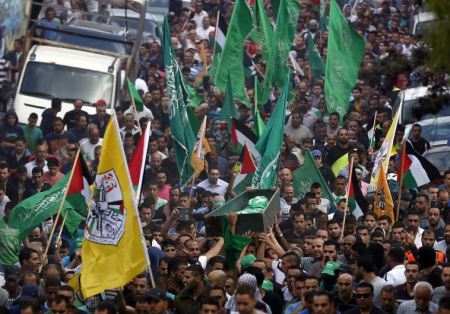
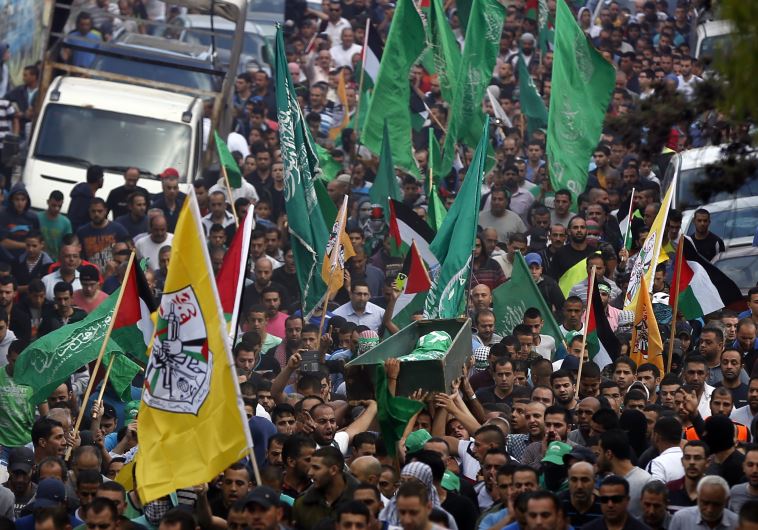
ShowImage (14)Funeral in the Shuafat refugee camp in east Jerusalem, on October 10, 2015. (photo credit: AHMAD GHARABLI / AFP)

About expected Palestinian state intentions, there is little real mystery to fathom. It should already be widely understood that any new state of Palestine could provide a ready platform for launching endlessly renewable war and terrorism against Israel. Significantly, not a single warring Palestinian faction has ever even bothered to deny such overtly criminal intent. On the contrary, aggressive intent has always been openly embraced, fervently cheered as a distinctly sacred “national” incantation.

*********************************

It’s farewell to the drawing-room’s civilized cry, The professor’s sensible where to and why, The frock-coated diplomat’s social aplomb, Now matters are settled with gas and with bomb.”

– W.H. Auden, Danse Macabre

With apparent suddenness, and a very deliberate brutality, Palestinian terrorists are launching a new wave of indiscriminate assaults they proudly hail as a “third intifada.”

But behind the protective veneer of language, where homicide is conveniently transfigured into revolution, these latest Arab attacks remain what they have always been – that is, crudely camouflaged expressions of rampant criminality.

Jurisprudentially, this is all perfectly obvious. Prima facie, under all pertinent international law, calculated assaults on mostly women and children can never be sanitized or justified. Always, rather, they represent codified crimes of war and crimes against humanity.

Always, such crimes are unpardonable.

Oddly enough, even after the painfully long history of egregious Palestinian crimes carried out against noncombatant populations, a sizable portion of the “international community” still seeks to encourage Palestinian statehood. Self-righteously, of course, and with ritualistic indignation directed against Israeli “intransigence,” the “civilized community of nations” remains willing to rip a 23rd Arab state from the still-living body of Israel. Even now, as the Palestinians remain rigorously segmented into barbarously warring factions – into opponents who enthusiastically maim and torture each other, all while cooperating in doing the same to their commonly despised Israeli victims – world public opinion calls naively for Palestinian “self-determination.”

Even now, when any new Palestinian state could quickly come to resemble an already-fractured Syria, the United Nations and its secretary – general seem much more concerned with comforting the markedly unheroic Palestinian criminals than with protecting fully innocent Israeli civilians.

Unapologetically, and whatever their unhindered and ongoing excesses, Fatah, Hamas and Islamic Jihad are easily able to incite followers to inflict and then celebrate incessant harms upon Israel.

At some point, it is likely that such harms, joyously imposed with a reassuring impunity, could involve diverse weapons of mega-terrorism, including assorted chemical, biological, or even nuclear agents.

In this last category of insidious choice, Palestine, after formalizing its sought-after condition of statehood or sovereignty, could be placed in an optimal position to assault Israel’s Dimona nuclear reactor.

This plainly sensitive facility was previously attacked, in both 1991 and again in 2014. Those earlier missile and rocket barrages, which produced no ascertainably injurious damages to the critical reactor core, had originated with Iraqi and Hamas aggressions, respectively.

About expected Palestinian state intentions, there is little real mystery to fathom. It should already be widely understood that any new state of Palestine could provide a ready platform for launching endlessly renewable war and terrorism against Israel. Significantly, not a single warring Palestinian faction has ever even bothered to deny such overtly criminal intent. On the contrary, aggressive intent has always been openly embraced, fervently cheered as a distinctly sacred “national” incantation.

A September 2015 poll by the Palestinian Center for Policy and Survey research – the leading social research organization in the Palestinian territories – found that a majority of Palestinians unhesitatingly reject a two-state solution.

When asked, as a corollary question, about any preferred or alternate ways to establish an independent Palestinian state, 42 percent called for “armed action.”

Only 29% favored “negotiation,” or some sort of peaceful resolution.

Not much mystery here.

On all currently official Hamas and Palestinian Authority (PA ) maps of “Palestine,” Israel has been removed altogether, or identified exclusively as “occupied Palestine.”

By these revealingly forthright and vengeful depictions, Israel has already been forced to suffer a “cartographic genocide.” Unambiguously, from the standpoint of any prospective Palestinian state policies toward Israel, such incendiary maps are portentous, predictive and possibly even prophetic.

What is not generally recognized is that a Palestinian state, any Palestinian state, could play a determinedly serious role in bringing some form of nuclear conflict to the Middle East. Palestine, of course, would itself be non-nuclear; but that’s not the issue. There would remain several other ways in which the new state’s predictable infringements of Israeli security could make the Jewish state more vulnerable to an eventual nuclear attack from Iran, or, in the even more distant future, from a newly-nuclear Arab state.

This second prospect would likely have its core origins in understandable reactions to the plainly impotent Vienna pact with Iran.

Following the July 14, 2015 Joint Comprehensive Plan of Action (JCPOA ), several Sunni states in the region, most plausibly Egypt and/ or Saudi Arabia, will likely feel compelled to “go nuclear.”

In essence, any such considered Sunni Arab nuclear proliferation would represent a more-or-less coherent “self-defense” reaction against expectedly escalating perils, once still-avoidable dangers now issuing from the reciprocally fearful Shi’ite world.

There is also more to expect from the Sunni side. Here, in actions that would have no apparent connection to expected Iranian nuclearization, Islamic State (IS) could begin an avowedly destructive march westward, across Jordan, and all the way to the borders of West Bank (Judea/Samaria). There, should a Palestinian state already be established and functional, dedicated Sunni terrorist cadres would likely make quick work of any deployed Palestinian army. In the event that a new Arab state had not yet been suitably declared – that is, in a fashion consistent with codifying Montevideo Convention (1934) expectations – invading IS forces (not Israel) will have become the principal impediment to Palestinian independence.

Credo quia absurdum – “I believe because it is absurd.” In either case, any such IS or IS-related conquest could create another available platform for launching relentless terrorist attacks across the region.

In time, of course, most of these murderous attacks would be aimed precisely at Israel.

IS, as everyone can see, is on the move. It has already expanded well beyond Iraq and Syria, notably into Yemen, Libya, Egypt and Somalia.

Although Hamas leaders generally deny any IS presence in Gaza, that terrorist group’s black flag is now seen more and more regularly in that expressly Palestinian space.

In principle, at least, Israel could sometime find itself forced to cooperate with Hamas against IS, but any reciprocal willingness from the Islamic Resistance Movement, whether glaringly conspicuous or beneath the radar, is implausible.

Additionally, Egypt regards Hamas as part of the much wider Muslim Brotherhood, and prospectively, just as dangerous as IS.

In any event, after Palestine, and even in the absence of any takeover of the new Arab state by IS forces, Israel’s physical survival would require increasing self-reliance in existential military matters.

Such expansions, in turn, would demand: 1) an appropriately revised nuclear strategy, involving deterrence, defense, preemption and warfighting capabilities; and 2) a corollary conventional strategy.

Significantly, however, the birth of Palestine could impact these strategies in several disruptive ways.

Most ominously, a Palestinian state could render most of Israel’s conventional capabilities substantially more problematic. It could thereby heighten certain eventual chances of a regional nuclear war.

Credo quia absurdum. A nuclear war in the Middle East is not out of the question. At some point, such a conflict could arrive in Israel not only as a “bolt-from-the-blue” surprise missile attack, but also as a result, whether intended or inadvertent, of escalation.

If, for example, certain enemy states were to begin “only” with conventional and/or biological attacks upon Israel, Jerusalem might then respond, sooner or later, with nuclear reprisals. Or if these enemy states were to begin hostilities with certain conventional attacks upon Israel, Jerusalem’s own conventional reprisals might then be met, at least in the future, with enemy nuclear counterstrikes.

For now, this second scenario could become possible only if Iran were to continue its evident advance toward an independent nuclear capability. It follows that a persuasive Israeli conventional deterrent, at least to the extent that it could prevent enemy state conventional, and/or biological attacks, would substantially reduce Israel’s risk of any escalatory exposure to a nuclear war. Israel will need to maintain its capacity for “escalation dominance,” but Palestinian statehood, on its face, could still impair this overriding strategic obligation.

A subsidiary question comes to mind. Why should Israel need a conventional deterrent at all? Israel, after all, seemingly maintains a capable nuclear arsenal and corollary doctrine, even though both still remain “deliberately ambiguous.”

And there arises a still further query. Even after “Palestine,” wouldn’t enemy states desist from launching conventional and/or biological attacks upon Israel, here, out of an entirely reasonable and prudent fear of suffering a nuclear retaliation? Not necessarily. Aware that Israel would cross the nuclear threshold only in certain extraordinary circumstances, these enemy states could be convinced – rightly or wrongly – that so long as their attacks were to remain non-nuclear, Israel would respond only in kind. Faced with such probable calculations, Israel’s ordinary security would still need to be sustained by conventional deterrent threats.

A strong conventional capability will still be needed by Israel to deter or to preempt conventional attacks – attacks that could, if undertaken, lead quickly, via escalation, to various conceivable forms of unconventional war.

Credo quia absurdum. It is still not sufficiently understood that Palestine could have serious effects on power and peace in the Middle East. As the creation of yet another enemy Arab state would need to arise from the intentional dismemberment of Israel, the Jewish state’s strategic depth would inevitably be diminished. Over time, therefore, Israel’s conventional capacity to ward off assorted enemy attacks could be correspondingly reduced.

Paradoxically, if enemy states were to perceive Israel’s own sense of expanding weakness and desperation, this could strengthen Israel’s nuclear deterrent. If, however, pertinent enemy states did not perceive such a “sense” among Israel’s decision-makers (a far more likely scenario), these states, now animated by Israel’s conventional force deterioration, could then be encouraged to attack. The cumulative result, spawned by Israel’s post-Palestine incapacity to maintain strong conventional deterrence, could become: 1) defeat of Israel in a conventional war; 2) defeat of Israel in an unconventional chemical/biological/nuclear war; 3) defeat of Israel in a combined conventional/unconventional war; or 4) defeat of Arab/Islamic state enemies by Israel in an unconventional war.

For Israel, a country less than half the size of Lake Michigan, even the “successful” fourth possibility could prove intolerable. The tangible consequences of a nuclear war, or even a “merely” chemical/ biological war, could be calamitous for the victor as well as the vanquished.

Under such exceptional conditions of belligerency, the traditional notions of “victory” and “defeat” would likely lose all serious meaning.

Although a meaningful risk of regional nuclear war in the Middle East must exist independently of any Palestinian state, this uniquely serious threat would be still greater if a new Arab terrorist state were authoritatively declared.

Palestine, it has increasingly been argued, could sometime become vulnerable to overthrow by even more militant jihadist Arab forces, a violent transfer of power that could then confront Israel with an even broader range of regional perils.

In this connection, IS, again, could find itself at the outer gates of “Palestine.” In such a scenario, it is plausible that the IS fighters would make fast work of any residual Palestinian defense force, PA and/ or Hamas, and then absorb Palestine itself into a rapidly expanding Islamic “caliphate.”

Before anything remotely decent could be born from such a determined theocracy, a very capable sort of gravedigger would have to wield the forceps.

The “third intifada” is just another legitimizing term for remorseless Palestinian terrorism. Should it transform the always fratricidal Palestinian territories into another corrupted Arab state, Palestine, either by itself, or as a newly-incorporated part of a still-growing IS “caliphate,” would become another Syria. Even more significantly, Palestine could bring specifically nuclear-based harms to the broader region.

Then, quite predictably, all pertinent “matters” would be settled “with gas and with bomb.”