Posted tagged ‘Islamic State’

Russian Magazine: Russia’s Air Force In Syria Is Winning The Battle For Assad

February 17, 2016

Russian Magazine: Russia’s Air Force In Syria Is Winning The Battle For Assad, MEMRI, February 17, 2016

(Please see also, Moscow on the Tigris: Russia Joins the Terror Nexus:

While an exhausted and burned out United States wishes international migraines like the Syrian civil war would just go away, Russia is energized by the prospect of filling the vacuum and thus once again playing a major role on the world stage. Aggressively intervening on behalf of his ally in Damascus, President Bashar al-Assad, and projecting force well beyond even the frontier states in his“near abroad,” Vladimir Putin audaciously aims to change political outcomes in a region that has been out of his country’s sphere of influence for a generation.

— DM)

Recently, the Russian campaign in Syria reached its 100th day. An article in Expert Online, the website of the influential Russian analytical magazine Expert, reviews the state of the Syria war, analyzing the activities on various fronts as well as the Russian involvement. The article, by journalist Pyetr Skorobogatyj, states that, with Russia’s help, the Syrian army is advancing slowly but surely. It stresses that the operation in Syria is not a substantial financial burden for Russia, and that it benefits Russia in many ways – including by allowing it to train pilots, test the performance of various weapons, and target Russian-speaking militants who are fighting in Syria. Most significantly, it allows Russia to establish a permanent presence in the Middle East that has an impact on all the region’s countries.

The article then reviews the military situation in Syria region by region. Focusing first on the north, it stresses that the Kurdish forces there are making headway against ISIS and are laying down the foundations for what may eventually become a Kurdish autonomy or even an independent Kurdish state. The main loser, says the article, is Turkey, who is powerless to stop these developments from unfolding.

The article states further that Russia, using its S-400 missiles, has effectively set up a no-fly-zone in the north of Syria, thus enabling the regime forces to make substantial achievements against the rebels, especially in the Latakia area. It adds that the U.S., too, is planning to establish a military base in northeast Syria, in the Malikia area.

Moving to the southern region, the article states that the stalemate between the sides there – namely the regime forces and rebel groups backed by Jordan – has ended, since Jordan has ordered these forces to stop attacking Assad’s troops. In Damascus, too, the regime is slowly flushing out the rebels, street by street and building by building. As for eastern Syria, the article concedes that ISIS still maintains a strong presence there and will be difficult to defeat.

The following are excerpts from the article.[1]

 “The Air Campaign Is Not Expensive For Moscow, And It Allows Russia To Train Pilots And Test Different Types Of Weapons”

“As the Russian campaign recently reached its 100th day,[2] [Russia’s] main goal appears to be the use of military power to force peace on the ‘rational’ [i.e., non-jihadist] rebel groups. There are a number of small [rebel] groups which have either joined Assad’s military or have stayed independent but coordinate their activities with the Syrian army. [Russia’s] largest partner [apart from the Syrian army] is the Syrian Democratic Army [SDA], a Sunni popular militia which is fighting in the north [of the country] alongside the Kurds and government troops. The Russian Ministry of Defense has confirmed that Russia supports the SDA with weapons, ammunition and airstrikes. ‘For its part, the patriotic opposition [i.e. the SDA] coordinates its military objectives with the Russian aviation group,’ noted Lt. General Sergei Rudskoy, Chief of Main Operations Management in the Russian Army General Staff…

“The joint military campaign of the Russian Air Force and Syrian troops seems to be [progressing] slowly but surely. [The slow pace] is due to the broad spectrum of military goals which must be met, including pressure on all ‘factions’ in order to separate [potential] ‘partners’ from ‘enemies,’ as well as the necessity to return as much territory as possible to the Syrian government’s control, in order to enable it to negotiate from a position of strength about the country’s future. In addition, all the battle fronts seem chaotic, with many parallel ‘seething cauldrons’… and with weather conditions are getting worse… All of these factors together make Russian air operations difficult, especially during the winter period. This week the ‘bad guys’ [i.e. ISIS] used the cover of a sandstorm [which hampered Russian air activity] to mount a major offensive on Deir Al-Zor, a Syrian enclave in the desert. This action resulted in a major defeat for the Syrian side. As prevailing weather conditions worsen, the… intensity of the military campaign will decrease…

“Notwithstanding, during the first 100 days of Russian Air Force and Navy operations, 217 villages and towns were retaken, and 1000 sq. km. of territory. The Russian-Syrian coalition has no need to hurry. The air campaign is not expensive for Moscow, and it allows Russia to train pilots and to test the battle performance of different types of weapons. These benefits are in addition to the political gains and to the main goal, which is to eliminate Russian-speaking fighters in theaters far away from Russia’s borders.

“In addition, thanks to the new Russian air force base in the [the Syrian city of] Latakia, Moscow has established a permanent presence in the region, controlling a very important logistic hub. This modern military base (equipped with Iskander[3] and S-400[4] missiles)… changes the military and political situation in Iraq, Iran, Israel, the U.S… and, of course, Turkey”…”

“Russia Has Set Up A No-Fly Zone Using Its S-400 Surface-To-Air Missile System”

“[Meanwhile] the goals of the main participants in the Syrian battle have become clear. In the north of Syria… the Kurds are winning. They are finally receiving extensive military support from the U.S. and covert support from Russia. They are carrying out offensive operations against ISIS and expanding their territory, which might become a future Kurdish state or an autonomous region within Syria, depending on the final agreement… The main loser is Turkey, who is unpredictable, irresponsible and unable to keep agreements. Currently, [Turkish President Recep Tayyip] Erdogan can only look on as the Kurdish enclave continually grows stronger. [The Turkish President] can initiate military operations only on his own territory…

“The geopolitical value of northern Syria is understood by all parties. Russia has set up a no-fly zone [there] using its S-400 surface-to-air missile system… [while] Syria is strengthening its Al-Bab air base with Russian military advisors and the S-300[5] missile system. The Americans are not napping either, and plan to set up a military base in Malikia in north-east Syria… This will allow the U.S to carry out an independent policy without having to depend on the Kurdish state which is being established…

“The Syrian army, aided by Hizbullah’s brigades, is doing very well in the Latakia governorate. The map [below] clearly shows the movement of the fighting forces over the last few months. The dotted red line represents the front on October 7, 2015. In the first half of January 2016, government troops finally showed fighting ability against the Islamist stronghold of Salma… It was the first time that Russian military experts actively took part in the campaign, probably coordinating the attack on Salma. Support from Russian planes in the northern Latakia province allows the Syrian army to continue its advance at full speed…”
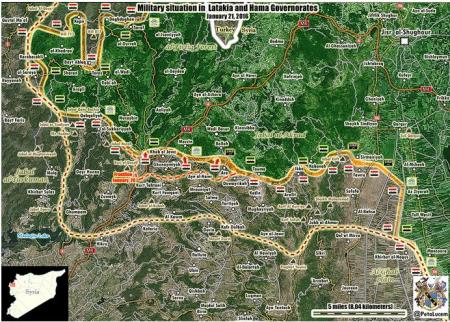
26798Military situation in Latakia and Hama areas, January 21, 2016

In The South, Jordan-Backed Rebels Have Been Ordered To Stop Attacking; In Damascus, The Government Is Flushing Out Islamists; In The East, ISIS Still Holds A Significant Area

“In the Dera province in the south, the opposing sides had [previously] agreed to maintain the status quo. Damascus was avoiding a conflict with Israel as well as with Jordan, which openly sponsored tribal forces and Islamist brigades… [Today, however,] the tactic of constant pressure [by Syrian regime troops on these forces and brigades] is producing results. The Military Operations Command [MOC] in Amman… which is coordinating rebel activities in southern Syria, has ordered [the forces it sponsors] to stop attacking [Syrian] government forces… Jordan’s logic is very simple… Syrian refugees in Jordan now total about 30% of the population, the same number as the Palestinians living in Jordan… so Jordan prefers to try to stabilize the situation in Syria rather than dream about cutting off Syria’s southern territories from the rest of the country. On the other hand, Damascus has begun to raise the issue of Israeli[-sponsored] rebels occupying the [Syrian] Golan Heights.

“In the Syrian capital, government troops are continuing to flush out Islamists and ‘bad guys’ from the city. The score is being kept not by counting streets retaken, but by counting buildings… The progress in the Damascus area is noticeable only when viewed over a long period of time. Below is a map showing the balance of forces in 2013, and beneath it a map showing the balance of forces in 2015.
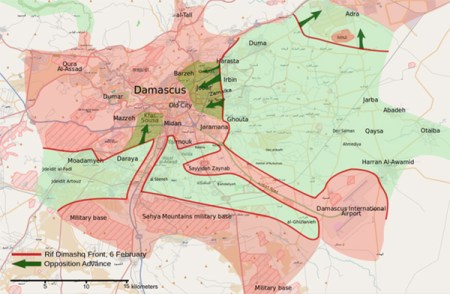
26799Damascus area in 2013
26800Damascus’ area in 2015

“In addition, peace talks between the government and some rebel groups are now underway. Just recently, an agreement was made with a rebel brigade in the Al-Qadam suburb [in Damascus]. Some militants who were disarmed were moved to Raqqa and Idlib, while almost 1,500 others agreed to switch to Assad’s side…

“In spite of the relative success of government troops, ISIS still holds a significant area in the eastern part of Syria… The [ISIS] Caliphate is well-entrenched in the area it controls, with a strong force and command structure, and is not going to withdraw easily.”


Endnotes:

[1] Expert.ru, January, 22, 2016.

[2] The Russian campaign in Syria started on September 30, 2015.

[3] A Russia-manufactured portable short-range ballistic missile system; NATO designation name: SS-26 Stone.

[4] A Russia-manufactured anti-aircraft weapons system; NATO designation name: SA-21 Growler.

[5] A Russia-manufactured long range surface-to-air missile system;  NATO designation name: SA-10 Grumble.

Turkey wants secure line made 10 km within Syria, including Azaz, Deputy PM says

February 17, 2016

Turkey wants secure line made 10 km within Syria, including Azaz, Deputy PM says

DAILY SABAH WITH REUTERS

Source: Turkey wants secure line made 10 km within Syria, including Azaz, Deputy PM says – Daily Sabah

Displaced Syrians fleeing areas in the northern embattled province of Aleppo, walk past tents at the Bab al-Salama camp, set up outside the Syrian city of Azaz on Syrias northern border with Turkey  (AFP Photo)
Displaced Syrians fleeing areas in the northern embattled province of Aleppo, walk past tents at the Bab al-Salama camp, set up outside the Syrian city of Azaz on Syria’s northern border with Turkey (AFP Photo)

Turkey wants a secure strip of territory 10 km (6.2 miles) deep on the Syrian side of its border, including the town of Azaz, to prevent attempts to “change the demographic structure” of the area and for humanitarian purposes, Deputy Prime Minister Yalçın Akdoğan said on Wednesday.

Assad forces backed by Russian air strikes have advanced towards the Turkish border in a major offensive in recent weeks. YPG fighters, regarded by Ankara as terrorists, have taken advantage of the violence to seize territory from Syrian rebels.

Turkey has accused the YPG of pursuing “demographic change” in northern Syria by forcibly displacing Turkmen and Arab communities.

“There is a game being played with the aim of changing the demographic structure. Turkey should not be part of this game,” Akdoğan said in an interview on the AHaber television station.

“What we want is to create a secure strip, including Azaz, 10 km deep inside Syria and this zone should be free from clashes,” he said.

Azaz is the last rebel stronghold before the border with Turkey north of the Syrian city of Aleppo, part of what was, before the Assad offensive, a supply route from Turkey to the rebels fighting Assad.

It has come under heavy assault in recent days, but Turkey has said it will not let the town fall into the hands of the Kurdish YPG militia.

German Chancellor Angela Merkel had also said that she supports Ankara’s proposal for a no-fly zone in northern Syria.

Ankara has been requesting that the U.N. establish “safe zones” in Syria since 2012 but could not find the necessary international support.

Turkey, home to more than 2.6 million Syrian refugees, has long pushed for the creation of a safe zone in northern Syria to protect displaced civilians, avoiding the need to bring them into Turkey.

But the proposal has so far gained little traction with Washington or NATO allies who fear it would require an internationally patrolled no-fly zone which could put them in direct confrontation with Assad and his allies.

Akdoğan said another 600,000 people could flee to the Turkish border if Aleppo falls to the Syrian army.

UNSC urges Turkey to ‘comply with intl law’ in Syria after Russia requests meeting

February 17, 2016

UNSC urges Turkey to ‘comply with intl law’ in Syria after Russia requests meeting

Published time: 16 Feb, 2016 21:01 Edited time: 16 Feb, 2016 22:30

Source: UNSC urges Turkey to ‘comply with intl law’ in Syria after Russia requests meeting — RT News

Following a briefing requested by Russia, the UN Security Council has urged Ankara to comply with international law in Syria. The closed-door meeting was called to discuss recent Turkish shelling of Kurdish YPG militia targets in Syria’s north.

READ MORE: Turkey shells Kurdish forces in Syria for 4th successive day

“UN Security Council members are concerned with the Turkish attacks on a number of Syrian regions,” Venezuelan Ambassador Rafael Ramirez, who now chairs the UNSC, said after the meeting, as cited by TASS.

The UN Security Council received a letter from the Syrian government in which Damascus condemned Turkey’s attacks in the north of Syria, Ramirez explained, noting that the entire council expressed “concern” about these violations.

“All members of the Security Council … agreed to ask for Turkey to comply with international law,” he added.

The UNSC also reiterated its commitment to the Munich agreement, expecting that all parties involved in the discussions will work toward a ceasefire to “allow humanitarian access for every place in the Syrian territory.”

Read more

© Abdalrhman Ismail

When asked if the UNSC discussed the shelling of the hospitals and schools in Northern Syria on Monday which left close to 50 people dead, Ramirez said the Council indeed discussed the issue, but reached “no agreement” or “consensus” because of “different sources” of information on the incidents.

“Everybody is concerned about air strikes over humanitarian installations,” said Ramirez, stressing that the UNSC is trying to get “more information.”

The UNSC president highlighted the need to have Kurds represented in the Syrian peace process, and for Ankara not to escalate the situation even further.

“One of the issues expressed by some countries, including Venezuela, is that the Kurdish people have to be included in the discussion. Now that is the principle concern of Turkey,” Ramirez said during the briefing.

“Something that is important – the Kurds are fighting against the terrorist groups on the ground and this is an important factor for everybody,” Ramirez emphasized.

Turkish artillery units have been shelling targets in Syria for the fourth day in a row, as Ankara maintains its commitment to stopping the Kurdish Democratic Union Party (PYD) from claiming more territory in the north of the country. According to the Russian Ministry of Defense, both government and opposition-held towns over the border from Turkey have fallen under Ankara’s shelling.

While the Kurdish forces remain one of Washington’s main allies on the ground in Syria, Turkey being a NATO member is also a key partner in the US-led anti-ISIS coalition. The US State Department on Tuesday urged all sides to avoid escalation of tensions on the Syria-Turkey border.

“I am aware of the reports… that they [Turkish forces] have struck the YPG affiliated forces,” State Department spokesperson Mark Toner said. “We have urged the YPG to avoid moves that will heighten tensions with Turkey. But at the same time we have also urged Turkey to cease any artillery… its artillery fire across the border.”


Turkey launched 100+ artillery strikes on Syrian towns in Aleppo

February 17, 2016

Turkey launched 100+ artillery strikes on Syrian towns in Aleppo

Russian military Published time: 16 Feb, 2016 20:55

Source: Turkey launched 100+ artillery strikes on Syrian towns in Aleppo – Russian military — RT News

© Abdalrhman Ismail
Both government and opposition-held towns in Syria over the border from Turkey have fallen under Ankara’s shelling that began last week, according the Russian Ministry of Defense.

Turkey’s artillery has fired more than 100 shells at bordering areas in the northwest province of Aleppo, targeting both Syrian government forces and the opposition, MoD spokesman Igor Konashenkov told reporters on Tuesday.

Read more

Emblem on the fence of the building of the Russian Defense Ministry on Frunzenskaya Embankment in Moscow. © Natalia Seliverstova

“Since the end of the last week Turkey has been launching massive artillery strikes on the Syrian government and the Syrian opposition at the border areas. Impartial monitoring bodies have detected more than a hundred rounds of fire that targeted border towns in the province of Aleppo,” Konashenkov said.

Last week Turkey started pounding Syrian Kurdish forces with fire in northern Syria in an apparent attempt to stop them from taking over the city of Azaz, Aleppo.

On Monday, at least 14 people were killed after missiles hit a children’s hospital, a school and other buildings, witnesses told Reuters. Ankara was quick to blame Russia for the strikes in Azaz.

Monday’s attacks have been condemned by the international community, with the UN calling on war parties to reduce hostility ahead of the planned ceasefire in Syria.

On a separate occasion, members of the United Nations Security Council expressed their concern with the aggressive actions carried out by Ankara in Syria and will urge it to follow international law.

“The UN Security Council members are concerned with the Turkish attacks on a number of Syrian regions,” UNSC President Rafael Ramirez said, according to TASS news agency, after a meeting held upon Russia’s request, adding that the members “have agreed to ask Turkey to obey international law.”

Russia’s ministry of defense statement came as a response to Turkish officials who accused Moscow of conducting a deadly attack on Syrian civilians. On Monday, Prime Minister Ahmet Davutoglu claimed a Russian warship in the Caspian Sea launched a ballistic missile that hit a hospital in the Idlib province. Following the hospital, reports of five medical facilitates and several schools being attacked in the city of Azaz also emerged.

Russia shrugged off the fresh claims on Tuesday saying there are no warships in the Caspian fleet “capable of launching ballistic missiles.”

The allegations, described as “empty” and “unfounded” were overturned by Kremlin spokesman Dmitry Peskov as well.

Nasrallah threatens to bomb chemical facility, kill thousands of Israelis

February 17, 2016

Nasrallah threatens to bomb chemical facility, kill thousands of Israelis Head of Lebanese terror group says strike on Haifa amonia storage facility would have impact similar to nuclear attack

By Tamar Pileggi

February 16, 2016, 11:56 pm

Source: Nasrallah threatens to bomb chemical facility, kill thousands of Israelis | The Times of Israel

Hezbollah leader Sheik Hassan Nasrallah speaks during a rare public appearance, in the suburbs of Beirut, Lebanon in November 2013. (file photo credit: AP/Bilal Hussein)

Hezbollah leader Sheik Hassan Nasrallah speaks during a rare public appearance, in the suburbs of Beirut, Lebanon in November 2013. (file photo credit: AP/Bilal Hussein)

Hezbollah leader Hassan Nasrallah on Tuesday insisted that although his group isn’t currently seeking war with Israel, it could defeat the Jewish state in a future conflict by targeting Haifa’s ammonia storage tanks, resulting in massive fatalities.

Dismissing recent reports of a possible outbreak of hostilities with Israel, Nasrallah said deterrence established by the terror organization in the first and second Lebanon wars was keeping Israeli aggression at bay.

 “Israel’s psychological warfare is of no use against us,” he told the Lebanese Naharnet news site.

As an example, Nasrallah said Israel “feared” the group’s cache of rockets capable of striking the ammonia facilities in Haifa, an attack that he said would result in casualties equivalent to those that would be caused by a nuclear attack.

He quoted an unnamed Israeli official to the effect that a strike on the northern city’s ammonia storage tanks would cause tens of thousands of fatalities.

“This would be exactly as a nuclear bomb, and we can say that Lebanon today has a nuclear bomb, seeing as any rocket that might hit these tanks is capable of creating a nuclear bomb effect,” he said, adding that Hezbollah, which has reportedly lost many of its men in the Syrian civil war, was continuing to boost its capabilities.

Hours after Nasrallah issued the explicit threat to strike Haifa, Environmental Protection Minister Avi Gabbai said he had ordered that the ammonia storage facility be moved to the Negev desert.

During his speech, the Hezbollah chief also accused Israel of behind-the-scenes intervention in Syria, warning Saudi Arabia not to ally itself with Jerusalem over the conflict and slamming other Sunni states for moving closer to Israel.

“Do you accept a friend occupying Sunni land in Palestine? Can you become friends with an entity that has committed the most horrible massacres against the Sunni community?” he said.

“You are free to consider Iran an enemy, but how can you consider Israel a friend and ally? This issue must be confronted in a serious manner.

“It is beneficial to monitor the Israeli media to realize that the Israeli rhetoric has become identical to the rhetoric reflected in some Arab media, especially in the Gulf and Saudi Arabia,” Nasrallah charged.

His comments came on the heels of Prime Minister Benjamin Netanyahu’s call to Arab states with which Israel has covert ties to publicly acknowledge those relationships.

Addressing the Conference of Presidents of Major American Jewish Organizations on Sunday, the prime minister maintained that most moderate Arab countries see Israel as their ally, not their enemy, as they share a common struggle against Iran and the Islamic State.

Israel has long said there are secret back-channel talks between Jerusalem and Sunni states, however, Saudi Arabia and other Arab countries maintain they will only normalize ties with the Jewish state once a peace deal is reached with the Palestinians via a two-state solution.

Turkey calls allies to launch ground offensive in Syria, continues to hit PYD

February 16, 2016

Turkey calls allies to launch ground offensive in Syria, continues to hit PYD

February 16, 2016, Tuesday/ 17:41:49/ TODAY’S ZAMAN | ANKARA

Source: Turkey calls allies to launch ground offensive in Syria, continues to hit PYD

Turkey calls allies to launch ground offensive in Syria, continues to hit PYD

Turkish artillery struck positions in northern Syria for the fourth straight day on Tuesday. (Photo: AP)

While Ankara and Moscow continued to exchange harsh remarks on Tuesday, Turkey once again hit Democratic Union Party (PYD) targets near the town of Azaz in Syria and called on its allies, including the US, to launch a ground offensive in Syria as Russian-backed Syrian regime forces come closer to Turkey’s borders.

A Turkish official speaking to reporters in İstanbul on Tuesday said Turkey wants a ground operation in Syria.

The official who asked to remain anonymous in order to speak more freely said: “We want a ground operation. If there is a consensus, Turkey will take part. Without a ground operation it is impossible to stop this war.”

The official also ruled out a unilateral ground operation in Syria carried out by Turkey. “Turkey is not going to have a unilateral ground operation … We are discussing this with allies,” the official said.

The Turkish military has been hitting PYD targets in Syria since Saturday and continued to shell the PYD militants in Azaz near the Mennagh air base on Tuesday.

In the meantime, Syrian President Bashar al-Assad has warned Turkey and Saudi Arabia that any ground incursion in Syria will have “global repercussions” and says sending in troops will be “no picnic.”

Commenting on the agreement reached last week among the US, Russia and other world powers for a temporary cessation of hostilities in Syria, Assad said, “Cease-fires occur between armies and states, but never between a state and terrorists.”

“They say they want a cease-fire within a week. All right, who will talk to a terrorist organization if it refuses to cease fire? Who will punish it?’” he asked. Assad spoke in Damascus late Monday during a meeting with members of the Bar Association. The comments were his first since the agreement on Friday to bring about a temporary pause in fighting within a week.

Washington has ruled out a major ground operation in Syria and a large-scale joint ground operation is still unlikely. But Turkey’s request shows how swiftly a Russian-backed advance in recent weeks has transformed a conflict that has drawn in most regional and global powers.

The offensive, supported by Iranian-backed Shiite militias as well as Russian air strikes, has brought the Syrian army to within 25 kilometers (15 miles) of Turkey’s frontier. Kurdish fighters regarded by Turkey as hostile insurgents have also exploited the collapse of positions held by other rebel groups to seize ground and extend their presence along the border.

The advances have increased the risk of a military confrontation between Russia and Turkey.

Turkish artillery returned fire into Syria for a fourth day straight on Tuesday, military sources said, targeting the Kurdish People’s Protection Units (YPG) militia, which Ankara says is being backed by Moscow.

Turkish Foreign Minister Mevlüt Çavuşoğlu spoke with his French counterpart and expressed Ankara’s dissatisfaction with the French foreign ministry’s comments regarding the Turkish operations against Kurdish People’s Protection Units (YPG) targets in Syria, diplomatic sources said.

Davutoğlu: Shameless Russia

Speaking at the ruling Justice and Development Party’s (AK Party) parliamentary group meeting on Tuesday, Turkish Prime Minister Ahmet Davutoğlu gave harsh remarks targeting Russia particularly and calling Moscow “inhumane,” “merciless” and “barbaric.”

Davutoğlu said the PYD and its armed wing, the YPG, are an offshoot of the terrorist Kurdistan Workers’ Party (PKK) and are killing people in Syria for the Russian and Syrian regimes. He stressed that Turkey will do anything to prevent the attack on Azaz and will retaliate whenever necessary.

Calling the developments in Syria “a national security threat” to Turkey, Davutoğlu said Russia is attacking Syrian rebel groups and civilians. Mentioning some of the photos that he has seen where Russian jets pounded Tel Rifaat and Azaz, Davutoğlu asked Russia what they want from this territory.

Davutoğlu said Russian jets are bombing any area around Azaz, adding that making 200 sorties around a small town like Azaz does not make sense other than if the aim was to get rid of all expired bombs in one’s stock.

“Russia is killing both civilians and Syrian rebels, as well as supporting the Syrian regime. They are also getting rid of obsolete bombs in their stock in Syria instead of destroying them in their own country. They have such a vile and inhuman plan. Russia, Assad and the PYD are cooperating and pounding the area to cut the way to the aid corridor to the Syrian people. Russia and Assad are using the PYD as a tool to change the ethnic structure. Russia has not once attacked ISIL [the Islamic State in Iraq and the Levant],” said Davutoğlu.

Davutoğlu also stressed that Turkey has been shelling the PYD since Saturday and will continue to do so in order to stop a new refugee influx to Turkey. He said the latest attacks near Turkey’s border are clearly targeting Turkey and posing a threat to Europe due to an increased refugee influx.

Davutoğlu pointed out that German Chancellor Angela Merkel has finally confirmed the need to establish a no fly zone in Syria. He said if the world leaders agreed with Turkey three years ago, many lives in Syria could have been saved.

“No one should doubt that Turkey will react in the same way against anyone threatening its border security,” said Davutoğlu.
He said the PYD does not represent the Kurds in Syria and has become a legionnaire for Russia in the region with the priority of harming Turkey, especially since Turkish-Russian relations have become tense following Turkey’s shooting down of a Russian jet in November last year.

“While Russia is bombing civilians, it complains about Turkey to the UN Security Council for defending Turkish air space. It is shameless,” said Davutoğlu. He also criticized the West, particularly the US, for not openly condemning the Russian bombardment in the area. “We are not afraid to say this. Coward Russian jets committed to this bombardment. We want to see a clear attitude [from the West] against this inhuman massacre,” said Davutoğlu.

He stressed that Turkish foreign policy is not based on ethnicity. He said if Kurds have a state, it is the Turkish Republic. He recalled that Turkey has embraced the Kurdish refugees who fled from ISIL in the town of Kobani in Syria.

Davutoğlu also said that Russia is pursuing a “dirty foreign policy” by mentioning the possibility of a World War III. “If there is a threat of war in Syria, Turkey is not the one creating the environment for it,” said Davutoğlu, adding that despite the chaos in the region the Turkish government is keeping the country out of war. He claimed that Turkey is taking measures to eliminate the threats close to it in order to stay away from war.

Russia categorically rejects statements from Turkey

Moscow on Tuesday strongly rejected Turkish accusations that it had committed a war crime after the missile strikes.

“We categorically do not accept such statements, the more so as every time those making these statements are unable to prove their unfounded accusations in any way,” President Vladimir Putin’s spokesman Dmitry Peskov told reporters.

“Our relations (with Turkey) are in a deep crisis. Russia regrets this. We are not the initiators of this.”
Turkey on Monday accused Russia of an “obvious war crime” after missile attacks in northern Syria killed scores of people and warned the YPG that it would face the “harshest reaction” if it tried to capture a town near the Turkish border.

ISIS Leader Moves to Libya

February 16, 2016

ISIS Leader Moves to Libya, Investigative Project on Terrorism, Pete Hoekstra, February 16, 2016

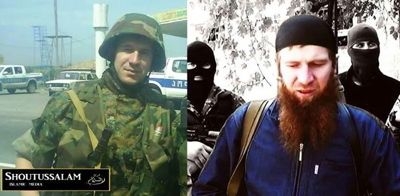
1359Shishani as a Georgian special forces soldier and as an ISIS leader.

The barbaric and elusive Chechen commander who recruited British executioner “Jihadi John” has moved to Sirte, Libya to assume control of ISIS operations in the terrorist organization’s metastasizing Mediterranean caliphate.

The Investigative Project on Terrorism first learned about the movement of Abu Omar al-Shishani – among the world’s most-wanted terrorists – through its exclusive Middle East sources. Other news organizations later confirmed the account.

Al-Shishani is a former American-trained officer in the Georgian special forces. He developed a reputation for his ferocity and effectiveness while fighting against the Russians during the 2008 invasion of Georgia and later for ISIS against dictator Bashar al-Assad in Syria.

He established his presence not long after arriving in former dictator Muammar Gaddafi’s hometown Sirte by ordering one execution and chopping the limbs off another individual.

Western intelligence officials believe that up to 6,500 ISIS fighters – twice the number previously thought – have relocated to Libya as a result of coalition airstrikes on ISIS in the Middle East and new difficulties entering Syria.

Libya’s emergence as an ideal location in which to foster its new caliphate arose after NATO assisted radical jihadists in killing Gaddafi in 2011 and abruptly abandoned the country. Left in its wake were two rival governments competing for power, which created space for Islamists to turn Libya into a cesspool of extremism.

ISIS’s new caliphate along the Mediterranean coastline reaches as close as 200 miles from the vulnerable southern border of Europe. It exploits Libya as a base to export weapons, jihadists and ideology to Europe, Africa and the Middle East.

Benghazi and Derna have long been nests of radicalism. They provided more fighters per capita to Afghanistan and Iraq than nearly any other geographic area in the world. The difference between then and now is that Gaddafi kept the lid on the garbage can.

With al-Shishani hanging his hat in Sirte, Libya has become a safe haven for one of the most murderous leaders in the world today. The situation demonstrates the total failure of a Western foreign policy that “leads from behind.”

Op-Ed: Contemplating a US/Russia Alliance

February 16, 2016

Op-Ed: Contemplating a US/Russia Alliance, Israel National News, Ted Belman and Alexander Maistrovoy, February 16, 2016

Before Donald Trump’s blowout win in New Hampshire he shocked the world by saying he would allow the Russians to do the “dirty work” and would “let them beat the s*** out of ISIS also.”. Trump went further, “I have always felt that Russia and the United States should be able to work well with each other towards defeating terrorism and restoring world peace, not to mention trade and all of the other benefits derived from mutual respect,”

Putin, responded by saying: “He (Trump) says that he wants to move to another level of relations, to a deeper level of relations with Russia. How can we not welcome that? Of course we welcome it.”

The condemnation of Trump for his remarks was immediate but certainly not universal. Many American’s are beginning to see Russia in a new light.

Until the fall of the USSR, the 20th Century was dominated by an ideological struggle between American capitalism and Russian communism. But now that Russia has abandoned communism and the US is embracing socialism, as seen by the Sander’s victory in the New Hampshire primary, the two powers are more alike than ever before.

Now we have a different ideological struggle to contend with, namely a civilizational war between the Christian/Secular West and the Islamic Caliphate. They are inimical to each other. North America, Europe and Russia are natural allies in this struggle as they are different daughters of one civilization.

In the past, both Russia and the US have backed different Arab states or Muslim groups, including radical Islamists. The end result of this US/Russia enmity was to destabilize the ME and Europe and to allow an Islamic fifth column into America and Europe.

The reality is that Russia, Europe and the US desperately need each other. Together they can withstand the hydra of pan-Islamism with its countless heads (ISIS, al-Qaeda, Jabhat al-Nusra, Salafis, Muslim brothers, etc.), can stabilize the Middle East, the cradle of Islamic fanaticism and can stabilize Europe.

For Russia, the triumph of the Caliphate in any form will be a deadly threat to its “soft underbelly”: the Caucasus and Volga region with Tatarstan.

Penetration of Islamic militancy from Afghanistan into Central Asia means the appearance of the Islamists on the longest and vulnerable southeastern border of Russia.

From Europe’s point of view, a destabilized North Africa and Middle East is resulting in a mass migration of Muslims including radical Islamists which threaten to tear it apart and irreparably change it. This in turn will have dire consequences for both Russia and America.

Both US and Russia are not able to cope with the global “jihad” separately” especially when they are supporting different sides. Russia has no resources for a war against radical Islam made more difficult by western sanctions and pressure. The West, in spite of its material power, lacks the will needed to defeat such a savage and ruthless enemy.

Thus an alliance is imperative.

“New Middle East”

A new Middle East is in the making. It will not look like the “New Middle East” as envisioned by Shimon Peres.  Syria, Iraq and Libya are no more. Lebanon looks like it will also fracture due to the influx of 1.5 million Sunnis, either Palestinian or Syrian. Hezbollah Shia have been reduced from 40% to 25% of the population by this influx so expect a power struggle to ensue there.

Alawite Syria, a strong Kurdish state in the north of former Iraq and Syria, tribal unions in Libya, Druze enclaves in Syria, a Christian enclave in Lebanon and perhaps in Iraq, all will appear on the map of the new Middle East. They will all need the support, both militarily and diplomatically, of either the US or Russia. In this way, the west will be empowered to keep the radical Islamists out.

Russia already has supported the Kurdish PYD (Democratic Union Party) in northern Syria diplomatically (Kremlin insists on PYD’s participation in negotiations about the future of Syria) and by providing them with weapons. The US is also supportive of the Kurds but bas been restrained by Turkey’s insistence that the Kurds be denied independence.  If the US forms an alliance with Russia it no longer needs an alliance with Turkey.

The American embrace of the Muslim Brotherhood and Turkey must be seen as the aberration it is. Rather than support the Islamization of the Middle East and North Africa, America should fight it. Rather than embrace the Muslim Brotherhood and other Islamists, as Obama did, the US should embrace Russia.

Pressure could then be brought to bear on Turkey to change its Islamist allegiances and to allow greater autonomy to its 10 million Kurdish citizens who otherwise will want to join the newly formed Kurdistan.

The US, by destroying Qaddafi and Mubarak, greatly destabilized North Africa. By waging war against Assad, the US has destabilized the Middle East and Europe. What is needed now is that the US and Russia come together to strengthen President al Sisi of Egypt to enable him to defeat ISIS in Sinai and Libya. Russia should be invited back into Libya to assist in its stabilization.  Europe and Tunisia will also benefit from this stabilization as will African states to the south.

In addition, US and Russia should cut a deal for a political solution for Syria in which Syria is divided into three states based on ethnic lines; Alawite Syria in which Russia holds sway, Kurdish Syria which will join with Kurdistan in Iraq and a Sunni state amalgamating the Sunni areas of both Syria and Iraq.

Such a deal will involve cooperation between Russia, US, Turkey and Saudi Arabia. ISIS must be defeated and non-Islamist Sunnis must be put in charge. Saudi Arabia would have a major role in the creation and maintenance of such a state. It is not inconceivable that Jordan would in the end, amalgamate with this state given the number of Sunni refugees it is now host to. This state would serve as a bulwark to an expansionist Iran.

It is in the interest of Russia to placate Saudi Arabia so that Saudi Arabia will cut down on her oil production and allow the price of oil to rise. Saudi Arabia would be agreeable to doing so and to such a division of Syria if Russia would restrain Iran.

Iran

Today, Russia is the de facto ally of Iran and the US is a wannabe.  The Iranian star reached its zenith with the total capitulation of the US in the Iran Deal. Since then it’s been downhill all the way. Without the help of Russia they would have lost Syria as an ally and their connection to Hezbollah. But with that help, Russia is now calling the shots.

It wasn’t so long ago that Russia supported the sanctions on Iran and didn’t want to remove them because it meant the addition of Iranian oil to the world market and the weakening the already weak ruble. Kremlin couldn’t betray its ally but in fact (aside from rhetoric) will not object to a renewal of sanctions. This will save Russia from a powerful competitor in the energy market.

Moscow needs Iran primarily as a means to put pressure on the West but it can quite easily sacrifice it for the sake of strategic considerations. Iran is not a natural ally of Russian for it doesn’t have any historical or cultural connection similar to the connection both Serbia and Armenia have for example.

The View from the Kremlin

Since the 16th century, the main threat to Russia came from the West. Moscow was occupied by Poles in the 17th century and by Napoleon in the 19th century.  In 1941, the troops of the Wehrmacht came within a few kilometers of Moscow.  St. Petersburg was built by Peter Great to resist the invasion of the Swedes.

The collapse of the Soviet Union was a painful blow to Russia and the West took advantage of this collapse. The bombing of Serbia and recognition of Kosovo, the “color revolutions” in the former Soviet Union, NATO’s extension to the Baltic countries, and the constant hectoring of Russia on human rights served to undermine Russia and make her feel threatened. This formed the impetus for the revival of nationalism under the leadership of Vladimir Putin.

The US, Britain and France intervened in Libya in order to both destroy the Gadaffi regime and oust Russia.  Accordingly, they refused Russia’s mediation efforts.  Similarly they tried to oust Assad. But this time, Russia, who had lost its Mediterranean port in Libya was determined to keep its Mediterranean port in Syria.  After many years of death and destruction in Syria brought about by the desire of the US and Saudi Arabia to oust Assad, Assad was on his “death bed”. Russia and Iran doubled down on their efforts to support him. Russia supplied their air force and air defense radar systems and Iran provided more troops. As a result Assad has gained much ground and is in a much better negotiating position today.

During this period, Russia acquired Crimea from the Ukraine and supported an insurgency in eastern Ukraine. A majority of the population of both areas are Russian. The Russians didn’t understand why the West came to the defense of Ukraine. It’s impossible to believe that EU wanted to bring Ukraine into the EU given its large population and systemic corruption.  Moscow believes the West didn’t do so in order to protect the sovereignty of Ukraine but to weaken Russia.  Ukraine, after all, is the backyard of Russia, as Mexica is backyard of US and Corsica is backyard of France.

Last week Russia’s Prime Minister, Medvedev, urged a “more constructive and more cooperative relationship with Russia… I strongly believe that the answer lies with both more defense and more dialogue.”

Last week Henry Kissinger delivered a speech in Moscow in which he began:

“I am here to argue for the possibility of a dialogue that seeks to merge our futures rather than elaborate our conflicts. This requires respect by both sides of the vital values and interest of the other,”

And concluded,

“It will only come with a willingness in both Washington and Moscow, in the White House and the Kremlin, to move beyond the grievances and sense of victimization to confront the larger challenges that face both of our countries in the years ahead.”

Should the West want to pursue such an alliance, it must recognize Russia’s “Near Abroad” – its traditional zone of influence since the 18th century: Ukraine and Belarus, Crimea, whose history is inseparable from Russia, the Caucasus and Central Asia. Russia also seeks influence in Europe and in the Eastern Mediterranean. This is imperial policy but Russia is no longer obsessed with ideological madness.  Thus, it is possible to negotiate a rapprochement and to respect each other’s sphere of influence.

Israel is not an ally of Russia nor its enemy.  Israel and Russia agreed to respect each other’s spheres of interest in Syria. In addition, Moscow mediated in delicate situations between Israel and Hezbollah.  This model can be used on a global scale by the US.

It is of historical note that the Byzantium, otherwise known as the Eastern Roman Empire, fought a sustained battle against the Ottoman Turks, who had invaded, only to finally succumb in 1453.  The Turks changed the name of their capital city, Constantinople, to Istanbul.  The Ottoman Empire succeeded over the years in conquering more of Europe and finally laid an unsuccessful siege to Vienna in 1529. There followed 150 years of bitter military tension and attacks, culminating in the Battle of Vienna of 1683. This battle was won by the Holy Roman Empire of the German Nations in league with the Polish-Lithuanian Commonwealth thereby saving Europe from Islamic conquest.

What is needed today is a similar resolute stand by both east and west against the Islamic Jihad’s attempt to conquer Europe.

Will the old prejudices and enmity focused on Russia prevail over rational considerations and the instinct for self-preservation?

According to the Munich Accords just signed, perhaps not.

It now appears that Russia and the US have come to an agreement for the implementation of a ceasefire and a division of spheres of influence. The document was signed by 17 nations, including Saudi Foreign Minister Adel al-Jubayr for the Syrian opposition and Iran’s top diplomat Muhammed Javad Zarif in the name of the Assad regime.

DEBKA reports:

“The nub of the Munich accord was therefore the parties authorized to name the terrorists. This was spelled out as follows: “The determination of eligible targets and geographic areas is to be left up to a task force of nations headed by Russia and the United States.”

“This puts the entire agreement in the joint hands of the US and Russia. Lavrov emphasized, “The key thing is to build direct contacts, not only on procedures to avoid incidents, but also cooperation between our militaries.”

“The Munich accord therefore provided the framework for expanding the existing US-Russian coordination on air force flights over Syria to cover their direct collaboration in broader aspects of military operations in the war-torn country.

“Lavrov mentioned a “qualitative” change in US military policy to cooperate with Russia in continuing the fight against the Islamic State, but it clearly goes beyond that.”

“This pact as sets out a division of military responsibility between the two powers: The Americans took charge of areas east of the Euphrates, leaving the Russians responsible for the territory east of the river. “

Hopefully, this accord is just the beginning of a new alliance.

Turkey shells Kurdish forces in Syria for 4th successive day

February 16, 2016

Turkey shells Kurdish forces in Syria for 4th successive day

Published time: 16 Feb, 2016 12:49

Source: Turkey shells Kurdish forces in Syria for 4th successive day — RT News

Turkish tanks stationed at a Turkish army position near the Oncupinar crossing gate close to the town of Kilis, south central Turkey, fire towards the Syria border, on February 16, 2016. © Bulent Kilic
Turkey has shelled Syrian Kurdish forces in northern Syria for the fourth day in a row. Ankara is trying to stop Kurdish YPG forces from claiming the town of Azaz, which is just eight kilometers from the Turkish border.

Turkish artillery units in the southeastern province of Kilis fired shells at Kurdish targets on Tuesday morning, in areas that were under the control of the Syrian Kurdish Democratic Union Party (PYD), Today’s Zaman daily reports citing the Dogan news agency.

The sound of shelling could be heard from Kilis city center, just kilometers from the Syrian border.

A Turkish official said on Tuesday that Ankara will ask its coalition partners, including the US, to take part in a joint ground operation in Syria. However, Turkey is adamant that it will not launch such an offensive on its own.

“Turkey is not going to have a unilateral ground operation. We are asking coalition partners that there should be a ground operation. We are discussing this with allies,” the official told reporters at a briefing in Istanbul, as cited by Reuters.

“We want a ground operation. If there is a consensus, Turkey will take part. Without a ground operation, it is impossible to stop this war.”

Turkish Prime Minister Ahmed Davutoglu said on Monday Ankara will not allow the town of Azaz in northern Syria to fall to the YPG forces. The PM promised the “harshest reaction,” if the group attempts to re-take the city.

“YPG elements were forced away from around Azaz. If they approach again they will see the harshest reaction. We will not allow Azaz to fall,” Davutoglu told reporters on his plane bound for Ukraine, Reuters reported.

Read more

Kurdish Peshmerga fighters. © Azad Lashkari

He said the Turkish military would render Syria’s Menagh airbase “unusable” if YPG forces do not retreat from the area, which they previously captured from Islamist militants. He warned the YPG not to move east of its Afrin region or west of the Euphrates River.

Turkey regards the YPG militia as a hostile insurgent force and is worried about the Syrian Kurds seizing more territory along the Turkish-Syrian border.

The United Nations Security Council will discuss Turkey’s shelling of Kurdish targets in Syria on Tuesday following a request from Russia. Moscow is backing the Kurdish militia fighters by offering them air support as they battle anti-government forces and Islamic State.

“It’s an absolutely unacceptable situation – what’s going on there on the Turkish-Syrian border. Syria complained to the Security Council, and provided all the materials on this issue. We will definitely support raising this issue in the Security Council,” Russian Foreign Ministry spokeswoman Maria Zakharova told RT on Monday.

“The international community and the global media is so concerned about the humanitarian situation in Syria, about accusing Russia of doing this or that and they paid no attention to what’s going on just on the Turkish-Syrian border, what the Turks are doing and the humanitarian situation there – it’s a disaster.”

Washington and Paris have both called on Turkey to cease its massive artillery bombardment against Kurdish targets and de-escalate tensions on all sides.

“We are concerned about the situation north of Aleppo and are working to de-escalate tensions on all sides,” State Department spokesman John Kirby said in a statement. “We have also seen reports of artillery fire from the Turkish side of the border and urged Turkey to cease such fire.”

Turkey vows ‘harsh reaction’ if Kurds try to take Syrian town

February 15, 2016

Turkey vows ‘harsh reaction’ if Kurds try to take Syrian town

February 15, 2016, Monday/ 12:05:44/ REUTERS | KIEV | ISTANBUL

Source: Turkey vows ‘harsh reaction’ if Kurds try to take Syrian town

Turkey vows ‘harsh reaction’ if Kurds try to take Syrian town

Prime Minister Ahmet Davutoğlu speaks to reporters on his plane en route to Ukraine on Monday. (Photo: DHA)

Turkey will not allow the northern Syrian town of Azaz to fall into the hands of Kurdish People’s Protection Units (YPG) and its fighters will face the “harshest reaction” if they approach it again, Prime Minister Ahmet Davutoğlu said on Monday.

A major offensive supported by Russian bombing and Iranian-backed Shiite militias has brought the Syrian army to within 25 km (15 miles) of the Turkish border. The YPG has exploited the situation, seizing ground from Syrian rebels to extend its presence along the Turkish border.

Turkey is infuriated by the expansion of Kurdish influence in northern Syria, fearing it will encourage separatist ambitions among its own Kurds. The YPG, which Ankara considers to be a terrorist group, controls nearly all of Syria’s frontier with Turkey.

Speaking to reporters on his plane en route to Ukraine, Davutoğlu said YPG fighters would have taken control of rebel-held Azaz and the town of Tal Rifaat further south had it not been for Turkish artillery firing at them over the weekend.

“YPG elements were forced away from around Azaz. If they approach again they will see the harshest reaction. We will not allow Azaz to fall,” Davutoğlu said.

He said Turkey would make the Menagh air base north of the city of Aleppo “unusable” if the YPG, which seized it over the weekend from Syrian insurgents, did not withdraw. He warned the YPG not to move east of the Afrin region or west of the Euphrates River, long a “red line” for Ankara.

Azaz came under heavy fire again on Monday. At least 14 civilians were killed when missiles hit a children’s hospital, a school and other locations, a medic and two residents said.

Syria’s rebels, some backed by the United States, Turkey and their allies, say the YPG is fighting with the Syrian military against them in the five-year-old civil war. The YPG denies this.

Ankara views the YPG as an extension of the terrorist Kurdistan Workers Party (PKK). Washington, which does not see the YPG as terrorists, supports the group in the fight against Islamic State of Iraq and the Levant (ISIL) in Syria.

NATO member Turkey is now at risk of being dragged ever deeper into the Syrian conflict. Turkish financial markets including the lira currency were weaker on Monday on fears about the situation.