Posted tagged ‘Islamic State’

US, Russia reach deal on ceasefire in Syria to begin Feb. 27

February 22, 2016

US, Russia reach deal on ceasefire in Syria to begin Feb. 27 – reports

Published time: 22 Feb, 2016 16:27 Edited time: 22 Feb, 2016 16:31

Source: US, Russia reach deal on ceasefire in Syria to begin Feb. 27 – reports — RT News

© Alaa Al-Faqir
The US and Russia have agreed on a draft plan outlining a cessation of hostilities in Syria to begin on February 27, according to media reports. Islamic State (IS, former ISIS/ISIL) and the Al-Qaeda-linked Al-Nusra Front are excluded from the plan.

The reports come from two unnamed diplomatic sources cited by Reuters.

The sources confirmed an earlier report by Al Jazeera, which said the document has yet to be signed by all the parties to the Syrian conflict – with an obvious exception of IS and Al-Nusra, as they are on the UN Security Council’s list of terrorist organizations.

The draft document calls on all the parties concerned to sign up by midday on February 27 and to cease hostilities by midnight the next day, according to Al Jazeera.

Riad Hijab, a coordinator of the Supreme Negotiations Committee – a group of Syrian opposition backed by Turkey and Saudi Arabia – has also confirmed that a provisional agreement was reached. He added the deal would be “according to international guarantees“.

Newsmax Prime | Raymond Ibrahim and Nonie Darwish discuss the latest US airstrike in Libya

February 22, 2016

Newsmax Prime | Raymond Ibrahim and Nonie Darwish discuss the latest US airstrike in Libya, Newsmax TV via You Tube, February 19, 2016

Shoigu in Tehran to rescue Putin’s plan from Assad’s Iranian-backed obstructionism

February 22, 2016

Shoigu in Tehran to rescue Putin’s plan from Assad’s Iranian-backed obstructionism, DEBKAfile, February 22, 2016
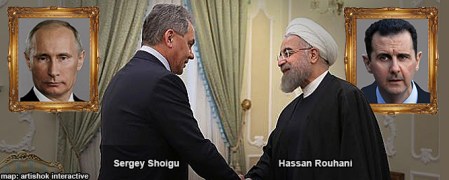
Shoigu_Ruhani

President Vladimir Putin this week mounted a rescue operation to unsnarl his blueprint for a solution of the Syrian crisis from the blockage placed in its path by none other than Bashar Assad. The Syrian ruler won’t hear of Moscow’s proposals for ending the war, or even the cessation of hostilities approved last week in Munich by the 17-member Syria Support Group.

DEBKAfile reports that the strains between Moscow and Damascus this week have blown back onto the working relations between the Russian, Syrian and Iranian military commands running the war in Syria.

US Secretary of State John Kerry, referring to the lack of progress toward a ceasefire during a visit to Amman Sunday, Feb. 21, pointed mainly at the Syrian opposition. Its High Negotiations Committee insists first on an end to the sieges, a halt on Russian bombardment and the inclusion of the jihadist Nusra Front in the ceasefire.

But, according to our sources, the main monkey wrench has been thrown into the mix by Assad.

When Putin discovered that the Syrian ruler had won the secret backing of Tehran in h is refusal, he decided to send the supreme commander of the Russian campaign in Syria, Defense Minister Gen. Sergei Shoigu, to Tehran Sunday, Feb. 21, with a personal message for President Hassan Rouhani.

Gen. Shoigu laid before Rouhani the extent to which Russian intervention had turned the tide of the Syrian war in favor of the regime, and the great advantages of a political resolution that would end the conflict in a way that enhanced Russian and Iranian influence in the region to the maximum.

The Russian general stressed that at the end of the proposed political process, Assad would be required to step down. This concurrence was incorporated in the Putin-Obama deal for working together to solve the Syrian crisis.

But Rouhani was unmoved, according to the statement he issued at the end of the interview.

“The crisis in Syria can only be solved through political negotiation and respect for the rights of the country’s government and people, who are those taking the final decision regarding its future,”  he said.

This was taken in Moscow as Iran’s rejection of at least one element of the Putin plan – imposing a solution on Assad – but not the plan in its entirety. This qualified response was meant to nudge Moscow closer to Teheran and Moscow and pull away from Washington.

The Shoigu mission therefore did not lessen the strains between Russia, Iran and Assad – at least for now, according to DEBKAfile’s sources.

Although all the parties concerned agree that the war must be ended by political means, those means are the subject of controversy between Moscow and its allies. The Russians are seeking a staged advance towards the final goal by first scaling down military operations, the while gradually refocusing their efforts on political and diplomatic arrangements.

But Syrian and Iranian leaders want to keep the focus on the military course.

Moscow wants the Assad regime to make concessions for paving the way to a cease-fire, and to accept a transitional government taking over in Damascus with representation for the opposition. The Syrian dictator would then gradually transfer his powers to the stand-ins as they assume responsibility for the various branches of government.

But both Assad and Tehran are adamantly opposed to a transitional government being installed – or any other political steps being pursued – before the rebel forces are totally defeated in non-stop military operations – first in the north and then in the south.

Neither the Syrian ruler nor Iran show any sign of relenting, or appreciating that the dramatic progress achieved in the past month by Syrian army, Iranian and Hizballah forces were down to Russian military support and especially its air campaign against their enemies. They feel safe in their intransigence because they assume that Putin can’t afford to abruptly pull his military support from under their feet to make them bow to his demands.

After five months in which Moscow and the Russian air force have provided the Iranian leadership and Assad with signal victories on the ground, President Putin has been brought up short by the same Iranian-Syrian negative obstructionism, that has defied every effort to end the brutal five-year war, which has cost 470,000 lives, left 1.9 million injured, displaced half the country’s population of 23 million and left a Syria ravaged beyond recognition.

50 ISIS fighters killed in Syria regime Aleppo advance: monitor

February 21, 2016

50 ISIS fighters killed in Syria regime Aleppo advance: monitor

Source: 50 ISIS fighters killed in Syria regime Aleppo advance: monitor – Al Arabiya English

Residents inspect damage after an airstrike on the rebel held al-Fardous neighbourhood of Aleppo, Syria February 18, 2016. (Reuters)

At least 50 ISIS group fighters have been killed in the last 24 hours in an advance by Syrian government forces east of Aleppo city, a monitor said Sunday.

The Britain-based Syrian Observatory for Human Rights said the fighters were killed in clashes as well as strikes by Russian forces that are waging an aerial campaign in support of government troops.

Since Saturday morning, Syrian government forces have taken more than a dozen villages from ISIS jihadists around a stretch of highway that runs east from the northern city of Aleppo to the Kweyris military base.

The advances have consolidated government control over the stretch of highway leading to Kweyris, which they seized in November.

“The army has encircled ISIS in 16 villages south of the road. The regime wants to take these villages to consolidate its position in the east and southeast of the province,” said Observatory chief Rami Abdel Rahman.

The advances follow a major regime operation in northern Aleppo against rebel forces that has allowed them to virtually surround the opposition-held east of Aleppo city.

US State Secretary Kerry: Provisional agreement in principle reached on Syria truce terms

February 21, 2016

US State Secretary Kerry: ‘Provisional agreement in principle’ reached on Syria truce terms

Source: US State Secretary Kerry: Provisional agreement in principle reached on Syria truce terms – Daily Sabah

AA Photo

Secretary of State John Kerry said Sunday that a “provisional agreement” has been reached on a cease-fire that could begin in the next few days in Syria’s five-year civil war.

Kerry said he spoke in the morning with Russian Foreign Minister Sergey Lavrov to discuss terms of a cease-fire and the two now must reach out to the parties in the conflict.

He declined to go into the details of the agreement, saying it “is not yet done.” But he said he hoped President Barack Obama and Russian President Vladimir Putin would talk soon and that after that, implementation could begin.

“The modalities for a cessation of hostilities are now being completed,” Kerry said. “In fact, we are closer to a cease-fire today than we have been. A cessation of hostilities … is possible over the course of these next hours.”

The Russian Foreign Ministry seemed to stop short of Kerry’s announcement. The ministry said Lavrov and Kerry spoke on the phone Sunday for a second day in a row and discussed “the modality and conditions” for a cease-fire in Syria that would exclude groups that the U.N. Security Council considers terrorist organizations.

Fighting has intensified in Syria during recent weeks and an earlier deadline to cease military activities was not observed. The United States, Russia and other world powers agreed Feb. 12 on a deal calling for the ceasing of hostilities within a week, the delivery of urgently needed aid to besieged areas of Syria and a return to peace talks in Geneva.

U.N. envoy Staffan De Mistura halted the latest Syria talks on Feb. 3, because of major differences between the two sides, exacerbated by increased aerial bombings and a wide military offensive by Syrian troops and their allies under the cover of Russian airstrikes. The humanitarian situation has only gotten worse, with an estimated 13.5 million Syrians in need of aid, including 6 million children.

“Peace is better than more war,” Kerry said, standing next to Nasser Judeh, the foreign minister of Jordan, which hosts 635,000 Syrian refugees. “A political solution is better than then a futile attempt to try to find a military one that could result in so many more refugees, so many more jihadists, so much more destruction, and possibly even the complete destruction of Syria itself.”

However, he reiterated the long-time U.S. position that any political solution to the conflict will not work if Syrian President Bashar Assad remains at the helm of the nation. “Make no mistake. The answer to the Syrian civil war will not be found in any military alliance with Assad,” Kerry said. “Let me make that clear.”

He said Russia now has to talk with the Syrian government and Iran, which backs Assad, and the U.S. has to talk with the opposition and members of the International Syria Support Group. He said he knows that not every party will automatically agree to the agreement reached for a ceasefire.

“There is a stark choice for everybody here,” Kerry said.

“I know how much work remains and I don’t know if everyone is going to meet their commitments,” Kerry said. “I can’t vouch for that the United States can’t make certain of that.”

He said enforcement issues still need to be resolved in addition to how any breeches will be addressed.

“These are details that have to be determined if it going to be effective,” Kerry said.

Erdoğan to Obama: Turkey to stop shelling YPG only if YPG, Russia, Assad abide by Munich deal

February 21, 2016

Erdoğan to Obama: Turkey to stop shelling YPG only if YPG, Russia, Assad abide by Munich deal

Deniz Zeyrek – ANKARA

Source: Erdoğan to Obama: Turkey to stop shelling YPG only if YPG, Russia, Assad abide by Munich deal – MIDEAST

The fall of the town of Azez in northern Aleppo province where the Turkish military is pushing ahead with its cross-border artillery shelling campaign against U.S.-backed Syrian Kurdish militia positions in Syria would mean emergence of a new refugee influx and security problem for Turkey, Turkish President Recep Tayyip Erdoğan told his U.S. counterpart, President Barack Obama. The People’s Protection Units (YPG), the militia force of Syria’s Democratic Union Party (PYD), and the Assad forces backed by Russia have been acting in cooperation, Erdoğan told Obama in an 80-minute telephone call on Feb. 19.

“Their goal is not fighting against ISIL [the Islamic State of Iraq and the Levant]. If Azez falls, Turkey will face a serious migration and security problem. If [Syrian President Bashar al-] Assad, Russia and the YPG abide by the agreement reached in Munich, then artillery fires will be ceased,” Erdoğan responded, when Obama reiterated the U.S. call for the Turkish Armed Forces’ (TSK) shelling of campaign of the YPG to stop.

The Turkish president was referring to a Feb. 12 deal reached by the 17-nation International Syria Support Group (ISSG) in Munich where many of the key actors in the Syrian conflict, including Damascus ally Russia, agreed on a proposed ceasefire and to increase humanitarian access.

Turkey will not let the continued building of a “corridor” south of its borders, Erdoğan said.

“Our artillery fires have this aim and will continue. We will never sit back and watch formation of such an illegitimate entity at our borders,” he told Obama, according Hürriyet reports citing sources from the Turkish president’s office and Turkish diplomatic sources.

As Obama expressed his condolences to Erdoğan over a Feb. 17 suicide car bomb attack that killed 28 people, many of them soldiers, in the heart of the capital city of Ankara, Erdoğan reiterated that they had “no doubt” that the YPG carried out the attack. As of Feb. 19, the Kurdistan Freedom Hawks (TAK), a group that once had links to the outlawed Kurdistan Workers’ Party (PKK), claimed responsibility for the bombing.

President asks for unconditional US support against YPG

Calling on the United States to give unconditional support in the fight against Syrian Kurdish militants, Turkish Prime Minister Ahmet Davutoğlu said on Feb. 20 he did not rule out the responsibility of the YPG, calling TAK a “proxy” that claimed the bombing to shield the international reputation of the YPG.

The YPG’s political arm has denied the group was behind the Ankara attack and said Turkey was using the bombing to justify an escalation in fighting in northern Syria.

“The only thing we expect from our U.S. ally is to support Turkey with no ifs or buts,” Davutoğlu told a news conference following a five-hour security meeting with members of his cabinet and other officials.

“If 28 Turkish lives have been claimed through a terrorist attack, we can only expect them to say any threat against Turkey is a threat against them,” he said.

Turkish Foreign Minister Mevlut Cavuşoğlu earlier accused the United States of making conflicting statements about the militia group.

Cavuşoğlu has also claimed that U.S. Secretary of State John Kerry told him the YPG could not be trusted, in what Cavuşoğlu said was a departure from Washington’s official position.

“My friend Kerry said the YPG cannot be trusted,” Cavuşoğlu said at a news conference during a visit to Tbilisi on Feb. 19, referring to call with Kerry that took place on Feb. 18.

“When you look at some statements coming from America, conflicting and confused statements are still coming…. We were glad to hear from John Kerry yesterday that his views on the YPG have partly changed.”

As of Feb. 20, Çavuoğlu held telephone conversations with both Kerry and Saudi Foreign Minister Abdel al-Jubair, Turkish diplomatic sources told Hürriyet Daily News on Feb. 21, without elaborating on content of talks or on who initiated the talks.

February/21/2016

Turkey has the right to conduct operations in Syria, elsewhere to combat terror threats:

February 21, 2016

Turkey has the right to conduct operations in Syria, elsewhere to combat terror threats: Erdoğan

ISTANBUL – Anadolu Agency

Sunday,February 21 2016

Source: Turkey has the right to conduct operations in Syria, elsewhere to combat terror threats: Erdoğan – MIDEAST

AA Photo

AA Photo

Turkey has the right to conduct operations not only in Syria but also any other place in which there are terrorist organizations that target Turkey, said President Recep Tayyip Erdoğan.

“Turkey has every right to conduct operations in Syria and the places where terror organizations are nested with regards to the struggle against the threats that Turkey faces,” Erdoğan said Feb. 20, during the event “UNESCO City of Gastronomy: Gaziantep,” which was organized to celebrate the inclusion of Turkey’s southeastern province of Gaziantep on the list of UNESCO’s Creative Cities Network in the gastronomy category.

Erdoğan’s remarks came one day after he and U.S. President Barack Obama talked on the phone for more than an hour regarding the latest developments in Syria and Turkey.

During his address on Feb. 20, Erdoğan said the situation had “absolutely nothing to do with the sovereignty rights of the states that cannot take control of their territorial integrity.”

“On the contrary, this has to do with the will Turkey shows to protect its sovereignty rights,” he said. “We except attitudes to prevent our country’s right [to self-defense] directly as an initiative against Turkey’s entity – no matter where it comes from.”

Erdoğan said the point Turkey has reached is a place of self-defense and that no one had the right to restrict that right.

“The place where we have come is a point of self-defense. No one can restrict Turkey’s right to self-defense in the face of terror acts that have targeted Turkey; they cannot prevent [Turkey] from using it,” Erdoğan said.

Turkey has been shelling targets belonging to the People’s Protection Units (YPG), the military wing of the Democratic Union Party (PYD), which Turkey sees as a terrorist organization due to its links to the outlawed Kurdistan Workers’ Party (PKK), in Syria since Feb. 13.

Turkey and the U.S. differ on the designation of the PYD and YPG and relations between the two NATO allies have been tense for more than a month. While Turkey regards the two groups as a terrorist organization, the U.S. sees the PYD and YPG as an important partner in its fight against the Islamic State of Iraq and the Levant (ISIL) in Syria.

“Turkey will use its right to expand its rules of engagement beyond [responding to] actual attacks against it and to encompass all terror threats, including PYD and Daesh in particular,” Erdoğan said, using the Arabic acronym for ISIL.

His remarks came after a suicide bomb attack in the Turkish capital Ankara killed 28 people and wounded 61 others on Feb. 17.

The Turkish government stated that the Ankara attack was carried out jointly by a YPG member – a Syrian national identified as 1992-born Salih Neccar – and PKK members.

The YPG denied the attack, while the Kurdistan Freedom Hawks (TAK) claimed the attack, saying it was carried out by an operative named Abdülbaki Sönmez.

Erdoğan said that while Turkey was defending itself, they would treat anyone that stands in Turkey’s way as a “terrorist and treat them accordingly.”

“I especially want this to be known this way,” he added.

Erdoğan also lashed out at countries where similar terror attacks have taken place, criticizing them for severely reacting to the attacks when it was their country at stake but “preaching only patience and resoluteness” when it comes to Turkey.

This is “disingenuous,” Erdoğan said.

At least 25 killed, dozens injured in double extremist attack in Homs, Syria (VIDEO, PHOTOS)

February 21, 2016

At least 25 killed, dozens injured in double extremist attack in Homs, Syria (VIDEO, PHOTOS)

Published time: 21 Feb, 2016 07:07 Edited time: 21 Feb, 2016 13:24

Source: At least 25 killed, dozens injured in double extremist attack in Homs, Syria (VIDEO, PHOTOS) — RT News

Dozens of people have been killed and injured in a double bombing attack in Homs, Syria. Talal Barazi, the governor of Homs, said at least 25 people had been killed, but other sources say the death toll was even higher.

The explosions at a traffic light at al-Siteen Street in the al-Zahra neighborhood happened within minutes of each other, witnesses said. One of them may have been triggered by a suicide bomber.

RIA Novosti cites a medical official who estimated a higher casualty number, saying the attack has claimed at least 46 lives and injured as many as 110.

Witnesses said at least one of the two blasts was triggered by a suicide bomber driving a car.

A follow-up bombing after an initial blast is a common terrorist tactic, which allows them to hit first responders, who rush to help victims.

The Syrian Foreign Ministry said the bombing was aimed at derailing the ongoing peace talks between Damascus and rebel forces, and called on the UN Security Council to condemn the attack.

Bombings targeting civilians happen regularly in Syria, which has been riven by a five-year armed conflict. Islamic State claimed responsibility for a bombing in Homs last month, which killed at least 24 people. Another attack in December claimed 32 lives.

EU won’t go to war against ISIS in Libya uninvited

February 21, 2016

EU won’t go to war against ISIS in Libya uninvited – Mogherini

Published time: 21 Feb, 2016 11:40

Source: EU won’t go to war against ISIS in Libya uninvited – Mogherini — RT News

© Goran Tomasevic
he EU will not intervene against the terrorist group Islamic State (IS, formerly ISIS/ISIL) in Libya if it receives an official invitation from a legitimate government of the country, the union’s top diplomat said.

“Defeating Daesh effectively can only happen through a legitimate Libyan government in charge of its own security,” Frederica Mogherini told Journal du Dimanche in an interview published on Sunday.

Mogherini called Islamic State by the Arabic language acronym of the organization. IS has been gaining ground in Libya, seizing the city of Sirte and advancing on the oil-rich regions in the east of the country, which remains split between rival groups in the wake of the toppling of its leader Muammar Gaddafi by a NATO-backed uprising in 2011.

The UN has spent months trying to negotiate a unified government, which would be supported by all major power centers including the Islamist militia alliance Libya Dawn, which currently controls the capital, Tripoli.

“We have supported efforts to create a national unity government for months,” Mogherini said. “If we want to help them, we should trust them because they know their country better than we do.”

The internationally recognized parliament of Libya is to vote on Tuesday on a unity government deal.

The EU’s foreign policy chief was speaking days after the US conducted an airstrike on a suspected IS training camp in western Libya targeting a commander responsible for terrorist attacks in Tunisia. Two Serbian hostages were among the four dozen people reportedly killed in the attack on Friday.

The Pentagon said it was acting with the consent of the Libyan interim government, but the Libyans have denied this and accused the US of violating the country’s national sovereignty.

While Mogherini said Libya’s permission is needed to bomb IS troops on its soil, some EU members are not as picky when it comes to Syria. Several countries, including European heavyweights Germany, France and Britain, have been conducting military missions over Syria as part of the US-led coalition fighting IS, even though neither Damascus nor the UN Security Council mandated such intervention.

Russia air strikes seal Jebel Druze against attack and refugees

February 21, 2016

Russia air strikes seal Jebel Druze against attack and refugees, DEBKAfile, February 22, 2016

2717545 10/10/2015 Russian Su-25 attack aircraft take off from the Khmeimim airbase in Syria. Dmitriy Vinogradov/RIA Novosti

2717545 10/10/2015 Russian Su-25 attack aircraft take off from the Khmeimim airbase in Syria. Dmitriy Vinogradov/RIA Novosti

While Syrian war reporting focused over the weekend on the battles around Aleppo and along the Turkish border in the north, Russia since Saturday, Feb. 20 has ramped up its air bombardment of southern cities and towns, especially Daraa and Nawa. Thousands of fleeing rebels with their families and other civilians have meanwhile been turned away from the locked Jordanian border and are heading towards the Golan opposite the Israeli border.

The heaviest Russian air strikes seen hitherto in Syria have two strategic goals.

1. To retake the key southern town of Daraa from rebel hands and restore it to Syrian President Bashar Assad’s full control.

2. To crush rebel resistance in the South and force them to accept surrender, collapse or escape in the direction of the Jordanian or Israeli borders.

The intense Russian sorties are opening the door to Syrian, Iranian and Hizballah forces to move into the South and reach the Israeli borders. Prime Minister Binyamin Netanyahu sent Dr. Dore Gold to Moscow last week as his special emissary to explain how this affected Israel’s security. But he was unable to persuade the Russians to scale down their attacks in this sensitive border region.

Those attacks have a third goal, which is to encircle the Jebel Druze region with a “shield of fire” as protection for this ethnic minority of 750,000, most which inhabit mountain villages.

This unusual operation, the first of its kind in the Syrian war, has three objectives:

A. To shield the Druzes villages against ISIS attack from the east, namely Deir az-Zour.

B. To shut the door against fleeing rebels seeking sanctuary in the Druze enclave.

C. To show other Syrian minorities, especially the Kurds in the north, the great advantage of allying themselves with Moscow. Word of Russian protection of the Druzes has undoubtedly spread to Syria’s other minorities.

As for the rebels and refugees, Jordanian troops moved into the border crossings evacuated by Syrian rebels and closed the last crossing at Ramtha.

The exodus from southern Syria is now heading towards the Golan on Israel’s doorstep.

Israel has imposed a media blackout on this development. However, DEBKAfile’s sources warn that it will soon be impossible to keep it dark. Within a few days, many thousands of Syrian refugees will be massing at Israel’s Ein Zivan gate opposite Quneitra. Like Turkey and Jordan, Israel will have to supply large numbers of distressed Syrian refugees with tents, food, water and medicines.


