Posted tagged ‘Islamic State’

Sisi asks Obama for military intervention to save Egypt from ISIS

March 28, 2016

Sisi asks Obama for military intervention to save Egypt from ISIS, DEBKAfile, March 28, 2016

Egyptian President Abdel Fatteh El-Sisi has sent a secret missive to President Barack Obama asking for urgent US military intervention in support of Egypt’s war on the Islamist State in Sinai, before the jihadis pose a real threat to Cairo. DEBKAfile’s exclusive intelligence and counterterrorism sources report that El-Sisi has come to the conclusion that Egyptian army lacks the ability to eradicate the terrorist peril without direct US military support.

In his note, he asks Washington to replicate in Sinai the format of US intervention in the war on ISIS in Iraq and Syria, namely, to send in special operations forces to establish bases and operate drones against jihadist targets. Unless stopped, he warns, the Islamic State is on the point of transforming the Sinai Peninsula into its primary forward base in the Middle East, bolstered by its branches of terror across North Africa, especially in Libya. US intervention is necessary to avert this.

So far, Sisi has received no answer from the White House and no sign of one in the pipeline.

Our military sources note that, given his record as former defense minister and a much-decorated general in the Egyptian army, an appeal to a foreign power for military assistance is out of character and would normally be found unacceptable in his own milieu. It must therefore be seen as a sign of extreme distress over Cairo’s failure to vanquish – or even contain ISIS, which now poses a strategic threat to Egypt proper.

In this situation, the generals in Cairo were dismayed to read a New York Timesleader on March 25, captioned “Time to Rethink US relationship with Egypt,” which faults the Egyptian regime’s human rights record and suggests that the relationship does Washington more harm than good.

The NYT concludes by saying, “Over the next few months, the president should start planning the possibility of a break in the alliance with Egypt. That scenario appears increasingly necessary.”

Since this article appeared out of the blue, it is feared in Cairo that it is President Obama’s way of spurring the Egyptian president’s SOS.

Some high-ranking military figures in Cairo have started talking about alternatives: If Washington refuses to come up with military assistance for fighting the Islamic State, perhaps the time has time to go elsewhere.
An Egyptian appeal to Moscow cannot be ruled out.


Fighting ISIS plays into ISIS’ Hands?

March 28, 2016

Fighting ISIS plays into ISIS’ Hands? Front Page Magazine, Daniel Greenfield, March 28, 2016

isis-shooting-syria

If you’re keeping score, freeing Islamic terrorists from Gitmo does not play into the hands of ISIS. Neither does bringing Syrians, many of whom sympathize with Islamic terrorists, into our country. And aiding the Muslim Brotherhood parent organization of ISIS does not play into the Islamic group’s hands.

However if you use the words “Islamic terrorism” or even milder derivatives such as “radical Islamic terrorism”, you are playing into the hands of ISIS. If you call for closer law enforcement scrutiny of Muslim areas before they turn into Molenbeek style no-go zones or suggest ending the stream of new immigrant recruits to ISIS in San Bernardino, Paris or Brussels, you are also playing into the hands of ISIS.

And if you carpet bomb ISIS, destroy its headquarters and training camps, you’re just playing into its hands. According to Obama and his experts, who have wrecked the Middle East, what ISIS fears most is that we’ll ignore it and let it go about its business. And what it wants most is for us to utterly destroy it.

Tens of thousands of Muslim refugees make us safer. But using the words “Muslim terrorism” endangers us. The more Muslims we bring to America, the faster we’ll beat ISIS. As long as we don’t call it the Islamic State or ISIS or ISIL, but follow Secretary of State John Kerry’s lead in calling it Daesh.

Because terrorism has no religion. Even when it’s shouting, “Allahu Akbar”.

Obama initially tried to defeat ISIS by ignoring it. This cunning approach allowed ISIS to seize large chunks of Iraq and Syria. He tried calling ISIS a JayVee team in line with his recent claim that, “We defeat them in part by saying you are not strong, you are weak”. Unimpressed, ISIS seized Mosul. It was still attached to the old-fashioned way of proving it was strong by actually winning land and wars.

Then Obama tried to defeat ISIS by arming the Islamist allies of Al Qaeda and now a lot more American weapons are in the hands of Islamic terrorists. Some of them are even in the hands of ISIS.

Europe and the United States decided to prove that we were not at war with Islam by taking in as many Muslims as we could. Instead of leading to less terrorism, taking in more Muslims led to more terrorism.

Every single stupid counterintuitive strategy for defeating Islamic terrorism has been tried. And it has failed miserably. Overthrowing “dictators” turned entire countries into terrorist training camps. Bringing Islamists to power in Egypt, Libya and Tunisia led directly to attacks on American diplomatic facilities. The Muslim Brotherhood showed no gratitude to its State Department allies. Instead its militias and forces either aided the attackers or stood by and watched while taking bets on the outcome.

Islamic terrorism has followed an entirely intuitive pattern of cause and effect. There’s a reason that the counterintuitive strategies for fighting Islamic terrorism by not fighting Islamic terrorism don’t work. They make no sense. They never did. Instead they all depend on convincing Muslims, from the local Imam to Jihadist organizations, to aid us instead of attack us by showing what nice people we are. Meanwhile they also insist that we can’t use the words “Islamic terrorism” because Muslims are ticking time bombs who will join Al Qaeda and ISIS the moment we associate terrorism with the I-word.

The counterintuitive strategy assumes that Islamic terrorism will only exist if we use the I-word, that totalitarian Jihadist movements just want democracy and that our best allies for fighting Islamic terrorism are people from the same places where Islamic terrorism is a runaway success. And that we should duplicate the demographics of the countries where Islamic terrorism thrives in order to defeat it.

The West’s counterterrorism strategy makes less sense than the ravings of most mental patients. The only thing more insane than the counterintuitive strategy for defeating Islamic terrorism is the insistence that the intuitive strategy of keeping terrorists out and killing them is what terrorists want.

If you believe the experts, then Islamic terrorists want us to stop them from entering Europe, America, Canada and Australia. They crave having their terrorists profiled by law enforcement on the way to their latest attack. And they wish we would just carpet bomb them as hard as we can right now.

When ISIS shoots up Paris or Brussels, it’s not really trying to kill infidels for Allah. Instead it’s setting a cunning trap for us. If we react by ending the flow of migrants and preventing the next attack, ISIS wins. If we police Muslim no-go zones, then ISIS also wins. If we deport potential terrorists, ISIS still wins.

But if we let ISIS carry out another successful attack, then ISIS loses. And we win. What do we win?

It depends. A concert hall full of corpses. Marathon runners with severed limbs. Families fleeing the airport through a haze of smoke. Only by letting ISIS kill us, do we have any hope of beating ISIS.

Politicians and experts claim that ISIS is insane. It’s not insane. It’s evil. Its goals are clear and comprehensible. The objectives of the Islamic State are easy to intuitively grasp. Our leaders and experts are the ones who are out of their minds. They may or may not be evil, but they are utterly insane. And they have projected their madness on Islamic terrorists who are downright rational compared to them.

Unlike our leaders, Islamic terrorists don’t confuse victory and defeat. They aren’t afraid that they’ll win. They don’t want us to kill them or deport them. They don’t care whether we call them ISIS or Daesh. They don’t derive their Islamic legitimacy from John Kerry or a State Department Twitter account. They get it from the Koran and the entire rotting corpus of Islamic law that they seek to impose on the world.

Our leaders are the ones who are afraid of winning. They distrust the morality of armed force and borders. They disguise that distrust behind convoluted arguments and counterintuitive rationales. Entire intellectual systems are constructed to explain why defeating ISIS is exactly what ISIS wants.

After the San Bernardino shootings, Obama insisted that, “Our success won’t depend on tough talk or abandoning our values…  That’s what groups like ISIL are hoping for.” But ISIS does not care whether Obama talks tough, even if it’s only his version of tough talk in which he puffs out his chest and says things like, ”You are not strong, you are weak.” It is not interested in Obama’s “right side of history” distortion of American values either. ISIS is not trying to be counterintuitive. It’s fighting to win.

And our leaders are fighting as hard as they can to lose.

The counterintuitive strategy is not meant to fight terror, but to convince the populace that winning is actually losing and losing is actually winning. The worse we lose, the better our plan is working. And when we have completely lost everything then we’ll have the terrorists right where we want them.

Just ask the dead of Brussels, Paris, New York and a hundred other places.

This isn’t a plan to win. It’s a plan to confuse the issue while losing. It’s a plan to convince everyone that what looks like appeasement, defeatism, surrender and collaboration with the enemy is really a brilliant counterintuitive plan that is the only possible path to a lasting victory over Islamic terrorism.

But intuitive beats counterintuitive. Winning intuitively beats losing counterintuitively. Counterintuitively dead terrorists multiply, but intuitively they stay dead. Counterintuitively, not discussing the problem is the best way to solve it. Intuitively, you solve a problem by facing it. Counterintuitively, collaborating with the enemy is patriotism. Intuitively, it’s treason.

Putin congratulates Assad on liberating Palmyra, says Russia to aid in demining ancient city

March 28, 2016

Putin congratulates Assad on liberating Palmyra, says Russia to aid in demining ancient city

Published time: 27 Mar, 2016 15:15 Edited time: 27 Mar, 2016 21:14

Source: Putin congratulates Assad on liberating Palmyra, says Russia to aid in demining ancient city — RT News

Russian President Vladimir Putin has congratulated Syrian President Bashar Assad on retaking the ancient city of Palmyra from Islamic State terrorists. Putin stressed the importance of preserving the UNESCO World Heritage Site.
Read more

A view of the central part of modern Palmyra. © Mikhail Voskresenskiy

In a telephone conversation with the Syrian president, Vladimir Putin congratulated his counterpart on retaking the city of Palmyra from terrorists and noted the importance of preserving this unique historic site for world culture,” Kremlin spokesman Dmitry Peskov said Sunday.

Putin once again stressed that despite the withdrawal of the bulk of Russia’s military contingent from Syria, Russia’s forces will continue to help the Syrian authorities in their anti-terrorist efforts,” he added.

“Assad highly valued the help Russian air forces have provided and underlined that such successes as regaining Palmyra would have been impossible without Russia’s support,” Peskov said.

On Sunday, the Syrian Army retook the historic city of Palmyra from Islamic State (IS, formerly ISIS/ISIL), which had occupied it since last May. Russian warplanes were providing heavy support from the air.

The Russian Air Force has made 40 flights over the area of the Syrian city of Palmyra in the last 24 hours, hitting 117 targets and killing over 80 militants, the Russian Center for Reconciliation in Syria said Sunday.

Putin also held a phone call with UNESCO head Irina Bokova on Sunday. Peskov said Putin told Bokova that “representatives of the Russian contingent will participate in the demining of the ancient city.

READ MORE: Palmyra ‘not just an archaeological site but a symbol of Syria’ – UNESCO

The two agreed that UNESCO, Russia and Syria will soon take the necessary steps to evaluate the damage to the historic site and map out a “plan of restoring what can still be restored,” Peskov added.

According to the Kremlin spokesman, Bokova thanked Putin for Russia’s contribution and confirmed UNESCO’s readiness to cooperate.

While summarizing the results of Russia’s five-month anti-terror campaign in Syria earlier in March, Putin expressed hope that Palmyra would soon be returned to the Syrian people. On March 18, Russia’s military said that the groundwork had been laid for defeating IS in Palmyra.

Read more

© Mikhail Voskresenskiy

At that time, the Syrian Army had already taken control of all dominant heights and major roads around the city, and the terrorists’ logistical support had also been cut off, according to Sergey Rudskoy, chief of the Russian General Staff’s main operations department.

Palmyra shows Damascus strategy more effective than US-led efforts in Syria – Assad

Calling the Syrian Army’s liberation of Palmyra an “important achievement,” Assad told a delegation of French parliamentarians visiting Syria on Sunday that the victory is “new evidence” that the strategy being pursued by Damascus and its allies is effective, according SANA, Syria’s state news agency.

He also pointed out that the strategy’s success is especially apparent when compared to that of the US-led coalition, which involves more than 60 countries, but has achieved very little since its establishment one and a half years ago, for which he blamed a lack of seriousness in fighting terrorism.

The US-led coalition launched its air campaign in Syria in September of 2014 without permission from the Syrian government. Damascus has repeatedly called the intervention ineffective, saying it has failed to weaken terrorists in the region.


EXCLUSIVE – Top Gazan Terrorist: Only A Matter of Time Before ‘Big Operation’ in Eilat

March 28, 2016

Top Gazan Terrorist: Only a Matter of Time Before ‘Big Operation’ in Southern Israel

By Breitbart Jerusalem

27 Mar 2016

Source: EXCLUSIVE – Top Gazan Terrorist: Only A Matter of Time Before ‘Big Operation’ in Eilat

David Silverman/Newsmakers/Getty

TEL AVIV – It is only a matter of time before the Islamic State’s branch in the Egyptian Sinai carries out a “big operation” in the Israeli resort town of Eilat and other parts of southern Israel, a leading Islamic State-allied militant claimed in an exclusive interview.

Abu al-Ayna al-Ansari, a Salafist movement senior official in the Gaza Strip, made the claim in a pre-recorded, hour-long interview to air in full on Sunday on “Aaron Klein Investigative Radio,” the popular weekend talk radio program broadcast on New York’s AM 970 The Answer and NewsTalk 990 AM in Philadelphia. Klein doubles as Breitbart’s senior investigative reporter and Jerusalem bureau chief.

Ansari is a well-known Gaza Salafist jihadist allied with Islamic State ideology. During the interview with Klein, Ansari seemed to be speaking as an actual IS member, repeatedly using the pronoun “we” when referring to IS and even making declarations on behalf of IS.

IS has been reluctant to officially declare its presence in Gaza for fear of a Hamas crackdown, but the group is known to be active in the coastal enclave and Ansari is a suspected IS leader. IS-aligned militants have taken responsibility for recent rocket fire from Gaza aimed at Israel.

Klein asked Ansari about IS’s capabilities inside Israel.

Ansari replied:

Israel and the United States are at the top of the list of the targets of the Islamic State. The Islamic State educates its people that Israel and the United States are the leaders of the infidels and we believe that Israel should be disappeared.

As for the question about the cells, I cannot give you any details but there is no doubt that the Islamic State keeps working on creating its infrastructure and cells all around the world. And I can confirm that the Wilayat Sinai, the Egyptian branch of the Islamic State that is operating in the Sinai, will be the pioneers in this confrontation with Israel or what is called Israel.

And I can confirm that it is only a question of time when there will be a big operation in Eilat and in the south of Israel. The Wilayat Sinai will be the ones responsible for the confrontation with Israel.

The Jerusalem Post, which also reported on Klein’s interview, noted Col. Yehuda Cohen, the commander of the Israel Defense Forces’ Sagi Brigade operating on the border with Egypt, warned in September that the Islamic State in Egypt will likely eventually attempt terrorist attacks against Israel.

“In the end it must be remembered this organization was formed by terrorists that dream of a terror attack against Israel, and it will come. It’s clear that there will be a terror attack against Israel, I believe that it will happen during my tenure,” Cohen told Israel’s Army Radio at the time.

“I teach my people to expect it to come tomorrow, to always be ready for it. When it happens, my doctrine is that we must strike a very strong blow at the same point and ensure that there are zero successful actions for the enemy,” he said, referring to the IDF.

Before our eyes: Syria’s Battle for Palmyra in latest RT reports (VIDEOS)

March 26, 2016

Before our eyes: Syria’s Battle for Palmyra in latest RT reports (VIDEOS)

Published time: 26 Mar, 2016 06:36

Source: Before our eyes: Syria’s Battle for Palmyra in latest RT reports (VIDEOS) — RT News

© Joseph Eid / AFP

Syrian army is close to regaining full control of the ancient city of Palmyra. Check out some of RT’s exclusive footage and battleground reports on how Islamic State (IS, previously ISIS/ISIL) militants are being pushed from the UNESCO heritage site.

Fierce fighting rages on

RT’s agency Ruptly’s latest video footage shows units of the Syrian Arab Army (SAA) battling IS militants in and around Palmyra on Friday. The historical ruins of Palmyra are clearly visible from the position of Syrian mortar crews.

READ MORE: Syrian Army retakes historic citadel from ISIS continuing advance on Palmyra – state media

In the latest update, Syria state TV said that troops have regained control of the Syriatel hill near Palmyra’s castle and are a step closer to retaking the whole city, which has been under Islamic State control since last May.

Russia helping with air sorties

Russian warplanes offered crucial support to the Syrian forces on the ground this week by carrying out 41 sorties and destroying 146 terrorist targets from Tuesday to Thursday, Russia’s Defense Ministry said.

READ MORE: Russian Air Force carried out 41 sorties to support Syrian army’s Palmyra offensive

One of the stories that stood out was a report on Russian Special Operations Forces officer who called a strike onto himself when he was compromised and surrounded by IS militants near Palmyra. Thanks to the brave actions of this officer and others, Russian military planes have been able to pinpoint IS targets with precision – something absolutely crucial in the circumstances.

ISIS pillage of Palmyra

A Russian TV crew captured a striking footage of Palmyra revealing the damage endured under IS occupation. The iconic 2,000-year-old Arch of Triumph was blown up by the jihadists in October 2015.

READ MORE: Striking drone footage shows what remains of Palmyra after ISIS pillage

Good win or bad win? US undecided

The US government still seems on the fence on whether or not the ancient city should be liberated from the hands of Islamic State by Syrian President Bashar Assad’s forces. Only when pressed by reporters did the State Department call IS “probably a greater evil” than President Assad.

READ MORE: US State Dept fails to say if ISIS must be pushed out of Palmyra or not

Bomb traps danger 

The Syrian army is very close to retaking control of the whole city, but it fears that IS militants have hidden bombs at ancient sites. Before more information can be gathered, the troops will not know when to expect a full-scale offensive against IS.

IS has used this tactic in the past. Also, the extremist group has carried out brutal executions at historical parts of the city by binding individuals to ancient columns and blowing them up.

RT crews remain on battlefront

The RT crew was one of the few that filmed the fighting in Palmyra, offering an exclusive look into the progress of Syrian soldiers in pushing out Islamic State fighters.

READ MORE: RT EXCLUSIVE: ISIS position in Palmyra up-close, RT 1st intl TV crew to follow Syrian Army assault

The conditions they faced while on the ground were extremely dangerous. RT’s Lizzie Phelan and her team risked their lives to report from a position with direct sight of Islamic State militants.

Just meters from where the crew was filming, a mortar landed next to their car. Shrapnel injured one of the Syrian Army soldiers.

Jordan’s king accuses Turkey of sending terrorists to Europe

March 26, 2016

Jordan’s king accuses Turkey of sending terrorists to Europe #Abdullah’sWar Abdullah tells US politicians that radicals are being ‘manufactured in Turkey… as part of Turkish policy’

Last update:
Saturday 26 March 2016 9:20 UTC

Source: Jordan’s king accuses Turkey of sending terrorists to Europe | Middle East Eye

Jordan’s king, Abdullah, and the Turkish president, Recep Tayyip Erdogan (AFP)

King Abdullah of Jordan accused Turkey of exporting terrorists to Europe at a top level meeting with senior US politicians in January, the MEE can reveal.

The king said Europe’s biggest refugee crisis was not an accident, and neither was the presence of terrorists among them: “The fact that terrorists are going to Europe is part of Turkish policy and Turkey keeps on getting a slap on the hand, but they are let off the hook.”

Asked by one of the congressmen present whether the Islamic State group was exporting oil to Turkey, Abdullah replied: ”Absolutely.”

Abdullah made his remarks during a wide-ranging debriefing to Congress on 11 January, the day a meeting with the US president, Barack Obama, was cancelled.

The White House was forced to deny that Obama snubbed one of America’s closest allies in the Middle East, attributing the cancellation to “scheduling conflicts,” although Obama and Abdullah met briefly at Andrews Air Force Base a day later.

Present at the meeting in Congress were the chairmen and members of the Senate Intelligence, Foreign Relations and Armed Services committees, including Senators John McCain and Bob Corker, and Senators Mitch McConnell and Harry Reid, the Senate Majority and Minority leaders respectively.

According to a detailed account of the meeting seen by MEE, the king went on to explain what he thought was the motivation of Turkey’s president, Recep Tayyip Erdogan.

Abdullah said that Erdogan believed in a “radical Islamic solution to the region”.

He repeated: “Turkey sought a religious solution to Syria, while we are looking at moderate elements in the south and Jordan pushed for a third option that would not allow a religious option.”

The king presented Turkey as part of a strategic challenge to the world.

“We keep being forced to tackle tactical problems against ISIL [the Islamic State group] but not the strategic issue. We forget the issue [of] the Turks who are not with us on this strategically.”

He claimed that Turkey had not only supported religious groups in Syria, and was letting foreign fighters in, but had also been helping Islamist militias in Libya and Somalia.

Abdullah claimed that “radicalisation was being manufactured in Turkey” and asked the US senators why the Turks were training the Somali army.

The king invited the US politicians present to ask the presidents of Kosovo and Albania about the Turks.

Abdullah said that both countries were begging Europe to include them, before Erdogan did.

Abdullah was supported in his remarks by his foreign minister, Nasser Judeh, who said that the Albanian president (Bujar Nishani) was a Catholic married to a Muslim, and that that was a model which should be protected in a Muslim majority country.

Judeh said that when the Russian bombing campaign prevented Turkey from establishing safe zones in northern Syria to stop refugees from coming to Turkey, “Turkey unleashed the refugees onto Europe”.

Both Judeh and Abdullah bridled at the $3bn deal offered by Europe to Turkey, noting that Turkey had only 2m Syrian refugees out of a population of 70m, whereas Jordan was facing “a bigger problem proportionally”.

Jordan and Turkey are officially allies. The Turkish prime minister, Ahmed Davutoglu, cancelled an official visit to Jordan after the latest bomb attack in Turkey, which on 13 March killed 34 people in Ankara.

The Kurdish Freedom Falcons (TAK), an offshoot of the PKK, or Kurdistan Workers’ Party, claimed responsibility for the bombing.

The postponed visit is due to take place this weekend and Davutoglu will be mindful that Abdullah told senators that Turkey was using the Kurds as an “excuse” for its policies in Syria.

Galip Dalay, research director at Al Sharq Forum and senior associate fellow on Turkey and Kurdish Affairs at Al Jazeera Center for Studies, said it was wrong to portray Turkey as having a strategic goal of establishing an Islamist government in Syria.

He said: “Turkey did its best in the first eight months of the Syrian crisis to find a political solution to the crisis, which would have included [Syrian President] Bashar Assad. Back then, Turkey was criticised in the region and the West for being too soft on the Assad regime and being too optimistic about the possibility of reform. When it became clear, after eight months of arduous attempts, that Assad had no intention of initiating a political and democratic process to meet the demands of the protestors, Turkey threw its weight behind the opposition.”

Dalay said that the claim Turkey was buying oil from the Islamic State group was a Russian fabrication concocted by Moscow after Turkey shot down the Russian fighter. “Turkey is not the only one saying there is no evidence to support this claim. The United States said it too.”

The Turkish government would not comment officially on Abdullah’s reported remarks on 11 January. But a senior Turkish source accused the king of becoming “the spokesman for Bashar al-Assad”.

He said the portrait emerging from these remarks was not one of a king speaking but of a “Western journalist with a fuzzy state of mind and little familiarity with the region”.

He said: “Turkey is definitely carrying out an intense struggle against Daesh [a reference to the Islamic State group]. Bombings take place in Turkey, not in Jordan. When this is the case, groundless accusations by King Abdullah are totally unacceptable.

“Moreover, his tackling of the Daesh issue with such unfounded information also raises the question about whether Jordan could play a meaningful role in the fight against Daesh.”

He said the king’s claims that IS was selling oil to Turkey were not only absurd but showed that Abdullah did not have the slightest idea about what was going on in Syria.

“The king’s statements and accusations against Turkey are not the first. Unfortunately, all of his allegations are the same as the slanders frequently expressed by the Assad regime.

“It would be to Jordan’s and the region’s interest if Jordan, as a friend of Turkey, were to work for a strategic cooperation with a strategic power like Turkey, instead of acting like the spokesperson of Assad.”
IRA, ISIS and the Fate of Great Britain

March 25, 2016

IRA, ISIS and the Fate of Great Britain, Clarion Project, JC Dash, March 25, 2016

(Here’s a video, in honor of Easter Week, which eventually ended oppressive British rule over Ireland after more than a century.

Did I mention that I’m half Irish? — DM)


London-bombing-7-77/7/05 is a day etched in the collective memory of the British. (Source: https://commons.wikimedia.org/w/index.php?curid=215746)

The first time I was invited to Belfast I have to admit I was terrified. After a lull with relatively few bombings in the 80’s the 90’s there was a resurgence of bombing campaigns. I was travelling in the wake of a double bombing in London in several other places on mainland Britain. At the time the Irish population in England was forced to live in the shadows. The Irish communities came under enormous amounts of surveillance and Irish residents were viewed with the same suspicion.

The United Kingdom was not bound by the constraints of political correctness and threats from the Irish community. The government was concerned with the safety and security of its citizens. That’s not to say Britain did not make mistakes. Many were made but Britain recognized the problems and dealt with them.

So what changed?

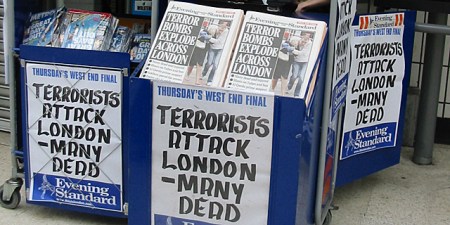
On July 7, 2005 a series of deadly bombings hit London. ‘Traditional terrorism’ died and radical Islam took up the terror reigns.

(This video looks at that fateful day🙂 (The video refuses to embed. You will have to click on it to see it. — DM)

There are many differences between the terrorism of the IRA and today’s radical Islamists. Let’s not fool ourselves, both are cruel and heartless with no respect for human life. But the Irish conflict itself was stalled by a peace initiative. The IRA stopped the bombing, even the splinter groups have been relatively quiet for 15 years.

Let’s put one myth to bed. Islamist extremism has no political or religious agenda. It is about world domination under a man-made system of laws perverting the religion of Islam to suit their own means.

They kill without prejudice. Men, women, children of all nationalities and all religions, even Islam, are targeted. They do not bomb to force a political process they bomb to dominate.

It is not just the terror that is forcing Britain to its knees but the hyper-successful way Islamists have penetrated the government, intelligentsia and liberal elite controlling political correctness to breed a generation of apologists. Schools, municipalities, government officials and influencers all willingly feed on their Islamist agenda.

In the wake of the attacks by ISIS in France and Belgium, Britain needs to wake up. David Cameron, the UK’s prime minister, is among the few with the guts to speak out. Britain needs to decide what is more important, protecting the people, cultural identity and the rule of law or appeasing radical Islam and just giving up.

Make no mistake, Islamist extremism is also alive and well across the Atlantic. In fact it’s a global problem.

It’s time the U.S. admitted there is a problem, joined the dots and make sure it doesn’t repeat the same mistakes as the United Kingdom.

Robert Spencer on Fox and Friends Discusses the Brussels Jihad Massacre

March 25, 2016

Robert Spencer on Fox and Friends Discusses the Brussels Jihad Massacre, Fox News via You Tube, March 24, 2016

Addressing terrorism: what’s the plan?

March 25, 2016

Addressing terrorism: what’s the plan? Sharyl Attkisson, March 24, 2016

Obama and Raul

[W]e’ve been convinced that we’re disallowed from taking most any action that would be logical or effective in protecting ourselves. That’s not to argue that all or even one of these specific measures should be taken. But the fact is, more Americans can probably cite the list of things we won’t do; it would be helpful for us to understand what we will do.

********************

In early 2014, I was in a small meeting with a high-ranking Obama administration official who was involved in counterterrorism. When asked, he made several candid assertions:

  • Al-Qaeda was never on the run. The President’s terrorism experts never told him it was. They were mystified by his 2012 campaign claims that seemed to the contrary.
  • Al-Qaeda and related terrorists had vastly expanded to other nations and grown more powerful during President Obama’s tenure.
  • The wave of terrorist violence had spread from the Mideast to North Africa and would next hit Europe, then the U.S. The official said this matter-of-factly, with no visible sense of urgency or distress, as if a fait accompli.
  • The terrorists, he acknowledged, had a better and more developed strategy than did the U.S. In fact, he said the U.S. did not have a strategy for addressing the terrorist threat.

In the two years since that conversation, the official’s predictions about terror spreading to Europe and then the U.S. have come to pass. ISIS has emerged as a driving force. And most Americans would say there’s still no discernible plan.

The debates over securing the border and tightening the screening of immigrants are an outgrowth of the absence of a national plan. In order to feel a sense of security, Americans need to believe there’s a cohesive strategy with stated goals and explicit tactics. We don’t need to know all the fine points. Sensitive tactical details, for example, should be protected. But we should be able to understand how our leaders are using their authority and our billions of tax dollars to protect us. What’s the plan?

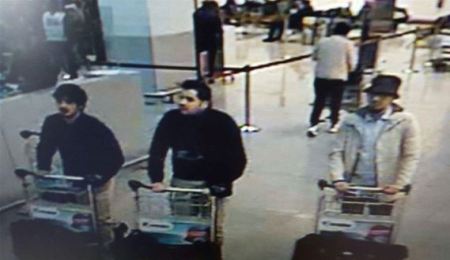
Brussels_suspects_CCTV-1March 2016 Brussels terrorist suspects

n the defense of this (or any) administration, it’s the most difficult plan to devise. It’s hard to imagine a more daunting task than defeating terrorist fighters who play by no rules; while the U.S. is bound by ethics, politics, guidelines and international agreements. And there’s little disincentive for Islamic extremists to join the jihad. After all, what’s the worst that can happen to these barbaric fighters who may come from primitive and destitute circumstances? They get captured by the U.S. and get a better way of life: three meals a day, a roof over their head, a shirt on their back, security, interrogation that promises not to get too tough, free health care and American advocates who will fight to make sure they have recreation, literature and religious expression.

Yet the academic and military discussions about strategy to date have been a source of confusion rather than clarity. The administration may say it’s not changing strategy while the military says it is. At best, the expressed “battle plans” are piecemeal. We’re working to retake cities we already once controlled…but walked away from? Then what? What’s the plan?

President_of_the_United_States_Barack_Obama_making_a_call_in_a_sensitive_compartmented_information_facility_SCIF-1-768x512President Obama in a sensitive compartmented information facility (SCIF)

The conundrum evokes complaints from Vietnam War-era soldiers who said they never really knew what they were doing. They would battle to the death to take a village or a hill, then be ordered to simply walk away from it a few days later, relinquishing it back to the enemy. What was the plan?

It reminds me of the border. While some politicians claim the southern U.S. border is secure, federal and local law enforcement who are there say that couldn’t be farther from the truth. They insist there’s no will or leadership from Washington to bring the border under control, and no strategy to do so. In fact, the only strategy they can verbalize, when asked, is the one they infer: to be as lax as possible in policing the border and enforcing immigration law. What’s the plan?

We’re left with presidential candidates who have attempted to put plan to paper. Because of her experience and knowledge, Hillary Clinton may seem best positioned to verbalize a clear strategy. Yet as secretary of state, her own miscalculations arguably hastened the rise of ISIS from the ashes of Libya. Her emails from the time confirm that she took the lead in aggressively pursuing the poorly-conceived ouster of Libyan dictator Muammar Ghaddafi without foreseeing the vacuum it would create. In its wake: the tragedy of Benghazi, and the transformation of Libya into a new proving ground for Islamic extremists. It doesn’t inspire confidence that a Clinton leadership would competently address what she failed to foresee as a top Obama official. On the other hand, it could be argued that mistakes of the past provide important lessons for those open to learning from them.

Hillary_Clinton_official_Secretary_of_State_portrait_cropHillary Clinton as secretary of state

There’s little doubt that, left its own devices, the world’s strongest military and best intelligence structure could do much better. But they’re hampered by the growing list of what we won’t do.

We won’t secure our southern border that FBI and Homeland Security officials have warned terrorists seek to exploit.

We won’t tighten up visa and immigration security because of the special interests who would cry racism.

We won’t send more terrorists captured in the field to Guantanamo Bay, lest we be criticized.

We won’t question detainees harshly to get information; that’s viewed as inhumane.

We won’t bomb targets in a way that may hurt a civilian or destroy assets. Obviously, the enemy has thus learned to live and work among civilians.

We’re told to report suspicions by the same authorities that view suspicion as racist.

In short, we’ve been convinced that we’re disallowed from taking most any action that would be logical or effective in protecting ourselves. That’s not to argue that all or even one of these specific measures should be taken. But the fact is, more Americans can probably cite the list of things we won’t do; it would be helpful for us to understand what we will do.

It’s an arduous question. But answering it is under the purview of our chosen leaders. What’s the plan?

Share

Despite reports, Syria’s Palmyra and Iraq’s Mosul not on verge of liberation

March 24, 2016

Despite reports, Syria’s Palmyra and Iraq’s Mosul not on verge of liberation, DEBKAfile, March 24, 2016

In complete contrast with media reports issued on Thursday morning, the Iraqi army is not preparing to liberate Mosul, the country’s second largest city, and the Syrian army is not on the verge of capturing Palmyra.

DEBKAfile‘s intelligence and military sources report that the Syrian army is not capable of taking over the historic city without support from the Russian air force. On President Vladimir Putin’s orders, the Russian military has recently reduced its support of the Syrian army to a minimum until Damascus agrees to negotiate with the opposition regarding the country’s future.

The sources add that the Iraqi army does not intend to attack ISIS-held Mosul at any time in the near future, and has even reduced its forces near the city by sending a number of battalions to Baghdad to protect the capital from attacks by the terrorist organization.