Posted tagged ‘Islamic State’

My First Hizb-ut-Tahrir Conference

May 24, 2016

My First Hizb-ut-Tahrir Conference, Gatestone InstituteZ., May 24, 2016

The first speaker was Brother Mostafa, of Arabic roots. Mostafa started by calling nationalism and sectarian conflict the main reasons for division in the Ummah (Islamic nation). He reminded Muslims that they are obligated to implement Allah’s demands that fulfill the Islamic State. It is “not permissible for us to choose, ” he said. He cited the verse:

“It is not for a believing man or a believing woman, when Allah and His Messenger have decided a matter, that they should [thereafter] have any choice about their affair. And whoever disobeys Allah and His Messenger has certainly strayed into clear error.” — Surat-Al-Ahzab (33), verse 36.

*********************

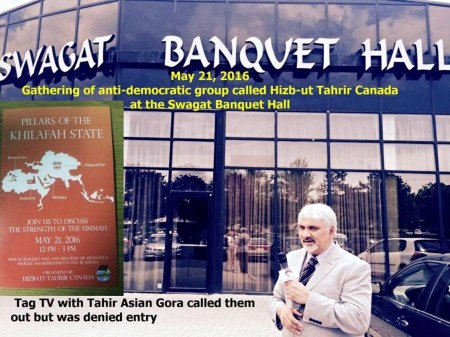
Time: Saturday May 21, 2016, 12:00-3:00PM
Venue: Swagat Banquet Hall, 6991 Millcreek Dr., Mississauga, Ontario, Canada
1616

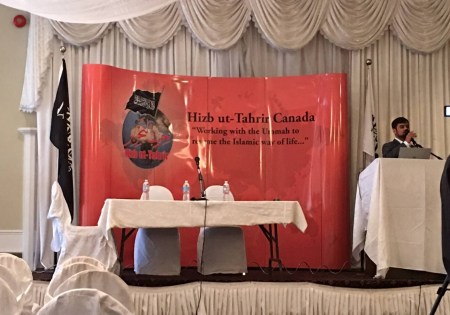
The half-full banquet hall, divided into the men’s side and the women’s side, admitted about 100 attendees. A black flag with white script was on display, on both the screen and on the podium. “Why,” I said to the woman next to me, “is this flag there? Is that not the ISIS flag?” The woman, later identified as Naeema, said it was not, and called her son, one of the organizers, to address the question. It seemed difficult for him, too; he went off to look for someone else more knowledgeable to the help with the problem. Naeema explained that the writing was different. “I can read Arabic,” I said. No one could be found to answer the question.

As the event started late, Naeema began a conversation. We talked about our origins and how long we had been in Canada. She said she had been here 40 years, so I asked about the disconnect between enjoying 40 years of democracy, yet trying to end it. I mentioned a book published by Hizb-ut-Tahrir:

“Democracy is Infidelity: its use, application and promotion are prohibited.”

“الديمقراطية نظام كفر، يحرم أخذها أو تطبيقها أو الدعوة إليها”

Naeema said she was not qualified to debate the topic, but that democracy had done nothing good for people, so she and other believers would follow the rule of Allah. Reflecting on the Muslim Brotherhood’s year in power in Egypt, I asked if she were prepared to have a dictator claim to be Allah’s spokesman even if he abused the power. She said she had never thought about it like that, but, again, that she was not qualified to debate the topic. As the conference began, the conversation stopped.
1617

The first speaker was Brother Mostafa, of Arabic roots. Mostafa started by calling nationalism and sectarian conflict the main reasons for division in the Ummah (Islamic nation). He reminded Muslims that they are obligated to implement Allah’s demands that fulfill the Islamic State. It is “not permissible for us to choose, ” he said. He cited the verse:

“وما كان لمؤمن ولا مؤمنة إذا قضى الله ورسوله أمرا ان يكون لهم الخيرة من أمرهم و من يعص الله ورسوله فقد ضَل ضلالا مبين.” سورة الأحزاب، آية ٣٦.

“It is not for a believing man or a believing woman, when Allah and His Messenger have decided a matter, that they should [thereafter] have any choice about their affair. And whoever disobeys Allah and His Messenger has certainly strayed into clear error.” — Surat-Al-Ahzab (33), verse 36.

Mostafa then focused on two pillars for advancing the Islamic State:

  1. Winning the public’s hearts and minds; and
  2. Partnering with people of power

To illustrate the point, he referred to the prophet’s sira (life) and cited two examples:

The first was a comparison between the Pledges of Aqabah 1 and 2. In the first, the prophet focused on seeking moral support from the tribes which he called to Islam. In the second, he sought their pledge for militant defense. This second pledge, Mostafa said, represented the foundation of the Islamic State.

His next example was an illustration of the right choice of allies. He cited the prophet’s negotiations with a tribe, the Banou-Shayban. When asked how strong they were, the Banou-Shayban had replied: “We are 1000 men who take weapons of war as our toys, and we care for our horses more than we care for our children.” This reply, it seems, enabled them to win the contract.

As Mostafa spoke, his teenage daughter proudly but quietly cheered him; her younger sisters played with glitter and coloring books.
1618

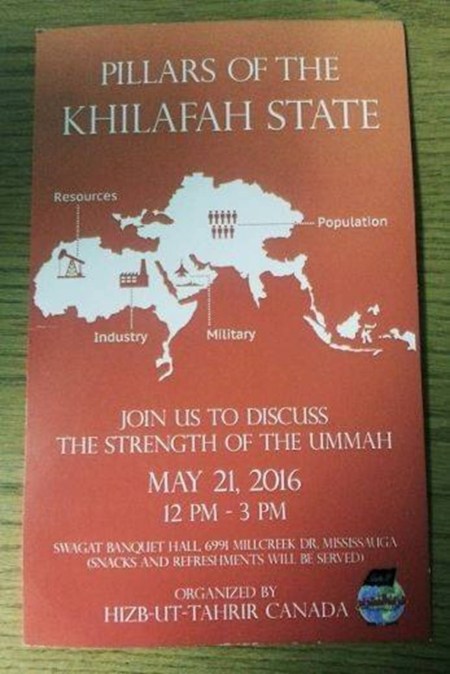
The next speaker was brother Bilal, of Asian origin. Bilal’s message focused on how to make the Ummah powerful and independent. He summarized the requirements: a capable military, economic engines, natural resources, and trained and dedicated people. A short video was presented to demonstrate these points. They included the collective oil and natural gas production capacities of the Muslim world, the human capital needed to mine and process these resources, the military power required to protect both natural and human resources, and the types of weapons needed to make this military effective.

Everyone waved the black flags with the white script.

Islamic State: “Only one way for US to gain victory and that is by taking the Quran out of the hearts of Muslims”

May 23, 2016

Islamic State: “Only one way for US to gain victory and that is by taking the Quran out of the hearts of Muslims” Jihad Watch

If we didn’t have learned imams such as John Kerry and David Cameron and Pope Francis assuring us otherwise, we might almost get the impression that the Islamic State had something to do with Islam. It’s a good thing we have such erudite leaders who are so helpful in aiding our understanding of the enemy ideology.

Abu-Mohamed-al-Adnani

“‘There is only one way for the US to gain victory,’ ISIS spokesman warns,” Rudaw, May 21, 2016:

ERBIL, Kurdistan Region – A spokesman of the Islamic State (ISIS) said in a defiant audio message that his group would not be defeated, even if it loses its strongholds in Syria and Iraq or its leader is killed in US air strikes.

“Your threats do not frighten us and you will never win over us,” Abu Mohamed al-Adnani, the official spokesman of the terrorist group, said in an audio message posted online Saturday.

The militant, whose real name is Taha Subhi Falaha, said that even if ISIS loses its Syrian stronghold of Raqqa or Mosul in Iraq, that would not amount to defeat, nor would the death of its leader, Abu Bakr al-Baghdadi.

“The loss of Raqqa, Mosul and the death of Abu Bakr al-Baghdadi would not mean that we have lost,” the spokesman said in the 30-minute recording.

He said Western reports about the group growing weaker – as US military officials have recently been saying – are untrue.

“You think defeat is the loss of a city or a land? Were we defeated when several cities of Iraq were taken away from us and we went to the desert? Will we lose if you control Mosul, Raqqa and other cities that were previously controlled by us: Definitely ‘no,’ because defeat is only the loss of the wish and will to fight.”

Naming several top ISIS leaders that have been killed in US airstrikes over the past several months, Adnani said their deaths – or the deaths of other living leaders – would not drive the group to defeat.

“There is only one way for the US to gain victory and that is by taking the Quran out of the hearts of Muslims,” Adnani claimed.

ISIS seeks to destroy Israel, ‘liberate’ Jerusalem with Sinai Peninsula terrorist force

May 23, 2016

Islamic State aims to destroy Israel, ‘liberate’ Jerusalem with Sinai Peninsula terrorist force By Rowan Scarborough –

The Washington Times Sunday, May 22, 2016

Source: ISIS seeks to destroy Israel, ‘liberate’ Jerusalem with Sinai Peninsula terrorist force – Washington Times

With a media blitz, the Islamic State has set its sights on Egypt’s Sinai Peninsula as the next shot at expanding its empire and establishing a base from which to attack neighboring Israel.

The terrorist group’s propaganda units have gone into high gear for recruitment this month to build a force in Sinai large enough to one day conquer Jerusalem — the same way its fighters took over large parts of Syria and Iraq.


Last week, Marine Gen. Joseph Dunford, chairman of the Joint Chiefs of Staff, warned of the Islamic State’s presence in Sinai, where the group may have placed as many as 1,000 terrorists. The general’s concern is a signal that the U.S. faces another war front against the Islamic State in addition to Iraq, Syria and Libya.

More than a dozen Islamic State media arms in Iraq and Syria have produced videos narrated by a who’s who of hardened jihadis, who are surely on a U.S. kill list for daily airstrikes.

Islamic State propaganda promises recruits that they will one day “liberate” Jerusalem and end the state of Israel, according to analysis by the Middle East Media Research Institute, which tracks jihadi communications. The Egyptian army, the force standing in the way, is threatened with beheadings if soldiers continue to fight.

Such a massive propaganda effort for one mission is unusual for the Islamic State, also known as ISIS and ISIL. Analysts says it means leader Abu Bakr al-Baghdadi views the land as increasingly important to his group’s ultimate goal of bringing down governments in the region and expanding its so-called caliphate, or Islamic state.

“I think ISIS sees the Sinai as a steppingstone for launching greater attacks against Israel, which would boost its claim to primacy in championing the Arab/Muslim cause against Israel, an issue that strongly resonates with many Arab Islamists,” said Jim Phillips, a Middle East analyst at The Heritage Foundation. “The Sinai cells also pose a long-term threat to Egypt, a key state with the largest Arab population. Nature may abhor a vacuum, but terrorists love them.”

Steve Stalinsky, executive director of the Middle East Media Research Institute, said the Islamic State is applying lessons learned in Anbar, Iraq, parts of which it controls, as it tries to persuade Egyptians and people in Hamas-controlled Gaza to join. Hamas is a U.S.-designated terrorist organization.

“One of the videos noted that ISIS in Sinai has learned from the experience of ISIS in Al-Anbar as the two areas are similar in terms of its desert geography,” Mr. Stalinsky said.

“They have been calling Egyptian and Gazans to join them. They believe that ISIS in Sinai will be the gate towards the liberation of Palestine,” he said.For now, the Islamic State lacks the firepower to repeat its success in Anbar, where it captured a number of towns including the disputed Fallujah, after invading Iraq.

“Their strategy now in the Sinai is basically hit-and-run kind of attacks,” Mr. Stalinsky said.

Egyptian forces on the peninsula are hit by those attacks almost daily.

The Islamic State made an enormous statement in Sinai in October when it placed a bomb on Metrojet Flight 9268, sending the Russian airliner crashing onto the desert landscape. The Islamic State claimed it sabotaged the plane, killing 224 people, with explosives hidden in a soda can. If so, the bomb was likely placed on the plane by an Islamic State insider at the Sinai Red Sea resort of Sharm el-Sheikh.

“ISIS leadership views the Sinai province as a key extension for the organization outside of its core area of control in Syria and Iraq,” says an analysis by the Middle East Media Research Institute. “Indeed, the Sinai province is considered one of the most powerful and effective among these extensions.”

Mr. Phillips said the Arab Spring uprising centered in Cairo fed the Islamic State the fighters it needed in Sinai as many Islamists were released from prisons.

“Extremist groups flourished in the Sinai, where they recruited disaffected Bedouin tribes, which had long resented what they perceived to be neglect and marginalization at the hands of the Egyptian government,” he said. “The Sinai also offered a conduit to Gaza, where extremists received support from Hamas and other radical Palestinian Islamist groups.”

Counteroffensive

A sampling of some of the more than one dozen Sinai-centered Islamic State videos provided by the Middle East Media Research Institute:

Two jihadis in Iraq, Abu Qaswara Al-Masri, an Egyptian, and Abu Omar Al-Maqdisi, likely a Palestinian from Gaza, urge Egyptians to join the Islamic State in Sinai.

Al-Masri tells the Egyptian army: “We advise you to repent before we manage to find you. If we find you, there will be no other [fate] but beheading for you. There will be no mercy for you and you are aware of that. You have seen what the soldiers of the caliphate have done with your colleagues and you will see. I advise you to repent. I am a truthful adviser to you.”

Islamic State fighters Abu Suhaib Al-Ansari and Abu Omar Al-Ansari, in Iraq’s Ninawa province, appear in a recruitment video. Abu Omar Al-Ansari urges Egyptians to attack Egyptian government officials and “spill their blood and communicate with them with guns and explosives and turn them into corpses with bombs.” He specifically called on Gazans to travel to Sinai.

A video produced in Aleppo province, Syria, attacks the Muslim Brotherhood in Egypt as mainstream.

A fighter says, “You are the preachers for polytheism and falsehood, you are the ones who issued the fatwa for people to take part in the polytheist democracy, and you are the ones who issued the fatwa for people to vote for the pagan constitution, which puts sovereignty in the hands of the people instead of Allah.”

He added: “You have deceived your followers that [adhering to] democracy and entering the parliament will lead to [the implementation] of Islamic Shariah. Now, where is the Shariah, O enemies of Allah?”

The Brotherhood’s overriding goal is to spread Shariah, or Islamic law, around the world by undercutting secular governments.

Gen. Dunford, the Joint Chiefs chairman, raised alarm last week about the Islamic State’s growing presence in Sinai and said Egyptian forces had begun a counteroffensive against its units.

“We have seen a connection between the Islamic State in the Sinai and Raqqa,” Gen. Dunford told reporters, according to a dispatch by Voice of America. “We have seen communication between the Islamic State in the Sinai and the Islamic State in Libya and elsewhere, so we are watching that pretty closely.”

Raqqa is the Islamic State’s self-proclaimed capital in central Syria, from which it directs media operations and terrorist attacks.

“The Egyptians are taking the fight to the Islamic State right now,” he said aboard a flight for a NATO meeting in Brussels.

The Egyptian military said this weekend that it conducted a series of raids in Sinai that killed 51 Islamic State fighters, according to the Arab news site Al Bawaba.

“Just being able to have a presence and cause some disruption in between Egypt and Israel gives ISIS some propaganda value, at the very least, said retired Army Lt. Gen. James Dubik, an analyst at the Institute for the Study of War in Washington. “It also causes Egypt to look both East and West and may, therefore, provide some operational flexibility to ISIS planning.”

FULL: Donald Trump at Morning Joe, May 20, 2016- ‘Would you consider Sanders as your running mate?’

May 20, 2016

FULL: Donald Trump at Morning Joe, May 20, 2016- ‘Would you consider Sanders as your running mate?’ May 20, 2016

(Spoiler alert: The question about Sanders as Trump’s VP choice comes at the tail end of the interview, and Trump’s answer was that Sanders should run as an independent. The interview is wide-ranging and deals with foreign policy, China, Mexico, the Islamist threat, the terrorist attack on EgyptAir and a bunch of other stuff. — DM)

Islamic State Threatens Global War With Israel

May 20, 2016

Islamic State Threatens Global War With Israel

by Breitbart Jerusalem

19 May 2016

Source: Islamic State Threatens Global War With Israel

Sipa via AP Images

The Jerusalem Post reports: Islamic State threatens Israel in an article in its weekly newsletter this week, saying that unlike Hamas, the “war on Israel will not be limited by geographical boundaries or by international norms.”

According to the article in the Al-Naba newsletter identified by the Jihad and Terrorism Threat Monitor of MEMRI (the Middle East Media Research Institute) and shared with The Jerusalem Post, Israel feels threatened by ISIS because of the “collapse” of neighboring states and the Sunni terrorist group’s advance toward the borders of the Jewish state.

For this reason, Israel has started to fight against Islamic State in Sinai and Syria, it says, adding that the entire world is now an arena for the fight against all the “polytheist combatants, including the Jews,” who are legitimate targets. Israel is using jets to attack Islamic State in Sinai, the article claims.

Bob Graham: 9/11 Support Goes To The Top Of Saudi Government

May 19, 2016

Bob Graham: 9/11 Support Goes To The Top Of Saudi Government

by Breitbart News

19 May 2016

Source: Bob Graham: 9/11 Support Goes To The Top Of Saudi Government

Spencer Platt/Getty Images

From Yahoo News:

Is there a smoking gun in the 28 pages that were redacted from the congressional joint inquiry on intelligence from before and after the 9/11 attacks that links the Saudi Arabian government to the attacks? A co-chair of that inquiry, former Forida Sen. Bob Graham thinks there is one. He also says the link goes all the way to the top of the Saudi government and that the government’s funding of terrorist groups continues to this day.

Graham, who has been advocating for the release of those pages for over a decade, sat down with Yahoo News host Stephanie Sy on “Yahoo News Live” to discuss when that might happen, the Senate’s passage of a bill allowing families of 9/11 victims to sue the Saudi government and what he says are the Saudi government’s continued links to terrorism.

On the 28 pages, he said: “I think [they’re] a smoking gun. I think the linkages are so multiple and strong and reinforcing that it’s hard to come away from reading all this material and not feel that there was a support network and that support network came from Saudi Arabia.”

He said it goes beyond the pages though: “They will also open the path to other materials. There are thousands of pages of documents, which speak to the relationship between Saudi Arabia and the 19 hijackers.” He continued, “Could those 19 people have carried out a plot as complex as 9/11 while maintaining anonymity in some cases for more than a year and a half while they were in the United States without having some support?”

As for the bill, which still has to be passed by the House of Representatives and signed by President Obama, he said, “It not only is going to open up the courts of justice to the families and the victims of 9/11. It also has the potential of exposing a tremendous amount of information relative to Saudi Arabia’s involvement in 9/11.” He called the bill “a very big victory.”

After meeting with Director of National Intelligence James Clapper on Tuesday about the 28 pages, Graham also indicated that the release of those pages could happen soon. He said, “The general has been reviewing these pages closely for a year or more. He told us that before the end of this week, he would probably have his review completed. Then it goes to a panel that’s made up of several agencies [FBI, the Department of State] who will look at the 28 pages for their issues of concern, and then it goes to the president for his determination as to whether to declassify these papers.”

He also told Sy that withholding the documents goes beyond 9/11. He said it could lead to current links between the Saudi government and terrorist groups. He said, “This has been a long time that this information has been withheld from the American people, but there’s also a recognition of the consequences of withholding. Not only the consequences that justice is being denied to the Americans who suffered grievously by 9/11 because they lost a loved one.” He continued, “I think that the Saudis who know what they did and have a pretty good idea that the United States, at least at the highest levels, knows what they did and then nothing’s happened… They’ve interpreted this as being impunity and have continued to fund terrorist organizations and to train the next generation of recruits in their mosques and madrasas.” He said those groups include al-Qaida and ISIS.

Does he consider the withholding of the 28 pages a cover-up? “I have used the term ‘aggressive deception.’”

Read the rest of Alex Bregman’s piece about Bob Graham here.

EgyptAir flight blown up by ISIS time bomb

May 19, 2016

EgyptAir flight blown up by ISIS time Bomb, DEBKAfile,  May 19, 2016

EgyptAir804_480

EgyptAir flight MS804, which took off at 11:09 p.m. on Thursday May 19 from Charles de Gaulle airport in Paris, was supposed to land at 3:55 a.m. in Cairo. However, it dropped off the radar screens of Greek and Egyptian flight controllers at 2:45 a.m. and crashed into the Mediterranean about 10 miles inside Egypt’s territorial waters.

The Airbus A320-232 had 66 people aboard including seven crew members, three security guards, 30 Egyptian citizens, 17 French nationals as well as citizens of Iraq, Saudi Arabia and other countries. The plane, which was built in 2003, was flown by two pilots who each had thousands of hours of cockpit experience. Reports by Egypt’s airport authority said the cargo did not contain dangerous materials or anything else out of the ordinary.

Egyptian Prime Minister Sherif Ismail said terrorism could not be ruled out, emphasizing that there were no distress calls made from the cockpit and that there were no reports showing deviation from the flight path or altitude before the plane disappeared. The spokesman of the Egyptian military, Brig. Gen. Mohammed Samir, confirmed in a posting on the military’s Facebook page that the pilots did not send out a distress signal.

Following the disappearance, French President Francois Hollande convened an emergency meeting Thursday morning at the Elysee Palace.

Reports on social media said that witnesses in Greece saw a large ball of fire in the sky, which may strengthen the assumption that flight MS804 carried a time bomb that was set to explode when the plane was in Egyptian airspace.

DEBKAfile’s counterterrorism sources say that if the plane was downed by an act of terror, it would be the latest major blow by ISIS to international civilian aviation, Egyptian tourism, and the security, counterterror and intelligence services of France and Egypt.

  • It is the second time in less than a year that ISIS has succeeded in using a time bomb to down a passenger plane linked to Egypt. The first one was a Russian Airbus A321 that took off from Sharm al-Sheikh and blew up over the Sinai Peninsula on October 31. All 224 passengers and crew were killed.
  • One of the main questions in the investigation of the latest air disaster will be whether the explosive device was planted in Cairo or Paris. If it did happen in Paris, it would raise the question of whether an ISIS cell penetrated the ground crews at Charles de Gaulle airport. If confirmed, it would be a serious escalation by ISIS following the terrorist organization’s November 2015 attacks in Paris in which 130 people were killed and hundreds were wounded.
  • A sign of an escalation was that it was the second terrorist attack within three months on a civilian aviation target in a Western European capital, following the bombing of Brussels international airport in March in which 31 people were killed and about 200 were wounded.
  • But if the investigation finds that the bomb was planted on the plane in Cairo before it departed for Paris, it would mark a serious and dangerous escalation of the infiltration and operational abilities of ISIS in the Egyptian capital, and a major threat to the stability of the regime of President Abel Fattah al-Sisi.

“Russia Did More ‘Good’ In 30 Days Than The US Did In A Year”

May 17, 2016

“Russia Did More ‘Good’ In 30 Days Than The US Did In A Year” – The Only Accredited Western Journalist In Damascus Speaks Up

by Tyler Durden on 05/16/2016 22:40 -0400

Source: “Russia Did More ‘Good’ In 30 Days Than The US Did In A Year” – The Only Accredited Western Journalist In Damascus Speaks Up | Zero Hedge

On behalf of Prensa Latina news agency, Miguel Fernandez was the only journalist from the Western world accredited to work in the Syrian capital of Damascus for nearly a year. After returning home to Havana, Fernandez gave Sputnik News an exclusive interview in which he reflects back on what he experienced in the war torn country.

Fernandez first gets into the single biggest lesson he learned, which is that the people of Syria don’t give in, they don’t stop pursuing the dream of having a prosperous country.

“Seeing how these people don’t give in, that they dream about a prosperous country, is the biggest lesson that Syria gave me”

Miguel then reflects back on when a colleague of his first arrived in the city, and as the journalist took him around the city, everything was seemingly so normal that his friend asked “where is the war?”

“Fear is the first thing that war creates, that fear which forces people to be on guard. However, Damascus broke that pattern. When my colleague arrived I took him around the city and he noticed that buses and taxis are traveling around, people are sitting in cafes and going shopping, children are going to school. He asked me, ‘where is the war?'”

“I said, I will show you before we leave for Cuba. And after less than a day, when we were traveling in a taxi, a mortar shell fell in front of us, onto a group of people, some of whom died, and there was chaos all around.”

“I looked at that and I said – that is war. That resistance of the Syrian people, the unwillingness to accept the hardships of war, has inspired me.”

The most harrowing moment for Fernandez was during the fall of Palmyra to the terrorists in May 2011 [later to be taken back from ISIS, and even recently held a concert that was put on by Russia’s famous Mariinsky Theatre Orchestra]. Fernandez reflected on a time in which monuments were destroyed, and children under Daesh leadership were made to kill captured Syrian soldiers.

 “Palmyra is one of ten UNESCO World Heritage sites in Syria, an oasis in the desert, full of mystical stories. Seeing how the Arch of Triumph and other monuments were destroyed. A terrible scene that I will never forget, was when children under the leadership of Daesh killed 50 captured Syrian soldiers who were on their knees.

“For me, that was the saddest moment, because I felt that the war was not only against Syria, but against the world, our culture, our values, our heritage. When I say ours, I mean civilization. These elements (Daesh) are savages. They can destroy a monument in the same way that they cut a child’s head off.”

Fernandez also recalled how differently the Syrian people view Russia and the United States, and that the Russian participation did not feel like an intervention at all. Importantly, Miguel discusses the stark differences between the precision and effectiveness of the US vs Russian air strikes as well. Notably that US airstrikes were not coordinated and often hit Syrian infrastructure, as opposed to Russia’s strikes, which destroyed more Daesh infrastructure in 30 days than the US had been able to accomplish in a year’s time.

“I am fair with blue eyes, so they often confused me with Russians and affectionately greeted me. Syrians believe in Russia because for a long time they were in conflict with the US and some European powers and Russia was the only friendly power.

“I was there when Russia entered the war in September 2015 and Syrians did not perceive it as an intervention, but as support and a sign of solidarity,” Fernandez explained.

“For over a year before that the US had led an international coalition that didn’t show any results. The Americans carried out bombings but Daesh spread even further, and seized new positions.

Those airstrikes were not coordinated and often hit Syrian infrastructure, hospitals and schools. The Russian airstrikes didn’t, because they entered the war at the request of Damascus and their activities were coordinated in order to be effective and not bring harm to civilians.

“During the first 30 days of bombing the Russians were able to destroy 40 percent of Daesh’s infrastructure, which the US and its allies hadn’t been able to do for a year.”

Fernandez ended the interview with a story of a Syrian soldier who complimented him by breaking bread and sharing it with the journalist, as a tribute to what the soldier said was Cuban bravery.

 “One of the soldiers, he was over 50, bearded, dirty, covered in powder and slush, he came to me, broke his bread in two and offered me half.”

“I refused, because I had already had breakfast at home and had no idea how many hours he had gone without eating. But my translator told me to take the bread, explaining that he wanted to share the bread with me because I am Cuban and he had always been told that Cuban soldiers are very brave and that if he shares the bread with me, it will bring him luck in the next battle.”

“I shed a few tears, because I am not a warrior, and I was very touched that he had such an impression about my nation,”


* * *

With all of the speculation and observations from the pundits on television, who have never stepped foot inside the war torn country of Syria, it is helpful to get a first hand account of what’s taking place on the ground. What one may find, is that those that sit around and parrot the “Russia Bad/US Good” narrative all day may not be exactly providing the complete picture.

ISIS, Syrian Conflict ‘Not Containable’ in Middle East

May 17, 2016

ISIS, Syrian Conflict ‘Not Containable’ in Middle East Bipartisan report calls for greater American involvement abroad

BY:
May 17, 2016 5:00 am

Source: ISIS, Syrian Conflict ‘Not Containable’ in Middle East

Threats emanating from the Middle East, including those caused by ISIS and the Syrian civil war, cannot be contained and therefore require the United States to significantly ramp up its military commitments in the region, according to a new report.

A group of scholars, strategists, and former government officials from Republican and Democratic administrations convened to develop the study, which was released by the Center for a New American Security on Monday.

The report, which has been endorsed by a number of ex-Democratic officials including a former Clinton administration aide, implies that the Obama administration’s policies toward Syria and the Middle East in general have been weak.

“Despite recent American misjudgments and failures in the Middle East, for which all recent administrations, including the present one, bear some responsibility, and despite the apparent intractability of many of the problems in the region, the United States has no choice but to engage itself fully in a determined, multi-year effort to find an acceptable resolution to the many crises tearing the region apart,” the report states.

“The key point is that the dangers emanating from the Middle East, including both terrorism and the massive flow of refugees, are not containable. They must be addressed at the source, over many years, using a combination of local actors and American power and influence.”

The report calls for the international effort against ISIS to be “scaled up substantially,” a move that would include sending more U.S. special operations forces to help root out the terror group from Iraq, Syria, and newly-established footholds in countries like Libya.

“The United States should show a new resolve by increasing significantly its military contribution across the board, including providing more unique air assets, additional intelligence assets, and a larger contingent of special operation forces capable of identifying and destroying high value and other critical ISIS targets,” the report states.

President Obama’s efforts against ISIS, which he once compared to a “JV team,” have long been criticized. Just one day before the group launched deadly coordinated terror attacks in Paris last November, the president declared during a nationally televised interview that the terror group had been “contained.”

The Obama administration, which began air strikes against ISIS in 2014, has sent modest contingents of special operations forces to Syria and Iraq in order to provide “advise and assist” support for Syrian Arab, Kurdish, and Iraqi troops fighting the terror group in the region. It has also green-lit limited operations directly targeting leaders of the terrorist group.

The administration has insisted that American troops are not in combat operations against ISIS, even though three American service members have died at the group’s hands in Iraq.

The report released Monday indicates that the administration has not done enough to thwart a terrorist group that could pose a greater threat to American and Western security than al Qaeda.

“The terrorist assault on Paris this past November and on Brussels in March were stark and painful reminders of the many ways instability in the Greater Middle East can come home to countries in Europe. The mass shooting in California in early December 2015 also demonstrates why ISIS potentially poses a greater threat to the United States and its allies and partners than al Qaeda,” the report states, citing the terrorist attack on a San Bernardino, Calif., holiday party carried out by a radicalized couple.

“With so many ISIS-inspired terrorists holding Western passports, counterterrorism has become significantly more difficult. Nor can one discount the possibility that just as ISIS has emerged to compete with al Qaeda for leadership of the jihadi forces, there will be other groups seeking to take the mantle.”

The CNAS project is co-chaired by James Rubin, a former State Department official during the Clinton administration, and is endorsed by CNAS co-founder Michèle Flournoy, who served as undersecretary of defense in the Obama administration. The project was established to develop a bipartisan consensus about the role America should play in the world, and the report was deliberately rolled out ahead of the 2016 election to shape the national conversation.

While the experts do not go out of their way to criticize the current administration’s foreign policy agenda, the report offers implicit rebukes of the administration’s efforts abroad, particularly in the Middle East. It calls for making a political solution to the five-year Syrian civil war dependent on the departure of Syrian leader Bashar al Assad—a point the Obama administration has appeared willing to concede in recent months.

The report also calls for an overhaul of the Pentagon’s “inadequate” program to arm and train the Syrian opposition forces, who have faced brutal resistance from Syrian government troops emboldened by Russian and Iranian intervention in the conflict. The Defense Department was forced to shutter its failed program to train and equip moderate Syrian rebels, which cost American taxpayers $500 million, in favor of a less ambitious initiative last October.

“Syrian government forces have regained considerable territory and momentum especially in and around Aleppo, primarily as a result of coordinated Russian-Syrian-Iranian operations backed by heavy and often indiscriminate Russian bombardment from the air,” the report states.

“At a minimum, the inadequate efforts hitherto to arm, train, and protect a substantial Syrian opposition force must be completely overhauled and made a much higher priority.”

The report also proposes the establishment of a no-fly zone in Syria where displaced Syrians can relocate out of harm’s way and where opposition forces can arm, train, and organize.

More generally, the experts make the case for boosting American engagement in the face of Chinese economic growth and military buildup, Russian aggression, and continued destabilization in the Middle East. The maintenance of post-World War II international order, the report explains, is dependent on strengthening U.S. diplomatic, economic, and military power and boosting spending on defense and national security.

“The greatest challenge to the preservation of this order today may be here in the United States. The bipartisan consensus that has long supported America’s engagement with the world is under attack by detractors in both parties,” the report states.

“Responsible political leaders need to explain to a new generation of Americans how important this world order is to their well-being and how vital America’s role is in sustaining it.”

Leaked wiretaps of ISIS agents show Ankara routinely ignores terrorist cross-border activity

May 14, 2016

Leaked wiretaps of ISIS agents show Ankara routinely ignores terrorist cross-border activity

Published time: 14 May, 2016 06:19 Edited time: 14 May, 2016 08:07

Source: Leaked wiretaps of ISIS agents show Ankara routinely ignores terrorist cross-border activity — RT News

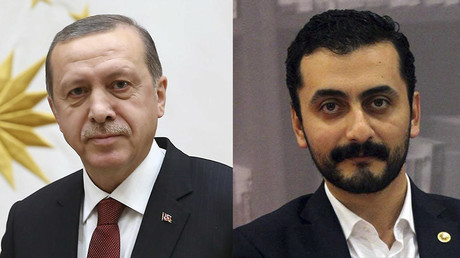
Thousands of ISIS associates have been routinely crossing into Syria aided by contacts in Turkey, phone calls tapped by Ankara security forces and handed to the media by opposition MP Erem Erdem reveal. He accuses the government of a massive cover-up.

Transcribed phone recordings belonging to Ilhami Bali, well known in Islamic State (IS, formerly ISIS/ISIL) ranks and suspected of staging high-profile bomb attacks in Ankara and the mainly-Kurdish border city of Suruc, detail the lack of control along the Syrian Turkish border. The 98-kilometer (61-mile) stretch of border has only two crossings, the Jarablus and Al Rai entry points across from Turkey’s Gaziantep and Kilis.

Pressured by the international community to impose stricter border controls to stem the flood of militants into Syria, Ankara has been erecting walls at key crossing points, but to no avail as surveillance data from the Municipality of Ankara Provincial Security Department revealed.

Read more

File photo: A bomb-disposal expert walks near victims' bodies covered with banners and flags, at the site of twin explosions near the main train station in Turkey's capital Ankara, on October 10, 2015. © Adem Altan

The transcripts of the recordings have been passed on to the media by Turkish opposition politician, Eren Erdem of the Republican People’s Party (CHP), who is facing a witch-hunt from President Recep Tayyip Erdogan’s government over his repeated allegations of massive cover-up of IS activity on Turkish soil.

While daily logs by the Turkish Armed Forces reveal that Turkish security forces apprehended 961 IS members from 57 countries in 2015, the alleged reality exposed by the Erdem leak, shows that thousands of IS fighters and their family members cross the Turkish border from Syria on a daily basis. But even those who get arrested on the Turkish side are often released at the crossing points.

For instance several documents suggest that IS coordinators helped some 1,400 people cross the Turkish border from September 22 – October 17. In one of the phone conversations, Ilhami Bali asked his interlocutor named Erkek, who according to the conversations helps smuggle people, the exact number of persons he has helped cross the border.

Read more

© Kayhan Ozer / Reuters; Eren Erdem / Facebook

As the men argue about the actual number of all those who entered and left Turkey, the conversation reveals that the actual count of people passing through to the Turkish side is actually more than IS coordinators have presumed.

Another conversations between the two subjects revealed Bali was extremely dissatisfied with Erkek’s performance as he failed to help IS operatives cross the border.

“Did you get our people through?” Bali asked Erkek, who replied that he was not the one guiding the group in question.

“What? Are you the one who is responsible that they got arrested? Don’t lie to me! Don’t lie to me. Eighteen people crossed the border last night. Fifteen of them got arrested when you tried to help them,” Bali said.

“Listen to me, I have warned you,” added Bali, losing his temper. “If I ever hear that you try to pass our guys through, I will come in your house and shoot you to your head. I will shoot your head while you’re in bed.”

READ MORE: RT documentary exposes dirty oil secrets, ISIS ties with Turkey

However, as other conversations have shown, IS operatives and contacts on the Turkish side of the border help those IS affiliates detained by Turkish security forces to evade justice.

“One brother, two sisters and one child were arrested while they tried to cross [at Kilis]. How could this happen? I do not understand,” wondered Erkek in another phone call.

“We have called and gave them the information,” Bali replied. “We talked to the brother who will look after the people who were arrested. Inshallah will look after them.”

More conversations between the two subjects further confirm that those who get arrested are later released through IS connections at police stations.

“The guy from the Gendarmerie called me and said that they were in the smuggler car,” Bali told Erkek in a conversations about another group detained at the border. “Call this guy. The people who got arrested today are at the Gandermarie station. Maybe he can do something… Gendarmerie took them under arrest. If they can let them free they should do that.”

Bali’s conversation with another IS operative, Mustafa Demir, offers apparent proof that the IS terror group is smuggling its fighters into Turkey for medical treatment.

“You know this Abu Abdella Garip who gets out the wounded people? Now Ali Mantara will come. He will bring a brother. He will call you when he arrives… Take the numbers and send them to the administration [of the crossing]. So the administration will look after them,” Mustafa Demir tells Bali.

“Where should I bring Abdullah Garip who helps cross the wounded ones? Should I take him to madrasa?” Bali asked.

“Send them to madrasa and call Ebu Abdallah and tell him that five persons are with Garip Geli… tell him that he should write down their names… So we can control how many left from here,” Demir replies.

In another conversation Erkek asks Bali what should “one wounded person” do when he comes to Turkey.

“I don’t really know. It has nothing to do with us,” Bali replied. “Tell them they should go to the border to the administration there.”