Europe: Let’s Self-destruct!, Gatestone Institute, Judith Bergman, November 25, 2016
A reasonable question that many Europeans might ask would be whether it is not perhaps time to review priorities?
Perhaps the time has come to look at whether it remains worth it, in terms of the potential loss of human life, to remain party to the 1961 Convention, which would prohibit a country from stripping a returning ISIS fighter of his citizenship in order to prevent him from entering the country?
The terrorist as poor, traumatized victim who needs help seems to be a recurring theme among European politicians. But what about the rights of the poor, traumatized citizens who elected these politicians?
Roughly 30,000 foreign and European Islamic State fighters from around 100 different countries, who have gone to Syria, Iraq and Libya, could spread across the continent once the terror group is crushed in its Iraqi stronghold, warned Karin von Hippel, director-general of the UK military think tank, Royal United Services Institute, speaking to the Express on October 26:
“I think once they lose territory in Iraq and Syria and probably Libya… they will likely go back to a more insurgent style operation versus a terrorist group that wants to try and hold onto territory… There has been about 30,000 foreign fighters that have gone in from about 100 countries to join. Not all of them have joined ISIS, some have joined al-Qaeda, Kurds, and other groups, but the vast majority have gone to join ISIS. These people will disperse. Some of them have already been captured or killed but many will disperse and they’ll go to European countries…They may not go back to where they came from and that is definitely keeping security forces up at night in many, many countries”.
Perhaps these scenarios are really keeping security forces up at night in many countries. Judging by the continued influx of predominantly young, male migrants of fighting age into Europe, however, one might be excused for thinking that European politicians themselves are not losing any sleep over potential new terrorist attacks.
According to a report by Radio Sweden, for example:
“Around 140 Swedes have so far returned after having joined the violent groups in Syria and Iraq. Now several municipalities are preparing to work with those who want to defect. This could include offering practical support to defectors.”
The municipality of Lund has dealt with this issue, and Malmö, Borlänge and Örebro have similar views. As Radio Sweden reports:
“Lund’s conclusion is that defectors from violent extremist groups should be handled like defectors from other environments, such as organized crime. After an investigation of the person’s needs, the municipality can help with housing, employment or livelihood.”
According to Sweden’s “national coordinator against violent extremism,” Christoffer Carlsson:
“…You need to be able to reintegrate into the job market, you may need a driver’s license, debt settlement and shelter. When people leave, they want to leave for something else, but they do not have the resources for it, so it is difficult for them to realize their plan. If they do not receive support, the risk is great that they will be unable to leave the extremist environment, but instead fall back into it.”
Anna Sjöstrand, Lund’s municipal coordinator against violent extremism, says that people who have served their penalty should all have support. Last year, the Municipality of Örebro received criticism for offering an internship to a young man who returned after having been in Syria.
“There may be such criticism, but for me it is difficult to think along those lines. They get the same help as others who seek help from us. We cannot say that because you made a wrong choice, you have no right to come back and live in our society,” says Anna Sjöstrand.
According to Sweden Radio, several of the municipalities stress that people who commit crimes should be sentenced and serve their penalties before they can receive support. According to Amir Rostami, who works with the national coordinator against violent extremism:
“If you are suspected of a crime, the investigation of the crime always comes first. But as long as there is no suspicion of a crime, then it is in our own interest to help those that come out of this extremist environment. The consequences for society are quite large if you do not.”
So, in Sjöstrand’s words, travelling to Syria and Iraq to join ISIS, a bestial Islamic terrorist organization with its sexual enslavement of women and children, rapes, brutal murders of Christians, Yazidis, and other Muslims is just “a wrong choice.” You know, similar to embezzling money or getting into a drunken brawl at a bar, just ordinary garden-variety crime, which should not intervene with your “right to come back and live in our society”. In other words, it seems to support the standard European idea that the terrorist is the victim, not the innocent people he is out to maim, rape, and kill.
According to the Swedish view, burning Christians and Yazidis alive, gang-raping and murdering women and children, and other such “wrong choices” should not get into the way of one’s “rights.” It also seems to ignore the rights of members of the peaceful society who are vulnerable to being attacked. It would be logical to posit that traveling for the express purpose of joining a terrorist organization such as ISIS, which has as its explicit goal the destruction of Western nations such as Sweden, should actually lead to the forfeiture of the “right to come back and live in our society” — especially as those former ISIS fighters evidently do not consider Swedish society “their society.”
Another word that comes to mind is treason. But not for Sweden, such logical moral and political choices. Better to have another go at politically correct policies, doomed to failure, at the expense of the security (and taxpayer money) of law-abiding Swedish citizens, whose rights to live without fear of violent assault, rape and terrorism clearly ceased to matter to Swedish authorities a long time ago.
This hapless attitude towards ISIS increasingly resembles criminal negligence on the part of Swedish authorities. It was recently reported that Swedish police received a complaint of incitement to racial hatred, after an unnamed Syrian-born 23-year-old used a picture of the ISIS flag as a profile picture on social media. Prosecutor Gisela Sjövall decided not to pursue legal action against the man. The reason, according to Sjövall?
“IS expresses every kind of disrespect; it is against everyone except those who belong to IS itself. There is the dilemma, it [offends] too big a group… You could say that merely waving a flag of IS in the current situation cannot be considered hate speech. It is not an expression of disrespect towards any [particular] ethnic group. It has been said there could possibly be some form of incitement, that IS urges others to commit criminal acts such as murder, but that is not the case.”
Since ISIS hates absolutely everybody, according to Swedish law they can apparently engage in as much hate speech as their hearts desire. The terrorists, who are vying for a world-dominating caliphate, must be laughing their heads off.
Sjövall added that because the Nazi swastika is intrinsically linked to inciting anti-Semitism, this contravenes Swedish laws, and that maybe the ISIS flag would be considered as contravening Swedish law in 10 years.
At the rate that Swedish society is self-destructing, there may not even be much of Sweden to speak of 10 years from now.
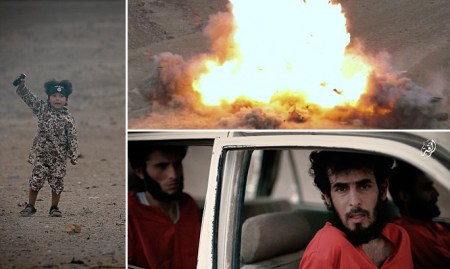 On June 7, 2016, it was reported that British citizen Grace “Khadija” Dare had brought her 4-year-old son, Isa Dare, to live in Sweden, in order to benefit from free health care. In February, the boy was featured in an ISIS video, blowing up four prisoners in a car (pictured above). The boy’s father, a jihadist with Swedish citizenship, was killed fighting for ISIS.
In neighboring Denmark, in March 2015, a Danish MP for the Social Democrats, Trine Bramsen, said about returning ISIS fighters:
“Some constitute a danger or can become dangerous. Others need help. We have actually seen that many of those who come home have experienced such horrors that they need psychological help”.
The terrorist as poor, traumatized victim who needs help seems to be a recurring theme among European politicians. But what about the rights of the poor, traumatized citizens who elected these politicians?
Denmark happens to be the European country with the most ISIS fighters returning from Syria, according to a report released in April by the International Centre for Counter-Terrorism in The Hague. The report shows that 50% of the people who left Denmark to fight with ISIS in Syria have returned to Denmark. The UK is second, with 48%, and then come Germany (33%), Sweden (29%), France (27%), and Austria (26%).
In Denmark, four Syrian ISIS fighters were arrested in April when they returned from Syria.
The head of the Strategic Institute of the Defense Academy in Denmark, Anja Dalgaard-Nielsen, told a Danish newspaper in April that there are not enough resources to monitor all returning ISIS fighters and thereby ensure their arrest, adding:
“But then again, not all [ISIS fighters] are identical. Some will come home and be a threat to society, whereas others will return disillusioned. If we treat everyone in the same manner, we risk pushing some of those who are in doubt even further in. If someone returns and it cannot be proven that he has committed crimes and if he, besides that, is disillusioned, then he should get help to get out.”
How do you determine with certainty that someone is “disillusioned,” when he could in fact be a ticking bomb waiting to commit terror?
In Denmark, the authorities decided on a prohibition to travel to Syria to join ISIS. That, however, does not solve the problem of what to do with the returning ISIS fighters. It also does not do much to prevent those potential ISIS fighters who have been frustrated in their efforts to join ISIS, from unleashing their terror on European soil instead — as ISIS has in fact commanded them to do.
Several countries, including the United Kingdom and Australia, have considered revoking the citizenship of returning ISIS fighters, thereby preventing them from returning. This is certainly feasible in those cases where the person in question has dual citizenship. Political obstacles aside, however, one of the main legal obstacles to countries taking this path is the 1961 UN Convention on the Reduction of Statelessness, which prohibits governments from revoking a person’s nationality if it leaves them stateless.
A reasonable question that many Europeans might ask would be whether it is not perhaps time to review priorities? Perhaps the time has come to look at whether it remains worth it, in terms of the potential loss of human life, to remain party to the 1961 Convention, which would prohibit a country from stripping a returning ISIS fighter of his citizenship in order to prevent him from entering the country?
Presumably, the European people care more about staying alive than the intricacies of international law. When will European leaders mobilize the political will to act?






 anneinpt
 artaxes
 danmillerinpanama
 davidking1530
 Peter Hofman
 Joseph Wouk
 Peter
Peter Louisiana Steve
 WarSclerotic
Recent Comments