Posted tagged ‘Islam’

Erdogan: Infidels “good for nothing. They try to destroy our Islamic values.”

June 3, 2016

Erdogan: Infidels “good for nothing. They try to destroy our Islamic values.”

ByPamela Geller on June 2, 2016

Source: Erdogan: Infidels “good for nothing. They try to destroy our Islamic values.” | Pamela Geller

It is very telling that Obama has called Turkish President Recep Tayyip Erdogan his “most trusted” and “favorite” foreign ally.

Obama has even asked Erdogan for advice on how to raise his daughters. Does he ask him for advice on how to treat infidels?


Islam not a religion of peace even for a day, says ISIS’ Indian recruit

May 30, 2016

Islam not a religion of peace even for a day, says ISIS’ Indian recruit

By: Vicky Nanjappa

Published: Tuesday, May 24, 2016, 8:32 [IST]

Source: Islam not a religion of peace even for a day, says ISIS’ Indian recruit – Oneindia

Bengaluru, May 24: Islam was not a religion of peace even for a day was the message given out by Abu Salha al Hindi, a former Indian Mujahideen operative who features now in a video that was released allegedly by the ISIS.

A video that is over 10 months old was released by members of the ISIS from India in what is being seen as a desperate attempt to spread their propaganda in the country.

There has been an attempt by the Indian government to counter the ISIS narrative by roping in the moderate Muslims to spread the message of peace in a bid to stop recruitments into terrorist outfits. However, the ISIS video looks to counter the same.

Islam never a religion of peace:

 The video clip has several Indians speaking in it. There are brazen messages and attempts made to belt out sentiments by quoting Babri or Godhra. However the most desperate attempt is made by Abu Salha who tries to counter the narrative that Islam is a religion of peace.
In the video he is heard saying, ” stop listening to those who say Islam is a religion of peace. It was never a religion of peace. It was not a religion of peace even for one single day.
Those who say Islam is a religion of peace are cowards. Are you all cowards to listen to these persons, he also states.

Six messages:

The video has messages from the six persons who are seen in it. Abu Salman says all should spend time preparing for jihad. Abu Salha says Islam was never a religion of peace for one single day.
Aman Tandel is the one who speaks about avenging Godhra and Babri.He also says the deaths caused due to the Muzzafarnagar riots too will be avenged. Abu Ammar invites Muslims of the Indian sub-continent to join the fight for jihad.Abu Omar Farooq goes on to state that after the Batla House encounter it was difficult to live in India. Bada Sajid who died in September 2015 says that India is a place of idol worship which is forbidden in Islam. OneIndia News

Deceiving Cairo and helping IS, Hamas sets Gaza on course for new troubles

May 28, 2016

Deceiving Cairo and helping IS, Hamas sets Gaza on course for new troubles Hamas officials promised Egypt two months ago they’d end cooperation with IS fighters in Sinai. But Gaza’s rulers have done nothing of the kind, and the repercussions could impact Israel

By Avi Issacharoff
May 28, 2016, 5:06 pm

Source: Deceiving Cairo and helping IS, Hamas sets Gaza on course for new troubles | The Times of Israel

Salafi demonstrators in Gaza waving Islamic State flags during a demonstration that took place on January 19, 2015. (Courtesy MEMRI)

A few days ago, Hamas’s security forces in Gaza arrested a group of Salafi activists — members of Salafiya Jihadiya, a movement made up of Islamist groups that identify mainly with Islamic State. The head of the group is the son of a well-known Salafi preacher from the Shahin family. Hamas officials claimed that the group was planning to cross Gaza’s border into Sinai to join members of Islamic State in their fight against Egypt.

News of the arrests created the sense that Hamas was working to stop attempts by these Gazan activists to help Islamic State in its war against the Egyptian army. The arrests were presented as part of an impressive operation by Hamas, fulfilling promises its representatives made to Egypt during a visit to Cairo two months ago. At that time, amid escalating tension between Egypt and Hamas and accusations of close collaboration between Hamas’s military wing and Walayat Sinai (Islamic State’s branch in Sinai), the high-ranking Hamas delegates assured Egyptian officials that Hamas would end its relationship with Islamic State there and then.

 Hamas has indeed since reinforced its troop deployment along the Gaza-Egypt border, and promised to stop all smuggling done via the tunnels there. The Salafi arrests thus provided further ostensible proof of the new Hamas commitment to Egypt’s well-being. (Those arrests, in turn, prompted rocket fire at Israel two days ago, for which the Sheikh Omar Hadid Brigade, a Salafi group, claimed responsibility — a case of Israel being targeted by a Gaza terror group angry with Hamas.)

Yet there seems to be a wide gap between what senior Hamas officials are telling the Egyptians and what the heads of its military wing are actually doing on the ground. Despite the promises by Gaza’s rulers to stop the smuggling to and from Sinai and the recent arrests, Hamas continues to maintain a delicate and complicated web of interests and alliances with Islamic State in Sinai.

According to an abundance of Arab, Israeli and Palestinian sources, wounded members of Islamic State are still being brought into Gaza for medical treatment at almost the same rate as before the Hamas delegation’s visit to Cairo two months ago. Likewise, arms smuggling from the Gaza Strip to Sinai and vice versa continues, albeit at a reduced rate, supervised by members of Hamas’s military wing. Overall, in short, it is largely business as usual.

Israel's Coordinator of Government Activities in the Territories Maj. Gen. Yoav Mordechai in 2015 (Gershon Elinson/Flash90)

Israel’s Coordinator of Government Activities in the Territories Maj. Gen. Yoav Mordechai (Gershon Elinson/Flash90)

When Maj. Gen. Yoav Mordechai, the Coordinator of Government Activities in the Territories (COGAT), mentioned some of these facts in interviews on the Saudi Arabian news site Elaph two weeks ago, Hamas issued vigorous denials, of course. But other sources — not Israeli ones, but sources actually living in Gaza — confirm that over the past 10 months, dozens of Islamic State fighters have received medical treatment in the hospital in Khan Yunis, for example. This is astonishing considering Hamas’s delicate relationship with Egypt.

Yahya Sinwar (screenshot)

Yahya Sinwar (screenshot)

The transfer of wounded Islamic State fighters is not the work of some low-ranking activist looking for a quick way to make money. It is a deliberate policy of Hamas that began in mid-2015. The Hamas official in charge of arranging medical treatment for Islamic State members is Mohammed Sutari, a well-known activist from the Khan Yunis refugee camp. This is the same place that produced the hard core of Hamas’s military wing, including notorious terror chief Mohammed Deif and Yahya and Muhammad Sinwar.

This week the Elaph website, quoting a Palestinian source, published the name of one Islamic State fighter who is receiving medical treatment in Gaza. Maj. Gen. Mordechai named two more: Ibrahim Matar, who helps Sutari coordinate medical treatment for Islamic State members, and Said Abdelal, a Gazan from Rafah who is responsible for coordinating Islamic State’s military activities (apparently training) in the Gaza Strip.

Hamas military wing commander Muhammad Deif

Hamas military wing commander Muhammad Deif

The most problematic factor for Cairo may be the smuggling of arms between Gaza and Sinai. There’s been a dramatic reduction in the scope, but Hamas still manages to bring quantities of arms into the Gaza Strip and to move arms and ammunition from Gaza to Sinai. Constrained by Egypt’s crackdown on the border tunnels, some of the smuggling has been done recently by sea.

In addition, despite those widely reported Salafi arrests, several former Hamas activists (whose ideology leans toward that of those same Salafist groups) have crossed the border in recent weeks to join the fighting in Sinai against the Egyptian army. The best-known case is that of Musa Abdallah el-Mor, a former member of Hamas’s military wing whose family set up a mourning tent in Rafah after he was killed in Sinai while fighting against the Egyptian army there.

All of this cross-border activity takes place under the noses of Egyptian officials, who heard the promises of the Hamas senior officials and then watched in dismay over the past two months as Hamas, and especially its military wing, did as they pleased and kept up their relationship of interests with Islamic State.

Egypt’s response to this, it must be said, shows a degree of confusion and perhaps a lack of clear strategy.

The Egyptians opened the Rafah border crossing briefly, for humanitarian reasons. At the same time, they allowed tons of concrete into the Gaza Strip when concrete and wood were in short supply there. They did this even though they knew that Hamas was using such materials to build tunnels, including tunnels that crossed into Sinai.

Palestinians inspect the damage after Egyptian forces flooded smuggling tunnels dug beneath the Gaza-Egypt border, in Rafah in the southern Gaza Strip, on September 18, 2015. (Abed Rahim Khatib/ Flash90)

Palestinians inspect the damage after Egyptian forces flooded smuggling tunnels dug beneath the Gaza-Egypt border, in Rafah in the southern Gaza Strip, on September 18, 2015. (Abed Rahim Khatib/ Flash90)

These might have been interpreted as goodwill gestures by Egypt, but Egyptian intelligence heads quickly realized that the likes of Deif and Yahya Sinwar were unmoved, and have no intention of ordering a complete halt to cooperation with Islamic State anytime soon. It is doubtful, then, that Cairo will again open the Rafah crossing for periods longer than just a day or two, even with Ramadan approaching.

In other words, almost two years after the 50-day Operation Protective Edge Israel-Hamas war, and despite several statements suggesting that relations between Cairo and Gaza might be about to improve, that’s not happening.

Instead, the Gaza Strip is spiraling back to the dangerous routine of tension with Egypt and a humanitarian situation that is slowly but consistently deteriorating. One can only hope that we are not in for a rerun of the summer of 2014.

Sweden: Is Islam Compatible with Democracy?

May 28, 2016

Sweden: Is Islam Compatible with Democracy? Gatestone InstituteIngrid Carlqvist, May 28, 2016

♦ It is not a secret that democracy can be used to abolish democracy.

♦ It may have finally begun to dawn on the people that Swedish Sweden will soon be lost forever, and in many areas replaced by a Middle Eastern state of affairs, where different immigrant groups (mainly Muslims) make war on each other as well as on the Swedes.
♦ According to Dr. Peter Hammond, in his book Slavery, Terrorism and Islam: The Historical Roots and Contemporary Threat, the goal of Islam is not to convert the whole world, but rather, to establish sharia law all over the world.

♦ There is no country where Islam is dominant that can be considered a democracy with freedom of speech and equal justice under law.

In Sweden’s last census in which citizens were asked about their religious beliefs, in 1930, fifteen people said that they were Muslims. Since 1975, when Sweden started its transformation from a homogenous, Swedish country into a multicultural and multi-religious one, the number of Muslims has exploded. Now, approximately one million Muslims live here — Sunni, Shia and Ahmadiyya from all the corners of the world — and Mosques are built and planned all over the country.

No one, however, seems to have asked the crucial question upon which Sweden’s future depends: Is Islam compatible with democracy?

The Swedish establishment has not grasped that Islam is more than a private religion, and therefore it dismisses all questions about Islam with the argument that Sweden has freedom of religion.

Two facts point to Islam not being compatible with democracy. First, there is no country where Islam is dominant that can be considered a democracy with freedom of speech and equal justice under law. Some point to Malaysia and Indonesia — two countries where flogging and other corporal punishments are meted out, for example, to women showing too much hair or skin, as well as to anyone who makes fun of, questions or criticizes Islam. Others point to Turkey as an example of an “Islamic democracy” — a country which routinely imprisons journalists, political dissidents and random people thought to have “offended” President Erdogan, “Islam” or “the nation.”

Second, Muslims in Europe vote collectively. In France, 93% of Muslims voted for the current president, François Hollande, in 2012. In Sweden, the Social Democrats reported that 75% of Swedish Muslims voted for them in the general election of 2006; and studies show that the “red-green” bloc gets 80-90% of the Muslim vote.

It is no secret that democracy can be used to abolish democracy — yet, this crucial issue is completely taboo in Sweden. Politicians, authorities and journalists all see Islam as just another religion. They seem to have no clue that Islam is also a political ideology, a justice system (sharia) and a specific culture that has rules for virtually everything in a person’s life: how to dress; who your friends should be; which foot should go first when you enter the bathroom. Granted, not all Muslims follow all these rules, but that does not change the fact that Islam aspires to control every aspect of human life — the very definition of a totalitarian ideology.

While the establishment closes its eyes to the problems that come with a rapidly growing Muslim population in Sweden, ordinary Swedes seem to be growing increasingly upset. Prime Minister Stefan Löfven, however, appears to be at a complete loss as to why this is. He recently told the British newspaper, Financial Times:

“But the more surreal thing is that all the numbers are going in the right direction, but the picture the public have is that the country is now going in the wrong direction. It’s not only a question about if they are afraid of the refugee crisis; it’s as if everything is going in the wrong direction.”

This comment says a lot about how disconnected Prime Minister Löfven is from the reality that ordinary Swedes are facing. The mainstream media withhold information about most of the violence that goes on in, and around, the asylum houses in the country, and it is not very likely that Stefan Löfven reads the alternative media sites; he and others in power have, in unison, dubbed them “hate sites.” He obviously has no idea about the anger and despair many Swedes are now feeling. It may have finally begun to dawn on them that Swedish Sweden will soon be lost forever, and in many areas replaced by a Middle Eastern state of affairs where different immigrant groups (mainly Muslims) make war on each other as well as on the Swedes.

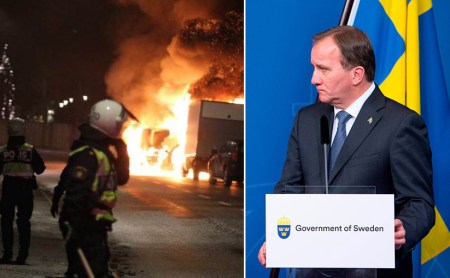
1625While the establishment closes its eyes to the problems that come with a rapidly growing Muslim population in Sweden, ordinary Swedes seem to be growing increasingly upset. Prime Minister Stefan Löfven (right), however, appears to be at a complete loss as to why this is. Pictured at left: The results of rioting in a Stockholm suburb, December 2014.

The people suffering most cruelly in the “New Sweden” are the elderly. The costs of immigration borne by the welfare state have led to a quarter of a million retirees living below the EU poverty line. Meanwhile, the government recently added another 30 billion kronor (about $3.6 billion) to the migration budget. The 70 billion kronor ($8.4 billion) Sweden will spend on asylum seekers in 2016 is more than what the entire police force and justice system cost, more than national defense costs, and twice the amount of child benefits.

Sweden’s 9.5 million residents are thus forced to spend 70 billion kronor on letting citizens of other countries come in. In comparison, the United States, with its 320 million residents, spent $1.56 billion on refugees in 2015. The editorial columnist PM Nilsson commented in the business paper, Dagens Industri:

“To understand the scope of the increase in spending, a historic look back can be worthwhile. When the right bloc came to power in 2006, the cost was 8 billion [kronor] a year. In 2014, it had gone up to 24 billion. That summer, then Minister of Finance Anders Borg talked about the increase being the most dramatic shift in the state budget he had ever seen. The year after, 2015, the cost rose to 35 billion, and in 2016, it is projected to rise to 70 billion.”

For many years, the politicians managed to fool the Swedish people into thinking that even if immigration presented an initial cost, the immigrants would soon enable the country to turn a profit. Now, more and more research indicates that the asylum seeker immigrants rarely or never find work. The daily newspaper Sydsvenskan reported in February, for example, that 64% of Malmö’s immigrants are still unemployed after living in Sweden for ten years. The government openly calculates in its budget that in four years, 980,000 people will be living on either sickness benefits, disability pensions, unemployment benefits, “introduction benefits” or social welfare.

Swedes, who for many years have paid the highest taxes in the world without whining, are now taking to social media to express their anger that their money is going to citizens of other countries. More and more Swedes are choosing to emigrate from Sweden, mainly to the other Nordic countries, but also to Spain, Portugal and Great Britain, where taxes on pensions are considerably less.

But there are worse problems than the economic aspect. A sense of insecurity and fear has gripped the many Swedes who live close to asylum houses. On some level, the government seems to have grasped that danger: in a recent decision to continue maintaining border controls, Interior Minister Anders Ygeman wrote:

“The Swedish Civil Contingencies Agency (Myndigheten för samhällsskydd och beredskap), MSB, makes the assessment that the flow of migrants still brings challenges to upholding security in society, when it comes to the ability to maintain certain important public functions, among other things. Several of these challenges are expected to persist over time. The Police Authority’s assessment is still that a serious threat to public order and internal security exists. The Immigration Service still advocates border controls.”

Despite these ominous words, politicians still do not seem to understand that many Swedes are already experiencing “a serious threat to public order and internal security.” New asylum houses are opening at an alarming pace, against the will of the people living near them. In the Stockholm suburb of Spånga-Tensta, on April 15, local authorities held a public meeting, the purpose of which was to allow local residents to ask the politicians and officials questions about planned housing for 600 migrants — next to a school. The meeting, which was filmed, showed a riotous mood among those gathered there, many shouting that they were going to fight “until their last breath” to keep the plans from materializing.

Some of the comments and questions were:

  • “We have seen how many problems there have been at other asylum houses – stabbings, rapes and harassment. How can you guarantee the safety for us citizens? This is going to create a sense of us against them, it’s going to create hate! Why these large houses, why not small ones with ten people in each? Why haven’t you asked us, the people who live here, if we want this? How will you make this safe for us?”
  • “We already have problems at the existing asylum houses. It’s irresponsible of you to create a situation where we put our own and our children’s health in jeopardy, with people who are not feeling well and are in the wrong environment. Why is this house right next to a school? What is your analysis?”
  • “Will Swedes be allowed to live in these houses? Our young people have nowhere to live. You politicians should solve the housing issue for the people already living here, not for all the people in the world.”

When the chairman of the meeting, Green Party representative Awad Hersi, of Somali descent, thanked the audience for the questions without giving any answers, the mood approached that of a lynch mob. People shouted: “Answer! Answer our questions! We demand answers!”

Everything points to the so far docile Swedes now having had enough of the irresponsible immigration policy that has been going on for many years, under socialist and conservative governments alike.

People are furious at the wave of rapes that have given Sweden the second-highest rate of rape in the world, after only Lesotho, and that recently forced the Östersund police to issue a warning to women and girls not to go outside alone after dark. People are scared: the number of murders and manslaughters has soared. During the first three months of this year alone, there have been 40 murders and 57 attempted murders, according to statistics compiled by the journalist Elisabeth Höglund.

The authorities have long claimed that lethal violence in Sweden is on the decline, but that is compared to a record-breaking year, 1989, when mass immigration to Sweden was already in full swing. If one instead were to compare the present to the 1950s and 1960s, when Sweden was still a homogenous country, the number of murders and manslaughters has doubled. Recently, the Swedish National Council for Crime Prevention (Brottsförebyggande rådet), BRÅ, had toadmit that lethal violence did, in fact, increase in 2015, when 112 people were killed — 25 more than the year before. It was also revealed that the kind of lethal violence that has gone down was run-of-the-mill drunken homicides committed by Swedes, while the number of gangster-style hits carried out by immigrants has gone up dramatically. Improved trauma care for wounded victims also helps keep the number of murders and manslaughters down.

A recent poll showed that 53% of Swedes now think immigration is the most important issue facing the country. The change from 2015 is dramatic — last year, only 27% said that immigration was most important. Another poll showed that 70% of Swedes feel that the amount of immigration to Sweden is too high. This is the fourth year in a row that skepticism about the magnitude of immigration has increased.

More and more people also seem to worry about the future of Sweden as a democracy with an increasing number of Muslims — through continued immigration as well as Muslim women having significantly more children than Swedish women do.

As statistics on religious beliefs are no longer kept, no one knows exactly how many Muslims are in Sweden. Last year, a poll showed that Swedes believe 17% of the population is Muslim, while the actual number, according to the polling institute Ipsos Mori, may be more like 5%. The company does not account for how it arrived at this number, and it is in all likelihood much too low. Ipsos Mori probably counted how many members Muslim congregations and organizations have, but as Islam is also a culture, and the country is equally affected by the Muslims who do not actively practice their faith, yet live according to Islamic culture.

In 2012, the Swedish alternative newspaper, Dispatch International, calculated how many Muslims were registered residents of Sweden at that time, based on the Swedish name registry. The number the paper arrived at was 574,000, plus or minus 20,000. For obvious reasons, illegals and asylum seekers were not included. The actual number may therefore have been much higher.

Since then, close to 300,000 people have sought asylum in Sweden. Not all of them have had their applications approved, but despite that, very few actually leave Sweden. The Immigration Service told Gatestone Institute that only 9,700 people were deported last year. Most asylum seekers are Muslim, which means that the number of Muslims in Sweden is fast approaching one million, or 10% of the population.

In his book Slavery, Terrorism and Islam: The Historical Roots and Contemporary Threat, published in 2005, Dr. Peter Hammond describes what has always happened throughout history when the number of Muslims in a country increases. Admittedly generalities, Hammond outlines the following:

  • As long as the Muslims make up about 1%, they are generally considered a peace-loving minority who do not bother anyone.
  • At 2-3%, some start proselytizing to other minorities and disgruntled groups, especially in prison and among street gangs.
  • At 5%, Muslims have an unreasonably large influence relative to their share of the population. Many demand halal slaughtered meat, and have been pushing the food industry to produce and sell it. They have also started to work toward the government giving them autonomy under sharia law. Hammond writes that the goal of Islam is not to convert the whole world, but rather, to establish sharia law all over the world.
  • When Muslims reach 10%, historically, lawlessness increases. Some start to complain about their situation, start riots and car fires, and threaten people they feel insult Islam.
  • At 20%, violent riots erupt, jihadi militia groups are formed, people are murdered, and churches and synagogues are set ablaze.
  • When the Muslims reach 40% of the population, there are widespread massacres, constant terror attacks and militia warfare.
  • At 60%, there is the possibility of uninhibited persecution of non-Muslims, sporadic ethnic cleansing, possible genocide, implementation of sharia law and jizya (the tax for “protection” that unbelievers must pay).
  • When there are 80% Muslims in the country, they have taken control of the government apparatus and are, as in, for instance, Syria, Afghanistan, Pakistan and Iraq, committing violence in the name of Islam or political power.
  • When 100% are Muslims, the peace in the house of Islam is supposed to come — hence the claim that Islam is the “religion of peace.”

Hammond also writes that in many countries, such as France, Belgium, Great Britain and Sweden, most of the Muslim population lives in Islamic enclaves — and apparently prefer not to be assimilated into a Western society. This detachment strengthens the group internally, allowing them to exercise greater power than their share of the population might indicate.

Hammond’s description of the 10%-limit accurately describes Sweden. In the so-called exclusion areas, there are car torchings every day, and riots occur in the cities. (To name but a few examples, there were serious riots in Malmö 2008, Gothenburg 2009, Stockholm 2013, and Norrköping and Växjö 2015.) Sometimes, the unrest starts after a local Muslim has been arrested or shot by the police. Muslim leaders then immediately say they sympathize with their people’s reaction. During the Husby riots in 2013, Rami Al-Khamisi of the youth organization “Megafonen”wrote: “We can see why people are reacting this way.”

The artist Lars Vilks, who drew the Muslim prophet Muhammed as a roundabout dog, has been the target of several assassination attempts, and now lives under round-the-clock police protection.

Yet, almost no one in Sweden is willing to speak of these problems and how it all fits together. For months, Gatestone Institute has called politicians, civil servants, organizations and various minority groups, to ask how they feel about Islam in Sweden. Do they think Islam is compatible with democracy, freedom of speech and legal equality — and if so, in what way or what way not?

The questions seemed to provoke anger as well as fear. Some of the people we called said they were angry at the mere questions, but assured the callers that Islam poses no problem whatsoever for Sweden. Others appeared frightened and refused to answer altogether. In the hopes of getting at least some honest answers, we presented ourselves as ordinary, concerned Swedes. Countless people hung up the phone, and in general, many answers pointed to an abysmal ignorance about what Islam is, what consequences the Islamization of a country might have, or how much trouble Sweden really is in. The country appears totally unprepared for what lies ahead.

Gaza rockets miss the mark

May 28, 2016

Gaza rockets miss the mark Terrorists from Gaza fire three rockets towards southern Israel, but they explode on the Gazan side of the border.

By Elad Benari, Canada

First Publish: 5/27/2016, 11:55 PM

Source: Gaza rockets miss the mark – Defense/Security – News – Arutz Sheva

Rocket fired from Gaza (archive)
Flash 90

Terrorists from Gaza on Friday night fired rockets towards southern Israel, but missed the mark as three rockets exploded on the Gazan side of the border.

There were no reports of injuries or damages on the Palestinian side.

Earlier this week, a rocket from Gaza was fired towards southern Israel, exploding in an open area of the Sha’ar Hanegev Regional Council and causing no physical injuries or damages.

The Israel Air Force retaliated by striking two terrorist infrastructures belonging to Hamas in Gaza.

Rocket and mortar fire from Gaza has continued to “trickle” into Israel on occasion. On May 6, two mortar shells fired from Gaza exploded near the security fence in the Eshkol Regional Council.

There were no physical injuries or damages. Israeli aircraft hit two Hamas targets in Gaza in retaliation for the attack.

8 Iranian missile launches since nuke deal signed, expert tells US Congress

May 26, 2016

8 Iranian missile launches since nuke deal signed, expert tells US Congress Islamic Republic increases ballistic missile tests, strives to improve accuracy, despite American opposition

By Judah Ari Gross

May 26, 2016, 4:29 pm

Source: 8 Iranian missile launches since nuke deal signed, expert tells US Congress | The Times of Israel

But the US state department has more concerns about Liberman than Iranian rockets

An Iranian Shahab-3 missile launched during military exercises outside the city of Qom, Iran, in June 2011. (AP/ISNA/Ruhollah Vahdati)

In the 10 months since the Iran nuclear agreement was signed, the Islamic Republic has increased the frequency of its ballistic missile testing, according to researcher Michael Elleman, who testified before a US senatorial committee this week.

Iran is primarily focused on increasing the accuracy, not the range, of its missiles, Elleman said.

 Elleman, a senior fellow at the International Institute for Strategic Studies (IISS) think tank, was called to speak Tuesday before the US Senate Committee on Banking, Housing, and Urban Affairs, which is investigating the effects of the Joint Comprehensive Plan of Action (JCPOA), the official name for the Iran nuclear deal signed in July 2015.

Since then, Iran’s ballistic missile program has become a central issue in the debate surrounding the nuclear deal, with opponents of the agreement saying test launches violate the terms of the JCPOA, while proponents argue missile tests are “inconsistent” with United Nations resolutions but not necessarily illegal.

According to the UN decision, “Iran is called upon not to undertake any activity related to ballistic missiles designed to be capable of delivering nuclear weapons, including launches using such ballistic missile technology,” until October 2023.

As they’re only “called upon not to” test missiles, but not expressly forbidden from doing so, Iran has used that loophole to increase its testing with impunity.

“[The US has] engaged in a lot of hue and cry over Iran’s missile capabilities, but they should know that this ballyhoo does not have any influence and they cannot do a damn thing,” Iranian supreme leader Ali Khamenei said this week.

A Khalij Fars ballistic missile on a transporter during a military parade in Iran. (Iranian military/CC BY-SA 3.0/WikiMedia)

A Khalij Fars ballistic missile on a transporter during a military parade in Iran. (Iranian military/CC BY-SA 3.0/WikiMedia)

According to Elleman, in the almost year following the signing of the agreement and the removal of sanctions, Iran has performed at least eight missile tests — three in 2015 and five thus far in 2016.

In 2005, 2013 and 2014, however, when negotiations for the deal were in full swing, Iran did not perform a single test of a “nuclear-capable missile,” the IISS fellow testified.

After talks fell through in 2005 and before they resumed in 2013, the Islamic Republic “averaged roughly five test launches per year,” according to Elleman.

A missile launched from the Alborz mountains in Iran on March 9, 2016, reportedly inscribed in Hebrew, 'Israel must be wiped out.' (Fars News)

A missile launched from the Alborz mountains in Iran on March 9, 2016, reportedly inscribed in Hebrew, ‘Israel must be wiped out.’ (Fars News)

Though the increase from an average of five to eight missile tests a year seems dramatic — it’s a 60 percent increase, after all — Elleman offered perspective by comparing that to the US and Soviet missile testing programs during the Cold War, which averaged “about one test a week,” or nearly 10 times as many tests per year.

Tactically speaking, ballistic missiles have little value other than as a means of delivering a nuclear warhead, Elleman pointed out.

In May, an Iranian official claimed the country had tested a missile capable of reaching Israel, which had almost unheard-of accuracy for Iran.

“We test-fired a missile with a range of 2,000 kilometers and a margin of error of eight meters,” Brigadier General Ali Abdollahi was quoted as saying at a Tehran science conference.

However, this was swiftly denied by the Iranian defense minister on the same day.

“We’re still trying to get to the bottom of what exactly transpired,” White House spokesman Josh Earnest said at a press briefing.

“We are aware of Iranian claims of an additional ballistic missile launch. We’re also aware of statements from the defense minister indicating that such a launch did not take place,” he said.

Accuracy over range

Whether or not the test took place, the emphasis on the rocket’s margin of error points to a renewed focus on the accuracy of Iran’s existing arsenal of missiles, rather than on the development of farther-reaching projectiles.

“Iran seeks to improve the accuracy of its missiles, a priority that supersedes the need to develop longer-range missiles,” Elleman told the Senate committee on Tuesday. “Iran has repeated said that it does not need missiles with a range of greater than 2,000 kilometers, or 1,200 miles.”

At that range, Iran could easily reach any target within Israel, which is just under 1,000 miles away.

A military exhibition displays the Shahab-3 missile under a picture of the Iranian supreme leader Ayatollah Ali Khamenei, in Tehran, in 2008 (photo credit: AP/Hasan Sarbakhshian)

A military exhibition displays the Shahab-3 missile under a picture of the Iranian Supreme Leader Ayatollah Ali Khamenei, in Tehran, in 2008. (AP/Hasan Sarbakhshian)

At this point in time, however, Iran’s missile technology is far from accurate enough to reliably hit a predetermined target, and changing that will not be easy or quick, Elleman said.

“Substantial improvements in missile accuracy will take years, if not a decade, to materialize,” he said.

As with so many things, he most important aspects of a military attack are location, location, location. A missile — even a nuclear-tipped missile — landing in the Arava desert would have an incomparably lesser effect than a missile landing on, say, Dizengoff Center in Tel Aviv.

“Iran’s ballistic missiles have poor accuracy. The successful destruction of a single fixed military target, for example, would probably require Iran to use a significant percentage of its missile inventory,” Elleman told the Senate committee.

Illustrative photo of a Fateh-110 ballistic missile, taken at an Iranian armed forces parade in 2012. (military.ir/Wikimedia Commons)

Illustrative photo of a Fateh-110 ballistic missile, taken at an Iranian armed forces parade in 2012. (military.ir/Wikimedia Commons)

That inventory consists of over 300 missiles considered “nuclear-capable,” according to the international Missile Technology Control Regime monitoring association, which defines it as any missile capable of delivering a 1,100 pound (500 kg) warhead a distance of 186 miles (300 km), Elleman said.

Slow progress on ICBM technology

In terms of increasing the range of its ballistic missiles, the senior researcher said Iran has not made great strides in that effort.

“I have seen no evidence to suggest that Iran is actively developing an intermediate- or intercontinental-range ballistic missile (IRBM or ICBM, respectively),” Elleman said, but he added, “I cannot speak to a covert program.”

The most recent test that could be related to ICBMs appears to have been the launch of the Simorgh rocket, which is believed to have been conducted last month. US and Iranian officials have not publicly acknowledged the test, though Russian revealed that the launch popped up on one of their radar stations.

Iranians take photos of the Simorgh satellite rocket during celebrations to mark the 37th anniversary of the Islamic Revolution, in Teheran, February 11, 2016. (AFP/Atta Kenare)

Iranians take photos of the Simorgh satellite rocket during celebrations to mark the 37th anniversary of the Islamic Revolution, in Teheran, February 11, 2016. (AFP/Atta Kenare)

The Simorgh rocket is designed to launch satellites into space. However, Elleman told the Senate committee, “Without question, rockets designed to boost a satellite into orbit and long-range ballistic missiles employ many of the same technologies, key components, and operational features.”

But it’s not likely that the Simorgh itself would be used as a weapon because of the considerable effort that would be required to convert it into a reliable ICBM. Rather, the information gleaned from the space rocket would be applied to create a new type of missile, Elleman said.

“Iran’s ambitious space program provides engineers with critical experience developing powerful booster rockets and other skills that could be used in developing longer-range missiles, including ICBMs,” he said.

The production of those long-range missiles, which would be capable of striking the United States, is still years away, assuming Iran continues on its current course.

According to Admiral William Gortney of the North American Aerospace Defense Command, Iran is anticipated to have an operational intercontinental ballistic missile by the year 2020.

Michael Elleman, a senior fellow at the International Institute for Strategic Studies think-tank. (Screen capture: C-Span)

Michael Elleman, a senior fellow at the International Institute for Strategic Studies think tank. (Screen capture: C-Span)

Meanwhile, Elleman, who has interviewed Russian and Ukrainian scientists who worked in the Iranian missile program, estimated the Islamic Republic would not be able to produce an operational ICBM until “2022, at the earliest.”

In his testimony, the senior IISS researcher also discussed an interesting piece of modern history, namely that Israel is partially responsbile for the Iranian missile defense program, which was created before the 1979 revolution when the two countries were still allies.

“Ironically, the shah teamed with Israel to develop a short-range system after Washington denied his request for Lance missiles,” Elleman said.

“Known as Project Flower, Iran supplied the funds and Israel provided the technology. The monarchy also pursued nuclear technologies, suggesting an interest in a delivery system for nuclear weapons,” he said.

Hamas is Fantastic!!

May 26, 2016
Published on May 22, 2016
Ami Horowitz

Would university students donate money to Hamas to blow up schools and hospitals? Watch and find out!!!

Russian UN envoy Churkin names Turkish companies helping ISIS make bombs

May 26, 2016

Russian UN envoy Churkin names Turkish companies helping ISIS make bombs

Published time: 26 May, 2016 06:31

Source: Russian UN envoy Churkin names Turkish companies helping ISIS make bombs — RT News

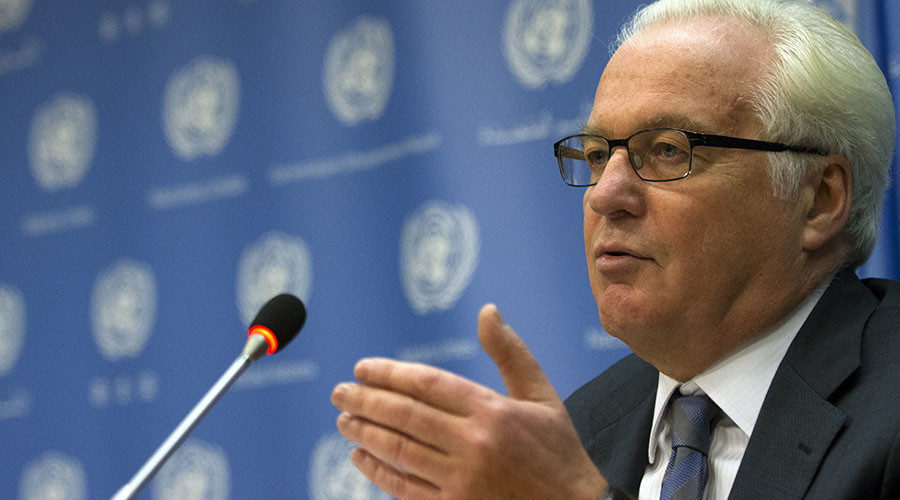
Russian ambassador to the United Nations Vitaly Churkin. © Brendan McDermid / Reuters

Russia has presented a list of Turkish companies to the UN that Moscow believes are providing Islamic State with the components needed to make homemade explosive devices.

In UN Ambassador Vitaly Churkin’s letter to UN Secretary General Ban Ki Moon, the envoy says analysis of chemical components of explosives recovered in Islamic State (IS, formerly ISIS/ISIL) liberated areas of Iraq’s Tikrit and the Syrian city of Kobani, implicate Turkish companies.

Read more

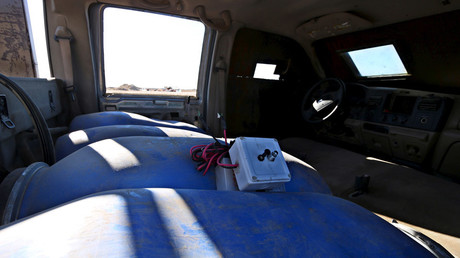
Containers filled with explosive materials, thought to have belonged to Islamic State militants. © Rodi Said

Components found in the explosives, Churkin wrote, “indicate that they were either manufactured in Turkey or delivered to that country without the right of re-export.”

The composition of the improvised explosive devices (IEDs) included the use of aluminum powder, ammonium nitrate, granulated carbamide and hydrogen peroxide that were produced by Turkish firms “Gultas Kimya” , “Marikem Kimyevi Ve Endüstriyel Ürünler”, “Diversey Kimya”, “Metkim”, and “EKM Gubre”.

Churkin specifically noted a sevenfold export increase from Turkey to Syria of ammonium nitrate used by terrorists as a component for the manufacture of improvised explosive devices.

He also noted that the “detonation cords manufactured in third countries have been illegally resold through Turkey to ISIL fighters,” as bombs used by Islamists also contained American made microcontrollers produced by Microchip Technology, Swiss-made transistors made by ST Microelectronics and Finish Nokia phones model 105 RM-908.

“These facts demonstrate that the Turkish authorities are deliberately involved in Daesh activity, as they are providing access to components for improvised explosive devices that are being widely used to commit terrorist acts,” the Russian envoy said.

Read more

© RT

The Turkish Foreign Ministry was quick to reject Russia’s claims calling the letter “the most recent example of Russia’s propaganda campaign against Turkey.”

Russia has repeatedly accused and presented evidence of Turkish involvement in running IS operations in Syria and Iraq. Churkin’s letter comes following an earlier 20-month long study published by Conflict Armament Research (CAR), which concluded that over 50 companies from 20 countries, sold or received hundreds of components used by Islamic State terrorists to build explosive devices. A total of 13 Turkish firms were found to be involved in the supply chain.

The 107-page report concluded homemade explosives can easily be assembled using everyday products that are actually not subject to transfer controls such as export licensing. As a result, their supply within the region is basically unregulated and weakly monitored. Other key components, such as detonators and detonating cords, are subject to export licensing, but are also commonly used in commercial activities, such as mining and industry.

Watch: Florida Atlantic Professor Defends Sharia Law Practice of Cutting Off Hands

May 25, 2016

Watch: Florida Atlantic Professor Defends Sharia Law Practice of Cutting Off Hands

by Breitbart TV

24 May 2016

Source: Watch: Florida Atlantic Professor Defends Sharia Law Practice of Cutting Off Hands – Breitbart

(THE UNITED WEST) On Tuesday on the campus of Florida Atlantic University in Boca Raton, FL, the university’s Muslim Student Association’s hosted a so-called Islamophobia panel discussion, which was attended by the United West.

FAU Department of Computer and Electrical Engineering and Computer Science Associate Professor Bassem Al Halabi was included on the panel of these distinguished experts and he made the incredible statement about the case to be made for Sharia Law and it’s provisions of capital punishment, including the cutting off of hands.

‘“Where there is no Sharia, Islamic Sharia, they die in dozens and hundreds every day because of organized crime. People kill people, other people or steal pizza for $10 and so – so when Islamic Shariah is saying about capital punishment – so even though it sounds like it is severe but if that is the solution to prevent any crimes, then it still has a lot of rules and regulations. I will just mention one and stop here, which is let’s say cutting off the hands of a person if they steal. It sounds very severe. It sounds very barbaric, I know. But if takes one or two people to have their hands cut off, and then there’s no more stealing and there’s no more stealing in the whole nation – that’s a much better resolution than having hundreds of people die every day.”

Should We Fear Islam? Czech Parliament

May 25, 2016

Vlad Tepesblog

Published on May 24, 2016

Watch it completer, worth the time .