Posted tagged ‘Islam’

Iran’s Rouhani: Tactical Shift at the UN

September 19, 2016

Iran’s Rouhani: Tactical Shift at the UN

by Majid Rafizadeh September 19, 2016 at 4:00 am

Source: Iran’s Rouhani: Tactical Shift at the UN

  • By criticizing and blaming the U.S. for not honoring the terms, Rouhani plans to exploit President Obama’s weak point, as the negotiating team has been doing all along, by invoking Obama’s fear that Tehran might pull out of the nuclear deal — a move that would highlight the failure of the accord. This tactic will, as usual, successfully pressure the administration to give Tehran even more geopolitical and economic “carrots,” and pursue a policy with Iran of agreeing to even more concessions.
  • Rouhani’s tactical shift is intended to reinforce Iran’s entrenched revolutionary ideal of anti-Americanism, appease Khamenei and the Revolutionary Guards, and ensure his second term presidency.

Iran’s President Hassan Rouhani and Foreign Minister Mohammad Javad Zarif will be attending the 71st session of the UN General Assembly in New York this week.

Based on the latest developments, all signs point to a tactical shift by Rouhani, in which his messages and tone will be quite different this year.

In the previous sessions of the UN General Assembly, Rouhani and his team adopted a diplomatic tone in order to have the UN Security Council lift sanctions against Iran. He praised the success of the nuclear agreement, its contribution to peace and its prevention of more tension and potential conflagration in the region. Iran’s objective was achieved: a few months later, when all four rounds of the Security Council sanctions were removed, billions of dollars and billions of cover-up stories arrived, all cost-free gifts from the U.S.
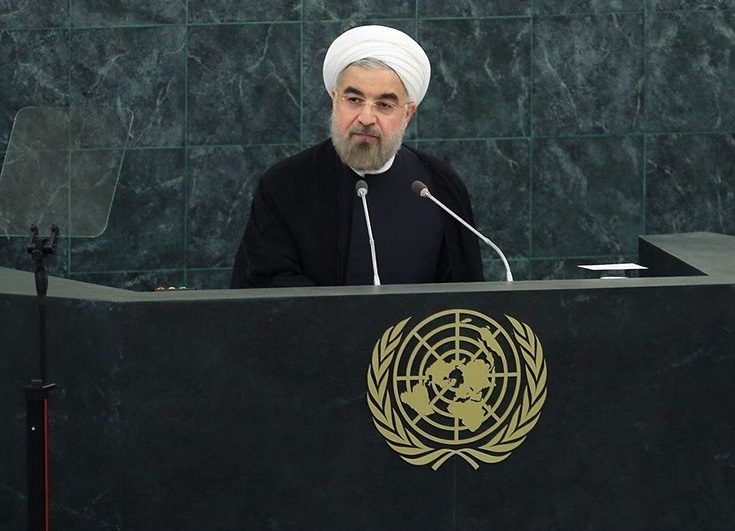
Iranian President Hassan Rouhani speaks at the UN General Assembly, September 26, 2013. (Image source: president.ir)

After achieving these goals for Iran’s ruling politicians, Rouhani’s message this year will switch to blaming the U.S. for all sorts of injurious shortcomings in the nuclear agreement, which Iran, incidentally, still has not signed.

U.S. President Barack Obama’s administration has sent hundreds of billions of dollars to Iran, and has hidden Iran’s supposed non-compliance with the nuclear deal to which it never officially agreed in the first place. The deal, in fact, seems only to have existed in the overheated imaginations of the US and other gullible members of the Joint Comprehensive Plan of Action (JCPOA). Nevertheless, the U.S. has ignored what Iran’s violations could be, and has assisted Tehran in evading any terms of the nuclear agreement it wished.

In addition, now that Iran has seen that the U.S. had lost all political leverage to pressure Tehran through the Security Council sanctions, and that, as critics of the deal had repeatedly and urgently warned, sanctions could not be “snapped back,” partly due to the veto power of Russia and China, Rouhani will be openly delivering the hardline messages of Iran’s Supreme Leader, Ayatollah Ali Khamenei, and the generals of Iran’s Islamic Revolutionary Guard Corps (IRGC), who enjoy power over Iran’s economic and political systems.

Khamenei and the senior cadre of the IRGC draw their legitimacy and power from the revolutionary principle of opposing the U.S., the “Great Satan.”

After the billions of dollars from the nuclear deal were delivered, the regime’s anti-American remarks and behavior only increased. For Rouhani, any expectation of rapprochement with the U.S. must be prevented, and also any domestic political liberalization prevented from occurring.

Reasons for Rouhani’s tactical shift in more publicly adhering to Iran’s revolutionary principle of anti-Americanism also include Iran’s leaders’ awareness that President Obama is tightly and desperately clutching the nuclear agreement until he leaves office: he considers the deal his crowning foreign policy accomplishment and legacy. By criticizing and blaming the U.S. for not honoring the terms, Rouhani plans to exploit President Obama’s weak point, as the negotiating team has been doing all along, by invoking Obama’s fear that Tehran might pull out of the nuclear deal — a move that would highlight the failure of the accord. This tactic will, as usual, successfully pressure the administration to give Tehran even more geopolitical and economic “carrots,” and pursue a policy with Iran of agreeing to even more concessions. Rouhani and Zarif will, as usual, conduct bilateral talks with American diplomats behind the closed doors to make sure they are achieved.

Rouhani’s public shift to Iran’s hard-line political spectrum is also partially pitched to Iran’s upcoming presidential elections. He needs the firm support of the hard-line leaders — fundamentally that of Supreme Leader Khamenei, who enjoys the final say in Iran’s domestic and foreign policy, and that of the IRGC leaders — in order to assure his election to a second term.

By more publicly delivering Khamenei’s message — that the US is not adhering to the terms of the nuclear deal and that it is supposedly the U.S. that has been “breaking oaths and not acting on their commitments and creating obstacles” —
Rouhani is most likely hoping further to endear himself to Khamenei and the IRGC and prove his loyalty.

A recent poll by the Center for International and Security Studies at the University of Maryland revealed that the moderate camp’s popularity has not only decreased, but that Iran’s former president, Mahmoud Ahmadinejad,

“now represents the single largest threat to Rouhani’s re-election, and trails the once-popular incumbent by only eight points. Suddenly, the ex-president [Ahmadinejad] seems once again to be a real political contender.”

Rouhani had also promised the Iranian people that the nuclear deal would improve their economic life. Since the implementation of the nuclear deal, however, the Iranian people have (unsurprisingly) not seen the fruits of the deal and the billions of dollars that the government has received. Rouhani will undoubtedly be trying to distract people’s attention from blaming the Iranian government by pointing to the U.S. as the culprit.

In one of his latest speeches, Khamenei pointed out that the U.S. is attempting to “destroy Iran’s economic relationships with other countries.” He added:

“Was it not supposed to be so that the unjust sanctions would be removed and it would have an effect on people’s lives? After six months, is there any tangible effect on the lives of the people? If not for America violating its oaths, would the administration not be able to do many things during this time? … Of course it has been some years that I have been repeating this about the lack of trust with America, but for some it was hard to accept this reality.”

Another issue on Rouhani’s agenda will be to promote, at the governmental level, business deals and trade, which will further financially benefit the IRGC and Khamenei, not Iran’s private sector.

Rouhani will more likely attempt to justify Iran’s military adventurism in the region by playing the anti-terrorism card, even though Iran is still the leading sponsor of terrorism.

Rouhani’s government will most likely focus on spreading the narrative of Khamenei and the IRGC, that Iran is an indispensable force in fighting the Islamic State and other extremist groups; that regional and global powers need to join Iran in this battle, and that Iran is the victim of terrorism in the region. In addition, Rouhani will presumably attempt to buttress the argument that the international community needs to support the Syrian President Bashar al-Assad in order to defeat terrorism.

Rouhani’s tactical shift is intended to reinforce Iran’s entrenched revolutionary ideal of anti-Americanism, appease Khamenei and the IRGC, and ensure his second term presidency.

Dr. Majid Rafizadeh, political scientists and Harvard University scholar is president of the International American Council on the Middle East. He can be reached at Dr.rafizadeh@post.harvard.edu.

White House: We’re in a ‘Narrative Battle’ With ISIS

September 19, 2016

White House: We’re in a ‘Narrative Battle’ With ISIS

BY:
September 19, 2016 9:11 am

Source: White House: We’re in a ‘Narrative Battle’ With ISIS


White House press secretary Josh Earnest said the U.S. was in a “narrative battle” with the Islamic State terrorist organization during an appearance Monday on CNN’s New Day.

Brought on to discuss the bombings in New York and New Jersey and the possible connections to international terrorism, Earnest cautioned against painting with a “broad brush” regarding terrorism and Islam.

“When it comes to ISIL, we are in a fight, a narrative fight with them, a narrative battle, and what ISIL wants to do is they want to project that they are an organization that is representing Islam in a fight and a war against the West, and a war against the United States,” he said. “That is a bankrupt, false narrative. It’s a mythology, and we have made progress in debunking that mythology.”

After laying out advances made militarily against ISIS, which the Obama administration calls ISIL, Earnest again repeated the U.S. had made progress in “debunking this mythology.”

“We can’t play into this narrative that somehow the United States or the West is fighting against the Muslim religion,” he said. “The fact is there are millions of patriotic Muslims in this country right now that make our country proud. They serve in our armed services. They serve in our law enforcement … These are individuals who make a substantial and positive contribution to our country, and that is an inconvenient fact for the ISIL narrative.”

Earnest used a similar line earlier on MSNBC’s Morning Joe, saying the fight against ISIS was in some ways “just a war of narratives.”

Turkey’s Erdogan plans to expand Syrian military op, wants ‘safe zones’

September 19, 2016

Turkey’s Erdogan plans to expand Syrian military op, wants ‘safe zones’

Published time: 19 Sep, 2016 12:22 Edited time: 19 Sep, 2016 12:25

Source: Turkey’s Erdogan plans to expand Syrian military op, wants ‘safe zones’ — RT News

Turkish soldiers on an armoured personnel carrier escort a military convoy on a main road in Karkamis on the Turkish-Syrian border in the southeastern Gaziantep province, Turkey, August 26, 2016. © Umit Bektas / Reuters

Ankara may continue its operation against Islamic State deeper into Syria – to within just 50km of Aleppo, as President Recep Tayyip Erdogan says the Turkish military plans to create a 5,000-sq-km safe zone within the country.

Erdogan says Turkey’s operation in Syria, Euphrates Shield, which started on August 24, has cleared border regions from Islamic State (IS, formerly ISIS/ISIL).

“As part of the Euphrates Shield operation, an area of 900 sq km has been cleared of terror so far. This area is pushing south,” Erdogan said, as cited by Reuters.

However, the Turkish president wants to increase the area of this safe zone, which is also aimed at stopping the advance of Syrian Kurdish forces. “We may extend this area to 5,000 sq km as part of a safe zone,” he added.

President Erdogan also stated that the Turkish military would continue its push further into Syria and its troops would look to capture the IS-held town of Al-Bab, which is some 50km north-east of Aleppo.

“Jarablus and Al-Rai have been cleansed, now we are moving towards Al-Bab… We will go there and stop [IS] from being a threat to us,” he said.

However, Turkey’s plans for a safe zone or a no fly zone have been questioned by its allies, who are unsure how feasible the plan is due to the number of ground troops and planes needed to patrol the area.

Read more

© Str

Turkey’s goal “is likely to require the deployment of thousands of Turkish soldiers in Syria for years and increase risks of a possible military confrontation with the Syrian forces,” Nihat Ali Ozcan, a strategist at the Economic Policy Research Foundation in Ankara, told Bloomberg.

Turkey has been supporting the Free Syrian Army (FSA) on the ground, which is a loose conglomeration of forces opposed to Syrian President Bashar Assad. However, Erdogan says he does not want the US military interfering in Ankara’s affairs and has blamed Washington for increasing tensions with the rebels.

The Turkish president was referring to a small number of US special forces who had entered Al-Rai to help coordinate airstrike against IS. However, the FSA, considered to be American allies, kicked the US military out, calling them “infidels” and “crusaders.”

“If you had rational people making rational policy – perhaps, but here is no evidence of that so far,” Jim Jatras, a former US diplomat, told RT when asked if the reports about Syrian rebels threatening American soldiers could be a turning point in the country’s conflict.

 “The Obama administration’s policy up to this point has been totally confused and contradictory, and now it is just reaching the point of bizarre,” Jatras added.

Russia Accuses US Of Defending ISIS, After Pentagon Admits Coalition Jets Killed 62 Syrian Soldiers

September 18, 2016

Russia Accuses US Of Defending ISIS, After Pentagon Admits Coalition Jets Killed 62 Syrian Soldiers

Source: Russia Accuses US Of Defending ISIS, After Pentagon Admits Coalition Jets Killed 62 Syrian Soldiers | Zero Hedge

Update 4:  The Obama administration officially expressed it’s “regret” for an airstrike that killed Syrian forces with a senior White House official saying “The United States has relayed our regret through the Russian Federation for the unintentional loss of life of Syrian forces.”

Meanwhile, the U.S. UN envoy called Russia’s request for an emergency Security Council meeting a “stunt.”


Russia’s U.N. Ambassador Vitaly Churkin responded by saying that the U.S. airstrike that struck Syrian government troops has put “a very big question mark” over the future of the U.S. and Russian-brokered cease-fire agreement in Syria adding that in his decades as a diplomat he had “never seen such an extraordinary display of American heavy-handedness as we are witnessing today.”

* * *

Update 3: Russia’s foreign ministry says it has “reached the terrifying conclusion” that the US is conniving with the Islamic State. As ABC reports, Russia has called for an emergency session of the United Nations Security Council over a U.S. air raid that it says struck Syrian troops battling the Islamic State group. Spokeswoman Maria Zakharova says Moscow is demanding “full and detailed explanations about whether this was deliberate support of the Islamic State or another mistake.”

Zakharova was quoted by the state news agency Tass as saying that “after today’s attack on the Syrian army, we come to the terrible conclusion that the White House is defending the Islamic State.”

The U.S. military says it halted an air raid against IS in eastern Syria after it was informed by Russia that it might have struck Syrian troops. If confirmed, it would be the first American strike on President Bashar Assad’s forces in the five-year-old conflict. The allegations come as Moscow and Washington are already at loggerheads over a five-day-old Syrian cease-fire, with each accusing the other of failing to fully implement it.

It appears this major diplomatic scandal is only starting to play out.

* * *

Update 2: it appears that Russia is angry, and has called a UN Security Council session, while reporting that Washington never announced any plans to conduct raids in the region in question:

Update: Centcom has issued a statement admitting the killing of over 60 Syrian troops was a mistake.


Earlier:

If the latest news out of Syria are confirmed, one can not only kiss last weekend’s so-called “ceasefire” goodbye, but a full blown war may be about to erupt. The reason: moments ago the Syrian Army General Command reported, and shortly thereafter the Russian military confirmed, that US-coalition forces struck the Syrian airbase at Deir el-Zour, killing at least 62 Syrian army troops, “paving the way” for ISIS militants to advance in the fiercely contested area..

According to Syria’s official SANA news agency, the bombing took place on al-Tharda Mountain in the region of Deir ez-Zor and caused casualties and destruction on the ground.

Sixty-two Syrian soldiers were killed and over 100 injured in the airstrike by the US-led coalition, Russia’s Defense Ministry spokesman, Major-General Igor Konashenkov, confirmed citing information received from the Syrian General Command.

There was no immediate comment from Washington. If confirmed, the attack could be tantamount to an act of war as it would be the first time the coalition has targeted Syrian government forces.  Subsequently, the Pentagon told RT that it is “aware of the reports and checking with Centcom and CJTF (Combined Joint Task Force).”


U.S. Secretary of State John Kerry (R) and Russian Foreign Minister

 Sergei Lavrov walk into their meeting room in Geneva, Switzerland

In a statement Saturday, the Syrian military says the airstrikes caused casualties and damage to equipment, and enabled an IS advance on the hill overlooking the air base. The statement calls it a “serious and blatant attack on Syria and its military” and “firm proof of the U.S. support of Daesh and other terrorist groups.” Daesh is an Arabic acronym for IS.

The Russian Defense Ministry said on Saturday that the aircraft which carried out the bombings had entered Syrian airspace from the territory of Iraq.  Four strikes against Syrian positions was performed by two F-16 jet fighters and two A-10 support aircraft, it added.

“Immediately after the airstrike by coalition planes, Islamic State militants launched their offensive. Fierce fighting with the terrorists is currently underway in the area of the airport where for a long a time humanitarian aid for civilians was parachuted,” Konashenkov said.

“If the airstrike was caused by the wrong coordinates of targets than it’s a direct consequence of the stubborn unwillingness of the American side to coordinate with Russia in its actions against terrorist groups in Syria,” Konashenkov stressed. Alternatively, the Syrians – and Russians – may claim that the US coalition attack meant to cripple Syrian army forces, taking the lethal conflict to an entirely new level, one where Syria and Russia are effectively at war with the US coalition.

Meanwhile, it appears that the Assad regime, which recently also garnered the support of Chinese military forces, is preparing for a full-blown escalation: the Syrian General Command has called the bombing a “serious and blatant aggression” against Syrian forces, and said it was “conclusive evidence” that the US and its allies support IS militants.

* * *

Earlier on Saturday, Russia accused the US of being reluctant to take measures to force rebels under its control to fall in line with the terms of the Syrian ceasefire. As RT reported, numerous Russian appeals to the American side remain unanswered, which “raises doubts over the US’s ability to influence opposition groups under their control and their willingness to further ensure the implementation of the Geneva agreements,” senior Russian General Staff official, Viktor Poznikhir, said. Poznikhir also said that the truce is being used by the militants to regroup, resupply and prepare an offensive against government troops.

Last week, Moscow and Washington agreed to influence the Syrian government and the so-called moderate rebel forces respectively in order to establish a ceasefire in the country “over pizza and vodka.”  We were skeptical, and for good reason: one week later it appears that not only is the ceasefire over but a whole new phase in the war may have broken out.

Russia has repeatedly alleged that the US is failing to keep its part of the bargain. The US, on its part, has blamed Russia for not pressuring Damascus enough to facilitate humanitarian access to Syria.

Both allegations may now be moot if Russia decides to retaliate against members of the US-led coalition, or directly against US forces.


U.S. Military: We Meant to Attack Islamic State, Not Syrian Army

September 18, 2016

U.S. Military: We Meant to Attack Islamic State, Not Syrian Army

by Breitbart Jerusalem

17 Sep 2016

Source: U.S. Military: We Meant to Attack Islamic State, Not Syrian Army – Breitbart

Putin has to keep his cool til 20 January 2017 when trump is sworn in as president of the USA

AFP

The BBC reports: The US-led coalition has admitted its planes carried out an attack in eastern Syria that the Russian army says killed at least 62 Syrian troops fighting IS.

The US said its planes halted the attack in Deir al-Zour when informed of the Syrian presence and would not knowingly strike them.

The strikes allowed IS jihadists to advance, the Russians said.

…The US Central Command statement said the coalition believed it was attacking positions of so-called Islamic State and the raids were “halted immediately when coalition officials were informed by Russian officials that it was possible the personnel and vehicles targeted were part of the Syrian military”.

Read the full story here.

Iron Dome intercepts two rockets over Golan

September 17, 2016

Iron Dome intercepts two rockets over Golan For the first time ever, the anti-missile system is used operationally in the Golan Heights. The rockets were ‘strays.’

Orli Harari,
17/09/16 21:01

Source: Iron Dome intercepts two rockets over Golan – Defense/Security – News –

Iron Dome system

Flash 90

The Iron Dome anti-missile system intercepted two missiles or mortar shells fired from Syria Saturday afternoon at the Israeli Golan Heights. The interceptions – the system’s first ever in the Golan Heights – were reportedly successful.

No one was hurt and no damage was caused.

Sources in the security establishment estimated that the rockets or mortar shells were “strays” from the civil war in Syria and that they were not intended to hit Israel.

A warning siren did not go off, but the IDF said that this was because the Iron Dome radar predicted that the missiles’ trajectory would not carry them into Israeli territory.

This is the tenth time in the past two weeks that mortar shells or rockets are fired in Israel’s direction from Syria. In the previous incidents, the mortar shells exploded inside Israeli territory, in “open spaces”.

The Head of the Golan Regional Council, Eli Malka, said after the incident that he “trusts that the IDF is doing all that is needed to bring to a minimum the strays that hit the Golan Heights”.

“The Golan residents and the numerous travelers who are flocking to the recreational and leisure sites in the Golan are making no changes in their plans”, he said.


VIDEO: American commandos ‘forced to run away’ from US-backed Syrian jihadis to the cheers of “ALLAH AKBAR”

September 16, 2016

VIDEO: American commandos ‘forced to run away’ from US-backed Syrian jihadis to the cheers of “ALLAH AKBAR”

ByPamela Geller

on September 16, 2016

Source: VIDEO: American commandos ‘forced to run away’ from US-backed Syrian jihadis to the cheers of “ALLAH AKBAR” | Pamela Geller


This must be what Obama means when he says, “leading from behind.”

Look what Obama and Hillary have done to our military. Unrecognizable. This is the poison fruit of their policies which supported and armed  the enemy. What was at first ridiculous and incoherent, is now catastrophic.

Iran is humiliating us at sea, ISIS on land.

Obama continues to be woefully unprepared to face the threat of ISIS and their acolytes: he CREATED the threat by leaving Iraq precipitously and giving an opportunity to this group. Hillary has vowed to follow this failed and reckless strategy.

He has armed the Syrian rebels — many of these arms fell into the hands of ISIS, and the Syrian rebels he armed have the same jihad goal that ISIS does.

“A spokesman for US Central Command said they were aware of the video and looking into the incident. ” Well that instills great confidence ….

“American commandos ‘forced to run away’ from US-backed Syrian rebels,” By Raf Sanchez, Middle East Correspondent, The Telegraph, 16 September 2016:

US commandos are operating in a complex web of alliances and enmities in Syria

Video footage appears to show US commandos fleeing a Syrian town under a barrage of abuse and insults hurled at them by fighters from the American-backed Free Syrian Army (FSA) rebel group.

video appears to be the first evidence of US special forces cooperating with Turkish troops in their battle against Islamic State.The incident illustrates the complex web of alliances and enmities in Syria, where many of America’s allies are fighting each other and some rebel groups that receive US support still harbour strong anti-American sentiments.The footage shows a crowd of rebel fighters in the town of al-Rai near the Turkish border, which was captured from the Islamic State (Isil) by Syrian rebel groups with the backing of Turkey. Turkey, which launched a military incursion into Syria in late August, has been backing the FSA.

The fighters scream anti-American chants as a column of pick-up trucks carrying US commandos drives away from them.

“Christians and Americans have no place among us,” shouts one man in the video. “They want to wage a crusader war to occupy Syria.”

Another man calls out: “They collaborators of America are dogs and pigs. They wage a crusader war against Syria and Islam. ”

The US troops are not wearing traditional uniform but they carry American weapons and are wearing the distinctive round helmets favored by US special forces.

Another video shows the US troops looking nonchalant and waving at the camera even as some of the rebels tell them to leave.

What will Israel’s next war look like?

September 15, 2016

What will Israel’s next war look like? Could Israel be facing multi-front war with hundreds of thousands of rockets targeting Israeli cities? IDF presents war scenario to cabinet.

Uzi Baruch, 15/09/16 17:17

Source: What will Israel’s next war look like? – Defense/Security – News –

Patriot Missile Battery      IDF/Flash 90

Hundreds of thousands of rockets and missiles targeting Israel. More than 10,000 direct hits by rockets on buildings in Israeli towns. Three hundred and fifty people dead.

That is the scenario presented recently by the IDF to the Security Cabinet, highlighting the potential threats by Israel – and the army’s preparations to confront them.

According to IDF estimates, such a conflict could include attacks by Islamic terror groups from the Gaza Strip, Hezbollah in Lebanon, and the Syrian and Iranian militaries. In such a scenario, most of Israel – and most of Israel’s population – would be under direct threat from rocket and missile fire, though the majority of such weapons would likely hit open spaces.

In the scenario laid out in the IDF report, more than 230,000 rockets and missiles would be directed towards Israel, covering the country from the Haifa district in the north to the southern coast, leaving most of the population vulnerable.

While only 1% of rockets and missiles fired would be expected to cause damage in populated areas, given the large volume of projectiles, hundreds of casualties could result from the conflict.

Next week, Home Front Command will hold its annual emergency exercises. Beginning Sunday and continuing through Wednesday, this year’s exercises, code-names “Standing Firm”, will include emergency sirens in populated areas, to be sounded twice on Tuesday.

Residents are advised to plan a path to the nearest safe-room or bomb shelter as part of the exercises mock emergency sirens.

US issues travel advisory warning for the Golan Heights

September 15, 2016

US Embassy issues travel advisory warning for the Golan Heights following mortar fire Following the recent mortar fire into the Israeli controlled Golan Heights; the US Embassy has issued a travel advisory warning to the area. US federal employees are forbidden from traveling north of Route 87 and east of Route 918.

Sep 15, 2016, 3:50PM

Rachel Avraham

Source: US issues travel advisory warning for the Golan Heights – World News | JerusalemOnline

Photo Credit: Reuters/Channel 2 News

In the wake of mortars being constantly fired into the Israeli controlled Golan Heights due to the fighting in recent days between the Syrian Army and rebel forces in the town of Quneitra, the American Embassy “urges US citizens to carefully consider and possibly defer travel to that area until the situation stabilizes.” The US government has forbidden federal employees from traveling north of Route 87 and east of Route 918 in the “Israeli occupied Golan Heights.”

“The United States Embassy continues to closely monitor the security situation and advises US citizens to visit the website of the Government of Israel’s Home Front Command for further emergency preparedness guidelines,” the American Embassy stated in a recent press release. “Recent events underscore the importance of situational awareness. We remind you to be aware of your surroundings at all times, to monitor the media and to follow the directions of emergency responders.”

Mortar fire from Syria fell 15 kilometers inside Israel

September 8, 2016

Mortar fire from Syria fell 15 kilometers inside Israel A mortar shell that was fired from Syria into Israel yesterday apparently reached the farthest inside the Jewish state since the beginning of the Syrian Civil War. Israeli officials believe that it was spillover from the fighting in Syria.

Sep 8, 2016, 10:39AM

Rachel Avraham

Source: Mortar fire from Syria fell 15 kilometers inside Israel – Middle East | JerusalemOnline

Photo Credit: CBN

Yesterday, a mortar shell exploded in an open area in the Northern Golan Heights and the IDF had announced that it was a spillover from the fighting within Syria. However, it was revealed this morning that it landed 15 kilometers from the Syrian-Israeli border, which means that it reached the furthest inside Israel out of any Syrian mortar shell that landed in the Jewish state since the Syrian Civil War began.

It is said to be an artillery shell with a 100 millimeter diameter that fortunately did not hit a populated area even though it was shot from a long distance. This is the second time this week a mortar shell landed at a distance from the border fence unlike on previous occasions in recent months. Israeli officials appraised that even though the mortar was fired from a significant distance, it was still a spillover from the Syrian Civil War that was caused by the inaccurate firing of the Syrian organizations.


