Posted tagged ‘IRGC’

Iranian Official: ‘If America Wants To Try Its Luck Against Us, [It Should Know That] We Are Completely Capable Of Mobilizing 9 Million Fighters… In Under 10 Days’; ‘We Have Warehouses Full [Of Missiles]… That Can Hit Tel Aviv’

October 3, 2016

Iranian Official: ‘If America Wants To Try Its Luck Against Us, [It Should Know That] We Are Completely Capable Of Mobilizing 9 Million Fighters… In Under 10 Days’; ‘We Have Warehouses Full [Of Missiles]… That Can Hit Tel Aviv’ MEMRI, October 2, 2016

In a September 25, 2016 speech to a Tehran political circle, Mohsen Rafighdoost, who was minister of the Iran’s Islamic Revolutionary Guard Corps (IRGC) during the 1980-88 Iran-Iraq War and who heads the Noor Foundation,[1] said that the secret of the victory of Iran’s Islamic Revolution was Iranians’ total obedience to the leader. He said that today the IRGC ground forces are “five times better” than the U.S. Army, and that the Iranian regime is capable of deploying nine million troops against it in less than 10 days.

Rafighdoost added that Iran’s missiles in Tehran and the northwest of the country can reach Tel Aviv, and expressed his yearning for Israel to launch a missile at Iran so that Iran could “flatten Tel Aviv.” He also said that Islamic Revolution founder Ayatollah Khomeini established Hizbullah in Lebanon to promote the Islamization of other countries,[2] and that today, in the era of Supreme Leader Ali Khamenei, the organization has become “a supreme force in the region.”

30165Mohsen Rafighdoost. Source: Wilayah.info, January 27, 2014.

Following are his September 25 statements:

“The IRGC’s Ground Forces Are Perhaps Five Times Better Than The American Army”

“The factor that led to our victory in the [Iran-Iraq] War is [the same] factor that led to our victory in the [Islamic] Revolution. The Imam [Khomeini], in France, would order a parade [to be held in Iran], and the people would hold a parade, even in remote villages.

“During the eight years of the imposed war, not only was not one inch of Iranian land surrendered to the enemy, but we also acquired deterrent capability. I believe that as long as the Islamic Revolution stands against the Western and Eastern camps, we will be under military sanctions. We must never think that the world will provide us with military aid. Thanks to the war and its martyrs, Iran currently has deterrent capability. After a while, the Imam [Khomeini] replaced the call of ‘war, war to victory’ with ‘war, war until the fitna is removed.’ At the time, we understood this call as meaning that ‘we must be so strong that the enemy will not even think of a military strike against Iran.’

“Today, Iran has deterrent capability. In recent years, the enemies have spoken of the option [of a military strike against Iran] as being on the table, but that was a lie. [Our] air force and navy are good, but it is [our] ground forces that finish the war. The IRGC’s ground forces are perhaps five times better than the American army.

“Despite all the enemy media and cultural propaganda against us, if America wants to try its luck against us, [it should know that] we are completely capable of mobilizing nine million fighters [against it]… on the [battle]front in under 10 days.”

“If Only A Single [Israeli] Shell Would Strike Anywhere In This Country – So That We Can Flatten Tel Aviv”

“We have warehouses full [of missiles] in Tehran, Zanjan [in northwest Iran] and Oshnavieh [in Western Azerbaijan Province in northwest Iran] that can strike Tel Aviv. If only a single [Israeli] shell would strike anywhere in this country, so that we can flatten Tel Aviv.”

In Khamenei’s Era, Hizbullah “Has Become A Supreme Force In The Region”

“In accordance with his secondary plan, the Imam [Khomeini] created Hizbullah in Lebanon. This plan was [aimed at] Islamizing other countries. Today, in the era of the Leader [Khamenei, Hizbullah] has become a supreme force in the region.

“Despite all the criminal [plots], Iranian security forces grow stronger every day. Some of the statements being put out there are made out of lack of awareness, and anyone who makes them is ignorant.[3]

“The secret to victory lies in wise and complete obedience to the leader [Khamenei]. During the time of the Imam [Khomeini], we obeyed him, and today we obey the leader [Khamenei].”[4]


Endnotes:


[1] Since 1999, Mohsen Rafighdoost has been director of the Noor Foundation, which reportedly owns significant real estate and has revenues of over $200 million from importing pharmaceuticals, sugar and construction materials.

[2] During the 1980s, Rafighdhoost was involved in the creation of Hizbullah in Lebanon and likely had knowledge of its terror activities in Beirut.

[3] A reference to Hashemi Rafsanjani’s August 20, 2016 call for investing in Iran’s economy instead of in its the military, as Japan and Germany did post-World War II. MEMRI is soon publishing a report on Rafsanjani’s statements and reactions to them.

[4] Khabaronline.ir, September 25, 2016.

Hizballah units regroup on Israel’s Golan border

September 7, 2016

Hizballah units regroup on Israel’s Golan border, DEBKAfile, September 7, 2016

qunetrafront

DEBKAfile’s military sources note that the Iranian media attached photos of Israel’s security force opposite Quneitra to their reporting on the new move, thereby framing the target of the Syrian-Iranian-Backed Hizballah build-

***********************

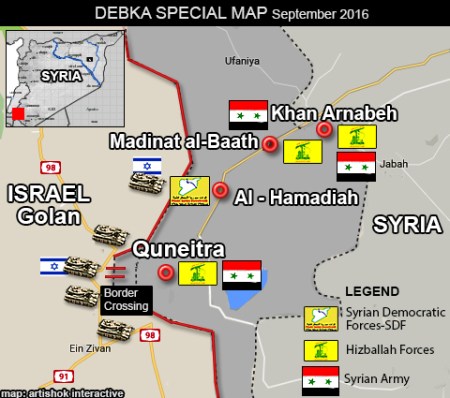
A large Hizballah force, backed by the Syrian army and pro-Iranian Shiite militias, is building up outside Quneitra, just 2km from Israel’s Golan border. The Lebanese Shiite fighters, under the command of Iranian Revolutionary Guards (IRGC) officers, are streaming into southern Syria, armed with tanks and artillery.

Monday night, Sept. 5, Iranian state-controlled media shed light on this movement, reporting that the combined force had “completed preparations necessary for an extensive operation in southern Syria,” adding, “Hizballah aims to put an end to the presence of armed men in the area close to the border.”

The nature of the “armed men” was not specified, but the goal of the new operation was clear: after evicting the assorted anti-Assad groups, including the Islamic State, holding territory “close to the border,” Hizballah and its backers planned to regroup on the Syrian-Israeli boundary.

This would position Iran and its Hizballah surrogate ready to realize their six-year old design, which is to open a second warfront against Israel.

Western and Mid East sources have toldl DEBKAfile that the triple army is in high spirits after last week’s successful operation in Aleppo. By snatching back parts of the city they lost in mid-August, the Syrian army and its allies managed to cut off the rebels’ supply lines from Turkey.

It was then that some Hizballah units were detached from the Aleppo arena and redirected to the Quneitra front in southern Syria to face the Israeli border.

israeliborder480

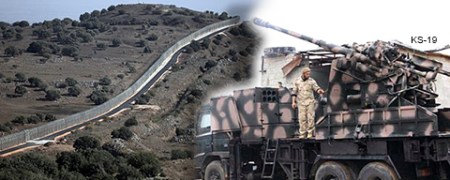
Those sources report that the incoming troops were sighted this week when they arrived at Madinat al-Baath and Khan Amabeh, the main Syrian army bases on the Syrian Golan. They came with tanks and heavy artillery. Seen for the first time in the Quentra sector were heavy, self-propelled KS-19 artillery batteries, which are Russian anti-air guns adapted to ground warfare. They have a range of 21km and a firing capacity of 15 shells per minute.

The newly-arrived Hizballah force appears to have set the capture of Syrian rebel-held al-Hamdiniyah 2km from the Israeli border, as its first objective.

DEBKAfile’s military sources note that the Iranian media attached photos of Israel’s security force opposite Quneitra to their reporting on the new move, thereby framing the target of the Syrian-Iranian-Backed Hizballah build-up.

This fast-approaching development poses two tough questions:

1. Will Israel lie down for the avowedly hostile Hizballah and Iran to occupy territory along its eastern border?Israel officials have repeatedly emphasized that these forces would not be allowed to take up positions on the Golan border, a message Russia most certainly passed on to Damascus.

If Hizballah and its allies go through with their planned offensive, Israel will have to consider serious military action to prevent them from reaching the border fence, i.e., an operation on a scale quite different from the small-shot IDF reprisals for rockets or shells straying across into the Golan from fighting on the other side.

2. Will the advancing Iranian-led force have Syrian air cover? If it does, the Israeli Air Force will also be involved in aerial combat over the Golan.

U.S. Navy Fires Warning Shots at Iranian Vessels

August 25, 2016

U.S. Navy Fires Warning Shots at Iranian Vessels, Washington Free Beacon via YouTube, August 25, 2016

John Kerry, The Islamic Republic’s New Lobbyist

June 2, 2016

John Kerry, The Islamic Republic’s New Lobbyist, Front Page MagazineAri Lieberman, June 2, 2016

(Please see also, Is Obama’s Iran Deal a ‘Dhimmi’ Contract? — DM)

john_kerry_senator_from_ma-2 (2)

Iran, the nation that has built a well-deserved reputation as the world’s premier state-sponsor of terrorism has a new lobbyist and he is none other than U.S. Secretary of State John Kerry. Since the Obama administration inked the Joint Comprehensive Plan of Action in January, Kerry has been busying himself with ensuring that European banks start doing business with the Iranians. Yes, you read that correctly. Not only has the United States and its European allies agreed to lift sanctions against the Islamic Republic, the administration is now encouraging the private banking sector to do the same. It appears however, that their intense lobbying efforts are being received with a healthy dose of skepticism.

HSBC’s chief legal officer, Stuart Levey confirmed that Kerry had requested that HSBC start opening its banking doors to the Iranians and transact business with them. Levey criticized Kerry’s misguided initiative noting that the U.S. still maintains other non-nuclear related sanctions against the Islamic Republic and that doing business with Iran runs the risk of running afoul of those sanctions. HSBC has had prior negative experience with the U.S. Treasury and Justice departments. In 2012, the bank was forced to fork over $1.9 billion to U.S. authorities to settle allegations involving money laundering for Mexican drug barons.

Levey also noted that the Iranian Revolutionary Guard Corps, which controls large swaths of the Iranian economy, has been slapped with sanctions by both the U.S. and Europe because of the central role it plays in illicit regional and international activities. Doing business with Iran will almost certainly result in facilitating IRGC operations. Adding to the uncertainty, Iran has over the years developed a penchant for hiding money, engaging in shady deals and money laundering thus making it difficult, if not impossible for banking institutions to engage the Iranians in legitimate business transactions without being complicit in their illegal dealings.

Kerry has assured the banks that they have nothing to fear if they perform their due diligence but banking representatives have expressed other legitimate concerns. Iran is one of the most corrupt nations on the planet and ranks poorly in the categories of transparency and ease of doing business. Banking institutions and large businesses are naturally reluctant to deal with such an opaque entity.

Practical matters and banking concerns aside, it is disturbing to witness the zeal in which Kerry is conducting his lobbying campaign on behalf of an enemy country whose national pastime involves chants of “Death to America” and “Down, Down U.S.A.” Even more disturbing is the fact that despite signing the JCPOA, Iran continues to act in defiance of United Nations Security Council resolution 2231 which calls on Iran to cease all research and testing activities relating to its ballistic missile program.

Since the conclusion of the Iran deal, the Islamic Republic has test-fired eight ballistic missiles. The Iranians boasted that some of their missiles were capable of reaching targets 1,200 miles away. Israel is only 1,000 miles away from Iran placing it well within the target radius. Emblazoned on the side of at least one test-fired missile was an ominous threat; “Israel must be wiped out from the face of the earth.”

The Iranians are continuously attempting to increase the range and accuracy of their ballistic missiles. Iran’s illicit ballistic missile program has only one aim, to deliver weapons of mass destruction (WMDs). That apocalyptic prospect does not seem to worry Kerry who seems more interested in propping up the Islamic Republic rather than ensuring that it lives up to its international obligations and stops behaving like a pariah state. Indeed, in an effort to prevent derailment of the JCPOA, the administration asked the Iranians not to publicize their launches. Iran’s illicit ballistic missile program doesn’t seem to bother the Obama administration so long as the Iranians keep their activities below the radar.

Iran’s nefarious undertakings extend far beyond its illicit ballistic missile program. The IRGC, the group that runs Iran in partnership with the ayatollahs, represents the life-blood of Hezbollah. Both Hezbollah and the IRGC are engaged in a full-fledged operation to destabilize the region. From Syria to Yemen, Iranian and Hezbollah operatives are fomenting chaos and bloodshed with the aim of establishing a Shiite arc extending from Iran through Syria and Lebanon as well as securing control of two of the region’s most important chokepoints, the Strait of Hormuz and the Bab-el-Mandeb Strait.

Hezbollah’s main source of funding comes from Iran, which trains, arms and pays the salaries of its operatives. Its other sources, though minor in comparison to Iranian assistance, include drug trafficking and extortion. Last week, Adam Szubin, the acting Treasury undersecretary for terrorism and financial intelligence, noted that Hezbollah was “in its worst financial shape in decades.” It’s hard to take that near-comical boast seriously in light of the $150 billion cash infusion the Obama administration injected into the anemic Iranian economy. It’s hard to imagine that Iran will spend any of that money on improving the quality of life of its citizens and promoting human rights. Iran will almost certainly channel a large portion of those funds to its proxy stooges in Syria, Lebanon, Iraq, Yemen and elsewhere.

Kerry’s lobbying efforts on behalf of Iran in connection with the banking industry will make Iran’s ability to transfer funds to these terrorist groups less difficult. The lengths to which the Obama administration will go to indulge the Iranians is beyond shocking, it’s frightening. But we should expect no more from an administration that expressed gratitude to the Islamic Republic after its naval pirates kidnapped and humiliated 10 American sailors when their craft encountered mechanical difficulties in the Arabian Gulf. Sadly, the Obama administration continues to lose the trust of its allies, while emboldening its enemies and has given new meaning to the term appeasement.

IRGC routed in Syria by new missile

May 16, 2016

IRGC routed in Syria by new missile, DEBKAfile, May 16, 2016

Khan_tuman_ambush_5.16

[N]either the Iranians nor Hizballah can win the war for Assad.

***************************

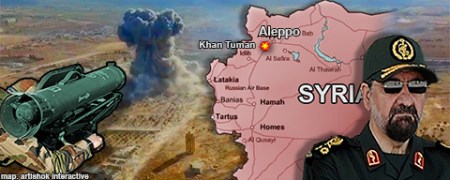
The battle on May 6 in the village of Khan Touman, located southwest of Aleppo near Route 5, the main highway leading to Damascus, will go down in the annals of the Syrian war as the biggest defeat suffered by the Iranian Revolutionary Guard Corps (IRGC) and Hizballah, as well as the battle that changed the face of the war.

DEBKAfile’s military and intelligence sources report that an Iranian force consisting of IRGC troops and Hizballah was ambushed by fighters from the Jaysh al Fath organization, part of the Nusra Front.

Until this battle took place, Iranian and Hizballah commanders in Syria did not know that the rebels had received a shipment of MILAN antitank missiles provided by Turkey and funded by Saudi Arabia.

The encounter with the advanced weapon system brought the IRGC and Hizballah to rout.

The Iranians admitted that 17 of their fighters fell in the battle, including 13 from the IRGC’s “Karbala” Division that is usually based in Iran, and 22 were wounded. Among the dead were two Iranian brigadier generals. At least ten IRGC troops were taken prisoner by the rebels. Five or seven Iranian troops were executed immediately, and an unknown number were taken from the area to an undisclosed location.

Hizballah claimed that none of its troops were killed or taken prisoner. However, that statement was actually an attempt to hide that at least 15 of its fighters were killed. According to intelligence sources that monitored the battle, Hizballah’s death toll was even higher.

The defeat was a major shock to the Iranian and Hizballah hierarchies In Tehran and Beirut, and officials vowed that revenge would be coming soon.

The immediate result of the shock was the appointment of Gen. Mohsen Rezaei, commander of the IRGC 26 years ago in the 1980s, who retired years ago and was a candidate in several presidential elections.

DEBKAfile’s sources report that Rezaei is one of the only IRGC commanders to have visited many times in the West, mainly to participate in international conferences, and has spoken freely with Western military and intelligence officers on the situation in Iran and the Middle East.

It is hard to believe that he will succeed in turning the clock back for Iran and Hizballah in Syria. Rezaei’s appointment indicates confusion   or panic in the Iranian hierarchy that does not know how to respond to the defeat.

KhanTuman480

In addition, it is still not clear whether Rezaei will replace Gen. Qassem Soleimanias commander of Iran’s forces in Syria, or be subordinate to him.

DEBKAfile’s military sources point out that bringing Rezaei to Syria does not resolve Iran and Hizballah’s main military problem, as the battle in Khan Touman showed. If the rebels continue to receive advanced weapons like antitank and antiaircraft missiles, they will become superior to the three military forces fighting for Syrian President Bashar Assad, namely Iran’s standing army and IRGC troops, the Syrian army and Hizballah.

In other words, neither the Iranians nor Hizballah can win the war for Assad.

Seven days after the battle, the commander of Hizballah’s forces in Syria, Mustafa Bader Al-din, was killed by a ground-to-ground missile strike near the Damascus international airport. Later claims by various sources that he was killed in battle at Khan Touman were actually attempts to conceal the two biggest military blows suffered by the Iranians and Hizballah in Syria

How Obama made Iran’s Latest “Destroy Israel” Missile Launches Possible

March 10, 2016

How Obama made Iran’s Latest “Destroy Israel” Missile Launches Possible, Front Page Magazine, Daniel Greenfield, March 10, 2016

Iran rocket takes off

Back in the Senate, Obama was a fierce opponent of classifying Iran’s IRGC, the core organizing point for Iran’s national and international terror network, as a terror group. He complained that such a move would be provocative. The worthless Iran nuke deal didn’t apply to Iran’s ballistic missile program. And the sanctions relief brought an economic windfall to the IRGC.

So this is the inevitable outcome, not just of Obama’s deal with Iran, but of his entire policy history on Iran even before he took office.

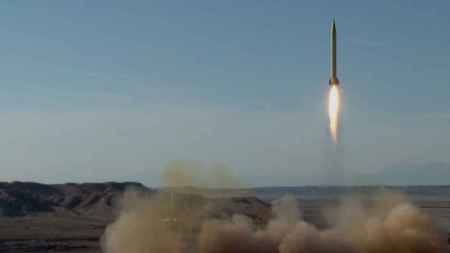
For the second day in a row, Iranian state television has broadcast propaganda videos that show the launch of several ballistic missiles with anti-Israel intent.

A video released Tuesday shows the inside of an underground tunnel used for launching the missiles. It features an Israeli flag painted on the ground which Islamic Revolutionary Guard Corps, or IRGC, members are meant to walk over on their way to launch.

Wednesday’s video shows another two missiles labeled with “Israel must be wiped off the Earth” in Hebrew. Persian-language media headlines included the Hebrew message in order to emphasize the IRGC’s anti-Israel intentions. The missiles were reportedly precision-guided Qadr missiles that put Israel within striking range.

Amir Ali Hajizadeh, commander of the IRGC aerospace division, said that the tests were meant to intimidate Israel.

“The reason we designed our missiles with a range of 2,000 km (1,200 miles) is to be able to hit our enemy the Zionist regime from a safe distance,” Hajizadeh said. “Israel is surrounded by Islamic countries and it will not last long in a war. It will collapse even before being hit by these missiles.”

Before this, the media ran a blitz about “moderates” winning in Iran. As with most terrorist organizations, the term “moderates” is completely meaningless.

Tehran’s show of force—it also tested missiles on Tuesday—are not the work of the usual “hardline” suspects. Iran tested ballistic missiles last fall in violation of a U.N. Security Council resolution, and in January Mr. Rouhani publicly ordered his defense minister to speed up missile testing and production… The tests appear to be timed to coincide with Vice President Joe Biden’s visit to Israel.

So there’s a clear message. It continues Iran’s pattern of slapping Obama across the face and seeing how far back he runs.

Part of the problem is that Secretary of StateJohn Kerry bowed to Iranian demands during the nuclear negotiations not to include ballistic missiles as part of the final deal, though missiles are an essential component of any nuclear program.

Instead, the U.S. pushed a weak resolution through the Security Council, which “called upon” Iran to wait eight years before building or fielding missiles “designed to be capable of delivering nuclear weapons.” Tehran insists that, since it has supposedly abandoned its nuclear program, the current tests cannot violate the resolution.

So either Iran is pursuing a ballistic missile program for no particular reason or it’s continuing its nuclear weapons program while deliberately mocking Obama. Two guesses which one it is.

Jewish voters who believed Obama have been shown up once again. But it isn’t likely that they will learn. The cults of personality that drive people to support candidates, even when their views sharply contradict their supposed deeply held values, are fiercely powerful. And no amount of evidence can dissuade Jewish voters caught up in a cult of personality from voting for anti-Israel candidates.

Obama has effectively allowed Iran’s nuclear weapons program to proceed under the cloak of plausible deniability in which he pretends to believe Iran’s lies so that it can advance toward war.

IRGC Ready for Rapid, Tough Response to Al Saud: Commander

October 3, 2015

IRGC Ready for Rapid, Tough Response to Al Saud: Commander, Tasnim News Agency, October 3, 2015

(Iranian rhetoric sounds increasingly like North Korea’s, but is all mere rhetoric? Does the IRGC commander actually contemplate military action against Saudi Arabia? — DM)

139209140106248561674533

Elsewhere in his comments, the IRGC commander pledged that his forces “will take revenge from the Al Saud for the terrible crime.”

***********************

TEHRAN (Tasnim) – Commander of the Islamic Revolution Guards Corps (IRGC) Major General Mohammad Ali Jafari said his forces are ready to show rapid and harsh reaction to make Saudi Arabia accountable after the Kingdom’s mismanagement of Hajj claimed the lives of hundreds of Iranian pilgrims.

Speaking on the sidelines of a military meeting on Saturday, the senior commander underlined that the IRGC enjoys “all possible capacities for Iran’s rapid and tough reaction” to Al Saud and for obliging the monarchy to accept responsibility for the terrible disaster.

On September 24, a crush of pilgrims in Mina, near Mecca, killed around 4,700 people, including 464 Iranians.

Major General Jafari said the IRGC is fully prepared to act under orders from Supreme Leader of the Islamic Revolution Ayatollah Seyed Ali Khamenei.

Back on Wednesday, Ayatollah Khamenei warned Riyadh that any disrespect for the Iranian Hajj pilgrims or its failure to repatriate the bodies of those killed in the Mina crush will draw Iran’s “severe and tough reaction”.

Following the straightforward warning, Saudis began to cooperate with the Iranian officials and have repatriated bodies of some of the victims.

Elsewhere in his comments, the IRGC commander pledged that his forces “will take revenge from the Al Saud for the terrible crime.”

If necessary, the general underscored, the IRGC is firmly and powerfully ready to take any action, in any region and at any time, to protect the dignity of Muslims, particularly to defend the honor of the Iranian people in the face of “oppressive and ignorant rulers of Al Saud.”

Ayatollah Khamenei had announced that Iran has had respect for fraternity in the Islamic world up to now, showing self-restraint and Islamic politeness.

“However,” the Leader had noted, “they (Saudis) should know that the slightest disrespect for tens of thousands of Iranian pilgrims in Mecca and Medina and failing in their duties to transfer the holy bodies (of pilgrims to Iran) will result in Iran’s severe and tough reaction.”

Iran Will Walk

June 5, 2015

Iran Will Walk, The Gatestone InstituteLawrence A. Franklin, June 5, 2015

(What if the article is otherwise correct but Obama agrees to a “deal” anyway? — DM)

  • The Islamic Revolutionary Guard Corps (IRGC), the Praetorian Guard of Iran’s regime, controls most of the economy, as well as the black-market, alternative economy. The IRGC therefore actually benefits from sanctions; it is private firms, such as those involved in international commerce, that suffer. Why would IRGC operatives want to see the playing field made more level by private investment, transparency and a competitive economy?
  • Sanctions never hurt the regime’s ruling class; lifting them only helped the regime solidify its power over its people.
  • The objective of these two demands [an immediate lifting of all sanctions and no, or severely limited, inspections] is either to have them accepted, or to render it untenable for the Obama administration to offer Congress any deal that could be accepted – thereby shifting blame for the collapse of the talks to the U.S.
  • The U.S should also be on guard against the mullahs’ belief that the Obama administration is weak both politically and its aversion to using force. The mullahs might find great pleasure in humiliating Obama, as they did President Jimmy Carter, by dragging out hostage crisis negotiations by running out the clock until his term was over. They clearly believe that the Obama administration, simply to say it got “a deal,” is ready to sign anything.

From Washington to Riyadh, not to mention Jerusalem, statesmen are gritting their teeth at the possibility of a U.S.-Iran nuclear deal that seems overly generous to the theocratic-terror state of the Islamic Republic.

1008Representatives of the P5+1 countries pose with Iranian Foreign Minister Javad Zarif after nuclear negotiations in Lausanne, Switzerland on April 2, 2015. (Image source: U.S. State Department)

Most intelligence analysts and journalists assume that because Iran’s leadership endorsed the negotiations and has been the beneficiary of several key concessions by the P5+1 (the five permanent members of the UN Security Council, plus Germany), that an agreement is imminent. Forecasters have been predicting what the likely consequences of such a deal would be: negative.

But what if the Iranians walk?

Sanctions never hurt the regime’s ruling class; lifting them only helped the regime to solidify its power over its people.

A nuclear deal combined with an improvement in the commercial and business relations with the West would be inimical to IRGC interests.

The Islamic Revolutionary Guard Corps (IRGC), the Praetorian Guard of the regime, controls most of the economy as well as the black-market, alternative economy. IRGC-controlled conglomerates operate outside the law and reap huge profits through their control of the black market. The IRGC therefore actually benefits by sanctions; it is the private firms, such as those involved in international commerce, that suffer.

Furthermore, IRCG naval vessels, and private ships under their control, have been engaging in sanctions-breaking deliveries of imports across Persian Gulf waters to Dubai. The IRGC then sells the products at a profit by filtering them through the many foundations they control in Iran.

The most recent example of IRGC’s skirting of sanctions involved the illegal acquisition of aircraft through front-organizations with offices in both Europe and the Arabian Peninsula. Mahan Air, an IRGC front, was able to purchase 15 used commercial aircraft for $300 million. Another front, al-Naser Air, was about to purchase two more aircraft, this time from a U.S. owner. Israeli intelligence, however, passed details of the planned sale to the U.S. government, and on May 21, the deal was scuttled by the Office of Export Enforcement of the Department of Commerce.

Why would IRGC operatives want to see the playing field made more level by private investment, transparency and a competitive economy?

Moreover, if a nuclear deal indicated improved relations with the United States, Iranian hardliners, whether clerical revolutionaries or intelligence operatives, might fear seeing their ideological legitimacy erode. The Iranian regime’s only remaining fig leaf of legitimacy is its anti-American animus, with its accompanying pledge to “protect” Iran’s interests against the U.S.-Israel-Sunni “alliance.”

Improved relations with Washington might raise false hopes among Iran’s citizens that the regime may ultimately improve its woeful record on human rights. There remains only a thin patina of clerical control over Iranian society; if the hoped-for social and political reforms were not implemented, the result could produce a destabilizing political environment, harmful to the interests of the regime.

Another fallacy embraced by many “inside-the-beltway” analysts is that, as the Supreme Leader Ayatollah Khamenei endorsed the negotiations, a legitimate deal is now probable.

The once all-powerful Office of the Supreme Leader no longer calls all the shots. The current Iranian regime resembles a military junta or a security state as much as a theocracy. While the reach of Ayatollah Khamenei, through his network of representatives, still penetrates all dimensions of Iranian society, he does not have the final decision on key security matters. The regime’s strategic assets, for instance, such as its ballistic missile programs, are firmly under the control of the IRGC. Decisions related to Iran’s expansionist presence in the region are made by IRGC Quds Force Commander Qasem Soleimani. The role of Khamenei’s representative to the IRGC resembles more that of a handler than of an action officer.

The principal task for the regime is to find a way to back out of the negotiations while avoiding the blame. Iran’s efforts at disengagement may already have been underway for the past few weeks; the pace of decoupling from the talks seems to be accelerating. Iran has been increasing its demands apparently in the hope that they will either be accepted, or else rejected like the “poison pills” they are — such as inspectors no longer being allowed on its military sites.[1]

Another way to make the talks no longer palatable for the Obama administration was to create a hostile incident with the United States in the Persian Gulf, as it has tried to do by aggressively tailing American warships. Iranian ships affiliated with the IRGC Navy also seized a commercial ship, the Maersk Tigris, in the Strait of Hormuz, and temporarily detained both vessel and crew. Then, on May 14, IRGC boats fired several shots across the bow of a Singapore flagged vessel, but it escaped unharmed.

By this type of reckless comportment, the IRGC Navy appears intent on producing a clash with American naval vessels in the Gulf waters. Western negotiators have only to recall the presidency of Mohammad Khatami, when the IRGC and Iran’s Ministry of Intelligence and Security operated independently after they felt that the reformers had gone too far, thus threatening hard-liner control of the regime. The IRGC may have decided that Rouhani along with his American-educated Foreign Minister Zarif have reached a similar tipping point. This independent IRGC initiative is being executed even though a deal would release Iranian monetary assets that would in turn boost the sagging economy.[2]

Iran’s combative posture in Gulf waters against international shipping is also a direct challenge to international maritime law, which guarantees freedom of navigation through the world’s shipping lanes such as the Strait of Hormuz. A key principle of U.S. foreign policy is to enforce this freedom of navigation, if it is challenged by any foreign power, as one also hopes the U.S. will do in the South China Sea.

Iranian military and political spokesmen have also raised the temperature of their anti-American and anti-Israeli rhetoric of late. Leading members of the regime, including its Supreme Leader, Ali Khamenei, keep repeating, “Death to America” as well as its theological “obligation” to destroy Israel. While the Obama administration has alleged that these threats are just for “internal consumption,” an old Persian saying goes: “They spit in his eye and he calls it rain.”

Mojtaba Zolnour, Ayatollah Khamenei’s Deputy Representative to the IRGC, stated that the Islamic Republic of Iran, “has the divine permission to destroy Israel.” This media assault on Israel was designed to widen the divergence between the Obama administration and the Israeli government regarding the efficacy of the framework of a nuclear agreement negotiated so far.

Additionally, various Iranian principals have drawn “lines in the sand” designed to cause the Americans to disengage from the talks, such as the assertion that Iran will never accept inspection of its declared military sites. Another is Tehran’s repeated statement that it will not accept a gradual lifting of sanctions. Iranian leaders have insisted on immediate and irreversible lifting of all sanctions immediately after a nuclear deal is signed. The objective of these two demands is either to have them accepted, or to render it untenable for the Obama administration to offer Congress any deal that could be accepted — thereby shifting the blame for the collapse of the talks to the U.S.

Regime hard-line representatives to the majlis [Iranian Parliament] have already been mobilizing members to denounce the talks as detrimental to Iran’s national sovereignty. Eighty majlismembers signed a petition on May 12, calling upon the regime to suspend the nuclear talks until Washington halts its rhetorical threats against Iran. Hardliners in the majlis and elsewhere within the regime’s bureaucracy will likely continue to lobby against any deal.

Western analysts should be looking for the Iranian regime’s hard-line media outlets to increase domestic commentary condemning alleged U.S. deception in the negotiations as a reason to abandon the talks.

The death knell for the nuclear negotiations could come from newspapers such as Kayhan, a pro-regime newspaper run by Hossein Shariatmadari, and often characterized as a Khamenei mouthpiece.

The regime’s Friday-prayer Imams in key Iranian cities might also start opposing the talks. The themes of their noonday khutbahs [sermons] are likely to appeal to Iranian people’s patriotism, and suggest that it is more important for Iran to endure continued sanctions rather than submit to intrusive monitoring that offends Iran’s sovereignty.

Finally, hardliners who oppose any possibility of Iran’s improved relations with the U.S. may launch personal attacks on Iran’s negotiators to the nuclear talks, and, in an effort to discredit them, challenge their loyalty to the Iranian revolution. Their point of attack on Foreign Minister Mohammad Javad Zarif’s loyalty might be his alleged obsequious behavior to Secretary of State John Kerry. Zarif, on account of his many years of residency and education in the United States, can be depicted as an Americanized Iranian.

The United States should also be on guard against the mullahs’ belief that the Obama administration is weak — both politically and in its reluctance to use force. The mullahs might find great pleasure in humiliating Obama as they did President Jimmy Carter, when they dragged out hostage crisis negotiations by running out the clock until his term was over. They clearly believe that the Obama administration, simply to say it got “a deal,” is ready to sign anything.


[1]Iran’s powerful Guard rejects inspection of military sites” by Ali Akhbar Dareini, Associated Press, 19 April 2015. Deputy Chief of the IRGC General Hossein Salami is quoted and several more statements by IRGC officials since have repeated the same prohibitive statements regarding Iran’s military sites.

[2]U.S. to Award Iran $11.9 Billion Through End of Nuke Talks,” Washington Free Beacon, 21 January 2015. In the first of many subsequent denunciations, Senator Mark Clark of Illinois attacked the Obama administration’s plan to free Iran’s frozen assets if nuclear deal is reached.