Posted tagged ‘Iraq’

The Case for Kurdish Statehood

July 11, 2016

The Case for Kurdish Statehood, Investigative Project on Terrorism, Noah Beck, July 11, 2016

1691

Why has the West been so supportive of Palestinian nationalism, yet so reluctant to support the Kurds, the largest nation in the world without a state?

The Kurds have been instrumental in fighting the Islamic State (ISIS); have generously accepted millions of refugees fleeing ISIS to the Kurdistan Regional Government (KRG); and embrace Western values such as gender equality, religious freedom, and human rights. They are also an ancient people with an ethnic and linguistic identity stretching back millennia and have faced decades of brutal oppression as a minority. Yet they cannot seem to get sufficient support from the West for their political aspirations.

The Palestinians, by contrast, claimed a distinct national identity relatively recently, are less than one-third fewer in number (in 2013, the global Palestinian population was estimated by the Palestinian Authority to reach 11.6 million), control land that is less than 1/15th the size of the KRG territory, and have not developed their civil society or economy with nearly as much success as the Kurds. Yet the United Nations, the European Union, the Arab League, and other international bodies have all but ignored Kurdish statehood dreams while regularly prioritizing Palestinian ambitions over countless other global crises.

Indeed, in 2014 the UK and Sweden joined much of the rest of the world in recognizing a Palestinian state. There has been no similar global support for a Kurdish homeland. Moreover, Kurdish statehood has been hobbled by U.S. reluctance to see the Iraqi state dismantled and by regional powers like Turkey, which worries that a Kurdish state will stir up separatist feelings among Turkish Kurds.

With an estimated worldwide population of about 35 million (including about 28 million in the KRG or adjacent areas), the Kurds are the fourth-largest ethnic group in the Middle East (after the Arabs, Persians, and Turks), and have faced decades of persecution as a minority in Turkey, Iran, and Iraq.

The 1988 “Anfal” attacks, which included the use of chemical weapons, destroyed about 2,000 villages and killed at least 50,000 Kurds, according to human rights groups (Kurds put the number at nearly 200,000). Several international bodies have recognized those atrocities as a genocide.

The Kurds in Turkey have also suffered oppression dating back to Ottoman times, when the Turkish army killed tens of thousands of Kurds in the Dersim and Zilan massacres. By the mid-1990s, more than 3,000 villages had been destroyed and 378,335 Kurdish villagers had been displaced and left homeless, according to Human Rights Watch.

The drive for Kurdish rights and separatism in Iran extends back to 1918, and – during its most violent chapter – cost the lives of over 30,000 Kurds, starting with the 1979 rebellion and the consequent KDPI insurgency.

A 2007 study notes that 300,000 Kurdish lives were lost just in the 1980s and 1990s. The same study states that 51,000 Jews and Arabs were killed in the Arab-Israeli conflict from 1950 until 2007 (and, because that total includes wars with Israel’s Arab neighbors, Palestinians are a small fraction of the Arab death toll).

Perhaps because of the Kurds’ own painful history, the KRG is exceptionally tolerant towards religious minorities and refugees. The KRG has embraced its tiny community of Jews, and in 2014, the Kurds rescued about 5,000 Yazidis trapped on Mount Sinjar after fleeing attempted genocide by ISIS. Last November, the Kurds recaptured the Sinjar area from ISIS, liberating hundreds more Yazidis from vicious oppression.

The KRG absorbed 1.8 million refugees as of December, representing a population increase of about 30 percent. The KRG reportedly needs $1.4 to 2.4 billion to stabilize the internally displaced people in its territory.

“Most of the refugees [in the KRG] are Arab Sunnis and Shia, Iranians, Christians, and others,” Nahro Zagros, Soran University vice president and adviser to the KRG’s Ministry of Higher Education, told the  IPT. “Yet there is no public backlash from the Kurds. And of course, we have been helping the Yazidi, who are fellow Kurds.”

The Kurdish commitment to gender equality is yet another reason that Kurdish statehood merits Western support. There is no gender discrimination in the Kurdish army: their women fight (and get beheaded) alongside the men. Last December, Kurdistan hosted the International Conference on Women and Human Rights.

The Kurds are also the only credible ground force fighting ISIS, as has been clear since the ISIS threat first emerged in 2014. ISIS “would have totally controlled the Baji oil field and all of Kirkuk had the [Kurdish] Peshmerga not defended it,” said Jay Garner, a retired Army three-star general and former Army assistant vice chief of staff who served during “Operation Provide Comfort” in northern Iraq. “Losing Kirkuk would have changed the entire war [against ISIS], because there are billions of dollars [per] week in oil flowing through there. The Iraqi army abandoned their equipment [while the Kurds defended Kirkuk, which has historically been theirs].”

Masrour Barzani, who heads the KRG’s intelligence services, says that Kurdish independence would empower the Kurds to purchase the type of weapons they need without the delays that currently hobble their military effort against ISIS. Under the present arrangement, Kurdish weapons procurement must go through Iraq’s Shia-led central government, which is also under heavy Iranian influence.

Besides bolstering the fight against ISIS, there are other geopolitical reasons for the West to support Kurdish statehood: promoting a stable partition of Syria, containing Iran, balancing extremist forces in the Middle East, and giving the West another reliable ally in a volatile region.

Now that Syria is no longer a viable state, it could partition into more sustainable governing blocs along traditional ethnic/sectarian lines with Sunni Arabs in the heartland, Alawites in the northwest, Druze in the south, and Kurds in the northeast. KRG leader Masrour Barzani recently argued that political divisions within Iraq have become so deep that the country must transform into “either confederation or full separation.”

Southeast Turkey and northwest Iran also have sizeable Kurdish areas that are contiguous with the KRG, but those states are far from disintegrating, and would aggressively resist any attempts to connect their Kurdish areas to the future Kurdish state. However, the Kurdish areas of former Syria should be joined to Iraqi Kurdistan as a way to strengthen the fledgling Kurdish state and thereby weaken ISIS.

In a recent article, Ernie Audino, the only U.S. Army general to have previously served a year as a combat adviser embedded inside a Kurdish Peshmerga brigade in Iraq, notes that Iran currently controls the Iraqi government and Iran-backed fighters will eventually try to control Kurdistan. He also makes the point that Western support for the Kurdish opposition groups active in Iran would force the Iranian regime to concentrate more on domestic concerns, effectively weakening Iran’s ability to pursue terrorism, expansionism, and other destabilizing activities abroad.

Because the Kurds are religiously diverse moderates who prioritize their ethno-linguistic identity over religion, a Kurdish state would help to balance out the radical Mideast forces in both the Shiite and Sunni camps. The Kurds are already very pro-American, thanks to their Western-leaning values, the U.S.-backed-no-fly zone, and the 2003 toppling of Saddam Husssein that made the KRG possible.

A Kurdish state would also have excellent relations with Israel, another moderate, non-Arab, pro-Western democracy in the region. Israeli Prime Minister Benjamin Netanyahu endorsed Kurdish independence in 2014, and Syrian Kurds – after recently declaring their autonomy – expressed an interest in developing relations with Israel.

By contrast, the Palestinian Authority slanders Israel at every opportunity: Abbas recently claimed in front of the EU parliament that Israel’s rabbis are trying to poison Palestinian drinking water. The Authority raises Palestinian children to hate and kill Jews with endless anti-Israel incitement coming from schools, media, and mosques. Palestinians have also shown little economic progress in the territories that they do control, particularly in Gaza, where Palestinians destroyed the greenhouses that donors bought for them in 2006 and instead, have focused their resources on attacking Israel with tunnels and rockets.

By almost any measure, a Kurdish state deserves far more support from the West. After absorbing millions of Syrian refugees while fighting ISIS on shrinking oil revenue, the KRG is battling a deepening financial crisis. Aggravating the situation, Iraq’s central government has refused – since April 2015 – to send the KRG its share of Iraqi oil revenue. The economic crisis has cost the KRG an estimated $10 billion since 2014.

U.S. Rep. Ed Royce, R-Calif., chairman of the House Foreign Affairs Committee, introduced House Resolution 1654 “to authorize the direct provision of defense articles, defense services, and related training to” the KRG. Fifteen months later, the bill is still stuck in Congress.

Helping the Kurds should be an even bigger priority for the European Union, which absorbs countless new refugees every day that ISIS is not defeated. If the EU were to fund the KRG’s refugee relief efforts and support their military operations against ISIS, far fewer refugees would end up on their shores.

 

Trump gets it right on Saddam

July 8, 2016

Trump gets it right on Saddam, CNNPeter Bergen, July 7, 2016

Occasionally Donald Trump says something that is politically incorrect but which also happens to be true.

On Tuesday at a campaign rally in North Carolina, Trump defended the former Iraqi dictator Saddam Hussein’s record on terrorism, saying, “He was a bad guy — really bad guy. But you know what? He did well? He killed terrorists. He did that so well. They didn’t read them the rights. They didn’t talk. They were terrorists. Over. Today, Iraq is Harvard for terrorism.”

Defending the brutal Iraqi dictator who killed hundreds of thousands of his own people isn’t exactly fashionable. But if you consider the 13 years of war that have wracked the country — in which a quarter of a million have died — and add that Saddam brutally repressed all dissent, including groups such as al Qaeda, and also add to this that ISIS is itself a fruit of the Iraq War, it’s a far more defensible position.

Trump didn’t offer any evidence for his assertions about Saddam’s brutal repression of terrorist groups or of Saddam “killing terrorists,” but his observations about the dictator are an implicit critique of the George W. Bush administration’s erroneous claims before the Iraq War that Saddam was allied to al Qaeda. Those claims were an essential element of the case that the administration made to go to war, since Saddam’s supposed connections to al Qaeda were the only purported evidence that he might give his putative weapons of destruction to terrorists.

The centerpiece of the Bush administration’s case for going to war in Iraq was Secretary of State Colin Powell’s presentation to the U.N. Security Council on February 5, 2003, six weeks before the invasion. Powell’s presentation was a bravura performance that seemed to establish beyond a doubt that Saddam was actively concealing an ongoing weapons of mass destruction program and was in league with al-Qaeda.

At one point the secretary of state dramatically brandished a small vial of a white powder of supposed anthrax, saying “about this amount…shut down the U.S. Senate in the fall of 2001.” As Powell gave his speech, sitting directly behind him was CIA director George Tenet, giving a visual imprimatur to what Powell was saying.

One section of Powell’s UN speech tried to make the case for an emerging alliance between Saddam and al-Qaeda:

“Iraq today harbors a deadly terrorist network headed by Abu Musab al-Zarqawi, an associate and collaborator of Osama bin Laden and his al-Qaeda lieutenants…When our coalition ousted the Taliban, the Zarqawi network helped establish another poison and explosive training center camp, and this camp is located in northeastern Iraq… He traveled to Baghdad in May of 2002 for medical treatment, staying in the capital of Iraq for two months while he recuperated to fight another day.”

Five weeks before the invasion of Iraq, CIA director Tenet testified before the Senate Armed Services Committee that Iraq had “provided training in poisons and gases to two al-Qaeda associates,” a point that Powell had also made in his U.N. presentation.

What the American public did not know about Tenet’s and Powell’s crucial claim about Iraq training al-Qaeda associates on poison gases was that it didn’t show a nexus between bin Laden, Saddam and some of the world’s nastiest weapons. Instead, it was the tainted fruit of an “extraordinary rendition” in which militants were transported by American officials to countries that routinely used torture, where they would supposedly finally divulge whatever secrets they had been keeping from their American interrogators.

In December 2001 Ibn al Shaykh al Libi, a Libyan militant who had run an al-Qaeda-affiliated training camp, was captured in Pakistan. Libi told his FBI interrogators that there were no ties between Saddam and al-Qaeda. Several days into his interrogation the CIA then rendered Libi to Egypt, where jailors were known for subjecting their prisoners to beatings, electric shocks and sexual assaults.

To improve his chances of better treatment once in Egypt, Libi told his interrogators that bin Laden had sent two operatives to Iraq to learn about biological and chemical weapons.

Because Libi’s story encapsulated the key arguments for the Iraq war, his tale was picked up by President Bush in a keynote speech in Cincinnati on October 7, 2002 in which he laid out his rationale for the coming conflict with Iraq, saying, “We’ve learned that Iraq has trained al-Qaeda members in bomb-making and poisons and deadly gases.”

But once he was back in American custody, on February 14, 2004, Libi recanted what he had falsely told his Egyptian interrogators. Libi told his U.S. interrogators that he had “fabricated” his tale of the Saddam-al-Qaeda-poison connection to the Egyptians following “physical abuse and threats of torture.”

Two and a half years into the Iraq war, in October 2005, the CIA released a report that finally disposed of the myth that Saddam and the leader of Al-Qaeda in Iraq, Zarqawi, had ever been in league, assessing that prior to the war, “the regime did not a have a relationship, harbor, or turn a blind eye towards Zarqawi.”

Since the fall of Baghdad no documents have been unearthed in Iraq proving the Saddam-al-Qaeda axis despite the fact that, like other totalitarian regimes, Saddam’s government kept meticulous records. The Defense Intelligence Agency had by 2006 translated 34 million pages of documents from Saddam’s Iraq and found there was nothing to substantiate a “partnership” between Saddam and al-Qaeda.

Two years later the Pentagon’s own internal think tank, the Institute for Defense Analyses (IDA), concluded after examining 600,000 Saddam-era documents and several thousand hours of his regime’s audio and video tapes that there was no “smoking gun (i.e. direct connection between Saddam’s Iraq and al-Qaeda.)”

83 killed as 2 blasts rip through Ramadan crowds at Baghdad shopping areas (PHOTOS, VIDEO)

July 3, 2016

83 killed as 2 blasts rip through Ramadan crowds at Baghdad shopping areas (PHOTOS, VIDEO)

Published time: 2 Jul, 2016 22:41 Edited time: 3 Jul, 2016 08:18

Source: 83 killed as 2 blasts rip through Ramadan crowds at Baghdad shopping areas (PHOTOS, VIDEO) — RT News

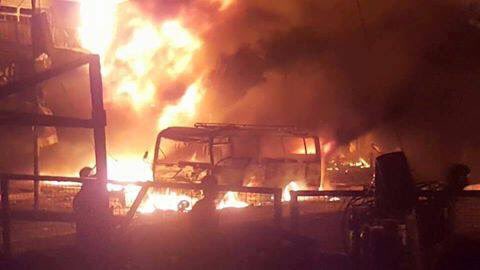
Two blasts have ripped through busy market areas in Baghdad, Iraq’s capital, killing around 80 people and injuring 160. The Islamic State militant group has claimed responsibility for one of the attacks.

Iraqi officials quoted by AP put the death toll from the first attack, in Karrada district, at 78 and said that more than 160 people had been injured.

Interior Ministry spokesman Saad Maan confirmed that the first blast had come from a car bomb.

Eyewitnesses said on Twitter that many shops burned down as a result of the explosions, and there are fears that the number of casualties could grow.

Karrada, an upper middle class district in the Iraqi capital, is mostly inhabited by Shia, but also has quite a large Christian minority. The area becomes very busy after sunset during the holy month of Ramadan.

https://twitter.com/Khaqani_M/status/749364331200978944/photo/1?ref_src=twsrc%5Etfw

Shortly after the explosion hit Karrada, eyewitnesses said that a second blast targeted the Shaab neighborhood, which is located in the northern part of the city.

AP said that at least five people were killed in that bombing and another 16 were injured. Meanwhile, Sky News Arabia said a suspected homemade explosive device was used to hit a market.

https://twitter.com/josiahalessoy/status/749381581597532161/photo/1?ref_src=twsrc%5Etfw

Islamic State (IS, formerly ISIS/ISIL) has in an online statement claimed responsibility for the attack in Karrada, Baghdad.

The tactics resemble Islamic State’s signature, as the terrorists frequently choose Shia-populated civilian areas in the capital as targets.

Iraqi security officials are attempting to restore order amid the state of panic that has ensued following the attacks, Altaf Ahmad, a local journalist, told RT.

“Major roads leading to the venue of the explosion [in Karrada] have been cut off. We know that the car bomb that went off in the area that is known to be crowded at this time. After sunset, after the break of fast during the holy month of Ramadan many people start to go out… We are expecting that the number could rise to 100 casualties,” Ahmad said.

Meanwhile, Abayomi Azikiwe, editor at Pan-African News Wire, said the pattern of bombing in Baghdad reminded him of what happened in Istanbul.

“There is some affirmation that Islamic State claimed responsibility for the attack. This follows a pattern for the last week with the attack in Istanbul. The sectarian divisions inside the country have exacerbated and there’s been a reaction on both sides,” Azikiwe told RT.

He also noted that Islamic State had suffered tremendous losses over the past several months and could be committing such attacks in order to avenge their retreat.

“They moved to other geopolitical regions, in Libya, for example, in western part of the country. A lot of these attacks are done for propaganda reasons,” he added. “[These attacks] definitely appear to be coordinated.”

Earlier this week, at least 12 people were killed and 32 injured in another suicide attack west of Baghdad, where an attacker wearing a suicide vest targeted a Sunni mosque in Abu Ghraib.

READ MORE: At least 12 killed in suicide attack on Abu Ghraib mosque

Islamic State was recently pushed out of Fallujah by Iraqi forces, but the terrorist group still controls Mosul, Iraq’s second largest city, which is located in northern Iraq.


The Untold Story Behind The “Mutiny At The State Department” Where Dozens Demand War With Syria

June 19, 2016

The Untold Story Behind The “Mutiny At The State Department” Where Dozens Demand War With Syria

by Tyler Durden – Jun 17, 2016 6:37 PM

Source: The Untold Story Behind The “Mutiny At The State Department” Where Dozens Demand War With Syria | Zero Hedge

Confirming once again that the entire US Middle-East campaign over the past 4 years has been one ongoing plan to destabilize and eliminate Syria’s president Bashar al-Assad from power – certainly including the involvement of ISIS which as we reported a year ago was “created” and facilitated by the Pentagon as a tool to overthrow Assad, an analysis which yesterday gained renewed prominence – overnight the WSJ reported that dozens of State Department officials this week protested against U.S. policy in Syria, signing an internal document that calls for “targeted military strikes against the Damascus government and urging regime change as the only way to defeat Islamic State.”

In other words, over 50 top “diplomats” are urging to eliminate Assad in order to “defeat ISIS”, the same ISIS which top US “diplomats” had unleashed previously in order to… eliminate Assad.

While one can understand the US state department’s relentless eagneress to create yet another failed state led by a US puppet ruler, one wonders if at least the boilerplate justification could not have used some more fine tuning.

Amusingly, the whole thing is wrapped in a narrative that the State Department is ready and willing to “mutiny” against Obama’s pacifism, because you see it was Obama who has been so successful in extricating and removing US troops from harm’s way in both the middle east and Afghanistan. Oh wait…

Here are the full details from he WSJ:

The “dissent channel cable” was signed by 51 State Department officers involved with advising on Syria policy in various capacities, according to an official familiar with the document. The Wall Street Journal reviewed a copy of the cable, which repeatedly calls for “targeted military strikes” against the Syrian government in light of the near-collapse of the ceasefire brokered earlier this year.


The views expressed by the U.S. officials in the cable amount to a scalding internal critique of a longstanding U.S. policy against taking sides in the Syrian war, a policy that has survived even though the regime of President Bashar al-Assad has been repeatedly accused of violating ceasefire agreements and Russian-backed forces have attacked U.S.-trained rebels.

More spin: why has Obama been so “against” unleash a full blown invasion on Syria? “Obama administration officials have expressed concern that attacking the Assad regime could lead to a direct conflict with Russia and Iran.”

Oh so that’s why the nuclear arms race is now officially back, just a few weeks after the US launched a ballistic missile shield over Europe, in the process shifting the entire post-cold war nuclear proliferation balance of power. Got it.

Meanwhile, the attempt to paint Obama as a liberal, peace loving dove continue:

“It’s embarrassing for the administration to have so many rank-and-file members break on Syria,” said a former State Department official who worked on Middle East policy. These officials said dissent on Syria policy has been almost a constant since civil war broke out there in 2011. But much of the debate was contained to the top levels of the Obama administration. The recent letter marked a move by the heart of the bureaucracy, which is largely apolitical, to break from the White House.

Oh, if only Obama would be more willing to install even more pro-US puppet regimes… like in Afghanistan, Libya, Egypt, Tunisia, Iraq, Ukraine and so on, and so on… Clearly all of these have turned out so well, that certainly things would be so much better in the middle east. Well, maybe not, but at least that damn Qatari pipeline would finally start flowing.

So why leak this now:

The internal cable may be an attempt to shape the foreign policy outlook of the next administration, the official familiar with the document said. President Barack Obama has balked at taking military action against Mr. Assad, while Democratic presidential hopeful Hillary Clinton has promised a more hawkish stance toward the Syrian leader. Republican candidate Donald Trump has said he would hit Islamic State hard but has also said he would be prepared to work with Russia in Syria.


The cable warns that the U.S. is losing prospective allies among Syria’s majority Sunni population in its fight against the Sunni extremist group Islamic State while the regime “continues to bomb and starve” them. Mr. Assad and his inner circle are Alawite, a small Shiite-linked Muslim sect and a minority in Syria. In Syria’s multisided war, the regime, Islamic State and an array of opposition rebel groups are all battling each other.

It gets better:  “Failure to stem Assad’s flagrant abuses will only bolster the ideological appeal of groups such as Daesh, even as they endure tactical setbacks on the battlefield,” the cable reads, using an Arabic acronym for Islamic State.

But wait, as the Pentagon itself admitted, the “Daesh” was carefully bred by the US government precisely for this reason: to overthrow Assad. Don’t believe us? Read the following line from the leaked document:

“… there is the possibility of establishing a declared or undeclared Salafist Principality in eastern Syria (Hasaka and Der Zor), and this is exactly what the supporting powers to the opposition want, in order to isolate the Syrian regime, which is considered the strategic depth of the Shia expansion (Iraq and Iran).”

Does not compute.

There is more: “The cable asserts Mr. Assad and Russia haven’t taken past cease-fires and “consequential negotiations” seriously and suggests adopting a more muscular military posture to secure a transitional government in Damascus.”

The Russian-led force is also pushing toward Raqqa from the south, making the march on the Islamic State stronghold a strategic and symbolic competition between the rival coalitions. Islamic State is also being rolled back in Iraq, where U.S.-allied government forces have retaken major cities and are advancing in Fallujah, the first city the extremists fully occupied back in 2014

Well, sure: with Russia’s backing of a sovereign nation, why should Assad fold to relentless US pressure. Actually that may well be the point: the US is humiliated that a small, feeble middle-eastern nation dares to defy it for years, just because it has the backing of the Kremlin. We don’t need to explain the ugly optics of this.

Perhaps the real reason why the cable has “emerged” now is because due to Russian intervention, ISIS will soon be history:

Although Islamic State is losing ground to multiple, U.S.-backed offensives in Syria, Iraq and Libya, Western diplomats say they worry the group has embedded itself so deeply in the population that it will be a major influence for years to come, eventually going underground as its quasi-army is defeated.

And finally, one last reason emerges: the US is merely pandering to Saudi demands, something it has clearly done very well ever since the Sep 11 attacks which covered up Saudi involvement:

The cable also echoes the growing impatience among U.S. Gulf allies with the lack of military intervention targeted at the Damascus government to force Mr. Assad to resign and make way for a transitional government. Peace talks between Syria’s government and opposition collapsed in April over Mr. Assad’s fate, with the regime insisting he should stay in power, while the negotiated cease-fire continued to disintegrate. Saudi Arabia and the United Arab Emirates have pressed the U.S. to provide more sophisticated weapons to rebels. But Washington has resisted.

In other words, if the US does fold and proceeds with military strikes, i.e. full blown invasion and war, on Assad, it will once again be Saudi Arabia that is running US foreign policy, and pushing the US nation into what may be a state of open war with Russia.

We can only hope the American people wake up and stop this travesty before Saudi Arabia’s favorite presidential candidate is elected president.

Hillary Clinton Had Secret Memo on Obama Admin ‘Support’ for ISIS

June 15, 2016

Hillary Clinton Received Secret Memo Stating Obama Admin ‘Support’ for ISIS

by Patrick Howley

14 Jun 2016

Source: Hillary Clinton Had Secret Memo on Obama Admin ‘Support’ for ISIS

WASHINGTON, DC — Hillary Clinton received a classified intelligence report stating that the Obama administration was actively supporting Al Qaeda in Iraq, the terrorist group that became the Islamic State.

The memo made clear that Al Qaeda in Iraq was speaking through Muhammad Al Adnani, who is now the senior spokesman for the Islamic State, also known as ISIS. Western and Gulf states were supporting the terrorist group to try to overthrow Syrian dictator Bashar al Assad, who was being propped up by the Russians, Iranians, and Chinese.

In August 2012, a “SECRET” classified memo was sent to various top Obama administration officials and agencies, including to the State Department and to Clinton’s office personally.

“The document is an IAR, an intelligence information report,” said Christopher J. Farrell, who serves on the board of directors of Judicial Watch, which obtained the document. “It is produced by somebody within the Defense intelligence agency (DIA). It is reporting from the field by an intelligence agent” who could be a U.S. government agent, a defense attaché, or a source.

“It’s a report from the field back to headquarters with some intelligence that somebody is willing to bet their career on,” Farrell said.

Farrell confirmed that the report was sent to Clinton’s office, based on the recipient marking “RUEHC/SECSTATE WASHINGTON DC.”

The report identifies Al Qaeda in Iraq (AQI) as being one of the principal elements of the Syrian opposition, which the West was choosing to “support.”

THE GENERAL SITUATION:

A. INTERNALLY, EVENTS ARE TAKING A CLEAR SECTARIAN DIRECTION.

B. THE SALAFIST, THE MUSLIM BROTHERHOOD, AND AQI ARE THE MAJOR FORCES DRIVING THE INSURGENCY IN SYRIA.

C. THE WEST, GULF COUNTRIES, AND TURKEY SUPPORT THE OPPOSITION; WHILE RUSSIA, CHINA, AND IRAN SUPPORT THE REGIME.

The intelligence report contains an extensive backgrounder on AQI and its methods and capabilities, noting that AQI was speaking through the spokesman of the Islamic State of Iraq Muhammad Al Adnani.

Al Adnani is now the chief spokesman for the current version of the Islamic State, also known as ISIS.

According to the report:

AL QAEDA – IRAQ (AQI):

A. AQI IS FAMILIAR WITH SYRIA. AQI TRAINED IN SYRIA AND THEN INFILTRATED INTO IRAQ.

B. AQI SUPPORTED THE SYRIAN OPPOSITION FROM THE BEGINNING, BOTH IDEOLOGICALLY AND THROUGH THE MEDIA. AQI DECLARED ITS OPPOSITION OF ASSAD’S GOVERNMENT BECAUSE IT CONSIDERED IT A SECTARIAN REGIME TARGETING SUNNIS.

C. AQI CONDUCTED A NUMBER OF OPERATIONS IN SEVERAL SYRIAN CITIES UNDER THE NAME OF JAISH AL NUSRA (VICTORIOUS ARMY), ONE OF ITS AFFILIATES.

D. AQI, THROUGH THE SPOKESMAN OF THE ISLAMIC STATE OF IRAQ (ISI) ABU MUHAMMAD AL ADNANI, DECLARED THE SYRIAN REGIME AS THE SPEARHEAD OF WHAT HE IS NAMING JIBHA AL RUWAFDH (FOREFRONT OF THE SHIITES) BECAUSE OF ITS (THE SYRIAN REGIME) DECLARATION OF WAR ON THE SUNNIS. ADDITIONALLY, HE IS CALLING ON THE SUNNIS IN IRAQ, ESPECIALLY THE TRIBES IN THE BORDER REGIONS (BETWEEN IRAQ AND SYRIA), TO WAGE WAR AGAINST THE SYRIAN REGIME, REGARDING SYRIA AS AN INFIDEL REGIME FOR ITS SUPPORT TO THE INFIDEL PARTY HEZBOLLAH, AND OTHER REGIMES HE CONSIDERS DISSENTERS LIKE IRAN AND IRAQ.

E. AQI CONSIDERS THE SUNNI ISSUE IN IRAQ TO BE FATEFULLY CONNECTED TO THE SUNNI ARABS AND MUSLIMS.

The intelligence report also predicts the rise of a broad “Islamic State” forming from segments of Al Adnani’s group:

THIS CREATES THE IDEAL ATMOSPHERE FOR AQI TO RETURN TO ITS OLD POCKETS IN MOSUL AND RAMADI, AND WILL PROVIDE A RENEWED MOMENTUM UNDER THE PRESUMPTION OF UNIFYING THE JIHAD AMONG SUNNI IRAQ AND SYRIA, AND THE REST OF THE SUNNIS IN THE ARAB WORLD AGAINST WHAT IT CONSIDERS ONE ENEMY, THE DISSENTERS. ISI COULD ALSO DECLARE AN ISLAMIC STATE THROUGH ITS UNION WITH OTHER TERRORIST ORGANIZATIONS IN IRAQ AND SYRIA, WHICH WILL CREATE GRAVE DANGER IN REGARDS TO UNIFYING IRAQ AND THE PROTECTION OF ITS TERRITORY.

“AQI HAD MAJOR POCKETS AND BASES ON BOTH SIDES OF THE BORDER TO FACILITATE THE FLOW OF MATERIEL AND RECRUITS,” the report states.

“THERE WAS A REGRESSION OF AQI IN THE WESTERN PROVINCES OF IRAQ DURING THE YEARS OF 2009 AND 2010; HOWEVER, AFTER THE RISE OF THE INSURGENCY IN SYRIA, THE RELIGIOUS AND TRIBAL POWERS IN THE REGIONS BEGAN TO SYMPATHIZE WITH THE SECTARIAN UPRISING. THIS (SYMPATHY) APPEARED IN FRIDAY PRAYER SERMONS, WHICH CALLED FOR VOLUNTEERS TO SUPPORT THE SUNNI’S IN SYRIA,” the report continues.

“IN PREVIOUS YEARS A MAJORITY OF AQI FIGHTERS ENTERED IRAQ PRIMARILY VIA THE SYRIAN BORDER.”

Al Adnani was named by the State Department as a “Specially Designated Global Terrorist” in 2014.

The Clinton campaign did not immediately return a request for comment on this report.

https://youtu.be/BOtIX_4D-sg


Ramadan: Islamic State Urges Lone Wolf Attacks in U.S., Europe

June 12, 2016

Ramadan Violence: Islamic State Urges Lone Wolf Attacks in U.S., Europe

by Edwin Mora

24 May 2016

Source: Ramadan: Islamic State Urges Lone Wolf Attacks in U.S., Europe

The Islamic State (ISIS/ISIL), in a new propaganda message, is urging supporters to carry out violent attacks against civilian and military targets within the United States and Europe during the Muslim holy month of Ramadan, which begins in early June.

“Ramadan, the month of conquest and jihad. Get prepared, be ready … to make it a month of calamity everywhere for the non-believers … especially for the fighters and supporters of the Caliphate in Europe and America,” said the audio message, urging ISIS sympathizers in the West to attack if they cannot travel to the group’s self-declared Caliphate in Syria and Iraq, Reuters reports.

“The smallest action you do in their heartland is better and more enduring to us than what you would if you were with us. If one of you hoped to reach the Islamic State, we wish we were in your place to punish the Crusaders day and night,” the message reportedly added.

ISIS encouraged its supporters to launch lone wolf attacks “to win the great award of martyrdom.”

The authenticity of the 31-minute message, purporting to come from Abu Muhammad al-Adnani, an ISIS spokesman, and posted on Twitter over the weekend by alleged supporters and opponents of the group alike, could not be verified, notes Reuters.


According to the International Business Times (IBTimes), the message was officially released on May 21 by al-Furqan, identified as the jihadist group’s media arm.

During the month of Ramadan, Islam adherents abstain from eating, drinking, smoking, having sex, and other physical needs each day, starting from before the break of dawn until sunset.

ISIS has imposed strict Islamic law, sharia, in the large swathes of Iraq and Syria it still controls, which includes a rigorous observance of Ramadan.

The day that marks the birth of the United States, the 4th of July, will fall on Ramadan. In addition, the holy month will take place during the summer, the season for multiple music festivals and concerts across the nation.

Various presidential campaign and election events will also take place during Ramadan 2016, as June will mark the end of the contentious primaries and caucuses held by the states and parties during which ISIS and Islam were debated.

“The period of Ramadan, which carries on into July, happens to coincide with a number of big events in Europe,” including the Euro Soccer Cup, Wimbledon, the Glastonbury Festival, and the London Gay Pride Parade, notes IBTimes.

Millions of Muslims in the United States and Europe are expected to participate in Ramadan.

In June 2015, as ISIS commemorated the first anniversary of the establishment of its Caliphate, the jihadist group made similar “Ramadan calls for violence,” also via an audio message by its spokesman al-Adnani.

ISIS was linked to various terrorist attacks after the message, encouraging followers to make Ramadan a time of “calamity for the infidels,” was released, noted Fox News.

Between then and now, the jihadist group has been associated with several deadly attacks in the United States and Europe.

FBI Director James Comey recently told reporters that the number of Americans who had attempted or successfully traveled to the Middle East to join ISIS had recently dropped dramatically from up to ten per month to an average of one.

In part, the decline has been attributed to ISIS’ recent focus on encouraging its supporters to carry out lone wolf attacks in their homeland.

Air Force Maj. Gen. Peter Gersten, a top deputy commander for the U.S.-led coalition against ISIS, said in late April that the number of overall foreign fighters making the trip to join ISIS in Iraq and Syria had dropped by 90 percent within the past year to 200 per month.

Other analysts have estimated that ISIS’ strength in Iraq and Syria is in decline, as the group loses fighters and territory.

Brett McGurk, President Barack Obama’s envoy to the U.S.-led coalition against ISIS, declared that the jihadist group’s “perverse caliphate is shrinking.”

Gen. Gersten told reporters that ISIS fighters are increasingly deserting, their morale is low, and they are facing difficulty getting paid.

“In every single way, their capability to wage war is broken,” the U.S. general declared.

Maj. Gen. Najm Abdullah al-Jubbouri, a top Iraqi commander, recently told Breitbart News that ISIS is “weaker than it was three months ago.”

Nevertheless, Comey told reporters that the FBI is dealing with “north of 1,000” terrorism-related cases, of which 80 percent are linked to ISIS.

Moreover, Gen. David Rodriguez, head of U.S. Africa Command, recently said that the number of ISIS jihadists in Libya who aspire to attack Europe or the United States has more than doubled to between 4,000 and 6,000 in the last 12 to 18 months.

Despite the reported decline, Director of National Intelligence James Clapper estimated in February that nearly 36,500 foreign fighters seeking to engage in jihad have already traveled from more than 100 countries to Iraq and Syria, including approximately 6,600 from Western nations.

At least 88 killed, dozens more injured in triple ISIS car bombings across Baghdad

May 11, 2016

At least 88 killed, dozens more injured in triple ISIS car bombings across Baghdad

Published time: 11 May, 2016 09:25 Edited time: 11 May, 2016 15:45

Source: At least 88 killed, dozens more injured in triple ISIS car bombings across Baghdad — RT News

People gather at the scene of a car bomb attack in Baghdad’s mainly Shi’ite district of Sadr City, Iraq, May 11, 2016. © Wissm al-Okili / Reuters

The Iraqi capital, Baghdad, has been rocked by three successive bombings that claimed the lives of dozens of civilians, according to police sources and media. Islamic State has claimed responsibility for the attacks.

The car bombing attack in the city’s district of Sadr City killed at least 63 people and injured dozens of others, AP reported citing Iraqi officials.

An SUV rigged with explosives was parked near a beauty salon in a busy market in the Sadr City neighborhood, Iraqi police reported.

The blast killed over 20 people on the spot while others succumbed to their wounds shortly after. At least 60 people were injured by the blast, and many remain in critical condition.

Shortly after the first blast, two more attacks were recorded in the city. One of them occurred in the Kadhimiya district of northern Baghdad – an area of the city considered a center of Shiite Islam. The attack claimed the lives of 18 people, Iraqi police and hospital officials told AP on condition of anonymity, adding that at least 34 people have been injured.

Five police officers are among the casualties in Kadhimiya district, officials added.

One more bomb that went off in the Sunni district of Jamiya killed seven and wounded at least 22 people.

The officials told Reuters that the death toll figures are likely to rise.

IS targeted Sadr City in February in a twin bombing attack, which claimed the lives of 70 people.

READ MORE: Over 70 feared killed, 100+ wounded in Baghdad blasts 

The group is ultra-conservative Sunni Muslim and considers Muslims adhering to other sects of Islam apostates and their enemies.

Sectarian violence remains one of the biggest security challenges in Iraq, since the US invasion of Iraq deposed its Sunni minority in power and installed a Shiite majority government.

Military officers and former officials of Saddam Hussein’s government, whose careers were ruined by the change of regime in Baghdad, were instrumental in Islamic State’s rise from a little-known Iraqi ally of Al-Qaeda to the most-publicized terrorist threat in the modern world.

Donald Trump: Hillary Clinton Is ‘Trigger Happy’ on Foreign Policy

May 8, 2016

Donald Trump: Hillary Clinton Is ‘Trigger Happy’ on Foreign Policy

by Michelle Moons

7 May 2016

Source: Donald Trump: Hillary Clinton Is ‘Trigger Happy’ on Foreign Policy – Breitbart

Speaking to an overflow crowd in Lynden, Washington, Donald Trump called Democratic presidential frontrunner Hillary Clinton “trigger happy” on foreign policy:

On foreign policy Hillary is trigger happy. She is, she’s trigger happy. She’s got a bad temperament. By the way, and her husband learned that a few times didn’t he? Bad timing. No it’s bad timing. But she’s trigger happy.

You look what she did, and look at this, I just wrote this down. Iraq, Libya she voted, Iraq, let’s go into Iraq. I voted against it except I was a civilian so nobody cared. From the beginning I said it’s gonna destabilize the Middle East and Iran will take over Iraq. Ya know for years they’ve been trying to get Iraq and Iraq has been trying to get Iran. We decimated that country’s military and now the country’s a mess. And what we did is we got ISIS, they got oil.

Trump moved on to slam former Secretary of State Hillary Clinton’s successor, John Kerry:

Now Iran, not only did they make a great deal with this total idiot Secretary of State that we have — he’s a clown. I’m telling ya he’s a clown. He never left the table once. He never left the table once. He’s making a deal with the Persians who are grea,t great negotiators over history.

“They’re killing him,” said Trump of Kerry’s negotiations with Iran. “Instead he goes on a bicycle and he breaks his leg so badly that for six months he’s out…”

Trump vowed, “I promise you I will never be in a bicycle race. I give you my word, okay? I promise.”

Trump returned to speaking of Clinton:

Her decisions in Iraq, Syria, Egypt, Libya have cost trillions of dollars, thousands of lives, and have totally unleashed ISIS. Now thousands of lives yes, for us, but probably millions of lives in all fairness, folks.

He referred to another side to the story. “You know, they bomb a city, I watch it, they bomb a city and you go and you see this city that’s obliterated, obliterated. We started this. Obama couldn’t get us out properly, but we started this; now it’s a total mess. If nothing would have happened we would have been far better off than we are now. We spent four trillion dollars.”

Trump called out reports from the Middle East that showed cities laid waste with statements that nobody was killed. “I’ll bet you thousands and thousands of people were killed every time you see that television set.”

“We’ve lost thousands of lives,  trillions of dollars, millions of people have been killed,” said Trump, postulating that if the United States had done nothing, “We would have been in much better shape.” Trump called Saddam Hussein a horrible, miserable, bad guy but said that he did something very well: “He killed terrorists.”

“Now Iraq is Harvard for terrorists,” said Trump.

Follow Michelle Moons on Twitter @MichelleDiana 

Iraq’s Al-Sadr reportedly summoned to Tehran

May 5, 2016

Iraq’s Al-Sadr reportedly summoned to Tehran, Middle East Monitor, May 5, 2016

muqtada-al-sadrMuqtada al-Sadr

Iraq’s Shia cleric Muqtada Al-Sadr was summoned to Tehran “for bashing and rebuke”, a Lebanon-based Shia cleric said.

Secretary General of the Arab Islamic Council in Lebanon Mohammad Ali Husseini said that the Iranian embassy in Baghdad informed Al-Sadr that he was summoned to Tehran because “his followers crossed red lines by criticizing and insulting clerical rule at a time when the Iranian regime is facing noticeable political and military decline among the countries of the region”.

Husseini told Okaz newspaper that Al-Sadr “will be subjected to much blame, censure and pressure” and he will be “redirected to serve Iran’s interest”.

Al-Sadr has mobilized followers to take to the streets to demand reforms and the replacement of ministers belonging to the parties dominating power in Baghdad.

Supporters of Al-Sadr stormed Baghdad’s Green Zone on Saturday before forcing their way into the parliament building where they broke windows and smashed furniture.

A Shiite Extremist Plunges Iraq into Crisis

May 2, 2016

A Shiite Extremist Plunges Iraq into Crisis, Clarion ProjectRyan Mauro, May 2, 2016

Iraq-Shiite-Militia-Iraqi-Army-IP_1Member of a Shiite militia group in Iraq (Photo: © Reuters)

A virulently anti-American Shiite Islamist cleric has thrown Iraq into a political crisis after his followers stormed the parliament, triggering a state of emergency. The cleric has hijacked popular resentment against corruption and sectarianism to attempt what the Institute for the Study of War deems “a de facto coup.”

Moqtada-al-Sadr-InsideMoqtada al-Sadr (Photo: Husain H. Rukun/WikiMedia Commons)

The leader of the protests is a radical Shiite cleric named Moqtada al-Sadr, best known for his militia’s targeting of U.S. troops and Iraqi security forces after the fall of Saddam Hussein. His forces’ sectarian violence brought the county to the brink of a civil war, which was only prevented by the U.S. “surge” in 2007. Sadr responded by moving to Iran and burnishing his religious credentials by studying at a seminary in Qom until 2011. It also helped him deny responsibility for the crimes committed by his militia and its splinter groups.

The institute warns that the instability damages the Iraqi government’s ability to operate as well as fight against the Islamic State (ISIS/ISIL). It could even lead to the collapse of the government. There is a high chance of violence between the “Sadrists” and Iraqi security forces and Iranian-linked militias allied with the Iraqi government.

For the U.S., it is dangerous that a ferociously anti-American cleric can shape events as Sadr has done. Sadr preaches that ISIS is a CIA front, seeking to equate the U.S. with the worst of Iraq’s enemies. When the U.S. campaign against ISIS began, Sadr said his forces would attack any U.S. military deployment.

“Like we gave you a taste of the heat of our fire and our might in the past, we will give a taste of the scourge of this decision, which will be the cause of your regrets and regression,” he said.

Last May, he threatened to “unfreeze the military wing … so that it may start targeting American interests in Iraq and outside of Iraq when possible.” He was infuriated over the U.S. budget allocating money for assisting Sunni tribes and Kurdish forces fighting ISIS.

Considering these comments, it may not be a coincidence that the Sadrists’ storming of parliament came right after Vice President Biden came to Iraq for the first time since 201l and praised the Iraqi-American cooperation in the fight against ISIS. Sadr may have wanted to remind the Iraqi political class, particularly the allies of Prime Minister Haider al-Abadi, that he’s the one who really determines their fate.

The irony is that many of those responding to Sadr’s calls are complaining about the sectarianism of which he was a shining example. There is video of demonstrators chanting, “Iran, get out, get out.”

Yet, it was but Sadr who brought Iran in. “Many of the protesters are chanting anti-Iranian slogans because we suspect that Iran is covertly promoting sectarianism in Iraq by supporting corrupt politicians,” said one demonstrator.

The situation in Iraq is a classic example of Islamists hijacking a popular grievance to gain power — or perhaps it is even a master act of manipulation at the hands of both Sadr and Iran. When he was in Iran addressing his lack of religious credibility, he underwent a political makeover.  He remained as anti-American as ever, but he adapted to the times by becoming a “born-again nationalist.” He began playing the role of political king-maker as parties competed for his constituency’s support and even began criticizing Shiite militias for being too cozy with Iran.

Perhaps Sadr’s relationship with the Iranian regime has genuinely weakened because of his political ambitions and because others have won Iran’s favor. Or perhaps it’s part of a skillful Iranian strategy to have proxies both allied to the Iraqi government and opposed to it.

For the U.S., it shouldn’t matter much. Sadr is a Shiite extremist whose hands are covered in American and Iraqi blood. He may be talking about corruption and sectarianism now, but the departure of the U.S. military is among his top demands. And he is far less hostile to Iran than he is to the West.