Posted tagged ‘Iranian threats’

Back in Tehran… Khamenei adds red lines, Rouhani tries to resign, Jaafari hints at “fait accompli” soon

July 12, 2015

Back in Tehran… Khamenei adds red lines, Rouhani tries to resign, Jaafari hints at “fait accompli” soon, DEBKAfile, July 12, 2015

(To the extent accurate, this is a fascinating account of what happened on June 29th, when Rouhani returned to Tehran for “consultation.” — DM)

ROUHANI-JAFARIPresident Rouhani vs Ali Jaafari

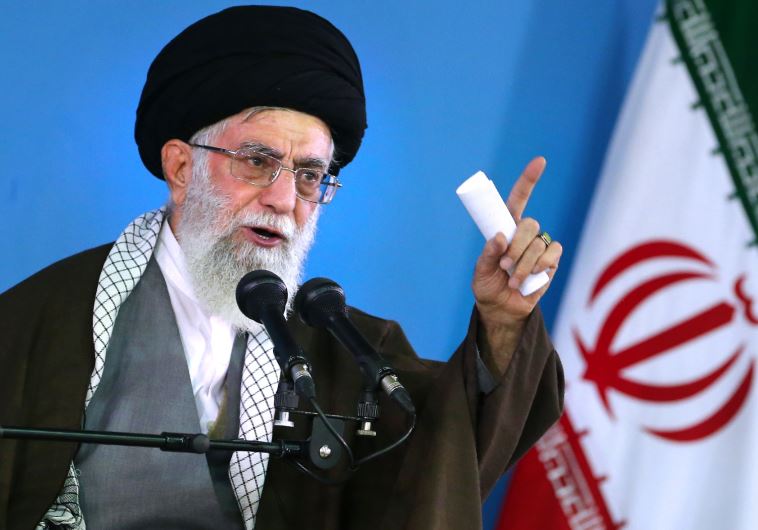
Iran’s top leaders remain ambivalent about whether or not to sign the comprehensive nuclear accord with the six world powers in Vienna as 22 agonizing months of negotiation falter on the brink. The all-powerful supreme leader Ayatollah Ali Khamenei’s latest comment was far from helpful. Saturday, July 11, he said publicly: “The US is the true embodiment of global arrogance,” the fight against which “could not be interrupted” even after the completion of the nuclear talks. He also boasted that the Islamic Republic had “managed to charm the world” by sticking with those negotiations.

DEBKAfile’s Iranian sources report that Khamenei’s remarks reflect the struggle between the pro- and anti-nuclear deal factions at the highest level of the Iranian leadership. For now, President Barack Obama’s odds of less than 50 percent on a final accord may well describe the balance in Tehran.

On June 29, President Hassan Rouhani was planning to resign when he asked the supreme leader to receive him first. He was upset by Foreign Minister Mohamed Zavad Zarif’s recall from Vienna to Tehran for a tough briefing. Zarif had warned the president that the talks were doomed unless Iran gave some slack. The foreign minister said that the six foreign ministers were preparing to leave Vienna in protest against Iran’s intransigence.

Rouhani when he met Khamenei warned him that Iran was about to miss the main diplomatic train to its main destination: the lifting of sanctions to save the economy from certain ruin.

The supreme ruler was unconvinced: He referred the president to the conditions for a deal he had laid down on June 23 and refused to budge: Sanctions must be removed upon the signing of the final accord; international atomic agency inspectors were banned at military facilities, along with interviews with nuclear scientists; and the powers must endorse Iran’s right to continue nuclear research and build advanced centrifuges for uranium enrichment.

Rouhani hotly stressed that those conditions had become a hindrance to the deal going through and insisted that sanctions relief was imperative for hauling the economy out of crisis.

Khamenei disputed him on that point too. He retorted that the revolutionary republic had survived the eight-year Iranian-Iraqi war (1979-187) with far fewer resources and assets than it commanded at present.

For back-up, the supreme ruler asked two hardliners to join his ding-dong with the president: Defense Minister Hosseim Dehqan and Revolutionary Guards chief Mohammad Ali Jaafari.

Both told Rouhani in the stiffest terms that Tehran must not on any account bow to international pressure for giving up its nuclear program or the development of ballistic missiles.

In a broad hint to President Rouhani to pipe down, Khamenei reminisced about his long-gone predecessor Hassan Bani-Sadr (president in 1980-1981) who was not only forced out of office but had to flee Iran, and the former prime minister and presidential candidate Mir Hossein Moussavi, who has lived under house arrest for six years since leading an opposition campaign.

The supreme leader then set out his thesis that the danger of Iran coming under attack had declined to zero, since Europe was in deep economic crisis (mainly because of Greece) and because the US president had never been less inclined to go to war than he is today.

Jaaafri added his two cents by commenting that after a succession of fiascos, Obama would go to any lengths to reach a nuclear deal with Iran as the crowning achievement of his presidency.  The Revolutionary Guards chief then added obliquely: “Before long we will present the West with a fait accompli.”

He refused to elaborate on this when questioned by the president, but it was taken as a reference to some nuclear event.

Rouhani left the meeting empty-handed, but his letter of resignation stayed in his pocket.

The next day, when Zarif landed in Vienna to take his seat once more at the negotiating table, he learned about a new directive Khamenei had sent the president, ordering him to expand ballistic missile development and add another five percent to its budget – another burden on Iran’s empty coffers.

Khamenei’s office made sure this directive reached the public domain. Zarif too was armed with another impediment to a deal. Khamenei instructed him to add a fresh condition: The annulment of the sanctions imposed against Iran’s missile development and arms purchases.

Know Comment: Sham smiles all around

July 10, 2015

Know Comment: Sham smiles all around, Jerusalem PostDavid M. Weinberg, July 9, 2015

Supreme Leader 1Iran’s supreme leader, Ayatollah Ali Khamenei. (photo credit:AFP PHOTO)

Decoupling allows Obama to smile and sell sham narratives about Iran, even as Khamenei rebuffs and humiliates America. With a smile, of course.

*************************

With four deadlines come and gone, it’s probably safe to predict that there won’t be a grand package deal with Tehran this weekend, or at all. Instead, we’ll get a lot of smiles, and agreement to continue talking indefinitely, “for as long as the talks are useful,” without closure on Iran’s nuclear weapons drive.

Meanwhile, Ayatollah Khamenei’s centrifuges will continue to spin, Iran’s adventurism in the region will proceed unchecked, and President Obama won’t have to reveal to Congress the deep concessions he has already deposited in Iran’s pocket.

American analyst Michael Ledeen puts it bluntly: Khamenei doesn’t want to sign anything. He has two fixed principles: No “new relationship” with the Great Satan, and relentless pursuit of the atomic bomb. But since Obama won’t take an Iranian “no” for a definitive answer, the default American position will be a new form of “creative appeasement.”

Iran will promise to try really, really hard to be nice, and Obama will pay for this. Iran will continue to get its monthly sanctions relief payoff, while Obama will get Iranian smiles.

This will allow Obama to give another interview in which he blathers about meeting Iran’s “legitimate needs and concerns” and about his hopes that Iran will become “a very successful regional power.” After all, Obama will yet tell us, Iran “is one of the oldest and grandest civilizations in the world” – or something obsequious like that.

Who could have imagined, just a few years ago, that the president of the United States of America would wish the mullahs well in their quest for regional hegemony? What strategic thinker would have believed that the US would actively enter a de facto alliance with Shi’ite Iran (in Iraq, Syria and the Gulf) at the expense of America’s traditional Sunni allies and its ally in Israel? The metamorphosis of Iran, in pro-Obama elite opinion circles, from terrorist state into US partner is a long-brewing triumph for a certain set of pro-Iranian apologists and anti-Israel lobbyists in Washington.

Writing in The Wall Street Journal this week, Sohrab Ahmari showed how the National Iranian American Council advanced the argument that Iran deserves strategic respect, and placed its people in the Obama National Security Council.

Indeed, US think tanks played a prominent role in paving the way toward a climb-down from Obama’s declared policy of halting Iran’s nuclear drive.

Start with Thomas R. Pickering, the former under secretary of state for political affairs (and US ambassador to Russia, the UN and Israel), who showed up in Israel in 2012 as the head of “The Iran Project.” Peddling a “nuanced and sophisticated” view of Iran, he counseled an “engagement” strategy.

In a lecture at the Begin-Sadat Center for Strategic Studies, Pickering asserted that the US must end its confrontation with Iran over nuclear weapons. Sanctions, he said, were only “contributing to an increase in repression and corruption within Iran,” and were “sowing the seeds of longterm alienation between the Iranian people and the US.” What about the use of military force to crush the Iranian nuclear bomb program? Well, military force should be the very last resort taken by the US, Pickering told us, “and probably not at all.”

Next was the Center for a New American Security.

Its 2013 report, primarily authored by former Obama administration deputy assistant secretary of defense for the Middle East Colin H. Kahl, outlined “a comprehensive framework to manage and mitigate the consequences of a nuclear- armed Iran.” In other words, stopping the Iranian nuclear effort was already a passé discussion.

Then came the Atlantic Council, which called for Washington to “lessen the chances for war through reinvigorated diplomacy that offers Iran a realistic and face-saving way out of the nuclear standoff.” That’s diplomatic-speak for a containment strategy.

Then the Rand Corporation concluded that a nuclear-armed Iran would not pose a fundamental threat to the US and its regional allies. “An Iran with nuclear weapons will still be a declining power,” it said. “Iran does not have territorial ambitions and does not seek to invade, conquer, or occupy other nations.”

In his last article before dying in 2013, the leading realist theorist Ken Waltz of Columbia University even argued that Iran should get the bomb. It would create “a more durable balance of military power in the Middle East,” he wrote in the establishment journal Foreign Affairs.

The writing has been on the wall. Both Washington’s retreat from confrontation with Iran and its shift toward appeasement of Iran were there for those willing to see.

Obama has even invented a fancy term – “decoupling” – to obscure the magnitude of American collapse before Iran.

“Decoupling” means that the nuclear talks can take place in a virtual vacuum, without reference to Iranian behavior in any other field or arena – as if Iran were Iceland. There is just no coupling or link between Iran the nuclear power and Iran the aggressive adversary.

Decoupling means that Obama can be forgiven for failing to constrain Iranian terrorism. It means that Iran can get nuclear sanctions relief without having to scale back its hegemonic and subversive muckraking around the region.

The suave concept allows Obama to “decouple” the ayatollahs’ unpleasant anti-Semitic and genocidal rhetorical outbursts from Iran’s “responsible” (sic) understandings with the West on nuclear matters. It also allows Obama to ignore Iran’s human rights abuses.

Decoupling allows Obama to smile and sell sham narratives about Iran, even as Khamenei rebuffs and humiliates America. With a smile, of course.

