Posted tagged ‘Iranian Revolutionary Guard’

How an Iranian general duped US command in Syria

June 10, 2017

How an Iranian general duped US command in Syria, DEBKAfile, June 10, 2017

Our sources cannot confirm for certain what part the Russians played in Iran’s underhand maneuver. Were they in on it, or were they hoodwinked by Soleimani like the Americans? However, the bottom line of this incident is that Syria’s neighbors, Israel and Jordan, face a new and distinctly troublesome downturn in the strategic situation on their borders. The next arena of potential US-Iranian confrontation is building up in Syria’s oil-rich Deir ez-Zor region.
********************************

The Iranian-made Syrian drone downed by US F-15 fighters in southeastern Syria on June 8 was presented by American media as a “pro-regime” drone. It was in fact, as DEBKAfile’s military sources can disclose, an Iranian Revolutionary Guards Shahed-129, which was fired as a part of a complicated ruse to dupe the US commanders while pro-Iranian forces surreptiously moved in on the Syrian-Iraqi border.

The Americans had drawn a line in the Syrian Desert sand 55 km outside the Al-Tanf border crossing embedded in the Syrian-Jordanian-Iraqi border triangle, which is under the control of US, Western and Jordanian special forces, together with a US-trained Syrian rebel group. The Secretary of Defense James Mattis and the US military command in Syria and Iraq were confident that by securing this perimeter, their forces would keep the pro-Iranian advance at bay and the border safe.

When the hostile drone flew past this line, it was shot down. But the Americans were reluctant to let the incident escalate into a major clash, while the Iranians were smarting under the Islamic State attack on Tehran’s national sites. And so they played it down. The next day, therefore, Pentagon spokesman Navy Capt. Jeff Davis reported that “hostilities between the coalition and the pro-regime forces had been avoided thanks to Russian influence. He went on to say: “The calm we see today is largely due to their efforts.”

What brought the Russians onstage?

The sequence of events which unfolded over 48 hours in the Syrian Desert is revealed her by our military sources. The drone was fired as a deliberate provocation to cross the 55-km line enclosing the US-controlled border garrison, on the orders of the Iran’s Gen. Qassem Soleimani. It was intended as a diversion from the real action.

The Russians entered the picture at this stage with an attempt to cool the situation and restore calm. While they were busy assuring the Americans that the Syrian army, Hizballah and its other pro-Iranian allies would refrain from crossing the 55-km line, Qassem moved a large-scale force up to a point just a few hundred meters from the American line.

By Friday, June 9, as Russian de-escalation diplomacy with the Americans wound down, Soleimani’s forces were found to have quietly reached new positions on both sides of the border.

1. He had moved those forces to a point 56km north of Al-Tanf to a rendezvous with pro-Iranian Shiite militias which had come from southern Iraq. That rendezvous breached the Iraqi-Syrian border and attained Iran’s strategic goal of opening up a land bridge between Iraq and Syria.

2. A second pro-Iranian force captured and cut off the roads from northern Syria to the southeastern town of Deir ez-Zor, thereby segregating US and pro-American forces in the north from the American garrison in the south.

Our sources cannot confirm for certain what part the Russians played in Iran’s underhand maneuver. Were they in on it, or were they hoodwinked by Soleimani like the Americans? However, the bottom line of this incident is that Syria’s neighbors, Israel and Jordan, face a new and distinctly troublesome downturn in the strategic situation on their borders. The next arena of potential US-Iranian confrontation is building up in Syria’s oil-rich Deir ez-Zor region.
One missile takes out ISIS command on Golan edge

June 8, 2017

One missile takes out ISIS command on Golan edge, DEBKAfile, June 8, 2017

DEBKAfile’s military sources report concerns in the US military commend lest Iranian general Qassem Soleimani decides to drop a division of Iranian special forces by helicopter, in order to catch the garrison off guard and capture the border crossing.

This concern increased after the Islamic State conducted a surprise bombing-cum-shooting attack on prize Iranian regime targets in Tehran on June 7. The Revolutionary Guards are bent on revenge and looking for an outstanding military success to cover this humiliation.

The US commanders are also under pressure on another score: the Iranians and Syrians have sent secret messages to Moscow complaining bitterly about the US air strike. They both made it clear that they command sufficient air and artillery fire power to overwhelm and wipe the ground with the American force in Syria.  Both Damascus and Tehran appear to be spoiling for a major showdown between their armies, using Hizballah and other Shiite proxies, and the US-led contingent.

***********************

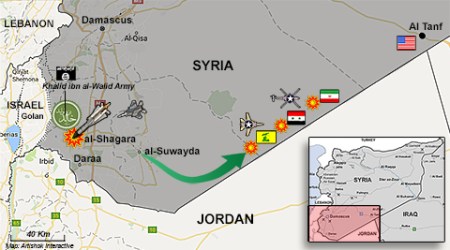
A single mystery missile, which could have been fired from the ground or the air early Wednesday morning, June 7, wiped out the entire top Islamic State command on the Syrian Golan, DEBKAfile’s military and intelligence sources report. All 16 officers of the 2,000-strong Khaled Ibn al Waleed army, the ISIS operations arm on the Syrian Golan, were present in the targeted building in the town of al-Shagara, located in the triangle where the Israeli, Syrian and Jordanian borders meet opposite the Sea of Galilee in northern Israel.

The unidentified missile blew up in the middle of a hall where the top command echelon were gathered to break their daily fast during the month of Ramadan and draw up plans. None of them survived.

Among them were the group’s chief, Gen. Abu Mohammed al-Makdessi; commander of operations, Gen. Abu Udai al-Homsi; and the group’s explosives expert who doubled as its religious leader, Abu Ali Shabat.

They operated under these aliases to conceal their real identities as former high Iraqi army officers who served in the late Saddam Hussein’s armed forces. They were also in senior command positions at the ISIS Syrian command center in Raqqa, when ISIS leader Abu Bakr al-Baghdadi decided to transfer them to the Syrian Golan to spearhead attacks that were planned to take place inside Israel and Jordan.

It took Al-Baghdad just a few hours to replace Magdessi as Khaled Ibn al-Waleed chief with a new man, Mohamed al-Refaei-Abu Hshem al-Askari.

On Tuesday, June 6, the day before the mysterious missile decapitated the Islamic State’s Golan force, US warplanes acted on another front to bomb a convoy of Iranian, Syrian and Hizballah forces that were traveling eastward from the southern town of Derra in the direction of the Al-Tanf border crossing.

Al Tanf, where US and Jordanian special forces units have established a garrison, is located in the triangle where the Syrian, Jordanian and Iraqi borders converge. The US planes destroyed several tanks, troop carriers, artillery pieces and antiaircraft systems, causing also fatalities and injuries, and so halted the convoy’s advance on the strategic crossing.

This was the second US air strike in three weeks on a similar target. The first was on May 18.

DEBKAfile’s military sources report concerns in the US military commend lest Iranian general Qassem Soleimani decides to drop a division of Iranian special forces by helicopter, in order to catch the garrison off guard and capture the border crossing.

This concern increased after the Islamic State conducted a surprise bombing-cum-shooting attack on prize Iranian regime targets in Tehran on June 7. The Revolutionary Guards are bent on revenge and looking for an outstanding military success to cover this humiliation.

The US commanders are also under pressure on another score: the Iranians and Syrians have sent secret messages to Moscow complaining bitterly about the US air strike. They both made it clear that they command sufficient air and artillery fire power to overwhelm and wipe the ground with the American force in Syria.  Both Damascus and Tehran appear to be spoiling for a major showdown between their armies, using Hizballah and other Shiite proxies, and the US-led contingent.

The Revolutionary Guard’s long shadow over Iran’s presidential election

May 19, 2017

The Revolutionary Guard’s long shadow over Iran’s presidential election, Long War Journal, May 19, 2017

Iranians head to the polls today to choose between “bad and worse” in yet another unfair-and-unfree presidential election. The primary challenger, Ebrahim Raisi – who is considered a frontrunner to succeed Khamenei – has received the support of the Islamic Revolutionary Guard Corps – the protector of Ayatollah Ruhollah Khomeini’s Islamic revolution who have long cast a dark shadow over the country.

The Guard’s political interference has at times been so blatant that incumbent President Hassan Rouhani on Wednesday publicly called on it not to meddle. During the final debate last week, Rouhani criticized the Guards for mobilizing support for Raisi.

Some in the West point to this as proof that Rouhani is the “lesser of two evils,” yet the political effect of this difference is minimal:  Rouhani cannot overcome the Guards and Supreme Leader Ali Khamenei on matters of foreign and security policy—to the extent that he even has differences with them. Rouhani’s feud with the corps goes back to the Iran-Iraq War and is less politically convulsive than can sometimes appear to outside observers.

Since 1989, the Revolutionary Guards’ intervention in Iranian politics and commerce has expanded dramatically under the watch of Supreme Leader Ali Khamenei, who has relied on the corps to consolidate his power.

While Rouhani has installed more intelligence ministry than Guard veterans in his cabinet, the corps overshadows all other security and military institutions.

Khamenei and the Guards exercise formal and informal means to check the elected branches. The corps’ decision-making hierarchy is dominated by a tightly-knit network of Iran-Iraq War (1980 – 1988) veterans loyal to the supreme leader. During the reform era (1997 – 2005), Khamenei and the Guards curtailed the agenda of former President Mohammad Khatami and purged reformists from the parliament.

As a partly conscript military organization, however, the 150,000-strong Guard Corps somewhat mirrors society, though more so the pro-regime base since Iranians who don’t support the regime often prefer to enlist in the regular army.  The Revolutionary Guards purged their ranks after the massive demonstrations following the 2009 presidential election: many officers and the rank-and-file refused to attack protesters.  Senior commanders have become more careful about vetting officers.  Khamenei-picked clerical commissars enforce ideological conformity and the corps’ Counter Intelligence Organization, souped up after 2009, roots out dissent.

Factionalism among the Guards, however, remains. For instance, former senior commander and parliamentarian, Mansour Haghighatpour, told a pro-reform newspaper the Guards foiled his re-election bid in the northwestern district of Ardebil last year because he voted for the 2015 nuclear accord.

The Revolutionary Guard has promoted Raisi before he announced his presidential run. Raisi, who owes his power to the supreme leader, has long been close to Iran’s security services. After Khamenei last year appointed Raisi the trustee of Iran’s wealthiest endowment, the Reza Holy Precinct, top Guard commanders visited him in Mashhad.  Media affiliated with the Revolutionary Guard then began promoting Raisi with the senior title of “Ayatollah.” That indicated Raisi was being groomed for the higher office of supreme leader, which nominally requires the senior clerical rank (the media has now returned to calling Raisi a mid-ranking cleric).

Even before the withdrawal of Mohammad-Baqer Qalibaf, the mayor of Tehran and a former senior Guard commander, from the presidential campaign, Raisi generated the most buzz in hardline circles. Prominent Guard theoretician Hassan Abbasi even claims there’s a “strange” aura to Raisi’s campaign rallies. Photos of guardsmen in Syria declaring their support for Raisi are now commonplace in Iranian social media.  The corps’ weekly Sobh-e Sadegh’s latest edition all but endorses Raisi without naming him directly.

Some in Khamenei’s close circle successfully pushed Raisi to run for president even though he’d initially refused. Cleric Ali Panahian, head of the pro-Khamenei think tank Ammar Base, told a militant seminary audience in Qom this month that Raisi consented to run with reservations.  Panahian viewed Raisi as “one of the sources of support” for the Islamic Republic regardless of “the result of the election.”  Panahian has dubbed Raisi the “seyyed of the dispossessed” (“seyyed” is an honorific given to descendants of the Prophet Muhammad).

The Guard Corps has also directly mobilized supporters for Raisi’s campaign rallies.  A reporter who attended Raisi’s Tehran campaign rally this week said the vast majority of attendees were members of the Basij – an all-volunteer, paramilitary organization that falls under the corps’ command. Eyewitnesses outside the campaign rally videotaped men on motorcycles and more than a dozen buses – hallmarks of the Guard’s mobilization.

The Revolutionary Guards might try to tip the results in Raisi’s favor. Polls by their media seem to predict a Raisi victory. The Guard Corps has attempted to station forces at Tehran’s ballot stations on election day, drawing a protest of a senior official from the interior ministry, which counts the votes and is under the control of Rouhani.  Iranian parliamentarian Mahmoud Sadeghi this week warned about the spread of undercover security agents in Tehran, some of whom vowed to crush the “green sedition,” referring to the 2009 Green Movement. The Guard may want to rig the results by a few points to avoid the mistake of declaring Mahmoud Ahmadinejad the winner by a large margin, which instantly led to widespread suspicions of fraud and massive demonstrations.

Rouhani’s supporters may well accuse the corps and the supreme leader of fraud if Raisi wins. Rouhani has been leading the polls and the public expects high turnout of the reformist base, which could only benefit Rouhani. The president has loudly and repeatedly warned against the Guards’ meddling in this election.

For his part, Khamenei has not overtly expressed his preference for president but has criticized Rouhani throughout the campaign, and has vowed to “slap in the face” anyone who “wishes to disrupt security.” He obviously fears a repetition of 2009 that rocked the regime to its core.

Whatever the result of the election, the Guard Corps will remain the most powerful network in the country.   A Raisi presidency would be beholden.  A Rouhani victory, however, cannot roll back the Guards’ influence.  The Islamic Republic’s history leaves no doubt that republican institutions are incapable of overcoming the unelected powers of the supreme leader and his praetorians, who perceive reform as an existential threat.  The prospect for gradual, peaceful reform within the Islamic Republic is bleak.

Iran Using U.S. Cash to Fund Unprecedented, Massive Military Buildup

May 3, 2017

Iran Using U.S. Cash to Fund Unprecedented, Massive Military Buildup, Washington Free Beacon, , May 3, 2017

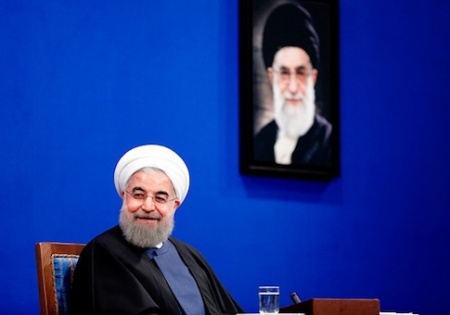
Iranian President Hassan Rouhani gives a press conference in the capital Tehran on April 10, 2017. Photo credit should read ATTA KENARE/AFP/Getty Images)

Iran is using the billions in cash resources provided under the landmark nuclear deal to engage in an unprecedented military buildup meant to transform the Islamic Republic’s fighting force into an “offensive” juggernaut, according to a largely unreported announcement by Iranian military leaders that has sparked concern among U.S. national security insiders and sources on Capitol Hill.

Iranian officials announced late last month that Iran’s defense budget had increased by 145 percent under President Hassan Rouhani and that the military is moving forward with a massive restructuring effort aimed at making it “a forward moving force,” according to regional reports.

Iranian leaders have stated since the Iran deal was enacted that they are using the massive amounts of cash released under the agreement to fund the purchase of new military equipment and other armaments. Iran also has pursued multi-million dollar arms deals with Russia since economic sanctions were nixed as part of the deal.

Leading members of Congress and U.S. officials working on the Iran portfolio suspect that at least a portion of the Obama administration’s $1.7 billion cash payment to Iran  has been used to fund and support terrorists in the Middle East.

The latest disclosure about Iran’s military buildup is further fueling concerns that U.S. cash assets returned to the country—which were released with no strings attached by the Obama administration—are helping Iran pursue a more aggressive military stance against U.S. forces in the region.

“President Obama flat-out caved in to Iran when he handed them the disastrous nuclear deal and $1.7 billion in cash payments that could assist Iran’s military,” Rep. Sean Duffy (R., Wis.), an opponent of the nuclear deal, told the Washington Free Beacon. “So it’s no surprise that the world’s lead sponsor of terrorism would feel emboldened to become more aggressive in the region and flex its military muscle.”

Iranian Brigadier General Kiumars Heidari announced the military buildup during Iran’s annual Army Day. While the announcement did not grab many headlines in the Western media, national security insiders have been discussing the announcement for weeks, according to conversations with multiple sources.

Iran’s goal is to turn its army into an “offensive” force, a major shift from its historic role as a support agent for the Iranian Revolutionary Guards Corps, or IRGC, Iran’s extremely well funded primary fighting force.

Iran hopes to revamp its army from top to bottom, including improving logistical capabilities, weaponry, and other armaments.

Mahan Abedin, an Iran analyst writing in Middle East Eye, described the announcement as a major shift in Iranian military policy that would allow the Islamic Republic to intervene in the Persian Gulf region, where the U.S. military has a significant presence.

“This is a major policy announcement with far-reaching consequences for foreign policy and internal defense-related power dynamics,” Abedin wrote. “If implemented properly, Heidari’s proposed modernization policy would not only radically alter Iranian defense doctrine, but just as importantly, it would also reverse the army’s subservient relationship to the Islamic Revolutionary Guard Corps (IRGC).”

Michael Rubin, a former Pentagon adviser and expert on rogue regimes, told the Free Beacon that it should come as no surprise that Iran is diverting the cash it received under the nuclear deal to its military industry.

The disclosure comes as “no surprise to anyone who studied Iran” and should have been anticipated by the Obama administration, which largely sought to downplay the importance of giving Iran billions in cash resources, Rubin said.

“First, there’s history: Between 1998 and 2005, European Union trade with Iran more than doubled and the price of oil quintupled,” Rubin explained. “Iran took that hard currency windfall and invested the bulk of it in its nuclear and missile programs. The person coordinating Iran’s strategy? Hassan Rouhani who was at the time secretary of Iran’s Supreme National Security Council.”

“Obama and Kerry might as well have wired the money directly into the accounts of those seeking to enhance Iran’s military, kill Sunnis, or sponsor terrorism,” Rubin said.

One senior congressional source tracking the matter expressed concern about the safety of U.S. forces in the region, which already are routinely harassed by Iranian military personnel.

“This is certainly grounds for concern,” the source said. “An Iranian military buildup coupled with an offensive posture is a threat to the United States and our allies. This also serves as an important reminder of why the Obama administration’s cash infusion to Iran was so dangerous.”

The cash windfall provided by the United States and European countries is “fungible and hence can be used for everything from sponsoring terror proxies to developing ballistic missiles,” the source warned. “Congress will continue to take action to counter Iranian terrorism and ensure this regime never acquires a nuclear weapon.”

Iran’s military announcement has already sparked a renewed push on Capitol Hill to reimpose economic sanctions on Iran.

“The Iranians know that the party will end this fall, when Congress will pass bipartisan legislation that begins to roll back Iran’s military growth,” one senior congressional adviser working on the sanctions effort told the Free Beacon.

“The Obama administration avoided any serious action for years, and so Iran kept growing its arsenal and using it against our allies, against Syrian civilians, and increasingly against our military,” said the source. “Now they’re rushing to accomplish as much as they can before Congress and the Trump administration get around to reversing Obama’s policies.”

Boeing Reps Meet With Iranian Terror Leader Who Threatened to ‘Destroy’ U.S. Forces

May 2, 2017

Boeing Reps Meet With Iranian Terror Leader Who Threatened to ‘Destroy’ U.S. Forces, Washington Free Beacon, May 1, 2017

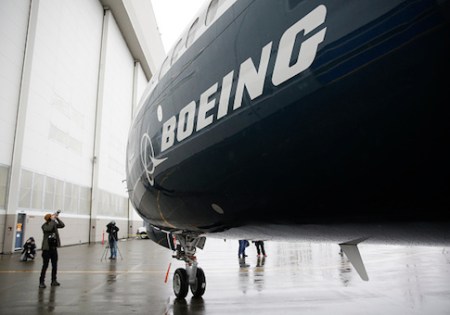
The first Boeing 737 MAX 9 airplane is pictured during its rollout for media at the Boeing factory in Renton, Washington on March 7, 2017. /Photo credit should read JASON REDMOND/AFP/Getty Images)

Boeing’s efforts to ink multi-billion dollar deals with Iran, the world’s foremost state sponsor of terror, has prompted outrage on Capitol Hill and currently is being reviewed by the Trump administration, which will have the final say on whether Boeing is granted licenses to sell new planes to Iran.

**********************************

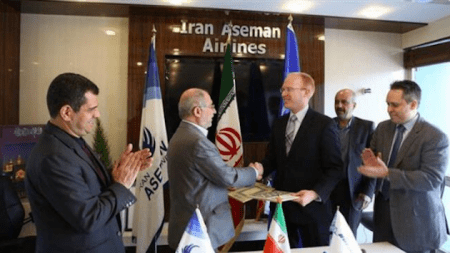
Leaders from Boeing reportedly traveled to Tehran recently to meet and sign a deal with a top former Iranian Revolutionary Guards Corps (IRGC) member who threatened to blow up U.S. forces in the Persian Gulf region, raising new questions about the U.S. aerospace company’s continued efforts to ink multi-billion dollar deals with the Iranian regime.

Representatives from Boeing traveled to Iran last month to meet with Hossein Alaei, CEO of Aseman Airlines, which is owned and controlled by the state. Boeing is moving forward with a $3 billion dollar deal to sell new planes to Aseman despite fierce opposition on Capitol Hill and direct evidence Iran has used commercial aircraft to ferry weapons and fighters across the region.

A photograph from the meeting shows a Boeing representative shaking hands with Alaei, who has been identified by Congress as a “prominent and longtime member of Iran’s Islamic Revolutionary Guard Corps,” which is responsible for killing and wounding scores of U.S. troops. The Boeing representative was not named in reports from the Iranian-controlled press or in information provided by U.S. foreign policy insiders.

Alaei, who was a senior figure in the IRGC before being installed as CEO of Aseman Airlines, served as commander of the IRGC Navy until 1990. Alaei oversaw the harassment of U.S. forces in the Persian Gulf and efforts by the IRGC Navy to plant mines in international waters.

Alaei was quoted during this time as threatening to “destroy” U.S. Navy assets in the region.

“We have drawn up plans whereby we will utilize all our military capability to destroy the U.S. fleet and solve the Persian Gulf issue once and forever,” Alaei was quoted as saying in 1987. “The Americans are here to fight us.”

Photo via @mdubowitz Twitter

Boeing’s efforts to ink multi-billion dollar deals with Iran, the world’s foremost state sponsor of terror, has prompted outrage on Capitol Hill and currently is being reviewed by the Trump administration, which will have the final say on whether Boeing is granted licenses to sell new planes to Iran.

Boeing’s deals with Iran are reported to be worth more than $16 billion.

The aerospace company has lobbied Congress aggressively to back the deal and was a key supporter of the Obama administration’s efforts to forge the landmark nuclear deal with Iran, which provided Tehran with billions in economic relief and cash windfalls.

“According to the U.S. Department of Commerce, an aerospace sale of this magnitude creates or sustains approximately 18,000 jobs in the United States,” Boeing said in a statement carried in Iran’s state-controlled media. “Boeing continues to follow the lead of the U.S. government with regards to working with Iran’s airlines, and any and all contracts with Iran’s airlines are contingent upon U.S. government approval.”

Senior sources on Capitol Hill who are working to stop the deal told the Washington Free Beacon that Boeing’s reported meeting with Alaei crosses the line. Representatives of major U.S. corporations should not be posing for pictures with senior IRGC members who have explicitly committed to killing U.S. soldiers, these sources said.

“If Boeing is trying to convince us they are doing their due diligence, they’re not doing a very good job,” said one senior congressional source working on the matter. “These photos of Boeing executives smiling and glad-handing with a prominent member of the Islamic Revolutionary Guard Corps are truly sickening. No self-respecting American should shake Hossein Alaei’s hands. They have American blood on them.”

Sen. Marco Rubio (R., Fla.) and Rep. Peter Roskam (R., Ill.) recently petitioned President Donald Trump to shut down these sales, citing Alaei’s role in the IRGC and Iran’s use of commercial planes to facilitate terrorism.

“Iran, the world’s leading state sponsor of terrorism, has systematically used commercial aircraft for illicit military purposes, including to transport troops, weapons, and cash to rogue regimes and terrorist groups around the world,” the lawmakers wrote. “The possibility that U.S.-manufactured aircraft could be used as tools of terror is absolutely unacceptable and should not be condoned by the U.S. government.”

Iran: Several factors Cause Closure of Factories and Economic Crisis

April 28, 2017

Iran: Several factors Cause Closure of Factories and Economic Crisis, Iran News Update, April 27, 2017

Iran’s economy was collapsing and the JCPOA saved it. President Rouhani claims this as an achievement of his tenure.  Still, evaluations and analyses seem to show that industry and industrial corporations are in crisis within Iran.

Nasim, a news website in Iran, writes, “The closure of more than 30 famous brands and old established factories, such as Arj, Darougar, Azmayesh, Pars Electric, Isfahan polyacryle, IRANA tile, Tabriz Machine manufacturing, Iztech, Isaac bicycles, Varamin Sugar Factory, Swan Oil Factory, Ray Textiles and Iran wood, are only portion of the important country’s production companies that have pulled down their shutters during Rouhani’s presidency.

Nasim continues, “Rouhani is the one who had promised flourishing of the Iranian economy in 100 days. Not only has he not improved people’s living standards these past 4 years, but according to most economy activists and experts, the economy has reached an unprecedented recession in its years after the revolution. One of the results of his economic activities was an economic downturn and the closure of famous brands whose names are associated with the lives of all Iranians. Unofficial statistics indicate that closure of these brands have led about one million people being unemployed in past four years.”

Marketing and / or management weaknesses or quality issues  cause businesses to lose their market share, close or become bankrupt, to be replaced by new brands, usually if they don’t have a company like Toronto SEO and seelutions seo company helping them with their website this will happen. However, the situation in Iran is concerning because of the number of closures and the history of the brands, all of them  famous for quality and profitability. The closures were not due to better products being created in Iran, but rather that mass legal and illegal imports have replaced domestic production and caused the closure of factories.

Manufacturing centers competing in other countries are typically replaced when a cheaper, more modern or more appealing product takes over the market and puts their competition out of business. If the business corrects its course, then it once again returns to market. If you need Financial help with your business an ABL credit facilityx can help you grow your income.

“Under the Iranian regime, when factories are shut down, it is forever and their workers are, without any support, placed out of work and their lives become endangered,” according to an article published by the National Council of Resistance of Iran (NCRI), who also notes that “bankruptcy of this large number of industries and factories logically cannot be entirely the product of a period of 4 years. The destruction of so many industries is the result of a total economic policy of the country. It has nothing to do with the governing of this faction or that faction. Statistics, for example, indicate during Ahmadinejad’s presidency, 50-70% of the factories were shut down. The difference between Rouhani and others lay in the fact that he claims to have a key for solving these economic problems and claimed to have achieved economic growth and lowered inflation. Meanwhile, closures, bankruptcies, unemployment and people’s empty tables are there. Deceitfully, Rouhani claims that the economy has improved.”

Several causes may be cited for the closure of factories, in particular the oldest ones, but the NCRI cites  the following important factors:

• Transfer of factories to “so called” private sectors, but they are fundamentally not private sector. Instead, they are entities, such as Iranian Revolutionary Guards, which do nothing other than the plundering of properties and factories;

• Existence of State jobber gangs which import foreign goods with lower custom tariffs and putting domestic manufactured goods out of the market, the existence of vast and established smuggling, a lack of cash for the industries not affiliated with the government and lack of government support for domestic production, sabotage and purposely withholding needed raw materials at customs;

• Lack of factories’ raw materials, poverty and the weak public’s purchasing power resulted in the accumulation of goods in storage;

• Obtaining heavy taxes from factories and manufacturing shops and continued municipalities’ extortions and governmental organs of producers.

The economic problems in this regime aren’t ‘purely economic’. They are political, with roots that go back to the governing structures, like Rouhani’s, known for its prodigious salaries and a president who doubled the budget of IRGC.

The problem will intensify as long as this structure and governance exist, say the NCRI, adding that the future will see more factory closures, and perhaps, complete economic collapse in Iran.th

Germany: Iran Plotting Terror on Jewish and Israeli Targets

April 25, 2017

Germany: Iran Plotting Terror on Jewish and Israeli Targets, Investigative Project on Terrorism, April 24, 2017

Last month, Bahrain security authorities arrested members of an Iranian-sponsored terrorist cell, accusing them of planning to assassinate senior government officials. The IRGC reportedly provided military training to several cell members.

************************

Iran is responsible for a significant amount of espionage activity in Germany over the past decade, and is responsible for planning terrorist attacks on Israeli and Jewish targets, the Jerusalem Post reports.

In a letter sent to a Left Party deputy from German’s interior ministry, the federal government launched 22 criminal investigations concerning Iran’s illegal espionage activity – more than China and Turkey who were suspected in 15 spy cases each. Only Russia, with 27 cases, is involved in more suspected espionage activity than Iran.

In one case, German prosecutors allege that Haidar Syed-Naqfi was ordered to identify Jewish and Israeli institutions in Germany and other Western European countries as potential targets for terrorist attacks. For example, he was accused of monitoring the headquarters of a Jewish newspaper in Berlin. Syed-Naqfi also identified several Israel supporters, including the former chief of the German-Israel Friendship Society and a French-Israeli business professor. German authorities believe his preparations were “a clear indication of an assassination attempt.”

Between July 2015 and July 2016, Iran’s Revolutionary Guards Corps’ (IRGC) al-Quds Force paid Syed-Naqi more than $2,200.

Half of Germany’s state governments reported Iranian attempts to acquire material related to nuclear activities in 2015, the Post reports. An examination of intelligence sources in 2016 also produced new revelations surrounding Iran’s chemical and biological weapons programs.

Iran pursued German businesses in the Rhineland-Palatinate state seeking dual-use goods that could be “used for atomic, biological and chemical weapons in a war,” according to that state’s intelligence report.

An estimated 250 active Iranian-backed Hizballah operatives, out of about 950 Hizballah members throughout Germany, according to a 2014 Berlin intelligence report summarized by the Post.

Last month, Bahrain security authorities arrested members of an Iranian-sponsored terrorist cell, accusing them of planning to assassinate senior government officials. The IRGC reportedly provided military training to several cell members.

Iran has been accused of plotting terrorist attacks in recent years – mainly through proxies like Hizballah and IRGC’s Quds Force – in countries such as Egypt, Cyprus, Georgia, Thailand, India and others. In July 2012, a bus bomb widely attributed to Hizballah killed five Israeli tourists and a bus driver in Bulgaria.

In October 2011, the United Stated disrupted an Iranian plot to assassinate the Saudi Arabian ambassador in Washington D.C. and bomb the Saudi and Israeli embassies in the U.S. capital.

Assad’s Air Force Chemical Attack & Possible Link to Iran’s IRGC Ground Forces Operations

April 22, 2017

Assad’s Air Force Chemical Attack & Possible Link to Iran’s IRGC Ground Forces Operations, Iran News Update, April 21, 2017

“The goal of chemical attack on Khan Sheikhoun was changing the balance of power in favor of the Iranian Revolutionary Guards,” writes the NCRI, adding, “The IRGC conflict zone was on average 20 km away from Khan Sheikhoun.”

The National Council of Resistance of Iran writes,”The role of the clerical regime and the IRGC in recent chemical attack proves once again that the only way to end war and bloodshed in Syria is to evict the mullahs’ regime and to expel the IRGC and its mercenaries from the country.”

********************************

When looking at the events before and after Bashar al-Assad’s chemical attack on the town of Khan Sheikhoun, and the operations of Iranian Revolutionary Guards (IRGC) in the northern province of Hama, questions arise as to the goal of the attack.

Beginning March 21, 2017, the Free Syrian Army and the Syrian opposition began to advance in the north of Hama, and reached within three kilometers of the city of Hama. According to an article published by the National Council of Resistance of Iran (NCRI), the IRGC dispatched its forces in Damascus and its suburbs, using its highest ranking commanders. These forces were present in the North and West of the city of Hama and around the town of Soran. They include battalions of the 19th Fajr Shiraz Division, battalions of the division known as Nabi Akram of Kermanshah, Saberine special battalions of Tehran province, and Ninawa brigade forces in Golestan province.

Dozens of IRGC forces and their mercenaries, including some IRGC commanders, were killed in the region less than two weeks before the chemical attack on Khan Sheikhoun. The NCRI reports that some of them include:

• Revolutionary Guards Corps Brigadier General Abdullah Khoshnoud from 19th Fajr Division on March 29 in the outskirts of Hama;

• Colonel Morad Abbasifar, from the division known as Nabi Akram who had close relationship with Qasem Soleimani, in late March in the town of Moardas in northeast of city of Hama;

• Mohammad Jannati known as Haj Haidar, a commander of the Revolutionary Guards in Syria, in late March in Tarabee near the city of Halfaya;

• Saeed Khaja Salehani, an IRGC officer, on March 25 in north of Hama;

• Hossein Moez Gholami of the Iranian Revolutionary Guards in Tehran, Abuzar Farahbakhsh and Ghodratollah Aboudi from 19th Fajr Division in Hama province.

A large number of Iraqi, Afghan and Pakistani mercenaries sent by the IRGC to Hama province were also killed. So high were the losses, that on March 31, four days before the chemical attack, Qassem Soleimani visited the IRGC forces to boost their morale.

“The goal of chemical attack on Khan Sheikhoun was changing the balance of power in favor of the Iranian Revolutionary Guards,” writes the NCRI, adding, “The IRGC conflict zone was on average 20 km away from Khan Sheikhoun.”

The IRGC forces continued their assault after the chemical attack, and last week, the bodies of a number of Afghan and Pakistani mercenaries were returned to Iran.

Bashar al-Assad’s ground force is weakened, and so offensive ground operations in Syria are now carried out by the IRGC, with support from Assad’s air force.

In his memoirs, Revolutionary Guards Corps (IRGC) Brigadier General Hossein Hamadani, who commanded the IRGC forces and was killed in October 2015 near the city of Aleppo, wrote, “In March 2013 (opposition) was quite close to a victory … they tightened the noose and got closer to the Syrian Presidential Palace such that they were set to occupy the palace… Bashar al-Assad also thought it was over and was pursuing to go to another country.” Hamadani goes on to tell how the IRGC saved Bashar al-Assad from being overthrown.

The National Council of Resistance of Iran writes,”The role of the clerical regime and the IRGC in recent chemical attack proves once again that the only way to end war and bloodshed in Syria is to evict the mullahs’ regime and to expel the IRGC and its mercenaries from the country.”

Boeing Trying to Sell Planes to Leading Official of Iran’s Revolutionary Guard Corps

April 12, 2017

Boeing Trying to Sell Planes to Leading Official of Iran’s Revolutionary Guard Corps, Washington Free Beacon, April 12, 2017

(Please see also, Airplane Sales to Iran Put Under Critical Review By Trump Admin. — DM)

The Boeing logo on the first Boeing 737 MAX 9 airplane is pictured during its rollout for media at the Boeing factory in Renton, Washington on March 7, 2017. /  JASON REDMOND/AFP/Getty Images)

U.S airline manufacturer Boeing is coming under renewed criticism following disclosures that its latest deal with Iran is being inked with a senior regime official and leading member of the country’s Revolutionary Guard Corps, which has sponsored terrorism across the Middle East and is responsible for helping to kill U.S. soldiers.

Boeing’s latest deal—which the Washington Free Beacon first reported last week has been put under a critical review by the Trump administration—is being inked with Iran Aseman Airlines, which is owned and controlled by the state. The CEO of Aseman Airlines is Hossein Alaei, a “prominent and longtime member of Iran’s Islamic Revolutionary Guard Corps,” or IRGC, according to several members of Congress who are petitioning the Trump administration to cancel the sales.

Sen. Marco Rubio (R., Fla.) and Rep. Peter Roskam (R., Ill.) expressed concern that Boeing’s sale of around 60 new planes to Aseman Airlines will bolster the IRGC’s global terrorism operation and help the Iranian regime transport weapons and troops to conflict areas such as Syria.

The lawmakers called on the Trump administration to immediately suspend licenses permitting these sales and conduct a review of Iran’s effort to use commercial aircraft for illicit activities.

“Iran, the world’s leading state sponsor of terrorism, has systematically used commercial aircraft for illicit military purposes, including to transport troops, weapons, and cash to rogue regimes and terrorist groups around the world,” the lawmakers wrote. “The possibility that U.S.-manufactured aircraft could be used as tools of terror is absolutely unacceptable and should not be condoned by the U.S. government.”

Rubio and Roskam asked the administration to “suspend current and future licenses for aircraft sales to commercial Iranian airlines until your administration conducts a comprehensive review of their role in supporting Iran’s illicit activity.”

Instead of granting Boeing a license for these sales, the United States should take immediate steps to “revoke authorizations and re-impose sanctions on Iranian airlines found guilty of such support, and should bar U.S. companies from selling aircraft to Iran until the Iranian regime ceases using commercial airliners for illicit military purposes,” according to the letter.

The latest information about Boeing’s deal with Aseman Airlines and IRGC leader Alaei has only heightened concerns about the danger of the Trump administration approving the sales.

Alaei served as commander of the IRGC Navy until 1990. During that time, Alaei oversaw the harassment of U.S. forces in the Persian Gulf and efforts by the IRGC Navy to plant mines in international waters.

Alaei also served as the head of the IRGC’s general staff and a deputy minister of defense before assuming control of Iran’s Aviation Industries Organization, which is currently subject to U.S. sanctions.

Alaei serves as a lecturer at Iran’s Imam Hossein University, the IRGC’s national defense college, which also has been sanctioned by the United States.

“With his deep ties and service to the IRGC, Hossein Alaei’s position as CEO of Aseman therefore casts a dark shadow on the corporate ownership of and control over the airlines, and raises significant concerns that Iran Aseman Airlines is part of the IRGC’s economic empire and a tool used to support its malign activity abroad,” according to Rubio and Roskam.

Boeing also is pursuing deals with Iran Air, the country’s flagship carrier, and Mahan Air. Both have been sanctioned by the United States.

These carriers have been accused of using “commercial aircraft to transport weapons, troops and other tools of war to rogue regimes like the Syrian dictatorship of Bashar al Assad, terrorist groups like Hezbollah, Hamas, and Islamic Jihad, and militant groups like the Houthi rebels in Yemen,” the lawmakers wrote.

Boeing could bolster Iran’s illicit activities and help the country revamp its aging fleet of planes, according to the lawmakers.

“There is no reason to believe Iran has ceased its malicious activity,” Rubio and Roskam wrote. “Compelling evidence indicates that commercial Iranian airliners remain pivotal in delivering military support to terrorist groups and dictatorships around the Middle East.”

“Iran’s commercial airlines have American blood on their hands,” they wrote.

U.S. airstrikes in Syria a smackdown for Iran’s mullahs

April 9, 2017

U.S. airstrikes in Syria a smackdown for Iran’s mullahs, American ThinkerReza Shafiee, April 9, 2017

(According to Iranian President Rouhani, “today all terrorists in Syria are celebrating the U.S. attack.” Rouhani evidently does not view Assad’s enforcers, Khamenei’s Revolutionary Guard or Iranian proxies such as Hezbollah as “terrorists.” The Syrian in this video must, according to Rouhani, be a terrorist. — DM)

Iranian president Hassan Rouhani strongly defended Assad regime’s recent sarin attack on his own people. He blasted President Trump for his decision for airstrikes. Rouhani said in a televised speech referring to the U.S. president: “This man who is now in office in America claimed that he wanted to fight terrorism, but “today all terrorists in Syria are celebrating the U.S. attack.” He also said: “Why have you attacked the Syrian army which is at war with terrorists? Under what law or authority did you launch your missiles at this independent country?”

To put more teeth to what U.S. means in terms of ending Iran’s influence in Syria, an even more effective step forward would be to expel the IRGC and all its proxies from Syria. It would certainly help with the broader war in the region against Islamic fundamentalism in all its shapes and forms. To get rid of terrorism, get rid of the Iran’s proxies.

***************************

The deadly chemical attack on innocent Syrian men, women and children in Idlib, which killed at least 100 and injured 400 was little more than Syrian dictator Bashar al-Assad crossing the “red line” again. It wasn’t his first chemical attack, he launched a similar attack in summer of 2013, which left at least 1400 dead, according the opposition sources. At that time, the world stared in disbelief as Assad commit atrocities in Syria without paying a price.  

This time, things were different. On April 7 the U.S. launched an airstrike on an airfield believed to have been used by his forces to drop chemical bombs on Idlib. It was a clear sign of shift in the U.S. attitude toward his regime. Other nations announced support, too, making the attitude shift more than just unilateralism.

President Donald Trump said after the U.S. airstrike: “Tonight, I call on all civilized nations to join us in seeking to end the slaughter and bloodshed in Syria and also to end terrorism of all kinds and all types.”

The airfield bombed is significant, because it is also used by members of Islamic Revolutionary Guard Corps (IRGC) and the Quds Force, according to a report from Asharq Al-Awsat Arabic language website. The field has been used for a long time by IRGC to operate not only in Syria but also in Iraq.

Since the start of the bloody six-year-old Syrian war, Bashar al-Assad and his allied goons, the Islamic Revolutionary Guard Corps (IRGC), including Quds Force commander Qasem Soleimani, thought that they could get away with anything.

They relied on the notion that the international community is too divided to take any firm action against the massacre of innocent Syrian people. So they thumbed their noses at every element of international law. Soleimani was caught on camera many times in Iraq and later in Aleppo walking around unencumbered as if he was a tourist there and not the international thug he was, blacklisted by UN resolutions banning him from traveling.

The reaction of the world’s leaders to the attack was a stark contrast to previous years in the Syrian conflict, too. Instead of knee-jerk opposition to Trump, there as almost a consensus about the fact that Assad must face the consequences of his actions; something long overdue.

In a joint statement, German Chancellor Angela Merkel and French President Francois Hollande laid the blame for the U.S. airstrikes on Assad’s Al-Shayrat airfield solely on Assad.

They said: “President Assad alone bears responsibility for this development.”  and “His repeated use of chemical weapons and his crimes against his own population had to be sanctioned.”

The Syrian opposition welcomed the airstrikes with joy and almost disbelief that after so many years of inaction, despite repeated calls on the U.S. to act against Assad regime, the moment finally arrived with the Tomahawk missiles.

Nikki Haley, the U.S. ambassador to the United Nations, told the UN Security Council: “The United States took a very measured step last night. We are prepared to do more, but we hope it will not be necessary.”

One of the few big exceptions to this moment of moral clarity was in the predictably repellant reaction from Iran.

Iranian president Hassan Rouhani strongly defended Assad regime’s recent sarin attack on his own people. He blasted President Trump for his decision for airstrikes. Rouhani said in a televised speech referring to the U.S. president: “This man who is now in office in America claimed that he wanted to fight terrorism, but today all terrorists in Syria are celebrating the U.S. attack.” He also said: “Why have you attacked the Syrian army which is at war with terrorists? Under what law or authority did you launch your missiles at this independent country?”

The United States Senate was quick to reciprocate President Trump’s action on behalf of the Syrian people by introducing a new bill to ensure further extend measures safeguarding human rights for innocent Syrian citizens.  The bill, titled the Syrian War Crimes Accountability Act was introduced on April 6 to instruct the Secretary of State to report on war crimes, crimes against humanity, and genocide in Syria, as well as to authorize assistance for investigations and other credible transitional justice efforts, including a potential hybrid tribunal, in a bid to hold Assad and his regime accountable for their heinous acts.

A durable solution to Syrian crisis is something hardly disputable by anyone. The U.S. administration through its UN Ambassador Nikki Haley reiterated again on an interview with CNN on Sunday that a long term solution for Syria with Assad in the picture is not possible to imagine. She also pointed to Assad’s main sponsor, the mullahs in Iran, as a major obstacle to peace in the war-torn country and the need to end the Iranian regime’s “influence” in Syria.

The mullahs’ “influence” is something which should not be taken lightly. The Syrian people’s peaceful uprising against the Assad’s dictatorship in 2011 could have taking a different turn had it not been for the IRGC and Quds Force stepping up in full support of the regime in Damascus.

The Assad regime was on the edge in 2013 and outside the capital it had no control over the rest of the country. With the aid of mullahs who spent billions in Syria while their own people at home were hungry, and the inaction of Obama administration by turning a blind eye to Assad’s crossing its established “red line,” the Syrian dictator survived.

Now it seems that a new plan is unfolding in Washington to stop the genocide in Syria with the U.S. administration’s firm respond to Assad’s use of chemical weapons against his people. The attack may not have a major military significance but it has firm political tone to it. The action no doubt has resonated as far east as Tehran.

To put more teeth to what U.S. means in terms of ending Iran’s influence in Syria, an even more effective step forward would be to expel the IRGC and all its proxies from Syria. It would certainly help with the broader war in the region against Islamic fundamentalism in all its shapes and forms. To get rid of terrorism, get rid of the Iran’s proxies.