Posted tagged ‘Iranian resistance’

In trouble, Iran tries to discredit the MEK – dissidents

February 7, 2017

In trouble, Iran tries to discredit the MEK – dissidents, Iran Focus, February 6, 2017
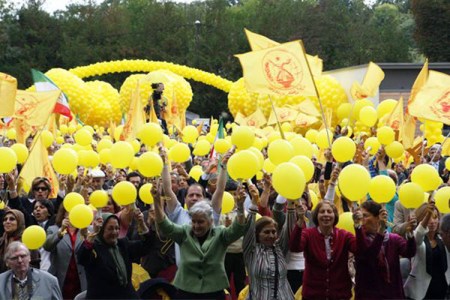
mek-rally-750

London, 7 Feb – As President Donald Trump’s new US administration steps up pressure on Iran over its belligerent activities, Iranian opponents are arguing that Tehran is now targeting its main organised opposition movement, the People’s Mojahedin Organisation of Iran (PMOI or MEK), with disinformation in order to discredit its role as a potential alternative to the theocratic regime.

The MEK, established over 51 years ago, as an opposition movement to the Shah’s regime, soon fell out with the clerical government that took over with the 1979 revolution. Since 1981, the MEK has been considered as the ruling theocracy’s main nemesis. The MEK is also the leading force in the main opposition coalition National Council of Resistance of Iran (NCRI).

Following the publication of articles by the Iranian ‘lobby’ targeting the MEK with ‘misinformation’, Farzin Hashemi, a Member of the NCRI Foreign Affairs Committee, wrote on Monday:

“Over the past week, once again policy on Iran was widely discussed in the media. Simultaneously, in recent weeks there has been more growing call for a new approach toward Iranian opposition, the MEK. The announcement by the US National Security Advisor that ‘Iran is officially on notice’ drew much attention. This position was followed by more Tweets from President Trump and a new round of sanctions, raising the prospect of a change of policy in the US approach towards Iran”.

Hashemi pointed out that both the NCRI and the MEK support sanctions against Iranian officials over their role in ballistic missile proliferation, a violation of United Nations Security Council Resolution 2231:

“As far as the Iranian Resistance, and its components including the People’s Mojahedin Organization of Iran (MEK/PMOI), is concerned imposing sanctions against a number of individuals and companies affiliated to the clerical regime for their role in missile proliferation is a positive step in confronting the illegitimate and terrorist dictatorship whose record includes 120,000 political executions”.

Last week the Trump administration sanctioned 25 Iranian officials and entities for a recent ballistic missile test launch by Tehran. Hashemi argued, however, that in order to deal with the threats emanating from Tehran – which it described as the Godfather of state-sponsored terrorism – the world community ought to impose comprehensive sanctions on Iran’s Revolutionary Guards (IRGC), the Ministry of Intelligence, and “other entities involved in suppression of the Iranian people and export of terrorism”.

“The IRGC and its affiliated militias and their commanders must be expelled from the countries of the region, in particular from Iraq, Syria, and Yemen. Otherwise, the region would not witness peace and tranquillity”.

“The prospect of a shift of US policy, has already shaken not only the Iranian regime and its lobbies but also apologists and advocates of the old and failed policy of appeasement. In order to maintain the ‘golden era,’ a term used by the mullahs’ officials internally and sometimes publicly to describe the last few years of US policy on Iran, they have resorted to a two-pronged strategy”, Hashemi argued.

Through their “propaganda in the media”, under various covers, they are trying to create an “echo chamber” with which any suggestion of the need for a firm policy on Iran and its rogue behaviour, both at home and abroad, is described as “war mongering”, he said. “They are desperately trying to intimidate those calling for a change of policy to side with the people of Iran, through such false labels”.

“Simultaneously, they are engaged in a massive disinformation campaign to discredit the democratic opposition, the MEK and the coalition National Council of Resistance of Iran (NCRI), led by its President-elect Maryam Rajavi. By spreading fake news about the MEK/PMOI, originated from the Ministry of Intelligence of the mullahs’ regime and the intelligence section of the IRGC, their objective is to convey this false message that there is no viable opposition and the world must accept and deal with the religious dictatorship ruling Iran. Thus, the core of the issue is not their debunked allegations but their hidden agenda to maintain the policy of appeasement”.

“So, the choice is simply to opt between supporting the central banker of international terrorism with the record of having executed 120,000 dissidents for political reasons –ironically, the majority of them members and sympathizers of the PMOI/MEK – or to side with the Iranian people in their quest for a free and democratic Iran in which there would be no more executions, no more gender discrimination, no more supporting terrorist groups and destabilizing the entire region and no more nuclear weapons program”.

Iranian dissidents have also taken to social media, such as Twitter and Facebook, to denounce Tehran’s ‘media propaganda ploy’ against the MEK.

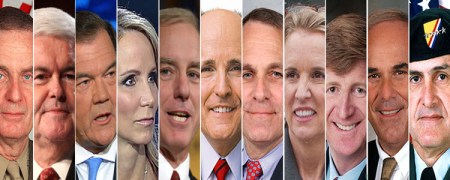
On 9 January this year, 23 US prominent dignitaries, many of them with years of public service, urged the Trump administration “to adopt and pursue an Iran policy that recognizes the interests and inalienable rights of the Iranian people, and not just the clerical regime ruling over them.”

Highlighting the failure of the past policy that the nuclear deal might lead to a change of behavior from Tehran, the signatories stressed that the regime’s aggressive policy is part of their efforts on “preserving the vulnerable system of dictatorship”.

They also called for the voice of the Iranian people to be listened to through the NCRI and the MEK.

The former US officials also spoke out against Iran’s misinformation campaign against the MEK.

Pointing out that some “media and policy community continue to recycle defamatory allegations from decades past,” they wrote “We now know that these designations of the resistance as a terrorist group by Western governments were not made in response to confirmed terrorism; all were diplomatic gestures taken at the request of Tehran. Iran’s Ministry of Intelligence and Security has for many years impaired the exiled opposition by covertly spreading false and distorted claims through third parties in the West. Other governments like Germany and the Netherlands closely monitor Iran’s influence operations on their soil; a thorough counter‐intelligence investigation by the US is clearly needed and long overdue”.

They concluded by recommending to Trump: “With a more enlightened grasp of the Iranian regime’s priorities and vulnerabilities, your Administration will be equipped to exert leverage enabling the US to oppose Tehran’s repression and adventurism while standing for the fundamental values both our peoples share”.

Hashemi added: “While, Tehran’s lobby and advocates of appeasement will desperately continue to allocate all their resource to discredit the resistance, and in particular the MEK (PMOI) and to preserve the failed old policy, their time is over”.


More about the People’s Mojahdin Organization of Iran (PMOI/ MEK) —– Source

The People’s Mojahedin Organization of Iran (Also known as MEK, or Mujahedin-e-Khalq / Mujahedeen-e-Khalq), was founded on September 6, 1965, by Mohammad Hanifnejad, Saeed Mohsen, and Ali-Asghar Badizadgan. All engineers, they had earlier been members of the Freedom Movement (also known as the Liberation Movement), created by Medhi Bazargan in May 1961.1

The MEK’s quest culminated in a true interpretation of Islam, which is inherently tolerant and democratic, and fully compatible with the values of modern-day civilization. It took six years for the MEK to formulate its view of Islam and develop a strategy to replace Iran’s dictatorial monarchy with a democratic government.

MEK’s interpretation of Islam

The theocratic mullah regime in Iran believe interpreting Islam is their exclusive domain. The MEK reject this view and the cleric’s reactionary vision of Islam. The MEK’s comprehensive interpretation of Islam proved to be more persuasive and appealing to the Iranian youth.
MEK’s founders and new members studied the various schools of thought, the Iranian history and those of other countries, enabling them to analyze other philosophies and ideologies with considerable knowledge and to present their own ideology, based on Islam, as the answer to Iran’s problems.

MEK’s leadership’s arrest during the 70s.

The Shah’s notorious secret police, SAVAK, arrested all MEK leaders and most of its member’s in1971. On May 1972, the founders of the MEK, Mohammad Hanifnejad , Saeed Mohsen and Ali Asghar Badizadegan, along with two members of the MEK leadership, Mahmoud Askarizadeh and Rasoul Meshkinfam, were put before death squads and were executed after long months of imprisonment and torture. They were the true vanguards, who stood against the dictatorial regime of Shah. However, they are also recognized for their opposition to what is today known as Islamic fundamentalism.

The death sentence of Massoud Rajavi, a member of MEK’s central committee, was commuted to life imprisonment as a result of an international campaign by his Geneva based brother, Dr. Kazem Rajavi (assassinated in April 1990 in Geneva by mullahs’ agents) and the personal intervention of the French President Georges Pompidou and Francois Mitterrand. He was the only survivor of the MEK original leadership.
Massoud Rajavi’s critical role in characterizing religious extremism

From 1975 to 1979, while incarcerated in different prisons, Massoud Rajavi led the MEK’s struggle while constantly under torture for his leading position.

Massoud Rajavi stressed the need to continue the struggle against the shah’s dictatorship. At the same time, he characterized religious fanaticism as the primary internal threat to the popular opposition, and warned against the emergence and growth of religious fanaticism and autocracy. He also played a crucial role when some splinter used the vacuum in the MEK leadership who were all executed or imprisoned at the time, to claim a change of ideology and policy. Massoud Rajavi as the MEK leader condemn these individual’s misuse of MEK’s name while continuing to stress the struggle against dictatorship. His efforts while still in prison forced these individuals to no longer operating under the name of MEK and adopting a different name for their group. These positions remained the MEK’s manifesto until the overthrow of the shah’s regime.

Release of Political Prisoners on the last days of the Shah

A month before the 1979 revolution in Iran, the Shah was forced to flee Iran, never to return. All democratic opposition leaders had by then either been executed by the Shah’s SAVAK or imprisoned, and could exert little influence on the trend of events. Khomeini and his network of mullahs across the country, who had by and large been spared the wrath of SAVAK, were the only force that remained unharmed and could take advantage of the political vacuum. In France, Khomeini received maximum exposure to the world media. With the aid of his clerical followers, he hijacked a revolution that began with calls for democracy and freedom and diverted it towards his fundamentalist goals. Through an exceptional combination of historical events, Shiite clerics assumed power in Iran.

Khomeini’s gradual crackdown on MEK in fear of their popular support

In internal discourses, Rajavi the remaining leader of the MEK, argued that Khomeini represented the reactionary sector of society and preached religious fascism. Later, in the early days after the 1979 revolution, the mullahs, specifically Rafsanjani, pointed to these statements in inciting the hezbollahi club-wielders to attack the MEK.

Following the revolution, the MEK became Iran’s largest organized political party. It had hundreds of thousands of members who operated from MEK offices all over the country. MEK publication, ‘Mojahed’ was circulated in 500,000 copies.

Khomeini set up an Assembly of Experts comprised of sixty of his closest mullahs and loyalists to ratify the principle of velayat-e faqih (absolute supremacy of clerical rule) as a pillar of the Constitution. The MEK launched a nationwide campaign in opposition to this move, which enjoyed enormous popular support. Subsequently, the MEK refused to approve the new constitution based on the concept of velayat-e faqih, while stressing its observance of the law of the country to deny the mullahs any excuse for further suppression of MEK supporters who were regularly targeted by the regime’s official and unofficial thugs.

Khomeini sanctioned the occupation of the United States embassy in 1979 in order to create an anti-American frenzy, which facilitated the holding of a referendum to approve his Constitution, which the MEK rejected.

MEK’s endeavors to participate in the political process avoiding an unwanted conflict with government repressive forces
The MEK actively participated in the political process, fielding candidates for the parliamentary and presidential elections. The MEK also entered avidly into the national debate on the structure of the new Islamic regime, though was unsuccessful in seeking an elected constituent assembly to draft a constitution.

The MEK similarly made an attempt at political participation when [then] Massoud Rajavi ran for the presidency in January 1980. MEK’s leader was forced to withdraw when Khomeini ruled that only candidates who had supported the constitution in the December referendum – which the MEK had boycotted- were eligible. Rajavi’s withdrawal statement emphasized the MEK’s efforts to conform to election regulations and reiterated the MEK’s intention to advance its political aims within the new legal system”. (Unclassified report on the People’s Mojahedin Organization of Iran(PMOI/ MEK) by the Department of State to the United States House of Representatives, December 1984.)

However, the MEK soon found itself in a direct struggle against the forces of the regime’s Supreme leader. The MEK’s differences with Khomeini dated back to the 1970s, and stem from its opposition to what is known today as Islamic extremism. Angry at the position taken by the MEK against his regime and worried about the MEK’s growing popularity, Khomeini ordered a brutal crackdown against the MEK and its supporters. Between 1979 and 1981, some 70 MEK members and sympathizers were killed and several thousand more were imprisoned by the Iranian regime.

June 20, 1981- Khomeini’s order to open fire on peaceful demonstration of half-a-million supporters of MEK

The turning point came on 20th June 1981, when the MEK called a demonstration to protest at the regime’s crackdown, and to call for political freedom which half-a-million supporters participated at. Khomeini ordered the Revolutionary Guards to open fire on the swelling crowd, fearing that without absolute repression the democratic opposition (MEK) would force him to engage in serious reforms – an anathema as far as he was concerned; he ordered the mass and summary executions of those arrested.

Since then, MEK activists have been the prime victims of human rights violations in Iran. Over 120,000 of its members and supporters have been executed by the Iranian regime, 30,000 of which, were executed in a few months in the summer of 1988, on a direct fatwa by Khomeini, which stated any prisoners who remain loyal to the MEK must be executed.

Having been denied its fundamental rights and having come under extensive attack at the time that millions of its members, supporters and sympathizers had no protection against the brutal onslaught of the Iranian regime, the MEK had no choice but to resist against the mullahs’ reign of terror.

“Towards the end of 1981, many of the members of the MEK and supporters went into exile. Their principal refuge was in France. But in 1986, after negotiations between the French and the Iranian authorities, the French government effectively treated them as undesirable aliens, and the leadership of the MEK with several thousand followers relocated to Iraq.” (Judgment of the Proscribed Organizations Appeal Commission, November 30, 2007.)

MEK Today

The MEK today is the oldest and largest anti-fundamentalist Muslim group in the Middle East. It has been active for more than a half century, battling two dictatorships and a wide range of issues. The MEK supports:

• Universal suffrage as the sole criterion for legitimacy
• Pluralistic system of governance
• Respect for individual freedoms
• Ban on the death penalty
• Separation of religion and state
• Full gender equality
• Equal participation of women in political leadership. MEK is actually led by its central committee consist of 1000 women.
• Modern judicial system that emphasizes the principle of innocence, a right to a defense, and due process
• Free markets
• Relations with all countries in the world
• Commitment to a non-nuclear Iran

The MEK remains a strong and cohesive organization, with a broad reach both worldwide and deep within Iran. MEK is the leading voice for democracy in Iran, supported by its interpretation of Islam that discredits the fundamentalist mullahs’ regime.
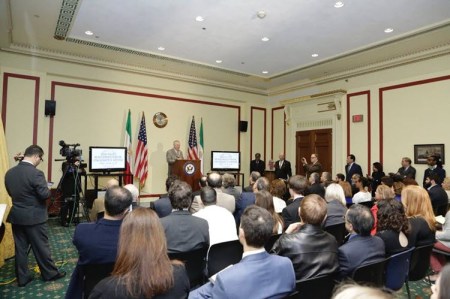
US Lawmakers Promise Iranian Opposition that there will be Tougher Laws on Iran

January 28, 2017

US Lawmakers Promise Iranian Opposition that there will be Tougher Laws on Iran, Iran News Update, January 28, 2017

unnamed-2

A bipartisan group of US lawmakers have promised the Iranian Opposition that they will press for tougher sanctions on the Iranian Regime. The House members made this pledge to the Organization of Iranian-American Communities (OIAC) on Tuesday. 

The OIAC is allied with the Iranian dissident group Mujahedin-e-Khalq (MEK)  and advocates for a “democratic, secular and non-nuclear government”, and overthrowing the  “religious dictatorship” in Iran.

Republican Congresswoman Ileana Ros-Lehtinen called for an expansion of the sanctions against Iran’s Islamic Revolutionary Guard Corps (IRGC), which were not removed during the nuclear deal.

She said: “It is time that we put the tools that we have created to use, broadening our sanctions so that they include IRGC-controlled businesses and subsidiaries. We must target the (Iranian) regime at every turn, not only enforcing the sanctions that have been too long neglected, but expanding their scope whenever and wherever possible.”

The lawmakers also want to stop IRGC-affiliated companies from buying US-made passenger planes, which would likely be used to ship weapons, troops and even money to terrorist cells.

Democratic Congressman Brad Sherman co-sponsored a bill to require the Trump administration to report any signs of Iran using US-made aircraft for “illicit military or other activities” which would violate the terms of the 2015 nuclear deal.

He said: “We need an ironclad system that makes sure (any newly-acquired planes with American technology) are not used for military or terrorist purposes (by Iran).”

During his campaign, Trump promised to renegotiate the Iranian Nuclear Deal- unlike his Republican opponents, Ted Cruz and Marco Rubio, who promised to “rip up” the deal, on their first day in office- but has not made steps towards it yet.

Sherman also wanted to prevent US banks from loaning Iran any money to pay for new planes.

Republican Congressman Dana Rohrabacher called for increased political pressure against the Iranian despots, especially to protect the human rights of the people living there.

He said: “One strategy is to help pro-democracy movements who would replace the mullahs. I’m willing to help the Azeris, Baluch and Kurds, who are not part of the Persian majority, to create a situation where you have autonomous regions similar to the states of the United States so that those people’s rights will feel secure as well.”

Democratic Congressman Eliot Engel explained that he wanted to help the Iranian dissidents who were previously exiled to Camp Liberty in Iraq, but have since been safely relocated to Albania.

He noted that they still have not received the money from the sale of their property in Iraq; an estimated $50 million left at Camp Liberty and $500 million at Camp Ashraf. This money is needed to help them make a new life, without handouts.

He said: “As all of their expenses in Albania are paid by MEK, they need their money to be returned as soon as possible. So, I urge Iraq, which the United States has helped for so many years, to honour its commitment to return the money to MEK.”

After Trump Inauguration, Netanyahu Wastes No Time Putting Iran Back on Agenda

January 21, 2017

After Trump Inauguration, Netanyahu Wastes No Time Putting Iran Back on Agenda, Jerusalem PostHerb Keinon, January 21, 2017

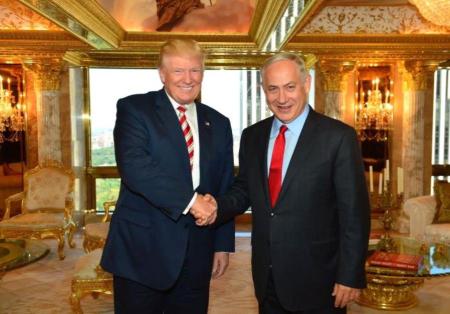
bibiandtrumpDonald Trump and Benjamin Netanyahu meet at the Trump tower. (photo credit:KOBI GIDON / GPO)

“This ruthless regime continues to deny you your freedom,” Netanyahu said in the English video, accompanied by Farsi subtitles.  “It prevents thousands of candidates from competing in elections, it steals money from your poor to fund a mass murderer like [Syrian President Bashar] Assad. By calling daily for Israel’s destruction, the regime hopes to instill hostility between us. This is wrong. We are your friend, not your enemy.”

***************************

Just 24 hours after US President Donald Trump spoke in his inaugural address about the need to eradicate radical Islamic terrorism, Prime Minister Benjamin Netanyahu put a brief video clip on social media aimed at placing the Iranian threat squarely back on the international agenda.

“I plan to speak soon with President Trump about how to counter the threat of the Iranian regime, which calls for Israel’s destruction,” Netanyahu said in the two-and-a-half minute video addressed directly to the Iranian people.

“This ruthless regime continues to deny you your freedom,” Netanyahu said in the English video, accompanied by Farsi subtitles.  “It prevents thousands of candidates from competing in elections, it steals money from your poor to fund a mass murderer like [Syrian President Bashar] Assad. By calling daily for Israel’s destruction, the regime hopes to instill hostility between us. This is wrong. We are your friend, not your enemy.”

This was the first video of this sort Netanyahu has put out in months, after putting out several in the spring and summer that addressed issues such as Palestinian incitement and the settlements. It is also the first time in a while that he has exclusively addressed the Iranian issue, other than in a  couple of sentences in public appearances here and there.

The release of the video now, just 24-hours after Trump took over from Barack Obama, is an obvious effort to get the world’s leaders – first and foremost Trump – to one again focus on the Iranian regime.

Trump has come out squarely against the Iranian nuclear deal.  The sense among sources close to Netanyahu is that when dealing with the new administration, Netanyahu will not only have a more receptive ear regarding the dangers that the Iranians pose, but also find an administration more willing to shine the light on Iran’s part in the spread of radical Islamic terrorism, and more vigilant in ensuring that Tehran lives up to its commitments under the nuclear deal.

“We’ve always distinguished between the Iranian people and the Iranian regime,” Netanyahu said in the video.

“The regime is cruel, the people are not; the regime is aggressive, the people are warm. I yearn for the day when Israelis and Iranians can once against visit each other freely – in Tehran and Isfahan, in Jerusalem and Tel Aviv,” he said. “The fanatics must not win, their cruelty must not conquer our compassion. Our two peoples can work together for a more peaceful and hopeful future for both of us. We must defeat terror and tyranny, and we must ensure that freedom and friendship win the day.”

Netanyahu referenced the Iranian student protests of 2009, which some say was a golden opportunity for change in Iran which was squandered by a lack of unequivocal moral and material support by Obama in the early days of his presidency.

“I will never forget the images of brave young students , hungry for change, gunned down in the streets of Tehran in 2009,” Netanyahu said. “And I will never forget beautiful Neda Soltan – gasping for her last breath on that sidewalk.”

This was a reference to Iranian student Neda Agha-Soltan, whose shooting-death during the protests was caught on video and went viral.

“You have a proud history, you have a rich culture,” Netanyahu said. “Tragically, you are shackled by a technocratic tyranny. In a free Iran you will once again be able to flourish without limit , but today a cruel regime is trying to keep you down.”

While Netanyahu said he will speak to Trump about Iran soon, no announcement has yet been made about when their first meeting will be held, though there have been recent reports it could be as early as the first week in February. Government officials said that the issue will be determined in the coming days.

Netanyahu congratulated Trump on his inauguration in a tweet Friday afternoon: “Congratulations to my friend President Trump,” he wrote. “I look forward to working closely with you to make the alliance between Israel and America stronger than ever. Shabbat Shalom.”

Senior National Security Experts Calling for Working with the Iranian Opposition Applauded by Iranian Americans

January 18, 2017

Senior National Security Experts Calling for Working with the Iranian Opposition Applauded by Iranian Americans, Iran News Update, January 18, 2017

noi2-750

This bi-partisan urge to the incoming Trump administration “to establish a dialogue with Iran’s exiled resistance, the National Council of Resistance of Iran (NCRI),” who have called for free elections to establish a secular, democratic, non-nuclear republic in Iran, as well as to end to Tehran’s “religious dictatorship.”

Successive US administrations, offering concessions in a futile attempt to moderate the behavior of the totalitarian regime, have failed, and ignored 80 million freedom loving people in Iran.

***************************

In an article published in the PR Newswire, a Cision Company on Jan. 16, 2017, the Organization of Iranian American Communities-US (OIACUS), the largest, most active and enduring grass root organization of Iranian-Americans in the United States welcomes the letter initiated by nearly two dozen bi-partisan former senior U.S. government officials who have urged President-elect Donald Trump to work with the Iranian opposition, as an integral part of a new policy on Iran.

Signed by 23 former top officeholders during the past five administrations the letter to the president-elect states, “To restore American influence and credibility in the world, the United States needs a revised policy based on universally shared norms and principles reflecting the ideals of peace and justice. A policy highlighting, and demanding an end to, Iran’s domestic human rights violations and malevolent regional actions will attract broad support and generate needed leverage against Iran’s threatening behavior.”

This bi-partisan urge to the incoming Trump administration “to establish a dialogue with Iran’s exiled resistance, the National Council of Resistance of Iran (NCRI),” who have called for free elections to establish a secular, democratic, non-nuclear republic in Iran, as well as to end to Tehran’s “religious dictatorship.”

Successive US administrations, offering concessions in a futile attempt to moderate the behavior of the totalitarian regime, have failed, and ignored 80 million freedom loving people in Iran.

The OIAC calls on the new administration to reach out to the Iranian people and their well-organized opposition movement, saying that foreign military intervention is not the answer, and that the United States should recognize the aspirations of Iranian people for a free and democratic future as the only effective and viable policy.

Our members have a range of political and party affiliations. However the members are unified in the belief that democracy and human rights in Iran are imperative to the national security of America, peace in the Middle East, and beyond. “In this honorable endeavor, we shall welcome your engagement and decisive decision-making.”

At a January 24th Congressional briefing, Iranian Americans will also join their representatives to present their policy recommendations on Iran with their representatives in Washington, DC.

Iranian Political Prisoners in Dire Need of the Support of the International Community

January 11, 2017

Iranian Political Prisoners in Dire Need of  the Support of the International Community, Iran News Update, January 11, 2017

(Perhaps if we referred to them as “Palestinians” the international community might notice their plight. — DM)

iranian-political-prisoners-750

Silence of the global community sends a message to the Iranian regime that it can get away with these crimes, and that is a message not to be condoned with silence.

**************************

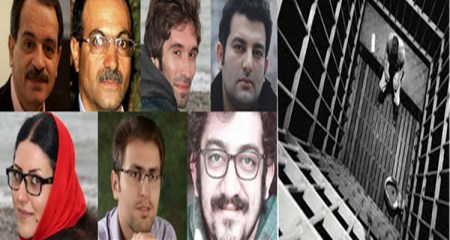
An article in The Hill by Ali Safavi, member of the Foreign Affairs Committee of the National Council of Resistance of Iran and president of the Near East Policy Research, discusses the alarming reports which from came from Gohardasht Prison, that activist and political prisoner Ali Moezzi, had disappeared on January 4, 2016.

Moezzi spent years in prison in the 1980’s for his affiliation with the Iranian opposition group, the Mujahedin-e Khalq (PMOI/MEK).  Beginning in 2008, he served two more years, for having visited his two daughters residing in Camp Ashraf, Iraq. Arrested again in 2011, seven months after his latest release, for attending the funeral of a fellow political prisoner, he’s been imprisoned ever since. He has faced much pressure, including the extension of his current prison term beyond its specified four years.He’s also be subjected to numerous explicit death threats.

Reportedly, he’s undergone routine beatings and torture and the absence of medical care for his pre-existing health problems. Moezzi’s arrest came shortly after he had been released from a hospital after undergoing surgery following a cancer diagnosis.

The regime has repeatedly been charged with disregard for the health and well-being of prisoners, especially those detained for political or religious offenses.  A recent example is Arash Sadeghi, who is serving a 15-year prison sentence for his peaceful human rights activism. Sadeghi began a hunger strike shortly after his wife was arrested. Sadeghi finally ended his hunger strike after judicial authorities granted his wife temporary release from her pre-trial detention. His hunger strike lasted more than 70 days befor the regime agreed to even that, and it was not the likelihood of Sadeghi’s imminent death that prompted them to act, but the massive support that his protest had garnered within Iran and abroad. Hundreds of Iranians gathered outside of Evin Prison, to protest his treatment. His cause was promoted on the internet and via banned social media networks by several thousands of supporters.

Salve writes, “It may not be a coincidence that Moezzi disappeared from Gohardasht Prison just one day after it was announced that Sadeghi had been hospitalized and brought back from the brink of death.”  He adds, “Both incidents demonstrated that the Iranian regime has no qualms about endangering the lives of its political adversaries, but the ruling mullahs can only take such a situation to its drastic conclusion if relatively free from public scrutiny.”

He says that it may be easier for the regime simply allow political prisoners to die, if those deaths occur in secret locations, so that they can claim “plausible” deniability.

Iran’s domestic activists or the international community may still be able to save Moezzi in much the same way they saved Sadeghi, but it is impossible to know Moezzi’s current condition, much less to follow its deterioration in real time.  This is a challenge as it is difficult to rally around a cause that they cannot see.  However, these atrocities must not be allowed to continue in the shadows.

This is the challenge that requires serious commitment, and a campaign that includes the international community and media. “World powers must take an interest in this case, and in the overall plight of Iranian prisoners of conscience,” writes Salvi.

Which is actually underscored by the recent success of the Sadeghi case.  Silence of the global community sends a message to the Iranian regime that it can get away with these crimes, and that is a message not to be condoned with silence.


Iran: How Will Rafsanjani’s Death Affect Regime?

January 11, 2017

Iran: How Will Rafsanjani’s Death Affect Regime? Iran News Update, January 10, 2017

rafsanjani-750

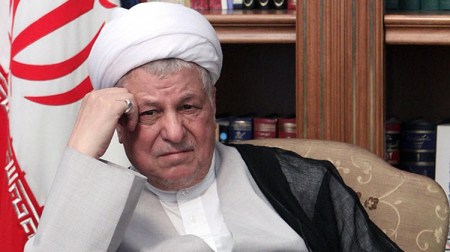
In his January 10 article for Al-Arabiya,, Heshmat Alavi, political and rights activist who focuses on Iran, writes about the effect of senior cleric Ali Akbar Hashemi Rafsanjani’s death by heart attack on Sunday, January 8, at the age of 82.

As Rafsanjani was known for his influential role in shaping the regime’s politics following the 1979 revolution, the Iranian regime was dealt a significant blow, and a power vacuum is created, less than four months prior to crucial presidential elections.

Rafsanjani’s role for the past 38 years helped maintain the regime’s measures of domestic crackdown, export of terrorism and extremism abroad, and their effort to obtain nuclear weapons, according to Alavi. 

“The death of Rafsanjani, one of the pillars of the religious fascism ruling Iran and its balance factor collapsed, and the regime in its entirety is closer now to its overthrow,” said Iranian opposition leader Maryam Rajavi, President of the National Council of Resistance of Iran.

After Iran-Iraq War of the 1980s, Rafsanjani served as president from 1989 to 1997. He ran again for office again in 2005, but lost the election to firebrand Mahmoud Ahmadinejad.

In recent years, Rafsanjani has been mentoring the so-called “moderate” Iranian President Hassan Rowhani, and was known for his fierce rivalry with Iranian Supreme Leader Ali Khamenei.

Although known for his close ties to the regime founder Ruhollah Khomeini, who died in 1989, the West believed him to be a “pragmatic conservative” willing to mend fences with the outside world, especially the US.

Rafsanjani’s last post was head of the Expediency Council, a body assigned to resolve conflicts between the regime’s parliament (Majlis) and the Guardian Council, which has close links to Khamenei, and vets all candidates based on their loyalty to the establishment before any so-called elections. Rafsanjani himself was disqualified by the Guardian Council when he sought to participate in the 2013 elections as a “reformist” candidate.

Instead, Rafsanjani placed his power behind Rowhani after the latter assumed power as president in 2013.  Rafsanjani used this position to “carve himself and his family an economic empire from the country’s institutions and natural resources in the past decades,” writes Alavi.

“One brother headed the country’s largest copper mine; another took control of the state-owned TV network; a brother-in-law became governor of Kerman province, while a cousin runs an outfit that dominates Iran’s $400 million pistachio export business; a nephew and one of Rafsanjani’s sons took key positions in the Ministry of Oil; another son heads the Tehran Metro construction project (an estimated $700 million spent so far),” states a 2003 Forbes analysis, which also alludes to the billions cached in Swiss and Luxembourg bank accounts by the Rafsanjanis.

While the West was convinced that Rafsanjani was more moderate than his “hardline” counterparts, he went along with them in suppressing dissidents, namely members and supporters of the People’s Mojahedin Organization of Iran (PMOI/MEK), the main opposition group that first blew the whistle on Iran’s clandestine nuclear weapons program.

“Four rulings are a must for the [PMOI]: 1- Be killed. 2- Be hanged. 3- Arms and legs be amputated. 4- Be separated from society,” Rafsanjani said back in 1981. He also played a presiding role in the 1988 massacre of over 30,000 political prisoners.

During his presidency, Rafsanjani allegedly directed numerous assassinations of dissidents abroad, including renowned human rights advocated Dr. Kazem Rajavi, former Iranian ambassador to Italy Mohammad Hossein Naghdi and Iranian Kurdish leader Abdulrahman Ghassemlou.  He was also indicted for his role in the 1994 AMIA bombing in Buenos Aires that left 85 killed and hundreds wounded.

Alavi writes, “Rafsanjani has through four decades of mullahs’ rule in Iran played the role of the regime’s No. 2 figure and a balancing element, always securing the regime’s higher interests. His death will significantly weaken the mullahs’ regime in its entirety and will trigger major upheavals across the regime’s hierarchy.”  He concludes by saying, “If past is any indication, the mullahs will most likely resort to further violence and the export of terrorism and extremism to prevent this newest crisis from spiraling out of control.”

The NCRI referred to Rafsanjani as “one of the two pillars and ‘key to the equilibrium’ of the Iranian regime,” adding that, “during his long career he was associated with some of the regime’s most egregious actions, including mass-casualty terror attacks and the assassinations of exiled dissidents.”

Rafsanjani is considered as one of its founding fathers of the Iranian regime, who played an outsized political role in the life of the Islamic republic, not only by serving as President after serving as Speaker of Parliament and Deputy Commander of the Armed Forces, but also heading two of the regime’s most important institutions, the Assembly of Experts, an 88-member body of top clerics which nominates the Supreme Leader; and the Expediency Council, a body that advises the Supreme Leader.

“Rafsanjani, who had always been the regime’s number two, acted as its balancing factor and played a decisive role in its preservation. Now, the regime will lose its internal and external equilibrium,” opposition leader Maryam Rajavi said in a statement that also referred to the “approaching overthrow” of the clerical regime.

On January 9 the NCRI published a list, outlining some of his outrageous conduct:

• Rafsanjani called for the extermination of members of Iran’s main opposition group, the People’s Mojahedin Organization of Iran (PMOI or MEK). On October 3, 1981, the state-run Ettela’at daily wrote, “Referring to the grouplets’ operations, Hashemi Rafsanjani, Speaker of the Islamic Parliament and Tehran’s acting Friday prayer leader, said in his sermon, ‘Divine law defines four sentences for them which must be carried out: 1 – kill them, 2 – hang them, 3 – cut off their arms and legs, 4 – banish them…‘Had we caught and executed 200 of them right after the Revolution, they would not have multiplied so much. If we don’t deal decisively with [Mojahedin] armed grouplet and agents of America and the Soviet Union today, in three years we will have to execute thousands of them instead of one thousand now…”

• According to Hossein-Ali Montazeri, Khomeini’s former heir, Khomeini sought counsel on his decisions from just two individuals: Rafsanjani and current Supreme Leader Ali Khamenei, including his decision to issue a fatwa ordering the massacre of at least 30,000 political prisoners at the end of the Iran-Iraq war in the summer of 1988.

During Rafsanjani’s tenure as President and as head of the Supreme National Security Council (SNSC), a body that oversees and authorizes the regime’s terrorist operations, the assassination of Iranian dissidents abroad and the regime’s terror attacks skyrocketed. The terror targets were not only Iranians.

• Rafsanjani’s remarks on May 5, 1989 as carried by Iran’s official state news agency IRNA , and were reported by The Associated Press:: “If in retaliation for every Palestinian martyred in Palestine, they will kill and execute, not inside Palestine, five Americans or Britons or Frenchmen, the Israelis could not continue to do these wrongs… It is not hard to kill Americans or Frenchmen. It is a bit difficult to Kill [Israelis]. But there are so many [Americans and Frenchmen] everywhere in the world.”

• Argentinian investigators implicated Rafsanjani in 2006, in one of the deadliest instances of Iranian terrorism abroad – a suicide truck bombing of the AMIA Jewish community center in Buenos Aires, in which 85 people were killed in 1994.  The investigators accused Iran of instructing Hezbollah to carry out the bombing. They issued arrest warrants for Rafsanjani, seven other senior Iranians, and a Lebanese national, Imad Mughniyah, Hezbollah terrorist chief.

Interpol, at Argentina’s request, issued red notices – the organization’s equivalent of arrest warrants – for five of the Iranians and Mughniyah.

• The FBI established undeniable evidence that Tehran had masterminded the deaths of 19 American servicemen, in the bombing of Khobar Towers in Saudi Arabia on June 25, 1996.

According to the NCRI, these are some of the most significant killings of prominent dissidents abroad during Rafsanjani’s tenure:

• In 1992, four Iranian Kurdish dissidents in a Berlin restaurant called Mykonos were assassinated. A German court ruled in 1996 that the Iranian regime under Rafsanjani was directly responsible for the killings, which the U.S. State Department said provided further proof that Iran was a terrorist state.

• Maryam Rajavi’s brother-in-law, Kazem Rajavi of the National Council of Resistance of Iran (NCRI) – Iran’s most renowned human rights advocate and a former Iranian ambassador to the U.N. was shot dead near Geneva in 1990. Swiss investigators accused the Iranian regime of responsibility and authorities issued an arrest warrant for Rafsanjani’s intelligence minister, Ali Fallahian.

• Mohammad Hossein Naghdi, the NCRI representative in Rome, was shot dead on a street in the Italian capital in March 1993.

• Zahra Rajabi, the NCRI’s representative on refugee issues, was shot dead with an NCRI colleague in an Istanbul apartment in February 1996.

Rafsanjani was the one who pushed the Iranian clandestine nuclear weapons program forward as a guarantor of the regime’s survival. He cooperated with countries like North Korea to achieve these objectives.

Rafsanjani acknowledged that during his time as parliamentary speaker and President, both he and Khamenei sought ways to obtain a nuclear bomb in an interview published by the regime’s official state news agency IRNA on October 27, 2015. “Our basic doctrine was always a peaceful nuclear application, but it never left our mind that if one day we should be threatened and it was imperative, we should be able to go down the other path,” Rafsanjani said.  He added he had travelled to Pakistan to try to meet Abdul Qadeer Khan, the father of Pakistan’s nuclear weapons program, who later helped North Korea to develop a bomb. Fortunately, the meeting never occurred.

Trump’s Great Iranian Opportunity

January 8, 2017

Trump’s Great Iranian Opportunity, PJ MediaMichael Ledeen, January 7, 2017

(Even in the unlikely event that the State Department — not yet Trump’s — would issue a visa, would Iran permit Borougerdi to attend Trump’s inauguration? However, the mere gesture of extending an invitation would speak loudly and well of President Trump’s views on Iran. — DM)

iran-ayatollah-sized-770x415xtPhoto courtesy Shutterstock.

Donald Trump should invite Ayatollah Boroujerdi to the inauguration.

***************************

The great Ayatollah Hossein Boroujerdi is briefly out of prison, where he had been held in miserable conditions for a decade. He is one of those dissidents who are so beloved by the Iranian people that the murderous regime of Ali Khamenei does not dare to put them to death, or even on trial.  They torture them instead, hoping that they will die of “natural causes.”

When regime security forces went to arrest him, thousands of his supporters protested, blocking miles of highway. Khamenei, Rouhani et. al. still fear those people, ten years later.

He’s out on parole, but don’t think the regime is showing mercy. They typically release prisoners for a few weeks at a time—that way everyone sees the miserable state to which they have been reduced—and then drag them back.

I have written several times about him, calling on human rights advocates and political and religious leaders to campaign for his release. The short version:

Ayatollah Boroujerdi threatens the regime for two reasons:  he advocates toleration of all religious (and non-religious) beliefs, and, in keeping with Shi’ite tradition, opposes the involvement of religious leaders in politics.  Years ago, he said  “the regime is adamant that either people adhere to political Islam or be jailed, exiled or killed. Its behavior is no different from that of Osama bin Laden or Mullah Omar.”

He has repeatedly criticized the fundamentalist doctrines of the Iranian theocratic state, and has dramatically spoken about the most explosive issues in the Muslim world, including anti-Semitism. In 2010 he sent Hanukkah greetings to the Jews of the world, saying “any religious belief that brings us closer to the Source (God) is the truth. This force will lead humanity towards enlightenment. On this great day, we celebrate the unity among the believers of God’s light.”

The response hasn’t been great.  Now that he is out, we have a formidable opportunity to help our kind of Iranian, deliver a stunning message to the Islamic world, and reassert our national values.

Donald Trump should invite Ayatollah Boroujerdi to the inauguration.  Such a dramatic move would deliver several important messages:

–Show our support for the brave, honorable dissidents in Iran.

–Demonstrate that the dreadful period of American support for the expansionist, terror-supporting, mass-murdering tyrants of Tehran is blessedly at an end.

–Show that we understand that there are freedom-loving Muslims, and that we believe they are worthy of Western solidarity.  Our war is with radical Islam, and we intend to win.

Boroujerdi is certainly not the only Muslim dissident we should be helping, but he’s a terrific way to start.

Straun Stevenson Blames President Obama for the Legacy of Death and Destruction in Middle East

January 8, 2017

Straun Stevenson Blames President Obama for the Legacy of Death and Destruction in Middle East, Iran News Update, January 8, 2017

(Please see also, In its Last Days, Obama Administration Clings to Hope of a Positive Role for Iran. — DM)

obama-750

Struan Stevenson, president of the European Iraqi Freedom Association, former member of the European Parliament representing Scotland (1999-2014), president of the Parliament’s Delegation for Relations with Iraq (2009-14) and chairman of Friends of a Free Iran Intergroup (2004-14), writes in his January 6, 2017 article for UPI, that the legacy of President Barack Obama will be death and destruction in the Middle East. His vision cooperation between  the United States and Iran “has unlocked a Pandora’s box of conflict and sectarian strife across the zone.”

During the closing days of the Obama administration the controversial nuclear deal with Iran and his policies regarding that ruthless regime have allowed the mullahs to threaten the security of the Middle East, and perhaps, while Saudi Arabia, the Gulf states and Turkey have tried to prevent Iran’s aggressive expansionism in the region.

The U.S. and other countries is the West failed the Syrian opposition and allowed a civil war to continue into its seventh year, costing hundreds of thousands of lives, and setting off the huge migration crisis in Europe.

$150 billion of frozen assets were released to Iran by the U.S. as part of the nuclear deal, which the Tehran government was expected to use to shore up their economy, on the brink of collapse. Instead, the regime redouble its spending the Islamic Revolutionary Guards Corps and Quds Force, both of which are listed terrorist organizations in the West and are involved in many conflicts in the Middle East. Not only does Iran support Bashar al-Assad in Syria, and Yemen’s Houthi rebels, it funds and supplies Hezbollah in Lebanon and the brutal Shi’ia militias in Iraq.

The nuclear deal has been breached, which Stevenson says demonstrates Iran’s complete disdain for the West. Two Qadr-H missiles were fired last March, in defiance of a U.N. Security Council resolution tied to the agreement. “Israel must be wiped out” was marked on the missiles, and the test firing took place on the day that the U.S. Vice President Joe Biden was visiting Israel. Vladimir Putin sent the first shipment of Russian S-300 surface-to-air missiles to Iran last August.

President Obama attempted to make deals with the so-called “moderate” and “smiling” Iranian President Hassan Rouhani, which he interpreted as having a green light for Tehran’s expansionist policy. Rouhani is in fact in charge of a government which has executed around 3,000 people since he took office in 2013, ten just this year. Mass hangings are now carried out in public, even in football stadiums. Many of the officials in his government were complicit in the 1988 massacre of some 30,000 political prisoners, most of whom were part of the opposition People’s Mojahedin of Iran. In fact, it was supervised by Mostafa Pour-Mohammadi, who is Rouhani’s justice minister.

Obama began his administration by agreeing with Iran, and backing Nouri al-Maliki as prime minister in Iraq. Stevenson writes, “Maliki was a puppet of the mullahs, doing their bidding by opening a direct route for Iranian troops and equipment heading to Syria to bolster the murderous Assad regime. Iran’s support for Maliki in Iraq and for Assad in Syria, two corrupt dictators who repressed and brutalized their own people, resulted in the rise of Daesh, also known as the Islamic State.Thanks to U.S. acquiescence over Tehran, Daesh grew and became a threat to the whole world.”  He continues, “Obama compounded this grievous mistake by providing American military support and air cover for the genocidal campaign being waged by pro-Iranian Shi’ia militias in Iraq. Once again Iran exploited its role in ousting Daesh as a means for implementing its ruthless policy of ethnic cleansing to annihilate the Sunnis in Iraq’s al-Anbar Province. Horrific sectarian atrocities were committed during the so-called “liberation” of the ancient cities of Fallujah and Ramadi. The Shi’ia militias, who formed the main part of the force fighting to recapture these cities from Daesh and are now engaged in the battle to recapture Mosul, are led by Gen. Qasem Soleimani, commander of the Iranian terrorist Quds Force. Soleimani has also played a key role in Syria and the massacre in Aleppo.”

Tehran is gaining strength in Iraq. The Iraqi army is poorly trained, and the Iranian has Prime Minister Haider al-Abadi’s agreement to allowing Iranian-funded militias to take control of military operations. Political disarray in Baghdad, has paved the way for Iran to consolidate its hold in Iraq.

The unenviable task of trying to sort out the Middle East mess will be left to President-elect Donald Trump. Many people on his team believe that Iran is the main source of conflict in the Middle East and poses a greater threat to the West than North Korea or even Russia. It will be interesting to see how Trump will fare.


In its Last Days, Obama Administration Clings to Hope of a Positive Role for Iran

January 8, 2017

In its Last Days, Obama Administration Clings to Hope of a Positive Role for Iran, Iran News Update, January 7, 2017

(Iran News Update 

Iran News Update (INU) features news, analysis, and commentary on events inside Iran and the Iranian Diaspora around the world.  News and information is provided in cooperation with the National Council of Resistance of Iran (NCRI), the parliament in exile of the Iranian Resistance, and the People’s Mojahedin Organization of Iran (PMOI/MEK).

— DM)

hstaee-750

Kerry’s remarks seem to imply that the Obama administration’s early claims about Iranian moderation will continue to be repeated until it departs the office. But the incoming administration cannot be expected to pick up that thread. And articles like the above-mentioned Fox News editorial indicate that on such issues as Iran’s coordination with America’s enemies, Donald Trump and his advisors will recognize the continuance of Tehran’s worst behaviors.

**********************

On Friday, Fox News published an editorial on the topic of recent nuclear threats from North Korea. As well as being a longstanding thorn in the side of the United States, the Korean dictatorship’s obsession with nuclear weapons development has also variously exposed the cooperation between Iran and other enemies of Western democracies.

This cooperation was highlighted in the Fox News article, with specific reference to a number of instances of Iran helping North Korea with its nuclear program. In the view of the author and other critics of recent US foreign policy, this assistance has effectively been further enabled by a conciliatory approach to dealing with the Iranian nuclear program. As well as failing to address this alleged cooperation while negotiating the 2015 Iran nuclear agreement, the Obama administration has also taken very little punitive action against Iran following its post-agreement ballistic missile tests, which were conducted in defiance of UN Security Council resolutions on the matter.

This has arguably given North Korea the impression that the United States is presently either unwilling or unable to react to such tests, of which the Fox News article says the east Asian dictatorship conducted 20 in the past year alone. But to whatever extent Obama-era permissiveness encouraged these activities, that permissiveness is all but certain to end when Donald Trump assumes the presidency on January 20. And the Fox News article concludes with recommendations as to what Trump can do to prevent North Korea’s nuclear development and missile testing.

Those recommendations include bolstering US defensive capabilities along the West Coast, and also constraining “enablers” of North Korean development, chiefly the Islamic Republic of Iran. However, the appropriate means for such constraint remain a serious topic of dispute. On the campaign trail, Trump frequently accused the Obama administration of handing the Iranians a nuclear agreement that brought little benefit to the West. He also threatened to tear it up – a measure that theoretically would have taken the world community back to the drawing board and allowed it to pursue a more comprehensive suite of Iranian concessions.

But subsequent to his election, Trump has taken a different tack, promoting renegotiation of the existing deal instead of its cancellation. Even some Republicans who opposed the deal or viewed it as seriously flawed have taken a similar view. As an example, The Guardian featured an article on Friday that detailed the input offered to Trump by Bob Corker, the Republican head of the Senate Foreign Relations Committee. He has been insistent that tearing up the nuclear deal would create more problems than it would solve, and that the best way forward is to enforce its existing provisions much more strictly than the Obama administration has done.

Iran has at various times been caught in the midst of small violations of the Joint Comprehensive Plan of Action, including two instances of exceeding the deal’s defined limits on Iranian stockpiles of heavy water, a nuclear byproduct. The absence of consequences for these violations has gone a long way toward promoting the perception of the outgoing administration’s permissiveness. And there has been a great deal of associated speculation and analysis of the reasons for this. The most natural explanations deal with the administration’s fear of endangering Iranian participation in the agreement. But the situation may also be more complex than this and include worries about antagonizing Iran at a time when its participation in regional conflicts is occasionally viewed as a positive thing.

Real Clear Politics points out that this perspective was explicitly expressed by Obama’s Secretary of State John Kerry in an interview with MSNBC’s Andrea Mitchell. “Together, Iran and Russia had to prop [Assad] up, and save him from the possibility that the extremists might take over the country,” Kerry said, apparently deviating from previous US positions calling for Assad’s ouster and promoting the possibility of a victory by moderate rebel groups led by the Free Syrian Army.

Iran and Russia have widely been credited with not only preventing Assad’s fall to these groups, but also with damaging them so severely as to push the Syrian Civil War toward a situation in which the only choices for the country’s future are the established Assad dictatorship and the militant rebels affiliated with ISIL and the Al Nusra Front. Meanwhile, Iran has done its best to advance the notion that its own interests in the region are adverse to Islamic extremism. But Tehran’s pro-democratic opposition the National Council of Resistance of Iran has often referred to the Islamic Republic as the “prototype” for Islamic extremism throughout the world.

On Friday, The Iran Project pointed to recent statements by Alaeddin Boroujerdi, the chairman of Iran’s National Security and Foreign Policy Commission, claiming that Iran has always been committed to a political solution in Syria. If taken at face value, those comments can be expected to encourage Kerry’s notion that under current circumstances, a victory for Iran in Syria is a defeat for Islamic terrorism. But the trouble with this claim is that it can only be reasonably defended if one takes “Islamic terrorism” to refer only to “Sunni terrorism.”

As a major part of Iran’s strategy not only in Syria but also in Iraq and Yemen, it has directed recruitment and deployment of multitudes of Shiite militant groups to those battlefields. Previous reports have confirmed that many of these groups swear allegiance to the Islamic Republic over and above the governments of the countries in which they are operating. In this way, Iran is evidently extending its Hezbollah model of foreign influence into other part of the region. And in Syria, it is a well-known fact that Iran is actually utilizing the Lebanese paramilitary group to strengthen its operations and build a large-scale network that spans several nearby countries.

On Thursday, Xinhua News Agency pointed out that the Iranian leadership had fervently disputed rumors that Hezbollah would be withdrawing from the Syrian Civil War. It is not clear what the ultimate source of those rumors was. But they are possibly rooted in Turkey’s demands for such a withdrawal as part of a political solution to the crisis, or else in the outgoing US administration’s optimism about Iranian “moderation” and willingness to cooperate over important foreign affairs. But although Boroujerdi’s comments about a desire for a political solution promote this perception, they are belied by the Iranian leadership’s clear unwillingness to withdraw its militant proxies, even as they continue to violate ceasefire agreements negotiated by Turkey, Russia, and others.

Nevertheless, Kerry’s remarks seem to imply that the Obama administration’s early claims about Iranian moderation will continue to be repeated until it departs the office. But the incoming administration cannot be expected to pick up that thread. And articles like the above-mentioned Fox News editorial indicate that on such issues as Iran’s coordination with America’s enemies, Donald Trump and his advisors will recognize the continuance of Tehran’s worst behaviors.

During My Five-Year Imprisonment I Witnessed Numerous Crimes of Iran Regime

December 9, 2016

During My Five-Year Imprisonment I Witnessed Numerous Crimes of Iran Regime, Iran Focus, December 9, 2016

shabnam-madadzadeh

“They pushed me and they hit me a lot…They grabbed my hair and pushed my head and wanted me to say what they wanted to hear. They tortured my brother, even more in front of my eyes. They increased the pressure and even more in the interrogation they said they would kill me and threatened to execute me. Nobody knew where I was, I was alone and I heard the sounds of other prisoners being tortured. They would cry out and it was the most horrible sound.”

****************************

London, 9 Dec – During My Five-Year Imprisonment I Witnessed Numerous Crimes of Iran Regime

A former Iranian political prisoner has told The Express about the barbaric way she was treated and why the West must support the democratic alternative to the Iranian Regime.

Shabnam Madadzadeh, 29, was imprisoned for seven years for her support of the political opposition group, the People’s Mojaheidn Organisation of Iran (MEK).

She was beaten and tortured, forced to listen as guards raped other female prisoners and forced to watch as intelligence agents beat her brother, Farzad.

Madadzadeh, a computer science student at Tarbiat Moalem University in Tehran, was arrested with her brother in 2009 for speaking out against the Iranian Regime’s human rights abuses.

She said: “I arrived and spent three months in solitary confinement and there was torture, both mental and physical. My cell was just 2x3m and I was alone with no connection to the world. My family was not allowed to contact me and they could not find out anything about me or what it was like for me in jail.”

When she was released from solitary confinement, Madadzadeh bravely smuggled letters out of prison to raise awareness of the brutality that she and other political prisoners were subjected to.

She refused to answer interrogators, to which they responded with violent interrogations of up to 10 hours each day.

She said: “They pushed me and they hit me a lot…They grabbed my hair and pushed my head and wanted me to say what they wanted to hear. They tortured my brother, even more in front of my eyes. They increased the pressure and even more in the interrogation they said they would kill me and threatened to execute me. Nobody knew where I was, I was alone and I heard the sounds of other prisoners being tortured. They would cry out and it was the most horrible sound.”

She revealed that prisoners were often electrocuted or tortured via the medieval method of stretching on a rack before being beaten.

After her release, Madadzadeh fled the country in fear for her life. She urges Western governments to stand up to the Iranian Regime and President Hassan Rouhani.

She said: “The West cannot negotiate with the regime. It’s the most criminal in the world. The face of the regime is not the smiling faces and shaking of hands. My message to European leaders is stop negotiating with the regime.”

She recommended that Western leaders side with the National Council of Resistance of Iran, a democratic group which acts as a government-in-exile and works alongside the MEK.

Earlier this week, Madadzadeh spoke to the European Parliament about the horrors of the Regime.

She said: “During my five-year imprisonment I witnessed numerous crimes of this regime particularly against Iran’s innocent women and girls and today I am here to be the voice of the voiceless, the voice of those being crushed in the clutches of this misogynist regime in face of the world’s silence and inaction.”

She continued: “The message of the Iranian people to western governments, and my message today is that you must adhere to the three decades of struggle by the Iranian people to break free from the clutches of this regime and accept the true freedom fighters, the National Council of Resistance of Iran as the true representative of the Iranian people, and refrain from any type of negotiations or deals with this notorious regime, because the true price of your deals is human lives, gallows in the streets of Iran.”

This references the numerous executions in Iran, which has the highest per capita execution rate in the world. In 2015 alone, the Regime ordered the deaths of around 1,000 people for mostly low-level, non-violent crimes.

Madadzadeh said: “The Iranian people have the will power to overthrow this regime, and with the tireless efforts of the Iranian resistance they will overthrow this regime.”