Posted tagged ‘Iranian proxies’

Reading Iran’s Reaction To US Missile Strikes In Syria

April 14, 2017

Reading Iran’s Reaction To US Missile Strikes In Syria, Long War Journal, April 14, 2017

Seyyed Hossein Taghavi-Hosseini, the spokesperson for the Iranian parliament’s hawkish National Security and Foreign Policy Committee exclaimed: “The truth is that the Americans and some regional countries which are supporters of terrorism and terrorist groups were defeated in the Syrian arena… [therefore] the Americans entered so as to revive the terrorists and develop a support umbrella for them.” Taghavi-Hosseini’s comments are designed to alter international public opinion. Should Taghavi-Hosseini’s erroneous narrative go unchecked, Iran, along with its Russian partners, could more aggressively look to offer themselves as guarantors of the regional order.

***************************

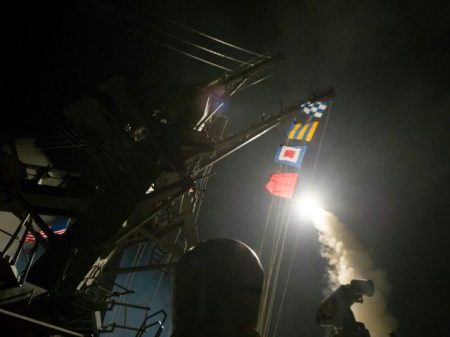
On the evening of Thursday April 6, Washington time, President Donald Trump ordered the US military to respond to the Assad regime’s recent use of chemical weapons which had “choked out the lives of helpless men, women and children.” In so doing, the US launched 59 Tomahawk Land Attack Cruise Missiles at the Shayrat Airfield in Homs belonging to the Syrian government.  The strikes, according to a Pentagon press statement, were delivered from two US destroyers stationed in the Eastern Mediterranean. According to a more recent Department of Defense evaluation, “20 percent of Syria’s operational aircraft” were wrecked by strike.

To date, international reactions have been somewhat predictable. US partners and allies in the Middle East, such as Israel and Saudi Arabia, endorsed the kinetic action. Conversely, government officials from the Syrian Arab Republic and Islamic Republic of Iran admonished the move. Such censures nonetheless provide insight into Iran’s framing of the war in Syria, as well as the methods of argumentation Iran has long used to support the Assad regime. As always, vitriolic anti-Americanism featured prominently in Tehran’s diplomatic response.

Iran’s Supreme Leader, Ayatollah Seyyed Ali Khamenei, called the strike a “strategic mistake.” He also ominously warned that the US was about “to repeat their past mistakes” in the region. “Former American officials created DAESH or helped it, and current American officials are in a state of strengthening DAESH or groups like it,” he alleged.

The conspiracy theory that the US has had a hand in the creation of the Islamic State is as old as the group itself, and is a narrative both favored and promoted by regime elites in Tehran. Over time it has even made itself manifest in elements of the Iranian population. On April 8, part of the headline above the fold on the front cover of the hardline Kayhan newspaper – whose editor-in-chief is a close Khamenei confidant – read: “America formally stood beside DAESH.”

Several other Iranian officials also framed American involvement in the region as a boost to such groups. Seyyed Hossein Taghavi-Hosseini, the spokesperson for the Iranian parliament’s hawkish National Security and Foreign Policy Committee exclaimed: “The truth is that the Americans and some regional countries which are supporters of terrorism and terrorist groups were defeated in the Syrian arena… [therefore] the Americans entered so as to revive the terrorists and develop a support umbrella for them.” Taghavi-Hosseini’s comments are designed to alter international public opinion. Should Taghavi-Hosseini’s erroneous narrative go unchecked, Iran, along with its Russian partners, could more aggressively look to offer themselves as guarantors of the regional order.

Alaeddin Boroujerdi, the Chairman of the same parliamentary committee, cited themes about perceived US desperation in his post-strike commentary. He told members of the Iranian press that, “The recent American action in Syria is indicative of the defeat of the statesmen and government of this arrogant country in the region and in the world.” Despite the obvious imbalance in capability, Iranian officials have often sought to position themselves as more adept than the US in the region, whom they accuse of being in retreat and decline. While Iran’s military assistance has been critical in the form of money, men, and munitions to the Assad regime, Iran lacks the conventional military power to project force in the region, and has therefore had to rely on tried and true asymmetric methods. For conventional force projection, Iran has turned to another state: the Russian Federation.

In a telephone call with Iran’s closest state partners, Syria and Russia, the latter of whom has provided air power and advanced Surface-to-Air Missiles to the beleaguered Assad regime, Iran’s President Hassan Rouhani similarly took to condemning the strike. Rouhani reportedly told Russian President Vladimir Putin that “We condemn America’s missile attack on Syria and believe it to be a case of gross violation of the sovereignty of an independent country which makes it necessary for this unilateral action to be investigated and condemned by the United Nations Security Council.”

The citing of the Assad regime as “independent” is in line with the Islamic Republic’s anti-Western and anti-imperialist governing ideologies. But it also draws from the lexicon of Syrian President Bashar al-Assad himself. At least twice in 2016 (once in July and once in October), the Iranian press reported comments by Assad attempting to frame his regime’s actions as measures needed to keep Syria independent because the West “cannot tolerate” or “does not accept” a sovereign Syrian state. The irony being that the longer the Assad regime lives on, the more reliant it will be on foreign patrons like Moscow and Tehran should they decide to reconquer lost territory or merely govern and hold the territory it presently controls.

Similarly, Tehran has long insisted on the “territorial integrity” of Syria, as well as that of Iraq, where it is using the campaign against the Islamic State to cement its presence through armed networks. These armed networks are seldom mentioned by Iranian diplomats.

Formally, Iran’s Foreign Minister Mohammad-Javad Zarif and its Foreign Ministry Spokesman Bahram Ghassemi also critiqued the strike. Zarif took to one of Iran’s new favorite mediums – Twitter – to berate the US for “impetuous unilateralism based on self-serving allegations.” Zarif bandwagoned on the argument made by Kayhan about the US and Salafist-terrorist groups. He purported that “Not even two decades have passed since the events of the 11th of September and America’s armed forces now fight beside al-Qaeda and DAESH in Yemen and Syria in a [unified] front.” This gross mischaracterization of recent US actions in the Middle East notwithstanding, Zarif also drew on Iran’s harrowing experiences during the Iran-Iraq War to bolster an argument against chemical weapons and WMD-use more generally.

In so doing, Zarif failed to mention that one of the strategic drivers of Tehran’s nuclear weapons program was its own eight-year conflict with Iraq. The same logic also helped guide Iran to develop and retaliate against Iraq’s chemical attacks by weaponizing pathogens of its own.

While Iranian military and religious elites also commented on the strike along themes already noted in this article, Iran’s regional proxies also weighed-in on the matter. Lebanese Hezbollah issued a press release calling the move a transgression of “Syrian sovereignty” that was ultimately in the “service of the Zionist entity.” Another militia, the Iran-linked Nujaba movement of Iraq noted via its spokesman that, “This missile attack does not change the rules of the Syrian conflict.” The spokesperson for Nujaba echoed themes about how American military action in Syria was merely a “tool… used to save terrorist groups.”

Conversely, Muqatada al-Sadr, the infamous Iraqi Shiite cleric who led the Mahdi Army (which despite being “disbanded” has been partially reconstituted into the “Peace Brigades” and is believed to be active in Syria) did not tow Tehran’s line on the strike and Assad’s future. According to reporting by Reuters, the cleric said, “it would be fair for President Bashar al-Assad to offer his resignation and step down in love for Syria, to spare it the woes of war and terrorism …and take a historic, heroic decision before it is too late.”

Despite the marked difference in tone by the leader of a prominent Shiite militia, Iranian officials have not seen the strike as inhibiting their support for Assad. While Iranian capabilities (presently comprised of ground assets often delivered by plane) do not appear to be impaired by the strike, there has been no overt escalation by Tehran at the time of this writing in the Syrian theater. Tehran also lacks the capability to respond on the same scope and scale as 59 cruise missile strikes against US assets without launching a major war. Rather, Iran appears to have fallen back on gloating, intimidation, and misinformation tactics that so often characterize Persian-language reporting. Nonetheless, Iranian officials would be wise to not write off the strike. US military power was just demonstrated on a key Iranian partner with exceeding ease. At a minimum, that should remind both Damascus and Tehran to be cognizant of escalation dynamics as the Syrian conflict drags on.

Yet, whatever the proximate cause for varying levels of Iranian activity in Syria, the root cause for the country’s continued involvement there remains the survival of the Islamic Revolution and its rejectionist message. To export this revolution and keep conflict away from Iranian territory, Tehran has continuously and successfully relied on a diverse array of non-state actors, terrorists, and armed religious networks across jurisdictions of weak central authority. But the Assad regime (both in its present incarnation under Bashar and previously under his deceased father, Hafez), has long represented the enduring value of a pro-Iranian state on Israel’s doorstep. Put differently, Tehran’s relationship with Damascus has permitted the Islamic Republic to inject hard- and soft-power into the Levantine theater for over three decades.

Time will tell if Iran will ultimately read the strike as a show of American resolve or indecision. But until then, sentiments such as those from 2013 by Hojjat al-Eslam Mehdi Taeb, the leader of the Ammar Base – an organization tasked with fighting the “soft war” – appear to be guiding Iran’s approach to the country: “Syria… is a strategic province for Iran… If we lose Syria, we will be unable to keep Tehran.”
Mission accomplished in Syria

April 12, 2017

Mission accomplished in Syria, Israel Hayom, Clifford D. May. April 12, 2017

(Accomplished or just begun? — DM)

Congress should send Trump the legislation it is now considering, seeking to impose new sanctions on Iran in reprisal for its continuing support of terrorists, its missile tests and its maintenance of more than 35,000 troops in Syria, including its own, those of its Lebanese proxy, Hezbollah, and Shiite fighters recruited from Iraq and Afghanistan. Suspending Iran’s deal with Boeing/Airbus would be useful, too. Only the willfully credulous believe that Iran’s theocrats won’t use such aircraft for illicit military purposes.

************************

If you’re still unsure about whether U.S. President Donald Trump did the right thing when he launched 59 cruise missiles at Syria’s Shayrat Air Base last week, consider the alternative.

He knew that Syrian dictator Bashar Assad had yet again used chemical weapons to murder Syrian civilians, women and children prominent among them. He knew that Iran and Russia had enabled this atrocity, as they have many others. He knew he had two choices.

He could shrug, instruct his U.N. ambassador to deliver a tearful speech calling on the “international community” to do something, and then go play a round of golf. Or he could demonstrate that the United States still has the power and the grit to stand up to tyrants and terrorists, thereby beginning to re-establish America’s deterrent capability.

In other words, this was what Sun Tzu and Carl von Clausewitz would call a no-brainer. (Well, loosely translated.) A mission was accomplished. Do harder missions lie ahead? Yes, of course. But I suspect Defense Secretary James Mattis and National Security Adviser H.R. McMaster have made that abundantly clear to the new president.

We now know for certain that Russia failed to live up to its 2013 commitment to ensure that Assad surrendered all his illegal chemical weapons under the deal it brokered. Secretary of State Rex Tillerson acerbically questioned whether that was the result of complicity or incompetence or whether Russia allowed itself to be duped by Assad.

The strike ordered by President Trump was not “unbelievably small” — then-Secretary of State John Kerry’s description of the punishment then-President Barack Obama decided not to impose in response to Assad’s earlier use of chemical weapons. It was big enough to make clear that American diplomats are again carrying big sticks. (For Obama to insist that diplomacy and force are alternatives was patently absurd.)

Conveniently, Trump was dining with Chinese President Xi Jinping when the strikes occurred. It’s fair to speculate that Xi is today thinking harder about American requests to rein in Kim Jong Un, the North Korean dictator whose drive to acquire nuclear-tipped missiles that can reach the American mainland has become what Tillerson called an “imminent” threat.

Having passed his first major national security test, Trump is now obliged to demonstrate firmness and consistency. What plans might the Pentagon have on the shelf to respond to further provocations? The next round of Tomahawk missiles could permanently ground Assad’s air force. That would make it easier to then establish no-fly zones. If such measures do not alter the calculations of Assad and his Iranian and Russian patrons, consideration could be given to leveling his defense, intelligence and command-and-control centers as well.

Another idea under discussion: setting up safe havens, or, to use a better term, “self-protection zones,” for those fleeing the Syrian regime and various jihadist forces, Sunni and Shiite alike. Israel and Jordan could help the inhabitants of such areas adjacent to their borders defend themselves. The Saudis, Emiratis and Bahrainis could contribute to the cost. Might this lead to the partition of Syria? Most likely, but it’s difficult to imagine a “political solution” that would not include such readjustments.

All this, while useful and perhaps even necessary, should be seen as insufficient. Syria is a major humanitarian catastrophe but only one piece in a much larger geopolitical puzzle. Sooner rather than later, the Trump administration needs to develop what Obama refused to contemplate: a comprehensive and coherent strategy to counter the belligerent, imperialist and supremacist forces that have emerged from the Middle East and are now spreading like weeds around the world.

The Islamic State group will of course need to be driven off the lands on which it has attempted to establish a caliphate. After that, its terrorists will have to be hunted, along with those of al-Qaida, wherever they hide (e.g., Egypt where, over the weekend, they bombed two Coptic Christian churches).

But — and this is crucial — accomplishing these missions must not serve to further empower Iran’s jihadist rulers, who dream of establishing an expanding imamate, the Shiite version of a caliphate.

Most immediately, Congress should send Trump the legislation it is now considering, seeking to impose new sanctions on Iran in reprisal for its continuing support of terrorists, its missile tests and its maintenance of more than 35,000 troops in Syria, including its own, those of its Lebanese proxy, Hezbollah, and Shiite fighters recruited from Iraq and Afghanistan. Suspending Iran’s deal with Boeing/Airbus would be useful, too. Only the willfully credulous believe that Iran’s theocrats won’t use such aircraft for illicit military purposes.

That the United States cannot solve all the world’s problems was one of Trump’s campaign themes. But the implication is not necessarily, as some of his supporters hoped, that he would turn a blind eye to all atrocities and threats not already within America’s borders.

In the last century, most Americans recognized, in some cases with enormous reluctance, that there was no good alternative to doing whatever was necessary to rout the Nazis and communists, enemies whose goal was to kill off the democratic experiment.

In this century, jihadists and Islamists harbor the same ambition. We can attempt to appease them. We can try to make ourselves inoffensive to them. We can keep our hand extended, hoping that in time they will unclench their fists. Or we can decide instead to plan for a long war that will end with the defeat of these latest enemies of America and the rest of the civilized world. If Trump has grasped that within his first 100 days, he’s not off to such a bad start.

Radical Iran-led Axis Confronted with U.S. Deterrence for First Time

April 11, 2017

Radical Iran-led Axis Confronted with U.S. Deterrence for First Time, Investigative Project on Terrorism, Yaakov Lappin, April 11, 2017

Until recently, the United States focused its attention exclusively on Sunni jihadist threats – ISIS and al-Qaida-affiliated groups. While these terrorists certainly need to be attacked, turning a blind eye to the activities of the more powerful radical Shi’ite coalition did nothing to stop the region’s destabilization. In this context, Assad’s numerous crimes against humanity went unanswered.

This helped embolden Assad to use chemical weapons. It also gave the Iranians confidence to magnify their meddling in Syria, Lebanon, Iraq, Yemen, Bahrain, and to target many other states. The end result is Iran’s enhanced ability to export its Khomeiniest Islamic fundamentalist doctrine.

Just as Iranian-backed Shi’ite militias have poured into Syria, the same has happened in Iraq, where 100,000 fighters supported by Tehran fight alongside the Iraqi government forces against ISIS. The IRGC’s network extends to Yemen’s Houthi Ansar Allah forces, who receive Iranian assistance. Ansar Allah, a heavily armed Shi’ite military force, fires ballistic missiles at Saudi Arabia on a regular basis.

The IRGC and Hizballah have been linked to a recent large-scale terrorist plot in Bahrain.

If the message addressed in the cruise missile strike is followed up with a strategy of deterrence, addressed to Ayatollah Khamenei as much as it was addressed to Assad, the U.S. could begin projecting to the world that it recognizes the threat posed by Shi’ite jihadists as much as it takes seriously the threat from their fundamentalist Sunni equivalents.

**********************

The conflict in Syria has long ceased being a civil war, becoming instead a clash between coalitions and blocs that divide the entire Middle East.

The Iranian-led axis is the most dangerous and highly armed bloc fighting in Syria. Bashar al-Assad’s regime is not an independent actor, but rather, a component of this wider axis. In many respects, Assad is a junior member of the Iranian coalition set up to fight for him.

Russia joined the Iranian axis in 2015, acting for its own reasons as the pro-Assad coalition’s air force, helping to preserve the Syrian regime.

This coalition enabled the Assad regime to conduct mass murder and ethnic cleansing of Sunnis from Syria, while also using unconventional weapons against civilians in an effort to terrorize rebel organizations into submission.

Feeling confident by its growing control of Syria, Iran also uses its regional coalition to arm, finance, and deploy Shi’ite jihadist agents all over the Middle East, and to attack those who stand in the way of Iranian domination.

The Iranian-led axis has been able to spread violence, terrorism, and Islamic militancy without facing repercussions.

Until recently, the United States focused its attention exclusively on Sunni jihadist threats – ISIS and al-Qaida-affiliated groups. While these terrorists certainly need to be attacked, turning a blind eye to the activities of the more powerful radical Shi’ite coalition did nothing to stop the region’s destabilization. In this context, Assad’s numerous crimes against humanity went unanswered.

This helped embolden Assad to use chemical weapons. It also gave the Iranians confidence to magnify their meddling in Syria, Lebanon, Iraq, Yemen, Bahrain, and to target many other states. The end result is Iran’s enhanced ability to export its Khomeiniest Islamic fundamentalist doctrine.

That sent a troubling message to America’s regional allies, who, in the face of these threats, formed a de facto coalition of pragmatic Sunni states – a coalition that includes Israel.

On April 6, the U.S. sent a signal that something may have changed. A cruise missile attack on an Assad regime air base, in response to a savage chemical weapons massacre in Idlib, Syria, was, first and foremost, a moral response to an intolerable act of evil.

But the strike also carries a wider prospective message about Washington’s new willingness to enforce red lines against Assad and his Shi’ite allies.

Potentially, it is an indication that the U.S. is willing to use its military prowess beyond the objective of targeting ISIS, and that it recognizes that Sunni jihadists are not the only global security threat that warrants the use of military force.

Statements by senior Trump administration officials indicate that a shift has occurred. “What you have in Syria is a very destructive cycle of violence perpetuated by ISIS, obviously, but also by this regime and their Iranian and Russian sponsors,” National Security Adviser H. R. McMaster told Fox News Sunday.

Russia must choose between its alignment with Assad, Iran, and Hizballah, and working with the United States, Secretary of State Rex Tillerson said Tuesday. The firm comment was made hours before he touched down in Moscow for talks.

According to U.S. officials, the April 6 missile attack destroyed 20 percent of Assad’s fighter jets. It represents the first time that Washington has taken military action against a member of the Iranian-led coalition.

The strike could evolve into a ‘dialogue of deterrence’ that the U.S. initiates against dangerous actors. These radical actors all have ‘return addresses,’ and are likely to prove responsive to cost-benefit considerations, despite their extreme ideology. They may think twice before considering further development and usage of unconventional weapons.

Washington is now able to exercise muscular diplomacy – the only kind that is effective in the Middle East – and inform all members of the Iran’s pro-Assad coalition that the deployment of unconventional weapons will not be tolerated. It can also begin to rally and strengthen the pro-American coalition of states in the Middle East, who seek to keep a lid on both ISIS and Iran.

With American officials indicating that they are “ready to do more” in Syria if necessary, signs suggest that the strike represents the start of a policy of deterrence, and leaving open future options for drawing additional red lines.

In theory, should Washington decide that Iran’s transfer of weapons and extremist Shi’ite military forces to other lands has reached unacceptable levels, or that Iran’s missile development program has gone far enough, it could call on Tehran to cease these activities. This call would carry substantially more weight following last week’s missile attack on the Syrian airbase.

The U.S. is in a better position to inform Assad and his allies that there is a limit to how far they can go in pursuing their murderous ambitions.

While the objective of creating a renewed American deterrent posture is vital, it should not be confused with plans for wider military intervention in the seemingly endless Syrian conflict.

There is little reason to believe that conventional weapons use against Syrian civilians is going to stop any time soon, or that the enormous tragedy suffered by the Syrian people is about to end.

And there is certainly no indication that the U.S. is planning to initiate large-scale military involvement in this failed state.

Hence, the missile strike should be seen for what it is: an attempt to boost American deterrence, which can then be leveraged to restrain radical actors that have, until now, been operating completely unchecked.

That is a message that will likely be heard loud and clear not only in Damascus, but also in Tehran, which has not given up its long-term ambition of building nuclear weapons.

North Korea, which helped build Syria’s plutonium nuclear plant (destroyed in 2007 in a reported Israeli air strike), and which maintains close links with Iran’s nuclear and missile programs, can be expected to take note as well.

If a policy of strategic deterrence follows the strike, it could have an impact on a coalition that is not just keeping Assad’s regime alive, but spreading its radical influence in many other areas.

In Syria, the Iranian Republican Guards Corps (IRGC) oversees ground operations across many battlefields to prop up Bashar al-Assad. Iran has gathered and armed tens of thousands of Shi’ite militia members from across the region into Syria, and manages a local force composed of 100,000 members. They fight alongside the Syrian Arab Army against Sunni rebel organizations, thereby increasing and entrenching Iranian influence.

The IRGC and its elite Quds Force are also helping to fill Hizballah’s weapons depots in Lebanon, with a vast array of surface-to-surface projectiles that are all pointed at Israel, often using Syria as an arms trafficking transit zone. Syria acts as a bridge that grants Iran access to Lebanon, and allows it to threaten both Israel and Jordan.

Jordan, an important U.S. ally, is deeply concerned by Iran’s actions in Syria, as evidenced by recent comments made by King Abdullah, who told the Washington Post that “there is an attempt to forge a geographic link between Iran, Iraq, Syria and Hezbollah/Lebanon.” IRGC forces are stationed within a mere 45 miles from Jordan’s border, he warned, adding that any hostile forces approaching the Hashemite Kingdom “are not going to be tolerated.”

Hizballah, a Lebanese-based Iranian Shi’ite proxy, evolved into a powerful army by sending 7,000 to 9,000 of its own highly trained members into Syria’s ground war. It helped rescue the Assad regime from collapse, and took part in battles stretching from Aleppo to the Qalamoun Mountains northeast of Damascus.

Last year, the Arab League and the Sunni countries of the Gulf Cooperation Council all declared Hizballah to be a terrorist entity.

Just as Iranian-backed Shi’ite militias have poured into Syria, the same has happened in Iraq, where 100,000 fighters supported by Tehran fight alongside the Iraqi government forces against ISIS. The IRGC’s network extends to Yemen’s Houthi Ansar Allah forces, who receive Iranian assistance. Ansar Allah, a heavily armed Shi’ite military force, fires ballistic missiles at Saudi Arabia on a regular basis.

The IRGC and Hizballah have been linked to a recent large-scale terrorist plot in Bahrain.

If the message addressed in the cruise missile strike is followed up with a strategy of deterrence, addressed to Ayatollah Khamenei as much as it was addressed to Assad, the U.S. could begin projecting to the world that it recognizes the threat posed by Shi’ite jihadists as much as it takes seriously the threat from their fundamentalist Sunni equivalents.

Washington’s campaign to pressure Russia to distance itself from its Middle Eastern allies could play an important part of this message.

After Syrian Gassing, Trump Must Expose the Iran Deal

April 10, 2017

After Syrian Gassing, Trump Must Expose the Iran Deal, PJ Media, Roger L Simon, April 9, 2017

Among the more disturbing questions emerging from the renewed use of gas by Bashar Assad is whether Barack Obama and his loyal minions (Kerry, Rhodes, Rice, etc.) actually knew the Syrian leader still had chemical weapons, even though they trumpeted the opposite to the American public on numerous occasions. Either they lied or were so extraordinarily credulous they believed — apparently without verification — the Syrians had truly rid themselves of those WMDs, in which case Obama — not Trump — was Vladimir Putin’s personal “useful idiot.”

(It may even be time to take a second look at the contention of some that Saddam transferred his chemical weapons to Syria way back when, which would be a surprise vindication of Bush 43.)

Whatever the case, it’s “heavy water” under the bridge at this point, but should alert us even more to the absolute necessity of revealing everything known about the also Obama-instigated Iran Deal, all its myriad hidden codicils and clauses that remain mysterious to the citizens of this country in whose name they were allegedly signed. That agreement too could be the product of useful idiocy, a sucker punch from the mullahs.  The devil, in this case, is very much in the details, few of which we know, except that the Iranians refused to give a baseline development level for their nuclear weapons program in this first place. In a sense, that made everything else moot.

Nevertheless, Iran has been the beneficiary of this deal to the tune of billions of dollars, some evidently in cash, much of which has been and is being spent in Syria, if not directly on chemical weapons, on a war that no less than the former chief rabbi of Israel, himself a Holocaust survivor, has called another Holocaust.  Iran is also using the money to finance Hezbollah in that war, simultaneously arming those terrorist thugs with tons of modern weapons, including long range missiles, even while the mullahs use Hezbollah’s guerrillas as cannon fodder to spare Iran’s own quasi-terrorist Revolutionary Guard. The Islamic Republic’s obvious goal is to control both Syria and Iraq by proxies.  A victorious Assad would be Iran’s boy as much as Russia’s, possibly more.

The Trump administration should expose this deal in its entirety to public view now.  If that means Iran pulls out of the agreement — as they have warned — so be it.  The transparency is worth whatever minimal insurance against a nuclear-armed Iran might be inherent in these evanescent documents.  After seeing just how much insurance against chemical weapons was inherent in Obama’s deal with Putin over the crossing of our then-president’s “red line,” one could be skeptical that there is any at all.  Indeed, what little we know of the Iran Deal leads one to believe that it would be simple for the mullahs to be as busy as ever on their nuclear program.  That they are allied with North Korea makes this all the more likely.

Further to be investigated is Obama’s peculiar desire to make a deal with these same mullahs from the very beginning of his administration or even before. Indeed, Obama representatives have been accused of meeting with both Hamas and Iran during his first presidential campaign. These meetings are better documented than Trump’s supposed collusion with Putin, which seems so unlikely now.

In a continuation of that behavior, Obama later famously ignored the pleas for support by the Iranian pro-democracy demonstrators during the Green Revolution of 2009.  “Obama, you are either with us or are you with them!”  they chanted.  Obama was evidently with them. He didn’t want to disrupt his rapport with Ahmadinejad in order to make his dreamed-of deal. (You can see it all on YouTube here.  As we used to say in the sixties, “Which side are you on?”)

Obama and Kerry then welcomed the election of Hassan Rouhani, whom their cheering section in the willfully ignorant mainstream media ludicrously called a “moderate” when he was, if anything, worse than Ahmadinejad and has since been responsible for many more murders of political prisoners than his predecessor.  They made their deal with Rouhani, who is obviously now cooperating in the maintenance of peace…. Well, not exactly.

What’s behind all this? As I said at the outset, this is disturbing — liberalism and progressivism turned upside down, at least according to their own self-described principles. Everything is situational. That Democrats like Schumer and Pelosi were so positive about Trump’s actions in Syria is a sure sign that not so deep down they were more than a little uncomfortable when Obama did nothing after a similar gassing.  Like a lot of people I would imagine, they had to bury their feelings and opinions in the name of party loyalty, what the French called mauvaise foi.  They should have felt the same way yet more intensely after Obama’s execrable non-reaction to the Green Revolution.  Maybe they did, but we’ll never know until someone leaks it out in a memoir. We didn’t need to send in the Marines.  All Obama would have had to have done was to say a few words of encouragement echoed by the international community and the revolution might have happened.  It was close enough.

Thank God there’s a new sheriff in town. Maybe there will be some hope for the citizens of Iran, eventually, some support for regime change after eight years of kowtowing to the mullahs.  But for now lets at least clear up the terms of the mysterious deal, its provenance and its usefulness, if any.  No time like the present.

U.S. airstrikes in Syria a smackdown for Iran’s mullahs

April 9, 2017

U.S. airstrikes in Syria a smackdown for Iran’s mullahs, American ThinkerReza Shafiee, April 9, 2017

(According to Iranian President Rouhani, “today all terrorists in Syria are celebrating the U.S. attack.” Rouhani evidently does not view Assad’s enforcers, Khamenei’s Revolutionary Guard or Iranian proxies such as Hezbollah as “terrorists.” The Syrian in this video must, according to Rouhani, be a terrorist. — DM)

Iranian president Hassan Rouhani strongly defended Assad regime’s recent sarin attack on his own people. He blasted President Trump for his decision for airstrikes. Rouhani said in a televised speech referring to the U.S. president: “This man who is now in office in America claimed that he wanted to fight terrorism, but “today all terrorists in Syria are celebrating the U.S. attack.” He also said: “Why have you attacked the Syrian army which is at war with terrorists? Under what law or authority did you launch your missiles at this independent country?”

To put more teeth to what U.S. means in terms of ending Iran’s influence in Syria, an even more effective step forward would be to expel the IRGC and all its proxies from Syria. It would certainly help with the broader war in the region against Islamic fundamentalism in all its shapes and forms. To get rid of terrorism, get rid of the Iran’s proxies.

***************************

The deadly chemical attack on innocent Syrian men, women and children in Idlib, which killed at least 100 and injured 400 was little more than Syrian dictator Bashar al-Assad crossing the “red line” again. It wasn’t his first chemical attack, he launched a similar attack in summer of 2013, which left at least 1400 dead, according the opposition sources. At that time, the world stared in disbelief as Assad commit atrocities in Syria without paying a price.  

This time, things were different. On April 7 the U.S. launched an airstrike on an airfield believed to have been used by his forces to drop chemical bombs on Idlib. It was a clear sign of shift in the U.S. attitude toward his regime. Other nations announced support, too, making the attitude shift more than just unilateralism.

President Donald Trump said after the U.S. airstrike: “Tonight, I call on all civilized nations to join us in seeking to end the slaughter and bloodshed in Syria and also to end terrorism of all kinds and all types.”

The airfield bombed is significant, because it is also used by members of Islamic Revolutionary Guard Corps (IRGC) and the Quds Force, according to a report from Asharq Al-Awsat Arabic language website. The field has been used for a long time by IRGC to operate not only in Syria but also in Iraq.

Since the start of the bloody six-year-old Syrian war, Bashar al-Assad and his allied goons, the Islamic Revolutionary Guard Corps (IRGC), including Quds Force commander Qasem Soleimani, thought that they could get away with anything.

They relied on the notion that the international community is too divided to take any firm action against the massacre of innocent Syrian people. So they thumbed their noses at every element of international law. Soleimani was caught on camera many times in Iraq and later in Aleppo walking around unencumbered as if he was a tourist there and not the international thug he was, blacklisted by UN resolutions banning him from traveling.

The reaction of the world’s leaders to the attack was a stark contrast to previous years in the Syrian conflict, too. Instead of knee-jerk opposition to Trump, there as almost a consensus about the fact that Assad must face the consequences of his actions; something long overdue.

In a joint statement, German Chancellor Angela Merkel and French President Francois Hollande laid the blame for the U.S. airstrikes on Assad’s Al-Shayrat airfield solely on Assad.

They said: “President Assad alone bears responsibility for this development.”  and “His repeated use of chemical weapons and his crimes against his own population had to be sanctioned.”

The Syrian opposition welcomed the airstrikes with joy and almost disbelief that after so many years of inaction, despite repeated calls on the U.S. to act against Assad regime, the moment finally arrived with the Tomahawk missiles.

Nikki Haley, the U.S. ambassador to the United Nations, told the UN Security Council: “The United States took a very measured step last night. We are prepared to do more, but we hope it will not be necessary.”

One of the few big exceptions to this moment of moral clarity was in the predictably repellant reaction from Iran.

Iranian president Hassan Rouhani strongly defended Assad regime’s recent sarin attack on his own people. He blasted President Trump for his decision for airstrikes. Rouhani said in a televised speech referring to the U.S. president: “This man who is now in office in America claimed that he wanted to fight terrorism, but today all terrorists in Syria are celebrating the U.S. attack.” He also said: “Why have you attacked the Syrian army which is at war with terrorists? Under what law or authority did you launch your missiles at this independent country?”

The United States Senate was quick to reciprocate President Trump’s action on behalf of the Syrian people by introducing a new bill to ensure further extend measures safeguarding human rights for innocent Syrian citizens.  The bill, titled the Syrian War Crimes Accountability Act was introduced on April 6 to instruct the Secretary of State to report on war crimes, crimes against humanity, and genocide in Syria, as well as to authorize assistance for investigations and other credible transitional justice efforts, including a potential hybrid tribunal, in a bid to hold Assad and his regime accountable for their heinous acts.

A durable solution to Syrian crisis is something hardly disputable by anyone. The U.S. administration through its UN Ambassador Nikki Haley reiterated again on an interview with CNN on Sunday that a long term solution for Syria with Assad in the picture is not possible to imagine. She also pointed to Assad’s main sponsor, the mullahs in Iran, as a major obstacle to peace in the war-torn country and the need to end the Iranian regime’s “influence” in Syria.

The mullahs’ “influence” is something which should not be taken lightly. The Syrian people’s peaceful uprising against the Assad’s dictatorship in 2011 could have taking a different turn had it not been for the IRGC and Quds Force stepping up in full support of the regime in Damascus.

The Assad regime was on the edge in 2013 and outside the capital it had no control over the rest of the country. With the aid of mullahs who spent billions in Syria while their own people at home were hungry, and the inaction of Obama administration by turning a blind eye to Assad’s crossing its established “red line,” the Syrian dictator survived.

Now it seems that a new plan is unfolding in Washington to stop the genocide in Syria with the U.S. administration’s firm respond to Assad’s use of chemical weapons against his people. The attack may not have a major military significance but it has firm political tone to it. The action no doubt has resonated as far east as Tehran.

To put more teeth to what U.S. means in terms of ending Iran’s influence in Syria, an even more effective step forward would be to expel the IRGC and all its proxies from Syria. It would certainly help with the broader war in the region against Islamic fundamentalism in all its shapes and forms. To get rid of terrorism, get rid of the Iran’s proxies.

KLEIN – Iran Is the Wild Card Following U.S. Air Strikes In Syria

April 7, 2017

KLEIN – Iran Is the Wild Card Following U.S. Air Strikes In Syria, BreitbartAaron Klein, April 7, 2017

U.S. Navy/via AP

President Vladimir Putin cannot risk a military confrontation with Trump and Russia is already signaling willingness to abandon Assad to come to a larger regional accommodation.

Still, there is the possibility that Russia may quietly support action by others, especially agents of a very nervous Iranian regime that has been preparing proxies for years who can heat up Israel’s northern border and beyond.  Both Moscow and Tehran have reason for wanting Trump to pay a price for acting in their Syrian playground.  The question is whether they will dare to respond, even tacitly.

The next few days and weeks will be critical in determining Iran and Russia’s resolve in the face of an awakened America that has returned from its eight-year slumber.

******************************

TEL AVIV – Following the U.S. launch of Tomahawk missiles targeting a strategic Syrian airfield on Thursday night, Iran must be monitored carefully for the possibility that it may use its proxies for retaliation, especially against Israel’s northern border.

Following eight years of inaction on Syria under the Obama administration, President Donald Trump demonstrated last night that he is willing to hold Syrian President Bashar al-Assad to account, this time by striking the Shayrat Airfield near the Syrian city of Homs that was believed to have been utilized to carry out a chemical weapons attack that killed scores of civilians.

The U.S. airstrikes signaled to Assad and his Russian and Iranian backers that Trump will act in Syria and the administration strongly supports the removal of the Syrian president – an important strategic ally of Moscow and Tehran. The U.S. military move demonstrates to Israel and the Sunni Arab bloc cast aside by Obama’s nuclear deal with the mullahs that American leadership has officially returned to the region.

Assad himself is unlikely to retaliate since the last thing he wants amidst a years-long insurgency attempting to topple his regime is to go to war with Trump or expand the battlefield to U.S. ally Israel.

Trump’s bold authority in Syria directly threatens Russian interests since it was Moscow that largely filled the security vacuum in that country when Obama repeatedly failed to take any meaningful action against Assad. However, Russia’s direct response will most likely be confined to vocal protestation, such as Kremlin spokesman Dmitry Peskov calling the U.S. strikes “aggression against a sovereign nation” carried out on a “made-up pretext.”

President Vladimir Putin cannot risk a military confrontation with Trump and Russia is already signaling willingness to abandon Assad to come to a larger regional accommodation.

Still, there is the possibility that Russia may quietly support action by others, especially agents of a very nervous Iranian regime that has been preparing proxies for years who can heat up Israel’s northern border and beyond.  Both Moscow and Tehran have reason for wanting Trump to pay a price for acting in their Syrian playground.  The question is whether they will dare to respond, even tacitly.

And that brings us to Iran.  Trump’s embrace of America’s traditional Sunni Arab partners at the expense of Tehran and his strong positions against the disastrous international nuclear agreement have been deeply concerning to the expansionist, terrorist-supporting Twelvers in Tehran.  And while the removal of Assad from power would be a blow to Russia, depending on the ultimate outcome such a move could be disastrous for Iran’s position in Syria.  Iranian Revolutionary Guard units have been fighting the anti-Assad insurgents alongside the Syrian military and the Iran-backed Hezbollah militia.  Syria represents a key pawn in Iran’s geopolitical chessboard that stretches across the vital region.

In recent weeks, there have been strong indications that Iran has been seeking to arm its Hezbollah proxy with even more advanced weapons that can target the Jewish state. Last month, Israel took the unusual step of striking a Hezbollah weapons convoy near the city of Palmyra that Prime Minister Benjamin Netanyahu said was transporting advanced weapons to the Iran-backed militia.

Israeli leaders and Hezbollah terrorists have in recent weeks ratcheted up war rhetoric, with Israeli officials warning that Hezbollah, which can only act at the direction of Iran, has been preparing for conflict.

Last Sunday, IDF Chief of Staff Lt. Gen. Gadi Eisenkot warned the IDF would not hold back from striking Lebanese state institutions in a future conflict with Hezbollah. “The recent declarations from Beirut make it clear that in a future war, the targets will be clear: Lebanon and the organizations operating under its authority and its approval,” Eisenkot stated.

Hezbollah is not Iran’s only option. Breitbart Jerusalem has been reporting on the formation of a “Golan Liberation Brigade,” which was announced last month by the secretary-general of the Iraqi Harakat al Nujaba Shiite militia and is reportedly being trained by the Iranian Revolutionary Guard Corps.  The so-called militia is another Iranian front that could be used to target Israel’s Golan Heights at the behest of Tehran.

The next few days and weeks will be critical in determining Iran and Russia’s resolve in the face of an awakened America that has returned from its eight-year slumber.

The Real War in ‘Syria’ and the Strategy for Long-Term Victory

April 7, 2017

The Real War in ‘Syria’ and the Strategy for Long-Term Victory, PJ MediaMichael Ledeen, April 6, 2017

(Iran is ripe for regime change and the sooner the better. Please see also, Iran’s Elections: A Breaking Crisis? and All 15 Arab Summit resolutions blast Iran.– DM)

Syria’s President Bashar al-Assad (Reuters, RTX34BQA)

Punishing Assad would be satisfying, but we’ve got a big war to win. It’s smarter and more effective to go after the regime in Tehran. Not militarily, but rather supporting the tens of millions of Iranians who detest the Khamenei regime. Call it political warfare, or subversion, or democratic revolution. It worked against the Soviet Empire, and there are good reasons to believe it would work in Iran as well. Most Iranians, suffering under the failed regime, want a freely chosen government that will address their problems instead of dispatching their husbands and sons sent to the battlefield.

Regime change in Iran would be devastating to Assad and Putin, and its positive effects would be felt in North Africa and our own hemisphere, striking at the Revolutionary Guards and Hezbollah in Latin America. And it would remind the tyrants that America’s greatest weapon is political. We are the most revolutionary country in the world, and we should act like it.

****************************

Of course I loathe Assad. And of course I despise the Obamans for that phony red line and the subsequent retreat-and-bogus-Russian-deal. But just carrying out vengeance against Assad isn’t good enough. It fails to address the central problem of our time: the global anti-American alliance.

There is no Syria any more, and the enemy forces on the Middle Eastern battlefield come from various jihadi groups, and three regimes: Moscow, Tehran, and Damascus. We have to defeat them all, and other members of the enemy alliance, including Cuba and North Korea. Nikki Haley has it right: “The truth is that Assad, Russia and Iran have no interest in peace.”

Indeed, they are waging war, and the principal force driving that war is not Assad, but Iranian Supreme Leader Ali Khamenei. Khamenei’s killers have been alongside Assad’s from the very beginning, as the survival of the Syrian dictator is crucial to Iranian ambitions and quite likely also the survival of the Islamic Republic itself. Listen to Defense Secretary James Mattis a few days ago (from Reuters):

Asked about comments Mattis made in 2012 that the three primary threats the United States faced were “Iran, Iran, Iran,” Mattis told reporters that Iran’s behavior had not changed in the years since.

“At the time when I spoke about Iran I was a commander of US central command and that (Iran) was the primary exporter of terrorism, frankly, it was the primary state sponsor of terrorism and it continues that kind of behavior today,” Mattis said.

True, and Mattis’ characteristically strong language points the way to the best American action in the region, namely bringing down the Tehran regime. Lashing out at Assad isn’t nearly good enough. After all, what strategic objective would we accomplish by smashing, even removing, Assad? The Iranian and Russian fighters would still be there, as would the Islamist forces. The demands on our military would dramatically expand. We do not want to occupy a significant land mass in what used to be called Syria, nor do we seem to have sorted out what we want to do with the Turks and the Kurds.

Punishing Assad would be satisfying, but we’ve got a big war to win. It’s smarter and more effective to go after the regime in Tehran. Not militarily, but rather supporting the tens of millions of Iranians who detest the Khamenei regime. Call it political warfare, or subversion, or democratic revolution. It worked against the Soviet Empire, and there are good reasons to believe it would work in Iran as well. Most Iranians, suffering under the failed regime, want a freely chosen government that will address their problems instead of dispatching their husbands and sons sent to the battlefield.

Regime change in Iran would be devastating to Assad and Putin, and its positive effects would be felt in North Africa and our own hemisphere, striking at the Revolutionary Guards and Hezbollah in Latin America. And it would remind the tyrants that America’s greatest weapon is political. We are the most revolutionary country in the world, and we should act like it.

Iran Sponsored Shi’a Militia Launches Terror Group to Fight Israel

April 5, 2017

Iran Sponsored Shi’a Militia Launches Terror Group to Fight Israel, Investigative Project on Terrorism, April 5, 2017

Israel is very concerned with the establishment of Iranian-led terrorist bases in the Golan Heights. Hizballah openly seeks to consolidate its presence in the region and launch attacks against Israel from a new front in a future war.

**************************

An Iranian supported Shi’a militia, Al-Nujaba, says it formed the “Golan Liberation Army” to fight Israel, the Middle East Media Research Institute (MEMRI) reports.

“This army has been trained and has detailed plans. If the Syria regime asks us to, we are ready to act to liberate the Golan [from Israel] along with our allies,” Al-Nujaba spokesman Hashem Al-Mousawi said in a March 8 interview with Iran’s Tasnim news agency.

Al-Mousawi also admitted that the new militant group is “part of the PMU [Popular Mobilization Units],” an Iraqi-backed umbrella organization comprised of numerous Shi’a militias, including some with close ties to Iran. The Golan Liberation Army emerged from the Iranian led “resistance” axis and consists of “special forces who have received training and equipment,” he said.

“Iran is the only country that has helped us,” Al-Mousawi said, “and sent us its military advisors, led by Qassem Soleimani.”

Soleimani, the commander of the Iranian Revolutionary Guards Corps’ (IRGC) Quds Force, is tasked with advancing Iran’s regional expansion and terrorist networks. Since September 2015, Iran increased its forces in Syria from hundreds to thousands to support Hizballah terrorists acting at Iran’s behest in propping up the Bashar al-Assad regime.

Despite Iran’s commitment to Syria, the Islamic Republic is establishing terrorist networks in the Golan Heights, using Hizballah, Druze, and Palestinian Islamic Jihad (PIJ) operatives to target Israel. The new Golan Liberation Army shows that Iran is now diverting Iraqi militia assets from fighting ISIS to confront the Jewish state.

Soleimani’s Quds Force financed most of the Iraqi-Shi’ite militias and provided them with weapons specifically to target American soldiers. With Hizballah’s assistance, the Quds Force supplied terrorists with powerful explosive devices that killed numerous American and coalition troops in Iraq.

Israel is very concerned with the establishment of Iranian-led terrorist bases in the Golan Heights. Hizballah openly seeks to consolidate its presence in the region and launch attacks against Israel from a new front in a future war.

President Trump and King Abdullah II Hold a Joint Press Conference

April 5, 2017

President Trump and King Abdullah II Hold a Joint Press Conference, White House via YouTube, April 5, 2017

Sisi as key to Arab anti-ISIS pact with Israel

April 3, 2017

Sisi as key to Arab anti-ISIS pact with Israel, DEBKAfile, April 3, 2017

(Please see also, Restore the U.S.-Egyptian Strategic Alliance, Designate the Muslim Brothers as Terrorists. — DM)

Our Washington sources report that President Trump aims to complete his plan for bringing together Egypt, Saudi Arabia, Jordan and Israel on a new footing by September.

*********************************

US President Donald Trump’s first face to face with Egyptian President Abdel-Fatteh El-Sisi at the White House Monday, April 3, focuses on four main topics, DEBKAfile reports: The fight against Islamist State terror rampant in Egyptian Sinai and neighboring Libya; topping up US military assistance to Cairo, aid for easing Egypt’s dire economic straits and, finally, the effort to bolster normal relations between the Arab world (including the Palestinians) and Israel.

From the moment he assumed the Egyptian presidency in June 2014, El-Sisi has waged a never-ending war on Islamist terror against Ansar Beit-al Maqdis, which later pledged alliance to the Islamic State’s leader Abu Bakr Al-Baghdadi. The Egyptian army has so far been worsted.  The Egyptian president is not deaf to the criticism of the Second and Third Armies’ failure to overcome a few thousand armed men, even though they can at a moment’s notice raise several thousand more fighters from the Bedouin tribes of Sinai. US intelligence has rated the Egyptian forces as slow-moving and unwieldy; but for limited forays, its contingents preferring to sit safely in their barracks rather than risk going out and pursuing the enemy across the Peninsula.

Shortly before President El-Sisi’s trip to Washington, the Egyptian air force conducted intense bombardments of ISIS concentrations around the northern town of El Arish, killing at least 14 terrorists, nabbing 22 and seizing large caches of roadside bombs. But they too long delayed bearding the Islamists in their main stronghold atop Mount Jabal Hala in central Sinai. ISIS is therefore free to move around the territory and strike at will, the while expanding its operations into Egypt proper.

The weekend air strikes came after months in which ISIS overran sections of El Arish, Sinai’s biggest town (pop: 100,000). Their grip is such that Egyptian forces no longer dared venture into those lawless neighborhoods, especially at night. Earlier this year, terrible persecution including executions forced the few thousand indigenous Christians, most of them Copts, to flee their homes in El Arish. Egyptian forces proved unequal to safeguarding the US-led international observer force (MFO) monitoring the 1972 Egyptian-Israel peace treaty at a nearby station.

American military aid to Egypt stands today at $1.3bn a year. Even though the US president means to slash foreign aid programs, he may make an exception in this case and expand military assistance -, possibly in the coin of advanced military hardware, given the country’s unending frontline battle against Islamist terror.

Its presence in El Arish, 130km from the Egyptian-Israeli border, plants the peril on the doorsteps of Egypt’s neighbors as well: Northern Sinai borders on Israel, its northwestern district shares a border with the Gaza Strip, abutting in the east on Jordan and in the southwest on Libya. The cities of western Sinai sit on the banks of the Suez Canal.

The Islamic State’s Sinai affiliate is closely allied with Salafi organizations in the Gaza Strip and works hand in glove with its Palestinian Hamas rulers, especially in the lucrative arms-smuggling business.

Al-Baghdadi last year posted a group of Iraqi officers in his service to the Sinai contingent. They travelled through southern Jordan to reach the peninsula. The Islamist cells in Libya have moreover made ISIS-held turf in Sinai their safe highway for traveling undetected to their other strongholds across the Middle East.

To stamp out this sprawling, multi-branched menace, the Trump administration needs to bring Egypt, Jordan and Israel into a coalition for a sustained, common campaign.

The Obama administration, which boycotted President El-Sisi for persecuting Egypt’s Muslim Brotherhood, tried unsuccessfully to build Turkey, Egypt and Israel into a counterterrorism pact. The Trump administration, for which the Brotherhood is anathema, has a better chance. But first, relations between the Arab world and Israel need to be placed on a regular footing. Some groundwork already exists in the informal bilateral military ties Egypt and Jordan maintain with Israel. DEBKAfile’s military sources have revealed in past reports the limited give-and-take relations for fighting terror Saudi Arabia and Abu Dhabi maintain with Israel.

The US President’s advisers recognize that before a broad, effective front against ISIS and Al Qaeda can be put together from these partial, often covert ties, progress is necessary towards normalizing relations between the Arab governments and the Jewish state, including the Israeli-Palestinian track.

Trump will certainly want to hear what role his Egyptian guest is willing to take for bringing this process forward. He will ask his next Middle East visitor, Jordan’s Abdullah II, the same question, when he arrives in Washington Tuesday. As for the Palestinian leader Mahmoud Abbas, he was promised an invitation to the White House this month, but not yet been given a date. He is clearly being left to wait until the senior players in the region have had their say. Our Washington sources report that President Trump aims to complete his plan for bringing together Egypt, Saudi Arabia, Jordan and Israel on a new footing by September.