Posted tagged ‘Iranian proxies’

Next challenge for US after Ramadi defeat: Iranian ship nears Yemeni shore

May 19, 2015

Next challenge for US after Ramadi defeat: Iranian ship nears Yemeni shore, DEBKAfile, May 19, 2015

Iran_Shahed_21.5.15Iranian aid vessel with “medical relief” personnel

DEBKAfile’s analysts strongly doubt that the USS Theodore Roosevelt carrier and strike force, which have been monitoring the Iranian flotilla’s movements, will be ordered to intervene against the Iranian ships reaching the Yemeni port.

Tehran, for its part has threatened to treat any such inspections as an act of war.

********************

Tuesday, May 19, two days after Ramadi’s fall to the Islamic State landed a major blow to Baghdad and US strategy in the region, 10,000 troops – more than half American – ended a large US-led military exercise in Jordan that was designed to practice tactics for countering ISIS. Taking part surprisingly in the two-week exercise was a heavy US nuclear-capable B-52H bomber, which flew in from the United States, crossing through Israeli air space and returning to home base when it was over.

This was the first time in the 12 years since the US invasion of Iraq that a B-52H, which can deliver nuclear weapons and bunker buster bombers, has appeared in Middle East skies for any military mission.

East of Jordan, as some 25,000 refugees from Ramadi slept in the open, the Islamist conquerors began moving on their next target, the Habbaniyah air base some 70 km west of Baghdad. Its fall would cut Baghdad off from northern and eastern Iraq and place it under siege from three directions – north, east and west.

Most Arab members have dropped out of the US-led coalition committed to fighting the Islamist terrorists in Iraq and Syria. This has left the US Air Force to bear the brunt of the aerial campaign. Its average of 19 air strikes a day is far too few to have any real effect on ISIS’s battle momentum. It certainly did not stop the long columns of black-clad Islamist fighters swarming on Ramadi from all directions in hundreds of tanks, APCs and minivans armed with heavy machine guns, and taking control of the capital of Iraq’s largest province, Anbar.

Western intelligence from the Ramadi region offered disturbing accounts of thousands of fully-armed ISIS fighters springing up apparently from nowhere to descend on the city, with no one able to see where they came from and no air action to scatter them before they entered the city.

After the Ramadi defeat, the Obama administration’s next major test in the region comes from an Iranian cargo vessel heading, accompanied by two warships, for the Yemeni Red Sea port of Hodeida and scheduled to dock Thursday, May 21. According to Tehran, the ship will unload 2,500 tons of humanitarian aid for Yemen, and the hundreds of passengers who disembark are Red Crescent medical relief workers.

The Saudi, US and Egyptian fleets have imposed a sea and air blockade on Yemen to prevent Iran provding the Yemeni Houthi rebels with fresh arms. Saudi and other regional intelligence agencies are convinced that the “paramedics” are in fact Revolutionary Guards officers and instructors in disguise, sent to strengthen the Houthi revolt.

Washington, Riyadh and Cairo have all vowed to stop the Iranian flotilla from putting into port in Yemen and said that its vessels will be forced to submit to inspections to make sure no illicit weapons are aboard and to confirm the passengers’ identities.

Tehran, for its part has threatened to treat any such inspections as an act of war.

Deputy Revolutionary Guards Commander Gen. Masoud Jazayeri put it plainly when he said: “I am distinctly stating that the patience of Iran has limits. If the Iranian aid ship is prevented from reaching Yemen then they, Saudi Arabians and United States, should expect action from us.”

DEBKAfile’s analysts strongly doubt that the USS Theodore Roosevelt carrier and strike force, which have been monitoring the Iranian flotilla’s movements, will be ordered to intervene against the Iranian ships reaching the Yemeni port. It is not a good moment for President Barack Obama to upset Tehran when he is in dire need of the Iraqi Shiite militias controlled by Iran to stand up to ISIS before its columns reach Baghdad.

Without the US, it is hard to see Saudi and Egyptian warships directly engaging an Iranian naval force and risking a major military conflagration.

Therefore, just as the B-52H came and went without action to impede ISIS’s creep closer to Baghdad, the Roosevelt is not likely to halt Iranian warships before they reach Yemen.

How the Islamic Republic Is Manipulating the U.S.

May 19, 2015

How the Islamic Republic Is Manipulating the U.S., Front Page Magazine, May 19, 2015

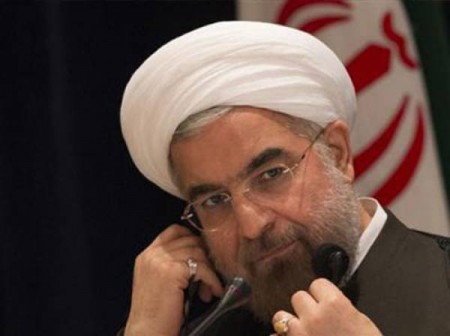
iran-s-rouhani-phones-pm-nawaz-after-soldier-s-killing-1395854702-4802-450x336

Rouhani and the moderate camp have persuaded Ayatollah Ali Khamenei that superficial diplomatic ties with the Obama administration will, in fact, empower the Islamic Republic, further its hegemonic ambitions, and raise Tehran’s economic status without the need for the Iranian leaders to give up on their revolutionary principles, anti-Americanism and anti-Semitism.

****************

There is a crucial Machiavellian (but not a strategic) tactical shift in the Islamic Republic’s foreign policy and its pursuit of regional preeminence.

First of all, Iranian leaders have realized that by superficially showing the Obama administration that the Islamic Republic is willing to restore diplomatic ties with his administration, they can in fact further advance their ideological and national interests.

Second, knowing that President Obama is desperate for a “historic” nuclear deal and the establishment of diplomatic ties with the Islamic Republic, Iranian leaders have played the role very well by attempting to satisfy President Obama’s empty goals.

Third, the ruling clerics of the Islamic Republic became cognizant of the fact that dealing with the Obama administration does not necessarily mean that they have to give up anything with respect to its domestic suppression, revolutionary Islamist principles, human rights abuses, regional hegemonic ambitions, anti-Americanism, hatred towards Israel, and foreign policy objectives.

The tactical shift, currently, is to satisfy President Obama’s personal and shallow objectives by allowing him to project that he is making historic moves (such speaking on the phone with the Iranian leaders), while simultaneously pursuing their own ideological objectives.

For example, most recently, Rouhani and the Obama administration agreed on opening new diplomatic offices in Tehran and Washington. For President Obama, opening diplomatic offices can be viewed as another “historic move” cited in his records or on his Wikipedia page. From the perspective of Iranian leaders, it is a crucial pillar for the advancement of Iran’s foreign policy and ideological objectives in the region without pressure from the US.

To pursue their objectives more efficiently, Iranian leaders have agreed to meet frequently with the diplomats at the highest level of the Obama administration, “negotiating,” and having some of their interactions publicly televised on American and Western media. In addition, the American and the Iranian flags are repeatedly shown next to each other in the high level meetings.

These moves, in fact, give legitimacy to the theocratic regime to further its ambitions.

The president was also delighted to make another “historic move” by speaking on the phone with his Iranian counterpart, President Hassan Rouhani. (One would wonder what a great accomplishment it is to pick up a phone and call another president.)

Washington and Tehran broke diplomatic ties in 1979. After the hostage crisis, high American officials and diplomats have not set foot on the Iranian soil due to Iran’s continuous violation of international norms and anti-Americanism.

Nevertheless, President Obama and Secretary of State John Kerry have decided to turn a blind eye on Iran’s egregious human rights abuses, aggressiveness and violations of international laws.

In another shallow move, Kerry claimed to be proud to set foot on Iranian “territory.” He met with Iran’s Foreign Minister, Mohammad Javad Zarif, at the residence of the Iranian ambassador to the United Nations, Gholamali Khoshroo, in New York.

Instead of attempting to change the behavior of the Ayatollahs and their revolutionary principles, President Obama and Kerry are satisfied with these superficial “historic moves.”

Since Iran’s political establishments and policies are driven, not solely by national and geopolitical interests, but also by ideological Islamist (Shiite) principles, hardliners and the office of the Supreme Leader will always view a real rapprochement with the US as taboo.

Restoring full diplomatic ties can also be analyzed as betraying the revolutionary principles of the Islamic Republic, which were based on anti-Americanism, as well as their opposition to Western models of socio-political and socio-economic landscapes.

From the perspective of Iran’s Supreme Leader, Ayatollah Ali Khamenei — who has the final say in foreign policy decisions — genuine diplomatic ties with the US will lead to the empowerment of Iranian civil society and secular factions. From the prism of the senior cadre of the IRGC, relationships with the American government might lead to the opening of the Iranian market, endangering the economic monopoly of IRGC institutions.

On the other hand, Rouhani and his technocrat team, who share the same objectives with the hardliners and want to preserve the interests of the Islamic Republic, came to the realizations that satisfying President Obama’s superficial and shallow objectives of “historic moves,” can indeed assist them in advancing their ambitions.

In conclusion, similar to the ongoing nuclear negotiations, Rouhani and the moderate camp have persuaded Ayatollah Ali Khamenei that superficial diplomatic ties with the Obama administration will, in fact, empower the Islamic Republic, further its hegemonic ambitions, and raise Tehran’s economic status without the need for the Iranian leaders to give up on their revolutionary principles, anti-Americanism and anti-Semitism.

Kerry – North Korea can have a great nuke deal like Iran if it becomes as moderate

May 17, 2015

Kerry – North Korea can have a great nuke deal like Iran if it becomes as moderate, Dan Miller’s Blog, May 17, 2015

(The views expressed in this article are mine and do not necessarily reflect those of Warsclerotic or its other editors. — DM)

North Korea played those negotiating its denuclearization for fools, much as Iran has been doing more recently with Obama. It must not have been difficult to do. To continue the process with Iran, and to repeat it with North Korea, makes no sense.

Speaking in the People’s Republic of China on May 16th, Secretary Kerry offered North Korea a nuke deal

Kerry explained that an Iran deal could help in showing North Korea how “your economy can do better, your country can do better, and you can enter into good standing with the rest of the global community by recognizing — just like Iran — that there is a verifiable, irreversible, denuclearization for weaponization, even as you can have a peaceful nuclear power program.”

Iran has not agreed to “a verifiable, irreversible, denuclearization for weaponization” and likely never will. On April 15th, Iran disputed the accuracy of the Obama Administration’s April 2nd “fact sheet,” which had made such claims about the deal. In the highly unlikely event that Iran were it to claim to do accept such terms, it would “cheat” as it has done in the past. In this video, John Bolton speaks about the “deal” with Iran as well as the North Korean connection.

Nevertheless, Iran has already received many of the rewards of essentially irreversible sanctions relief, including augmented power, both military and financial, in the Middle East.

A deal like the one Iran is about to get by virtue of the Iran scam should be welcomed by North Korea. The countries have long cooperated on nukes and missile development, a matter apparently ignored during Obama’s P5+1 “negotiations” with Iran.

Kerry also said,

the United States will continue to work with its partners “to make it absolutely clear to the DPRK that their actions, their destabilizing behavior — unlike Iran’s — is unacceptable against any international standard.” [Emphasis added.]

Iran’s destabilization efforts and successes are, in Kerry’s view, apparently not “against any international standard.” Yet Iran does far more regional destabilizing than does North Korea — North Korea mainly relies upon bellicose bluster (with infrequent military actions against South Korea). Iran — a major if not the most active sponsor of terrorism —  sends its proxies throughout the Middle East while accusing America and others of destabilization. A likely “signing bonus” of up to fifty billion dollars for Iran if and when the “deal” is finalized will substantially further Iran’s hegemonic ambitions and power as well as its missile and nuclear weapons development.

Here’s a video of Iran having some fun:

According to Hossein Salami, Deputy Commander of the Iranian Revolutionary Guard, Iran welcomes war with the United States:

This North Korean propaganda video purports to displays North Korean military prowess:

Conclusions

The rogue nations of Iran and North Korea are both intent upon maximizing their nuclear weapon capabilities. Both are totalitarian and have obscene human rights records. To trust either would be a gross mistake; yet that appears to be what Obama intends to do.

The only thing notably missing from Kerry’s offer is a requirement that North Korea abandon the Religion of Kim and adopt the glorious “Religion of Peace” instead. That would help North Korea to fit even better than at present into Obama’s policy of supporting America’s enemies and rejecting her friends. If Kim Jong-un would merely recognize Allah as the superior power, perhaps he could become the first Korean Ayatollah. Obama would probably be thrilled were North Korea to become the Democratic Islamic Republic of Korea (DIRK).

Obama’s Not-So-Ironclad Guarantee

May 15, 2015

Obama’s Not-So-Ironclad Guarantee, Commentary Magazine, May 15, 2015

Now that the nuclear deal makes an Iranian bomb only a matter of when rather than if, the Gulf nations were hoping for more than just a carefully worded expression of American indifference.

***********

This was supposed to be the week when President Obama put on a show of his desire to reaffirm America’s support for its Arab allies. Saudi Arabia and the other Gulf states have spent the last year in the unusual position of agreeing more with Israel than the United States, as Obama pushes for détente with Iran. Like the Israelis, the Arabs are pondering their future in a region dominated by an Iranian nuclear threshold state that appears to be the lynchpin of the president’s foreign policy legacy. So to demonstrate his good will, Obama invited these nations to a summit at which he would convince them they had nothing to fear. But with the U.S. putting nothing on the table of substance that would allay those concerns about the weak nuclear deal being negotiated with Iran, the Saudi king and other leaders snubbed the event, turning it into a fiasco even before it began. But it turned out King Salman didn’t miss much. Though Obama offered what he called an “ironclad guarantee’ of America’s support for the Arabs, it was phrased in the kind of ambiguous language that rendered it meaningless. The meeting and especially the statement epitomized an Obama administration foreign policy that puts a premium on appeasing foes and alienating friends.

The wording of the president’s “guarantee” is a marvel of lawyerly ambiguity that any connoisseur of diplomatic doubletalk must appreciate:

In the event of such aggression or the threat of such aggression, the United States stands ready to work with our GCC partners to determine urgently what action may be appropriate, using the means at our collective disposal, including the potential use of military force, for the defense of our GCC partners.

Let’s unpack this carefully so we’re clear about what the United States isn’t promising its Arab allies. As even Obama’s cheerleaders at the New York Times noted, this “carefully worded pledge that was far less robust than the mutual defense treaty the Gulf nations had sought.” In the event of aggression, the U.S. isn’t going to spring into action to defend them. Instead it will “work” with them to “determine” what they might do. That falls quite a bit short of a hard promise of collective action, let alone the drawing of a line in the sand across which the Iranians may not cross. In other words, if something bad happens, Obama will talk with the threatened parties but he won’t say what he will do in advance or if he will do anything at all. If that is an “ironclad guarantee,” I’d hate to see what a less binding promise might sound like.

To understate the matter, this is not the sort of pledge that will deter an Iran that is emboldened by its diplomatic victory in the negotiations that let them their nuclear infrastructure and continuing working toward a bomb. Iran’s push for regional hegemony has also been boosted by the triumph of their Syrian ally Bashar Assad with the help of Tehran’s Hezbollah terrorist auxiliaries. With the Iran-backed Houthi rebels threatening to take over Yemen and Iran also resuming its alliance with Hamas in Gaza, the axis of Iranian allies has Arab states understandably worried about their future. Now that the nuclear deal makes an Iranian bomb only a matter of when rather than if, the Gulf nations were hoping for more than just a carefully worded expression of American indifference.

That’s why the statement at the end of the summit made no mention of America’s chief worry about the Gulf states: the possibility that the Saudis will, either acting alone or in concert with their neighbors, seek to match Iran’s nuclear potential. As critics of the Iran deal foretold, far from saving the Middle East from an Iranian bomb, it has set off an arms race that has will make the world a fare more dangerous place.

This omission will likely make the Iranians even more reluctant to give in to U.S. demands about sanctions, Tehran’s military research and the disposition of its stockpile of enriched uranium in the final stages of the nuclear talks. A better guarantee for the Arabs might have convinced the Islamist state that the president really meant business about strengthening the deal. In its absence, they have no reason to think Obama won’t fold as he has at every other stage of the negotiations.

Under the circumstances, it’s little wonder that Bahrain’s King Hamad preferred to go to a horse show London rather than confer with Obama. Just as Israel has learned that the United States is more interested in a new Iran-centric policy than it backing its traditional allies, so, too, must the Arabs come to grips with a new reality in which their Iranian foe is no longer restrained by the United States.

President Strangelove or, how I learned to stop worrying and love the bomb

May 14, 2015

President Strangelove or, how I learned to stop worrying and love the bomb, Jerusalem Post, David Turner, May 14,2015

Concerned about Soviet intentions in the region the Truman administration entered into the U. S.-Saudi Mutual Defense Assistance Agreement (MDA) in 1951. The Agreement provided the foundation for what would emerge as an American commitment to provide a defense umbrella for the region to protect American interests in the Middle East. American assurances to states in the region seemed intact until the GW Bush Administration invasion of Iraq. Trapped in a war it completely misjudged and soon realized it could not win the administration sought an accommodation with Iran to control Shi’ite militias battling the Americans.

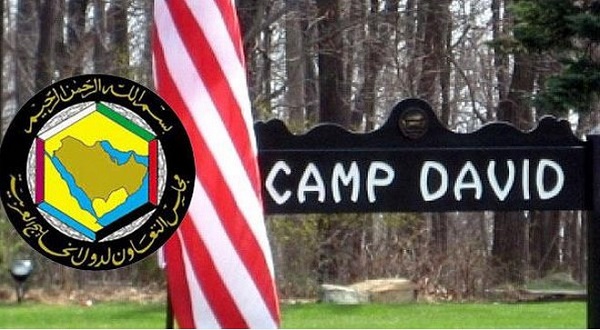
The Bush policy of “accommodation” with Iran became the Obama policy of “appeasement” towards the Islamic Republic. Thus began a six-year-long quest to intended to encourage that country’s recalcitrant and hegemony ambitious leaders to abandon its nuclear weapons program. With the imminent 30 June deadline for signing an Agreement quickly approaching the president invited the Gulf Cooperation Council (GCC) states headed by Saudi Arabia to Camp David promising a mutual defense agreement assuring the Arab states of American protection in the event Iran proved a threat to the region. In addition to “assurances, the Saudis insisted on a signed and “formal alliance structure with the United States guaranteeingU.S. support against potential Iranian aggression.”

In advance of the conference the White House announced that President Obama would meet with the Saudi king the day beforeCamp David. But at the last minute, [d]ispleased with Washington’s dealings with Iran, with an emerging deal over its nuclear program and with US security proposals to Gulf Arab nations,” King Salman announced he would not meet with President Obama and would not attend the Camp Davidconference. In the end only two of six Gulf nations decided to attend with heads of state.

The king’s last-minute cancellation, his turn-down of a meeting with the leader of the Free World was described as “a calculated snub for the president’s policies on Iran and the Middle East.” It was revealed that Kerry, in his meeting with the Saudis the week earlier, told the king that Obama was not prepared to finalize according to the king’s timetable any agreement that might result at Camp David.

And then there was the fact that a mutual defense agreement with the Saudis, the 1951 MDA, already existed already assuring the Saudis protection under America’s nuclear umbrella. Mistrust of American intentions and assurances by America’s “allies” built up over the previous twelve years was palpable.

Bush and the Region

“Even before the inauguration [and, of course, the pretext of 9/11], Cheney asked outgoing Secretary of Defense William Cohen to provide Bush with a briefing focused on Iraq… [Bush appointee] Defense Secretary Rumsfeld saw, “September 11, 2001, as a potential “opportunity.””

Symptomatic of hubris resulting from power minus coherent policy President Bush ignored both Arab and Israeli warnings of Foreseen Consequences certain to follow should the administration follow through with its threat to invade Iraq.

“With his latest remarks, [Saudi, later king] Prince Abdullah joined the chorus of Arab complaints about the Bush administration’s talk of taking military action to oust Saddam Hussein and put an end to his programs to develop weapons of mass destruction. At virtually every stop in the Arab world, Mr. Cheney has been told that an American military strike would destabilize the region.”

And, according to Lawrence Wilkerson, a member of the State Department’s Policy Planning Staff, “[t]he Israelis were telling usIraq is not the enemy – Iran is the enemy.” Wilkerson said that the Israeli reaction to invading Iraq in early 2002 was, “If you are going to destabilize the balance of power, do it against the main enemy.”

Bush and the Bomb

Cut off the head of the snake,” the Saudi ambassador toWashington, Adel al-Jubeir, quotes the king as saying during a meeting with General David Petraeus in April 2008.

In a speech to the Knesset in 2008 to observe Israel’s 60thanniversary Bush told the Knesset, “America stands with you in firmly opposing Iran’s nuclear weapons ambitions. Permitting the world’s leading sponsor of terror to possess the world’s deadliest weapon would be an unforgivable betrayal of future generations.” Nowhere in his speech did Bush hint at his long held view that America was not prepared to enter another Middle East war, that there never was a military option with which to threaten Iran’s nuclear weapons program. No accident then that Bush chose war-averse Robert Gates as his defense secretary; and that Gates in turn chose war-averse Admiral “Mike” Mullen as head the Joint Chiefs of Staff. The dovish defense pair would for years be the president’s PR mouthpiece warning against even the threat of force to halt Iran’s nuclear program. The Gates/Mullen oft-repeated warning of “unforeseen consequences” became, over the years a common, almost mantra-like warning against any action against Iran.

No surprise then that the openly dovish, newly-elected President Obama invited Gates to remain on as his defense department head, “a show of bipartisan continuity in a time of war that will be the first time a Pentagon chief has been carried over from a president of a different party.”

Obama and the Region

By way of destabilizing the region Obama has not yet equaled the fallout of Bush’s invasion of Iraq. If Bush gifted Iraq to Iran, set the stage for the “Arab Spring,” Obama did not come in second for lack of trying. The new president followed Bush by targeting his own tyrant, Muamar Qadafi and transformingLibya, as did Bush in Iraq, a political wreck bordering on a failed state.  Libya today is ruled al-Queda, Islamic State and other terror organizations with two governments powerless to assert control. Bordering Egypt Libya today supplies both the Sinai Salafist insurgency and the terror enclave of Gaza with weapons. And as Bush ignored Israeli and Arab warnings regarding the impact of invading Iraq, Obama chose to those same Arab-Israeli warnings regarding his intention to depose America’s principal Arab ally, Hosni Mubarak of Egypt. In a single mindless move the U.S. followed up its Iraq disaster with Egypt. And followed the collapse of Egypt’s secular regime, insult to injury Obama endorsed as “democratic government” the same Muslim Brotherhood with a decades-long terror campaign against the government; the group behind the assassination of Anwar Sadat for having sought peace with Israel: the Muslim Brotherhood whose child, al-Quaeda, had flown airliners into New York’s World Trade Center! The list of Bush and Obama Administration policy failures seems to know no limits: Iraq redo, Bahrain,Yemen and the bloodbath of Syria. Lacking capacity to learn from ideology-based failures, it continually repeats its “unintended consequences.”

Obama and the Bomb

If Bush set the pattern for accommodation then the tactic at least had some “justification” as Iran’s IRGC was funding, arming and even leading the Shi’ite insurgency against Iraq’s American invaders. Not provoking Iran might have the result of limiting American casualties. But for Obama, recipient in advance of the Nobel Peace Prize for promising regarding “world peace”; for Obama to provide Iran, a state sponsor of Islamist terrorism a world forum to show up American weakness and enhance Iranian prestige; for Obama whose commitment on entering office was to promote nuclear non-proliferation: for Obama to provide Iran all the time necessary to achieve threshold nuclear armament status and, failing to contain Iran the consequence would be a nuclear arms race in the lands of the Arab Spring… Saudi Arabia,Turkey and Egypt are already moving to parity with Iran whileJordan and several Gulf states are at varying stages of planning.   

Obama, who promised nuclear non-proliferation, has turned out to be godfather to a nuclear arms race in the least stable, most militant region of the world!

In Advance Of Obama-GCC Camp David Summit, Saudi Press Warns: Iran’s Interference In Region Poses Greater Danger Than Iranian Nuclear Bomb

May 13, 2015

In Advance Of Obama-GCC Camp David Summit, Saudi Press Warns: Iran’s Interference In Region Poses Greater Danger Than Iranian Nuclear Bomb, MEMRI, May 12, 2015

(The linked Saudi press articles suggest that Obama’s efforts to reassure Saudi and other regional powers about Iran will not succeed. — DM)

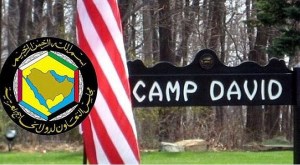
May 14, 2015 is the date set for the summit at Camp David between U.S. President Barack Obama and heads of state of the member countries of the Gulf Cooperation Council (GCC) – Saudi Arabia, Qatar, Kuwait, Bahrain, UAE, and Oman. A meeting at the White House with President Obama and the conferees is planned for the preceding day, May 13.

The objective of the Camp David summit, as announced several weeks ago, is to reassure the GCC countries about the nuclear agreement slated to be signed with Iran next month, as well as to discuss tighter U.S.-Gulf security cooperation.[1]In advance of the summit, the GCC held several preparatory meetings at various diplomatic levels, including: an April 20 meeting of GCC foreign ministers; a May 4 summit of GCC heads of state which was attended also by French President François Hollande; a May 7 meeting in Riyadh of Saudi Foreign Minister ‘Adel Al-Jubeir and his U.S. counterpart Secretary of State John Kerry; and a May 8 meeting in Paris of all the GCC foreign ministers and Kerry.

However, on May 9, Saudi Arabia announced that Saudi King Salman would not be at the Camp David summit as planned, and that Crown Prince Mohammed bin Nayef and Deputy Crown Prince Mohammed bin Salman would be participating in his stead. Saudi Foreign Minister ‘Adel Al-Jubeir explained that the monarch would not attend because he had to stay home to ensure peace and security in Yemen and to oversee the arrival of humanitarian assistance to the Yemeni people.[2]

Later, it was reported that the Bahraini king, the UAE president, and the Sultan of Oman would also not be attending the summit, sending representatives instead. As of this writing, the Emirs of Kuwait and Qatar are the only GCC heads of state who are planning to attend.

The downgrade of the level of representation at the summit appears to constitute a message to the U.S. that Saudi Arabia and the other GCC member countries were not pleased with the preliminary talks with Secretary of State Kerry, and also that they were disappointed at what the summit would achieve. According to a May 2, 2015 New York Times report, the Saudis had even then hinted that they would downgrade their representation if they felt that the summit was not going to produce results that conformed to their expectations.[3]

In fact, Arab press reports that preceded the announcement of downgraded representation pointed to what the GCC countries were demanding from the U.S., as well as to dissatisfaction on their part. At the May 4 summit of GCC heads of state with Hollande, Saudi King Salman called on the international community, especially the P5+1 that is negotiating with Iran, to “set stricter rules that guarantee the region’s security and prevent it from plunging into an arms race.” The king also stipulated that any final agreement with Iran must include unambiguous security guarantees.[4] Additionally, on May 7, UAE Ambassador to the U.S. Yousef Al Otaiba announced that the GCC would demand from the U.S. guarantees in writing that the latter would defend it from Iran.[5] Likewise, on May 9, the London-based Saudi daily Al-Hayat reported that even at the May 8 meeting with Kerry, the GCC foreign ministers had demanded U.S. guarantees that their countries would havemilitary superiority over Iran.[6]

Elaph.com also reported, on May 9, that the Gulf heads of state, headed by the Saudi monarch, would not settle for aid, military contracts, and defense systems provided by the U.S., but that they were seeking “clear, honest, and practical clarification, by means of absolutely firm, long-term resolutions, that Iran would be prevented from actualizing its expansionist aspirations in the region and from developing nuclear weapons…” Elaph also reported that “the Gulf leaders are headed for confrontation with the American president, and they want answers and explanations about his positions on these burning issues…”[7]

On May 12, three days after the Saudis announced that King Salman would not be attending the summit, it was reported that President Obama and King Salman had spoken by phone about the preparations for the summit, and had discussed the agenda of the meetings that would take place during it.[8] Both the White House, in an announcement, and Saudi Foreign Minister ‘Adel Al-Jubeir, at a press conference, emphasized the continuing Saudi-U.S. partnership. According to the White House announcement, Obama and Salman had, in their phone conversation, “reviewed the agenda for the upcoming meetings” and had “agreed on the necessity of working closely, along with other GCC member states, to build a collective capacity to address more effectively the range of threats facing the region and to resolve regional conflicts.” The two also discussed “the importance of a comprehensive agreement between the P5+1 and Iran that verifiably ensures the exclusively peaceful nature of Iran’s nuclear program” and “emphasized the strength of the two countries’ partnership, based on their shared interest and commitment to the stability and prosperity of the region, and agreed to continue… close consultations on a wide range of issues.”[9] Also, at a Washington press conference, the Saudi foreign minister stressed that King Salman’s “absence from the summit is not in any way connected to any disagreement between the two countries,” adding, “We have no doubts about the U.S.’s commitment to Saudi and Gulf security. The U.S. will present the Gulf countries with a new level of cooperation that will meet the needs on the ground.”[10]

At the same time, the Saudi press published numerous articles, including op-eds and editorials, fiercely attacking the Obama administration’s Middle East policy, stating that it had repeatedly disappointed the Arab countries, in its positions on Syria, Iraq, Bahrain, Yemen, and Iran. The articles accused the Obama administration of reinforcing Iran’s power in the region – so much so that it was now threatening GCC interests – and claimed that it was not the Iranian nuclear bomb but Iran’s imperialism in the region and Iran’s interference in the affairs of the Arab countries that was the “real bomb threatening [the Arab countries’] security,” and called on the U.S. to curb these. These articles focused on the demands that the GCC countries would be presenting to Obama at the summit, including that he change his policy towards Iran and “restore the regional balance,” while at the same time he would undertake unprecedented security military cooperation with the GCC. The articles emphasized that “the Gulf countries no longer believe the U.S.’s promises and guarantees,” and that they would now demand guarantees in writing. Some of the articles even warned that U.S.-GCC relations were now at a point of a grave, even critical crisis of confidence, and that the Camp David summit was a chance for the U.S. to prevent the collapse of its alliance with the GCC. If this alliance did fall apart, they said, U.S. interests in the region would suffer, and the smoldering regional conflict would erupt into a conflagration.

Below are translated excerpts from some of the articles:
23277

‘Al-Sharq Al-Awsat’ Editor: The Dissolution Of The U.S.-Gulf Alliance Will Harm U.S. Interests In The Region

Salman Al-Dosari, editor of the London-based Saudi daily Al-Sharq Al-Awsat, argued that the mutual trust between the US and the Gulf states had eroded to an extent that jeopardizes the alliance between them: “The upcoming Camp David summit may be the most important Gulf-U.S. meeting to take place in 50 years, [because] the U.S.-Gulf alliance is going through a phase of tension and a crisis of confidence… Washington is aware of this and it is no secret. Who knows, perhaps the summit will be an opportunity to put the train of this historic alliance back on the track from which it slipped in recent years. The summit will be an opportunity for the American administration to shift from talk to action, and quell the doubts in the region regarding its credibility, that has been put to the test  [by a series of events,] starting with the Syrian crisis, continuing with [America’s]feeble position on the events in Bahrain, Egypt and Iraq, and culminating in the nebulous and secret agreement that is expected to be signed with Iran…

“All [U.S.] institutions are aware of the negative repercussions for American interests that will ensue if the alliance with the Gulf States is dissolved. Naturally, the two parties do not have to be [perfectly] coordinated in their policies. However, it is unreasonable for U.S. policy to threaten the interests of the Gulf States, and later we [are bound to] discover that U.S. interests in the region have been harmed as well. This proves that Washington’s policy in the region is completely misguided…

“President Obama undoubtedly has a clear plan that will translate American talk into action, as reflected in statements by a senior American official last Thursday, published in Al-Sharq Al-Awsat, regarding ‘unprecedented military cooperation’ that will be revealed at the Camp David summit. It is also important that the U.S. give [the Gulf States] its assurances in writing… Only by such actions can the U.S. restore the cordiality to its relations with the Gulf States and truly demonstrate that the final nuclear agreement expected to be signed [with Iran] will not include ambiguous meanings and unclear details.

“The US wants to kill two birds with one stone, [namely achieve] excellent relations with the Gulf States and with Iran simultaneously. This equation is unacceptable, not because the Gulf States hate [Iran], but because the Iranian regime is predicated on hostility to its neighbors in the Arabian Gulf, and its entire policy is geared towards intervening in their internal affairs. This is the entire story, honorable President Barack Obama.”[11]

Al-Hayat Editor: U.S. Hesitation At Camp David Will Cause The Regional Conflict To Erupt

Ghassan Charbel, editor-in-chief of the London-based Saudi daily Al-Hayat, wrote: “The U.S. is not interested in playing the role of the Middle East’s policeman. It does not wish to squander additional billions [of dollars] and blood. However, it certainly cannot wash its hands of the fate of this region of the world – not just  because [it seeks to preserve] the security of oil and of Israel, but also for the sake of the security of the U.S. and the West. Experience teaches us that Middle East diseases are contagious, and that the terrorism that is taking root there threatens the safety of New York, Washington, Paris, Berlin, and so on.

“It would be no exaggeration to say that the U.S.-Gulf summit at Camp David creates an unusual encounter that will leave its mark on the fate of the Middle East for years or [even] decades to come. The summit demands more than just dispersing [messages of] reconciliation and calm [to alleviate Gulf fears]. The situation is too grave to be treated with painkillers and hopes. The framework of a new regional order must be outlined; [such an order] must restore the necessary balance and provide safety valves to stop the chain of collapses, coups, and infiltrations [of foreign elements]. It is clear that the Iranian specter will be at the summit, bearing two bombs [that is, both nuclear bomb and the bomb represented by the regional role that Iran is seeking]…

“The problem that the GCC countries have with Iran does not end with Iran’s nuclear program. The GCC countries maintain that Iran’s current interference… is the real bomb threatening the security of the GCC countries, and [also] threatening the stability and status of the Arabs in the region. Therefore, what the Gulf is demanding at Camp David is measures to curb Iran’s involvement in the region, in addition to curbing its nuclear ambitions…

“It appears, therefore, that the Camp David summit must clarify the American position vis-à-vis the two Iranian ‘bombs’ – the first being the nuclear program, and the second being the regional role [that Iran covets]. The GCC is against the view that an agreement concerning the first bomb is a character reference providing it with what it needs in order to protect and expand the second bomb. This goes beyond the issue of missile defense [to be provided by the U.S. to] the Gulf countries, and beyond providing it with a deterrent arsenal, and has to do with the U.S.’s perception regarding its own interests in the next stage, how committed it is to its allies, and how serious it is in thwarting Iran’s takeover of the region – as well as how [willing] it is to give [the Gulf countries] unequivocal [security] guarantees.

“It is impossible to establish a suitable regional order without first restoring balance to the region. The bomb of [the regional]role [for which Iran strives] contradicts the required balance, and the American hesitation to deal with it [i.e. with Iran] decisively and seriously will diminish the importance of the summit and increase the Gulf countries’ apprehensions about Obama’s ‘Iran policy.’ American hesitation will also cause the regional conflict to erupt, especially the Syrian link [in the chain]… That is, if the Camp David summit does not address these two bombs, it will add fuel to the alarming Middle East conflagration.”[12]

‘All-Hayat’ Columnist: We No Longer Believe Obama’s Promises; Saudi Arabia Has Alternatives To The U.S. – Such As China And France

George Sama’an, a columnist for the London-based Saudi daily Al-Hayat, wrote about the U.S. president’s dilemma, under the headline “Obama Stuck Between Losing Saudi Arabia and Stopping Iran’s Expansion”: “Iran. There is no other issue butIran on the agenda of the U.S.-Gulf summit set for this week in Washington and Camp David. The [Iranian] nuclear program has worried, and continues to worry, the members of the GCC. In their meetings in Paris with U.S. Secretary of State John Kerry, the GCC foreign ministers did not focus on technical clarifications related to the program nor on those related to the mechanism of economic sanctions. What they fear is the day after the anticipated agreement between Iran and the five superpowers and Germany.

“Like many who oppose the approach of the American dialogue [with Iran], they fear Iran’s getting its hands on the region. [Iran] could gain from the lifting of the siege and of the sanctions on its frozen assets by continuing its regional expansionist program. Despite its [economic] distress, Iran has accelerated this expansionism, with brazen persistence. Its strategy relies on two main elements: the advanced, developed, and extensive arsenal of missiles in its possession, which are conventional weapons that are not subject to an international ban such as nuclear energy, and on continuing its expansion using its Shi’ite forces and militias in several Arab countries…

“The Gulf states are among the countries that no longer believe the promises and guarantees that the U.S. is providing these days. Obama has not kept any of the promises he made to the residents of the region since his speeches in Egypt and Turkey… The American indifference regarding the events in Iraq, for instance, left that country in Iran’s hands, and this scenario has been repeated in all the countries of the Levant [i.e. Syria and Lebanon]. The Obama administration has made no serious attempts to arrive at an arrangement [to resolve] the Syria crisis, leaving that country in [the hands of] Tehran and Moscow… [Obama] also kept out of the events in Yemen prior to [Operation] Decisive Storm…

“[The U.S.’s] partners did not have the sense that it wanted to end Iran’s lack of restraint and expansionism in the region, even if it led to damage to several Arab countries and their national unity. It [i.e. the U.S.] also did not do enough to address the conventional missile industry, at which Iran excels, possibly as a temporary substitute for the banned nuclear bomb…

“Today, the strategic arena is no longer solely in the hands of the U.S. and Iran. Arabs have a say and a policy [in them,]following Saudi Arabia’s establishment of the new coalition… No matter how far overboard the U.S. goes in relying on its future relations with Iran and on [Iran’s] role in the stability of the region, it can no longer ignore the positions of the residents of the Gulf, headed by Saudi Arabia – which has proven itself as the central player with regard to energy… Operation Decisive Storm has increased the Saudis’ ability to correct the imbalance in the power balance with Iran…

“In light of the changes in the regional and strategic arenas, it is not enough for President Obama to provide guarantees or attempt to calm the situation, to make do with talk about ABM [systems] for the Gulf as he did five years ago, or to focus on the war on terror. What [he] must do [now] is take an active role in a policy that will restore the balance among the region’s major powers, and reexamine his policy in Iraq, Syria, Yemen, and Lebanon. Will he do this, and grow closer to the U.S.’s traditional partners instead of pushing them away?

“The Arab coalition will not stop. Many elements that could replace the U.S., from China to France, should be considered. [Likewise,] the Gulf states might possibly decide to initiate an arms race, for which they have the suitable economic capacities.”[13]

In the same vein, Saudi columnist Muhammad Aal Al-Sheikh wrote, in the Saudi Al-Jazirah daily: “Last Tuesday in Riyadh, a GCC consultation summit was held, led by King Salman; during it, the countries stressed the unity, adherence, and solidarity amongst them… At this summit, the participation of French President Hollande, as a guest of honor, stood out. It constituted a clear and highly significant message to the American president, Obama, who has been chasing down the Persian ayatollahs to get them to sign a final agreement regarding the peacefulness of the Iranian nuclear facilities and to remove the sanctions from them.

“The message [sent by Hollande’s presence] said clearly to Obama, prior to the summit with the Gulf heads of state at Camp David: ‘Gulf residents, there are other options. You are not alone in the arena. France is an independent decision-maker, as Francophones tend to be. France is a world power, a permanent member of the U.N. Security Council with a veto, and a major and advanced manufacturer of developed weaponry. And, some of the armament agreements and military deals of the Gulf countries are going to be [signed] with it.’

“This is an extremely clear message, and the [U.S.] Republican Party will necessarily use it against the Democrats, particularly in the upcoming presidential election campaign between the two parties.”[14]

Endnotes:

[1] Alarabiya.net April 3, 2015, April 6, 2015.

[2] Alarabiya.net, May 10, 2015.

[3] Nytimes.com, May 2, 2015.

[4] Arabnews.com, May 5, 2015.

[5] Al-Riyadh (Saudi Arabia), May 7, 2015.

[6] Al-Hayat (London), May 9, 2015.

[7] Elaph.com, May 9, 2015.

[8] Alarabiya.net; Al-Quds Al-Arabi (London), May 12, 2015.

[9] Al-Quds Al-Arabi (London), May 12, 2015; Whitehouse.gov/the-press-office/2015/05/11/readout-president-s-call-king-salman-bin-abdulaziz-al-saud-saudi-arabia. May 11, 2015.

[10] Telegraph (London) May 12, 2015; Usatoday.com, May 11, 2015; Al-Sharq Al-Awsat (London) May 12, 2015.

[11] Al-Sharq Al-Awsat (London), May 11, 2015.

[12] Al-Hayat (London), May 11, 2015.

[13] Al-Hayat (London), May 11, 2015.

[14] Al-Jazirah (Saudi Arabia) May 10, 2015.

Why the Snub? Saudis Know Obama’s Replaced Them With Iran

May 11, 2015

Why the Snub? Saudis Know Obama’s Replaced Them With Iran, Commentary Magazine, May 11, 2015

Will Obama get the message and change course? That’s even less likely than him embracing Netanyahu. An administration that came into office determined to create more daylight between itself and Israel has now embarked on a policy designed to alienate all of America’s traditional allies in order to appease a vicious Islamist foe. Anyone who thinks this will turn out well simply isn’t paying attention to the same events that have left the Saudis and other U.S. allies thinking they are more or less being left on their own.

**********************

If the Obama administration thought it’s half-hearted efforts to make up with Saudi Arabia and other Arab states outraged by its Iran policies, it’s got another thing coming. On Sunday, the Saudis told the White House that King Salman would not be attending meetings there or at Camp David this week. Later, Bahrain said its King Hamad would skip the same meeting. The snubs are as pointed as President Obama’s recent signals that he has no intention of meeting with Israeli Prime Minister Benjamin Netanyahu anytime soon. But while the president has little interest in patching things up with America’s sole democratic ally in the Middle East, he was quite interested in making nice with the Saudi monarch. But the Saudis and Bahrain, like the Israelis, are deeply concerned by the U.S. effort to create a new détente with Iran. It’s not just that Salman apparently has better things to do than to schmooze with Obama. The president may have thought he could essentially replace the Saudis with Iran as the lynchpin of a new Middle East strategic vision without paying a price. But the Saudis understandably want no part of this. The result will be a region made even more dangerous by the Arabs, as well as the Israelis, coming to the realization that they can’t rely on Washington.

The conceit of Obama’s strategy rests on more than a weak deal that he hopes will be enough to postpone the question of an Iranian bomb even as it essentially anoints Tehran as a threshold nuclear power. Rather it is predicated on the notion that once Iran is allowed to, in the president’s phrase, “get right with the world” and reintegrated into the global economy, it can be counted on to keep peace in a region from which Obama wants to withdraw.

That’s why the administration has tacitly allied itself with Iran in the struggle against ISIS in Iraq and, bowed to Tehran’s desire to leave its ally Bashar Assad in power in Syria even as they sought to restrain the Islamist regime’s Houthi friends in their effort to take over Yemen. But given Iran’s desire for regional hegemony, it’s reliance on terrorist allies like Hezbollah and Hamas as well as Assad’s criminal regime, the notion that it is a force for stability is as much a delusion as the idea that it is giving up its quest for nuclear weapons.

Just as important, the Obama foreign policy team was convinced that it could afford to ignore the Saudis’ concerns about their intended entente with Iran with as much impunity as it did those of Israel. As one expert quoted in the New York Times said, the Saudis have no alternative to the U.S. as a superpower ally. But it has not failed to escape their attention that “there’s a growing perception at the White House that the U.S. and Saudi Arabia are friends but not allies, while the U.S. and Iran are allies but not friends.”

Under the circumstances, the Saudis are now prepared to show the president the extent of their disdain. But it may not stop at that.

The Saudis, like the Israelis, know that America’s promises about both the nuclear deal and the future of the region are not worth much. The Iranians have been granted two paths to a bomb by the United States. One is by cheating via the easily evaded restrictions in the nuclear pact with little fear of sanctions being snapped back. The other is by patiently waiting for it to expire while continuing their nuclear research with little interference from a West that will be far more interested in trade than anything else.

That leaves the Saudis thinking they may need to procure their own nuclear option and to flex their muscles, as they have been doing in Yemen. It also sets up the region for what may be an ongoing series of confrontations between Iranian allies and the Saudis and their friends, a recipe for disaster.

Will Obama get the message and change course? That’s even less likely than him embracing Netanyahu. An administration that came into office determined to create more daylight between itself and Israel has now embarked on a policy designed to alienate all of America’s traditional allies in order to appease a vicious Islamist foe. Anyone who thinks this will turn out well simply isn’t paying attention to the same events that have left the Saudis and other U.S. allies thinking they are more or less being left on their own.

Qalamoun battle is do-or-die for Bashar Assad, Hassan Nasrallah and Iran’s Gen. Soleimani

May 9, 2015

Qalamoun battle is do-or-die for Bashar Assad, Hassan Nasrallah and Iran’s Gen. Soleimani, DEBKAfile, May 9, 2015

(??????????? — DM)

Qalamoun_battle_5.15Hizballah flag aloft in Qalamoun battle

President Obama has just lately adopted a plan some members of his National Security Council put forward: It is to get the Iranians moving on the nuclear deal by applying a painful prod in the form of a wedge in the Revolutionary Guards (IRGC) leadership. IRGC chief Gen. Ali Jafari is being elevated as a “moderate” and the “good guy” of the regime, while Gen. Soleimani, the Al Qods chief, who orchestrates IRGC’s external subversive operations, is fingered as the “bad guy.’

*****************

Two contenders are locked in a fateful contest to win the strategic Qalamoun Mts. on the Syrian-Lebanese border: The Syrian army and its Hizballah ally are fighting tooth and nail against the opposition Army of Conquest, which is spearheaded by Nusra Front, Al Qaeda’s Syrian branch. This battle has all of a sudden attained the proportions of a critical regional contest, which poses dire consequences for the Iran-Syrian-Hizballah alliance at large and its three prime movers, Syrian President Bashar Assad, Hizballah leader Hassan Nastrallah, and their overall commander, Iran’s Gen. Qassem Soleimani, head of the Al Qods Brigades.

With so much hanging in the balance, it is no wonder that Hizballah issued confused communiqués on the battle, until Nasrallah interceded Tuesday, May 5 to say: “We have not issued a statement, and we will not issue a statement. When we launch a (Qalamoun) operation, it will be obvious to everyone.”

The operation is, however, already in full flight. Neither Nasrallah nor anyone else can predict its outcome for sure, because a radical, unforeseen shift has taken place in the balance of strength. For the first time in nearly five years of Syrian civil war, the United States has lined up with Saudi Arabia, Turkey, Qatar and the UAE to give the Syrian opposition heavy weapons. Had they been supplied earlier, the war might have ended sooner and many of the hundreds of thousands of victims might have been saved.

Also, after a long silence, senior Obama administration spokesmen were finally willing to blast the Assad regime for his heinous war crimes.

Friday, May 8, three senior spokesmen confirmed as “strong and credible” the reports that the Syrian army had reverted to the use of chemical weapons. They were Robert Malik, US ambassador to the Hague-based Organization for the Prohibition of Chemical Weapons, US Undersecretary of State Antony Nlnken and US ambassador to the UN Samantha Power.

They were willing to “disclose” a fact – long common knowledge in the region – that the Syrian army had retained a part of its chemical stockpile. This disclosure exposed the much-acclaimed US-Russian accord concluded by Secretary of State John Kerry and Foreign Minister Sergei Lavrov at the end of 2013, forcing Assad to surrender his chemical arsenal, as a more or less dead letter.

On the heels of the US accusation, PCWU international inspectors revealed that traces of sarin and VX nerve agents were found in Syria last December and in January.

The new Obama administration’s diplomatic offensive against Assad came as the Qalamoun showdown attained momentous proportions, after two weeks of heavy Syrian military war reverses in the north. The sharp US edge was also directed at Gen. Soleimani, who is responsible for Iran’s supply of chorine-filled barrel bombs dropped by the Syrian air force on civilians in rebel-held areas.

Washington has refocused its attention on Syrian-Iranian chemical warfare out of two broader considerations:

1. Iran’s cavalier contempt for the international accords and treaties banning chemical weapons raises tough questions about Tehran’s credibility and trustworthiness for upholding the comprehensive nuclear accord currently in negotiation with the Six Powers. Can Iran be trusted to honor any commitment to allow the “intrusive inspections” of its nuclear sites, which President Barack Obama has pledged as the underpinning of any accord?

2.  President Obama has just lately adopted a plan some members of his National Security Council put forward: It is to get the Iranians moving on the nuclear deal by applying a painful prod in the form of a wedge in the Revolutionary Guards (IRGC) leadership. IRGC chief Gen. Ali Jafari is being elevated as a “moderate” and the “good guy” of the regime, while Gen. Soleimani, the Al Qods chief, who orchestrates IRGC’s external subversive operations, is fingered as the “bad guy.’

Jafary is also to receive economic incentives for accepting the nuclear accord, while denouncing Soleimani, leading light of Iran’s military interventions in Iraq, Syria and Yemen, may have the added benefit of forcing Tehran to pull in its horns in those conflicts.

Time will tell whether this tactic is effective. As matters stand in May 2015, it is hoped that undercutting Soleimani’s repute will impinge on the level of Iranian military involvement in Syria, Iraq and Yemen. A decision by Tehran to downscale its military support for the Syrian and Hizballah armed forces may undo them in the battle of Qalamoun. This defeat will seriously undermine Assad, Nasrallah and Soleimani. And so the Syrian opposition and its backers have all the more reason to push hard to win this fateful encounter.

Iran and suspension of disbelief

May 8, 2015

Iran and suspension of disbelief, Israel Hayom, Yoram Ettinger, May 8, 2015

The term “suspension of disbelief” — coined in 1817 by the philosopher Samuel Taylor Coleridge — refers to a willingness to suspend one’s critical faculties and believe the unbelievable; sacrificing reality, common sense, doubt and complexity on the altar of a pretend reality, convenience and oversimplification; infusing a semblance of truth into an untrue narrative.

U.S. President Jimmy Carter’s policy toward Iran in 1977-1979 was characterized by suspension of disbelief: energizing the Ayatollah Ruhollah Khomeini while ignoring or underestimating his track record and his radical, supremacist and violent worldview. The betrayal of the Shah transformed Tehran from “the U.S. policeman in the Gulf” to the worst enemy of the U.S.

Currently, the suspension of disbelief undermines the U.S. posture of deterrence and vital U.S. national security and commercial interests. It was demonstrated by U.S. President Barack Obama, who — irrespective of Middle East reality — referred to the brutally intolerant, terror-driven, anti-U.S., anti-infidel, repressive, tumultuous Arab tsunami as the “Arab Spring.” He said it was “casting off the burdens of the past,” “a story of self-determination,” “a democratic upheaval,” “a peaceful opposition,” “rejection of political violence” and “a transition toward [multi-sectarian, multi-ethnic] democracy.”

Suspension of disbelief, coupled with the ayatollahs’ mastery of ‘taqiyya’ (Islam-sanctioned double-talk and deception), is what led U.S. Secretary of State John Kerry to assert on November 24, 2013 that “Iran’s Foreign Minister [Mohammad Javad] Zarif emphasized that they don’t intend to acquire nuclear weapons, and Iran’s supreme leader has indicated that there is a ‘fatwa’ [an authoritative religious ruling] which forbids them to do this.”

In an April 7, 2015 NPR interview, Obama made a reality-stretching assumption which underlines the Iran policy: “If in fact Iran is engaged in international business … then in many ways it makes it even harder for them to engage in behaviors that are contrary to international norms. … It is possible that if we sign this nuclear deal, we strengthen the hand of the more moderate forces in Iran.”

Rebutting Obama’s remarks, Amir Taheri, a leading authority on Iran, wrote: “Hope is not a sufficient basis for a strategy. … [The relatively moderate former President Akbar Hashemi] Rafsanjani has little chance of surviving a direct clash with [Supreme Leader Ayatollah Ali] Khamenei.

The Saudi frustration with U.S. policy on Iran — shared by all pro-U.S. Arab regimes — was expressed on April 25, 2015 by the opinion editor of the prestigious Saudi daily Asharq Al-Awsat, which echoes the position of the House of Saud: “While the U.S. considers the ayatollahs a legitimate partner to negotiation, Saudi Arabia and other Persian Gulf states are in a state of war with Iran, which is the main source of chaos in the region.” The editor-in-chief of the Saudi daily added: “Has the axis of evil collapsed to the extent that President Obama is courting one of its key members?! Isn’t this the same Tehran that has posed a clear and present danger to the Gulf states for the past 36 years?!”

• An agreement is not the goal, but a tool to achieve the real goal.

• Transforming an agreement to a goal undermines the real goal.

• Details of an agreement are less critical than the details of the ayatollahs’ 36-year track record of supremacist, apocalyptic and megalomaniacal violence, martyrdom, sponsorship of global Islamic terrorism, subversion of pro-U.S. Arab regimes, repression, anti-U.S. hate education- and policies, a systematic noncompliance with agreements and mastery of concealment.

• Such a track record warrants a “guilty until proven innocent” approach.

• Preconditioning an agreement upon a dramatic change in the conduct of the rogue, anti-U.S. ayatollahs would be “a poison pill” to a bad deal, but a vitamin to a good deal.

• A “bad deal” would nuclearize Iran; “no deal” would allow the U.S. to choose the ways and means to prevent Iran’s nuclearization.

• Nuclear capabilities would extend the life of the repressive, rogue ayatollah regime, precluding any hope for civil liberties or home-induced regime change.

• An agreement — not preconditioned upon the transformation of the ayatollahs — would compound their clear and present threat to vital U.S. interests.

• The transformation of the nature of the ayatollahs — as a precondition to an agreement — would prevent the nuclearization of the ayatollahs.

• Precluding the option of military pre-emption has strengthened and radicalized the rogue ayatollahs, and could lead to a nuclear war.

• Misrepresenting the option of military pre-emption as war defies reality, since it should be limited to surgical — no troops on the ground — air and naval bombings of critical parts of Iran’s nuclear infrastructure from U.S. bases in Bahrain, Qatar, Saudi Arabia, Oman and the Indian Ocean, or aircraft carriers.

• A U.S. military option forced Iran to end the 1980-1988 war against Iraq, convinced Libya to give away its nuclear infrastructure in 2003, and led Iran to suspend its nuclear development in 2003.

• “Ironclad” supervision and intelligence failed to detect the nuclearization of the USSR, China, Pakistan, India and North Korea.

• Unlike the USSR, which was deterred by Mutual Assured Destruction, the apocalyptic ayatollahs would be energized by MAD-driven martyrdom.

• The zeal to strike a deal has led to a U.S. retreat from six U.N. Security Council Resolutions, which aimed to prevent Iran’s nuclearization.

• A nuclear Iran, which celebrates “Death to America Day,” would devastate cardinal U.S. interests: toppling the oil-producing Arab regimes (impacting supply and price of oil) and other pro-U.S. Arab regimes; intensifying Islamic terrorism, globally and on the U.S. mainland; agitating Latin America; collaborating with North Korea; cooperating with Russia and destabilizing Africa and Asia.

• The track record of the ayatollahs on the one hand, and compliance with agreements on the other hand, constitute an oxymoron.

• Suspension of disbelief, in the case of Iran’s nuclearization, entails overlooking facts that highlight the implausibility of a viable agreement with the ayatollahs, thus damaging crucial U.S. interests and fueling a nuclear war.

Why Obama Will Just Keep Making the Middle East Worse

May 6, 2015

Why Obama Will Just Keep Making the Middle East Worse, Front Page Magazine, Daniel Greenfield, May 6, 2015

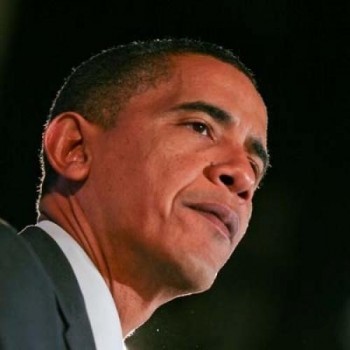
obama9-350x350

In its own perverse way, Iran is becoming a client state of America. But it’s a client state that, like the Palestinian Authority with Israel, is actively trying to destroy us. The lesson from that failed effort was that you can’t use terrorists to stabilize territory. All that terrorists can do is destabilize it even more.

****************

A few years ago it was the Muslim Brotherhood. These days it’s Iran. Next week it may be ISIS or Al Qaeda. Obama stands with the worst elements in the Middle East. That’s always been his philosophy.

If the left had a foreign policy, it would be, “The squeaky wheel gets the grease.” But the wheel is a sword and it’s lubricated with blood. The squeakiest wheels and the bloodiest swords get the most grease from the State Department because they hate us the most. And hating us the most means that somewhere along the way we must have hurt them the worst. They hate us, therefore we’re guilty.

The squeaky wheel runs on blood and on American guilt. The worse they are, the guiltier we must be. Instead of reinforcing the moderates, whose shortage of ravening hatred suggests that they don’t have any legitimate complaints about us worth listening to, the left seeks out the extremes of extremists.

When he wasn’t vowing to lower the oceans, abolish taxes on seniors or heal up race relations, Obama was campaigning on fixing our alliances with our allies. But that’s not what he really had in mind.

Any old Joe can ally with allies. It takes a real Barack to ally with enemies.

Our allies were the problem, so he started shedding them. The least crazy Muslims went first. Then Israel. Now he’s down to deciding which enemies will be his allies and he sits on a golf course, like that little girl in the LBJ ad, picking petals off a daisy trying to choose between Iran and the Muslim Brotherhood. Meanwhile the nuclear countdown is building from one to a mushroom cloud.

Allying with moderates is out of the question. Egypt is fighting terrorists, but its moderate government forced out the Muslim Brotherhood, ruining Obama’s best appeasement effort not directed at Russia. Even the Saudis, who stone people to death like it’s a national sport, have become too sensible for him.

Obama won’t have anything to do with moderates. If they aren’t screaming, banging flabby fists on the table and threatening a nuclear war every Wednesday, they aren’t aggrieved enough to be the root cause of our problems in the region. And there’s no point in wasting our time and goodwill on them.

Animated by American guilt, the left’s foreign policy obsessively seeks to mollify the angriest and most violent enemies in the region. And that poisoned foreign policy philosophy of American appeasement leaves him with few other options.

The left insists that the conventional approach of upholding allies just reinforces a hegemony which makes us more hated. The only way to get to the root of the problem, their way, is to find those who hate us the most, apologize and work through their issues with us.

Instead of building a hegemony of allies, Obama has built up a hegemony of enemies.

But rewarding the angriest and most violent enemies in the region has made the Middle East unstable. Instead of fixing the violence and instability in the region, Obama has made it that much worse.

A policy that is inherently opposed to moderates will either end up destroying the stable countries in the region or destabilize them by involving them in regional wars. Obama’s foreign policy is hostile to moderates because it sidelines them as being incapable of resolving the problems in the region.

If you aren’t the problem, then to Obama and the left, you can’t be the solution.

The emphasis on stabilizing the region by enlisting the aid of the violent and the unstable is a dead end. It rewards exactly the sort of behavior that it claims to want to discourage while punishing the stable behavior it claims to want to encourage.

The left’s foreign policy in the region is a Pavlovian experiment for creating more terrorists and cutting down the list of countries that aren’t expansionistic or involved in terrorism.

Obama talks about stabilizing the Middle East, but you can’t fix a hole by making a bigger hole and you can’t put out a fire by pouring gasoline on it, and gasoline and holes are all he has to work with. By making the violent and angry the focus of his outreach efforts, he has made violence and anger into the unstable pivot of the region. The future of the region now belongs to the angry and the violent.

Jimmy Carter tried to stabilize Iran and the region by aiding the Ayatollah. Instead of stabilizing anything, a revolutionary Shiite Iran became a loose cannon that not only threatened the United States, but dragged the rest of the region into its wars. From the Iran-Iraq war to terrorism in Lebanon and all the way to Al Qaeda looking for some experts to teach its terrorists how to hijack a lot of planes, the peanut farmer’s crop was a harvest of wars and bombings that killed a lot of Americans and even more locals.

Obama picked up where Carter left off. And the problems are bigger, but basically the same. The difference is that Obama had the leisure and disregard for national security to move the same foreign policy philosophy into destructive testing mode. America’s traditional alliances have collapsed. The rest of the region is handling problems on its own with Obama stuck trying to lobby the Saudis or Israel on behalf of Iran. When the Saudis bomb the Shiite Houthi terrorists in Yemen, the Iranians run to Obama. When the Israelis urge sanctions on Iran, the Iranians run to Obama to fix the problem for them.

In its own perverse way, Iran is becoming a client state of America. But it’s a client state that, like the Palestinian Authority with Israel, is actively trying to destroy us. The lesson from that failed effort was that you can’t use terrorists to stabilize territory. All that terrorists can do is destabilize it even more.

But the lessons of that failed peace process were never learned and attempts to use terrorists to stabilize entire countries continued.

Obama is still attempting to negotiate with the Taliban to stabilize Afghanistan. Negotiations with Iran to stabilize the region are going so well that every Sunni Muslim country that can afford it is rushing off to get its own nuclear program started.

There’s no telling how stable the Middle East will be once it has more nuclear nations than existed in the entire world a generation ago; probably even more unstable than the atomic structure of Plutonium.

The only thing Obama can keep doing is making the Middle East worse because it’s the only possible outcome of his foreign policy. American guilt requires perpetual atonement and the only people we can get it from are tearing apart the Middle East and the world.