Posted tagged ‘Iranian proxies’

Iran’s long arm

January 21, 2016

Iran’s long arm, The Jerusalem Post, JPost Editorial, January 21, 2016

(Please see also, New Iranian-Backed Terror Group Makes Inroads in West Bank, Gaza. — DM)

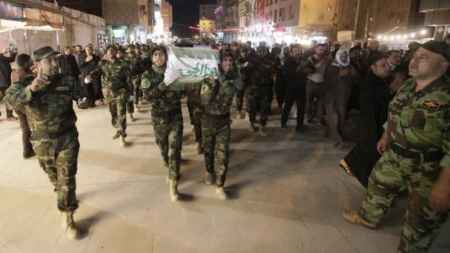
ShowImage (20)Thousand of Basij soldiers stage mock seige of Temple Mount in Iran. (photo credit:FARS)

If anyone needed proof how the lifting of sanctions on Iran will hurt Israel’s security, this week provided two examples.

Just days after implementation of the Joint Comprehensive Plan of Action nuclear agreement, we received a reminder that Iran and its proxies remain dangerous enemies of Israel.

Five Palestinians from the Tulkarm area were arrested for planning to carry out terrorist attacks under instructions from Hezbollah, the Shin Bet (Israel Security Agency) said on Wednesday.

The head of the cell, Mahmoud Za’alul, had been recruited through social media networks. Using encrypted messages, he enlisted five more men from the Tulkarm area; they were ordered to gather intel and plan terrorist attacks, including preparing explosive vests for suicide bombings.

Hezbollah funded their operation by sending them $5,000 through money changers.

Now that the “crippling” economic sanctions on Iran have been removed, the resources at its disposal – and as an extension at Hezbollah’s – will be significantly greater.

In Lebanon, meanwhile, Hezbollah is consolidating its political power. On Monday, in a development that is nothing short of earth shattering, Samir Geagea, leader of the Christian Lebanese Forces party, publicly endorsed his rival, the formal general Michel Aoun, for president of Lebanon.

In so doing, Geagea abandoned his loyalty to Saad Hariri, head of the anti-Syrian Future (Al-Mustaqbal) Movement, for an alliance with the enemy camp headed by Hezbollah, which supports Aoun for president.

This opens the way to the appointment of a pro-Iranian president in Lebanon.

Hezbollah and Iran are undoubtedly pleased with the development. If Aoun is elected president, Hariri’s influence – and the influence of Hariri’s main patron, Saudi Arabia – will be greatly diminished.

Finally, in the Gaza Strip, Iran has over the past few months been providing funding to a new terrorist group called Al-Sabireen Movement for Supporting Palestine. Al-Sabireen, which means “the patient ones” in Arabic, was formed in the wake of a break between Tehran and the two largest terrorist organizations operating in Gaza – Hamas and Islamic Jihad.

Neither organization has acquiesced to Iran’s demand to support President Bashar Assad in Syria.

Both have incensed the Iranians by remaining silent on Saudi attacks in Yemen against the Iranian-backed Houthis. Both face their worst financial crisis in two decades after Iran’s decision to cut off support.

Al-Sabireen’s emblem – a gun sprouting from the center of its name in Arabic – is nearly identical to Hezbollah’s.

So far, the organization has about 400 followers in the Gaza Strip, each one receiving a monthly salary of $250-$300, while the senior officials get at least $700, according to The Jerusalem Post’s Palestinian Affairs correspondent Khaled Abu Toameh. Iran has been supplying Al-Sabireen with weapons used to attack Israel.

The Iranians are believed to have supplied their new terrorist group in the Gaza Strip with Grad and Fajr missiles that are capable of reaching Tel Aviv. Also, Iranian funds channeled through Al-Sabireen are said to be used to support the families of killed or arrested terrorists living on the West Bank.

The Iranian-backed organization is also wooing Fatah members. Scores of militiamen once belonging to Palestinian Authority President Mahmoud Abbas’s Fatah faction in the Gaza Strip have allied themselves with Al-Sabireen. Most were attracted by the money.

The rise of an unshackled Iran’s influence in the region is bad for Israel. But it is also bad for many of the US’s Sunni allies in the region such as Saudi Arabia and the Palestinian Authority. A shared enemy has created a shared interest – the curtailing of Iranian influence.

Implementation of the JCPOA might delay Tehran’s nuclear weapon program. The removal of sanctions, however, has set the stage for the Islamic Republic to increase its destabilizing influence. Iran and its proxies must be stopped.

The Inside Track From Israel’s Gaza Border Defenders

January 21, 2016

The Inside Track From Israel’s Gaza Border Defenders, Investigative Project on Terrorism, Paul Alster, January 21, 2016

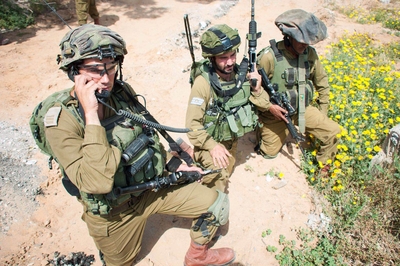
1339Photos courtesy of IDF Spokesperson.

Like it or not, the Iran nuclear deal is done. In much of the Middle East, defense officials in many states believe that a sizeable proportion of the soon-to-be released $100 billion Iranian windfall will be directed toward funding proxy armies of the Islamic Republic, for whom the Jewish state remains the prime target. Israel’s focus is now, more than ever, on defense and surveillance.

In the north, Hizballah, Iran’s proxy Lebanese army, remains a massive threat to regional stability, siding with Syria’s disgraced President Bashar Assad and his saviors from Russia. In Gaza, it is no secret that a previous rift between Iran and Hamas has been smoothed over to further mutual objectives and that another, and possibly more brutal round of hostilities between Israel and Hamas may not be far away.

“The sanctions relief and the nuclear deal with Iran represent a strategic shift that the IDF will have to tackle over the next decade,” Israel Defense Forces (IDF) Chief of Staff Gadi Eizenkot said Monday in a speech at the INSS conference in Tel Aviv. “We also see [Iran’s] attempt to influence Arab Israelis and those in the Gaza Strip, and the estimation is that as Iran’s economic situation improves, over the next one-to-two years, it will divert considerably more resources into opposing Israel, via the Iranian military industry.”

Last week, the Investigative Project on Terrorism (IPT) saw first-hand the situation on Israel’s south-western border, meeting with a senior IDF source who cannot be identified for security reasons. Close to the Kerem Shalom border crossing, where Israel oversees the transfer of many hundreds of tons of goods and supplies every day into Gaza,  we scrambled up a sizeable sand dune that offered a panoramic view of the situation on the ground toward the closed Rafah crossing from Egypt into Gaza.

“We hear the explosions and the fighting [against the Islamists] on the Egyptian side. The Egyptian army is taking it seriously,” the senior IDF source explained as we looked across the triangular border junction and heard distant noises, apparently explosions. “We hear this every day. Terrorists continue to try to cross from Egypt into Gaza.”

Minutes later, a text message announced that the Keren Shalom crossing suddenly had been closed. It turned out that the Egyptian army reportedly engaged and killed 13 jihadists  just a couple of miles away. Two days earlier, an attempt to breach the Israel-Gaza border fence and plant an IED resulted in an Israeli airstrike reportedly eliminating a member of the Al Aqsa Martyrs Brigade.

Meanwhile, Hamas continues to test fire rockets into the sea, and in recent months other Islamic militants in Gaza sporadically lob rockets toward Israel. On the other side of the border triangle, Egypt is doing its best to keep a lid on ISIS and other Islamist forces in the Sinai Peninsula.

It’s clear that relations between the Israeli and Egyptian militaries are good, a dangerous common enemy helping to focus minds. Under President Abdel Fattah el-Sisi, Egypt (despite a lack of support from the United States), has taken the fight to the terror organizations, often at a significant cost in Egyptian military lives. The horrific October downing of the Russian passenger jet out of Sharm el-Sheikh brought the scale of the task facing Egypt into focus. Israel remains alert for the jihadists turning their attention and firepower from Sinai, but for now believes that Gazan-based terror poses its most immediate threat.

“It’s been quite quiet with Hamas [since the 2014 Protective Edge war], but they don’t keep quiet for long,” the IDF source said. “We’re not looking for a fight – we have an interest that there will be quiet here – but if we have to deal with Hamas, this time we’ll deal with them properly.”

Many Israelis were dismayed when Israel unilaterally pulled out of Gaza in 2014 without a ceasefire, some criticism coming notably from members of the left-wing opposition and media for allowing Hamas off the hook when many believed it was in utter disarray. Now, despite ongoing attempts to stem the flow of weapons, reports suggest Hamas is rebuilding fast and may have some surprises in store for Israel if there’s another round of fighting.

“Look, we’re quite certain they are still building tunnels,” the official said, planting his heel in the sand and showing how easy it is to dig. “And yes, I’m sure they have new weapons – anti-tank, anti-aircraft etc. Like us, they will want to be better next time, but we understand more. The reality is different. We’re learning all the time what is going in Gaza. The army is always preparing for the war to come and [Hamas] won’t meet the same thing as in [Protective Edge].”

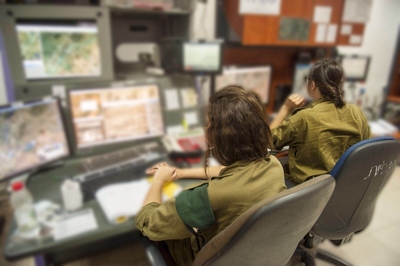
While Israeli soldiers and advanced technology such as its Guardium unmanned patrol vehicles are the first line of defense – the IDF indicated last year that the development of underground tunnel detection systems is also a priority project – the eyes of the military are actually in special units of female soldiers, known as the tazpitanyot. They monitor all movements, looking for suspicious activity, known terror operatives, and attempts to breach the border.

1340 (2)

They work in a series of non-descript trailers and shipping containers belying the fact that inside are massed banks of video screens and radar images, and the ability to combine pictures filmed from aerial blimps with other cameras – both day and night vision. This arrangement allows operatives to zoom in and see Gazans as far as a mile from the border fence.

When anything, or anyone suspicious pops up, there are pictures of ‘Wanted’ terror suspects close to the screens.  They instruct the on-the-ground forces to investigate. Never averting their gaze from the screen during a four-hour shift, each soldier has been trained to identify every landmark, tree, or rock within her specific area of surveillance. “If there’s even a single branch missing from a tree, they’ll spot it” the women’s commanding officer said. They also have remote control of the machine guns sited on border watch towers.

No security system is 100 percent foolproof, and during the first two weeks of the last round of fighting, four terror tunnels emerged on the Israeli side, only being detected at the last moment.  In two cases, the IDF fought gun-battles leaving  at least 10 terrorists and six Israeli soldiers dead. Hamas had hoped to kill civilians before luring Israeli soldiers back through the tunnels then kidnapping them or causing mass casualties.

Methods and practices of surveillance are being continually reviewed, but no-one in the Israeli military doubts the tatzpitanyot’s crucial front-line role in its border security, both north and south.

New Iranian-Backed Terror Group Makes Inroads in West Bank, Gaza

January 19, 2016

New Iranian-Backed Terror Group Makes Inroads in West Bank, Gaza, Washington Free Beacon, January 19, 2016

Screen-shot-from-al-Sabireen-propaganda-videoScreen shot from al-Sabireen propaganda video

A new Iranian-backed terror group is making inroads in the Gaza Strip and West Bank, where it operates underground with the potential capacity to deliver devastating attacks to Israel, according to regional experts who have been investigating the organization’s rise.

The group, which goes by the name Harakat al-Sabireen, was established around May 2014 but has begun in recent months to boost its public profile on social media and brag about its plots to wage jihad against Israel, according to information gathered by regional analysts and provided to the Washington Free Beacon.

Al-Sabireen is believed to receive $10 million a year from Iran via funds that are smuggled through a large network of tunnels built by terrorists to facilitate illicit travel beneath the Gaza Strip, according to estimates disseminated in the Arab language press.

Like Hezbollah, the Iranian-funded terror group that controls territory along Israel’s northern border, al-Sabireen is being used by the Islamic Republic to indirectly wage war on the Jewish state and foster unrest in the Palestinian territories, according to experts, who view the group’s rise as a sign that Iran is not interested in scaling down its global terror network following the recent implementation of the nuclear agreement.

A State Department official who was not authorized to speak on record said that officials are aware of al-Sabireen and its activities. However, the group has not been officially designated as a foreign terrorist organization, though it is possible this could occur in the future.

Al-Sabireen says it has established an armed wing with militants in Jerusalem and the West Bank, according to a recent interview with the Palestinian news agency Ma’an.

“Given the tense relationship between Tehran and Hamas the past few years, it makes sense that Iran would look to form another proxy in Gaza,” Grant Rumley, a Middle East analyst at the Foundation for Defense of Democracies, said. “However, Sabireen’s entire model of expansion hinges on its ability to present itself as a Palestinian, non-sectarian movement.”

Like Hezbollah, al-Sabireen’s official logo closely resembles that of the Iranian Revolutionary Guard Corps, which is responsible for giving orders to these types of terror groups.

The group’s charter condones violent jihad and promotes attacks on “the racist Zionist body” and “America the great Satan,” according to a copy published by the group on its official Arabic-language website.

Al-Sabireen has taken to its website and Facebook page in recent months to praise operatives who have been killed while conducting reconnaissance missions on the group’s behalf.

In one posting from late October, the group celebrated the death of one operative who was killed “after direct targeting from the Zionist forces while he was leading a monitoring and reconnaissance team.”

Mourners raised flags during a funeral ceremony for this individual from a variety of Palestinian political groups, including Fatah, which is largely viewed by Western governments as a moderate voice, according to photographs posted by al-Sabireen on its Facebook page.

It also has been plucking recruits from rival terrorist groups, according to Rumley.

“It’s unclear exactly what Sabireen’s operational capabilities are right now, but we know that they’ve pulled recruits from a more established terror group, Palestinian Islamic Jihad, and that they’ve lost at least two fighters in two separate Israeli strikes, so they’re on Israel’s radar,” Rumley said.

Al-Sabireen has been present at pro-Hezbollah rallies in Gaza that were also attended by leading Hamas officials.

While not much is known about the group’s composition, it appears to have two main leaders, one an operational leader and another who provides intellectual guidance.

Hisham Salem, the terror group’s top leader, formerly served as a member of Palestinian Islamic Jihad, a State Department-designated terror organization, according to information provided by regional analysts. Salem, who is in his early 50s, was raised in the Gaza Strip and began referring to himself as al-Sabireen’s leader in 2014.

Salem claimed in a recent interview with the Palestinian press that armed members of the group are currently in the West Bank and Jerusalem.

“We have an armed branch whose goal it is to wage war on the Israeli occupation everywhere,” Salem was quoted as saying. “Within this framework we have members in the West Bank and Jerusalem who will soon receive financial and military support from us.”

A recent propaganda video produced by the organization and posted to YouTube shows soldiers marching through Gaza with AK-47s.

Al-Sabireen’s second in command, Mohammad Abu Nadi, frequently writes on al-Sabireen’s official website and praises Palestine as integral to the Arab world.

Al-Sabireen has taken a hardline stance against the United States, claiming in September on its Facebook page that the United States is responsible for “producing terrorists.”

The group’s Facebook page remains active with near-daily postings despite attempts by Facebook to shut it down.

While al-Sabireen has faced difficulty in expanding its base in Gaza, where the Hamas-controlled government cracks down on rival terror groups, it has been able to gain a foothold in the West Bank, where it can directly challenge both Israel and the Palestinian Authority.

Saudi Arabia stews in policy hell

January 4, 2016

Saudi Arabia stews in policy hell, Asia Times, January 3, 2016

Last week’s mass executions in Saudi Arabia suggest panic at the highest level of the monarchy. The action is without precedent, even by the grim standards of Saudi repression. In 1980 Riyadh killed 63 jihadists who had attacked the Grand Mosque of Mecca, but that was fresh after the event. Most of the 47 prisoners shot and beheaded on Jan. 2 had sat in Saudi jails for a decade. The decision to kill the prominent Shia cleric Nimr al-Nimr, the most prominent spokesman for restive Saudi Shia Muslims in Eastern Province, betrays fear of subversion with Iranian sponsorship.

Saudi-beheading22-300x183Official Saudi beheading

Why kill them all now? It is very hard to evaluate the scale of internal threats to the Saudi monarchy, but the broader context for its concern is clear: Saudi Arabia finds itself isolated, abandoned by its longstanding American ally, at odds with China, and pressured by Russia’s sudden preeminence in the region. The Saudi-backed Army of Conquest in Syria seems to be crumbling under Russian attack. The Saudi intervention in Yemen against Iran-backed Houthi rebels has gone poorly. And its Turkish ally-of-convenience is consumed by a low-level civil war. Nothing has gone right for Riyadh.

Worst of all, the collapse of Saudi oil revenues threatens to exhaust the kingdom’s $700 billion in financial reserves within five years, according to an October estimate by the International Monetary Fund (as I discussed here). The House of Saud relies on subsidies to buy the loyalty of the vast majority of its subjects, and its reduced spending power is the biggest threat to its rule. Last week Riyadh cut subsidies for water, electricity and gasoline. The timing of the executions may be more than coincidence: the royal family’s capacity to buy popular support is eroding just as its regional security policy has fallen apart.

For decades, Riyadh has presented itself as an ally of the West and a force for stability in the region, while providing financial support for Wahhabi fundamentalism around the world. China has been the kingdom’s largest customer as well as a provider of sophisticated weapons, including surface-to-surface missiles. But China also has lost patience with the monarchy’s support for Wahhabi Islamists in China and bordering countries.

According to a senior Chinese analyst, the Saudis are the main source of funding for Islamist madrassas in Western China, where the “East Turkistan Independence Movement” has launched several large-scale terror attacks. Although the Saudi government has reassured Beijing that it does not support the homegrown terrorists, it either can’t or won’t stop some members of the royal family from channeling funds to the local jihadis through informal financial channels. “Our biggest worry in the Middle East isn’t oil—it’s Saudi Arabia,” the analyst said.

China’s Muslims—mainly Uyghurs in Western China who speak a Turkish dialect—are Sunni rather than Shia.  Like Russia, China does not have to worry about Iranian agitation among Shia jihadis, and tends to prefer Iran to the Sunni powers. As a matter of form, Beijing wants to appear even-handed in its dealings with Iran and Saudi Arabia, for example in recent contacts between their respective navies. Chinese analysts emphasize that Beijing has sold weapons to both—more in absolute to terms to Iran but more sophisticated weapons to the Saudis.

More pertinent than public diplomacy, though, is where China is buying its oil.

Nonetheless, China’s oil import data show a significant shift away from Saudi Arabia towards Russia and Oman (which China considers part of the Iranian sphere of influence). Russia’s oil exports to China have grown fourfold since 2010 while Saudi exports have stagnated. Given the world oil glut, China can pick and choose its suppliers, and it is hard to avoid the inference that Beijing is buying more from Russia for strategic reasons.  According to Russian sources, China also has allowed Russian oil companies to delay physical delivery of oil due under existing contracts, permitting Russia to sell the oil on the open market for cash—the equivalent of a cash loan to Russia.

saudioil1-768x558

China’s interests in Syria coincide with Russia’s. Both have reason to fear the growth of ISIS as a magnet for their own jihadis.  Thousands of Chinese Uyghurs make their way into Southeast Asia via the porous southern border of Yunnan province, with financial assistance from Saudi supporters and logistical support—including passports—from local Turkish consulates. Chinese Uyghurs were implicated in the bombing of Bangkok’s Erawan Temple last August, and have linked up with ISIS supporters as far south as Indonesia. Turkey reported last month that most jihadists crossing its border into Syria to join ISIS are Chinese Muslims.

With Kurdish and allied forces gaining control of Syria’s border with Turkey, aided by Russian air support, Chinese Uyghurs may lose access to Syria. Late in December Kurdish forces crossed to the western bank of the Euphrates River and are in position to link up with Kurdish militias in northwestern Syria, eliminating Turkish hopes of a “safe zone” controlled by Turkey on the southern side of the Syrian border.  For its part, Turkey risks paralysis from a low-intensity civil war with its Kurdish population. The Kurdish-majority southeast of the country is under siege and fighting has spread to Turkey’s western provinces.

It’s an ill wind that blows nobody good, and China seems hopeful that it has contained its jihadist problem. On New Year’s Day, the Communist Party leader in China’s Xinjiang province declared that “the atmosphere for religious extremism has weakened markedly.”

China is extremely reluctant to commit military forces to overseas conflicts, and its military is ill-prepared to do so even if Beijing were to change its mind. The People’s Liberation Army lacks ground attack aircraft like the two squadrons of Russian Su-24 and Su-25 deployed in Syria. Nonetheless, Beijing is happy that Russia is reducing ISIS forces in Syria as well as Saudi- and Turkish-backed Sunni Islamists like the Army of Conquest.

It will be hard to evaluate the success of Russian bombing in Syria until the dust settles, but there is a great deal of dust in the air. According to Israeli sources, Russia is dumping vast amounts of its Cold War inventory of dumb bombs on Syrian Sunnis with devastating effect. The Russian bombing campaign makes up in volume what it lacks in sophistication, killing far more civilians than Western militaries would tolerate, but changing the situation on the ground. That explains Russian President Vladimir Putin’s newfound popularity among world leaders. He is doing their dirty work.

Saudi Arabia’s proxies in Syria are in trouble. Early in 2015, the Army of Conquest (Jaish al-Fateh), a coalition of al-Qaida and other Sunni Islamists backed by the Saudis, Turks and Qataris, had driven the Syrian army out of several key positions in Northwest Syria, threatening the Assad regime’s core Alawite heartland. The coalition began breaking up in November, however, and the Syrian Army recently retook several villages it had lost to the Army of Conquest. One of the Army of Conquest’s constituent militias, Failaq al-Sham, announced Jan. 3 that it was leaving the coalition to defend Aleppo against regime forces reinforced by Russia.

Everything seems to have gone wrong at once for Riyadh. The only consolation the monarchy has under the circumstances is that its nemesis Iran also is suffering from the collapse of oil revenues and the attrition of war. Iran began withdrawing its Revolutionary Guard forces from Syria in December, largely due to high casualties. The high cost of maintaining the war effort as Iran’s finances implode also may have been a factor. Iran’s Lebanese Shia proxy, Hezbollah, has suffered extremely high casualties, virtually neutralizing its whole first echelon of combat troops. And Russia has shown no interest in interfering with Israeli air strikes against Hezbollah.

The oil price collapse turns the competition between Saudi Arabia and Iran into a race to the bottom. But the monarchy’s panicked response to its many setbacks of the past several months raises a difficult question. In the past, the West did what it could to prop up the Saudi royal family as a pillar of stability in the region, despite the Saudis’ support for jihadi terrorism. Soon the West may not be able to keep the House of Saud in power whether it wants to or not.

Iran-Saudi crisis spurs Hizballah strike on Israel

January 4, 2016

Iran-Saudi crisis spurs Hizballah strike on Israel, DEBKAfile, January 3, 2016

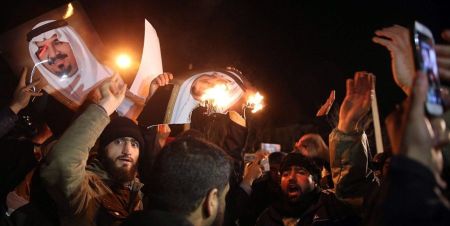
Iranian_protesters_set_fire_to_pictures_of_the_Saudi_royal_family_3.1.16

The heated verbal battle between Tehran and Riyadh over Saudi Arabia’s execution of a Shiite cleric escalated Sunday night, Jan 3, with the severance of diplomatic relations. On the broader front, the repercussions from the quarrel between the two leaders of the Muslim world’s Shia-Sunni split are widely seen in Middle East military and intelligence circles as spurring a fast-track Hizballah attack on Israel.

Among the 47 people executed by Saudi Arabia Saturday on terrorism charges was Sheikh Nimr al-Nimr, Saudi Shiite leader and a prominent Shiite cleric in the region. Put to death with him were several Saudi Shiite and Sunni activists, which enraged Iran’s supreme leader Ayatollah Ali Khamenei to the point of threatening the Saudi royal family with “divine revenge.”

From Iran’s perspective, the Saudis committed the unpardonable act of executing Shiites together with Sunni Al Qaeda and ISIS terrorists. This made the House of Saud the first ruling power ever to treat Shiite and Sunni terrorists alike. This, more than anything, incensed Iran and its Lebanese proxy Hizballah, who are deep in a bloody war against the Sunni Islamic State and the Nusra Front terrorists in Syria. Iran’s Revolutionary Guards are additionally locked in a bitter conflict with ISIS in Iraq.

The Iranian war effort is backed by the US in Iraq and by Russia in Syria.

By the mass executions of both classes of terrorist at the same time, Riyadh issued four messages:

1. Washington and Moscow are wrong. The Iranians and the forces they back in the Persian Gulf, Syria and Iraq are just as much terrorists as ISIS and Al Qaeda.

2. The House of Saud is determined to fight both with equal resolve and severity

3. Riyadh has already taken Tehran on in Yemen, and indirectly in Syria, and is now ready to take the fight against Tehran all the way to the war on terror.

4. Taking off the diplomatic gloves, Saudi Foreign Minister Adel al-Jubeir Monday night severed relations with Iran and ordered all Iranian diplomats to leave the kingdom within 48 hours. The foreign ministry said that by condemning the Nimr execution, Iran was supporting terrorism.

Saudi diplomats were already gone after protesters in Tehran torched and ransacked the Saudi embassy Saturday.

Amid all the sound and fury, Tehran’s attention was drawn to comments made by Israeli Prime Minister Binyamin Netanyahu in the light of a major terrorist attack in Tel Aviv. He pointed out that, in addition to the Palestinians, Israel is threatened by two streams of radical Islam, the Shiites and the Sunnis.

He was clearly referring to Iran and its terrorist arm, Hizballah, on the one hand, and ISIS and Al Qaeda, on the other, inspired less by the Tel Aviv outrage than by the gathering clouds of terror darkening the region, which place the Saudi royal family and Israel on the same side, sharing a similar perception of the two foes facing both countries.

Policymakers in Jerusalem noted the odd statement by Turkish President Tayyip Erdogan to reporters on Saturday, January 1 on the way home from a visit to Riyadh. After years of reviling the Jewish state, he said, “Israel is in need of a country like Turkey in the region. We have to admit that we also need Israel.”

He sounded as though he was urging the resumption of the old political and military alliance binding the two countries years ago.

DEBKAfile’s Middle Eastern sources point out that, since his comment came directly after his talks with Saudi King Salman in Riyadh, it appeared to open a path toward the possible creation of a new Middle East bloc consisting of Turkey, Saudi Arabia, perhaps Egypt, and Israel, bound by the same enemies. This grouping could serve as a counterweight against the Sunni-Shiite bloc of Iran, Iraq, Syria and Hizballah, which has the backing of the US and Russia on one hand, and fights ISIS on the other.

Iran’s leaders may curse the House of Saud without restraint, but they are canny enough not to go from words to deeds, knowing they would be on their own if they attacked the oil kingdom and earn no backing from either Washington or Moscow.

However, it might be easier for Tehran to take advantage of Netanyahu’s tough predicament in his war on terror, by sending Hizballah to strike Israel and, meanwhile, pre-empt the formation of a new anti-Tehran alliance. Speeding up Hassan Nasrallah’s promised revenge for the assassination of its master terrorist Samir Quntar would serve this purpose.

This possibility has prompted the IDF to keep artillery units pounding areas bordering on Israel during the past few days. The IDF says this action is necessary to stop Hizballah exploiting the stormy, snowy winter weather to attack Israel. Its military chiefs appear to be acting on information received of an approaching Hizballah operation as its leader has threatened.

IDF, Russian, Iranian forces on war alert for Hizballah attack on Israel – and backlash

December 31, 2015

IDF, Russian, Iranian forces on war alert for Hizballah attack on Israel – and backlash, DEBKAfile, December 31, 2015

Gerhard-Conrad

The IDF and all of the armies involved in the Syrian civil war, namely those of Russia, Syria and Iran, went on their highest war alert on Thursday, Dec. 31 when all their intelligence organizations reported that Hassan Nasrallah could not be stopped from attacking Israel, in revenge for the assassination of Samir Quntar in Damascus on December 20.

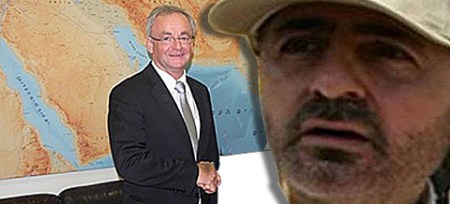
More than one intermediary visited Beirut to avert the Hizballah attack and its deadly fallout, including a former senior officer of the German BND foreign intelligence service. According to DEBKAfile’s intelligence sources, Gerhard Conrad, late of the BND and incumbent director of the European Union’s Intelligence and Situation Center, was given this urgent mission by Chancellor Angela Merkel.

He came away from a meeting with Nasrallah on Dec. 29, with the news that the Hizballah chief was not open to persuasion and the attack was already underway.

Conrad has excellent connections in the Arab world, especially in Syria and Lebanon. Seven years ago, he acted as intermediary between Israel and Hizballah for negotiating the recovery of the bodies of two fallen IDF soldiers, Eldad Regev and Ehud Goldwasser, in exchange for the handover of that same Hizballah high-up Samir Quntar and other jailed and convicted Arab terrorists.

The German spy-diplomat then established personal connections with a shadowy figure, Wafik Safa, who is in charge of Hizballah’s intelligence and security network and a close crony of Nasrallah.

Conrad used those connections again in 2011 to broker the release of Gilead Shalit from Hamas captivity.

It was Safa he arranged for him to meet Nasrallah in Beirut Tuesday. He found the Hizballah chief unshakeable in his determination to make Israel pay for Quntar’s death, even at the cost of a painful backlash against the Shiite group’s terrorists in Syria and Lebanon.

He was unmoved by the warning issued by Israel’s chief of staff, Lieut. Gen. Gady Eisenkott, on Monday, just hours before the Conrad mission.  Eisenkott said, “Just as we have proven in the past, we know how to strike anyone who wishes to harm us. Our enemies know they will suffer grave consequences if they try to undermine our security.”

Upon receipt of the German emissary’s report on the meeting, Eisenkott, his deputy, Maj. Gen. Yair Golan, and OC Northern Command, Maj. Gen. Aviv Kochavi, inspected the preparedness of the IDF’s northern border defenses for all contingencies.

They took into account a scenario, whereby Nasrallah would take advantage of the stormy weather forecast for the weekend in Syria, Lebanon and Israel, to strike Israel, in the knowledge that the heavy rain and snow would impede Israeli air force activity and give the Hizballah operation a tactical edge.

Russian military and Iranian Revolutionary Guard forces in Syria have taken into account that a Hizballah attack will not go unanswered by Israel and that the IDF would most likely hit back at Hizballah on Syrian soil, thus ushering in the New Year with a new whirlwind.

Assad again controls Damascus thanks to Russian air strikes and intelligence

December 26, 2015

Assad again controls Damascus thanks to Russian air strikes and intelligence, DEBKAfile, December 26, 2015

Allous_Killed_25.12.15

Less noticed, was the UN plan to remove at the same time several thousands ISIS fighters from the Syrian capital and transport them to their Syrian headquarters. The latter project has not been trumpeted for good reason: It implies UN recognition of ISIS as a party in the Syria war.

***************************

The Russian air strike that Friday, Dec. 25, killed Zahran Aloush, founder of the most powerful Syrian rebel group Jaysh al-Islam and his deputy, gave President Bashar Assad a big break in the Syrian war, thanks to his powerful backer, Vladimir Putin.

This grave loss will accelerate the breakup of Syrian rebel strongholds in and around Damascus. It will also hasten the evacuation under a UN-sponsored ceasefire of at least 2,000 rebels from the Damascus region. Less noticed, was the UN plan to remove at the same time several thousands ISIS fighters from the Syrian capital and transport them to their Syrian headquarters. The latter project has not been trumpeted for good reason: It implies UN recognition of ISIS as a party in the Syria war.

For nearly five years, the war seesawed back and forth, with neither the Syrian army nor the insurgents gaining the upper hand for long, even after Tehran threw its Lebanese proxy, Hizballah,  into the fray to bolster Assad’s army.

Interventions by the US, Saudi Arabia, Qatar, the UAE, Jordan and Israel were too trifling and hesitant to tilt the balance in favor of the anti-Assad insurgent militias. Weapons supplies were inferior and tardy and kept the rebels heavily outgunned by the Syrian army’s tanks, helicopters and fighter jets, and helpless against the Iranian-made barrel bombs dropped by the Syrian air force.

The Obama administration was the architect of this uneven support strategy, going so far as to constrain the rebels’ other foreign backers against giving them the resources for carrying the day, aside from local victories.

This strategy had the effect of prolonging the vicious conflict – until it was cut short by two events:

1. In the summer of 2014, the Islamic State of Iraq and the Levant arrived in full force to capture the northern Iraqi city of Mosul, scattering seven Iraqi armed divisions to the four winds, and grabbing  their sophisticated American weapons, along with their arsenals, that were crammed with good American tanks, armored personnel carriers, and an assortment of surface, antitank and antiair missiles.

Part of this booty was diverted to ISIS Syrian headquarters in Raqqa.

2.  A year later, in late September 2015, President Vladimir Putin embarked on a massive buildup of Russian military strength in Syria – notably, his air and missile forces – for direct intervention in the war.

In contrast to President Barack Obama, who sought to keep his hand on the conflict by a complicated system of dribbling arms to select Syrian rebel groups, Putin went all out with massive military and strategic backing to assure the Syrian ruler and his Iranian ally of victory.

The Russian strategy is now becoming evident:  It is to drive the rebels out of the areas they have captured around the main cities of Latakia, Aleppo, Idlib, Homs, Hama and the capital, Damascus, giving them two options: join the opposition front around the table for negotiating an end to the war, or total eradication – even though Moscow and Washington have yet to agree which of the rebel militias belong around that table.

According to Moscow’s scale of priorities, the fight against the Islamic State must wait its turn until after Bashar Assad’s authority as president is fully restored and his country returns to his army’s control.

But on the way to this objective, Putin has run up against a major impediment: the failure of Iranian, Shiite militia, Hizballah and Syrian army ground forces keep up with his pace. The plan was for Russian air strikes and missiles to clear rebels out of one area after another and for pro-Assad ground troops to storm in and take over.

But these troops are proving too slow to press the advantage given them by the Russians.

Last week, the Russians decided to use their intelligence assets to speed things up. They borrowed an Israeli counter-terror tactic to start targeting key rebel chiefs for liquidation.

The death of the Jaysh al-Islamc commander as the result of a Russian airborne rocket strike on Friday was an intelligence feat rather than a military one. Just as Israel last Sunday used its clandestine assets in Damascus to precisely target the Hizballah-Iranian arch terrorist Samir Quntar at his home in the Jaramana district, so the Russians directed their agents on the ground to mark the secret meeting of Jaysh al-Islam commanders at Marj al-Sultan at the precise moment for taking them down.

This blow to the rebel movement, plus the mass-evacuation of its fighters from the Syrian capital, are major steps towards bringing the Syrian capital back under the control of the Syrian dictator.

Leftist Media Ignore Islamic Terrorists Groups

December 22, 2015

Leftist Media Ignore Islamic Terrorists Groups, Front Page MagazineDr. Majid Rafizadeh, December 22, 2015

tg

It is intriguing that mainstream media has focused on violent terrorist acts of the Islamic State (IS or ISIS), a radical Sunni Islamist group, while they are deliberately avoiding raising awareness about other Islamist terrorist groups that are as brutal as ISIS, if not worse.

The other groups that I am referring to are primarily the Iranian-backed radical Islamist militias.

Brutal terrorist groups such as Kataib al-Imam Ali (KIA) are not any less violent than ISIS when it comes to the aggressive and horrific tactics they use against civilians. In fact, they are known for showing videos of cut-off heads and bodies burned over open fires. This particular group, which is backed by Iran, originated from the Muqtada al-Sadr’s Mahdi Army. Shebl al-Zaidi is the secretary-general of Kataib al-Imam Ali and he is known for his sectarian and vicious tactics.

Another militia group that is known locally for its violent attacks is Asa’ib Ahl al-Haq. It reportedly receives approximately $2 million a month from the Islamic Republic.

There exist more than 100 of these Islamist terrorist groups and they are increasing on a daily basis as they branch out.

One reason behind the liberal media outlets’ failure to shed light on non-ISIS terrorist groups is that they do not want to criticize Iran. These outlets are heavily influenced by the Obama administration’s leniency toward the Islamic Republic. If President Obama views Iran as a constructive state actor, then the media put aside standards of professional journalism and follow in the footsteps of the President.

One of the crucial tenets of Journalism in Western democracies is that it should not be influenced, intimidated or guided by ruling politicians. Being independent and raising public awareness by presenting different ideas and facts is what makes a media outlet an informative outlet and a platform for advancing democracy.

If a Western media outlet is following what the White House likes or despises, then what is the difference between these outlets and Iran’s state media outlets, which are the mouthpieces of the ruling clerics?

In addition, media outlets and journalists seem to prefer simplicity to complexity. It is much easier for those journalists to talk about the Islamic State and their horrific acts rather than engaging in rigorous research on other stealth terrorist and radical militia groups. Unfortunately, a lot of reporters are not knowledgeable in this field and they prefer to do the easier task. It is easier for them to write about ISIS in the length of space and time they are given than to research all other Islamist terrorist groups.

The ultimate goal of these groups is to enter the political establishment of the state and inform decision-making from the top. Hezbollah succeeded at this in Lebanon and other Iran-backed Iraqi Shiite militia groups did the same on Iraq.

Furthermore, leftist media outlets appear to view these radical Islamist groups as “legitimate” groups because they are funded by a nation-state (in this case, Iran). Many of these groups report directly to General Soleimani or Iran’s Supreme Leader, Ayatollah Ali Khamenei. As a result, if a similar violent act is committed by one of these Iranian-backed groups, the mainstream media outlets are less likely to criticize them harshly.

Finally, in order to survive as news organizations, these outlets are more driven by the need to make a profit, than the need to raise awareness, As a result, they focus on increasing their ratings and attracting high numbers of readers and advertisers, rather than providing credible information to the public.

In spite of the fact that there are many Islamist terrorist groups around the world committing atrocities against civilians, only ISIS has received the attention of the liberal media. There seems to be a symbiotic relationship between these outlets and ISIS. On the one hand, ISIS receives the publicity it needs from liberal media outlets. On the other hand, these networks increase their ratings, viewers, readers, advertisement revenues, and therefore their profit.  It is incumbent on media outlets to bring to the world the stories of non-ISIS Islamist terrorist groups as well, and put a spotlight on the sufferings of the multitudes of forgotten people, who are affected by these terrorist groups.

Column One: Rubio, Cruz and US global leadership

December 18, 2015

Column One: Rubio, Cruz and US global leadership, Jerusalem Post, Caroline Glick, December 17, 2015

For the first time in a decade, Americans are beginning to think seriously about foreign policy; But are they too late?

At some point between 2006 and 2008, the American people decided to turn their backs on the world. Between the seeming futility of the war in Iraq and the financial collapse of 2008, Americans decided they’d had enough.

In Barack Obama, they found a leader who could channel their frustration. Obama’s foreign policy, based on denying the existence of radical Islam and projecting the responsibility for Islamic aggression on the US and its allies, suited their mood just fine. If America is responsible, then America can walk away. Once it is gone, so the thinking has gone, the Muslims will forget their anger and leave America alone.

Sadly, Obama’s foreign policy assumptions are utter nonsense. America’s abandonment of global leadership has not made things better. Over the past seven years, the legions of radical Islam have expanded and grown more powerful than ever before. And now in the aftermath of the jihadist massacres in Paris and San Bernadino, the threats have grown so abundant that even Obama cannot pretend them away.

As a consequence, for the first time in a decade, Americans are beginning to think seriously about foreign policy. But are they too late? Can the next president repair the damage Obama has caused? The Democrats give no cause for optimism. Led by former secretary of state Hillary Clinton, the Democratic presidential hopefuls stubbornly insist that there is nothing wrong with Obama’s foreign policy. If they are elected to succeed him, they pledge to follow in his footsteps.

On the Republican side, things are more encouraging, but also more complicated.

Republican presidential hopefuls are united in their rejection of Obama’s policy of ignoring the Islamic supremacist nature of the enemy. All reject the failed assumptions of Obama’s foreign policy.

All have pledged to abandon them on their first day in office. Yet for all their unity in rejecting Obama’s positions, Republicans are deeply divided over what alternative foreign policy they would adopt.

This divide has been seething under the surface throughout the Obama presidency. It burst into the open at the Republican presidential debate Wednesday night.

The importance of the dispute cannot be overstated.

Given the Democrats’ allegiance to Obama’s disastrous policies, the only hope for a restoration of American leadership is that a Republican wins the next election. But if Republicans nominate a candidate who fails to reconcile with the realities of the world as it is, then the chance for a reassertion of American leadership will diminish significantly.

To understand just how high the stakes are, you need to look no further than two events that occurred just before the Wednesday’s Republican presidential debate.

On Tuesday, the International Atomic Energy Agency voted to close its investigation of Iran’s nuclear program. As far as the UN’s nuclear watchdog is concerned, Iran is good to go.

The move is a scandal. Its consequences will be disastrous.

The IAEA acknowledges that Iran continued to advance its illicit military nuclear program at least until 2009. Tehran refuses to divulge its nuclear activities to IAEA investigators as it is required to do under binding UN Security Council resolutions.

Iran refuses to allow IAEA inspectors access to its illicit nuclear sites. As a consequence, the IAEA lacks a clear understanding of what Iran’s nuclear status is today and therefore has no capacity to prevent it from maintaining or expanding its nuclear capabilities. This means that the inspection regime Iran supposedly accepted under Obama’s nuclear deal is worthless.

The IAEA also accepts that since Iran concluded its nuclear accord with the world powers, it has conducted two tests of ballistic missiles capable of carrying nuclear weapons, despite the fact that it is barred from doing so under binding Security Council resolutions.

But really, who cares? Certainly the Obama administration doesn’t. The sighs of relief emanating from the White House and the State Department after the IAEA decision were audible from Jerusalem to Tehran.

The IAEA’s decision has two direct consequences.

First, as Iranian President Hassan Rouhani said Wednesday, it paves the way for the cancellation of the UN’s economic sanctions against Iran within the month.

Second, with the IAEA’s decision, the last obstacle impeding Iran’s completion of its nuclear weapons program has been removed. Inspections are a thing of the past. Iran is in the clear.

As Iran struts across the nuclear finish line, the Sunni jihadists are closing their ranks.

Hours after the IAEA vote, Turkey and Qatar announced that Turkey is setting up a permanent military base in the Persian Gulf emirate for the first time since the fall of the Ottoman Empire a century ago. Their announcement indicates that the informal partnership between Turkey and Qatar on the one side, and Hamas, the Muslim Brotherhood and Islamic State on the other hand, which first came to the fore last year during Operation Protective Edge, is now becoming a more formal alliance.

Just as the Obama administration has no problem with Iran going nuclear, so it has no problem with this new jihadist alliance.

During Operation Protective Edge, the administration supported this jihadist alliance against the Israeli-Egyptian partnership. Throughout Hamas’s war against Israel, Obama demanded that Israel and Egypt accept Hamas’s cease-fire terms, as they were presented by Turkey and Qatar.

Since Operation Protective Edge, the Americans have continued to insist that Israel and Egypt bow to Hamas’s demands and open Gaza’s international borders. The Americans have kept up their pressure on Israel and Egypt despite Hamas’s open alliance with ISIS in the Sinai Peninsula.

So, too, the Americans have kept Egyptian President Abdel Fattah al-Sisi at arm’s length, and continue to insist that the Muslim Brotherhood is a legitimate political force despite Sisi’s war against ISIS. Washington continues to embrace Qatar as a “moderate” force despite the emirate’s open support for the Muslim Brotherhood, Hamas and ISIS.

As for Turkey, it appears there is nothing Ankara can do that will dispel the US notion that it is a credible partner in the war on terror. Since 2011, Turkey has served as Hamas’s chief state sponsor, and as ISIS’s chief sponsor. It is waging war against the Kurds – the US’s strongest ally in its campaign against ISIS.

In other words, with the US’s blessing, the forces of both Shi’ite and Sunni jihad are on the march.

And the next president will have no grace period for repairing the damage.

Although the Republican debate Wednesday night was focused mainly on the war in Syria, its significance is far greater than one specific battlefield.

And while there were nine candidates on the stage, there were only two participants in this critical discussion.

Sens. Marco Rubio and Ted Cruz faced off after weeks of rising contention between their campaigns.

In so doing, they brought the dispute that has been seething through their party since the Bush presidency into the open.

Rubio argued that in Syria, the US needs to both defeat ISIS and overthrow President Bashar Assad.

Cruz countered that the US should ignore Assad and concentrate on utterly destroying ISIS. America’s national interest, he said, is not advanced by overthrowing Assad, because in all likelihood, Assad will be replaced by ISIS.

Cruz added that America’s experience in overthrowing Middle Eastern leaders has shown that it is a mistake to overthrow dictators. Things only got worse after America overthrew Saddam Hussein and supported the overthrow of Muammar Gaddafi and Hosni Mubarak.

For his part, Rubio explained that since Assad is Iran’s puppet, leaving him in power empowers Iran. The longer he remains in power, the more control Iran will wield over Syria and Lebanon.

The two candidates’ dispute is far greater than the question of who rules Syria. Their disagreement on Syria isn’t a tactical argument. It goes to the core question of what is the proper role of American foreign policy.

Rubio’s commitment to overthrowing Assad is one component of a wider strategic commitment to fostering democratic governance in Syria. By embracing the cause of democratization through regime change, Rubio has become the standard bearer of George W. Bush’s foreign policy.

Bush’s foreign policy had two seemingly contradictory anchors – a belief that liberal values are universal, and cultural meekness.

Bush’s belief that open elections would serve as a panacea for the pathologies of the Islamic world was not supported by empirical data. Survey after survey showed that if left to their own devices, the people of Muslim world would choose to be led by Islamic supremacists. But Bush rejected the data and embraced the fantasy that free elections lead a society to embrace liberal norms of peace and human rights.

As to cultural meekness, since the end of the Cold War and with the rise of political correctness, the notion that America could call for other people to adopt American values fell into disrepute. For American foreign policy practitioners, the idea that American values and norms are superior to Islamic supremacist values smacked of cultural chauvinism.

Consequently, rather than urge the Islamic world to abandon Islamic supremacism in favor of liberal democracy, in their public diplomacy efforts, Americans sufficed with vapid pronouncements of love and respect for Islam.

Islamic supremacists, for their part stepped into the ideological void without hesitation. In Iraq, the Iranian regime spent hundreds of millions of dollars training Iranian-controlled militias, building Iranian-controlled political parties and publishing pro-Iranian newspapers as the US did nothing to support pro-American Iraqis.

Although many Republicans opposed Bush’s policies, few dared make their disagreement with the head of their party public. As a result, for many, Wednesday’s debate was the first time the foundations of Bush’s foreign policy were coherently and forcefully rejected before a national audience.

If Rubio is the heir to Bush, Cruz is the spokesman for Bush’s until now silent opposition. In their longheld view, democratization is not a proper aim of American foreign policy. Defeating America’s enemies is the proper aim of American foreign policy.

Rubio’s people claim that carpet bombing ISIS is not a strategy. They are right. There are parts missing from in Cruz’s position on Syria.

But then again, although still not comprehensive, Cruz’s foreign policy trajectory has much to recommend it. First and foremost, it is based on the world as it is, rather than a vision of how the world should be. It makes a clear distinction between America’s allies and America’s enemies and calls for the US to side with the former and fight the latter.

It is far from clear which side will win this fight for the heart of the Republican Party. And it is impossible to know who the next US president will be.

But whatever happens, the fact that after their seven-year vacation, the Americans are returning the real world is a cause for cautious celebration.

To Strike or Not to Strike, That is the Question

December 17, 2015

To Strike or Not to Strike, That is the Question, The Investigative Project on Terrorism, Paul Alster, December 16, 2015

1310 (1)

[C]ould there still be a window of opportunity, unpalatable as much of the international community might find it, of Israel launching a pre-emptive strike against what is widely perceived as a massive and increasing threat to its security?

**********************

Israeli estimates of the number of missiles terrorist powerhouse Hizballah has in Lebanon increased last summer from 100,000 to 150,000. The Shi’ite army continues to gain strength, unhindered by the token presence of United Nations troops in what was supposed to be a de-militarized zone following the 2006 Second Lebanon War.

Hizballah’s promises of capturing the Galilee – that have inspired a feature-length Lebanese movie on the subject – are oft-repeated. The imminent release (as a result of the P5+1 nuclear deal) of billions of dollars to its guardian angel and guiding hand, the Islamic Republic of Iran, promise more money and materiel will be placed at the disposal of an organization that has already fought two vicious wars against the Jewish state, a state whose existence it refuses to recognize.

Hizballah’s growing strength, and its acquisition of advanced weapons, (undoubtedly aided of late by Russian air strikes in support of the Syrian army), has Israeli leaders thinking hard about how long they can allow such a build-up to go unchecked, and whether there is a growing case for something more than sporadic cross-border interventions to temporarily stem Hizballah’s growing firepower.

“We operate in Syria from time to time to prevent it turning into another front against us,” Israeli Prime Minister Benjamin Netanyahu acknowledged Dec. 1 at the Galilee Conference in Acre. “We act, of course, to prevent the transfer of deadly weaponry from Syria to Lebanon.”

His surprise comments came on the back of two reported airstrikes on Syrian weapons convoys – attributed to the IAF – apparently destined for Hizballah.

Two days later, Defense Minister Moshe Ya’alon again highlighted the increasing danger posed by Iran’s overt support of the Hizballah, telling members of the U.S. Congress, “We are very worried about Iran’s presence in Syria… This regime generates terrorism and undermines many of the regimes in the Middle East, and this is not good news for the region, not only Israel.”

Reports last week of Iran completing a second medium-range ballistic missile test in contravention of U.N. Security Council resolutions did little to ease Israeli fears. On Dec. 10, in another indication of the urgency with which it views the Iran-Hizballah threat, Israel successfully tested its Arrow 3 missile defense system, an extra layer of defense on top of the Iron Dome, David’s Sling, and the Arrow 2 system that may well prove critical in defending against the Iranian-made Shihab 3 longer ranger missiles.

In an exclusive interview with the Investigative Project on Terrorism, a senior IDF official – who for security reason must remain anonymous – spelled out the likely scenario should Hizballah live up to its promises and attack Israel from the north. He did not discuss the likelihood of an Israeli pre-emptive strike against Hizballah, but painted a sometimes grim assessment of what the Israeli public can expect.

“The next war will be different. As an Israeli citizen, father to two boys in the army, I really hope we will find a solution to peace in the area… but we have to deal with this,” the IDF official explained. “I believe that in the next war we will see that Hizballah and Hamas will both launch missiles. They have the same interest here.”

Earlier this month, subsequent to this interview taking place, Israel’s Channel 2 news reported that Shadi el-Meni, the Islamic State leader in the Sinai Peninsula, met with Hamas leaders to discuss increased weapons supplies to the Gaza-based terrorists. The ideological differences between the two sides seemingly set aside in the pursuit of preparing an enhanced assault on Israel.

The IDF officer suggested that during the 2014 Gaza War more than 70 percent of the Israeli population was covered by the Iron Dome as it intercepted missiles coming from the Hamas-controlled enclave. But with rockets raining down from Israel’s north and south, Iron Dome’s use would be limited. There will be occasions when civilians will not be protected when defending strategic installations take priority.

“We understand that Iron Dome next time will not do the same work,” he said, “because you will not always put it on populations; you will put it in strategic locations that we need to defend like chemical factories, and gas [installations], of course.”

Israel’s third largest metropolitan area, Haifa, is home to a huge Mediterranean port and a major Israeli naval base. Defending such a massive target will be “very hard” he said. “We have Iron Dome, the Arrow and the Patriot as well, but when you have 150,000 missiles from Lebanon, you cannot assume that every missile they will launch will [be intercepted]. This is what we need to explain to the Israeli population. A lot of [apartment blocks], a lot of industrial zones, a lot of factories will be targeted, and at the same time Hamas will launch from Gaza. This is our understanding.”

He suggested there will be sustained bouts of simultaneous rocket attacks in the north, although there is no doubt that Hizballah’s arsenal offers the capability to reach as far as Tel Aviv and Jerusalem.

“I think the enemy has [learned] very well. Today we see Hizballah fighting in Syria. Hizballah a few years ago said they are just defensive, now we see they are an offensive force. After the [2014] operations near Israel’s Gaza border, we understand that kibbutzim near the [Lebanese] border may be ‘evacuated and moved back.’ We think it is possible [Haifa] will be without electricity for 72 hours,” he continued. “No phones. No talking to your family. We have practiced evacuations to shelters and built civilians rescue teams in the towns and villages.”

Civilian teams have trained to help get people into shelters and in emergency response in Jewish towns and Arab villages alike. Haifa, for example, is home to a wide variety of communities, including around 30,000 Israeli Arabs, (both Muslim and Christian), Druze, and followers of the Baha’i faith.

“We assume everything Hizballah sees in Syria they can try to bring into Lebanon, so I assume that they will try to bring missiles such as Scuds and try and launch them all over Israel. In [the Haifa] district what we will see is the 122mm – they have thousands of these Katyushas that have a range of up to 45 kms – and that would take them from the [Lebanese] border to Tirat HaCarmel [on the south side of Haifa]. This is the main problem for the first days of the war.”

“Hizballah has advanced weapons. You don’t need to be in uniform to know that if they take the C-802 that they launched at Eilat in 2006 they will try launching it [again]. They have very good, advanced weapons, anti-tank missiles – a huge stockpile.”

And, under the cover of missile fire, the senior IDF officer said he has little doubt Hizballah will attempt some degree of land invasion.

“I think that there are maps of this,” he said. “We understand this when [Hizballah leader Hassan] Nasrallah says he will be in the Galilee and will take it from Israel. I don’t think that he will [achieve] it. So, they will take Metula, or Shlomi, or Hanita for a few hours and they’ll raise a flag. Okay, so they will launch thousands of rockets. It will be hard, but Israel will continue to exist. With Hizballah fighting in Syria in offensive attacks with tanks, infantry, UAV’s, you understand they are building a very powerful military with much practical experience.”

During the long and bloody fight against ISIS, Al Nusra and others in Syria, Hizballah has picked up large amounts of weaponry from the battlefield, weapons manufactured around the globe, some likely from the U.S. who have armed the Free Syrian Army. Whatever they captured could be fired on Israel when the war everyone expects finally breaks out.

With the exception of its border with Jordan, Israel faces non-state actors at all points of the compass. Hizballah in south Lebanon, Hizballah, ISIS and the Al Nusra Front in Syria, Hamas and Islamic Jihad in Gaza, and ISIS and al-Qaida in Sinai. There are also signs that the Fatah-run Palestinian Authority is increasingly vulnerable to radical Islamists from Hamas or ISIS as the stabbing terror spree against Israelis continues into a third month.

Could the awful Paris attacks in November have finally brought Europeans around to understanding the Israeli predicament in facing terror organizations on virtually all sides?

“I think that all over the world we have problems with radical Muslims. What we see… is a common enemy. These radical terror organizations have similar tactics and I hope the world will understand what Israel has [faced] in the last decades. I think maybe we don’t know how to explain our story [very well]. I hope that maybe now they will understand what a threat the world has, facing non-state actors and terrorist organizations – and we know it is Iran that gives money to Hizballah and tries to give them missiles to hit every place in Israel.”

The best opportunity for Israel to intervene might have presented itself last summer, when Hizballah appeared to be on the ropes.

“One can conclude that Israel may see an auspicious opportunity to make a preemptive attack to destroy Hezbollah’s massive ordnance in southern Lebanon, stockpiled since the 33-day Israel-Hezbollah war in 2006,” Iranian-Canadian political analyst Shair Shahidsaless wrote at the Huffington Post in June.

That was before the game-changing Russian entry into the conflict that has seen the balance of power sway back towards Assad and Hizballah. But could there still be a window of opportunity, unpalatable as much of the international community might find it, of Israel launching a pre-emptive strike against what is widely perceived as a massive and increasing threat to its security?