Policy Ban Reversed – Iranian Students Study Nuke Science In U.S. – Fox & Friends via You Tube, March 11, 2015
Iran Declares Pre-emptive Victory in Nuke Talks, Washington Free Beacon,
(Unfortunately, he appears to be correct. Iran seems to have improved her arsenal substantially since November of 2013 and the sanctions relief, used to get Iran to “negotiate,” doubtless helped it to do so. Please see also Iran is an empire, Iraq is our capital.
What will Obama do if Iran declines even his “extremely reasonable” deal because Iran doesn’t want one? Blame it on the recent letter sent by Republican members of the Congress? — DM)
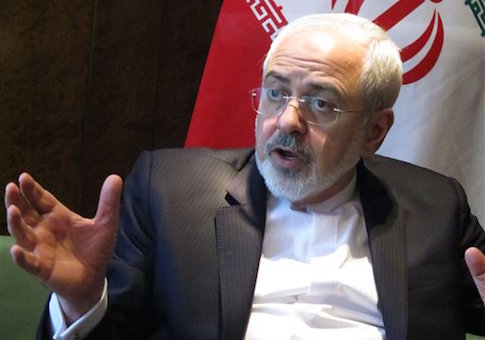 Iranian Foreign Minister Mohammad Javad Zarif / AP
Iran’s foreign minister and chief negotiator in nuclear talks with the West declared victory for his country, stating that no matter how the negotiations end, Tehran has come out “the winner,” according to remarks made on Tuesday and presented in the country’s state-run press.
Javad Zarif, the Islamic Republic’s foreign minister, stated in remarks before the country’s powerful Assembly of Experts, which recently installed a hardline new cleric as its leader, that the nuclear negotiations have established Tehran as a global power broker.
“We are the winner whether the [nuclear] negotiations yield results or not,” Zarif was quoted as saying before the assembly by the Tasnim News Agency. “The capital we have obtained over the years is dignity and self-esteem, a capital that could not be retaken.”
Zarif’s comments were accompanied by a host of bold military displays by Tehran in recent weeks, including the announcement of one new weapon that Iranian military leaders have described as a “very special” missile.
As the United States and Iran rush to hash out a final nuclear agreement ahead of a self-imposed July deadline, Zarif also lashed out at congressional Republicans who have expressed skepticism over the Obama administration’s diplomacy and have fought to exert control over the implementation of any deal.
Zarif dismissed as a “propaganda ploy” a recent letter signed by 47 Senate Republicans that warned Tehran against placing too much stock in a weak deal agreed to by the Obama administration.
Meanwhile, Iran’s military continues to unveil a range of new strategic missiles and advanced weapons meant to project strength throughout the region.
Iran disclosed during military drills late in February that it is developing a missile capable of being fired from a submerged submarine. Top Iranian military leaders have described the missile as a “very special weapon,” according to IHS Jane’s, a defense industry news source.
“I believe that this weapon is a strategic weapon,”Admiral Ali Fadavi, the naval commander of the Iranian Revolutionary Guard Corps (IRGC), said on state television, according to Jane’s. “It has special characteristics.”
Fadavi declined to provide additional details about the missile. “I would like to keep this information for the future. It is a very special weapon and the Americans cannot even surmise how strong and effective this weapon is.”
On Tuesday morning, the commander of Iran’s navy previewed the unveiling of “advanced surface and subsurface vessels” that will soon be incorporated into the country’s fleet, according to the state-run Fars News Agency.
Iran has put great stock in its navy, investing significant resources to bolster the force and make it a principal player in key global shipping lanes, including around the Strait of Hormuz, the Gulf of Oman, and the Caspian Sea.
Sea-based weapons were a major focus of recent high-level meetings between Iranian and Russian officials, who agreed to a new arms pact.
Earlier this week, Iran initiated into its fleet a new destroyer ship that is “armed with advanced anti-surface and anti-subsurface weapons and air defense systems,” according to military leaders quoted by Fars.
The ship was immediately deployed to the Caspian Sea, an area Iran views as critical to its interests.
Admiral Kordad Hakimi, a top Iranian navy official, told the country’s press that Iran is prepared to use force in the region.
“We have no security problem in the Caspian Sea today, [but] … the Navy is fully prepared to confront any threat,” he was quoted as saying.
Iranian officials have also bragged about being in full control of five out of nine major international waterways.
Intelligence: Broken Arrow
By G. Murphy Donovan
March 11, 2015
via Articles: Intelligence: Broken Arrow.
Policy is a worldview. Intelligence is the real world, a wilderness of untidy facts that may or may not influence policy. When Intelligence fails to provide a true and defensible estimate, a clear picture of threat, policy becomes a rat’s nest of personal and political agendas where asserted conclusions and political correctness become the loudest voices in the room. The policymaker thinks he knows the answer. The intelligence officer has the much tougher tasks of confirming or changing minds.
American national security analysis has been poisoned by such toxins. An Intelligence report these days might be any estimate that supports the politics of the moment. Truth today is an afterthought at best and an orphan at worst.
Alas, corrupt Intelligence is the midwife of strategic fiasco. Four contemporary failures provide illustrations: revolutionary theocracy, the Islam bomb, imperial Islamism, and the new Cold War.
Back to Theocracy
The Persian revolution of 1979 was arguably the most significant strategic surprise of the last half of the 20th Century. Yes, more significant than the fall of Soviet Communism. (The precipitous fall of the Soviet Bloc, to be sure, was another bellwether event unanticipated by Intelligence analysis.) The successful religious coup in Iran, heretofore an American client regime, now provides a model for all Muslim states where the default setting among tribal autocracies is now theocracy not democracy. In the wake of the Communist collapse, Francis Fukuyama argued that the democratic ideal was triumphant, an end of history as we knew it, the evolutionary consequence of progressive dialects. Fukuyama was wrong, tragically wrong. History is a two-way street that runs forward as well as backwards.
The fall of the Soviet monolith was not the end of anything. It was the beginning of profound regression, an era of religious irredentism. Worrisome as the Cold War was, the relationship with Moscow was fairly well managed. Who can argue today that East Europe or the Muslim world is more stable or peaceful than it was three decades ago?
The Persian revolution of 1979 not only reversed the vector of Muslim politics, but the triumph of Shia imperialism blew new life into the Shia/Sunni sectarian fire, a conflict that had been smoldering for more than a thousand years. The theocratic victory in Tehran also raised the ante for Israel too, now confronted by state sponsored Shia and Sunni antagonists, Hezb’allah, Fatah, and Hamas.
Shia Hezb’allah calls itself the party of God! Those in the Intelligence Community who continue to insist that religion is not part of the mix have yet to explain why God is part of the conversation only on the Islamic side of the equation.
Global Islamic terror is now metastasizing at an alarming rate. More ominous is the ascent of the Shia clergy, apocalyptic ayatollahs, bringing a lowering of the nuclear threshold in the Middle East. Sunni ISIS by comparison is just another tactical terror symptom on the Sunni side — and yet another strategic warning failure too.
Tehran is in the cat bird’s seat, on the cusp of becoming a nuclear superpower. Nuclear Iran changes every strategic dynamic: with Israel, with Arabia, and also with NATO. A Shia bomb is the shortcut to checkmate the more numerous Sunni. Iran will not be “talked out” of the most potent tool in imperial Shia kit — and the related quest for parity with Arabian apostates.
The Islam Bomb
The Islam bomb has been with us for years, in Sunni Pakistan, although you might never know that if you followed the small wars follies in South Asia. The enemy, as represented by American analysis, is atomized, a cast of bit players on the subcontinent. First, America was fighting a proxy war with the Soviets. When the Russians departed, the enemy became the murderous Taliban followed by al Qaeda. Both now make common cause with almost every stripe of mujahedeen today. In the 25 years since the Soviet withdrawal, Afghanistan has been reduced now to a rubble of narco-terror and tribalism. If we can believe bulletins from the Pentagon or the Oval Office, America is headed for the Afghan exit in the next two years — maybe. Throughout, the real threat in South Asia remains unheralded — and unmolested.
Nuclear Pakistan is one car bomb, or one AK-47 clip, away from another Taliban theocracy. This is not the kind of alarm that has been raised by the Intelligence Community. Hindu India probably understands the threat, Shia Persia surely understands the Sunni threat, and just as surely, Israel understands that a Sunni bomb is the raison d’etre for a more proximate Shia bomb. Who would argue that the Sunni Saudis need nuclear “power”? Nonetheless, Riyadh is now in the game too. The most unstable corner of the globe is now host to a nuclear power pull.
The American national security establishment seems to be clueless on all of this. Indeed, when a unique democracy like Israel tries to illuminate a portion of the nuclear threat before the American Congress, the Israeli prime minister is stiff-armed by the Oval Office. If Washington failed with Pakistan and North Korea, why would anyone, let alone the Israelis, believe that Wendy Sherman is a match for the nuclear pipedreams of apocalyptic Shia priests.
Alas, the motive force behind a Shia bomb is not Israeli capabilities or intentions. Israel is a stable democracy where any territorial ambitions are limited to the traditional Jewish homeland. Israel is no threat to Persia or Arabia. Pakistan, in contrast, is like much of the Sunni world today, another internecine tribal or sectarian wildfire waiting for a match.
The advent of the Islam bomb in Asia was not just a strategic surprise, but the step-child of strategic apathy. The folly of taking sides with the Sunni has now come home to roost. Iran is about to go for the atomic brass ring too, with the Saudis in trail, and there’s not much that America can/will do except mutter about secret diplomacy and toothless sanctions. Of course, there’s always the option of blaming Jews when appeasement fails.
Imperial Islam
The Ummah problem, the Muslim world, has now replaced the Soviet empire, as Churchill would have put it, as the “riddle wrapped in a mystery inside an enigma.” There are four dimensions to the Islamic conundrum: the Shia/Sunni rift, intramural secular/religious conflicts, kinetic antipathy towards Israel and the West writ large, and the failure of analysis, especially strategic Intelligence, to unwrap the Muslim onion in any useful way. Imperial Islam, dare we say Islamofascism, now threatens secular autocracy and democracy on all points of the compass.

Islam in London
Islamic imperialism is a decentralized global movement. Nonetheless, the various theaters are united by tactics, strategy, ideology, and objectives. The tactics are jihad, small wars, and terror. The strategy is the imposition of Shariah Law. The ideology is the Koran and the Hadith. And the objective is a Shia or Sunni Islamic Caliphate — for infidels, a distinction without difference.
Muslim religious proselytizers and jihad generals in the field make no secret of any of this. The problem isn’t that some Muslims dissent from this agenda, the problem is that the West, especially national security analysts, cannot/will not believe or accept what Islamic imperialists say aloud, about themselves. The enemy is hiding in plain sight, yet the Intelligence Community doesn’t have the integrity or courage to make a clear call.
Noted British criminal psychiatrist Theodore Dalrymple captures the bizarre logic of appeasement:
“Racial, religious and cultural identity are morally important in politics, precisely what so many people would like to deny because it can so easily unleash the vilest political passions. Something that is true, say our people of goodwill to themselves, could have nasty consequences; therefore it is not true.”
Propaganda provides many of the strategic “tells” in any conflict. The Nemstov murder in the shadow of the Kremlin provides an example. The knee-jerk reaction of politicians and pundits in America was to implicate Russian culture, the Kremlin, or Vladimir Putin.
Contrast the Nemstov blame game with any or every recent Islamist atrocity and the nuclear race in the Ummah. With these, the knee-jerk reaction is to defend Islam, more concern for Islamism and the religious equivalence shibboleth than the nuclear threat or Jewish, Christian, and apostate heads that are now literally rolling on a global scale. In a recent US State Department brief, we are told by State Department spokesman Marie Harf that Islamic terrorism might be attributed to “unemployment” (sic).
Cold War Redux
The West can no longer take yes for an answer. The deliberate resuscitation of the Cold War amidst a host of tactical defeats in the Ummah is probably one of the worst foreign policy choices on record.
The old Soviet Union: took down the Berlin Wall, relinquished former satellites, dismantled the Warsaw Pact military alliance, and purged East Europe of nuclear weapons. In response, America and the EU dismantled Yugoslavia, taking the Muslim side we might add, and aggressively expanded NATO up to the traditional Russian border. The “End of (totalitarian) History” as we knew it wasn’t enough. Any vestigial associations with Moscow were relentlessly undermined. The American sponsored coup, orchestrated by Victoria Nuland at the US State Department, with likely help from the CIA, in Ukraine is the best and most recent example.
The “regime change” strategy in Europe has degenerated into some petulant version of nuclear chicken with the Russians. The American embassies in Moscow and Kiev regularly host anti-Putin dissidents in Ukraine and Russia
Regime change folly has lowered the nuclear threshold in South Asia, the Mideast, and now East Europe. Sevastopol and Kiev are side shows. The real target for Brussels and Washington is Moscow — and the Putin regime. The idea that the Kremlin or Russians can be undone or manipulated by: black operations, cyber war, sanctions, propaganda, or provocations is naïve and reckless. Putin is not a Pahlavi, Gadhafi, Assad, or Yanukovych.
Russians were very helpful in ridding Syria of chemical weapons and clearing the Ukraine of nuclear weapons. Moscow and Putin have the potential also to be very useful against terror, nuclear proliferation, and resolving the Levant lunacy too.
The House minority leader recently lamented losing the “public relations” war with Russia. The American Secretary of State responded that Russian Television (RT) was responsible (sic). The more believable narrative spun by the Kremlin might be closer to the mark. Truth is a powerful ally, especially when it’s coupled with skillful propaganda.
The origin of the new Cold War may have domestic origins. Neither major American political party has a clue as what to do with the metastasizing Muslim problem. Indeed, both sides gag on words like Islam, Muslim, or Mohammed. As 2016 approaches, both parties desperately need to change the subject and find a foreign policy to run on. Regime change in Russia seems to be the consensus choice for American demagogues, Right and Left.
The idea that domestic “politics stops at the border” was always honored more in the breach than anywhere else. The politics of personal destruction is a time honored tradition in America, especially on the Left. That standard has now been folded into the foreign relations bag of tricks. Henry Kissinger claims that “demonization” is not policy. That may be true in any real politic sense, but the Putin bogyman is an ideal straw man for the next American presidential election. Proxy war abroad seems to be the safe sex of domestic politics.
What Now?
The American Intelligence Community is now the largest (17 agencies and uncountable contractors) and most expensive data collection and processing complex in history. Unfortunately, this gold-plated leviathan is undone by inferior analysis, indeed, estimates and reports that are more political than prudent. Withal, existential functions like strategic warning may be in freefall.
The obvious solution would be to take the strategic warning and national estimative functions out from under the IC, and the Executive Branch, and give those tasks to some apolitical body, assuming of course that an impartial forum might be sustained beyond the control of any branch of government. Realistically, it’s hard to believe that any American political party would sponsor an independent and uncontrollable voice of candor or objectivity.
Nonetheless, there are small things that might be done to make a huge difference. During the Cold War, USAF Intelligence ran a service of common concern for the IC called “Soviet Awareness.” The purpose of that program at Bolling AFB was to educate novice intelligence officers and FBI agents about the Soviet threat. The program included Russian history, the rise and spread of Communism, Marxist ideology, and Soviet military capabilities.
Ironically, the inter-agency program that answered the question “why we fight” was discontinued by James Clapper when he became the USAF Assistant Chief of Staff for Intelligence.

Clapper is now the Director of National Intelligence. The Soviet Awareness resources were reallocated to the information processing function. Today there is no awareness program of common concern on Russian, Islamist, or any other threats.
Clapper threw the threat baby out with the Soviet bathwater. Indeed, in most service schools, discussing Islamic ideology or religion is off limits. If any soldier or Intelligence officer were to ask: “Why do we fight?” the answer today would have to be, “Trust me.”
The real tragedy of Intelligence failure today is the burden born by American veterans, servicemen and women: the dead, crippled, and maimed. “Why we fight?” is a leadership deficit, the forgotten readiness issue. Troops don’t have a clear picture of the enemy or the ideology in play in places like Iraq, Afghanistan, Arabia, the Philippines, and Africa. They will know even less about the rationale for serving in East Europe should another conflict be engineered with Russia.
Indeed, the Pentagon and the Oval Office throw lives at small wars that generals and politicians have no intention of declaring, justifying, or winning — by their own admission. The Commander-in-Chief says the he seeks outcomes where there are no victors or vanquished. Indeed!
Traditionally, we like to think of collection and associated clandestine operations as the sharp end of the Intelligence spear. In fact, analysis is the cutting edge. Unfortunately, that edge is gone today. You could do worse than think of Intelligence analysis as the Broken Arrow in the national security quiver.
We may not know why we fight today, but there is little mystery anymore about why we fail.
The importance of information is seldom self-evident. Even if significance were obvious, information is still not knowledge. And clearly knowledge is not wisdom. Just as surely, only conscience allows an analyst to know the difference. All key judgments must be accompanied by courage and conviction too; courage to communicate to policy mandarins, or voters, with enough force to prompt action. Repetition is often the midwife of acceptance.
Good data and good analysis might be necessary, but never sufficient. Bridging the gap between analysis and acceptance is often a bridge too far for the timid. The national security continuum is a perilous enterprise. The messenger is always in danger of being shot. Alas, truth is an equal opportunity offender. It doesn’t care who gets hurt.
Nonetheless, changing minds is the object of any good Intelligence. Policy and action is only stimulated by an altered consciousness about the subject at hand. Prudent policy is a function of correct data, honest analysis, moral certainty, and rhetorical skill — written or spoken.
Alas, none of these self-evident, common sense observations, with the possible exception of abundant evidence, play much of a role in American threat analysis these days. A very expensive and growing intelligence Community (IC) is now the weak link in the national security chain. Any speculations about the catastrophic failures of American foreign policy in the past fifty years should begin with the “wilderness of mirrors,” James Angleton’s metaphor for Intelligence praxis.
G. Murphy Donovan was the last Director of Research and Russian (nee Soviet) Studies at USAF Intelligence, the directorate that staffed the associated Soviet Awareness Program. He served under General James Clapper.
The Danger of Negotiating with Iran, Washington Free Beacon, Michael Rubin, March 9, 2015
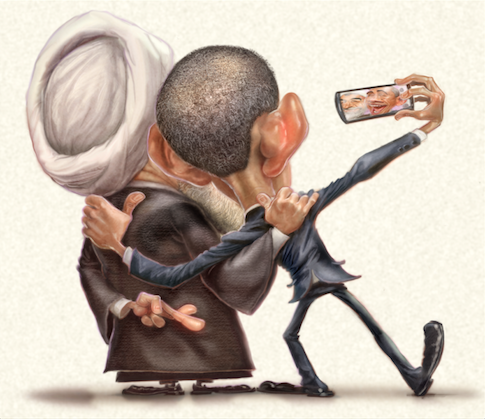
Incentivizing defiance also undercuts diplomacy. In the year before Obama blessed talks with Iran, the Iranian economy had shrunk 5.4 percent. After talks, its economy grows. In order to bring Iran to the table, Obama has released more than $11 billion to Iran. To put that in perspective, that is equivalent to the last two years’ budget of the IRGC, a group responsible for the deaths of hundreds of Americans. What Obama has done is the equivalent of giving a toddler dessert first, and then asking him to come back to eat his broccoli.
How can these past successes be replicated? Sunset clauses, multinational contracts, and sanctions relief won’t do it. Only one thing will: Forcing the regime to choose between its nuclear ambitions and its survival.
*********************
As a candidate for president, Barack Obama made diplomacy with rogue regimes a signature issue. “The notion that somehow not talking to countries is punishment to them…is ridiculous,” he declared in 2007. In both his inaugural addressand his first television interview as president, he reached out to the Islamic Republic of Iran. “If countries like Iran are willing to unclench their fist, they will find an extended hand from us,” he told Al-Arabiya. In the six years since, whether firebrand Mahmoud Ahmadinejad or reformer-by-comparison Hassan Rouhani held the Iranian presidency, Obama has been so committed to a deal on Iran’s illicit nuclear program that he hasn’t let anything stand in his way—Congress, allies, or evenfacts.
Unfortunately, when it comes to the history of high-profile diplomacy with rogue regimes, Obama’s behavior is more the rule than the exception. If every senator looks in a mirror and sees a future president, then every president looks in a mirror and sees a brilliant statesman, a man who will be Nixon in China or Reagan in Reykjavik. In reality, what most should see is a reflection of Frank B. Kellogg, Aristide Briand, or Neville Chamberlain. With very little understanding of history, Obama, alas, sees only himself.
Albert Einstein is often credited (wrongly) with the adage that insanity is doing the same thing repeatedly while expecting different results. By that definition, Foggy Bottom is Bedlam. The U.S. military, in contrast, constantly forces soldiers to confront their mistakes—that is, after all, why sergeants-major chew out soldiers. Soldiers spend more time in the classroom dissecting exercises than they do in the field. Even when deployed, they never neglect after-action reports to determine what they might have done better.
In the last half century, however, the State Department has never conducted a “lessons learned” exercise to identify what went wrong with high stakes diplomacy. Nor does the State Department have any clear metrics to measure success and failure. State Department spokesmen often make declarations of progress that declassified records of talks—with Iran, North Korea, the Palestinians, Saddam Hussein’s Iraq, Muammar Gaddafi’s Libya, Pakistan or, increasingly, Turkey and Russia—belie.
Too many American diplomats dismiss the need to consider mistakes. Instead, many are committed to the belief that talking is a cost-free, risk-free strategy. Testifying before the Senate in support of Obama’s outreach to Iran, Nicholas Burns, the second undersecretary of state for foreign affairs under George W. Bush, promised, “We will be no worse off if we try diplomacy and fail.” Richard Armitage, another veterans of Bush’s State Department, has promoted a similar argument: “We ought to have enough confidence in our ability as diplomats to go eye to eye with people—even though we disagree in the strongest possible way—and come away without losing anything.”
But Armitage was wrong to project American values onto others. Americans may not see willingness to talk as weakness, but other cultures do. On the same day in 2008 that William J. Burns, Bush’s third undersecretary of state for foreign affairs, met an Iranian delegation in Geneva—the first public high-level meeting between American and Iranian diplomats in decades—Mohammad-JafarAssadi, the ground force commander of the Islamic Revolutionary Guard Corps (IRGC) declared that, “America has no other choice but to leave the Middle East region beaten and humiliated.”
But Armitage was wrong to project American values onto others. Americans may not see willingness to talk as weakness, but other cultures do. On the same day in 2008 that William J. Burns, Bush’s third undersecretary of state for foreign affairs, met an Iranian delegation in Geneva—the first public high-level meeting between American and Iranian diplomats in decades—Mohammad-JafarAssadi, the ground force commander of the Islamic Revolutionary Guard Corps (IRGC) declared that, “America has no other choice but to leave the Middle East region beaten and humiliated.”
American diplomats genuinely want peace, but cultural equivalence can kill. So too can ignorance of an adversary’s true goals. This is why Obama’s headlong rush into a deal with Iran will be disastrous.
Obama has had no shortage of cheerleaders. Secretary of State Hillary Clinton endorsed his embrace of diplomacy with rogue regimes. “You don’t make peace with your friends,” she said, adding, “You have to be willing to engage with your enemies.” That may be true, but how you engage with rogues is important. And this is where Obama—and so many would-be statesmen before him—have gone wrong.
It is possible both to take diplomacy seriously and to remember that rogue regimes are a particular problem. There is, of course, no standard definition of “rogue,” but there is no universal definition of “terrorism” either. That doesn’t mean it doesn’t exist. In effect, rogueness is the diplomatic equivalent of pornography; attempting to define it calls to mind Justice Potter Stewart’s quip about pornography: “I can’t define it, but I know it when I see it.”
For the purposes of American policy, it wasn’t the “neocons” of the Bush administration who coined the concept, but rather the progressives within the Clinton administration. In 1993, Les Aspin, then the secretary of defense, warned that “the new nuclear danger we face is perhaps a handful of nuclear devices in the hands of rogue states or even terrorist groups.” The following year, Bill Clinton himself described Iran and Libya as “rogue states” in a speech before European officials. Secretary of State Warren Christopher, hardly a hawk, repeatedly referred to Iran as a rogue regime, and, in 1997, Madeleine Albright argued that “dealing with the rogue states is one of the great challenges of our time…because they are there with the sole purpose of destroying the system.”
Indeed, Iran checks every box for a rogue regime: It has sacked embassies at home and blown them up abroad. When, between 2000 and 2005, the European Union more than doubled its trade with Iran in the name of supporting “Dialogue of Civilizations,” Mohammad Khatami’s reformist administration poured the bulk of its hard currency windfall into nuclear and ballistic missile programs, constructing, for example, the undeclared and covert enrichment facility at Natanz. Iranian leaders have also been unapologetic about ratcheting up terrorism and support for insurgencies in proportion to their sense of the West’s diplomatic desperation. In their wildest dreams, the Iranians never imagined seeing Western acquiescence to their domination not only of Syria and Lebanon, but also of Iraq, Yemen, and perhaps the Gaza Strip. The Iranians have only grown more truculent under Obama, sending naval warships through the Suez Canaland undertaking their first naval deployment to the Pacific Ocean since the 10th century.
Of course, the Iranian people themselves bear the brunt of the Islamic regime’s tyranny. Every time Iranian leaders speak of reform to the Western audience, public executions and crackdowns on religious minorities increase: Iranians understand the message: talk of reform is for external consumption only.
That hasn’t stopped every U.S. administration from seeking to bring Iran in from the cold. Obama may have reached his hand out to Iran, but he wasn’t the first: both Bushes, Clinton, Reagan, and Jimmy Carter each tried something similar. Revolutionary leaders only had American hostages to seize because Carter was determined to keep hopes for rapprochement alive, and to keep the embassy in Tehran open whatever the risks—Khomeini’s rhetoric notwithstanding. Then, as now, the president had the media in his corner. The day before Khomeini’s revolutionary thugs seized the U.S. embassy, Steven Erlanger, the New York Times’ future chief diplomatic correspondent, published an analysis arguing that “the religious phase [of Iran’s Revolution] is drawing to a close even as it is becoming formalized.” In other words, Carter was right. The naysayers who listened to what the Iranian leaders actually promised were not sophisticated enough to understand the nuanced position of the new regime.
But Carter did not stand alone in his hope of restoring the partnership between Tehran and Washington, nor are Democrats the only party who have expected dialogue to reform rogues. The Reagan-era “Arms for Hostages” scheme began as an effort to engage Iran and cultivate a new generation who might succeed Khomeini. And it was George H.W. Bush, not Obama, who used his inauguration topromise the Iranian leadership that, “Goodwill begets goodwill. Good faith can be a spiral that endlessly moves on.” President Ali Akbar Hashemi Rafsanjani publicly suggested that he was willing to play ball, and Bush was hooked. Only when Bush had the secretary general of the United Nations send an intermediary to Tehran did he learn that Rafsanjani’s interest in peace was a ruse. Rafsanjani, whom aides to Carter, Reagan, and George H.W. Bush all called a pragmatist at various times, subsequently suggested that Iran could annihilate Israel with a single nuclear bomb while Iran’s size would enable it to withstand any retaliation.
Bill Clinton turned the other cheek to Iran’s culpability in the 1996 Khobar Towers attack in order to give diplomacy a chance. After Khatami’s term ended, his own advisors began to brag about how they had played the United States. On June 14, 2008, Abdollah Ramezanzadeh, Khatami’s press secretary, hinted about the real motivation behind Iran’s reformist rhetoric. “We should prove to the entire world that we want power plants for electricity,” he said. “Afterwards, we can proceed with other activities.” Ramezanzadeh had this to say about the purpose of dialogue: “We had an overt policy, which was one of negotiation and confidence building, and a covert policy, which was continuation of the activities.”
When Obama declared on April 5, 2009, that “All countries can access peaceful nuclear energy,” the hardline daily Resalat responded with a front-page headline, “The United States capitulates to the nuclear goals of Iran.”
If Obama were serious about ending Iran’s nuclear threat, he would consider the lessons from past diplomacy with Iran. First, taking force off the table undercuts rather than eases diplomacy. Consider the hostage crisis. According to interviews with veterans of Carter’s Iran crisis team, Gary Sick, the 39th president’s point man on Iran, leaked word that the White House had agreed to table any military response. Hostage takers have since acknowledged that, once they learned that they could expect no military consequences, they transformed their 48-hour embassy sit-in into a 444-day crisis.
Desperation for a deal also backfires. After Iran seized the hostages, Secretary of State Cyrus Vance sought to talk to any Iranian who would listen. He sought a meeting with his Iranian counterpart, Abulhassan Bani Sadr. Bani Sadr made demands, but lost his post just two and a half weeks after the meeting was held. So Vance then sought to work with Bani Sadr’s successor, Sadegh Ghotbzadeh, a former trainer for Palestinian terrorists, who proved his revolutionary credentials by augmenting earlier demands. Steering into the Iranian political maelstrom has never worked.
Western diplomats, like community organizers, pride themselves on sensitivity. Multiculturalism is their religion and moral equivalence is their mantra. They seldom understand how adversaries feign grievance to put Americans on the defensive. Take, for example, Ambassador Thomas Pickering, a vocal proponent of engagement with Iran, who warned that Iranians “bristle at the use of the phrase ‘carrots and sticks,’” because it both depicted them as donkeys and implied noncompliance would lead to a beating. What Pickering and crew never realized, however, is that Iranians often use the phrase “carrots and sticks” themselves.
Likewise, Iranians often demand apologies for grievances real and imagined. When Albright apologized for the American role in the 1953 coup against Iranian Prime Minister Mohammad Mosaddeq, Tehran demanded compensation. Alas, Albright was apologizing to America’s co-conspirators: Due to right-wing Iranian fears of communism during the Cold War, the clergy had sided with the United States and the Shah over the left-leaning populist.
Incentivizing defiance also undercuts diplomacy. In the year before Obama blessed talks with Iran, the Iranian economy had shrunk 5.4 percent. After talks, its economy grows. In order to bring Iran to the table, Obama has released more than $11 billion to Iran. To put that in perspective, that is equivalent to the last two years’ budget of the IRGC, a group responsible for the deaths of hundreds of Americans. What Obama has done is the equivalent of giving a toddler dessert first, and then asking him to come back to eat his broccoli.
Obama recently dismissed a speech by Prime Minister Benjamin Netanyahu of Israel for being devoid of any “viable alternatives.” But Netanyahu was right: leverage matters. Reagan talked to the Soviet Union, but only after a massive military build-up that allowed him to negotiate from a position of strength. He never abandoned moral clarity. Only twice in history has the Islamic Republic reversed course after swearing to a course of no compromises. The first time was about what it would take to release the American hostages, and the second about what it would take to end the Iran-Iraq War. After the hostages were released on the first day of the Reagan presidency, Carter’s associates credited the persistence of diplomacy. This is nonsense: As Peter Rodman has pointed out, Iraq’s invasion of Iran had rendered Tehran’s isolation untenable. Khomeini needed to release the hostages or his country would have crumbled. Likewise, Khomeini considered ending the Iran-Iraq War in 1982, but the IRGC pushed him to continue it until “the liberation of Jerusalem.” After six years of stalemate and another half million deaths, Khomeini reconsidered. In his radio address, he likened accepting the ceasefire to drinking from a chalice of poison, but suggested that he had no choice if Iran was to survive.
How can these past successes be replicated? Sunset clauses, multinational contracts, and sanctions relief won’t do it. Only one thing will: Forcing the regime to choose between its nuclear ambitions and its survival.
What Iran Won’t Say About the Bomb, New York Times,
(Please refer to the link for an excellent diagram I was unable to reproduce here. It shows the few IAEA successes and the many Iranian refusals to permit access. — DM)
Last month, the inspectors reported that “Iran has not provided any explanations” for two of the three design questions now on the table. The other nine remain in limbo.
********************
OVER the course of a dozen years, ever since atomic sleuths from the United Nations began scrutinizing Iran’s nuclear program, hundreds of inspections have uncovered a hidden world of labs and sprawling factories, some ringed by barbed wire and antiaircraft guns, others camouflaged or buried deep underground. Yet despite that progress, Iran has so far managed to evade a central question — whether it knows how to build an atom bomb.
With negotiators from six world powers facing a deadline later this month to cut a basic agreement with Iran on the fate of its nuclear program, much of the public discussion has focused on curtailing Iran’s uranium plants and plutonium complex, its pathways to atomic fuel. In short, the buzz centers on brawn, not brains. But quietly, the United States and its allies are also discussing whether a final deal should compel Tehran to reveal the depth of its atomic knowledge.
That inner debate, as one European official in the midst of the negotiations put it, turns on “whether to force Iran to explain its past” — especially before 2003, when American intelligence officials believe Iran operated a full-scale equivalent of the Manhattan Project — “or whether to focus on the future.”
American officials are vague when pressed on how fully Iran will have to answer questions it has avoided for years from United Nations inspectors with the International Atomic Energy Agency, based in Vienna. To date, Iran has dodged all but one of the agency’s dozen sharp questions on bomb design.
“Iran’s most serious verification shortcoming,” Olli Heinonen, the former chief inspector, now at Harvard, said recently, “remains its unwillingness to address concerns about the past and possibly ongoing military dimensions of its nuclear program.”
Investigators at the I.A.E.A., drawing on intelligence from member states as well as their own investigations, have assembled a secret trove of reports, correspondence, viewgraphs, videos and blueprints that purport to show Iran’s skill in warhead design.
Iran ridicules the material as fake, maintaining that the trove is full of forged documents created by the Central Intelligence Agency or Israel’s Mossad. (The atomic agency’s chief, Yukiya Amano, dismissed that allegation in an interview last summer, saying the inspectors had confirmed the documents by consulting other sources.)
The problem is that the documents, if real, would undercut Iran’s argument that its nuclear ambitions are entirely peaceful, centering on the production of radioisotopes for medicine and electrical power for economic growth.
Expertise in warhead design, as opposed to atomic fuel production, is far more ephemeral and hard to track. It can also be less ambiguous. Some nuclear parts have application only to making weapons, such as neutron spark plugs at the core of some atom bombs. In contrast, uranium can fuel both nuclear arms and reactors that make electricity — it can light cities or annihilate them.
In early 2003, when the inspectors began their investigation, the focus was mainly on whether Iran was building factories that could make fuel for nuclear arms. That agenda made sense because acquiring fuel is the hardest part of the bomb equation. It’s the chokepoint. Moreover, it was relatively easy for the inspectors to monitor the giant factories that Iran was building, such as the plutonium reactor at Arak and the uranium plant at Natanz, its halls roughly half the size of the Pentagon.
Today, the six powers negotiating with Iran — Britain, China, France, Germany, Russia and the United States — still focus overwhelmingly on fuel production. They want Tehran to downsize or disconnect the centrifuges that spin at supersonic speeds to purify uranium. They want the reactor at Arak, still under construction, reconfigured to produce less plutonium, the other bomb fuel. The negotiators want the cutbacks to be large enough and long enough in duration — a decade or more — to ensure that Iran for the near future cannot mount a headlong rush for a bomb, known in the field as breakout.
Even Prime Minister Benjamin Netanyahu of Israel, in his dramatic speech to a joint session of Congress on Tuesday, elevated brawn over brains, saying “nuclear know-how without nuclear infrastructure doesn’t get you very much.” He added, “A pilot without a plane can’t fly.”
True enough. But there are other ways to get fuel, including buying it from the likes of North Korea or on the black market. So the design riddle still lurks in the background, both for breakout and what experts call sneak out.
Iran already knows how to make a rudimentary bomb. So do terrorists and college students. The real question is whether Iran can miniaturize a weapon to fit atop a missile, can make bombs more destructive than the one that turned Hiroshima into a radioactive cinder, and can use precious fuel sparingly enough to build a nuclear arsenal.
The I.A.E.A. inspectors saw hope of getting answers in mid-2007 when they agreed on a “work plan” with Iran meant to shed light on what happened inside the secretive laboratories run by Mohsen Fakhrizadeh, said to be Iran’s atomic mastermind. More than two years later, in late 2009, the plan lay in ruins. Mohamed ElBaradei, then the agency’s director general, said the inquiry had “effectively reached a dead end” because of Iran’s intransigence.
In November 2011, the inspectors stepped up the pressure by publishing a detailed listing of a dozen major fields critical for warhead building, saying their cache indicated that Iran had deeply researched the topics. Iran repeated its disavowal. In August 2013, as tensions mounted, Iran’s new president, Hassan Rouhani, elected on a platform of getting international sanctions lifted, agreed to open negotiations about the overall fate of Iran’s atomic program.
While those talks have dragged on for 18 months, Iran has let inspectors deep inside its production facilities and observed every commitment on cutting back its production of nuclear fuel. But it has continued to stiff-arm the inspectors on the question of suspected “military dimensions,” despite agreeing to another work plan. The Obama administration has said little about that silence.
Last month, the inspectors reported that “Iran has not provided any explanations” for two of the three design questions now on the table. The other nine remain in limbo.
So will Iran have to come clean before the economic sanctions are lifted? American officials won’t say. “It’s the most sensitive topic for the Iranians,” said one former American negotiator. “Is it worth blowing up a potential agreement in the name of forcing a confession?”
One solution, analysts suggest, would be the gradual lifting of sanctions in step with the investigators certifying that Tehran was finally answering their longstanding queries. That is under discussion. But it remains unclear whether the atomic riddle will be resolved. If past is prologue, the West might once again find itself stonewalled.
Ron Dermer and Dore Gold on Fox, via You Tube, March 8, 2015
(Giving Iran years to pursue its ambition of obliterating the U.S. and Israel, with few or no remaining sanctions as Iran continues its efforts to control the Middle East, and no significant progress in allowing the IAEA to pursue its investigations of Iran’s past and future progress in nuclear weaponry strikes me as worse than merely absurd.– DM)
Nuclear Truth; Clare Lopez, Hide the Nukes, via You Tube, March 7, 2015
White House pushing Israel to recall ambassador? Hot Air, Ed Morrissey, March 5, 2015
Yesterday, the Washington Post and former Obama adviser and Middle East envoy Dennis Ross urged Barack Obama to provide a serious response to the “strong case” presented by Benjamin Netanyahu to a joint session of Congress against the administration’s Iran deal. The left-leaning Israeli paper Ha’aretz reports that the “serious response” has been to treat Israeli ambassador Ron Dermer as an unwelcome guest to the party. Dermer created the embarrassment of Barack Obama this week, as Ha’aretz reports the White House’s thinking, and Dermer has to go if Netanyahu wants to do business over the next two years:
“We are not the ones who created this crisis,” said a senior administration official. “President Obama has another two years in office and we wish to go back to a reality where you can work together despite the differences. The prime minister of Israel is the one who needs to find a way to fix this.”
Although White House officials don’t say so explicitly, they seem to imply that one way to repair the relations between Netanyahu and Obama would be to replace Israel’s ambassador to Washington, Ron Dermer. The latter is seen as an instigator who concocted Netanyahu’s Congress speech behind Obama’s back with John Boehner, the Republican speaker of the House of Representatives.
In his speech to AIPAC, Netanyahu praised Dermer for standing firm and taking the heat in Washington. If Netanyahu wins the election and continues to back Dermer, the ambassador will find himself isolated in the American capital. As long as Obama is in the White House, nobody in the administration will work with him.
Ha’aretz reporter Barak Ravid reports this in a matter-of-fact manner, which misses the irony in this passage:
Over the past six years, there have been more than a few ups and downs in the Netanyahu-Obama relationship – tensions, crises, public recriminations and wrangling before the cameras. Senior U.S. officials say that to date, ongoing relations between the two countries continue to function despite these strains. But this time, they stressed, there was the feeling that Netanyahu was using these differences – in fact, highlighting and intensifying them – for his own political needs.
“Historians can probably find examples of times when there were similar crises in the U.S.-Israel relations in the past,” said a senior U.S. official. “In the last six years we had big differences over the peace process and on other issues, but the situation now is extremely difficult and feels more politically charged than ever before.”
Ahem. When Hamas opened fire on Israel last summer, which country went to Qatar to legitimize the terrorist group in negotiations in order to push Israel into recognizing them? That came just after the Bowe Bergdahl swap sent five high-ranking Taliban commanders to Doha, and the Obama administration needed to show that Qatar could be trusted, and to allow Qatar to curry favor in the region. It took Egypt Abdel Fatah al-Sisi to bigfoot John Kerry out of that particular folly.
Don’t think for a moment that the Obama administration hasn’t been playing politics with Iran all along, too. Which country in this equation has a foreign-policy track record so poor that it has desperately glommed onto the idea of a rapprochement with the largest state sponsor of terrorism in the world? For this White House to accuse another government, especially an ally as beleaguered as Israel, of playing politics with foreign policy and alliances is the height of hypocrisy. Obama’s entire policy in the region has been predicated on playing footsie with Iran since he first took office, either in a sham “containment” relationship or a fully endorsed policy of regional hegemony.
As for Dermer, he’s clearly not the problem. However, as one former US ambassador to Israel says, ambassadors are “an expendable lot,” and Netanyahu may need to find another envoy if he wins another term as Prime Minister. That won’t change the trajectory of this administration’s folly on Iran, though, nor the chronic ineptitude of Obama’s State Department on Israel and the region.
Update on the Update below: That story was from last year, actually, as Gabriel Malor pointed out later on Twitter. We both missed that. I’ve changed the headline to remove the red headline and wanted to post this above the link. My apologies for the confusion, even though it’s still a pretty good reminder of the threat Iran poses to Israel and the region.
Update: Here’s a timely reminder that Netanyahu accurately warned that Iranian support for terrorism was a direct threat to Israel (via Gabriel Malor):
The Israel Navy intercepted a ship early on Wednesday that Iran was using to smuggle dozens of long-range rockets to Gaza.
The IDF’s “Operation Discovery” took place in the Red Sea, 1,500 kilometers away from Israel and some 160 kilometers from Port Sudan. IDF Chief of Staff Lt.-Gen. Benny Gantz oversaw the raid.
Missile ships and navy commandos from the Flotilla 13 unit, backed by the air force, raided the Klos-C cargo ship, which was carrying Syrian- manufactured M-302 rockets.
The ship’s crew is in Israeli custody, and the navy is towing the vessel to Eilat, where it is expected to arrive in the coming days.
The rockets originated in Syria, according to Military Intelligence assessments. Iran reportedly flew the rockets from Syria to an Iranian airfield, trucked them to the seaport of Bander Abbas, and shipped them to Iraq, where they were hidden in cement sacks. The ship then set sail for Port Sudan, near the Sudanese-Eritrean border, on a journey that was expected to last some 10 days.
Hey, but I’m sure the Tehran mullahcracy will be totally trustworthy with those thousands of uranium centrifuges!
The Pointlessness of the Two-Phased Nuclear Deal, Front Page Magazine,
(The pointless point is: Never mind the pesky details which you wouldn’t understand anyway; Obama achieved peace in our time! — DM)
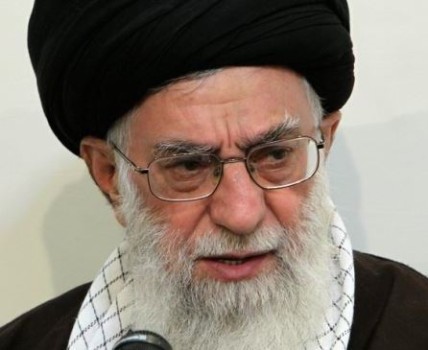
According to Kerry and Iranian leaders, the first phase is aimed at reaching a general outline by the end of March, while the second phase will chart a way to agree on the nuances and technical issues by June. But didn’t both sides previously reach an interim deal and discuss the major talking points for the final nuclear talks?
The major objective of this strategy by the Obama administration is to avoid criticism by projecting a pointless picture that “progress” is being made, that Iran is complying with the International Atomic Energy Agency (IAEA) and sanction rules, and that the Obama administration’s policy on Iran is effective. The administration appears to ignore that Iran is already skirting the sanction, as at least $1 billion has been smuggled into Tehran by the Iranian government in bank notes.
****************
The deadline for the “first phase” of nuclear talks between the Islamic Republic and the six world powers (known as the P5+1; the United States, the United Kingdom, Germany, France, Russia, and China) is approaching.
The prolonged negotiations appear to be making progress, according to Secretary of State John Kerry. In addition, Iranian Foreign Minister Mohammad Javad Zarif stated that both sides came to “a better understanding” at the negotiation.
After the interim nuclear deal was reached in November 2013, the nuclear negotiations between the two sides were again divided into two stages in order to reach a final and comprehensive nuclear deal. Kerry previously proposed the two-phased nuclear negotiations.
The question that is being ignored by the mainstream media is: What are the real objectives of dividing the final negotiations into two stages?
According to Kerry and Iranian leaders, the first phase is aimed at reaching a general outline by the end of March, while the second phase will chart a way to agree on the nuances and technical issues by June. But didn’t both sides previously reach an interim deal and discuss the major talking points for the final nuclear talks?
The major objective of this strategy by the Obama administration is to avoid criticism by projecting a pointless picture that “progress” is being made, that Iran is complying with the International Atomic Energy Agency (IAEA) and sanction rules, and that the Obama administration’s policy on Iran is effective. The administration appears to ignore that Iran is already skirting the sanction, as at least $1 billion has been smuggled into Tehran by the Iranian government in bank notes.
For President Obama, striking a ceremonial, pointless, and redundant deal by the proposed March deadline — rather than waiting until June to reach a final accord — would buttress his argument that “progress” is being continuously made with respect to his administration’s efforts to curb Iran’s nuclear program.
Domestically speaking, the administration has been heavily criticized by Congress (by both the Republicans and Democrats) for allowing the Islamic Republic to buy time, making unnecessary and unprecedented concessions, prolonging the talks, and not showing signs of real progress towards a credible final and comprehensive nuclear deal.
In addition, by striking a pointless deal in the “first phase” and projecting that “progress” has been made, President Obama would desire to ratchet up his leverage in vetoing any sanctions bill that might be proposed by Congress against the Islamic Republic’s nuclear and sanctions defiance.
In other words, President Obama will need this unnecessary first-phase deal in order to avoid further domestic pressure, show the effectiveness of spending so much political capital on the nuclear talks with Iran, ease sanctions on Iran, and justify making compromises.
It is in the interest of both President Obama and Hassan Rouhani to reach a deal in the first phase.
In addition to the aforementioned political reasons and interests of the Obama and Rouhani administrations to strike a deal in the first phase, other factors contribute to the increasing likelihood of reaching a general accord by the end of March.
The first phase agreement will not include the technical details regarding Iran’s nuclear program. The accord will likely include the major talking points that both sides repeatedly discussed previously. Some of the crucial points are:
· US possible flexibility on the breakout timeline (The amount of time that Tehran will need to build a nuclear bomb from highly enriched uranium or Plutonium);
· Iran’s flexibility for the immediate sanction reliefs;
· Iran’s acceptance of providing more data regarding the military dimensions of Tehran’s nuclear program;
· The heavy water Arak Reactor, and the production of plutonium at this site;
· Flexibility on both sides to reduce and further discuss the scope and capacity of Tehran’s uranium enrichment; and
· The possibility of allowing Iran to maintain an additional number of centrifuges.
The nuances and the technical details are not part of the first phase accord. The following crucial questions are less likely to be included in the first phase of the agreement: What exactly will the minimum “breakout” time be? What will the duration of the deal be? 10 years? 15 years? 20 years? How many years will it take to remove all economic sanctions against Iran? Will Tehran keep 1,500, 4,500, or 6,500 centrifuges? What is the exact scope of nuclear research and development that Tehran can maintain?
Since the aforementioned crucial and nuanced questions are not part of the first phase accord, striking this dispensable accord of the first phase is very likely and not a strenuous task.
As a result, reaching this general outline by end of March will not be historic as some mainstream media suggest. It is in fact pointless, unnecessary, redundant, and it is more likely to occur.
Report: Iran’s Supreme Leader Hospitalized in Critical Condition, Israel National News, Ari Yashar, March 5, 2015
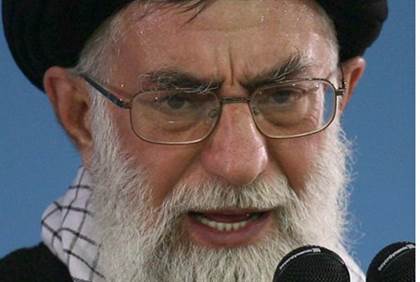 Ayatollah Ali Khamenei Reuters
Arab media reports Ayatollah Khamenei brought for urgent care in Tehran after several of his body systems fail.
Just in time for Purim, the Jewish holiday celebrating the redemption of the Jewish people from plots of genocide in ancient Persia, Iranian Supreme Leader Ayatollah Ali Khamenei was reportedly hospitalized incritical condition on Wednesday.
According to Arab media reports cited by Israel Hayom, Khamenei was urgently brought to a hospital in Tehran after several of his bodily systems had already failed.
The reports add that the 76-year-old supreme leader of the Islamic regime has undergone surgery and remains in critical condition.
Recently it has been reported that he was suffering from prostate cancerwhich had spread to additional parts of his body, and due to his poorhealth condition he had largely ceased taking part in public events.
The hospitalization comes just days after Prime Minister Binyamin Netanyahu addressed Congress on Tuesday to warn of the existential threat to Israel and the world that Iran poses, urging America to avoid the deal being formed on Iran’s nuclear deal ahead of a March 31 deadline for talks.
Lending some credence to the reports is the fact that Khamenei’s official Twitter account hasn’t been updated since Netanyahu’s speech on Tuesday, when he wrote the “US is now facing a #dilemma. It should either stop unlimited services to #Israel or they’ll lose more face in the world.”
Khamenei has threatened Israel with destruction numerous times in the past; last October he used his annual message to Hajj pilgrims heading to Mecca to call for Muslim unity to bring Israel’s “annihilation.”
And last November he launched a series of anti-Israel Tweets, writing in one “This barbaric, wolflike & infanticidal regime of #Israel which spares no crime has no cure but to be annihilated.”
Khamenei has demanded Iran be allowed to increase to 190,000 centrifuges in the deal being formulated, an amount that would allow it to produce a nuclear arsenal within weeks.
And yet it was revealed last November that US President Barack Obama had sent secret letters to Khamenei in an overture looking for an alliance and cooperation in the fight against Islamic State (ISIS) terrorists in Iraq and Syria.
Iran is the largest state sponsor of terrorism, and as Netanyahu noted in his speech, has seized influence in Yemen through the Houthis, Lebanon through Hezbollah, Iraq by taking a lead role in the ISIS fight, and Syria by propping up President Bashar al-Assad militarily.




 anneinpt
 artaxes
 danmillerinpanama
 davidking1530
 Peter Hofman
 Joseph Wouk
 Peter
Peter Louisiana Steve
 WarSclerotic
Recent Comments