Posted tagged ‘Iranian nukes’

Iranians Chant “Death to America” While Negotiations Continue

March 22, 2015

Iranians Chant “Death to America” While Negotiations Continue, The Clarion Project, March 22, 2015

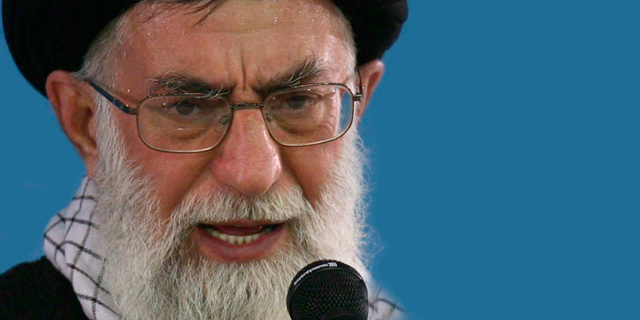
Iran-Ayatollah-Khamenei-IP_0Supreme Leader of the Islamic Republic of Iran Ayatollah Khamenei (Photo: © Reuters)

Ayatollah Khamenei, the Supreme Leader of Iran, presided over chants of “Death to America” in his Nowruz address to the people of Iran.

Nowruz is the Persian New Year and the Supreme Leader traditionally gives on address to mark the festival.

As part of his Nowruz address, Khamenei responded to President Obama’s Nowruz video message, in which he spoke directly to the Iranian people and called on them to support a nuclear deal.

Ayatollah Khamenei said that Obama’s Nowruz message was asking Iranians to submit to American demands in exchange for economic relief, couching the negotiations in terms of struggle rather than mutual benefit.

The crowd then broke out in chants of “Death to America” which was repeated multiple times over the course of the hour long speech.


By contrast, Obama’s Nowruz message to the Iranian people said that a nuclear deal would bring a brighter future for the people of Iran and urged them to support the negotiations.


Security Challenges of the New Israeli Government

March 21, 2015

Security Challenges of the New Israeli Government, Middle East Forum, Efraim Inbar, March 19, 2015

1111Israel lies at the center of the territorial caliphate envisioned by ISIS – and that’s only it’s second greatest security concern.

The US is racing toward an agreement that will legitimize the nuclear threshold status of Iran

Israel’s main challenge is to maintain its freedom of action, while on a collision course with current American policy.

Israel must prepare for worst-case scenarios, not best-case dreams.


************************

A new Likud-led government will take office in Jerusalem in the upcoming weeks. The government will have to face many security challenges emerging from the turbulent strategic environment.

The most important issue is Iran. The US is racing toward an agreement that will legitimize the nuclear threshold status of Iran. Many key Mideast powers have signaled their displeasure with the nascent accord, as well as their desire to develop uranium enrichment capabilities on par with Iran.

The American attempt to offer a nuclear umbrella to forestall regional nuclear proliferation – which is a strategic nightmare – is doomed to failure. No Arab leader trusts President Obama. Therefore, only a military strike to destroy the Iranian capability to produce fissionable material needed for nuclear bombs can stop nuclear proliferation in the region.

The only country with ‘enough guts’ to do this is Israel. This decision must be taken by the next Israeli government. The timetable for such a strike is not to be determined by additional Iranian progress on the nuclear path, but by the perceptions of regional leaders of Iranian ambitions and power. The expansion of Iranian influence to Iraq and Yemen, in addition to its grip over Syria and Lebanon, has heightened threat perceptions. American willingness to accept a greater Iranian regional role undermines American credibility and underscores the need for Israeli action in the near future.

An Israeli strike is needed to prevent nuclear proliferation and to prevent imperial and Islamist Iran from acquiring hegemony in the Middle East. History indicates that such Israeli actions are not welcomed by American administrations, but are highly appreciated later on. In this case, it is Israel that will have to save the Americans from themselves.

Israel’s main challenge is to maintain its freedom of action, while on a collision course with current American policy. This is not an easy endeavor, but Israel has large reservoirs of goodwill in the US that should allow Israel to act on its cardinal security interests against the will of an unpopular American president.

Despite the fact that some of the Arab armies that posed a threat to Israel have largely disintegrated and the power differential between Israel and its Arab neighbors grows constantly, the Jewish state still faces great hostility from Islamist sub-state armed groups. Hezbollah, Hamas and Islamic Jihad cannot conquer Israel, but have acquired impressive capabilities to cause massive damage to Israel. Large armored formations are still needed to tackle those challenges. In addition, Israel’s active defense missile capabilities must be augmented.

Unfortunately, the IDF is underfunded, which has led to cuts in ground forces and in training for the regular army and its reserves. Whoever will be the new defense minister has the task of securing a much larger, multi-year military budget on which the IDF can definitively plan a sustained force build-up. Israel’s strong economy can definitely sustain larger defense layouts.

Another area that needs attention is the navy. Over 90 percent of Israel’s exports travel via the East Mediterranean. Moreover, this area is rich in energy resources that are vital for Israel’s future prosperity. Yet, the East Mediterranean is increasingly becoming an Islamic lake.

Turkey under Erdogan grows more hostile every month. Syria is an Iranian ally, and its civil war has brought about the rise of Islamist militias of all kinds. Lebanon is largely ruled by Hezbollah – a Shiite radical organization aligned with Iran. Hezbollah occasionally perpetrates attacks against Israel and has threatened to hit Israel’s gas rigs at sea. Hamas, a radical Sunni terrorist group linked to Iran, has taken over Gaza. It has launched thousands of rockets into Israel and staged attacks on Israeli gas installations in the Mediterranean. In Sinai, a plethora of Islamist armed groups are challenging the sovereignty of Egypt and even attacked targets along the Suez Canal. Libya is no longer a real state and the Islamist militias are fighting to carve out areas of influence. In short, we may soon see real piracy and terrorist attacks in the East Mediterranean.

Israel’s responses must include a larger and stronger navy. This is an expensive project that has already started. Hopefully, all budgetary problems will be overcome. Fortunately, some of the vessels needed for this are procured in Germany (not the US), while others can be built in Israel if enough money is allocated.

The strategic landscape of the Middle East is begetting new leaders and new ruling elites. Israel’s intelligence apparatus faces a difficult job in identifying the important players and their modus operandi. Many of the devils Israel knew are no longer in power. This means greater uncertainty and higher chances of surprises. Since Israel cannot prevent all surprises (that is their nature), it must prepare for worst-case scenarios rather than be tempted by best-case, rosy dreams.

Iranians break off deadlocked nuclear talks to… attend Tehran funeral. Another pressure gambit

March 20, 2015

Iranians break off deadlocked nuclear talks to… attend Tehran funeral. Another pressure gambit, DEBKAfile, March 20, 2015

nuclear_talks_collapsed__20.3.15Nuclear talks reach deadlock

The Iranian delegation suddenly informed its US, British, French, Germany, Russian and Chinese counterparts Friday, March 20, that they were packing their bags and leaving Lausanne for Tehran later that day to attend the funeral of President Hassan Rouhani’s 90-year-old mother and would return next week.

Earlier, Foreign Minister Mohammed Jawad Zarif and US Secretary of State John Kerry failed to break the impasse on a nuclear accord at their sixth meeting.

Iran’s national security chief Ali Akhbar Salehi was part of the delegation. Another delegation member, Hossein Fereydoun, Rouhani’s brother, left earlier.

The Iranians set no date for resuming the talks, although other sources mentioned Wednesday, March 25. Another sign of a crisis was the cancellation of a briefing Friday in Brussels of British, German, French and European Union leaders on progress in the negotiations, that was supposed to reflect progress toward a deal by the March 31 deadline.

An hour before France, Britain and Germany were to join the talks in Lausanne, the Iranians announced they were about to leave.

It was announced subsequently that Kerry would hold the cancelled Brussels briefing in France Saturday for officials rather than top leaders.

Speaking to Western news agencies Friday, Western and Iranian officials admitted that all the sides were very far apart. “We are not close to anything resembling a draft agreement,” said a European negotiator. Russian Deputy Foreign Minister Sergei Ryabkov said the length of an agreement, the pace of sanctions relief and international monitoring remain points of contention. No draft would be circulated until closer to the June 30 deadline for technical annexes, said the Russian official.

In other words, the March 31 deadline for a framework accord appeared to have gone by the board.

Iran endorses nuclear EMP attack on United States

March 19, 2015

Iran endorses nuclear EMP attack on United States, Washington ExaminerPaul Bedard, March 19, 2015

Iran with a small number of nuclear missiles can by EMP attack threaten the existence of modernity and be the death knell for Western principles of international law, humanism and freedom. For the first time in history, a failed state like Iran could destroy the most successful societies on Earth and convert an evolving benign world order into world chaos.

*****************************

Suspected for years of plotting to dismantle the U.S. electric grid, American officials have confirmed that Iranian military brass have endorsed a nuclear electromagnetic pulse explosion that would attack the country’s power system.

American defense experts made the discovery while translating a secret Iranian military handbook, raising new concerns about Tehran’s recent nuclear talks with the administration.

Iran-Military-Chief-APSupreme Leader Ayatollah Ali Khamenei, right, attends a graduation ceremony of army cadets, accompanied by Revolutionary Guard commander Mohammad Ali Jafari, left, Chief of the General Staff of Iran’s Armed Forces, Hasan Firouzabadi, second left in Tehran, Iran, Saturday, Oct. 5 2013. (AP Photo/Office of the Iranian Supreme Leader)

The issue of a nuclear EMP attack was raised in the final hours of this week’s elections in Israel when U.S. authority Peter Vincent Pry penned a column for Arutz Sheva warning of Iran’s threat to free nations.

“Iranian military documents describe such a scenario — including a recently translated Iranian military textbook that endorses nuclear EMP attack against the United States,” he wrote.

A knowledgable source said that the textbook discusses an EMP attack on America in 20 different places.

Arizona Republican Rep. Trent Franks, who is leading an effort to protect the U.S. electric grid from an EMP attack, has recently made similar claims based on the document translated by military authorities.

Once sneered at by critics, recent moves by Iran and North Korea have given credibility to the potential EMP threat from an atmospheric nuclear explosion over the U.S.

Pry has suggested ways for Iran to deliver a nuclear attack: by ship launched off the East Coast, a missile or via satellite.

Either way the result could be destruction of all or part of the U.S. electric grid, robbing the public of power, computers, water and communications for potentially a year.

Frank Gaffney, founder and president of the Center for Security Policy, said the threat to the grid can also come from solar activity.

He has been pushing Washington and state governments to take the relatively inexpensive move to protect the electric grid, though his concern is from a nuclear attack by Iran or North Korea.

“It is increasingly frightening,” he said. “We have to get started on this.”

He noted that Iran’s top military leader recently announced that he was ready for war with the U.S.

“We are ready for the decisive battle against the U.S. and the Zionist regime,” Iranian Armed Forces Chief of Staff General Hassan Firouzabadi told Iran’s Fars News Agency in 2014.

Below is from Pry’s column that discusses an Iran EMP attack:


Iran armed with nuclear missiles poses an unprecedented threat to global civilization.

One nuclear warhead detonated at high-altitude over the United States would blackout the national electric grid and other life sustaining critical infrastructures for months or years by means of an electromagnetic pulse (EMP). A nationwide blackout lasting one year, according to the Congressional EMP Commission, could cause chaos and starvation that leaves 90 percent of Americans dead.

Iranian military documents describe such a scenario–including a recently translated Iranian military textbook that endorses nuclear EMP attack against the United States.

Thus, Iran with a small number of nuclear missiles can by EMP attack threaten the existence of modernity and be the death knell for Western principles of international law, humanism and freedom. For the first time in history, a failed state like Iran could destroy the most successful societies on Earth and convert an evolving benign world order into world chaos.


Houthis say they have secured aid package from Iran

March 14, 2015

Houthis say they have secured aid package from Iran

Spokesperson says Tehran has pledged to expand Yemen’s ports, help build power plants and provide Yemen with oil.

14 Mar 2015 12:51 GMT

via Houthis say they have secured aid package from Iran – Al Jazeera English.


Look Brennan civilians, not terrorist !


The UN warned this week that the situation in Yemen can spiral into something similar to Syria, Libya or Iraq [Reuters]
Yemen’s de-facto rulers, the Shia Houthi rebels, say they have secured an economic aid package from Iran.

A delegation of Houthis just returned from Iran and a spokesperson said Iran had pledged to expand Yemen’s ports, help build power plants and provide Yemen with enough oil to last a year.

Yemen is caught in a standoff between deposed president Abd-Rabbu Mansour Hadi and the Houthi rebels, who seized control of the capital Sanaa and staged a coup in February by dissolving the country’s parliament and creating a “presidential council”.

A spokesman for the exiled government, Rajeh Badi, said the Houthis would be the only ones to benefit from a deal with Iran.

The Iranian interference is merely, inside or outside Yemen, about military support to some militias or military groups,” Badi said.

The United Nations warned this week that the situation in Yemen can spiral into something similar to Syria, Libya or Iraq if no solution is found through talks between the country’s rival parties.

The UN special envoy to Yemen, Jamal Benomar, told Al Jazeera on Thursday that there was a real danger of the country disintegrating and a civil war erupting.

Benomar has been meeting all parties in Yemen as well as regional powers in a bid to resolve the country’s crisis

“If there is no agreement, the prospects are very bleak. It’s a combination of scenarios like Syria, Libya and Iraq. It’s a horrible scenario and all sides are aware that every effort should be made for a peaceful way forward.”

The Houthi takeover has also stoked secessionist sentiments in the south, raising fears of a repeat of the 1994 civil war, when the formerly independent south attempted to break away from its union with the north, forged four years earlier.

Obama’s Iran scheme is laid bare

March 13, 2015

Obama’s Iran scheme is laid bare, Washington Post, Jennifer Rubin, March 13, 2015

We surmised yesterday that the Obama administration had the idea to go to the United Nations to pass by resolution what Congress would never agree to: a lifting of sanctions on Iran in exchange for a nearly worthless deal in which Iran would keep thousands of centrifuges and get a 10-year glide path to nuclear breakout. Sen. Bob Corker (R-Tenn.), seeing what was afoot, demanded an explanation from the White House, calling such a scheme an “affront to the American people.”

On Thursday evening, after being pressed by irate Republicans, the National Security Council issued a defensive statement insisting that it would do no such thing. The story was handed to BuzzFeed:

The U.S. has “no intention” of using the United Nations to lock into place any potential deal with Iran over its nuclear program, a senior U.S. official said on Thursday.

The United States will not be “converting U.S. political commitments under a deal with Iran into legally binding obligations through a UN Security Council resolution,” Bernadette Meehan, spokesperson for the U.S. National Security Council, said in a statement emailed to BuzzFeed News.

“Past UNSC resolutions on Iran have called for a negotiated settlement of the Iran nuclear issue, and accordingly we would fully expect the UNSC to ‘endorse’ any deal with Iran and encourage its full implementation so as to resolve international concerns about Iran’s nuclear program,” Meehan continued. “But any such resolution would not change the nature of our commitments under such a deal, which would be wholly contained in the text of that deal.”

What is going on here? For starters, the existing U.N. resolutions obtained by President George W. Bush are much, much stricter than anything President Obama has indicated would be forthcoming. Those resolutions don’t permit Iran to keep thousands of centrifuges. They don’t give Iran a 10-year sunset. They require complete dismantling of Iran’s illicit program, full inspections and an accounting of past illicit behavior. In other words, any new deal negotiated by the administration would be weaker than — and in fact, in violation of — existing U.N. resolutions. That is why Obama would need to go back to the U.N., to water down, to cave into Iran’s demands.

This is not an original thought. For quite some time, former U.N. spokesman Richard Grenell has been warning that this is exactly what is coming down the pike. Last year Grenell wrote: “President Obama’s Geneva proposal to the permanent members of the United Nations Security Council allowing Iran to enrich some uranium violates previous UN resolutions demanding the Islamic Republic stop ‘all’ uranium enrichment activity. To avoid a violation of current UN resolutions, the permanent members must ask the entire Security Council to vote to weaken and supersede their previous demands.” He continued, “The UN’s four rounds of hard-fought sanctions on Iran and several other resolutions demanding compliance call for a full suspension of all enrichment activities, including research and development, then full verification of that suspension before negotiations on a permanent diplomatic solution begin. The sequencing was strategic. It was designed to build international confidence in a secretive country’s deceitful past.” But Obama deliberately departed from these restrictions, so he has always planned to go back. Otherwise, his deal would be in violation of existing international law.

That brings us to U.S. law. The U.N. resolutions don’t automatically become law, the administration was forced to concede. But under currentU.S. sanctions law, the president can waive them. And that is just what Obama intends to do. He will get the U.N. to water down international sanctions while he suspends U.S. sanctions. Why is this so dangerous? Mark Dubowitz, whose research and expertise helped lawmakers to construct the sanctions legislation, e-mails me:

President Obama risks undermining the entire sanctions edifice on which continued economic leverage depends. A future US president will need this leverage to enforce an Iran deal so that he can respond to Iranian noncompliance without resorting to either military strikes or surrender. But it increasingly appears that UN, EU and perhaps some US sanctions will be suspended and then reimposed or snap backed if Iran cheats. The snapback is a delusion. Reimposing sanctions is harder than it sounds. Amongst the United States, EU and UNSC, there are bound to be significant disputes on the evidence, differing assessments of the seriousness of infractions, fierce debates about the appropriate level of response and concerns about Iranian retaliation.

It’s also important to remember that when sanctions were first implemented, it took years before a critical mass of international companies terminated their business ties with Tehran. Once strictures are loosened, with so many international companies positioning to get back into Iran, it will be very difficult to persuade these companies to leave again. The Iranian regime will also adopt countermeasures to minimize its economic exposure to Western pressure when it anticipates that it will violate any nuclear agreement.

Obama’s legacy becomes demolition of the sanctions regime and an opening for Iran to either make a dash for breakout or to wait 10 years and get its stamped permission slip. The word for this is “containment.” The next president can reverse the waiver, but the Iranian economy will be on the road to recovery and the next president’s options will be severely limited. Iran might even have a bomb by then. As one conservative wag cracked, “If you like your sovereignty you can keep your sovereignty.” Yes, Obama tells us many soothing things but does whatever he wants.

What can Congress do? Well, it can express bipartisan outrage and pass a resolution deploring the president’s end run. But it must do more. Ideally, one would summon a bipartisan veto-proof majority to fix U.S. sanctions in law with no presidential waiver unless a deal meeting the existing U.N. resolutions was agreed upon. (I suppose Congress could use the power of the purse to defund our U.N. contributions, but let’s not get carried away.) But we also have to consider that this might simply be unattainable or susceptible to the argument that Congress can’t constitutionally eliminate all executive discretion. The next best option would be to increase the threshold for waiving existing and new sanctions — in other words, to narrow severely the president’s ability to waive U.S. sanctions, and require officials in the intelligence community and/or the military to add their certification (and thereby put their own credibility on the line as well). For example, U.S. sanctions would not be waived unless and until Iran gave a complete accounting of past nuclear activities and dismantled the Arak facility, things that the Iranians have refused to do and are objective criteria the president and the intelligence community could not honestly certify have occurred.

We have seen this again and again from this president — the complete contempt for coequal branches of government and determination to act in ways contrary to our constitutional structure and overwhelming public opinion (84 percent of Americans don’t favor a 10-year glide path to Iran getting a bomb). In the case of immigration, it took the form of an executive order overriding existing immigration laws under the theory that the president was using “discretion” to delay deportation of certain illegal immigrants. That is now in the courts. But his dual strategy of sabotaging strict U.N. resolutions and waiving U.S. sanctions is far more dangerous and nefarious. It gives primacy to an international body over Congress and the laws of the United States. It assumes sole authority in foreign affairs, something not envisioned in the Constitution, which divides powers between the two branches. Lawmakers have every right to feel as though they were misled and are being entirely marginalized once again.

A senior Republican on Capitol Hill tells me, “Everyone knows, including Democrats, that Obama and [Secretary of State John] Kerry are dangerously close to cutting a bad deal and lifting sanctions and shutting out Congress. If you don’t believe that just ask Democrats privately. They know it.” He remarks, “Instead of talking about that, we have a parade of faux outrage about Republicans and protocol, first the Bibi [Netanyahu] speech and now the letter. Historians will wonder why we did nothing to curb Iranian expansionism or shut down the nuclear program.”

The American people should demand that Congress affix existing sanctions in non-waivable legislation and tighten them as envisioned under the Menendez-Kirk legislation unless the new deal does what the president and the existing U.N. resolutions originally pledged to do — deprive Iran of an enrichment capacity sufficient to make a bomb.

Moreover, voters must demand that 2016 candidates disclose whether they would continue Obama’s explicit appeasement of Iran. Perhaps if Congress acted and 2016 candidates pledge to refuse to carry out this charade, the president would stiffen his spine and use all that as leverage to extract more concessions from Iran. Former Texas governor Rick Perry issued a forceful statement on Thursday. Wisconsin Gov. Scott Walker has also said “Republicans need to ensure that any deal President Obama reaches with Iran receives congressional review. Unless the White House is prepared to submit the Iran deal it negotiates for congressional approval, the next president should not be bound [by] it. I will continue to express that concern publicly to the President and directly to the American people.” Non-candidate Mitt Romney, who garnered respect for having been right on so many Obama foreign policy debacles, reiterates the Israeli prime minister’s message: “Walk away from a Swiss-cheese agreement; institute even more punitive and crippling sanctions than have been imposed; and remove those sanctions only when Iran agrees to dismantle its nuclear enrichment capability and to submit to unrestricted inspections. Finally, if contrary to reason and expectation those sanctions don’t bring Iran to its senses, prepare for a kinetic alternative.” But where are other candidates? Jeb Bush sounded sympathetic about the circumstances giving rise to Sen. Tom Cotton’s letter but refused to say he would not abide by a rotten deal not approved by Congress. His caution conveys weakness. All the top 2016 contenders need to stand up on this one.

If Congress and the 2016 contenders act forcefully, the White House may have to rethink its gambit. If not, the Iranians will know they won’t have a free ride (relief from sanctions) for very long.

There is one more problem for Obama. Our Sunni allies are not dim. They have every reason to be alarmed. They are already taking steps to “to match the nuclear capabilities Iran is allowed to maintain as part of any final agreement reached with world powers. This could include the ability to enrich uranium and to harvest the weapons-grade plutonium discharged in a nuclear reactor’s spent fuel.” An Obama deal of the type described would set off a Middle East arms race. Perhaps Congress should invite the king of Jordan or of Saudi Arabia to speak.

No wonder the White House was infuriated with Cotton: By suggesting there is a flaw in Obama’s scheme to leave out Congress, he made it less likely that the Iranians will be rewarded for their conduct and more likely that the next president would be able to extract concessions from Iran. He shined a light on what the administration was up to and let Democratic colleagues know they were being entirely left out of the loop by the president of their own party. He alerted the public to Obama’s belief that the U.N., not Congress, will be driving the Iran appeasement train. If the result of Cotton’s letter is to cement sanctions in law so that the president cannot waive them in his quest to appease Iran, the senator will be heralded as a heroic defender of the West’s security. If the result is to set the stage for a massive repudiation of Democratic leadership in both the Senate (should Democrats choose to drag their feet on cementing sanctions) and the White House, we can draw some comfort in the prospect of a large GOP majority in both houses and a Republican in the White House. Maybe they will have the gumption to prevent Iran from going nuclear. In any case, the message to Iran should be clear: The president’s shenanigans will not guarantee your quest for nuclear power; the only real insurance that your regime will survive is a binding treaty — and that is not happening unless you comply with existing U.N. resolutions.

Now the Saudis are developing a nuclear arsenal

March 12, 2015

Now the Saudis are developing a nuclear arsenal, Examiner, March 12, 2015

(????????????? — DM)

US nuke testThe “Baker” explosion, part of Operation Crossroads, a nuclear weapon test by the United States military at Bikini Atoll, Micronesia, on 25 July 1946.

Thus far, South Korea has been secure behind America’s nuclear arsenal. But, that country seems to have lost confidence with President Obama as well. It also might be disposed to share the technology with Japan, a country that has cast an anxious eye toward North Korea and China. In turn, the latter country will become very much alarmed.

************************

One of the terrible side effects of the impending Munich-style nuclear arms deal between President Obama and Iran is the possibility of a Middle East nuclear arms race. Hot Air reported on Thursday that the other shoe has dropped, and Saudi Arabia and South Korea has signed a nuclear agreement. The agreement suggests that the Saudis have concluded that there is no hope for President Obama preventing Iran from acquiring the Bomb. Therefore, the Kingdom is moving to acquire a native nuclear enrichment capacity in advance of building a nuclear arsenal.

By pretending that it is engaged in serious diplomacy with Iran, the Obama administration has managed to frighten the rest of the region to death. Israel is the only other country in the Middle East with a nuclear arsenal. Nearby Pakistan has the Bomb as well, but its nuclear weapons are geared toward countering its main enemy, India. The Saudis have concluded that it is time for an Arabic bomb to counter the impending Iranian bomb. Thus proliferation and the bone chilling possibility that a nuclear weapon might find its way into the hands of terrorists proceeds apace.

It gets worse. South Korea, besides an infusion of petrodollars, gets access to the nuclear technology it will build for its new desert customers. South Korea faces a country, North Korea, run by an insane man with its nuclear arsenal. Thus far, South Korea has been secure behind America’s nuclear arsenal. But, that country seems to have lost confidence with President Obama as well. It also might be disposed to share the technology with Japan, a country that has cast an anxious eye toward North Korea and China. In turn, the latter country will become very much alarmed.

So, the president, with his “smart diplomacy,” is about to create more nuclear powers across the world. Moreover, these countries will have, under the right circumstances, every incentive to use their nuclear arsenals. Who would have thought it possible?

It’s Not Just Islam, It’s the Tribal Mentality

March 12, 2015

It’s Not Just Islam, It’s the Tribal Mentality, Front Page Magazine, March 12, 2015

fft-450x253

Islam in part is the “theologizing” of the tribal mentality. Islam’s important innovation was to redefine the “tribe” as the whole umma of believers, creating in effect a “super tribe” that transcends mere blood as the bonding agent. But the tribal warrior ethos persists–– in the doctrine of jihad, tribal atrocities in contemporary terror and its gruesome videos, the privileging of men in polygamy, honor killings, and social restrictions on women, the disdain for the infidel “other” in the Koranic belief that Muslims are the “best of nations,” the betrayal of alliances in the religious sanction of lying to infidels (taqiyya), and the obsession with “honor” that today we find in violent Muslim reactions to “blasphemy” against Mohammed or the Koran.

Ignoring the tribal mentality is as dangerous for our foreign policy as downplaying Islamic doctrine.

The Obama administration’s serial appeasement of Iran––currently the “strongest tribe” spreading its influence throughout the region–– has damaged our prestige among allies like Jordan, Saudi Arabia, and Egypt, who are already shopping around for a more reliable and forceful partner. If we want to destroy the jihadists, check Iran’s nuclear ambitions, and protect our interests, we must again become the “strongest tribe.”
********************

The “nothing to do with Islam” mantra took a hit recently in one of the premier organs of liberal received wisdom, The Atlantic. Many have greeted as a revelation Graeme Wood’s article on the Islamic doctrines behind ISIS’s atrocities. Regular readers of FrontPage and Jihad Watch will not be as impressed. For years they have understood the link between jihadism and Islam. In 1994 Andy McCarthy made this connection when he prosecuted the perpetrators of the first World Trade Center bombing the previous year, a connection that the FBI ignored or discounted at the time––a failure, by the way, that has become a pernicious tradition for those charged with protecting our nation’s security and interests. For everyone else who has been paying attention to the rise of modern jihadism, Wood’s article is a dog bites man story.

One can hope that perhaps now, with the truth revealed by one of the Acela corridor’s oracles, the jihad deniers will wise up, though I wouldn’t bet on it. Unexamined opinions comprise the bulk of the progressive mind, and are notoriously resistant to empirical evidence and sound argument. But the current mess in the Middle East results from more than just Islam and its traditional belligerence, supremacist pretensions, and illiberal religious laws and doctrines. These characteristics reflect variations on the mentality of the tribe, one antithetical to modernity and the principles of liberal democracy, and still powerful in the Middle East, the region once described as “tribes with flags.”

For all the differences among tribal peoples, the components of this mentality are consistent, from the ancient Gauls and Germans Caesar conquered and the Vikings terrorizing much of Europe, to the American Indians the U.S. Cavalry fought and the jihadist gangs rampaging in the Middle East.

First, there is little notion of a common humanity that transcends ethnicity or culture. Universal principles are scarce, and personal identity is found solely in the collective customs and traditions of the tribe. Outsiders are to be distrusted, plundered, or conquered when possible. Loyalty is not to principle, but to blood. Most tribal peoples consider their tribe the acme of humanity, the only genuine humans. Hence their word for “human” is usually identical to the name of their tribe. They are literally ethnocentric.

Second, violence, particularly against outsiders, is an acceptable instrument for resolving conflict and asserting tribal superiority. Not just the violence of war, but also the cruel torture and slaughter of outsiders, including women and children, are legitimate for serving the interests of the tribe. Indeed, what we call terrorism was a tactic of tribal warfare to prevent a full-scale war by so terrorizing enemies that they would give up without a fight, a phenomenon common in the various Indian wars of American history. Hence the scary face-paint, tattoos, war cries, bizarre hairstyles, tortures like scalping, mutilation of enemies, or slaughter of their women and children, all of which are meant to frighten and demoralize the enemy. The same intent explains the blustering threats, braggadocio, and insults typical of tribal warfare and diplomacy. These practices can be documented in tribal societies from the Iroquois to the ancient Gauls.

Next, loyalty in tribal societies counts only for those within the tribe. Alliances with other tribes or peoples are ad hoc and contingent on the immediate interests of the tribe. They can be abandoned or betrayed if circumstances or perceptions change. Moreover, respect for others beyond the tribe is based solely on their capacity to inflict violence on their enemies. The “strongest tribe,” a status based on its effectiveness and success in conflict, will attract allies, who will abandon the hegemon once it loses that perception of its strength. Thus during Caesar’s wars in Gaul various Gallic and Germanic tribes would ally with the Romans when they appeared dominant, and betray them in an instant if they thought them weak. Likewise during the U.S. Cavalry’s wars against the Plains Indians, many tribes victimized by the Sioux or Apache or Cheyenne would ally with the Americans if they seemed to be winning, then switch sides the moment they seemed weak.

Finally, tribal societies are centered on the male warrior and his honor. Forget the Women’s Studies fantasies of matriarchal tribal societies. Tribal cultures privilege males, for men fight, and the survival and honor of the tribe depends on martial valor. Women bear children and work, as the skeletons of pre-contact American Indian remains demonstrate. Female bones show much more damage from hard physical labor than do male. This doesn’t mean that women had no status within the tribe, or did not enjoy somewhat more equality than women in more sophisticated civilizations. But warrior males still dominated, and culture in the main centered on men and their prowess in war, which earned honor, what we call prestige, for the whole tribe.

Sound familiar? It should, for Islam in part is the “theologizing” of the tribal mentality. Islam’s important innovation was to redefine the “tribe” as the whole umma of believers, creating in effect a “super tribe” that transcends mere blood as the bonding agent. But the tribal warrior ethos persists–– in the doctrine of jihad, tribal atrocities in contemporary terror and its gruesome videos, the privileging of men in polygamy, honor killings, and social restrictions on women, the disdain for the infidel “other” in the Koranic belief that Muslims are the “best of nations,” the betrayal of alliances in the religious sanction of lying to infidels (taqiyya), and the obsession with “honor” that today we find in violent Muslim reactions to “blasphemy” against Mohammed or the Koran.

Ignoring the tribal mentality is as dangerous for our foreign policy as downplaying Islamic doctrine. The chronic disorder in northern Iraq today is not just about the Sunni-Shi’a divide, or ISIS’s dream of a caliphate. It also reflects the bewildering number of tribes and clans in the region, whose complex alliances and enmities continually shift depending on circumstances and the perceptions of which tribe is the stronger. Our ally today can instantly become our enemy tomorrow. Factions that appear “moderate” today can become jihadist terrorists tomorrow. Our “friends” will tell us what we want to hear today, and then betray their words tomorrow. Most important, anything we do that creates the perception of weakness––especially concessions, or failure to inflict revenge, or acts of mercy––will also damage our prestige as the “strongest tribe” and invite tribes to abandon us.

These tribal practices defined most peoples, including Europeans, before the advent of modernity. They have survived among Middle Eastern Muslims because they were encoded in religious doctrines that promise global power for the tribe of the faithful in this life, and paradise in the next, especially for jihadist warriors. This amalgamation in part explains the spectacular success of Muslim warriors for a 1000 years, a record of martial achievement the memory of which today fuels the resentment and anger of those Muslims who wish to restore that lost honor. It also contributes to the difficulty of many Muslim societies to reconcile with modernity, particularly liberal democracy and its cargo of human rights, confessional tolerance, and equality for women and those of other faiths.

Of course, worldwide millions of Muslims have managed to transcend tribalism and adjust their faith to modernity. But millions more haven’t, and it is they who are fomenting most of the mayhem and murder on every continent except Antarctica. Our tactics and strategies in confronting this threat must indeed be based on a correct understanding of the spiritual imperatives that motivate the jihadists. But they also must take into account the tribal mentalities that respect force and honor the strong.

The Obama administration’s serial appeasement of Iran––currently the “strongest tribe” spreading its influence throughout the region–– has damaged our prestige among allies like Jordan, Saudi Arabia, and Egypt, who are already shopping around for a more reliable and forceful partner. If we want to destroy the jihadists, check Iran’s nuclear ambitions, and protect our interests, we must again become the “strongest tribe.”

Iranian President: Diplomacy With U.S. is an Active ‘Jihad’

March 12, 2015

Iranian President: Diplomacy With U.S. is an Active ‘Jihad’, Washington Free Beacon, March 12, 2015

Hassan RouhaniHassan Rouhani / AP

Iranian President Hassan Rouhani described his country’s diplomacy with the United States as an active “jihad” that is just as significant to Tehran’s advancement as the slew of new weapons and missiles showcased by the Islamic Republic’s military.

Rouhani praised the country’s military leaders for standing “against the enemy on the battlefield” and said as president, he would carry out this “jihad” on the diplomatic front.

Rouhani’s comments echo those of foreign minister and lead nuclear negotiator Javad Zarif, who said Tuesday that Iran has emerged as “the winner” in talks with Western powers. Like Zarif, Rouhani boasted that Iran’s years-long diplomacy with Western nations over its nuclear program established the Islamic Republic as a global power.

Iran has made headway in convincing the U.S. to allow it to maintain much of its core infrastructure through diplomatic talks that Rouhani said are viewed as a “jihad.”

“Our negotiations with the world powers are a source of national pride,” Rouhani said earlier this week. “Yesterday [during the Iran-Iraq War], your brave generals stood against the enemy on the battlefield and defended their country. Today, your diplomatic generals are defending [our nation] in the field of diplomacy–this, too, is jihad.”

“Our power is growing each day, but we don’t intend to be aggressive toward anyone. However, we will certainly defend our country, nation, independence, and honor wholeheartedly.”

Iran stands “10 times more powerful” than it was during the time of the Iran-Iraq War, Rouhani said, which “reflects a serious deterrence to the enemies’ threats.”

Iranian leaders view the ongoing talks with the United States and other nations as a source of global legitimacy.

Rouhani’s remarks have “significant domestic implications,” according to an analysis published by the American Enterprise Institute.

“Iran’s negotiations team to the status of Iran-Iraq War commanders, who are traditionally revered by the regime as upholders of Islamic Revolutionary values, could potentially lead to rhetorical backlash from regime hardliners opposed to the nuclear negotiations,” AEI wrote.

Matan Shamir, director of research at United Against Nuclear Iran, said Rouhani’s latest comments show he is not a moderate leader.

“While Rouhani talks about a ‘win-win’ nuclear deal to global audiences, his comments make clear that he continues to view the U.S. an antagonistic global oppressor that must be triumphed over, in this case by a diplomatic ‘jihad,’” Shamir said. “This is clearly not the language of a moderate or of a regime with which rapprochement is at all realistic.”

Zarif said Tuesday that a final nuclear deal with the United States is meaningless at this point.

“We are the winner whether the [nuclear] negotiations yield results or not,” Zarif was quoted as saying by the Tasnim News Agency. “The capital we have obtained over the years is dignity and self-esteem, a capital that could not be retaken.”

As Rouhani and Zarif grandstand on the nuclear front, Iranian military leaders have begun to unveil a host of new missiles and sea-based weapons.

General Amir Ali Hajizadeh, a leader in the Iranian Revolutionary Guard Corps, said Iran’s defensive capabilities “are non-negotiable in the nuclear talks,” AEI reported.

The comments came the same day Iran paraded its new cruise missiles.

Hajizadeh also dismissed economic sanctions on Iran, saying that “his is a message which should be understood by the bullying powers which raise excessive demands.”

On Wednesday, the State Department said any final deal with Iran was “nonbinding,” meaning that neither party would be legally obliged to uphold the agreement.

Rouhani adviser denies he called for Iran’s return to empire

March 11, 2015

Rouhani adviser denies he called for Iran’s return to empire, Al-MonitorArash Karami, March 10, 2015

(An modest attempt at a partial walk-back. Please see also, Advisor To Iranian President Rohani: Iran Is An Empire, Iraq Is Our Capital . . . — DM)

Iran's former Intelligence Minister Younesi, chief nuclear negotiator Larijani and former chief nuclear negotiator Rohani attend conference in TehranIran’s former Intelligence Minister Ali Younesi (L), chief nuclear negotiator Ali Larijani and former chief nuclear negotiator and current President Hassan Rouhani (R) attend a conference on Iran’s nuclear policies and prospects in Tehran April 25, 2006. (photo by REUTERS/Raheb Homavandi)

Ali Younesi, President Hassan Rouhani’s adviser on Ethnic and Religious Minorities affairs, has issued a clarification about his comments suggesting a union between regional countries. His words had sparked criticism from the Arab-language media, which construed them as reviving Iran’s ancient empire. A former Iranian vice president who was at the conference also spoke out against Younesi’s comments.

Younesi accused Iran’s enemies of creating propaganda by misconstruing his comments at a March 8 conference on Iranian history and culture, saying that he was simply talking about a “historical and cultural unity” between certain countries in the region, including Iran, Tajikistan, Afghanistan and Iraq. He said that his proposal was for a “union” and “does not mean an empire should be reborn,” but rather that the neighbors should cooperate to confront mutual threats. He added that Iran’s official position is that “it respects the national boundaries and territorial integrity of other countries.”

Younesi was specifically criticized for saying, “Currently, Iraq is not only part of our civilizational influence, but it is our identity, culture, center and capital, and this issue is for today and the past. Because Iran and Iraq’s geography and culture are inseparable, either we fight one another or we become one.” He went on, “My meaning is not that we should remove our borders, but that all the countries of the Iranian plateau should become close because our interests and safety are intertwined.”

Younesi’s call for a “natural union” between these countries was not welcomed by Iran’s regional rivals, especially given the sensitivities of Arab countries in the Persian Gulf to Iran’s assistance to Iraqi forces currently battling the Islamic State in former Iraqi President Saddam Hussein’s hometown of Tikrit.

Saudi Arabian-funded Al-Arabiya incorrectly reported that Younesi had said, “Iran today has become an empire like it used to be through history, and its capital is now Baghdad. That is the center of our civilization and our culture and our identity today, as it has been in the past.” CNN Arabic wrote in their headline that Younesi said, “Iran is an empire and its capital is Iraq. We protect the region from Wahhabis, neo-Ottomans and atheists.” Though the first sentence in the CNN Arabic is incorrectly translated, Younessi did say in the March 8 conference that Iran was helping to protect the region from Wahhabi, takfiri, Zionist and Western domination. The Al-Arabiya article was tweeted over 3,000 times and shared on Facebook by over 4,000 people.

Former Iranian Vice President Mohammad Ali Abtahi also criticized Younesi, posting on Facebook immediately after attending the conference, “Now that the Arab countries in the region have reached a relative unity with Israel on fears about Iran, these comments will be construed as the same threatening talk of Ahmadinejad.” He added, “Irrespective of their governments, people have a sensitivity to their land, and this talk provokes people’s sensitivities.”

As Rouhani’s Ethnic and Religious Minorities adviser, Younesi has become known for reaching out to Iran’s Jewish population by laying wreaths at the graves of Jewish Iranians killed in the Iran-Iraq war, taking criticism from conservatives for suggesting Iran revert to its pre-revolution flag bearing the lion and sun and criticizing those who commit human rights violations in Iran. Though he was once minister of intelligence under President Mohammad Khatami, today his position carries no executive weight. But given the tensions between Iran and Arab countries in the Persian Gulf, it’s understandable that these comments would spark a backlash.