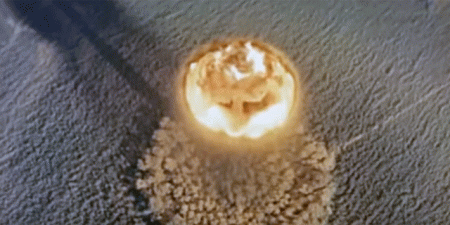
Posted tagged ‘Iranian nukes’

Ralph Peters on US-Iran Relations: ‘I Hate To Say This, But We’ve Lost This One’

March 9, 2016

Ralph Peters on US-Iran Relations: ‘I Hate To Say This, But We’ve Lost This One’

BY:
March 9, 2016 11:33 am

Source: Ralph Peters | Iran

Lieutenant Colonel Ralph Peters responded Wednesday to the Iranian launch of a ballistic missile that had ‘Israel must be wiped out’ written on it, saying that the Obama administration has positioned America as the perpetual loser in U.S.-Iran relations.

“Our president and the secretary of state have painted themselves into a very dangerous corner in which whatever we do or fail to do, we’re the losers,” Peters said.

Iranian hardliners who launched the missile are out to prove that they hold power both inside Iran post-parliamentary elections and on the global stage post-nuclear agreement, he said.

“This is the Revolutionary Guards and hardliners showing everybody who is still in charge, because, elections not withstanding, the people who hold the guns hold the power,” Peters said.

He said that the launch violates a U.N. Security Council resolution and shows that Iran is “rubbing it in” America’s face that they can “do whatever they want” after the nuclear deal because of the Obama administration’s weakness. As an example, Peters referenced the detention and “torment” of 10 U.S. sailors by Iran’s Islamic Revolutionary Guard Corps, after which Secretary of State John Kerry thanked the Iranians for their cooperation.

“They can do whatever they want now because this terribly flawed nuclear deal was front-loaded with benefits for Iran, and the benefits we get, if we get them, are spread out over the long-term,” Peters said.

He said that the economic ties Iran is now forging are difficult to sanction even if Obama wanted to punish Iran for the missile launch.

“Even if President Obama decided to abrogate that bad nuclear deal and resurrect sanctions against Iran, it wouldn’t work because Iran has been flooded with European and global corporations signing contracts right and left,” Peters said.

In all, he said, the outlook for a strong U.S. role in relations with Iran is dim.

“I hate to say this about my country, but we’ve lost this one,” Peters said.

Peters is known for his blunt assessments of the Obama administration’s foreign policy. In the past, he has called Obama a “total pussy” on live television.

Revolutionary Guards: ‘Iran has 10 times more missiles than Hezbollah’s 100,000’

March 9, 2016

Revolutionary Guards: ‘Iran has 10 times more missiles than Hezbollah’s 100,000’

Source: Revolutionary Guards: ‘Iran has 10 times more missiles than Hezbollah’s 100,000’ – Middle East – Jerusalem Post

A MILITARY truck carrying a missile and a picture of Iran’s leader Ayatollah Ali Khamenei drives in a parade marking the anniversary of the Iran-Iraq war in Tehran. (photo credit:REUTERS)

Deputy commander of the Iranian Revolutionary Guards said on Wednesday that Israel’s “collapse” was near and that it had ten times more missiles than Hezbollah’s 100,000.

“The Zionist regime will collapse in the near future. When Hezbollah has stockpiled over 100,000 missiles, it means Iran has tens of times more than that. Iran is in possession of different classes of missiles, and this power is unstoppable,” said Brigadier General Hossein Salami, Fars News Agency reported.

“We have a large stockpile of ballistic missiles in different ranges. They are ready to hit enemies and targets from different parts of the country,” he said on the second day of IRGC missile tests.

Salami asserted that international sanctions on the country boosted the domestic production of missiles.

Brigadier General Amir Ali Hajizadeh, commander of the IRGC’s aerospace division, said on Wednesday that the country’s missiles fired during drills are “Iran-made and belong to the Palestinian, Lebanese, Syrian and Iraqi nations, as well as all the oppressed people of the world.”

Separately, the spokesman for Iran’s atomic energy agency, Behrouz Kamalvandi, said the country needs nine nuclear power plants in the next 10 years for its energy needs, the official IRNA news agency reported.

He estimated that between 8 to 12 percent of the country’s electricity should be generated by nuclear power and there is a good possibility for the construction of two new power plants.

In the post-sanction era the idea has been warmly received, noting that there are a number of countries competing for the opportunity, asserted the Iranian official.

Iran Threatens to Walk Away From Nuke Deal After New Missile Test

March 8, 2016

Iran Threatens to Walk Away From Nuke Deal After New Missile Test, Washington Free Beacon, March 8, 2016

FILE - This file picture released by the official website of the Iranian Defense Ministry on Sunday, Oct. 11, 2015, claims to show the launching of an Emad long-range ballistic surface-to-surface missile in an undisclosed location. Iran tested a ballistic missile again in November 2015, a U.S. official said Dec. 8, describing the second such test since this summerís nuclear agreement. The State Department said only that it was conducting a "serious review" of such reports. The test occurred on Nov. 21, according to the official, coming on top of an Oct. 10 test Iran confirmed at the time. The official said other undeclared tests occurred earlier than that, but declined to elaborate. The official wasnít authorized to speak on the matter and demanded anonymity. (Iranian Defense Ministry via AP)

FILE – This file picture released by the official website of the Iranian Defense Ministry on Sunday, Oct. 11, 2015, claims to show the launching of an Emad long-range ballistic surface-to-surface missile in an undisclosed location. Iran tested a ballistic missile again in November 2015, a U.S. official said Dec. 8, describing the second such test since this summerís nuclear agreement. The State Department said only that it was conducting a “serious review” of such reports. The test occurred on Nov. 21, according to the official, coming on top of an Oct. 10 test Iran confirmed at the time. The official said other undeclared tests occurred earlier than that, but declined to elaborate. The official wasnít authorized to speak on the matter and demanded anonymity. (Iranian Defense Ministry via AP)

Iranian leaders now say that they are poised to walk away from the deal if the United States and other global powers fail to advance the Islamic Republic’s “national interests.”

*************************

Iran on Tuesday again threatened to walk away from the nuclear agreement reached last year with global powers, hours after the country breached international agreements by test-firing ballistic missiles.

Iran’s most recent ballistic missile test, which violates current U.N. Security Council resolutions, comes a day after the international community’s nuclear watchdog organization disclosed that it is prohibited by the nuclear agreement from publicly reporting on potential violations by Iran.

Iranian leaders now say that they are poised to walk away from the deal if the United States and other global powers fail to advance the Islamic Republic’s “national interests.”

“If our interests are not met under the nuclear deal, there will be no reason for us to continue,” Abbas Araqchi, Iran’s deputy foreign minister, warned during remarks delivered to a group of Iranian officials in Tehran.

“If other parties decide, they could easily violate the deal,” Araqchi was quoted as saying by Iran’s state-controlled media. “However, they know this will come with costs.”

Araqchi appeared to allude to the United States possibly leveling new economic sanctions as a result of the missile test. The Obama administration moved forward with new sanctions earlier this year as a result of the country’s previous missile tests.

Iran’s latest missile test drew outrage from longtime regime critics on Capitol Hill.

“The administration’s response to Iran’s new salvo of threatening missile tests in violation of international law cannot once again be, it’s ‘not supposed to be doing that,’” Sen. Mark Kirk (R., Ill.) said in a statement. “Now is the time for new crippling sanctions against Iran’s Islamic Revolutionary Guard Corps, Ministry of Defense, Aerospace Industries Organization, and other related entities driving the Iranian ballistic missile program.”

House Majority Leader Kevin McCarthy (R., Calif.) warned that the nuclear agreement has done little to moderate Iran’s rogue behavior.

“Far from pushing Iran to a more moderate engagement with its neighbors, this nuclear deal is enabling Iran’s aggression and terrorist activities,” McCarthy said in a statement. “Sanctions relief is fueling Iran’s proxies from Yemen to Iraq to Syria to Lebanon. Meanwhile, Khamenei and the Iranian regime are acting with impunity because they know President Obama will not hold them accountable and risk the public destruction of his nuclear deal, the cornerstone of the president’s foreign policy legacy.”

McCarthy went on to demand that the Obama administration step forward with new sanctions as punishment for the missile test.

Meanwhile, the U.S. State Department had difficulty Monday explaining why the nuclear agreement limits public reporting by the International Atomic Energy Agency, or IAEA, on potential deal violations by Iran.

Yukiya Amano, the IAEA’s chief, disclosed on Monday that his agency is no longer permitted to release details about Iran’s nuclear program and compliance with the deal. The limited public reporting is a byproduct of the nuclear agreement, according to Amano.

When asked about these comments again Tuesday, a State Department official told the Free Beacon that the IAEA’s reports would continue to provide a complete picture of Iran’s nuclear program, though it remains unclear if this information will be made publicly available.

“There isn’t less stringent monitoring or reporting on Iran’s nuclear program,” the official said. “The IAEA’s access to Iran’s nuclear program and its authorization to report on it has actually expanded. It’s a distortion to say that if there is less detail in the first and only post-Implementation Day IAEA report then that somehow implies less stringent monitoring or less insight into Iran’s nuclear program.”

While the IAEA “needs to report on different issues” under the final version of the nuclear agreement, the agency continues to provide “a tremendous amount of information about Iran’s current, much smaller nuclear program,” the source maintained.

The IAEA’s most recent February report—which was viewed by nuclear experts as incomplete and short on detail—“accurately portrays the status of Iran’s nuclear program,” including its efforts to uphold the nuclear deal, the official added.

“We expect this professional level of reporting to continue in the future,” the official said.

What to Expect in Iran

February 22, 2016

What to Expect in Iran, Gatestone InstituteJagdish N. Singh, February 22, 2016

♦ “The destruction of Israel is non-negotiable.” — Mohammad Neza Naghdi, Commander of Iran’s Basij paramilitary force.

♦ Sanctions relief will mainly benefit Ayatollah Khamenei and members of the Revolutionary Guards: they control up to one-third of Iran’s economy.

♦ Part of the Iranian regime’s grand strategy is to inflict “death to America” and replace it with its own radical version of Islamic governance. Ayatollah Khamenei himself called for America’s destruction amid nuclear negotiations.

♦ Officials also believe Iran is indirectly funding the Islamic State (IS) in the Sinai. “Suitcases of cash” are sent directly to Hamas officials in the Gaza Strip; part of the money is then transferred to IS.

♦ Iran now poses an even greater threat. If democracies today continue their present policies towards Iran, it will only embolden Iran’s regime to continue its quest to obtain nuclear weapons as well as its terrorism and human rights violations.

Humanity seldom seems to learn its lessons. The governments of the world’s leading democracies appear to be suffering from this predicament in their nuclear dealings with the Islamic Republic of Iran. To avoid catastrophe, democracies need quickly to correct their course.

One of the fatal blunders of Western democracies is their repeated commitment to appeasing and delaying action against aggressive regimes. Between the two World Wars, despite plenty of evidence of the widely-declared global racist agenda of Germany’s Adolf Hitler, democratic powers waited to take action until it was too late. Hitler was able to carry out a genocide that continues to haunt many nations.

Today, Western democratic governments, with their Eastern counterparts such as India, seem on a similar course in dealing with the Islamic Republic of Iran.

The domestic and international agenda of the Khomeinist government is publicly documented. Since the Iranian Revolution of 1979, part of the regime’s open grand strategy is to inflict “death to America,” the leader of the free world, and replace it with its own radical version of Islamic governance. Under the current Supreme Leader Ayatollah Ali Khamenei and his Islamic Revolutionary Guards Corps (IRGC), Iran has been gaining influence across the Middle East, Latin America, the Caribbean and South Asia. Despite nuclear talks with the West, Iran’s goal of “death to America” remains. The Ayatollah himself even called for America’s destruction amid nuclear negotiations.

Currently, Iran is a major player in aiding the autocratic regime of Basher al-Assad in Syria, the Houthis in Yemen, Hezbollah in Lebanon, Palestinian Islamic Jihad and Hamas in the West Bank and Gaza and the Islamic State (IS) in Egypt’s Sinai Peninsula.

To advance its imperial agenda, Iran has proceeded to develop its conventional and nuclear ballistic missile program. According to Director of National Intelligence James Clapper, Iran has “one of the largest inventories of ballistic missiles in the Middle East.”

In line with Iran’s missile development program, Iran’s Revolutionary Guard Navy Rear Commander, Ali Fadavi, announced: “Based on the fifth five-year plan, we should materialize our objective of mass-producing military speedboats with the speed of 80 knots per hour… and are equipped with missiles with a range of 100km; the vessels no one can catch.”

Aside from its military aspirations, since the fall of the Shah in 1979, successive Iranian governments have voiced their plans to annihilate the State of Israel, the only pluralist democracy in the Middle East, and an effective military deterrent to Iran’s designs in the region.

Hostile messages have been pouring forth from Iran. Mohammad Neza Naghdi, Commander of the Basij paramilitary force, stated in clear terms in April 2015, that, “The destruction of Israel is non-negotiable.”

Major General Yahya Rahim Safavi, a former IRGC commander and a top military aide to Khamenei, warned in May 2015, that “More than 80,000 missiles are ready to rain down on Tel Aviv and Haifa.”

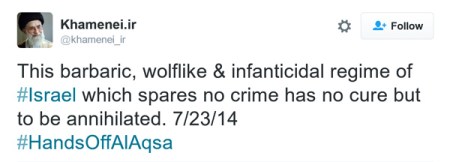
As late as November, Iran’s Supreme Leader Khamenei himself tweeted, “This barbaric, wolflike & infanticidal regime of #Israel which spares no crime has no cure but to be annihilated.”

1477

Bewilderingly, Western democracies have chosen to overlook Iran’s speeches and actions. They chose instead to appease the regime. Last July, despite genuinely serious reservations expressed by international strategic and military experts (including retired American military officers), the United States, United Kingdom, France and Germany – the four democracies in the P5+1 — concluded a nuclear deal with themselves that they proposed to Iran. Iran so far has not signed the deal, and apparently even if it did, according to the U.S. Department of State, the deal would not be legally binding.

Tehran will greatly benefit financially from the terms of the nuclear agreement in the months to come. Under the administration of President Barack Obama, nuclear sanctions against Iran have been lifted. To advance the deal and make it more appealing to Iran, the president has also agreed to pay Iran a $1.7 billion settlement for $400 million in “frozen” assets held in the United States since 1981.

The Society for Worldwide Interbank Financial Telecommunication (SWIFT), “the electronic bloodstream of the global financial system,” had disconnected 15 Iranian banks from its system in 2012. after coming under pressure from both the United States and the European Union at the height of efforts to curb Iran’s nuclear ambitions. Today, SWIFT is ready to let those banned banks, including the Central Bank of Iran, use its system once again. Iran now has an even greater ability to fund its terrorist proxies around the world.

European political and business leaders have been rushing to Tehran to sign new agreements. On January 28, in Paris, Iran’s President Hassan Rouhani and France’s President Francois Hollande signed major business deals, including a joint venture between car-makers PSA Peugeot Citroen and Iran’s Khodro. Iran is in the process of buying 118 Airbus passenger planes to update its aging fleet. The construction group Bouygues and the French airport operator ADP are now set to build an extension for Tehran’s airport, while Vinci, another construction firm, has been commissioned to design, build and operate new terminals for the Mashhad and Isfahan airports. The French oil company Total has agreed to buy Iranian crude oil, and agreements in shipping, health, agriculture and water provision have also been signed.

Democratic India is also cultivating relations with Iran. In a meeting in May, India’s Minister of Road Transport and Highways, Nitin Gadkari, and Iranian Transport and Urban Development Minister, Abbas Ahmad Akhoundi signed a Memorandum of Understanding on India’s participation in the development of the Chabahar Port in Iran.

The Chabahar project will impart strategic leverage to India and its access to Afghanistan and energy-rich Central Asia by bypassing Pakistan. The distance between the Chabahar Port and Gujarat – India’s westernmost state, located near the Persian Gulf, is less than the distance between Delhi and Mumbai. Transit times are estimated to be reduced by a third. Indian firms have already agreed to lease two existing berths at the port and operate them as container and multi-purpose cargo terminals.

The Chabahar project, New Delhi calculates, will be highly beneficial. As India has invested over $2 billion in Afghanistan, the Indian government plans to link the Chabahar port with the Zaranj-Delaram road it built in Afghanistan, thereby opening alternative routes to Afghanistan and enhancing access to regional and global markets.

Russia and China, permanent members of the UN Security Council, are also strengthening their cooperation with Iran. Both Russia and China adopted a policy of ambivalence towards Iran and saw to it that sanctions imposed by the West were not too tough. They also repeatedly blocked attempts at sanctioning Iran’s ally, the current Syrian regime, out of concern over financial ties in the region.

China is also capitalizing on the lifting of sanctions against Iran. Chinese President Xi Jinping rushed to Iran after the so-called nuclear agreement to discuss a 25-year strategic cooperation plan. In a landmark deal worth up to $600 billion, Xi committed to increase trade between the two nations during the next decade. Beijing and Tehran also agreed to enhance security cooperation through intelligence-sharing, counter-terror measures, military exchanges and coordination. Incidentally, despite international sanctions, China-Iran trade increased from $3 billion in 2001 to more than $50 billion in 2014.

Given its fanatical and sectarian ideological agenda, Iran is likely to use the new funds to boost its armament program and ongoing clandestine terror acts. Sanctions relief will mainly benefit Khamenei and members of the IRGC: they control up to one-third of Iran’s economy.

Iran now poses an even greater threat to the entire civilized world. The pattern of Tehran’s behavior shows the government can never be trusted on any promises it makes not to advance its nuclear weapons program. Khamenei has made an open declaration that Tehran will not allow effective inspections of its military sites or interviews with its nuclear scientists.

The links of the IRGC’s Qods Force with Hezbollah, Hamas, Palestinian Islamic Jihad, the Houthis and other terror militias pose a major threat to peace and stability in the Middle East.

Hezbollah’s networks have expanded over the years, infiltrating Latin America and the Caribbean through Shiite cultural centers in the region. According to an official Argentine report, Tehran has established its terrorist, intelligence and operational networks throughout Latin America as far back as the 1980s. Iran’s intelligence activities in the region are being conducted directly by Iranian officials or through its proxy, Hezbollah. Criminal activity may already be underway in Brazil, Colombia, Chile, Paraguay, Uruguay, Suriname and Trinidad and Tobago. Iran’s involvement in the cocaine trade has bolstered the regimes regional access and strengthened ties with its allies in Venezuela, Ecuador, Bolivia and elsewhere.

According to senior Western intelligence officials, the IRGC has transferred tens of millions of dollars to Hamas to be used for weapons, military equipment and training, and that Iran also delivers arms and funds to Hamas through the Red Sea and the Sinai. Officials also believe Iran is indirectly funding the Islamic State (IS) in the Sinai. “Suitcases of cash” are sent directly to Hamas officials in the Gaza Strip; part of the money is then transferred to IS.

Tehran’s links with Hamas and IS are part of a grander strategy of using proxy forces to gain hegemony over the Middle East and undermining American allies such as Egypt and Israel. In Lebanon, Iraq and Syria, Iran seeks to preserve its influence. By fighting IS, Iran strengthens existing pro-Iran regimes and maintains its relevance in the region.

While Iran does support IS indirectly in the Sinai, the government’s goal is to weaken the current Egyptian regime and the Sunni Arab alliance between Egypt, Saudi Arabia and Jordan. It has no problem with IS gaining strength in the Sinai right now. If IS does gain more power in the Sinai, Iran can use it to impose its own agenda in the future. Tehran evidently wants to use IS victories against Sunni states as an opportunity to take over.

Iran also supports the Gaza-based terror group al-Sabireen [“The Patient Ones”], established in the wake of previous tensions between Iran, Hamas and Islamic Jihad. The group has about 400 followers and its emblem is identical to that of Hezbollah. Each member receives a monthly salary of $250-$300, while senior members receive at least $700. Annually, the terror group receives a budget of $10 million from Iran, smuggled in suitcases through tunnels along the border with Egypt. Potential members are wooed by al-Sabireen through familiar channels of philanthropy and education. The group’s publications refer to the United States as “the source of superpower terrorism,” and its slogan is, “The road to the liberation of Palestinian goes through Karbala” — a Shiite holy city in Iraq.

Al-Sabireen has extended its operations from the Gaza Strip to the West Bank and Jerusalem with Iran’s backing. Hisham Salim, the founder of al-Sabireen, admitted that his group is directly financed by Iran. “We have an armed branch whose goal is to wage war on the Israeli occupation everywhere,” Salim said. “Within this framework we have members in the West Bank and Jerusalem.”

The Obama administration has forged ahead with its Iran policies despite knowing the regime’s support of global terrorism. U.S. President Barack Obama himself spoke about Iran’s terror activities in a press conference last year. “Now, we’ll still have problems with Iran’s sponsorship of terrorism; its funding of proxies like Hezbollah that threaten Israel and threaten the region; the destabilizing activities that they’re engaging in, including place like Yemen,” he said, adding that the nuclear “deal is not contingent on Iran changing its behavior. Its not contingent on Iran suddenly operating like a liberal democracy.”

History urges those living in democracies today to rein in their governments and correct their fatal Iran policies. The world cannot afford to overlook the damage of these governments. If democracies today continue their present policies towards Iran, it will only embolden Iran’s regime to continue its quest to obtain nuclear weapons as well as its terrorism and human rights violations.

Clapper: Iran Views Deal as ‘Means to Remove Sanctions While Preserving Nuclear Capabilities’

February 9, 2016

Clapper: Iran Views Deal as ‘Means to Remove Sanctions While Preserving Nuclear Capabilities’ Washington Free Beacon, February 9, 2016

Director of National Intelligence James Clapper testified to lawmakers Tuesday that Iran sees the nuclear deal it struck with the United States and five other world powers as a way to remove burdensome sanctions while simultaneously maintaining a strong nuclear infrastructure.

Clapper made his statement to the Senate Armed Services Committee at a hearing in which the intelligence chief discussed the intelligence community’s annual assessment of worldwide threats to U.S. interests and national security.

Part of Clapper’s testimony focused on the threats posed by the Islamic Republic and how the Iran nuclear deal, known formally as the Joint Comprehensive Plan of Action (JCPOA), affects the country’s relationship with America going forward.

“Iran probably views the JCPOA as a means to remove sanctions while preserving nuclear capabilities,” Clapper told lawmakers.

He added that “Iran’s perception of how the JCPOA helps it achieve its overall strategic goals will dictate the level of its adherence to the agreement over time.”

The nuclear deal was signed in July and implemented on Jan. 16, at which time Iran received an estimated $50 billion to $150 billion in sanctions relief after it took steps to curb its nuclear program.

Some experts have said Iran’s objective throughout negotiations was to ensure the removal of sanctions that were crippling its economy while retaining a nuclear weapons capability to possibly exercise at a future time.

One argument critics of the JCPOA make is that the agreement grants Tehran large-scale sanctions relief whileallowing it to have a vast nuclear infrastructure whose most important restrictions have clear expiration dates, after which time Iran could breakout to a nuclear weapon in little time.

The Obama administration maintains that the deal ensures Iran cannot obtain a nuclear weapon and is at least a year away from producing one.

Clapper’s testimony comes upon his release of the annual “Worldwide Threat Assessment of the U.S. Intelligence Community,” which outlines the current array of challenges threatening U.S. national security.

The report says the intelligence community “continue[s] to assess that Iran does not face any insurmountable technical barriers to producing a nuclear weapon, making Iran’s political will the central issue.”

Directly addressing Iran’s political will, the document adds that “Supreme Leader [Ayatollah Ali] Khamenei continues to view the United States as a major threat to Iran, and we assess that his views will not change, despite implementation of the JCPOA deal … Iran’s military and security services are keen to demonstrate that their regional power ambitions have not been altered by the JCPOA deal.”

The assessment also describes how Tehran’s pursuit of nuclear weapons is part of its “overarching strategic goals of enhancing its security, prestige, and regional influence.”

Beyond the nuclear deal, the intelligence assessment calls the Islamic Republic the world’s foremost state sponsor of terrorism. Clapper explained to lawmakers how Iran’s aggression in the Middle East and elsewhere is dangerous to American interests and national security, as well as its growing missile arsenal and cyber capabilities.

The intelligence community, according to its assessment, views Iran as “an enduring threat to US national interests” and a country that sees itself as leading an “axis of resistance” against American influence and the influence of U.S. allies.

“Tehran might even use American citizens detained when entering Iranian territories as bargaining pieces to achieve financial or political concessions in line with their strategic intentions,” the report added.

Electronic Doomsday for the US?

January 13, 2016

Electronic Doomsday for the US? The Electromagnetic Pulse (EMP)

by Peter Huessy

January 13, 2016 at 4:45 am

Source: Electronic Doomsday for the US?


  • The recent North Korean nuclear and the Iranian ballistic missile tests are serious deadly threats to the United States. North Korea’s latest bomb test is being widely dismissed by “experts” because the apparent yield is around 10 kilotons or less – which just so happens to be exactly the right amount for an electromagnetic pulse (EMP) explosion.
  • An EMP attack on the U.S. would leave the country with no electricity, no communications, no transportation, no fuel, no food, and no running water.
  • “Our increasing dependence on advanced electronics systems results in the potential for an increased EMP vulnerability… and if unaddressed makes EMP employment by an adversary an attractive asymmetric option.” — EMP Commission
  • The recent military writings and exercises of potential adversaries would combine EMP with cyber-attacks, sabotage, and kinetic attacks against the national electric grid and other critical infrastructures.

Contrary to some “expert” analysis, both the recent North Korean nuclear and the Iranian ballistic missile tests are deadly serious threats to the United States.

The danger to the United States is particularly consequential due to the close military cooperation of North Korea and Iran. Their combined capabilities, as demonstrated recently, could very well signal a future nuclear attack of the electromagnetic pulse type, for which the U.S., at the moment, is totally unprepared.

The threat to the United States from an electromagnetic pulse (EMP) attack — the high-altitude detonation of a nuclear weapon over the United States — is so potentially catastrophic that both the 2004 and 2008 reports of the Congressional EMP Commission said so openly — probably in the hope that the public warning would spur the nation and the Department of Defense to action. [1]

Even an EMP attack from a single 10-kiloton nuclear weapon — of the type now in North Korea’s arsenal — could cause cascading failures which could black out the U.S. Eastern Grid for months or years, and devastate the civilian economy. An EMP, detonated at an altitude above 30-70 kilometers, could be delivered by a short-range missile fired off a freighter, hundreds of kilometers off U.S. shores.

The result would be no communications, no transportation, no fuel, no food, and no water for a decade or more. That would be true for at least the entire eastern half of the United States, where most of the population lives. National Geographic has described it as an “Electronic Armageddon.”

An illustrative rendering of an EMP attack on the United States. (Image source: Video screenshot from “33 Minutes”)

Despite these previous warnings and North Korea’s recent bomb test — its fourth known nuclear test since 2006 — “experts” are dismissing a nuclear threat from North Korea as of little concern because the apparent yield of the bomb was in the neighborhood of 10 kilotons or less.

Hydrogen Bombs, or thermonuclear weapons, which is what North Korea claimed to have detonated, produce yields higher than those.

In fact, however, these experts may be way off base. The yield of an EMP explosion is lower. The North Korean bomb capability that was tested may therefore well be that of a super-EMP.

Neutron bombs, or Enhanced Radiation Weapons such as Super-EMP weapons, are essentially very low yield H-Bombs. They typically have yields of 1-10 kilotons, exactly like North Korea’s device. Indeed, because of their very low yield, all four North Korean nuclear tests look like Super-EMP weapons.

A Super-EMP weapon is designed to produce special effects (gamma rays, in the case of Super-EMP). A Super-EMP warhead, while having a seemingly insignificant explosive yield, could be far more deadly and dangerous to the United States than the most powerful H-Bomb ever built.

Russia’s Tsar H-Bomb, (known as Tsar Bomba), the most powerful H-Bomb ever detonated, produced during its test in October 1961 a yield of 60 megatons. It would have been capable of flattening everything in the state of Rhode Island. [2]

A Super-EMP weapon, however, detonated 300 kilometers above the center of the U.S., could destroy the entire nation’s industrial and military capacity, and kill a large percentage of the American people, by taking down the U.S. electrical grid. Once destroyed, the grid’s elements would take decades to rebuild.[3]

Even if the U.S. were to protect its electrical infrastructure from such a threat — legislation to protect the grid is now in Congress, primarily thanks to Rep. Trent Franks (R-Arizona) — the parallel vulnerability of U.S. military forces to an EMP attack would be just as serious.

We know the Department of Defense has testified to Congress that 99% of the electricity for continental U.S. military bases comes from the civilian grid. Our military bases would thereby be without electrical power for decades as well. Unfortunately, the thousands of electrical transformers destroyed by an EMP attack were not primarily built in America. Even if they were, they require at least a five-year lead-time for production.

Overseas power-projection from U.S. military bases would be effectively impossible without an operational grid. Moreover, after such an EMP attack, the national focus would be on saving millions of Americans from mass starvation and preserving societal existence, not on going “over there” to fight a war or defend U.S. interests.

If the EMP attack were executed anonymously, say, by a missile launched off a freighter at sea close-in to the United States, we would probably not even know against whom to retaliate. Thus, classical deterrence would not work, further “inviting” such an attack.

In 1999, for example, at a high level meeting in Vienna of a Congressional delegation with senior members of the Russian government, Vladimir Lukin, the chairman of the Duma’s Foreign Affairs Committee, angry with American policy in the Balkans, issued the following threat: “If we really wanted to hurt you with no fear of retaliation, we would launch a Submarine-launched Ballistic Missile (SLBM), [and] we would detonate a nuclear weapon high above your country and shut down your power grid.”

Congressman Curt Weldon, (R-PA), the American delegation chair, who understood Russian, turned to his Maryland colleague, (Roscoe Bartlett, D-MD) and asked, “Roscoe, did you hear what he said?”

The chairman of the State Duma Geopolitics Commission, Alexander Shabanov, smiled and said, “And if that one doesn’t work, we have plenty of spares”.[4]

Thus a nuclear weapon designed specifically for EMP attack, what Russian experts call a “Super-EMP” warhead, would constitute a worst-case threat.

A single Super-EMP warhead, detonated in the sky 300 kilometers over the center of the U.S., would generate such a powerful EMP field over all 48 contiguous United States that, not only would a protracted nationwide blackout result, but even the best protected U.S. military forces and C3I on all military bases—if not sufficiently protected– could also be at risk.

The technology to protect the electrical grid is relatively straightforward and inexpensive. But only with action now could the grid be protected sufficiently to give the US industrial and economic capability a fighting chance to survive an “Electronic Armageddon”.

It is also possible to protect military assets through “hardening,” but doing so after production and the fielding of equipment is time-consuming and costly. The sooner the U.S. starts with hardening its equipment, sooner the job will get done. The U.S. is seriously behind schedule in what is required to protect it.

It is not as if the threat is “over the horizon.” Russia and China already have Super-EMP warheads. Moreover, according to the Congressional EMP Commission, the design of Super-EMP warheads is no secret: “Certain types of relatively low-yield nuclear weapons can be employed to generate potentially catastrophic EMP effects over wide geographic areas, and designs for variants of such weapons may have been illicitly trafficked for a quarter-century.”

The EMP Commission warned that non-state actors — terrorists — could also pose an EMP threat: “What is different now is that some potential sources of EMP threats are difficult to deter — they can be terrorist groups that have no state identity, have only one or a few weapons, and are motivated to attack the U.S. without regard for their own safety.”

The EMP Commission also warned that the Department of Defense has failed to maintain adequate EMP protection for U.S. military forces since the end of the Cold War:

“The end of the Cold War relaxed the discipline for achieving EMP survivability within the Department of Defense, and gave rise to the perception that an erosion of EMP survivability of military forces was an acceptable risk. EMP simulation and test facilities have been mothballed or dismantled, and research concerning EMP phenomena, hardening design, testing, and maintenance has been substantially decreased. However, the emerging threat environment, characterized by a wide spectrum of actors that include near-peers, established nuclear powers, rogue nations, sub-national groups, and terrorist organizations that either now have access to nuclear weapons and ballistic missiles or may have such access over the next 15 years have combined to place the risk of EMP attack and adverse consequences on the US to a level that is not acceptable.”

The EMP Commission further warned that even U.S. strategic forces and C3I may be at risk from an EMP attack:

“Current policy is to continue to provide EMP protection to strategic forces and their controls. The Department of Defense must continue to pursue the strategy for strategic systems to ensure that weapons delivery systems of the New Triad [land, sea and air] are EMP survivable, and that there is, at a minimum, a survivable ‘thin-line’ of command and control capability to detect threats and direct the delivery systems.”[5]

U.S. strategic forces today are also relatively more vulnerable than they were during the Cold War: they are far less numerous and located on fewer bases, so an adversary could more easily target peak EMP fields on each base. Compared to Cold War era systems, the more modern and sophisticated C3I systems for command and control of U.S. strategic forces could be vulnerable to EMP, unless they are hardened to withstand such electromagnetic pulse attacks. This is also true for the entire industrial infrastructure, the most critical of which is the electrical grid.

The EMP Commission also warned that as U.S. conventional forces become more dependent upon high-technology, they also become more vulnerable to EMP attack:

“The situation for general-purpose forces (GPF) is more complex. The success of these forces depends on the application of a superior force at times and places of our choosing. We accomplish this by using a relatively small force with enormous technological advantages due to superior information flow, advanced warfighting capabilities, and well-orchestrated joint combat operations. Our increasing dependence on advanced electronics systems results in the potential for an increased EMP vulnerability of our technologically advanced forces, and if unaddressed makes EMP employment by an adversary an attractive asymmetric option.”

The above alarming assessments about the vulnerability of U.S. military forces to EMP attack are what the EMP Commission decided must be stated publicly, in its unclassified Executive Summary. The EMP Commission submitted a separate, classified, report to the Department of Defense analyzing these and many other vulnerabilities in far greater detail.

What progress has the Department of Defense (DoD) made to protect itself and the nation from EMP attacks since the reports were completed?

When the EMP Commission terminated in 2008, it was on the understanding that DoD would move aggressively to protect U.S. military forces from EMP, and report biennially to Congress on progress being made implementing the EMP Commission recommendations. The only unclassified biennial report from DoD indicates that there were still serious deficiencies in protecting U.S. military forces from EMP in 2011.

On April 7, 2015, the North American Aerospace Defense Command (NORAD) chief, Admiral William Gortney, announced that NORAD was moving critical assets back into the nuclear bunker inside Cheyenne Mountain and spending $700 million to harden the mountain further against a potential nuclear EMP attack from North Korea. That the nation’s most critical C3I node is just now being adequately protected does not bode well for the preparedness of U.S. military forces as a whole for an EMP Doomsday scenario.[6]

Fortunately, Congress re-established the EMP Commission in the recently completed and passed Fiscal Year 2016 National Defense Authorization Act, to serve as a watchdog on U.S. preparedness and the fast-evolving EMP threat.

The recent military writings and exercises of potential adversaries, for example, combine EMP with cyber-attacks, sabotage, and kinetic attacks against the national electric grid and other critical infrastructures — a decisive new way of warfare described by Russian experts as a “Revolution in Military Affairs.”[7]

The U.S. response has recently gotten some important traction. The House, on November 16, 2015, unanimously passed the Critical Infrastructure Protection Act (CIPA — House of Representatives bill number HR 1073).

CIPA directs the Department of Homeland Security (DHS) to educate emergency planners and first responders at all levels of government about the EMP threat, and to prepare plans to protect and recover the electric grid and other critical infrastructures from an EMP attack and from natural EMP that can be generated by a rare solar super-storm. The House Energy and Commerce Committee also passed provisions to secure the electric grid from EMP, including by stockpiling spare parts and incorporating the SHIELD Act, which gives new authorities to the U.S. Federal Energy Regulatory Commission to protect the grid.

Protecting the national electric grid from EMP is necessary to preserve the existence of American civilization, to sustain U.S. military power-projection capabilities, and it would also mitigate worst-case threats from cyber warfare, sabotage, kinetic attacks, and even severe weather. CIPA and SHIELD are the crowning achievements of Rep. Trent Franks (R-AZ), who for years has been the conscience of the Congress, warning about the existential threat from EMP. [8]

While both bills now await action in the Senate, there is an increasing threat from Iran, which recently successfully tested two nuclear-capable missiles, and from a North Korean satellite, the KSM-3, which regularly orbits over North America at the optimum trajectory to evade U.S. national missile defenses. If the KSM-3 were to carry a nuclear weapon, it would project an EMP field over all of the 48 contiguous United States.

North Korea is Iran’s strategic partner, and there is a treaty between the two countries that obligates the sharing of scientific and military technology.

North Korea’s military recently carried out what some have described as an attempted test from a submerged barge, an indication that an earlier test failure has not derailed its underwater missile program, according to U.S. defense officials.

Add North Korea’s missile capability and a super EMP weapon to this potential, and the significance of the recent North Korean nuclear test comes into better focus. The possibility of a North Korean or Iranian EMP attack seems to be gathering strength.

We may have already seen what such an attack might look like. During the 2014 Gaza War, Hamas, the Syrian Electronic Army, and Iran attempted mass cyber-attacks, coordinated with massive missile strikes, on Israel’s electrical grid. Hamas launched over 5000 rockets and missiles against Israel. Prepared, Israel’s cyber defenses defeated the cyber-attacks, and the Iron Dome missile defense system shot down all the missiles aimed at the Israeli grid.[9]

There are important lessons here. Missile and cyber defenses work: they are critically important parts of any national security strategy.

Israel had also made a prior decision to harden its grid against threats by EMP attacks. The combined efforts of this crucial ally of ours gives us a roadmap to follow: robust missile defenses to defend the homeland from EMP-armed missiles; cyber defenses to protect critical assets and the infrastructure; and EMP defenses to protect national security and defense assets and the electrical grid from attack.

Both the 2004 and 2008, EMP Commission reports urged America’s leaders to protect against such threats as EMP. The House of Representatives has now passed the necessary legislation to protect the grid. The Senate has a champion — Senator Ron Johnson (R-WI), who has pledged to secure Senate passage.

But there are serious pressures working against its passage. Too many “experts” currently dismiss any such threat to the American homeland.

Just recently, for instance, a former intelligence specialist in the U.S. government, Paul Pilar, argued in The National Interest that Iranian ballistic missiles were “here to stay” and were simply elements of Iran’s defenses – and, despite repeated Iranian calls for “Death to America,” were no threat to the United States homeland or its overseas interests.[10]

Such conventional complacency, such as calling ISIS the jay-vee team, is not uncommon in Washington, D.C. The National Intelligence Estimate on Iran in 2007 argued that Iran had stopped all its nuclear weapons work in 2003[11]; the International Atomic Energy Administration has now determined that Iran’s nuclear work had continued to at least 2009.[12]

Unfortunately, there is real-world experience — in Israel — that such threats from missiles and cyber-attacks are constantly serious and looming: the entire job of an adversary is to look for weak spots to attack.

There always seem to be those who wish to downplay all threats and are reluctant even to invest in an “insurance premium.” The consequences of failing to protect America against such threats, however, will be far more serious than future embarrassment for some head-in-the-sand bureaucrats.

An EMP attack would shut down the country; lead to the loss of millions of lives, and set it back into effective defenselessness.

It is a threat as serious as any estimates of what a mushroom cloud at the height of the Cold War would have entailed. Instead, it kills by sending the country back to what former House Speaker Newt Gingrich has described as early 18th century America: people would not be able to function in even the simplest of ways. Buildings would be left standing but the ability to live in them would not. People would be unable to move about, eat, drink, shop or communicate.

It therefore requires full attention, in this era of increased cyber-sophistication, especially among enemies of the West, to see that an EMP attack is never “invited” to happen in the U.S.

Peter Huessy is President of GeoStrategic Analysis of Potomac, Maryland and Senior Defense Consultant to the Mitchell Institute of the Air Force Association and a guest lecture at the US Naval Academy on nuclear deterrent policy and the founder of the 36 year AFA-NDIA-ROA Congressional Breakfast Seminar Series on Nuclear Deterrence, Missile Defense, Arms Control, Proliferation and Defense Policy.


[1] Previous such threat analysis had been classified; the Report of the Commission to Assess the Threat to the United States from Electromagnetic Pulse (EMP) Attack, July 2004 and April 2008 was issued in both classified and unclassified versions; see also Henry F. Cooper and Peter Vincent Pry, “The Threat to Melt the Electric Grid,” Wall Street Journal, April 30, 2015; and Former Director of Central Intelligence, R. James Woolsey, testimony before the U.S. Congress, May 21, 2013.

[2] “Big Ivan”, The Tsar Bomba”, Viktor Adamsky and Yuri Smirnov, 1994, “Moscow’s Biggest Bomb”.

[3] EMP Commission, April 2008.

[4] Committee on Armed Services, House of Representatives, July 22, 2004, Hearing on the Report of the Commission to Assess the Threat to the US from Electromagnetic Pulse Attack.

[5] “Report of the Commission to Assess the Threat to the United States from Electromagnetic Pulse (EMP) Attack”, Volume I: Executive Report; hereinafter cited as EMP Commission Report 2004.

[6] EMP Commission Report 2004, p. 47.

[7] “Defense Science Board (DSB) Task Force on the Survivability of Systems and Assets to Electromagnetic Pulse (EMP) and other Nuclear Weapon Effects (NWE)”, Summary Report No. 1, Interim Report of the DSB Task Force, 2011. See also Dr. Peter Vincent Pry, Apocalypse Unknown: The Struggle to Protect America from an Electromagnetic Pulse Catastrophe, Task Force on National and Homeland Security, 2013, pp. 158-164.

[8] For a good history of these efforts, see Congressman Trent Franks, remarks at the AFA-NDIA-ROA Congressional Breakfast Seminar, December 17, 2015, transcript available from Peter Huessy at AFA (Phuessy@afa.org).

[9] Information from Uzi Rubin, President of Rubicon, to the authors.

[10] See an excellent rejoinder by Emily Landau and Shimon Stein, INSS, National Defense University, “Iran’s Ballistic Missiles Are Actually a Huge Problem“, January 5, 2016.

[11] Paul Pillar spoke approvingly of the 2007 NIE at “The Iran National Intelligence Estimate and Intelligence Assessment Capabilities”, December 20, 2007, the Brookings Institution.

[12] IAEA Board Report: Joint Comprehensive Plan of Action implementation and verification and monitoring in the Islamic Republic of Iran in light of United Nations Security Council Resolution 2231 (2015), Resolution adopted by the Board of Governors on 15 December 2015.
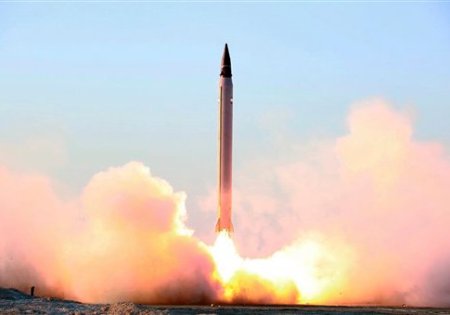
When North Korea Tests a Nuke, Assume It’s Iran’s as Well

January 13, 2016

When North Korea Tests a Nuke, Assume It’s Iran’s as Well, Clarion ProjectRyan Mauro, January 13, 2016

North-Korean-Nuclear-Test-HPA previous nuclear Test made by North Korea (Photo: Video screenshot)

Given the spotty record of U.S. intelligence assessments (to say the least), the West must operate under the assumption that there isn’t an Iranian WMD problem and a North Korean WMD problem, but an Iranian-North Korean WMD problem.

********************************

North Korea briefly reclaimed the global press’ attention again by claiming to have tested a hydrogen bomb. While coverage focused on whether that was an exaggeration, the press missed a much more important question: Was this test only for Kim Jong-Un or was it also for the Iranian regime?

The North Korean and Iranian nuclear and ballistic missile programs should be seen as a single entity, as should be their shared cyber warfare programs. The advance of one is an advance of the other. Differences in their activity should be seen as a common-sense division of labor. Gordon Chang, a prominent expert on Asian affairs, has written about the likelihood that this is the case.

Last May, an Iranian opposition group that has accurately identified hidden nuclear sites in the past reported that it had specific intelligence about North Korean nuclear and missile experts secretly visiting Iran. Intelligence analyst Ilana Freedman said in January 2014 that her sources said a relocation of major parts of Iran’s nuclear program to North Korea began as early as December 2012.

For Iran, it is best to let the North Koreans put the finishing touches on the most provocative nuclear and missile work. Whereas the Iranian regime does suffer from sanctions and must always keep the 2009 Green Revolution in the back of its mind, North Korea thrives off isolation and international provocation.

North Korea has nothing to lose and can only gain by such an arrangement. Kim Jong-Un’s regime has already crossed the nuclear pariah threshold, so it might as well let its Iranian allies take the lucrative deal offered by the West. It has been content to spend $1.1-$3.2 billion each year on it. Plus, the deal puts Iran in a more advantageous position  and its economic improvements can help it invest more in North Korea’s activity.

The good news is that this latest test—North Korea’s fourth— does not appear to be more powerful than its last one, indicating no significant advance in technology. RAND Corporation analyst Bruce Bennett says North Korea is still working on the “basics” of a nuclear fission bomb.

It is hard for some to accept that an Islamist theocracy like that in Iran would work with a cultish communist dictatorship like North Korea, but there is nothing in either one’s ideology that would prevent such cooperation. In fact, North Korea’s success in building a nuclear arsenal actually encourages Iran to see nuclear weapons as a key lesson for the Islamic Revolution.

“The entire world may well consider North Korea a failed state, but from the view point of [Iran], North Korea is a success story and a role model: A state which remains true to its revolutionary beliefs and defies the Global Arrogance,” Ali Alfoneh, an expert on the Iranian regime, told the Washington Free Beacon.

Given the spotty record of U.S. intelligence assessments (to say the least), the West must operate under the assumption that there isn’t an Iranian WMD problem and a North Korean WMD problem, but an Iranian-North Korean WMD problem.

Iran: U.S. Lifting Sanctions in a ‘Few Days’

January 12, 2016

Iran: U.S. to Lift Sanctions in a ‘Few Days’ Republicans pushing last-minute effort to block release of billions Share Tweet Email Hassan Rouhani Hassan Rouhani /

AP BY: Adam Kredo Follow @Kredo0 January 12, 2016 5:00 am

Source: Iran: U.S. Lifting Sanctions in a ‘Few Days’


As Republican lawmakers on Capitol Hill focus on a last-ditch effort to prevent the Obama administration from awarding Iran $100 billion, the Islamic Republic’s leaders have stated that economic sanctions on the country will be fully lifted in the coming days.

President Hassan Rouhani, in a recent address, promised “good news” in the next few days, hinting that the Obama administration will make good on its promise to fully lift economic sanctions and provide Iran with up to $100 billion in unfrozen cash assets as part of the nuclear deal finalized last year.

Rouhani’s comments comport with recent remarks by Secretary of State John Kerry, who claimed last week that Iran is just “days away” from upholding its own end of the deal, which required it to ship certain nuclear materials to Russia.

As Iran prepares to receive the cash influx, which experts say will revive the country’s long-stalled economy, Republican lawmakers in Congress are focusing on last-minute efforts to block the Obama administration from releasing these cash assets and unraveling sanctions on individuals who have aided Tehran’s nuclear weapons program.

Sen. Kelly Ayotte (R., N.H.) along with a growing coalition of colleagues in both the House and Senate, has put forward legislation that would stop sanctions relief until the Obama administration can officially verify that Iran has ceased all work on a nuclear weapon.

The bill would require the director of national intelligence to launch an investigation into this activity and submit a report to Congress. All sanctions relief agreed to by the Obama administration would be blocked until this report is complete, according to the bill.

The lawmakers maintain that an ongoing United Nations investigation into this activity remains incomplete due to stalling efforts by Iranian hardliners who seek to keep the country’s military work a secret.

“Given the glaring deficiencies of the International Atomic Energy Agency’s (IAEA) PMD report and Iran’s continued brazen missile tests and rocket launches, Congress must take serious action to protect the American people,” Rep. Mike Pompeo (R., Kansas), a key sponsor of the House version of the bill and member of the House Permanent Select Committee on Intelligence, said in a statement.

“With the impending implementation of the president’s dangerous nuclear agreement with Iran, the world’s largest state sponsor of terror, it is absolutely unacceptable that we still do not have a thorough understanding of this regime’s past weaponization efforts,” he said. “This information is critical to our ability to detect and thwart future efforts by Iran to restart its nuclear program.”

Congressional critics of the nuclear deal have repeatedly warned that Iran—designated by the United States as one of the world’s leading sponsors of terrorism—will use the newly unfrozen cash assets to fund its military operations and pursuit of ballistic missiles.

The White House still has not disclosed why it abandoned recent efforts to impose new sanctions on Iran as a result of its multiple ballistic missile tests, which violate U.N. Security Council resolutions.

Some in Congress have speculated that the administration was forced to abandon the new sanctions after Iran threatened to walk away from the deal.

Experts predict that much of the sanctions relief will help fund Iran’s military campaigns in Syria, Yemen, Iraq, and elsewhere.

“The lion’s share of the inflow of capital and technology in Iran in the post-implementation day era will go to the” Iranian Revolutionary Guard Corps, Iran’s leading military organization, according to Saeed Ghasseminejad, an expert at the Foundation for Defense of Democracies.

That money, Ghasseminejad said, “will be used to oppose the U.S. in the Middle East and around the world.” Implementation of the deal will enrich the Revolutionary Guard Corps and give it the tools necessary to push Iran’s extremist ideology across the region, he said.

“The administration should stop acting as Rouhani’s campaign manager and instead has to focus on fighting back against the IRGC’s growing influence in the region by punishing the IRGC for its bad behavior,” Ghasseminejad said.

The State Department maintains that it is prepared to uphold up its end of the deal and lift U.S. sanctions on the day the deal is implemented.

“‎None of the sanctions specified in the [nuclear deal] will be lifted prior to Implementation Day, which will occur when the [International Atomic Energy Agency] verifies that Iran has completed its relevant nuclear steps,” said a State Department official who was not authorized to speak on record.

“All of the details of the specific actions to be taken by the U.S. and the [European Union] as it relates to the lifting of sanctions under the Joint Comprehensive Plan of Action (JCPOA), as well as the timing of those actions, are spelled out in the text of the deal,” the official said.

Mark Dubowitz, Foundation for Defense of Democracies executive director and a leading expert on the deal, told the Free Beacon that “Implementation Day is no cause for celebration.”

Iran, he said, “get a patient pathway to a nuclear weapon, intercontinental ballistic missiles and an economy increasingly fortified against future sanctions pressure.”

The United States, on the other hand, gets “a brief pause in their nuclear expansion” due to the shipment on some enriched material to Russia. However, Iran “can easily regenerate” this material and expand it by turning on advanced centrifuges, which more quickly enrich nuclear materials.

“Unless a new president digs us out from under this flawed agreement, the Obama Iran deal will severely erode American deterrence and greatly expand Iranian regime power,” Dubowitz said.

Under the parameters of the deal, the United States is set to suspend most of the sanctions enacted by Congress over the past several years.

This includes the suspension of nearly all sanctions related to Iran’s banking system, its insurance industry, energy and petrochemical sectors, shipping industry, gold trade, and automotive sector, according to the deal.

The major Iranian banks and companies included in the list have long been believed to be supporting the country’s nuclear program and military.

“Other nuclear proliferation-related sanctions will also be lifted,” according to information in Annex II of the nuclear agreement.

Sanctions pertaining to Iran’s commercial airline industry also will be suspended, paving the way for U.S.-owned entities to resume legal trade with Tehran.

Sanctions on those accused of aiding Iran’s nuclear efforts also will be removed from U.S. government lists. This includes certain individuals and companies on the specially designated persons list as well as its list of foreign sanctions evaders .

Additionally, the United States has agreed to eventually remove sanctions on two individuals, Fereidoun Abbasi-Davani and Mohsen Fakhrizadeh, both accused of providing critical support to Iran’s weaponization and nuclear activities.

Experts tracking the deal estimate that after eight years only 25 percent of nearly 650 entities designated by Treasury over the past decade for their role in Iran’s nuclear and ballistic missile program will remain sanctioned.

Richardson: North Korea May Have Launched Nuclear Test to Get Nuclear Deal Like Iran’s

January 7, 2016

Richardson: North Korea May Have Launched Nuclear Test to Get Nuclear Deal Like Iran’s, Washington Free Beacon, January 6, 2016

(Why not? Their human rights records are comparable. — DM)

Richardson, who ran for president in 2008, endorsed Clinton for the 2016 election. Clinton, Obama’s former secretary of state, has been a vocal supporter of the Iran nuclear agreement.

**********************

Hillary Clinton supporter and former New Mexico governor Tom Richardson said North Korea’s nuclear test may have been an attempt to gain leverage for a nuclear deal similar to the one Iran struck with the Obama administration and other world powers.

North Korea claimed it successfully tested a hydrogen bomb on Tuesday, although nuclear experts doubt that was the actual device tested. CNN reported the test corresponded with a 5.1 seismic event.

CNN host Wolf Blitzer asked Richardson whether North Korean dictator Kim Jong-un was crying out for attention with this latest act of aggression.

“I think he’s trying to get attention, number one, but I think he’s also sending a message that if you want to deal with me, if you want me to curb our nuclear weapons, it’s going to be a very high price,” Richardson said. “It’s a very poor country. They need humanitarian assistance. They need energy assistance. They need all kinds of sanctions lifted. It could be that he’s preparing for a negotiation. I think he’s looking at what happened with Iran, and he says, ‘You know, maybe there’s a deal that can be struck for me,’ although we don’t know this man thinks. He’s very unpredictable.”

Richardson, who ran for president in 2008, endorsed Clinton for the 2016 election. Clinton, Obama’s former secretary of state, has been a vocal supporter of the Iran nuclear agreement.

The Iran nuclear deal made in July and championed by the Obama White House, despite numerous concessions, was met with celebration in Tehran. The world’s largest state sponsor of terrorism received billions of dollars in sanctions relief, among other sweeteners, as part of the agreement.

Examining Allegations Of Nuclear Ties Between North Korea & Iran

January 6, 2016

Examining Allegations Of Nuclear Ties Between North Korea & Iran, Fox News, January 6, 2016

(This video relates the claimed North Korean test of a miniaturised H-Bomb to previous joint Iran – North Korea nuke efforts. — DM)


https://www.youtube.com/watch?v=wjOgGKqq1PM