Posted tagged ‘Iranian “moderates”’

Iran Ramps Up Crackdown on Women

May 18, 2016

Iran Ramps Up Crackdown on Women, Front Page MagazineAri Lieberman May 18, 2016

women_in_shiraz_2

On Sunday, the Islamic Republic announced the arrest of eight women whose photographs were featured on Instagram. The models reportedly failed to adhere to stifling Islamic style dress codes rigorously enforced by Iran’s oppressive mullahs. More specifically, they posed without wearing religiously sanctioned head scarves designed to cover exposed hair.

Following her arrest, one of the models was forced to appear on Iranian TV in the presence of two prosecutors. Wearing a black head scarf and matching black gloves, she was recorded – almost certainly under duress – sanctioning the government’s Orwellian-like actions, warning other Iranian women that they “can be certain that no man would want to marry a model whose fame has come by losing her honor.” As an aside, when Iranian navy pirates operating off Farsi Island kidnapped 10 U.S. Navy sailors in the Arabian Gulf in January, they forced a female sailor into Sharia compliance, requiring her to don a hijab.

The arrests come in the midst of a yet another government crackdown on social media and dissent. The anti-social media operation, ominously codenamed “Spider II” has thus far netted dozens of models, photographers, makeup artists and other dangerous enemies of the state. Also arrested was Iranian blogger Mahdi Boutorabi who reportedly covered Iran’s rigged 2009 elections. It appears that periodically, the mullahs get bored or insecure and conjure up ways to make the lives of their citizens more miserable.

But the Islamic Republic’s absurdity doesn’t end there. Iran’s Revolutionary Guard bizarrely accused reality star (and not much else) Kim Kardashian-West of being behind the nefarious plot to undermine or otherwise taint the morals of Iran’s young women.

Mostafa Alizadeh, a spokesman for the Revolutionary Guard’s Organized Cyberspace Crimes Unit stated that, “Ms. Kim Kardashian is a popular fashion model so Instagram’s CEO tells her, ‘make this native.’” He added that “There is no doubt that financial support is involved as well. We are taking this very seriously.”

In February, Iranian authorities engaged in a similar crackdown, targeting a benign rock group known as “Confess.” Authorities charged the group’s members with “blasphemy,” writing “satanic” lyrics and meeting with forbidden foreign radio stations. The charge of “blasphemy” carries a punishment of execution. Others in the Islamic Republic have been arrested and sentenced to lashings for merely appearing in a YouTube video while dancing and lip syncing to Pharrell’s hit song “Happy.”

Conspiracy theories and political and religious oppression are the norm in the Islamic Republic. Let us dispel with the notion that there are “moderate” forces within the Iranian government working to change things for the better. Power in that tyrannical regime vests with two entities – Iran’s “Supreme Leader,” the Holocaust-denying Ayatollah Khamenei and his thuggish henchmen of the Iranian Revolutionary Guard Corps and the Basij militia.

The Obama administration and its “echo chamber” (as Obama shill Ben Rhodes puts it) would like us to think that there are moderate elements and reformers with whom we can deal. That notion is an absolute farce but continues to gain credence in some leftist circles with vested interests in propagating this false narrative. For example, while the New York Times reported the arrest of the Iranian models, it made sure to qualify its reportage by informing its readers that the crackdown was the work of “hard liners.”

In the meantime, while Ben Rhodes is creating his spin and John Kerry is thanking the Iranians for kidnapping and mistreating U.S. Navy sailors, the mullahs of the Islamic republic continue to crack down on dissent and execute human rights activists, continue to advance their ballistic missile program (in defiance of UNSC resolutions) and continue to cut a path of misery and destruction in the Mideast, from Syria to Yemen.

The administration has done its best to convince the American public that Iran can be trusted to keep agreements. This rests on the false and dangerous narrative that there exists a power struggle in Iran between moderate reformers who have the support of the people and an assortment of hard line religious extremists and anti-Western zealots. Narratives running counter to this fantasy-like version of events are dismissed by the administration.

Even worse, it has now come to light that the Obama administration has asked the Iranians not to publicize their illicit ballistic missile activities for fear of unsettling opponents of the Joint Comprehensive Plan of Action (JCPOA). Meanwhile John Kerry is quietly attempting to encourage various European banking institutions to do business with the Iranians despite the fact that the IRGC controls vast swaths of Iran’s economy.

No matter how much spin the Obama administration attempts to place on the merits of the JCPOA and no matter how much it attempts to cover its tracks, it cannot hide the fact that the Islamic Republic is a pernicious regime that cannot be trusted and represents a malignancy that sooner or later will have to be confronted. The only question that remains is whether Iran will have nuclear bombs when that time arrives.
Iran’s Soft War Against America

May 17, 2016

Iran’s Soft War Against America, Gatestone InstituteLawrence A. Franklin, May 17, 2016

♦ Iran’s sophisticated employment of asymmetrical tactics such as “soft war” — which relies on the other side’s wishes, conscious or not, to be taken in — is apparently part of Tehran’s strategy to level the playing field against the U.S., despite America’s overwhelming military superiority.

♦ Iran is now being treated by most of the world as a normal nation-state rather than the revolutionary, terror-supporting, totalitarian regime that in reality it is.

Iran is waging a “soft war” offensive — media, social media, charm — against the United States. Tehran believes it is scoring significant victories in this war, and it clearly has, as can be seen by the so-called “Iran deal” — technically no “deal” at all: one side, Iran, got everything.

Iran’s sophisticated employment of asymmetrical tactics, such as “soft war” — which relies on the other side’s wishes, conscious or not, to be taken in — is apparently part of Tehran’s strategy to level the playing field against the U.S., despite America’s overwhelming military superiority.

Tehran seems to think, with justification, that it has successfully exploited the Obama administration’s uncorseted desire for better bilateral relations into granting Iran concessions that are not part of the original Joint Comprehensive Program of Action (JCPOA).

One of these concessions is granting Iran access to the U.S financial system; U.S. Secretary of State John Kerry spent last week trawling through Europe, imploring bankers to do business with Iran, despite that minor detail that America will not.

Another concession is the U.S. offer to buy Iran’s heavy water, a product of its planned plutonium bomb-making reactor in Arak.

Still another concession is the U.S. administration’s failure to increase sanctions on Iran for repeatedly launching potentially nuclear-capable ballistic missiles — in violation of UN Security Council Resolution 2231.

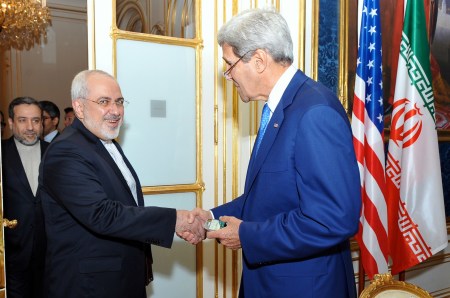
The Iranian regime may well attribute these American concessions to its employment of the “jang-e-narm” (soft war) tactic of “smile diplomacy”: the media-friendly demeanor of President Hassan Rouhani and Foreign Minister Mohammad Javad Zarif.

767 (1)The Iranian regime may well attribute recent American concessions to its employment of the soft war tactic of “smile diplomacy”: the media-friendly demeanor of President Hassan Rouhani and Foreign Minister Mohammad Javad Zarif. Pictured: U.S. Secretary of State John Kerry shakes hands with Iranian Foreign Minister Mohammad Javad Zarif during talks in Vienna, Austria, July 14, 2014. (Image source: U.S. State Department)

Not surprisingly, those are the same tactics that Iran is accusing Washington of using against Iran. Iran has been alleging that the U.S. has been waging soft war attacks against it, via Facebook, YouTube, and Twitter, supposedly — according to Iran — to develop sympathies within Iran’s elites for Western culture, policies, and ideals. Presumably the next concession is that the U.S. be quiet and let Iran keep expanding as far as it likes. The other day, Iran threatened to block the transport of oil by closing the Strait of Hormuz at the mouth of the Persian Gulf.

This is the problem: Iran is now being treated by most of the world as a normal nation-state rather than the revolutionary, terror-supporting, totalitarian regime that in reality it is.

Iran also is using this narrative of an American-led soft war against Iran to institute tighter controls on Iranian citizens. Iran recently dispatched Basij paramilitary teams to elementary schools to instill revolutionary Islamic values in the students. Iran has also established “Atlas,” a new, government-controlled press agency modeled upon Qatar’s Al-Jazeera network. Iranian authorities most likely hope that this news service will counteract any untoward thoughts of liberalization that the “Arab Spring” might have conjured up to question the regime’s “stability.”[1]Iran has also stepped up internet censorship as well as efforts by the government’s plainclothes police to sever contacts between Western NGO personnel and Iran’s civil society activists.

Evidence of how seriously Iran views the potential of America’s supposed soft war tactics was its establishing a National Data Center to filter messages coming into Iran from Western media, in addition to Tehran’s sponsorship of its first National Forum on Soft War, in the autumn of 2015.

Meanwhile, pursuing both its hard war and soft war offensives, Iran continues to trumpet its ability to produce new weapons systems, including novel and illegal ballistic missiles.

The regime also boasts about its acquisition of weapons from outside the country, such as Russia’s S-300 air defense system.

Not surprisingly, this soft war saber-rattling by Shi’ite Iran has been increasing the security concerns of its neighboring Sunni Arab States. These concerns, in turn, cause the Gulf countries and others to demand that their American ally demonstrate that it is serious about halting Iranian expansion in the region. Recent visits to the Sunni states by high-level American political leaders (President Obama), ranking diplomats (Secretary of State John Kerry), and senior military figures (Secretary of Defense Ashton Carter and Chairman of the Joint Chiefs of Staff General Dunford) have sought to allay these fears; it is still not clear with what.

Meanwhile, Iran’s aggressive involvement in Syria, Yemen, and Iraq is clearly creating the impression among Gulf states and others that regional leadership is passing from Sunni Saudi Arabia onto a toxic Shi’ite Iran.

Khamenei’s Anti-Americanism

May 9, 2016

Khamenei’s Anti-Americanism, Gatestone InstituteMajid Rafizadeh, May 8, 2016

(Please see also, Dangerous illusions about Iran. — DM)

♦ Khamenei is sending a strong signal to Washington that Iran’s reintegration in global financial system does not mean that the Iranian regime will change its hostility towards the U.S. and Israel.

♦ “The Persian Gulf is the Iranian nation’s home and the Persian Gulf and a large section of the Sea of Oman belong to this powerful nation. Therefore, we be present in the region, hold war games and display our power.” – Iranian Supreme Leader Ali Khamenei

♦ In addition, Khamenei is sending a message to the Iranian people that the current process of implementing the nuclear agreement, lifting sanctions, and partial economic liberalization does not mean that Iran is going to liberalize its politics and allow freedom of speech, freedom of the press, and more political participation.

Some politicians and policy analysts argue that Iran’s sanctions relief and the continuing implementation of its nuclear program would push Iran towards moderation in dealing with the United States and Israel, as well as scaling down Iran’s expansionist and hegemonic ambitions. The realities on the ground suggest otherwise.

As Tehran’s revenues are rising, anti-American and anti-Semitic rhetoric by Iran’s Supreme Leader, Ayatollah Ali Khamenei, are escalating.

The Iranian regime continues to view the U.S. and Israel as their top geopolitical, strategic and ideological enemies. According to Iran’s Mehr News Agency, on May 1, Khamenei welcomed the Secretary General of Palestinian Islamic Jihad, Ramadan Abdullah Shalah, and his accompanying delegation in Tehran:

“Ayatollah Khamenei reaffirmed that with this perspective in regional issues, Iran sees the United States as the main enemy with the Zionist regime standing behind it. He pointed to extensive, unprecedented sanctions of the U.S. and its followers against the Islamic establishment in recent years and dubbed the objective of them as discouraging Iran from continuing its path; ‘but they failed to achieve their goals and will fail in future as well.’ “

Khamenei is sending a strong signal to Washington that Iran’s reintegration in the global financial system does not mean that the Iranian regime will change its hostility towards the U.S. and Israel.

In addition, Khamenei is sending a message to the Iranian people that the current process of implementing the nuclear agreement, lifting sanctions, and partial economic liberalization does not mean that Iran is going to liberalize its politics and allow freedom of speech, freedom of the press, and more political participation.

Khamenei is also making it clear that Iran is not going to fundamentally change its foreign policy objectives in the region.

Regarding Iran’s role in the Gulf, Iran’s Supreme Leader pointed out on May 2 that

“The Persian Gulf is the Iranian nation’s home and the Persian Gulf and a large section of the Sea of Oman belong to this powerful nation. Therefore, we should be present in the region, hold war games and display our power.”

When it comes to Syria, Iran’s Islamic Revolutionary Guard Corps (IRGC) has become more emboldened and empowered in supporting the Syrian regime financially, militarily, and in intelligence and advisory capacities. Even during the current peace talks, Iran is ramping up its presence in Syria to increase Bashar Assad’s leverage in the negotiations.

In Iraq, Iran’s sectarian agenda and support for Shiite militias continues to cause political instability. This week, hundreds of followers of the Iraqi Shia leader, Muqtada al-Sadr, stormed into the Iraqi parliament building, demanding its speaker halt the session. Prime Minister Haider al-Abadi warned that these protests could lead to the Iraqi state’s failure. After the protests, al-Sadr — who spent several years studying in Qom (Iran’s center of Islamic studies) — travelled to Iran.

Currently, some of the powerful Iraqi Shiite militias with which Iran has close connections, and in which it is investing its resources, are: Sadr’s Promised Day Brigade, the successor to the Mahdi Army; the Badr Organization, Asa’ib Ahl al Haqq (League of the Righteous) and Kata’ib Hezbollah (Battalions of Hezbollah).

In Yemen and Bahrain, Iran’s support for the Houthi rebels and Shiite groups continues to fuel the sectarian conflicts there.

Khamenei has also unleashed a series of anti-U.S. and anti-Israel tweets, including:

“Lebanon’s Hezbollah is strong enough not to be hurt by some pressures; today, no doubt Zionist regime is scared of Hezbollah more than past.” (1 May 2016)

“Shia-Sunni clash is colonialist, US plot. Top issue is to realize 2 sides of the extensive war & one’s stance to avoid being against Islam.” (1 May 2016)

Iran’s foreign policy is anchored in three areas: ideological principles (anti-Americanism and anti-Semitism), national interests (mainly economic gains), and nationalism.

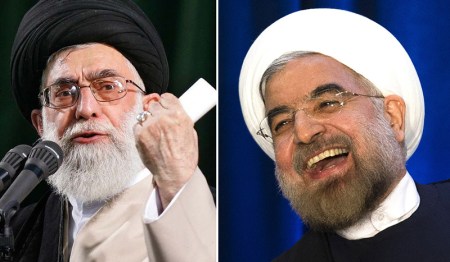
Although Khamenei needed to emphasize Iran’s national and economic interests, there is no evidence that he is giving up on the revolutionary ideological norms. Khamenei is relying on the so-called moderates — President Hassan Rouhani and his U.S.-educated foreign minister, Javad Zarif — to continue the process of implementing the nuclear deal in order to benefit Iran economically and ensure the regime’s hold on power.

1590Iran’s Supreme Leader, Ayatollah Khamenei (left), is not giving up on the revolutionary ideological norms. He is relying on the so-called moderates, such as President Hassan Rouhani (right), to continue the process of implementing the nuclear deal in order to benefit Iran economically and ensure the regime’s hold on power.

Nevertheless, at the end of day, the key decision makers in Iran’s political establishments are Khamenei and the senior cadre of the IRGC, who prioritize Iran’s ideological and revolutionary principles. It is from them that Khamenei draws his legitimacy.

As long as the Supreme Leader is alive, one should not expect that Iran’s reintegration into the global economy to move the country to the moderate end of the spectrum, or that its anti-American, anti-Semitic sentiments and fundamentals of Tehran’s foreign policies will change.

Khamenei Criticizes Top Political Rivals: Favoring Talks over Missiles Constitutes Treason

April 4, 2016

Khamenei Criticizes Top Political Rivals: Favoring Talks over Missiles Constitutes Treason, MEMRITV via You Tube, April 4, 2016

https://www.youtube.com/watch?v=RWBl15Wmw6Q

According to the blurb posted beneath the video,

In two recent public speeches, Iranian Supreme Leader Ali Khamenei, in a pointed reference to a Tweet made by Expediency Council Chairman Rafsanjani, said that those who say that today is an era of talks, not of missiles, are committing treason. Khamenei rejected President Rouhani’s call to instate an economic and cultural model – which he termed JCPOA 2, 3, and 4 – for the benefit of society, and said that this would constitute an abandonment of the principles of Islam and of the Islamic Revolution. He further criticized the U.S., saying: “the Americans have not upheld their commitments” in the JCPOA.

Rouhani threatened unless he keeps Iran’s “provocative”

April 2, 2016

Rouhani threatened unless he keeps Iran’s “provocative” DEBKAfile, April 2, 2016

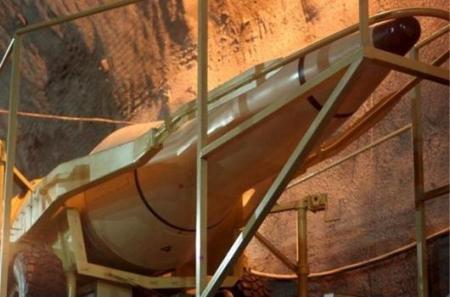
A missile is seen inside an underground missile base for Iran's Islamic Revolutionary Guards Corps (IRGC) Aerospace Force at an undisclosed location in this undated handout photo courtesy of Fars News. REUTERS/farsnews.com/Handout via Reuters

A missile is seen inside an underground missile base for Iran’s Islamic Revolutionary Guards Corps (IRGC) Aerospace Force at an undisclosed location in this undated handout photo courtesy of Fars News. REUTERS/farsnews.com/Handout via Reuters

President Barack Obama said Friday April 1, that “Iran has so far followed the letter of the [nuclear] agreement [with the six powers], but, he added, “the spirit of the agreement involves Iran also sending signals to the world community and business that it is not going to be engaging in a range of provocative actions that may scare business off,” such as fire-testing nuclear-capable ballistic missiles, calling for Israel’s destruction and providing Hizballah with missiles.

At a news conference ending the two-day nuclear summit in Washington, Obama went on to say: “Some of the concerns that Iran has expressed, we are going to work with them to address.” But meanwhile, he said, the US and its allies are taking steps to help Iraq benefit from the agreement by facilitating trade and banking transactions with the Islamic Republic; and the US Treasury Department is seeking to set clearer investment guidelines for Iran.

Two days earlier, on Wednesday, March 30, the Obama administration was reported acting to give Iran limited access to US dollars, since the almost complete lifting of sanctions in January, which netted Tehran an injection of approximately $150 billion “hasn’t provided the country with sufficient economic benefits.”

DEBKAfile’s analysts note the inherent contradiction in the US president’s approach to Tehran: He wants Iran to be compensated with a never-ending shower of dollars for agreeing to limit its nuclear program, but “the US and its allies” cannot question how the money is spent.

So while the West, under orders from Washington, must scramble to boost the Iranian economy, Tehran may continue to test ballistic missiles until they are nuclear capable, and top up the Hizballah terrorists’ arsenal with ever deadlier tools of death.

This glaring inconsistency arises from a fact largely hidden from the world public: last year’s landmark nuclear accord was concluded by Iran’s President Hassan Rouhani and Foreign Minister Mohammed Javad Zarif – not by the real powers in Tehran, supreme leader Ayatollah Ali Khamenei, the Revolutionary Guards chiefs and the ayatollahs at the head of the fundamentalist Shiite movement.

Indeed, even Rouhani was never allowed to formally sign the deal, much less gain Khamenei’s ratification.

But now, Rouhani’s fate depends on keeping those ruling elites happy.  He has found himself in the position of their hostage, a cash machine for keeping the funds for the Islamic Republic’s projects termed by President Obama “provocative” constantly on tap.

Those projects which are currently in full spate clearly leave every little over from the $150bn to even start lifting the Iranian economy out of its mess, while the Rouhani’s government carries the can for that too. Indeed, DEBKAfile’s Iranians sources disclose, the president is forced to earmark 50 percent of the funds released by sanctions relief for items listed under “defense”, namely,  the nuclear and missile development programs, Iran’s overseas military operations, including the Syrian war, subsidizing the Lebanese Hizballah, and establishing new terrorist organizations for attacks on Israel, such as the Al-Sabirin, on the Golan.

These enterprises eat up billions of dollars. Just Iran’s operations in Syria and support for Hizballah cost Tehran $2 billion every month.

Syrian president Bashar Assad didn’t surprise anyone when he revealed that the five-year civil war in his country had cost $200 billion so far. With this kind of spending on “defense,”  the Iranian economy will continue to decay, while Rouhani’s government, which promised the people a better life after the nuclear accord, must bow to the will of the hard-liners or face the consequences.

Our Iranian sources report that Obama’s inconsistent approach to Iran has sharpened the discord between the two major political camps in Tehran and put the “reformists” in extreme peril should they dare to defy the hard-liners who hold the levers of power. Khamenei has publicly threatened to liquidate such opposition leaders as Rouhani and his ally, former president Ayatollah Akbar Hashemi Rafsanjani.

President Rouhani has been put by Obama’s policy in the position of having to keep Tehran’s hungry war- and terror-mongers flush with cash, if he is to save himself and fellow “reformists” from “liquidation.”

The supreme leader was pretty blunt when he said on Friday, March 29, “Those who say the future is in negotiations, not in missiles, are either ignorant or traitors.” This comment underlined Iran’s overriding commitment to developing nuclear missiles and a warning to “traitors” of their fate: execution or a life sentence in a grim Iranian jail.