Posted tagged ‘Iranian missiles’

Column One: Obama’s greatest achievement

September 1, 2016

Column One: Obama’s greatest achievement, Jerusalem PostCaroline B. Glick, September 1, 2016

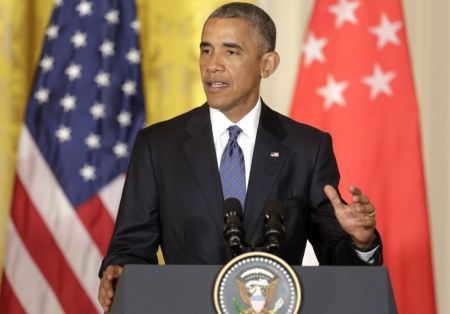
Obama lies on Iran scamU.S. President Barack Obama and Singapore Prime Minister Lee Hsien Loong (not pictured) speak during a press conference at the White House in Washington, U.S., August 2, 2016.  (photo credit:REUTERS)

The time for complaining about President Barack Obama’s nuclear deal with Iran has passed. The time has come to overcome the damage enormous damage his signature foreign policy accomplishment has caused.

To understand why this is the case, it is important to understand the breadth and depth of Obama’s failure.

On August 4, during the course of a press conference, Obama gave his interim assessment of his nuclear agreement with Iran.

“It worked,” he insisted.

A year after the deal was signed, Obama argued, events have proven that he was right and the deal’s critics were wrong.

“You’ll recall that there were all these horror stories about how Iran was going to cheat and this wasn’t going to work and Iran was going to get $150 billion to finance terrorism and all these kinds of scenarios, and none of them have come to pass,” he proclaimed.

Obama then snidely swiped at the deal’s opponents saying that it would be “impressive” if the people who criticized the deal would own up to their mistakes and admit that it worked.

As it works out, everything that Obama said about the deal with Iran during his press conference was a lie.

Some of his lies became apparent within hours.

For instance, Obama falsely claimed that Israel now “acknowledges this has been a game changer and Iran has abided by the deal and they no longer have the sort of short-term breakout capacity that would allow them to develop nuclear weapons.”

Hours later, the Defense Ministry issued a stinging rebuke of Obama’s claim, parroted more diplomatically by the Prime Minister’s Office.

Obama’s press conference took place the day after The Wall Street Journal reported that in January 2016, the US sent an unmarked plane to the Tehran airport filled with $400 million in cash, on the same day Iran released four US hostages.

Obama angrily rejected allegations that the cash payment was a ransom payment for the hostages’ release. He insisted that the US had made the payment as the first installment of a $1.7b. payment the administration made to settle an Iranian government lawsuit against America.

Obama claimed that the administration agreed to the settlement at the urging of the Justice Department.

He said his administration was able to settle the dispute only due to the nuclear deal which placed US officials in direct contact with their Iranian counterparts for the first time in decades.

Within a day, Obama’s claims were exposed as lies. It turns out that Justice Department lawyers opposed the cash payout to Iran.

One of the hostages released in January told the media that the Iranians refused to allow the hostages to leave Iran until the airplane with the cash landed in the airport.

The Iranians, for their part, contemptuously mocked Obama, and stated openly that the $400m.

was a ransom payment for the hostages.

Two weeks later, Obama’s State Department admitted that the $400m. was a payment for the hostages.

Obama’s principle claim is that due to his deal, Iran no longer has a short-term nuclear breakout capacity. He also says that in accordance with the deal, Iran has shipped its nuclear materials out of the country. These claims are both untrue and misleading.

On Thursday Reuters reported that Iran did not ship the quantities of low-enriched uranium out of the country in the quantities the deal required.

Last January, when the deadline arrived for Iran to comply with the deal’s clauses calling for it to move its uranium enriched to 3.5 percent and 20 percent out of the country and so enable the US and its European colleagues to cancel UN sanctions against it, it worked out that Iran had failed to comply.

Rather than acknowledge Iran’s failure and maintain the sanctions in accordance with their deal, the Americans and Europeans decided to move the goalpost closer to Iran.

They secretly decreased the amount of uranium the Iranians were required to part with. They then announced triumphantly that they were canceling UN sanctions because Iran had complied with the agreement.

Reuters reported that much of the low-enriched uranium Iran did remove from its territory wasn’t actually removed from its possession. Instead it was transferred to neighboring Oman, where it is held under Iranian guard and control.

Obama of course knows all of this. So his claims that the agreement “worked” are nothing more than a card trick meant to trick the American public.

Obama’s assertion that Iran’s breakout time to a nuclear arsenal has been slowed as a result of his deal is similarly a stretch of the imagination. The Iranians have suspended much of their prior centrifuge spinning. But that is only because they are now directing their efforts to developing and deploying more advanced centrifuges that will be able to enrich uranium to bomb grade material far more rapidly than the centrifuges they were required to retire.

Experts have already placed Iran’s post-deal nuclear breakout time at a mere six months. And Iran can leave the agreement – which it never actually signed or officially agreed to – anytime it wants.

While developing their next generation centrifuges, the Iranians are expanding the range and precision of their ballistic missiles, deploying them and increasing the size of their arsenals. Despite the fact that these actions are prohibited under US law and breach what was initially claimed about the ever-changing nuclear deal, the Obama administration has refused to impose sanctions against Iran, insisting that its actions merely breach the spirit, rather than substance, of the deal.

The administration has had a similar response to Iran’s recent deployment of Russia’s S-300 missile defense battery around its military nuclear site at Fordo. On Sunday Iranian television showed footage of the missiles being set up around the formerly secret site.

As Omri Ceren of the Israel Project noted this week, Iran’s deployment of the S-300 system places it in breach of three US sanctions laws. Despite this, the White House announced on Wednesday that it has no intention of enforcing US law and applying sanctions on Iran. The S-300 missiles can be used both as a defensive system and as an offensive one.

On Tuesday, Tehran announced that it will be launching three satellites in the coming months.

Satellite launches are widely viewed as a means through which Iran is covertly developing a longrange ballistic missile capability. Rather than censure Iran for its actions, the Obama administration insists that such actions, as well as Iran’s recent longrange rocket tests, do not violate the nuclear deal or warrant US action.

Taken separately and together, Iran’s actions since the nuclear deal was officially concluded make clear that it continues to pursue its nuclear program, and indeed, has become more brazen in its nuclear operations than it was before the agreement was announced last year.

In other words, not only has the deal not worked, contrary to Obama’s claims, it has been a colossal failure on every level. The deal’s opponents were entirely right about the dangers it posed and Obama was entirely wrong.

This is true as well in relation to the administration’s qualified promises that the deal would lead to better relations between the US and Iran. As Shoshana and Stephen Bryen noted last week following the Iranian naval assault on the USS Nitze in the Strait of Hormuz, with its repeated harassment of US naval ships traversing the Strait of Hormuz, Iran is clearly practicing its tactic of swarming US naval craft as a preparation for a real strike against them.

The main reason that Iran’s nuclear program is such a grave concern for Israel and for other Middle Eastern states is that the Iranian regime has hegemonic ambitions. It seeks to destroy Israel and dominate the entire region.

Since it concluded the deal with Washington, Iran has surged its forces and massively expanded its power projection throughout the region.

On Thursday the Daily Mail reported that the commonly held belief that Iran commands 16,000 troops in Syria is wrong. According to the National Council of Resistance in Iran, the regime actually commands 60,000 forces in Syria, deployed throughout the country. The entire Syrian army today numbers a mere 50,000 men.

On August 4, Obama mocked claims that Iran would spend its windfall profits of $100b.-$150b.

from the sanctions relief the nuclear deal offered to fund terrorism. Yet, according to the Daily Mail report, to date Iran has spent $100b. on the war in Syria.

The implications of the report are blood curdling.

They mean that despite Obama’s denials, the funds Iran has received as a result of the sanctions relief he brought about through his nuclear deal have paid for Iran’s war in Syria. That war has caused the death of nearly half a million people and forced more than 11 million people to flee their homes.

Obviously, it is important for Americans to know the truth about the Iran deal and its consequences as they consider their votes for Obama’s replacement.

One of Democratic nominee Hillary Clinton’s top candidates for secretary of state is Wendy Sherman.

Sherman was the chief negotiator of Obama’s nuclear deal with Iran.

For Israel, the question of what to do about Iran now is far more urgent than it is for Americans.

Today more and more commentators are voicing concern over the prospect that Obama will support an anti-Israel resolution at the UN Security Council as a parting shot at Israel.

But any such resolution will be small potatoes in comparison to the strategic devastation his nuclear deal, which is his main foreign policy legacy, has caused.

The rapidity of Iran’s advance makes clear that there is no justification for waiting to act until Obama has left office. If it doesn’t act soon, Israel is on the fast track to waking up one morning and discovering it has no means of thwarting the threat.

Indeed, with each passing month, its options for action become more and more limited.

After Israel’s security leadership undermined Prime Minister Benjamin Netanyahu’s plan to attack Iran’s nuclear installations in 2010 and 2012, Netanyahu settled on a strategy of blocking Obama’s moves to appease Tehran.

That strategy of course failed last summer. Since then, Netanyahu has worked to build an anti-Iranian alliance with the Sunni Arab states. His efforts in this area have clearly met with some measure of success, as witnessed by public statements from prominent Saudis and others.

Whatever that success may be, and whatever the status of that burgeoning alliance of spurned US allies, the fact is that it’s time Israel and its new allies do something more than send signals. Time is a-wasting.

Last spring Brig.-Gen. Hossein Salami, the deputy commander of Iran’s Revolutionary Guard Corps, said, “Today the grounds for the annihilation and collapse of the Zionist regime are more present than ever before.”

Thanks to Obama, he may be right.

It is time for Israel to make him eat his words.
Iran: No Range Limit for Our New Ballistic Missiles

August 29, 2016

Iran: No Range Limit for Our New Ballistic Missiles, Clarion Project, Meira Svirski, August 29, 2016

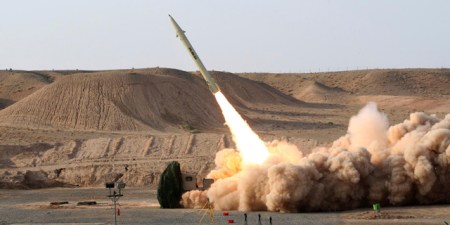
Iran-Missile-HP_9An Iranian missile test (Photo: © Reuters)

Iran has successfully played America as the fool, challenging the U.S. to stand up to its belligerence. Every time America backs down, by either making excuses for the Islamic Republic (i.e., by redefining the deal) or ignoring their latest outrage, Iran becomes more empowered.

Sanctions relief let the Iranian genie out of the bottle. Now, the terror-supporting and oppressive regime is taking its place on the world stage unrestrained and unopposed.

********************

The Iranian defense minister recently pronounced that the Islamic Republic has “no limit for the range” of the ballistic missiles it is developing.

In making the pronouncement, General Hossein Dehqan also said that Iran is now on par with world standards for most of its weapons and military equipment, specifically, that “production of the national individual weapons and efforts to improve the quality and precision-striking power of ballistic missiles are among the defense ministry’s achievements…”

One of the advanced weapons Iran has developed is a ballistic missile that deploys multiple warheads against a single target. As the government-aligned Fars News Agency reported, “This makes for an efficient area attack weapon.”

(Never mind that just three months ago, that the state-owned IranianPress TV announced that “all these advancements on the military level are only for defensive reasons.”)

In addition, Iran has now deployed the long-awaited Russian-made, long-range S-300 missile system. The system was deployed to protect the country’s Fordo nuclear facility, which the commander of Iran’s air force calls paramount “in all circumstances.”

Western officials, who tried to block the delivery of the missile system, said that once in place, the S-300 would essentially eliminate the military option to stop Iran from obtaining nuclear weapons.

The nuclear deal made with Iran and the world powers was sold to the public as a way to contain not just Iran’s nuclear weapons program, but its ballistic missile program as well.

Ballistic missiles are mainly used to deliver nuclear warheads. Under the terms of the agreement we were told that the current UN restrictions on Iran’s ballistic missile program would remain in effect for eight years, including forbidding Iran from testing of ballistic missiles.

Less than two months after the deal was formalized, a senior figure in the Iranian Revolutionary Guards Corps (IRGC), Brigadier General Amirali Hajizadeh, announced, “Some wrongly think Iran has suspended its ballistic missile programs in the last two years and has made a deal on its missile program … We will have a new ballistic missile test in the near future that will be a thorn in the eyes of our enemies.”

As far as the defense minister Dehqan, commenting about the restrictions, he said, “To follow our defense programs, we don’t ask permission from anyone.”

After the first ballistic missile test conducted by Iran after the agreement was made, the U.S. administration backtracked, saying that the test was really not a violation of the nuclear agreement but there were “strong indications” that the test violated UN restrictions.

The second ballistic missile test came as U.S. Vice President Joe Biden was visiting Israel. Painted on the two missiles (which had the capability of reaching the Jewish state) were written the word in Hebrew, “Israel should be wiped out.”

Hajizadeh said at the time, “The 1,240-mile range of our missiles is to confront the Zionist regime. IRNA, Iran’s state news agency, reported the head of the Islamic Revolutionary Guards Corps as saying the test had Iran’s enemies “shivering from the roar” of the missiles.

For his part, Biden said at the time, the U.S. would “act” if Iran broke the nuclear agreements.

Judging from its lack of action, the U.S. ostensibly does not count this as a violation of the agreement, despite clear evidence to the contrary.

Since the signing of the nuclear agreement Iran has engaged in aprovocative “cat and mouse” game with the U.S.

In addition, to the ballistic missile tests, since signing the agreement:

●      In September, Iran simulated a missile attack on a US aircraft carrier in an agitprop video titled “If Any War happens.”

●      In October, just three days after one of the ballistic tests, Iranian state TV aired unprecedented footage of an underground missile base.

●      In December, Iran tested rockets with live fire within 1,500 yards of American warships in the Strait of Hormuz

●      In January, Iran test-fired an upgraded surface-to surface cruise missile in a new set of wargames code-named Velayat-94

●      In January, an unarmed Iranian surveillance drone flew near U.S. and French aircraft carriers in the Gulf, managing to take “precise” photos while the ship was involved in an ongoing naval drill. An Iranian submarine was also detected in close proximity to the aircraft carriers.

●      In January, Iran captured 10 U.S. sailors whose boat had strayed into Iranian territorial waters. The soldiers were humiliated and held for 15 hours. Iran has since used the incident to mocked America in videos and plays.

“Without understanding Iranian culture, it is impossible to understand what is going on,” said Harold Rhode, an expert on Islamic culture who worked for the Pentagon for 28 years, in an interview with The Algemeiner. “Nothing is in and of itself. The way negotiations work among Iranians is that an agreement as we understand it means nothing. It is nothing more than a step along the way to getting what they want.”

“From an Iranian cultural point of view, at all times there is a balance — ‘Are you giving it or are you getting it?’ … It’s simply domination; it’s simply power.”

Iran has successfully played America as the fool, challenging the U.S. to stand up to its belligerence. Every time America backs down, by either making excuses for the Islamic Republic (i.e., by redefining the deal) or ignoring their latest outrage, Iran becomes more empowered.

Sanctions relief let the Iranian genie out of the bottle. Now, the terror-supporting and oppressive regime is taking its place on the world stage unrestrained and unopposed.

Iran unveils its own version of S-300 air defense system

August 22, 2016

Iran unveils its own version of S-300 air defense system, Israel Hayom, August 22, 2016

iran 373Iranian President Hassan Rouhani and Defense Minister Hossein Dehghan with the Bavar 373 | Photo credit: Reuters

According to Iranian media, the system can engage cruise missiles, drones, fighter jets and ballistic missiles. Production began after Russia put a deal to supply Iran with the original S-300 system on hold as part of international pressure geared toward curbing Iran’s nuclear program. The decision to suspend the deal was made after Israel and the U.S. pressured Moscow to enforce nuclear sanctions on Iran.

**************************

Iran revealed Sunday its first long-range, domestically built air defense system, which supposedly has similar characteristics to the Russian made S-300.

The Iranian media aired footage of President Hassan Rouhani and Defense Minister Hossein Dehghan standing near the system, the Bavar (Belief) 373, whose production was commissioned in 2010.

According to Iranian media, the system can engage cruise missiles, drones, fighter jets and ballistic missiles. Production began after Russia put a deal to supply Iran with the original S-300 system on hold as part of international pressure geared toward curbing Iran’s nuclear program. The decision to suspend the deal was made after Israel and the U.S. pressured Moscow to enforce nuclear sanctions on Iran.

In the wake of the landmark July 2015 nuclear agreement between Western powers and Iran, Russia agreed to proceed with the S-300 deal and some of the system’s components have reportedly already been delivered.

“Our goal was not to make an Iranian version of the S-300, but rather a [new] Iranian system, and we built it,” Dehghan told the state-run Islamic Republic News Agency on Saturday. A day earlier, during Friday prayers, he said that “our missile power is at such a level that we are able to destroy all targets at any operational range.”

Iran’s president echoed Dehghan’s comments on Sunday, telling Iranians in a televised speech that “we are able to engage world powers around the negotiating table because of our national strength, because of our national unity.”

Rouhani also unveiled his country’s first Iranian-made turbojet engine on Sunday. Iran claims it can be used for flight at 50,000 feet. “The Islamic republic is one of only eight countries in the world that have mastered the technology to build these engines,” the president said.

Rouhani also announced that Iran’s defense budget was more than double what it was the previous fiscal year.

Connecting the Nuclear Dots

August 5, 2016

Connecting the Nuclear Dots, Gatestone InstitutePeter Huessy, August 5, 2016

♦ Iran seeks to do us grave harm, potentially with ballistic missiles and nuclear weapons. The threat warnings are clear and we have strong evidence — Iran has attacked us repeatedly over the past 30 years.

♦ Instead of heeding the nuclear missile “dots” that are emerging all around us, we are busy promoting trade with Iran, downplaying its violations of the nuclear deal, simply ignoring its ballistic missile developments and dismissing the growing evidence of its terrorist past.

After the attacks on September 11, 2001, Congress, the Bush administration, and terrorist experts complained that the country had simply not “connected the dots” provided by prior terrorist threats.

The 9/11 Commission also concluded that the attacks “should not have come as a surprise,” as “Islamist extremists had given plenty of warning that they meant to kill Americans indiscriminately and in large numbers.”

The Commission then listed 10 Islamic terror plots against the US prior to 9/11:

“In February 1993, a group led by Ramzi Yousef tried to bring down the World Trade Center with a truck bomb.

“Plans by Omar Abdel Rahman and others to blow up the Holland and Lincoln tunnels and other New York City landmarks …

“In October 1993, Somali tribesmen shot down US helicopters, killing 18 and wounding 73…

“In early 1995, police in Manila uncovered a plot by Ramzi Yousef to blow up a dozen U.S. airliners while they were flying over the Pacific.

“In November 1995, a car bomb exploded outside the office of the US program manager for the Saudi National Guard in Riyadh, killing five Americans and two others.

“In June 1996, a truck bomb demolished the Khobar Towers apartment complex in Dhahran, Saudi Arabia, killing 19 US servicemen and wounding hundreds.

“In August 1998, al Qaeda, carried out near-simultaneous truck bomb attacks on the US embassies in Nairobi, Kenya, and Dar es Salaam, Tanzania. The attacks killed 224 people, including 12 Americans, and wounded thousands more.

“In December 1999, Jordanian police foiled a plot to bomb hotels and other sites frequented by American tourists…

“…US Customs agent arrested Ahmed Ressam at the US-Canadian border as he was smuggling in explosives intended for an attack on Los Angeles International Airport.

“In October 2000, an al Qaeda team in Aden, Yemen, used a motorboat filled with explosives to blow a hole in the side of a destroyer, the USS Cole, almost sinking the vessel and killing 17 American sailors.”

Despite the overwhelming indications that an attack like 9/11 was around the corner, as former Secretary of State Condoleezza Rice told the country in her April 2004 testimony to the 9/11 Commission, “The terrorists were at war with us, but we were not yet at war with them. For more than 20 years, the terrorist threat gathered, and America’s response across several administrations of both parties was insufficient.”

Are we now better equipped to “connect the terrorist-threats by dots” than we were prior to 9/11? Certainly we are not still echoing the testimony of Richard Clarke when he told the Emerging Threats Subcommittee in the summer of 2000 that the administration “had not yet” determined how to spend homeland security funds even some eight years after the first World Trade Center bombing of February 1993.

Unfortunately, not only are we not connecting the terrorist dots, we are actively downplaying their significance. Nowhere else is this more apparent than in the virtually complete failure, on the part of the US, to hold Iran responsible for the terror attacks that have killed and maimed thousands of Americans since 1979. This failure is all the more disturbing after the numerous court decisions that have found Iran accountable for nearly $60 billion in damages owed to the victims and survivors of these attacks, including the 9/11 attacks.

The outstanding news analyst and author Melanie Phillips wrote nearly a year ago that Iran had been “…perpetrating acts of war against Western interests for more than three decades — including playing a key role in the 9/11 attacks on America.” Phillips noted that a Revolutionary Guard-Iranian Intelligence (MOIS) task force

“designed contingency plans for unconventional warfare against the US… aimed at breaking the American economy, crippling or disheartening the US, and disrupting the American social, military and political order — all without the risk of a head-to-head confrontation which Iran knew it would lose.”

She explained that the court testimony from former Iranian agents illustrates that Iran “…devised a scheme to crash hijacked Boeing 747s into the World Trade Center, the White House and the Pentagon. … The plan’s code name was ‘Shaitan dar Atash’ (‘Satan in flames’).” Further, the court evidence revealed that Iran obtained “a Boeing 757-767-777 flight simulator which it hid at a secret site where the 9/11 terrorists were trained.”

In December 2011, Judge George B. Daniels found that Iran, with the participation of its Supreme Leader Ayatollah Ali Khamenei, was directly and heavily involved in the 9/11 atrocities. Khamenei instructed intelligence operatives that while expanding collaboration between Hezbollah and al-Qaeda, they must restrict communications to existing contacts with al-Qaeda’s second-in-command Ayman al Zawahiri and Imad Mughniyeh — Hezbollah’s then terrorism chief and agent of Iran.

1081Iran’s Supreme Leader, Ayatollah Ali Khamenei (center), is shown meeting in May 2014 with Iran’s military chief of staff and the commanders of the Islamic Revolutionary Guards Corps. (Image source: IRNA)

While the 9/11 Commission found solid evidence Iran aided the 9/11 hijackers in their travels from Iran, the “Extensive cooperation in major global terrorist activities,” between Iran, Hezbollah and Al Qaeda, including the 1996 bombing of the Khobar Towers housing complex in Saudi Arabia and the 1998 East Africa US embassy bombings, escaped the 9/11 Commission’s detailed attention. Notably, as long ago as in 2000, a US Defense Intelligence Agency analyst was alerting the government to a web of connections between al-Qaeda, the Iranian intelligence agencies controlled by Khamenei, and other terrorist groups.

Many press reports and analysts, cognizant of Iran’s terrorist history and aware that Iran has been designated by the US Department of State as the world’s premier state sponsor of terror, choose to believe the 2015 Iranian nuclear deal should not be derailed over concern of Iran’s possible future terrorist plans. Especially when it is often assumed these plans are aimed primarily at Israel and groups in Syria, Iraq and Lebanon, and thus not of real concern to the United States.

Is the nuclear deal with Iran thus a good trade? We get to slow Iran’s pursuit of nuclear weapons, but any serious sanctions or military effort to stop Iran’s terror agenda are off the table. Let’s connect the new nuclear-related Iran dots.

First, the world’s expert on Iran ballistic missiles, Uzi Rubin, revealed on July 15 that Iran has five new missile capabilities: they can strike the middle of Europe, including Berlin; they can target with GPS accuracy military facilities in Saudi Arabia; they can launch missiles from underground secret tunnels and caves without warning; they have missiles that are ready to fire 24/7; and they have developed other accurate missiles whose mission is to strike targets throughout Gulf region.

Second, the Associated Press revealed that a side agreement under the Joint Comprehensive Plan of Action (JCPOA) nuclear “deal” actually allows Iran to break out of the agreement in year 11, not 15, at which point Iran will not even be six months away from having sufficient nuclear fuel to arm a nuclear warhead, and Iran will be able to install nuclear centrifuges five times more efficient than the ones they have today.

Third, according to German intelligence reports, Iran has, a few dozen times since the July 2015 nuclear agreement, sought to purchase nuclear ballistic missile technology, a violation of previous UN resolutions.

As Americans wonder who will be behind the next terrorist attacks on our country — “lone wolf” terrorists inspired by social media from Islamist groups; organized cells of ISIS, Al Qaeda, Islamic Jihad, Hezbollah; states such as Iran and Syria; or a combination of all three — we would do well to be reminded of the long-term use of terrorism by the former Soviet Union as one of their trademark elements of “statecraft.”

Iran’s pursuit of nuclear weapons has not been stopped and at best has been delayed. Add to that Iran’s enhanced ballistic missile capability, its growing partnership with North Korea and its history of terrorist attacks on the United States, and connecting the dots reveals a stark reality — nuclear terrorism by missile may be on its way.

During the spring and summer of 2001, US intelligence agencies received a stream of warnings that Al Qaeda was determined to strike. The specific information pointed to threats from overseas. The Bush administration began developing a strategy in early 2001 to eliminate Al Qaeda in three years. The 9/11 attacks happened “too soon.”

Iran seeks to do us grave harm, potentially with ballistic missiles and nuclear weapons. The threat warnings are clear and we have strong evidence — Iran has attacked us repeatedly over the past 30 years

But instead of heeding the nuclear missile “dots” that are emerging all around us, we are busy promoting trade with Iran, downplaying its violations of the nuclear deal, simply ignoring its ballistic missile developments and dismissing the growing evidence of its terrorist past.

In short, we are not connecting these dots; we are erasing them.

Obama Admin Brushes Off Intel Iran Is Buying Nuke, Missile Materials

July 11, 2016

Obama Admin Brushes Off Intel Iran Is Buying Nuke, Missile Materials. Washington Free Beacon, July 11, 2016 

(Please see also, German intel report charges Iran seeking illegal nuke, missile tech. — DM)

iran_missileA missile is displayed during a military parade in Tehran / AP

The administration’s response stands in sharp contrast to comments made by many lawmakers who view the German intelligence as proof that Iran is in violation of international accords.

******************

The Obama administration is brushing aside new German intelligence reports indicating that Iran has accelerated its efforts to procure key nuclear materials, despite promises to end this behavior as part of last summer’s nuclear accord, according to comments by a U.S. official provided to the Free Beacon.

Germany’s internal intelligence agency concluded in a recent report that sources have witnessed “extensive Iranian attempts” to procure illicit materials, “especially goods that can be used in the field of nuclear technology,” according to the report. The report appears to show that Iran is not upholding its most critical commitments under the nuclear deal.

German Chancellor Angela Merkel made it clear this week that the intelligence shows “Iran continued unabated to develop its rocket program in conflict with the relevant provisions of the UN Security Council,” particularly one Security Council resolution that bars Iran from pursuing ballistic missile technology.

The intelligence report and subsequent warnings were met with a tepid response from the Obama administration, which declined to comment on the intelligence and told the Free Beacon that it continues to view Iran as complying with the nuclear accord.

The administration’s response stands in sharp contrast to that of leading GOP lawmakers, who told the Free Beacon that the White House is intentionally ignoring Iran’s bad behavior.

“We believe that Iran is continuing to meet its [Joint Comprehensive Plan of Action] commitments,” a State Department official authorized only to speak on background told the Free Beacon.

When pressed to explain how this comported with Germany’s warnings, the official said the administration “would refer you to German authorities for any comment about reports attributed to them.”

The administration official would not take a stance on indications that Iran’s procurement activity—which has increased nearly twofold since the nuclear deal—could violate U.N. Security Council Resolution 2231, which bans such activity.

“As for UNSCR 2231, we have spoken previously about ‎how Iran’s reported missile launches are clearly inconsistent with the resolution,” the source said when asked if the new intelligence shows that Iran’s behavior constitutes a violation of the resolution.

A CIA official declined to comment on Germany’s findings and whether they comport with U.S. intelligence assessments.

The administration’s response stands in sharp contrast to comments made by many lawmakers who view the German intelligence as proof that Iran is in violation of international accords.

Rep. Kevin McCarthy (R., Calif.), the House majority leader, told the Free Beacon that the administration is ignoring mounting evidence of Iran’s illicit actions.

“The Obama Administration can’t ignore the sheer weight of evidence showing Iran isn’t upholding its side of the bargain,” McCarthy said. “From illicit procurement for its nuclear program to testing ballistic missiles, Iran is showing that it had no intention of ever following international agreements, even ones that granted them enormous concessions.”

“The administration’s decision to continue implementing the deal and ignore Iran’s actions isn’t just delusional, it’s dangerous,” he added. “Iran must be stopped, which is why we need the sanctions legislation we are voting on this week.”

Rep. Mike Pompeo (R., Kan.), a member of the House intelligence committee, also said Iran’s behavior indicates that it is not faithfully abiding by the nuclear deal.

“The latest German intelligence report on Iran’s efforts to secure nuclear and missile technology and material is extremely troubling,” Pompeo said. “While the Obama administration deletes public videos and alters transcripts related to the nuclear deal, at least our allies are speaking out on the threat from Iran’s nuclear program.”

The German intelligence report’s “naming of more than 1,000 associates of Iranian-backed terrorist groups that are living in Germany should serve as a wake-up call to the U.S. and other European countries who are prefer to ignore Tehran’s active support for entities like Hezbollah and Hamas,” Pompeo said.

One source intimately familiar with the administration’s thinking on Iran told the Free Beacon that Iran’s illicit activity has forced U.S. officials to walk back certain claims made about how the deal would reform Tehran.

“The administration isn’t even sure what to say any more. Sometimes they say that the nuclear deal is so weak Iran can’t violate it even if it illegally imports nuclear technology,” said one senior congressional adviser who works closely on the Iran portfolio. “Other times they say the nuclear deal is really strong, and they just ignore what even they admit are violations, like when Iran accumulated more heavy water than allowed a few months ago.”

Germany’s disclosure is the latest in a series of revelations that appear to show Iran stretching the limits of last summer’s nuclear deal.

The issue of ballistic missile technology has emerged as an issue of concern on Capitol Hill in light of the administration’s refusal to describe Iran’s ballistic missile tests as violations of UNSCR 2231.

Iranian military official: We have 100,000 missiles in Lebanon ready to hit Israel

July 7, 2016

Iranian military official: We have 100,000 missiles in Lebanon ready to hit Israel

Source: Iranian military official: We have 100,000 missiles in Lebanon ready to hit Israel – Arab-Israeli Conflict – Jerusalem Post

President Hassan Rouhani said the last year’s nuclear deal “was the cheapest way to achieve Iran’s goals and interests.”

Speaking in Tehran on Saturday at an iftar meal breaking the Ramadan fast, Rouhani said the pre-Iran nuclear-deal era is past and Iran now needs to take advantage of the new atmosphere to pursue its “national interests more than before,” Iran’s Islamic Republic News Agency reported.

The country’s supreme leader Ayatollah Ali Khamenei on Saturday called for student associations to establish a “unified anti-US and anti-Zionist front” among the Muslim world’s students, Tasnim News Agency reported.
“By using advanced means of communication and in cyberspace, general campaigns can be formed by Muslim students based on the opposition to the policies of the US and the Zionist regime of Israel so that when needed, millions of young Muslim students create a big movement in the Islamic world,” he said.

Khamenei also warned against plots by enemies seeking to sabotage the country.

Separately, on Saturday, Fars News Agency reported a senior official of the Islamic Revolutionary Guards as having said Israel’s Iran Dome anti-rocket system has vulnerabilities that were revealed in recent wars.
On a similar note, the deputy commander of the Revolutionary Guards, Brig.-Gen.

Hossein Salami, said on Friday “more than 100,000 missiles are ready to fly from Lebanon,” according to Tasnim.

“Today, the grounds for the annihilation and collapse of the Zionist regime are [present] more than ever,” he declared, saying there are “tens of thousands of destructive long-range missiles” from Islamic territories aiming at all of “occupied” Israel.

“If the Zionists make a wrong move, all the occupied territories will come under attack from dedicated fighters and, God willing, the territories will be liberated,” Salami warned.

On Friday, Rouhani accused Western powers of trying to exploit differences between the world’s Sunni and Shi’ite Muslims to divert attention from the Israel-Palestinian conflict, state television reported.

“We stand with the dispossessed Palestinian nation,” he said.

Reuters contributed to this report.

Salami on Qods Day: Over 100,000 Missiles in Lebanon Alone Are Ready to Annihilate Israel

July 3, 2016

Salami on Qods Day: Over 100,000 Missiles in Lebanon Alone Are Ready to Annihilate Israel, MEMRI-TV via YouTube, July 3, 2016

The blurb beneath the video states,

Speaking at a sermon in Tehran prior to the Friday prayers marking Qods Day, IRGC Deputy Commander Hossein Salami said that the ground is ready today for the annihilation of the Zionist regime, elaborating that over 100,000 missiles were waiting in Lebanon alone and that tens of thousands of other missiles were placed throughout the Muslim world in order to wipe “the accursed black dot” from the map of the world. Salami also threatened Kurdish leaders in northern Iraq to keep their promises, saying that Iran would “completely destroy any place that constitutes a threat to our regime.”

IDF Intelligence Chief: If our Enemies Knew What We Can Do They’d Give Up

June 15, 2016

IDF Intelligence Chief: If our Enemies Knew What We Can Do They’d Give Up

By: JNi.Media

Published: June 15th, 2016

Source: The Jewish Press » » IDF Intelligence Chief: If our Enemies Knew What We Can Do They’d Give Up

Major General Herzl Halevi, head of Military Intelligence
Photo Credit: FIDF YouTube screenshot / https://www.youtube.com/watch?v=VkvP3ljrPoc

At a session headlined “Israel in a Turbulent Middle East: Strategic Review & Intelligence Assessment” held Wednesday at the 2016 Herzliya Conference, Maj. Gen. Herzl (Herzi) Halevi, Chief of the IDF Military Intelligence Directorate warned Israel’s opponents against initiating a conflict, saying, “I am sure that had Nasrallah or any of our enemies known our military capabilities they wouldn’t risk additional conflict.”

Halevi discussed Israel’s challenges and opportunities in today’s middle east, saying “there are a lot of people who live in the Middle East with no electricity. Looking at the GDP per capita or unemployment rates it is noticeable that very big gaps have formed between us and our neighbors. It should not make us happy – A poor Middle East is a hotbed for terrorist organizations.”

“The Game board in the Middle East has changed,” he added. “Instead of few states, there are now many players. The transition from nation states to organizations is very significant. There are no good and bad guys, and players on the field change their identities.”

Halevi continued to discuss the new ways in which conflicts and wars are formed in the Middle East, in what he calls Dynamics of Escalation’. “We live in an era in which it is most likely for wars to begin even though neither side is interested in it,” he explained.

Regarding Iran, Halevi said: “The nuclear agreement was a great achievement for Iran, allowing them to be accepted among the world’s nations and we believe they will honor [the nuclear deal] for the first few years. At the same time, Iran is investing great efforts against Israel. Iran is supporting the three main threats Israel faces: Hamas, Hezbollah, and Islamic Jihad – in fact, they support 60% of [the threat]. It is [a case of] a Shiite nation giving money to Sunni organizations – they would do that to hurt Israel.”

Regarding Lebanon & Hezbollah, Halevi said, “We have no offensive intentions in Lebanon. We do not want a war but we’re ready for one more than ever. No army has had more intelligence on their enemies as we do about Hezbollah today.”

“The next conflict will not be easy. Hezbollah is suffering heavy casualties in Syria but also experiences significant achievements, and in this process they learn a lot and gain access to new means of combat.”, said Halevi. “Iran is sending weaponry to Hezbollah – some of it gets so Syria, but some of it stays in Lebanon. Syrian industries have resumed the production of weaponry for Hezbollah, and neither the world or Israel should accept it – it could escalate the next conflict.”

The Iran Threat to America

June 12, 2016

The Watchman – Episode 4: The Iran Threat to America

The Watchman

John Kerry, The Islamic Republic’s New Lobbyist

June 2, 2016

John Kerry, The Islamic Republic’s New Lobbyist, Front Page MagazineAri Lieberman, June 2, 2016

(Please see also, Is Obama’s Iran Deal a ‘Dhimmi’ Contract? — DM)

john_kerry_senator_from_ma-2 (2)

Iran, the nation that has built a well-deserved reputation as the world’s premier state-sponsor of terrorism has a new lobbyist and he is none other than U.S. Secretary of State John Kerry. Since the Obama administration inked the Joint Comprehensive Plan of Action in January, Kerry has been busying himself with ensuring that European banks start doing business with the Iranians. Yes, you read that correctly. Not only has the United States and its European allies agreed to lift sanctions against the Islamic Republic, the administration is now encouraging the private banking sector to do the same. It appears however, that their intense lobbying efforts are being received with a healthy dose of skepticism.

HSBC’s chief legal officer, Stuart Levey confirmed that Kerry had requested that HSBC start opening its banking doors to the Iranians and transact business with them. Levey criticized Kerry’s misguided initiative noting that the U.S. still maintains other non-nuclear related sanctions against the Islamic Republic and that doing business with Iran runs the risk of running afoul of those sanctions. HSBC has had prior negative experience with the U.S. Treasury and Justice departments. In 2012, the bank was forced to fork over $1.9 billion to U.S. authorities to settle allegations involving money laundering for Mexican drug barons.

Levey also noted that the Iranian Revolutionary Guard Corps, which controls large swaths of the Iranian economy, has been slapped with sanctions by both the U.S. and Europe because of the central role it plays in illicit regional and international activities. Doing business with Iran will almost certainly result in facilitating IRGC operations. Adding to the uncertainty, Iran has over the years developed a penchant for hiding money, engaging in shady deals and money laundering thus making it difficult, if not impossible for banking institutions to engage the Iranians in legitimate business transactions without being complicit in their illegal dealings.

Kerry has assured the banks that they have nothing to fear if they perform their due diligence but banking representatives have expressed other legitimate concerns. Iran is one of the most corrupt nations on the planet and ranks poorly in the categories of transparency and ease of doing business. Banking institutions and large businesses are naturally reluctant to deal with such an opaque entity.

Practical matters and banking concerns aside, it is disturbing to witness the zeal in which Kerry is conducting his lobbying campaign on behalf of an enemy country whose national pastime involves chants of “Death to America” and “Down, Down U.S.A.” Even more disturbing is the fact that despite signing the JCPOA, Iran continues to act in defiance of United Nations Security Council resolution 2231 which calls on Iran to cease all research and testing activities relating to its ballistic missile program.

Since the conclusion of the Iran deal, the Islamic Republic has test-fired eight ballistic missiles. The Iranians boasted that some of their missiles were capable of reaching targets 1,200 miles away. Israel is only 1,000 miles away from Iran placing it well within the target radius. Emblazoned on the side of at least one test-fired missile was an ominous threat; “Israel must be wiped out from the face of the earth.”

The Iranians are continuously attempting to increase the range and accuracy of their ballistic missiles. Iran’s illicit ballistic missile program has only one aim, to deliver weapons of mass destruction (WMDs). That apocalyptic prospect does not seem to worry Kerry who seems more interested in propping up the Islamic Republic rather than ensuring that it lives up to its international obligations and stops behaving like a pariah state. Indeed, in an effort to prevent derailment of the JCPOA, the administration asked the Iranians not to publicize their launches. Iran’s illicit ballistic missile program doesn’t seem to bother the Obama administration so long as the Iranians keep their activities below the radar.

Iran’s nefarious undertakings extend far beyond its illicit ballistic missile program. The IRGC, the group that runs Iran in partnership with the ayatollahs, represents the life-blood of Hezbollah. Both Hezbollah and the IRGC are engaged in a full-fledged operation to destabilize the region. From Syria to Yemen, Iranian and Hezbollah operatives are fomenting chaos and bloodshed with the aim of establishing a Shiite arc extending from Iran through Syria and Lebanon as well as securing control of two of the region’s most important chokepoints, the Strait of Hormuz and the Bab-el-Mandeb Strait.

Hezbollah’s main source of funding comes from Iran, which trains, arms and pays the salaries of its operatives. Its other sources, though minor in comparison to Iranian assistance, include drug trafficking and extortion. Last week, Adam Szubin, the acting Treasury undersecretary for terrorism and financial intelligence, noted that Hezbollah was “in its worst financial shape in decades.” It’s hard to take that near-comical boast seriously in light of the $150 billion cash infusion the Obama administration injected into the anemic Iranian economy. It’s hard to imagine that Iran will spend any of that money on improving the quality of life of its citizens and promoting human rights. Iran will almost certainly channel a large portion of those funds to its proxy stooges in Syria, Lebanon, Iraq, Yemen and elsewhere.

Kerry’s lobbying efforts on behalf of Iran in connection with the banking industry will make Iran’s ability to transfer funds to these terrorist groups less difficult. The lengths to which the Obama administration will go to indulge the Iranians is beyond shocking, it’s frightening. But we should expect no more from an administration that expressed gratitude to the Islamic Republic after its naval pirates kidnapped and humiliated 10 American sailors when their craft encountered mechanical difficulties in the Arabian Gulf. Sadly, the Obama administration continues to lose the trust of its allies, while emboldening its enemies and has given new meaning to the term appeasement.