Posted tagged ‘Iranian missiles’

Iran (and Obama) vs. Israel (1)

June 22, 2015

Iran (and Obama) vs. Israel (1), Power Line, Scott Johnson, June 21, 2015

I wondered how I missed the story about Iran’s plot to bomb the Israeli legation [in Washington, D.C.]. In his interview with us on Friday, Oren implied that information regarding the plot had previously been classified. Going through the Israeli government’s prepublication review of his manuscript, he received permission to reveal what remains about it in the book.

That’s quite a crew that President Obama has us crawling into bed with, on a tissue of rationalizations and deceptions and betrayals. Oren’s book sets off a potent alarm. We’re going to hate ourselves on the morning after.

*****************

The Islamic Republic of Iran avows its desire to eliminate Israel. It is an avowedly anti-Semitic terror state. To state the obvious, it wars on Israel because Israel is the Jewish state.

Iran’s war against Israel is of course not simply verbal. It has armed Hezbollah with more than 100,000 missiles to use against Israel on demand. It seeks nuclear weapons that will make the elimination of Israel an afternoon’s work. Yet the United States is about to enter into an agreement with Iran that blesses its nuclear program and facilitates its acquisition of nuclear weapons.

President Obama by turns excuses, discounts and rationalizes the avowed anti-Semitic statements and goals of the Islamic Republic of Iran. Obama asserts, for example: “The fact that you are anti-Semitic, or racist, doesn’t preclude you from being interested in survival. The fact that the supreme leader is anti-Semitic doesn’t mean that this overrides all of his other considerations.”

And: “They have their worldview and they see their interests. They’re not North Korea.” According to Obama, Iran “use[s] anti-Semitic rhetoric as an organizing tool.” The anti-Semitic pronouncements are not to be taken too seriously; they are simply intended for domestic consumption.

Obama’s comments are so stupid and glib it’s hard to believe that he takes them seriously himself. Michael Oren addresses the substance of Obama’s comments in the Los Angeles Times column “Why Obama is wrong about Iran being ‘rational’ on nukes” (bad headline, excellent column).

Oren concludes his column with this understated observation: “Obama would never say that anti-black racists are rational. And he would certainly not trust them with the means — however monitored — to reach their racist goals. That was the message Israeli officials and I conveyed in our discreet talks with the administration. The response was not, to our mind, reasonable.”

Oren also treats the issue of Iran and Obama in his book Ally: My Journey Across the American-Israeli Divide, to be published on Tuesday. Oren’s treatment of the issue is one of the book’s great virtues.

Oren reveals in the book that Iran plotted to bomb the Israeli legation in Washington, D.C., in 2011. He writes: “The terrorists also targeted Saudi Arabia’s ambassador to Washington, planning to murder him with a bomb while he dined at his favorite restaurant, Cafe Milano.” Oren quotes himself asking Prime Minister Netanyahu on October 11, 2011: “Who will protect the embassy?”

We knew about the plot against the Saudi ambassador; the plot was all over the news when charges against two Iranians were unsealed. The Washington Post quoted then Attorney General Holder saying that “the United States is committed to holding Iran accountable for its actions,” but noted that other Obama administration officials indicated that it was not yet clear who in the Iranian government was behind the alleged plot. It’s all a big mystery.

I follow the news. I wondered how I missed the story about Iran’s plot to bomb the Israeli legation. In his interview with us on Friday, Oren implied that information regarding the plot had previously been classified. Going through the Israeli government’s prepublication review of his manuscript, he received permission to reveal what remains about it in the book.

Oren notes that the 2011 plot was the handiwork of “Iran’s elite al-Quds force, in charge of overseas operations directly authorized by the regime’s Supreme Leader.” He continues:

By selling drugs internationally and laundering the profits through used-car dealerships, Iran had financed terrorist attacks in twenty-five cities throughout the world. Now that list included America’s capital. Such brazen aggression should have precipitated an instant U.S. military response. Instead, President Obama called the Saudi king–not Netanyahu–telling him, “This plot represents a flagrant violation of international norms, ethics, and law.” Such abstractions, I assumed, did not appease the desert monarch. And they certainly failed to mollify me. If the administration balked at retaliating for an attempted massacre only blocks from the White House, I asked myself, would it strike nuclear facilities six thousand miles away?

Well, if we were ever in doubt, now we know the answer to that last question. I’ll return to it tomorrow. Before leaving off here, however, I want to pick up Oren’s thread on the reality of Iran’s war against Israel. A few pages after his discussion of the 2011 plot focused on Washington, Oren writes:

[V]icious Iranian words soon translated into murderous actions. Starting in February 2012, when an al-Quds force operative blew off his own legs while trying to bomb an Israeli diplomatic target, Iran masterminded a series of terrorist attacks worldwide. Mossad and foreign intelligence networks subsequently managed to thwart similar strikes against Israelis in Kenya, South Africa, Cyprus, Azerbaijan, and Georgia. But not all of Iran’s aggressions could be stopped. A car bomb wounded the wife of Israel’s military attache in New Delhi. Then, on July 18–exactly eighteen years after explosives killed eighty-five people at a Jewish center in Buenos Aires–Hezbollah terrorists struck a bus carrying Israeli tourists in Burgas airport in Bulgaria. A bomb planted in the luggage compartment blew burning bodies out of the bus, killing seven and wounding thirty-three.

That’s quite a crew that President Obama has us crawling into bed with, on a tissue of rationalizations and deceptions and betrayals. Oren’s book sets off a potent alarm. We’re going to hate ourselves on the morning after.

Obama offers further concessions to keep Iran nuclear deal alive

June 17, 2015

Obama offers further concessions to keep Iran nuclear deal alive, Breitbart, John Hayward, June 17, 2015

ap_barack-obama_ap-photo9-640x493

Why is current intransigence — the refusal to engage in honest disclosure about past activities — not taken as a very major clue about Iran’s likelihood to make good on assurances about the future? This is like waving aside the arrest record of an infamous thief to hire him as a bank security guard, insisting that what he writes on his employment application today matters far more than whatever the cops were so upset about a few years ago.

*****************

As if the Iran nuclear deal farce were not ridiculous enough already, President Obama is ready to reward Tehran for its intransigence once again.

Until now, a sticking point in the deal was Iran’s refusal to come clean about its history of nuclear cheating, to establish an honest baseline from which future compliance can be measured. Secretary of State John Kerry just signaled the Administration is willing to unstick this point and give Iran what it wants, immediate sanctions relief, without resolving those issues.

“In his first State Department news conference since breaking his leg last month in a bicycling accident, Mr. Kerry suggested major sanctions might be lifted long before international inspectors get definitive answers to their longstanding questions about Iranian experiments and nuclear design work that appeared aimed at developing a bomb. The sanctions block oil sales and financial transfers,” the New York Times reports.

In a video conference from Boston, Kerry said, “We’re not fixated on Iran specifically accounting for what they did at one point in time or another. It’s critical to us to know that going forward, those activities have been stopped, and that we can account for that in a legitimate way. That clearly is one of the requirements in our judgment for what has to be achieved in order to have a legitimate agreement.”

The move reveals this “nuclear deal” as a bit of badly-staged theater in which Obama pretends to be securing Peace In Our Time by working out a tough deal, when in reality Iran is completely driving this process, extracting one concession after another from Obama because they know he cannot afford to walk away from the table. Obama’s concern about his reputation and political legacy, and the damage to his party that would result in the 2016 election cycle if his much-ballyhooed deal falls apart, trump any and all concerns he has about exactly when Iran gets the bomb.

Without knowing what Iran has been up to in the past, it is impossible to accurately judge whether they are complying with whatever sketchy agreement they sign now. The New York Times does a good job of explaining this, and warning that capitulation to Iran will set a dangerous example to other aspiring rogue nuclear states:

Those favoring full disclosure of what diplomats have delicately called the “possible military dimensions” of Iranian nuclear research say that the West will never know exactly how long it would take Iran to manufacture a weapon — if it ever developed or obtained bomb-grade uranium or plutonium — unless there is a full picture of its success in suspected experiments to design the detonation systems for a weapon and learn how to shrink it to fit atop a missile.

For a decade, since obtaining data from an Iranian scientist on a laptop that was spirited out of the country, the C.I.A. and Israel have devoted enormous energy to understanding the scope and success of the program.

Failing to require disclosure, they argue, would also undercut the atomic agency — a quiet signal to other countries that they, too, could be given a pass.

Support for the concessions Kerry teases is based on the idea that Iran will never allow its national pride to be injured by divulging the details of its past mischief. When only one side in a negotiation is permitted to introduce its pride as leverage, that is the winning side. The people trading away vital security considerations to curry favor with the prideful party are the losers.

The Times finds Kerry suggesting “assurances about the future were more important than excavating the past.” What good are those assurances when there is no evidence on where the Iranian program stands on the day a new deal is signed?

Why is current intransigence — the refusal to engage in honest disclosure about past activities — not taken as a very major clue about Iran’s likelihood to make good on assurances about the future? This is like waving aside the arrest record of an infamous thief to hire him as a bank security guard, insisting that what he writes on his employment application today matters far more than whatever the cops were so upset about a few years ago.

No one on Earth, outside the Obama White House and its friends in U.S. media, will interpret capitulation on this issue as anything less than a major victory for Iran. As Lawrence J. Haas notes at U.S. News and World Reportthe White House was loudly insisting it would never make this concession, just a few months ago. “They have to do it. It will be done. If there’s going to be a deal, it will be done,” Haas recalls Kerry saying in a PBS interview in April. But suddenly they don’t have to do it, and it won’t be done.

Another discarded scrap of Obama rhetoric will be the President’s repeated assurances that Iran is X number of years away from having a nuclear weapon. Without the historical evidence Iran refuses to provide, there is really no way to be sure how far Iran is from a deliverable weapon. Once again, it seems as if Obama’s major concern is making sure it happens after he collects a round of applause for striking a “historic” deal, enters a comfortable retirement, and watches the whole mess become someone else’s problem.

The Iran scam worsens — Part II, North Korea – China connection

June 17, 2015

The Iran scam worsens — Part II, North Korea – China connection, Dan Miller’s Blog, June 17, 2015

(The views expressed in this article are mine and do not necessarily reflect those of Warsclerotic or its other editors. — DM)

It is likely that the P5+1 nuke “deal” with Iran will be approved soon. Military and other nuke sites which Iran has not “disclosed” will not be inspected. Nor will Iran’s nuke ties with North Korea — which P5+1 member China seems to be helping, Iran’s massive support for terrorism and abysmal human rights record be considered because they are also deemed unnecessary for “deal” approval. Sanctions against Iran are moribund and will not be revived regardless of whether there is a “deal.” However, a bronze bust of Obama may soon be displayed prominently in Supreme Leader Khamenei’s office and one of Khamenei may soon be displayed proudly in Dear Leader Obama’s office.

Iran fenced in

Part II — The North Korea – China connection

The North – Korea connection is a “natural,” and its basis should be obvious: Iran has been receiving funds through sanctions relief and will get substantially more when the P5+1 “deal” is made. North Korea needs money, not to help its starving and depressed masses, but to keep the Kim regime in power and for its favorites to continue their opulent lifestyles.

As I have written here, here and elsewhere, North Korea has been making substantial progress on nuclear weapons and means to deliver them, which it shares with Iran. Now, China appears to be intimately involved in their transfers of nuclear and missile technology as well as equipment.

As noted in an April 15, 2015 article titled Obama Hid North Korea Rocket Component Transfer to Iran,

US intelligence officials revealed that during the ongoing Iran nuclear negotiations, North Korea has provided several shipments of advanced missile components to the Islamic regime in violation of UN sanctions – and the US hid the violations from the UN. [Emphasis added.]

The officials, who spoke to the Washington Free Beacon on Wednesday on condition of anonymity, said more than two shipments of missile parts since last September have been monitored by the US going from North Korea to Iran.[Emphasis added.]

One official detailed that the components included large diameter engines, which could be used to build a long-range missile system, potentially capable of bearing a nuclear warhead. [Emphasis added.]

The information is particularly damaging given that Admiral Bill Gortney, Commander of North American Aerospace Defense Command (NORAD) and US Northern Command (USNORTHCOM), admitted this month that the Pentagon fears that North Korea and possibly Iran can target the US with a nuclear EMP strike.

Critics have pointed out that the nuclear framework deal reached with Iran earlier this month completely avoids this question of Iran’s intercontinental ballistic missile (ICBM) program, which would allow it to conduct nuclear strikes. [Emphasis added.]

US President Barack Obama was given details of the shipments in his daily intelligence briefings, but the officials say the information was hidden from the UN by the White House so that it would not take action on the sanctions violations. [Emphasis added.]

On June 17th, Secretary Kerry stated, just before leaving to participate in P5+1 negotiations, that the

“US and its negotiating partners are not fixated on the issue of so-called possible military dimensions [of the Iranian nuclear program] because they already have a complete picture of Iran’s past activities.”

This comment was a compendium of contradictions and untruths.

Sure, John. A June 17th article at Power Line on the same subject is titled Kerry’s absolute idiocy.

Here are the highlights from a March 29, 2015 article at The Daily Beast titled Does Iran Have Secret Nukes in North Korea?

As can be seen from the North Korean base housing Tehran’s weapons specialists, Iran is only one part of a nuclear weapons effort spanning the Asian continent. North Korea, now the world’s proliferation superstar, is a participant. China, once the mastermind, may still be a co-conspirator. Inspections inside the borders of Iran, therefore, will not give the international community the assurance it needs. [Emphasis added.]

Inspections? We don’t need and won’t get no stinkin inspections since His Omniscience Kerry knows everything and is not troubled by it.

The cross-border nuclear trade is substantial enough to be called a “program.” Larry Niksch of the Center for Strategic and International Studies in Washington, D.C., estimates that the North’s proceeds from this trade with Iran are “between $1.5 billion and $2.0 billion annually.” A portion of this amount is related to missiles and miscellaneous items, the rest derived from building Tehran’s nuclear capabilities.

Iran has bought a lot with its money. Mohsen Fakhrizadeh, thought to be Tehran’s chief nuclear scientist, was almost certainly in North Korea at Punggye-ri in February 2013 to witness Pyongyang’s third atomic test. Reports put Iranian technicians on hand at the site for the first two detonations as well.

. . . .

The North Koreans have also sold Iran material for bomb cores, perhaps even weapons-grade uranium. The Telegraph reported that in 2002 a barrel of North Korean uranium cracked open and contaminated the tarmac of the new Tehran airport.

The relationship between the two regimes has been long-lasting. Hundreds of North Koreans have worked at about 10 nuclear and missile facilities in Iran. There were so many nuclear and missile scientists, specialists, and technicians that they took over their own coastal resort there, according to Henry Sokolski,  the proliferation maven, writing in 2003.

As noted in a January 31, 2014 Daily Beast article titled Iran and North Korea: The Nuclear ‘Axis of Resistance,’

Last September, at the same time Iran was secretly meeting with U.S. officials to set up the current nuclear talks, North Korea leaders visited Tehran and signed a science and technology agreement that is widely seen as a public sign the two countries are ramping up their nuclear cooperation.

“Iran declared Sept. 1, 2012 North Korea was part of their ‘Axis of Resistance,’ which only includes Iran, Syria, and Hezbollah. They’ve announced to the world they are essentially allies with North Korea,” said David Asher, the State Department’s coordinator for North Korea from 2001 to 2005. [Emphasis added.]

On February 13, 2013, DEBKAfile reported that North Korea —  Iran nuclear connection is substantial.

There is full awareness in Washington and Jerusalem that the North Korean nuclear test conducted Tuesday, Feb. 12, brings Iran that much closer to conducting a test of its own. A completed bomb or warhead are not necessary for an underground nuclear test; a device which an aircraft or missile can carry is enough. [Emphasis added.]

Mahmoud Ahmadinejad’s boast this week that Iran will soon place a satellite in orbit at an altitude of 36,000 kilometers – and Tehran’s claim on Feb. 4 to have sent a monkey into space – highlight Iran’s role in the division of labor Pyongyang and Tehran have achieved in years of collaboration: the former focusing on a nuclear armament and the latter on long-range missile technology to deliver it. [Emphasis added.]

Their advances are pooled. Pyongyang maintains a permanent mission of nuclear and missile scientists in Tehran, whereas Iranian experts are in regular attendance at North Korea’s nuclear and missile tests.[Emphasis added.]

Since the detonation of the “miniature atomic bomb” reported by Pyongyang Tuesday – which US President Barack Obama called “a threat to US National security”- Iran must be presumed to have acquired the same “miniature atomic bomb” capabilities – or even assisted in the detonation. [Emphasis added.]

On the same day, an article at Fox News observed,

In an exclusive interview with Fox News, Ambassador Thomas Graham, Jr, who has advised five U.S. presidents as a world renowned authority on arms control and nuclear non-proliferation, noted “If the assessments are correct as to his (Fakhrizadeh’s) role in the Iranian nuclear program, if China knowingly permitted him transfer from Iran across China to witness the North Korea test … then it would appear that China or at least some element in China are cooperating with nuclear programs in North Korea and Iran.” [Emphasis added.]

The Feb. 11 test has been described by experts as a miniaturized atomic bomb test of a relatively small yield of 6-7 kilotons, mounted on a Nodong missile.

. . . .

Ambassador Graham added: “The objective of this test has said to be the development of a compact highly explosive nuclear warhead mated with a North Korean missile. Iranian missiles were developed from North Korean prototypes. It could appear that North Korea is building nuclear weapons for transfer to Iran.” [Emphasis added.]

A June 11, 2015 Gatestone Institute article titled North Korea’s Serious New Nuclear Missile Threat, noted that North Korea already has upwards of twenty nukes and that

if North Korea’s technical advances are substantive, its missiles, armed with small nuclear weapons, might soon be able to reach the continental United States — not just Hawaii and Alaska. Further, if such missile threats were to come from submarines near the U.S., North Korea would be able to launch a surprise nuclear-armed missile attack on an American city. In this view, time is not on the side of the U.S. Submarine-launched missiles come without a “return address” to indicate what country or terrorist organization fired the missile.

The implications for American security do not stop there. As North Korea is Iran’s primary missile-development partner, whatever North Korea can do with its missiles and nuclear warheads, Iran will presumably be able to do as well. One can assume the arrangement is reciprocal.

Although attempts have been made to debunk recent photoshopped images of North Korea firing of a missile from a submerged platform, the immediately linked Gatestone article offers substantial reasons to think that it was indeed fired and that it is troubling.

The linked Gatestone article continues, despite hopes that China may force or talk North Korea into halting its missile development program and sharing with Iran, such hopes are

painfully at odds with China’s established and documented track record in supporting and carrying out nuclear proliferation with such collapsed or rogue states as Iran, Syria, Pakistan, North Korea and Libya, as detailed by the 2009 book The Nuclear Express, by Tom C. Reed (former Secretary of the Air Force under President Gerald Ford and Special Assistant to the President of National Security Affairs during the Ronald Reagan administration) and Daniel Stillman (former Director of the Lawrence Livermore National Laboratory).(Emphasis added.]

Far from being a potential partner in seeking a non-nuclear Korean peninsula, China, say the authors, has been and is actually actively pushing the spread of nuclear weapons to rogue states, as a means of asserting Chinese hegemony, complicating American security policy and undermining American influence. [Emphasis added.]

The problem is not that China has little influence with North Korea, as China’s leadership repeatedly claims. The problem is that China has no interest in pushing North Korea away from its nuclear weapons path because the North Korean nuclear program serves China’s geostrategic purposes. [Emphasis added.]

As Reed and Stillman write, “China has been using North Korea as the re-transfer point for the sale of nuclear and missile technology to Iran, Syria, Pakistan, Libya and Yemen”. They explain, “Chinese and North Korean military officers were in close communication prior to North Korea’s missile tests of 1998 and 2006.″ [Emphasis added.]

Thus, if China takes action to curtail North Korea’s nuclear program, China will likely be under pressure from the United States and its allies to take similar action against Iran and vice versa. China, however, seems to want to curry favor with Iran because of its vast oil and gas supplies, as well as to use North Korea to sell and transfer nuclear technology to both North Korea and Iran, as well as other states such as Pakistan. As Reed again explains, “China has catered to the nuclear ambitions of the Iranian ayatollahs in a blatant attempt to secure an ongoing supply of oil.” [Emphasis added.]

What about Russia which, like China, is a P5+1 member? Russia announced in late May of this year that it would build an Iranian nuclear reactor for “peaceful” generation of electricity. It announced in April that it would provide accurate, long range S-300 missiles to Iran.

Iranian news sources are reporting that negotiations with Russia to buy the S-300 surface-to-air missile systems were “successful.”

Western officials say delivery of the system would essentially eliminate the military option to stop Iran from obtaining nuclear weapons.

During a press conference Monday, Iran’s Deputy Foreign Minister for Arab and African Affairs Hossein Amir-Abdollahian said that the missiles will be delivered as soon as possible.

On September 23, 2014, the Iranian FARS News Agency announced that Iran was completing its own version of the S-330 missile.

Last month, senior Iranian military officials announced that their home-grown version of the Russian S-300 missile defense system, called Bavar (Belief)-373, has already been put into test-run operation and has once shot at a target successfully.

Commander of Khatam ol-Anbia Air Defense Base Brigadier General Farzad Esmayeeli told the Iranian state-run TV that “Bavar-373 has fired a first successful shot”.

Might Russia have given Iran the plans needed to build its own version of the Russian missile? Why not?

Conclusions

We have to guess far more than we actually know about the North Korea – China – Iran nuclear connection. That is unfortunate. It is absurd that the P5+1 joint plan of action and the White House summary focus on Iran’s uranium enrichment to the exclusion of its militarization of nukes. Since nuke militarization, among other substantial matters, is deemed irrelevant to whether there is a “deal,” so is the connection with North Korea, China and possibly Russia.

Obama wants a “deal” with Iran, regardless of what it may say or — more importantly — what it may not say.

NK and Iran

Kerry’s refusal to be “fixated” on Iran’s former nuclear misdeeds fits the US pattern of indulging Tehran

June 17, 2015

Kerry’s refusal to be “fixated” on Iran’s former nuclear misdeeds fits the US pattern of indulging Tehran, DEBKAfile, June 17, 2015

(The Obama administration’s “fixation” is on getting any “deal” acceptable to Iran. Please see also, Kerry’s absolute idiocy. — DM)

Kerry_Massachusetts_General_Hospital_12.6.15John Kerry returns to the Iran nuclear table

US Secretary of State John Kerry remarked Wednesday that the “US and its negotiating partners are not fixated on the issue of so-called possible military dimensions [of the Iranian nuclear program] because they already have a complete picture of Iran’s past activities.”

This comment was a compendium of contradictions and untruths.

DEBKAfile lists five instances to demonstrate the US has been in the dark over Iranian nuclear activities – past and present:

1. Iran’s military complex at Parchin remains a closed book despite repeated international demands to check on the nuclear detonation tests reported to have been conducted there. The US and Israel are left with suspicions, no facts, although Kerry declared: “We know what they did.”

2. At the Fordo underground site, all that is known for sure is that the Iranians are enriching uranium with advanced centrifuges – which they admitted after they were found out. But nothing is known about activities in other parts of the subterranean facility.

3.  Iran is known to be operating secret sites. Once again, strong suspicions are not supported by solid evidence which remains out of reach.

4.  US intelligence has not gained a full picture of Iran’s nuclear collaboration with North Korea or their shared plans for the development of ballistic missiles. Every now and then, delegations of nuclear scientists pay reciprocal visits to each other’s facilities, but no one has got to the bottom of the secret transactions between them. The question is why does this collaboration continue if Iran is not developing a nuclear weapon? And how far as it got? There are no answers to either of these questions.

5. Neither the US nor the international inspectors have gained direct access to the Iranian scientists employed on military nuclear projects, aside from the information reaching the US and Israel from Iranian defectors. All applications to interview these scientists were either turned away or ignored by Tehran.

So when Kerry claims that the negotiators “already have a complete picture of Iran’s past activities,” he is in fact letting Iran off the hook for providing information or even opening up its suspect facilities to international monitors, least of all the “intrusive inspections” promised by President Barack Obama.

For the sacred goal of getting a final nuclear deal signed with Iran by the June 30 deadline, it is permissible to brush these embarrassing “details” under the carpet and ignore troubling questions.

On June 15, Republican Sen. Bob Corker, head of the Foreign Affairs Committee, sent a letter to President Obama saying: “It is breathtaking to see how far from your original goals and statements the P5+1 have come during negotiations with Iran.” He went on to say that negotiators “have moved” from trying to strike a 20-year agreement to a 10-year one and “seem ready to let Tehran continue to develop its ballistic missile effort and maintain research and development for advanced nuclear centrifuges.”

Senator Cork concludes: “The stakes here are incredibly high and the security implications of these negotiations are difficult to overstate.”

However, the Obama administration’s concessions to buy a deal do not stop there. They go still further. DEBKAfile’ sources reveal that Washington is preparing to give way on the snap inspections mandated by the Additional Protocol, and agree to limit inspections to facilities unilaterally designated “nuclear” by Tehran and only after two weeks’ notice.

But President Obama has made his most substantial concession yet, by accepting Tehran’s demand to divide the final accord into two parts. The first would be made public and the second, carrying the technical protocols, would be confidential. The senior US negotiator Undersecretary Wendy Sherman fought hard to have both parts of the accord released, explaining that the president could not otherwise get it through Congress. But she was overruled.

The US president has employed the same stratagem on the issue of sanctions. While declaring that they will not be lifted until Iran complies with its commitments, he has allowed American companies to enter into business negotiations with Iranian firms.

The 50 pages of the nuclear accord’s practical annexes embody the adage that the devil is in the detail. But president Obama has chosen to keep it secret from Congress, the American public and US allies, while Iran is given free rein to pursue its objectives.

Kerry’s absolute idiocy

June 17, 2015

Kerry’s absolute idiocy, Power LineScott Johnson, June 16, 2015

The administration told Congress to hold off pressuring Iran by declaring they were going to bring home a deal in which the Iranians capitulated on PMDs. They failed. Now they’re claiming it never mattered anyway.

********************

The Obama administration’s rush to sell us out to Iran presents a spectacle of deception, prevarication, and idiocy the likes of which we have never seen. It is as though Henry Wallace had been given the keys to the kingdom in 1945 instead of Harry Truman and made Alger Hiss Secretary of State instead of Dean Acheson.

Among the “parameters” of a final agreement set forth by the White House and supposedly agreed to by Iran is this one: “Iran will implement an agreed set of measures to address the IAEA’s concerns regarding the Possible Military Dimensions (PMD) of its program.” Sounds a little vague on a key measure that is necessary to provide a baseline against which future activities can be measured, but it was touted as a substantial requirement. In today’s news we have this development, summarized by Omri Ceren in an email this afternoon (including his footnotes):

Earlier today Secretary Kerry addressed the State Department press corps by teleconference. Here’s the quote, in response to a question from the NYT’s Michael Gordon on whether concerns over atomic work by Iran’s military would “need to be fully resolved before sanctions are eased or released or removed or suspended on Iran as part of that agreement.” The term of art for that work – which ranges from mines controlled by the IRGC to full-blown weaponization work – is “possible military dimensions” (PMDs):

Michael, the possible military dimensions, frankly, gets distorted a little bit in some of the discussion, in that we’re not fixated on Iran specifically accounting for what they did at one point in time or another. We know what they did. We have no doubt. We have absolute knowledge with respect to the certain military activities they were engaged in. What we’re concerned about is going forward. It’s critical to us to know that going forward, those activities have been stopped, and that we can account for that in a legitimate way. That clearly is one of the requirements in our judgment for what has to be achieved in order to have a legitimate agreement. And in order to have an agreement to trigger any kind of material significant sanctions relief, we would have to have those answers [1].

This is new. I don’t think the administration has ever tried to spin up reporters on the claim that the US “has absolute knowledge” of Iran’s military nuclear work. Certainly it’s never been a top message. But administration officials have no choice: the Associated Press confirmed last week that the P5+1 has collapsed on the demand that Iran come clean about its past atomic work, which would gut the verification regime that the White House has made the key criterion of any deal [2]. Without knowing what the Iranians did in the past there’s no way confirming they’ve stopped doing those things, which means there’s no way that Kerry’s other line about confirming that prohibited “activities have stopped” could ever be true. So the new argument is – as it sort of has to be – that Washington doesn’t need the Iranians to reveal anything because American officials already know everything.

Couple things to note about the claim:

(1) It’s false – Here is IAEA Director General Amano 3 months ago: “what we don’t know [is] whether they have undeclared activities or something else. We don’t know what they did in the past. So, we know a part of their activities, but we cannot tell we know all their activities. And that is why we cannot say that all the activities in Iran is in peaceful purposes” [3]. And here he is again a few weeks ago: “the Agency is not in a position to provide credible assurance about the absence of undeclared nuclear material and activities in Iran, and therefore to conclude that all nuclear material in Iran is in peaceful activities” [4].

And here is a partial list of things the West doesn’t know about Iran’s past atomic work (the first few are from current and former IAEA inspectors): how far Iran got on testing nuclear detonators [5], whether Iran maintains the infrastructure to do further tests and build on that work [6], whether Iran diverted nuclear material, including enriched material, for past or future clandestine purposes [7], what nuclear assets and knowledge Iran acquired from North Korea and is keeping on the shelf [8], same about nuclear assets and knowledge acquired from Russia [9], how Iran skirted inspectors in the past and whether they could repeat those tricks in the future [10], what the Iranians managed to destroy when it literally paved over the Parchin site where it did nuclear work [11].

(2) It’s a collapse the administration’s core promise to lawmakers on any deal – Every time the administration needed to defend negotiations they asked Congress and the public for breathing room by promising they’d force the Iranians to meet their PMD obligations. Lead negotiator Wendy Sherman sold the interim JPOA to Congress in December 2013 by telling Senate Banking that under the interim agreement Iran had agreed to “address past and present practices, which is the IAEA terminology for possible military dimensions” and that “we intend to support the IAEA in its efforts to deal with possible military dimensions” [12]. A few months later she told SFRC that “in the Joint Plan of Action we have required that Iran come clean” [13]. The same month she told AIPAC attendees to “create space” for talks because “the possible military dimensions of the Iranian nuclear program will have to be addressed” [14]. Kerry told PBS in April, in the immediate aftermath of Lausanne, that on PMDs the Iranians will “have to do it. It will be done” [15].

The administration told Congress to hold off pressuring Iran by declaring they were going to bring home a deal in which the Iranians capitulated on PMDs. They failed. Now they’re claiming it never mattered anyway.

[1] http://www.state.gov/secretary/remarks/2015/06/243892.htm
[2] http://hosted2.ap.org/APDEFAULT/89ae8247abe8493fae24405546e9a1aa/Article_2015-06-11-US–Iran-Nuclear%20Talks/id-bf93656644504b9386eb34a86065721d
[3] http://www.pbs.org/newshour/bb/iaea-monitoring-irans-nuclear-program/
[4] https://www.iaea.org/newscenter/statements/introductory-statement-board-governors-63
[5] http://www.isisnucleariran.org/assets/pdf/ISIS_Analysis_IAEA_Report_May_29_2015_Final.pdf
[6] http://isis-online.org/uploads/isis-reports/documents/PMD_Resolution_November_5_2014.pdf
[7] http://www.algemeiner.com/2014/10/21/iaea-chief-unsure-that-all-iranian-nuclear-material-is-peaceful/
[8] http://www.washingtonpost.com/opinions/what-else-is-iran-hiding/2015/03/29/0c231790-d4b9-11e4-8fce-3941fc548f1c_story.html
[9] http://www.timesonline.co.uk/tol/news/world/middle_east/article6860161.ece
[10] http://nationalinterest.org/feature/atomic-amnesia-the-forgotten-military-aspects-iran%E2%80%99s-nuclear-10585
[11] http://www.foxnews.com/world/2013/08/22/iran-may-have-covered-up-nuclear-site-with-asphalt-us-institute-says/
[12] http://www.nti.org/gsn/article/iran-iaea-discuss-atomic-probes-step-two/
[13] http://www.shearman.com/~/media/Files/Services/Iran-Sanctions/US-Resources/Joint-Plan-of-Action/4-Feb-2014–Transcript-of-Senate-Foreign-Relations-Committee-Hearing-on-the-Iran-Nuclear-Negotiations-Panel-1.pdf
[14] http://www.i24news.tv/en/news/international/middle-east/140222-sherman-aipac-should-give-iran-talks-a-chance
[15] http://www.pbs.org/newshour/bb/iran-must-disclose-past-nuclear-military-activities-final-deal-says-kerry/

The Iran scam grows even worse – Part I, Nuke site inspections

June 15, 2015

Dan Miller’s Blog, May 15, 2015

(The views expressed in this article are mine and do not necessarily reflect those of Warsclerotic or its other editors. — DM

It is likely that the P5+1 nuke deal with Iran will be approved soon. Military and other nuke sites which Iran has not “disclosed” will not be inspected. Nor will Iran’s nuke ties with North Korea — which P5+1 member China seems to be helping, Iran’s massive support for terrorism and abysmal human rights record be considered because they are also deemed unnecessary for deal approval. Sanctions against Iran are moribund and will not be revived regardless of whether there is a “deal.” However, a bronze bust of Obama may soon be displayed prominently in Supreme Leader Khamenei’s office and one of Khamenei may soon be displayed proudly in Dear Leader Obama’s office.

Iran fenced in

Part I — Nuke site inspections

According to a June 11, 2015 article by the Middle East Research Institute (MEMRI), Iran’s Supreme Leader has said there will not even be “token” IAEA inspections.

This past week, members of Iran’s nuclear negotiating team revealed details about the Iran-U.S. nuclear negotiations. The negotiations were dealt a blow when Iranian Supreme Leader Ali Khamenei rejected an agreement reached by the two sides concerning a token inspection of military facilities and questioning of several nuclear scientists and “military personnel”; these were to be the response to the IAEA’s open dossier on possible military dimensions (PMD) of Iran’s nuclear program to which Iran has so far refused to respond.

Iranian reports on these developments show that in order to arrive at a comprehensive agreement, the U.S. is willing to forgo actual inspection of Iranian military facilities and to settle for inspection of declared nuclear facilities only, as set forth under the Additional Protocol, while the ongoing monitoring of Iran’s nuclear program will be left to intelligence elements. [Emphasis added.]

Also on June 11th, it was reported that

CIA Director John Brennan likely came to Israel last week to tell Israeli officials that a final nuclear deal with Iran does not have to include a commitment by Tehran to provide access to military bases, or Iranian consent to interview its scientists, a new report by the Middle East Media Research Institute (MEMRI) said. [Emphasis added.]

On June 12th, Iranian President Rouhani reiterated that

the country will never allow its secrets to be exposed under the Additional Protocol of the Nuclear Non-Proliferation Treaty (NPT) or any other treaty.

“Certainly, Iran will not allow its secrets to be obtained by others under the pretext of implementing the (Additional) Protocol or any other treaty,” President Rouhani said at a press conference in Tehran.

He reaffirmed that foreigners will be denied access not only to Iran’s military secrets but also to secret information in other technological fields.

Here’s a video with comments by Former DIA Director Lt. General Michael Flynn and Ambassador Robert Joseph on Iran’s ballistic missile program and other aspects of the “deal:”

Here’s the Obama administration’s most recent waffle on inspections of Iran’s nuclear sites and sanctions relief:

Although the State Department spokesman waffled, his comments were, unfortunately, at least generally consistent with the January 14, 2014 White House Summary of the framework for subsequent P5+1 negotiations. As I noted here in January of 2014, that summary failed even to mention such military sites as Parchin — even though the IAEA “had reason to think that there had been implosion testing in 2011 but was refused access to inspect” it, Iran’s development and testing of rocketry capable of delivering nuclear warheads and its development and testing of nuclear warheads.

It had been reported on November 27, 2013 that

Despite Tehran’s protestations that it has no intention of ever creating a nuclear weapon, Iran, in fact, has been developing a warhead for some 15 years. That design is now near perfect. [Emphasis added.]

It had been reported on November 28, 2013 that

A top Iranian military leader announced late Tuesday that Iran has developed “indigenous” ballistic missile technology, which could eventually allow it to fire a nuclear payload over great distances. [Emphasis added.]

Why does the White House Summary fail to mention such things? Probably because they are not within the parameters of the November 24, 2013 Joint Plan of Action.

The Joint Plan of Action, — on which the White House Summary seems to have been based — states, in a superficially comforting preamble,

The goal for these negotiations is to reach a mutually-agreed long-term comprehensive solution that would ensure Iran’s nuclear programme will be exclusively peaceful. Iran reaffirms that under no circumstances will Iran ever seek or develop any nuclear weapons. This comprehensive solution would build on these initial measures and result in a final step for a period to be agreed upon and the resolution of concerns. This comprehensive solution would enable Iran to fully enjoy its right to nuclear energy for peaceful purposes under the relevant articles of the NPT in conformity with its obligations therein. This comprehensive solution would involve a mutually defined enrichment programme with practical limits and transparency measures to ensure the peaceful nature of the programme. This comprehensive solution would constitute an integrated whole where nothing is agreed until everything is agreed. This comprehensive solution would involve a reciprocal, step-bystep process, and would produce the comprehensive lifting of all UN Security Council sanctions, as well as multilateral and national sanctions related to Iran’s nuclear programme. [Emphasis added.]

There would be additional steps in between the initial measures and the final step, including, among other things, addressing the UN Security Council resolutions, with a view toward bringing to a satisfactory conclusion the UN Security Council’s consideration of this matter. The E3+3 and Iran will be responsible for conclusion and implementation of mutual near-term measures and the comprehensive solution in good faith. A Joint Commission of E3/EU+3 and Iran will be established to monitor the implementation of the near-term measures and address issues that may arise, with the IAEA responsible for verification of nuclear-related measures. The Joint Commission will work with the IAEA to facilitate resolution of past and present issues of concern.

However, while the Joint Plan of Action calls for “enhanced monitoring” of Iran’s facilities, its focus is on nuclear enrichment, not Iran’s militarization of nukes.

Enhanced monitoring:

Provision of specified information to the IAEA, including information on Iran’s plans for nuclear facilities, a description of each building on each nuclear site, a description of the scale of operations for each location engaged in specified nuclear activities, information on uranium mines and mills, and information on source material. This information would be provided within three months of the adoption of these measures.

Submission of an updated DIQ for the reactor at Arak, designated by the IAEA as the IR-40, to the IAEA.  Steps to agree with the IAEA on conclusion of the Safeguards Approach for the reactor at Arak, designated by the IAEA as the IR-40.

Daily IAEA inspector access when inspectors are not present for the purpose of Design Information Verification, Interim Inventory Verification, Physical Inventory Verification, and unannounced inspections, for the purpose of access to offline surveillance records, at Fordow and Natanz.

IAEA inspector managed access to: centrifuge assembly workshops; centrifuge rotor production workshops and storage facilities; and, uranium mines and mills.

Despite Obama’s claims, Iran appears to have increased, not rolled-back, its nuclear enrichment program. According to the New York Times on June 1st,

With only one month left before a deadline to complete a nuclear deal with Iran, international inspectors have reported that Tehran’s stockpile of nuclear fuel increased about 20 percent over the last 18 months of negotiations, partially undercutting the Obama administration’s contention that the Iranian program had been “frozen” during that period.

But Western officials and experts cannot quite figure out why. One possibility is that Iran has run into technical problems that have kept it from converting some of its enriched uranium into fuel rods for reactors, which would make the material essentially unusable for weapons. Another is that it is increasing its stockpile to give it an edge if the negotiations fail.

Here’s an “explanation” by Marie Harf, the “the Senior Advisor for Strategic Communications to U.S. Secretary of State John Kerry at the U.S. State Department. . . .”

Iran will not budge on inspection of its military and other sites it has not disclosed and which are claimed by the IAEA to be places where Iran’s weaponization of nukes is likely. The Obama Administration will not budge on permitting Iran to get away with it.

Although Israel has been the only free and democratic nation consistently to oppose the P5+1 “negotiations” and the framework on which they are based from the beginning, France has sometimes opposed Obama’s pursuit of a bad “deal.” Recently, France even demanded the inspection of Iran’s sites as sought by the IAEA and stated that it would not consent to a P5+1 “deal” without them.

However, “the French position creates a problem for President Obama because the deal has to be agreed on by the P5+1, not the ‘P4+1-with-one-vote-in-opposition’.” Of the P5+1 members (China, France, Russia, the United Kingdom, and the United States, plus Germany), France appeared to stand alone on this point. However, the linked article suggests that Obama may be trying to use France’s support for a Palestinian state within Israel to convince her to agree that such inspections are unnecessary.

The first story is about France, a member of the P5+1 negotiating a deal with Iran on nuclear capabilities. The French government has expressed increasing concern that the emerging deal is flawed — perhaps fatally.

The other story is that Obama’s

expressed skepticism about the achievability of an Israeli-Palestinian agreement appears to have given way to the French notion that “all other ways have been explored,” and that it is time to let the UN determine parameters for a “big overarching deal.” And, as it happens, the French draft corresponds with the President Obama’s own — strongly held — belief that Israel has to ascribe to the President’s view, despite having just elected a Prime Minister who disagrees.

. . . .

Smash the two stories together, you get an American president supporting France in its efforts to be a major player in the Middle East in exchange for French support of the P5+1 deal with Iran.

In both cases, guess who pays the price: Israel.

The rest of the “free world,” such as it has become, will also pay a hefty price for such a “deal” with Iran.

On a similar note, it was reported on June 9th that

A senior Western diplomat told Ma’ariv in a report published Tuesday that “a diplomatic attack against Israel is expected soon that will surprise even the pessimists in Jerusalem.”  [Emphasis added.]

“In the (UN) Security Council, in western capitals and at EU headquarters, they are just waiting for the Iran deal to be signed and for it to be approved by the American Congress,” warned the diplomatic source.

It appears that the waiting period will likely expire in September, at which time a UN General Assembly will open in tandem with the first shots of the diplomatic barrage against Israel.

Diplomatic sources familiar with Western European positions vis-a-vis Israel said the EU already has a list ready, itemizing sanctions against Israel in the fields of trade, agriculture, science and culture. [Emphasis added.]

That list is to be translated into an economic assault – unless Israel presents a new set of concessions it is willing to make for a new round of peace talks, after the last set of talks was torpedoed by the PA signing a unity deal with the Hamas terrorist organization.

“S‭enior officials in Jerusalem are aware of the existence of sanctions documents at EU headquarters, some of which have even fallen into their hands,” one diplomatic source revealed to Ma’ariv.

Were Israeli Prime Minister Netanyahu to have agreed with Obama on the Iran nuke “negotiations,” Israel’s punishment by imposing economic sanctions on her as those on Iran cease would now be unlikely.

Obama seems to be happy with any “deal” that Iran is willing to sign, despite Iran’s ongoing nuke militarization, the Iran-North Korea-China connection, Iran’s continued massive support for terrorism and its abysmal human rights record. With such a “deal,” Iran will be able to pursue such goals essentially unimpeded, at least until a different administration takes over in Washington.

gary_varvel_gary_varvel_for_04272014_5_-500x367 (H/t Freedom is just another word.)

Parts II through ?? of this series will be posted over the next several days.

State Dept Struggles to Explain Massive Nuke Concessions To Iran

June 13, 2015

State Dept Struggles to Explain Massive Nuke Concessions To Iran, Washington Free Beacon via You Tube, June 12, 2015


General Michael Flynn and Ambassador Robert Joseph on Iran’s Missile Program and a Nuclear Deal

June 11, 2015

General Michael Flynn and Ambassador Robert Joseph on Iran’s Missile Program and a Nuclear Deal, Secure Freedom.Org. via You Tube, June 11, 2015

Former DIA Director Lt. General Michael Flynn and Ambassador Robert Joseph discuss their concerns about the exclusion of Iran’s ballistic missile program from the nuclear agreement currently being negotiated with Tehran and their belief that this deal will not stop or slow Iran’s pursuit of nuclear weapons.


Nuclear Negotiations At An Impasse

June 11, 2015

Nuclear Negotiations At An Impasse, MEMRI, A. Savyon and Y. Carmon, June 11, 2015

Leader Khamenei Rejects Agreement Reached On Token Inspection Of Military Sites And Questioning Of Scientists; U.S. Willing To Close IAEA Dossier On Iranian PMD, To Settle For Inspecting Declared Nuclear Sites Only, And To Rely On Intelligence; EU Objects.

Introduction

This past week, members of Iran’s nuclear negotiating team revealed details about the Iran-U.S. nuclear negotiations. The negotiations were dealt a blow when Iranian Supreme Leader Ali Khamenei rejected an agreement reached by the two sides concerning a token inspection of military facilities and questioning of several nuclear scientists and “military personnel”; these were to be the response to the IAEA’s open dossier on possible military dimensions (PMD) of Iran’s nuclear program to which Iran has so far refused to respond.

Iranian reports on these developments show that in order to arrive at a comprehensive agreement, the U.S. is willing to forgo actual inspection of Iranian military facilities and to settle for inspection of declared nuclear facilities only, as set forth under the Additional Protocol, while the ongoing monitoring of Iran’s nuclear program will be left to intelligence elements.[1]

Thus, at this stage, there is a deadlock: Iran is refusing both to respond to the IAEA dossier on its PMD, and to allow actual inspection of facilities that are not declared nuclear facilities.

Furthermore, the EU has announced its objections to a comprehensive agreement with Iran in the absence of satisfactory answers from it regarding the IAEA dossier on its PMD. It said that the IAEA investigation of the PMD “will be essential” to a nuclear deal.[2] IAEA Director-General Yukio Amano has also linked the investigation of Iranian PMD to the attainment of such an agreement.

The Issue: Inspection Of Iranian Military Sites, Questioning Of Iranian Scientists

On May 25, 2015, in an Iranian television interview, Iranian Deputy Foreign Minister and head negotiator Abbas Araghchi disclosed that this issue had been agreed upon, but that when the Iranian team returned to Tehran for Khamenei’s approval, Khamenei had rejected this agreed solution out of hand (see MEMRI TV Clip No. 4928, Top Iranian Nuclear Negotiator Abbas Aragchi: We Reached Solution with P5+1 on Site Inspection, But Khamenei Rejected It, May 25, 2015 and Appendix I).[3]

It was evident also from Aragchi’s statements that after Khamenei rejected the agreed solution, Iran even reneged from what had been agreed as part of the Additional Protocol, and is now insisting that limitations and restrictions that are part of the Protocol be implemented in a way that will make future inspections difficult. As part of Iran’s backpedaling, Araghchi repeatedly emphasized that “so far, nothing has been concluded” regarding the issue of the inspections.[4]

U.S. Willingness To Disregard IAEA PMD Dossier

Statements by negotiating team member Hamid Baidinejad show that in return for willingness on Iran’s part to sign a comprehensive agreement, the U.S. was willing to forgo actual investigation of the IAEA’s open PMD dossier on Iran and instead to conduct a token inspection of military sites and questioning of Iranian nuclear scientists and military personnel. The U.S. asked Iran to carry out a number of specific steps, thereby paving the way to a comprehensive solution for this issue. These steps included inspections at several points in Iran, including two military facilities, and questioning several senior military officials and scientists (see Appendix II).

Iranian Negotiators’ Two Versions Of Events

An analysis of these statements by the Iranian negotiators shows that there are two different versions of what took place in the negotiations. According to Araghchi, the Iranian team agreed to the U.S.’s demand for a token inspection, but when the team returned to Tehran, Khamenei completely rejected this token inspection. Aragchi’s disclosure that the Iranian negotiators had arrived at an agreement with the Americans that was subsequently rejected by Khamenei caused an uproar in the Iranian political system, triggering harsh criticism against both the negotiators and the leaders of the pragmatic camp, and even leading to a public confrontation between Khamenei and pragmatic camp leader Hashemi Rafsanjani.[5]

The second version of events emerged after the uproar sparked by Aragchi’s revelations. Another negotiator, Baidinejad, in an attempt to correct Araghchi’s claim, stated that the Iranian negotiators had rejected the U.S. demands, even the demand for token inspection, but that the Americans had pressed them to present the demand to Khamenei anyway; when they did so, at the Americans’ urging, Khamenei rejected it outright.

Conclusion

Iran’s reneging on its consent to the U.S. demand for token inspections of its military facilities and questioning of some of its scientists and military personnel in exchange for the closing of the IAEA’s PMD dossier on it places President Obama in a difficult situation, and brings the negotiations to an impasse. This is because along with Khamenei’s rejection, the EU and the IAEA director-general both oppose closing Iran’s dossier in order to arrive at a comprehensive agreement.

It was apparently under these circumstances that CIA director John Brennan was secretly dispatched in early June to Israel, in order to persuade Israel, and, via Israel, the EU, that intelligence monitoring of any Iranian PMD was a satisfactory solution and that actual investigation of the PMD, which Khamenei rejected, could be waived. To this end, Brennan also underlined,on May 31, 2015 on CBS’s Face the Nation, the close U.S.-Israel security cooperation.[6]

In light of this situation, Iranian Foreign Minister Javad Zarif said on May 31, 2015 that with regard to inspection, “other solutions must be discussed.”[7]

Appendix I: Aragchi’s Version Of Events

In an interview that aired May 25, 2015 on Iran’s Channel 2 TV,Araqchi said [8]: “[Our] red lines may change under certain circumstances. This is another issue. We may change some of our red lines for a certain period of time. This is not a problem. The [leader] will give us new instructions, and the team will act accordingly. We have acted within this framework, and we will do so in the future. We will not let ourselves go beyond this framework…

“The Additional Protocol, which is the internationally accepted [control] regime, was not a red line for us. As I said before, our [negotiating] team does not determine those red lines. From the very beginning – and given that the Additional Protocol is [internationally] accepted – we were given permission to accept it during the negotiations. So far, it has not been accepted – we do not have an agreement yet – but it is one of the issues that the negotiating team has been given instructions to accept. As I said, the red lines may or may not be changed in due course, and the Additional Protocol may or may not be accepted at some point, but so far, this has not happened, and our instructions have not changed…

“If the military officials, the relevant officials, the Iranian parliament or the council appointed by Khamenei reach the conclusion that the access provided for in the Additional Protocol comes under the same category as the inspections that Khamenei banned, we will obey and will categorically not allow ‘managed access…’

“The ‘Possible Military Dimension’ [PMD] has always been a strong pretext for the [West]. We have to take this pretext away from them. We have created conditions that will enable us, within the framework of reaching the final nuclear agreement, to resolve the issue of PMD. This is possible now. In the negotiations, we discussed and reached several possible solutions, but these were not accepted in Tehran. These include [allowing the IAEA] to interview several [nuclear scientists], and allowing access to several facilities. They gave us a list and said: ‘If you let us have access to these people and these facilities, we will end the issue of PMD.’ This, however, was not accepted by Tehran, and Khamenei decisively and courageously rejected it..”

Appendix II: Baidinejad’s Version Of Events

In June 1, 2015 statements on his Instagram account that were quoted by the Iranian news agency Fars, negotiating team member Hamid Baidinejad said:[9] “One of the first principles agreed upon, already at the start of the Iran-P5+1 negotiations, was that in a future nuclear agreement, Iran would implement the Additional Protocol on a temporary and voluntary basis until the Majlis decides whether to ratify it and takes into account the other side’s implementation of its obligations…

“It is natural that after a comprehensive nuclear agreement is signed, Iran would be expected to revert to its previous decision – that is, temporarily and voluntarily implementing the Additional Protocol… Without the implementation of the Additional Protocol, even if it is on a temporary basis, the IAEA will not be able to confirm that Iran’s nuclear program is civilian, and that would mean that the process for resolving the nuclear issue will have failed…

“In no way does the Additional Protocol include a clause regarding an obligation on the part of the member states to agree to inspection of their military facilities or investigation of their nuclear scientists. The only thing that the Additional Protocol does make possible is controlled access to non-nuclear facilities, for taking [soil] samples for proving that there is no nuclear activity at facilities that are not declared [to be nuclear sites]…

“Should there be evidence of nuclear material at undeclared sites, whether they are military or civilian, the IAEA will be able to demand controlled access to them [but] only by means of a specific procedure already set out, so that an [Additional Protocol] member state will agree to the sampling in order to prove that it is not conducting nuclear activity in undeclared facilities…

“The Additional Protocol is not a special agreement between the international community and Iran; it is an important international document. Over 120 states are currently members of this protocol, and some have signed it and implemented it temporarily. Therefore, the attempt to interpret it in a way that will include an obligation on the part of [member]states to undergo inspection at [their] military facilities or to allow investigation of [their] nuclear scientists is completely mistaken…

“The discussion on the issue of [Iran’s] PMD, [that is,] Western countries’ claim that Iran has a military nuclear program for producing nuclear weapons, is historically rooted in the years prior to 2003. In recent years, U.S. and Western intelligence services have said that before 2003, Iran’s military wing – commanded by specific commanders in the country – engaged in an extensive clandestine project for producing nuclear weapons. To prove their mistaken claim, [the West] presented intelligence based on their intelligence agencies; however, Iran considers all this intelligence [data] to be faked… There is no doubt that these false accusations against Iran can only be resolved with a political agreement. Discussion of this issue, no matter how lengthy, will not remove these accusations…

“[That is why] the Iranian negotiating team proposed during the talks that Iran and the P5+1 resolve this issue, because they [i.e. the P5+1] would like, along with reaching an agreement, that the issue of the accusations [that Iran] attempted to obtain nuclear weapons will be resolved. They proposed that Iran take several specific steps and thus pave the way to a comprehensive solution to the issue… Iran announced that it considers this dossier faked… But an agreement on it depends on what steps Iran will be asked to take [in order to close the dossier]. They announced that they will discuss the issue on level of the P5+1 [alone] because of its special sensitivity, and will submit their final opinion to Iran at the appropriate time.

“In the round [of talks] that preceded the [April 2015] press release in Lausanne, the P5+1 countries presented Iran with a program that includes inspection at a few points, including two military facilities, and questioning of several senior military officials and nuclear experts whose names were noted in the IAEA reports both directly and indirectly. They claimed that [if they] were allowed access to these sites, and the IAEA was permitted to question these people, that would be the end of the matter of the [PMD] accusations against Iran. As soon as this insulting proposal was raised, Iran rejected it unequivocally… At the same time, the P5+1 asked the Iranian representatives to present the P5+1’s opinion to officials in Iran, despite their express opposition, [for the officials’ approval].

“Leader [Khamenei’s] harsh response rejecting the demand by these countries to inspect military facilities and question nuclear scientists was a completely correct and accurate response. The nuclear negotiations team is proud of having expressed the exact same position [as Khamenei] three months ago, thanks to its complete grasp of the position of the regime and of the leader… Unfortunately, there were some in Iran who were not updated on the details of this issue… and instead of praising the Iranian negotiating team, took the opportunity, while being unaware of the process by which the issue was brought up for discussion – which was reported in full to top regime officials – to launch extremely harsh attacks on the Iranian negotiating team, to plan protests, and to demand a halt to the negotiations…

“These objections and accusations will not last long, but airing these concerns to public opinion can cast doubt on the regime’s main institutions. Everyone is expected to understand Iran’s critical circumstances, and, in this Year of Empathy Between the Government and the People they must join hands in defending Iran’s basic principles and rights and must unite with senior officials in order to efficiently promote the sensitive stage of the nuclear negotiations under the guidance of top senior officials in the regime of the Islamic Republic – and especially by Leader [Khamenei] who is very closely overseeing the negotiations. This way, if an agreement is reached, it will guarantee the preservation of the great Iranian nation’s basic principles.”

Endnotes:

[1] Under the Additional Protocol, the clarification of PMDs at facilities that are not declared nuclear facilities is subject to the consent of the member state under investigation; thus, such sites in fact cannot be inspected.

[2] AP, June 8 2015.

[3] In the interview, Aragchi said that the NPT’s Additional Protocol was not a red line for the Iranian team, and that the team had in fact beeninstructed to accept it. He explained that Iran could always harden its position on these issues. See MEMRI TV Clip No. 4928, “Top Iranian Nuclear Negotiator Abbas Araqchi: We Reached Solution with P5+1 on Site Inspection, But Khamenei Rejected It,” May 25, 2015. It should be mentioned that under former Iranian president Mahmoud Ahmadinejad, IAEA questioning of Iranian scientists was permitted, and two visits to theParchin military facility were allowed. The Iranian team’s acceptance of this demand by the international community was presumably based on this precedent.

[4] Irib (Iran), June 4, 2014.

[5] Senior figures in Iran’s ideological camp hastened to obscure Araghchi’s statements, and to correct them. Majlis speaker for national security affairs Alaa Al-Boroujerdi stated that Aragchi’s words were untrue, and added: “Aragchi only discussed the major issues, and did not say that Iran had consented to inspection of military facilities… Khamenei announced that we will not allow any talks with Iranian scientists, after he noticed that we were under threat by terrorists. The arrest of several who murdered our nuclear scientists revealed that these [perpetrators] were linked to the Mossad. We have red lines, and we will implement them. ISNA, Iran, May 25, 2015. The Javandaily, which is affiliated with Iran’s Islamic Revolutionary Guards Corps (IRGC), also denied Aragchi’s statements regarding the red lines: “In a television interview, top Iranian negotiation [Aragchi] referred to a particular point, and this issue should be addressed. He said: ‘…Perhaps under certain conditions our red lines will change, and the work [of the negotiations] will proceed according to instructions.’ This declaration regarding the possibility of changes to the red lines under certain circumstances is mistaken, for several reasons… As is evident from their names, the red lines are borders that define the basic framework of the negotiations, and without them the negotiations will reach undesirable and unexpected results.” Javanalso warned the Iranian negotiating team about deviating from the red lines: “The Iranian nation supports its negotiating team as long as it operates to realize its rights in the framework of the national interests and preserves national honor. Any withdrawal from this basis, and acceptance of being forced into humiliation by the enemy side, will be met with a popular response from the nation, and will undoubtedly go down in history as a dark and negative point.” Javan, Iran, May 26, 2015. A new website affiliated with the extremist ideological camp called on May 26, 2015 on Khamenei to fire Foreign Minister Zarif and his negotiating team for their “American tendencies.” Amanpress.ir, May 26, 2015.

[6] Haaretz (Israel), June 9, 2015.

[7] Mehr (Iran), May 31, 2015.

[8] See MEMRI TV Clip No. 4928, Top Iranian Nuclear Negotiator Abbas Aragchi: We Reached Solution with P5+1 on Site Inspection, But Khamenei Rejected It, May 25, 2015.

[9] Fars (Iran), June 1, 2015.

North Korea’s Serious New Nuclear Missile Threat

June 11, 2015

North Korea’s Serious New Nuclear Missile Threat, The Gatestone InstitutePeter Huessy, June 11, 2015

China . . . seems to want to curry favor with Iran because of its vast oil and gas supplies, as well as to use North Korea to sell and transfer nuclear technology to both North Korea and Iran, as well as other states such as Pakistan. As Reed again explains, “China has catered to the nuclear ambitions of the Iranian ayatollahs in a blatant attempt to secure an ongoing supply of oil”.

***********************

  • China continues to transfer, through its own territory, nuclear weapons technology involving both North Korea and Iran.
  • In April, North Korea launched a ballistic missile from a submerged platform. The North Korean underwater launch test was closely related to the further development of a missile-firing submarine capable of hitting the U.S. — “a first step,” according to Uzi Rubin, “in achieving a very serious and dangerous new military capability… it will take many years to build up the missile defenses, so we had better use the time wisely.”
  • Although the Chinese profess to be against nuclear proliferation, documented evidence illustrates just the opposite — as a means of asserting Chinese hegemony, complicating American security policy and undermining American influence.
  • Unfortunately, no matter how attractive a strategy of diplomatically ending North Korea’s nuclear program might look, it is painfully at odds with China’s established record of supporting nuclear proliferation with such collapsed or rogue states as Iran, Syria, Pakistan, North Korea and Libya.
  • China’s nuclear assistance to Pakistan did not stay just in Pakistan.

North Korea appears to have made significant progress in extending its capability as a nuclear-armed rogue nation, to where its missiles may become capable of hitting American cities with little or no warning.

What new evidence makes such a threat compelling?

North Korea claims to have nuclear warheads small enough to fit on their ballistic missiles andmissiles capable of being launched from a submerged platform such as a submarine.

Shortly after North Korea’s April 22, 2015 missile test, which heightened international concern about the military capabilities of North Korea, U.S. Secretary of State John Kerry urged China and our regional allies to restart the 2003 “six-party talks” aimed at eliminating nuclear weapons from the Korean peninsula and reining in North Korea’s expanding nuclear missile program.

There are some “experts,” however, who believe that North Korea’s threat is highly exaggerated and poses no immediate danger to the United States. Consequently, many believe that, given China’s oft-repeated support for a “nuclear weapons free” Korean peninsula, time is on America’s side to get an agreement that will guarantee just such a full de-nuclearization.

But, if North Korea’s technical advances are substantive, its missiles, armed with small nuclear weapons, might soon be able to reach the continental United States — not just Hawaii and Alaska. Further, if such missile threats were to come from submarines near the U.S., North Korea would be able to launch a surprise nuclear-armed missile attack on an American city. In this view, time is not on the side of the U.S. Submarine-launched missiles come without a “return address” to indicate what country or terrorist organization fired the missile.

The implications for American security do not stop there. As North Korea is Iran’s primary missile-development partner, whatever North Korea can do with its missiles and nuclear warheads, Iran will presumably be able to do as well. One can assume the arrangement is reciprocal.

Given recent warnings that North Korea may have upwards of 20 nuclear warheads, the United States seems to be facing a critical new danger. Would renewed negotiations with China, Japan, South Korea and North Korea really be able to address this threat?

Two years ago, Andrew Tarantola and Brian Barrett said there was “no reason to panic;” that North Korea was “a long way off” — in fact “years” — before its missiles and nuclear weapons could be “put together in any meaningful way.”

At the same time, in April 2013, an official U.S. assessment by the Defense Intelligence Agency stated the U.S. had “moderate” confidence that “North Korea had indeed developed a nuclear device small enough to mount on a ballistic missile.”

That was followed up two years later, on April 7, 2015, when the commander of Northcom, Admiral Bill Gortney, one of the nation’s leading homeland security defenders, said the threat was considerably more serious. He noted that, “North Korea has deployed its new road-mobile KN-08 intercontinental ballistic missile and was capable of mounting a miniaturized nuclear warhead on it.”[1]

At a Pentagon press briefing in April, Admiral Cecil Haney, Commander of the US Strategic Command and America’s senior military expert on nuclear deterrence and missile defense, said it was important to take seriously reports that North Korea can now make small nuclear warheads and put them on their ballistic missiles.[2]

And sure enough, in April, North Korea launched a ballistic missile from a submerged platform. Media reaction to the North Korean test has been confused. Reuters, citing the analysis of two German “experts,” claimed the North Korean test was fake — a not-too-clever manipulation of video images.

The Wall Street Journal, on May 21, 2015, echoed this view, noting: “[F]or evidence of North Korea’s bending of reality to drum up fears about its military prowess,” one need look no further than a consensus that North Korea “doctored” pictures of an alleged missile test from a submarine. This, they claimed, was proof that the “technology developments” by North Korea were nothing more than elaborately faked fairy tales.

However, Israeli missile defense expert Uzi Rubin — widely known as the “father” of Israel’s successful Arrow missile defense program — explained to this author that previous North Korean missile developments, which have often been dismissed as nothing more than mocked-up missiles made of plywood, actually turned out to be the real thing — findings confirmed by subsequent intelligence assessments.

Rubin, as well as the South Korean Defense Ministry, insist that on April 22, the North Korean military did, in fact, launch a missile from a submerged platform.[3]
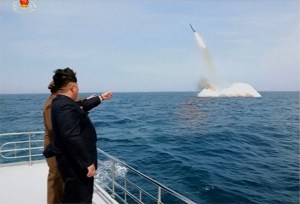
1104Kim Jong Un, the “Supreme Leader” of North Korea, supervises the April 22 test-launch of a missile from a submerged platform. (Image source: KCNA)

What gave the “faked” test story some prominence were the misunderstood remarks of the Vice Chairman of the Joint Chiefs of Staff, Admiral James Winnefeld. He had said, on May 19, that the North Korean missile launch was “not all” that North Korea said it was. He also mentioned that North Korea used clever video editors to “crop” the missile test-launch images. Apparently, that was exactly what the editors did. The Admiral, however, never claimed in his speech at the Center for Strategic and International Studies there had been no successful missile test.[4]

The same day, a high-ranking State Department official, Frank Rose — Assistant Secretary of State for Arms Control, Verification, and Compliance — told a Korean security seminar on Capitol Hill that North Korea had successfully conducted a “missile ejection” test, but from an underwater barge rather than a submarine.[5]

To confuse matters further, additional pictures were released by the South Korean media to illustrate stories about the North Korean test. Those pictures, however, were of American missiles, which use both solid and liquid propellant; as a result, one photo showed a U.S. missile with a solid propellant smoke trail and one, from a liquid propellant, without a smoke trail. These photographs apparently befuddled Reuters’ “experts,” who may have jumped to the conclusion that the photos of the North Korean test were “faked,” when they were simply of entirely different missile tests, and had been used only to “illustrate” ocean-going missile launches and not the actual North Korean test.[6]

According to Uzi Rubin, to achieve the capability to eject a missile from an underwater platform is a significant technological advancement. The accomplishment again illustrates “that rogue states such as North Korea can achieve military capabilities which pose a notable threat to the United States and its allies.”

Rubin also stated that the North Korean underwater launch test was closely related to the development of a missile-firing submarine, “a first step in achieving a very serious and dangerous new military capability.”[7]

Admiral Winnefeld and Secretary Rose, in their remarks, confirmed that the North Korean test was not the “dog and pony show” some have claimed. In other words, the U.S. government has officially confirmed that the North Koreans have made a serious step toward producing a sea-launched ballistic missile capability.

While such an operational capability may be “years away,” Rubin warns that “even many years eventually pass, and it will also take many years to build up the missile defenses, so we had better use the time wisely.”[8]

Will diplomacy succeed in stopping the North Korean threats? U.S. Secretary of State John Kerry seemed to think it worth a try; so he began the push to restart the old 2003 “six-party” talks between the United States, North Korea, Russia, China, South Korea and Japan, to bring North Korea’s nuclear weapons under some kind of international control and eventual elimination.

After all, supporters of such talks claim, similar talks with Iran appear to be leading to some kind of “deal” with Tehran, to corral its nuclear weapons program, so why not duplicate that effort and bring North Korea back into the non-nuclear fold?

What such a “deal,” if any, with Iran, will contain, is at this point unknown. Celebrations definitely seem premature. If the “deal” with North Korea is as “successful” as the P5+1’s efforts to rein in Iran’s illegal nuclear weapons program, the prognosis for the success of diplomacy could scarcely be more troubling.

Bloomberg’s defense writer, Tony Carpaccio, reflecting Washington’s conventional wisdom, recently wrote that of course China will rein in North Korea’s nuclear program: “What might be a bigger preventative will be the protestations of China, North Korea’s primary trade partner and only prominent international ally. Making China angry would put an already deeply impoverished, isolated North Korea in even more dire straits.”

Unfortunately, no matter how attractive a strategy of diplomatically ending North Korea’s nuclear program might look on the surface, it is painfully at odds with China’s established and documented track record in supporting and carrying out nuclear proliferation with such collapsed or rogue states as Iran, Syria, Pakistan, North Korea and Libya, as detailed by the 2009 book The Nuclear Express, by Tom C. Reed (former Secretary of the Air Force under President Gerald Ford and Special Assistant to the President of National Security Affairs during the Ronald Reagan administration) and Daniel Stillman (former Director of the Lawrence Livermore National Laboratory).

Far from being a potential partner in seeking a non-nuclear Korean peninsula, China, say the authors, has been and is actually actively pushing the spread of nuclear weapons to rogue states, as a means of asserting Chinese hegemony, complicating American security policy and undermining American influence.

The problem is not that China has little influence with North Korea, as China’s leadership repeatedly claims. The problem is that China has no interest in pushing North Korea away from its nuclear weapons path because the North Korean nuclear program serves China’s geostrategic purposes.

As Reed and Stillman write, “China has been using North Korea as the re-transfer point for the sale of nuclear and missile technology to Iran, Syria, Pakistan, Libya and Yemen”. They explain, “Chinese and North Korean military officers were in close communication prior to North Korea’s missile tests of 1998 and 2006”.

Thus, if China takes action to curtail North Korea’s nuclear program, China will likely be under pressure from the United States and its allies to take similar action against Iran and vice versa. China, however, seems to want to curry favor with Iran because of its vast oil and gas supplies, as well as to use North Korea to sell and transfer nuclear technology to both North Korea and Iran, as well as other states such as Pakistan. As Reed again explains, “China has catered to the nuclear ambitions of the Iranian ayatollahs in a blatant attempt to secure an ongoing supply of oil”.

North Korea is a partner with Iran in the missile and nuclear weapons development business, as Uzi Rubin has long documented. Thus, it is reasonable to believe that China may see any curtailment of North Korea’s nuclear program as also curtailing Iran’s access to the same nuclear technology being supplied by North Korea. Any curtailment would also harm the Chinese nuclear sales business to Iran and North Korea, especially if China continues to use the “North Korea to Iran route” as an indirect means of selling its own nuclear expertise and technology to Iran.

It is not as if Chinese nuclear proliferation is a recent development or a “one of a kind” activity. As far back as 1982, China gave nuclear warhead blueprints to Pakistan, according to Reed. These findings indicate that China’s nuclear weapons proliferation activities are over three decades old.[9]

Reed and Stillman also note that nearly a decade later, China tested a nuclear bomb “for Pakistan” on May 26, 1990, and that documents discovered in Libya when the George W. Bush administration shut down Libyan leader Muammar Kaddafi’s nuclear program revealed that China gave Pakistan the CHIC-4 nuclear weapon design.

Unfortunately, China’s nuclear assistance to Pakistan did not stay just in Pakistan. The nuclear technology made its way from Pakistan to North Korea. For example, high explosive craters, construction of a 50 megawatt nuclear reactor (finished in 1986) and a secret reprocessing facility begun in 1987 all were done in North Korea with major Pakistani help from the A.Q. Khan “Nukes R Us” smuggling group, as Reed and Stillman document in their book.

Reed and Stillman write that when, amid disclosures in 2003 of a major Libyan nuclear weapons program, the U.S. government sought help in shutting down the Khan nuclear smuggling ring, “Chinese authorities were totally unhelpful, to the point of stonewalling any investigation into Libya’s nuclear supply network.”

More recently, Chinese companies have now twice — in 2009 and 2011 — been indicted by the Attorney for the City of New York for trying to provide Iran with nuclear weapons technology.

The indictments document that Chinese companies were selling Iran steel for nuclear centrifuges and other banned technology. A leaked State Department cable, discussing the indictments at the time, revealed “details on China’s role as a supplier of materials for Iran’s nuclear program,” and that “China helped North Korea ship goods to Iran through Chinese airports.”

And more recently, in April 2015, the Czech government interdicted additional nuclear technology destined for Iran — the origin of which remains unknown — in violation of current sanctions against Iran.

From 1982 through at least the first part of 2015, the accumulation of documentary evidence on nuclear proliferation reveals two key facts:

First, despite literally hundreds of denials by Iran that it is seeking nuclear weapons, and amid current negotiations to end Iran’s pursuit of nuclear weapons, there is solid evidence that Iran still seeks nuclear weapons technology; and that North Korea has nuclear weapons and is advancing their capability.

Second, China continues to transfer, through its own territory, nuclear weapons technology involving both North Korea and Iran.

Although the Chinese profess to be against nuclear proliferation, their track record from the documented evidence illustrates just the opposite.

In summary, it is obvious North Korea’s nuclear weapons and ballistic missiles are a serious threat to America and its allies. And China, from its proliferation record for the past three decades, is making such a threat more widespread.

In this light, is dismissing North Korea’s advances in military technology and ignoring China’s record of advancing its neighbors’ nuclear weapons technology really best for U.S. interests?

_______________________

[1] The Washington Post, May 20, 2015, Anna Fifield, “North Korea says it has technology to make mini-nuclear weapons“; and Admiral Bill Gortney, US NORAD Commander, quoted in “NORAD commander: North Korean KN-08 Missile Operational“, by Jon Harper, in “Stars and Stripes”, of April 7, 2015; the Admiral said: “Our assessment is that they have the ability to put a nuclear weapon on a KN-08 and shoot it at the homeland.” He said “Yes sir” when asked if the U.S. thinks North Korea has succeeded in the complicated task of miniaturizing a warhead for use on such a missile. North Korea has conducted three nuclear tests since 2006.

[2] Department of Defense Press Briefing by Admiral Cecil Haney, Commander, U.S. Strategic Command, March 24, 2015.

[3] Personal communication with Uzi Rubin, President of Rubincon, May 21, 2015.

[4] Admiral James Winnefeld, Remarks at the Center for Strategic and International Studies (CSIS) Briefing on Missile Defense, May 20, 2015.

[5] U.S. Department of State, Daily Digest Bulletin, Frank Rose, Remarks on “Missile Defense and the U.S. Response to the North Korean Ballistic Missile and WMD Threat”, May 20, 2015.

[6] Explanation provided by Israel missile expert Uzi Rubin, personal communication, May 20, 2015.

[7] Ibid.

[8] Ibid.

[9] According to Reed and Stillman, in “The Nuclear Express,” none of China’s nuclear help to Pakistan and Iran could have been possible without China’s transfer of the nuclear technology through Chinese airspace.