Posted tagged ‘Iranian Islam’

Young Iranian chess grandmaster expelled from national team for not wearing hijab

February 22, 2017

Young Iranian chess grandmaster expelled from national team for not wearing hijab, Jihad Watch

Her brother Borna, 15, has also been banned after competing against Israeli player Alexander Huzman in the same tournament.

********************************

Dorsa Derakhshani is part of a new and growing movement within some Sharia states that is daring to challenge the brute strictures of Sharia, including the inferior status of women. The hijab is, of course, a symbol of that oppression and by law in the Islamic Republic of Iran, women must wear it.

The head of Iran’s Chess Federation, Mehrdad Pahlevanzadeh, was quoted as saying the Chess Federation will deal with the siblings in the “severest way possible.”

“The first step in dealing with them would be to deprive them from playing in Iran, and they won’t have a chance to be in the national team,” Pahlevanzadeh said, Azerbaijani news outlet Trend News Agency reported

dorsa-derakhshani

“Young Iranian chess grandmaster expelled from national team for not wearing hijab,” RT News, February 21, 2017:

Iran has banned 18-year-old chess grandmaster Dorsa Derakhshani from competing for the national chess team for not wearing a hijab – obligatory dress for women under Iranian law.

Derakhshani was expelled for not covering her hair with the garment – compulsory wear for women since the Islamic Revolution in 1979 – while competing as an independent player in the 2017 Tradewise Gibraltar Chess Festival.

Her brother Borna, 15, has also been banned after competing against Israeli player Alexander Huzman in the same tournament.

The siblings have subsequently been precluded from competing in future international competitions for the Islamic Republic. Dorsa obtained her International Master and Woman Grandmaster titles last year and currently lives in Barcelona, Spain, after taking up the offer of a year’s residency.

The head of Iran’s Chess Federation, Mehrdad Pahlevanzadeh, was quoted as saying the Chess Federation will deal with the siblings in the “severest way possible.”

“The first step in dealing with them would be to deprive them from playing in Iran, and they won’t have a chance to be in the national team,” Pahlevanzadeh said, Azerbaijani news outlet Trend News Agency reported.

Belgium-based Iranian gender discrimination activist Darya Safai tweeted a negative reaction about the move with the hashtag “forced hijab”

“Dorsa to me is the true feminist, not the Swedish government parading with the headscarf with [President of Iran Hassan] Rouhani,” Safai said in a Facebook post.

Safai was referring to members of the Swedish government – many of whom self-identify as feminists – who visited Iran in February.

The Swedish delegation received criticism from many observers who saw the move as a legitimization of an enforced law that violates women’s rights in Iran.

Under Iranian law, women are required to cover their hair and wear loose-fitting clothes when they appear in public and foreigners are obliged to dress modestly when entering the Islamic Republic for whatever length of time.

“By actually complying with the directives of the Islamic Republic, Western women legitimize the compulsory hijab law,” Masih Alinejad, CEO of human rights group UN Watch, wrote on Facebook.

It is the not the first time Iran’s insistence on female competitors to wear the hijab has caused controversy.

In September 2016, female players accused the World Chess Federation (FIDE) of failing to stand up for women’s rights after it said competitors must accept local law and wear hijabs during the world championship in Tehran, Iran.

Female grandmasters risked arrest if they did not cover their hair during the tournament…….

Iranian Regime gets desperate; holds 300 exhibitions against MEK

February 13, 2017

Iranian Regime gets desperate; holds 300 exhibitions against MEK, Iran Focus, February 13, 2017

(Will President Trump work with the MEK for regime change in Iran? Should he? — DM)

mek-750

London, 13 Feb – The Iranian Regime held 300 exhibitions against the resistance group, MEK, in an increasingly desperate attempt to smear the Iranian Opposition.

This is believed to be in response to a report by the Regime’s Ministry of Intelligence which detailed the power of the People’s Mojahedin Organization of Iran (PMOI or MEK) and the progress they have made.

The report noted that young people are far more likely to side with the Resistance and that the Iranian Resistance is highly respected both at home and abroad.

Hashemi Nejad the director general of the state-funded foundation, Habilian, said: “We have held 300 exhibitions against MEK in Iran up to now. These days, MEK is getting recognised as a leading institute in Human Rights, our duty is to discuss Human Rights issues against MEK since Iranian youths are the target of MEK.”

The report noted that the MEK favoured regime change and the removal of the Iranian mullahs, but the MEK have never made a secret of that.

It also highlighted that the MEK had assisted the West by revealing Iran’s secret nuclear missiles programme.

They noted that in order to stop the youth from joining the MEK, the Regime would have to present a totally warped view of the Resistance Forces, which is what they have attempted to do with the exhibitions.

The National Council of Resistance of Iran (NCRI) noted in their recap of the report, that it was weird to hear the Regime admit that they had been trounced by the Resistance in terms of support from the Iranian people.

They wrote: “The truth is that after the regime was unable to destroy the MEK by inhumane siege and missile attacks and Mojahedin were able to maintain the integrity of their organisation and transfer themselves to a safe place, the regime is frightened now. That is why the mullahs regularly yowl and whimper about the danger of Mojahedin.”

They continued: “This fear and sense of danger is particularly due to the fact that the power and cohesion of the People’s Mojahedin Organization of Iran has coincided on the one hand with the weakness and ultimate decay of the Velayat-e faqih regime and the crises engulfing the regime, and on the other hand by the fact that Iran’s society is on the verge of explosion and ready for uprising and revolution and is only waiting for a spark.”

More about the People’s Mojahdin Organization of Iran (PMOI/ MEK)

The People’s Mojahedin Organization of Iran (Also known as MEK, or Mujahedin-e-Khalq / Mujahedeen-e-Khalq), was founded on September 6, 1965, by Mohammad Hanifnejad, Saeed Mohsen, and Ali-Asghar Badizadgan. All engineers, they had earlier been members of the Freedom Movement (also known as the Liberation Movement), created by Medhi Bazargan in May 1961.1

The MEK’s quest culminated in a true interpretation of Islam, which is inherently tolerant and democratic, and fully compatible with the values of modern-day civilization. It took six years for the MEK to formulate its view of Islam and develop a strategy to replace Iran’s dictatorial monarchy with a democratic government.

MEK’s interpretation of Islam

The theocratic mullah regime in Iran believe interpreting Islam is their exclusive domain. The MEK reject this view and the cleric’s reactionary vision of Islam. The MEK’s comprehensive interpretation of Islam proved to be more persuasive and appealing to the Iranian youth.

MEK’s founders and new members studied the various schools of thought, the Iranian history and those of other countries, enabling them to analyze other philosophies and ideologies with considerable knowledge and to present their own ideology, based on Islam, as the answer to Iran’s problems.

MEK’s leadership’s arrest during the 70s.

The Shah’s notorious secret police, SAVAK, arrested all MEK leaders and most of its member’s in1971. On May 1972, the founders of the MEK, Mohammad Hanifnejad , Saeed Mohsen and Ali Asghar Badizadegan, along with two members of the MEK leadership, Mahmoud Askarizadeh and Rasoul Meshkinfam, were put before death squads and were executed after long months of imprisonment and torture. They were the true vanguards, who stood against the dictatorial regime of Shah. However, they are also recognized for their opposition to what is today known as Islamic fundamentalism.

The death sentence of Massoud Rajavi, a member of MEK’s central committee, was commuted to life imprisonment as a result of an international campaign by his Geneva based brother, Dr. Kazem Rajavi (assassinated in April 1990 in Geneva by mullahs’ agents) and the personal intervention of the French President Georges Pompidou and Francois Mitterrand. He was the only survivor of the MEK original leadership.

Massoud Rajavi’s critical role in characterizing religious extremism

From 1975 to 1979, while incarcerated in different prisons, Massoud Rajavi led the MEK’s struggle while constantly under torture for his leading position.

Massoud Rajavi stressed the need to continue the struggle against the shah’s dictatorship. At the same time, he characterized religious fanaticism as the primary internal threat to the popular opposition, and warned against the emergence and growth of religious fanaticism and autocracy. He also played a crucial role when some splinter used the vacuum in the MEK leadership who were all executed or imprisoned at the time, to claim a change of ideology and policy. Massoud Rajavi as the MEK leader condemn these individual’s misuse of MEK’s name while continuing to stress the struggle against dictatorship. His efforts while still in prison forced these individuals to no longer operating under the name of MEK and adopting a different name for their group. These positions remained the MEK’s manifesto until the overthrow of the shah’s regime.

Release of Political Prisoners on the last days of the Shah

A month before the 1979 revolution in Iran, the Shah was forced to flee Iran, never to return. All democratic opposition leaders had by then either been executed by the Shah’s SAVAK or imprisoned, and could exert little influence on the trend of events. Khomeini and his network of mullahs across the country, who had by and large been spared the wrath of SAVAK, were the only force that remained unharmed and could take advantage of the political vacuum. In France, Khomeini received maximum exposure to the world media. With the aid of his clerical followers, he hijacked a revolution that began with calls for democracy and freedom and diverted it towards his fundamentalist goals. Through an exceptional combination of historical events, Shiite clerics assumed power in Iran.

Khomeini’s gradual crackdown on MEK in fear of their popular support

In internal discourses, Rajavi the remaining leader of the MEK, argued that Khomeini represented the reactionary sector of society and preached religious fascism. Later, in the early days after the 1979 revolution, the mullahs, specifically Rafsanjani, pointed to these statements in inciting the hezbollahi club-wielders to attack the MEK.

Following the revolution, the MEK became Iran’s largest organized political party. It had hundreds of thousands of members who operated from MEK offices all over the country. MEK publication, ‘Mojahed’ was circulated in 500,000 copies.

Khomeini set up an Assembly of Experts comprised of sixty of his closest mullahs and loyalists to ratify the principle of velayat-e faqih (absolute supremacy of clerical rule) as a pillar of the Constitution. The MEK launched a nationwide campaign in opposition to this move, which enjoyed enormous popular support. Subsequently, the MEK refused to approve the new constitution based on the concept of velayat-e faqih, while stressing its observance of the law of the country to deny the mullahs any excuse for further suppression of MEK supporters who were regularly targeted by the regime’s official and unofficial thugs.

Khomeini sanctioned the occupation of the United States embassy in 1979 in order to create an anti-American frenzy, which facilitated the holding of a referendum to approve his Constitution, which the MEK rejected.

MEK’s endeavors to participate in the political process avoiding an unwanted conflict with government repressive forces

The MEK actively participated in the political process, fielding candidates for the parliamentary and presidential elections. The MEK also entered avidly into the national debate on the structure of the new Islamic regime, though was unsuccessful in seeking an elected constituent assembly to draft a constitution.

The MEK similarly made an attempt at political participation when [then] Massoud Rajavi ran for the presidency in January 1980. MEK’s leader was forced to withdraw when Khomeini ruled that only candidates who had supported the constitution in the December referendum – which the MEK had boycotted- were eligible. Rajavi’s withdrawal statement emphasized the MEK’s efforts to conform to election regulations and reiterated the MEK’s intention to advance its political aims within the new legal system”. (Unclassified report on the People’s Mojahedin Organization of Iran(PMOI/ MEK) by the Department of State to the United States House of Representatives, December 1984.)
However, the MEK soon found itself in a direct struggle against the forces of the regime’s Supreme leader. The MEK’s differences with Khomeini dated back to the 1970s, and stem from its opposition to what is known today as Islamic extremism. Angry at the position taken by the MEK against his regime and worried about the MEK’s growing popularity, Khomeini ordered a brutal crackdown against the MEK and its supporters. Between 1979 and 1981, some 70 MEK members and sympathizers were killed and several thousand more were imprisoned by the Iranian regime.

June 20, 1981- Khomeini’s order to open fire on peaceful demonstration of half-a-million supporters of MEK

The turning point came on 20th June 1981, when the MEK called a demonstration to protest at the regime’s crackdown, and to call for political freedom which half-a-million supporters participated at. Khomeini ordered the Revolutionary Guards to open fire on the swelling crowd, fearing that without absolute repression the democratic opposition (MEK) would force him to engage in serious reforms – an anathema as far as he was concerned; he ordered the mass and summary executions of those arrested.

Since then, MEK activists have been the prime victims of human rights violations in Iran. Over 120,000 of its members and supporters have been executed by the Iranian regime, 30,000 of which, were executed in a few months in the summer of 1988, on a direct fatwa by Khomeini, which stated any prisoners who remain loyal to the MEK must be executed.

Having been denied its fundamental rights and having come under extensive attack at the time that millions of its members, supporters and sympathizers had no protection against the brutal onslaught of the Iranian regime, the MEK had no choice but to resist against the mullahs’ reign of terror.

“Towards the end of 1981, many of the members of the MEK and supporters went into exile. Their principal refuge was in France. But in 1986, after negotiations between the French and the Iranian authorities, the French government effectively treated them as undesirable aliens, and the leadership of the MEK with several thousand followers relocated to Iraq.” (Judgment of the Proscribed Organizations Appeal Commission, November 30, 2007.)

MEK Today

The MEK today is the oldest and largest anti-fundamentalist Muslim group in the Middle East. It has been active for more than a half century, battling two dictatorships and a wide range of issues. The MEK supports:

• Universal suffrage as the sole criterion for legitimacy

• Pluralistic system of governance

• Respect for individual freedoms

• Ban on the death penalty

• Separation of religion and state

• Full gender equality

• Equal participation of women in political leadership. MEK is actually led by its central committee consist of 1000 women.

• Modern judicial system that emphasizes the principle of innocence, a right to a defense, and due process

• Free markets

• Relations with all countries in the world

• Commitment to a non-nuclear Iran

The MEK remains a strong and cohesive organization, with a broad reach both worldwide and deep within Iran. MEK is the leading voice for democracy in Iran, supported by its interpretation of Islam that discredits the fundamentalist mullahs’ regime.

In trouble, Iran tries to discredit the MEK – dissidents

February 7, 2017

In trouble, Iran tries to discredit the MEK – dissidents, Iran Focus, February 6, 2017
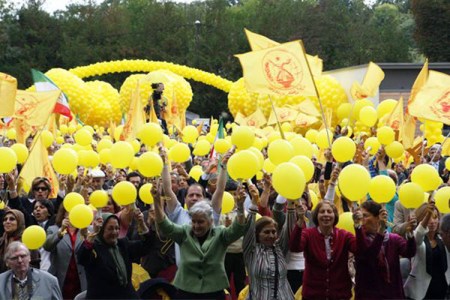
mek-rally-750

London, 7 Feb – As President Donald Trump’s new US administration steps up pressure on Iran over its belligerent activities, Iranian opponents are arguing that Tehran is now targeting its main organised opposition movement, the People’s Mojahedin Organisation of Iran (PMOI or MEK), with disinformation in order to discredit its role as a potential alternative to the theocratic regime.

The MEK, established over 51 years ago, as an opposition movement to the Shah’s regime, soon fell out with the clerical government that took over with the 1979 revolution. Since 1981, the MEK has been considered as the ruling theocracy’s main nemesis. The MEK is also the leading force in the main opposition coalition National Council of Resistance of Iran (NCRI).

Following the publication of articles by the Iranian ‘lobby’ targeting the MEK with ‘misinformation’, Farzin Hashemi, a Member of the NCRI Foreign Affairs Committee, wrote on Monday:

“Over the past week, once again policy on Iran was widely discussed in the media. Simultaneously, in recent weeks there has been more growing call for a new approach toward Iranian opposition, the MEK. The announcement by the US National Security Advisor that ‘Iran is officially on notice’ drew much attention. This position was followed by more Tweets from President Trump and a new round of sanctions, raising the prospect of a change of policy in the US approach towards Iran”.

Hashemi pointed out that both the NCRI and the MEK support sanctions against Iranian officials over their role in ballistic missile proliferation, a violation of United Nations Security Council Resolution 2231:

“As far as the Iranian Resistance, and its components including the People’s Mojahedin Organization of Iran (MEK/PMOI), is concerned imposing sanctions against a number of individuals and companies affiliated to the clerical regime for their role in missile proliferation is a positive step in confronting the illegitimate and terrorist dictatorship whose record includes 120,000 political executions”.

Last week the Trump administration sanctioned 25 Iranian officials and entities for a recent ballistic missile test launch by Tehran. Hashemi argued, however, that in order to deal with the threats emanating from Tehran – which it described as the Godfather of state-sponsored terrorism – the world community ought to impose comprehensive sanctions on Iran’s Revolutionary Guards (IRGC), the Ministry of Intelligence, and “other entities involved in suppression of the Iranian people and export of terrorism”.

“The IRGC and its affiliated militias and their commanders must be expelled from the countries of the region, in particular from Iraq, Syria, and Yemen. Otherwise, the region would not witness peace and tranquillity”.

“The prospect of a shift of US policy, has already shaken not only the Iranian regime and its lobbies but also apologists and advocates of the old and failed policy of appeasement. In order to maintain the ‘golden era,’ a term used by the mullahs’ officials internally and sometimes publicly to describe the last few years of US policy on Iran, they have resorted to a two-pronged strategy”, Hashemi argued.

Through their “propaganda in the media”, under various covers, they are trying to create an “echo chamber” with which any suggestion of the need for a firm policy on Iran and its rogue behaviour, both at home and abroad, is described as “war mongering”, he said. “They are desperately trying to intimidate those calling for a change of policy to side with the people of Iran, through such false labels”.

“Simultaneously, they are engaged in a massive disinformation campaign to discredit the democratic opposition, the MEK and the coalition National Council of Resistance of Iran (NCRI), led by its President-elect Maryam Rajavi. By spreading fake news about the MEK/PMOI, originated from the Ministry of Intelligence of the mullahs’ regime and the intelligence section of the IRGC, their objective is to convey this false message that there is no viable opposition and the world must accept and deal with the religious dictatorship ruling Iran. Thus, the core of the issue is not their debunked allegations but their hidden agenda to maintain the policy of appeasement”.

“So, the choice is simply to opt between supporting the central banker of international terrorism with the record of having executed 120,000 dissidents for political reasons –ironically, the majority of them members and sympathizers of the PMOI/MEK – or to side with the Iranian people in their quest for a free and democratic Iran in which there would be no more executions, no more gender discrimination, no more supporting terrorist groups and destabilizing the entire region and no more nuclear weapons program”.

Iranian dissidents have also taken to social media, such as Twitter and Facebook, to denounce Tehran’s ‘media propaganda ploy’ against the MEK.

On 9 January this year, 23 US prominent dignitaries, many of them with years of public service, urged the Trump administration “to adopt and pursue an Iran policy that recognizes the interests and inalienable rights of the Iranian people, and not just the clerical regime ruling over them.”

Highlighting the failure of the past policy that the nuclear deal might lead to a change of behavior from Tehran, the signatories stressed that the regime’s aggressive policy is part of their efforts on “preserving the vulnerable system of dictatorship”.

They also called for the voice of the Iranian people to be listened to through the NCRI and the MEK.

The former US officials also spoke out against Iran’s misinformation campaign against the MEK.

Pointing out that some “media and policy community continue to recycle defamatory allegations from decades past,” they wrote “We now know that these designations of the resistance as a terrorist group by Western governments were not made in response to confirmed terrorism; all were diplomatic gestures taken at the request of Tehran. Iran’s Ministry of Intelligence and Security has for many years impaired the exiled opposition by covertly spreading false and distorted claims through third parties in the West. Other governments like Germany and the Netherlands closely monitor Iran’s influence operations on their soil; a thorough counter‐intelligence investigation by the US is clearly needed and long overdue”.

They concluded by recommending to Trump: “With a more enlightened grasp of the Iranian regime’s priorities and vulnerabilities, your Administration will be equipped to exert leverage enabling the US to oppose Tehran’s repression and adventurism while standing for the fundamental values both our peoples share”.

Hashemi added: “While, Tehran’s lobby and advocates of appeasement will desperately continue to allocate all their resource to discredit the resistance, and in particular the MEK (PMOI) and to preserve the failed old policy, their time is over”.


More about the People’s Mojahdin Organization of Iran (PMOI/ MEK) —– Source

The People’s Mojahedin Organization of Iran (Also known as MEK, or Mujahedin-e-Khalq / Mujahedeen-e-Khalq), was founded on September 6, 1965, by Mohammad Hanifnejad, Saeed Mohsen, and Ali-Asghar Badizadgan. All engineers, they had earlier been members of the Freedom Movement (also known as the Liberation Movement), created by Medhi Bazargan in May 1961.1

The MEK’s quest culminated in a true interpretation of Islam, which is inherently tolerant and democratic, and fully compatible with the values of modern-day civilization. It took six years for the MEK to formulate its view of Islam and develop a strategy to replace Iran’s dictatorial monarchy with a democratic government.

MEK’s interpretation of Islam

The theocratic mullah regime in Iran believe interpreting Islam is their exclusive domain. The MEK reject this view and the cleric’s reactionary vision of Islam. The MEK’s comprehensive interpretation of Islam proved to be more persuasive and appealing to the Iranian youth.
MEK’s founders and new members studied the various schools of thought, the Iranian history and those of other countries, enabling them to analyze other philosophies and ideologies with considerable knowledge and to present their own ideology, based on Islam, as the answer to Iran’s problems.

MEK’s leadership’s arrest during the 70s.

The Shah’s notorious secret police, SAVAK, arrested all MEK leaders and most of its member’s in1971. On May 1972, the founders of the MEK, Mohammad Hanifnejad , Saeed Mohsen and Ali Asghar Badizadegan, along with two members of the MEK leadership, Mahmoud Askarizadeh and Rasoul Meshkinfam, were put before death squads and were executed after long months of imprisonment and torture. They were the true vanguards, who stood against the dictatorial regime of Shah. However, they are also recognized for their opposition to what is today known as Islamic fundamentalism.

The death sentence of Massoud Rajavi, a member of MEK’s central committee, was commuted to life imprisonment as a result of an international campaign by his Geneva based brother, Dr. Kazem Rajavi (assassinated in April 1990 in Geneva by mullahs’ agents) and the personal intervention of the French President Georges Pompidou and Francois Mitterrand. He was the only survivor of the MEK original leadership.
Massoud Rajavi’s critical role in characterizing religious extremism

From 1975 to 1979, while incarcerated in different prisons, Massoud Rajavi led the MEK’s struggle while constantly under torture for his leading position.

Massoud Rajavi stressed the need to continue the struggle against the shah’s dictatorship. At the same time, he characterized religious fanaticism as the primary internal threat to the popular opposition, and warned against the emergence and growth of religious fanaticism and autocracy. He also played a crucial role when some splinter used the vacuum in the MEK leadership who were all executed or imprisoned at the time, to claim a change of ideology and policy. Massoud Rajavi as the MEK leader condemn these individual’s misuse of MEK’s name while continuing to stress the struggle against dictatorship. His efforts while still in prison forced these individuals to no longer operating under the name of MEK and adopting a different name for their group. These positions remained the MEK’s manifesto until the overthrow of the shah’s regime.

Release of Political Prisoners on the last days of the Shah

A month before the 1979 revolution in Iran, the Shah was forced to flee Iran, never to return. All democratic opposition leaders had by then either been executed by the Shah’s SAVAK or imprisoned, and could exert little influence on the trend of events. Khomeini and his network of mullahs across the country, who had by and large been spared the wrath of SAVAK, were the only force that remained unharmed and could take advantage of the political vacuum. In France, Khomeini received maximum exposure to the world media. With the aid of his clerical followers, he hijacked a revolution that began with calls for democracy and freedom and diverted it towards his fundamentalist goals. Through an exceptional combination of historical events, Shiite clerics assumed power in Iran.

Khomeini’s gradual crackdown on MEK in fear of their popular support

In internal discourses, Rajavi the remaining leader of the MEK, argued that Khomeini represented the reactionary sector of society and preached religious fascism. Later, in the early days after the 1979 revolution, the mullahs, specifically Rafsanjani, pointed to these statements in inciting the hezbollahi club-wielders to attack the MEK.

Following the revolution, the MEK became Iran’s largest organized political party. It had hundreds of thousands of members who operated from MEK offices all over the country. MEK publication, ‘Mojahed’ was circulated in 500,000 copies.

Khomeini set up an Assembly of Experts comprised of sixty of his closest mullahs and loyalists to ratify the principle of velayat-e faqih (absolute supremacy of clerical rule) as a pillar of the Constitution. The MEK launched a nationwide campaign in opposition to this move, which enjoyed enormous popular support. Subsequently, the MEK refused to approve the new constitution based on the concept of velayat-e faqih, while stressing its observance of the law of the country to deny the mullahs any excuse for further suppression of MEK supporters who were regularly targeted by the regime’s official and unofficial thugs.

Khomeini sanctioned the occupation of the United States embassy in 1979 in order to create an anti-American frenzy, which facilitated the holding of a referendum to approve his Constitution, which the MEK rejected.

MEK’s endeavors to participate in the political process avoiding an unwanted conflict with government repressive forces
The MEK actively participated in the political process, fielding candidates for the parliamentary and presidential elections. The MEK also entered avidly into the national debate on the structure of the new Islamic regime, though was unsuccessful in seeking an elected constituent assembly to draft a constitution.

The MEK similarly made an attempt at political participation when [then] Massoud Rajavi ran for the presidency in January 1980. MEK’s leader was forced to withdraw when Khomeini ruled that only candidates who had supported the constitution in the December referendum – which the MEK had boycotted- were eligible. Rajavi’s withdrawal statement emphasized the MEK’s efforts to conform to election regulations and reiterated the MEK’s intention to advance its political aims within the new legal system”. (Unclassified report on the People’s Mojahedin Organization of Iran(PMOI/ MEK) by the Department of State to the United States House of Representatives, December 1984.)

However, the MEK soon found itself in a direct struggle against the forces of the regime’s Supreme leader. The MEK’s differences with Khomeini dated back to the 1970s, and stem from its opposition to what is known today as Islamic extremism. Angry at the position taken by the MEK against his regime and worried about the MEK’s growing popularity, Khomeini ordered a brutal crackdown against the MEK and its supporters. Between 1979 and 1981, some 70 MEK members and sympathizers were killed and several thousand more were imprisoned by the Iranian regime.

June 20, 1981- Khomeini’s order to open fire on peaceful demonstration of half-a-million supporters of MEK

The turning point came on 20th June 1981, when the MEK called a demonstration to protest at the regime’s crackdown, and to call for political freedom which half-a-million supporters participated at. Khomeini ordered the Revolutionary Guards to open fire on the swelling crowd, fearing that without absolute repression the democratic opposition (MEK) would force him to engage in serious reforms – an anathema as far as he was concerned; he ordered the mass and summary executions of those arrested.

Since then, MEK activists have been the prime victims of human rights violations in Iran. Over 120,000 of its members and supporters have been executed by the Iranian regime, 30,000 of which, were executed in a few months in the summer of 1988, on a direct fatwa by Khomeini, which stated any prisoners who remain loyal to the MEK must be executed.

Having been denied its fundamental rights and having come under extensive attack at the time that millions of its members, supporters and sympathizers had no protection against the brutal onslaught of the Iranian regime, the MEK had no choice but to resist against the mullahs’ reign of terror.

“Towards the end of 1981, many of the members of the MEK and supporters went into exile. Their principal refuge was in France. But in 1986, after negotiations between the French and the Iranian authorities, the French government effectively treated them as undesirable aliens, and the leadership of the MEK with several thousand followers relocated to Iraq.” (Judgment of the Proscribed Organizations Appeal Commission, November 30, 2007.)

MEK Today

The MEK today is the oldest and largest anti-fundamentalist Muslim group in the Middle East. It has been active for more than a half century, battling two dictatorships and a wide range of issues. The MEK supports:

• Universal suffrage as the sole criterion for legitimacy
• Pluralistic system of governance
• Respect for individual freedoms
• Ban on the death penalty
• Separation of religion and state
• Full gender equality
• Equal participation of women in political leadership. MEK is actually led by its central committee consist of 1000 women.
• Modern judicial system that emphasizes the principle of innocence, a right to a defense, and due process
• Free markets
• Relations with all countries in the world
• Commitment to a non-nuclear Iran

The MEK remains a strong and cohesive organization, with a broad reach both worldwide and deep within Iran. MEK is the leading voice for democracy in Iran, supported by its interpretation of Islam that discredits the fundamentalist mullahs’ regime.

Global Assembly of Islamic Awakening aims at rooting out Takfiri thought

October 22, 2016

Global Assembly of Islamic Awakening aims at rooting out Takfiri thought, AhlulBayt News, October 21, 2016

(The split between Shiite – Sunni Muslims began centuries ago due to disputes about who was Mohamud’s legitimate successor . A Takfiri 

is a Muslim who accuses another Muslim (or an adherent of another Abrahamic faith) of apostasy.[1] The accusation itself is called takfir, derived from the word kafir (unbeliever), and is described as when “one who is, or claims to be, a Muslim is declared impure.”[2]Accusing other Muslims of being takfiris has become a sectarian slur, particularly since the outbreak of the Syrian Civil War in 2011

Significant healing of the rift between Shiites and Sunnis seems unlikely anytime soon, but were it to happen it probably would not be advantageous for non-Muslims. — DM)

Velayati, also a top advisor to Supreme Leader Ayatollah Seyyed Ali Khamenei on international affairs, made the remarks during a joint press conference held in Baghdad on Thursday after he met with Head of the Supreme Islamic Council of Iraq Ammar Hakim.

Velayati travelled to Iraq on Wednesday to participate in the 9th meeting of the supreme council of the Global Assembly of Islamic Awakening.

He told reporters at the conference that the fact that most of the participants in the meeting are from some 22 Sunni Muslim countries and a few of them are from Shia countries has indicated the unity and solidarity among all Muslim nations.

He also stressed that Iran would continue its support for Iraq as the latter is an ‘oppressed country which was occupied by the US and liberated later with the help of God and is now being ruled completely based on democracy.’

Meanwhile, Hakim told reporters that the Assembly meeting is being held in Baghdad while Mosul liberation operation is underway in north of the country.

He noted that the Daesh (ISIS) terrorists are not only considered a threat for Iraq but for the entire world.

Hakim noted that the Assembly meeting aims at briefing the Shiite and Sunni Muslims and scholars on the latest developments in the Islamic world.

Dr. Jasser discusses the U.S. refugee policies on the Mike Siegel Show 08.24.2016

August 24, 2016

Dr. Jasser discusses the U.S. refugee policies on the Mike Siegel Show 08.24.2016, AIFDtv

(The discussion is wide-ranging, covering more topics than indicated by the title.–DM)


Newly Unearthed Audio Details Iran’s Mass Executions

August 24, 2016

Newly Unearthed Audio Details Iran’s Mass Executions, Front Page MagazineDr. Majid Rafizadeh, August 24, 2016

(But how is this possible? With the Iran Scam, Iran — which frequently vituperates Israel for her gross “abuses of human rights” — has been recognized as a respected member of the world community. — DM)

grand-ayatollah-hossein-a-001

Shocking audio was released recently on the Internet in the Persian language. Immediately, Iranian officials ordered its removal. The audio clearly shows that the so-called “moderate” Iranian leaders are in fact world-class criminals based on every legal or humanitarian standard. The audio sheds light on horrific crimes against humanity that are not that distinct from those egregious crimes committed by the Nazis.

In the audio, Ayatollah Hussein Ali Montazeri, the ex-heir of Iran’s Supreme Leader, reveals the true character of the Islamic Republic and crimes committed by it in the name of Islam. Montazeri was born in Esfahan, Iran, and was one of the founding fathers of the Islamic Republic. He was an Islamic theologian and the designated successor to the Islamic revolution’s Supreme Leader, Ayatollah Rooh Allah Khomeini, until the very last moments of Khomeini’s life. His pictures were posted next to Khomeini’s in the streets. Nevertheless, Montazeri’s fate changed dramatically, as he could not stay silent and felt compelled to speak out.

Montazeri’s son, Ahmad, posted the audio on his website, but was ordered by Iranian intelligence (Etela’at) to remove it.

“You [Iranian officials] will in the future be etched in the annals of history as criminals,” Montazeri warns the Islamic Republic in the audio. “The greatest crime committed under the Islamic Republic, from the beginning of the Revolution until now, which will be condemned by history, is this crime [mass executions] committed by you.”

In reference to one of the worst mass executions in the modern history of the Middle East being carried by the Iranian government officials, Montazeri stated that “I am a straight-talking person. I don’t hold back what is in my heart. In contrast to some gentlemen who do what is politically expedient…. Believe me, I haven’t been able to sleep and this issue (executions) occupies my mind 2-3 hours every night … How will you respond to the families? How much did the Shah execute? Compare our executions to his!”

When an official asked him for his permission to execute 200 people, Montazeri retorted fiercely, “I don’t give permission at all. I am even against a single person being executed.”

Many members of those who were executed were from the opposition group, MEK, which is led currently by Maryam Rajavi. Amnesty International estimates that in the summer of 1988, the total number of people executed was 4,500. Some estimates reach as high as over 30,000 people.

Executions included all range of innocent people, including children and pregnant women. The audio continues:

So, now, without [the prisoners] having carried out any new activities, we go and execute them. This means that all of us screwed up, our entire judicial system is wrong. Isn’t that what it means? We are among ourselves here. I mean, we want to take stock … This one guy, his brother was in prison. Eventually when, you know, he got caught up in this, they said his sister was also a suspect. So they went and brought the sister. They executed the guy. The sister — it was only two days since they had brought her — when they told her [of the brother’s death], she said, I liked these people. They said the sister was 15 or 16 years old. They said, now that her brother has been executed and after what she said, execute her too, and they did. In Esfahan, a pregnant woman was among [those massacred]. In Esfahan they executed a pregnant woman…. [In clerical jurisprudence] one must not execute a woman even if she is a mohareb [enemy of God]. I reminded [Khomeini] of this, but he said they must be executed. In the month of Moharram … the month of God and the Prophet, it shouldn’t be like this. At least feel some shame before Imam Hussein. Cutting off all meetings and suddenly engaging in such butchery, dragging them out and bang! Bang! Does this happen anywhere in the world?

The government could not eliminate Montazeri the way it did with other opposition leaders due to his religious authority and the large number of followers he had. A few months before he was supposed to replace the Supreme Leader, Khomeini removed him from being the successor. He was put under house arrest, and his speeches and activities were heavily controlled. The regime chose the current Supreme Leader, Khamenei, who was a junior cleric, to be the Supreme Leader. He was a low-risk figure and total puppet of the Islamic Revolutionary Guard Corps (IRGC).

Ironically, all those people Montazeri is speaking to and warning in the audio — and all of those who were involved in these crimes — appear to have higher positions in the government currently.

For example, Mostafa Pourmohammadi was a representative of the Intelligence Ministry to the notorious Evin prison, and he was recently appointed by the so-called moderate president Hassan Rouhani to be justice minister. Ebrahim Raeisi was a public prosecutor and currently he is the head of Astan Quds Razavi, which has billions of dollars in revenues. Hussein Ali Nayeri was a judge and currently is the deputy of the Supreme Court of Iran. In his memoir, Montazeri writes that he told Nayeri to stop the executions at least in the month of Moharram, but Nayeri said, “We have executed so far 750 people in Tehran… we will get the job done with another 200 people and then we will listen to whatever you say.” Montazeri wrote several letters to Khomeini warning him as well.

What is crucial to point out is that realistically speaking, the above-mentioned people are only tje tip of the iceberg of those who are involved in such large scale crimes against humanity in Iran. But they have been awarded higher positions, power, and more money.

Montazeri advised the ruling politicians, “Beware of 50 years from now, when people will pass judgment on the leader [Khomeini] and will say he was a bloodthirsty, brutal and murderous leader…. I do not want history to remember him like that[.]”

The International Criminal Court, the UN, human rights originations and liberal institutions and activists should push to bring these officials to justice the way the international community did for some members of the Nazi Party. Finally, we should remember that these are world-class criminals and we are easing sanctions against a brutal regime, giving them more money from taxpayers, shaking hands with them, and calling them the moderates. How are we going to respond to millions of families whose members have been executed and tortured? What are we going to say in the future when asked why we allied with such criminals, appeased them, and gave them billions of dollars?

Muslim cleric from terror sponsor Iran praises Pope for saying Islam is peaceful

August 24, 2016

Muslim cleric from terror sponsor Iran praises Pope for saying Islam is peaceful, Jihad Watch,

He is thanking the Pope for furthering what he must know are false statements that keep people ignorant and complacent about the jihad threat. He is, in effect, thanking the Pope for being a tool of the global jihad.

*****************

“Grand Ayatollah Makarem Shirazi of Qom wrote in a letter to the Pope: ‘I am really delighted to have heard your comments during your last trip to Poland in which you stated “Islam is not equal to terrorism” and further dismissed the association of violence and harshness with any and all divinely-sent religions.’”

Grand Ayatollah Makarem Shirazi of Qom must know better. He must know that the Qur’an and Sunnah teach warfare against unbelievers, as I demonstrate here and in many other places. He is thanking the Pope for furthering what he must know are false statements that keep people ignorant and complacent about the jihad threat. He is, in effect, thanking the Pope for being a tool of the global jihad.

grand anat

“Top Muslim cleric praises Pope Francis for saying it is wrong to identify Islam with violence,” by Carey Lodge, Christian Today, August 23, 2016:

A top Iranian religious leader has praised Pope Francis for saying it is wrong to identify Islam with violence.

Grand Ayatollah Makarem Shirazi of Qom wrote in a letter to the Pope: “I am really delighted to have heard your comments during your last trip to Poland in which you stated ‘Islam is not equal to terrorism’ and further dismissed the association of violence and harshness with any and all divinely-sent religions.

“Your wise and logical stance regarding Islam in disassociating the religion from the inhumane actions and atrocities of the Takfiri groups such as Daesh is truly admirable.”

Pope Francis told reporters on his plane back from Poland last month: “I think it is not right to identity Islam with violence. This is not right and this is not true.”

He was speaking following the murder of Father Jacques Hamel, an 85-year-old Catholic priest in Rouen, France, in an attack that was claimed by Islamic State.

“I think that in nearly all religions there is a always a small fundamentalist group,” the Pope said. “I don’t like to talk about Islamic violence because every day when I look at the papers I see violence here in Italy – someone killing his girlfriend, someone killing his mother-in-law. These are baptised Catholics.

“If I speak of Islamic violence, I have to speak of Catholic violence. Not all Muslims are violent.”

In his letter, Shirazi said that “such barbaric acts have nothing to do with divinely-sent religions and their various schools of thought. Rather, they originate from the inferior materialistic objectives of some corrupt superpowers who seek nothing but to obtain more illegitimate wealth.”…

Lashing and Flogging: Islam and Iran

August 1, 2016

Lashing and Flogging: Islam and Iran, Front Page MagazineDr. Majid Rafizadeh, August 1, 2016

happy times in Iran

[D]espite all the [international] laws banning flogging, the Islamic Republic of Iran continues to use these kinds egregious punishments without feeling any pressure from the media or from international organizations. This highlights the fact that Iran is actually widening its crackdown as it is receiving sanctions relief and gaining more revenue.

********************

The ruling clerics of Iran are increasing their reliance on public flogging not only for punishing people, but also for threatening those who are violating minor Islamic and Sharia laws. 

Public lashing is orchestrated for several reasons, including to punish the person who has violated Sharia laws, impose fear in the society, humiliate the victims and cause psychological harms to the individuals.

Holding a girlfriend/boyfriend’s hand, kissing in public (even for a married couple), listening to music, drinking alcohol and wearing non-Islamic dress can all be grounds for flogging under the Islamic law of Iran. As an Iranian prosecutor, Esmail Sadeghi Niaraki, who recently arrested people for “dancing and jubilating,” said, “We hope this [flogging] will be a lesson for those who break Islamic norms in private places.”

Yesterday, according to Iran’s state-owned news agency, Tasnim, Iranian officials arrested 150 young people for being at a mixed-gender birthday party in the city of Islamshahr, close to the capital of Tehran. Young people who are arrested for attending mixed-gender parties are often fined, flogged, beaten and sometimes raped.

According to Colonel Mohsen Khancherli, Iran’s police commander for the west of Tehran Province:

“After we obtained a report about a mixed-gender party in a garden in the vicinity of Islamshahr in the west of Tehran Province, an operation was carried out by the police and another organization, leading to the arrest of dozens of boys and girls.”

He added:

“Some 150 boys and girls had gathered at the mixed-gender party under the guise of a birthday party in this garden which is situated next to a studio where unlawful music was produced and recorded. Upon arrival of the police, all those present were arrested and sent before the judiciary.”

A few weeks ago, more than 30 college students were arrested, and within 24 hours the judge ordered each to receive 99 lashes for attending a graduation party. In the last two months, approximately 600 people have been arrested, fined and lashed for celebrating.

In this video, a teenager is being lashed for helping a girl whom the moral police were attempting to arrest for wearing bad hijab. He can be heard begging for mercy.

According to Ismaeil Sadeqi Niaraki, a top Iranian cleric, Iran will not tolerate “freedom” or “having fun.” He praised the moral police for arresting and punishing those who break the Islamic laws: “Thanks [sic] God that the police questioning, investigation, court hearing, verdict and implementation of the punishment all took place in less than 24 hours.”

According to Chapter III of the Iranian Islamic constitution, Enforcement of Sentences of Flogging, Article 27:  “Flogging will be administered by a woven leather belt of approximately one meter in length and one-and-a-half centimeter in width.” The penal code goes on detailing how one should be flogged:

Article 32: Enforcement of hadd for female convicts will be carried out while the convict is in a sitting position with her body fully covered by clothing.

Article 33: Flogging for male convicts will be administered while the convict is in a standing position.  For adultery, sodomy, and consumption of alcohol, there will be no clothing other than coverage of private organs, and for qazf or pandering, flogging will be administered over regular clothing.

Flogging is banned according to international law. The Universal Declaration on Human Rights, the International Covenant on Civil and Political Rights and the Convention Against Torture prohibit torture and “cruel, inhuman, or degrading treatment or punishment.” Various organizations within the United Nations, such as the UN High Commissioner for Human Rights) and the UN Human Rights Committee, equate flogging with inhumane and cruel punishments.

Nevertheless, despite all the laws banning flogging, the Islamic Republic of Iran continues to use these kinds egregious punishments without feeling any pressure from the media or from international organizations. This highlights the fact that Iran is actually widening its crackdown as it is receiving sanctions relief and gaining more revenue.

Enforcing ‘God’s Commandments’: Heightened Mass Executions in Iran

June 17, 2016

Enforcing ‘God’s Commandments’: Heightened Mass Executions in Iran, Front Page MagazineDr. Majid Rafizadeh, June 17, 2016

hangings_in_iran

While the Obama administration is continuing its appeasement policies and romance with the ruling mullahs of Iran, the scale of executions has reached an unprecedented level. The Iranian regime is resorting to more and more mass executions. How is the Islamic Republic of Iran different from the Islamic State or those who commit terrorist acts by mass murdering people? 

Most recently, the ruling clerics of Iran hanged 16 people in one day in several cities, including in Gohardasht (Rajai Shahr) and Ghezel-Hessar prisons in Karaj (western part of Tehran) and Adelabad Prison in Shiraz (southern part of Iran).

One of those executed was 16 years old at time of allegedly committing a crime. President Obama, Hillary Clinton or the several European governments, which are following in the footsteps of the Obama administration, have issued no robust condemnation or criticism. These egregious human rights violations and acts of mass executions committed by a state — in the name of Islam — have been totally ignored.

Prior to the above-mentioned mass executions, the Iranian regime hanged 13 prisoners on May 17 in three cities of Yazd, Urmia and Mashhad. Twelve individuals were executed collectively. A few weeks ago, the Iranian regime executed five Kurdish rights activists in the northwestern city of Urmia. The five Kurds — Naji Kiwan, Ali Kurdian, Haidar Ramini, Nadir Muhamadi and Ruhman Rashidi — were hanged publicly on charges of “conspiring against the Islamic Republic of Iran.” Dara Natiq, a member of the Kurdistan Democratic Party in Iran, said to ARA News, “The victims were human rights activists who used to document violations by Iranian security forces against civilians in the Kurdish city of Urmia.”Reportedly, the Iranian government executes approximately seven Kurdish civilians and activists every week.

The Iranian president has publicly endorsed the executions and described them as “God’s commandments” carried out under the “laws of the parliament that belong to the people.” What is more appalling is that the mainstream liberal media and the Obama administration depict the Iranian president, Hassan Rouhani, and his team as diplomatic, rational, and “moderate.” What definition of “moderate” politician means someone who endorses mass executions of human rights activists, political activists, children, innocent women, etc.?

So far, under the “moderate” presidency of Rouhani, more than 2,400 people, including men, women, and children, have been executed. As Ahmed Shaheed, the UN special rapporteur for human rights in Iran, pointed out, in spite of the arguments being made that Rouhani is a moderate figure “the overall situation has worsened” when it comes to human rights issues in the Islamic Republic.

In comparison to the executions being carried out in neighboring countries, Iran carried out 82 percent of the all executions in the region. As the Amnesty International pointed out in its latest report, “Iran put at least 977 people to death in 2015, compared to at least 743 the year before…. Iran alone accounted for 82% of all executions recorded in the region.”

In addition, the Iranian regime continues to be the sole country that executes children. Amnesty International added, “Iran is also one of the world’s last executioners of juvenile offenders, in flagrant breach of international law. The country put to death at least four people who were under 18 at the time of the crime for which they were convicted in 2015.”

The executions committed by the Iranian regime, which are being imposed by Sharia and Islamist law, can also be politically driven to preserve control over people and ensure the survival of the mullahs’ rule. There exists no doubt that the justifications for these executions do not meet any due process standard. People are often executed by a simple subjective order from a cleric who can make vague charges against the victims such as “enmity with Allah (God),” “ corruption on earth,” “war against Allah and the state,” and so on.

The international community has neglected Iran’s use of brute force to carry out these mass executions.

More fundamentally, the nuclear agreement and the Western appeasement policies towards Iran have increased Iran’s legitimacy. Consequently, this has emboldened and empowered the Iranian leaders and mullahs to more forcefully and effectively execute more people and to crack down on domestic opposition with brute force, without fearing international outcry, pressure, sanctions and condemnations.

Obama and the Moderate Muslims

June 17, 2016

Obama and the Moderate Muslims, Front Page MagazineCaroline Glick, June 17, 2016

Imam Obama on Islam

On Wednesday Goldberg wrote that in Obama’s view, discussing radical Islam is counterproductive because it harms the moderates who need to stand up to the radicals.

How can enforcing ignorance of a problem help you to solve it? How does refusing to call out the Islamic extremists that Islamic moderates like the Green revolutionaries and Sisi risk their lives to fight weaken them? How does empowering jihad apologists from CAIR and MPAC help moderate, anti-jihad American Muslims who currently have no voice in Obama’s White House?

************************

Originally published by the Jerusalem Post

As far as the White House is concerned, Jeffrey Goldberg, The Atlantic’s top reporter, is President Barack Obama’s unofficial mouthpiece.

This was one of the many things we learned from The New York Times in David Samuels’s profile of Deputy National Security Adviser Ben Rhodes.

In the course of explaining how Rhodes was able to sell Obama’s nuclear deal with Iran, despite the fact that it cleared Iran’s path to a nuclear arsenal while giving the world’s leading state sponsor of terrorism more than a hundred billion dollars, Samuels reported that “handpicked Beltway insiders like Jeffrey Goldberg of The Atlantic… helped retail the administration’s narrative.”

Given his White House-assigned role, Goldberg’s explanation of Obama’s refusal to discuss radical Islam is worthwhile reading. It reflects what Obama wants the public to believe about his position.

On Wednesday Goldberg wrote that in Obama’s view, discussing radical Islam is counterproductive because it harms the moderates who need to stand up to the radicals.

“Obama,” he wrote, “believes that [a] clash is taking place [not between Western and Muslim civilization but] within a single civilization, and that Americans are sometimes collateral damage in this fight between Muslim modernizers and Muslim fundamentalists.”

Pointing out that there are Muslim fundamentalists, Obama has argued to Goldberg, will only strengthen them against the modernizers.

Over the past week, prominent conservative commentators have agreed with Obama’s position.

Eli Lake from Bloomberg and Prof. John Yoo writing in National Review, among others, criticized presumptive Republican presidential nominee Donald Trump for speaking openly radical Islam. Like Goldberg, they argued that Trump’s outspokenness alienates moderate Muslims.

But what moderate Muslims is Obama trying to help? Consider his treatment of Egyptian President Abdel Fattah al-Sisi.

Sisi is without a doubt, the most outspoken and powerful advocate of a moderate reformation of Islam, and of Islamic rejection of jihad, alive today.

Sisi has staked his power and his life on his war to defeat the Muslim Brotherhood, Islamic State and jihadist Islam in general.

Sisi speaks openly about the danger of jihadist Islam. In his historic speech before the leading Sunni clerics at Cairo’s Al-Azhar University on January 1, 2015, Sisi challenged the clerics to reform Islam.

Among other things he said, “I address the religious clerics. We have to think hard about what we are facing…. It is inconceivable that the thinking that we hold most sacred should cause the entire Islamic nation to be a source of anxiety, danger, killing and destruction for the rest of the world.

Impossible! “That thinking – I am not saying ‘religion,’ but ‘thinking’ – that corpus of texts and ideas that we have held sacred over the years, to the point that departing from them has become almost impossible, is antagonizing the entire world!…

“Is it possible that 1.6 billion people [Muslims] should want to kill the rest of the world’s inhabitants – that is 7 billion – so that they themselves may live? Impossible! “I say and repeat again that we are in need of a religious revolution. You imams are responsible before Allah. The entire world, I say it again, the entire world is waiting for your next move…because this Islamic nation is being torn, it is being destroyed, it is being lost – and it is being lost by our own hands.”

Certainly since September 11, 2001, no Muslim leader has issues a clearer call for moderation in Islam than Sisi did in that speech. And he has continued to speak in the manner ever since.

No other Muslim leader of note has put everything on the line as Sisi has to defeat the forces of jihad both on the field and in the mosques.

Moreover, Sisi has put his anti-jihadist belief into action by expanding security cooperation between Egypt and Israel and by bringing the Gulf states into his undeclared alliance with the Jewish state.

He has also acted to end the demonization of Israel in the Egyptian media.

Obviously, supporting Sisi is a no-brainer for a leader who insists that his goal is to empower moderate Muslims. And yet, far from being Sisi’s greatest supporter, Obama opposes him.

Since Sisi led the Egyptian military in overthrowing the Obama-backed Muslim Brotherhood regime as it was poised to transform Egypt into a jihadist terrorist state, Obama has worked to undermine him.

Obama has denied Sisi weapons critical to his fight with ISIS in Sinai. He has repeatedly and consistently chastised Sisi for human rights abuses against radical Islamists who, if permitted to return to power, would trounce the very notion of human rights while endangering the US’s key interests in Middle East.

Then there is Iran.

If Obama fears radical Islam, as Goldberg insists that he does, why did he turn his back on the Green Revolution in 2009? Why did he betray the millions of Iranians who rose up against their Islamist leaders in the hopes of installing a democratic order in Iran where women’s rights, and minority rights are respected? Why did he instead side with the radical, jihadist, terrorism-supporting, nuclear weapons-developing and -proliferating ayatollahs? And why has Obama striven to reach an accommodation with the Iranian regime despite its continued dedication to the destruction of the US? Goldberg’s claim that Obama is interested in empowering Muslim moderates in their fight against radicals doesn’t pass the laugh test.

Obama’s actual schemes for relating to – as opposed to acknowledging, fighting or defeating – the forces of jihad involve empowering those forces at the expense of the moderates who oppose them.

Yes, there are exceptions to this rule – like Obama’s belated assistance to the Kurds in Syria and Iraq. But that doesn’t mean that empowering Islamic jihadists at the expense of moderate Muslims is not Obama’s overarching strategy.

In the case of the Kurds, Obama only agreed to help them after spending years training Syrian opposition forces aligned with the Muslim Brotherhood. It was only after nearly all of those forces cut contact with their American trainers and popped up in al-Qaida-aligned militias that Obama began actively supporting the Kurds.

Then there is his behavior toward American jihadists.

Almost every major jihadist attack on US soil since Obama took office has been carried out by US citizens. But Obama has not countered the threat they pose by embracing American Muslims who reject jihad.

To the contrary, Obama has spent the past seven- and-a-half years empowering radical Muslims and Islamic groups like the pro-Hamas terrorism apologists from the Council on American-Islamic Relations (CAIR) and the Muslim Public Affairs Council (MPAC).

This week The Daily Caller reported that MPAC President Salam al-Marayati, is serving as an adviser to the US Department of Homeland Security.

Marayati accused Israel of responsibility for the September 11 attacks on the US, and has called on Muslims not to cooperate with federal counter-terrorism probes. According to the report, Marayati has visited the White House 11 times since 2009.

The Daily Caller also reported that a Syrian immigrant to the US was hired to serve as a member of Obama’s task for on “violent extremism” last year.

Laila Alawa, who joined the task force the day she received US citizenship, referred to the September 11 attacks as an event that “changed the world for good.”

According to the Daily Caller, her task force called for the administration to avoid using the terms “jihad” and “Shari’a” in discussing terrorism – as if Obama needed the tip.

So far from helping Muslim moderates, Obama’s actual policy is to help radical Muslims. In stark opposition to his talking points to Goldberg, since he entered office, Obama has worked to empower radical Muslims in the US and throughout the Middle East at the expense of moderates. Indeed, it is hard to think of an anti-jihad Muslim leader in the US or in the Middle East whom Obama has supported.

The victims in Orlando, San Bernadino, Garland, Amarillo, Boston and beyond are proof that Obama’s actual policies are not making America safer. The rise of ISIS and Iran makes clear that his actual policies are making the world more dangerous.

Maybe if his actual policies were what he claims they are, things might be different today. Maybe White House support for anti-jihadist Muslims combined with a purge of all mention of jihad and related terms from the federal lexicon would be the winning policy. But on its face, it is hard to see how forbidding federal employees from discussing jihadists in relevant terms makes sense.

How can enforcing ignorance of a problem help you to solve it? How does refusing to call out the Islamic extremists that Islamic moderates like the Green revolutionaries and Sisi risk their lives to fight weaken them? How does empowering jihad apologists from CAIR and MPAC help moderate, anti-jihad American Muslims who currently have no voice in Obama’s White House? Eli Lake argued that it was by keeping mum on jihad that then-president George W. Bush and Gen. David Petraeus convinced Sunni tribal leaders in Iraq to join the US in fighting al-Qaida during the surge campaign in 2007-2008.

The same leaders now support ISIS.

A counter-argument to Lake’s is that Bush’s policy of playing down the jihadist doctrine of the likes of al-Qaida had nothing to do with the Sunni chieftains’ decision to side with the US forces.

Rather, they worked with the Americans first because the Americans paid them a lot of money to do so. And second, because they believed the Americans when they said that they would stay the course in Iraq.

They now side with ISIS because they don’t trust America, and would rather live under ISIS rule than under Iranian rule.

In other words, for them, the question wasn’t one of political niceties, but of financial gain and power assessments. And that remains the question that determines their actions today.

In the 15 years since September 11, first under Bush, and since 2009, to a more extreme degree under Obama, the US has refused to name the enemy that fights America with the expressed aim of destroying it.

Maybe, just maybe, this is one of the reasons that the Americans have also failed to truly help anti-jihadist – or moderate – Muslims. Maybe you can’t help one without calling out the other.


