Posted tagged ‘Iran’

Iran Builds Two New Nuke Plants As Obama Admin Continues Talks With Regime, Berates Congress For Attempts To Impose Sanctions

January 15, 2015

Iran Builds Two New Nuke Plants As Obama Admin Continues Talks With Regime, Berates Congress For Attempts To Impose Sanctions

via Iran Builds Two New Nuke Plants As Obama Admin Continues Talks With Regime, Berates Congress For Attempts To Impose Sanctions – Breitbart.


Reuters

Iranian President Hassan Rouhani announced on Tuesday that Iran has broken ground on two new nuclear power plants in the country’s Bushehr province, Iranian state news agencies reported.

“Construction of two new power plants will increase the capacity of Bushehr province’s power generation to 2,000 megawatts,” Rouhani said in an address in Bushehr province.

The expansion of Iran’s nuclear program has been made possible largely due to Russian cooperation. In March, Russia’s State Atomic Energy Corporation (AEOI) agreed to help build the two plants in Bushehr.

Meanwhile, U.S. Secretary of State John Kerry and his counterpart, Iranian Foreign Minister Zarif, engaged in “substantive meetings” on Wednesday, according to the State Department. Kerry was expected to leave the Geneva-based negotiations with Iran on Wednesday, but stayed in order to engage with more conversation with Zarif, the Jerusalem Post reported. “Secretary Kerry is returning to Mandarin Hotel for another meeting with Foreign Minister Zarif,” a senior State Department official said of the unexpected change of plans.

Instead of responding to Iran’s expansion of its nuclear program, the Obama administration has castigated Congress for introducing its upcoming bill to create additional sanctions against Iran. The State Department said earlier this week that any bill regarding sanctions on Iran will be immediately vetoed by President Obama.

“Even with a trigger, if there’s a bill that’s signed into law, and it is US law, in our mind it is a violation of the Joint Plan of Action, which, as we’ve said, could encourage Iran to violate,” said State Department spokesperson Marie Harf on Tuesday. Harf warned that the Iranian government was extremely sensitive to bills in Congress, and that a bill passed through both chambers could “very well lead to a breakdown in these negotiations.”

However, the Iran sanctions have overwhelming support in both chambers of Congress, with a reported veto-proof majority ready to pass the sanctions. Democratic Rep. Eliot Engel told Al-Monitor on Wednesday: “I respect and understand the White House arguing that sanctions — even triggered sanctions — could be counterproductive or even harmful. That’s their judgment. It’s not necessarily mine.”

Iran also announced on Wednesday that the regime has indicted Washington Post journalist Jason Rezaian and that he will stand trial, without speaking to what charges he will face. Rezaian’s fate remains unknown, but Iran reportedly executed 721 people in 2014, which marked a new high under President Hassan Rouhani’s tenure.

Tehran is also reportedly helping construct a nuclear plant in Syria, reported Der Spiegel earlier this week. The ruling Syrian regime under Bashar al-Assad remains a close ideological ally of Ayatollah Khamenei’s Islamic Republic of Iran.

Iran denies aiding Assad in alleged nuclear project

January 12, 2015

Iran denies aiding Assad in alleged nuclear projectForeign minister says ‘ridiculous’ Der Speigel report aimed to discredit the Islamic Republic’s own program

By Marissa Newman and AFP January 12, 2015, 9:52 am

via Iran denies aiding Assad in alleged nuclear project | The Times of Israel.


Iranian Foreign Minister Mohammad Javad Zarif speaks at a press conference in Tehran on August 31, 2014. (photo credit: AFP/Atta Kenare)

Iranian Foreign Minister Mohammad Javad Zarif speaks at a press conference in Tehran on August 31, 2014. (photo credit: AFP/Atta Kenare)


ran on Sunday dismissed as “ridiculous” a report that it had supported Syrian President Bashar Assad in alleged efforts to construct a secret underground nuclear plant.

Germany’s Der Spiegel news magazine had reported on Friday that Assad was seeking nuclear weapons, adding that the Lebanese terror group Hezbollah, which has provided military support to Assad’s regime in the bloody conflict in Syria, has been guarding the secret project. The report said North Korean and Iranian experts were involved in the project development.

Foreign Minister Mohammad Javad Zarif rejected the report, which he said aimed to discredit the Islamic Republic’s own contested nuclear program.

“The magazine’s allegation is one of the attempts made by those circles whose life has been based on violence and fear to cloud the international community with illusion and create imaginary concerns about the Islamic Republic, and this is a ridiculous claim,” Zarif was quoted by the semi-official Fars news agency as saying.

The foreign minister also insisted, based on an Islamic edict issued by Supreme Leader Ayatollah Ali Khamenei, that “we believe that all nuclear weapons should be dismantled.”

Citing information made available by unidentified intelligence sources, Der Spiegel reported Friday that the Syrian plant was located in an inaccessible mountain region in the west of the war-ravaged country, two kilometers (1.2 miles) from the Lebanese border.

It is deep underground, near the town of Qusayr and has access to electricity and water supplies, the magazine said in a pre-released version of the story made available ahead of Saturday’s publication.

It said it had had access to “exclusive documents,” satellite photographs and intercepted conversations thanks to intelligence sources.

Western experts suspect, based on the documents, that a reactor or an enrichment plant could be the aim of the project, whose codename is “Zamzam,” Der Spiegel said.

The Syrian regime has transferred 8,000 fuel rods to the plant that had been planned for a facility at Al-Kibar, it added.

In 2007, a bombing raid on an undeclared Syrian nuclear facility at al-Kibar was widely understood to have been an Israeli strike, but it was never acknowledged by the Jewish state.

Der Spiegel said North Korean and Iranian experts are thought to be part of the “Zamzam” project.

Throw Islamists out or give them the “peace” of Islam they seek

January 10, 2015

Throw Islamists out or give them the “peace” of Islam they seek, Dan Miller’s Blog, January 10, 2015

(The opinions expressed in this article are mine, and do not necessarily reflect those of Warsclerotic or any of its other editors. — DM)

They should welcome Islamic peace, including eternal bliss with their beautiful virgins.

Many more await you

Many more of us await you. Hurry up!

The attacks by adherents to the Religion of “Peace” in France were not the first, nor will they be the last, by “extremists” who live for nothing better than to demonstrate Islamic tolerance by slaughtering blasphemers who mock their “holy prophet” or otherwise insult Islam. We are told, ad nauseam, that they and their cohorts — like the Islamic State — are not Islamic: the Fort Hood massacre was mere “workplace violence” that had nothing to do with Islam, the Islamic Republic of Iran can be trusted with nukes and Saudi Arabia is our friend.

No matter that Major Hasan, a Muslim, yelled “Allah Akbar” while he slaughtered thirteen people and injured thirty more, and now wants to be a citizen of the Islamic State. No matter that there were many more Islamic jihad attacks during 2014.

nypd-hatchet-jms-2023_7dd2624c5c872567bf59b371d60e9444-794x600

No matter that Iran has long sought (and may already have) nukes and the death of Israel. Is Iran non-Islamic? No matter that our “ally,” Saudi Arabia, just applied to Raif Badaw the first fifty of the one thousand lashes imposed as part of his punishment for blasphemy for calling for religious freedom and thereby insulting Islam. Is Saudi Arabia non-Islamic?

A lengthy article from the Catholic World Report dated January 8, 2015 is titled “What is Islam?” Revisited, by Father James V. Schall, S.J. He

taught political philosophy at Georgetown University for many years until recently retiring. He is the author of numerous books and countless essays on philosophy, theology, education, morality, and other topics. His most recent book is Reasonable Pleasures: The Strange Coherences of Catholicism (Ignatius Press).

After highlighting only a few of many Islamic murders* and persecutions of Christians, Father Schall contends, quite persuasively, that

In the Quran, there is no mention of the Trinity or Incarnation, except explicitly to deny them. It is blasphemy to believe in them, as well as to question anything connected with the Quran. Allah intends the whole world to observe the Sharia, the Muslim legal code, observing its letter. As soon as it can, this law is imposed in every Muslim land or smaller community, even in democratic states. No distinction between Islam and the state exists. Everyone is born a Muslim. If he is not a Muslim, it is because his parents or teachers corrupted him. It is impossible to convert from Islam to another religion, without grave, often lethal, consequences. [Emphasis added.]

It is not against the Quran to use violence to spread or enforce Islamic law. Those Islam conquers, even from its beginnings till now, it either kills, forces conversion, or imposes second class citizenship. The Islamic State, now so much to the forefront, seems to have the correct understanding of what the Quran intends and advocates. The voluntarist presuppositions of Islamic thought allow what is prohibited to become good. Allah is not bound by the distinction of good and evil. Whatever Allah wills, even if it was the opposite yesterday, is good. [Emphasis added.]

. . . . To most Muslims, the West is itself morally decadent. Many think that the decline of population in the West and the high birth rate of Muslims almost guarantee eventual control of many European countries by Islam. And no talk exists of “converting” Islam by Christians. With Fatima, Reagan and  John Paul II could talk of ending the evil empire of the Soviet Union, but the question, “What is Islam?”, is seldom addressed. There is certainly nothing said about really changing Islam, only containing it. [Emphasis added.]

[I]t is possible that Islam will follow its pattern in the early modern world. Much of its recent success has depended on its good fortune with oil and other resources. But no Islamic state or group has been the origin of any properly modern inventions or developments. There seems to be theological reasons for this, as there is no reason to investigate a world that is based solely on the arbitrary will of Allah. Islam lacks any real notion of a natural law or a basis in reason that would allow it to criticize itself and recognize the extremism of many of its own practices, and especially the killings. [Emphasis added.]

. . . .

[N]o real basis for the much-appealed-to “dialogue” with Islam seems to exist. Almost all the initiative for dialogue has come from the Christian side. Islam has no central authority. It has no fixed theology except what is in the Quran and attempts to defend its consistency.

Dialogue is looked upon as a sign of weakness unless it can be used to further Muslim goals. In the case of the killings that Coren lists, if they are looked upon as legitimate means, there is no need either to talk about them or to cease their presumed effectiveness in spreading Islam. One cannot really appeal to the Quran to cease these killings, as there is ample reason within it to justify them as worthy means. Had it not been possible to justify these means in the Quran, the whole history of Islam would be different. Indeed, it probably never would have expanded at all. [Emphasis added.]

Somebody should tell the Pope, who wants more interfaith dialogue.

Speaking at the start of a three-day trip to Turkey, Pope Francis said “terrorist violence” showed no sign of abating in Turkey’s southern neighbours, where Islamist insurgents had declared a caliphate and persecuted Shiite Muslims, Christians and others who do not share their ultra-radical brand of Sunni Islam.

“It is licit, while always respecting international law, to stop an unjust aggressor,” the leader of the world’s 1.2 billion Roman Catholics said in reference to the Islamic State militants after a meeting with Turkish president Tayyip Erdogan.

What is required is a concerted commitment on the part of all … [to] enable resources to be directed, not to weaponry, but to the other noble battles worthy of man: the fight against hunger and sickness.”[Emphasis added.]

Sure. That should take care of the problem. In an Islamic pig’s eye.

Perhaps Obama and His devotees should read the article, even though it would not likely change their minds even a whit.

Why do many refer to Islamic terrorists as “extremists” or “radicals?” Aren’t they actually Islamists, dedicated to defending their religion against “slander?”

Are Christians and Jews, who actually practice their religions, “extremists” or “radicals?” Aren’t they practicing Christians and Jews? Or are Christians, in the eyes of Obama and His supporters, just bitter little people who cling to their religion or their guns and hate those who are not like them? (That’s a good characterization of Islamists.)

You go into these small towns in Pennsylvania and, like a lot of small towns in the Midwest, the jobs have been gone now for 25 years and nothing’s replaced them. And they fell through the Clinton administration, and the Bush administration, and each successive administration has said that somehow these communities are gonna regenerate and they have not.

And it’s not surprising then they get bitter, they cling to guns or religion or antipathy toward people who aren’t like them or anti-immigrant sentiment or anti-trade sentiment as a way to explain their frustrations. [Emphasis added.]

How about the Jews of Israel, who would much rather live in peace with their neighbors than kill or be killed by them? Are they also “bitter clingers?” They cling to life, so they must be, in Obama’s view.

An article at Breitbart titled ‘Don’t denigrate Islam’ says Obama after calling Americans ‘butter clingers’ notes,

President Obama finally remarked upon the attacks on our consulate in Libya — but was silent on the attack on our embassy in Egypt — and stressed the importance of not disrespecting religion in his speech, something he’s newly concerned about:

While the United States rejects efforts to denigrate the religious beliefs of others, we must all unequivocally oppose the kind of senseless violence that took the lives of these public servants.

It’s interesting that only when Islamists riot is Obama concerned for religious respect. I assume that Islam is excluded from what is called his ‘war on religion’ as he’s never before shown any concern for the denigration of other faiths. He’s demonstrated none of what he asks these past several years. Who could forget his demeaning characterization of middle America as ‘bitter clingers?’ [Emphasis added.”

obama-with-muslims-450x300

Remember Obama’s October 3, 2014 Eid greeting to Muslims around the world?

As our Muslim neighbors and friends gather for Eid celebrations, Muslim Americans are among the millions of pilgrims joining one of the world’s largest and most diverse gatherings.  Hajj brings together Muslims from around the world – Sunni and Shiite – to share in reverent prayer, side by side.  It serves as a reminder that no matter one’s tribe or sect, race or religion, gender or age, we are equals in humanity.

On Eid, Muslims continue the tradition of donating to the poor and joining efforts with other faith communities in providing assistance to those suffering from hunger, sickness, oppression, and conflict.  Their service is a powerful example of the shared roots of the world’s Abrahamic faiths and how our communities can come together in shared peace, with dignity and a sense of justice. [Emphasis added.]

Is there such a thing as “moderate” Islam of the type to which Obama may have referred? After searching high and low and finding none, Daniel Greenfield finally found an example:

There is no moderate Islam in the mosques or in Mecca. You won’t find it in the Koran or the Hadiths. If you want to find moderate Islam, browse the newspaper editorials after a terrorist attack or take a course on Islamic religion taught by a Unitarian Sociologist wearing fake native jewelry.

You can’t find a moderate Islam in Saudi Arabia or Iran, but you can find it in countless network news specials, articles and books about the two homelands of their respective brands of Islam.

You won’t find the fabled land of moderate Muslims in the east. You won’t even find it in the west. Like all myths it exists in the imagination of those who tell the stories. You won’t find a moderate Islam in the Koran, but you will find it in countless Western books about Islam.

Moderate Islam isn’t what most Muslims believe. It’s what most liberals believe that Muslims believe. [Emphasis in original]

The new multicultural theology of the West is moderate Islam. Moderate Islam is the perfect religion for a secular age since it isn’t a religion at all. [Emphasis added.]

Take Islam, turn it inside out and you have moderate Islam. Take a Muslim who hasn’t been inside a mosque in a year, who can name the entire starting lineup of the San Diego Chargers, but can’t name Mohammed’s companions and you have a moderate Muslim. Or more accurately, a secular Muslim. [Emphasis added.]

Perhaps such secular Muslims are not “bitter clingers.”

Islam and the multicultural “blessings” of “shared peace, with dignity and a sense of justice” (from Obama’s Eid greeting) it brings are rampant in Europe. They could have been avoided but were not, on the apparent theories (a) that there is no evil in the world, (b) that all religions are equally evil, (c) that all religions are equally good and/or (d) that no other evil is even comparable in its insidiousness to Islamophobia.

Some in Europe are learning, but their principal leaders seem to be too dense, too devoted to their ideologies or both, to absorb the lessons of even recent history. French President Hollande decried “racism and anti-Semitism” and proclaimed that the Islamic attacks in France had “nothing to do with Islam.” Apparently, in his twisted view, “true” Islam rejects racism and “antisemitism.” This Islamic preacher must not be Islamic.

In similar vein, a Palestinian envoy to Iran recently “said that ‘Israel is a cancer’ that ‘will be destroyed.”

Islamists throughout the world are as antisemitic as they are anti-Christian and appear to be proud of it.

Here are five more short videos:


Appeasement (is that another name for multiculturalism?) is not a viable solution; it merely postpones evil until it become stronger and multitudes are slaughtered, unnecessarily. Unfortunately many of us, as well as many of our “leaders,” have yet to learn the lessons of history; hence appeasement continues to be the preferred, but most deadly, response to evil.

Meanwhile, Obama and all too many leading RINOs insist that massive immigration must continue in the United States and that amnesty for illegal immigrants already in the there is good. I have found no credible statistics suggesting the numbers of Islamists or other murderers among actual and potential illegal immigrants, but their numbers cannot rationally be assumed to be insignificant. Nor can it be assumed that the apparent hopes of our “leaders” that all will turn out just fine will be realized; it may all depend on their definitions of “just fine.” It can reasonably be assumed that the Obama Nation is galloping, and will continue to gallop, down a path similar to that trod by Europe and that the consequences will be comparable in lives and freedoms lost, to say nothing of the financial burdens incurred by Federal, State and local governments and, of course, their citizens.

Here are eighteen points adopted by the American Freedom Defense Initiative in April of 2013.

– AFDI denounces the crippling rules of engagement under which our soldiers are forced to labor. They should be given the freedom to defend themselves and protect their comrades.

— AFDI calls for profiling of Muslims at airports and in hiring in professions in which national security and public safety could be compromised.

— AFDI calls for immediate investigation into foreign mosque funding in the West and for new legislation making foreign funding of mosques in non-Muslim nations illegal.

— AFDI calls for surveillance of mosques and regular inspections of mosques in the U.S. and other non-Muslim nations to look for pro-violence materials. Any mosque advocating jihad or any aspects of Sharia that conflict with Constitutional freedoms and protections should be closed.

— AFDI calls for curriculum and Islam-related materials in textbooks and museums to describe the Islamic doctrine and history accurately, including its violent doctrines and 1,400-year war against unbelievers.

— AFDI calls for a halt of foreign aid to Islamic nations with Sharia-based constitutions and/or governments.

– AFDI denounces the use of Sharia law in any Western court or nation.

– AFDI advocates deportation hearings against non-citizens who promote jihad in our nations.

– AFDI calls for an immediate halt of immigration by Muslims into nations that do not currently have a Muslim majority population.

— AFDI calls for laws providing that anyone seeking citizenship in the United States should be asked if he or she supports Sharia law, and investigated for ties to pro-Sharia groups. If so, citizenship should not be granted.

– AFDI calls for the cancellation of citizenship or permanent residency status for anyone who leaves the country of his residence to travel for the purpose of engaging in jihad activity, and for the refusal of reentry into his country of residence after that jihad activity.

— AFDI calls careful investigation of Muslims resident in non-Muslim country who have obtained naturalized citizenship or permanent residency status, to ensure that that status was not obtained under false pretenses.

— AFDI calls for the designation of the following as grounds for immediate deportation: fomenting, plotting, financing, attempting or carrying out jihad attacks; encouraging or threatening or attempting to carry out the punishments Islamic law mandates for apostasy, adultery, blasphemy, fornication or theft; threatening or attempting or carrying out honor murders, forced marriage, underage marriage, female genital mutilation, or polygamy.

— AFDI calls for the U.S. and other free nations to have jihad, as it is traditionally understood in Islamic jurisprudence to involve warfare against and subjugation of non-Muslims, declared a crime against humanity at the U.N., or to withdraw from the U.N. and have its headquarters moved to a Muslim nation.

– AFDI calls for legislating making illegal the foreign funding of Islamic Studies departments and faculty positions in our universities.

– AFDI demands the repeal of U.N. resolution 16/18 and any other resolutions that might limit the freedom of speech.

– AFDI calls for all Muslim chaplains in prisons and the military to be thoroughly vetted, and dismissed if they have ties to any Islamic supremacist group, or if they advocate jihad.

– AFDI calls for the development of energy policies that will free us from dependence upon oil from Muslim countries.

Through SION, AFDI establishes a common American / European coalition of free people determined to stand for freedom and oppose the advance of Islamic law, Sharia. Islamic law is not simply a religious system, but a political system that encompasses every aspect of life; is authoritarian, discriminatory, and repressive; and contradicts Western laws and principles in numerous particulars. SION respects Muslims as fellow human beings and rejects Islamization as a comprehensive political, religious, cultural and social system of behavior and ideology.

AFDI and SION stand for:

— The freedom of speech – as opposed to Islamic prohibitions of “blasphemy” and “slander,” which are used effectively to quash honest discussion of jihad and Islamic supremacism;

— The freedom of conscience – as opposed to the Islamic death penalty for apostasy;

— The equality of rights of all people before the law – as opposed to Sharia’s institutionalized discrimination against women and non-Muslims.

Here’s a link to an essay by Allen West proposing much the same. It’s well worth reading.

That's racist

The Obama Nation won’t take any of the suggested steps, of course, and no European nation seems likely to; they are too preoccupied with fighting Islamophobia and pursuing the “blessings” of multiculturalism. However, it’s worth pushing hard for. After all, it’s more humane than giving Islamists the “peace” they claim to want, wholesale, and sending them to their virgins.

In the meantime, let’s load up on neat gifts and get ready for a merry Christmas.

_________________

*An exhaustive list of Christians slaughtered during November of 2014 is available in an article titled Christians Burned Alive, published on January 10, 2015 by the Gatestone Institute.

We Are Charlie: Free Speech v. Self-Censorship

January 8, 2015

We Are Charlie: Free Speech v. Self-Censorship, Gatestone InstituteDouglas Murray, January 8, 2015

(How many of our “allies” against the (non-Islamic, we are told) Islamic State, et al, take comparable measures under their laws against those who “insult” Islam or its prophet? Why does Obama persist in advancing, directly or indirectly, the notion that “the future must not belong to those who slander the prophet of Islam?” Does the future instead belong to Islam and its prophet? Unless and until the evil that is Islam is recognized as an existential evil that threatens our lives as well as our freedoms, rather than ignored and/or tolerated, the future may well belong to it. How will the appeasers of all things Islamic react when Iran gets “the bomb” and uses it, not only on the “evil” they perceive as Israel, but on them as well?– DM)

— DM)

It is easier to denigrate the people warning us about a danger . . . than it is to address the danger they are warning us about. The same holds true for Europe’s policy toward Israel: It is easier to bully an open, pluralistic democracy than to take on all those terrorists and the countries that support them, and it is to do what is necessary to get them to stop.

***********************

Will we keep on blaming the victims? Perhaps the media assume that it is easier to force good people to keep quiet, or keep their own media offices from being attacked, than to than to tackle the problem of Islamic extremism head-on. It is easier to blame Geert Wilders, Ayaan Hirsi Ali, Lars Hedegaard, Suzanne Winters, Salman Rushdie or Charlie Hebdo — and even put some of them on trial — than to attack the attackers, who might even attack back!

The press and the media seem to prefer coerced self-censorship: It is your own fault if you get hurt: none of this would be happening to you if you had only kept your mouth shut. It is easier to denigrate the people warning us about a danger than it is to address the danger they are warning us about.

Do you think a country should change its policies because segments of one community will run into newspaper offices and gun people down if you don’t?

If those in positions of influence do not deal with this problem now, we will not like those who deal with it later.

Wednesday’s massacre at the Paris offices of the magazine Charlie Hebdo was not just a barbaric act of jihadist violence. It was also a test for the West and for the freedom of speech in the West. It is a test that we all have been failing.

Those of us who have proposed that all Western — and in particular European — news outlets should multilaterally publish the Charlie Hebdo cartoons have been greeted in return with a terrified and terrifyingly self-conscious silence. The papers and broadcasters do not want to do it. Last time they refused to republish the cartoons, from Denmark’s Jyllands Posten, they said it was because the cartoons were from a “right wing” newspaper. This time they refuse to republish cartoons from a “left-wing” newspaper. It does not matter what the politics are — it is not about the politics, it is about the cartoons. The sooner the press at least has the guts to admit this, the better.

But there has been much worse than the cringing surrender that this refusal denotes. Consider just a couple of even worse examples from the mainstream media’s coverage of these barbaric events.

In the United Kingdom on Wednesday, the Daily Telegraph newspaper was straight out of the starting blocks. Within a couple of hours of the attack, as the bodies of the slain journalists had not even been identified, The Telegraph chose to run a report headlined, “France faces rising tide of Islamophobia“!

The press was already blaming the victims. Commentators on CNN opined that Charlie Hebdohad been “provoking Muslims” for some time. Perhaps they assum that it is easier to force good people to keep quiet, or keep their own media offices from being attacked, than to tackle to the problem of Islamic extremism head-on. It is easier blame Geert Wilders, Ayaan Hirsi Ali, Lars Hedegaard, Suzanne Winters, Salman Rushdie or Charlie Hebdo — and even put some of them on trial — than to attack the attackers, who might even attack back!

The press and the media seem to prefer a policy of coerced self-censorship: It is your own fault if you get hurt; none of this would be happening to you if you had only kept your mouth shut. It is easier to denigrate the people warning us about a danger on than it is to address the danger they are warning us about. The same holds true for Europe’s policy toward Israel: It is easier to bully an open, pluralistic democracy than to take on all those terrorists and the countries that support them, and it is to do what is necessary to get them to stop. That is also what Germany’s Chancellor Angela Merkel broadcast in her New Year’s message when she warned against the anti-Islamic “Pegida” marches in Germany: she said it was the marchers against Islamic extremism that have “coldness” in their hearts, not the propagators of Islamic extremism.

And so the Telegraph’s first response piece listed the terrible events of the rise of right-wing and other forces — as though the attack were the response to radical Islam, rather than even suggest that it might be radical Islam itself that was at fault. Once again, the “backlash” against Muslims took precedence over the actual murder of non-Muslims at the hands of Muslim fanatics.

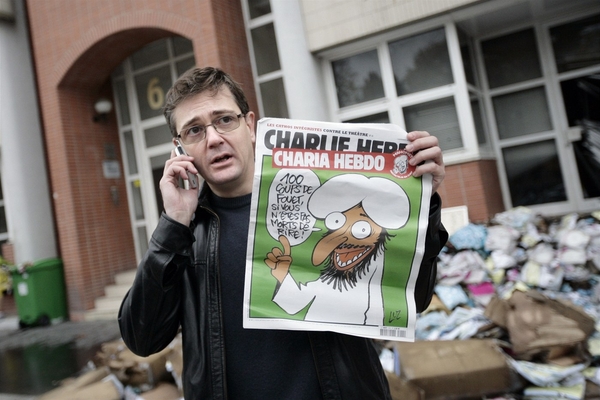
Over in New York, The New York Daily News is not a newspaper that tends to pull its punches. But consider what it did while the dead were still lying in the magazine’s offices. It ran a story which showed images of a Parisian policeman at the moment that the terrorists — shouting “Allahu Akhbar” [“Allah is Greater!”] — gunned him down in cold blood. It also showed an image from 2011 of Charlie Hebdo editor and publisher Stéphane Charbonnier standing outside his firebombed offices, the last time the magazine was attacked, holding up an edition of the paper with an image of Mohammed on the front. But the image was pixelated. Yes — that’s right. The paper was willing to show a man who had been alive that morning in the process of being murdered. But they chose not to publish a cartoon of a historical figure who died 1400 years ago.

871Stéphane Charbonnier, the editor and publisher of Charlie Hebdo, who was murdered yesterday along with many of his colleagues, is shown here in front of the magazine’s former offices, just after they were firebombed in November 2011.

This is the pass that the free press has come to, even in countries such as America, and even in places where there has been no attack on a newspaper’s offices for “insulting” somebody else’s prophet. And then again, in the tide-wave of bafflement, the same excuses have begun to get rolled out:

“Has this to do with France’s foreign policy?” interviewers and pundits have mused. In this particular instance, the answer to that question is “no more than usual.” But the follow-on bit of the answer should be even more easily said: “So what if it were?” Let us say that you do not like France’s foreign policy. Do you think that a country should change its policies because segments of one community will run into newspaper offices and gun people down if you don’t?

Another diversionary question has been, has been, “Does this have something to do with the situations in which many French Muslims find themselves – the banlieues (less-affluent French suburbs) and so forth?” The only answer I have so far managed to give to this question is that there are really people out there who may not like where they live but do not run into newspaper offices with Kalashnikov rifles and start firing off. Many people do not like their neighborhoods. It is not the point.

Other media have gone straight for the placatory option. Across in Britain, from left to right, the response was the same: “British Muslim leaders all come out in opposition to Paris magazine attack.” As though head-shaking constituted some great breakthrough. There seems to be a long-term pattern — no matter how often the attackers shout “Allahu Akbar!” or announce, as yesterday, that, “The Prophet [Mohammad] has been avenged” — of condemning terrorist attacks in general, accompanied by bewilderment at the thought that they that it could have anything do with “Islam.”

There are also great loud woolly condemnations of “terrorism,” but never accompanied by naming the men or groups involved. And will we keep on blaming the victims? This all bodes very ill.

Charlie Hebdo was — I hope I can still say “is” — a magazine that satirizes any and all ideas. Their targets have included not only Mohammed, but also Christians, Jews, the French novelist Michel Houellebecq and the Front National leader Marine le Pen. At this moment, mainstream media and politicians should be ensuring that they understand the concerns of their publics, rather than treating them as radioactive “racists” and “Islamophobes.” If those in positions of influence do not deal with this problem now, we will not like those who deal with it later.

Obama’s ‘Islamic Republic’ Doctrine: Trust in Iran Creates a Dangerous Mess

January 2, 2015

Obama’s ‘Islamic Republic’ Doctrine: Trust in Iran Creates a Dangerous Mess, Algemeiner, Ben Cohen, January 2, 2015

1412799874523-300x199President Barack Obama arrives at Port Columbus International Airport. Photo: White House.

As a senior Iranian military commander said only last week, “There are only two things that would end enmity between us and the United States. Either the U.S. president and EU leaders should convert to Islam and imitate the Supreme Leader, or Iran should abandon Islam and the Islamic revolution.”

***************

JNS.org When Barack Obama began his first term as president almost six years ago, foreign policy chatter was prone to including terms like “regime change” and “axis of evil” in discussions about Iran. But as Obama sought to break decisively with the legacy of his predecessor, George W. Bush, he moved rapidly in the opposite direction, offering an olive branch to the Iranian regime within a few weeks of assuming office.

In March 2009, Obama delivered a message to mark the Persian New Year in which he said, “The United States wants the Islamic Republic of Iran to take its rightful place in the community of nations. You have that right, but it comes with real responsibilities. And that place cannot be reached through terror or arms, but rather through peaceful actions that demonstrate the true greatness of the Iranian people and civilization.”

As a declaration of policy intent, those remarks were refreshingly free of ambiguity. The reference to Iran as an “Islamic Republic” indicated that Washington’s goal from that point forward would not be getting rid of the regime that seized power during the 1979 revolution, but rather stabilizing it and encouraging it to behave more responsibly.

By the close of 2014, though, it was abundantly clear that America’s Iran policy—based on Obama’s “Islamic Republic” doctrine of trust in the regime—was in a dangerous mess. The nuclear negotiations between Iran and Western powers have yielded not a single gain, allowing the Iranians to continue with their uranium enrichment program while the International Atomic Energy Agency frets about the likely prospect that Tehran is continuing to operate clandestine nuclear facilities.

At the same time, the brutal civil war in Syria, which has claimed 200,000 lives and turned more than half the country into refugees, has massively boosted Iran’s regional standing. The Iranian mullahs now stand at the head of a coalition that includes the dictator of Damascus, Bashar al-Assad, the Lebanese terrorist organization Hezbollah, and various Shi’a terror groups from Yemen to Iraq. Yet Western public opinion is continually fed a stream of stories about how “moderate” Iran is under President Hasan Rouhani, and how we have an opportunity here that we cannot afford to lose. When you look at how Iran’s military interventions are destabilizing the region, and when you realize that its human rights record is as lousy as it was last year (and the year before that), one can only conclude that Obama will stick to the policy of turning enemies into friends even when those enemies don’t want to become friends.

Against that backdrop, we come to the president’s recent interview with National Public Radio, in which he restated, when talking about Iran, his conviction that engaging with “rogue regimes” is the right thing to do if it advances American interests.

The question is this: Does Obama still regard Iran as a rogue regime? It would be more accurate to say that he regards it as a regime with rogue elements, but you can only accept that analysis if you share the president’s view that there are moderate parties in Iran whom we can trust. “They have a path to break through that isolation and they should seize it,” Obama declared. “Because if they do, there’s incredible talent and resources and sophistication inside of Iran, and it would be a very successful regional power that was also abiding by international norms and international rules, and that would be good for everybody.”

Everybody? That’s not how the Saudis and the United Arab Emirates, to name just two Gulf states, see it; to the contrary, preventing Iran from becoming a “very successful regional power” is their top priority. Ditto for Egypt, Jordan, Turkey, and a host of other Arab and Muslim states. As for Israel, it is impossible—literally impossible—to imagine how the Jewish state enjoying cordial relations with Iran while the Islamist regime remains in power. Because even if Israel was willing to entertain such an outcome, none of the mullahs—whether we’re talking about Supreme Leader Khamenei or President Rouhani—would do the same.

As for the Iranians “abiding by international norms,” their slippery and dishonest approach to their nuclear negotiations acutely demonstrates what they think of that idea.

It’s therefore tempting to believe that his personal legacy, and not any dispassionate assessment of geopolitics, is what lies at the heart of Obama’s calculations. As Associated Press reporter Matt Lee observed at a White House press briefing, “Since 1979, American foreign policy, with respect to Iran, has been designed to keep it from becoming a successful regional power.” So what has changed? Certainly not the behavior or the stance of the Iranians. As a senior Iranian military commander said only last week, “There are only two things that would end enmity between us and the United States. Either the U.S. president and EU leaders should convert to Islam and imitate the Supreme Leader, or Iran should abandon Islam and the Islamic revolution.”

Yet Obama wants to be remembered as the president who made peace with states that were previously regarded as this country’s implacable enemies. If we can make peace with Cuba, the logic goes, and end a trade embargo that has prevailed for more than 50 years, why can’t we do the same with Iran?

One president’s legacy of peace, however, can quite easily be another president’s inheritance of war and conflict. The present time would have been an ideal opportunity for Obama to get tough with the Iranians, given that oil prices have collapsed and that the Saudis are content for the price to remain at rock bottom if that makes life harder for the Tehran regime. Instead, America is leading the world—from the front, this time—into another series of open-ended negotiations with the mullahs that could well result in the weaponization of Iran’s nuclear program by the time Obama leaves office.

Never did the bitter words of the Hebrew prophet Jeremiah ring truer: “Peace, peace, they say, when there is no peace.”

A Sad State of Affairs: The Kerry Record

January 2, 2015

A Sad State of Affairs: The Kerry Record, World Affairs JournalJoshua Muravchik, November/December, 2014

(Kerry likely agrees with Obama as to his quite foreign foreign policies and, equally likely, we are stuck with both at least until Obama leaves the White House.

Kerry I'm an idiot

The most bothersome current aspects of Obama-Kerry foreign policies are the extent to which they trust Iran and how they deal with it and the P5+1 negotiating group. — DM)

John_Kerry_and_Benjamin_Netanyahu_July_2014 (1)

Although Kerry’s anti-American ideology has moderated to some degree from his fiery days as an antiwar leader, he has misrepresented but never repudiated his past. Especially consistent has been his inclination to see the best in America’s enemies, from Madame Binh to Comandante Ortega to Bashar Assad. Israelis were shocked this summer that Kerry came up with a plan molded by Turkey and Qatar to fit the interests of Hamas at their own expense. Had they known him and his record better, they might not have been.

***************

The Gaza war of July and August 2014 occasioned the sharpest frictions in memory between the United States and Israel, highlighted by a cease-fire proposal offered by Secretary of State John Kerry that Israel’s security cabinet rejected unanimously. Kerry’s plan envisioned a seven-day cease-fire, during which the parties would negotiate “arrangements” to meet each of Hamas’s demands about the free flow of people and goods into Gaza and the payment of salaries of Hamas’s tens of thousands of employees. As for Israel’s demands about destruction of tunnels and rockets and the demilitarization of Gaza, these were not mentioned at all, except in the add-on phrase that the talks would also “address all security issues.”

The document cited the important role to be played by “the United Nations, the Arab League, the European Union, the United States, Turkey, [and] Qatar.” Conspicuous by their absence from this list were Israel, Egypt, and the Palestinian Authority. These three had also not been invited to the Paris meetings where Kerry worked on his ideas with leaders of the countries and bodies mentioned.

Barak Ravid, diplomatic correspondent for the liberal Israeli newspaper Haaretz, wrote that the proposal “might as well have been penned by Khaled Meshal [head of Hamas]. It was everything Hamas could have hoped for.” The centrist Times of Israel’s characteristically circumspect editor, David Horovitz, branded Kerry’s initiative “a betrayal.” And left-leaning author Ari Shavit commented that “Kerry ruined everything. [He] put wind in the sails of Hamas’ political leader Khaled Meshal, allowed the Hamas extremists to overcome the Hamas moderates, and gave renewed life to the weakened regional alliance of the Muslim Brotherhood.”

Turkey and Qatar are the mainstays of that alliance and were chosen by Kerry as his principal interlocutors because they are Hamas’s main backers. This brought protests from the Palestinian Authority, led by President Mahmoud Abbas’s movement, Fatah, the secularist rival to Hamas. That group declared that “whoever wants Qatar and Turkey to represent them can emigrate and go live there. Our only legitimate representative is the PLO.”

The shock of Palestinian and Israeli leaders would have been less, however, if they had been more familiar with the record of John Kerry. Spurning America’s friends in pursuit of deals with their nemeses was perfectly in character for the secretary of state. The hallmark of his career has been to denigrate America itself, while supporting the claims of its enemies.

That career began in 1969, when, months after returning from a tour of duty in Vietnam, Kerry sought and received a military discharge so that he might run for Congress. His campaign as a peace candidate sputtered, but his authenticity as a Vietnam vet established him as a presence in the burgeoning antiwar movement. In May 1970, he traveled to Paris for an unpublicized meeting with Viet Cong representatives, and, perhaps at their suggestion, he joined up upon his return with Vietnam Veterans Against the War. VVAW was headed by Al Hubbard, a former Black Panther. Kerry was instantly given a top role, twinning with Hubbard as the public face of the organization.

At a VVAW protest in Washington, DC, in April 1971, Kerry joined other veterans in throwing away their military medals in front of news cameras. The entire demonstration was punctuated by Kerry’s appearance before the Senate Foreign Relations Committee, where he offered dramatic testimony about American atrocities in Vietnam based on accounts heard at a VVAW inquest a few months earlier. He spoke of veterans who said:

They had personally raped, cut off ears, cut off heads, taped wires from portable telephones to human genitals and turned up the power, cut off limbs, blown up bodies, randomly shot at civilians, razed villages . . . poisoned food stocks, and generally ravaged the countryside.

These acts, Kerry emphasized, “were not isolated incidents but crimes committed on a day-to-day basis with the full awareness of officers at all levels of command.”

When, at the behest of aghast senators, the Naval Criminal Investigative Service conducted a formal inquiry into the stories presented at the VVAW inquest, it reported that many of the VVAW witnesses cited by Kerry refused to cooperate, although promised immunity. Others were clearly crackpots, and several swore, and provided witness corroboration, that they had not participated at the inquest at all and had no idea who had appeared in their names. The entire exercise had been inspired and largely engineered by Mark Lane, whose book on the same subject earlier that year had been panned by New York Times columnist James Reston Jr. as “a hodgepodge of hearsay,” while that paper’s book reviewer, Neil Sheehan, who had reported from Vietnam and would soon break the Pentagon Papers, revealed that some of Lane’s “witnesses” had not served in Vietnam. (The political scientist Guenter Lewy documents these events in his 1978 book America in Vietnam.)

In August 1971, four months after his Senate appearance, Kerry made another trip to Paris, to meet with Madame Nguyen Thi Binh, foreign minister of the Viet Cong, this time in full view, for his first exercise in international diplomacy. He returned touting the “peace plan” of the Viet Cong, explaining: “If the United States were to set a date for withdrawal, the prisoners of war would be returned.” Although he frequently accused American leaders of lying, he took the Communist leaders’ statements at face value, asserting that their peace plan “negates very clearly the argument of the president [Nixon] that we have to maintain a presence in Vietnam to use as a negotiating [chip] for the return of those prisoners.”

Kerry’s dismissal of the statements of US leaders as lies and his credulity toward those of the Vietnamese Communists reflected a broader difference in attitude toward the two sides to the conflict. Ho Chi Minh, who had spent long years as a henchman of Stalin’s, serving the Comintern in several countries, was in Kerry’s admiring eyes “the George Washington of Vietnam” who aimed only “to install the same provisions into the government of Vietnam” that appeared in the American Constitution. America, in contrast, had itself strayed so far from those principles that it needed a “revolution” to restore them.

Kerry’s colleagues in VVAW undoubtedly shared this sentiment, and in November 1971, at a conference of its leadership in Kansas, the group considered just how far down the path of revolution it was willing to go. It debated, although ultimately rejected, a proposal to commence a campaign of terrorist violence and assassination of pro-war US senators. When he ran for president in 2004, Kerry denied he had been present at this conclave, but when FBI files secured by the Los Angeles Times under the Freedom of Information Act placed him there, he retracted that denial in favor of the statement that he had “no personal recollection” of it.

Is this plausible? Gerald Nicosia, author of a highly sympathetic history of the antiwar movement, reported, in May 2004, that “several people at the Kansas City meeting recently said to me or to mutual friends that they had been told by the Kerry campaign not to speak about those events without permission.” Why the urgency to cover up? And how would the campaign know who was there, that is, whose silence to seek, if Kerry had no recollection of the meeting? One of Nicosia’s interviewees, John Musgrave, said “he was asked by Kerry’s veterans coordinator to ‘refresh his memory’ after he told the press Kerry was in Kansas City. Not only is Musgrave outraged that ‘they were trying to make me look like a liar,’ but he also says ‘there’s no way Kerry could have forgotten that meeting—there was too much going on.’”

This puts it mildly: the event was memorably raucous, with debates over the proposals for violence and for napalming the national Christmas tree, furious factional fighting, the discovery of eavesdropping bugs in the building leading to a quick move to another location, and above all an angry showdown between Kerry and Hubbard over revelations that the latter had never been in Vietnam. This particular contretemps was punctuated by Hubbard’s dramatically pulling down his pants to show scars he claimed he sustained in Vietnam. The mayhem culminated in Kerry’s announcing his resignation from the group’s executive. And Kerry had “no personal recollection” of being there?

Although Kerry appeared as a speaker for VVAW for about a year following this resignation, he then faded from national view for a decade, climbing the ladder of local and state politics in Massachusetts before winning election to the US Senate in 1984. The Senate, he later said, “was the right place for me in terms of . . . my passions. The issue of war and peace was on the table again.” What put it on the table were the anti-communist policies of President Ronald Reagan, which Kerry deeply opposed. A year earlier, Reagan had ordered the invasion of Grenada, which Kerry scorned as “a bully’s show of force [that] only served to heighten world tensions and further strain brittle US-Soviet and North-South relations.”

In contrast, Kerry ran on a platform of the Nuclear Freeze, a popular movement opposing US plans to counterbalance a large Soviet nuclear buildup over the previous decade. Kerry made sure to score one hundred percent on a test of candidates’ positions presented by a group called Freeze Voter ’84, and he proposed to cut the defense budget by nearly twenty percent, including “cancellation of twenty-seven weapons systems” and “reductions in eighteen other[s],” according to the Boston Globe. He cited his own work with VVAW as a counterpoint: “We were criticized when we stood up on Vietnam. . . . But we’ve been borne out. We were correct. Sometimes you just have to stand and hold your ground.”

In the Senate, he secured a coveted seat on the Foreign Affairs Committee and turned his attention to the fraught issue of policy toward Central America, a small region that had assumed inordinate geopolitical importance by becoming one of the front lines in the Cold War. A Marxist-Leninist party, the Sandinista National Liberation Front, had seized power in Nicaragua and was aiding likeminded movements in El Salvador and other nearby states while the Reagan administration supported anti-Communist guerrillas inside Nicaragua, the so-called “Contras.”

Kerry lent his name to Medical Aid for El Salvador, which gave non-lethal aid to the Communist side in that civil war. On February 16, 1982, an Associated Press story quoted actor Ed Asner, leader of a Hollywood group that raised much of the funding for this project, as explaining that “medical supplies are to be purchased in Mexico and shipped clandestinely to the Democratic Revolutionary Front in El Salvador.” However, the issue of US aid to El Salvador’s anti-Communist government became overshadowed by debate about aid to the Nicaraguan “Contras.”

As the Senate neared a decisive vote, Kerry and Senator Tom Harkin undertook a dramatic maneuver to try to head off approval of the Reagan administration’s request for Contra funding. They flew to Managua, the Nicaraguan capital, for their own summit meeting with the country’s strongman, “Comandante” Daniel Ortega. The results resembled those of his 1971 meeting with Madame Binh. Ortega handed Kerry a “peace plan” according to which the US would first end all aid to the Contras, and the Sandinistas would then initiate a cease-fire and restore civil liberties. Kerry justified undercutting the US government in this way by faulting Reagan’s failure “to create a climate of trust” with the Sandinistas. He, in contrast, offered them trust in abundance, calling Ortega’s plan “a wonderful opening.” He took to the Senate floor to say, “Here, in writing, is a guarantee of the security interest of the United States.”

A year later, in 1986, in another Senate debate on Contra aid, Kerry voiced one of the odder claims about his Vietnam experience. Warning against the slippery slope of military involvement and against the duplicity of our own government, Kerry delivered a floor speech containing this assertion:

I remember Christmas of 1968, sitting on a gunboat in Cambodia. I remember what it was like to be shot at by Vietnamese and Khmer Rouge and Cambodians, and have the president of the United States telling the American people that I was not there; the troops were not in Cambodia. I have that memory which is seared—seared—in me.

The “seared” part was a nice touch, especially in view of the fact that the whole thing had not happened (although Kerry had been repeating the story since as early as 1979). In the course of Kerry’s 2004 presidential campaign, the Swift Boat Veterans for Truth, former crewmen on the type of vessel on which Kerry served who were angered by his antiwar activities, attacked this claim among other aspects of Kerry’s military history. In this case, however, unlike in response to some points raised by Kerry’s detractors, no shipmate of Kerry’s could be found to corroborate his version. Soon, his spokesmen began to hedge. One aide explained that Kerry’s boat had been “between” Vietnam and Cambodia. But the two countries are contiguous: there is no “between,” so another spokesman backed down further, explaining that Kerry had merely been “near” Cambodia.

Then, Douglas Brinkley, who authored a laudatory history of Kerry’s military service, issued another explanation, apparently at the behest of the campaign. On Christmas 1968, the moment of Kerry’s “seared” memory, he was fifty miles from Cambodia, said Brinkley, but his boat “went into Cambodia waters three or four times in January and February 1969.” Oddly, however, Brinkley’s book, which covered those two months in painstaking detail at a length of nearly one hundred pages, even to the extent of locating the sites of battles, made no mention of Kerry’s having crossed into Cambodia. And the campaign soon pulled the rug from under Brinkley by issuing a new claim, namely, that Kerry’s boat had “on one occasion crossed into Cambodia.” Three of Kerry’s shipmates, two of whom were supporting his campaign, categorically denied even this minimized claim.

In that, they are supported by no less a source than Kerry himself, in the form of a journal he kept while on duty. Substantial passages of it are reproduced in Brinkley’s book, and one of them reads:

The banks of the [Rach Giang Thanh River] whistled by as we churned out mile after mile at full speed. On my left were occasional open fields that allowed us a clear view into Cambodia. At some points, the border was only fifty yards away and it then would meander out to several hundred or even as much as a thousand yards away, always making one wonder what lay on the other side.

He was never to learn the answer because this diary entry was from his final mission.

Kerry was of course right to link Central America to Southeast Asia. They were both nodes in the Cold War, the epic struggle that defined international politics for forty years, including the first two decades of Kerry’s political engagement, from the time he returned from Vietnam in 1969 until the Berlin Wall came down in 1989. Whatever the rights and wrongs of America’s entry into Vietnam, or its actions in Central America or elsewhere, Kerry perverted the basic issue of the Cold War, always viewing America’s actions as bellicose and malign, while casting those of the Communists, like “George Washington” Ho Chi Minh, in the most favorable light.

To many, the Cold War’s benign denouement—the fall of the Wall and the USSR’s disappearance into the ash bin of history—vindicated Reagan’s approach, but Kerry appears to have entertained no second thoughts despite these outcomes. When it came to addressing post–Cold War issues, he remained reflexively averse to the exercise of American power. Kerry had lamented as “not proportional” Reagan’s 1986 bombing of Libyan dictator Muammar el-Qaddafi’s residence in response to a Libyan terror attack on US servicemen in Germany. The Middle East was also the scene of the first military showdown after the Cold War, when Saddam Hussein’s Iraq swallowed whole the neighboring state of Kuwait, in 1990. At the time, Kerry opposed the Bush administration’s request for authorization of military action, saying that those “of the Vietnam generation . . . come to this debate with a measure of distrust [and] a resolve . . . not [to be] misled again.” He concluded his Senate speech by reading a passage from an antiwar novel by the American Communist Dalton Trumbo.

With the Cold War’s end, and America’s demonstration of will and strength in driving Hussein’s forces from Kuwait, the defining issue of the 1990s became the wars of Yugoslavia’s dissolution. Here, the prime issue was whether or not to lift an international arms embargo that rendered Bosnia’s Muslims naked before their predators, the well-armed Serbs. As public opinion reacted to news accounts of the grisly results of this imbalance, the Senate voted to lift the embargo, over the objections of Kerry, who helped to lead the opposition.

With the terrorist attacks of September 11, 2001, the American public was awakened from its post–Cold War indifference toward foreign affairs. A fierce patriotism burst forth, and with it a determination to take down those who had attacked us. Thus, preparing for a 2004 presidential bid, Kerry moved to reconfigure his image. The antiwar veteran was suddenly replaced by the military hero, and the Democratic nominating convention was replete with uniforms and military gestures, highlighted by Kerry’s sharp salute to the assemblage while uttering the words, “reporting for duty.” Already, his rejected service medals had miraculously reappeared mounted and framed on his Senate office wall. Asked how that was possible, as he had been photographed throwing them away, Kerry explained that the medals he tossed were not his own but actually belonged to another veteran.

The dramatic reincarnation did not quite come off, as Kerry was dogged by Vietnam veterans, led by fellow Swift Boat crewmen, still furious at how he had blackened their names. And the awkwardness of his transformation was symbolized by his much-ridiculed explanation of his stance on funding the 2003 US invasion of Iraq: “I actually did vote for the $87 billion before I voted against it.”

In his later years in the Senate, Kerry made the issue of Syria his own. He took several trips to Damascus where, according to a June 2011 account in the Wall Street Journal, he “established something approaching a friendship with [Syrian dictator Bashar] Assad.” When Barack Obama came to office, he made Kerry his point man in efforts to improve US-Syrian relations. Kerry put his endorsement on diplomatic proposals he received in Damascus, including an offer by Assad to engineer a Palestinian unity government embracing Fatah and Hamas. The benefits to the US, not to mention Israel, of such unity were not self-evident, but in any event, talks between the two Palestinian factions were already under way, mediated by Egypt, which was closer to Fatah. Why it would be advantageous to switch the sponsorship to Syria, the ally of Hamas, was hard to grasp. Nonetheless, Kerry saw in Assad’s proposal the prospect of “a major step forward in terms of how you reignite discussions for the two-state solution . . . . Syria indicated to me a willingness to be helpful in that respect.” In all, as the Journal put it, “Kerry . . . became . . . Assad’s champion in the US, urging lawmakers and policymakers to embrace the Syrian leader as a partner in stabilizing the Mideast.”

In sum, although Kerry’s anti-American ideology has moderated to some degree from his fiery days as an antiwar leader, he has misrepresented but never repudiated his past. Especially consistent has been his inclination to see the best in America’s enemies, from Madame Binh to Comandante Ortega to Bashar Assad. Israelis were shocked this summer that Kerry came up with a plan molded by Turkey and Qatar to fit the interests of Hamas at their own expense. Had they known him and his record better, they might not have been.

Obama’s 2015 gift for Israel and Mid East: Funding for a new Iraqi army – dominated by Iran’s Rev Guards

January 1, 2015

Obama’s 2015 gift for Israel and Mid East: Funding for a new Iraqi army – dominated by Iran’s Rev Guards, DEBKAfile, January 1, 2015

Iraqi_52nd_Infantry_Battalion_12.14New Iraqi 52nd Infantry Battalion set up by Iran

All those militias are under the direct command of the Guards. Therefore, the Obama administration has committed the United States to forging a strong military bond with Tehran and providing military and financial assistance for the creation of a strong regional Shiite armed force that will elevate Iran to the standing of leading military power in the Middle East.

******************

President Barack Obama’s New Year gift to Israel and the Middle East is a multibillion fund for establishing an Iraqi army as a division of the Iranian Revolutionary Guards (IRGC). Wednesday, the last day of 2014, two defense ministers, Iran’s Brig. Gen. Hossein Dehqani and Iraq’s Khallid al-Obeidi, signed a pact whereby Iran i.e. the Revolutionary Guards, will “continue to train new Iraqi military units” for replacing the army that crumbled under the onslaught launched by the Islamic State of Iraq and Levant since last June.

“We do not see any other option than cooperation and being on the same side as Iran to uproot the terrorists,” said the Iraqi general.

But he carefully avoided mentioning the 1,850 US soldiers posted to Baghdad, Kurdistan’s Irbil and the Al Asad air base in the western province of Anbar, or the 1,300 addition American combat troops, including paratroops of the elite 82nd Airborne Division’s 3rd Brigade Combat Team.

The 3,150 US troops currently serving in Iraq are therefore sharing the task of rebuilding Iraqi military units with Iran’s Revolutionary Guards!

Two other key points glossed over by the two defense ministers are revealed here by DEBKAfile’s exclusive military and intelligence sources: The sources of financing and recruits.

On the quiet, President Obama has promised Tehran and Baghdad to put up the funding for the new Iraqi army. It is to come out of the US budgetary allocation for the war on terror – a truly ironic gesture considering the missions of the Revolutionary Guards Corps’s pro-active arm, its Al Qods Brigades, which are primarily to orchestrate external terrorism.

The source of the new manpower was disclosed by Deputy Commander of the IRGC Brig. Gen. Hossein Salami, when he announced this week that Iran was assembling a mighty army from the various Shiite militias fighting in Syria and Iraq. “This force will be larger even than the Lebanese Hizballah,” he boasted.

All those militias are under the direct command of the Guards. Therefore, the Obama administration has committed the United States to forging a strong military bond with Tehran and providing military and financial assistance for the creation of a strong regional Shiite armed force that will elevate Iran to the standing of leading military power in the Middle East.

US-Iranian cooperation in the war on ISIS is already in full swing in Iraq between the US officers and troops posted there and the headquarters of Iranian Al Qods Brigades Commander, Gen. Qassem Soleimani. Iraq’s Shiite Prime Minister Haider al-Abadi provides liaison. So closely are the two forces aligned, that no Iraqi Shiite operation goes forward without first being cleared with the US command.

Egypt-Qatar rapprochement rattles Hamas

December 31, 2014

Egypt-Qatar rapprochement rattles Hamas, Al-MonitorAdnan Abu Amer, December 30, 2014

(These guys could form several pretty adequate stand-up comedy teams.

— DM)

Egyptian woman gestures during a protest against what they say is Qatar's backing of ousted Egyptian president Mohamed Mursi's government, outside the Qatari Embassy in CairoAn Egyptian woman gestures during a demonstration against what protesters call Qatar’s backing of ousted Egyptian President Mohammed Morsi’s government, outside the Qatari Embassy in Cairo, Nov. 30, 2013. (photo by REUTERS)

At a time when Hamas is mending its relationship with Iran, Egypt and Qatar are also in the process of rapprochement after more than a year of tension. Resumed ties between them will likely have an impact on Hamas, but questions remain as to whether the Palestinian Islamist movement stands to gain or lose from this important regional development.

Hamas waited several days to announce its final position on the return of positive relations between Doha and Cairo on Dec. 20, when President Abdel Fattah al-Sisi met the envoy of Qatar’s emir in Cairo, Sheikh Mohammed bin Abdulrahman bin Jassim Al-Thani, the minister’s assistant for International Cooperation Affairs.

On Dec. 28, senior Hamas leader Mahmoud al-Zahar welcomed the Egyptian-Qatari convergence and denied Qatar was pressuring the Hamas leadership to leave Doha. He also denied reports that Qatar was planning to suspend its support for Hamas over the warming of ties with Egypt, reiterating that Hamas supports the unity of Arab countries to serve the Palestinian cause.

Yousef Rizqa, the former minister of information and political adviser to former Gaza Prime Minister Ismail Haniyeh, said in an interview with Al-Monitor, “The Egyptian-Qatari rapprochement serves the interest of the Palestinian national project, and Hamas has no concerns about its relations with Doha being harmed after the Doha-Cairo rapprochement because the movement is not a party to the internal Arab conflict, and it is accepted by the Arab capitals.”

However, an anonymous Egyptian official said in Dec. 26 press statement that Doha informed Hamas leaders that it would temporarily suspend its support for the movement in a bid to pressure Hamas to change its policies against Cairo.

Husam Badran, spokesman for Hamas and a resident of Doha, told Al-Monitor, “There is no suspension of the Qatari financial support for the movement, since their relationship is ongoing.” But Palestinian Minister of Labor Maamoun Abu Shahla revealed Dec. 28 that Qatar had postponed the financial grant supposed to be sent to Gaza’s state workers.

Rizqa neither confirmed nor denied this report, but he told Al-Monitor that Qatar has not cut its support and relationship with Hamas over the rapprochement with Egypt, saying, “The Hamas-Doha relationship is stable and Qatar’s support for the movement is sustained and has never ceased. Moreover, Qatar’s position on Hamas is strategic.”

It is worth noting that Hamas’ fear of Qatar halting its financial support for the movement at Egypt’s request coincides with its renewed attempt to improve ties with Iran, as well as political head Khaled Meshaal’s recent visit to Turkey. Hamas may be reaching out to possible alternatives for regional support should Doha downgrade its ties with the movement in a “secret” deal with Cairo.

The Palestinian Authority did not express a position on the Egyptian-Qatari rapprochement, but on Dec. 25 Ambassador Hazem Abu Shanab, a member of the Revolutionary Council of Fatah, ruled out the consideration that the Egyptian-Qatari convergence would contribute to the improvement of relations between Hamas and Cairo, because this depends on how Cairo decides to deal with the Muslim Brotherhood and its affiliates, such as Hamas.

This prompted the Egyptian official to reveal Dec. 26, also on condition of anonymity, that Hamas demanded Doha mediate with Cairo to calm the atmosphere with Hamas, as the movement expressed its goodwill toward overcoming the tension with Cairo.

A senior Hamas official told Al-Monitor on condition of anonymity that Hamas is analyzing the extent of Doha’s ability to influence Cairo on reconciling with the movement. Should the rupture between Hamas and Egypt continue irrespective of the Doha-Cairo rapprochement, this would be interpreted by Hamas as being made a scapegoat.

A former member of the Qatari Shura Council, asking not to be named, revealed to Al-Monitor, “There have been contacts made between the Hamas leadership, represented by Meshaal, and Emir Tamim bin Hamad al-Thani, among other Qatari officials. They discussed the rapprochement with Egypt. Meshaal told the emir that he fully supports any Qatari effort to unify Arab positions.”

The Qatari official told Al-Monitor by phone from Doha, “Meshaal received a formal Qatari pledge not to attack the Hamas leadership or tighten the noose around its neck in Doha in exchange for rapprochement with Cairo. This is because Qatar never establishes relations based on bargaining between one party or another, and our relationship with Hamas will continue to exist.”

Interestingly, coinciding with the rapprochement, Egyptian media outlets reported that Cairo threatened to cut ties with Hamas on Dec. 26 unless 13 accused members of the movement were extradited to Egypt. The 13 were accused of involvement in armed operations in Egypt, and allegedly, Egyptian authorities have insisted that extradition proceedings must conclude before they consider improving relations with Hamas.

On Dec. 28, Zahar denied Egyptian media reports that Hamas interfered in Egypt’s domestic affairs.

A senior Hamas official in Gaza who spoke to Al-Monitor on condition of anonymity also denied the reports, saying, “Egypt made no formal request to extradite any Hamas member, and these accusations were featured across all media outlets, which only creates more tensions,” he said.

Ahmed Yousef, a senior Hamas official, told Al-Monitor that he hopes “the breakthrough in the Doha-Cairo relations will positively affect Hamas’ relations with Egypt and that Qatar would do its best to alleviate the tension between Gaza and Cairo,” adding, “The Hamas and Cairo dossier is likely to be opened after the meeting of Emir Tamim with Sisi.” He denied the existence of contacts between the movement and Egypt following the Doha-Cairo rapprochement.

The timing of the Egyptian-Qatari warming may have come as a surprise to Hamas, which took nearly a week to announce that it welcomes the move, making sure that it would not come at its expense. The atmosphere prevailing within Hamas is still ambiguous over whether the Qatari position toward the movement will be affected, despite promises made by Doha to the contrary. Hamas knows that the pressure exerted on Qatar may be stronger than its ability to resist.


Turkey: America’s unacknowledged problem

December 31, 2014

Turkey: America’s unacknowledged problem, Israel Hayom, Prof. Efraim Inbar, December 31, 2014

(The foreign policy of the Obama administration is difficult to understand. What might be the reasoning behind its apparently continuing support for Islamic Turkey, a bitter foe of Israel? What are the administration’s interests in the Middle East?– DM)

It is not clear why Washington puts up with such Turkish behavior. The Obama ‎administration seems to be unable to call a spade a spade. It refuses to acknowledge ‎that Turkey is a Trojan horse in NATO, and that Ankara undermines American interests ‎in the Middle East and elsewhere.‎

***************

Turkey is a NATO ally, and U.S. President Barack Obama has called Turkish President Recep Tayyip Erdogan his best friend. But Erdogan-led Turkey does not ‎behave as an ally or a friend of the U.S. This is not a new development.‎

Erdogan and his Islamist party, the Justice and Development Party (AKP), have ruled Turkey since 2002. Erdogan’s ‎Turkey has gradually distanced itself from the West, adopting domestic and foreign ‎policies fueled by Ottoman and Islamist impulses. ‎

Turkey has been on the road to an authoritarian regime for several years. Infringements ‎on human rights have gradually increased. In truth, Turkey has never had a political ‎system with checks and balances able to constrain attempts to consolidate power ‎around one politician. In recent years, Erdogan has weakened further the few ‎constitutional constraints against “Putinization” of the Turkish political system. ‎

The longer Erdogan rules, the more power-hungry he seems. His authoritarian ‎personality becomes clearer every day. The press is hardly free. Erdogan arrests even ‎Islamist journalists who are critical of his policies. His party has infiltrated the judicial ‎system and the police. Foci of power, such as the bureaucracy, the banking system, ‎industrial associations and trade unions, have been mostly co-opted by the AKP. ‎Opposition political parties are largely discredited. The military, once active in politics ‎as the defender of the Kemalist secular tradition, has been successfully sidelined. ‎

From a realpolitik perspective, the domestic political developments, deplorable as they ‎may be in Turkey, could be ignored by the democratic West as long as Ankara ‎continues to be a useful ally. Unfortunately, Turkey no longer qualifies as a trusted ‎ally. ‎

The most recent examples of nefarious Turkish behavior are its support of Islamic State and ‎Hamas. Turkey is playing a double game on the issue of Islamic State. It pretends to ‎cooperate with the U.S. policy in the attempt to contain radical Islam, but actually ‎Turkey supports the radical group. It allows passage of volunteers through Turkish territory to join ‎Islamic State in Iraq. The group gets logistical support via Turkey, and sends its wounded militants for ‎treatment in Turkey. Turkish military forces stood idly by the besieged city of Kobani, ‎just across the Turkish border, while the Islamists killed Kurdish fighters. Finally, ‎Turkey denies the American air force access to Turkish bases, forcing the U.S. to use far‎away bases when attacking Islamic State targets. ‎

Turkey is also openly supporting another radical Islamist organization, Hamas. ‎Despite the fact that the West regards Hamas a terrorist organization, Ankara regularly ‎hosts Hamas representatives to meet the highest Turkish dignitaries. Hamas, an ‎offshoot of the Muslim Brotherhood, has a rabid anti-American position. Moreover, ‎Salah al-Aruri, a senior Hamas operative, operates out of Istanbul. Recently, the ‎Turkish branch of Hamas was involved in a series of attempts to carry out terrorist ‎attacks against Israel, and in orchestrating a coup against the current leadership of the ‎Palestinian Authority.‎

Such behavior should not surprise policy makers in Washington. In 2003, Ankara ‎denied the request from Washington to open its territory so that the U.S. military could ‎attack Saddam Hussein’s forces from two separate fronts.‎

AKP-ruled Ankara also defied American preferences on Syria, a country allied with ‎radical Iran and on the American list of states supporting terrorism. In January 2004, ‎Bashar Assad became the first Syrian president ever to visit Turkey. In April 2009, the ‎two states conducted their first ever joint military exercise. No other NATO member ‎had such close relations with the authoritarian regime in Damascus, which has been ‎closely allied with Iran for several decades.‎

Turkey further deviated from the Western consensus in 2008 by hosting Sudanese ‎President Omar Hassan al-Bashir twice. Bashir, who was charged with war crimes and ‎genocide in Darfur, presided over an Islamist regime. ‎

Turkey even welcomed the president of the Islamic Republic of Iran, Mahmoud ‎Ahmadinejad, for a visit in August 2008. No Western country has issued such an ‎invitation to the Iranian leader. Additionally, Erdogan congratulated Ahmadinejad ‎immediately after his re-election in June 2009. When it comes to Iran’s nuclear threat, ‎Ankara, unlike its NATO allies, has refused to adopt the U.S. stance on harsher ‎sanctions, fearing in part the economic consequences of such steps. In June 2010, ‎Turkey voted at the U.N. Security Council against a U.S.-sponsored resolution meant to ‎impose a new round of sanctions on Iran.‎

Turkey also has consistently defied advice from Washington to tone down its anti-‎Israel statements and mend relations with an important American ally. All American ‎efforts in this direction have failed.‎

There is also a clear divergence between the U.S. and Turkey on important global issues ‎such as Russia and China. For example, U.S. wanted to send ships into the Black Sea via ‎the Bosporus Strait during the Georgia war in August 2008. Turkey flatly denied ‎several such requests on the pretext that the military vessels were too large. Moreover, ‎Turkey proposed the creation of a regional security framework involving Turkey, ‎Russia, Georgia, Armenia and Azerbaijan that left out a NATO role. More blatantly, ‎Turkey has failed to participate in the Western economic sanctions imposed on Russia ‎during the recent Ukraine crisis.‎

Dissonance exists also with regards to China. While the U.S. fears the rise of China, ‎Turkey sees this country as a potential economic partner and not a problem. It held ‎military exercises with China. Ankara even considered purchasing anti-aircraft systems ‎from Beijing, an incredibly brazen position for a NATO member.

It is not clear why Washington puts up with such Turkish behavior. The Obama ‎administration seems to be unable to call a spade a spade. It refuses to acknowledge ‎that Turkey is a Trojan horse in NATO, and that Ankara undermines American interests ‎in the Middle East and elsewhere.‎

The Israelis who back UN hypocrisy

December 29, 2014

The Israelis who back UN hypocrisy, Israel Hayom, Dr. Limor Samimian-Darash, December 29, 2014

[T]he more one delves into the U.N.’s outrageous conduct, the harder it becomes to separate the actions of the international community from the tailwind provided by certain Israelis.

******************

The growing relationship between Iran and the Palestinian Authority, as well as Iran’s arms shipments and its involvement in terrorism, are, as always, not being condemned internationally. This is in addition to the world’s silence about the Palestinian terrorist attacks in recent months, which have included stabbings, vehicular rammings and firebombings. None of these produced a U.N. resolution against the Palestinians. And if the massacre at the synagogue in Jerusalem had not looked like a classic anti-Semitic attack in Europe, it is doubtful we would have heard any condemnation of it at all.

One can, of course, complain about the hypocrisy of the world, and particularly that of European nations, who have continued to ignore the growth of Islamic radicalism and terrorism in the world and have focused instead, in a biased manner, on the Israeli-Palestinian conflict. Alongside this, more and more nations are symbolically recognizing a Palestinian state and turning a blind eye to all Palestinian misdeeds. These moves are indeed symbolic, not just because they have no diplomatic meaning, but also, ironically, because Israel is once again being placed on the altar for sacrifice.

But the more one delves into the U.N.’s outrageous conduct, the harder it becomes to separate the actions of the international community from the tailwind provided by certain Israelis. Indeed, Tzipi Livni, Isaac Herzog and even Avigdor Lieberman have explained to us that this is all happening because of a lack of diplomatic initiative on the part of Prime Minister Benjamin Netanyahu. They do this, of course, without attributing any blame to Palestinian Authority President Mahmoud Abbas, who, despite all the concessions offered by Netanyahu, would not even agree to begin peace talks.

And there are now more false accusations being hurled around, such as the claim that the lack of negotiations following Operation Protective Edge is leading us toward a renewal of hostilities in the Gaza Strip. There is no mention of Hamas or its desire to expel us from the region. There is also no mention of the use of reconstruction funds by Hamas to re-arm itself ahead of the next round of fighting or the fact that the Palestinian Authority was kicked out of Gaza by the Palestinians themselves. No, they say, everything is the Israeli government’s fault for not initiating a diplomatic process.

And even more bluntly, Israeli politicians are directly appealing to the international community to apply pressure on the Israeli government. For example, Livni had the gall to implore U.S. Secretary of State John Kerry to not support the unilateral Palestinian move at the U.N., as this would have strengthened the Israeli Right. Herzog made a similar claim when he sought to dissuade the British parliament from recognizing a Palestinian state.

Former Labor MK Avraham Burg took a different tack, urging his British friends to recognize a Palestinian state and force a diplomatic solution on Israel. And if we look not too far back in history, this was the exact line taken by Livni when she was appointed foreign minister in 2006 by then-Prime Minister Ehud Olmert. Her first speech at the U.N. did not remind the nations of world about the historical right of the Jewish people to the land of Israel. Instead, her debut speech on the world stage was dedicated to presenting her vision of the establishment of a Palestinian state.

These are not some words uttered by one Palestinian government minister or another. And no, they are not a biased report by a BBC presenter. Rather, these are Israeli politicians who, whether they are just trying to butt heads with the government or if they truly believe in the righteousness of Abbas, are ultimately providing fuel for unilateral anti-Israel moves at the U.N. And when they do this, they are helping the lowlifes at the U.N.