Posted tagged ‘Iran’

Iran’s New Terror Base against Israel

January 22, 2015

Iran’s New Terror Base against Israel, The Gatestone InstituteYaakov Lappin, January 22, 2015

The new base in Syria gives Hezbollah the option of attacking Israel and drawing Israel’s return fire away from Lebanon, where its most precious assets are hidden: well over 100,000 rockets and missiles that might be saved for a future battle over Iran’s nuclear weapons program.

Hezbollah, exploiting its presence in Syria, has been attempting to open a new front against Israel.

Over the past 18 months, Hezbollah and its enablers from the Iran’s Islamic Revolutionary Guard Corps [IRGC] have begun launching a series of attacks on Israel from their new center of operations in southern Syria.

After Sunday’s air strike (attributed by the media to the Israel Air Force) that killed 12 high-ranking Hezbollah and IRGC operatives near Quneitra, Syria, along the Israeli border, Israel is bracing for the possibility of an attack by Hezbollah and Iran.

Although Israel has not officially taken responsibility for the strike, it would make sense to view the action as a preemptive move designed to remove a clear and present danger arising on Israel’s border with Syria. The danger is the formation of a second Hezbollah terrorism base, in addition to Hezbollah’s home base already in Lebanon.

The IRGC and Hezbollah have begun playing a dual role in the geographical area once known as the Syrian Arab Republic, a country that no longer exists as it appears on world maps. Iran and Hezbollah are acting as the life support machine for the shrunken but still functional Assad regime, now in control of just Damascus, Aleppo, and the Syrian Mediterranean coastline.

Since moving into Syria to rescue the regime of Bashar Al-Assad, Hezbollah, acting on orders from Iran, has expanded its presence in several areas of Syria. Iran too has boosted its presence in Syria, primarily though the presence of members of its Revolutionary Guards.

At the same time, the IRGC and Hezbollah have begun building a terrorism base in Syria that is directed against Israel, in addition to the Iranian-backed Hezbollah semi-state entity in southern Lebanon.

The new base in Syria, at Israel’s northeast border, gives Hezbollah the option of attacking Israel and drawing Israel’s return fire away from Lebanon, where its most precious assets are hidden: well over 100,000 rockets and missiles that might be saved for a future battle over Iran’s nuclear weapons program.

Hezbollah is also under domestic Lebanese pressure not to drag Lebanon into a new devastating conflict with Israel.

The Hezbollah and IRGC operatives that were targeted in Sunday’s airstrike were in the midst of significantly stepping up these attacks. Their plans included rockets and cross-border raids by terror cells. These attack plans were seriously larger in scale than past assaults.

It is in this context that Sunday’s air strike occurred.

Now, all eyes are on northern Israel to see whether Hezbollah and Iran retaliate there. The leader of the IRGC, Major General Mohammad Ali Jafari, on Tuesday threatened Israel with “devastating thunderbolts” — threats Israel cannot afford to take lightly.

896Israeli soldiers take part in a training exercise near the border with Syria, December 2013. (Image source: IDF)

It would be safe to assume, however, that Hezbollah wishes to avert the outbreak of an all-out conflict. Such a war would expose Lebanon to unprecedented Israeli firepower, and would also expose Israel to unprecedented Hezbollah rocket attacks and cross-border infiltrations by land, air and sea.

If such a conflict were to break out, many parts of southern Lebanon could lie in ruins, and Hezbollah’s many Sunni enemies in next-door Syria could seize on the weakness of their Shi’ite foes and pounce, dragging Lebanon into the Syrian war.

That kind of outcome would not benefit Hezbollah or Iran in any way. But in the Middle East, miscalculations have led to costly errors in the past, and events can take on a life of their own.

Israeli TV shows ‘Iranian missile’ that ‘can reach far beyond Europe’

January 21, 2015

Israeli TV shows ‘Iranian missile’ that ‘can reach far beyond Europe’

Satellite images taken outside Tehran feature first look at long-range missile newly developed by Iran, TV report says

By Times of Israel staff January 21, 2015, 9:21 pm

via Israeli TV shows ‘Iranian missile’ that ‘can reach far beyond Europe’ | The Times of Israel.


A satellite image shown on Israel’s Channel 2 news, January 21, 2015, said to show a new long-range Iranian missile on a launch pad outside Tehran. (Channel 2 screenshot)


Iran has built a 27-meter-long missile, capable of delivering a warhead “far beyond Europe,” and placed it on a launch pad at a site close to Tehran, an Israeli television report said Wednesday, showing what it said were the first satellite images of the missile ever seen in the West.

It stressed that the missile could be used to launch spacecraft or satellites, but also to carry warheads.

The Channel 2 news report showed satellite imagery documenting what it said was Iran’s “very rapid progress” on long-range missile manufacture.

It showed one photograph of a site near Tehran, which it said the West had known about for two years, where Iran was working on engines for its long-range missiles.

It then showed a satellite photograph of a second site, nearby, which featured a launch pad, with the 27-meter missile on it — an Iranian missile “never seen before” by the West.

The missile is capable of taking a manned spacecraft or satellite into space, the TV report said.

It is also capable of carrying a conventional or non-conventional warhead “far beyond Europe,” the report added.

The TV report said the satellite images were taken by the Eros B commercial Earth observation satellite, which was designed and manufactured by Israel Aircraft Industries, launched in 2006, and is owned by the Israeli firm ImageSat International.

Israel has long charged that Iran is working toward a nuclear weapons capability, and has publicly opposed any negotiated accommodation with Iran that would leave it with a uranium enrichment capability for potential nuclear weapons use.

Obama’s White Flag On Assad a Gift for Iran

January 21, 2015

Obama’s White Flag On Assad a Gift for Iran, Commentary Magazine, January 21, 2015

[T]he American white flag acknowledging his continued reign of terror is more than merely an admission that he can’t be pushed out of Damascus. It must now be understood as part of a comprehensive policy that is aimed at appeasing Iran. That presents a danger not only to the oppressed people of Syria but to every other nation in the region, including both moderate Arabs and Israel, who are targets of Iran’s predatory ambition.

************************

As anyone who has heard President Obama discuss his opposition to more sanctions being placed on Iran knows, the White House is deeply disturbed at the notion of the United States doing anything to disturb those who run the Islamist regime. Thus, the news that the United States is signaling what may be the formal end of its opposition to Bashar Assad’s rule over Syria must be seen in the context of a general American push for détente with that dictator’s allies in Tehran. This is bad news for the people of Syria who are seeking an alternative to Assad’s murderous rule–other, that is, than the ISIS terrorists. But it is very good news for the Iranians who are pleased about the way the rise of ISIS has led to a de facto alliance on the ground between the U.S. and Iran’s allies Assad and Hezbollah in the effort to fight ISIS. This has led not only to a tacit green light for Assad to go on killing Syrians but also for negotiations that seemed fated to grant a Western seal of approval for Iran’s aspiration to become a threshold nuclear power.

It must be acknowledged that at this point the United States has no good options open to it on Syria. If the U.S. had acted swiftly to aid moderate opponents to the Assad regime after the Arab Spring protests began, it might have been possible to topple Assad, something that would have been a telling blow to Iran’s ambitions for regional hegemony. But President Obama was characteristically unable to make a decision about what to do about it for years despite continually running his mouth about how Assad had to go. By the time he was ready to strike—after Assad crossed a “red line” enunciated by the president about his use of chemical weapons against his own people—the moderate option looked less attractive. The president quickly backed down and punted the task of cleaning up the chemical weapons to Assad’s Russian ally.

Even worse, after Obama’s precipitate withdrawal of U.S. forces from Iraq and inaction on Syria led to the rise of ISIS terrorists, Washington seemed more interested in using this crisis as an excuse to make common cause with Iran than in actually fighting the Islamist group. Thus, while U.S. air attacks on ISIS have barely made a dent in the terrorists’ grip on control of much of Syria and Iraq, the administration is signaling enthusiasm for Russian and United Nations-sponsored diplomatic events that will effectively doom a framework agreed to by the West last year in Geneva by which Assad would be forced to yield power.

The administration will defend this switch as something that will aid the effort to end a war that has killed hundreds of thousands. They also justify the tacit alliance with Iran, Assad, and Hezbollah on the Syrian battlefield as the only possible option available to those who wish to combat ISIS. At this point with non-Islamist Syrian rebels effectively marginalized and the battlefield dominated by the Iran/Hezbollah/Assad alliance and their ISIS foes, forcing Assad out may no longer be an option.

But the chain of events that led to this American move to allow Assad to survive despite his crimes must now be viewed from a different perspective than merely one of Obama’s Hamlet routine on difficult issues.

The decision to gradually back away from the president’s campaign pledge to dismantle the Iranian nuclear program and to engage in negotiations aimed at granting Tehran absolution for its ambitions will, if it results in an agreement, at best make Iran a threshold nuclear power. A weak nuclear deal will further buttress Iran’s hopes for regional hegemony by which it will further threaten moderate regimes and strengthen its Hezbollah and Hamas terrorist allies.

It’s not clear yet whether the Iranians will ever sign a nuclear agreement with the U.S. or if, instead, it will continue to run out the clock on the talks. That’s something that the president’s zeal for a deal may permit because he refuses to admit failure or pressure the Iranians as Congress would like him to do by toughening sanctions in the event the talks collapse.

But what we do know now is that this administration’s Syria policy must now be viewed through the prism of its infatuation with the idea of, as the president put it last month, letting “Iran get right with the world.”

Options for getting rid of the butcher Assad may be few these days. But the American white flag acknowledging his continued reign of terror is more than merely an admission that he can’t be pushed out of Damascus. It must now be understood as part of a comprehensive policy that is aimed at appeasing Iran. That presents a danger not only to the oppressed people of Syria but to every other nation in the region, including both moderate Arabs and Israel, who are targets of Iran’s predatory ambition.

Russian Defense Minister in Iran for Arms Pact Talks

January 20, 2015

Russian Defense Minister in Iran for Arms Pact Talks, Washington Free Beacon, January 20, 2015

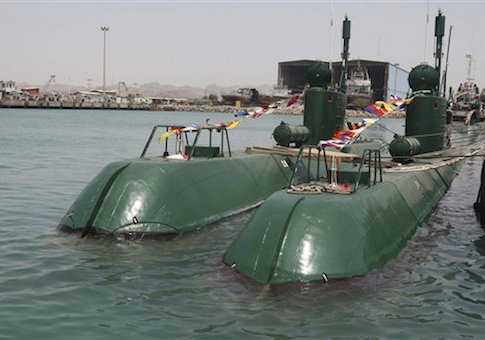
Mideast Iran Nuclear TalksIran’s Ghadir submarines / AP

Iran and Russia have been strengthening their military ties for quite some time. Moscow is largely responsible for Iran’s nuclear infrastructure and has provided the Islamic Republic with much of its missile arsenal.

“So long as we have an administration that’s not inclined to do anything in response, they’re going to keep it up. They’re going to speed ahead.”

***********************

Russian Defense Minister Sergei Shoigu is in Iran for high-level talks with Supreme Leader Ali Khamenei about boosting Tehran’s supply of submarines, torpedoes, and sea-based cruise missiles, according to Russian media reports and sources familiar with details of the talks.

Shoigu, whose trip is being kept quiet with few details being released publicly, landed in Tehran on Monday to talk with Iranian leaders about “increasing defense cooperation and arms trade with the Islamic republic,” the Moscow Times reported.

The talks will focus on Iran’s desire to purchase from Russia a slew of advanced military hardware that would significantly boost Tehran’s sea power, particularly in the Gulf of Oman, according to one source familiar with the substance of the talks.

The arms deal talks also come a day after Iranian military leaders claimed that they have the ability to sink U.S. aircraft carriers.

Iran and Russia have been strengthening their military ties for quite some time. Moscow is largely responsible for Iran’s nuclear infrastructure and has provided the Islamic Republic with much of its missile arsenal.

The latest talks are a sign that both countries aim to maintain the relationship, particularly as Russia helps Iran build several new nuclear reactors in the southern portion of the country.

“Iran gets a lot of military advice and missile equipment from the Russians,” said Michael Ledeen, an Iran expert and former consultant to the National Security Council (NSC), State Department, and Defense Department.

However, “the bulk of that stuff nowadays seems to have to do with sea power, and it’s delivered across the Caspian Sea,” said Ledeen, who has been in contact with Iranian sources familiar with the latest negotiations with Russia.

Iran is seeking to fortify its military edge in the Gulf of Oman and could employ Russian-made missiles as a deterrent to the United States and other nations present there.

In meetings with Khamenei and other Iranian leaders, Russia’s Shoigu is likely to discuss arming Tehran with new submarines, torpedoes, cruise missiles, and sea-to-sea arms, according to Ledeen, a freedom scholar for the Foundation for Defense of Democracies.

“Those are the things the Russians and Iranians will be talking about, and it’s obviously a very important meeting because [Shoigu] is scheduled to see Khamenei himself,” Ledeen said.

These talks are “very important” to both Moscow and Tehran as they seek to bolster their alliance.

“After all,” said Ledeen, “the Iranian nuclear program is basically a Russian program: Russian reactors, Russian equipment. They’re the ones who make it all possible. So Iranian military power is heavily dependent on Russia technology, Russian advisers, and Russian counsel.”

Iranian President Hassan Rouhani announced last week that Iran has begun construction on two new nuclear reactors with Russia’s assistance.

Following the announcement, the U.S. State Department told the Washington Free Beacon that Iran is permitted to pursue these nuclear reactors under the terms of an interim nuclear deal meant to curb Iran’s contested program.

The State Department’s revelation elicited harsh criticism on Capitol Hill and from other proponents of a tougher U.S. stance against Iran’s nuclear program.

Meanwhile, Iranian naval commander Ali Fadavi, a member of Iran’s Revolutionary Guard Corps (IRGC), bragged that Tehran has the ability to sink U.S. aircraft carriers.

“The U.S. military officials have admitted in their remarks that they have spent $13 [billion] for building aircraft carriers, but the IRCG can sink it with its speed boats,” Fadavi claimed.

Ledeen said these comments speak directly to Iran’s desire to boost their power in the sea.

“Their long term objective is to destroy us, and they say that all the time,” he said. “So long as we have an administration that’s not inclined to do anything in response, they’re going to keep it up. They’re going to speed ahead.”

Iranian IRGC chief vows ‘devastating thunderbolts’ on Israel

January 20, 2015

Iranian IRGC chief vows ‘devastating thunderbolts’ on Israel

Tehran threatens Israel after strike attributed to the IAF killed six Hezbollah fighters and six Iranian military men, including a general.

Roi Kais

Published: 01.20.15, 14:45 / Israel News

via Iranian IRGC chief vows ‘devastating thunderbolts’ on Israel – Israel News, Ynetnews.


After confirming one of its generals was among those killed in an airstrike attributed to Israel in the Syrian Golan on Sunday, the commander of Iran’s Revolutionary Guards (IRGC) said Tuesday that Israel should expect “devastating thunderbolts” in response to the attack.

This, Mohammad Ali Jafari said, will be “a new beginning point for the imminent collapse of the Zionist Regime.”

IRGC commander Mohammad Ali Jafari (Photo: Reuers)

IRGC commander Mohammad Ali Jafari (Photo: Reuers)

 Tensions in the Golan Heights have been high since Sunday, when a helicopter fired two missiles, killing Jihad Mughniyeh, Hezbollah’s commander of the Syrian Golan sector and the son of master terrorist Imad Mughniyeh, along with five other Hezbollah fighters and six Iranian military personnel – including Iranian General Mohammed Ali Allah Dadi of Iran’s Revolutionary Guard. The attack was largely attributed to Israel, but so the IDF has neither confirmed nor denied the reports.

Meanwhile, Iranian Defense Minister Hossein Dehqan said Tuesday in a meeting with his Russian counterpart Sergei Shoigu that “the terrorist act by the Zionist regime in the Golan Heights was the continuation of the regime’s crimes in Palestine, Syria, Iraq and Lebanon and their open support for Takfiri terrorists.”

Better days in Iran:Jihad Mughniyeh meets with Ayatollah Khamenei.

Better days in Iran:Jihad Mughniyeh meets with Ayatollah Khamenei.

The IDF raised its alert level on the northern front on Monday, in positions along the border with Syrian and Lebanon, as foreign media outlets reported that Iron Dome batteries were being deployed in the North.

Apart from the deployment of the missile interceptor batteries on the northern front – reported by Sky News in Arabic – there has not been a significant reinforcement of the forces on the border.

Better days in Iran:Jihad Mughniyeh meets with Ayatollah Khamenei.

Better days in Iran:Jihad Mughniyeh meets with Ayatollah Khamenei.

Yet, there are concerns in the security establishment that Hezbollah will attempt a retaliatory terror attack against Israeli forces which operate along the border. Thus, the soldiers were ordered to increase their level of alert and preparedness.

The international community is also concerned of a retalitory attack – France and the United States were working together on the diplomatic level in an attempt to keep restraint among all sides, Lebanese newspaper An-Nahar reported.

Hezbollah sources told the paper the organization’s response to the attack will likely happen outside of Lebanon.

Newspapers affiliated with Hezbollah estimated that organization chief Hassan Nasrallah will make a speech soon to respond to the attack. Nasrallah was scheduled to speak on February 16 on the 7th anniversary of Imad Mughniyeh’s death, as he does every year, but some believe he will speak as early as next week.


Obama ‘Dog Whistles’ Netanyahu (and Insults Congress, too)

January 20, 2015

Obama made a pointed, but unspoken, reference to Netanyahu scaremongering about Iran during a press briefing. He also insulted members of congress.

BY Lori Lowenthal Marcus

The Jewish Press » » Obama ‘Dog Whistles’ Netanyahu (and Insults Congress, too).


U.S. President Barack Obama at a White House Press Briefing, Jan. 16, 2015.
Photo Credit: screen capture whitehouse.gov


There is a phrase called “dog whistling.” It is making reference to the kind of high pitched dog whistles that operate at such a high sound frequency that humans cannot hear, but the intended audience – dogs – can.

Using “dog whistling” in a non-canine context means saying something so that the intended audience understands what you mean, without having to say the exact words. Dog whistling enables the “whistler” to escape being quoted while clearly signaling to the intended audience what the whistle was about.

During the press briefing held in the White House on Friday, Jan. 16, by U.S. President Barack Obama and U.K. Prime Minster David Cameron, Obama engaged in some dog whistling.

It happened during a lengthy response from the president to a question posed by Major Garrett, the Chief White House Correspondent for CBS News. Garrett asked whether he had correctly understood that the president to say that if the diplomatic negotiations with Iran over the Islamic Republic’s efforts to obtain nuclear weapons fail, the next step will be a military one.

The president emphatically denied that was what he meant: “I am not, repeat not, suggesting that were are at immediate war footing should negotiations with Iran fail,” Obama said, “we simply have to recognize that should diplomacy fail, we have to look at other options.”

THE DOG WHISTLE

If diplomacy fails, and the allies won’t then proceed to war footing, the message the president is sending to Iran is, you can look forward to even more time to have your way while we argue over next steps. The U.S. president had explained his view of why he would veto any new sanctions bill, even one that would only be triggered should his negotiations with Iran fail. In his view, the current deal would not permit any such step, and it could jeopardize any possibility of a diplomatic resolution. Then Obama pursed his lips and began dog whistling. There can be no doubt who Obama is insulting with this whistle:

If you listen to the rhetoric surrounding this issue, I think there is sometimes the view that this regime cannot be trusted, that, effectively, negotiations with Iran are pointless.

Not sure yet? Here it comes:

And since these claims are being made by individuals who see Iran as a mortal threat… .

Yes, “individuals who see Iran as a mortal threat,” are the ones who are trying to undermine this president’s diplomatic efforts. By the way, Obama said during this same press briefing that those efforts have, at best, a 50-50 chance of success. So the person attempting to undermine the diplomatic efforts is that “coward” (remember when that word was used by this administration to describe the Israeli leader?) in Jerusalem: Binyamin Netanyahu.

OBAMA ALSO INSULTED CONGRESS AS AMATEURS REGARDING IRAN

So long as he was handing out insults, Obama also tossed one out to members of congress. Obama said that “his team” would not agree to any deal with Iran that would allow the Islamic Republic to, either covertly or gradually, build up its nuclear weapons capability. He vowed that any deal made with the Iranians would be scrutinized by knowledgeable professionals. Obama made clear that by knowledgeable professionals, he did not mean members of congress. He said:

We’re not going to allow that and anything that we do, any deal that we arrive at, if we were to arrive at one, would be subject to scrutiny across the board. Not just by members of congress, but, more importantly, by people who actually know how the technical aspects of nuclear programs can advance, and how we can effectively verify in the most rigorous way possible, that the terms of the deal are being met. (emphasis added.)

At least the Supreme Court has not had to weigh in on this issue yet, or we might have had a trifecta.

Making sense of Obama’s counter-intuitive approach to negotiations with Iran

January 19, 2015

Making sense of Obama’s counter-intuitive approach to negotiations with Iran, Power LinePaul Mirengoff, January 18, 2014

Obama doesn’t want just any nuclear deal. Obama wants a deal Iran will feel good about so that he can make more deals with the ruling clerics. He sees Iran as the key to a grand bargain in the Middle East, one that will thwart ISIS and bring stability — on Iran’s terms — to the region. Israel, of course, excepted.

********************

Last week, President Obama and British Prime Minister Cameron pleaded with Congress not to pass new sanctions legislation against Iran. Such legislation, which has strong bipartisan support, could undermine ongoing negotiations, they argued. “Just hold your fire” until we complete negotiations, Obama urged.

But Obama’s position seems nonsensical on its face. The sanctions legislation Congress contemplates passing does exactly what Obama instructs Congress to do. As the Washington Post’s editors remind us, the Menendez-Kirk legislation would impose sanctions only if Iran reaches no agreement before the June 30 deadline it previously agreed to. “Fire” is “held” until then.

If anything, as the Post argues, the legislation would make a deal with Iran more likely. For unless Obama is going to cave entirely (a definite possibility, sadly), Iran will have to make concessions. And Iran is more likely to make concessions if the consequence of no deal is a stepped-up sanction regime.

In other words, the legislation to which Obama objects would give him a bargaining chip. The fact that Obama doesn’t want one (he says he’d veto the Menendez-Kirk bill) should tell Congress that he’s not interested in playing hardball in negotiations with Iran.

Iran is playing hardball, though. It has manufactured two bargaining chips. First, it recently announced that is has begun the construction of two new nuclear reactors.

Second, Iran has referred the case of Jason Rezaian, a Washington Post reporter held prisoner in Tehran, for processing by the “Revolutionary Court.” Rezaian has been denied basic humanitarian treatment by his captors — for example, his weight is down by 40 pounds, according to his mother — and has neither been informed of the charges against him nor allowed to consult with his lawyer, according to the Post.

Put simply, Rezaian is a hostage to the nuclear negotiations. And why not? The Castro brothers got what they wanted from Obama using the same approach.

As with Cuba, Iran is actually using a belt and suspenders approach. Obama has always wanted to lift sanctions on Cuba and he clearly wants a nuclear deal, any deal, with Iran. With Cuba, he was able to obtain the photo ops accompanying a prisoner release to make his concessions easier for Americans to swallow. The Rezaian captivity means that Obama may be able to do the same with a nuclear deal with Iran.

But Obama doesn’t want just any nuclear deal. Obama wants a deal Iran will feel good about so that he can make more deals with the ruling clerics. He sees Iran as the key to a grand bargain in the Middle East, one that will thwart ISIS and bring stability — on Iran’s terms — to the region. Israel, of course, excepted.

This, I believe, is why Obama opposes congressional action that would strengthen his bargaining position. Obama is fine with bargaining from weakness with Iran, and wants to earn credit with the mullahs for standing up on their behalf to Congress, including members of his own party.

A final note. The Post’s editors should be commended for the strong position they advance in today’s editorial. A few days age, I suggested that the Post was experiencing something resembling Stockholm syndrome in its reporting on Iran. If so, the syndrome has not spilled over to its editorial page.

Iranian Exports to Europe Jump by 63% in November

January 18, 2015

Iranian Exports to Europe Jump by 63% in November, Tasnim News Agency [Iranian], January 18, 2015

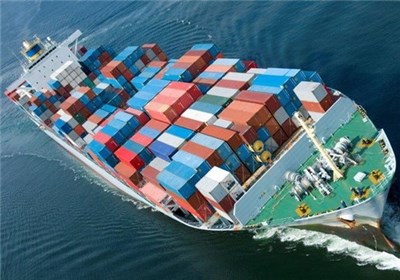
Ship

TEHRAN (Tasnim) – The value of Iran’s exports to the 28 members of the European Union (EU) in November 2014 has witnessed a 63 percent increase, compared to the same month in 2013, data released by the Eurostat showed.

The EU imports from the Islamic Republic in November 2014 reached 134 million euros, showing a 63 percent rise, compared to the same period last year, in which the figure stood at €82 million, according to the Eurostat.

Meanwhile, trade turnover between Iran and the EU member states during November 2014 also jumped by 18 percent hitting €693 million.

The figure in November 2013 had amounted to €585 million, the data indicated.

According to the report, the total value of EU exports to Iran in November 2014 amounted to €559 million, indicating an 11 percent increase compared with November 2013, in which the figure stood at €503 million.

Following the Iranian President Hassan Rouhani’s “constructive interaction” policy with the world since August 2013, a whole host of Western companies have been vying for Iran’s market, particularly after an interim nuclear deal between Tehran and six major world powers.


800,000-strong Shiite militia calls for formal recognition by Baghdad

January 18, 2015

800,000-strong Shiite militia calls for formal recognition by Baghdad, RUDAW, January 18, 2015

(RUDAW is a Kurdish media network. Hezbollah was conceived by Muslim clerics and funded by Iran following the Israeli invasion of Lebanon in 1982. From the inception of Hezbollah to the present, the elimination of the State of Israel has been one of Hezbollah’s primary goals. [Footnotes omitted.] — DM)

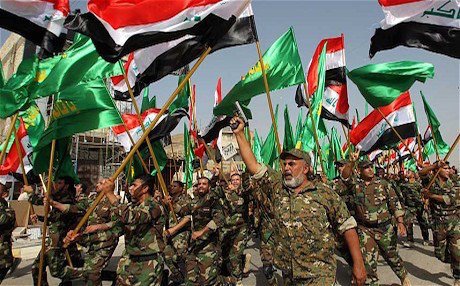
97644Image1Thousands of Shiite men responded to a call for jihad after ISIS stormed across Iraq in June and captured a third of the country. AFP photo.

BAGHDAD, Iraq – The leader of Iraq’s Hezbollah met with Shiite clerical authorities in Najaf Sunday to discuss formal recognition of hundreds of thousands of militiamen by the government and putting them on official payroll, a Hezbollah statement said.

Sheikh Abbas al-Mahmadawi, leader of the Shiite militia group Hezbollah, said that he met with Shiite clerics in Najaf, including Ayatollah Muhammad Saeed al-Hakim, to seek recognition “for the success of the militia groups in the fight against the Islamic State (ISIS).”

Al-Mahmadawi added that the Shiite volunteer militia should be recognized by the authorities and compensated financially “because many of them do not have any salaries and many have been wounded and handicapped.”

According to al-Mahmadawi, there are 800,000 volunteer Shiite fighters in Iraq who joined the fight against ISIS last June.

But he added that “the numbers have been inflated by some political parties” by more than double.

“We do not have any such numbers on the ground which is put down as 2 million volunteers,” he said in a statement following his visit to Najaf.

Al-Mahmadawi hoped that Baghdad would put the Shiite militia on its payroll now that the country is about to pass this year’s budget.

Thousands of Shiite men responded to a call for jihad against ISIS by Iraq’s Grand Ayatollah Ali Sistani last year, when the extremist Sunni group captured Mosul and made a lightening advance towards Baghdad and important Shiite shrines.

A great number of Shiite militiamen are based in the towns of Jalawla and Saadiya, north of Diyala, which they jointly liberated from ISIS in November.

Local residents, mainly the Kurdish population, have remained apprehensive about returning to their homes for fear of the armed militia groups, which operate outside government control and have been accused by Sunnis of acting as vigilantes.

On Saturday, Iraq’s parliament speaker Salim al-Jibouri met with Kurdish leaders in Sulaimani on forming a joint committee to facilitate the return of displaced peoples to Jalawla and Saadiya.

Meanwhile, around 200 tribal and political figures in Diyala met on Saturday to discuss normalizing the situation in the province after some of the fiercest battles between ISIS and a joint force of Peshmerga and Shiite militia groups.

Hezbollah Has 150,000 Missiles-Thousands Pointed at Israel

January 16, 2015

A “rare and substantial firepower apparently even exceeded the firepower possessed by most of the European states combined.”

By Jeff Dunetz

http://www.truthrevolt.org/news/hezbollah-has-150000-missiles-thousands-pointed-israel


Former Israeli National Security Adviser, Maj. Gen. (ret.) Yaakov Amidror, outlined the threats to the Jewish State from non-state entities in a report released by the Begin Center for Strategic Studies ​ (BESA). The most serious existential threat to the Jewish State by non-state entities is the terrorist group Hezbollah, with 150,000 missiles, which according to the General is a “rare and substantial firepower apparently even exceeded the firepower possessed by most of the European states combined.”

After having been accustomed to a situation in which large regular armies with armor, artillery, hundreds of aircraft and thousands of troops were arrayed on Israel’s borders, there can be no doubt that Israel has moved into a different world.

The current threat to Israel is different. It consists mainly of non-state entities motivated by Islamic ideology. The strongest of them is Hezbollah, which was formed with a dual purpose in mind: It represents Iran’s long reach in the area and against Israel, while at the same time it aims to control Lebanon, where the Shiites are the largest ethnic group.

Hezbollah’s capabilities most closely resemble those of an army. Its arsenal numbers some 150,000 missiles and rockets, several thousand of which have a range that cover the entire State of Israel. This rare and substantial firepower apparently even exceeded the firepower possessed by most of the European states combined.

Hezbollah also has long-range surface-to-sea missiles, anti-aircraft missiles, unmanned aerial vehicles, and modern anti-tank missiles. It is well organized into a military-style hierarchy and appears to possess command and control systems of high quality. It was established by Iranian leaders, but its leadership has always consisted of Lebanese people who were closely linked to Iran’s interests. Hezbollah assisted the Shiites by providing for their needs in the civilian sphere as a base for building its military power.

Hezbollah is currently busy assisting Syrian President Bashar Assad’s regime in Syria. It has sacrificed hundreds of its own people there and is acquiring substantial battle experience, but from its perspective, the battle is over its survival. It fights beside the Syrian Alawites because it needs them to stay in power. If Assad survives, Hezbollah’s status in Lebanon will increase, as will its status in Damascus.

Hezbollah may be the biggest threat, but not the only one. According to the general, Hamas still has 3,500 rockets and is rearming. Islamic Jihad has a “smaller rocket arsenal of lower quality, [but] it cannot be disregarded as insignificant.” There is also the threat of ISIS on the boarder of Lebanon and Syria.

The most significant threat to Israel’s very existence is the possibility that some time in 2015, Iran will reach a deal with the West that would allow it to pursue some form of nuclear military capability. This process will not come to fruition this year, but a bad deal with the superpowers would be an important milestone for Tehran.

This may be Israel’s main security challenge, and any deal between Iran and the West will make it difficult for Israel to deal with it. This means that together with providing ongoing security, the Israeli military must be prepared for both large-scale ground warfare in Lebanon, attrition in Gaza and an operation in Iran – a feat that will be neither easy nor cheap.